SHARE Knowledge Hub
Manual handling
Manual handling includes lifting, lowering, pushing, pulling, carrying and supporting a load by bodily force. Avoid hazardous handling where reasonably practicable, assess what remains and redesign the task before relying on technique alone.
Owner: SHARE Knowledge Hub editorial team.
Understanding Manual handling
Manual handling is a design and risk-control issue, not a test of whether workers remember a lifting pose.
Why this matters at work
For an acute injury, stop the activity, secure the load and equipment, provide first aid and emergency care as needed, and protect others from repeating the exposure. Avoid moving an injured person unless necessary for immediate safety and follow clinical advice.
Useful leading measures include completion of planned redesign, aid defect closure, worker trial results and checks on high-risk tasks. Lagging measures include injury reports and absence, but low reported numbers can reflect under-reporting rather than low exposure.
How organisations manage this in practice
Review an assessment when a load, packaging, task frequency, route, floor, staffing, worker capability, equipment or process changes, or when injury and symptom reports suggest controls are insufficient. A scheduled annual date is not a reason to defer a known hazard.
Record who approved the change, which workers were consulted, what was tested and how effectiveness was checked. A revision number in a document is less useful than a verified reduction in force, awkward posture or exposure time.
Keep evidence of avoidance options, actual task observations, worker input, selected control trials and verification. Name a control owner and review triggers. If safe staffing, equipment or route cannot be achieved, hold affected handling and escalate for a workable method; a manager signature cannot resolve unknown mass, instability, symptoms or a failed aid.
A handling aid reduces risk only while it is available, suitable and working. Worn wheels, seized bearings, defective brakes, damaged handles, leaking hydraulic systems or incompatible attachments can sharply increase effort or create loss of control.
Agency and temporary workers should have task-specific induction, appropriate equipment, supervision and a way to report a problem. A host should not assume an agency has assessed a changing local route, and an employer should not assume a host-provided trolley is always serviceable.
A task may be hazardous even when the individual load is light: high frequency, distant reach, twisting, poor grip, forceful starting, awkward space or insufficient recovery can dominate risk. Conversely, a heavy item may be made manageable by eliminating manual movement through a suitable engineered system.
Remove transfers before coaching the lift
Delivery at the point of use, suitable mechanisation and a better route can remove handling. The remaining work includes picking, carrying, pushing and placing, not only one lift.
Remove transfers before choosing the remaining controls
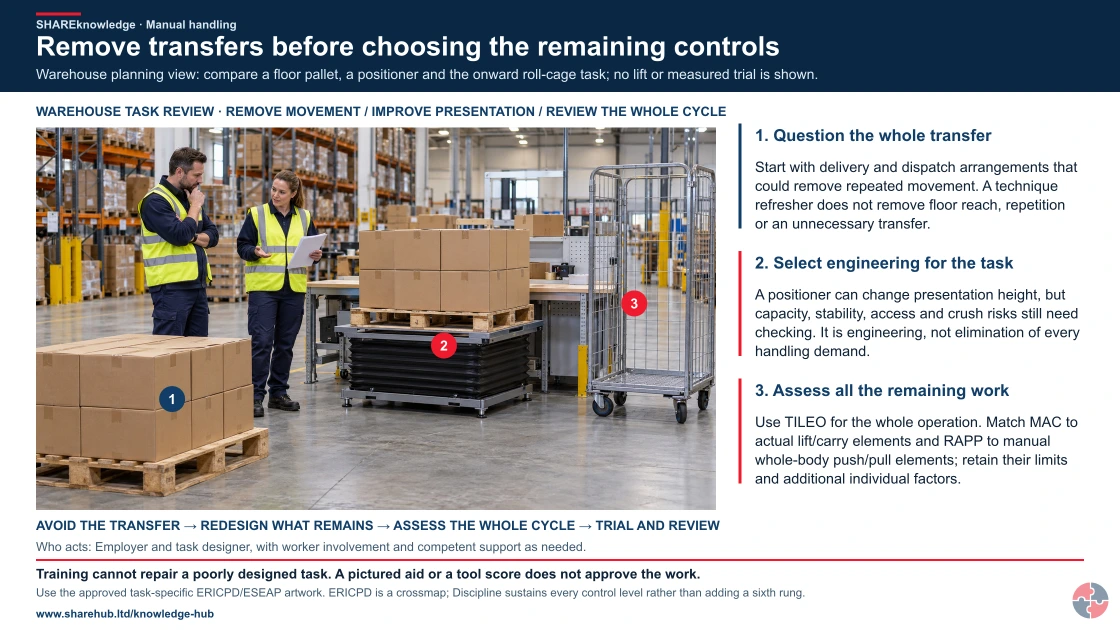
Full written explanation
A realistic warehouse planning scene places a floor-level loaded pallet, a raised pallet positioner beside a dispatch bench and an empty parked roll cage in one view. Two workers discuss the arrangement without lifting or operating the aid. Native numbered explanations connect avoidable transfers, the engineering effect and remaining whole-cycle assessment. The positioner changes load presentation but does not prove rated suitability, remove every transfer or establish an acceptable reach or force. TILEO considers Task, Individual, Load, Environment and Other factors across the whole operation. MAC supports the actual lifting/carrying/team-handling components within its scope; RAPP supports manual whole-body pushing/pulling within its separate scope. Extra individual, environmental and work-organisation factors still need judgement. The approved task-specific ERICPD and ESEAP artwork remains unchanged: ERICPD is a planning crossmap, ESEAP expresses the five-level control order, and Discipline sustains all controls rather than forming a sixth effectiveness level. No scores, average colour, legal safe weight, measured exposure or personal permission is assigned.
Warehouse planning view: compare a floor pallet, a positioner and the onward roll-cage task; no lift or measured trial is shown.
- Question the whole transfer. Start with delivery and dispatch arrangements that could remove repeated movement. A technique refresher does not remove floor reach, repetition or an unnecessary transfer.
- Select engineering for the task. A positioner can change presentation height, but capacity, stability, access and crush risks still need checking. It is engineering, not elimination of every handling demand.
- Assess all the remaining work. Use TILEO for the whole operation. Match MAC to actual lift/carry elements and RAPP to manual whole-body push/pull elements; retain their limits and additional individual factors.
Change the pathway
- Avoid the transfer. Deliver at the point of use or remove unnecessary handling.
- Redesign the remaining task. Use suitable aids, storage, route and handholds for the actual work.
- Verify in real use. Check frequency, people, maintenance and changed conditions with workers.
Evidence check: Technique training cannot compensate for a poorly designed task or route.
Use the approved manual-handling ERICPD/ESEAP artwork and complete task-specific control tables
Primary references: HSE manual handling: avoid, assess and reduce · HSE MAC scope and whole-task observation · HSE RAPP: scope, exclusions and separate operations · HSE five-level hierarchy of controls · HSENI manual handling and TILEO · SHAREtools TILEO and separate MAC/RAPP assessments and exports
Open the complete HD image (new tab)Download image

Use the approved manual-handling ERICPD/ESEAP artwork and complete task-specific control tables
Primary references: HSE manual handling: avoid, assess and reduce · HSE MAC scope and whole-task observation · HSE RAPP: scope, exclusions and separate operations · HSE five-level hierarchy of controls · HSENI manual handling and TILEO · SHAREtools TILEO and separate MAC/RAPP assessments and exports

Avoid and redesign
Consider supply position, sequence and suitable mechanical assistance before relying on technique.
Assess the cycle
Review load, person, task, environment, frequency and recovery, including pushing, pulling and placement.
Trial and maintain
Check usability with workers, maintain routes/aids and review symptoms, defects and changed conditions.
There is no universal safe load weight or lifting technique that removes the need for assessment.
What is manual handling?
Manual handling is transporting or supporting a load by hand or bodily force, including lifting, lowering, pushing, pulling, carrying and moving.
Best-practice guide: Manual handling
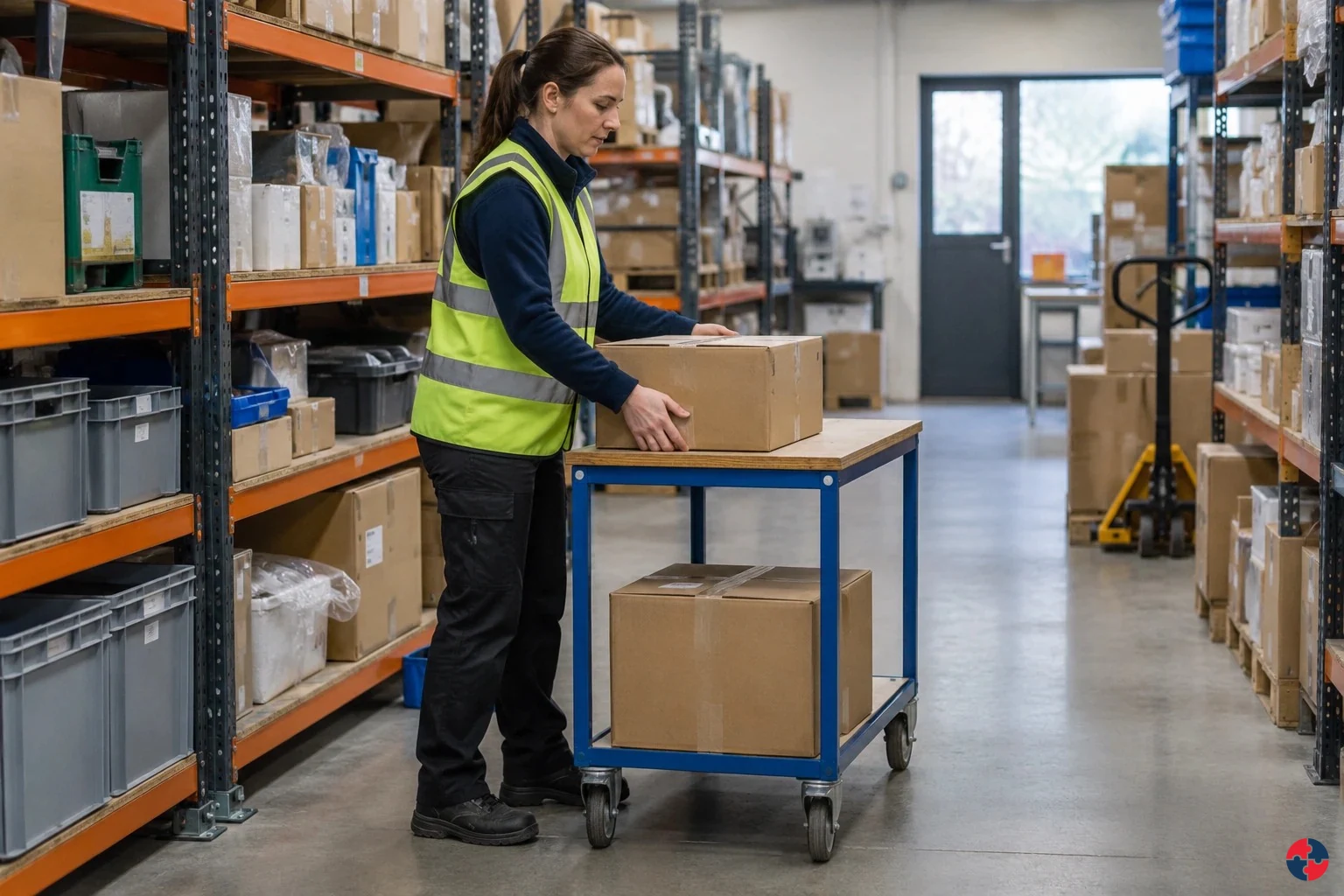
Redesign the handling before teaching the lift
Manual handling includes lifting, lowering, pushing, pulling, carrying and supporting a load by bodily force. Assess the task, load, person, environment and work organisation. A training refresher does not repair a threshold or make a damaged cage easy to push.
Turn manual handling knowledge into a decision
Manual handling includes lifting, lowering, pushing, pulling, carrying and supporting a load by bodily force. Avoid hazardous handling where reasonably practicable, assess what remains and redesign the task before relying on technique alone. Store heavy items at better height or use lift table.
Change a floor-level warehouse picking task
The team observes the task rather than attributing repeated discomfort to poor technique. It assesses load size, frequency, reach, route and pushing forces, then trials suitable handling aids and work changes. Review the whole flow so the redesign does not transfer difficult handling to replenishment workers.
Follow the load, force and body position
Handling risk depends on the complete task, including force, posture, frequency, duration and individual capability. A low weight alone does not establish safety. Act on discomfort reports and reassess tasks that have changed.
Choose controls for manual handling
Eliminate: Procurement and operations consider delivery and dispatch arrangements that remove the repeated manual transfer, such as an appropriately designed direct transfer system. Reduce: Compare manageable packages and alternative supply formats where they fit the task; assess increased frequency, awkward grips and packaging stability. Isolate: Select suitable pallet positioners, lift tables or handling aids, with safe access and protection from crushing or unexpected movement. Control: Supervisors plan replenishment, routes, workload, task variation and individual needs; provide load information and training in the assessed method. PPE: Select grip, foot or other protection for residual load and workplace hazards where appropriate. Read the full control table for qualifications, ownership and verification. Use the actual task and applicable jurisdiction; existing technical approval remains unchanged.
Use the full manual handling lesson
Use the full topic for the decision points, practical examples, detailed control tables and source scope. HSE guidance applies to Great Britain; use HSENI for the Northern Ireland route and the source’s stated jurisdiction. A simplified guide does not change the page’s technical-review or approval status.

Read all six steps as text
1. Redesign the handling before teaching the lift
Avoid hazardous handling where practicable; assess and reduce what remains.
- Avoid: Change delivery or material flow to remove repeated manual transfers.
- Redesign: Improve storage heights, routes, handling aids and the pace of work.
- Verify: Observe the whole task, including replenishment and breakdown recovery.
Manual handling includes lifting, lowering, pushing, pulling, carrying and supporting a load by bodily force. Assess the task, load, person, environment and work organisation. A training refresher does not repair a threshold or make a damaged cage easy to push.
Apply it: Which part of the picking route creates the greatest force, reach or repetition, and can it be removed?
2. Turn manual handling knowledge into a decision
Use the evidence to improve the actual work arrangement.
- Change at source: Procurement and operations consider delivery and dispatch arrangements that remove the repeated manual transfer, such as an appropriately designed direct transfer system.
- Make it observable: Observe the complete flow, including replenishment and breakdown recovery.
- Keep useful evidence: Store heavy items at better height or use lift table.
Manual handling includes lifting, lowering, pushing, pulling, carrying and supporting a load by bodily force. Avoid hazardous handling where reasonably practicable, assess what remains and redesign the task before relying on technique alone. Store heavy items at better height or use lift table.
Apply it: What evidence would show that the change improves this task, rather than only completing a record?
3. Change a floor-level warehouse picking task
Example: a warehouse redesigns repeated picking and cage movement.
- Find: Heavy boxes are picked from the floor and twisted into a cage.
- Change: Raise the pick position, reorient the cage and repair the threshold.
- Verify: Maintain cage wheels and observe handling during a realistic peak.
The team observes the task rather than attributing repeated discomfort to poor technique. It assesses load size, frequency, reach, route and pushing forces, then trials suitable handling aids and work changes. Review the whole flow so the redesign does not transfer difficult handling to replenishment workers.
Apply it: Can the team complete the redesigned pick and replenishment tasks without the former awkward transfer?
4. Follow the load, force and body position
Connect the task, the route to the person and the control that can fail.
- Force: A heavy or awkward load and poor wheels increase the effort needed.
- Posture: Floor-level picks, twisting and long reaches load the back and shoulders.
- Repetition: Frequent handling and inadequate recovery can accumulate strain.
Handling risk depends on the complete task, including force, posture, frequency, duration and individual capability. A low weight alone does not establish safety. Act on discomfort reports and reassess tasks that have changed.
Apply it: What changes when the load, route, frequency or worker’s needs differ from the assessment?
5. Choose controls for manual handling
Start with the stronger practicable options and verify their effect.
- Eliminate: Procurement and operations consider delivery and dispatch arrangements that remove the repeated manual transfer, such as an appropriately designed direct transfer system.
- Reduce: Compare manageable packages and alternative supply formats where they fit the task; assess increased frequency, awkward grips and packaging stability.
- Isolate: Select suitable pallet positioners, lift tables or handling aids, with safe access and protection from crushing or unexpected movement.
- Control: Supervisors plan replenishment, routes, workload, task variation and individual needs; provide load information and training in the assessed method.
- PPE: Select grip, foot or other protection for residual load and workplace hazards where appropriate.
Eliminate: Procurement and operations consider delivery and dispatch arrangements that remove the repeated manual transfer, such as an appropriately designed direct transfer system. Reduce: Compare manageable packages and alternative supply formats where they fit the task; assess increased frequency, awkward grips and packaging stability. Isolate: Select suitable pallet positioners, lift tables or handling aids, with safe access and protection from crushing or unexpected movement. Control: Supervisors plan replenishment, routes, workload, task variation and individual needs; provide load information and training in the assessed method. PPE: Select grip, foot or other protection for residual load and workplace hazards where appropriate. Read the full control table for qualifications, ownership and verification. Use the actual task and applicable jurisdiction; existing technical approval remains unchanged.
Apply it: Which stronger option can be used here, and who will verify it before accepting the remaining risk?
6. Use the full manual handling lesson
Follow the official sources below and retain the task-specific evidence.
- Official guidance: HSE manual handling at work
- Official guidance: HSENI manual handling
- Task decision: Store heavy items at better height or use lift table.
Use the full topic for the decision points, practical examples, detailed control tables and source scope. HSE guidance applies to Great Britain; use HSENI for the Northern Ireland route and the source’s stated jurisdiction. A simplified guide does not change the page’s technical-review or approval status.
Apply it: Which official source and full-topic section will you use to resolve the next decision?
A load can be an object, person or animal. Manual handling becomes hazardous when the task, load, person, environment or work organisation creates a risk of injury. The law does not set a single safe weight limit because risk depends on reach, height, frequency, posture, grip, distance, pace, recovery, floor condition, team handling and individual capability. Sources: HSE manual handling at work; HSENI manual handling
The legal hierarchy is simple and powerful: avoid hazardous manual handling so far as reasonably practicable; assess any hazardous handling that cannot be avoided; reduce the risk of injury so far as reasonably practicable. This means redesigning the work before relying on training. Sources: HSE manual handling at work; HSENI manual handling
Manual handling should be treated as work design. Repeated low weights, awkward reaches, poor storage, damaged wheels, rushed deliveries, unstable loads, heat, fatigue and lack of recovery can create as much risk as a single heavy lift. Sources: HSE manual handling at work; HSENI manual handling
| Factor | What to assess | Examples |
|---|---|---|
| Task | Posture, reach, twisting, lifting height, carrying distance, repetition and pace. | Floor-level picking, shoulder-height stacking, repetitive loading.Sources: HSE manual handling at work; HSENI manual handling |
| Individual | Capability, training, fatigue, pregnancy, injury, disability or temporary restriction. | New starter, returning worker, pregnant worker or worker with back pain.Sources: HSE manual handling at work; HSENI manual handling |
| Load | Weight, size, shape, stability, grip, centre of gravity and contents. | Unstable sacks, awkward panels, unmarked heavy boxes.Sources: HSE manual handling at work; HSENI manual handling |
| Environment | Space, flooring, steps, slopes, lighting, temperature and obstructions. | Damaged threshold, congested route, cold store.Sources: HSE manual handling at work; HSENI manual handling |
| Other factors | PPE, time pressure, team handling, mechanical aids and communication. | Bulky gloves, noisy loading bay, poor trolley maintenance.Sources: HSE manual handling at work; HSENI manual handling |
| Recovery | Whether the body can recover between efforts. | Peak-season overtime and continuous handling.Sources: HSE manual handling at work; HSENI manual handling |
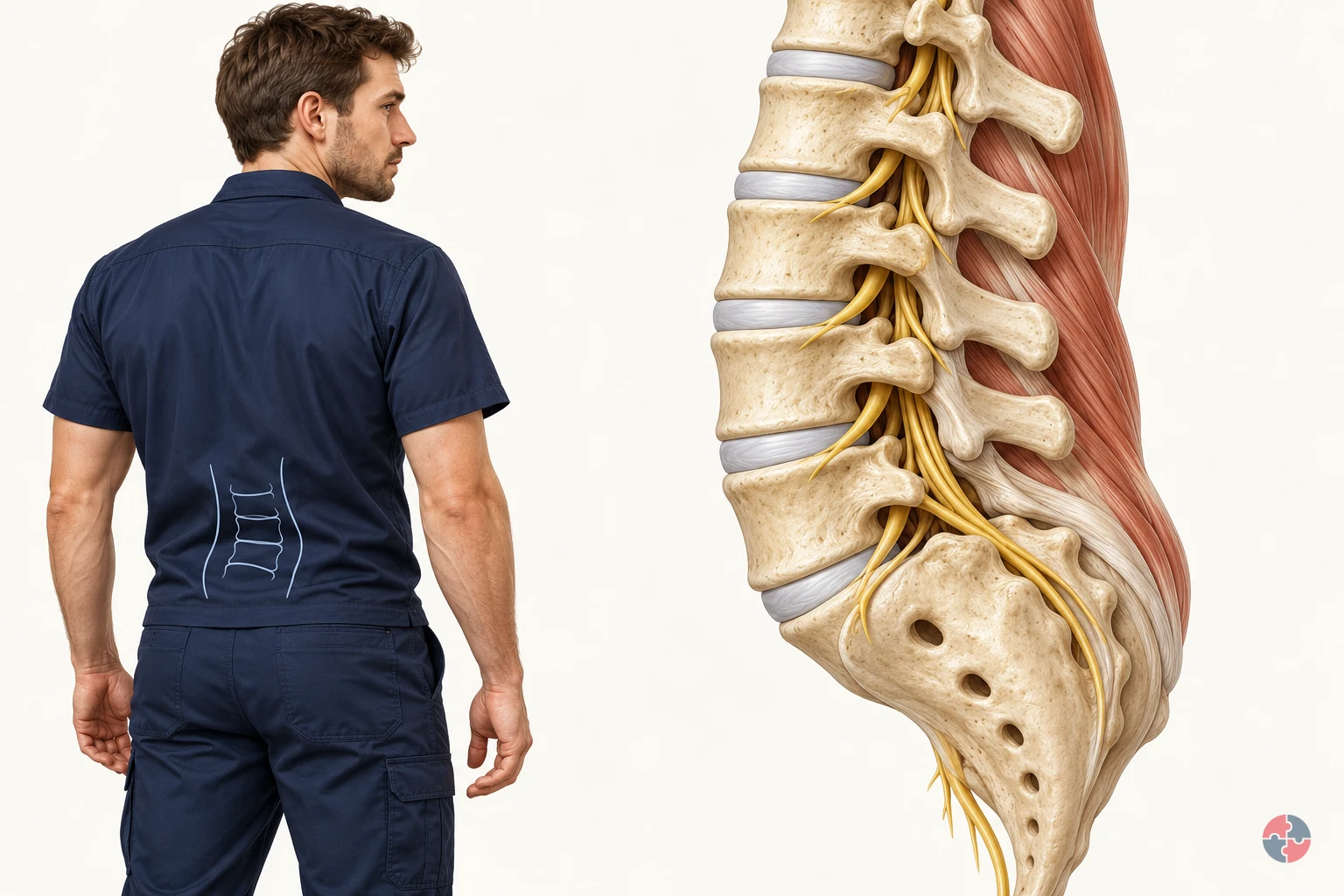

How does the back support movement, and how can work design reduce manual handling risk?
Interactive anatomy · Back and manual handling · Updated 2026-10-23
Read all anatomy and process explanations without the viewer
Simplified education, not a scan interpretation, diagnosis, safe-weight calculator, posture score or personalised exercise prescription. No webcam, posture capture or personal symptom input. Task demand comparisons never alter disc morphology or calculate spinal compression, tissue tolerance or injury probability.
Vertebral body
A vertebra is one of the bones of the spine. The vertebral body is the substantial front portion of a spinal bone. Neighbouring bodies are linked through discs, while other bony parts help enclose the nerve space behind them. Follow the bone-and-disc pattern to see how a spinal segment combines support with movement rather than behaving as a pile of separate blocks. University Hospitals Birmingham NHS Foundation Trust: Lumbar decompressive surgery: structure of the spine · DynamicHealth · NHS: Lower back pain
Intervertebral disc
A disc lies between neighbouring vertebral bodies. A disc is flexible tissue joining neighbouring vertebral bodies. A tougher outer region surrounds a softer centre, and the connected structure helps accommodate loading and movement. In the healthy model it stays part of the segment. The closer cutaway explains its regions; it is not a pressure gauge or a prediction of what a lift will do. University Hospitals Birmingham NHS Foundation Trust: Lumbar decompressive surgery: structure of the spine · DynamicHealth · NHS: Lower back pain
Outer disc region
The tougher outer region surrounds the softer centre. This labelled cross-section simplifies the disc’s tissue organisation. A ring outline is a teaching aid, not a measure of tissue strength. University Hospitals Birmingham NHS Foundation Trust: Lumbar decompressive surgery: structure of the spine
Inner disc region
The softer centre works with the outer disc tissue. Both regions contribute during loading. The diagram does not behave as a water balloon or show a pressure gauge. University Hospitals Birmingham NHS Foundation Trust: Lumbar decompressive surgery: structure of the spine
Facet joint
Small paired joints link neighbouring vertebrae. They contribute to stability and help guide movement at the back of the spine. Partner surfaces remain together during the normal movement example. The Dudley Group NHS Foundation Trust: Facet joint injections and medial branch block
Ligament
A ligament connects bones. Spinal ligaments help guide and restrain movement. They are a different tissue connection from a tendon. NHS: Sprains and strains · University Hospitals Birmingham NHS Foundation Trust: Lumbar decompressive surgery: structure of the spine
Supporting muscle
Back and trunk muscles help produce and control movement. Muscle fibres generate force and change length as they produce or control movement. Their pull is transmitted through tendon attachments to bone. Back, trunk and hip muscles contribute together during everyday bending and reaching. The highlighted muscle simplifies one part of that system, allowing you to follow a connection rather than calculate the effort of every muscle. DynamicHealth · NHS: Lower back pain · NHS: Tendonitis · York and Scarborough Teaching Hospitals NHS Foundation Trust: Treating a soft tissue injury: normal soft-tissue roles
Tendon attachment
A tendon transmits a muscle’s pull to bone. A tendon provides the connection through which muscle pull reaches bone. Trace it from the muscle into the attachment, then compare it with a ligament, which connects bones. The two connections contribute different functions. Keeping the attachment visible helps explain how a muscle can move or steady a joint without the tendon becoming a separate loose cord. NHS: Tendonitis · DynamicHealth · NHS: Lower back pain
Nerve root
Nerve roots leave the canal through side openings. A nerve root passes out beside the spinal bones towards the areas it supplies. Pressure or nearby inflammation can irritate it, sometimes producing symptoms in the buttock, leg or foot. The highlighted pathway explains this possible relationship, but symptoms vary. A coloured region cannot identify the cause of somebody’s pain or establish that a particular disc is responsible. University Hospitals Birmingham NHS Foundation Trust: Lumbar decompressive surgery: structure of the spine · NHS: Slipped disc · NHS: Sciatica · Norfolk & Waveney Community Musculoskeletal Services · NHS: Sciatica: understanding nerve irritation and protective muscle activity · Bradford Teaching Hospitals NHS Foundation Trust: Pain management: nerve root pain
Lower spinal canal
The lower lumbar canal contains a bundle of nerve roots. Below the end of the spinal cord these roots continue as the cauda equina. A solid spinal cord should not extend through this lower-lumbar illustration. University Hospitals Birmingham NHS Foundation Trust: Lumbar decompressive surgery: structure of the spine
Open the complete process transcript
The process, step by step
1 · Share support
Each vertebra works with the discs and other tissues around it to support the trunk while allowing movement. The disc between two vertebral bodies is flexible tissue, with a tougher outer region surrounding a softer centre. It helps the connected segment accommodate loading; it is not a loose pad that normally slides out when someone bends. Follow the repeating bone-and-disc arrangement, then look behind it towards the joints and nerve space. This relationship explains how support, movement and protection can coexist in the same part of the back. University Hospitals Birmingham NHS Foundation Trust: Lumbar decompressive surgery: structure of the spine · DynamicHealth · NHS: Lower back pain
What to watch: Follow two neighbouring vertebral bodies, the disc between them and the protected nerve space behind the bones in the lumbar view.
Why it matters: Support is shared across connected tissues rather than supplied by a single bone or disc. This arrangement allows the back to bear everyday demands while retaining the flexibility needed to change position.
Explore this step: Pause the model and locate the disc between two bones before selecting the next step.
2 · Allow movement
Movement of the back is spread across connected spinal segments and the rest of the body. The paired facet joints at the back of neighbouring vertebrae help guide movement, while ligaments connect bones and contribute to stability. In this step, the small illustrative movement helps you locate these relationships; it does not show a strain or a ligament being torn. Ordinary bending is part of normal function. Notice how a joint and a ligament perform different jobs, and avoid interpreting one demonstrated position as a universal safe or unsafe posture. University Hospitals Birmingham NHS Foundation Trust: Lumbar decompressive surgery: structure of the spine · The Dudley Group NHS Foundation Trust: Facet joint injections and medial branch block · Cambridge University Hospitals NHS Foundation Trust: Myth busting about posture, core stability and lifting
What to watch: Look behind the vertebral bodies for the paired facet joints, then follow the ligament between its bony attachment points.
Why it matters: Joints permit and guide movement; ligaments contribute restraint and stability. Together with the other spinal tissues, they allow controlled movement without making the back a rigid column or ordinary bending an injury.
Explore this step: Compare the joint and ligament labels and describe the different connection each one makes.
3 · Produce and control force
Muscle fibres produce force and can shorten or lengthen as they move or control the body. Their pull reaches bone through tendon attachments. Follow that continuous connection from the larger muscle region into the narrower tendon and its attachment, rather than treating muscle, tendon and bone as separate objects. Back, trunk and hip muscles contribute together during bending, turning and reaching. The model simplifies one part of this system so that the connection is easier to follow. Its movement is an explanation of function, not a measurement of an individual muscle’s effort or strength. DynamicHealth · NHS: Lower back pain · NHS: Tendonitis · York and Scarborough Teaching Hospitals NHS Foundation Trust: Treating a soft tissue injury: normal soft-tissue roles
What to watch: Follow the supporting muscle into its tendon and then to the bone, using the close view to keep the attachment visible.
Why it matters: This continuous attachment allows a muscle’s pull to move or steady the skeleton. Controlling a movement can involve muscle work as well as starting it; the visible motion does not account for every contributing muscle.
Explore this step: Trace the connection in both directions, then explain how a tendon differs from a ligament.
4 · Review the task
Normal back function takes place within a whole task, not an isolated spinal joint. Use the task view to compare a nearer reach with a more distant one. The load, how often it is handled, the working height, available space and the person’s capability all matter when assessing unavoidable handling. Repeated work is a separate factor from the reach shown in one still position. This comparison directs attention to work design; it does not calculate spinal force, identify a tissue injury or establish a safe load for everyone. HSE: Back pain at work · HSE: Assess manual handling you cannot avoid
What to watch: Compare the position of the person and the load in the closer and farther reach, including the surrounding working space.
Why it matters: The same body may face different demands when the task layout changes. Looking at reach alongside load, frequency, space and capability helps explain why an anatomy view alone cannot establish whether handling is suitable.
Explore this step: Compare both arrangements and name one task factor the model cannot measure for your workplace.
5 · Compare an example
Use the healthy segment as a reference before exploring an independent tissue example. A muscle strain concerns muscle tissue, a sprain concerns a ligament, and a disc example concerns a different structure again. These are separate explanations, not consecutive stages that every back passes through during a lift. Back pain can have several contributors, and the location or intensity of pain does not identify a damaged tissue by itself. Keep the normal view available so you can compare the selected structure without assuming that a pictured mechanism diagnoses a person or predicts what a task will do. NHS: Sprains and strains · NHS: Slipped disc · NHS: Back pain
What to watch: Locate the muscle, ligament, disc and nearby nerve root in the healthy reference before opening any separate tissue example.
Why it matters: Separating the tissues prevents a misleading story in which normal movement automatically becomes a specific injury. A model can explain a possible mechanism while leaving an individual’s symptoms and cause to proper assessment.
Explore this step: Choose one tissue example, identify the structure involved, and return to the healthy reference for comparison.
Mechanisms and their limits
Muscle strain example A pulled muscle, or strain, involves overstretched or torn muscle fibres. Watch the local fibre disruption: it can cause pain and tenderness. The muscle may also tighten involuntarily in a painful spasm. Back pain may also be felt in the buttock or thigh. Pain location alone does not identify the injured tissue or establish nerve involvement. The local fibre change is illustrative; the task does not predict injury severity or recovery time. The disc-and-nerve example is a separate mechanism. NHS: Sprains and strains · NHS: Back pain · Bexley Musculoskeletal Service · NHS: Acute low back pain
Avoid, assess and reduce handling risks
Redesign work and respond to early problems
Ligament sprain example A sprain involves an overstretched, twisted or torn ligament. Follow the band between the bones: disruption here can cause local pain and make movement uncomfortable. A ligament guides and restrains movement; it does not contract like muscle. This independent example is not a later stage of a strain. The simplified band and overlay do not identify the ligament involved in a person’s symptoms. NHS: Sprains and strains · University Hospitals Birmingham NHS Foundation Trust: Lumbar decompressive surgery: structure of the spine · York and Scarborough Teaching Hospitals NHS Foundation Trust: Treating a soft tissue injury: normal soft-tissue roles
Avoid, assess and reduce handling risks
Redesign work and respond to early problems
Disc protrusion and nerve irritation A local disc protrusion approaches a lumbar nerve root. Irritation here can produce radiating pain or tingling in the buttock and leg because the nerve supplies those regions. Nearby muscles may tighten protectively. Some disc protrusions cause no symptoms. This animation illustrates one possible symptomatic mechanism. It does not predict inevitable progression, measured forces or real-time injury. A nerve can be irritated by local inflammation as well as pressure. Visible contact is one example, rather than the only explanation for symptoms. The leg highlight marks a possible symptom region; it is not tissue damage spreading down the leg, a diagnostic dermatome map or proof of a person’s pain source. Reach, repetition and load-position controls remain separate and do not alter disc morphology or generate a diagnosis. NHS: Slipped disc · NHS: Back pain · NHS: Sciatica · Norfolk & Waveney Community Musculoskeletal Services · NHS: Sciatica: understanding nerve irritation and protective muscle activity · Bradford Teaching Hospitals NHS Foundation Trust: Pain management: nerve root pain
Read NHS advice about disc changes
Understand sciatica and leg symptoms
Recognise when back pain needs assessment
Muscle strain example — follow the anatomy
Look at: The muscle fibres beside the lumbar spine.
What changes: Excessive demand can overstretch or injure some muscle fibres and trigger protective spasm.
Why it matters: Pain and stiffness can limit movement; ordinary movement does not automatically tear muscle.
What to do: Improve the handling task and seek appropriate advice for persistent or severe symptoms.
Reaching for a crate on a deep shelf
Warehouse picking: a worker reaches past the shelf edge for a crate stored low and far away. The 32-second sequence illustrates a task and one possible acute strain; it does not calculate injury from reach or repetition. Reaching or bending does not inevitably injure a back. The highlighted muscle is an example, not a diagnosis.
A demanding pick The crate is awkward to reach and the route leaves little room to reposition. First consider whether this handling can be avoided or redesigned. HSE: Assess manual handling you cannot avoid · HSE: Back pain at work
Follow the muscle’s spinal attachments Locate the supporting muscle beside the lumbar spine and follow its tendon attachments to bone. These connections transmit pull as muscles control movement. The separate close-up next shows one possible local strain. DynamicHealth · NHS: Lower back pain · NHS: Tendonitis · York and Scarborough Teaching Hospitals NHS Foundation Trust: Treating a soft tissue injury: normal soft-tissue roles · NHS: Sprains and strains
A local muscle pull and painful tightening The enlarged example shows fibres overstretching with a small disrupted area. This illustrates a muscle pull: local pain and tenderness may accompany involuntary tightening, called spasm. The coloured cue marks possible symptoms, not a measured injury from the pick. NHS: Sprains and strains · NHS: Back pain
Change the task and respond to symptoms Bring stock within easier reach, review handling aids and remove access constraints. Encourage early reporting and appropriate clinical advice; use the separate urgent-help panel for warning signs. HSE: Back pain at work · HSE: Assess manual handling you cannot avoid · NHS: Back pain
Ligament sprain example — follow the anatomy
Look at: The ligaments connecting one vertebra to the next.
What changes: A sprain affects the supporting ligament, rather than the muscle fibres.
Why it matters: Injured tissue can be painful and make movement feel restricted.
What to do: Reduce awkward loading and improve the task, equipment and working space.
An unexpected twist while moving stock
A stockroom worker turns with an awkward load where the floor and access route restrict foot movement. Playback is a teaching reconstruction of one possible event; no force, likelihood or recovery duration is calculated. A sprain affects a ligament. This is independent of the muscle-strain example and does not mean every twist tears tissue.
Restricted handling space A load blocks the view and the worker has little room to turn. Check the route, floor, load and available assistance before handling. HSE: Assess manual handling you cannot avoid
Locate the ligament between vertebrae Find the ligament connection and neighbouring joint in the lumbar segment. Ligaments help guide and restrain movement between bones while supporting muscles control the turn. The close-up next isolates one possible local sprain. NHS: Sprains and strains · University Hospitals Birmingham NHS Foundation Trust: Lumbar decompressive surgery: structure of the spine · York and Scarborough Teaching Hospitals NHS Foundation Trust: Treating a soft tissue injury: normal soft-tissue roles
A stretched ligament with local disruption The enlarged band stretches between its bone attachments, with a small area of disrupted fibres in this sprain example. Local pain and tenderness may make movement difficult. The neighbouring muscle and disc remain separate tissues. NHS: Sprains and strains · University Hospitals Birmingham NHS Foundation Trust: Lumbar decompressive surgery: structure of the spine
Prevent a repeat and obtain advice Clear access, avoid unnecessary handling and review the method with the worker. New or worsening symptoms need appropriate advice; emergency warning signs stay available outside playback. HSE: Back pain at work · HSE: Assess manual handling you cannot avoid · NHS: Back pain
Disc protrusion and nerve irritation — follow the anatomy
Look at: The disc beside the spinal nerve root.
What changes: Disc material can bulge towards a nerve root and irritate or compress it.
Why it matters: Pain, tingling or weakness may be felt down the leg; the disc injury itself does not travel down the leg.
What to do: Review loading and seek clinical advice; use the emergency guidance for new bladder, bowel or saddle-area symptoms.
Disc protrusion, nerve irritation and possible radiating symptoms
An enlarged lower-back cutaway follows one possible symptomatic disc-and-nerve example, with a separate body inset for symptom location and muscle guarding. The 32-second playback slows and enlarges a selected teaching mechanism. It does not measure when a disc change arose, nerve-signal speed, symptom severity or healing time. The handling-task clip remains a separate example. Disc changes may have no symptoms. The regional highlight represents possible pain or tingling, not damage travelling down a leg. Guarding or spasm is a possible response, not an inevitable stage.
Connected disc and nerve root Identify the disc between neighbouring vertebrae and the nerve root beside it. This reference view sets the orientation for the animated example; it is not a scan of a person. NHS: Slipped disc · University Hospitals Birmingham NHS Foundation Trust: Lumbar decompressive surgery: structure of the spine
Disc tissue protrudes towards the nerve The local disc contour extends outwards and approaches the adjacent nerve root. In this selected example it makes contact. The disc remains attached between the vertebrae; it does not slip out as a loose object. NHS: Slipped disc · Norfolk & Waveney Community Musculoskeletal Services · NHS: Sciatica: understanding nerve irritation and protective muscle activity · Bradford Teaching Hospitals NHS Foundation Trust: Pain management: nerve root pain
Why symptoms can be felt down the leg Pressure or local inflammation can irritate the nerve root. The inset follows regions it supplies, where pain or tingling may be felt in the buttock, leg or foot. Nearby muscle tightening illustrates guarding; painful involuntary tightening is spasm. The leg highlight shows a possible symptom region, not a tear travelling down the leg. NHS: Sciatica · Norfolk & Waveney Community Musculoskeletal Services · NHS: Sciatica: understanding nerve irritation and protective muscle activity · Bradford Teaching Hospitals NHS Foundation Trust: Pain management: nerve root pain · NHS: Back pain
Respond to symptoms and review the work Report symptoms and review avoidable handling demands. Seek appropriate advice for persistent, worsening or activity-limiting symptoms. Use the separate urgent-help panel immediately for emergency warning signs. The animation keeps the example visible; response controls do not instantly reverse a disc change. HSE: Back pain at work · NHS: Back pain · NHS: Sciatica
Worked handling examples
Bending to lower a load
A worker lowers a held box towards a low receiving surface. The low destination and repeated handling make the arrangement worth reviewing.
Check the receiving height, reach, grip, load and number of moves, including whether a handling aid can remove the repeated low placement.
Inspect the low destination The box starts in the worker’s hands, with a low receiving point ahead. Notice the standing space, the handhold and the distance to the destination. HSE: Assess manual handling you cannot avoid
Bend and lower the box The worker bends forwards and lowers the box. Watch the trunk and hips move together while supporting muscles control the descent. Muscle fibres change length and transmit pull through their tendon attachments. HSE: Back pain at work · NHS: Tendonitis · Cambridge University Hospitals NHS Foundation Trust: Myth busting about posture, core stability and lifting · York and Scarborough Teaching Hospitals NHS Foundation Trust: Treating a soft tissue injury: normal soft-tissue roles
Inspect the supporting muscles Follow the fibres into their tendon attachments. In the separate strain example, a small area overstretches or tears and may become painful; involuntary muscle tightening can add spasm. Ordinary bending does not establish that this has happened. NHS: Sprains and strains · NHS: Tendonitis · Cambridge University Hospitals NHS Foundation Trust: Myth busting about posture, core stability and lifting · York and Scarborough Teaching Hospitals NHS Foundation Trust: Treating a soft tissue injury: normal soft-tissue roles
Raise the receiving point and reduce handling Compare a receiving point closer to a practical working height. Before relying on a handling instruction, consider a suitable lift table, a different delivery arrangement or removing the handling step. HSE: Manual handling at work · HSE: Manual handling: reduce the risk of injury
Compare raised placement Provide a suitable raised receiving surface within easy access, and check whether a handling aid or process change can remove the repeated low placement. Confirm that the revised arrangement works with the team. HSE: Manual handling at work · HSE: Assess manual handling you cannot avoid · HSE: Manual handling: reduce the risk of injury
Ordinary bending is part of normal movement. This composite task does not identify a pain source, assign a safe posture or predict injury.
Turning while holding a load
A worker transfers a box to a surface at the side. The original layout invites a turn through the trunk while the feet remain facing the first surface.
Review transfer direction, foot space, the load and the pace of work so people have room to reposition while controlling the box.
Spot the sideways destination The destination is offset from the starting position. Before moving, check that the turning route is clear and the load will not hide obstacles. HSE: Assess manual handling you cannot avoid · HSE: Manual handling: good handling technique
Watch the loaded turn Compare the feet, pelvis and shoulders as the worker turns with the box. Supporting muscles change their pull to control the turn, while ligaments guide and restrain movement between neighbouring bones. HSE: Back pain at work · University Hospitals Birmingham NHS Foundation Trust: Lumbar decompressive surgery: structure of the spine · HSE: Manual handling: good handling technique · York and Scarborough Teaching Hospitals NHS Foundation Trust: Treating a soft tissue injury: normal soft-tissue roles
Inspect the ligament connection Follow the ligament between its two bone attachments. The separate sprain example shows local fibre disruption that can cause pain and tenderness. A sprain affects this supporting band; it is distinct from a muscle pull or disc change. NHS: Sprains and strains · University Hospitals Birmingham NHS Foundation Trust: Lumbar decompressive surgery: structure of the spine
Make room to turn with the load Compare a clearer transfer arrangement that lets the worker reposition the feet towards the destination. Review the layout first; a turning instruction cannot create missing floor space. HSE: Manual handling: good handling technique · HSE: Manual handling: reduce the risk of injury
Compare repositioned turn Clear the turning area and bring the receiving position into a better alignment. Where a turn remains, provide space to move the feet with the load; consider a suitable transfer aid for repeated moves. HSE: Manual handling: good handling technique · HSE: Manual handling: reduce the risk of injury
This is a selected work example and a separate possible sprain illustration. The model cannot decide whether a particular turn is harmful or diagnose symptoms.
Reaching to place a load
A worker places a box towards the back of a shelf. The shelf depth keeps the load away from the body during the final part of the placement.
Check shelf depth, placement height, access from the other side, grip and repetition instead of assessing the box by weight alone.
Identify the placement point The destination is set behind the accessible shelf edge. Notice the space in front of the shelf and the reach needed while the box is still supported by the hands. HSE: Assess manual handling you cannot avoid
Watch the load move away The box moves farther from the body as the worker reaches. Watch the trunk and arms extend while the supporting muscles control the load. The longer reach changes the task demand; the model does not calculate tissue force. HSE: Back pain at work · HSE: Assess manual handling you cannot avoid · HSE: Manual handling: good handling technique
Inspect muscle fibres and the spine Inspect the muscle fibres as they change length and pull through their attachments. The separate strain example shows local fibre disruption and possible painful spasm. For pain or tingling extending along a nerve-supplied leg region, choose the disc-and-nerve example. NHS: Sprains and strains · NHS: Tendonitis · NHS: Sciatica · York and Scarborough Teaching Hospitals NHS Foundation Trust: Treating a soft tissue injury: normal soft-tissue roles
Bring the receiving point within reach Compare a receiving point closer to the shelf edge. Consider changing the shelf or access, using a suitable aid, and setting the load down before making small position adjustments. HSE: Manual handling: good handling technique · HSE: Manual handling: reduce the risk of injury
Compare closer placement Move the receiving point nearer or redesign access so a long unsupported placement is unnecessary. Check suitable aids for the actual load and consider putting it down before the final position adjustment. HSE: Manual handling: good handling technique · HSE: Manual handling: reduce the risk of injury
Reach and load position are task factors, not a diagnosis. The colour and fibre motion identify a teaching region, rather than a measured injury from this placement.
Read the practice situations and all answer explanations
BK-Q1: Which plan best addresses the task?
Repeated boxes are stored deep on a low shelf. The team must reach in and lift them many times per shift.
Add a sign telling everyone to keep their backs perfectly straight. — A posture warning leaves the reach and repetition unchanged. Training supports a better task design; it cannot ensure safety on its own.
First consider avoiding the handling; then redesign storage and use a suitable handling aid. — This starts with the work. Review handling need, shelf access, the aid and how often people repeat the task, with worker input.
Declare it safe because each box is light. — Weight alone does not settle the assessment. Reach, repetition, grip, surroundings and individual capability also matter.
HSE: Manual handling at work · HSE: Back pain at work · HSE: Manual handling: training · HSE: Assess manual handling you cannot avoidBK-Q2: What can this illustration establish?
A scan report describes a disc change. No clinical history or assessment is included in this teaching example.
The disc change proves the exact cause of pain. — An image alone is not proof of the pain source. Back pain can have several contributing factors or no single obvious cause.
Some changes have no symptoms; assessment needs the person’s clinical context. — Correct. A disc finding must be interpreted with clinical assessment; this model cannot diagnose the learner.
Every bend will make the disc change worse. — The illustration does not support that prediction. It provides no individual tissue tolerance, injury probability or activity prescription.
NHS: Slipped disc · NHS: Back pain · Cambridge University Hospitals NHS Foundation Trust: Myth busting about posture, core stability and liftingBK-Q3: What should happen now?
A colleague has new back pain, loss of feeling around the genitals and new bladder changes. Emergency help is displayed independently of this question.
Finish the lesson before deciding. — Do not delay for a lesson or quiz. These symptoms need immediate emergency assessment.
Seek emergency medical help now. — Call 999 or go to A&E now. Do not drive yourself. The model cannot determine the cause.
Use the model to locate the affected disc. — This is not a diagnostic tool and cannot rule out a serious nerve problem. Seek emergency help now.
NHS: Back painSources and how the model is made
The opening images are AI-generated anatomical illustrations. The interactive 3D models and labelled SVG diagrams use original procedural artwork. These teaching images are not medical scans or diagnostic tools. Source references support the learner explanations and do not grant artwork rights.
- HSE: Manual handling at work — Avoid hazardous handling where practicable, assess unavoidable tasks and reduce risk; there is no universal weight limit.
- HSE: Back pain at work — Work design, repetition/reach, handling aids, consultation and early reporting.
- NHS: Sprains and strains — Muscle strain versus ligament sprain, local pain/tenderness and possible involuntary painful muscle tightening (spasm); no treatment programme copied.
- NHS: Slipped disc — Outward disc protrusion, possible nerve involvement and absence of symptoms in some people; the animation is not a diagnosis.
- NHS: Back pain — Often uncertain cause, possible muscle spasm, routine versus urgent assessment and emergency warning signs.
- University Hospitals Birmingham NHS Foundation Trust: Lumbar decompressive surgery: structure of the spine — Basic vertebral/disc/ligament anatomy, nerve roots and cauda equina only. Source illustrations and surgery instructions are not copied.
- DynamicHealth · NHS: Lower back pain — Lumbar support, discs, ligaments, tendon attachments and varied movement context.
- The Dudley Group NHS Foundation Trust: Facet joint injections and medial branch block — Only the normal role of paired facet joints in stability and guiding movement; no injection advice.
- NHS: Tendonitis — Tendons connect muscle to bone; no medication or treatment prescription reused.
- HSE: Manual handling: training — Training supports work design and does not ensure safe handling on its own.
- HSE: Assess manual handling you cannot avoid — Assessment of task, load, frequency, working environment and individual capability.
- Cambridge University Hospitals NHS Foundation Trust: Myth busting about posture, core stability and lifting — Avoid fear-based posture claims and a single ideal posture; no personalised exercise advice.
- NHS: Sciatica — Nerve irritation/compression, possible symptoms in the buttock and one leg or foot, variable symptom onset, when to obtain advice and emergency warning signs. No treatment programme or diagnostic distribution is copied.
- Norfolk & Waveney Community Musculoskeletal Services · NHS: Sciatica: understanding nerve irritation and protective muscle activity — Pressure and local inflammation as possible routes to nerve irritation; protective muscle activity and possible cramp; connected discs do not slip out as loose objects. No copied artwork, exercise or treatment programme.
- Bradford Teaching Hospitals NHS Foundation Trust: Pain management: nerve root pain — Disc bulges may irritate or compress nerve roots, with symptoms in supplied leg/foot regions. Only explanatory anatomy and symptom context, not clinical management or a diagnostic nerve map.
- HSE: Manual handling: good handling technique — Practical planning, load position, foot movement during turning, and setting down before final adjustment. Technique supports task redesign and suitable aids; no universal posture or safe load is inferred.
- HSE: Manual handling: reduce the risk of injury — Task-specific mechanical help and changes to load, height, layout, space and work routine for unavoidable handling. Original worked examples are not HSE-tested tasks.
- York and Scarborough Teaching Hospitals NHS Foundation Trust: Treating a soft tissue injury: normal soft-tissue roles — Basic anatomy only: muscle fibres contract and lengthen to produce or control movement, tendons connect muscle to bone, and ligaments connect bones. Paediatric treatment advice, recovery times and artwork are not reused.
- Bexley Musculoskeletal Service · NHS: Acute low back pain — Low-back pain may also be felt in the buttocks and thighs; pain intensity or location does not establish a specific tissue injury. No treatment programme, exercise, fixed recovery estimate or diagnostic rule is reused.
Power-zone explorer: what the colours mean
Choose Explore the 3D power zone in the handling examples. Move the load using the height, reach, side-position and mass controls. The floor target connects the feet to the load position; the translucent volume shows a close-in handling zone for this illustrative worker. Red highlights and matching text identify areas with added demand as the arrangement changes.
The display is a task-design illustration. It does not calculate tissue forces, identify damaged structures, predict pain or injury, or recommend a safe lifting weight. Actual handling needs assessment of the task, individual, load, environment and other factors, including repetition and recovery. Consider avoiding the handling or using suitable aids before relying on lifting technique.
HSE: good handling technique · HSE: control measures for lifting tasks
How can I practise this topic in 3D?

Twisting with a heavy extractor
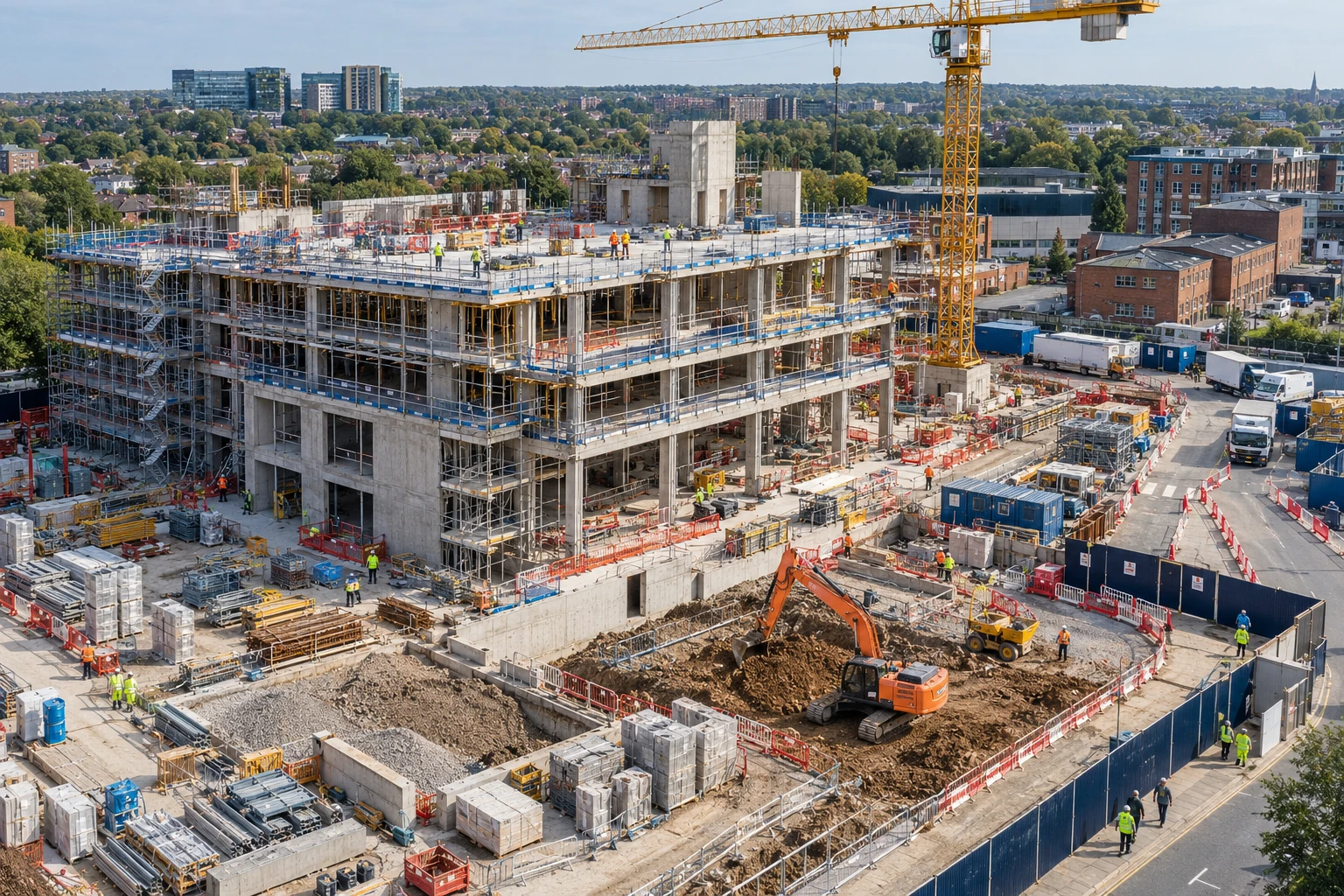
Rebar creates impalement and handling risks

Repetitive bed making strains the worker
All related inspection points 19 across 8 locations
Garage workshop 1 inspection point
Construction site 2 inspection points
Riverside Leisure 3 inspection points
Harvest & winter housing 4 inspection points
From flour to chilled despatch 2 inspection points
A safer place to call home 1 inspection point
Recover materials. Protect people. 4 inspection points
Aerosystems Engineering 2 inspection points
Practice in the SHAREhub environment. Browser practice is separate from workplace competence and formal learning records.
How should manual handling be assessed?
Assessment should observe the real task, identify risk factors and choose controls that reduce force, posture, frequency, distance and uncertainty.
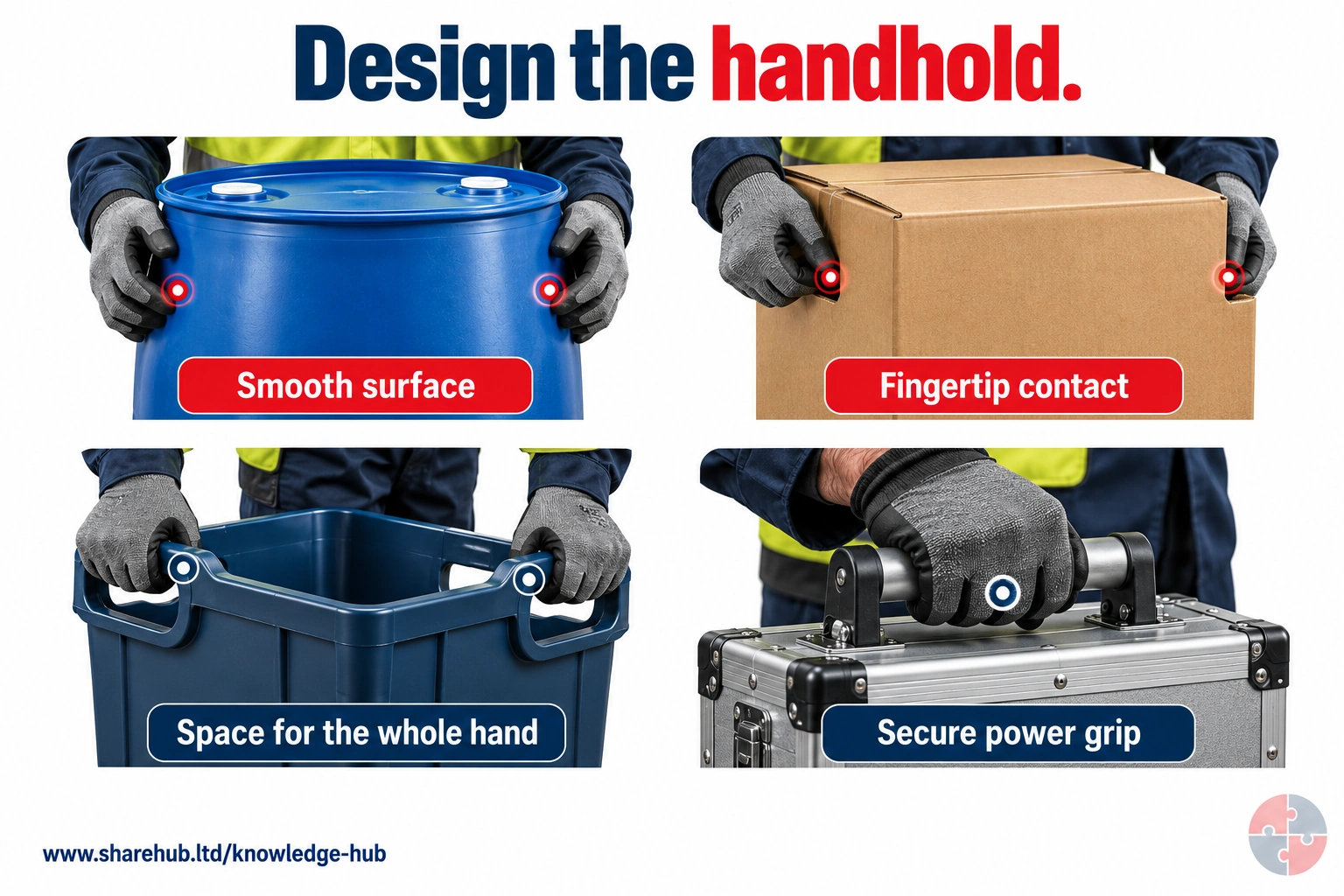

Load shape, surface and handhold space affect grip demand. Suitable handles permit secure contact without trapping fingers; gloves must suit the actual item.
Which change improves the hand contact?
A suitably placed handle with room for the whole gloved hand can improve the grasp. Also review load size, stability and the handling method.
Illustrative handholds only; actual handle capacity, clearance and suitability require assessment.
Source guidance: HSE L23
A good assessment watches the task happen. It measures or estimates load weight, height, reach, distance, frequency, route, floor condition, team communication and use of aids. It asks workers what actually makes the job difficult, not just what the procedure says. Sources: HSE L23 Manual handling guidance on regulations; HSE manual handling at work
For structured assessment, HSE's Manual Handling Assessment Charts (MAC) support lifting, carrying and team handling. The Risk Assessment of Pushing and Pulling (RAPP) tool supports pushing and pulling. The Assessment of Repetitive Tasks (ART) tool supports repetitive upper-limb tasks. These tools help prioritise risk, but they do not replace judgement or the hierarchy of avoiding and reducing the task. Sources: HSE L23 Manual handling guidance on regulations; HSE manual handling at work
| Question | Assessment prompt | Output |
|---|---|---|
| Can the handling be avoided? | Can delivery, storage, automation or process flow remove manual movement? | Eliminate or reduce handling need.Sources: HSE L23 Manual handling guidance on regulations; HSE manual handling at work |
| What task factors remain? | Height, reach, twist, carry distance, frequency and team coordination. | Task redesign actions.Sources: HSE L23 Manual handling guidance on regulations; HSE manual handling at work |
| What load factors matter? | Weight, size, grip, stability, centre of gravity and sharp/hot/cold surfaces. | Packaging, marking or load reduction.Sources: HSE L23 Manual handling guidance on regulations; HSE manual handling at work |
| What environment factors matter? | Floor, lighting, route, weather, heat, cold, space and obstacles. | Route and workplace improvements.Sources: HSE L23 Manual handling guidance on regulations; HSE manual handling at work |
| Which tool helps? | MAC for lifting/carrying/team handling; RAPP for pushing/pulling; ART for repetition. | Structured score and control plan.Sources: HSE L23 Manual handling guidance on regulations; HSE manual handling at work |
| How will controls be checked? | Observe use, review discomfort and inspect aids. | Supervisor checks and evidence.Sources: HSE L23 Manual handling guidance on regulations; HSE manual handling at work |
What can a manual-handling weight or tool score actually tell us?
The law has no fixed safe lifting weight. Observe the full task and the person doing it; a filter or coloured tool score is a screening aid, not permission to continue a harmful lift.
Manual handling includes lifting, lowering, carrying, pushing, pulling and supporting a load. If the task cannot be avoided, consider frequency, reach, vertical travel, twisting, grip, load stability, route, pace and the individual. The same carton can present different risk at floor level and waist height. HSE manual handling at work and HSE L23 Manual handling guidance on regulations.
HSE’s Manual Handling Assessment Charts (MAC) help analyse lifting, carrying and team handling; its Risk Assessment of Pushing and Pulling (RAPP) tool addresses those tasks, and V-MAC covers some variable-load patterns. Pick the tool for the actual operation and assess factors it omits, such as individual capability and environmental constraints. A green score is not a legal safe weight or a complete assessment. HSE Manual Handling Assessment Charts, HSE MSD assessment toolkit, HSE MSD toolkit frequently asked questions and HSE simple manual-handling risk filters.
| Observed task | Potential aid | What still needs judgement |
|---|---|---|
| Repeat lifting, carrying or team handling | MAC | Observe worst case, person, route and additional factors; a score is not a permit.Sources: HSE Manual Handling Assessment Charts; HSE L23 Manual handling guidance on regulations |
| Pushing or pulling a trolley or load | RAPP | Check wheels, floor, slope, force, stops and individual capability.Sources: HSE MSD assessment toolkit; HSE MSD toolkit frequently asked questions |
| Variable weights/frequency across a shift | V-MAC where scope fits | Verify task matches the tool assumptions and add omitted risks.Sources: HSE MSD assessment toolkit; HSE MSD toolkit frequently asked questions |
| Simple low-risk task | HSE filter as first screen | Not a statutory weight limit; reassess if assumptions or worker needs differ.Sources: HSE simple manual-handling risk filters; HSENI manual handling |
Check tool eligibility before scoring
V-MAC is for work meeting HSE’s full eligibility conditions, including regular single-person handling with substantially variable loads/frequency over a substantial part of the shift. Variable box weights alone do not make the two-person archive example eligible. Assess relevant lift/carry and trolley push/pull elements separately with MAC/RAPP as appropriate; do not combine scores into a pass mark. HSE: V-MAC criteria and toolkit limitations.
How can the hierarchy of controls avoid hazardous manual handling and reduce remaining strain?
Avoid hazardous manual handling where reasonably practicable, assess what remains and reduce the injury risk. Training and gloves support the chosen method; they cannot make an unsuitable repetitive lift safe.
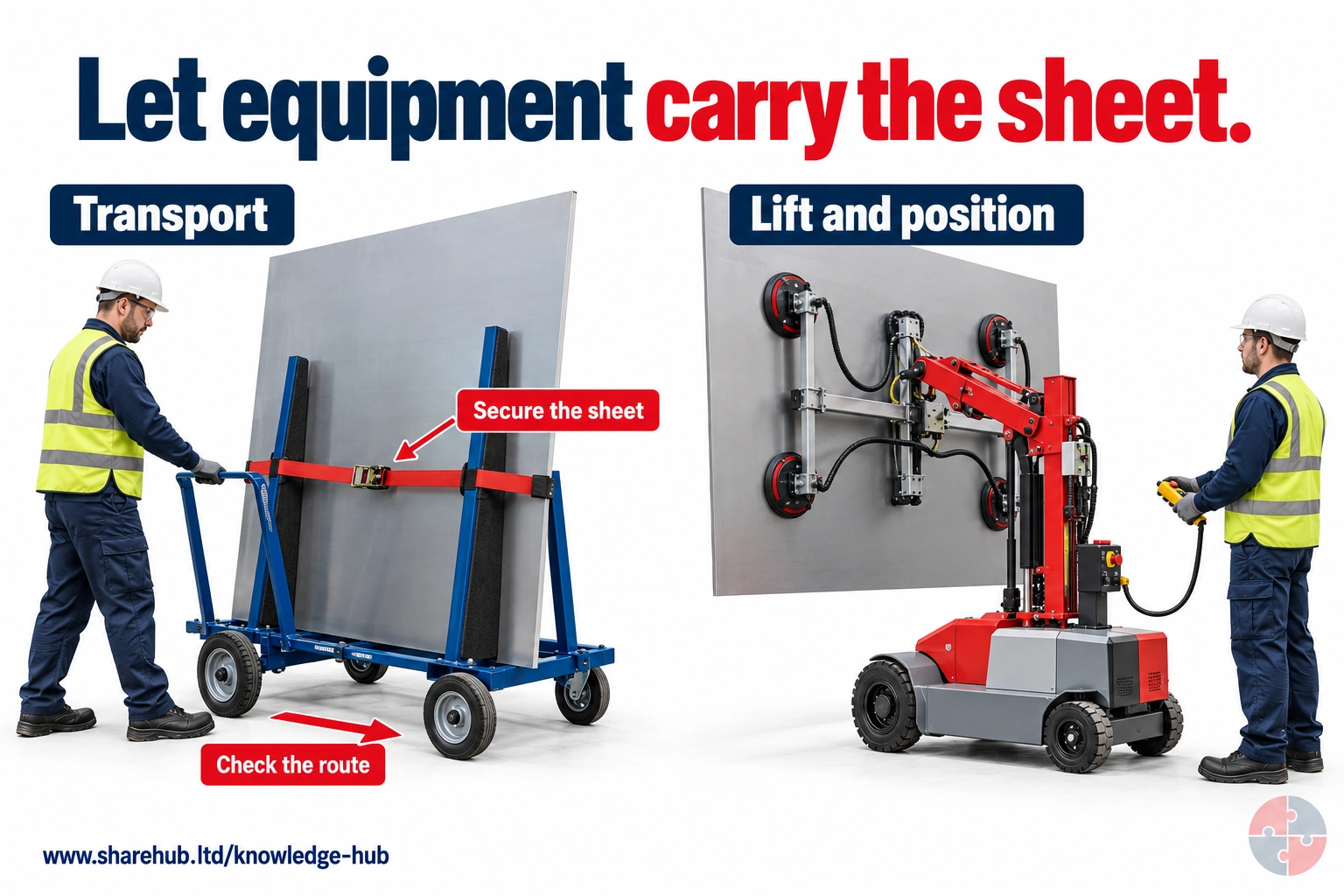

A trolley can take the carrying demand during transport; a suitable powered aid can support lifting and positioning. Both need a stable retained load, suitable route and task-specific selection.
Which part of the task does each aid remove?
The trolley supports movement along the route; the powered aid supports lifting and positioning. Choose equipment for the full task and material.
Illustrative equipment only, not a lifting plan or equipment specification. Check rated capacity, sheet compatibility, secure retention, stability and the route; vacuum lifting needs a suitable surface and loss-of-vacuum safeguards.
Source guidance: HSE L23
Illustrative decision: warehouse workers repeatedly lift stock from floor-level pallets to dispatch benches. The manager and workers examine the whole supply-to-dispatch task, including reaching, twisting, pushing, load stability and differing individual capability.
ERICPD means Eliminate, Reduce (including substitution), Isolate, Control, PPE and Discipline. The five-level hierarchy groups measures as elimination, substitution, engineering controls, administrative controls and PPE. They overlap: isolation is usually an engineering measure; control can include engineered and administrative measures. Discipline means maintaining and checking the controls, supervising the method and learning from defects, rather than blaming someone or accepting weaker protection.
How can the ERICPD hierarchy of controls avoid hazardous manual handling and reduce remaining strain?

| ERICPD and five-level position | Intervention and owner | Verification, failure and stop point |
|---|---|---|
| Eliminate / elimination | Procurement and operations consider delivery and dispatch arrangements that remove the repeated manual transfer, such as an appropriately designed direct transfer system. | Observe the complete flow, including replenishment and breakdown recovery. A machine that shifts the lifting burden to another worker has not eliminated the hazardous operation. |
| Reduce / substitution when replacing a hazard; otherwise engineering or administrative risk reduction | Compare manageable packages and alternative supply formats where they fit the task; assess increased frequency, awkward grips and packaging stability. | Record the total task exposure and worker feedback. No package weight is a universal safe limit; more smaller lifts can still create substantial risk. |
| Isolate / engineering | Select suitable pallet positioners, lift tables or handling aids, with safe access and protection from crushing or unexpected movement. Design reach and destination heights around the actual task. | Check load capacity, stability, condition, use and the real movement forces. An unsuitable aid or unresolved crush point prevents release of that method. |
| Control / administrative | Supervisors plan replenishment, routes, workload, task variation and individual needs; provide load information and training in the assessed method. | Watch work at realistic pace and include unusual loads and damaged pallets. A team lift or rotation is not an automatic solution; difficult handling returns to assessment. |
| PPE / PPE | Select grip, foot or other protection for residual load and workplace hazards where appropriate. Check it does not worsen handling. | Verify fit and condition. Gloves or supportive clothing do not remove musculoskeletal loading or establish a safe lift. |
| Discipline / sustained engineering and administrative controls | Managers maintain aids, respond to defects and discomfort, and revisit the assessment after workload, packaging or route changes. | Retain task observations and corrective actions. A failed aid or new unstable load requires a safe alternative or pause rather than routine manual workaround. |
How can the ISO 45001 hierarchy of controls avoid hazardous manual handling and reduce remaining strain?

| ERICPD and five-level position | Intervention and owner | Verification, failure and stop point |
|---|---|---|
| Eliminate / elimination | Procurement and operations consider delivery and dispatch arrangements that remove the repeated manual transfer, such as an appropriately designed direct transfer system. | Observe the complete flow, including replenishment and breakdown recovery. A machine that shifts the lifting burden to another worker has not eliminated the hazardous operation. |
| Reduce / substitution when replacing a hazard; otherwise engineering or administrative risk reduction | Compare manageable packages and alternative supply formats where they fit the task; assess increased frequency, awkward grips and packaging stability. | Record the total task exposure and worker feedback. No package weight is a universal safe limit; more smaller lifts can still create substantial risk. |
| Isolate / engineering | Select suitable pallet positioners, lift tables or handling aids, with safe access and protection from crushing or unexpected movement. Design reach and destination heights around the actual task. | Check load capacity, stability, condition, use and the real movement forces. An unsuitable aid or unresolved crush point prevents release of that method. |
| Control / administrative | Supervisors plan replenishment, routes, workload, task variation and individual needs; provide load information and training in the assessed method. | Watch work at realistic pace and include unusual loads and damaged pallets. A team lift or rotation is not an automatic solution; difficult handling returns to assessment. |
| PPE / PPE | Select grip, foot or other protection for residual load and workplace hazards where appropriate. Check it does not worsen handling. | Verify fit and condition. Gloves or supportive clothing do not remove musculoskeletal loading or establish a safe lift. |
| Discipline / sustained engineering and administrative controls | Managers maintain aids, respond to defects and discomfort, and revisit the assessment after workload, packaging or route changes. | Retain task observations and corrective actions. A failed aid or new unstable load requires a safe alternative or pause rather than routine manual workaround. |
The comparison is an original illustrative application of the general HSE hierarchy, not a machine-specific method, permit or design approval. The employer must choose measures for the actual work and jurisdiction. Apply the separate Northern Ireland legal route where relevant; the local assessment and competent technical decision govern release.
How should a warehouse floor-level picking task be redesigned?
A worked example shows why manual-handling training is not enough where storage height, frequency and route design create risk.
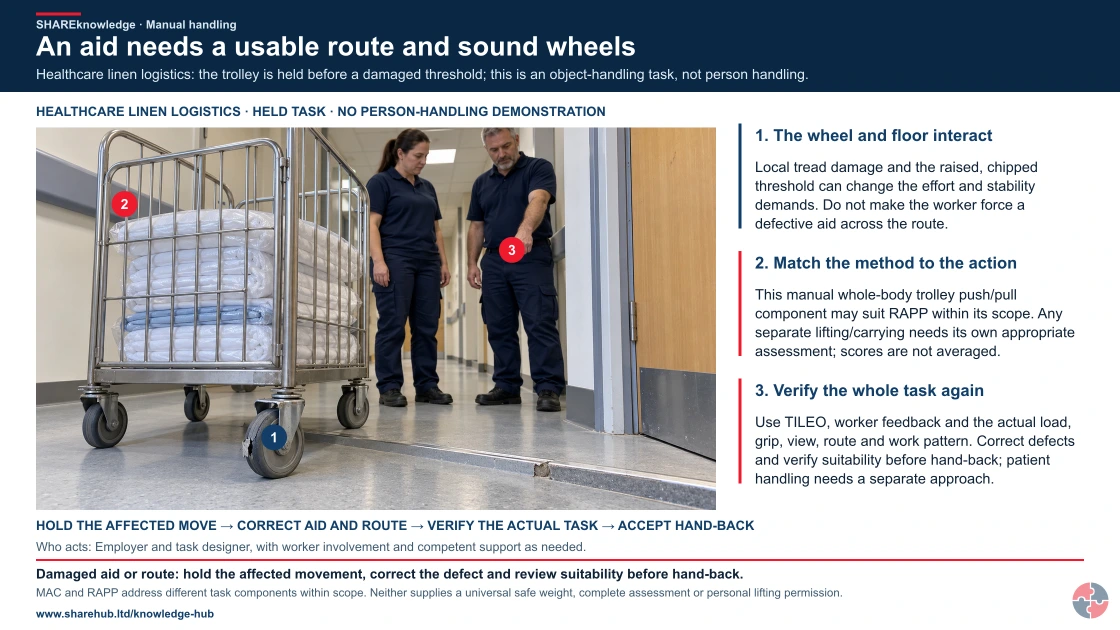
An aid needs a usable route and sound wheels
Full written explanation
A realistic healthcare logistics scene shows a stationary linen trolley with a locally damaged castor tread, intact hub/fork and stable wrapped linen, before a raised chipped doorway threshold. Two staff stand beside the held task without pushing, pulling or placing hands near the wheel. Native explanations connect the wheel/floor interaction to possible force and stability demands, distinguish the manual whole-body trolley component from any separate lift/carry task, and require a whole-task review and verified hand-back. The scene does not demonstrate a repair, measured force, safe gradient, approved load or safe push technique. RAPP excludes powered handling equipment and operations using only upper or lower limbs, and it may not cover the full assessment. MAC and RAPP results must not be combined into a pass mark. TILEO and individual/work-organisation factors remain; linen logistics is not patient handling and does not provide a person-transfer plan. Existing full source stop, maintenance, medical/occupational-health and assessment boundaries remain separate and unchanged.
Healthcare linen logistics: the trolley is held before a damaged threshold; this is an object-handling task, not person handling.
- Question the transfer. Can the movement be removed, mechanised or reduced at the planning stage?
- Assess the whole job. Consider task, individual, load, environment and other relevant factors.
- Choose suitable support. Use MAC or RAPP only within their scope; select aids for the actual task and route.
- Trial and review. Check the change with the people doing the work and resolve remaining demands.
When the evidence does not fit: A damaged aid, blocked route or unassessed handling change requires correction or reassessment before the affected movement.
Who acts: Employer and task designer, with worker involvement and competent support as needed.
Changed workplace
Distribution centre: Reduce repeated floor-level picking and check the trolley route and thresholds.
Healthcare support: Person-handling needs an individual and task-specific approach; box-lifting scores do not transfer automatically.
Evidence check: Technique training cannot compensate for a poorly designed task or route.
Use the approved manual-handling ERICPD/ESEAP artwork and complete task-specific control tables
Primary references: HSE manual handling: avoid, assess and reduce · HSE MAC scope and whole-task observation · HSE RAPP: scope, exclusions and separate operations · HSE five-level hierarchy of controls · HSENI manual handling and TILEO · SHAREtools TILEO and separate MAC/RAPP assessments and exports
Open the complete HD image (new tab)Download image

Use the approved manual-handling ERICPD/ESEAP artwork and complete task-specific control tables
Primary references: HSE manual handling: avoid, assess and reduce · HSE MAC scope and whole-task observation · HSE RAPP: scope, exclusions and separate operations · HSE five-level hierarchy of controls · HSENI manual handling and TILEO · SHAREtools TILEO and separate MAC/RAPP assessments and exports
Warehouse workers pick heavy boxes from floor-level pallets, twist to place them into roll cages and push loaded cages over a damaged threshold. Back and shoulder discomfort is common during seasonal peaks. The weak response is refresher manual-handling training and a poster about bending knees. Sources: HSE Manual Handling Assessment Charts; HSE making the best use of lifting and handling aids
A stronger response observes the task, uses MAC/RAPP-style thinking, raises storage height, reduces box weights, changes slotting so heavy goods are between knee and shoulder height, repairs the threshold, maintains cage wheels, uses lift tables for peak work, rotates tasks and reviews staffing so pace does not destroy recovery. Sources: HSE Manual Handling Assessment Charts; HSE making the best use of lifting and handling aids
| Finding | Weak response | Better control |
|---|---|---|
| Floor-level heavy boxes | Tell workers to lift correctly. | Store heavy items at better height or use lift table.Sources: HSE Manual Handling Assessment Charts; HSE making the best use of lifting and handling aids |
| Twist into cage | Remind workers not to twist. | Reorient cage and work flow.Sources: HSE Manual Handling Assessment Charts; HSE making the best use of lifting and handling aids |
| Damaged threshold | Tell workers to push carefully. | Repair floor and maintain route.Sources: HSE Manual Handling Assessment Charts; HSE making the best use of lifting and handling aids |
| Cage wheels poor | Use two people when difficult. | Inspect and maintain wheels; remove defective cages.Sources: HSE Manual Handling Assessment Charts; HSE making the best use of lifting and handling aids |
| Peak frequency | Accept seasonal strain. | Add staffing, rotation and recovery.Sources: HSE Manual Handling Assessment Charts; HSE making the best use of lifting and handling aids |
| Repeat discomfort | Treat as individual weakness. | Review task design and trend data.Sources: HSE Manual Handling Assessment Charts; HSE making the best use of lifting and handling aids |
What is the difference between TILE, TILEO and TILEE?
TILE, TILEO and TILEE are practical prompts that help assess the whole handling situation rather than focusing only on load weight.
TILE is the core prompt: Task, Individual, Load and Environment. It reflects the main risk factors HSE expects employers to consider when assessing manual handling. TILEO adds Other factors, such as work organisation, time pressure, communication, PPE, fatigue, team handling, handling aids and recovery. TILEE is used by some organisations as a further extension; the final E should be defined in the organisation's standard, most usefully as Equipment, Ergonomics or Existing controls. Sources: HSE L23 Manual handling guidance on regulations; HSE manual handling at work
The important point is not which acronym is used, but whether the assessment identifies the real risk factors and produces better work design. A TILE/TILEO/TILEE assessment should lead to avoiding the handling where possible, reducing load and reach, improving equipment, changing routes and heights, reducing repetition, supporting individuals and reviewing the work after change. Sources: HSE L23 Manual handling guidance on regulations; HSE manual handling at work
| Prompt | What it covers | How to use it well |
|---|---|---|
| TILE | Task, Individual, Load and Environment. | Use as the minimum structured check for lifting, carrying, lowering, pushing or pulling.Sources: HSE L23 Manual handling guidance on regulations; HSE manual handling at work |
| Task | Posture, reach, twisting, vertical movement, carrying distance, repetition, pace and recovery. | Observe the real sequence and remove unnecessary handling before assessing technique.Sources: HSE L23 Manual handling guidance on regulations; HSE manual handling at work |
| Individual | Capability, training, fatigue, injury history, pregnancy, disability, temporary restriction and new-starter status. | Discuss work impact privately and adjust the task without intrusive medical questioning.Sources: HSE L23 Manual handling guidance on regulations; HSE manual handling at work |
| Load | Weight, size, shape, grip, stability, centre of gravity, temperature, sharpness or unpredictability. | Reduce, split, mark, package or mechanically move the load where practicable.Sources: HSE L23 Manual handling guidance on regulations; HSE manual handling at work |
| Environment | Space, floors, slopes, steps, lighting, weather, temperature, housekeeping, route and access. | Fix the route and workplace conditions before asking people to compensate physically.Sources: HSE L23 Manual handling guidance on regulations; HSE manual handling at work |
| TILEO | TILE plus Other factors. | Add work organisation, time pressure, PPE, communication, team handling, recovery and bystander/interface risks.Sources: HSE L23 Manual handling guidance on regulations; HSE manual handling at work |
| TILEE | TILE plus an extra E, usually defined locally as Equipment, Ergonomics or Existing controls. | Use to force a check of handling aids, workstation height, layout, mechanical assistance and whether current controls are actually usable.Sources: HSE L23 Manual handling guidance on regulations; HSE manual handling at work |
| LITE | Load, Individual, Task and Environment; the same core ideas in a different order. | Acceptable as a shorthand if the assessment still covers the full risk picture.Sources: HSE L23 Manual handling guidance on regulations; HSE manual handling at work |
How do TILE, TILEO and TILEE work in practice?
A TILE/TILEO/TILEE assessment should identify task, individual, load, environment and equipment or other factors before redesigning the work.
A facilities team moves archive boxes from a basement store to a first-floor office. Each box weighs 16 to 22 kg, some have poor handholds, the route includes a narrow door, a short ramp and a lift lobby, and the job is planned for two people over one afternoon. One worker is returning after a back-pain absence and the team has a trolley, but the trolley wheels catch on the ramp threshold. Sources: HSE L23 Manual handling guidance on regulations; HSE Manual Handling Assessment Charts
A poor assessment records 'two-person lift, use good manual-handling technique'. A better assessment uses TILE, TILEO and TILEE thinking to expose the real controls: reduce box weight, split contents, improve handles, use a route-selected handling aid, chosen only after confirming the intended lift/route, door and turning clearances, stability/capacity, thresholds, slope and starting/stopping forces suitable for the route, stage the work at waist height, repair the ramp threshold, plan rest/recovery, avoid twisting in the lift lobby and adapt duties for the returning worker without asking for unnecessary medical detail. Sources: HSE L23 Manual handling guidance on regulations; HSE Manual Handling Assessment Charts
| Assessment factor | What the assessment finds | Redesign or control |
|---|---|---|
| Task | Repeated lifting from floor, carrying through a narrow route and twisting in a lift lobby. | Stage boxes on a trolley/lift table, reorient the route and reduce carry distance.Sources: HSE L23 Manual handling guidance on regulations; HSE Manual Handling Assessment Charts |
| Individual | One worker is returning after back pain and may need temporary restriction. | Private work-impact discussion, adjusted duties and review date.Sources: HSE L23 Manual handling guidance on regulations; HSE Manual Handling Assessment Charts |
| Load | Boxes are heavy, variable, poorly gripped and not weight-marked. | Split contents, mark weights, improve containers and keep heaviest items between knee and shoulder height.Sources: HSE L23 Manual handling guidance on regulations; HSE Manual Handling Assessment Charts |
| Environment | Basement, ramp threshold, narrow door, lift lobby and time pressure create extra risk. | Repair threshold, clear route, improve lighting and schedule the move over more time.Sources: HSE L23 Manual handling guidance on regulations; HSE Manual Handling Assessment Charts |
| Equipment/aids | Trolley exists but is unsuitable for the route condition. | Select suitable trolley, inspect wheels and confirm it can pass the full route.Sources: HSE L23 Manual handling guidance on regulations; HSE Manual Handling Assessment Charts |
| Other factors | PPE, team handling, time pressure and communication affect the work. | Brief roles, use commands and avoid team handling where mechanical aid can remove the lift.Sources: HSE L23 Manual handling guidance on regulations; HSE Manual Handling Assessment Charts |
| Ergonomics/existing controls | Current storage and trolley arrangement still force bending, twisting and pushing over a poor threshold. | Change storage height, repair the route and confirm controls work before the job continues.Sources: HSE L23 Manual handling guidance on regulations; HSE Manual Handling Assessment Charts |
| Recovery | Continuous moving over one afternoon creates fatigue. | Breaks, rotation, realistic pace and same-day review.Sources: HSE L23 Manual handling guidance on regulations; HSE Manual Handling Assessment Charts |
| Review | Discomfort reports or route changes may alter risk. | Supervisor observation and same-day review before continuing.Sources: HSE L23 Manual handling guidance on regulations; HSE Manual Handling Assessment Charts |
Complete the route trial
Trial the aid over the whole intended route with worker feedback and record remaining manual transfers. If stairs are intended, introduce and assess that route explicitly before choosing stair equipment. Retain threshold repair and adjusted duties; possession of a trolley or a two-person lift does not close the assessment.
Why is manual-handling training not enough?
Training supports safe work, but it does not make a poor task design safe.
Manual-handling training often fails when it is used as the main control. Workers may know good technique but still face heavy loads, poor reach, high repetition, slippery floors, damaged trolleys, rushed work, awkward loads or no handling aids. In those conditions, technique cannot remove the risk. Sources: HSE manual handling at work; HSE making the best use of lifting and handling aids
A strong control plan changes the task first: remove handling, reduce load, improve route, improve height, provide aids, maintain aids, reduce frequency, improve grip and plan recovery. Training then explains how to use those controls properly. Sources: HSE manual handling at work; HSE making the best use of lifting and handling aids
| Issue | Training-only response | Design-led response |
|---|---|---|
| Heavy load | Teach lifting technique. | Reduce weight or use mechanical aid.Sources: HSE manual handling at work; HSE making the best use of lifting and handling aids |
| Awkward reach | Remind about posture. | Change storage height and layout.Sources: HSE manual handling at work; HSE making the best use of lifting and handling aids |
| Long carry | Tell workers to take care. | Move delivery point or use trolley.Sources: HSE manual handling at work; HSE making the best use of lifting and handling aids |
| Poor wheels | Ask for team handling. | Repair or replace equipment.Sources: HSE manual handling at work; HSE making the best use of lifting and handling aids |
| High frequency | Brief early reporting. | Change pace, rotation and staffing.Sources: HSE manual handling at work; HSE making the best use of lifting and handling aids |
| Unstable load | Tell workers to hold securely. | Change packaging or handling method.Sources: HSE manual handling at work; HSE making the best use of lifting and handling aids |
What does good manual handling control look like in different sectors?
The same avoid-assess-reduce principles apply, but the practical controls vary by task and setting.
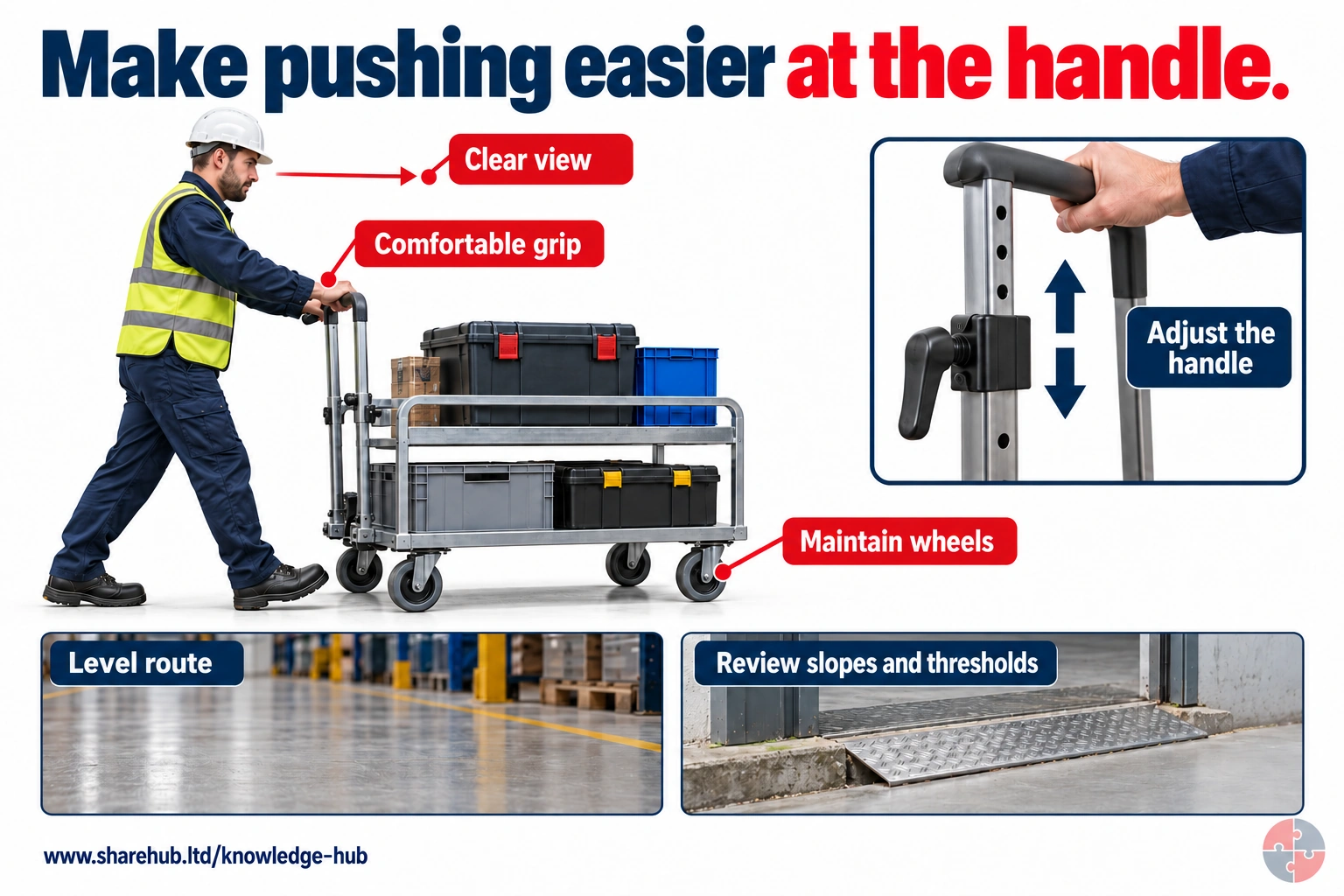

Handle position, wheel condition, load stability and route quality affect push/pull demand. Review slopes, transitions and visibility as well as the person's position.
What could make this trolley difficult to move even with a comfortable handle?
Poor wheels, excessive or unstable loading, slopes and thresholds can increase effort or reduce control.
No universal handle height or push/pull force limit is implied.
Source guidance: HSE L23
Manual handling is common in construction, logistics, healthcare, retail, manufacturing, hospitality, offices, agriculture and waste work. The assessment should fit the task rather than use generic training language. Sources: HSE manual handling at work; HSENI manual handling
Sector examples help learners see that manual handling is about force, posture, repetition, distance, environment, people and recovery, not just box weight. Sources: HSE manual handling at work; HSENI manual handling
| Sector or task | Typical risk | Control focus |
|---|---|---|
| Construction materials | Blocks, boards, kerbs, awkward panels and changing ground. | Plan deliveries, use mechanical aids and reduce carrying distance.Sources: HSE manual handling at work; HSENI manual handling |
| Care work | Supporting people, unpredictable movement and dignity. | Avoid manual lifting, use hoists and train in person-centred handling.Sources: HSE manual handling at work; HSENI manual handling |
| Logistics | Cages, pallets, tail-lifts and delivery pressure. | Route design, maintained aids and realistic scheduling.Sources: HSE manual handling at work; HSENI manual handling |
| Manufacturing | Repetitive feeding, packing and awkward bins. | Workstation height, lift tables and rotation.Sources: HSE manual handling at work; HSENI manual handling |
| Retail | Stockroom congestion and shelf heights. | Delivery planning, step equipment and heavy-item slotting.Sources: HSE manual handling at work; HSENI manual handling |
| Office moves | Boxes, furniture and stairs. | Use movers, trolleys and clear route planning.Sources: HSE manual handling at work; HSENI manual handling |
When should manual handling stop or escalate?
Stop or escalate when the load, route, frequency, posture, handling aid, environment or worker capability makes injury likely.
Workers and supervisors should not wait for injury. Stop points should include unknown weight, unstable load, blocked route, damaged trolley, inadequate staffing for team handling, pain or discomfort, poor lighting, slippery floor, fatigue or a task that cannot be done as assessed. Sources: HSE manual handling at work; HSENI manual handling
Escalation should lead to redesign, equipment, staffing, changed delivery, competent assessment or occupational health support where individual restrictions are involved. Sources: HSE manual handling at work; HSENI manual handling
| Trigger | Immediate action | Restart evidence |
|---|---|---|
| Unknown or excessive load | Stop and check weight/handling method. | Marked weight or revised method.Sources: HSE manual handling at work; HSENI manual handling |
| Route blocked or poor floor | Clear/repair route before moving. | Route inspection.Sources: HSE manual handling at work; HSENI manual handling |
| Handling aid damaged | Quarantine aid and use alternative. | Repair and pre-use check.Sources: HSE manual handling at work; HSENI manual handling |
| Pain or discomfort reported | Review task and reduce exposure. | Task review and support record.Sources: HSE manual handling at work; HSENI manual handling |
| Team handling poorly coordinated | Pause and re-brief roles. | Briefing and supervisor observation.Sources: HSE manual handling at work; HSENI manual handling |
| Repeated handling injuries | Escalate for ergonomic review. | Trend review and control plan.Sources: HSE manual handling at work; HSENI manual handling |
Where do manual handling controls fail?
They fail when organisations focus on worker technique while leaving poor work design, poor equipment and unrealistic workload unchanged.
Warning signs include repeated strains, workers swapping tasks informally, trolleys abandoned because they are hard to use, high absence after peak work, heavy goods stored low or high, damaged wheels, congested routes and supervisors treating pain reports as attitude problems. Sources: HSE L23 Manual handling guidance on regulations; HSE MSD toolkit frequently asked questions
The strongest manual-handling programmes use early reports as design signals. They ask what part of the task is creating unnecessary load and what must change in the process. Sources: HSE L23 Manual handling guidance on regulations; HSE MSD toolkit frequently asked questions
| Failure or weak practice | How it develops | What good looks like |
|---|---|---|
| Technique-only control | Training repeated but injuries continue. | Redesign task and handling aids.Sources: HSE L23 Manual handling guidance on regulations; HSE MSD toolkit frequently asked questions |
| Mechanical aid not usable | Aid exists but route, space or maintenance prevents use. | Design route and maintain aid.Sources: HSE L23 Manual handling guidance on regulations; HSE MSD toolkit frequently asked questions |
| Poor storage | Heavy loads stored at floor or overhead level. | Slot heavy items at safer heights.Sources: HSE L23 Manual handling guidance on regulations; HSE MSD toolkit frequently asked questions |
| Unrealistic pace | Workers rush and skip aids. | Review staffing, schedules and targets.Sources: HSE L23 Manual handling guidance on regulations; HSE MSD toolkit frequently asked questions |
| No early reporting | Discomfort hidden until absence. | Supportive reporting and supervisor action.Sources: HSE L23 Manual handling guidance on regulations; HSE MSD toolkit frequently asked questions |
| Assessment not reviewed | Change in load, route or workers ignored. | Review after change and incidents.Sources: HSE L23 Manual handling guidance on regulations; HSE MSD toolkit frequently asked questions |
What evidence shows manual handling is controlled?
Evidence should show that hazardous handling has been avoided where possible, assessed where unavoidable and reduced through work design.
Useful evidence includes task observation, manual-handling assessment, MAC/RAPP records where useful, photos of layout, load information, handling-aid inspection, worker consultation, training, early discomfort reports, task redesign actions, occupational health advice where needed and review after change. Sources: HSE L23 Manual handling guidance on regulations; HSE Manual Handling Assessment Charts
The best evidence is visible in the workplace: fewer floor-level lifts, maintained trolleys, shorter carrying distances, clearer routes, better storage and workers who can explain what to do when a load is unsafe. Sources: HSE L23 Manual handling guidance on regulations; HSE Manual Handling Assessment Charts
| Evidence item | What it should show | Assurance question |
|---|---|---|
| Manual handling assessment | Task, individual, load, environment and other factors are assessed. | Was the real task observed?Sources: HSE L23 Manual handling guidance on regulations; HSE Manual Handling Assessment Charts |
| MAC/RAPP evidence | Structured tools support higher-risk lifting, carrying, team handling or pushing/pulling assessment. | Are scores linked to controls?Sources: HSE L23 Manual handling guidance on regulations; HSE Manual Handling Assessment Charts |
| Handling-aid controls | Aids are suitable, available, maintained and used. | Are aids practical at the point of work?Sources: HSE L23 Manual handling guidance on regulations; HSE Manual Handling Assessment Charts |
| Risk assessment | Assessment describes the actual task, people affected, credible harm routes, controls and review triggers. | Compare against work as done, not only the written method.Sources: HSE L23 Manual handling guidance on regulations; HSE Manual Handling Assessment Charts |
| Control standard | The required control is defined in operational terms. | Workers and supervisors can explain what must be in place before work starts.Sources: HSE L23 Manual handling guidance on regulations; HSE Manual Handling Assessment Charts |
| Competence and briefing | People have suitable instruction, training, supervision and authorisation where needed. | Competence is checked through observed practice, not attendance alone.Sources: HSE L23 Manual handling guidance on regulations; HSE Manual Handling Assessment Charts |
| Monitoring and defect action | Checks find weak signals, defects and non-compliance early. | Actions are risk-ranked, owned and closed with evidence.Sources: HSE L23 Manual handling guidance on regulations; HSE Manual Handling Assessment Charts |
| Management review | Leaders review trends, repeat findings, high-risk actions and resource needs. | Decisions and learning are recorded.Sources: HSE L23 Manual handling guidance on regulations; HSE Manual Handling Assessment Charts |
How should manual handling controls be assured?
Assurance should test whether task design has improved and whether controls are used in real work.
First-line assurance comes from supervisors observing tasks, checking aids and acting on discomfort reports. Second-line assurance samples assessments, injury trends, maintenance of aids, action quality and worker consultation. Specialist assurance may involve ergonomists, manual-handling assessors or occupational health. Sources: HSE L23 Manual handling guidance on regulations; HSE MSD assessment toolkit
A strong assurance question is: why is this load being handled by people at all, and what has been done to remove or reduce the handling? Sources: HSE L23 Manual handling guidance on regulations; HSE MSD assessment toolkit
| Level | What to check | What good looks like |
|---|---|---|
| Frontline check | Workers and supervisors confirm that manual handling controls are present, understood and suitable before work starts. | Work stops when critical controls are missing, defeated or unclear.Sources: HSE L23 Manual handling guidance on regulations; HSE MSD assessment toolkit |
| Manager review | Managers review open actions, repeat defects, competence gaps, incidents, health signals and work-as-done feedback. | Resources and deadlines match the seriousness of the risk.Sources: HSE L23 Manual handling guidance on regulations; HSE MSD assessment toolkit |
| Competent review | Specialists review technical, medical, fire, security, ergonomic or machinery complexity. | Advice is converted into practical controls and review dates.Sources: HSE L23 Manual handling guidance on regulations; HSE MSD assessment toolkit |
| Leadership assurance | Senior leaders review high-consequence risks, overdue actions and weak signals. | Governance tests control effectiveness, not just document completion.Sources: HSE L23 Manual handling guidance on regulations; HSE MSD assessment toolkit |
Which GB and NI manual-handling duties apply?
Great Britain and Northern Ireland each have a 1992 manual-handling instrument. In both routes, avoid hazardous handling where reasonably practicable, assess unavoidable tasks and reduce remaining injury risk.
In Great Britain (GB), use the Manual Handling Operations Regulations 1992 alongside the 1974 Act and HSE L23. In Northern Ireland (NI), use the separate Manual Handling Operations Regulations (NI) 1992 and the 1978 Order; HSENI explains the practical avoid–assess–reduce sequence. Neither regime provides a fixed legal safe weight. Manual Handling Operations Regulations 1992, Manual Handling Operations Regulations (NI) 1992, Health and Safety at Work etc. Act 1974, Health and Safety at Work (NI) Order 1978, HSE L23 Manual handling guidance on regulations and HSENI manual handling.
| Decision | Great Britain | Northern Ireland | Field proof |
|---|---|---|---|
| Avoid hazardous operation | GB 1992 Regulations: avoid where reasonably practicable. | NI 1992 Regulations: separate avoid duty. | Redesign, aid, supply or process choice considered before individual technique.Sources: Manual Handling Operations Regulations 1992; Manual Handling Operations Regulations (NI) 1992 |
| Assess what remains | Suitable and sufficient assessment of unavoidable hazardous handling. | Separate NI assessment duty. | Observe real task, load, individual and environment; review after change or symptoms.Sources: Manual Handling Operations Regulations 1992; Manual Handling Operations Regulations (NI) 1992 |
| Reduce injury risk | Reduce remaining risk as low as reasonably practicable. | Corresponding NI reduction route. | Installed aid, suitable load/route, worker feedback and action close-out.Sources: Manual Handling Operations Regulations 1992; Manual Handling Operations Regulations (NI) 1992 |
| Weight values and tools | HSE filters and MAC/RAPP aid judgement; no legal safe lift weight. | HSENI explains the same risk-based method; NI law remains separate. | Tool assumption and omitted risk recorded; no colour treated as permission.Sources: HSE simple manual-handling risk filters; HSENI manual handling |
Voluntary-standard detail on hold
Specific standard editions, clauses and derived management-system detail are withheld until authorised text, rights and competent technical review are complete. Use applicable law and verified site evidence for current decisions.
For general health and safety management, see HSE managing health and safety.
What training and competence are needed?
Training should explain avoid-assess-reduce, task risk factors, use of aids, early reporting, stop points and why work redesign matters more than heroic lifting.
Training should be role-based. General awareness creates a baseline, but supervisors, managers, advisers and senior leaders need different levels of decision-making, verification and escalation competence. Sources: HSE manual handling at work; HSENI manual handling
| Level | Who it is for | What it should cover |
|---|---|---|
| General awareness | All workers who may be affected by the topic. | Plain-English overview of manual handling risk control, why it matters, early warning signs, basic reporting routes and where to find support or guidance.Sources: HSE manual handling at work; HSENI manual handling |
| Task-specific practical training | Workers who carry out the activity or face the exposure. | Real tasks, equipment, decision points, stop triggers, pre-use checks, emergency response and practical scenarios.Sources: HSE manual handling at work; HSENI manual handling |
| Supervisor and line manager training | People who plan work, allocate staff, check controls or respond to concerns. | How to brief work, verify controls, challenge drift, protect confidentiality where relevant and escalate when conditions change.Sources: HSE manual handling at work; HSENI manual handling |
| HSE, HR, occupational health (OH) or technical adviser coordination | Advisers who support the system. | Legal boundaries, records, assurance checks, trend review, referral quality, evidence standards and action tracking.Sources: HSE manual handling at work; HSENI manual handling |
| Specialist competence | Use competent manual-handling assessors, ergonomists, occupational health, physiotherapists, equipment suppliers or HSE advisers where tasks are complex, injuries repeat or individual restrictions are involved. | Competent assessment, technical review, design, inspection, audit, occupational health or engineering support where ordinary management competence is not enough.Sources: HSE manual handling at work; HSENI manual handling |
How could BuildOut Ltd manage this in practice?

BuildOut Ltd would avoid hazardous handling where possible and organise unavoidable movement around the load, route, equipment and people doing the task.
BuildOut Ltd · practical example
Change the delivery arrangement before moving heavy boards
The key lesson Handling risk depends on the whole task and conditions, not simply a load's weight or whether workers have attended lifting training.
The situation: A delivery of large boards is booked to the pavement outside a fit-out. The intended storage area is upstairs, reached through a narrow occupied corridor. The driver asks the crew to unload quickly.
Why this matters: An awkward route, poor grip and repeated carrying can defeat an otherwise sensible handling plan and expose building users to the same movement.
How BuildOut Ltd would manage it
- Re-plan the delivery — Project Manager. Ask whether materials can arrive closer to their point of use, in a different form or through a different sequence. Resolve access and timing with the client and supplier before unloading.
- Assess unavoidable handling — Site Manager. Walk the full route with the crew. Consider load size and stability, reach, carry distance, changes of level, frequency, working space and individual capability, including other people using the route.
- Provide the right method — Plant and Procurement Coordinator. Arrange suitable handling equipment and any necessary delivery changes. Check that the aid fits the route and load rather than leaving workers to improvise when a trolley cannot pass.
- Prepare people and access — Trade Supervisor. Agree the movement, communication, protected space and stop conditions with those involved. Demonstrate the assessed use of equipment and check understanding without treating technique as the main control.
- Watch the real operation — Site Manager. Observe the first movement and respond to fatigue, discomfort, blocked access or a different load. Revise the method and future purchasing or delivery requirements where necessary.
When the conditions change
- Recognise the trigger
- The load or route differs from the plan, or the aid cannot be used safely.
- Make the immediate decision
- Keep the affected unloading or movement paused rather than carry by improvisation.
- Verify the next step
- The Site Manager checks the revised delivery route, load arrangement and suitable handling aid with the crew before the next movement.
What good looks like
Materials reach the workface through an organised method with suitable equipment and space. Workers do not have to choose between an unsafe carry and delaying the delivery.
Evidence to look for: Delivery and access plan, handling assessment, equipment suitability checks, briefing and observations of use.
Common mistake to avoid: Using a generic lifting certificate or a supposed universal safe weight to justify the task.
Apply this to your work: What change before delivery could remove the most difficult part of your handling task?
Guidance behind the management approach: HSE: assessing unavoidable manual handling. Use the topic's legal and technical guidance for the applicable work and location.
This contractor handles materials, tools, waste, office moves and site deliveries. It uses manual-handling assessment as a work-design tool rather than a training record. Sources: HSE manual handling at work; HSE making the best use of lifting and handling aids
| Management element | How the business would manage it | Evidence to review |
|---|---|---|
| Avoid | Deliver materials close to workface and use mechanical movement. | Delivery and logistics plan.Sources: HSE manual handling at work; HSE making the best use of lifting and handling aids |
| Assess | Higher-risk tasks are observed and scored where useful. | MAC/RAPP assessment.Sources: HSE manual handling at work; HSE making the best use of lifting and handling aids |
| Reduce | Loads, routes, heights and repetition are redesigned. | Action tracker.Sources: HSE manual handling at work; HSE making the best use of lifting and handling aids |
| Support | Discomfort is reported early and reviewed. | Early report and OH route.Sources: HSE manual handling at work; HSE making the best use of lifting and handling aids |
| Assure | Supervisors check aids, routes and worker feedback. | Inspection and trend review.Sources: HSE manual handling at work; HSE making the best use of lifting and handling aids |
What do the acronyms and key terms mean?
The terms separate task risk factors, assessment aids and control decisions.
| Term | Full name | Meaning here |
|---|---|---|
| MHOR | Manual Handling Operations Regulations | Separate GB and NI 1992 instruments. Manual Handling Operations Regulations 1992; Manual Handling Operations Regulations (NI) 1992 |
| TILE | Task, Individual, Load, Environment | A memory aid for risk factors, not a legal test. HSE L23 Manual handling guidance on regulations |
| MAC | Manual Handling Assessment Charts | HSE lifting, carrying and team-handling aid. HSE Manual Handling Assessment Charts |
| RAPP | Risk Assessment of Pushing and Pulling | HSE aid for applicable push/pull tasks. HSE MSD assessment toolkit |
| V-MAC | Variable Manual Handling Assessment Charts | Aid for some variable-weight lifting/carrying patterns. HSE MSD assessment toolkit |
| MSD | Musculoskeletal disorder | Injury or ill health of muscles, joints or supporting structures. HSE musculoskeletal disorders at work |
| PPE | Personal protective equipment | Residual protection, not a spinal-load control. HSE managing risk using PPE |
| ART | Assessment of Repetitive Tasks | HSE tool for repetitive upper-limb tasks; use it within its scope. HSE ART tool |
| OH | Occupational health | Confidential clinical advice on health and work adjustments. HSE musculoskeletal disorders at work |
| ERICPD | Eliminate, Reduce, Isolate, Control, PPE, Discipline | A control-selection aid; sustain controls through supervision, maintenance and learning. It creates no separate legal duty. |
Which BuildOut documents support this topic?
Download individual editable BuildOut documents for this topic. Procedures and plans contain completed arrangements; forms, checklists, assessments, RAMS and permits are blank masters. Registers include separate worked examples.
| Document | Purpose and content | Editable download |
|---|---|---|
| Manual handling assessment and task planning procedure BOUK-PRO-MAN · Completed worked example · v1.0 | Assess load, task, individual and environment; plan delivery/storage and team coordination. | Download DOCX Read preview |
| Manual handling task assessment BOUK-RA-MAN-01 · Blank editable master · v1.0 | Evaluate task/load/environment/individual factors and practical alternatives. | Download DOCX Read preview |
| Mechanical-aid and team-handling RAMS BOUK-RAMS-MAN-01 · Blank editable master · v1.0 | Define aids, routes, communications, limits and safe staging. | Download DOCX Read preview |
| Storage, delivery and handling-route check BOUK-CHK-MAN-01 · Blank editable master · v1.0 | Reduce double handling, height/reach demands and poor access. | Download DOCX Read preview |
| Handling adjustment and discomfort follow-up BOUK-FRM-MAN-01 · Blank editable master · v1.0 | Record task changes and support after difficulty or symptoms. | Download DOCX Read preview |
| Bricklaying and blockwork RAMS BOUK-RAMS-MAN-02 · Blank editable master · v1.0 | Access platforms, load storage, handling, cutting dust and wet cement contact. | Download DOCX Read preview |
Review and adapt the documents for your organisation, activities and jurisdiction before approval and issue. Open the SHAREms management-system hierarchy to find each document under its parent policy.
Unlock another resource
You have used this month’s two free downloads. Publish a post in your own words to unlock one more resource, or choose SHARE Individual for 10 downloads per month.
You decide whether to share. If you do, use the relevant platform disclosure tools and do not make claims you do not genuinely hold.