
Hotel, pool and leisure safety / Gym, pool and spa safety in hotels
Hotel, pool and leisure safety · SH-HOTEL-06Gym, pool and spa safety in hotels
Free online training · Approximate learning time: 160–250 minutes · Self-paced
Check supervision, visibility, equipment and response under the conditions guests actually create.
Full public teaching and readers are free without an account. A free learner account is required for saved LMS progress and recorded assessment. Completion and any course-completion certificate depend on the configured LMS conditions.
Who this course is for
Leisure attendants, reception, duty managers, gym teams and pool supervisors
Check supervision, visibility, equipment and response under the conditions guests actually create. Follow the task, explain harm, compare controls and justify what may be released.
Independent hotel, pool and leisure awareness using the fictional Riverside model. GB workplace guidance; apply corresponding NI and nation-specific arrangements. England-specific fire guidance is labelled. Learning does not establish practical competence, clinical advice, specialist work or operational authority.
Learning outcomes
- Judge whether supervision and emergency access match the activity and users.
- Respond to unclear pool water, conflicting readings and damaged suction protection.
- Control gym, changing-room and poolside defects and verify a safe reopening decision.
Course outline
Understand the hotel work
- An open leisure facility needs an operating basisJudge whether supervision and emergency access match the activity and users.
- Distinguish measurements, symptoms and decisionsRespond to unclear pool water, conflicting readings and damaged suction protection.
Establish evidence and responsibility
- Match supervision to the activity being offeredReview users, sight lines, workload and available response before a pool session starts.
- Manage the whole wet-side journeyFollow users through changing, pool access and return routes to identify changing conditions.
Choose controls and practise
- Keep spa and water evidence distinct from appearanceRecognise when operating evidence is missing or conflicting and maintain the appropriate restriction.
- Test readiness before an emergency tests the teamConnect an emergency plan to available people, equipment and communication.
- Defective gym equipment remains in serviceRemove the defective item from service using a secure practical method, offer suitable alternatives and arrange competent repair. Checks and maintenance should follow the equipment's use and manufacturer guidance. After repair, verify function and authorise release rather than allowing a guest to act as the test user.
- Emergency response cannot reach the gym userAssess the gym's users, opening hours, staffing and communication. Arrange an achievable way to summon help and bring responders and emergency services to the casualty. Staff need suitable competence and clear roles; the lesson teaches response arrangements rather than attempting to replace practical first-aid training.
- Changing-room water reaches electrical equipmentKeep people clear and isolate the affected supply through a safe accessible means where competent and authorised to do so. Arrange competent investigation of the leak, equipment suitability and installation. Drying the visible surface does not establish internal safety or justify re-energisation.
- Pool supervision does not match the activityDetermine supervision from the actual pool and activity, including children and non-swimmers. Avoid inventing a universal lifeguard ratio. The pool safety operating arrangements should define normal operation and emergency response, with competent people, suitable equipment and coverage when a responder is occupied.
- Pool water clarity compromises safetyUse the visibility and water-quality criteria in the competent pool operating scheme. If the necessary visibility is not achieved, stop the affected use and investigate the cause. A satisfactory-looking controller display does not override a failed physical observation or authorise improvised chemical dosing.
Verify the connected service
- Water-quality readings disagreeFollow the competent testing and exception procedure, using suitable maintained equipment and correct sampling. Record both results and investigate the reason for disagreement. Make restrictions and escalation decisions using the assessed operating criteria; do not change dosing simply to make one display match another.
- Spa load exceeds effective controlUse a spa-specific risk assessment and operating scheme rather than borrowing the swimming-pool approach unchanged. Control capacity, maintenance, testing, cleaning and exceptional events. Investigate deviations and use competent release criteria; do not prescribe a generic chemical dose or reopen solely because one sample is satisfactory.
- Pool suction protection is damagedStop affected use and have competent pool engineers assess the defect and system protection. Do not ask a swimmer to test the suction by hand or body. Repair and release must consider the complete arrangement, not merely whether a replacement cover appears to fit.
- Poolside slip controls fail during useAssess the actual wet-use floor, drainage and cleaning method. Keep walking routes and transitions usable and deal with contamination promptly without introducing hoses or equipment across the route. Running rules and signs support the arrangement but cannot compensate for unsuitable flooring or standing water.
Apply, hand over and assess
- A busy hotel shift: justify each releaseControl gym, changing-room and poolside defects and verify a safe reopening decision.
- Take a verified action into the workplaceConnect one actual task to an owner, evidence and a clear release or escalation decision.
Activities, model practice and assessment
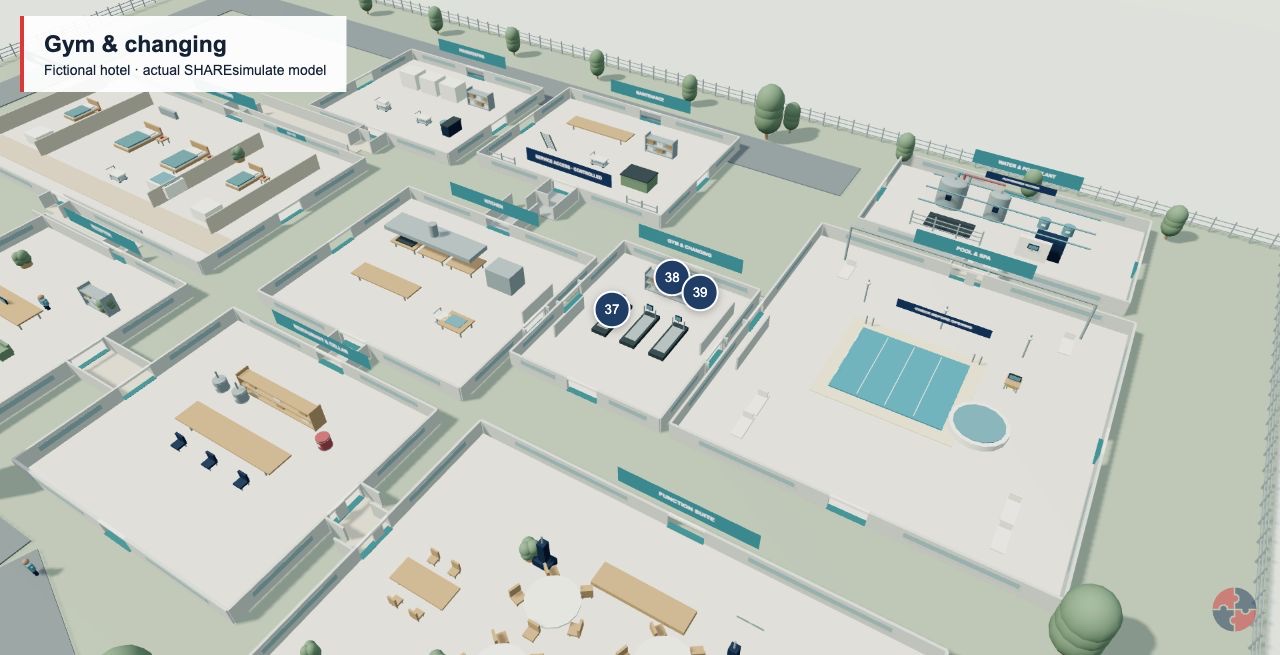
Work through 5 required applied activities and 3 model-practice pauses, with explanatory feedback and independent lesson decisions. Complete 9 distinct model mission sequences across those pauses. Use the actual fictional Riverside hotel, pool and leisure model or its equivalent accessible route to complete the required decision sequences; launching the model alone does not complete practice.
The 20-question assessment requires at least 80% plus every designated critical safety answer. Complete the required activities, practice and lesson checks. Points and badges cannot offset a critical safety error.
Use the LMS for confirmed save/resume and recorded results. Any certificate follows its configured passed-completion and grade conditions.
Open the public interactive practice copy; public practice is separate from the LMS record.
Sources and learning provenance
Original fictional cases are paired with public SHAREhub teaching and structured topic records. Use the applicable jurisdiction and primary guidance for live work.
- HSE · maintenance of work equipment
- HSE · first aid at work
- HSE · work on electrical equipment
- HSE · swimming pool safety management
- HSE · HSG179, Health and safety in swimming pools
- PWTAG · pool water treatment Code of Practice (industry technical guidance)
- HSE · HSG282, spa-pool infection control
- HSE · causes and prevention of slips
Topic sections, source identities and versions
| Public topic | Chunk and version | Jurisdiction and sources |
|---|---|---|
| hazard-identification-and-risk-assessment-foundations · uncertainty | hazard-identification-and-risk-assessment-foundations--uncertainty | Great Britain, Northern Ireland source-hse-risk, source-hseni-risk |
| slips-and-trips · control-hierarchy | slips-and-trips--control-hierarchy | Great Britain slips-and-trips--hierarchy, slips-and-trips--hsemodel, slips-and-trips--retail, share-hierarchy-hse, share-hierarchy-iosh |
| legionella-management · control-scheme | legionella-management--control-scheme 2026-10-02-additive-1 | Great Britain, Northern Ireland legionella-management-src-01, legionella-management-src-03 |
| emergency-procedures-and-first-aid-needs · coverage | emergency-procedures-and-first-aid-needs--coverage 2.2 | Great Britain, Northern Ireland hse-firstaid-needs, hse-firstaid-employer, hse-emergency, hseni-firstaid |
| guards-and-machinery-interlocks · intervention | guards-and-machinery-interlocks--intervention 2.4 | Great Britain, Northern Ireland src-guards-hse-maint, src-guards-hse-quarry, src-guards-l22, src-guards-hse-interlock |
| electrical-control-measures-safe-systems-and-inspection · controls | electrical-control-measures-safe-systems-and-inspection--controls 2.2 | Great Britain, Northern Ireland hse-intro, hse-hsg85, hse-rights-06, www-hse-gov-uk-electricity-maintenance-isolate-htm, share-hierarchy-iosh |
Course SH-HOTEL-06 · version 2026.10.20.hotel.2. .
Questions about this course
Is this training free?
Full public teaching and readers are free without an account. A free learner account is required for saved LMS progress and recorded assessment. Completion and any course-completion certificate depend on the configured LMS conditions.
How long should I allow?
Approximately 160–250 minutes, including teaching, lesson checks, required activities, model or accessible practice and one assessment attempt. Individual pace, review and retries vary. Save and resume in the LMS.
Can I learn without a 3D-capable browser?
Yes. The complete HTML reader provides the teaching. Required model practice has an equivalent accessible decision route in the interactive course. Use the LMS route for recorded learning.
What is required to pass?
Complete the required learning, activities, practice and lesson decisions. The 20-question final assessment requires at least 80% plus every designated critical safety answer. Points cannot compensate for a critical safety error. Follow the feedback before retrying.
Does this authorise hotel or leisure work?
Independent hotel, pool and leisure awareness using the fictional Riverside model. GB workplace guidance; apply corresponding NI and nation-specific arrangements. England-specific fire guidance is labelled. Learning does not establish practical competence, clinical advice, specialist work or operational authority. This independent course does not award an external qualification or replace competent task assessment, practical training or site authorisation.