SHARE Knowledge Hub
Berylliosis and chronic beryllium disease
Berylliosis, more formally known as chronic beryllium disease, is an occupational lung disease caused by an immune reaction after exposure to airborne beryllium dust, fume or mist. It is different from ordinary dust overload because a person can first become sensitised, then develop granulomatous lung inflammation that may reduce breathing capacity and progress over time. Higher-risk work includes machining, grinding, finishing, welding, recycling, ceramics, specialist electronics, aerospace components and maintenance involving beryllium-containing materials. Prevention depends on identifying beryllium, controlling airborne and skin contamination, monitoring exposure and using health surveillance where indicated.
Understanding Berylliosis and chronic beryllium disease
Berylliosis, more formally known as chronic beryllium disease, is an occupational lung disease caused by an immune reaction after exposure to airborne beryllium dust, fume or mist. It is different from ordinary dust overload because a person can first become sensitised, then develop granulomatous lung inflammation that may reduce breathing capacity and progress over time. Higher-risk work includes machining, grinding, finishing, welding, recycling, ceramics, specialist electronics, aerospace components and maintenance involving beryllium-containing materials. Prevention depends on identifying beryllium, controlling airborne and skin contamination, monitoring exposure and using health surveillance where indicated.
Why this matters at work
Confirm the actual material composition and residues, then identify work that can release dust, fume or contamination. Include machining, heating, maintenance, cleaning, waste and recycling as relevant. An alloy name, intact component or job title cannot establish the exposure pathway, and not every copper alloy or electronic component contains beryllium. Obtain reliable product and process information rather than inferring composition from appearance. Assess who can inhale material or encounter contaminated surfaces, swarf or soluble compounds, including people outside normal production. Prevent or minimise release through suitable task and engineering controls and verify them during the complete cycle. The guide addresses beryllium as a chemical hazard; it is not a biological infection topic. Keep exposure evidence distinct from clinical conclusions. A normal-looking worker or absence of recorded disease cannot demonstrate control, and a previous survey may not cover cleaning or intrusive work. GB and NI COSHH instruments are separate, with the actual assessment and surveillance decisions requiring competent advice.
Preserve the original survey and clearly identify uncovered stages. Record protective action, responsibilities and the evidence needed to verify the revised complete cycle. Check whether tools, clothing or waste transfer contamination beyond the area and whether maintenance presents a similar gap. Explain the revised method and stop points to cleaners and supervisors and observe its use under representative conditions. Where exposure or symptoms raise concern, support the separate occupational-health pathway while continuing technical correction. No clinical examination can retrospectively approve the old cleaning method, and no universal numerical surface-clearance criterion is supplied by this example.
How organisations manage this in practice
The guide does not prescribe one universal test panel or interval for every worker. In particular, the saved silica surveillance supplement is about a different hazard and its protocol must not be imported into beryllium work. Explain purpose, results, confidentiality, restrictions and follow-up through competent clinical arrangements. Use adverse findings to review exposure prevention and similarly exposed groups without treating surveillance as a replacement for engineering controls. Maintain necessary employer health records separately from clinical notes. A reassuring test does not establish that current cleaning, extraction or maintenance controls work, and an abnormal result needs professional interpretation rather than an automatic employment decision.
Beryllium sensitisation is a specific immune response and may be detected without symptoms or established lung disease. Chronic beryllium disease involves sensitisation with evidence of lung involvement. Specialist diagnosis can require several types of evidence and may involve uncertainty. These concepts are not interchangeable with acute lung injury, dermatitis or lung cancer, even though prevention of exposure matters to all of them.
Define the accepted condition of enclosure and extraction and make the pre-start check usable. Uncertain material identity, a damaged enclosure or extraction outside its accepted condition should trigger the defined hold point and competent review before generation begins. A previous shift's signature is not evidence that the system performs today. Workers need a practical route to pause work without pressure to improvise.
Anyone with breathlessness, persistent cough, unexplained fatigue, falling exercise tolerance, abnormal lung tests or concern about beryllium exposure should seek qualified medical or occupational health assessment. Work that may generate beryllium dust, fume or mist should be controlled before further exposure continues.
Reach care quickly and verify the material before work
Separate exposure, sensitisation and chronic beryllium disease. A suspected material or symptom needs the appropriate assessment; it is not a manager diagnosis. For severe breathing difficulty, use the linked NHS emergency route without waiting for occupational-health confirmation.
Confirm the material before creating dust or fume
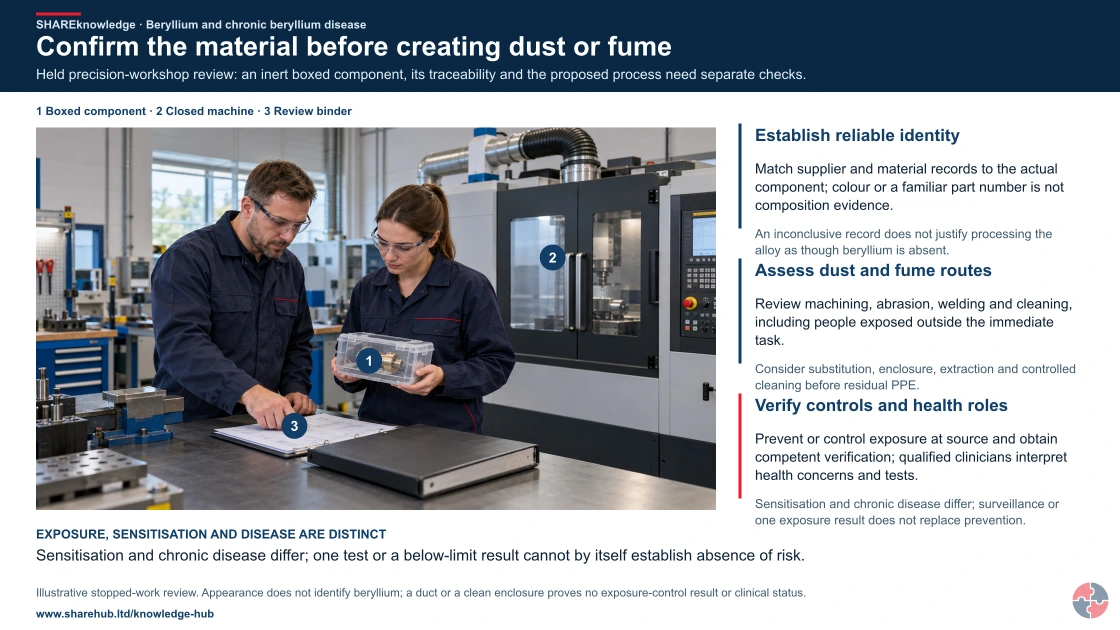
Full written explanation
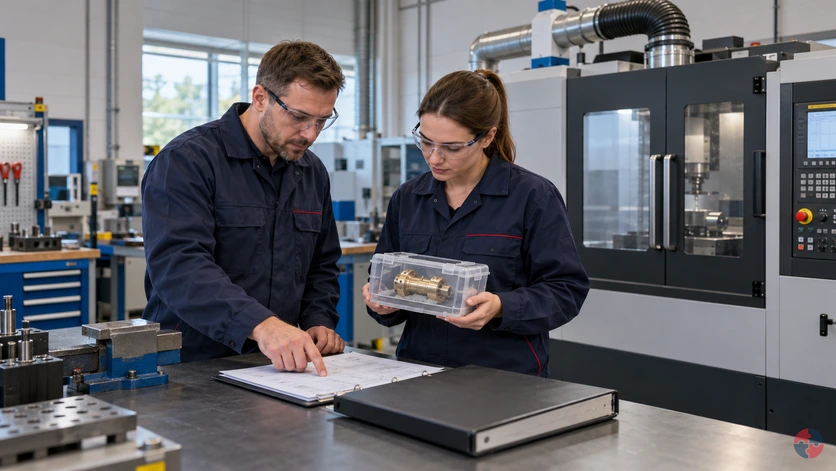
Held precision-workshop review: an inert boxed component, its traceability and the proposed process need separate checks. Picture key: 1 Boxed component · 2 Closed machine · 3 Review binder. Illustrative stopped-work review. Appearance does not identify beryllium; a duct or a clean enclosure proves no exposure-control result or clinical status.
Held precision-workshop review: an inert boxed component, its traceability and the proposed process need separate checks.
- Establish reliable identity. Match supplier and material records to the actual component; colour or a familiar part number is not composition evidence.
- Assess dust and fume routes. Review machining, abrasion, welding and cleaning, including people exposed outside the immediate task.
- Verify controls and health roles. Prevent or control exposure at source and obtain competent verification; qualified clinicians interpret health concerns and tests.
Change the pathway
- Keep uncertainty explicit. An inconclusive record does not justify processing the alloy as though beryllium is absent.
- Control the full work cycle. Consider substitution, enclosure, extraction and controlled cleaning before residual PPE.
- Do not infer a diagnosis. Sensitisation and chronic disease differ; surveillance or one exposure result does not replace prevention.
Evidence check: Sensitisation and chronic disease differ; one test or a below-limit result cannot by itself establish absence of risk.
Existing urgent breathing and occupational-health response routes
Primary references: HSE: Beryllium and you (hazard-awareness overview) · NHS: shortness of breath and when to obtain help · OSHA: sensitisation and CBD mechanisms (US scientific background, not UK legal limits)
Open the complete HD image (new tab)Download image

Existing urgent breathing and occupational-health response routes
Primary references: HSE: Beryllium and you (hazard-awareness overview) · NHS: shortness of breath and when to obtain help · OSHA: sensitisation and CBD mechanisms (US scientific background, not UK legal limits)
Before machining, welding or contaminated cleaning, establish reliable material identity and the actual route of dust or fume. Keep WEL context and specialist test limitations with any shortened answer. A result below a limit or an inconclusive composition record cannot establish absence of risk.
The alloy certificate is inconclusive
Illustrative example. A machinist is asked to process an alloy component whose available record does not reliably establish composition.
Decision. Hold machining and obtain suitable material evidence and a competent task/control assessment.
Evidence to check. Record supplier/material traceability, dust/fume-generating operations, contamination boundaries and extraction verification.
Hold or escalation point. No release from appearance, a familiar part number or an unrelated air result.
Follow-up. The owner verifies composition and source control before release, then reviews actual machining and cleaning.
Check the alloy before the first run
A material description such as “special alloy” cannot establish its beryllium content. Resolve identity and the dust-generating operation before machining, cleaning or maintaining the equipment.

- Verified workpiece identity
- Enclosed source and capture
- Controlled cleaning / clean boundary
Read the labels in the full-size drawing
- VERIFIED MATERIAL
- ENCLOSED MACHINE
- Capture / swarf / clean boundary
- Verify the actual task
Identity
Match the actual stock, supplier evidence and process history. If composition is unknown, hold the work and obtain competent advice rather than infer it from appearance.
Source and transfer
Assess machining, enclosure/extraction, swarf handling and maintenance. Trace airborne exposure and contaminated surfaces or clothing into the clean area.
Operation and assurance
The operating method states how containment, cleaning and access work. The assurance record separately shows examination, task-representative exposure evidence, defects and action closure.
Neither a normal-looking enclosure nor a sensitisation result proves that current exposure is controlled. Health surveillance and diagnosis belong to the qualified health route; do not substitute an immune test for task-control evidence.
What are the key facts about berylliosis?
The key facts are that berylliosis is immune-mediated, respiratory, potentially progressive and preventable through exposure control.
Terms used below: TWA means time-weighted average; ALARP means as low as reasonably practicable; SDS means safety data sheet. An SDS helps identify supplied material hazards but does not replace confirming the actual alloy composition.
Sensitisation is important
A worker may become immunologically sensitised before obvious disease develops.
Fine airborne material is the main concern
Dust, fume and mist from machining, grinding, welding or cleaning can reach the lungs.
Skin contamination also matters
Skin contact may contribute to sensitisation and can spread contamination.
Symptoms can be delayed
Breathlessness and cough may appear months or years after exposure begins.
Control is more than a WEL
Exposure limits are not the whole answer; carcinogen and sensitisation risks need strong control.
Health surveillance can be critical
Surveillance may detect sensitisation or early disease before severe disability develops.
What is berylliosis?
Berylliosis is chronic beryllium disease, a granulomatous lung disease caused by immune reaction to beryllium exposure.
Beryllium is a light metal used in specialist alloys, ceramics and high-performance components because it can provide strength, stiffness, heat resistance and electrical or thermal properties. Those same specialist uses can hide the hazard from people who only see a finished part.
Berylliosis usually refers to chronic beryllium disease. It is not simply dust scarring caused by a large dust burden. The body becomes sensitised to beryllium, then the immune system can react in the lungs, creating granulomas and inflammation that may impair breathing.
The disease can resemble other respiratory conditions, including asthma, infection or sarcoidosis. That makes occupational history essential: a clinician needs to know whether the person has worked with beryllium-containing materials, dusts, fumes or contaminated areas.
Condition name. Berylliosis or chronic beryllium disease. Occupational lung disease linked to beryllium exposure.
Related term. Beryllium sensitisation. Immune reactivity that may precede disease.
Main body system. Lungs and intrathoracic lymph nodes. Respiratory symptoms and fitness for work may be affected.
Typical onset. Often delayed and gradual; acute beryllium lung injury is now less common. Exposure history may go back years.
Progression. Can persist or worsen over time. Further exposure should be prevented where disease or sensitisation is suspected.
Workplace relevance. Machining, grinding, welding, ceramics, aerospace, electronics and maintenance. COSHH assessment and exposure control are essential.
What is beryllium sensitisation?
Beryllium sensitisation is an immune response where the body becomes reactive to beryllium before or alongside lung disease.
Sensitisation is a key concept because it explains why berylliosis is not a simple dose-only dust disease. Some people become sensitised and may later develop chronic beryllium disease if exposure continues or if the immune reaction progresses.
A sensitised person may have no symptoms at first. That means symptom reporting alone is not enough to confirm that controls are working. Health surveillance and specialist testing may be considered where beryllium exposure is significant.
Workplaces should prevent both inhalation and skin contamination because skin exposure to beryllium particulate may play a role in sensitisation.
Exposure. Contact with beryllium dust, fume, mist or contamination. Starts the risk pathway.
Sensitisation. Immune system becomes reactive to beryllium. May exist before symptoms.
Chronic beryllium disease. Lung inflammation and granuloma formation in a sensitised person. Can reduce lung function and work capacity.
Progression. Disease may worsen with continuing exposure. Removal from exposure may be needed.
Surveillance. Checks for early signs of sensitisation or disease. Supports earlier intervention.
Control failure. Continued exposure after sensitisation. Can increase risk of developing or worsening disease.
A positive beryllium lymphocyte proliferation test (BeLPT) can support evidence of sensitisation. It does not by itself diagnose chronic beryllium disease; a specialist assesses lung involvement and other causes. No workplace manager should infer fitness or disease from one test result.
The IIAC disease-prescription review explains why occupational history matters when chronic beryllium disease resembles other granulomatous lung disease. It informs the mechanism here; diagnosis, interpretation of testing and individual restrictions belong to the specialist clinician.
How can beryllium enter the body and what forms does it take at work?
Beryllium mainly enters the body through inhalation of airborne dust, fume or mist, with skin contamination also relevant.
The highest risk usually occurs when beryllium-containing material is mechanically or thermally worked. Cutting, machining, grinding, polishing, sanding, drilling, blasting, welding or high-temperature processing can generate fine airborne particles.
Beryllium may be present in metallic beryllium, copper-beryllium alloys, beryllium oxide ceramics, specialist electronic components, aerospace parts, defence components, recycled materials, filters, dust extraction systems and contaminated work areas.
Settled dust is not harmless. If it is disturbed by dry sweeping, compressed air, vibration or poor cleaning, it can become airborne again and spread beyond the task area.
Dust inhalation. Machining, grinding, sanding or dry cleaning releases fine particles. LEV, wet methods, enclosure and housekeeping.
Fume inhalation. Welding or thermal work on beryllium-containing alloys. Process control, ventilation and RPE where needed.
Mist or aerosol. Wet processes or high-energy cleaning create droplets. Enclosure, extraction and splash control.
Skin contact. Dust or contaminated surfaces contact skin. Gloves, hygiene and clean/dirty segregation.
Contaminated clothing. Dust leaves the work area on garments or shoes. Changing, laundering and decontamination arrangements.
Maintenance residues. Filters, LEV ducting or machines contain settled dust. Permit, isolation, cleaning method and PPE/RPE.
What causes berylliosis at work?
Berylliosis is caused by exposure to airborne beryllium after a worker becomes sensitised to beryllium.
The immediate cause is exposure to beryllium-containing particulate, usually by inhalation. The underlying cause is often failure to identify beryllium in the material, failure to control dust or fume at source, weak housekeeping, poor maintenance or lack of health surveillance.
Risk depends on material composition, particle size, task energy, ventilation, frequency, duration, control reliability, skin contamination and individual susceptibility. A job may be low risk when the material is intact, but high risk when it is cut, ground, welded, blasted or cleaned.
Maintenance and cleaning deserve particular attention because workers may disturb hidden contamination without recognising that beryllium is present.
Machining and grinding. Creates respirable dust and contaminated swarf. Dry cutting, poor extraction and manual finishing.
Welding or heating. Creates metal fume and airborne particles. Repair, fabrication and thermal cutting.
Abrasive blasting. Can release beryllium from surfaces or contaminated media. Legacy components and uncontrolled blasting areas.
Ceramic processing. Beryllium oxide dust may be generated. Shaping, finishing, repair and waste handling.
Maintenance cleaning. Settled dust is disturbed and resuspended. LEV, filters, ducts, machinery and enclosures.
Poor hygiene. Dust spreads to skin, clothing and welfare areas. Dry sweeping, compressed air and no decontamination.
What is the damage mechanism of berylliosis?
The damage mechanism is a cell-mediated immune reaction that causes granulomatous inflammation in the lungs.
Resolve unknown alloy before abrasive processing
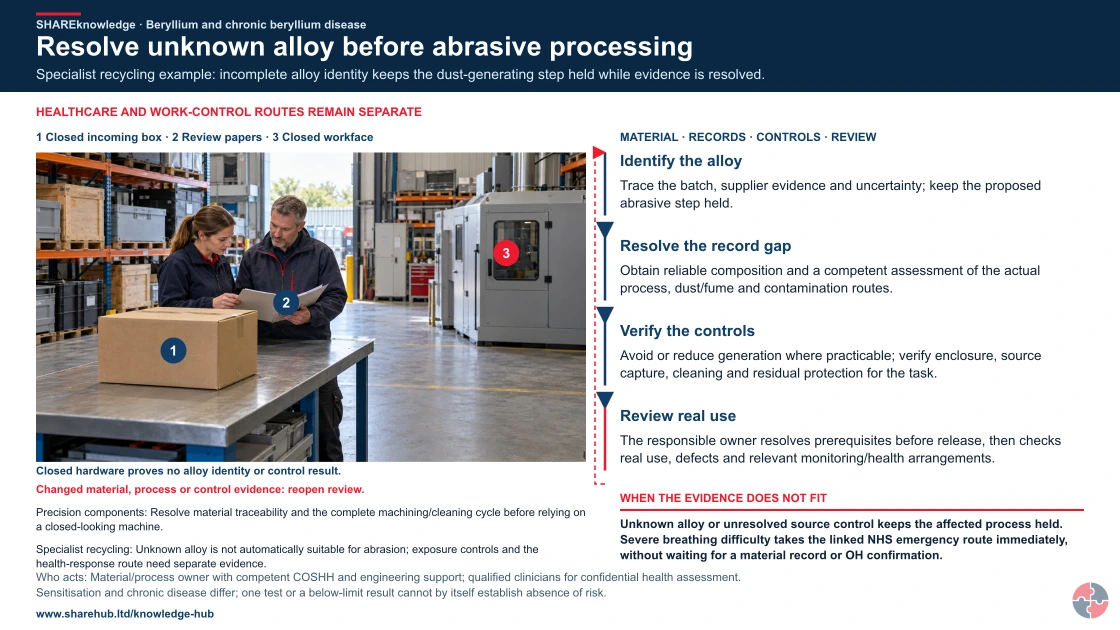
Full written explanation
An illustrative UK specialist-recycling receiving setting shows an opaque closed incoming box on a table, normal adults reviewing inert papers, ordinary racks and a distant closed-front processing workface. One literal picture key identifies 1 closed incoming box, 2 review papers and 3 closed workface. The contents of the box are unseen; appearance does not identify an alloy, beryllium content or contamination status. Closed hardware is not verification of isolation, suitability, containment, extraction, cleaning, residual protection or permission. No opening, processing, abrasion, material handling, particles, sampling, testing or cleaning is demonstrated. Four assessment checks follow: Identify the alloy: Trace the batch, supplier evidence and uncertainty; keep the proposed abrasive step held. Resolve the record gap: Obtain reliable composition and a competent assessment of the actual process, dust/fume and contamination routes. Verify the controls: Avoid or reduce generation where practicable; verify enclosure, source capture, cleaning and residual protection for the task. Review real use: The responsible owner resolves prerequisites before release, then checks real use, defects and relevant monitoring/health arrangements. Three forward arrows show the assessment review order, not an operating recipe or automatic release. Changed material, process or control evidence reopens the affected review. HEALTHCARE AND WORK-CONTROL ROUTES REMAIN SEPARATE. Unknown alloy or unresolved source control keeps the affected process held. Severe breathing difficulty takes the linked NHS emergency route immediately, without waiting for a material record or OH confirmation. Who acts: Material/process owner with competent COSHH and engineering support; qualified clinicians for confidential health assessment. Sensitisation and chronic disease differ; one test or a below-limit result cannot by itself establish absence of risk. Precision components: Resolve material traceability and the complete machining/cleaning cycle before relying on a closed-looking machine. Specialist recycling: Unknown alloy is not automatically suitable for abrasion; exposure controls and the health-response route need separate evidence. Healthcare and qualified confidential clinical interpretation remain independent of material records, occupational-health confirmation or a work-release decision. No disease, sensitisation, clinical test, fitness or control-performance conclusion is shown.
Specialist recycling example: incomplete alloy identity keeps the dust-generating step held while evidence is resolved.
- Identify the alloy. Trace the batch, supplier evidence and uncertainty; keep the proposed abrasive step held.
- Resolve the record gap. Obtain reliable composition and a competent assessment of the actual process, dust/fume and contamination routes.
- Verify the controls. Avoid or reduce generation where practicable; verify enclosure, source capture, cleaning and residual protection for the task.
- Review real use. The responsible owner resolves prerequisites before release, then checks real use, defects and relevant monitoring/health arrangements.
When the evidence does not fit: Unknown alloy or unresolved source control keeps the affected process held. Severe breathing difficulty takes the linked NHS emergency route immediately, without waiting for a material record or OH confirmation.
Who acts: Material/process owner with competent COSHH and engineering support; qualified clinicians for confidential health assessment.
Changed workplace
Precision components: Resolve material traceability and the complete machining/cleaning cycle before relying on a closed-looking machine.
Specialist recycling: Unknown alloy is not automatically suitable for abrasion; exposure controls and the health-response route need separate evidence.
Evidence check: Sensitisation and chronic disease differ; one test or a below-limit result cannot by itself establish absence of risk.
Existing urgent breathing and occupational-health response routes
Primary references: HSE: Beryllium and you (hazard-awareness overview) · NHS: shortness of breath and when to obtain help · OSHA: sensitisation and CBD mechanisms (US scientific background, not UK legal limits)
Open the complete HD image (new tab)Download image

Existing urgent breathing and occupational-health response routes
Primary references: HSE: Beryllium and you (hazard-awareness overview) · NHS: shortness of breath and when to obtain help · OSHA: sensitisation and CBD mechanisms (US scientific background, not UK legal limits)
Beryllium exposure is an immune-system hazard


Read the complete visual as text
- SOURCE: Machining, grinding or other disturbance of beryllium-containing material can produce airborne dust, fume or mist.
- EXPOSURE: Airborne material can be breathed in; contaminated surfaces and skin also need control. A familiar-looking alloy is not identification.
- HARM: Sensitisation can precede chronic granulomatous lung inflammation. Symptoms and exposure records do not alone diagnose the condition.
- INTERRUPT THE ROUTE: Consider finished parts or safer alternatives; otherwise use enclosure, source capture, controlled cleaning and exposure verification.
In a sensitised person, beryllium can trigger immune cells to react in lung tissue. The reaction produces granulomas, which are organised clusters of inflammatory cells. Over time, inflammation may impair gas exchange and contribute to scarring or reduced lung function.
This mechanism explains why two workers with similar work histories may have different outcomes. Susceptibility and immune response matter as well as exposure level. It also explains why continuing exposure after sensitisation is a serious concern.
Early recognition can help prevent further exposure and support specialist assessment, but established disease may not fully reverse.
Exposure pathway. Airborne beryllium reaches the lungs. Control respirable dust and fume at source.
Sensitisation. Immune system becomes reactive to beryllium. Surveillance may detect risk before symptoms.
Granuloma formation. Inflammatory cell clusters form in lung tissue. Symptoms may resemble other lung diseases.
Lung impairment. Inflammation and scarring reduce breathing capacity. Work restrictions may be needed.
Aggravating factor. Continued exposure can worsen disease. Remove from exposure where advised.
Long-term impact. Persistent breathlessness, fatigue and reduced lung function. Long-term occupational health support may be needed.
What are the typical symptoms of berylliosis?
Typical symptoms include breathlessness, cough, fatigue and reduced exercise tolerance, often developing gradually.
Early symptoms can be subtle. A worker may notice breathlessness on stairs, reduced stamina, a dry cough or fatigue that is not explained by ordinary workload. Symptoms may be mistaken for asthma, chest infection, ageing, low fitness or stress.
More advanced disease may involve persistent cough, worsening breathlessness, chest discomfort, fever, night sweats, weight loss and significant limitation in physical activity. The pattern is not diagnostic on its own, so occupational exposure history is essential.
Workers should report respiratory symptoms where beryllium exposure is possible. Managers should respond by reviewing exposure controls as well as signposting to medical or occupational health assessment.
Early. Mild breathlessness, dry cough, fatigue or reduced exercise tolerance. Possible early respiratory effect requiring assessment.
Moderate. Persistent cough, breathlessness on exertion, chest discomfort or reduced stamina. Lung function may be affected.
Advanced. Marked breathlessness, weight loss, fever, night sweats or major fatigue. Specialist assessment and work restriction may be needed.
Sensitisation only. No symptoms may be present. Surveillance and exposure prevention remain important.
Confusing presentation. Symptoms resemble asthma, infection or sarcoidosis. Occupational history and specialist tests are important.
How can berylliosis affect working life and future health?
Berylliosis can reduce breathing capacity, stamina, respirator tolerance and fitness for physically demanding or safety-critical work.
Breathlessness and fatigue can make manual handling, climbing stairs, emergency response, work at height, confined space entry, respirator use, long shifts and hot environments harder or unsafe.
Some workers may need removal from further beryllium exposure, redeployment, adjusted duties, occupational health review or specialist respiratory follow-up. The effect on work depends on lung function, symptoms, treatment, exposure control and the demands of the role.
The long-term health impact can include persistent respiratory disability and increased concern about cancer risk, so prevention and early recognition are important.
Breathing capacity. Reduced ability to climb, walk, carry or respond. Persistent respiratory limitation.
Fatigue. Reduced stamina and concentration. Long-term reduced capacity.
RPE tolerance. Respirators may be harder to wear. Role restrictions or alternative controls needed.
Safety-critical work. Emergency response or high-risk tasks may be affected. Fitness-for-work review.
Exposure suitability. Further beryllium work may be restricted. Redeployment or removal from exposure.
Mental wellbeing. Concern about chronic disease or cancer risk. Need for clear communication and support.
Which industries and occupations are most at risk of berylliosis?
Risk is highest where beryllium-containing materials are processed in ways that generate airborne dust, fume or mist.
Beryllium is specialist enough that some workers may not realise it is present. Procurement, material certificates, Safety Data Sheets (SDS), engineering drawings and legacy asset information should be checked before machining, grinding or maintenance begins.
Risk is task-driven. Handling a finished component may be lower risk, while grinding, blasting, welding or cleaning the same component may be high risk. Bystanders and cleaners can also be exposed if contamination spreads.
Contractors are particularly vulnerable when they enter unfamiliar sites or work on legacy equipment without reliable material information.
Aerospace and defence. Machinists, engineers, maintenance contractors. Machining or repairing high-performance components.
Electronics and ceramics. Technicians, ceramic processors, maintenance workers. Beryllium oxide processing or contaminated equipment work.
Metal alloy manufacture. Foundry, casting, machining and finishing workers. Copper-beryllium alloy production and finishing.
Welding and fabrication. Welders and fabricators. Fume from beryllium-containing alloys.
Recycling and waste. Dismantling and recycling workers. Unknown components and dust release.
Abrasive blasting and cleaning. Blasters, cleaners and supervisors. Surface contamination and airborne particulate.
What should someone do if they think they have berylliosis?
A person concerned about berylliosis should avoid further exposure where safe, report the concern and seek qualified medical or occupational health assessment.
The worker should report symptoms and give a clear work history: materials handled, tasks carried out, controls used, duration, frequency, monitoring results and whether they were involved in machining, grinding, welding, blasting or contaminated cleaning.
The workplace should review the COSHH assessment, material identification, exposure monitoring, LEV, RPE, housekeeping, health surveillance and whether other workers may have similar exposure.
Call 999 for severe breathing difficulty, collapse, blue or grey lips/skin, or other emergency signs in the NHS shortness-of-breath guidance. Activate the workplace emergency plan alongside the clinical response; do not wait for occupational-health confirmation or drive an unwell person’s own journey.
Report concern. Tell a supervisor, manager or occupational health contact. Triggers exposure and health review.
Reduce further exposure. Avoid beryllium-generating work until assessed where safe. Prevents possible worsening.
Record exposure history. List tasks, materials, controls and symptoms. Supports medical and workplace assessment.
Seek assessment. Use GP, occupational health or specialist respiratory route as appropriate. Symptoms need qualified interpretation.
Review controls. Check COSHH, LEV, RPE, monitoring and housekeeping. Protects the individual and others.
Follow up. Review surveillance, restrictions and learning. Prevents repeat exposure.
How can berylliosis be prevented at work?
Berylliosis is prevented by identifying beryllium and controlling airborne and skin contamination through the hierarchy of controls.
Prevention starts before work begins. The employer should know whether beryllium is present in materials, coatings, alloys, ceramics, residues or legacy equipment. If material information is uncertain, work that could generate dust or fume should not proceed on assumptions.
The strongest controls remove or avoid the beryllium-generating task. Where work must proceed, enclosure, LEV, wet methods, restricted access, HEPA-filtered cleaning, controlled waste, skin hygiene, suitable RPE and health surveillance may all be needed.
Dry sweeping, compressed-air cleaning, uncontrolled grinding and contaminated clothing transfer are particularly poor practices because they spread fine dust.
Eliminate. Remove beryllium or the dust/fume-generating task. Specify non-beryllium materials or buy finished parts. May be difficult for specialist components.
Reduce. Lower quantities, energy and exposure time. Low-dust methods, fewer people exposed and shorter controlled tasks. Residual sensitisation risk can remain.
Isolate. Separate beryllium work from people and clean areas. Enclosures, glove boxes, restricted rooms and clean/dirty segregation. Maintenance can breach isolation.
Control. Capture and contain airborne contamination. LEV, wet methods, HEPA vacuuming, ventilation and controlled waste. Controls need testing and maintenance.
PPE. Protect against residual inhalation and skin exposure. Suitable RPE, gloves, protective clothing and footwear controls. Vulnerable to poor fit, removal and contamination.
Discipline. Use rules, permits, supervision and hygiene. No dry sweeping, no compressed air, training and decontamination. Relies on behaviour and should support stronger controls.
What happens when contaminated equipment leaves the work area?
Include the destination of contaminated tools, filters and dismantled components in the task assessment. An enclosure can control production while a maintenance trolley later carries settled material into a clean workshop. Closing the production job is therefore different from demonstrating that the component can be handled safely by the next team. Establish what contamination may remain and how it will be contained during removal, transport, repair or disposal.
For an illustrative extraction repair, the competent task owner agrees the isolation, removal and contamination-control method before the housing is opened. Keep the removed part within the assessed containment arrangement and communicate the material hazard and handling restrictions to the receiving team. Do not send it for uncontrolled brushing or compressed-air cleaning. If the material identity or contamination status is uncertain, hold that transfer pending competent assessment. Hand-back should cover the repaired extraction system and the disposition of removed material, tools and protective clothing so the work does not merely move the exposure elsewhere.
Guidance and scope: Original SHARE maintenance-interface example applying GB COSHH exposure-control duties and HSE LEV principles. The specialist assessment must specify a suitable cleaning/containment method; no surface-clearance value, decontamination recipe or clinical conclusion is supplied. Control of Substances Hazardous to Health Regulations 2002 HSE local exhaust ventilation
How should beryllium exposure be monitored?
Beryllium exposure should be monitored where measurement is needed to prove that airborne contamination is controlled.
Exposure monitoring should focus on the tasks that generate airborne beryllium, not only routine background conditions. Machining, grinding, blasting, filter changes and maintenance may create peak exposures that are missed by general area checks.
Monitoring should be planned by competent occupational hygiene advice. It may include personal sampling, static sampling, surface contamination checks and LEV performance checks depending on the process.
Results should be interpreted with caution because beryllium is both a sensitiser and carcinogenic hazard. A result below a limit does not remove the need for good control.
Personal air sampling. Worker breathing-zone exposure. Compare with EH40 and identify task controls.
Task monitoring. Peak exposure during specific work. Improve method, enclosure, LEV and RPE.
Static sampling. Area contamination or spread. Review segregation and access control.
Surface checks. Settled dust and contamination spread. Improve cleaning and clean/dirty separation.
LEV testing. Capture and transport effectiveness. Repair and maintain before exposure increases.
Trend review. Changes over time or between tasks. Trigger management review and action.
When is health surveillance relevant for beryllium exposure?
Health surveillance is relevant where beryllium exposure could cause sensitisation or chronic beryllium disease.
Health surveillance should be decided through COSHH assessment and competent occupational health advice. For beryllium, surveillance may need to consider respiratory symptoms, lung function and specialist testing for sensitisation where appropriate.
Surveillance is not a control by itself. It is a way of detecting early effects and checking whether workplace controls are sufficient. If surveillance identifies concern, the employer should investigate exposure and prevent further harm.
Health records and medical information should be handled confidentially. Managers need clear fitness and work-restriction advice, not unnecessary clinical detail.
Exposure group. Identify who may be exposed. Risk-based surveillance population.
Symptom review. Detect cough, breathlessness or fatigue. Regular questionnaire or occupational health review.
Lung function. Checks respiratory capacity. Baseline and periodic testing where advised.
Sensitisation testing. May identify immune reactivity. Specialist advice on suitability and interpretation.
Removal from exposure. Prevents possible progression where concern exists. Occupational health restriction and manager action.
Record control. Protects confidential health information. Secure occupational health records and proportionate management advice.
HSE’s respiratory-surveillance review identifies false-positive BeLPT results and differences between laboratories, with evidence gaps about post-exposure testing intervals. An occupational clinician should select and interpret testing in context. A single result must not become a manager’s diagnosis, fitness decision or assurance that exposure controls are effective. HSE RR1221 respiratory health surveillance review
Which legal duties apply in Great Britain and Northern Ireland?
The applicable legal route depends on where the work takes place. The duties below are scoped to Great Britain and Northern Ireland; a task assessment and the current instruments determine the actual requirements.
Great Britain
GB COSHH 2002 requires assessment and prevention where reasonably practicable, or adequate control, maintenance, monitoring and health surveillance where appropriate. Beryllium is a carcinogen; HSE says carcinogen exposure should be reduced as low as reasonably practicable as well as kept below the applicable WEL. EH40 lists beryllium and its compounds (as Be) at 0.002 mg/m³ eight-hour TWA, with no separate 15-minute WEL. This is not a safe target or a diagnosis threshold.
Northern Ireland
Use the NI Health and Safety at Work Order and COSHH (Northern Ireland) 2003, not GB COSHH instrument numbers. HSENI says EH40 is approved in NI; verify the current edition and task-specific conditions. Apply exposure prevention, carcinogen control, monitoring and health surveillance according to the NI assessment and competent advice.
For Northern Ireland disease reporting, the HSENI RIDDOR (NI) booklet lists poisoning by beryllium or one of its compounds in Schedule 3 item 28. Sensitisation or a raised exposure result is not itself a poisoning diagnosis. Whether a diagnosed chronic beryllium condition meets the statutory description needs competent occupational-health and HSENI advice; record that decision without delaying clinical care or exposure control.
How should beryllium exposure appear in a risk register?
Beryllium should appear as a substance-specific respiratory and carcinogen risk linked to tasks, controls, monitoring and surveillance.
The risk register should identify where beryllium is present and what work could generate dust, fume or mist. It should not rely on generic 'metal dust' wording because the sensitisation and disease mechanism changes the control standard.
Each entry should define who is exposed, including bystanders, cleaners, maintenance staff and contractors. It should also list controls for airborne exposure, skin contamination, housekeeping, waste and decontamination.
Controls should have owners and evidence: LEV examination, exposure monitoring, health surveillance, RPE fit testing, training, cleaning records and material verification.
| Scenario | Exposure concern | Controls and evidence |
|---|---|---|
| Machining beryllium alloy | Respirable dust and contaminated swarf. | Enclosure, LEV, wet method, monitoring and cleaning. |
| Welding copper-beryllium component | Metal fume inhalation. | Material verification, welding controls, LEV and RPE. |
| Cleaning LEV filters | Settled dust release. | Permit, PPE/RPE, HEPA vacuum and waste procedure. |
| Legacy plant refurbishment | Unknown beryllium-containing parts. | Pre-work survey, SDS review and stop point. |
| Abrasive blasting | Airborne particulate and contamination spread. | Substitution, enclosure, extraction and controlled access. |
| Contractor maintenance | Unfamiliar workers disturb contamination. | Induction, permit, competence and supervision. |
How could BuildOut Ltd manage beryllium exposure?

BuildOut Ltd could manage beryllium exposure by treating specialist refurbishment and maintenance work as a controlled COSHH risk before cutting, grinding or cleaning begins.
BuildOut Ltd
BuildOut Ltd undertakes construction, refurbishment and maintenance projects, including work in specialist industrial premises where legacy components, filters, coatings or alloys may contain beryllium.
BuildOut would begin with pre-work information. Before demolition, grinding, drilling or maintenance, the project team would review client information, drawings, SDS, material certificates and legacy asset data. Where beryllium could be present, the task would be paused until a competent assessment is completed.
The project risk register would identify beryllium as a specific hazardous-substance risk, not as generic metal dust. Controls would cover elimination or substitution, enclosure, LEV, wet methods, clean/dirty segregation, HEPA-filtered cleaning, waste containment, RPE, PPE and health surveillance decisions.
Contractor management would be central. BuildOut would verify that specialist contractors understand beryllium risks, have appropriate equipment, use competent occupational hygiene advice, maintain LEV and RPE, and can produce exposure monitoring and inspection records.
Training would be layered. General site teams would be told not to disturb unknown specialist components. Operatives carrying out higher-risk work would receive task training on dust control, hygiene, RPE, PPE, waste and decontamination. Supervisors would learn to check controls before work starts and to stop work if material identity is uncertain.
Assurance would include workface inspections, LEV checks, exposure-monitoring review, health-surveillance status, RPE face-fit evidence, waste documentation and close-out of any contamination events. Lessons learned would be fed back into procurement, method statements and client information requests.
Pre-work information. Checks whether beryllium may be present before intrusive work. Client data, SDS, survey and material certificates.
Risk register. Defines beryllium-specific tasks and exposure groups. Task entries with owners and controls.
Engineering controls. Uses enclosure, wet methods, LEV and HEPA cleaning. LEV inspection and monitoring records.
Contractor management. Verifies specialist competence and equipment. Pre-start checks and contractor evidence.
Training. Separates awareness, task and supervisor competence. Training matrix and briefing records.
Assurance. Audits exposure controls, surveillance and learning. Inspection findings and action close-out.
What training is needed for beryllium exposure control?
Training should explain where beryllium is found, why it is dangerous, how exposure occurs and what controls must be used.
General awareness is useful for people who may encounter specialist materials but are not expected to work on them. The key message is simple: do not cut, grind, weld, blast or clean unknown beryllium-containing materials without assessment.
Task-specific training is needed for workers who handle or disturb beryllium-containing materials. This training should include material identification, COSHH controls, LEV, wet methods, RPE, PPE, hygiene, decontamination, waste and emergency arrangements.
Supervisors and managers need deeper training on exposure monitoring, health surveillance, contractor control, assurance and when to stop work.
Competence means a person can carry out the actual task safely, recognise a changed condition and respond correctly. Attendance alone is insufficient. The matrix makes assessment, ownership, records and reassessment explicit.
| Role | Required learning | How competence is assessed | Assessor or owner | Record | Reassess when |
|---|---|---|---|---|---|
| Workers and contractors | Identify beryllium-containing stock, inhalation/skin routes, LEV, wet cleaning, RPE and stop triggers. | Observed material check, pre-use control check and abnormal-release response. | Task supervisor | Task authorisation and check record | After material, method or control change. |
| Maintenance and cleaners | Contain dust during intrusive work, isolate services, clean with suitable wet/HEPA methods and prevent take-home contamination. | Observed setup, decontamination and hand-back. | Maintenance lead | Permit, cleaning and hand-back record | After equipment change, exposure finding or failed check. |
| Occupational hygienists | Plan representative personal sampling and interpret WEL, uncertainty, ALARP and peaks. | Peer-reviewed sampling strategy and report. | Competent hygiene lead | Exposure plan and interpretation | After process change, new result or complaint. |
| Occupational health and managers | Recognise sensitisation versus disease, refer clinically, protect confidentiality and act on surveillance signals. | Case-based review of referral and exposure-control action. | OH lead and operations manager | Surveillance and corrective-action records | After abnormal finding or programme review. |
How does berylliosis support study and professional development?
Berylliosis supports study by connecting sensitisation, respiratory disease, carcinogen control, COSHH, monitoring and health surveillance.
For NEBOSH National General Certificate learners, berylliosis is a useful example of hazardous-substance control and occupational ill health. Scenario answers should include routes of exposure, health effects, COSHH assessment, hierarchy of control, health surveillance and training.
For Diploma-level learners and occupational hygiene practitioners, the topic goes deeper. It requires understanding sensitisation, granulomatous disease, exposure measurement, health surveillance strategy, carcinogen control, worker records and management-system assurance.
For workplace professionals, berylliosis is a reminder that rare materials can create serious health risk if procurement, client information and contractor controls are weak.
New learner. Berylliosis is chronic beryllium disease. Explain exposure, sensitisation and symptoms.
NEBOSH NGC learner. COSHH requires assessment and control. Use ERICPD, training, monitoring and surveillance.
NEBOSH Diploma learner. Sensitisation and carcinogen risk need deeper analysis. Discuss occupational hygiene and health surveillance strategy.
Supervisor. Material identity and work method matter. Check before machining, grinding, welding or cleaning.
Manager. Rare hazards need strong procurement and contractor controls. Review evidence and assign owners.
Occupational health or hygiene link. Health and exposure data must be connected. Use monitoring, surveillance and confidential referral routes.
How can a management system make beryllium control robust?
A management system makes beryllium control robust by linking material identification, COSHH, engineering control, surveillance, competence and review.
Beryllium risks can be missed because the material is specialist, hidden in alloys or present in legacy equipment. The management system should connect procurement, design information, maintenance planning, contractor control, COSHH assessment and occupational health.
A management cycle helps assign leadership, planning, competence, safe operations, performance review and improvement. A voluntary management framework is a voluntary system reference; a licensed current text is needed for exact clause applications.
A mature system can answer: where is beryllium present, who may disturb it, how is exposure controlled, what evidence proves controls work and what happens if a worker becomes sensitised?
| Management-system stage | Plain-English expectation | Beryllium evidence |
|---|---|---|
| Leadership and worker participation | Leaders support conservative control and worker reporting. | Stop-work support and worker consultation. |
| Planning | Beryllium locations, tasks and exposure groups are identified. | COSHH register and risk register. |
| Support | People, information and competence are maintained. | SDS library, training and specialist advice. |
| Operation | Dust/fume tasks are controlled and supervised. | Method statements, LEV, RPE and hygiene procedures. |
| Performance evaluation | Monitoring, surveillance and inspections are reviewed. | Exposure data, LEV checks and audit findings. |
| Improvement | Exposure events and defects lead to stronger controls. | Action close-out and updated standards. |
What are the warning signs that beryllium controls are failing?
Warning signs include unknown materials, visible dust, poor cleaning, weak LEV, missing surveillance and respiratory symptoms among exposed workers.
Control failure can look ordinary: dry dust on benches, compressed-air cleaning, dusty clothing, open machining, LEV arms not positioned properly, RPE stored dirty or no one able to show whether the material contains beryllium.
These signs can cause harm by allowing fine particulate to be inhaled or spread to other workers. Because sensitisation can develop before obvious illness, waiting for symptoms is not an acceptable monitoring strategy.
The improvement action should be to stop the uncontrolled task, confirm material identity, clean safely, review COSHH and obtain competent occupational hygiene advice.
Unknown alloy or ceramic being machined. Beryllium may be disturbed without controls. Confirm material before work.
Visible fine dust. Respirable particulate may be inhaled. Stop dry work and improve capture/cleaning.
Dry sweeping or compressed air. Settled dust becomes airborne. Use HEPA vacuum and wet cleaning methods.
LEV not used or poorly positioned. Dust reaches breathing zone. Repair, test, train and supervise.
No health surveillance decision. Sensitisation or disease may be missed. Review COSHH and occupational health advice.
Respiratory symptoms in exposed workers. Possible early disease or poor control. Investigate exposure and arrange assessment.
What does the beryllium workplace exposure limit mean?
EH40 lists beryllium and beryllium compounds (as Be) at 0.002 mg/m³ as an eight-hour time-weighted average, with a carcinogen notation and no separate 15-minute WEL. State substance, units and averaging period together. A result below the WEL is not proof of no sensitisation or a licence to retain avoidable dust exposure.
Use competent personal exposure sampling and review task peaks, skin contamination, control reliability and uncertainty. A BeLPT is a specialist test for sensitisation, not an airborne exposure measure or a stand-alone diagnosis of chronic beryllium disease. Clinical assessment belongs to qualified professionals.
How should a beryllium task be controlled and released?
These examples illustrate a decision from context and prevention to stop, ownership, hand-back and recheck. They do not replace task assessment.
Unknown alloy machining: evidence before the first run


Read the complete visual as text
- 1. ACTUAL TASK: Describe the component, proposed machining and any dust-producing stages; record that composition is not confirmed.
- 2. PEOPLE AND BASIS: The material owner obtains reliable composition information; engineering and occupational hygiene define the exposure-control basis.
- 3. BEFORE: Consider removing the cutting step or buying finished parts. Otherwise plan enclosure, source capture, segregation and controlled cleaning.
- 4. VERIFY DURING: Verify LEV capture after relocation, containment, assessed RPE, competence, housekeeping and representative sampling.
- 5. HOLD OR REFER: Keep machining held for unknown composition, unverified extraction, dust escape or reliance on a mask alone.
- 6. HAND BACK AND REVIEW: Release only with recorded identity, enclosure/extraction checks, cleaning arrangements and worker briefing; unresolved defects remain held.
Precision machining of an unknown alloy
Task material and setting: A machinist receives components that may contain beryllium copper. The job would generate fine dust and the extraction hood has not been checked since relocation.
People and prerequisites: The material owner, machinist, supervisor and hygienist need the alloy composition, process plan, LEV status and COSHH assessment before authorising cutting.
Before: The material owner confirms composition before cutting. Eliminate or buy finished parts where feasible; otherwise design enclosure and source capture, segregate the area, and plan wet/HEPA cleaning and exposure verification.
During: The supervisor verifies LEV capture, containment, RPE where assessed, worker competence, housekeeping and representative sampling arrangements before authorising the first run.
Hold or stop: Hold if composition is unknown, extraction or containment is unverified, dust escapes, or worker protection relies on a mask alone.
Decision owner: Engineering owns enclosure and LEV; operations owns the task release; a hygienist interprets sampling.
Completion and hand back: Release machining only when material identity, enclosure and extraction checks, cleaning arrangements and worker briefing are recorded; unresolved defects keep the job on hold.
Evidence: Keep material evidence, COSHH assessment, LEV tests, monitoring, training and dust-control inspections.
Changed conditions: Reassess after alloy, tool, hood position, maintenance or worker findings change.
Intrusive duct maintenance
Task material and setting: A contractor opens ducting used for beryllium grinding extraction. Residual dust could be released and carried into occupied areas.
People and prerequisites: The plant owner and contractor need the duct history, isolation boundary, contamination assessment, containment plan, waste route and competent verification roles.
Before: Operations identifies contaminated sections, confirms the energy and duct isolation boundary on the permit and protects occupied areas. Maintenance specifies contained opening and filter removal, sealed waste transfer, clean and dirty zones, hygiene facilities and exclusion of bystanders.
During: Competent workers use protective clothing/RPE as assessed, suitable vacuum/wet methods and controlled filter bagging. Maintain containment through access, cleaning and waste transfer; stop if the method spreads dust into adjacent occupied space.
Hold or stop: Stop for unknown contamination, loss of containment, ineffective decontamination or unplanned occupied-area exposure.
Decision owner: The plant owner controls the permit; contractor supervises method; hygienist advises verification; OH handles worker findings.
Completion and hand back: The plant owner accepts hand-back only after waste and contamination controls are verified against the agreed assessment. Engineering records restored LEV function; the hygienist interprets exposure or contamination verification. Visual cleanliness alone does not prove safe release, and no universal clearance number is implied.
Evidence: Keep isolation and permit boundaries, contamination assessment, contained filter/waste records, hygiene checks, verification findings, defects and LEV reinstatement records with the named release decision.
Changed conditions: Reassess if the duct history, scope or adjacent occupancy differs from the plan.
Source scope: HSE/IIAC sources describe GB technical evidence, transferable as practice in NI where appropriate; separate NI COSHH and reporting duties govern NI work. Illustrative permit and release method, not a clinical protocol or universal clearance standard.
What does official guidance add to this decision?
A competent COSHH assessment must verify beryllium exposure, engineering control and appropriate health surveillance. Measurement does not itself establish clinical fitness.
Use the current HSE exposure limits and the jurisdiction-specific duties listed on this page to verify the actual task and controls.
If a contract or competent design specifies a published technical standard, obtain authorised access to its current text and check its exact scope and edition. Apply the standard only within its stated scope; this guidance does not reproduce its clauses.
Which national legal route governs this decision?
Use the rule for the place and the actual activity. These rows identify the topic-specific work-risk route; existing legal sections explain other relevant instruments.
| Direct authority | Jurisdiction | Application to this topic | Practical evidence |
|---|---|---|---|
| Control of Substances Hazardous to Health Regulations 2002 | Great Britain | GB beryllium dust and fume require COSHH assessment and control. | Applicability, task assessment, control owner and review record. |
| Control of Substances Hazardous to Health Regulations (Northern Ireland) 2003 | Northern Ireland | NI beryllium work follows its separate COSHH instrument. | Applicability, task assessment, control owner and review record. |
How can the hierarchy of controls reduce beryllium exposure and chronic beryllium disease risk?
For each controllable work hazard, the five HSE levels and ERICPD guide a specific decision. A stronger measure is assessed for feasibility before reliance on procedures or personal protection; the owner checks whether it works and stops the task on failure. HSE examples are GB regulator guidance applied as technical principles in NI, not NI law; use the separate NI legal map. See HSE five-level hierarchy of control; HSE five-level hierarchy of control
How can the ERICPD hierarchy of controls reduce beryllium exposure and chronic beryllium disease risk?

| Material harm route | Five levels and ERICPD control choice | Higher-order feasibility and risk transfer | Owner, effectiveness check and stop condition |
|---|---|---|---|
| Inhalation of beryllium dust or fume | Elimination / ERICPD Eliminate: Remove beryllium-containing operation where practicable; Substitution / Reduce: Use a verified safer material or prefinished part; Engineering / Isolate and Control: Enclose process and provide tested local exhaust ventilation; Administrative / Control and Discipline: Assess exposure, maintain controls, train and provide health surveillance when indicated; PPE / PPE: Suitable fit-tested RPE only for residual exposure. | Substitution must preserve product integrity; wet methods can add contamination or electrical risk | COSHH owner checks extraction and exposure; stop on failed capture or uncontrolled dust See HSE INDG311: Beryllium and you |
| Secondary contamination during maintenance or cleaning | Elimination / ERICPD Eliminate: Eliminate dry brushing and compressed-air cleaning; Substitution / Reduce: Use sealed disposable consumables where feasible; Engineering / Isolate and Control: Isolate, contain and HEPA-clean equipment; Administrative / Control and Discipline: Permit decontamination, waste and clothing separation; PPE / PPE: Task-assessed protective coveralls and RPE for residual particulate exposure. | Intrusive maintenance can remain necessary; wet cleaning must be compatible with equipment | Maintenance lead verifies isolation and clean release; stop on visible dust or broken containment See HSE local exhaust ventilation |
How can the ISO 45001 hierarchy of controls reduce beryllium exposure and chronic beryllium disease risk?

| Material harm route | Five levels and ERICPD control choice | Higher-order feasibility and risk transfer | Owner, effectiveness check and stop condition |
|---|---|---|---|
| Inhalation of beryllium dust or fume | Elimination / ERICPD Eliminate: Remove beryllium-containing operation where practicable; Substitution / Reduce: Use a verified safer material or prefinished part; Engineering / Isolate and Control: Enclose process and provide tested local exhaust ventilation; Administrative / Control and Discipline: Assess exposure, maintain controls, train and provide health surveillance when indicated; PPE / PPE: Suitable fit-tested RPE only for residual exposure. | Substitution must preserve product integrity; wet methods can add contamination or electrical risk | COSHH owner checks extraction and exposure; stop on failed capture or uncontrolled dust See HSE INDG311: Beryllium and you |
| Secondary contamination during maintenance or cleaning | Elimination / ERICPD Eliminate: Eliminate dry brushing and compressed-air cleaning; Substitution / Reduce: Use sealed disposable consumables where feasible; Engineering / Isolate and Control: Isolate, contain and HEPA-clean equipment; Administrative / Control and Discipline: Permit decontamination, waste and clothing separation; PPE / PPE: Task-assessed protective coveralls and RPE for residual particulate exposure. | Intrusive maintenance can remain necessary; wet cleaning must be compatible with equipment | Maintenance lead verifies isolation and clean release; stop on visible dust or broken containment See HSE local exhaust ventilation |
What do the acronyms and key terms mean?
Acronyms should be defined because beryllium control involves medical, hygiene and COSHH terms.
| Acronym or term | Full wording | Meaning in this topic |
|---|---|---|
| CBD | Chronic Beryllium Disease | The formal term commonly used for berylliosis. |
| BeS | Beryllium Sensitisation | Immune response to beryllium that may precede disease. |
| BeLPT | Beryllium Lymphocyte Proliferation Test | Specialist test used in surveillance or diagnosis contexts. |
| COSHH | Control of Substances Hazardous to Health | Main UK framework for controlling beryllium exposure. |
| WEL | Workplace Exposure Limit | Limit used when assessing airborne exposure. |
| LEV | Local Exhaust Ventilation | Engineering control used to capture dust and fume. |
| RPE | Respiratory Protective Equipment | Respirator or breathing protection used for residual airborne exposure. |
| HEPA | High Efficiency Particulate Air | Filter type used in suitable vacuum cleaning or extraction systems. |
| TWA | Time-Weighted Average | Exposure concentration averaged over the stated period, here eight hours. |
| ALARP | As Low As Reasonably Practicable | Carcinogen exposure reduction duty beyond merely meeting a WEL. |
| SDS | Safety Data Sheet | Supplier hazard and handling information; confirm alloy composition separately where needed. |