
SHARE Knowledge Hub
What should you know about COSHH control measures and health surveillance?
Identify the substance and task, prevent exposure where possible, then contain and capture it at source. Check controls in use and provide risk-based health surveillance where disease is detectable and exposure conditions justify it; surveillance never replaces prevention.
Understanding What should you know about COSHH control measures and health surveillance?
Identify the substance and task, prevent exposure where possible, then contain and capture it at source. Check controls in use and provide risk-based health surveillance where disease is detectable and exposure conditions justify it; surveillance never replaces prevention.
Why this matters at work
Health surveillance is a preventive process for specified risks, not general wellbeing screening. HSE describes relevant conditions including a disease associated with the substance, the ability to detect an adverse change and reduce further harm, and workplace conditions making disease likely. The applicable COSHH provisions and hazard-specific guidance determine the actual requirement. Obtain competent occupational-health input to select suitable methods, timing and interpretation. Use findings to investigate and improve exposure control and obtain individual advice where necessary. Explain the programme and results to workers. The provider keeps confidential clinical information, while the employer maintains appropriate health records and implements relevant work restrictions or protective action. Normal results cannot compensate for failed control, and tests alone are insufficient without interpretation and action. Review the programme after new substances, exposure changes or concerning findings. Avoid prescribing one annual test package to every worker regardless of hazard or country.
Review containment, extraction, storage, waste, PPE, emergency arrangements and any relevant DSEAR assessment. Consult users and verify control in the real task without deliberate exposure. Update controlled instructions and learning and withdraw obsolete operating information. Record the decision basis, limitations, checks and review triggers. Consider effects on nearby people and maintenance. This example does not approve a replacement chemical or select a glove or filter; the actual product, exposure and equipment evidence remain necessary.
How organisations manage this in practice
Identify the substance or process-generated hazard, form, route, people exposed and conditions of use, including cleaning, maintenance and foreseeable failures. The SDS contributes hazard information but is not itself the assessment. Prevent exposure where reasonably practicable through elimination or substitution, then select effective source and engineering controls with suitable work methods. Consider nearby people and contact or ingestion routes as well as the operator’s breathing zone. Use PPE and RPE for residual exposure, selected for the task and person, with training, maintenance and fit requirements where applicable. Verify the whole control strategy through appropriate checks and evidence rather than assuming equipment presence means adequate protection. Record significant findings, owners, instructions and stop conditions and review after relevant change or concern. GB COSHH and NI COSHH are separate instruments. Carcinogens, sensitisers and other specific hazards may require additional conditions; this answer does not replace task-specific competent assessment.
Keep the assessment connected to actual substances, tasks, exposed groups, controls and responsible people. Include operating and maintenance instructions, evidence of control performance, relevant examination and monitoring, defects and corrective action. Where required, maintain appropriate health records through the actual legal retention arrangements, keeping them distinct from confidential clinical notes. Avoid applying the five-year equipment-test period to every type of exposure or health record.
No. A formal thorough examination and test assesses the LEV system at a particular time; users and maintenance personnel still need appropriate checks between examinations. Establish what normal performance looks like from commissioning and relevant instructions. Check airflow indications, hood position, damage, blockages, connections and collection condition as appropriate. A running fan or current test label does not prove effective capture at the contaminant source.
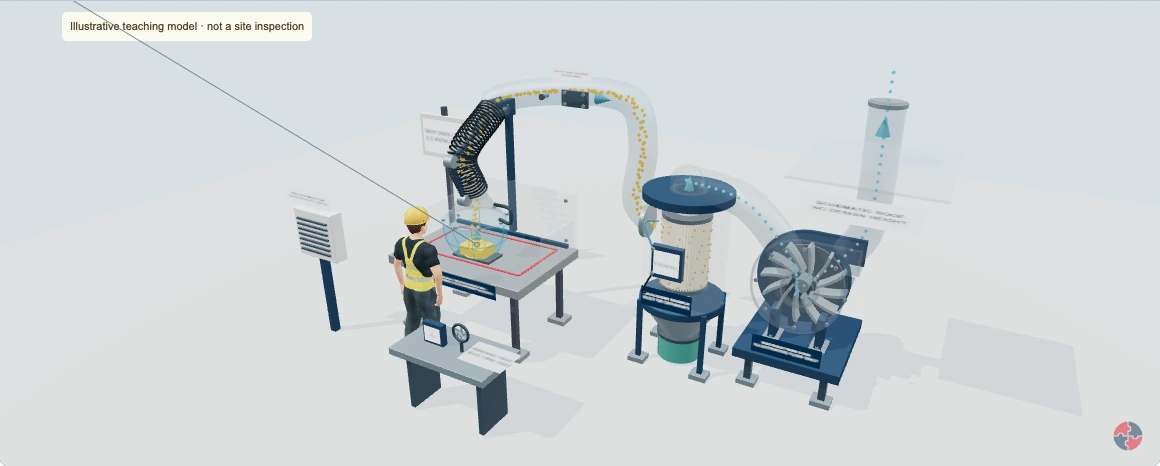

LEV: follow the harmful substance out of the breathing zone
Move the capturing hood, watch the fan draw air through connected ductwork and follow harmful dust or particulate fume away from the breathing zone. Move the work beyond the marked bench area to see why a running fan can still leave people exposed.
Checksheets and risk assessments
Equipment checksheets
Risk assessment forms
Risk assessment examples
Forms and tools
Full written walkthrough — all 13 steps
1. Identify the source, task and people
What is happening: The source marker represents airborne dust or particulate fume released by a task. The same task may expose the operator, neighbours, cleaners and maintenance staff.
How harm can occur: Contaminant reaching a breathing zone can be inhaled; the type of harm depends on the substance, exposure and person.
Best practice to apply: Assess the actual substance and work. Consider elimination, substitution and source reduction before selecting suitable extraction and other controls.
2. Position the hood close to the source
What is happening: The hood is raised. Its flexible duct and jointed support remain connected, but the source is further from the hood mouth. Use Lower hood or drag the hood-position control.
How harm can occur: The capture effect weakens rapidly with distance. A contaminant cloud can pass through the breathing zone while the fan keeps turning.
Best practice to apply: Position the hood as specified for the actual task. Use the commissioning information and a representative competent test to establish the allowed source position, height and full working movement.
Why this works: Air speed at the source matters. Neither a strong draught at the hood mouth nor the sound of a fan proves effective capture where the work happens.
LEV Local Exhaust Ventilation · What are capture zones, working zones and breathing zones?3. Lower the hood and keep the source in range
What is happening: The open flanged hood is lowered towards the source. Air is drawn towards the mouth and into the flexible duct. The red tape marks only an illustrative bench footprint; source height and the whole tool movement matter too. The translucent blue volume shows an illustrative three-dimensional capture envelope: source height and sideways distance both matter. Select Move the hood or Move the workpiece to drag them independently around the bench.
How harm can occur: A source beyond the effective capture zone can release contaminant into the worker’s or a bystander’s breathing zone, even with the fan running.
Best practice to apply: Have a competent person test the actual process, hood, source position/height, airflow and expected draughts. Mark the verified working footprint on the bench and record the maximum position/height and hood setting. Keep the full working zone inside it; change the hood or method if this is impractical. A real capture envelope must be established by representative competent testing; the blue shape is not a measured safe boundary.
Why this works: A visible position mark helps repeat the tested arrangement. It is a positioning aid, not a certificate, a universal distance or proof that changed conditions remain controlled.
LEV Local Exhaust Ventilation · What are capture zones, working zones and breathing zones?4. Watch the impeller draw air away
What is happening: The cutaway shows a slowly rotating impeller connected to a fixed motor. Press Animate fan and airflow to turn the rotor and follow the arrows from source to hood, duct, filter, fan and discharge. The real guard and casing stay closed.
How harm can occur: Loss of flow can allow the source cloud to escape; moving fan parts create separate servicing hazards.
Best practice to apply: A running fan or a single pressure indication does not prove capture. Check suitable indicators and interpret measurements against the real design/commissioning basis.
5. Stop: work has moved outside the marked area
What is happening: The workpiece moves beyond the red bench mark. The fan continues running, but most of the illustrative cloud misses the hood and escapes towards people. The same hood has less capture effect at the more distant source. Try moving the hood towards the workpiece. The teaching cloud changes when the full source moves into or out of the three-dimensional envelope; changing the real arrangement still needs verification.
How harm can occur: Dust or fume can be inhaled by the operator or nearby workers. Moving the work outside the tested capture zone can defeat otherwise functioning extraction.
Best practice to apply: Stop the contaminant-generating task. Move the work back into the verified zone, reposition the hood or choose a more suitable control. Check the indicator and have changed arrangements verified before restarting.
Why this works: A bench mark helps repeat a tested arrangement; it is not a physical wall. The hood must control the full cloud, including the edges of the work and its movement.
LEV Local Exhaust Ventilation · What are capture zones, working zones and breathing zones?6. Restore the working position and recheck
What is happening: The workpiece returns inside the illustrative footprint and the hood is lowered. The dust/fume path is drawn into the hood again in this teaching example.
How harm can occur: A different material, source height, tool movement or cross-draught may still defeat capture even after moving the work back.
Best practice to apply: Repeat the actual verified arrangement and pre-use checks. If reliable control cannot be restored, keep the task stopped and report the defect. Do not use the animation as an exposure measurement. A moved hood requires review of the new three-dimensional working zone; do not rely on the old tape mark.
LEV Local Exhaust Ventilation · What are capture zones, working zones and breathing zones?7. Carry the contaminant through the duct
What is happening: The cutaway follows the contaminant-bearing stream through connected ductwork. Flanges, access and a test point are visible.
How harm can occur: Leaks, deposits, damage or obstructions can impair control and expose people during operation or maintenance.
Best practice to apply: Use suitable design and actual inspection/measurement. The moving dots show a route, not a calculated velocity, concentration or leak test.
8. Separate suitable particles in the cleaner
What is happening: Inspect the pleated cartridge. Amber teaching particles collect on the outer media; the blue carrier-air path continues from the inner side.
How harm can occur: Damaged, unsuitable or heavily loaded media can impair control. A particulate filter does not establish removal of gases or vapours.
Best practice to apply: Select and verify cleaning appropriate to the actual contaminant and process. No filtration efficiency or safe discharge concentration is calculated.
9. Contain and handle collected material
What is happening: Follow the separated material towards the closed hopper/bin. Dust does not stop being hazardous because it has left the breathing zone.
How harm can occur: Opening, emptying or changing components may release dust; combustible material can introduce fire/explosion hazards.
Best practice to apply: Use suitable containment, isolation, waste handling and substance-specific precautions. The model does not approve collection of combustible or reactive dust.
10. Stop: the fan is off but the source can still release
What is happening: The impeller stops and the air-path arrows disappear. The source may continue releasing harmful material until the actual process is stopped or otherwise made safe.
How harm can occur: Without extraction, the contaminant can spread into the breathing zone. A hidden motor failure or disconnected supply may leave a task uncontrolled.
Best practice to apply: Stop the affected task, report the fault and follow the site procedure. Any automatic interlock needs separate design and testing; this model does not simulate one.
LEV Local Exhaust Ventilation · What are capture zones, working zones and breathing zones?11. Compare a loaded filter with a running fan
What is happening: The fan still rotates. Collected material is shown on the cartridge; slower symbolic tracers and escaped particles illustrate possible reduced capture as system resistance changes.
How harm can occur: A running motor does not prove the specified airflow. A blocked or damaged filter, leaking duct or changed system can leave people exposed.
Best practice to apply: Compare suitable airflow and pressure indicators with the actual commissioning data. Investigate defects; isolate before intrusive maintenance and control exposure to collected material.
LEV Local Exhaust Ventilation · What are capture zones, working zones and breathing zones?12. Consider discharge and replacement air
What is happening: Blue particles identify the continuing air route beyond the fan. Blue does not mean the discharge has been proven harmless.
How harm can occur: An unsuitable discharge or air-supply arrangement can expose other people or disturb capture at the source.
Best practice to apply: Assess actual contaminant removal, discharge, nearby intakes and replacement air. No dispersion, discharge height or safe separation is established.
13. Verify performance and review changes
What is happening: The measurement station connects design, commissioning, routine checks, maintenance, examination/testing and review. Its instruments do not display measured results.
How harm can occur: A system that looks intact can still leave people exposed, especially when tasks, materials or operating conditions change.
Best practice to apply: Use competent performance verification and exposure assessment where needed. Record defects and stop affected work when control is unreliable.
Illustrative awareness learning. The model does not design equipment, authorise work, verify safe conditions or complete a real inspection.
The wider workplace has its own account and subscription access. Exploring this lesson does not grant access, record course completion or authorise work.
UK guidance for further reading
HSE: local exhaust ventilationHSE HSG258: controlling airborne contaminantsHSE: COSHHHow can I practise this topic in 3D?

Welding fume misses the extraction hood

Dry cutting is proposed without its source control
An unlabelled liquid beside an open drum
All related inspection points 13 across 5 locations
Garage workshop 4 inspection points
Construction site 2 inspection points
Warehouse walkabout 1 inspection point
Riverside Leisure 3 inspection points
From flour to chilled despatch 3 inspection points
Practice in the SHAREhub environment. Browser practice is separate from workplace competence and formal learning records.
Use a health signal to review exposure rather than replace prevention
Keep three routes distinct: a task assessment identifies exposure and controls; exposure monitoring checks the work environment or personal exposure for a defined purpose; health surveillance looks for relevant early effects under a competent programme where indicated. A health-screening offer is not automatically the same thing, and a normal result does not clear uncontrolled exposure.
Best-practice guide: COSHH Control Measures And Health Surveillance
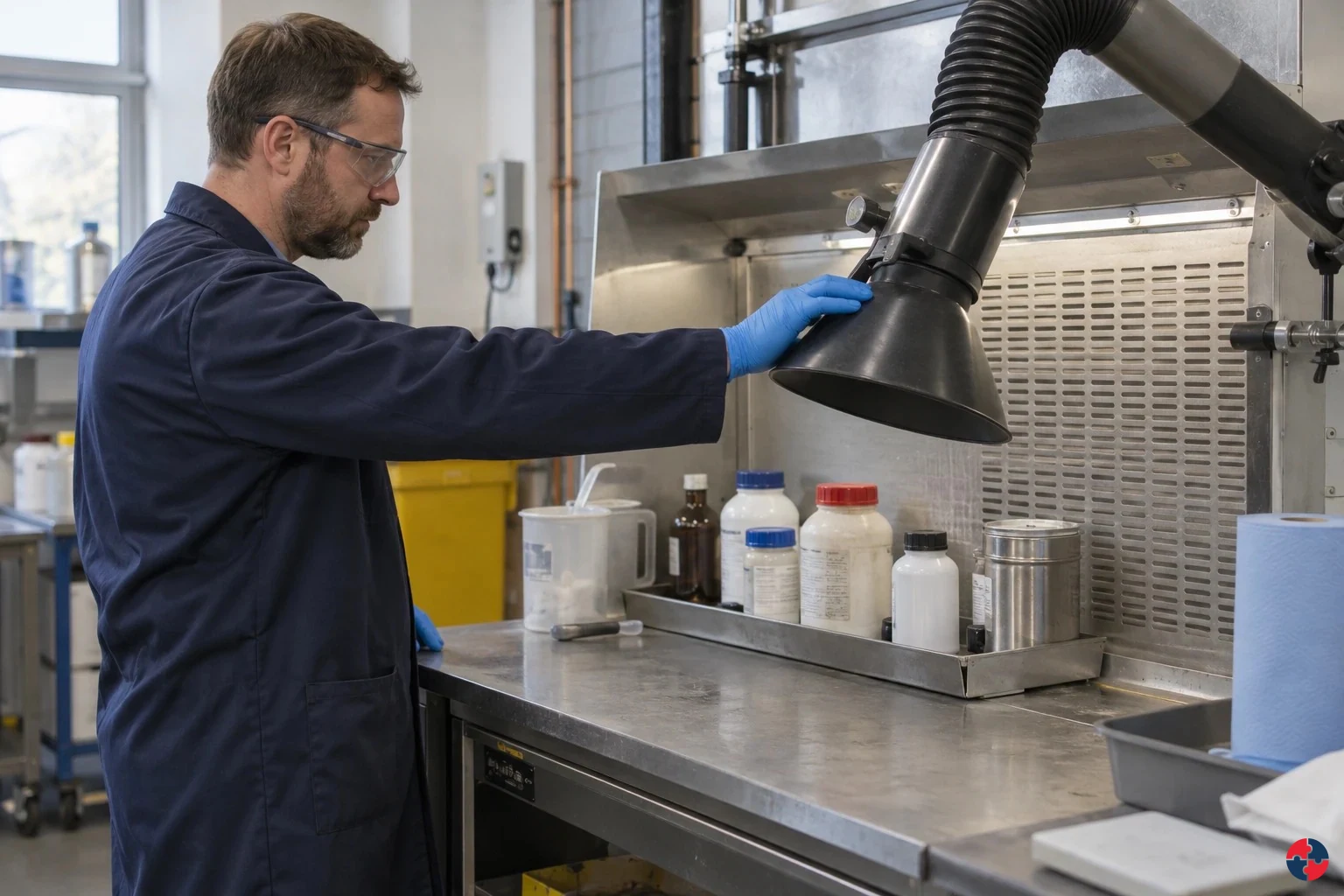
Use a health signal to review exposure rather than replace prevention
Keep three routes distinct: a task assessment identifies exposure and controls; exposure monitoring checks the work environment or personal exposure for a defined purpose; health surveillance looks for relevant early effects under a competent programme where indicated. A health-screening offer is not automatically the same thing, and a normal result does not clear uncontrolled exposure. Identify the substance and task, prevent exposure where possible, then contain and capture it at source.
Turn coshh control measures and health surveillance knowledge into a decision
Identify the substance and task, prevent exposure where possible, then contain and capture it at source. Check controls in use and provide risk-based health surveillance where disease is detectable and exposure conditions justify it; surveillance never replaces prevention. Approved product list, current SDS, task COSHH assessments, rejected substitution decisions and project review notes.
the site team COSHH example
Risk register and procurement: The company keeps a COSHH register for each project and reviews products before purchase. It challenges high-solvent, high-dust or sensitising products and looks for safer alternatives before work starts. Evidence / response: Approved product list, current SDS, task COSHH assessments, rejected substitution decisions and project review notes. Construction dust control: Dry cutting is avoided where reasonably practicable. Where cutting or grinding is necessary, teams use wet suppression, on-tool extraction, suitable vacuums, segregation and RPE selected for residual dust exposure. Evidence / response: Supervisor dust-control checks, equipment inspection records, RPE face-fit records, toolbox talks, defect logs and exposure monitoring where justified.
Exposure continues when source controls fail
Dust, fume, vapour or liquid escapes during the task. A substance can enter by inhalation, skin contact, ingestion or another assessed route. Health effects depend on the substance and exposure; surveillance does not prevent the exposure. Use the full topic for the detailed mechanism, task limits and source scope.
Choose controls for coshh control measures and health surveillance
Eliminate: Specify non-spray or off-site finished part if feasible. Substitute: Select compatible lower-hazard coating after assessment. Engineering: Extracted booth with verified clearance and safe air supply. Administrative: COSHH assessment, cleaning, maintenance and access control. PPE: Task-specific air-fed RPE and skin protection. Read the full control table for qualifications, ownership and verification. Use the actual task and applicable jurisdiction; existing technical approval remains unchanged.
Use the full coshh control measures and health surveillance lesson
Use the full topic for the decision points, practical examples, detailed control tables and source scope. HSE guidance applies to Great Britain; use HSENI for the Northern Ireland route and the source’s stated jurisdiction. A simplified guide does not change the page’s technical-review or approval status.

Read all six steps as text
1. Use a health signal to review exposure rather than replace prevention
Keep three routes distinct: a task assessment identifies exposure and controls; exposure monitoring checks the work environment or personal exposure for a defined purpose; health surveillance looks for relevant early effects under a competent programme where indicated.
- Avoid / redesign: Specify non-spray or off-site finished part if feasible.
- Control the task: Extracted booth with verified clearance and safe air supply.
- Verify before release: Designer records option; hold spray if safe no-spray route works.
Keep three routes distinct: a task assessment identifies exposure and controls; exposure monitoring checks the work environment or personal exposure for a defined purpose; health surveillance looks for relevant early effects under a competent programme where indicated. A health-screening offer is not automatically the same thing, and a normal result does not clear uncontrolled exposure. Identify the substance and task, prevent exposure where possible, then contain and capture it at source.
Apply it: Which part of this plan would you check at the workface before authorising the task?
2. Turn coshh control measures and health surveillance knowledge into a decision
Use the evidence to improve the actual work arrangement.
- Change at source: Specify non-spray or off-site finished part if feasible.
- Make it observable: Designer records option; hold spray if safe no-spray route works.
- Keep useful evidence: Approved product list, current SDS, task COSHH assessments, rejected substitution decisions and project review notes.
Identify the substance and task, prevent exposure where possible, then contain and capture it at source. Check controls in use and provide risk-based health surveillance where disease is detectable and exposure conditions justify it; surveillance never replaces prevention. Approved product list, current SDS, task COSHH assessments, rejected substitution decisions and project review notes.
Apply it: What evidence would show that the change improves this task, rather than only completing a record?
3. the site team COSHH example
Example: a practical application of the existing topic lesson.
- Risk register and procurement: The company keeps a COSHH register for each project and reviews products before purchase.
- Construction dust control: Dry cutting is avoided where reasonably practicable.
- Cement, resins and skin protection: Wet cement and epoxy products are treated as skin hazards.
Risk register and procurement: The company keeps a COSHH register for each project and reviews products before purchase. It challenges high-solvent, high-dust or sensitising products and looks for safer alternatives before work starts. Evidence / response: Approved product list, current SDS, task COSHH assessments, rejected substitution decisions and project review notes. Construction dust control: Dry cutting is avoided where reasonably practicable. Where cutting or grinding is necessary, teams use wet suppression, on-tool extraction, suitable vacuums, segregation and RPE selected for residual dust exposure. Evidence / response: Supervisor dust-control checks, equipment inspection records, RPE face-fit records, toolbox talks, defect logs and exposure monitoring where justified.
Apply it: At which point would you hold this example, and what evidence would allow it to proceed?
4. Exposure continues when source controls fail
Connect the task, the route to the person and the control that can fail.
- Release: Dust, fume, vapour or liquid escapes during the task.
- Route: A substance can enter by inhalation, skin contact, ingestion or another assessed route.
- Outcome: Health effects depend on the substance and exposure; surveillance does not prevent the exposure.
Dust, fume, vapour or liquid escapes during the task. A substance can enter by inhalation, skin contact, ingestion or another assessed route. Health effects depend on the substance and exposure; surveillance does not prevent the exposure. Use the full topic for the detailed mechanism, task limits and source scope.
Apply it: Where is this harm route present in the actual work, and which control breaks it before anyone is exposed?
5. Choose controls for coshh control measures and health surveillance
Start with the stronger practicable options and verify their effect.
- Eliminate: Specify non-spray or off-site finished part if feasible.
- Substitute: Select compatible lower-hazard coating after assessment.
- Engineering: Extracted booth with verified clearance and safe air supply.
- Administrative: COSHH assessment, cleaning, maintenance and access control.
- PPE: Task-specific air-fed RPE and skin protection.
Eliminate: Specify non-spray or off-site finished part if feasible. Substitute: Select compatible lower-hazard coating after assessment. Engineering: Extracted booth with verified clearance and safe air supply. Administrative: COSHH assessment, cleaning, maintenance and access control. PPE: Task-specific air-fed RPE and skin protection. Read the full control table for qualifications, ownership and verification. Use the actual task and applicable jurisdiction; existing technical approval remains unchanged.
Apply it: Which stronger option can be used here, and who will verify it before accepting the remaining risk?
6. Use the full coshh control measures and health surveillance lesson
Follow the official sources below and retain the task-specific evidence.
- Official guidance: HSE vehicle spray painters
- Official guidance: HSENI COSHH
- Task decision: Approved product list, current SDS, task COSHH assessments, rejected substitution decisions and project review notes.
Use the full topic for the decision points, practical examples, detailed control tables and source scope. HSE guidance applies to Great Britain; use HSENI for the Northern Ireland route and the source’s stated jurisdiction. A simplified guide does not change the page’s technical-review or approval status.
Apply it: Which official source and full-topic section will you use to resolve the next decision?
If dust-related surveillance identifies a concern, the operational owner reviews the task and control performance promptly with appropriate advice. The supervisor needs the relevant restriction and prevention actions, not a copy of spirometry or other clinical records. Do not interpret tests on the page or impose a generic annual medical. Asbestos and lead remain under their separate statutory regimes.
BuildOut: a surveillance concern reveals weak dust capture
Illustrative example. A occupational-health feedback route flags a need to review a dusty task; an inspection finds extraction not capturing effectively.
Decision. The supervisor holds the affected method while the assessment and equipment owners restore and verify source control.
Evidence to check. Task observation, extraction performance, relevant exposure information and restricted functional advice from the competent health route.
Hold or escalation point. No continued exposure based on an earlier normal surveillance result or RPE alone when required capture has failed.
Follow-up. Review similar tasks and verify the corrective control; keep medical records separate from operational restrictions.
Ask three different questions about exposure and health
Assessment specifies controls, monitoring checks relevant exposure/performance, and health surveillance can detect relevant early effects. A favourable result in one lane does not settle the others.
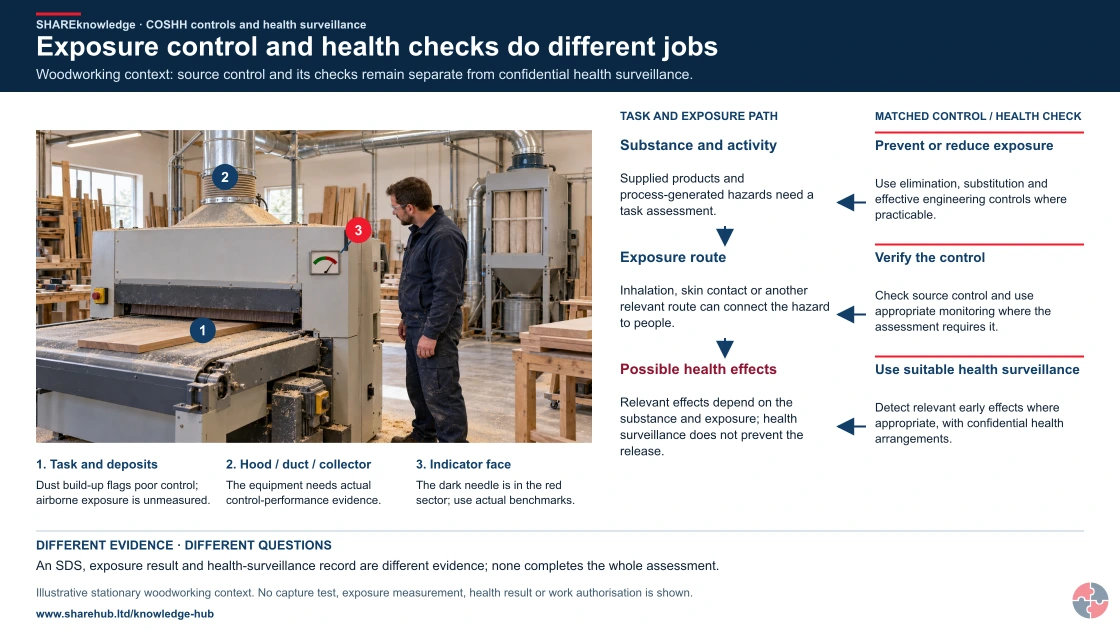
Exposure control and health checks do different jobs
Full written explanation
An illustrative stationary woodworking scene makes the task and its source-control questions visible: a workpiece and settled deposits at a machine, a hood linked to ductwork and a collector, and an indicator face. Picture key: 1 identifies the task and deposits; 2 identifies the hood, duct and collector; 3 identifies the indicator face. The dark needle points into a red sector; this supplies no numeric reading or operating benchmark. The image establishes no running or feeding operation, airborne dust concentration, material identity, available isolation, guard adequacy, extraction airflow or capture performance. All three complete causal stages remain: substance and activity; exposure route; possible health effects. Two forward arrows relate those stages. All three full matched barriers also remain: prevent or reduce exposure; verify the control; use suitable health surveillance. Three separate barrier-entry relationships connect them to the corresponding stages. Health surveillance does not prevent a release; it is suitable, risk-based health follow-up with confidential arrangements, not proof that the pictured extraction works. No symptom, clinical examination, test result, diagnosis, treatment, exposure measurement, PPE choice or work release is depicted or inferred. An SDS, exposure result and health-surveillance record answer different questions; use the full task assessment, actual control evidence and competent occupational-health arrangements. Prompt action on health concerns and correction of source-control failure remain independent of each other’s papers or results. Use the complete topic for separate GB/NI COSHH, chemical-supply and specific-regime qualifications, current source controls and privacy. Visible settled dust build-up flags poor dust management and possible source-control failure requiring review; the illustration does not measure airborne exposure or diagnose a particular extraction fault.
Woodworking context: source control and its checks remain separate from confidential health surveillance.
- Substance and activity. Supplied products and process-generated hazards need a task assessment.
- Exposure route. Inhalation, skin contact or another relevant route can connect the hazard to people.
- Possible health effects. Relevant effects depend on the substance and exposure; health surveillance does not prevent the release.
Change the pathway
- Prevent or reduce exposure. Use elimination, substitution and effective engineering controls where practicable.
- Verify the control. Check source control and use appropriate monitoring where the assessment requires it.
- Use suitable health surveillance. Detect relevant early effects where appropriate, with confidential health arrangements.
Evidence check: An SDS, exposure result and health-surveillance record are different evidence; none completes the whole assessment.


What is the exposure?
Identify material, release, route and people affected, and specify suitable controls for the actual task.
Are controls effective?
Use suitable examination, monitoring and work observations with their limitations; investigate failed or uncertain control evidence.
Is surveillance indicated?
Use a competent confidential programme where applicable. A signal feeds back into exposure review; an apparently healthy worker does not prove the work is safe.
Keep clinical interpretation and individual records private; do not replace source control with medical testing.
What is COSHH and why does it matter?
COSHH means controlling substances hazardous to health so that work does not cause poisoning, dermatitis, asthma, cancer, lung disease, infection or other occupational ill health.
COSHH applies to many substances that are bought into a workplace, such as cleaning chemicals, paints, adhesives, solvents, fuels, disinfectants, laboratory reagents and process chemicals. It also applies to harmful substances created by the work itself, such as welding fume, wood dust, respirable crystalline silica, flour dust, solder fume, diesel exhaust emissions, metalworking fluid mist and biological agents.
The important point is that the label on a container is only the start. A substance with a modest hazard classification can become high risk if it is sprayed, heated, mixed, used in a confined area, handled for long periods or used by someone with existing sensitivity. Equally, a highly hazardous substance may be tightly controlled if it is enclosed, extracted, monitored and handled by competent people using a proven system.
COSHH management is therefore a chain of decisions: identify the substance, understand the form and route of exposure, decide who may be harmed, prevent exposure where reasonably practicable, control what remains, maintain the controls, train the people and check health or exposure where the risk justifies it.
Which hazardous substances are covered by COSHH?
COSHH covers substances that can harm health through inhalation, skin contact, ingestion, injection or biological exposure, unless they are controlled mainly by more specific regulations.
Purchased products
These include products supplied with hazard pictograms, signal words, hazard statements or safety data sheets. Examples include acids, caustics, solvents, isocyanate paints, epoxy resins, cleaning chemicals, pesticides, adhesives and disinfectants. The safety data sheet helps identify hazards, but the COSHH assessment must still consider the actual task, concentration, quantity, duration, ventilation and user behaviour.
Process-generated substances
Many serious health risks come from substances created during work rather than products bought from a supplier. Cutting stone can create respirable crystalline silica; welding can create metal fume and gases; sanding can create wood dust; machining fluids can create mist; hot work can create combustion products; and construction or refurbishment can disturb dusts, residues or contamination.
Physical form and route
The same chemical can present different risks depending on whether it is a solid, powder, liquid, mist, vapour, gas, fume or fibre. Inhalation risk increases when fine particles or vapours are released into breathing zones. Skin risk increases where wet work, splashes, permeable gloves, damaged skin or poor hygiene allow direct contact.
Specific regimes
Lead and asbestos have their own specific regulations, and explosive or flammable risks may bring DSEAR into play. Those topics can still sit alongside COSHH thinking, but the dutyholder must apply the more specific legal regime where it applies.
How do REACH, CLP, safety data sheets and hazard pictograms support COSHH?
UK REACH and GB CLP govern chemical supply information in Great Britain; EU REACH and EU CLP apply in Northern Ireland. COSHH still requires a task-specific exposure assessment and controls for the work location.
HSE UK REACH guidance explains the GB supply regime. HSE GB and NI CLP guidance distinguishes GB CLP from EU CLP in NI; DAERA NI REACH guidance confirms EU REACH applies in NI. Check where a substance is supplied and used before selecting the current label and safety-data-sheet rules.
REACH is mainly concerned with the registration, evaluation, authorisation and restriction of chemicals in the supply chain. In practical terms for a COSHH user, it helps make sure chemical information flows from manufacturers, importers and suppliers to downstream users. CLP is the classification, labelling and packaging system. It governs how hazardous substances and mixtures are classified and how labels, pictograms, signal words, hazard statements and precautionary statements communicate that hazard.
A safety data sheet is not a COSHH assessment. It is supplier information that helps the employer understand hazardous properties, first-aid measures, firefighting measures, accidental release measures, handling, storage, exposure controls, personal protective equipment (PPE), stability, reactivity, toxicology and disposal. The COSHH assessment must then ask a different question: how is this substance actually used here, by whom, in what quantity, for how long, with what ventilation, and what controls prove exposure is prevented or adequately controlled?
| Typical pictogram or label signal | What it can indicate | COSHH management point |
|---|---|---|
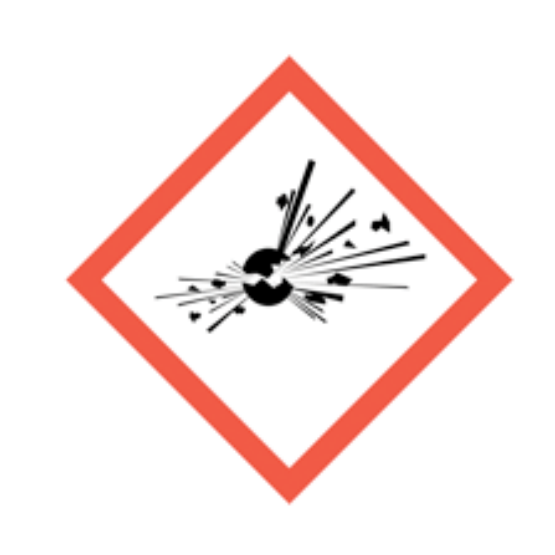 Exploding bomb | Explosive, self-reactive substances or organic peroxides. | Consider DSEAR, storage compatibility, heat, shock, contamination and emergency arrangements as well as health risk. |
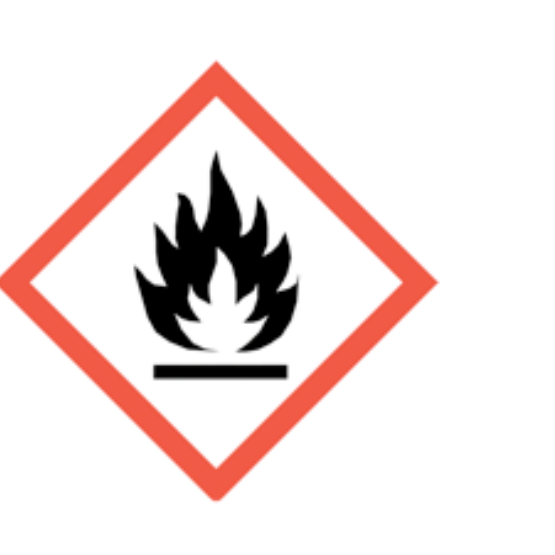 Flame | Flammable gases, liquids, solids, aerosols or substances that may ignite easily. | Control ignition sources, vapour release, ventilation, storage quantities and spill response. |
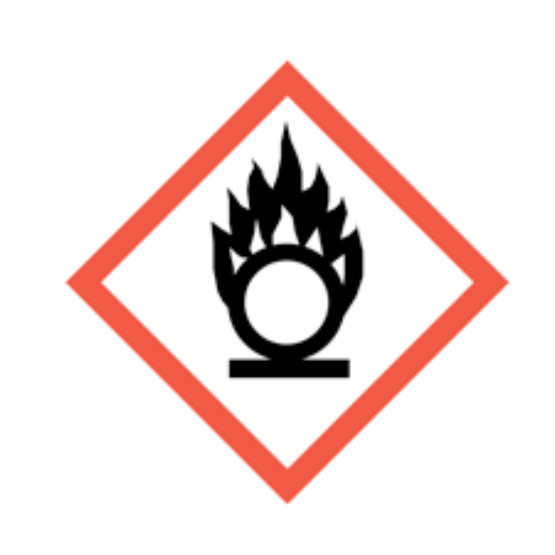 Flame over circle | Oxidising substances that can intensify fire. | Keep away from combustibles and incompatible materials; check storage segregation and emergency plans. |
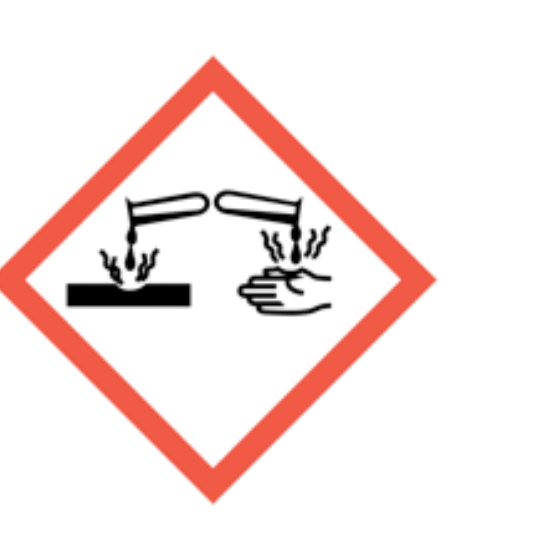 Corrosion | Skin corrosion, serious eye damage or corrosive to metals. | Assess splash risk, decanting methods, eye/face protection, chemical gloves, emergency drench arrangements and first aid. |
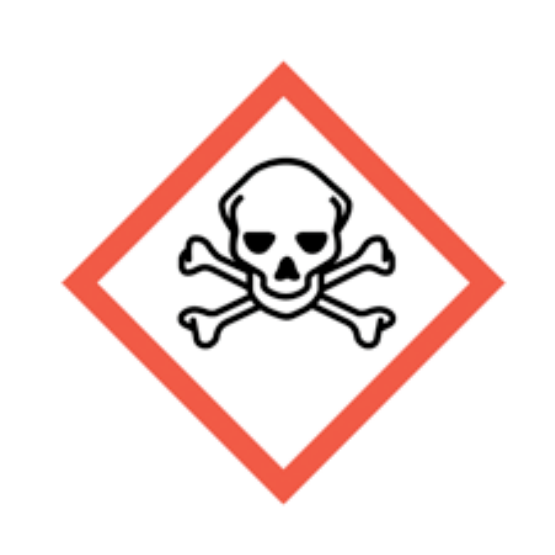 Skull and crossbones | Acute toxicity that may be fatal or toxic after exposure. | Question whether the substance can be eliminated or substituted, then tightly control access, exposure route, storage and emergency response. |
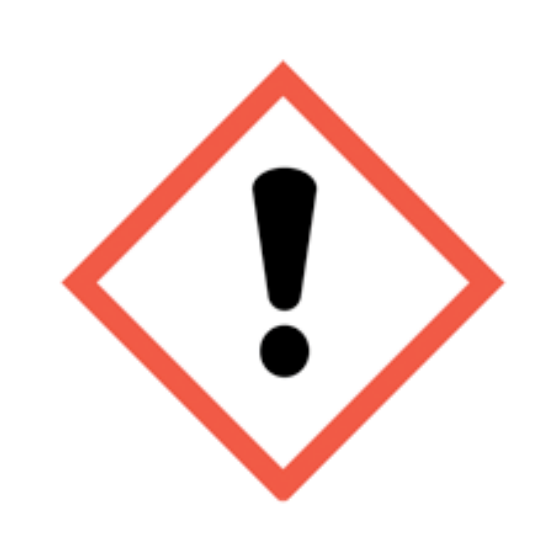 Exclamation mark | Harmful, irritant, skin sensitiser, serious eye irritation or similar lower-category hazards. | Do not dismiss it as minor; repeated skin or respiratory exposure can still create reportable occupational disease. |
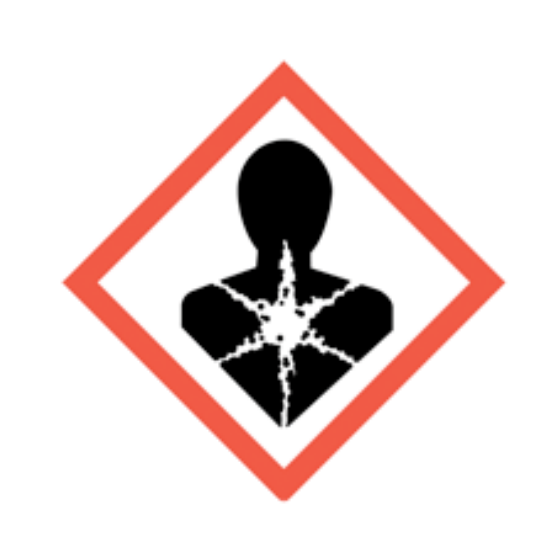 Health hazard silhouette | Serious health hazards such as carcinogenicity, respiratory sensitisation, reproductive toxicity, mutagenicity or target organ toxicity. | Treat as a high-priority COSHH risk. Exposure may need to be reduced as low as reasonably practicable, with monitoring and health surveillance considered. |
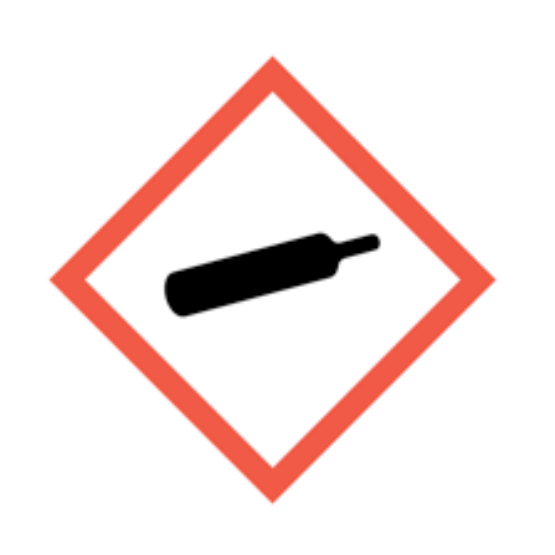 Gas cylinder | Gas under pressure. | Consider cylinder handling, storage, impact protection, release risk, asphyxiation, ventilation and emergency isolation. |
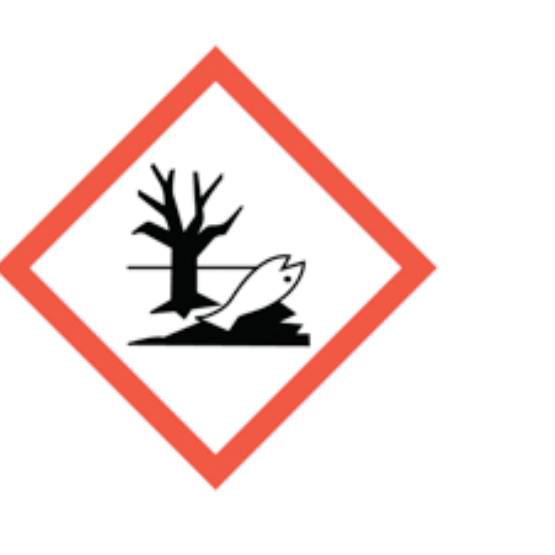 Environment | Hazardous to the aquatic environment. | Primarily an environmental signal, but it should still trigger controls for storage, bunding, spills, drainage and disposal. |
How should a COSHH assessment be carried out?
A COSHH assessment should describe the real task, the hazardous substance, the exposure route, the people affected, the controls needed and the evidence that those controls remain effective.
A good assessment starts in the workplace, not at a desk. The assessor should observe how the substance is delivered, stored, decanted, mixed, applied, heated, sprayed, extracted, cleaned up and disposed of. They should ask what happens during maintenance, breakdowns, spills, high workload, contractor activity, night shifts and temporary work because exposure often appears in the messy parts of the job.
| Assessment question | What a competent assessment should consider |
|---|---|
| What is the substance or exposure source? | Name the product or generated contaminant, its form, concentration, quantity and harmful properties. Include substances produced by cutting, heating, mixing, cleaning, curing, biological activity or accidental reaction. |
| How can people be exposed? | Map inhalation, skin contact, ingestion and injection routes. Consider breathing zones, hand contamination, contaminated clothing, eating and drinking areas, poor welfare, sharps, splashes and residues. |
| Who may be affected? | Include operators, cleaners, maintenance workers, contractors, supervisors, visitors, neighbouring workgroups, young workers, pregnant or nursing workers, people with asthma or skin conditions and anyone working alone or out of hours. |
| How much exposure is likely? | Consider task frequency, duration, concentration, temperature, volatility, dustiness, ventilation, work rate and whether the substance has a workplace exposure limit in EH40. |
| What controls are required? | Select controls in the hierarchy: eliminate, substitute, change the process, enclose, extract, segregate, reduce time, improve hygiene, provide suitable respiratory protective equipment (RPE) and personal protective equipment (PPE), train users and plan emergencies. |
| How will effectiveness be checked? | Use workplace observation, LEV examination and test, exposure monitoring, RPE face-fit records, maintenance records, health surveillance, biological monitoring, incident learning and supervisor checks. |
How can the hierarchy of controls guide COSHH exposure controls before relying on health surveillance?
Choose prevention and reliable engineering control before procedures or PPE; verify the actual equipment and task.
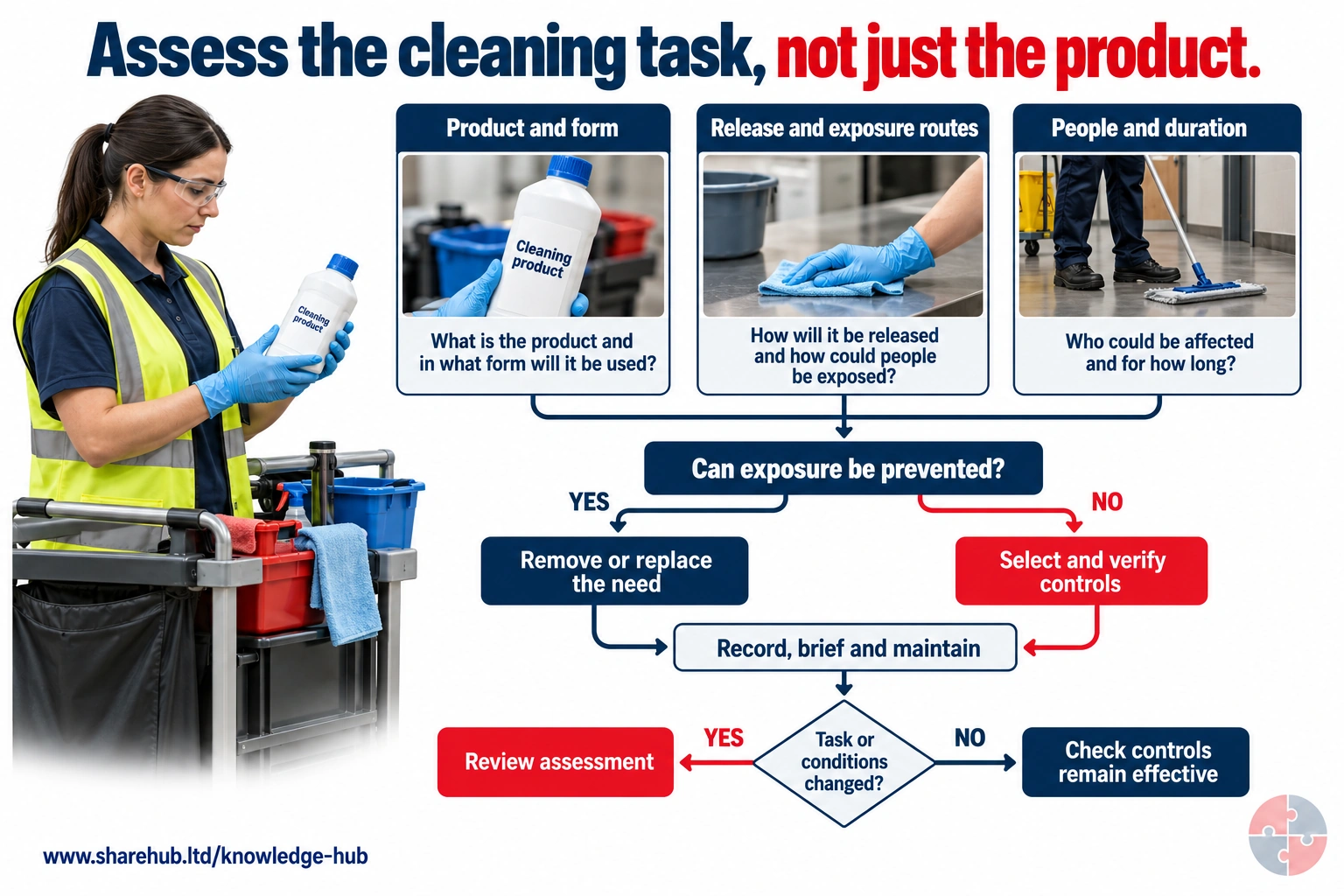

A task-based COSHH assessment considers hazardous substances used or generated, exposure routes, people, frequency and duration. Prevent exposure where reasonably practicable; otherwise control it adequately, brief users and maintain and check the controls. Review when conditions change or there is reason to doubt the assessment.
Why is the safety data sheet insufficient on its own?
It supplies substance information but does not describe every workplace exposure, person, work method or control condition.
High-level pathway, not a product-specific COSHH assessment. The generic bottle, gloves and eye protection do not establish chemical compatibility or the complete controls needed.
Source guidance: HSE HSG97
For isocyanate two-pack spray paint, assess a non-isocyanate coating or off-site process first. If spraying remains, use an enclosed extracted booth with clearance time and suitable air-fed breathing equipment, plus controlled gun cleaning, training and checks. The HSE spray-painter guide specifies these controls; HSENI COSHH sets the NI hierarchy. Stop spraying for failed extraction, unknown clearance time or missing air supply; do not rely on a better mask alone.
On a small screen, scroll this table sideways to read all columns.
How can the ERICPD hierarchy of controls guide COSHH exposure controls before relying on health surveillance?

| Five-level / ERICPD | Control choice | Owner, check, failure and stop |
|---|---|---|
| Eliminate / eliminate | Specify non-spray or off-site finished part if feasible. | Designer records option; hold spray if safe no-spray route works. |
| Substitute / reduce | Select compatible lower-hazard coating after assessment. | Coatings engineer approves; stop on unknown chemistry. |
| Engineering / isolate and control | Extracted booth with verified clearance and safe air supply. | Booth lead tests; stop on failed extraction or air. |
| Administrative / discipline | COSHH assessment, cleaning, maintenance and access control. | Supervisor inspects; hold on failed clearance. |
| PPE / PPE | Task-specific air-fed RPE and skin protection. | Trainer checks; no spray if protection fails. |
How can the ISO 45001 hierarchy of controls guide COSHH exposure controls before relying on health surveillance?

| Five-level / ERICPD | Control choice | Owner, check, failure and stop |
|---|---|---|
| Eliminate / eliminate | Specify non-spray or off-site finished part if feasible. | Designer records option; hold spray if safe no-spray route works. |
| Substitute / reduce | Select compatible lower-hazard coating after assessment. | Coatings engineer approves; stop on unknown chemistry. |
| Engineering / isolate and control | Extracted booth with verified clearance and safe air supply. | Booth lead tests; stop on failed extraction or air. |
| Administrative / discipline | COSHH assessment, cleaning, maintenance and access control. | Supervisor inspects; hold on failed clearance. |
| PPE / PPE | Task-specific air-fed RPE and skin protection. | Trainer checks; no spray if protection fails. |
HSE five-level hierarchy complements ERICPD. For this spray process, the competent designer specifies the booth/extraction for the actual coating, spray load, workpiece geometry, mist generation, air supply and discharge. Competent commissioning verifies installed compatibility and effective exposure control under representative conditions and records performance benchmarks, acceptance, user instructions and maintenance duties before use; see HSE LEV commissioning. MR2 (January2025) supports measured/displayed clearance time, negative-pressure containment, breathing-air quality and equipment checks. Before each job, check extraction, airlines, RPE and damage; monitor booth condition and performance during use, and reassess process changes. Keep maintenance, clearance and examination results and act on defects. Stop failed extraction or unsafe air supply; correct the cause, recheck required performance and clearance, and authorise restart only when control is restored.
How should local exhaust ventilation, RPE and PPE be managed?
Local exhaust ventilation (LEV), respiratory protective equipment (RPE) and personal protective equipment (PPE) only protect people when they are correctly selected, fitted, used, maintained, examined and supervised.
Local exhaust ventilation
Local exhaust ventilation (LEV) should capture the contaminant close to where it is generated and move it away from the breathing zone. The hood design, capture velocity, ducting, filter, discharge point and user position all matter. A system can be installed and still fail if the hood is too far from the source, airflow is blocked, filters are overloaded, dampers are altered or operators work outside the capture zone. LEV requires routine checks and a thorough examination and test by a competent person at least every 14 months unless a more frequent interval applies.
Respiratory protective equipment
Respiratory protective equipment (RPE) must match the substance, airborne concentration, oxygen level, task duration and wearer. Tight-fitting masks need face-fit testing and users need to be clean-shaven where the seal depends on the face. Filters must be correct for the contaminant and changed before breakthrough or clogging. RPE should be stored clean, inspected before use and supported by training so workers can carry out seal checks and recognise failure.
Gloves, coveralls and eye protection
Gloves should be selected using chemical compatibility and breakthrough information, not simply by colour or habit. Nitrile, latex, neoprene, PVC and other materials behave differently against different chemicals. Coveralls and aprons should prevent contamination of skin and clothing, while eye and face protection should match splash, mist, dust or corrosive risk. Personal protective equipment (PPE) needs cleaning, disposal or replacement rules so contamination is not carried into welfare areas, vehicles or homes.
Hygiene and welfare
Good COSHH control often depends on basic hygiene done consistently: clean handwashing facilities, no eating or drinking in contaminated areas, suitable changing arrangements, safe waste disposal, dust-free cleaning methods and contaminated clothing controls. Dry sweeping dusty material, using compressed air on clothing or sharing dirty gloves can defeat otherwise sensible controls.
MR3 (January2025) specifies enclosed extracted gun washing; if washings must be sprayed, use the booth/room and airline breathing apparatus. Keep airline protection during spraying and the measured clearance period; do not lift the facepiece to inspect the finish. The HSE LEV examination FAQ supports the GB 14-month thorough-examination/test expectation and retained records; routine checks and maintenance continue between examinations. Confirm applicable shorter intervals and the separate NI requirement rather than treating an examination label as proof of daily control.
What should each role learn and demonstrate?
Learning must match the decisions people make, from recognising danger to checking that controls work.
Briefings should tell people how to act, but attendance alone does not show competence. Assess the real decision or task, record who assessed it and revisit after a material change, failed control or incident. A local authorisation is task-specific; no universal external certificate is implied.
On a small screen, scroll this table sideways to read all columns.
| Role and learning | Demonstration and assessor | Record and reassessment trigger |
|---|---|---|
| Sprayer | Demonstrate booth/RPE and clearance response; supervisor observes. | Task observation; repeat on defect. |
| Supervisor | Verify extraction and maintenance; hygienist assesses. | Test log; review on process change. |
| Occupational health | Set and interpret surveillance; clinician reviews. | Confidential records and trend feedback; reassess after symptom. |
When is health surveillance needed?
Use it when a disease is associated with the substance, can be detected early and workplace conditions make occurrence likely; act on results and protect medical privacy.
The HSE surveillance guide states these three criteria and says surveillance is a continuing process, not a one-off test. HSENI health-surveillance guidance gives the NI route: NI COSHH 2003 regulation 11 and Schedule 6 require relevant-doctor supervised medical surveillance for specified processes, at intervals no longer than 12 months where that condition applies. For isocyanate spray work, competent occupational health sets respiratory and skin surveillance; the employer receives appropriate fitness and trend information, not unrestricted clinical records. Investigate symptoms and control failure immediately. Air monitoring measures exposure; health surveillance looks for health change, so neither substitutes for the other.
Competent occupational-health advice should confirm that the detection technique is valid and low risk for workers, with consultation, suitable referral and action on findings. HSENI surveillance criteria states this explicitly. MR2/MR3 support biological exposure monitoring for isocyanate work alongside appropriate asthma/skin surveillance; neither replaces exposure prevention or clinical assessment.
Which COSHH duties apply by location?
GB COSHH 2002 and NI COSHH 2003 are separate; both require risk assessment, prevention or adequate control, instruction and appropriate monitoring/surveillance.
Use HSE COSHH assessment in GB and HSENI COSHH in NI. Lead and asbestos have separate regimes; do not put them under a general COSHH control plan. The HSE surveillance guide and HSENI surveillance guide govern location-specific decisions.
What do HSE enforcement and prosecution cases show about COSHH failures?
HSE enforcement cases show that COSHH failures often involve poor assessment, inadequate control of exposure, weak training, missing health surveillance, poor supervision or failure to comply with notices.
Enforcement examples should be read as learning prompts rather than scare stories. They show the kinds of practical failings that inspectors and courts look at: whether exposure was foreseeable, whether safer methods were available, whether workers understood the risk, whether controls were maintained and whether the employer acted on warnings, symptoms, monitoring results or enforcement notices.
| Public case source | What happened | COSHH learning point |
|---|---|---|
| HSE COSHH case study: employees suffered dermatitis | Workers developed allergic contact dermatitis after exposure to photographic chemicals over several years. | A COSHH system must include suitable assessment, exposure control and health surveillance where workers are at risk of identifiable occupational disease. |
| HSE Media Centre: chemical burns from corrosive drain unblocker | An agency worker suffered chemical burns after corrosive liquid was released during decanting from bulk containers. | COSHH controls must address the system of work, language and training needs, supervision, PPE use, first aid and emergency washing arrangements. |
| HSE Media Centre: workers exposed to hydrogen sulphide gas | Workers were exposed to harmful hydrogen sulphide gas associated with site drainage systems. | COSHH assessment must include gases generated by site systems and abnormal conditions, not only labelled chemical products. |
| HSE Media Centre: welders exposed to carcinogenic fumes | A manufacturer was fined after welders were exposed to welding fume without adequate control measures and after failing to comply with HSE notices. | Process-generated fume is a COSHH issue. Enforcement risk rises sharply when known control gaps, notices or repeated failings are not addressed. |
These are GB historical case reports: the dermatitis case page is undated; the chemical-burn, drainage-gas and welding reports were published 13 February, 8 January and 18 June 2026 respectively. The latter three report HSWA1974 prosecutions, with COSHH exposure-control lessons; the welding report also concerns noise health-surveillance and failure to comply with notices. They do not establish a new universal COSHH penalty or NI prosecution route.
What should a COSHH risk register include?
A COSHH risk register should connect each substance or exposure group to the task, exposure route, controls, health surveillance need, owner and review trigger.
A useful register is not just a list of products. It should tell managers which exposures matter most, where controls are critical, which workers are in similar exposure groups and what evidence should be checked. It should also flag high-consequence substances such as carcinogens, mutagens, asthmagens and substances with workplace exposure limits.
| Register field | What to record | Why it matters |
|---|---|---|
| Substance or exposure source | Product name, generated contaminant, process source, hazardous properties and physical form. | Prevents the register being limited to purchased chemicals while missing dusts, fumes, mists and biological agents. |
| Task and exposed group | Who does the work, who is nearby, how often, for how long and during which normal or abnormal activities. | Supports proper health surveillance, monitoring strategy and prioritisation. |
| Critical controls | Substitution, enclosure, LEV, wet methods, hygiene, RPE, PPE, safe systems, storage, waste and emergency arrangements. | Shows which controls prevent exposure and which need inspection, maintenance or testing. |
| Assurance evidence | LEV test dates, airflow checks, exposure monitoring, face-fit records, glove selection, training, audits and health surveillance outcomes. | Turns the register from a static list into a management tool. |
| Review triggers | New product, changed process, new SDS, illness report, monitoring result, LEV defect, incident, contractor change or regulatory update. | Keeps COSHH controls current as work changes. |
How could BuildOut Ltd manage COSHH in practice?

BuildOut Ltd would manage COSHH by controlling construction dust, cement, adhesives, fuels, cleaning chemicals and contractor substances through a live register, task controls, training, supervision and health checks.
Control exposure. Check performance. Review health.
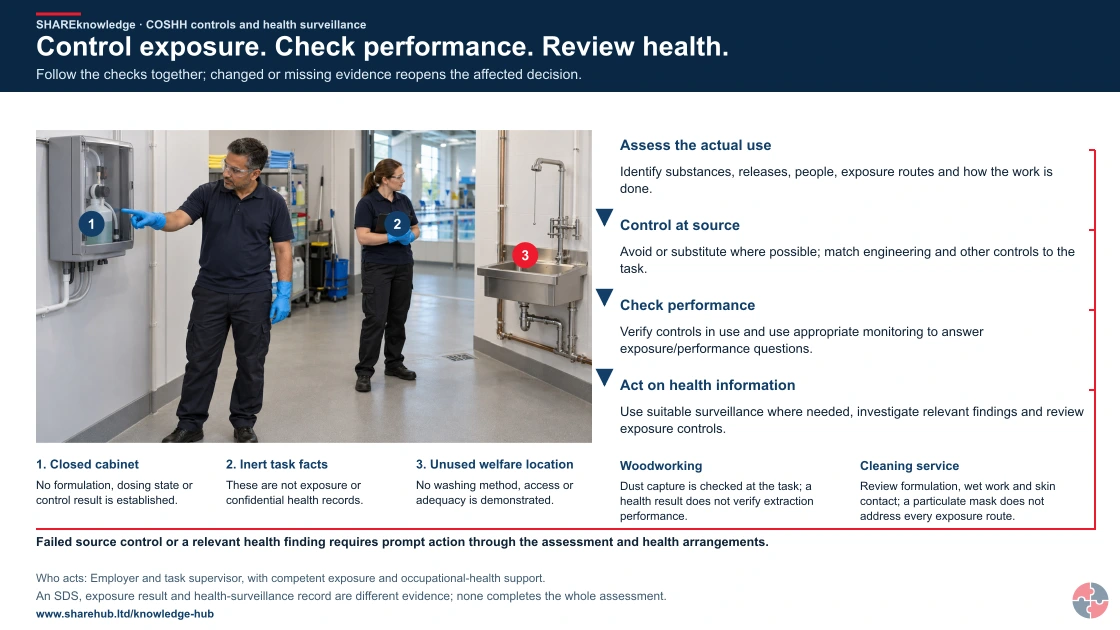
Full written explanation
An illustrative cleaning-service scene places a closed product cabinet, inert task facts and an unused welfare location in one view. Picture key: 1 identifies the closed cabinet; 2 identifies the inert task facts; 3 identifies the unused welfare location. No chemical identity, formulation, dosing or flow state, splash, skin contact, glove material or compatibility, washing method, welfare access or adequacy is established. The ordinary uninjured people are not demonstrating medical surveillance or an approved PPE selection. Four complete checks retain their source order: assess the actual use; control at source; check performance; act on health information. Three forward arrows relate those checks, while a separate unarrowed rail connects all four to the common prompt-action hold. Independent headings are unnumbered. A health finding needs the appropriate health arrangements and review of exposure controls; a health result does not verify a hood, enclosure or skin-contact control or permit continued poor control. Prompt health help/action and source-control correction do not wait for each other’s paperwork or results. The full employer/task-supervisor and competent exposure/occupational-health roles, evidence distinction and both woodworking and cleaning-service cases accompany the explanation. The inert facts are not an SDS, completed COSHH assessment, exposure result or confidential health record. Use the complete topic for actual task assessment, prevention first, verified source controls, suitable surveillance, medical privacy and separate GB/NI COSHH, REACH/CLP and lead/asbestos qualifications. No test, symptom, clinical interpretation, health outcome, fitness decision, operating, cleaning, washing or PPE recipe, threshold or work permission is given.
- Assess the actual use. Identify substances, releases, people, exposure routes and how the work is done.
- Control at source. Avoid or substitute where possible; match engineering and other controls to the task.
- Check performance. Verify controls in use and use appropriate monitoring to answer exposure/performance questions.
- Act on health information. Use suitable surveillance where needed, investigate relevant findings and review exposure controls.
When the evidence does not fit: Failed source control or a relevant health finding requires prompt action through the assessment and health arrangements.
Who acts: Employer and task supervisor, with competent exposure and occupational-health support.
Changed workplace
Woodworking: Dust capture is checked at the task; a health result does not verify extraction performance.
Cleaning service: Review formulation, wet work and skin contact; a particulate mask does not address every exposure route.
Evidence check: An SDS, exposure result and health-surveillance record are different evidence; none completes the whole assessment.

BuildOut Ltd is a construction and refurbishment business. Its COSHH profile changes from project to project, so the business cannot rely on a fixed generic assessment. It needs a site-specific register that follows the work: cutting, chasing, drilling, sanding, demolition, mixing cement, using resins and adhesives, cleaning welfare areas, fuelling small plant and managing subcontractors who bring their own products.
| Management area | How BuildOut Ltd applies COSHH | Evidence and improvement |
|---|---|---|
| Risk register and procurement | The company keeps a COSHH register for each project and reviews products before purchase. It challenges high-solvent, high-dust or sensitising products and looks for safer alternatives before work starts. | Approved product list, current SDS, task COSHH assessments, rejected substitution decisions and project review notes. |
| Construction dust control | Dry cutting is avoided where reasonably practicable. Where cutting or grinding is necessary, teams use wet suppression, on-tool extraction, suitable vacuums, segregation and RPE selected for residual dust exposure. | Supervisor dust-control checks, equipment inspection records, RPE face-fit records, toolbox talks, defect logs and exposure monitoring where justified. |
| Cement, resins and skin protection | Wet cement and epoxy products are treated as skin hazards. Workers receive gloves matched to the task, washing facilities, skin-care guidance and instruction to report redness, cracking, itching or persistent irritation early. | Skin surveillance records, glove selection records, welfare inspections, occupational health referrals and trend review at monthly safety meetings. |
| Contractor control | Subcontractors must provide details of hazardous substances and controls before starting work. BuildOut checks whether their work could expose other trades, tenants or visitors. | RAMS review, coordination meeting notes, permits where needed, site induction records and checks against actual work. |
| Learning and audit | Dust complaints, failed LEV checks, skin symptoms, poor housekeeping or RPE non-use are treated as signs that the system needs improvement, not just worker behaviour issues. | Incident investigations, corrective actions, repeated-defect analysis, training refreshers and management review actions. |
What can a fuel-task example add to a COSHH assessment?
Connect the selected substance and activity with the possible exposure route and controls. Keep occupational health assessment separate from the explosive-atmosphere classification question.
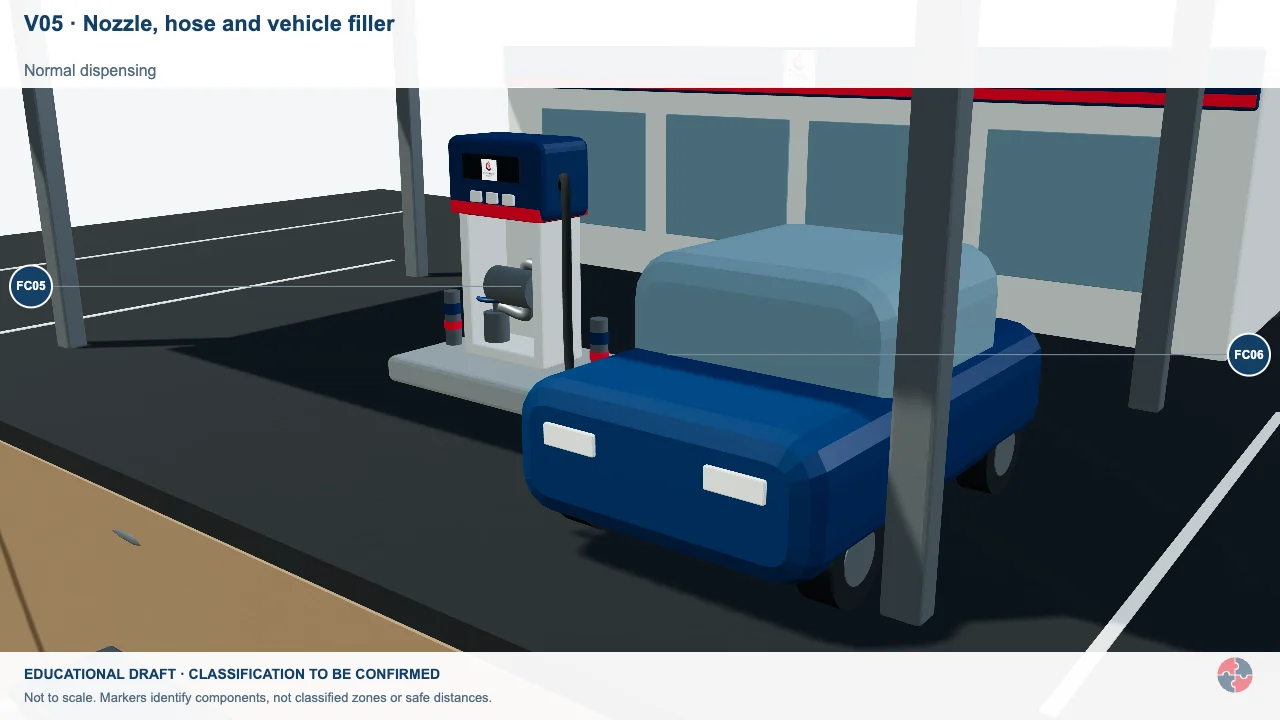
Nozzle, hose and vehicle filler
An extended hose places the nozzle tip and vehicle filler farther from the island. The local rounded teaching envelope follows that interface, with the hose kept slack.
Activity focus: Select near or extended hose, trace its fixed island connection, and inspect where the nozzle enters the filler. Compare recovery operating with no Stage II recovery.
Contextual workplace scene. Use the task, control and evidence checks in this section; appearance alone does not establish safe conditions, individual health or approval.
Educational illustration, not to scale. Coloured zones are teaching examples, not a site-specific hazardous-area classification.
Occupational exposure is separate; hazardous-area boundaries are not health exposure limits.
How does COSHH support NEBOSH National General Certificate study?
For NEBOSH National General Certificate (GNC) 7.4, learners need to show that they can move from hazardous substance theory to sensible workplace controls, evidence and review.
The strongest answers usually follow a simple chain: identify the substance or process-generated contaminant, state the route of entry, explain the possible health effect, identify who is exposed, apply the hierarchy of control, then say how the controls will be maintained and checked. This avoids the common weak answer that jumps straight to PPE without explaining the exposure pathway.
| Likely study area | What to be ready to explain | Example of a stronger answer point |
|---|---|---|
| Preventing or adequately controlling exposure | The difference between preventing exposure completely and adequately controlling exposure where prevention is not reasonably practicable. | For silica dust, avoid cutting where possible; if cutting remains, use wet methods or on-tool extraction, suitable RPE and dust-free cleaning. |
| Principles of good control practice | Controls should be proportionate, reliable, maintained, compatible with the work and not create new risks. | LEV must capture contaminant at source, be used correctly, checked by users and thoroughly examined by a competent person. |
| RPE and PPE | PPE is a last line of defence and must be selected, fitted, used, stored, cleaned and supervised. | Tight-fitting respiratory protective equipment (RPE) needs face-fit testing and wearers must know how to complete a pre-use seal check. |
| Health surveillance | Surveillance is required where an identifiable disease may occur and valid methods can detect early signs. | Workers exposed to respiratory sensitisers may need respiratory questionnaires and lung function checks, with results used to review exposure controls. |
| Carcinogens, asthmagens and mutagens | Some substances need tighter control because serious health effects may occur at low or repeated exposure. | Exposure should be reduced as low as reasonably practicable, not merely treated as acceptable because no complaint has been made. |
How can a management system sustain effective decisions?
Give each hazard or support route an owner, a control, a check and a response to failure.
Connect material inventory, task controls, equipment tests, exposure findings, confidential surveillance and corrective action. An owner should sample actual work and corrective actions, not accept a policy or certificate as evidence that the controls work.
The free GB regulator guide HSE Managing for health and safety (HSG65) explains a plan–do–check–act approach: assign controls and owners, involve workers, check work as done, and correct failures. For Northern Ireland, use HSENI risk assessment guidance for the local duty. A certificate alone does not demonstrate that a control works.
What are the warning signs that COSHH is failing?
COSHH is usually failing when assessments do not match real work, controls are not maintained, symptoms are normalised or exposure evidence is missing.
- COSHH assessments are copied from safety data sheets and do not describe the actual task, exposure route or people affected.
- Dust, fume or vapour is visible or smelled, but nobody checks whether exposure is adequately controlled.
- LEV hoods are damaged, airflow indicators are ignored, filters are overloaded or statutory examination records are missing.
- Workers wear RPE without face-fit testing, seal checks, correct filter selection or clean storage.
- Skin irritation, breathing symptoms, headaches, nausea or unusual absence patterns are dismissed without reviewing exposure.
- Cleaning spreads contamination through dry sweeping, compressed air or poor waste handling.
- New products, changed tasks or contractor substances are introduced without reviewing the COSHH assessment.
- Health surveillance is carried out, but results do not feed back into control improvements.
What COSHH acronyms should readers understand?
COSHH uses several common acronyms, and pages should define them before relying on them.
| Acronym or term | What it means | Why it matters in COSHH |
|---|---|---|
| COSHH | Control of Substances Hazardous to Health. | The UK legal framework for assessing and controlling substances that can harm health at work. |
| RPE | Respiratory protective equipment. | Masks and breathing protection used where inhalation exposure remains after stronger controls have been applied. |
| PPE | Personal protective equipment. | Personal items such as gloves, coveralls, goggles and face protection used to protect the worker from residual exposure. |
| LEV | Local exhaust ventilation. | An engineering control that captures dust, fume, mist or vapour close to the source before it reaches the breathing zone. |
| WEL | Workplace exposure limit. | A legal limit for the concentration of some airborne hazardous substances in workplace air. |
| SDS | Safety data sheet. | Supplier information about a substance or mixture; useful for COSHH assessment but not a substitute for one. |
| CLP | Classification, labelling and packaging. | The system used to classify chemical hazards and communicate them through labels, pictograms and hazard statements. |
| REACH | Registration, evaluation, authorisation and restriction of chemicals. | The supply-chain chemical control regime that supports chemical information and restrictions. |
Which BuildOut documents support this topic?
Download individual editable BuildOut documents for this topic. Procedures and plans contain completed arrangements; forms, checklists, assessments, RAMS and permits are blank masters. Registers include separate worked examples.
| Document | Purpose and content | Editable download |
|---|---|---|
| Substance assessment, exposure control and monitoring procedure BOUK-PRO-COSHH · Completed worked example · v1.0 | Use task-specific COSHH assessments, competent RPE selection/fit testing and effective control verification. | Download DOCX Read preview |
| Task-specific COSHH assessment BOUK-RA-COSHH-01 · Blank editable master · v1.0 | Assess actual exposure routes and select effective controls beyond the safety data sheet. | Download DOCX Read preview |
| Silica and construction-dust control RAMS BOUK-RAMS-COSHH-01 · Blank editable master · v1.0 | Specify cutting method, water/extraction, RPE, cleaning and exclusion controls. | Download DOCX Read preview |
| RPE selection and face-fit record BOUK-FRM-COSHH-01 · Blank editable master · v1.0 | Record compatible RPE, face-fit result, training and limitations. | Download DOCX Read preview |
| LEV and exposure-monitoring evidence register BOUK-REG-COSHH-01 · Blank register with separate worked entries · v1.0 | Track control checks, thorough examinations/tests, monitoring and remedial actions. | Download XLSX Read preview |
| Biological agents, water hygiene and contaminated-ground assessment BOUK-RA-COSHH-02 · Blank editable master · v1.0 | Assess sewage, animal contamination, standing water and welfare water-system risks. | Download DOCX Read preview |
| Hazardous-substance storage, spill and waste check BOUK-CHK-COSHH-01 · Blank editable master · v1.0 | Verify labelling, segregation, containers, spill response and controlled disposal. | Download DOCX Read preview |
| Screeding, flooring and tiling RAMS BOUK-RAMS-COSHH-02 · Blank editable master · v1.0 | Wet materials, adhesives, dust, cutting, kneeling and occupied-area segregation. | Download DOCX Read preview |
| Painting, coating and spray application RAMS BOUK-RAMS-COSHH-03 · Blank editable master · v1.0 | Product substitution, ventilation, skin/respiratory exposure, fire and access. | Download DOCX Read preview |
| Drilling, chasing, core cutting and grinding RAMS BOUK-RAMS-COSHH-04 · Blank editable master · v1.0 | Hidden services, silica, noise, vibration, rotating equipment and slurry/waste control. | Download DOCX Read preview |
| Insulation and fire-stopping installation RAMS BOUK-RAMS-COSHH-05 · Blank editable master · v1.0 | Product exposure, access, confined areas and quality/safety-critical interfaces. | Download DOCX Read preview |
Review and adapt the documents for your organisation, activities and jurisdiction before approval and issue. Open the SHAREms management-system hierarchy to find each document under its parent policy.
Which Crownway Fuels documents support this topic?
Open an editable document, read the preview, or find its place in the Crownway hierarchy. 7 resources relate to this page.
Fictional Crownway Fuels examples for English forecourts, with a separate illustrative bulk terminal. Check site applicability, permissions and actual controls before adapting any document for use.
Chemical exposure and occupational hygiene policy (7)
- Chemical exposure and occupational hygiene policy (CWF-POL-COSHH · Completed fictional example)
Set company expectations, responsibilities and resources for chemical exposure and occupational hygiene.
Read preview · Download DOCX · Show in hierarchy - Chemical exposure and occupational hygiene procedure (CWF-PRO-COSHH · Completed fictional example)
Explain who does what, in what sequence, the control rationale, evidence, escalation and safe restart conditions.
Read preview · Download DOCX · Show in hierarchy - Chemical and SDS inventory (CWF-REG-COSHH-01 · Blank register with separate fictional worked entries)
Provide the site/task-specific chemical and sds inventory and retain its controlled output.
Read preview · Download XLSX · Show in hierarchy - Task COSHH and fuel exposure assessment (CWF-RA-COSHH-01 · Blank editable master)
Provide the site/task-specific task coshh and fuel exposure assessment and retain its controlled output.
Read preview · Download DOCX · Show in hierarchy - Exposure monitoring and health surveillance decision plan (CWF-PLN-COSHH-01 · Completed fictional example)
Provide the site/task-specific exposure monitoring and health surveillance decision plan and retain its controlled output.
Read preview · Download DOCX · Show in hierarchy - Chemical storage handling and PPE suitability check (CWF-CHK-COSHH-01 · Blank editable master)
Provide the site/task-specific chemical storage handling and ppe suitability check and retain its controlled output.
Read preview · Download DOCX · Download PDF · Show in hierarchy - Exposure incident and control review record (CWF-FRM-COSHH-01 · Blank editable master)
Provide the site/task-specific exposure incident and control review record and retain its controlled output.
Read preview · Download DOCX · Show in hierarchy