SHARE Knowledge Hub
Biological hazards
Biological hazards are bacteria, viruses, fungi, parasites, human or animal materials, contaminated waste and other biological agents that can harm people at work. Good management starts with the source and route of exposure, then sets clear controls for hygiene, containment, sharps, waste, cleaning, ventilation, PPE, occupational health input, reporting and review.
Understanding Biological hazards
Biological hazards are bacteria, viruses, fungi, parasites, human or animal materials, contaminated waste and other biological agents that can harm people at work. Good management starts with the source and route of exposure, then sets clear controls for hygiene, containment, sharps, waste, cleaning, ventilation, PPE, occupational health input, reporting and review.
Why this matters at work
Define the required condition, responsible owner, check and action on failure. Look for unreliable extraction, damaged containers, overflowing waste, missing washing supplies, uncontrolled dirty-to-clean transfer or an unclear out-of-hours contact. Repeated defects or informal workarounds are evidence that the operating system needs review. A low illness count may coexist with under-reporting, delayed effects or chance.
Use a sample that traces a barrier through its full lifecycle, including maintenance and change. Confirm that a person finding a defect can make the appropriate report and hold affected work, and that the responsible manager verifies closure. Avoid recording pass when the evidence shows only that equipment is present. Assurance should establish its accepted protective status for the current task. Where uncertainty concerns serious exposure, obtain competent review and verify restoration before authorising continuation.
How organisations manage this in practice
The implementation log should identify decisions, owners, due dates and evidence of completion. Prioritise unresolved consequential barriers rather than count every action equally. Temporary arrangements must have limits and a route to restoration. At management review, examine recurring failure, worker feedback and whether resources remain adequate. A completed document package supports teaching and assessment; operational acceptance still requires task evidence and competent decisions in the workplace where it will be used.
Include relevant occupational health advice, prompt symptom reporting and competent interpretation of monitoring. A dust limit, if applicable, does not remove the need to control sensitisation. Avoid diagnosing farmer's lung, asthma or infection from a general symptom list; supply the clinician with the task and exposure history. A confirmed case or adverse trend requires review of source controls and other exposed workers, while protecting the individual's clinical information and implementing necessary functional recommendations.
Arrange appropriate healthcare or occupational-health assessment for symptoms while reviewing the technical controls. Verify commissioning, maintenance, capture and practical usability under the changed cycle, including waste removal and clothing. Preserve the change and exposure evidence and identify interim restrictions where protection is uncertain. A symptom-free colleague or absence of visible dust cannot establish adequacy, and historical numerical or equipment-marking statements should not be treated as current universal rules. Record responsible actions and demonstrate the revised method before closure. Animal welfare and any other specialist permissions remain separate from occupational exposure control and cannot be inferred from an equipment purchase.
Recognise the source and route before selecting controls
Use this page to recognise biological material and plausible exposure routes. Sewage, animal proteins, mould and deliberate cultures do not all create the same mechanism or require the same response. State the task and what people may breathe, touch, swallow or be inoculated with.
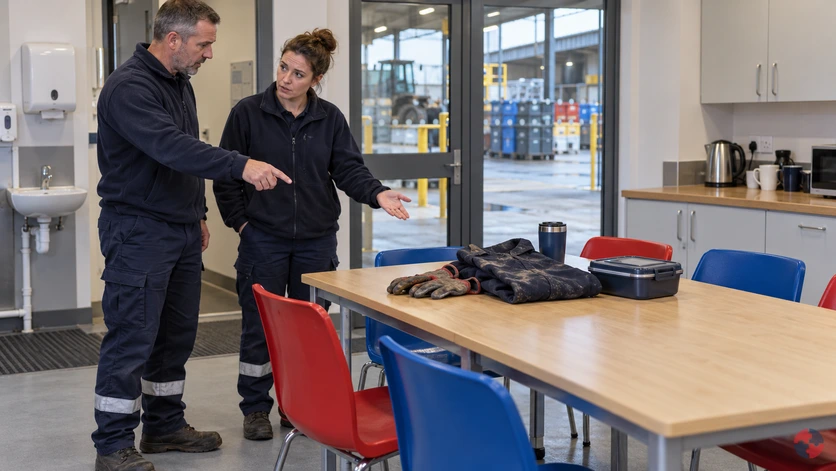
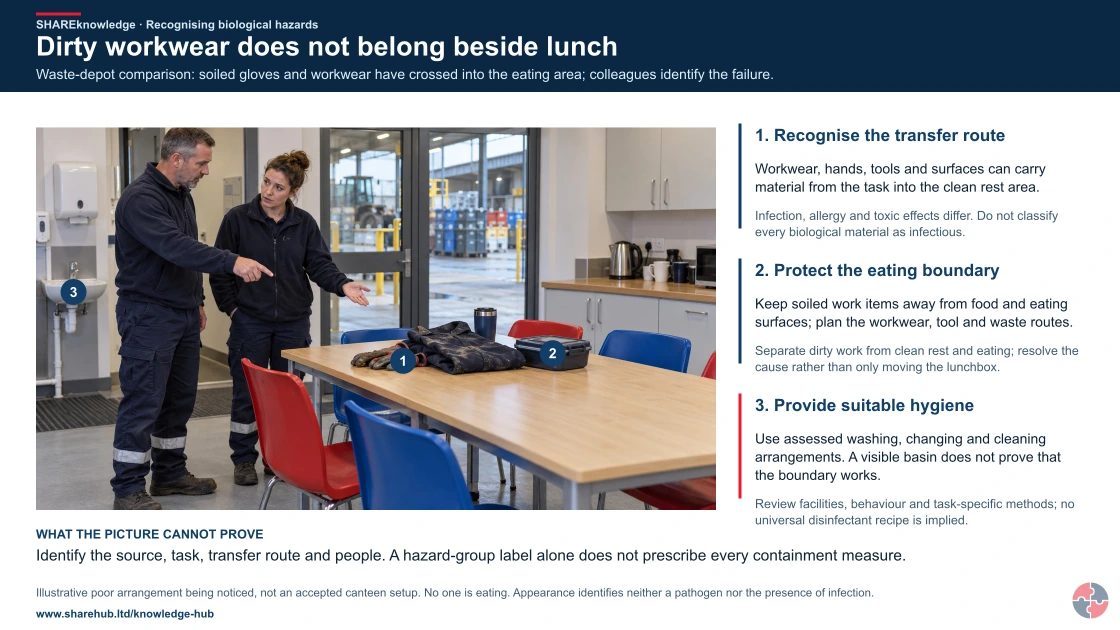
Dirty workwear does not belong beside lunch
Full written explanation
Waste-depot comparison: soiled gloves and workwear have crossed into the eating area; colleagues identify the failure.
- Recognise the transfer route. Workwear, hands, tools and surfaces can carry material from the task into the clean rest area.
- Protect the eating boundary. Keep soiled work items away from food and eating surfaces; plan the workwear, tool and waste routes.
- Provide suitable hygiene. Use assessed washing, changing and cleaning arrangements. A visible basin does not prove that the boundary works.
Change the pathway
- Name the actual mechanism. Infection, allergy and toxic effects differ. Do not classify every biological material as infectious.
- Change the arrangement. Separate dirty work from clean rest and eating; resolve the cause rather than only moving the lunchbox.
- Check real use. Review facilities, behaviour and task-specific methods; no universal disinfectant recipe is implied.
Evidence check: Identify the source, task, transfer route and people. A hazard-group label alone does not prescribe every containment measure.
Full exposure-response, first-aid and appropriate clinical-support guidance
Primary references: HSE: preventing incidental exposure to infection at work · HSE: needlestick and sharps injuries
Open the complete HD image (new tab)Download image

Full exposure-response, first-aid and appropriate clinical-support guidance
Primary references: HSE: preventing incidental exposure to infection at work · HSE: needlestick and sharps injuries
Uncertainty should lead to an investigation or entry hold, not a forced classification. Once the source/route is understood, use the biological-agents control guide and the relevant disease or water-system page for the next specialist decision. Hazard group alone does not prescribe every containment arrangement.
A flooded basement has more than one exposure
Illustrative example. A team finds flooding with possible sewage and evidence of rodents before a proposed clean-up.
Decision. Avoid unassessed entry and plan source-route controls with competent input, including low-splash work and welfare.
Evidence to check. Record flood source uncertainty, contamination, spray potential, access, electrical/structural interfaces and safe re-entry evidence.
Hold or escalation point. No ordinary cleaning release while the source or other entry hazards remain unresolved.
Follow-up. The responsible owner verifies the accepted method, welfare and area conditions before hand-back.
Keep contamination out of the clean route
Plan a contaminated-basement task from the source outward. The water’s appearance does not identify its biological content or settle the separate electrical, structural or confined-space risks.
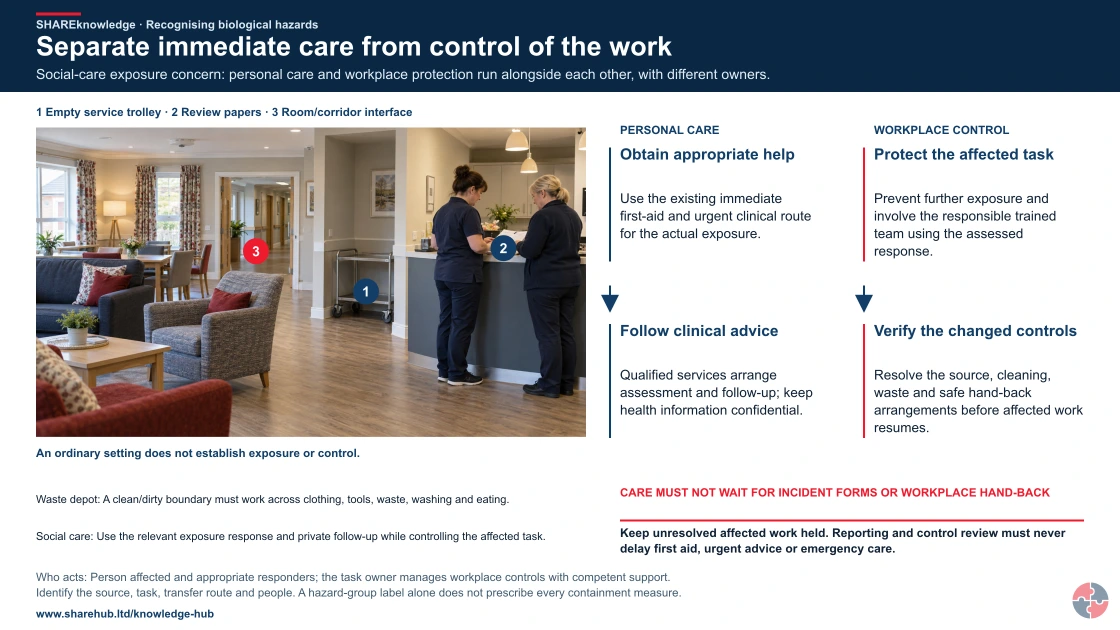
Separate immediate care from control of the work
Full written explanation
An illustrative UK social-care shared-room setting shows an empty stationary service trolley, normal adults reviewing inert work papers and the room/corridor interface. One literal picture key identifies 1 empty service trolley, 2 review papers and 3 room/corridor interface. The setting supports questions about affected work and responsibilities; it does not depict an exposure, clinical care or a verified clean boundary. No residents, patient, sharps, body fluids, injury, medical equipment or clinical action is shown. Two independent tracks retain the four checks. Personal care: Obtain appropriate help: Use the existing immediate first-aid and urgent clinical route for the actual exposure. Follow clinical advice: Qualified services arrange assessment and follow-up; keep health information confidential. Workplace control: Protect the affected task: Prevent further exposure and involve the responsible trained team using the assessed response. Verify the changed controls: Resolve the source, cleaning, waste and safe hand-back arrangements before affected work resumes. Only one arrow within each track shows its own order; neither track authorises or clears the other. CARE MUST NOT WAIT FOR INCIDENT FORMS OR WORKPLACE HAND-BACK. Keep unresolved affected work held. Reporting and control review must never delay first aid, urgent advice or emergency care. Who acts: Person affected and appropriate responders; the task owner manages workplace controls with competent support. Identify the source, task, transfer route and people. A hazard-group label alone does not prescribe every containment measure. Waste depot: A clean/dirty boundary must work across clothing, tools, waste, washing and eating. Social care: Use the relevant exposure response and private follow-up while controlling the affected task. A tidy shared area, empty trolley or paper review establishes no pathogen identity, contamination status, hygiene performance, competence, clinical follow-up, cleaning method, safe hand-back or work permission. Immediate first aid and urgent qualified clinical help remain independent of incident forms and workplace control review. Inert papers represent no personal or clinical record.
Social-care exposure concern: personal care and workplace protection run alongside each other, with different owners.
- Obtain appropriate help. Use the existing immediate first-aid and urgent clinical route for the actual exposure.
- Follow clinical advice. Qualified services arrange assessment and follow-up; keep health information confidential.
- Protect the affected task. Prevent further exposure and involve the responsible trained team using the assessed response.
- Verify the changed controls. Resolve the source, cleaning, waste and safe hand-back arrangements before affected work resumes.
When the evidence does not fit: Keep unresolved affected work held. Reporting and control review must never delay first aid, urgent advice or emergency care.
Who acts: Person affected and appropriate responders; the task owner manages workplace controls with competent support.
Changed workplace
Waste depot: A clean/dirty boundary must work across clothing, tools, waste, washing and eating.
Social care: Use the relevant exposure response and private follow-up while controlling the affected task.
Evidence check: Identify the source, task, transfer route and people. A hazard-group label alone does not prescribe every containment measure.
Full exposure-response, first-aid and appropriate clinical-support guidance
Primary references: HSE: preventing incidental exposure to infection at work · HSE: needlestick and sharps injuries
Open the complete HD image (new tab)Download image

Full exposure-response, first-aid and appropriate clinical-support guidance
Primary references: HSE: preventing incidental exposure to infection at work · HSE: needlestick and sharps injuries

- Source and dirty work area
- Controlled tool / waste exit
- Washing and clean rest area
Read the labels in the full-size drawing
- CONTAMINATED TASK
- CLEAN WASHING / REST
- AREA
- Control water, tools, footwear and waste at the boundary
Avoid unnecessary entry
Establish the source, work needed and safer access or remote options before allocating people. Keep unresolved hazards in the hold decision.
Control release and spread
Assess splash/aerosol-generating work, drainage and the waste route. Choose a task-specific method rather than a universal disinfection recipe.
Protect the clean boundary
Plan how tools, footwear, clothing and waste leave the dirty area. Keep washing, rest and eating arrangements separate; review whether contamination crosses that boundary.
The unoccupied sketch is an assessment aid, not authority to enter. Record the competent task owner and clinical advice route for relevant exposure, alongside the other hazards and access controls.
What are biological hazards at work?
Biological hazards are living organisms, biological agents or contaminated materials that can cause infection, allergy, toxicity or other harm when work creates an exposure route.
Biological risk is easiest to manage when it is broken into five questions: what is the source, how could it leave that source, how could it reach a person, who may be more vulnerable, and what evidence proves the controls still work?
Biological agent. A microorganism, cell culture or human endoparasite that may cause infection, allergy, toxicity or other harm. Examples include bacteria in sewage, blood-borne viruses, mould spores and laboratory cultures.
Biological hazard. The source or situation that can expose people to a biological agent. Sharps waste, contaminated cleaning, infected animals, stagnant water, clinical waste, bird droppings.
Exposure route. The way the agent reaches the body. Inhalation of aerosols, needlestick injury, splash to eyes, hand-to-mouth transfer, broken skin contact.
Deliberate work. Work where biological agents are intentionally used or grown. Microbiology laboratories, research work, diagnostic cultures, animal research.
Incidental exposure. Work where the agent is not the purpose of the job but may be present. Drain clearance, first aid, waste handling, facilities work, refurbishment, agriculture, care work.
Biological materials such as animal allergens and organic dusts can cause disease without a live infectious agent. Separate that COSHH risk from the approved-list classification of a named biological agent.
Which biological exposure routes should be assessed?
A useful assessment follows the route of exposure, not just the job title. The same biological agent may need different controls depending on whether people can inhale it, touch it, ingest it or receive it through a puncture wound.
Inhalation. Bioaerosols, dust, mould spores, animal dander, sewage mist, respiratory droplets, laboratory aerosols. Respiratory infection, allergy, asthma-like symptoms or systemic illness depending on the agent. Containment, local exhaust or controlled ventilation, wet methods, enclosure, RPE where justified, cleaning and occupancy control.
Skin or mucous membrane contact. Blood or body fluids, contaminated surfaces, animal material, waste, soil, stagnant water, splashes. Skin infection, eye infection, dermatitis-like effects, blood-borne virus exposure or zoonotic disease. Gloves matched to task, eye or face protection, hand hygiene, splash control, wound covering and decontamination.
Sharps, bites or puncture wounds. Needles, broken glass, contaminated blades, animal bites, insect bites, hidden sharps in waste. Blood-borne viruses, tetanus risk, local infection, zoonoses or venom/vector-related illness. Sharps systems, puncture-resistant containers, tongs/tools, no hand compression of waste, animal handling controls and urgent reporting.
Ingestion. Hand-to-mouth transfer from dirty hands, food in contaminated areas, poor welfare or contaminated PPE taken into welfare spaces. Gastrointestinal illness, systemic infection or toxic biological exposure. Clean welfare, handwashing, no eating in contaminated zones, changing arrangements, laundering and hygiene supervision.
Vectors and environmental reservoirs. Ticks, rodents, birds, livestock, standing water, cooling systems, damp buildings and contaminated soil. Vector-borne disease, leptospirosis-like risk, legionella-type risk or allergy. Pest control, water hygiene, site surveys, welfare, vegetation or habitat controls and occupational health advice where needed.
Where do biological hazards arise in real workplaces?
Biological hazards are not limited to healthcare or laboratories. They can appear wherever work brings people into contact with people, animals, water, soil, waste, damp buildings or contaminated materials.
Healthcare, care, first aid and public-facing work. Blood, body fluids, respiratory illness, clinical waste, sharps, vomit or contaminated laundry. Infection-control procedures, vaccination policy where relevant, sharps arrangements, cleaning standards, exposure reporting and confidentiality.
Laboratories, research and diagnostics. Cultures, samples, animal work, aerosols, centrifuges, contaminated glassware and waste streams. Competent biosafety assessment, containment level, validated procedures, access control, decontamination, waste route and incident response.
Waste, drainage, facilities and cleaning. Sewage, needles, rodent contamination, bin stores, blocked drains, toilets, bodily fluid clean-up and contaminated PPE. Pre-task checks, welfare, tools to avoid hand contact, cleaning chemicals used correctly, waste segregation, gloves/eye protection and reporting.
Construction and refurbishment. Bird or bat droppings, mould, contaminated soil, stagnant water, unexpected sewage, asbestos-like confusion and poor welfare. Survey before disturbance, stop-work trigger, isolation of contaminated area, specialist clean-up where needed, hygiene and welfare arrangements.
Agriculture, animal work and veterinary settings. Birth products, slurry, animal bites, zoonoses, dust, bedding, manure, insects and contaminated clothing or vehicles. Animal handling rules, pregnancy-sensitive communication, handwashing, changing, laundering, vehicle hygiene and competent veterinary/OH advice.
Leisure, water, hospitality and shared premises. Swimming pools, spas, water systems, public toilets, food waste, first-aid incidents and high public contact. Water hygiene, cleaning verification, staff training, spill response, waste control, contractor interface and escalation to public health where required.
How should a biological hazard assessment be structured?
The assessment should move from source to route to person to control. If the route of exposure is unclear, the controls are usually unclear as well.
source or activity -> biological agent or material -> exposure route -> people at risk -> control standard -> exposure response -> evidence and review
What is the source?. Controls must match the actual source, not a generic label such as infection risk. Is the source blood, sewage, animal material, mould, laboratory culture, waste, water or contaminated soil?
How could exposure happen?. Route determines the control standard. Could people inhale aerosols, be splashed, suffer a sharps injury, touch contaminated surfaces or ingest contamination?
Who may be affected?. The exposed group may include workers, cleaners, maintenance staff, contractors, visitors, vulnerable workers or the public. Could a cleaner, expectant mother, immunocompromised worker, apprentice or visiting contractor be exposed?
What controls prevent or reduce exposure?. A PPE-only approach is rarely enough. Can the task be avoided, enclosed, delayed, ventilated, cleaned, segregated or carried out by a competent specialist?
What is the response route?. Delayed reporting can turn a controllable exposure into a serious health concern. Who is called after a sharps injury, splash, bite, sewage exposure or suspected infectious cluster?
What proves control?. Records show whether arrangements are working or only written down. Training, cleaning logs, waste records, vaccination policy, inspection findings, exposure reports, OH advice and corrective action close-out.
How does the work method change biological exposure?
Describe what the worker will actually do to the material. Walking past a contained source, handling a damaged bag and spraying or breaking up its contents create different contact and inhalation opportunities. The assessment must follow the proposed activity, including preparation, cleaning and waste removal, rather than assuming that one set of PPE makes every method suitable.
For an illustrative refurbishment survey, the planner identifies evidence of contamination and asks whether the inspection can be completed without opening or disturbing the affected area. If intrusive access remains necessary, competent assessment defines the likely source, route, containment, hygiene, protective equipment and waste method before disturbance. Include the person who cleans up and the next trade, not only the surveyor. Stop if the material differs from the survey, the planned containment cannot be maintained or the chosen method would spread contamination into occupied areas. Resolve that change before resuming.
Guidance and scope: Original SHARE method comparison applying HSE GB incidental-infection and construction guidance. The example does not presume that every organic material is infectious or identify an agent without evidence; local assessment determines the controls. HSE preventing incidental infection exposure HSE harmful micro-organisms in construction
What controls should be considered?
Controls should follow the hierarchy: avoid exposure where possible, reduce the source, interrupt the route of exposure, protect people and verify that the arrangement is working.
Avoid or eliminate exposure. Do not disturb contaminated material until assessed; use sealed systems; remove unnecessary handling; outsource high-risk decontamination to competent specialists. Pre-work survey, decision record, method statement, contractor competence and stop-work record.
Reduce the source. Clean before maintenance, damp down dusty contamination, reduce aerosols, segregate dirty and clean areas, control pests and maintain water systems. Cleaning schedule, inspection record, water hygiene record, pest-control record and photographic evidence where useful.
Contain or isolate. Use containment cabinets, sealed waste containers, splash screens, dedicated dirty areas, controlled access and closed transport of contaminated materials. Containment checks, access arrangements, waste transfer notes, signage and supervisor verification.
Engineering and workplace design. Ventilation, LEV where relevant, hands-free washing, sharps containers at point of use, clinical waste storage, clean welfare and changing areas. Commissioning, inspection, maintenance, welfare checks and defect close-out.
Safe systems and hygiene. Handwashing, no eating in contaminated areas, wound covering, laundering rules, tool cleaning, clean/dirty separation and clear reporting. Briefing records, observation checks, hygiene inspections, supervision notes and incident learning.
PPE and RPE. Task-suitable gloves, eye/face protection, aprons/coveralls, RPE where inhalation cannot otherwise be controlled, and safe removal to avoid self-contamination. Selection rationale, fit testing where tight-fitting RPE is used, training, storage, replacement and disposal records.
Occupational health and clinical input. Vaccination policy where relevant, post-exposure advice, health surveillance where required, confidential referral and return-to-work advice. OH contract, referral consent, management advice, confidential record separation and review dates.
What should happen after suspected exposure or contamination?
A biological exposure response should protect the person, prevent further exposure, obtain competent advice, preserve useful facts and review the controls that allowed the exposure.
stop work -> make the area safe -> first aid or decontamination -> report -> urgent clinical/OH/public health advice where needed -> clean and dispose safely -> investigate and improve controls
Needlestick or sharps injury. Encourage bleeding if appropriate, wash, cover, report immediately and seek urgent clinical advice. Preserve source details if available, review sharps system, waste handling, training, supervision and whether RIDDOR/OH action is needed.
Blood or body-fluid splash. Move away from the source, rinse affected skin or eyes, use first aid and report. Check PPE suitability, splash controls, cleaning arrangements, exposure record and clinical advice route.
Sewage, drainage or waste contamination. Stop the task if uncontrolled, wash contaminated skin, remove contaminated clothing safely and isolate the area if needed. Review pre-task survey, welfare, gloves, eye protection, tools, waste route, cleaning and contractor interface.
Mould, droppings or bioaerosol release during refurbishment. Stop disturbance, leave the affected area if exposure may continue and prevent others entering. Assess material, ventilation, cleaning/decontamination route, respiratory controls and whether specialist help is needed.
Animal bite, scratch or contaminated birth-product exposure. Provide first aid, wash thoroughly, report and seek medical advice where indicated. Review animal handling, pregnancy-sensitive communication, PPE, hygiene, training and vehicle/clothing transfer controls.
Cluster of illness possibly linked to work. Protect confidentiality, record factual information, seek competent advice and avoid informal diagnosis. Review work contacts, cleaning, ventilation, welfare, absence patterns, public health advice and communication without stigma.
Which legal duties apply in Great Britain and Northern Ireland?
The applicable legal route depends on where the work takes place. The duties below are scoped to Great Britain and Northern Ireland; a task assessment and the current instruments determine the actual requirements.
Great Britain
GB COSHH 2002 and general health and safety duties require assessment and prevention, or adequate control, of hazardous biological-agent exposure. Deliberate culture and incidental exposure have different task requirements; the 2026 ACDP list is relevant to agent classification, especially deliberate work. Animal allergens are a separate COSHH health hazard even where infection is not present. RIDDOR infection reporting requires reasonable evidence of occupational causation; ordinary community infection is not automatically reportable.
Northern Ireland
Use the NI Health and Safety at Work Order, NI Management Regulations and COSHH (Northern Ireland) 2003. HSENI approved the ACDP sixth edition in 2026. Check NI-specific reporting and specialist animal or laboratory rules for the actual task; do not cite a GB regulation number as NI law.
What evidence shows biological hazards are controlled?
Good evidence shows that the organisation understands exposure routes, has working controls and responds properly when conditions change or exposure occurs.
Risk assessment. Actual sources, routes, people at risk, task controls, vulnerable groups, emergency arrangements and review triggers.
Procedures and task controls. Safe sequence for handling, cleaning, waste, sharps, animal contact, samples, contaminated clothing and dirty-to-clean transfer.
Training and supervision. People know what to avoid, what to wear, how to remove PPE, how to report exposure and when to stop.
Welfare and hygiene checks. Handwashing, toilets, changing, clean eating areas, laundering and waste storage are suitable for the work.
Vaccination or OH arrangements. Where relevant, workers have access to competent occupational health advice and confidential clinical support.
Incident and exposure records. Sharps injuries, splashes, bites, contamination, symptoms, near misses and corrective actions are recorded and reviewed.
Audit and assurance. Supervisors and managers verify that controls work at the point of work, not just in the written procedure.
What competence is needed?
Competence depends on the risk. Routine hygiene controls need clear instruction and supervision; laboratory, healthcare, animal, waste, water and high-risk biological work may need specialist advice.
Workers. Follow hygiene rules, use controls correctly, cover wounds, report exposure, stop if conditions are not as planned and avoid bringing contamination into welfare or home settings.
Supervisors. Check welfare, PPE, waste routes, cleaning, task planning, briefings, stop-work triggers and exposure reporting before and during work.
Managers and dutyholders. Provide resources, competent advice, risk assessment, facilities, training, health arrangements, contractor control and review of incidents or symptoms.
HSE/OH/biosafety professionals. Set control standards, advise on COSHH, exposure response, health surveillance, vaccination policy, confidential records and complex or uncertain risks.
Contractors and visitors. Receive site-specific information about dirty areas, welfare, emergency routes, waste controls, exposure reporting and restrictions.
Competence means a person can carry out the actual task safely, recognise a changed condition and respond correctly. Attendance alone is insufficient. The matrix makes assessment, ownership, records and reassessment explicit.
| Role | Required learning | How competence is assessed | Assessor or owner | Record | Reassess when |
|---|---|---|---|---|---|
| Workers and contractors | Recognise the source, exposure route, hygiene, welfare and stop triggers. | Observed task walk-through and safe contamination response. | Task supervisor | Task briefing and observed check | After task, source or control change. |
| Animal and laboratory workers | Separate zoonosis from animal aeroallergen risk; use containment, cage methods and exposure response. | Demonstration with actual enclosure, cleaning and incident route. | Competent animal or biosafety lead | Authorisation and exposure-control record | After animal, procedure or health finding change. |
| Supervisors and facilities staff | Verify isolation, cleaning, ventilation, waste and reporting arrangements. | Scenario assessment with an abnormal exposure and hand-back. | Operations manager | Assessment, check and corrective action | After loss of control or new setting. |
| OH and biosafety advisers | Interpret agent list, allergy and infection surveillance, vaccination and clinical referral boundaries. | Peer-reviewed case decision and documented advice. | Competent professional lead | Advice, consent and review record | After list update, incident or signal. |
What makes biological hazard control weak?
Weak arrangements often look tidy on paper but fail because they do not follow the actual route of exposure or the real way work is done.
Generic infection-risk wording
The assessment says infection may occur but does not identify the source, route, exposed people, controls, response route or evidence.
PPE treated as the whole answer
Gloves, masks or aprons are issued without removing the source, improving hygiene, providing welfare, controlling splashes or checking safe removal.
Dirty and clean areas mixed
Workers handle contaminated material, then use shared tools, vehicles, phones, welfare or eating areas without proper cleaning and separation.
No exposure response
People do not know what to do after a sharps injury, splash, bite, sewage contact or suspected infectious cluster, so reporting and treatment are delayed.
Vulnerable people missed
Pregnancy, immune suppression, open wounds, young workers, agency workers, cleaners and contractors are not considered in planning or communication.
Assurance stops at training records
The organisation can show people attended a briefing but cannot show that welfare, cleaning, waste, containment and reporting work in practice.
What is the boundary between biological agents and biological materials?
A biological agent under COSHH is a micro-organism, cell culture or human endoparasite capable of infection, allergy, toxicity or another health hazard. The wider workplace phrase biological hazard also covers exposure to animal proteins, organic dust and contaminated material that may cause allergy or irritation. The risk assessment must identify the actual agent or material and route; do not assign an ACDP hazard group to every dust, allergen or material.
Rat water and sewage create different exposure routes


Read the complete visual as text
- RAT-WATER CONTACT: Leptospira from infected rat urine can enter through damaged skin or the eyes and mouth after contaminated-water contact.
- SEWAGE: Sewage adds enteric and spray hazards. Do not treat all biological materials as one identical exposure.
- WORK METHOD: Avoid entry or unnecessary jetting first; select a contained low-splash method with clean and dirty zones.
- PERSONAL TRANSFER: Cover cuts, provide washing and separate rest space, and prevent hand-to-mouth or eye transfer. Report relevant exposure and later illness promptly.
The 2026 ACDP list helps classify named agents for relevant work. It is not a substitute for assessing aerosol generation, bites, sharps, susceptible people, cleaning and environmental reservoirs.
If agents are intentionally handled, propagated or manipulated in a laboratory, diagnostic service, animal room or industrial process, the competent biosafety lead must follow the deliberate-work route. COSHH Schedule 3 requires suitable agent classification and containment for the actual work; it also requires exposed-worker lists for specified agents and notification of use or consignment where applicable. Check the GB HSE route and the corresponding NI COSHH requirements before starting or changing such work.
What does official guidance add to this decision?
Use the approved agent list and task-specific COSHH assessment to decide containment and worker protection; a general management framework cannot classify the agent.
Use the current HSE biosafety law and the jurisdiction-specific duties listed on this page to verify the actual task and controls.
If a contract or competent design specifies a published technical standard, obtain authorised access to its current text and check its exact scope and edition. Apply the standard only within its stated scope; this guidance does not reproduce its clauses.
How are the decisions made on real work?
The scenarios show what must be known, controlled, stopped and verified before hand-back. They are illustrations, not site instructions.
Contaminated basement: six evidence checkpoints


Read the complete visual as text
- 1. ACTUAL TASK: Survey rat activity, sewage, water movement, drainage and the proposed entry or jetting task.
- 2. PEOPLE AND BASIS: The contractor and site owner agree competence, clean/dirty boundaries, welfare, first aid and clinical advice routes.
- 3. BEFORE: Avoid unnecessary entry and jetting; plan a contained low-splash method, controlled waste removal and task-assessed protection.
- 4. VERIFY DURING: Verify equipment, exclusion, washing and the briefing; prevent skin, eye and hand-to-mouth exposure during work.
- 5. HOLD OR REFER: Hold for unknown contamination, uncontrolled spray, absent washing or an unclear exposure-response route.
- 6. HAND BACK AND REVIEW: Record cleaning, waste and decontamination; the site owner accepts intended use with remaining restrictions explicitly owned.
Flooded basement with rat and sewage contamination
Task material and setting: A drainage crew is asked to jet a flooded basement where rats and sewage have been present. Leptospira bacteria from infected rat urine may enter through damaged skin or the eyes/mouth after contact with contaminated water; sewage also presents separate enteric and spray exposure hazards.
People and prerequisites: The duty holder and drainage crew need the contamination survey, drainage plan, washing facilities, exclusion boundary and route to urgent clinical advice.
Before: Survey the contamination source and drainage route, isolate the area and first avoid entry or unnecessary jetting. Select a contained low-splash method with clean/dirty zones, separate rest space, washing, controlled waste removal and task-assessed protective clothing, gloves and eye/RPE protection.
During: The supervisor verifies equipment, exclusion, welfare and the briefing before controlled entry. Cover cuts and prevent hand-to-mouth/eye transfer; workers report splash or broken-skin contact promptly and use the agreed first-aid/clinical route. Any later flu-like illness should be discussed promptly with a clinician, giving the rat-water/sewage work history.
Hold or stop: Hold if contamination is unknown, the chosen method creates uncontrolled spray, washing facilities are absent or the exposure response is unclear.
Decision owner: The site duty holder owns the survey and method; the contractor supervisor controls entry; clinical advice belongs to qualified services.
Completion and hand back: The contractor supervisor records cleaning, waste removal, hygiene/decontamination and residual contamination controls. The site owner accepts the area for its intended use only after those findings and remaining restrictions are recorded; a tidy appearance does not alone prove the exposure route is controlled.
Evidence: Keep survey, COSHH assessment, briefing, exposure report and hand-back; reassess when water level or source changes.
Changed conditions: Reassess if water level, animal activity, jetting method or adjacent occupancy changes.
Source scope: Illustrative Leptospira contact route with separate sewage hazards. HSE guidance is GB technical practice, transferable in NI with separate NI COSHH duties. No organism test, vaccination or clearance threshold is prescribed.
Research animal cage change
Task material and setting: Workers change cages for an animal colony. No infection is known, but dried bedding, urine and dander can become airborne; a new worker has respiratory symptoms.
People and prerequisites: Animal-room workers and the biosafety/OH leads need animal infection status, cage method, extraction checks and a private symptom-reporting route.
Before: Assess both infection and animal aeroallergen routes. Use designed extraction or contained cages, controlled bedding removal, hygiene and appropriate protection. Refer symptoms to occupational health.
During: A competent lead checks enclosure airflow, cleaning method, training and restricted access; avoid dry sweeping.
Hold or stop: Pause dusty cage work if capture fails, symptoms suggest uncontrolled exposure, or animal infection information changes.
Decision owner: Facility management owns engineering and surveillance; the task lead checks controls; OH handles confidential health findings.
Completion and hand back: Return the animal room to service only after cleaning, capture function and waste containment are verified; review the affected worker’s duties with OH.
Evidence: Keep cage/ventilation checks, cleaning, surveillance decision and incident action; reassess after animal, process or worker-health change.
Changed conditions: Reassess after animal health, bedding process, extraction or worker symptoms change.
For the flooded-basement case, name the agent and contact route before selecting the method: preventing spray does not remove contaminated-water contact, and gloves do not replace washing or source control. HSE leptospirosis from rats
Which national legal route governs this decision?
Use the rule for the place and the actual activity. These rows identify the topic-specific work-risk route; existing legal sections explain other relevant instruments.
| Direct authority | Jurisdiction | Application to this topic | Practical evidence |
|---|---|---|---|
| COSHH Regulations 2002 | Great Britain | GB biological-agent exposure must be assessed and controlled under COSHH. | Applicability, task assessment, control owner and review record. |
| COSHH Regulations (Northern Ireland) 2003 | Northern Ireland | NI biological-agent exposure follows its separate COSHH instrument. | Applicability, task assessment, control owner and review record. |
How can the hierarchy of controls control biological hazards and prevent infection at work?
For each controllable work hazard, the five HSE levels and ERICPD guide a specific decision. A stronger measure is assessed for feasibility before reliance on procedures or personal protection; the owner checks whether it works and stops the task on failure. HSE examples are GB regulator guidance applied as technical principles in NI, not NI law; use the separate NI legal map. See HSE five-level hierarchy of control; HSE five-level hierarchy of control
How can the ERICPD hierarchy of controls control biological hazards and prevent infection at work?

| Material harm route | Five levels and ERICPD control choice | Higher-order feasibility and risk transfer | Owner, effectiveness check and stop condition |
|---|---|---|---|
| Incidental infection from contaminated material | Elimination / ERICPD Eliminate: Remove unnecessary contact with contaminated waste or surfaces; Substitution / Reduce: Use safer handling or single-use route where justified; Engineering / Isolate and Control: Contain source and provide accessible washing and suitable ventilation; Administrative / Control and Discipline: Set hygiene, cleaning, reporting and exposure response; PPE / PPE: Gloves/RPE only for residual assessed exposure. | Some contact is intrinsic to work; disinfectant introduces chemical and compatibility risk | Supervisor verifies cleaning and exposure incidents; stop on uncontrolled contamination See HSE preventing incidental infection exposure |
| Animal allergen or zoonotic exposure | Elimination / ERICPD Eliminate: Avoid unnecessary animal contact; Substitution / Reduce: Use a less sensitising model or process where valid; Engineering / Isolate and Control: Contain cages and use ventilated handling; Administrative / Control and Discipline: Health surveillance, training and incident response; PPE / PPE: Suitable RPE and gloves only for residual risk. | Research need may remain; substitution must be scientifically valid | Facility lead checks containment and symptoms; stop on escape or failed ventilation See HSE working safely with research animals |
How can the ISO 45001 hierarchy of controls control biological hazards and prevent infection at work?

| Material harm route | Five levels and ERICPD control choice | Higher-order feasibility and risk transfer | Owner, effectiveness check and stop condition |
|---|---|---|---|
| Incidental infection from contaminated material | Elimination / ERICPD Eliminate: Remove unnecessary contact with contaminated waste or surfaces; Substitution / Reduce: Use safer handling or single-use route where justified; Engineering / Isolate and Control: Contain source and provide accessible washing and suitable ventilation; Administrative / Control and Discipline: Set hygiene, cleaning, reporting and exposure response; PPE / PPE: Gloves/RPE only for residual assessed exposure. | Some contact is intrinsic to work; disinfectant introduces chemical and compatibility risk | Supervisor verifies cleaning and exposure incidents; stop on uncontrolled contamination See HSE preventing incidental infection exposure |
| Animal allergen or zoonotic exposure | Elimination / ERICPD Eliminate: Avoid unnecessary animal contact; Substitution / Reduce: Use a less sensitising model or process where valid; Engineering / Isolate and Control: Contain cages and use ventilated handling; Administrative / Control and Discipline: Health surveillance, training and incident response; PPE / PPE: Suitable RPE and gloves only for residual risk. | Research need may remain; substitution must be scientifically valid | Facility lead checks containment and symptoms; stop on escape or failed ventilation See HSE working safely with research animals |
How can a management cycle keep biological controls effective?
Assign ownership of source identification, containment, worker information, exposure response and review. Sample work and records to see whether controls work on busy shifts; close defects before treating a policy or training count as proof of control.
What do the acronyms and key terms mean?
These terms decode the main legal, biosafety and occupational-health shorthand used on this page.
| Acronym or term | Full wording | Meaning in this topic |
|---|---|---|
| COSHH | Control of Substances Hazardous to Health | GB and NI have separate instruments. |
| ACDP | Advisory Committee on Dangerous Pathogens | Maintains the approved biological-agent list. |
| RIDDOR | Reporting of Injuries, Diseases and Dangerous Occurrences Regulations | Reportability requires the jurisdiction-specific test. |
| OH | Occupational Health | Qualified work-health advice and confidential records. |
| RPE | Respiratory Protective Equipment | Residual inhalation protection after source and engineering controls. |
Unlock another resource
You have used this month’s two free downloads. Publish a post in your own words to unlock one more resource, or choose SHARE Individual for 10 downloads per month.
You decide whether to share. If you do, use the relevant platform disclosure tools and do not make claims you do not genuinely hold.