SHARE Knowledge Hub
Biological agents and infection risk controls
Biological agents and infection risk controls cover the workplace management of bacteria, viruses, fungi, parasites, blood-borne viruses, zoonoses and other infectious materials that can harm workers or others. The control task is to identify the source, route of exposure, susceptible people and chain of infection, then use proportionate measures such as containment, hygiene, ventilation, safe sharps systems, vaccination, waste controls, water-system management, health surveillance and outbreak response. UK employers normally manage occupational biological risks through COSHH, risk assessment, training, supervision and evidence that controls are working in real tasks.
Understanding Biological agents and infection risk controls
Biological agents and infection risk controls cover the workplace management of bacteria, viruses, fungi, parasites, blood-borne viruses, zoonoses and other infectious materials that can harm workers or others. The control task is to identify the source, route of exposure, susceptible people and chain of infection, then use proportionate measures such as containment, hygiene, ventilation, safe sharps systems, vaccination, waste controls, water-system management, health surveillance and outbreak response. UK employers normally manage occupational biological risks through COSHH, risk assessment, training, supervision and evidence that controls are working in real tasks.
Why this matters at work
Damaged skin can be an entry route, while wet work, cleaning products and unsuitable PPE can themselves damage skin. Assess both the biological exposure and the consequences of the control method. Relevant care guidance supports covering cuts and abrasions appropriately and obtaining advice for skin problems. Consider splashes, scratches and punctures separately rather than treating intact gloves as proof of complete protection. Provide usable washing, drying and skin-care arrangements, suitable residual protection and a method that avoids unnecessary contact. Check compatibility with cleaning agents and the real task, and teach removal or disposal that does not spread contamination. Consult workers about discomfort, damaged gloves and workarounds and respond early to concerns. A more aggressive cleaning regime is not successful if it creates avoidable skin damage or prevents people using the method. Record the assessment and practical checks, with health information kept confidential. Occupational-health advice and relevant vaccination can supplement source controls; neither replaces safe equipment, containment or hygiene in daily work.
Consult the crew and host or collection service about where contamination occurs and how equipment, clothing and waste move through the shift. Provide a method and facilities that can actually be used at the necessary point, with suitable residual PPE and instructions. Record the owner and implementation evidence and verify the arrangement on a representative route, including delays or damaged packaging. Review any exposure incident through the competent clinical and organisational response pathways. The absence of recorded illness does not demonstrate that the current method is adequate, and an office sink cannot answer the needs of a mobile task without a workable access arrangement.
How organisations manage this in practice
Keep sharps arrangements distinct from ordinary bagged waste and define the response to damaged packaging, spills, overfilling or refused collection. Do not compress uncertain contents by hand or assume gloves prevent every puncture. Check how hands, tools, radios, vehicle controls and clothing can transfer contamination. Agree responsibilities between host, employer, cleaner and waste service, then verify the route in practice under normal and busy conditions. Record defects and corrective action with an accountable owner. A collection contract or signed cleaning sheet does not establish that the material was safely contained and handled throughout its journey.
Establish why the bin overfilled: location, replacement supply, collection, workload, ownership and user practice may all contribute. Coordinate the healthcare employer, cleaning contractor and waste service according to their actual control and legal scope. Preserve the event facts and investigate the exposure opportunity and underlying failures without needing to prove an infection diagnosis first. Record corrective action and verify that point-of-use disposal and collection work under realistic conditions. A refresher briefing alone will not resolve an absent replacement supply or unclear responsibility for closing and collecting containers.
Follow the source and the task to the route into a person: inhalation, mucous-membrane contact, damaged skin, puncture or hand-to-mouth transfer. Include normal work, cleaning, disposal, maintenance and accidental release. Identify who performs each stage and the usable facilities and equipment they need. Worker consultation can reveal contamination of radios, awkward lids or missing washing facilities that a desk assessment misses.
Suspected infection, significant exposure to blood or body fluids, sharps injury, animal bite, contaminated water exposure or outbreak concern should be managed through the organisation's reporting, first-aid, occupational health, NHS, infection-control or public health routes. Workplace control should focus on preventing exposure and breaking the chain of infection.
Choose exposure response, incidental control or deliberate work
This guide helps choose and verify practical controls. Start with source, exposure route, people and task, then decide whether the concern is an event needing care, incidental workplace exposure or deliberate agent work. These routes must not be collapsed into generic hygiene advice.
Best-practice guide: Biological agents and infection risk controls
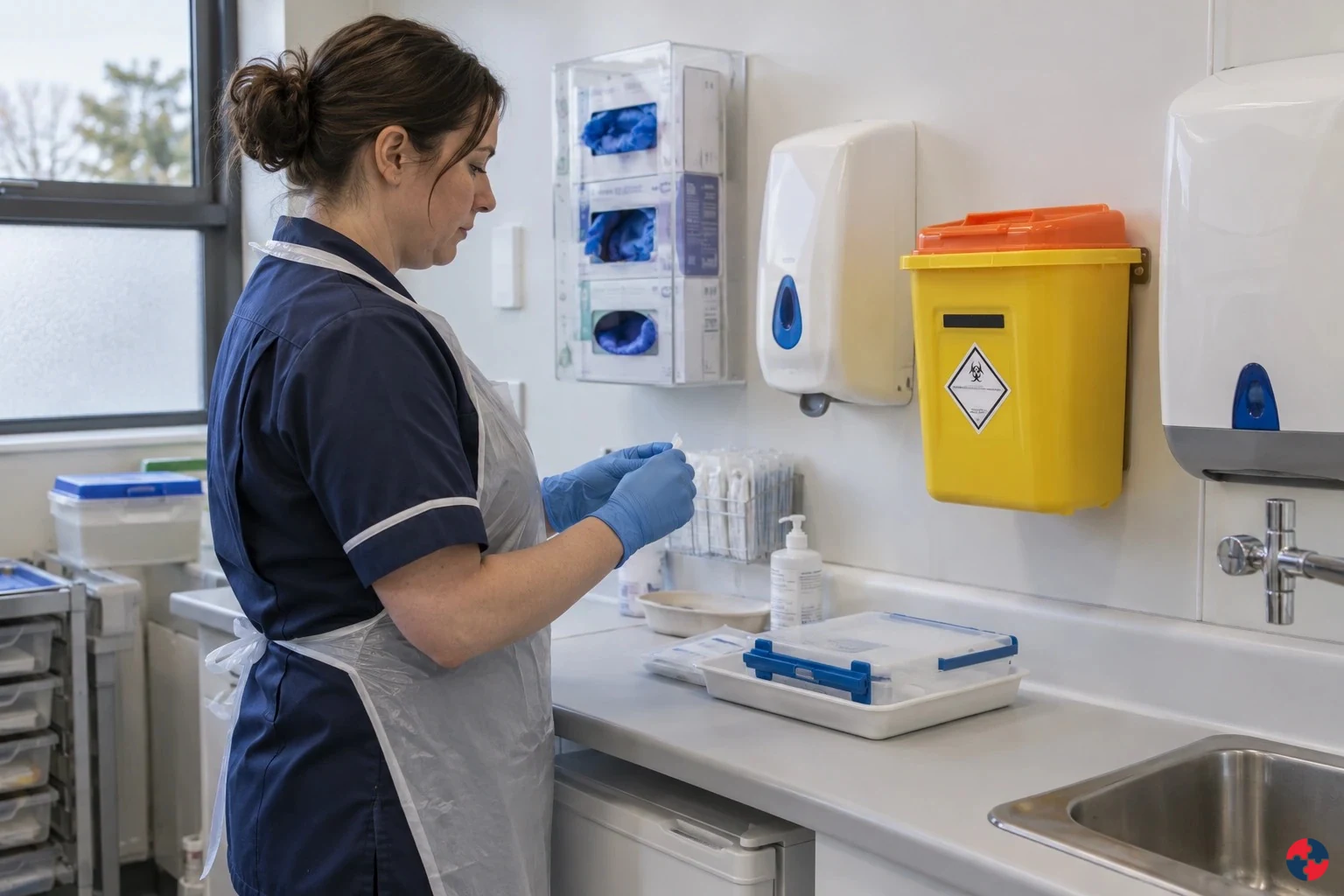
Choose exposure response, incidental control or deliberate work
This guide helps choose and verify practical controls. Start with source, exposure route, people and task, then decide whether the concern is an event needing care, incidental workplace exposure or deliberate agent work. Biological agents and infection risk controls cover the workplace management of bacteria, viruses, fungi, parasites, blood-borne viruses, zoonoses and other infectious materials that can harm workers or others.
Turn biological agents and infection risk controls knowledge into a decision
Biological agents and infection risk controls cover the workplace management of bacteria, viruses, fungi, parasites, blood-borne viruses, zoonoses and other infectious materials that can harm workers or others. The control task is to identify the source, route of exposure, susceptible people and chain of infection, then use proportionate measures such as containment, hygiene, ventilation, safe sharps systems, vaccination, waste controls, water-system management, health surveillance and outbreak response. Keep a confidential exposure record, device details, timely referral and corrective actions; assess reportability by the actual facts.
Sharps injury during care
The worker follows the local immediate first-aid and urgent clinical assessment pathway, reports promptly and preserves confidentiality. Managers secure the device and investigate the system, not blame the worker. Close the immediate response when clinical follow-up is arranged, the worker knows the confidential contact route and safer-sharps corrective actions have owners and dates.
How biological exposure reaches a person
Different biological tasks create different entry routes. Source control, safer equipment, containment and hygiene interrupt those routes; gloves do not prevent a needlestick and cannot replace the post-exposure clinical pathway.
Choose controls for biological agents and infection risk controls
Elimination: Avoid unnecessary injections and sharps Substitution: Use a safer device where clinically suitable Engineering: Provide engineered sharps protection and disposal at point of use Administrative: Train, report injury promptly and maintain post-exposure pathway PPE: Gloves protect residual contact but do not prevent puncture. Read the full control table for qualifications, ownership and verification. Use the actual task and applicable jurisdiction; existing technical approval remains unchanged.
Use the full biological agents and infection risk controls lesson
Use the full topic for the decision points, practical examples, detailed control tables and source scope. HSE guidance applies to Great Britain; use HSENI for the Northern Ireland route and the source’s stated jurisdiction. A simplified guide does not change the page’s technical-review or approval status.

Read all six steps as text
1. Choose exposure response, incidental control or deliberate work
This guide helps choose and verify practical controls.
- Avoid / redesign: Avoid unnecessary injections and sharps
- Control the task: Provide engineered sharps protection and disposal at point of use
- Verify before release: Clinical lead audits devices and injuries; stop unsafe reuse or missing disposal See HSE sharps injuries in healthcare
This guide helps choose and verify practical controls. Start with source, exposure route, people and task, then decide whether the concern is an event needing care, incidental workplace exposure or deliberate agent work. Biological agents and infection risk controls cover the workplace management of bacteria, viruses, fungi, parasites, blood-borne viruses, zoonoses and other infectious materials that can harm workers or others.
Apply it: Which part of this plan would you check at the workface before authorising the task?
2. Turn biological agents and infection risk controls knowledge into a decision
Use the evidence to improve the actual work arrangement.
- Change at source: Avoid unnecessary injections and sharps
- Make it observable: Clinical lead audits devices and injuries; stop unsafe reuse or missing disposal See HSE sharps injuries in healthcare
- Keep useful evidence: Keep a confidential exposure record, device details, timely referral and corrective actions; assess reportability by the actual facts.
Biological agents and infection risk controls cover the workplace management of bacteria, viruses, fungi, parasites, blood-borne viruses, zoonoses and other infectious materials that can harm workers or others. The control task is to identify the source, route of exposure, susceptible people and chain of infection, then use proportionate measures such as containment, hygiene, ventilation, safe sharps systems, vaccination, waste controls, water-system management, health surveillance and outbreak response. Keep a confidential exposure record, device details, timely referral and corrective actions; assess reportability by the actual facts.
Apply it: What evidence would show that the change improves this task, rather than only completing a record?
3. Sharps injury during care
Example: a practical application of the existing topic lesson.
- Setting: A care worker is punctured by a used needle during disposal.
- Act: Use safer sharps and a point-of-use container before the task; train staff in a clear post-exposure route and avoid recapping.
- Hold / review: Do not delay clinical advice while trying to identify the source, and do not let an untrained person handle the contaminated device.
The worker follows the local immediate first-aid and urgent clinical assessment pathway, reports promptly and preserves confidentiality. Managers secure the device and investigate the system, not blame the worker. Close the immediate response when clinical follow-up is arranged, the worker knows the confidential contact route and safer-sharps corrective actions have owners and dates.
Apply it: At which point would you hold this example, and what evidence would allow it to proceed?
4. How biological exposure reaches a person
Interrupt the source-to-person route before relying on gloves.
- Sharps: A contaminated sharp can puncture skin. Prevent unnecessary use and provide suitable safer devices and point-of-use disposal.
- Splash or aerosol: Disturbing contaminated material can expose eyes, mouth or breathing zones. Assess the task and prevent release at source.
- Contact transfer: Contaminated hands, tools or surfaces can transfer material. Control the clean boundary and hygiene; use the separate urgent clinical route after exposure.
Different biological tasks create different entry routes. Source control, safer equipment, containment and hygiene interrupt those routes; gloves do not prevent a needlestick and cannot replace the post-exposure clinical pathway.
Apply it: Which source-to-entry link is interrupted, and what happens if that control fails?
5. Choose controls for biological agents and infection risk controls
Start with the stronger practicable options and verify their effect.
- Elimination: Avoid unnecessary injections and sharps
- Substitution: Use a safer device where clinically suitable
- Engineering: Provide engineered sharps protection and disposal at point of use
- Administrative: Train, report injury promptly and maintain post-exposure pathway
- PPE: Gloves protect residual contact but do not prevent puncture.
Elimination: Avoid unnecessary injections and sharps Substitution: Use a safer device where clinically suitable Engineering: Provide engineered sharps protection and disposal at point of use Administrative: Train, report injury promptly and maintain post-exposure pathway PPE: Gloves protect residual contact but do not prevent puncture. Read the full control table for qualifications, ownership and verification. Use the actual task and applicable jurisdiction; existing technical approval remains unchanged.
Apply it: Which stronger option can be used here, and who will verify it before accepting the remaining risk?
6. Use the full biological agents and infection risk controls lesson
Follow the official sources below and retain the task-specific evidence.
- Official guidance: Control of Substances Hazardous to Health Regulations 2002
- Official guidance: Control of Substances Hazardous to Health Regulations (Northern Ireland) 2003
- Task decision: Keep a confidential exposure record, device details, timely referral and corrective actions; assess reportability by the actual facts.
Use the full topic for the decision points, practical examples, detailed control tables and source scope. HSE guidance applies to Great Britain; use HSENI for the Northern Ireland route and the source’s stated jurisdiction. A simplified guide does not change the page’s technical-review or approval status.
Apply it: Which official source and full-topic section will you use to resolve the next decision?
A response record supports care and control review after immediate actions. Keep individual clinical details restricted and share only operational restrictions with task owners. Laboratory containment, healthcare sharps duties and general public-space cleaning each retain their own scope.
A discarded needle changes a cleaning task
Illustrative example. A cleaner encounters a discarded needle in a public-access area and a possible exposure is reported.
Decision. Follow the existing response and sharps route first; control the area and arrange the competent local handling method.
Evidence to check. Record material/location, actual task and exposure facts for the clinical handover, separately from the general control review.
Hold or escalation point. Do not make care wait for a completed risk assessment or automatically apply healthcare-employment rules to a public-space task.
Follow-up. Review discovery, access control, safe handling and staff understanding with the responsible owner.
Break the route before relying on gloves
Name the source, transfer and entry route for the actual task. The same label “biological hazard” does not justify the same controls for every job.
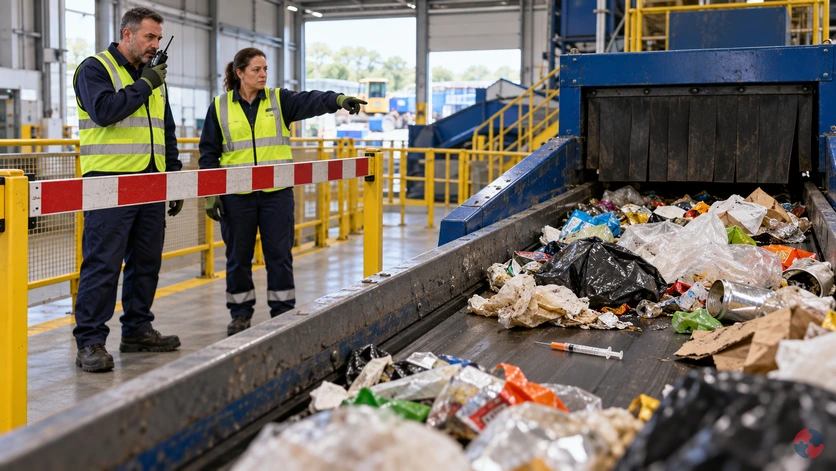
A sharp on the waste belt changes the task
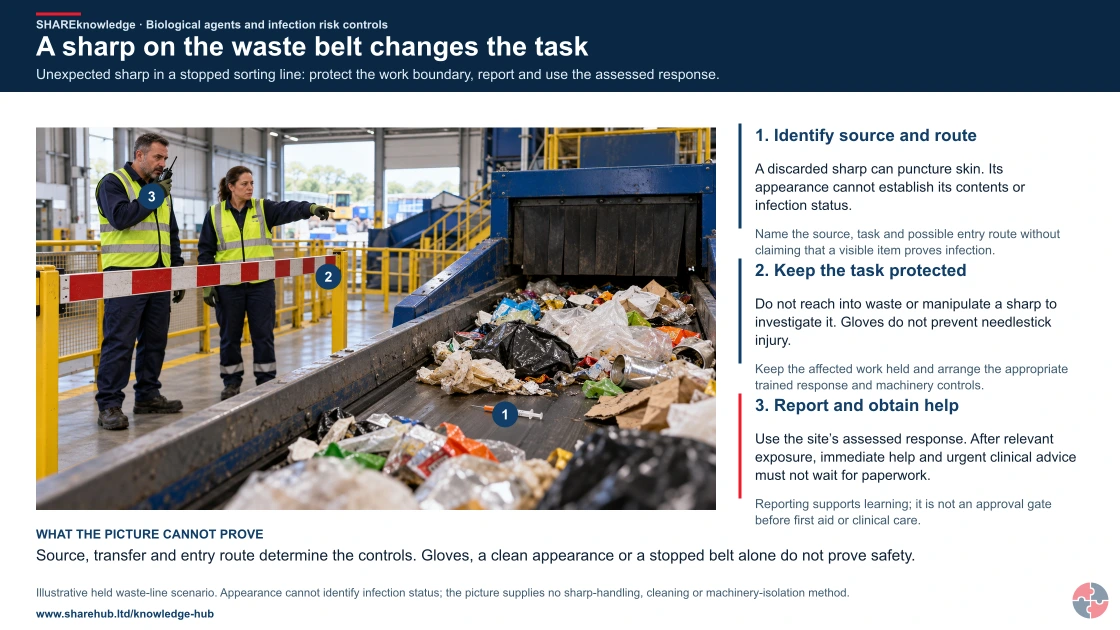
Full written explanation
Unexpected sharp in a stopped sorting line: protect the work boundary, report and use the assessed response.
- Identify source and route. A discarded sharp can puncture skin. Its appearance cannot establish its contents or infection status.
- Keep the task protected. Do not reach into waste or manipulate a sharp to investigate it. Gloves do not prevent needlestick injury.
- Report and obtain help. Use the site’s assessed response. After relevant exposure, immediate help and urgent clinical advice must not wait for paperwork.
Change the pathway
- Record the task, not a diagnosis. Name the source, task and possible entry route without claiming that a visible item proves infection.
- Avoid the exposure. Keep the affected work held and arrange the appropriate trained response and machinery controls.
- Keep care separate. Reporting supports learning; it is not an approval gate before first aid or clinical care.
Evidence check: Source, transfer and entry route determine the controls. Gloves, a clean appearance or a stopped belt alone do not prove safety.
Full incident, immediate first-aid and confidential clinical-response guidance
Primary references: HSE: needlestick and sharps injuries · HSE: preventing incidental exposure to infection at work
Open the complete HD image (new tab)Download image

Full incident, immediate first-aid and confidential clinical-response guidance
Primary references: HSE: needlestick and sharps injuries · HSE: preventing incidental exposure to infection at work

- Source / used sharp or water
- Transfer and entry route
- Source control + separate care
Read the labels in the full-size drawing
- SOURCE
- TRANSFER / ENTRY
- CONTROL BREAK + CARE
- Separate responsibilities; connect necessary evidence
| Source and task | Possible entry route | Prevent transfer | After a relevant exposure |
|---|---|---|---|
| Used sharp in clinical work | Puncture or broken skin | Avoid unnecessary sharps; use suitable safer devices and disposal at the point of use. Gloves do not prevent a needlestick. | Follow immediate first aid and the urgent confidential clinical pathway. |
| Contaminated water handled or disturbed | Splash or task-generated aerosol | Avoid unnecessary contact; assess containment and a method that reduces release. | Report the source, task and route to the appropriate clinical adviser. |
| Contaminated surface or tool | Hand-to-mouth or skin/eye contact | Control contamination, cleaning and handling; provide suitable hygiene facilities and a clean boundary. | Use the assessed response; do not guess infection status from appearance. |
Do not recap or manipulate a used sharp to investigate it. Keep the safer-device, point-of-use disposal and clinical-response guidance on this page together; this diagram does not identify a pathogen or prescribe treatment.
What are the key facts about biological agents and infection controls?
The key facts are that biological risk depends on the agent, source, route, exposure, susceptible person and control reliability.
Terms used below: ACDP means Advisory Committee on Dangerous Pathogens; RIDDOR means the Reporting of Injuries, Diseases and Dangerous Occurrences Regulations. GB and Northern Ireland reporting instruments must be checked separately.
Biological agents are varied
They include bacteria, viruses, fungi, parasites and materials such as blood or contaminated waste.
The route matters
Controls differ for inhalation, sharps injury, ingestion, skin contact, mucous membrane contact and water aerosols.
Work can amplify exposure
Cleaning, healthcare, water systems, animal work, waste and maintenance can create concentrated exposure.
Hygiene is a control system
Hand hygiene, welfare, cleaning and decontamination prevent spread beyond the immediate task.
Vaccination is not enough alone
Vaccines support control where available but do not replace exposure prevention.
Evidence is practical
Training, cleaning, waste, surveillance, vaccination, incident and maintenance records show whether arrangements work.
How can I practise this topic in 3D?


Contaminated soil and sharps are handled casually
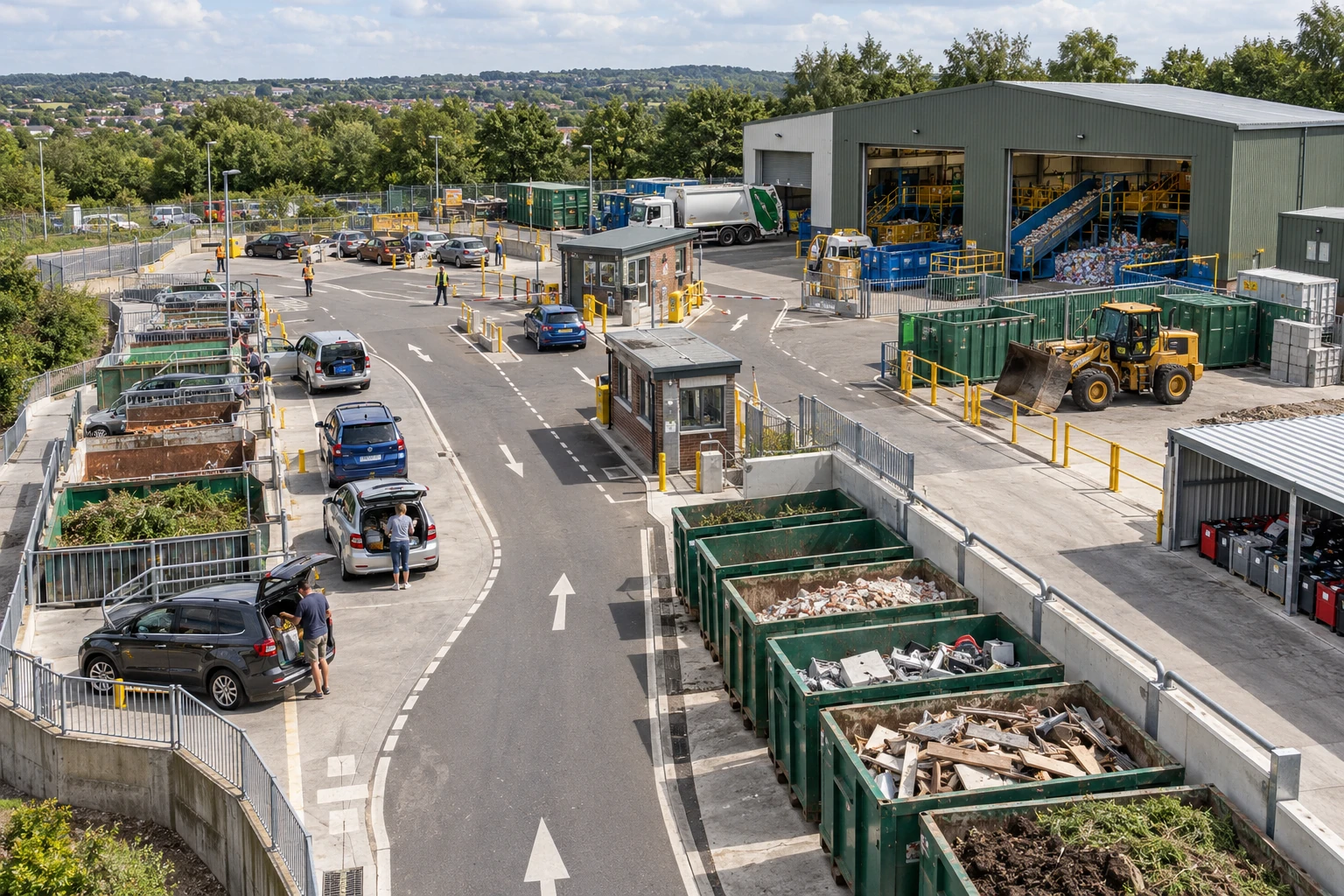
Concealed needle in a waste bag
All related inspection points 5 across 2 locations
Construction site 2 inspection points
Recover materials. Protect people. 3 inspection points
Practice in the SHAREhub environment. Browser practice is separate from workplace competence and formal learning records.
What are biological agents and infection risk controls?
Biological agents are microorganisms or biological materials that can cause infection, allergy, toxicity or other harm at work.
The term covers a wide range of hazards. Some biological agents infect people directly, such as viruses or bacteria. Some cause allergic or inflammatory reactions. Some are carried in blood, body fluids, animal material, sewage, water systems, contaminated sharps, waste or environmental dust.
Infection risk control is the practical management of the source, pathway and exposed person. It is not only a healthcare issue. Construction, leisure, waste, laboratories, animal care, cleaning, maintenance, agriculture, education, hospitality and public-facing work can all involve biological risks.
A competent assessment asks: what agent may be present, where is the source, how can people be exposed, who is more vulnerable, what controls interrupt transmission, and what evidence shows the controls are maintained?
Agent. Bacteria, viruses, fungi, parasites or biological material. Identify the specific hazard where possible.
Source. People, animals, water, soil, waste, blood, surfaces or aerosols. Control begins at the source.
Route. Inhalation, ingestion, injection, skin, mucous membrane or bite. Controls must match the route.
Susceptible person. Risk varies with immunity, pregnancy, health status, vaccination and role. Consider vulnerable workers proportionately.
Control. Contain, clean, ventilate, segregate, vaccinate, train and monitor. Use multiple barriers.
Evidence. Records show controls are live. Audit cleaning, training, waste, water and incident data.
What types of biological agents can affect workplaces?
Workplace biological agents include bacteria, viruses, fungi, parasites, blood-borne viruses, zoonoses and waterborne organisms.
Grouping agents helps readers understand risk, but the assessment still needs task detail. A virus spread through blood needs different controls from a bacterium growing in warm water or a fungus disturbed in contaminated building material.
Some agents are part of normal public health risk and become a workplace issue when work increases exposure, such as care, cleaning or close public contact. Others are strongly occupational, such as exposure to animal urine, sewage, laboratory cultures, contaminated sharps or cooling-tower aerosols.
The group tells you the broad control family; the task tells you the actual controls.
Bacteria. Legionella in water systems, leptospirosis from animal urine, wound infection risks. Water control, hygiene, vaccination where relevant and exposure prevention.
Viruses. Blood-borne viruses, respiratory viruses and outbreak-related exposure. Sharps safety, hygiene, ventilation, vaccination and isolation.
Fungi. Moulds in damp buildings, composting, waste or organic dust. Moisture control, ventilation, cleaning and RPE where needed.
Parasites and protozoa. Contaminated water, soil, animal faeces or travel-related exposure. Hygiene, water quality, PPE and task control.
Zoonotic agents. Animal, bird, rodent, tick or livestock-associated infections. Animal handling, bite prevention, hygiene and vaccination where available.
Biological toxins or allergens. Endotoxins, mould fragments or animal proteins. Dust control, containment, ventilation and cleaning.
The 2026 ACDP sixth edition may change the classification or vaccine note for a named agent. Check the current GB/NI approved list rather than relying on an older table in a training pack.
Where do workplace biological agents come from?
Workplace biological agents come from people, animals, water systems, soil, waste, blood, body fluids, surfaces and contaminated equipment.
Biological hazards are often hidden because the source looks ordinary: a blocked drain, a spa pool, a used needle, a bird-loft space, a waste bag, a wet air-handling unit or a sick worker attending a crowded workplace.
The source may be routine or accidental. Routine sources include healthcare procedures, animal care, laboratory work and water systems. Accidental sources include sewage leaks, discarded sharps, contamination during cleaning, flooding or outbreak conditions.
The source should be controlled as close to origin as possible. Cleaning after spread is weaker than preventing contamination release.
People. Respiratory illness, blood, body fluids or skin infection. Hygiene, ventilation, exclusion where necessary and sharps controls.
Animals. Bites, urine, faeces, tissues, bedding and ticks. Animal handling systems, PPE, hygiene and vaccination decisions.
Water systems. Legionella in tanks, showers, cooling systems or spa pools. Temperature control, cleaning, monitoring and competent management.
Waste and sewage. Contaminated bags, bins, drains and effluent. Segregation, PPE, washing and waste contractor control.
Soil and organic material. Compost, mould, manure, dust and decaying material. Dust control, hygiene and respiratory protection where needed.
Sharps and clinical equipment. Needles, scalpels, lancets or contaminated glass. Safer sharps, containers, training and response procedures.
How can biological agents enter or affect the body?
Biological agents can enter through breathing, swallowing, broken skin, mucous membranes, sharps injuries, bites or contaminated water droplets.
Routes of entry are practical because they determine controls. If the route is inhalation, ventilation, containment, aerosol control and respiratory protection may matter. If the route is injection, sharps prevention and post-exposure response become critical.
Some tasks involve several routes at once. Cleaning a contaminated shower can involve aerosol inhalation, splash to eyes and hand contamination. Handling waste can involve cuts, puncture wounds, skin contamination and hand-to-mouth transfer.
Controls should be selected route by route rather than relying on a single generic hygiene message.
Inhalation. Aerosols, droplets, dusts, spores or fumes are breathed in. Ventilation, enclosure, aerosol reduction and RPE where needed.
Ingestion. Contaminated hands, food, drink or smoking transfer agents. Handwashing, welfare and no eating in contaminated areas.
Injection. Needlestick, sharps injury, bite or puncture. Safer sharps, containers, bite controls and response.
Skin contact. Broken skin contacts contaminated material. Gloves, skin care, covering cuts and washing.
Mucous membranes. Splash to eyes, nose or mouth. Eye/face protection and splash control.
Water aerosol. Contaminated droplets from showers, spa pools or cooling systems. Water-system control and aerosol management.
How does the chain of infection help control workplace risk?
The chain of infection helps control risk by showing which link can be broken to stop transmission.
Control the chain, not just the final glove


Read the complete visual as text
- SOURCE: Identify the infectious material and the task that can release or transfer it; source status may be unknown.
- ROUTE: A used sharp can puncture skin and create a blood-borne exposure route. Other tasks may involve splash, aerosols or hand-to-mouth transfer.
- PREVENTION: Use safer devices and suitable point-of-use containers, avoid recapping and maintain a clear disposal method.
- AFTER EXPOSURE: Follow immediate first aid and urgent clinical assessment without waiting to establish source status; preserve confidentiality.
The chain of infection is a simple but powerful model: agent, reservoir, exit route, transmission route, entry route and susceptible host. In workplace language, it asks where the agent is, how it leaves, how it travels, how it enters a person and who is at risk.
Controls can break the chain at several points. Water treatment controls the reservoir. Gloves and sharps containers control transfer. Ventilation reduces airborne spread. Vaccination reduces susceptibility. Reporting and exclusion can reduce source exposure.
A mature risk assessment does not rely on one link. It builds layered controls so that one missed handwash or one late cleaning task does not defeat the whole system.
Agent. Bacteria, virus, fungus or parasite. Identify hazard and remove or inactivate it where possible.
Reservoir. Water system, person, animal, waste or surface. Clean, disinfect, maintain or segregate source.
Exit route. Cough, blood, urine, faeces, drainage or aerosol. Contain, cover, ventilate and control procedures.
Transmission. Hands, sharps, droplets, surfaces, water or vectors. Hygiene, sharps safety, cleaning and pest control.
Entry route. Breathing, broken skin, mucous membrane or ingestion. PPE, RPE, eye protection and handwashing.
Susceptible person. Unvaccinated, pregnant, immunocompromised or exposed worker. Vaccination, work restriction and occupational health advice.
Which work activities create higher biological infection risk?
Higher-risk activities are those that bring workers into contact with infectious sources, contaminated materials, aerosols, sharps, animals or waste.
Risk is not defined by sector alone. An office has low biological risk most days, but may need outbreak controls. A leisure site may have water-system and public-contact risks. A construction worker may encounter contaminated land, sewage, bird droppings or discarded sharps.
Non-routine work matters because workers may disturb contamination that routine users never contact. Examples include drain repair, water-system cleaning, demolition, filter change, waste compaction, flood recovery and maintenance in confined or poorly ventilated areas.
The assessment should identify who is exposed directly and who may be affected indirectly, including cleaners, contractors, pregnant workers, immunocompromised workers and members of the public.
Healthcare and care. Blood, body fluids, respiratory illness and sharps. Standard precautions, vaccination, PPE and waste control.
Water systems and spa pools. Legionella and other organisms can grow and aerosolise. Water safety plan, temperature, disinfection and monitoring.
Animal work. Zoonoses, bites, scratches, urine and faeces. Handling systems, hygiene, PPE and vaccination decisions.
Waste and cleaning. Contaminated materials, sharps and surfaces. Segregation, gloves, washing and sharps response.
Construction and maintenance. Sewage, bird droppings, soil, mould and contaminated plant. Survey, task controls, cleaning and RPE/PPE.
Laboratory work. Cultures, samples and concentrated agents. Containment, competence, emergency procedures and waste controls.
How can biological agent exposure be controlled at work?
Biological agent exposure is controlled by preventing contact with the source, interrupting transmission and supporting susceptible people.
Control should follow the hierarchy, but biological hazards often need a bundle of controls: containment, hygiene, cleaning, ventilation, vaccination, waste management, PPE, training and rapid response.
The strongest controls remove or contain the source. For example, closed waste systems, engineered sharps safety, controlled water systems and restricted access are stronger than relying only on gloves or reminders.
Discipline remains important because hygiene and reporting depend on people. However, discipline works best when the workplace provides time, facilities, equipment and supervision to make the safe method realistic.
Eliminate. Remove the biological source or avoid the task. Use closed systems, outsource specialist handling or remove contaminated material safely. Not always possible in care, waste, water or animal work.
Reduce. Reduce exposure frequency, people exposed or contamination level. Limit access, reduce aerosol-generating tasks and minimise waste handling. Residual exposure may remain.
Isolate. Separate people from the source. Containment cabinets, segregated rooms, barriers and clean/dirty zones. Breaches occur during maintenance or cleaning.
Control. Use engineering, hygiene and procedural controls. Ventilation, disinfection, handwashing, sharps containers, water treatment and waste segregation. Needs maintenance and verification.
PPE. Protect against residual contact or inhalation. Gloves, eye protection, aprons, masks or RPE depending on route. Can fail through poor selection, removal or contamination.
Discipline. Use training, supervision, reporting and behaviour controls. Hand hygiene, vaccination uptake, incident reporting and exclusion rules. Relies on good culture and adequate facilities.
What should cleaning hand-back tell the next team?
Describe the remaining exposure routes when an area is handed back after contamination work. “Cleaned” can mean visible material was removed; it does not by itself establish that an infectious source has been stopped, the chosen treatment was suitable or later work will avoid aerosolising residue. Agree the intended next use and the evidence needed for that use before the contractor starts.
For an illustrative sewage leak in a service room, the site owner and competent contractor establish which surfaces, equipment and access routes are affected, stop the source safely and use an assessed containment and cleaning method. Hand-back identifies what was treated, any inaccessible or untreated area, waste removed, remaining restrictions and who will decide whether the next task can proceed. If a later contractor needs to open contaminated equipment or use a different cleaning method, assess that activity separately. Keep worker exposure and clinical follow-up information in the appropriate private process rather than including medical details in a general area handover.
Guidance and scope: Original SHARE contractor example applying HSE GB incidental-infection guidance and COSHH. Agent-specific treatment, contact conditions and reopening evidence require competent selection; no universal disinfection method or laboratory clearance criterion is proposed. HSE preventing incidental infection exposure Control of Substances Hazardous to Health Regulations 2002
How should sharps and blood-borne virus risks be controlled?
Sharps and blood-borne virus risks should be controlled by avoiding sharps where possible, using safer devices, safe disposal and rapid exposure response.
Sharps injuries can transmit blood-borne viruses such as hepatitis B, hepatitis C and HIV where the source is infected. The risk depends on the device, injury depth, blood volume, source status and speed of response.
The strongest control is to avoid unnecessary sharps. Where sharps are needed, safer sharps, immediate disposal into suitable containers, no recapping, good lighting, stable work position and training are essential.
After a sharps injury, the response should be immediate: first aid, reporting, occupational health or clinical assessment, source-risk assessment where appropriate, and investigation of how the injury occurred.
Avoidance. Use needle-free or safer systems where possible. Procurement and risk assessment.
Use. Do not recap; handle one sharp at a time with clear workspace. Procedure, training and observation.
Disposal. Use suitable sharps containers at point of use. Container checks and waste records.
Vaccination. Offer hepatitis B vaccination where risk assessment supports it. Confidential vaccination programme records.
Exposure response. First aid, reporting and clinical/occupational health assessment. Sharps injury log and referral route.
Learning. Investigate causes and improve work design. Action close-out and trend review.
How should zoonoses be managed at work?
Zoonoses should be managed by identifying animal or environmental sources, controlling contact and maintaining hygiene, vaccination and reporting arrangements.
Zoonoses are infections that can pass from animals to humans. Workplace routes include bites, scratches, urine, faeces, birth products, bedding, aerosols, ticks, contaminated soil or water and contact with dead animals.
Higher-risk work includes farming, veterinary care, animal handling, pest control, waste, grounds maintenance, forestry, waterway work, laboratories and some construction or demolition activities.
Controls should include animal handling systems, segregation, handwashing, protective clothing, wound care, bite prevention, tick awareness, vaccination where available and prompt reporting of symptoms after exposure.
Rats and animal urine. Leptospirosis risk in water, sewers or contaminated areas. Waterproof PPE, wound covering, hygiene and information.
Livestock. Contact with birth products, faeces or respiratory agents. Segregation, hygiene, PPE and vaccination decisions.
Birds and droppings. Dusts, fungi or bacterial contamination. Wet cleaning, RPE/PPE and exclusion.
Ticks. Outdoor work exposure. Clothing, tick checks and symptom awareness.
Bites and scratches. Broken skin exposure and infection risk. Handling systems, training and first aid.
Animal bedding and waste. Aerosol, dust or contact exposure. Ventilation, dampening, gloves and cleaning.
How should waterborne infection risks such as Legionella be controlled?
Waterborne infection risks should be controlled by managing water systems so harmful organisms do not grow and spread as aerosols.
Legionella is a key workplace biological risk because it can grow in poorly managed water systems and infect people who inhale contaminated aerosol. Relevant systems can include hot and cold water, showers, cooling towers, spa pools, whirlpools and other aerosol-generating equipment.
Control depends on system design, temperature control, cleaning, disinfection, avoiding stagnation, monitoring and competent management. Leisure sites and facilities teams should be especially alert to spa pools because warm aerated water can create a high-risk environment.
Water-system control should be documented, assigned to competent people and reviewed after changes, failures, shutdowns or evidence of poor control.
Hot and cold water systems. Stagnation and poor temperature control support growth. Temperature checks, flushing and schematic.
Spa pools. Warm aerated water creates aerosol exposure. HSG282-style management, testing and cleaning.
Showers. Aerosol can be inhaled. Cleaning, flushing and temperature control.
Cooling systems. Aerosol can spread widely. Written scheme, monitoring and competent management.
Dead legs and low-use outlets. Stagnant water supports growth. Removal, flushing or control plan.
Post-shutdown restart. Water quality may deteriorate. Recommissioning checks and disinfection where needed.
When are vaccination and information important?
Vaccination and information are important where risk assessment shows occupational exposure to vaccine-preventable infection.
Vaccination can be a powerful control where a suitable vaccine exists, such as hepatitis B for certain blood-exposure risks. It should be offered through an appropriate occupational health process with confidentiality and clear information.
Vaccination does not replace exposure control. A vaccinated worker still needs safe sharps systems, hygiene, PPE, waste control and incident response. Some workers may not respond to a vaccine or may not be able to receive it.
Information should explain the risk, the benefits and limits of vaccination, what records are kept, what is confidential and what to do after exposure.
Risk assessment. Identify who has occupational exposure risk. Vaccination decision record.
Informed offer. Explain benefits, limits and confidentiality. Occupational health information and consent route.
Coverage. Monitor uptake without unnecessary disclosure. Anonymous trend or fitness confirmation.
Non-responders or decliners. Review controls and advice without unfair treatment. Occupational health guidance.
Post-exposure process. Define what happens after blood or infection exposure. Procedure and training.
Review. Update after role, agent or public health change. Scheduled review and outbreak learning.
When is health surveillance relevant for biological agents?
Health surveillance is relevant where biological exposure can cause identifiable health effects and surveillance can help detect or prevent harm.
Health surveillance should be based on COSHH assessment and occupational health advice. It may involve symptom reporting, vaccination status checks, exposure records, post-exposure follow-up, respiratory review, skin checks or other task-specific arrangements.
Surveillance should be proportionate. It is not needed for every ordinary infection risk, but it can be important for workers with task-specific exposure to blood-borne viruses, zoonoses or other biological agents where the assessment and occupational health advice identify a useful surveillance method.
Health information must be handled confidentially. Managers need work fitness and restrictions, not private clinical detail.
Blood-borne virus risk. Vaccination and post-exposure follow-up. Confidential occupational health process.
Animal work. Symptoms after bites, urine or faeces exposure. Information, reporting and referral routes.
Organic dust or mould. Respiratory symptoms or sensitisation. Symptom reporting and occupational health review.
Laboratory agents. Agent-specific medical advice. Defined containment and incident follow-up.
Waterborne exposure. Illness reporting after suspected Legionella exposure. Water-system investigation and public health liaison.
Vulnerable workers. Pregnancy, immunosuppression or health conditions. Individual risk assessment and confidentiality.
How should exposure incidents and outbreaks be managed?
Exposure incidents and outbreaks should be reported, assessed, controlled and reviewed using defined workplace and public health routes.
Exposure response should be planned before an incident occurs. Sharps injuries, blood splashes, animal bites, sewage exposure, water-system failures and suspected outbreaks all need clear actions and named routes.
The response should protect the exposed person, prevent further exposure, preserve useful evidence, clean or isolate the source and involve competent support. For some events, occupational health, clinical services, infection-control teams, local public health teams or regulators may need to be involved.
After the event, the organisation should investigate the route of exposure and improve controls rather than treating it as an isolated personal mishap.
Sharps injury. First aid, report, clinical/occupational health assessment. Review device, disposal and training.
Blood or body fluid splash. Decontaminate, report and seek assessment. Review eye/face protection and procedure.
Animal bite or scratch. First aid, report and medical route where needed. Review handling, restraint and training.
Sewage or contaminated water exposure. Wash, report and assess symptoms/exposure. Review PPE, hygiene and work method.
Legionella control failure. Restrict use where needed and investigate system. Review written scheme, monitoring and competence.
Suspected workplace outbreak. Increase controls and use public health route where appropriate. Review ventilation, cleaning, attendance and communication.
Which legal duties apply in Great Britain and Northern Ireland?
The applicable legal route depends on where the work takes place. The duties below are scoped to Great Britain and Northern Ireland; a task assessment and the current instruments determine the actual requirements.
Great Britain
GB COSHH 2002 covers incidental exposure, such as sewage, waste, blood or animal contact, and deliberate work with biological agents in laboratories or industry. Assessment should identify agent/source, route, susceptible people and suitable prevention or control. Extra notification or containment requirements depend on the planned work and the current ACDP list; the hazard group alone does not prescribe one universal work method. For healthcare employers and relevant contractors, the Health and Safety (Sharp Instruments in Healthcare) Regulations 2013 add specific prevention, safer-device, no-recapping, information, training and post-injury duties; check their scope. RIDDOR reporting applies only where its tests are met.
Northern Ireland
Use COSHH (Northern Ireland) 2003 with the NI Health and Safety at Work Order and Management Regulations. HSENI approved the 2026 sixth edition of the biological-agent list for NI COSHH. The Health and Safety (Sharp Instruments in Healthcare) Regulations (Northern Ireland) 2013 apply to relevant healthcare employers and contractors; check their scope, prevention and post-injury requirements. Apply NI reporting tests to the facts; GB instrument numbers cannot be copied as NI law.
How should biological agents appear in a risk register?
Biological agents should appear as task-specific exposure risks with routes, sources, susceptible groups, controls and evidence.
A useful risk register does not simply state 'infection risk'. It identifies the agent or likely agent group, source, route, affected people, control failure route and review trigger.
Controls should be owned. Water-system controls need a responsible person. Sharps systems need procurement, disposal and response owners. Cleaning needs standards and verification. Vaccination programmes need occupational health governance.
The register should include ordinary work and foreseeable abnormal events such as spillages, bites, outbreaks, water failures, waste incidents and maintenance.
| Scenario | Exposure concern | Controls and evidence |
|---|---|---|
| Spa pool operation | Legionella and other waterborne agents. | Water safety plan, tests, cleaning and competence. |
| First-aid sharps incident | Blood-borne virus exposure. | Sharps procedure, first aid and occupational health route. |
| Cleaning public toilets | Body fluids, faecal contamination and sharps. | PPE, sharps check, cleaning method and hygiene. |
| Grounds maintenance | Animal urine, ticks and contaminated soil. | PPE, wound covering, washing and information. |
| Waste handling | Sharps, contaminated bags and aerosols. | Segregation, containers, training and contractor controls. |
| Outbreak in workplace | Person-to-person respiratory spread. | Ventilation, cleaning, attendance guidance and communication. |
How could Riverside Leisure Ltd manage biological agents and infection risks?

Riverside Leisure Ltd would prevent avoidable biological exposure through task design, suitable equipment and a clear route for unexpected contamination and exposure incidents.
Riverside Leisure Ltd · practical example
Respond to a discarded sharp without creating another exposure
The key lesson Biological risk depends on the agent, route of exposure and task; ordinary gloves or a clean appearance do not make an unexpected sharp safe.
The situation: A housekeeper finds a discarded needle while preparing a hotel room. The normal waste bag is nearby, but no one should need to reach into bedding or a waste container to make the room ready.
Why this matters: Rushing room turnaround or putting a sharp into ordinary waste can expose the finder, colleagues and people handling waste later.
How Riverside Leisure Ltd would manage it
- Protect people and the area — Department Supervisor. Keep the affected room or task unavailable and prevent further handling of the item. If an exposure has occurred, use the prompt first-aid and medical-advice route in the site's arrangements.
- Use a competent response — Duty Manager. Arrange handling and disposal by trained people with suitable equipment under the assessed method. Do not ask the housekeeper to recap, retrieve by hand or improvise a disposal container.
- Review foreseeable exposure — Health and Safety Adviser. Check housekeeping, laundry and waste tasks for sharps and contamination routes. Apply relevant workplace duties without assuming healthcare-specific sharps rules automatically describe a hotel.
- Prepare staff and supplies — Hotel Manager. Provide the assessed equipment, contractor arrangements, training and reporting route. Make the method usable for agency workers and out-of-hours shifts as well as the main housekeeping team.
- Verify and learn — Facilities Coordinator. Confirm competent removal, the accepted room condition and safe waste transfer. Review how the item was found and improve the system without identifying or speculating about a guest's health.
When the conditions change
- Recognise the trigger
- An unexpected sharp or contamination is found, or a possible exposure occurs.
- Make the immediate decision
- Stop affected handling and protect access; activate the relevant urgent exposure route where needed.
- Verify the next step
- The Duty Manager checks the competent removal record, accepted room condition and identified safe waste route before returning the room to use.
What good looks like
Staff protect the area, know their response limits and can obtain prompt assistance. Waste handling remains controlled after the room is returned to service.
Evidence to look for: Task assessment, response method, training and equipment checks, secure incident record and accepted hand-back.
Common mistake to avoid: Moving the risk into an ordinary waste bag so the visible area looks clear.
Apply this to your work: What would prevent an unexpected contaminated sharp from reaching your ordinary waste stream?
Guidance behind the management approach: HSE: preventing blood-borne virus exposure. Use the topic's legal and technical guidance for the applicable work and location.
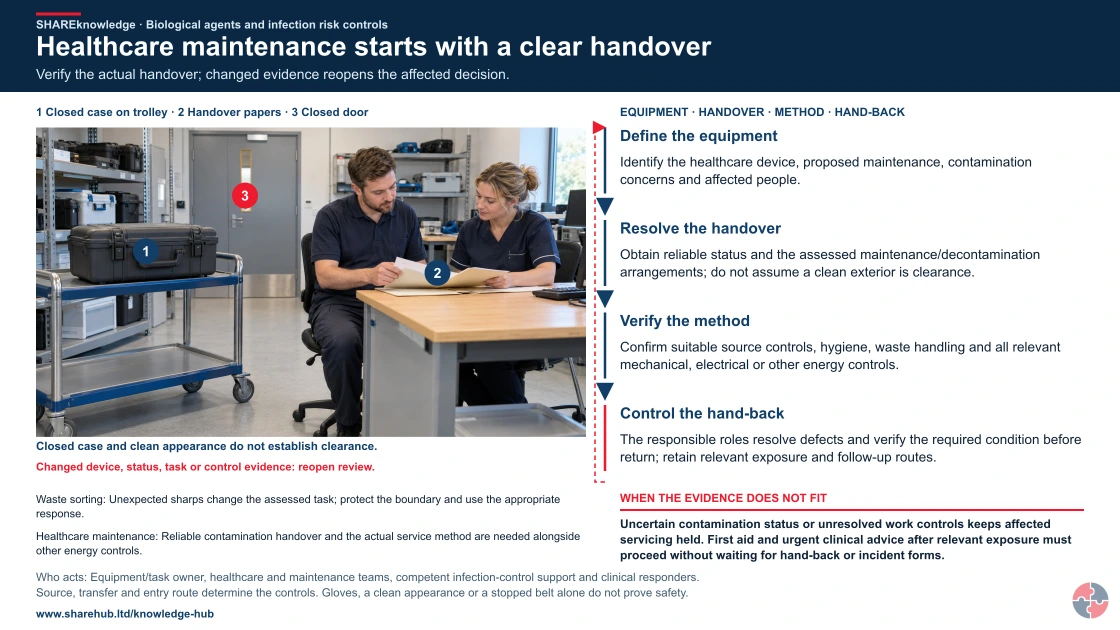
Healthcare maintenance starts with a clear handover
Full written explanation
An illustrative UK healthcare-engineering receiving-room setting outside patient care shows a closed opaque equipment case on a trolley, ordinary closed room door and normal adults reviewing inert handover papers. One literal picture key identifies 1 closed case on trolley, 2 handover papers and 3 closed door. The case contents and status are unknown. A cover, clean appearance, shut case or closed room does not establish contamination status, decontamination, sterility, isolation, containment, competence, clearance or permission. No patient, clinical procedure, sharps, material, device opening, testing, repair, cleaning or energy-control action is shown. Four assessment checks follow: Define the equipment: Identify the healthcare device, proposed maintenance, contamination concerns and affected people. Resolve the handover: Obtain reliable status and the assessed maintenance/decontamination arrangements; do not assume a clean exterior is clearance. Verify the method: Confirm suitable source controls, hygiene, waste handling and all relevant mechanical, electrical or other energy controls. Control the hand-back: The responsible roles resolve defects and verify the required condition before return; retain relevant exposure and follow-up routes. Three forward arrows show the assessment-review order, not a servicing recipe or automatic hand-back. Changed device, status, task or control evidence reopens the affected review. Uncertain contamination status or unresolved work controls keeps affected servicing held. First aid and urgent clinical advice after relevant exposure must proceed without waiting for hand-back or incident forms. Who acts: Equipment/task owner, healthcare and maintenance teams, competent infection-control support and clinical responders. Source, transfer and entry route determine the controls. Gloves, a clean appearance or a stopped belt alone do not prove safety. Waste sorting: Unexpected sharps change the assessed task; protect the boundary and use the appropriate response. Healthcare maintenance: Reliable contamination handover and the actual service method are needed alongside other energy controls. Immediate first aid and urgent confidential clinical advice after relevant exposure are independent of forms, equipment status, handover or work-release permission. Incidental exposure, deliberate agent work and healthcare sharps-law scope remain different questions; no agent-specific method, diagnosis or control-performance finding is supplied.
- Define the equipment. Identify the healthcare device, proposed maintenance, contamination concerns and affected people.
- Resolve the handover. Obtain reliable status and the assessed maintenance/decontamination arrangements; do not assume a clean exterior is clearance.
- Verify the method. Confirm suitable source controls, hygiene, waste handling and all relevant mechanical, electrical or other energy controls.
- Control the hand-back. The responsible roles resolve defects and verify the required condition before return; retain relevant exposure and follow-up routes.
When the evidence does not fit: Uncertain contamination status or unresolved work controls keeps affected servicing held. First aid and urgent clinical advice after relevant exposure must proceed without waiting for hand-back or incident forms.
Who acts: Equipment/task owner, healthcare and maintenance teams, competent infection-control support and clinical responders.
Changed workplace
Waste sorting: Unexpected sharps change the assessed task; protect the boundary and use the appropriate response.
Healthcare maintenance: Reliable contamination handover and the actual service method are needed alongside other energy controls.
Evidence check: Source, transfer and entry route determine the controls. Gloves, a clean appearance or a stopped belt alone do not prove safety.
Full incident, immediate first-aid and confidential clinical-response guidance
Primary references: HSE: needlestick and sharps injuries · HSE: preventing incidental exposure to infection at work
Open the complete HD image (new tab)Download image

Full incident, immediate first-aid and confidential clinical-response guidance
Primary references: HSE: needlestick and sharps injuries · HSE: preventing incidental exposure to infection at work
Riverside Leisure Ltd
Riverside Leisure Ltd operates leisure centres, pools, spa areas, hospitality facilities and outdoor activity sites where infection risk can arise from water systems, customers, first aid, cleaning, waste, animals and outdoor environments.
Riverside would maintain a biological risk register covering swimming and spa pools, showers, changing rooms, first aid, cleaning, waste, food areas, outdoor activities, animal or pest contamination and outbreak response. Each risk would identify the source, route, affected people and controls.
For water systems, Riverside would appoint competent responsible people, maintain written schemes, check temperatures or disinfectant controls, clean and inspect systems, keep records and review after shutdowns or water-quality failures. Spa pools would receive extra attention because warm aerated water can create aerosol exposure.
For first aid and cleaning, Riverside would use standard precautions: gloves, eye protection where splash is possible, sharps containers, cleaning chemicals, handwashing, waste segregation, incident reporting and post-exposure assessment routes. Staff would know not to pick up sharps by hand or improvise after blood exposure.
Training would be layered. All staff would receive infection-control awareness, hand hygiene, reporting and cleaning basics. Lifeguards, cleaners, maintenance staff and activity leaders would receive task-specific training. Supervisors would check records, investigate incidents and review contractor controls.
Assurance would use inspections, water records, cleaning audits, training records, incident trends, worker feedback, waste documentation and management review. If repeated cleaning failures or water checks appeared, Riverside would improve staffing, equipment, procedures and supervision rather than relying only on reminders.
Risk register. Maps water, cleaning, first aid, waste and outdoor infection risks. Biological risk profile and task assessments.
Water safety. Controls Legionella and spa pool risks. Written scheme, tests, cleaning and review.
Cleaning and waste. Uses standards, PPE, sharps controls and waste segregation. Cleaning audits and waste records.
Training. Provides awareness, task and supervisor training. Training matrix and practical assessment.
Incident response. Defines sharps, blood, bite, sewage and outbreak routes. Incident logs and referral evidence.
Assurance. Reviews trends and takes corrective action. Audit findings and action close-out.
What training is needed for biological agents and infection controls?
Training should be matched to exposure risk, with more detailed training for workers handling biological sources, sharps, waste, water systems or animals.
General awareness should explain basic infection routes, hand hygiene, reporting, welfare, cleaning and when not to work while infectious. This is suitable for broad workforces and public-facing roles.
Task-specific training is needed where workers handle body fluids, sharps, animals, waste, sewage, water systems, laboratories or contaminated environments. It should be practical and include PPE, decontamination and incident response.
Managers and supervisors need enough knowledge to assess risk, review evidence, coordinate occupational health, protect privacy and escalate to specialists where needed.
Competence means a person can carry out the actual task safely, recognise a changed condition and respond correctly. Attendance alone is insufficient. The matrix makes assessment, ownership, records and reassessment explicit.
| Role | Required learning | How competence is assessed | Assessor or owner | Record | Reassess when |
|---|---|---|---|---|---|
| All exposed workers | Recognise biological sources, routes, hand hygiene, task boundaries and prompt incident reporting. | Observed hygiene and source-identification scenario. | Supervisor | Induction and task check | After task or source change. |
| Healthcare, sharps and waste workers | Use safer devices, segregation, PPE, disposal and immediate post-exposure route. | Practical sharps/disposal and needlestick-response exercise. | Competent clinical or operations lead | Task authorisation and drill record | After device, process or guidance change. |
| Water-system and facilities teams | Identify aerosol-generating systems, control temperature/biocide as designed, maintain and respond to out-of-range results. | Observed system check and escalation exercise. | Responsible person | Water log and competence record | After system change or failed control. |
| Biosafety specialists and managers | Select containment for deliberate work, review ACDP list, vaccinations and surveillance, and assess reportability. | Case review of agent, process, group, controls and abnormal release. | Competent biosafety lead | Assessment and assurance record | After list update, new agent or incident. |
How do biological agents and infection controls support study and professional development?
Biological agents support study by linking health hazards, COSHH, infection chains, public health, hygiene, surveillance and risk management.
For NEBOSH National General Certificate learners, this topic links to hazardous substances, welfare, occupational health, risk assessment, training and emergency arrangements. Scenario answers should explain source, route, exposed person and controls.
For NEBOSH Diploma learners, this topic aligns with deeper occupational health and biological-agent criteria. Strong answers should analyse agent groups, routes, containment, sharps, zoonoses, vaccination, surveillance, legal duties and evidence.
For professionals, the page supports practical judgement: identify the specific source and route, choose controls that break transmission, and define evidence that proves the controls are actually working.
New learner. Biological agents include bacteria, viruses, fungi and parasites. Explain source, route and controls simply.
NEBOSH NGC learner. COSHH and risk assessment apply to biological hazards. Use hygiene, training, PPE and emergency response examples.
NEBOSH Diploma learner. DN2 10.10 requires deeper biological-agent analysis. Discuss routes, containment, sharps, zoonoses, vaccination and surveillance.
Supervisor. Controls must match tasks. Check cleaning, waste, PPE, sharps and water records.
Manager. Biological risk needs ownership and review. Assign controls and review incidents/trends.
Occupational health or hygiene link. Health and exposure data need specialist interpretation. Advise on surveillance, vaccination and exposure response.
How can a management system make biological risk control robust?
A management system makes biological risk control robust by linking risk assessment, competence, hygiene, maintenance, surveillance, incident response and review.
Biological controls fail when they are treated as one-off hygiene instructions. A management system keeps ownership clear: who manages water systems, who controls sharps, who reviews cleaning, who manages vaccination, who handles exposure incidents and who reviews outbreaks.
A management cycle helps assign leadership, planning, competence, safe operations, performance review and improvement. A voluntary management framework is a voluntary system reference; a licensed current text is needed for exact clause applications.
The system should be able to answer: what biological risks exist, who is exposed, how are controls maintained, what records prove it and what changes after an incident or outbreak?
| Management-system stage | Plain-English expectation | Biological risk evidence |
|---|---|---|
| Leadership and worker participation | Leaders support hygiene, reporting and worker involvement. | Consultation, resources and stop-work support. |
| Planning | Biological sources, routes and exposed groups are identified. | Risk register and COSHH assessments. |
| Support | People, information and competence are maintained. | Training, vaccination information and specialist advice. |
| Operation | Controls are implemented in real tasks. | Cleaning, waste, water, sharps and exposure procedures. |
| Performance evaluation | Controls are checked and reviewed. | Audits, water records, incident trends and surveillance. |
| Improvement | Incidents and outbreaks improve controls. | Action close-out and revised procedures. |
What are the warning signs that biological infection controls are failing?
Warning signs include repeated illness reports, poor hygiene facilities, unmanaged sharps, weak cleaning, water-control gaps and incidents that do not lead to learning.
Control failure often appears as small practical gaps: empty soap dispensers, overflowing waste, sharps in general waste, poor cleaning records, undocumented water checks, staff unsure what to do after blood exposure or contractors disturbing contaminated materials without a plan.
These signs can cause harm by allowing infection sources to spread, exposing vulnerable people, delaying post-exposure assessment or creating outbreaks that disrupt operations.
The improvement action should focus on the failed link in the chain of infection and the management weakness that allowed it to persist.
Poor handwashing facilities. Hand-to-mouth or surface transmission increases. Restore facilities and audit hygiene arrangements.
Sharps found in general waste. Needlestick exposure risk. Improve segregation, containers and training.
Water checks missed. Legionella control may drift. Review responsible person, schedule and competence.
Cleaning records completed without evidence. Contamination may remain. Observe cleaning and verify standards.
Workers unsure after exposure. Clinical assessment may be delayed. Rebrief response routes and test drills.
Repeated infection-related absence in one area. Workplace transmission or exposure source may exist. Investigate source, ventilation, cleaning and attendance controls.
How should the 2026 approved biological-agent list be used?
The ACDP sixth edition, published in 2026, updates classifications and vaccine advice. HSE publishes it for GB and HSENI approves it for NI COSHH. Check the actual agent and current list, especially when work is deliberate, then assess the procedure, exposure route, quantity and affected people.
A hazard group describes the agent’s potential infection hazard, but it is not a complete containment decision for every task. Incidental exposure in care, waste or sewage needs a task-specific source-to-person risk assessment; deliberate culture or propagation may invoke further containment and notification duties. Record the specialist decision and revisit it when the list or work changes.
How do infection-control decisions work in practice?
These examples illustrate a decision from context and prevention to stop, ownership, hand-back and recheck. They do not replace task assessment.
Break the infection route before a sharps injury


Read the complete visual as text
- Use safer sharps at source
- Place disposal at the point of use
- Keep the clinical response prompt
- The photograph provides topic context. Sharps injury during care is an illustrative learning example; the checks below must be adapted to the actual task.
Used-needle injury: a response and learning map


Read the complete visual as text
- 1. INCIDENT FACTS: A care worker is punctured during disposal; record the task and exposure facts without assuming infection status.
- 2. IMMEDIATE CARE: Use the established immediate first-aid and urgent clinical pathway; do not delay for source identification.
- 3. PREVENT FURTHER CONTACT: Keep others away from the contaminated device and arrange safe management by trained staff.
- 4. REPORT AND FOLLOW UP: Report promptly through the confidential route; clinical services decide assessment and follow-up.
- 5. SECURE AND INVESTIGATE: Prevent untrained handling and further exposure. Managers investigate the system without blame.
- 6. CLOSE THE ACTIONS: Confirm clinical follow-up and a confidential contact, then assign safer-sharps corrective actions with owners and dates.
Sharps injury during care
Task material and setting: A care worker is punctured by a used needle during disposal. The source and blood-borne-virus status are not immediately known.
People and prerequisites: The exposed worker needs immediate first-aid and clinical contact details; the employer needs a trained sharps-response lead, confidential reporting route and safe device-disposal plan.
Before: Use safer sharps and a point-of-use container before the task; train staff in a clear post-exposure route and avoid recapping.
During: The worker follows the local immediate first-aid and urgent clinical assessment pathway, reports promptly and preserves confidentiality. Managers secure the device and investigate the system, not blame the worker.
Hold or stop: Do not delay clinical advice while trying to identify the source, and do not let an untrained person handle the contaminated device.
Decision owner: Clinical service owns post-exposure assessment; the employer owns safe devices, training and investigation.
Completion and hand back: Close the immediate response when clinical follow-up is arranged, the worker knows the confidential contact route and safer-sharps corrective actions have owners and dates.
Evidence: Keep a confidential exposure record, device details, timely referral and corrective actions; assess reportability by the actual facts.
Changed conditions: Reassess device design, disposal location and staffing after the event.
Stagnant water and aerosol exposure
Task material and setting: A facility proposes reopening a little-used shower and a spa pool after long closure. Stagnation and inadequate treatment can allow Legionella bacteria to multiply; shower spray and spa aerosols can carry contaminated droplets for staff, contractors and users to inhale.
People and prerequisites: The responsible person and competent water contractor need the current scheme, system history, monitoring results and an agreed restriction and reopening process.
Before: The responsible person reviews the separate shower/water-service and spa control schemes, closure history, redundant branches, cleaning, temperature or biocide controls and planned verification. Use a competent contractor’s method for the actual system; plan safe access and safeguards against treatment chemicals and hot-water scalding.
During: Competent water-system staff complete the agreed cleaning, treatment and control checks before normal use, restricting aerosol exposure during work. Record deviations and actions, and communicate restrictions to users and contractors; routine flushing alone is not a substitute for investigating failed controls.
Hold or stop: Keep aerosol-generating outlets out of use if control status is unknown or an adverse result is unresolved.
Decision owner: The duty holder appoints a responsible person; competent contractors carry out treatment and verification.
Completion and hand back: Reopen only after the responsible person accepts the documented control checks and corrective actions against the actual scheme. Spa treatment and monitoring need their own evidence. Record the release owner, operating restrictions and continuing checks, then tell users and contractors which restrictions are lifted.
Evidence: Keep risk assessment, separate system schemes, responsible-person/contractor roles, closure and reopening records, water-control checks, required test results, corrective actions and signed release decision.
Changed conditions: Reassess after occupancy, water-system, treatment or monitoring changes.
Source scope: Named Legionella water/aerosol case. HSE Legionella and HSG282 guidance are GB technical practice, transferable in NI with separate NI COSHH duties; shower and spa controls differ. No universal sampling threshold, treatment dose or release interval is specified.
For the water case, the written scheme should connect the source of growth, aerosol route, exposed people and continuing verification. Use the control guidance for the actual water system and the spa-specific publication for the spa. HSE Legionella prevention and control; HSE Legionella monitoring and records; HSE HSG282 spa-pool control
How does the control hierarchy break an infection chain?
Eliminate an unnecessary exposure task where possible; reduce source material and aerosol generation; isolate infectious material or people from susceptible workers; engineer containment, ventilation and safer sharps; apply procedures, hygiene, surveillance, vaccination where indicated and training; use PPE for residual risk. Each measure should break a named link between source, route and person.
No vaccination or glove can substitute for a failed sharps system or uncontrolled water aerosol. Check whether controls create new risks and define who verifies and restores them.
Which national legal route governs this decision?
Use the rule for the place and the actual activity. These rows identify the topic-specific work-risk route; existing legal sections explain other relevant instruments.
| Direct authority | Jurisdiction | Application to this topic | Practical evidence |
|---|---|---|---|
| Control of Substances Hazardous to Health Regulations 2002 | Great Britain | GB biological-agent exposure falls under COSHH with task-specific exposure controls. | Applicability, task assessment, control owner and review record. |
| Control of Substances Hazardous to Health Regulations (Northern Ireland) 2003 | Northern Ireland | NI biological-agent exposure follows its separate COSHH regulations. | Applicability, task assessment, control owner and review record. |
| Health and Safety (Sharp Instruments in Healthcare) Regulations 2013 | Great Britain | Apply healthcare sharps duties where the work is within the healthcare scope. | Applicability, task assessment, control owner and review record. |
| Health and Safety (Sharp Instruments in Healthcare) Regulations (Northern Ireland) 2013 | Northern Ireland | NI healthcare sharps work follows its corresponding regulations. | Applicability, task assessment, control owner and review record. |
How can the hierarchy of controls reduce biological-agent exposure and infection risk?
For each controllable work hazard, the five HSE levels and ERICPD guide a specific decision. A stronger measure is assessed for feasibility before reliance on procedures or personal protection; the owner checks whether it works and stops the task on failure. HSE examples are GB regulator guidance applied as technical principles in NI, not NI law; use the separate NI legal map. See HSE five-level hierarchy of control; HSE five-level hierarchy of control
How can the ERICPD hierarchy of controls reduce biological-agent exposure and infection risk?

| Material harm route | Five levels and ERICPD control choice | Higher-order feasibility and risk transfer | Owner, effectiveness check and stop condition |
|---|---|---|---|
| Sharps injury and blood-borne virus exposure | Elimination / ERICPD Eliminate: Avoid unnecessary injections and sharps; Substitution / Reduce: Use a safer device where clinically suitable; Engineering / Isolate and Control: Provide engineered sharps protection and disposal at point of use; Administrative / Control and Discipline: Train, report injury promptly and maintain post-exposure pathway; PPE / PPE: Gloves protect residual contact but do not prevent puncture. | Clinical need may require sharps; device choice must not compromise care | Clinical lead audits devices and injuries; stop unsafe reuse or missing disposal See HSE sharps injuries in healthcare |
| Aerosol infection during handling or care | Elimination / ERICPD Eliminate: Avoid unnecessary aerosol-generating steps; Substitution / Reduce: Use lower-aerosol method where valid; Engineering / Isolate and Control: Contain work and verify ventilation or cabinet protection; Administrative / Control and Discipline: Assess agent, task, cleaning and exposure follow-up; PPE / PPE: Task-assessed RPE is residual protection. | Containment may change specimen or care needs; validate method before use | Biosafety lead checks containment and incidents; stop on failed ventilation or unknown agent See HSE law on infections at work |
| Legionella aerosol from a water system | Elimination / ERICPD Eliminate: Remove redundant dead legs and unnecessary aerosol-generating outlets; Substitution / Reduce: Use lower-aerosol equipment or process where feasible; Engineering / Isolate and Control: Control water temperature, circulation and treatment; prevent aerosol escape; Administrative / Control and Discipline: Assess the system, monitor controls, clean and recommission after change; PPE / PPE: RPE only for assessed residual maintenance exposure. | Water service is necessary; disinfection or temperature change can create scald or chemical risk | Water-system dutyholder checks temperatures and treatment; restrict use on failed control or suspected contamination See HSE Legionella and legionnaires’ disease |
How can the ISO 45001 hierarchy of controls reduce biological-agent exposure and infection risk?

| Material harm route | Five levels and ERICPD control choice | Higher-order feasibility and risk transfer | Owner, effectiveness check and stop condition |
|---|---|---|---|
| Sharps injury and blood-borne virus exposure | Elimination / ERICPD Eliminate: Avoid unnecessary injections and sharps; Substitution / Reduce: Use a safer device where clinically suitable; Engineering / Isolate and Control: Provide engineered sharps protection and disposal at point of use; Administrative / Control and Discipline: Train, report injury promptly and maintain post-exposure pathway; PPE / PPE: Gloves protect residual contact but do not prevent puncture. | Clinical need may require sharps; device choice must not compromise care | Clinical lead audits devices and injuries; stop unsafe reuse or missing disposal See HSE sharps injuries in healthcare |
| Aerosol infection during handling or care | Elimination / ERICPD Eliminate: Avoid unnecessary aerosol-generating steps; Substitution / Reduce: Use lower-aerosol method where valid; Engineering / Isolate and Control: Contain work and verify ventilation or cabinet protection; Administrative / Control and Discipline: Assess agent, task, cleaning and exposure follow-up; PPE / PPE: Task-assessed RPE is residual protection. | Containment may change specimen or care needs; validate method before use | Biosafety lead checks containment and incidents; stop on failed ventilation or unknown agent See HSE law on infections at work |
| Legionella aerosol from a water system | Elimination / ERICPD Eliminate: Remove redundant dead legs and unnecessary aerosol-generating outlets; Substitution / Reduce: Use lower-aerosol equipment or process where feasible; Engineering / Isolate and Control: Control water temperature, circulation and treatment; prevent aerosol escape; Administrative / Control and Discipline: Assess the system, monitor controls, clean and recommission after change; PPE / PPE: RPE only for assessed residual maintenance exposure. | Water service is necessary; disinfection or temperature change can create scald or chemical risk | Water-system dutyholder checks temperatures and treatment; restrict use on failed control or suspected contamination See HSE Legionella and legionnaires’ disease |
What do the acronyms and key terms mean?
Acronyms should be defined because infection control combines health and safety, public health and clinical terminology.
| Acronym or term | Full wording | Meaning in this topic |
|---|---|---|
| COSHH | Control of Substances Hazardous to Health | Main UK framework for biological agent exposure at work. |
| BBV | Blood-Borne Virus | Virus transmitted through blood or body fluids, such as hepatitis B, hepatitis C or HIV. |
| PPE | Personal Protective Equipment | Gloves, eye protection, aprons and other worn protection. |
| RPE | Respiratory Protective Equipment | Respirator or breathing protection for airborne exposure. |
| LEV | Local Exhaust Ventilation | Engineering control for capturing airborne contaminants. |
| ACOP | Approved Code of Practice | Practical guidance with special legal status, such as HSE L8 for Legionella. |
| SDS | Safety Data Sheet | Supplier document relevant where biological work also uses chemicals or disinfectants. |
| ACDP | Advisory Committee on Dangerous Pathogens | Body associated with the Approved List used for agent classification. |
| RIDDOR | Reporting of Injuries, Diseases and Dangerous Occurrences Regulations | GB reporting framework; NI has its own reporting instrument and tests. |