SHARE Knowledge Hub
Breast health awareness at work
Breast health awareness means knowing what is normal for your own breasts or chest, recognising changes that should be checked, understanding NHS screening routes where they apply, and reducing stigma around seeking medical advice. In the workplace, breast health awareness is not about managers diagnosing symptoms; it is about creating a respectful culture, supporting appointment time, protecting privacy, providing clear official signposting, making reasonable adjustments where health affects work, and planning return to work carefully after investigation, diagnosis or treatment.
Understanding Breast health awareness at work
Breast health awareness means knowing the usual appearance and feel of the breasts or chest, noticing changes and knowing how to seek advice.
Why this matters at work
For safety-sensitive duties, assess the demands and consequences of errors proportionately. Consider the existing safeguards, supervision, breaks, working alone and any relevant restrictions. Do not adopt a universal cancer-related ban on driving, machinery or decision-making. Equally, do not treat a worker's determination to continue as evidence that a task is safe. Where medical or licensing advice is required, obtain the appropriate competent input rather than make the decision from a general wellbeing page.
Use the programme relevant to the person's residence and care arrangements. England, Scotland, Wales and Northern Ireland have separate screening routes and administrative guidance; do not turn one programme's criteria into a UK employment rule. Screening invitations concern programme eligibility and are not evidence of illness or fitness for work. Symptoms still need their own healthcare assessment.
How organisations manage this in practice
Help the worker arrange care and address appointment or work barriers without asking them to demonstrate the change to a manager. Screening and diagnostic assessment serve different purposes, and a recent screening result cannot settle every new symptom. Use the appropriate national and local healthcare route. Keep personal details restricted and ask only what is necessary for support and safe work. If referral follows, it does not itself establish a cancer diagnosis. Record agreed practical actions and review needs, leaving clinical examination, tests and interpretation with the healthcare team rather than an occupational wellbeing questionnaire or workplace photograph.
Agree the appointment arrangement and any current task needs, with an owner and review point. Keep medical speculation out of the work plan. If further tests or referral follow, maintain support without treating referral as a diagnosis or demanding unnecessary clinical details. Use official healthcare information and the applicable employment policy and legal route for time away. Check that rota cover is actually in place and does not create avoidable overload for colleagues. The employer's role is to enable care and manage work fairly; a recent screening invitation or a normal-looking work performance cannot decide the significance of the reported change.
Clinical follow-up after breast cancer treatment is also different from routine screening. A person may need imaging or appointments managed by the treating team. The workplace should not determine when follow-up has ended or tell someone to attend duplicate screening because the standard invitation arrived. The service can advise about overlapping appointments. No employer rule should convert a specialist surveillance plan into a standard interval for all workers.
Breast changes, screening results or treatment concerns should be discussed with a GP, NHS service, breast clinic or qualified healthcare professional. Managers should not diagnose, interpret symptoms, ask for unnecessary clinical detail or delay support where a person needs time, privacy, adjustment or medical appointments.
Keep symptoms, screening and work support on separate routes
A new change follows the clinical assessment route; screening is for people without symptoms and must not become a waiting queue for a concern. Employers can provide discreet cover and official information while leaving personal decisions and results private.
Public Health Wales invites women from 50 until their 70th birthday, with a first invitation before 53. At 70 or over, contact Breast Test Wales to request an appointment rather than expect an automatic invitation. For trans and non-binary eligibility or uncertainty, use individual GP or screening-service advice.
Private appointment cover without a team disclosure
Illustrative example. A worker wants time for an assessment and temporary changes to lifting/overhead tasks, but does not want to share clinical details.
Decision. Agree discreet appointment cover and functional adjustments with a named private contact.
Evidence to check. Record task demands, the changes agreed and review timing; keep symptoms, screening results and diagnosis out of the team plan.
Hold or escalation point. A recent normal screen must not delay the existing new-change clinical route or be demanded as participation evidence.
Follow-up. Review the work changes with the person and any appropriate functional advice, respecting their communication preference.
A new change takes a different route
Breast or chest changes can have different causes and need the appropriate clinical assessment. A past normal screening result does not close the route for a new change.

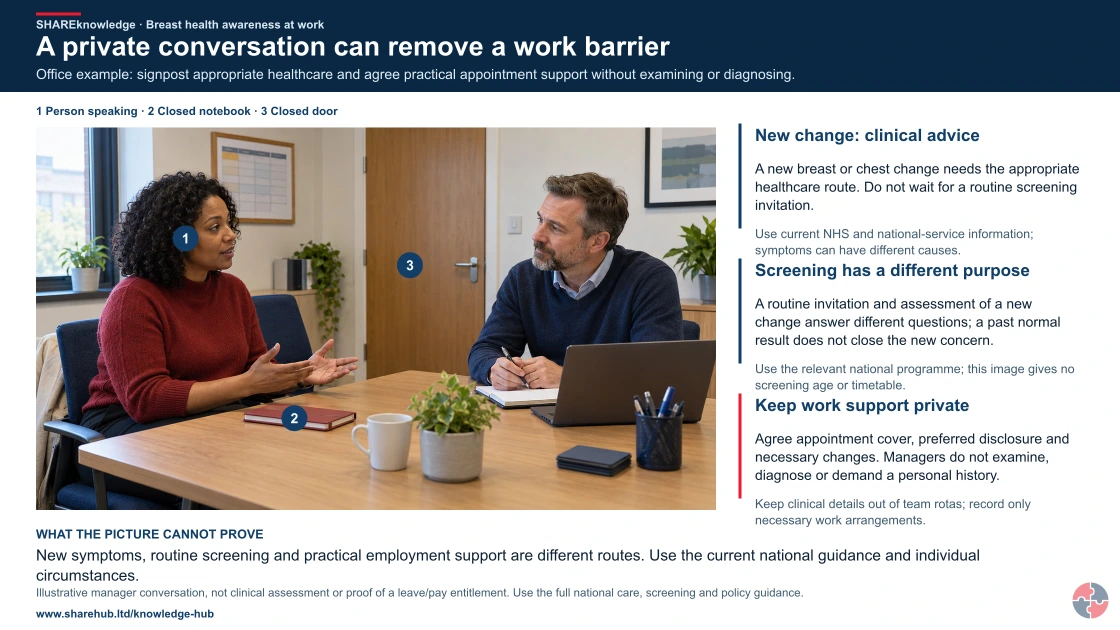
A private conversation can remove a work barrier
Full written explanation
Office example: signpost appropriate healthcare and agree practical appointment support without examining or diagnosing. Picture key: 1 Person speaking · 2 Closed notebook · 3 Closed door. Illustrative manager conversation, not clinical assessment or proof of a leave/pay entitlement. Use the full national care, screening and policy guidance.
Office example: signpost appropriate healthcare and agree practical appointment support without examining or diagnosing.
- New change: clinical advice. A new breast or chest change needs the appropriate healthcare route. Do not wait for a routine screening invitation.
- Screening has a different purpose. A routine invitation and assessment of a new change answer different questions; a past normal result does not close the new concern.
- Keep work support private. Agree appointment cover, preferred disclosure and necessary changes. Managers do not examine, diagnose or demand a personal history.
Change the pathway
- Signpost, do not diagnose. Use current NHS and national-service information; symptoms can have different causes.
- Avoid one UK-wide assumption. Use the relevant national programme; this image gives no screening age or timetable.
- Record only what is needed. Keep clinical details out of team rotas; record only necessary work arrangements.
Evidence check: New symptoms, routine screening and practical employment support are different routes. Use the current national guidance and individual circumstances.
Full national screening, symptom-assessment and inclusive access context
Primary references: NHS: changes to breasts or chest · NHS: breast screening
Open the complete HD image (new tab)Download image

Full national screening, symptom-assessment and inclusive access context
Primary references: NHS: changes to breasts or chest · NHS: breast screening

- New change → clinical route
- Routine invitation → screening
- Private work support alongside
Read the labels in the full-size drawing
- NEW CHANGE → CARE
- ROUTINE SCREENING
- PRIVATE WORK SUPPORT
- Separate responsibilities; connect necessary evidence
New breast or chest change
Contact the appropriate clinical service for a new lump, swelling or other change that is not normal for you. Do not wait for a routine screening invitation.
Routine screening
Follow the relevant national screening programme and invitation arrangements. Screening and assessment of a new symptom answer different questions.
Workplace support
Agree appointment cover, necessary practical changes, preferred disclosure and optional review. Use inclusive language and respect how the person describes their body and circumstances.
This page does not diagnose a change, promise an investigation timetable or impose a single UK-wide screening age. Keep personal health information private and use the national care and screening links on this page.
What are the key facts about breast health awareness?
The key facts are that body awareness, timely healthcare advice, privacy and practical work support matter.
Awareness starts with knowing what is normal
People are more likely to notice changes when they understand their usual look and feel.
Most changes are not cancer
Many symptoms have other causes, but unusual or persistent changes should still be checked.
Screening is different from symptom checking
Screening looks for signs before symptoms; symptoms should be checked even after recent screening.
Workplaces should reduce stigma
Embarrassment and fear can delay conversations, appointments and support.
Managers should focus on work impact
The workplace role is support, confidentiality and adjustment, not diagnosis.
Treatment can affect work in many ways
Fatigue, pain, anxiety, surgery, medication, appointments and recovery can all affect work capacity.
What is breast health awareness?
Breast health awareness is the habit of knowing normal breast or chest appearance and feel, noticing changes and using healthcare routes when needed.
Breast health awareness is not a workplace medical programme. It is simple, practical health awareness: people understand their own normal, know common changes that should be checked, and feel able to seek help without shame.
The topic matters for all workplaces because people may need appointment time, privacy, flexibility, support during investigations, adjustment during treatment, or careful return-to-work planning after surgery, radiotherapy, chemotherapy, hormone treatment or other care.
The language should be calm and inclusive. Breast health can affect women, some men, trans men, trans women and non-binary people depending on anatomy, hormones, surgery and individual risk. Employers do not need to know private medical details to create a respectful support route.
Body awareness. Knowing what is normal for your own breasts or chest. Supports early healthcare contact.
Symptom checking. Noticing changes in look, feel, skin, nipple or armpit. Helps signpost to GP or NHS routes.
Screening. Mammograms offered through NHS screening routes where eligible. May need appointment flexibility.
Privacy. Health concerns are personal and sensitive. Managers should limit information sharing.
Functional impact. How symptoms, anxiety or treatment affect work. The basis for adjustments and planning.
What breast or chest changes should people know about?
People should know their normal and get unusual breast, chest, nipple, skin or armpit changes checked by a healthcare professional.
NHS information explains that symptoms may include a lump or swelling in the breast, chest or armpit; changes in skin such as dimpling or redness; change in breast size or shape; nipple discharge when not pregnant or breastfeeding; nipple inversion; or rash-like changes on the nipple.
Symptoms do not definitely mean cancer. Breast lumps and pain can have many causes. The important awareness message is not to self-diagnose, dismiss embarrassment or wait for a screening appointment when something is not normal for the person.
Workplace campaigns should not use graphic fear tactics. They should give plain signs, official links, and a simple message: notice changes, speak to a GP or NHS service, and ask for workplace support if appointments or treatment affect work.
Lump or swelling. A new lump or swelling in breast, chest or armpit. Encourage healthcare advice without asking for details.
Skin change. Dimpling, redness, puckering or texture change. Use inclusive skin-tone-aware campaign wording.
Size or shape change. One or both breasts look different from usual. Signpost to NHS/GP routes.
Nipple change. Inversion, rash-like change or unusual appearance. Protect privacy and dignity.
Discharge. Discharge that is unusual for the person. Do not discuss publicly or speculate.
Persistent breast or armpit pain. Pain alone is not usually cancer, but pain that does not go away should be checked by a GP, with or without another change. Support appointments if needed.
How does NHS breast screening fit into workplace awareness?
NHS breast screening is a healthcare programme that employers can signpost to, while keeping participation personal and voluntary.
Breast screening looks for signs of cancer before symptoms are noticed. The government’s England guide explains that the first invitation is between ages 50 and 53, followed by invitations every three years until the 71st birthday. From 71, people can request screening every three years from their local service; invitations are not automatic.
Screening does not replace symptom checking. A person who notices a breast or chest change should not wait for the next screening appointment. They should use healthcare routes.
Employers can support screening by allowing reasonable appointment flexibility, sharing official information, making communications inclusive and avoiding pressure. A person should not have to discuss screening results with a line manager unless work support is needed.
Awareness. Share official NHS screening information. Creating local medical advice.
Appointments. Allow reasonable time and plan cover discreetly. Making the person explain details to multiple people.
Choice. Respect that screening participation is personal. Pressuring people to attend or disclose results.
Symptoms. Remind people to seek healthcare advice for changes. Suggesting recent screening means symptoms can be ignored.
Inclusion. Use wording that recognises trans and non-binary guidance. Assuming screening needs from appearance or job role.
Nidirect describes NI routine invitations for women 50–70 every three years, with first invitation before 53 and a request route over 70. Scottish Government policy lists women 50–70 as the routine group; confirm current individual timing and eligibility with the Scottish service. Public Health Wales describes invitations from age 50 up to the 70th birthday, with the first invitation before 53. Women aged 70 or over can contact Breast Test Wales to request an appointment; invitations are not automatic. Use individual GP or screening-service advice for eligibility questions.
What is the workplace role in breast health awareness?
The workplace role is to provide awareness, dignity, support, time, adjustments and confidential handling of information.
A good employer creates conditions where people can seek help early. That means no jokes, gossip, intrusive questions, embarrassment or pressure to explain private symptoms. It also means managers know how to respond when someone asks for appointment time or shares a diagnosis.
Workplaces can influence barriers: time off, rota flexibility, workloads, uniform comfort, fatigue, public-facing duties, travel, restroom access, recovery after surgery and mental wellbeing.
The workplace should use official health sources for condition facts and qualified occupational health advice where a medical condition needs translation into work restrictions or adjustments.
Awareness. Use official, respectful campaign material. Wellbeing calendar and communications.
Time. Support screening, GP and treatment appointments. Appointment flexibility process.
Privacy. Limit who knows and what is recorded. Privacy and HR records.
Adjustments. Adapt work where health affects capacity. Adjustment plan and review.
Return to work. Plan phased duties and support after treatment. Return-to-work plan.
Culture. Prevent stigma, gossip and discriminatory handling. Training, consultation and feedback.
How should dignity, confidentiality and health information be protected?
Breast health information should be treated as sensitive worker health information and shared only where necessary for support or safety.
A worker may share information because they need time off, adjustments or support. That does not give the organisation permission to share diagnosis, symptoms, treatment or screening results widely.
Managers should record work-relevant information: agreed adjustments, restrictions, appointment arrangements, review dates and who needs to know. Clinical detail should be avoided unless it is necessary and handled through the right route.
The worker should understand what will be recorded, who will see it and why. Poor confidentiality can harm trust, delay future disclosure and create legal and ethical risk.
Private conversation. Conversation held discreetly with consent and respect. Discussion in open office or team setting.
Need-to-know sharing. Only practical restrictions and support details are shared. Managers disclose diagnosis unnecessarily.
Secure records. Health information kept separately or access-controlled. Notes stored in general team files.
Clear purpose. Information collected for support, absence or safety planning. Collecting details out of curiosity.
Review. Records and adjustments updated when circumstances change. Old information used without checking.
How should managers support someone with breast health concerns?
Managers should respond privately, listen for work barriers, signpost to healthcare routes and agree practical support.
The first response should be simple and human: ask how the person is, what they need from work, what should remain private and whether any immediate work changes are needed. The manager should not ask to see breasts, interpret symptoms or decide whether a concern is serious.
If the person is waiting for tests or results, anxiety and concentration may be affected. Temporary flexibility, reduced exposure to stressful tasks, time off for appointments or a named contact can help.
Where treatment is confirmed, occupational health input may help translate medical advice into work adjustments, fatigue planning, infection vulnerability, manual handling limits, uniform comfort, travel, workload and phased return.
Listen. Ask what support would help at work. Do not diagnose or probe symptoms.
Protect privacy. Agree what can be shared and with whom. Do not brief the team without permission.
Plan time. Support appointments and treatment scheduling. Do not make attendance support punitive.
Adjust work. Review workload, duties, uniform, travel and fatigue. Do not assume incapacity.
Refer. Use OH or HR where functional advice is needed. Do not demand excessive medical detail.
Review. Set dates and update support as needs change. Do not leave adjustments unmanaged.
What workplace adjustments may help during investigation, treatment or recovery?
Adjustments should be personal, reviewable and based on functional impact rather than assumptions about diagnosis.
Breast investigations or treatment may involve appointments, scans, biopsy, surgery, radiotherapy, chemotherapy, hormone therapy, fatigue, pain, lymphoedema risk, emotional distress, body image changes or infection vulnerability. Not everyone experiences the same effects.
Practical adjustments may include flexibility for appointments, remote work where possible, reduced manual handling, amended uniform, private changing arrangements, rest breaks, temperature comfort, phased return, reduced travel or temporary changes to public-facing duties.
Some adjustments are short term while waiting for tests. Others may be longer term after surgery or treatment. Review dates are important because capacity can change during treatment cycles and recovery.
Appointment flexibility. Screening, GP, breast clinic, scans or treatment. Check schedule and cover needs.
Flexible hours. Fatigue, treatment cycles or recovery. Review after each treatment stage.
Reduced manual handling. Post-surgery pain, fatigue or lymphoedema risk. Use OH advice and task assessment.
Uniform adjustment. Comfort after surgery, prosthesis, swelling or skin sensitivity. Review fit and dignity.
Private facilities. Changing, expressing milk where relevant, medication or personal care. Check access and cleanliness.
Phased return. After absence, surgery or treatment. Gradual build-up with review dates.
How should breast health awareness campaigns be designed?
Campaigns should use official sources, plain language, inclusive wording, privacy and practical signposting.
A campaign should make it easier to act, not harder. Useful materials explain normal body awareness, common changes, NHS screening, GP routes, appointment support and confidentiality. They should avoid shock tactics, graphic imagery or wording that blames people for illness.
The message should be accessible to different literacy levels, languages, cultures, ages, job roles and working patterns. Night workers, mobile workers, contractors and remote workers need access to the same information as office staff.
Campaigns should include a manager note so supervisors know how to handle appointment requests, disclosures and privacy. Awareness without manager competence can create awkward or harmful responses.
Official source. Use NHS or GOV.UK information. Approved campaign links.
Tone. Calm, respectful and non-embarrassing. Reviewed wording.
Inclusion. Recognise different bodies and screening routes. Inclusive language check.
Access. Reach shift, mobile, contractor and non-desk workers. Communication plan.
Manager guidance. Tell managers how to support privately. Manager FAQ or briefing.
Feedback. Ask whether campaign felt useful and respectful. Worker feedback and improvements.
How can an awareness campaign be checked without collecting private symptoms?
Evaluate whether people can understand the message and use the support offered. Ask whether the information is accessible, relevant to different staff groups and available across shifts; whether workers know how to request appointment flexibility; and whether they can speak privately to an appropriate contact. A list of who attended screening or reported a lump is not needed to answer those operational questions.
For an illustrative workplace campaign, offer a confidential feedback route for practical barriers such as inaccessible information, lack of cover or difficulty arranging appointments. Resolve those barriers and check whether the agreed change works. Keep a person’s symptoms, screening decision and clinical results with the appropriate private healthcare process. If someone tells a manager about a new concern, the conversation should focus on support and access to the local clinical route, without examination or reassurance based on a campaign checklist. Do not judge campaign success by getting every worker to disclose or attend screening.
Guidance and scope: Original SHARE campaign example applying UK government data-protection and GB reasonable-adjustment guidance. Adjustment duties depend on the individual and applicable law; NI uses its separate route below. Screening choices and symptom assessment remain clinical matters. GOV.UK data protection GOV.UK reasonable adjustments
How should breast health awareness be inclusive?
Inclusive breast health awareness recognises sex, gender, anatomy, culture, disability, language and access barriers.
Some people may not see themselves in standard breast health messages. Men can get breast cancer. Trans and non-binary people may need screening or symptom advice depending on anatomy, hormones and GP registration. People with disabilities may need accessible appointment information or support.
Cultural stigma, embarrassment, language barriers, fear, trauma or previous poor healthcare experiences can delay help-seeking. Workplace campaigns should therefore use respectful wording and provide multiple routes to official information.
Inclusive does not mean asking people intrusive questions. It means providing information in a way that lets people decide what applies to them and speak privately if work support is needed.
Men. Breast cancer can affect men, though less commonly. Avoid women-only wording where general awareness is intended.
Trans and non-binary people. Screening invitation routes and risk can vary. Use the England-scoped government guidance and suggest individual local GP/screening-service advice.
Disability. Appointments and information may need adaptation. Accessible formats and reasonable adjustments.
Language and literacy. People may miss key signs or support routes. Plain language and translated routes where needed.
Culture and stigma. Embarrassment can delay healthcare advice. Private, respectful communication.
Shift and remote work. Campaign access can be unequal. Multiple channels and manager briefings.
In England, GP registration can affect automatic invitations, and some people need a GP referral to the screening service. The employer can provide private appointment flexibility and accessible information without collecting anatomy, hormone or surgery details. Individual eligibility is a clinical/service decision; use local advice in the other nations. GOV.UK screening information for trans people
How should return to work be planned after breast investigation or treatment?
Return to work should be planned around functional impact, medical advice, worker preference, confidentiality and review.
A return-to-work plan should not assume that someone is either fully fit or unfit. Many people return in stages while still managing fatigue, appointments, physical restrictions, emotional effects or treatment side effects.
The plan should consider hours, duties, workload, travel, manual handling, PPE or uniform comfort, workstation set-up, public-facing pressure, infection vulnerability and how much information the person wants colleagues to know.
Reviews should be scheduled because recovery is not always linear. Support may need to increase, reduce or change as treatment progresses.
Work capacity. Hours, pace, travel and workload. Return-to-work plan.
Physical tasks. Manual handling, reach, PPE, uniform and posture. Task risk assessment.
Appointments. Time for treatment, scans or reviews. Agreed flexibility.
Confidentiality. What can be shared with colleagues. Communication agreement.
Review. Dates and triggers to change support. Review schedule.
OH input. Functional advice where needed. OH report and action plan.
Which legal duties apply in Great Britain and Northern Ireland?
The applicable legal route depends on where the work takes place. The duties below are scoped to Great Britain and Northern Ireland; a task assessment and the current instruments determine the actual requirements.
Great Britain
Employers should manage work-related health and safety risks and provide fair, private work support. In Great Britain, cancer is deemed a disability from diagnosis under the Equality Act 2010; reasonable adjustments and non-discriminatory decisions must be considered. Managers do not diagnose symptoms, choose screening for workers or demand full medical records. Health information requires necessary, lawful, fair and secure processing; permission to share a work adjustment is distinct from the employer’s lawful data-processing basis.
Northern Ireland
Use the NI Health and Safety at Work Order and Management Regulations for workplace risk. Cancer is covered from diagnosis under the NI Disability Discrimination Act 1995 as amended; consider reasonable adjustments under that route, not GB Equality Act 2010. Screening invitations and self-referral follow the NI programme, and clinical information remains private.
How could Riverside Leisure Ltd manage breast health awareness?

Riverside Leisure Ltd would manage breast health awareness through respectful campaigns, private support routes, manager competence and reviewable adjustments.
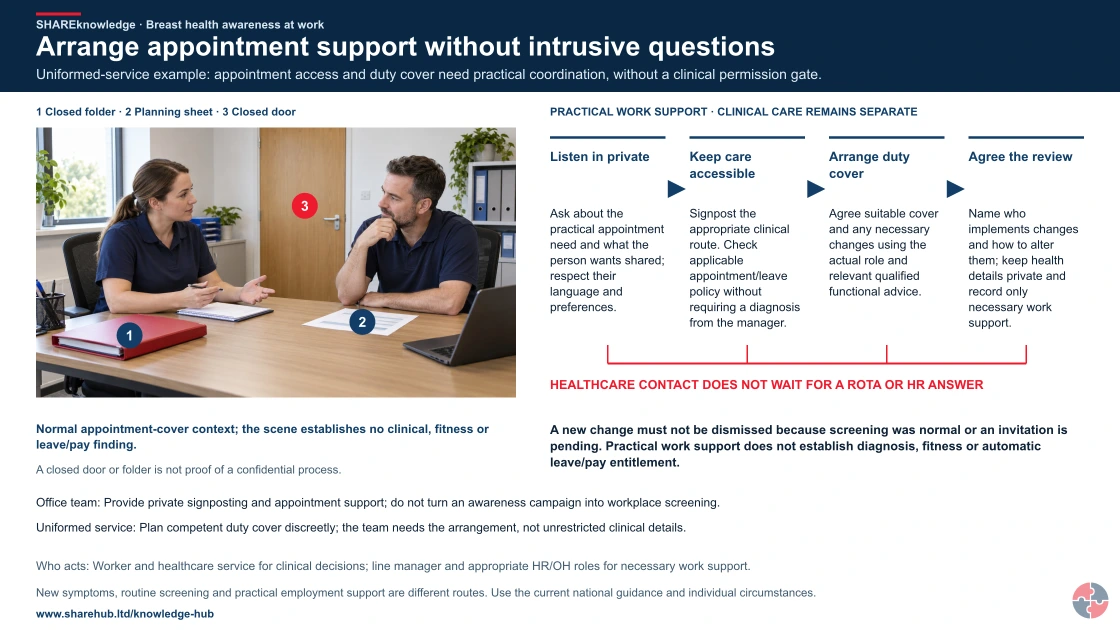
Arrange appointment support without intrusive questions
Full written explanation
An illustrative UK uniformed-service administrative office shows two ordinary adults in unbranded navy workshirts discussing practical work-cover arrangements. A closed folder, inert planning sheet and ordinary closed door provide location context. One literal picture key identifies 1 closed folder, 2 planning sheet and 3 closed door. The setting is generic service administration, with no real agency, rank, emergency activity or clinical provider. Four complete support checks retain their left-to-right review order: Listen in private: Ask about the practical appointment need and what the person wants shared; respect their language and preferences. Keep care accessible: Signpost the appropriate clinical route. Check applicable appointment/leave policy without requiring a diagnosis from the manager. Arrange duty cover: Agree suitable cover and any necessary changes using the actual role and relevant qualified functional advice. Agree the review: Name who implements changes and how to alter them; keep health details private and record only necessary work support. Three short arrows show discussion and work-support review, without requiring them before healthcare contact. A common unarrowed boundary applies at every check: HEALTHCARE CONTACT DOES NOT WAIT FOR A ROTA OR HR ANSWER. A new change must not be dismissed because screening was normal or an invitation is pending. Practical work support does not establish diagnosis, fitness or automatic leave/pay entitlement. Who acts: Worker and healthcare service for clinical decisions; line manager and appropriate HR/OH roles for necessary work support. New symptoms, routine screening and practical employment support are different routes. Use the current national guidance and individual circumstances. Office team: Provide private signposting and appointment support; do not turn an awareness campaign into workplace screening. Uniformed service: Plan competent duty cover discreetly; the team needs the arrangement, not unrestricted clinical details. New changes, routine screening and practical work support are different routes. Healthcare contact remains independent of rota cover, HR or policy answers, test results and manager opinion. Normal appearance, clothing, papers, a conversation, a closed folder or a closed door establish no symptoms, diagnosis, anatomy, sex or gender, screening eligibility, provider competence, fitness, duty capability, competent cover, leave/pay entitlement, consent, lawful processing, privacy compliance or operating permission. The papers contain no actual health or personal records. No clinical action, examination, test, screening, result, treatment, timing or eligibility rule is supplied.
Uniformed-service example: appointment access and duty cover need practical coordination, without a clinical permission gate.
- Listen in private. Ask about the practical appointment need and what the person wants shared; respect their language and preferences.
- Keep care accessible. Signpost the appropriate clinical route. Check applicable appointment/leave policy without requiring a diagnosis from the manager.
- Arrange duty cover. Agree suitable cover and any necessary changes using the actual role and relevant qualified functional advice.
- Agree the review. Name who implements changes and how to alter them; keep health details private and record only necessary work support.
When the evidence does not fit: A new change must not be dismissed because screening was normal or an invitation is pending. Practical work support does not establish diagnosis, fitness or automatic leave/pay entitlement.
Who acts: Worker and healthcare service for clinical decisions; line manager and appropriate HR/OH roles for necessary work support.
Changed workplace
Office team: Provide private signposting and appointment support; do not turn an awareness campaign into workplace screening.
Uniformed service: Plan competent duty cover discreetly; the team needs the arrangement, not unrestricted clinical details.
Evidence check: New symptoms, routine screening and practical employment support are different routes. Use the current national guidance and individual circumstances.
Full national screening, symptom-assessment and inclusive access context
Primary references: NHS: changes to breasts or chest · NHS: breast screening
Open the complete HD image (new tab)Download image

Full national screening, symptom-assessment and inclusive access context
Primary references: NHS: changes to breasts or chest · NHS: breast screening
Riverside Leisure Ltd
Riverside Leisure Ltd is used here as a leisure, hospitality and visitor-facing business with pools, gyms, events, food service, maintenance teams and seasonal workers.
Riverside adds breast health awareness to its wellbeing calendar using NHS and GOV.UK material. The campaign is available to shift workers, gym teams, pool staff, kitchen workers, cleaners and office staff. It avoids fear-based language and explains that concerns should be discussed with healthcare services, not managers.
Managers receive a short briefing on appointment support, privacy and practical adjustments. If a worker asks for time off for screening or investigation, the manager plans cover discreetly and records only the work arrangement. If the worker shares a diagnosis or treatment plan, HR and occupational health help translate functional advice into work support.
Riverside reviews roles where treatment side effects may affect work: poolside supervision, lone closing, hot kitchen work, manual handling, event shifts, public-facing conflict and long travel. Adjustments are agreed with the worker and reviewed regularly.
The organisation checks its approach through worker feedback, absence trend learning, manager confidence, privacy incident review and action close-out. The aim is to make early support normal rather than exceptional.
Assess. Identifies where privacy, shift access, fatigue and appointment barriers may arise. Wellbeing risk review and worker feedback.
Analyse. Looks at absence, manager questions, campaign reach and adjustment delays. Trend review and action tracker.
Implement. Runs NHS-linked campaigns and provides private appointment support. Campaign plan and manager guidance.
Train. Briefs managers, HR, wellbeing leads and supervisors. Training records and FAQs.
Check. Samples whether privacy and adjustments are handled consistently. HR review and internal audit.
Learn and improve. Updates support routes after feedback, cases or official guidance changes. Review minutes and revised materials.
What training is useful for breast health awareness at work?
Training should help people use official information, protect privacy, support appointments and manage adjustments without diagnosing.
General awareness can be short and simple: know your normal, understand common changes, use NHS information and speak to healthcare services. Manager training needs more depth because managers may receive sensitive disclosures.
HR, wellbeing and health and safety teams need to understand boundaries: official health information, equality, confidentiality, reasonable adjustments, occupational health referral and return-to-work planning.
Refresher training should follow a campaign, poor feedback, confidentiality concerns, new official guidance or cases where managers were unsure how to respond.
Competence means a person can carry out the actual task safely, recognise a changed condition and respond correctly. Attendance alone is insufficient. The matrix makes assessment, ownership, records and reassessment explicit.
| Role | Required learning | How competence is assessed | Assessor or owner | Record | Reassess when |
|---|---|---|---|---|---|
| Workers | Know normal breast/chest changes and official GP/screening routes without self-diagnosis. | Able to find official information and private support contact. | Wellbeing lead | Campaign check and feedback | When NHS route changes. |
| Managers | Listen without intrusive questions, protect privacy, agree appointment and work support. | Role-play a confidential functional conversation. | HR/OH lead | Competence and case-review record | After case or policy change. |
| HR and OH | Apply GB/NI equality routes, data minimisation and reviewable adjustments. | Peer-review a phased-return case. | Professional lead | Private advice and review date | At new diagnosis or change. |
| Campaign owners | Use current nation-specific NHS sources and inclusive access. | Accessibility/content review with affected audiences. | Communications lead | Source and campaign approval | At source update or campaign repeat. |
What professional development strengthens breast health awareness support?
Useful professional development covers wellbeing communication, equality, data protection, occupational health referrals and return-to-work management.
Breast health awareness may not be a standalone safety qualification topic, but it connects strongly to professional competence in worker wellbeing, dignity, inclusion, confidential communication, reasonable adjustments and management systems.
Learners should be able to explain the boundary: use official health sources for symptoms and screening; use workplace sources for privacy, equality, support and work design. They should not turn awareness into diagnosis.
The strongest professional development uses scenarios: an employee waiting for test results, a worker returning after surgery, a manager unsure what to tell the team, or a campaign that unintentionally excludes some workers.
Sensitive conversation training. Managers and supervisors. Dignity, privacy and supportive questions.
Wellbeing campaign design. Wellbeing leads and HR. Official-source communication and inclusion.
Equality and adjustments. HR, managers and H&S advisers. Fair treatment and reasonable adjustments.
Worker health data protection. HR and managers handling health information. Confidentiality and lawful processing.
Return-to-work planning. Managers and HR. Phased return, fatigue and reviewable support.
Occupational health referral skills. HR and managers. Useful functional advice.
How can management systems strengthen breast health awareness support?
Management systems help ensure awareness, privacy, support and improvement are planned rather than left to individual manager confidence.
A management system should define who owns health awareness campaigns, who approves official-source content, how managers are trained, how health information is protected, how adjustments are agreed and how return-to-work planning is reviewed.
Use the management cycle to assign ownership, assess risks, communicate controls, check competence and performance, and improve when evidence shows a gap.
Useful indicators include campaign reach, manager training, worker feedback, adjustment timeliness, privacy concerns, return-to-work outcomes and evidence that official guidance updates are reviewed.
| Management-system stage | How it supports the topic | Practical evidence |
|---|---|---|
| Consultation and participation of workers | Supports worker voice in campaign design and support routes. | Consultation feedback and changes made. |
| Hazard identification and assessment of risks and opportunities | Supports assessment of wellbeing, work design and sensitive health barriers. | Wellbeing risk review. |
| Competence | Ensures managers understand boundaries and support processes. | Training matrix and briefings. |
| Communication | Supports clear, respectful and official-source messaging. | Campaign approvals and communication plan. |
| Operational planning and control | Turns adjustments and return-to-work plans into controlled arrangements. | Adjustment and phased-return records. |
| Monitoring, measurement, analysis and performance evaluation | Checks whether support is working. | Feedback, trends and action review. |
| Incident, nonconformity and corrective action | Improves after privacy failures, poor support or campaign issues. | Corrective actions and lessons learned. |
What are the warning signs that breast health awareness is not managed well?
Warning signs include intrusive questions, gossip, no appointment support, inaccessible campaigns and failure to make adjustments.
Poor management often comes from discomfort rather than bad intent. A manager may avoid the conversation, over-share with the team, ask inappropriate questions or fail to plan cover for appointments.
Campaigns can also fail if they use embarrassing wording, exclude men or trans/non-binary people, only reach office workers or do not explain what workplace support is available.
Each warning sign should lead to improvement: manager refresher training, clearer privacy rules, better campaign review, worker consultation and stronger HR/occupational health routes.
Manager asks intrusive medical questions. Worker may lose trust or avoid seeking support. Train managers on boundaries.
Gossip or over-sharing. Confidentiality and dignity are harmed. Tighten privacy and take action.
No appointment flexibility. Screening or tests may be delayed. Create clear appointment support route.
Campaign excludes some workers. People may miss relevant information. Review inclusion and access.
No return-to-work plan. Fatigue, pain or restrictions may be unmanaged. Use phased return and OH advice.
Adjustments not reviewed. Support may fail as treatment changes. Set review dates and owners.
Why should a new change bypass the screening queue?
Screening looks for disease before symptoms. A new breast, chest, nipple, skin or armpit change needs GP assessment even if a recent mammogram was normal or the next invitation is near. A symptom does not by itself mean cancer, and a manager should never interpret it.
Screening and a new symptom are separate routes


Read the complete visual as text
- SCREENING: Routine NHS screening has its own eligibility and invitation arrangements. It does not replace assessment of a new change.
- NEW CHANGE: A new lump or other breast/chest change should be discussed promptly with a GP, including after a normal earlier screen.
- MANAGER SUPPORT: Offer discreet appointment flexibility and practical work support chosen with the person. Managers do not interpret the change.
- PRIVACY: Keep necessary work decisions separate from clinical details; do not request mammogram results or circulate symptoms.
England’s government guide describes first invitation at 50–53, then every three years until 71; from 71 screening can be requested every three years. NI routinely invites women 50–70 every three years and allows requests over 70. Scottish Government lists a routine group of 50–70; confirm current Scottish timing and later eligibility locally. In Wales, routine invitations are from 50 up to the 70th birthday, with first invitation before 53; from 70 contact Breast Test Wales to request an appointment. Trans and non-binary people should seek individual GP or screening-service advice; the linked detailed government referral guidance applies to England.
What does official guidance add to this decision?
Workplace support can protect privacy, access to appointments and suitable adjustments. Clinical screening eligibility and symptom advice must follow the current programme for the person’s nation.
Use the current Northern Ireland government breast-screening overview and the jurisdiction-specific duties listed on this page to verify the actual task and controls.
If a contract or competent design specifies a published technical standard, obtain authorised access to its current text and check its exact scope and edition. Apply the standard only within its stated scope; this guidance does not reproduce its clauses.
How do these decisions work in practice?
These examples show prerequisites, control, stopping, ownership and hand-back. They are illustrations, not instructions for an individual or site.
A new change needs a clinical route


Read the complete visual as text
- Do not wait for screening
- Offer private appointment cover
- Keep work support separate from diagnosis
- The photograph provides topic context. New breast change after a normal screen is an illustrative learning example; the checks below must be adapted to the actual task.
New lump after screening: a support evidence map


Read the complete visual as text
- 1. NEW CHANGE: A worker reports a new lump after a recent normal screen; treat this as a new clinical concern.
- 2. PROMPT GP CONTACT: Encourage prompt GP contact without interpreting the finding or waiting for the next screening invitation.
- 3. PRIVATE WORK SUPPORT: Ask privately what appointment flexibility or temporary support the worker wants.
- 4. DISCREET COVER: Arrange discreet cover and agree who needs to know about the work arrangement; use OH only for functional advice.
- 5. DO NOT DELAY: Do not delay clinical assessment for a campaign, another screen or managerial approval; prevent intrusive sharing.
- 6. OPTIONAL REVIEW: Agree an optional check-in and review necessary work changes after advice; retain only proportionate work records.
New breast change after a normal screen
Task material and setting: A staff member tells a supervisor about a new breast lump despite a normal mammogram several months ago. The next invitation is years away.
People and prerequisites: The worker, manager and qualified advisers need current work facts, a private support route, competent advice and a clear decision owner.
Before: Encourage prompt GP contact without interpreting the lump or waiting for screening. Ask only what appointment flexibility or temporary work support the person wants.
During: Plan discreet appointment cover at the worker’s request and ask who, if anyone, needs to know about the work arrangement. Do not request mammogram results or interpret a normal earlier screen as reassurance about a new lump. OH becomes involved only when functional work advice is needed.
Hold or stop: Do not delay GP assessment for a workplace campaign, another screen or managerial approval; stop intrusive circulation of symptoms.
Decision owner: The person and clinicians own healthcare; the manager owns appointment support and privacy; HR advises on adjustments.
Completion and hand back: Agree an optional check-in and review any work changes after clinical advice; retain only necessary work decisions.
Evidence: Keep the agreed appointment or adjustment arrangement, access permissions and review date securely, without symptom gossip or a routine copy of screening results.
Changed conditions: Reassess when the task, healthcare advice, work demands or agreed controls change.
Source scope: England government decision guide and NI government information support checking new changes after a normal screen. Current local clinical advice governs care; GB and NI adjustment laws differ.
Return to work during treatment
Task material and setting: A leisure worker returning after breast-cancer treatment reports fatigue and reduced arm movement; the rota includes heavy equipment setup.
People and prerequisites: The worker, manager and qualified advisers need current work facts, a private support route, competent advice and a clear decision owner.
Before: Discuss the worker’s current stamina, arm movement and preferences privately. With appropriate clinical/OH input, assess the actual equipment weight, reach, repetition and handling method; consider aids and team cover before allocating setup duties.
During: Offer a time-limited lighter rota, breaks and appointment flexibility, while arranging safe cover for heavy setup.
Hold or stop: Hold heavy work if it exceeds current restrictions; do not presume the person cannot do any work or disclose the diagnosis to the team.
Decision owner: Manager owns safe duties; HR applies GB or NI equality duties; OH/clinician advises on function.
Completion and hand back: Review the agreed duties after a defined interval or changed clinical advice. Confirm the actual setup task remains within functional restrictions, including fatigue across the shift, and involve the worker before gradual hand-back. There is no universal treatment-to-work timetable.
Evidence: Keep a limited adjustment plan, assessment and review, with clinical records restricted.
Changed conditions: Reassess when the task, healthcare advice, work demands or agreed controls change.
Source scope: This is an illustrative workplace adjustment plan, not a treatment protocol. GB Equality Act and NI DDA routes are separate; clinical advisers determine individual restrictions.
Which national legal route governs this decision?
Use the rule for the place and the actual activity. These rows identify the topic-specific work-risk route; existing legal sections explain other relevant instruments.
| Direct authority | Jurisdiction | Application to this topic | Practical evidence |
|---|---|---|---|
| Equality Act 2010 | Great Britain | In GB, cancer is deemed a disability from diagnosis; the adjustment needed for a particular worker still depends on the facts. | Applicability, task assessment, control owner and review record. |
| NI disability discrimination employment rights | Northern Ireland | NI disability-discrimination duties use a separate route. | Applicability, task assessment, control owner and review record. |
| UK government guidance | United Kingdom | United Kingdom | Necessary, lawful, fair and secure health-data processing; permission to share is distinct from a lawful processing basis. |
How can the hierarchy of controls guide control of workplace exposures relevant to breast health?
The physical-hazard hierarchy applies only where work creates a controllable exposure. Clinical symptoms, screening access and private support are different decisions; levels that do not fit are marked not applicable, while the owner still checks the response and escalates failure. HSE examples are GB regulator guidance applied as technical principles in NI, not NI law; use the separate NI legal map. See HSE five-level hierarchy of control; HSE five-level hierarchy of control
How can the ERICPD hierarchy of controls guide control of workplace exposures relevant to breast health?

| Material harm route | Five levels and ERICPD control choice | Higher-order feasibility and risk transfer | Owner, effectiveness check and stop condition |
|---|---|---|---|
| Delayed assessment of new breast or chest symptoms | Elimination / ERICPD Eliminate: Not applicable: a person’s symptoms are not an employer-controlled hazard; Substitution / Reduce: Not applicable: shift swaps or appointment access are administrative support, not substitution; Engineering / Isolate and Control: No workplace engineering control treats symptoms; a private contact channel supports confidentiality; Administrative / Control and Discipline: Offer appointment flexibility and current clinical signposting without employer triage; PPE / PPE: PPE is inapplicable. | Screening does not replace assessment of symptoms; England government screening guidance is clinical signposting, not NI law | Wellbeing owner checks signpost access; direct symptomatic worker to clinician promptly See GOV.UK guide to breast screening and symptoms |
| Missed screening through inflexible shifts or inaccessible information | Elimination / ERICPD Eliminate: Not applicable: screening access is not a removable physical workplace hazard; Substitution / Reduce: Not applicable: shift swaps are work-organisation measures, not substitution; Engineering / Isolate and Control: No engineering exposure barrier applies; accessible information is a communication measure; Administrative / Control and Discipline: Offer flexible release, confidential adjustments and country-specific invitation guidance; PPE / PPE: PPE is inapplicable. | Screening eligibility differs by nation and individual; employer should not inspect results | HR owner checks flexibility and privacy; correct inaccessible arrangements See GOV.UK breast screening programme overview; nidirect breast screening overview; Scottish Government screening policy; Welsh Government breast screening statement (2018) |
How can the ISO 45001 hierarchy of controls guide control of workplace exposures relevant to breast health?

| Material harm route | Five levels and ERICPD control choice | Higher-order feasibility and risk transfer | Owner, effectiveness check and stop condition |
|---|---|---|---|
| Delayed assessment of new breast or chest symptoms | Elimination / ERICPD Eliminate: Not applicable: a person’s symptoms are not an employer-controlled hazard; Substitution / Reduce: Not applicable: shift swaps or appointment access are administrative support, not substitution; Engineering / Isolate and Control: No workplace engineering control treats symptoms; a private contact channel supports confidentiality; Administrative / Control and Discipline: Offer appointment flexibility and current clinical signposting without employer triage; PPE / PPE: PPE is inapplicable. | Screening does not replace assessment of symptoms; England government screening guidance is clinical signposting, not NI law | Wellbeing owner checks signpost access; direct symptomatic worker to clinician promptly See GOV.UK guide to breast screening and symptoms |
| Missed screening through inflexible shifts or inaccessible information | Elimination / ERICPD Eliminate: Not applicable: screening access is not a removable physical workplace hazard; Substitution / Reduce: Not applicable: shift swaps are work-organisation measures, not substitution; Engineering / Isolate and Control: No engineering exposure barrier applies; accessible information is a communication measure; Administrative / Control and Discipline: Offer flexible release, confidential adjustments and country-specific invitation guidance; PPE / PPE: PPE is inapplicable. | Screening eligibility differs by nation and individual; employer should not inspect results | HR owner checks flexibility and privacy; correct inaccessible arrangements See GOV.UK breast screening programme overview; nidirect breast screening overview; Scottish Government screening policy; Welsh Government breast screening statement (2018) |
What do the acronyms and key terms mean?
Acronyms should be understood so readers can follow health, workplace and privacy guidance.
| Acronym or term | Meaning | Why it matters |
|---|---|---|
| BSP | Breast Screening Programme | NHS screening programme term. |
| GP | General Practitioner | Primary healthcare route for symptoms or concerns. |
| OH | Occupational Health | Specialist work-health advice route. |
| HR | Human Resources | Supports absence, adjustments and fair process. |
| EAP | Employee Assistance Programme | Optional support route where provided. |
| UK GDPR | UK General Data Protection Regulation | Data protection framework for personal data. |
| DPIA | Data Protection Impact Assessment | Assessment for high-risk data processing. |
| RTW | Return to Work | Planning process after absence or treatment. |