SHARE Knowledge Hub
Fatigue Management
Fatigue management is the systematic control of work demands that can reduce alertness, memory and reaction time, especially long hours, night shifts, missed breaks and inadequate recovery. An effective system compares actual work with planned rosters, provides staffing and relief, and acts on reports before impaired performance meets a vehicle, machine or critical decision. Stop unsafe safety-critical duty or driving, arrange competent cover and safe travel, then use worker feedback and incident evidence to correct the work design.
Understanding Fatigue Management
Fatigue management is the organisation-wide system for preventing and controlling fatigue-related safety and health risk. It combines leadership, risk assessment, roster and workload design, staffing, worker involvement, training, point-of-work escalation, fitness-for-work arrangements, data, assurance, investigation and review. It is not a numerical fatigue score, a compliance spreadsheet or a policy that shifts responsibility onto workers. It should be integrated with normal safety, health, operational and people-management processes.
Why this matters at work
Select an operation with repeated late extensions. Start with the risk register: what fatigue mechanism, consequence and control were identified? Follow the plan to the roster, relief allocation, changed duties and actual time records. Talk to workers and sample whether breaks and handovers occurred. Inspect how an exception was authorised and whether the temporary safeguards and recovery arrangement existed. A policy, training certificate and signed approval are intermediate evidence, not proof of effective control.
Suppose a site receives more fatigue reports after introducing a confidential reporting route. The increase could reflect more risk, greater trust, or both. Compare report themes with overtime, missed breaks, competent relief, near misses and conversations with workers. Preserve the time period and exposure context, and distinguish reports received from reports requiring an immediate task intervention. A single total without a denominator or explanation can hide which team or activity needs attention.
How organisations manage this in practice
A mature FMS maintains a live fatigue-risk register that connects strategic risks to operational controls. Each record should describe the work activity, people exposed, fatigue mechanism, credible error or health pathway, consequence, existing prevention/control/recovery barriers, control owner, assurance evidence, residual risk, review date and change triggers. Keep it useful: a register that cannot be understood by a planner or supervisor will not prevent a bad roster or a missed relief.
Management review is where the FMS becomes a living system rather than a set of local controls. Review the risk register, roster and exception trends, workload/staffing, fatigue reports, worker consultation, journey interventions, incidents, health/stress indicators, audit results, action completion, contractor performance, training, change and sector updates. Ask whether the controls are preventing fatigue or merely documenting that it occurred.
Use gated decisions so that each stage produces evidence before the next begins. The discovery gate confirms task, people, law and data. The design gate confirms controls, resources, roles and worker consultation. The deployment gate confirms schedule, staffing, handover, training, contractor interfaces and emergency arrangements. The assurance gate samples real work, exceptions and worker feedback. The management-review gate decides whether to continue, improve, restrict or escalate the programme.
What is the advice boundary for fatigue management?
Manage actual work demands and immediate task risk; neither a roster score nor a manager conversation diagnoses medical fitness.
A fatigue management system connects leadership, realistic staffing, roster design, protected breaks, worker consultation and operational stop authority. It checks real hours, call-outs and recovery against planned shifts, then changes work when reports or events show a control is failing. A worker who cannot perform a safety-critical duty safely needs competent cover or safe deferral, and an unsafe journey needs rest or transport.
Use current government guidance and competent task-specific advice; this section does not establish a technical specification.
Updated 2026-09-25.


Fatigue Management in a working scene
Try 1 scenario with images, explanations and decisions that develop into follow-on situations. Trace how a hazard can cause harm, compare work arrangements and choose controls.
What does fatigue management mean in practice?
Fatigue management means controlling the causes of fatigue through work design, staffing, recovery and decision-making standards.
A proper system does not rely on generic wellbeing advice alone. Sleep hygiene information can help, but it cannot compensate for a rota that gives poor recovery, a shutdown plan that relies on routine excessive hours, or a culture where workers feel they must drive home after a night shift even when they are struggling to stay awake.
The management task is to identify where alertness may reasonably degrade and to decide what controls are needed before harm occurs. That includes looking at the task, the person, the shift pattern, the journey, the environment, the workload, the staffing level and the consequences of error.
Fatigue can be acute after a long shift or poor sleep, cumulative after repeated inadequate recovery, or linked to circadian disruption from night work and early starts. All three can appear in the same person or team.
| Building block | What it means | Why it matters |
|---|---|---|
| Policy | Sets responsibilities, limits and reporting expectations. | Gives managers authority to control fatigue before incidents. |
| Risk assessment | Identifies who is exposed and which tasks are safety critical. | Prevents generic controls being applied to high-risk work. |
| Roster design | Controls shift length, nights, quick returns and recovery. | Reduces foreseeable sleep loss and body-clock disruption. |
| Operational control | Manages actual hours, breaks, call-outs and exceptions. | Controls what happens in real work, not only the plan. |
| Worker involvement | Uses feedback from the people doing the work. | Reveals missed breaks, poor rest areas and impractical schedules. |
| Assurance | Checks indicators, audits and learning. | Shows whether arrangements work and improve. |
Fatigue is the performance impairment along the pathway. The controllable source is the work demand or task exposure: extended hours, poorly timed shifts, insufficient break cover, high workload or hazardous work scheduled at a low-alertness time. A person or medical condition is not the workplace hazard.
Harm chain: a roster, call-out or workload pattern reduces recovery, which can narrow attention and slow response. A task hazard such as moving plant, machinery, hot liquid or a process alarm can then reach a person when a control step is missed. The outcome depends on the task and exposure; fatigue alone does not prove causation. HSE describes the performance pathway.
| Work pattern and task | How harm reaches people | Plausible injury or ill health | Early sign and stop decision |
|---|---|---|---|
| Night shift and missed breaks during plant or driving | Sleep pressure slows reaction or causes a microsleep; vehicle energy can strike a person. | Head or limb trauma, crush injury or fatal injury. | Nodding, lane drift or missed pedestrian: stop driving or plant duty and arrange rested cover or safe travel. |
| Extended control-room duty or permit decisions | Narrowed attention and memory can miss an alarm or isolation step; process or stored energy may reach people. | Depending on process: skin burns, airway harm or impact injury. | Repeated check, missed alarm or confusion: stop critical decision, make safe and hand over to competent cover. |
| Late machine intervention or pressured kitchen close | An impaired check may miss a guard, moving part, wet floor or hot vessel. | Hand crush/cut injury, lower-limb or back slip injury, or skin burn. | Unsafe reach, stumble or repeated error: pause, secure the hazard and get relief. |
| Repeated overtime, high workload and poor recovery | Sustained demand can worsen tiredness, concentration and wellbeing; a clinician must assess unexplained symptoms. | Persistent symptoms and work ability may deteriorate; do not infer a diagnosis. | Reports persist or daily life is affected: adjust work and use local GP or occupational-health route. |
What are the key facts about fatigue management?
The key facts are that fatigue is foreseeable, work design can create it, and controls must be checked against real work.
Fatigue is a work-system issue
Workers can make sensible personal choices and still become fatigued if work is badly planned.
Rosters are only the starting point
Real hours, overtime, shift swaps, call-outs, missed breaks and travel show the actual exposure.
Night work needs specific control
Work during natural low-alertness periods needs assessment, recovery and worker consultation.
Safety-critical work needs stop rules
Tasks with serious consequences need clear triggers for delay, reassignment or added supervision.
Reporting culture matters
Low fatigue reporting may mean workers fear blame, lost overtime or being seen as unreliable.
Evidence should drive change
Near misses, vehicle events, quality errors, absence, overtime and worker feedback should influence work design.
How should fatigue risk be assessed?
Fatigue risk assessment should compare planned work with actual exposure, task criticality and worker feedback.
Compare the roster with the work actually done
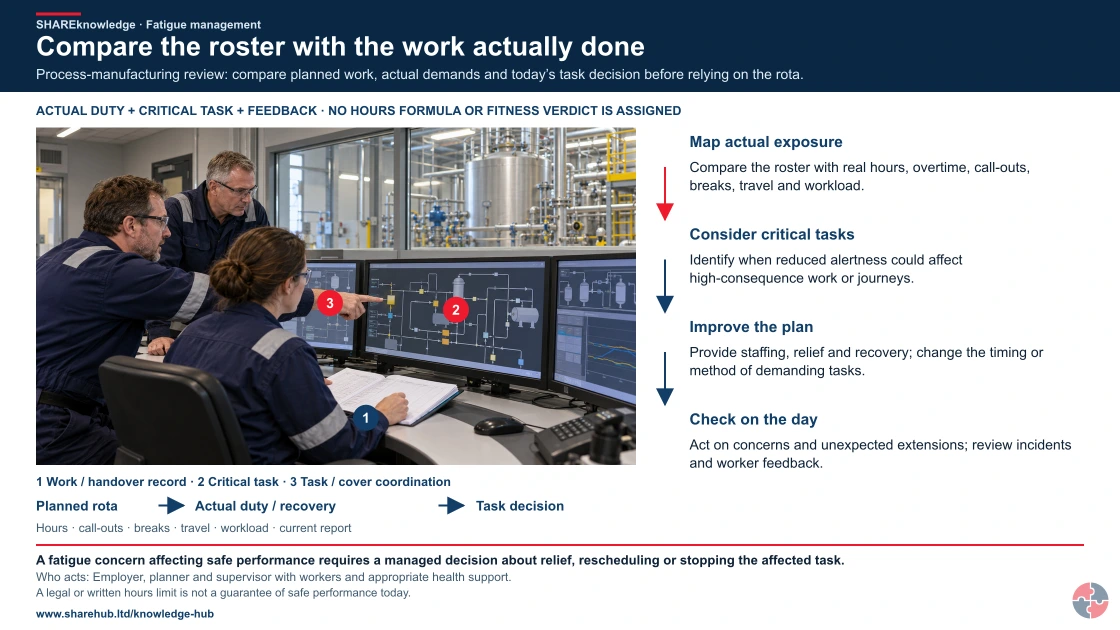
Full written explanation
An illustrative UK process-control review scene shows colleagues coordinating around neutral illustrative displays and an inert work/handover record, with representative plant behind glass. Numbered picture markers1–3 connect the record, critical-task context and task/cover coordination as evidence questions; no actual live process state, fault, worked hours, alertness, rested cover or successful handover is established. A comparison strip links the planned rota to actual duty/recovery and a managed task decision, including hours, call-outs, breaks, travel, workload and the current report. Four checks map real exposure against the roster, identify high-consequence tasks/journeys, improve staffing/relief/recovery and timing/method, and act on current concerns/extensions/feedback. This is a review relationship, not automatic authority to work or an approved schedule. No specific work-rest law, legal compliance calculation, fatigue index, clinical diagnosis, sleep prescription, automatic fitness or work-return permission is supplied. Picture key: 1 Work / handover record · 2 Critical task · 3 Task / cover coordination. The separate process headings are unnumbered.
Process-manufacturing review: compare planned work, actual demands and today’s task decision before relying on the rota.
- Map actual exposure. Compare the roster with real hours, overtime, call-outs, breaks, travel and workload.
- Consider critical tasks. Identify when reduced alertness could affect high-consequence work or journeys.
- Improve the plan. Provide staffing, relief and recovery; change the timing or method of demanding tasks.
- Check on the day. Act on concerns and unexpected extensions; review incidents and worker feedback.
When the evidence does not fit: A fatigue concern affecting safe performance requires a managed decision about relief, rescheduling or stopping the affected task.
Who acts: Employer, planner and supervisor with workers and appropriate health support.
Changed workplace
Road transport: Consider loading, waiting, actual driving and the journey home within the relevant arrangements.
Process manufacturing: Night work, call-outs and late safety-critical interventions need realistic staffing and recovery.
Evidence check: A legal or written hours limit is not a guarantee of safe performance today.

A weak assessment looks only at the written rota. A useful assessment checks real worked hours, overtime, call-outs, shift swaps, break quality, travel, commute, workload, incidents, near misses, absence and fatigue reports. It should also identify vulnerable situations such as new starters, young workers, pregnancy, medication, long-term health conditions, lone work and remote sites.
Task criticality matters. The same level of tiredness may have very different consequences in routine admin, tanker loading, electrical isolation, mobile plant operation, process control or driving on public roads. Higher consequence tasks need tighter limits and clearer stop-work triggers.
| Step | What to examine | Useful evidence |
|---|---|---|
| Define exposure | Who works nights, shifts, overtime, call-outs, driving or safety-critical tasks. | Role register and task inventory. |
| Analyse real hours | Actual hours, overtime, shift swaps, call-outs and missed breaks. | Payroll, time sheets and supervisor records. |
| Map task criticality | Tasks where reduced alertness could cause serious harm. | Risk register and method statements. |
| Consult workers | Sleep opportunity, rest facilities, break use, commuting and reporting barriers. | Consultation results. |
| Evaluate controls | Roster rules, break cover, handovers, supervision and escalation. | Control checks and audit findings. |
| Set review triggers | Roster change, incident, peak demand, shutdown or worker feedback. | Management of change records. |
HSE calls for a robust record of actual hours, overtime, swaps and on-call work. A fatigue/risk index can help compare patterns, but it cannot override missed breaks, sleepy driving reports or high-consequence tasks. Reassess when staffing, shift timing, workload, location, contractors or emergency cover change.
Assess the full duty sequence, including the previous shift, travel, realistic recovery, the next start, critical decisions and the journey home. Include temporary and agency staff, contractors and people with more than one assignment. Where total duty history is uncertain, coordinate lawfully between employers and restrict or redesign the task instead of assuming the worker is rested.
What should a fatigue risk management system include?
A fatigue risk management system should link policy, planning, operational control, worker involvement, health support, monitoring and review.
The system should be owned by the business, not left to a single manager or wellbeing campaign. Operations need to plan the work and staffing. HR needs to support working-time and contract arrangements. Occupational health needs routes for health assessment and advice. Safety teams need risk assessment and assurance. Leaders need to remove pressure that rewards unsafe hours.
The system should define limits and escalation. Examples include maximum shift length, maximum consecutive nights, minimum recovery after nights, rules for quick returns, overtime approval, call-out recovery, extended travel and what happens when a safety-critical worker reports fatigue.
| Element | What good looks like | Typical evidence |
|---|---|---|
| Policy | Fatigue is defined as a foreseeable health and safety risk. | Policy, roles and standards. |
| Planning | Rosters, staffing, relief cover and welfare are planned before work starts. | Roster review and resource plan. |
| Operational control | Exceptions are authorised, visible and challenged. | Overtime approvals and escalation records. |
| Worker involvement | Workers are consulted on rosters, breaks, reporting and rest facilities. | Consultation notes and action logs. |
| Health support | Night-worker and fatigue-related health concerns have confidential routes. | Occupational health referral and advice records. |
| Review | Indicators and investigations change the system. | Management review, trends and closed actions. |
Senior leaders should appoint an accountable system owner, define how fatigue risk is escalated and resource relief, welfare and contingency capacity. Planners need a named authority for exceptional overtime, reduced crews and changed rosters; a high-risk exception should receive independent challenge rather than approval and assurance by the same person. Repeated exceptions expose a design or staffing problem and should reach leadership review.
How should shift work and night work be controlled?
Shift work should be designed to reduce sleep loss, circadian disruption, cumulative fatigue and unsafe recovery gaps.
Night work places people at work when the body is naturally prepared for sleep. Daytime sleep is often shorter and more easily disturbed, so consecutive nights, overtime and quick returns can quickly build fatigue. Shift work can also affect digestion, mood, family life, exercise, diet and long-term wellbeing.
Good design considers shift length, start and finish time, rotation direction, number of consecutive nights, recovery days, weekends, breaks, workload during circadian low points, welfare availability, travel and worker preferences. Worker preference matters, but it should not override evidence of fatigue risk.
| Control area | Practical standard | Why it matters |
|---|---|---|
| Consecutive nights | Limit repeated nights and provide recovery. | Reduces cumulative sleep debt. |
| Quick returns | Avoid short gaps between shifts. | Gives real sleep opportunity. |
| Forward rotation | Consider rotating morning to afternoon to night where suitable. | May be easier for circadian adjustment. |
| Break cover | Plan relief so breaks are actually taken. | Nominal breaks do not control fatigue. |
| Workload at night | Avoid high-risk, high-complexity tasks during low-alertness periods where practicable. | Reduces serious error risk. |
| Worker consultation | Review the practical effect of shifts with workers. | Finds sleep, travel and welfare issues. |
HSE shift-design suggestions are context-dependent good practice, not a universal statutory safe shift length. Use more conservative limits for demanding, monotonous or dangerous work and check whether travel and personal responsibilities leave real recovery opportunity.
Before releasing a new rota or accepting an emergency extension, record the affected tasks, actual-hours evidence, worker consultation, break cover, competent relief, approval and a post-change test. A new system, vacancy, shutdown or contractor plan can also change fatigue risk; run that decision through management of change. If relief is unavailable, defer work, reduce output or shut down safely.
How do working time, overtime and call-outs affect fatigue?
Working time controls should manage real exposure, not just average weekly hours.
The Working Time Regulations support recovery through limits and rest rules, but compliance with working-time law is not proof that fatigue risk is controlled. A person may be within legal limits and still be too tired for a safety-critical task because of nights, commuting, poor sleep, intense workload or a recent call-out.
Overtime can become normalised. When teams depend on overtime to meet routine work, fatigue risk becomes a resourcing issue. Call-outs also need care: a worker may complete an emergency job after already working a full day, then return to normal duties without enough recovery unless there is a clear rule.
GB and NI working-time instruments set their own rest and night-work rules, with sector provisions and exceptions. Neither a 48-hour average nor a completed opt-out proves fatigue risk is controlled. Check actual hours, call-outs, missed breaks, task demands, recovery and journey risk; escalate exceptions through a documented competent decision.
How should commuting and work-related driving be managed?
If a worker is too tired to drive safely, they should not drive; arrange rest or safe transport and change the work pattern that produced the risk.
Driving while fatigued can be one of the most immediate consequences of poor work design. The journey home after a night shift, long day, emergency call-out, shutdown or demanding physical work may be outside paid time, but the risk can still be foreseeable when the work pattern created the tiredness.
Controls can include journey planning, rest before driving, lift-share, taxi, public transport, overnight accommodation, delayed travel, limits after call-outs and clear permission to say 'I am not safe to drive'. For fleet and mobile workers, fatigue should sit inside journey risk assessment and driver management.
| Situation | Risk | Control |
|---|---|---|
| Driving after nights | Microsleep and slow reaction. | Rest, alternative transport or delayed travel. |
| Long commute | Sleep loss before and after shifts. | Roster review and travel planning. |
| Call-out response | Driving while already tired. | Call-out recovery rules and second-person support. |
| Mobile workers | Multiple sites and long road time. | Journey planning and realistic schedules. |
| Post-incident return | Adrenaline drop and tiredness after emergency work. | Relief, rest and transport plan. |
| Contractor travel | Unknown previous hours. | Pre-job checks and contractor rules. |
HSE journey planning supports planning work travel and breaks. Drowsiness detection can help identify risk but does not replace safe scheduling. A long drive home after an extended shift must be discussed as a practical travel decision, even when the shift has ended.
Emergency plans should include rotation, welfare, safe transport or accommodation and a post-event stand-down. The next roster must account for an extended response and disrupted sleep rather than treating the person as available for normal duty. Test these arrangements during realistic call-outs, not only in a policy document.
How should fatigue be managed in safety-critical tasks?
When reduced alertness makes a safety-critical task unsafe, stop that duty, make the activity safe and arrange competent replacement or reassignment before a task-specific restart decision.
Safety-critical tasks are those where error can cause serious injury, major loss, environmental harm or significant public risk. Examples include process control, permit issue, isolations, tanker loading, lifting, electrical work, confined-space rescue, work at height, driving, plant operation and emergency response.
The decision standard should be simple: if a person is too fatigued to perform the task safely, the task should be paused, delayed, reallocated, supervised differently or redesigned. This standard needs leadership support so supervisors do not feel forced to choose production over safety.
Examples include process control, permit issue, isolations, mobile plant, driving, lifting and emergency response. When a worker reports unsafe alertness, stop the critical duty, make the activity safe with competent support and arrange rested cover or reassignment. A second checker or extra supervision may be an additional safeguard after risk assessment, but is not permission for an impaired operator to continue. Reassess the actual task and recovery before restart.
How can the hierarchy of controls guide work planning to reduce fatigue risk?
Controls should reduce exposure to fatigue, improve recovery, support reporting and make fatigue visible in management decisions.
Fatigue is affected by more than the rota
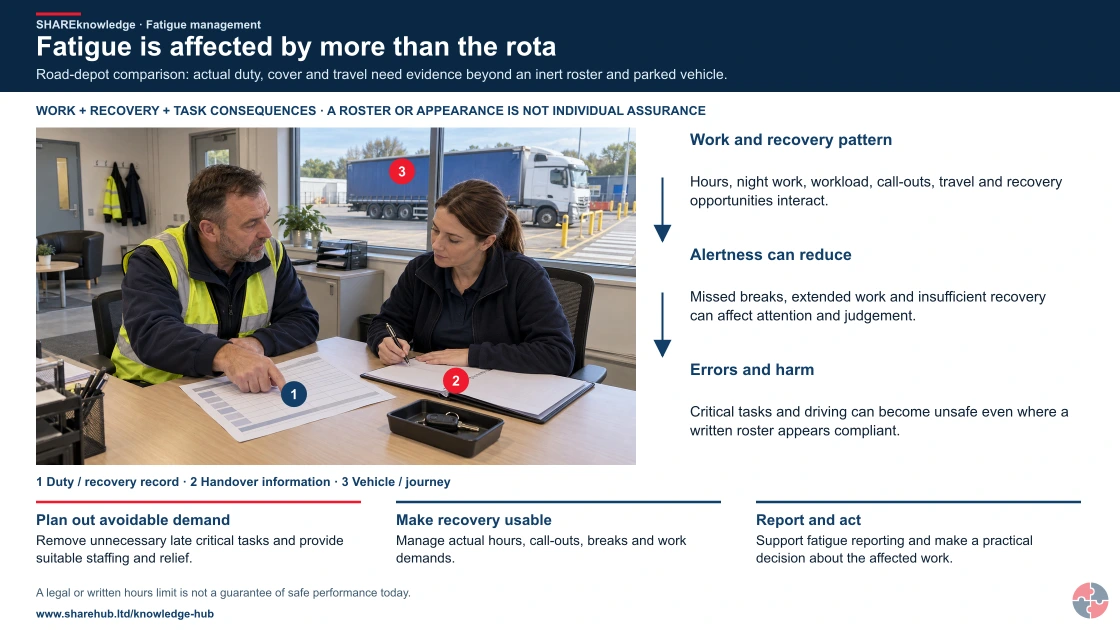
Full written explanation
An illustrative UK road-depot planning scene shows a worker and dispatcher discussing an inert duty/recovery sheet beside a separate handover folder, desk key tray and stationary lorry. Numbered picture markers1–3 identify the records and vehicle/travel context as questions rather than verified duty hours, rested cover, sufficient recovery or fitness to drive. The pathway shows how hours, night work, workload, call-outs, travel and recovery interact; missed breaks, extended work and insufficient recovery can reduce attention/judgement; critical tasks and driving may become unsafe even if a written roster appears compliant. The three control relationships plan out avoidable late demand with suitable staffing/relief, make recovery usable by managing actual work/breaks/call-outs, and support reporting with a practical affected-task decision. No sleepy-worker stereotype or harm/clinical model is shown, and no roster, personal diagnosis, safe-hours rule, metric, recovery threshold or drive/work permission is assigned. Picture key: 1 Duty / recovery record · 2 Handover information · 3 Vehicle / journey. The separate process headings are unnumbered.
Road-depot comparison: actual duty, cover and travel need evidence beyond an inert roster and parked vehicle.
- Work and recovery pattern. Hours, night work, workload, call-outs, travel and recovery opportunities interact.
- Alertness can reduce. Missed breaks, extended work and insufficient recovery can affect attention and judgement.
- Errors and harm. Critical tasks and driving can become unsafe even where a written roster appears compliant.
Change the pathway
- Plan out avoidable demand. Remove unnecessary late critical tasks and provide suitable staffing and relief.
- Make recovery usable. Manage actual hours, call-outs, breaks and work demands.
- Report and act. Support fatigue reporting and make a practical decision about the affected work.
Evidence check: A legal or written hours limit is not a guarantee of safe performance today.

Plan work so that avoidable late critical tasks are removed, actual hours and call-outs are limited, relief makes breaks usable, and unsafe task exposure is stopped when alertness fails. Guard machinery and separate people from moving vehicles independently of fatigue controls. PPE only reduces a specific task injury; it cannot restore attention.
Use current government guidance and competent task-specific advice; this section does not establish a technical specification.
Point-of-work arrangements must still work during peak demand and abnormal operations: make stop authority, task restriction, safe handover, relief and emergency rotation explicit. For contractors and agency workers, specify travel and rest expectations, local induction, reporting and stand-down arrangements before the work starts. A controlled safe state and competent cover take priority when an alertness concern appears.
Choose the activity
How can the ERICPD hierarchy of controls reduce risks while designing a roster for night operations?

| Control level | Control for this activity | Owner and verification | Stop / restart decision |
|---|---|---|---|
| Eliminate | Remove unnecessary night operations and duplicated out-of-hours work from the service plan. | Process owner verifies that the revised workflow achieves the required output and the hazardous step is genuinely removed. | If the hazardous step remains, retain a task assessment and select the stronger feasible remaining controls. |
| Reduce, including substitution | Use a lower-fatigue service or staffing arrangement after assessing the shift pattern with workers. | Process/technical owner validates the alternative, its compatibility and any new risks before adoption. | Reject the alternative if suitability is unproved or its new hazards are unresolved. |
| Isolate | Keep safety-critical work away from periods when staffing or fatigue prevents safe performance. | Supervisor verifies the task boundaries and that the separation or isolation protects affected people and connected work. | Hold or stop for insufficient recovery, repeated overtime or inability to staff a critical task safely. |
| Control: physical safeguards | Provide automation, safe plant states and reliable work equipment so foreseeable human lapses do not initiate major harm. | Competent equipment/process owner checks actual hours, recovery periods, task demand and available staffing. | Hold or stop for insufficient recovery, repeated overtime or inability to staff a critical task safely. |
| Control: work method and response | Set workable shift, overtime, break, call-out and recovery arrangements; review actual hours and staffing shortfalls. | Supervisor confirms the limits, response, communication and restart authority with the people doing this activity. | Stop if the agreed method, communication, competent cover or task limits cannot be maintained. |
| PPE | No PPE corrects an unsafe roster; control task exposures and fatigue at source. | Assessor confirms whether PPE is needed and checks selection, condition, compatibility and any required face-fit evidence. | Do not rely on unsuitable or defective protection, or use PPE to continue after an essential source control fails. |
| Discipline | Review overtime, fatigue reports and incidents with workers; adjust staffing and schedules when the controls cannot be followed. | Release only after operations approves a workable roster and contingencies. Retain the checks and unresolved restrictions at handover. | Keep the activity on hold while defects or required reinstatement evidence remain unresolved. |
How can the ISO 45001 hierarchy of controls reduce risks while designing a roster for night operations?

| Control level | Control for this activity | Owner and verification | Stop / restart decision |
|---|---|---|---|
| Elimination | Remove unnecessary night operations and duplicated out-of-hours work from the service plan. | Process owner verifies that the revised workflow achieves the required output and the hazardous step is genuinely removed. | If the hazardous step remains, retain a task assessment and select the stronger feasible remaining controls. |
| Administrative controls | Use a lower-fatigue service or staffing arrangement after assessing the shift pattern with workers. | Process/technical owner validates the alternative, its compatibility and any new risks before adoption. | Reject the alternative if suitability is unproved or its new hazards are unresolved. |
| Administrative controls | Keep safety-critical work away from periods when staffing or fatigue prevents safe performance. | Supervisor verifies the task boundaries and that the separation or isolation protects affected people and connected work. | Hold or stop for insufficient recovery, repeated overtime or inability to staff a critical task safely. |
| Engineering controls | Provide automation, safe plant states and reliable work equipment so foreseeable human lapses do not initiate major harm. | Competent equipment/process owner checks actual hours, recovery periods, task demand and available staffing. | Hold or stop for insufficient recovery, repeated overtime or inability to staff a critical task safely. |
| Administrative controls | Set workable shift, overtime, break, call-out and recovery arrangements; review actual hours and staffing shortfalls. | Supervisor confirms the limits, response, communication and restart authority with the people doing this activity. | Stop if the agreed method, communication, competent cover or task limits cannot be maintained. |
| PPE | No PPE corrects an unsafe roster; control task exposures and fatigue at source. | Assessor confirms whether PPE is needed and checks selection, condition, compatibility and any required face-fit evidence. | Do not rely on unsuitable or defective protection, or use PPE to continue after an essential source control fails. |
| Administrative controls | Review overtime, fatigue reports and incidents with workers; adjust staffing and schedules when the controls cannot be followed. | Release only after operations approves a workable roster and contingencies. Retain the checks and unresolved restrictions at handover. | Keep the activity on hold while defects or required reinstatement evidence remain unresolved. |
How can the ERICPD hierarchy of controls reduce risks while releasing a lift after an overnight call-out?

| Control level | Control for this activity | Owner and verification | Stop / restart decision |
|---|---|---|---|
| Eliminate | Remove the lift through suitable ground-level assembly or delivery at the final position where feasible. If lifting remains necessary, hold it until a rested competent team and supervision are available. | Process owner verifies that the revised workflow achieves the required output and the hazardous step is genuinely removed. | If the hazardous step remains, retain a task assessment and select the stronger feasible remaining controls. |
| Reduce, including substitution | Use a rested competent supervisor or an approved alternative lifting sequence after reviewing the new interfaces. | Process/technical owner validates the alternative, its compatibility and any new risks before adoption. | Reject the alternative if suitability is unproved or its new hazards are unresolved. |
| Isolate | Provide the assessed physical exclusion and lifting safeguards for the actual task. A decision to withhold lift release while fitness or supervision is unresolved is administrative, not an engineered interlock. | Supervisor verifies the task boundaries and that the separation or isolation protects affected people and connected work. | Hold or stop for fatigue concerns, unclear supervision, communication failure or changed load conditions. |
| Control: physical safeguards | Use suitable rated lifting equipment, load control and safe positions specified by the lift plan. | Competent equipment/process owner checks competent rested personnel, lift plan, equipment condition and exclusion zone. | Hold or stop for fatigue concerns, unclear supervision, communication failure or changed load conditions. |
| Control: work method and response | Review the supervisor’s actual duty/rest, lifting roles and communication; brief the rested team and manage handover. | Supervisor confirms the limits, response, communication and restart authority with the people doing this activity. | Stop if the agreed method, communication, competent cover or task limits cannot be maintained. |
| PPE | Use task-assessed lifting PPE for residual contact risks; it cannot compensate for a fatigued lifting team. | Assessor confirms whether PPE is needed and checks selection, condition, compatibility and any required face-fit evidence. | Do not rely on unsuitable or defective protection, or use PPE to continue after an essential source control fails. |
| Discipline | Record the postponement or replacement decision and provide recovery before further safety-critical work. | Release only after appointed lifting owner accepts a competent fit team and the current lift plan. Retain the checks and unresolved restrictions at handover. | Keep the activity on hold while defects or required reinstatement evidence remain unresolved. |
How can the ISO 45001 hierarchy of controls reduce risks while releasing a lift after an overnight call-out?

| Control level | Control for this activity | Owner and verification | Stop / restart decision |
|---|---|---|---|
| Elimination | Remove the lift through suitable ground-level assembly or delivery at the final position where feasible. If lifting remains necessary, hold it until a rested competent team and supervision are available. | Process owner verifies that the revised workflow achieves the required output and the hazardous step is genuinely removed. | If the hazardous step remains, retain a task assessment and select the stronger feasible remaining controls. |
| Administrative controls | Use a rested competent supervisor or an approved alternative lifting sequence after reviewing the new interfaces. | Process/technical owner validates the alternative, its compatibility and any new risks before adoption. | Reject the alternative if suitability is unproved or its new hazards are unresolved. |
| Engineering controls | Provide the assessed physical exclusion and lifting safeguards for the actual task. A decision to withhold lift release while fitness or supervision is unresolved is administrative, not an engineered interlock. | Supervisor verifies the task boundaries and that the separation or isolation protects affected people and connected work. | Hold or stop for fatigue concerns, unclear supervision, communication failure or changed load conditions. |
| Engineering controls | Use suitable rated lifting equipment, load control and safe positions specified by the lift plan. | Competent equipment/process owner checks competent rested personnel, lift plan, equipment condition and exclusion zone. | Hold or stop for fatigue concerns, unclear supervision, communication failure or changed load conditions. |
| Administrative controls | Review the supervisor’s actual duty/rest, lifting roles and communication; brief the rested team and manage handover. | Supervisor confirms the limits, response, communication and restart authority with the people doing this activity. | Stop if the agreed method, communication, competent cover or task limits cannot be maintained. |
| PPE | Use task-assessed lifting PPE for residual contact risks; it cannot compensate for a fatigued lifting team. | Assessor confirms whether PPE is needed and checks selection, condition, compatibility and any required face-fit evidence. | Do not rely on unsuitable or defective protection, or use PPE to continue after an essential source control fails. |
| Administrative controls | Record the postponement or replacement decision and provide recovery before further safety-critical work. | Release only after appointed lifting owner accepts a competent fit team and the current lift plan. Retain the checks and unresolved restrictions at handover. | Keep the activity on hold while defects or required reinstatement evidence remain unresolved. |
How could Crownway Fuels manage an overnight call-out safely?

Crownway Fuels Ltd would consider working hours, recovery, workload and the demands of the next task before approving a shift change or overtime.
Crownway Fuels Ltd · practical example
Review the whole roster before approving overtime
The key lesson Fatigue control is an organisational planning issue; willingness to work and compliance with one hours rule do not establish alertness for a task.
The situation: A depot shift needs cover after an absence. A willing supervisor offers another night shift after recent overtime and an on-call interruption. The new shift would include deliveries and alarm response.
Why this matters: Accumulated work, disrupted sleep and demanding or monotonous activities can affect performance when a critical decision is needed.
How Crownway Fuels Ltd would manage it
- Review the actual pattern — Site Manager. Check recent shifts, overtime, call-outs and planned duties rather than looking only at the proposed shift. Invite the worker to raise fatigue without a penalty or an expectation to prove illness.
- Consider alternatives — Area Operations Manager. Review competent cover, rescheduling and restrictions on affected activities. Do not solve the absence by assigning safety-critical work to someone whose fatigue risk remains unresolved.
- Make the decision explicit — Operations Director. Support the necessary staffing or operating decision where local resources are insufficient. Address commercial consequences at management level instead of asking the worker to make an unsafe exception.
- Monitor the shift — Shift Supervisor. Use the agreed workload, breaks and escalation arrangements. Respond to fatigue reports or performance concerns and plan safe travel arrangements where tiredness makes the journey unsafe.
- Fix repeated cover failures — HR and Training Manager. Review actual hours, shift swaps and call-outs with operations and workers. Repeated reliance on overtime prompts a staffing or roster review, not another reminder to sleep better.
When the conditions change
- Recognise the trigger
- Recent hours, disrupted recovery or observed fatigue make the proposed duty uncertain.
- Make the immediate decision
- Do not allocate the affected safety-critical duty until the fatigue risk has been resolved.
- Verify the next step
- The Site Manager checks actual recent hours and recovery, suitable competent cover and the revised duties, breaks and travel arrangements before accepting the shift plan.
What good looks like
Records show the real working pattern, managers can change the plan, and staff know that reporting fatigue can lead to a safer allocation of work.
Evidence to look for: Actual-hours record, proposed roster, cover decision, fatigue reports and review of recurring staffing gaps.
Common mistake to avoid: Assuming a worker who volunteers for overtime has therefore accepted or removed the risk.
Apply this to your work: Who can change the programme when the only available person is too fatigued for the task?
Guidance behind the management approach: HSE: fatigue. Use the topic's legal and technical guidance for the applicable work and location.
Crownway Fuels night call-out and next-shift decision
Task material and setting: A fuel depot plans routine tanker-loading and control-room checks after a maintenance call-out extends the night shift; the desired outcome is safe completion by rested competent staff or deferral.
People and prerequisites: Operator, contractor, drivers, co-workers and others near the depot could be affected. Competent supervision, a safe-state plan and relief cover are prerequisites.
Before: The operations manager compares roster and real hours, checks break cover, alarm load, contractor interfaces and the next safety-critical tasks.
During: An operator reports a lapse and missed breaks. The supervisor stops their critical decision, has competent personnel make the activity safe, and assigns rested cover or defers the check.
Hold or stop: Do not continue impaired critical work or use an extra checker as permission. Hold if safe-state or competent cover is uncertain. If the worker is too tired to drive, do not drive; arrange rest or safe transport.
Completion and hand back: Record the safe handover, alternative work or time off, recovery arrangement and task-specific restart decision. Review contractor and next-shift staffing before work resumes.
Evidence: Keep actual-hours, call-out, break, handover, cover, travel and supervisor decision records; sample near misses and worker feedback to test whether staffing and roster changes worked.
These short sector variations show how the same work-design problem reaches different people. Each needs its own task assessment, underlying hazard controls and stop point; do not infer that fatigue alone caused any injury.
| Sector and task | Affected people and mechanism | Plausible outcome | Strongest controls, residual check and stop |
|---|---|---|---|
| Manufacturing: late machine changeover | Operator and maintainer may miss an isolation or guard step after overtime; moving parts can reach a hand. | Cut or crush injury. | Schedule rested cover; keep fixed/interlocked guards. Check real hours and isolation; stop intervention if alertness or guarding fails. |
| Construction: concrete pour overrun | Site-plant driver may react late as pedestrians and vehicles mix after an early start and extended work. | Struck-by or crush injury. | Plan duration and relief; minimise late movements and separate routes. Check lighting, barriers and driver state; stop plant if cover fails. |
| Hospitality: late kitchen clean-down | Kitchen worker may miss wet floor or hot vessel after a high-demand service and missed break. | Slip injury or skin burn. | Remove avoidable late tasks, add relief and clean spills promptly. Check floor and heat controls; stop and make safe if attention or spill control fails. |
| Logistics: extra delivery leg | Driver may microsleep or react late after long duty; road users can be struck by vehicle energy. | Collision trauma. | Eliminate extra leg or use a rested driver; plan safe breaks and travel. Check real hours and alertness; do not dispatch or drive if unsafe. |
How does this topic align with ISO 45001?
Use these examples to connect the relevant clauses to your own occupational health and safety management system. For each clause, identify the person responsible, the control in use and the evidence that it works.
Scroll across the table to read all four columns.
| ISO 45001 clause | How it applies | What to put in place | How to verify it works |
|---|---|---|---|
| 6.1.2.1 Hazard identification | Work scheduling can create fatigue hazards, particularly when overtime, interrupted recovery and night work occur together. | Review actual hours, call-outs and rest opportunities before assigning Crownway’s depot supervisor an extra night. Include duties where reduced alertness could have serious consequences, such as managing vehicle movements or responding to alarms. | The assessment shows the actual pattern of duties and recovery and identifies which jobs require alternative cover when fatigue is a concern. |
| 8.1.3 Management of change | Extra shifts and temporary cover are work changes that can affect fatigue risk and safety-critical duties. | Before approving revised cover, check workload and recovery opportunities, arrange a competent deputy or defer work where possible. Brief the outgoing and incoming supervisors on the duties that need handover. | The change record shows the alternatives considered and who assumed the safety-critical duties. A roster and handover check confirms the arrangement was used. |
| 9.1.1 Monitoring and evaluating performance | Checking the hours actually worked helps Crownway find recurring pressures that planned rosters can conceal. | Review overtime, call-outs and unfilled cover with confidential worker feedback and relevant near misses. Give an owner responsibility for acting on repeated patterns and checking the effect of changes. | Compare actual shift patterns and reported fatigue concerns before and after changes across similar periods. Track whether repeated gaps in competent cover are resolved. |
Selected applications of ISO 45001:2018 with Amendment 1:2024. Use the current standard for a full assessment and check the legal duties that apply to the work and location.
ISO 45001:2018 · 2024 climate action amendment · ISO 45002 implementation guidance · ISO technical committee clause FAQ
How should fatigue controls be checked and improved?
Assurance should check whether fatigue controls work in real operations and whether weak signals are acted on.
Fatigue assurance should use a three-line approach. First line checks happen in daily work: supervisors verify breaks, actual hours, handover quality and visible fatigue concerns. Second line checks by HSSE, HR or operational leaders compare records, rosters, overtime, reports and worker feedback. Third line audits test the management system and sample evidence from high-risk roles or sites.
The data should lead to decisions. If overtime rises, breaks are missed, workers stop reporting, near misses cluster around night shifts or driving events increase after long shifts, the system should change. Assurance that only counts completed forms will miss the point.
| Assurance level | Typical check | Top tip |
|---|---|---|
| First line | Supervisor checks real hours, breaks, handover and immediate fitness for safety-critical work. | Use simple yes/no prompts and act quickly when a worker says they are not safe to continue. |
| Second line | Managers, HSSE or HR review rosters, overtime, reports, absence, incidents and worker feedback. | Look for patterns and rank findings with named, time-bound actions. |
| Third line | Internal audit or external specialist review tests the fatigue management system. | Sample evidence from real shifts, shutdowns, call-outs and high-consequence tasks. |
| Management review | Leadership reviews trends and decides resources. | Treat staffing and recovery as risk controls, not optional welfare extras. |
Use leading indicators such as actual hours, call-outs, missed breaks, staffing gaps, fatigue reports and completed corrective actions alongside near misses, driving events and incidents. Investigate patterns without presuming fatigue was the only cause or blaming a reporter. Review whether a control changed the real shift, not only the written policy.
Compare planned and actual duties, time-recording gaps, contractor hours, missed breaks and reports with field observations and worker feedback. Collect only necessary fatigue and health information, restrict access to confidential details and do not let an app, wearable or score declare fitness or become a disciplinary shortcut. Close corrective actions only after checking real-world effectiveness and recurrence; seek independent review for high-consequence or repeated failures.
What are the warning signs that fatigue management is failing?
Warning signs include excessive hours, missed breaks, unsafe driving, poor handovers, low reporting, repeated errors and normalised tiredness.
Warning signs should be treated as weak signals of system failure. If workers repeatedly miss breaks, driving incidents increase after nights, handovers are poor, supervisors approve overtime without checking previous hours or staff joke about surviving on caffeine, the issue is no longer only personal tiredness.
Low fatigue reporting can be particularly misleading. It may mean fatigue is low, but it may also mean people fear losing overtime, being disciplined, letting the team down or being seen as weak. Managers should compare reports with hours, workload, absence, near misses and worker conversations.
| Warning sign | How it can cause harm | Management response |
|---|---|---|
| Missed breaks | Workers do not recover during demanding shifts. | Provide relief cover and sample break quality. |
| High overtime | Cumulative fatigue builds and becomes normal. | Review resourcing and approval rules. |
| Poor handover | Critical information is missed or misunderstood. | Use structured handover and independent checks. |
| Driving events | Microsleep or slow reactions occur after tiring work. | Review journey controls and post-shift travel. |
| Low reporting | Fatigue remains hidden until an incident. | Improve trust and non-blame reporting routes. |
| Repeated errors | Attention and judgement may be degraded. | Investigate hours, workload and task timing. |
How do work controls and health support fit together?
A supervisor decides whether the task can proceed safely and arranges controls; clinicians assess symptoms and advise on health.
Use current government guidance and competent task-specific advice; this section does not establish a technical specification.
Who needs to understand fatigue management?
Fatigue management needs shared understanding across workers, planners, supervisors, managers, HR, occupational health, safety teams and senior leaders.
Workers
Need to recognise fatigue signs, report unsafe tiredness and use rest or support routes.
Supervisors
Need authority to pause work, protect breaks, challenge overtime and manage handovers.
Managers and planners
Need to design staffing, rosters, call-out rules and workload controls.
HR and occupational health
Need to support working-time arrangements, health assessments, adjustments and confidentiality.
Safety teams
Need to assess fatigue risk, investigate weak signals and test controls through assurance.
Senior leaders
Need to resource staffing and recovery instead of normalising routine excessive hours.
Use repeated overtime as a signal to redesign staffing and recovery
Compare planned hours with the work actually done, including call-outs, swaps, missed breaks, travel and overlapping contractor assignments. Repeated overtime may show a vacancy, workload or scheduling problem. A written maximum or an apparently compliant roster does not demonstrate that a particular task is safe today.
Best-practice guide: Fatigue Management
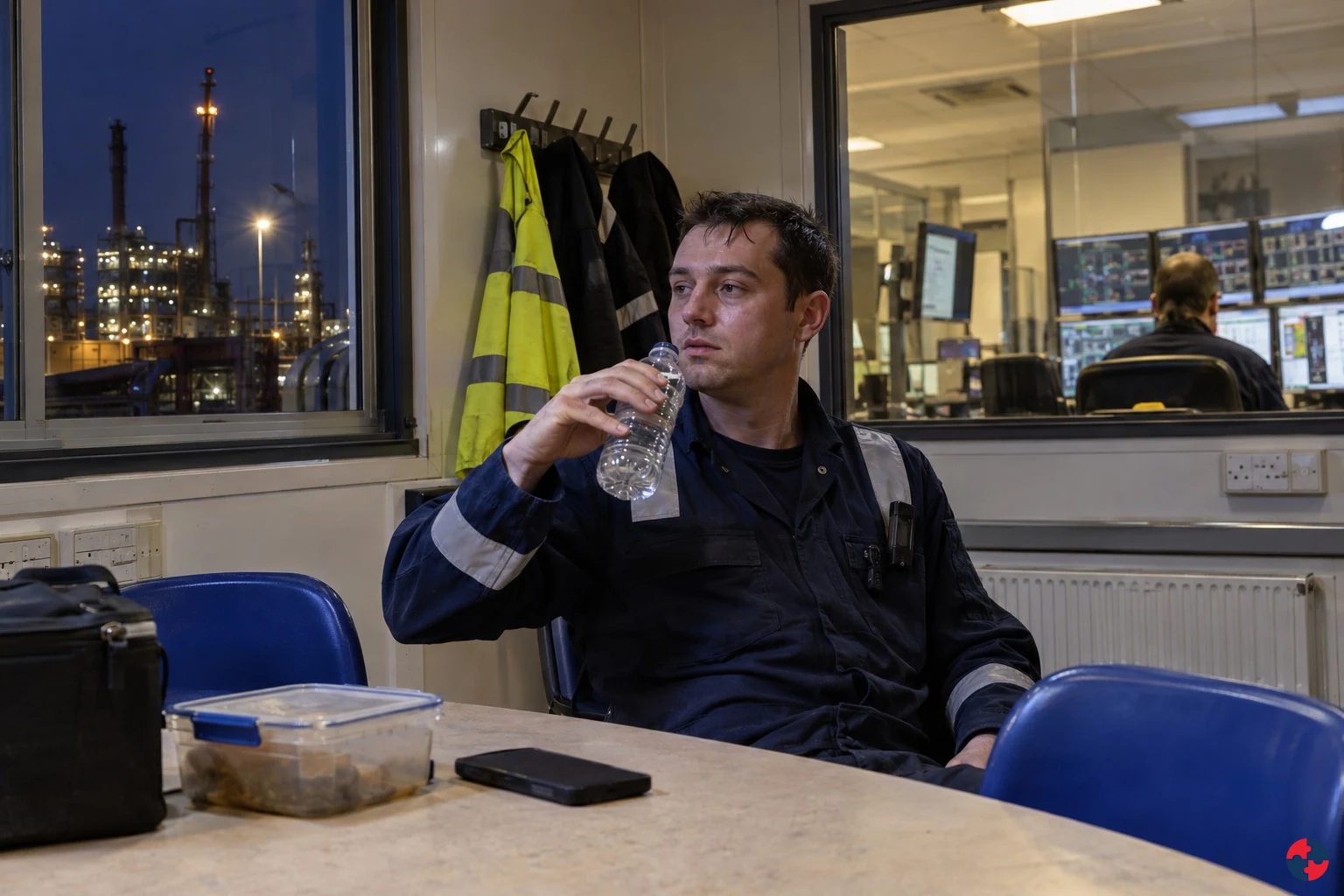
Use repeated overtime as a signal to redesign staffing and recovery
Compare planned hours with the work actually done, including call-outs, swaps, missed breaks, travel and overlapping contractor assignments. Repeated overtime may show a vacancy, workload or scheduling problem. Fatigue management is the systematic control of work demands that can reduce alertness, memory and reaction time, especially long hours, night shifts, missed breaks and inadequate recovery.
Turn fatigue management knowledge into a decision
Fatigue management is the systematic control of work demands that can reduce alertness, memory and reaction time, especially long hours, night shifts, missed breaks and inadequate recovery. An effective system compares actual work with planned rosters, provides staffing and relief, and acts on reports before impaired performance meets a vehicle, machine or critical decision. Keep actual-hours, call-out, break, handover, cover, travel and supervisor decision records; sample near misses and worker feedback to test whether staffing and roster changes worked.
the process operator night call-out and next-shift decision
An operator reports a lapse and missed breaks. The supervisor stops their critical decision, has competent personnel make the activity safe, and assigns rested cover or defers the check. Record the safe handover, alternative work or time off, recovery arrangement and task-specific restart decision.
Warning signs and how harm can develop
Missed breaks: Workers do not recover during demanding shifts. High overtime: Cumulative fatigue builds and becomes normal. Poor handover: Critical information is missed or misunderstood.
Choose controls for the actual task
Elimination: Remove unnecessary night operations and duplicated out-of-hours work from the service plan. Administrative controls: Use a lower-fatigue service or staffing arrangement after assessing the shift pattern with workers. Administrative controls: Keep safety-critical work away from periods when staffing or fatigue prevents safe performance. Engineering controls: Provide automation, safe plant states and reliable work equipment so foreseeable human lapses do not initiate major harm. Administrative controls: Set workable shift, overtime, break, call-out and recovery arrangements; review actual hours and staffing shortfalls. Read the full control table for qualifications, ownership and verification. Use the actual task and applicable jurisdiction; existing technical approval remains unchanged.
Use the full fatigue management lesson
Use the full topic for the decision points, practical examples, detailed control tables and source scope. HSE guidance applies to Great Britain; use HSENI for the Northern Ireland route and the source’s stated jurisdiction. A simplified guide does not change the page’s technical-review or approval status.

Read all six steps as text
1. Use repeated overtime as a signal to redesign staffing and recovery
Compare planned hours with the work actually done, including call-outs, swaps, missed breaks, travel and overlapping contractor assignments.
- Avoid / redesign: Remove unnecessary night operations and duplicated out-of-hours work from the service plan.
- Control the task: Keep safety-critical work away from periods when staffing or fatigue prevents safe performance.
- Verify before release: If the hazardous step remains, retain a task assessment and select the stronger feasible remaining controls.
Compare planned hours with the work actually done, including call-outs, swaps, missed breaks, travel and overlapping contractor assignments. Repeated overtime may show a vacancy, workload or scheduling problem. Fatigue management is the systematic control of work demands that can reduce alertness, memory and reaction time, especially long hours, night shifts, missed breaks and inadequate recovery.
Apply it: Which part of this plan would you check at the workface before authorising the task?
2. Turn fatigue management knowledge into a decision
Use the evidence to improve the actual work arrangement.
- Change at source: Remove unnecessary night operations and duplicated out-of-hours work from the service plan.
- Make it observable: If the hazardous step remains, retain a task assessment and select the stronger feasible remaining controls.
- Keep useful evidence: Keep actual-hours, call-out, break, handover, cover, travel and supervisor decision records; sample near misses and worker feedback to test whether staffing and roster changes worked.
Fatigue management is the systematic control of work demands that can reduce alertness, memory and reaction time, especially long hours, night shifts, missed breaks and inadequate recovery. An effective system compares actual work with planned rosters, provides staffing and relief, and acts on reports before impaired performance meets a vehicle, machine or critical decision. Keep actual-hours, call-out, break, handover, cover, travel and supervisor decision records; sample near misses and worker feedback to test whether staffing and roster changes worked.
Apply it: What evidence would show that the change improves this task, rather than only completing a record?
3. the process operator night call-out and next-shift decision
Example: a practical application of the existing topic lesson.
- Setting: A fuel depot plans routine tanker-loading and control-room checks after a maintenance call-out extends the night shift; the desired outcome is safe completion by rested competent staff or deferral.
- Act: The operations manager compares roster and real hours, checks break cover, alarm load, contractor interfaces and the next safety-critical tasks.
- Hold / review: Do not continue impaired critical work or use an extra checker as permission.
An operator reports a lapse and missed breaks. The supervisor stops their critical decision, has competent personnel make the activity safe, and assigns rested cover or defers the check. Record the safe handover, alternative work or time off, recovery arrangement and task-specific restart decision.
Apply it: At which point would you hold this example, and what evidence would allow it to proceed?
4. Warning signs and how harm can develop
Connect the task, the route to the person and the control that can fail.
- Missed breaks: Workers do not recover during demanding shifts.
- High overtime: Cumulative fatigue builds and becomes normal.
- Poor handover: Critical information is missed or misunderstood.
Missed breaks: Workers do not recover during demanding shifts. High overtime: Cumulative fatigue builds and becomes normal. Poor handover: Critical information is missed or misunderstood.
Apply it: Who could be exposed, including other trades, cleaners, maintainers and people nearby?
5. Choose controls for the actual task
Control summary. Read the complete task-specific controls and checks in the linked topic.
- Elimination: Remove unnecessary night operations and duplicated out-of-hours work from the service plan.
- Substitution: No separate approved substitution is specified; assess a genuinely safer material or process before relying on lower controls.
- Engineering controls: Provide automation, safe plant states and reliable work equipment so foreseeable human lapses do not initiate major harm.
- Administrative controls: Use a lower-fatigue service or staffing arrangement after assessing the shift pattern with workers.
- PPE: No PPE corrects an unsafe roster; control task exposures and fatigue at source.
Elimination: Remove unnecessary night operations and duplicated out-of-hours work from the service plan. Administrative controls: Use a lower-fatigue service or staffing arrangement after assessing the shift pattern with workers. Administrative controls: Keep safety-critical work away from periods when staffing or fatigue prevents safe performance. Engineering controls: Provide automation, safe plant states and reliable work equipment so foreseeable human lapses do not initiate major harm. Administrative controls: Set workable shift, overtime, break, call-out and recovery arrangements; review actual hours and staffing shortfalls. Read the full control table for qualifications, ownership and verification. Use the actual task and applicable jurisdiction; existing technical approval remains unchanged.
Apply it: Which stronger option can be used here, and who will verify it before accepting the remaining risk?
6. Use the full fatigue management lesson
Follow the official sources below and retain the task-specific evidence.
- Official guidance: HSE
- Official guidance: HSE Managing shift work HSG256
- Task decision: Sample actual breaks, cover and worker reports on later shifts. Keep unresolved critical work held; no roster alone proves individual fitness.
Use the full topic for the decision points, practical examples, detailed control tables and source scope. HSE guidance applies to Great Britain; use HSENI for the Northern Ireland route and the source’s stated jurisdiction. A simplified guide does not change the page’s technical-review or approval status.
Apply it: Which official source and full-topic section will you use to resolve the next decision?
Test the revised arrangement against an absence, a late job and an emergency call-out before adopting it. Name who can reduce output, defer work or obtain rested relief, and fund the travel and recovery arrangements. Consult workers and compare real hours, break delivery, fatigue reports and safe handovers after the change. Keep private health information out of routine roster dashboards.
Crownway: cover survives a call-out
Illustrative example. Routine vacancy cover repeatedly extends a night shift, and a call-out leaves the next shift without recovered staff.
Decision. Operations defers non-essential loading and provides competent relief while management changes the staffing plan.
Evidence to check. Real duty records, consultation, break cover, relief availability and an observed handover under the revised roster.
Hold or escalation point. Do not release a critical assignment because scheduled hours look acceptable while actual recovery is unknown.
Follow-up. Sample an absence and contractor-pressure week; revise resources if overtime or missed breaks recur.
Compare the roster with the work actually done
A fatigue system needs evidence about actual work and recovery, followed by a resourced change to the operation.

Collect the real pattern
Compare planned duties with call-outs, swaps, overtime, breaks, travel and contractor overlap.
Locate the demanding task
Identify the critical decision, lift, driving or intervention that could be affected, with workers and supervisors.
Change the work
The operations manager removes unnecessary demand, arranges rested cover and corrects staffing or handover gaps; a release prohibition is an administrative decision, not an engineered interlock.
Verify improvement
Sample actual breaks, cover and worker reports on later shifts. Keep unresolved critical work held; no roster alone proves individual fitness.
Read the complete task-specific control examples
ERICPD is a planning cross-map: Discipline verifies and sustains every control. ESEAP compares effectiveness. A label does not authorise the task; retain the owner, evidence and stop or change decision.
Designing a roster for night operations · ERICPD
- Eliminate
- Remove unnecessary night operations and duplicated out-of-hours work from the service plan.
- Reduce
- Use a lower-fatigue service or staffing arrangement after assessing the shift pattern with workers.
- Isolate
- Keep safety-critical work away from periods when staffing or fatigue prevents safe performance.
- Control
- Provide automation, safe plant states and reliable work equipment so foreseeable human lapses do not initiate major harm.
- PPE
- No PPE corrects an unsafe roster; control task exposures and fatigue at source.
- Discipline
- Review overtime, fatigue reports and incidents with workers; adjust staffing and schedules when the controls cannot be followed.
Designing a roster for night operations · ESEAP
- Elimination
- Remove unnecessary night operations and duplicated out-of-hours work from the service plan.
- Substitution
- No separate approved substitution is specified; assess a genuinely safer material or process before relying on lower controls.
- Engineering controls
- Provide automation, safe plant states and reliable work equipment so foreseeable human lapses do not initiate major harm.
- Administrative controls
- Use a lower-fatigue service or staffing arrangement after assessing the shift pattern with workers.
- PPE
- No PPE corrects an unsafe roster; control task exposures and fatigue at source.
Releasing a lift after an overnight call-out · ERICPD
- Eliminate
- Remove the lift through suitable ground-level assembly or delivery at the final position where feasible.
- Reduce
- Use a rested competent supervisor or an approved alternative lifting sequence after reviewing the new interfaces.
- Isolate
- Provide the assessed physical exclusion and lifting safeguards for the actual task. A decision to withhold lift release while fitness or supervision is unresolved is administrative, not an engineered interlock.
- Control
- Use suitable rated lifting equipment, load control and safe positions specified by the lift plan.
- PPE
- Use task-assessed lifting PPE for residual contact risks; it cannot compensate for a fatigued lifting team.
- Discipline
- Record the postponement or replacement decision and provide recovery before further safety-critical work.
Releasing a lift after an overnight call-out · ESEAP
- Elimination
- Remove the lift through suitable ground-level assembly or delivery at the final position where feasible.
- Substitution
- No separate approved substitution is specified; assess a genuinely safer material or process before relying on lower controls.
- Engineering controls
- Provide the assessed physical exclusion and lifting safeguards for the actual task. A decision to withhold lift release while fitness or supervision is unresolved is administrative, not an engineered interlock.
- Administrative controls
- Use a rested competent supervisor or an approved alternative lifting sequence after reviewing the new interfaces.
- PPE
- Use task-assessed lifting PPE for residual contact risks; it cannot compensate for a fatigued lifting team.
What training is needed for fatigue management?
Training should match the level of influence people have over work design, reporting, supervision and assurance.
General awareness should be simple and practical: fatigue signs, reporting, tired driving, sleep basics and the right to pause unsafe work. Higher-risk teams need face-to-face discussion of real scenarios such as night work, shutdowns, driving, lone work, permit issue and emergency call-outs.
Supervisors and managers need deeper training because they make the decisions that control or worsen fatigue. They need to understand how rosters, overtime, quick returns, workload, breaks, worker consultation and reporting culture affect safe performance.
Planners need roster, workload and exception skills. Supervisors need a practised authority to stop unsafe critical work, obtain cover and arrange safe travel. Workers and contractors need a non-punitive reporting route and clear break, handover and stop rules. HR, safety and occupational health need role-specific training on records, assurance and private functional advice.
| Role | Learning to test | Competence demonstration | Assessor and record | Reassessment trigger |
|---|---|---|---|---|
| Workers, agency staff and contractors | Report unsafe alertness, missed breaks and driving concerns; use handover and stop routes. | Walk through a call-out report and identify the safe task hold and travel option. | Supervisor observes scenario and records induction and local route. | New assignment, exception pattern or reporting failure. |
| Schedulers and planners | Assess real hours, workload, break cover, recovery, task criticality and exception authority. | Produce a revised rota with documented consultation, relief and approval before release. | Operations/safety lead reviews assessment and exception record. | New roster, vacancy, contractor plan or repeated overtime. |
| Supervisors and incident commanders | Pause unsafe critical work, obtain competent relief, control handover and safe journey. | Lead a no-relief scenario through deferral or safe shutdown without blaming the reporter. | Accountable FMS owner observes decision and records exercise. | Emergency extension, near miss or failed relief. |
| Senior leaders and procurement | Resource staffing, contingency, scheduling data and independent challenge. | Show budget/specification decisions that permit safe reduced output or relief. | Board or independent assurance samples decisions and action closure. | Capacity change, procurement, recurring exception or serious event. |
| Safety, HR and occupational-health specialists | Analyse system trends, lawful data use, GB/NI legal boundary and private functional advice. | Audit a real-hours case from report to verified corrective action and privacy controls. | Competent discipline lead records technical review and limits. | Guidance change, privacy failure or ineffective corrective action. |
Which legal routes govern fatigue management in GB and Northern Ireland?
Both jurisdictions require foreseeable work risks to be assessed and managed, but the relevant health-and-safety, working-time and adjustment instruments differ.
Great Britain: the 1974 Health and Safety Act and Management Regulations 1999 frame risk assessment and preventive arrangements. The Working Time Regulations 1998 address hours, rest and night work. Where a disability-related adjustment duty applies, the Equality Act 2010 is the GB route.
Use current government guidance and competent task-specific advice; this section does not establish a technical specification.
Compliance with working-time minimums alone does not establish that a roster or safety-critical task is safe. Assess actual hours, workload, breaks, travel and recovery. Special sectors can have additional or different rules; check current amended provisions and sector exceptions before adopting an organisational rule.
| Jurisdiction | Direct legal route | Relevant decision | Boundary and verification |
|---|---|---|---|
| Great Britain | Management Regulations 1999 | Assess foreseeable fatigue from work design and assign preventive action. | Check the actual task and amended law; the regulation is not a universal hours limit. |
| Great Britain | Working Time Regulations 1998 | Check hours, rest, night-work and applicable exceptions. | Working-time compliance alone does not prove a worker is fit for a safety-critical task. |
| Northern Ireland | Management Regulations (NI) 2000 | Use the NI risk-assessment and prevention route. | Do not cite the GB Management Regulations as the NI instrument. |
| Northern Ireland | Working Time Regulations (NI) 2016 | Check NI hours, rest, night-work and applicable exceptions. | Do not carry a GB working-time citation into NI policy. |
How should fatigue appear in a risk register?
Fatigue should appear where work patterns, travel or task demand can foreseeably reduce safe performance.
Record the work-pattern exposure and task consequence separately: night control-room monitoring, post-overtime driving and contractor maintenance have different routes to harm. Name the roster, break, staffing, handover and travel controls, their owner, evidence, stop point and review trigger. Do not label a worker or health condition as the hazard.
How should the selected controls be checked in practice?
Remove the actual hazard where possible, then use substitution and verified physical controls before relying on procedures or PPE. Discipline checks that the chosen barriers still work.
The scenario is overnight call-out before a critical lift. The controls below are reasoned task applications of linked guidance, not a prescribed design or evidence that each intervention appears verbatim in a source. A competent owner must check feasibility, local law and stop criteria.
Use current government guidance and competent task-specific advice; this section does not establish a technical specification.
How should management-system themes support fatigue controls?
Leadership, worker consultation, planning, competence and corrective action matter when they change real shifts and task decisions.
BS EN ISO 45001:2023+A1:2024 themes can organise accountability and evidence, but an unverified clause mapping or certificate does not show that fatigue is controlled. Leaders resource staffing and relief; planners design rosters; supervisors stop unsafe work; workers report without blame; safety and HR compare real hours and break use with the plan. Audit sampling should follow an actual call-out, shift swap or maintenance peak through to corrective action, not count forms alone.
Staffing, procurement and contingency funding determine whether relief, safe travel and recovery are available in practice. Specify actual-hours visibility, exception review, handover and contractor requirements when buying scheduling systems or services. Senior management should examine whether budget or output targets are creating routine overtime and should authorise reduced output or safe shutdown when demand exceeds safe capacity.
Use current government guidance and competent task-specific advice; this section does not establish a technical specification.
These are practical management-system themes, not a clause-by-clause interpretation. A competent reviewer must verify any clause mapping against a lawfully accessed current standard.
How does fatigue management support study and professional development?
For study, fatigue management should be understood as a human factors, leadership and operational control topic.
Learners should be able to explain why fatigue affects attention, memory, judgement, communication and physical co-ordination. They should also be able to move from theory to workplace application: identify high-risk work patterns, decide suitable controls, explain why worker preference does not remove employer duties and describe what evidence proves controls are working.
Scenario-based answers should avoid simply saying 'train workers'. Stronger answers discuss staffing, roster design, actual hours, breaks, recovery, task timing, commute risk, supervisor authority, worker consultation, incident learning and management review.
A useful study answer compares the written roster with real hours, break use, task demands and recovery. Explain how poor work design can narrow attention, then show which controls remove or reduce the demand before lower-level safeguards. Test the plan with worker feedback and incident evidence; a low fatigue-model score cannot override a missed break or unsafe driving report.
Fatigue management FAQs - what do people ask?
People usually ask how fatigue should be controlled, who owns it and what evidence shows the system is working.
What is fatigue management?
Fatigue management is the organised control of work patterns, workload, rest, shift design, reporting and assurance so tiredness does not reduce safe performance.
Is Working Time Regulations compliance enough?
No. Working time rules are important, but fatigue risk still needs task, workload, commute, recovery, safety-critical work and real-hours assessment.
Who owns fatigue management?
Senior leaders own resourcing and risk appetite; operations own work design; HR supports working-time arrangements; supervisors manage day-to-day triggers; workers report fatigue; safety and occupational health provide specialist support.
What are real hours?
Real hours are the hours actually worked, including overtime, shift swaps, call-outs, travel between sites and work completed outside the planned roster.
What is a quick return?
A quick return is a short recovery period between shifts, for example finishing late and starting early before the person has had enough opportunity to sleep and recover.
How should fatigue be handled in safety-critical work?
If reduced alertness could make a safety-critical task unsafe, stop that duty, make the activity safe and arrange rested competent cover or reassignment. Reassess the task and recovery before restart; extra supervision alone is not permission to continue impaired work.
Should workers be blamed for fatigue?
Not automatically. A good system looks first at work design, hours, workload, staffing, reporting culture and support before making assumptions about the individual.
What data should be monitored?
Monitor actual hours, overtime, missed breaks, fatigue reports, near misses, vehicle events, quality errors, absence, worker feedback and audit findings.
When should occupational health be involved?
Use occupational health where fatigue appears persistent, complex, health-related, medication-related or affects fitness for safety-critical work.
How often should fatigue risk be reviewed?
Review after roster changes, staffing pressure, peaks, shutdowns, incidents, near misses, worker feedback, abnormal operations or evidence that controls are not being followed.
What do the acronyms and key terms mean?
Acronyms should be explained so readers can follow guidance, records and management-system terms.
| Acronym | Meaning | Plain English use |
|---|---|---|
| EAP | Employee Assistance Programme | Confidential support service where provided by the employer. |
| FRMS | Fatigue Risk Management System | A structured system for assessing, controlling and reviewing fatigue risk. |
| HSE | Health and Safety Executive | Great Britain workplace health and safety regulator. |
| HR | Human Resources | People management function supporting contracts, working time and employment processes. |
| OH | Occupational Health | Specialist work-health advice service. |
| WTR | Working Time Regulations | Rules covering working time, rest and night work. |
| ERICPD | Eliminate, Reduce, Isolate, Control, PPE, Discipline | A practical planning order for controlling work demands and task hazards. |
| Actual hours | Time actually worked | Includes overtime, call-outs and swaps, not just the published rota. |
| Exception | Approved departure from planned staffing or hours | A risk decision to record and review, not a routine way to cover shortages. |
Which BuildOut documents support this topic?
Download individual editable BuildOut documents for this topic. Procedures and plans contain completed arrangements; forms, checklists, assessments, RAMS and permits are blank masters. Registers include separate worked examples.
| Document | Purpose and content | Editable download |
|---|---|---|
| Stress, fatigue, hours and workload assessment BOUK-RA-OCC-02 · Blank editable master · v1.0 | Assess foreseeable psychosocial and fatigue risks and agree work-design controls. | Download DOCX Read preview |
Review and adapt the documents for your organisation, activities and jurisdiction before approval and issue. Open the SHAREms management-system hierarchy to find each document under its parent policy.