
SHARE Knowledge Hub
Chronic fatigue syndrome and ME at work
ME/CFS can cause post-exertional symptom worsening, unrefreshing sleep and cognitive difficulties, with capacity that fluctuates. A manager should ask about the work that is difficult, agree flexible duties and breaks within the person’s energy limits, and review without imposing fixed increases in activity. Diagnosis and treatment remain with qualified clinicians.
Understanding Chronic fatigue syndrome and ME at work
ME/CFS can cause post-exertional symptom worsening, unrefreshing sleep and cognitive difficulties, with capacity that fluctuates. A manager should ask about the work that is difficult, agree flexible duties and breaks within the person’s energy limits, and review without imposing fixed increases in activity. Diagnosis and treatment remain with qualified clinicians.
Why this matters at work
Discuss practical changes such as shorter or later shifts, predictable timing, fewer consecutive days, reduced meetings, quieter work, fewer simultaneous priorities, less travel and protected rest. Break work into manageable parts and distinguish hours from workload. Resource the plan so it does not depend on hidden overtime by the worker or colleagues. Record measures, ownership and review, with only necessary information shared. Review after symptoms or job changes and allow downwards as well as upwards adjustment. The goal is sustainable participation within current capacity; attendance or immediate productivity alone cannot show whether delayed harm is being avoided.
Evaluate whether the promised changes were delivered and whether participation is sustainable over time, including delayed effects and outside-work essentials. Avoid judging success solely by attendance, immediate output or compliance with a calendar. Check that targets have fallen with hours and that colleagues are resourced fairly. Consider the correct national employment and disability provisions and obtain competent advice where duties or entitlement are disputed. Review flexibly with the person and occupational health where appropriate. A plan should support safe participation and remove actual disadvantage; it should not become a medical treatment contract, a fixed escalation schedule or a requirement to demonstrate capacity through avoidable harm.
How organisations manage this in practice
Specify duties, hours, workload, rest, location, travel and review criteria, including a clear way to maintain, reduce or pause. Reduced hours need reduced demands, not the same backlog in less time. Allow enough observation to capture later deterioration and consider essential life activities outside work. Record who can change the plan and ensure supervisors understand it. Do not label a setback as unwillingness or impose a fixed exercise-increase programme as an employment requirement. Clinical activity programmes belong with the appropriate specialist service, while the employer organises achievable safe work.
Review the total demand with the person and appropriate occupational health or clinical support. Reduce or reorganise hours, workload, travel, interruptions or other triggers to a sustainable current level, with planned rest where helpful. Do not instruct a repeat exposure to prove the pattern. Record the agreed work measures, responsible people and a review long enough to capture delayed effects. The manager does not diagnose ME/CFS or prescribe treatment. A sustainable plan may need to be maintained, reduced or paused; progression should follow current evidence and the person's circumstances rather than appearance at the end of one shift.
Maintain strong operational barriers such as suitable automation, alarms, interlocks, independent checks, staffing and controlled handover. Do not rely on an individual compensating for a weak system. Where current function compromises a critical task, agree suitable temporary duties and a fair review rather than requiring an uncontrolled trial. Record demands, restrictions, measures and responsibility, sharing only necessary functional information. Reassess when conditions or symptoms change and consider effects on emergency arrangements. This Q&A does not grant or remove a specific work authorisation; competent local dutyholders must evaluate the real task, advice and safeguards without blanket assumptions or discrimination.
What are the key facts about ME/CFS and work?
The key facts are that ME/CFS is fluctuating, functional impact varies between people and work should be paced around safe, sustainable capacity.
This page is workplace guidance, not medical, legal or HR advice. ME/CFS symptoms, diagnosis, treatment, medication and deterioration should be discussed through NHS, GP, specialist care or occupational health routes as appropriate. Workplace records should focus on functional impact, agreed support and review dates, not unnecessary clinical detail.
What signs may affect work?
- Post-exertional symptom worsening, overwhelming fatigue, brain fog, pain, unrefreshing sleep or reduced stamina.
- Fluctuating capacity, relapse after busy periods, sensory sensitivity, dizziness or difficulty sustaining concentration.
- Attendance, pace, memory, travel, meetings, shift work, manual tasks or safety-critical duties becoming harder to sustain.
What should managers do first?
- Speak privately, avoid diagnosis, ask what work is making harder and agree what information can be shared.
- Consider temporary or longer-term adjustments, workload pacing, breaks, remote work, reduced hours and review dates.
- Use occupational health or HR input where functional impact, safety-critical work or adjustment decisions are complex.
When should work be reviewed?
- When symptoms worsen, capacity changes, the role includes driving, machinery, lone work, public safety or emergency response.
- When absence patterns, presenteeism, errors or exhaustion suggest the current work design is not sustainable.
- When a phased return, flexible work, reasonable adjustment or fitness-for-work decision needs competent advice.
Pushing through can backfire
Overactivity may worsen symptoms for some people, so support should consider pacing and recovery rather than crude attendance targets.
Functional impact matters most
A diagnosis label alone does not define what someone can do; the useful question is what the work requires and what creates barriers.
Work can help or hinder
Flexible design, stable communication and fair adjustments can support work, while long hours, shifts, travel and pressure can make symptoms harder to manage.
Safety risk may be indirect
Fatigue and cognitive difficulty can affect attention, memory, reaction time and judgement, especially in safety-critical roles.
Confidentiality builds trust
Workers are more likely to ask for help early if health information is handled respectfully and narrowly.
Review is essential
ME/CFS can fluctuate, so adjustments should be reviewed rather than treated as one-off decisions.
Check how the worker feels after the shift, not only at its end
A shift that appears successful at finishing time may still be followed by delayed symptom worsening. Ask the worker how the agreed duties affect recovery afterwards, through a confidential discussion they can manage. Record useful functional feedback and the work changes agreed, not a compulsory symptom diary shared with the team.
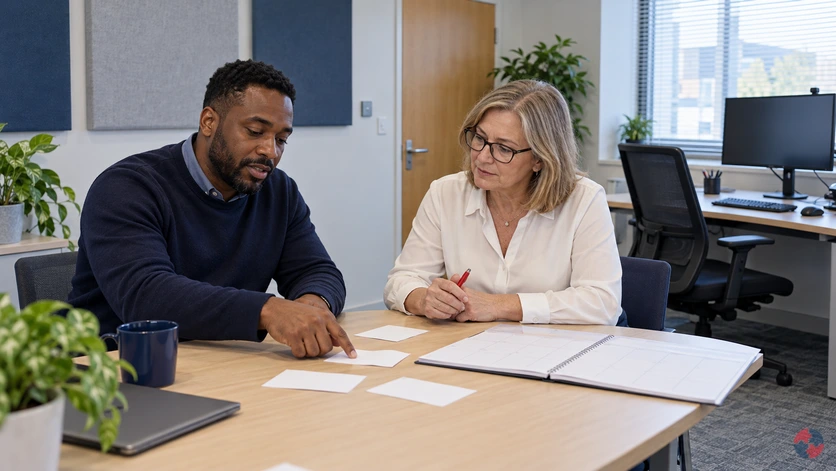
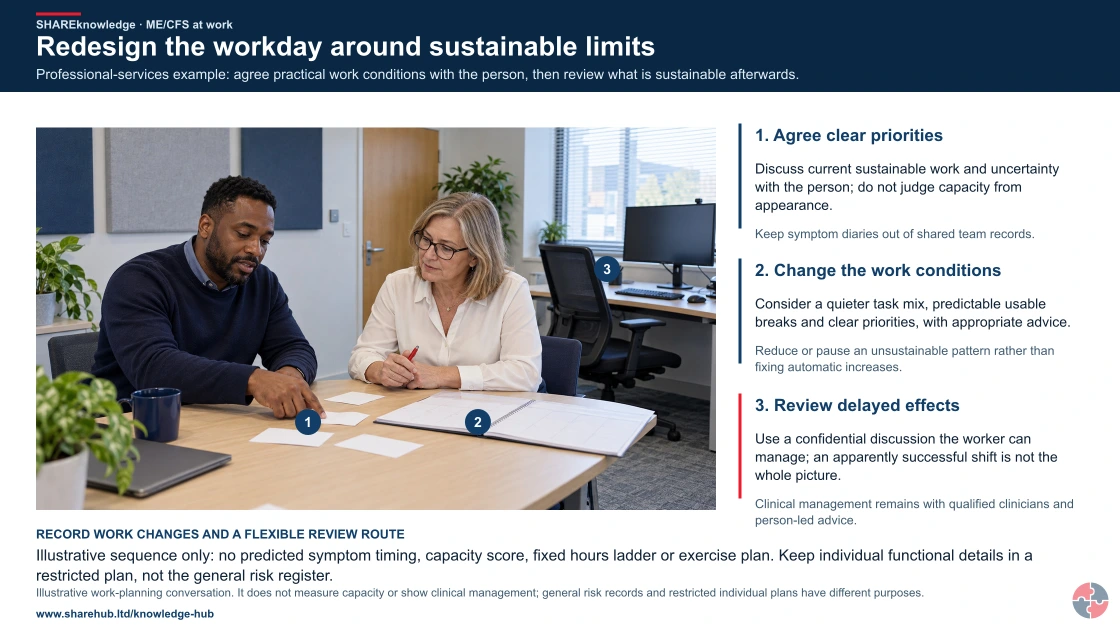
Redesign the workday around sustainable limits
Full written explanation
Professional-services example: agree practical work conditions with the person, then review what is sustainable afterwards.
- Agree clear priorities. Discuss current sustainable work and uncertainty with the person; do not judge capacity from appearance.
- Change the work conditions. Consider a quieter task mix, predictable usable breaks and clear priorities, with appropriate advice.
- Review delayed effects. Use a confidential discussion the worker can manage; an apparently successful shift is not the whole picture.
Change the pathway
- Keep feedback manageable. Keep symptom diaries out of shared team records.
- Plan a flexible rollback. Reduce or pause an unsustainable pattern rather than fixing automatic increases.
- Separate work and care. Clinical management remains with qualified clinicians and person-led advice.
Evidence check: Illustrative sequence only: no predicted symptom timing, capacity score, fixed hours ladder or exercise plan. Keep individual functional details in a restricted plan, not the general risk register.
Full person-led adjustment and delayed-worsening context
Primary references: NICE NG206: ME/CFS recommendations · NHS: ME/CFS symptoms and delayed worsening · Acas: occupational health and work support
Open the complete HD image (new tab)Download image

Full person-led adjustment and delayed-worsening context
Primary references: NICE NG206: ME/CFS recommendations · NHS: ME/CFS symptoms and delayed worsening · Acas: occupational health and work support
At Riverside, an agreed reduction in hours can be paired with a quieter task mix, predictable breaks and written priorities. If the pattern proves unsustainable, pause or reduce it rather than automatically increasing weekly activity. Keep clinical management with clinicians and person-led advice, and assess safety-sensitive tasks individually rather than treating the diagnosis as blanket exclusion.
Riverside: the next day changes the trial decision
Illustrative example. A receptionist completes a shortened shift but later reports prolonged worsening after queue-heavy changeover work.
Decision. The manager and worker reduce the next trial’s demand, change the task mix and review the agreed support with appropriate advice.
Evidence to check. Worker feedback about sustainable work and recovery, actual duties, breaks and the agreed rollback plan.
Hold or escalation point. Do not progress hours because the worker appeared well at the end of the previous shift.
Follow-up. Review after a suitable agreed interval and sooner if delayed effects or work demands change.
Review later effects as well as the work period
An arrangement that appears manageable during a task may need review after the worker experiences later effects. Agree individual adjustments without an automatic increase in activity.

Agree the activity
Discuss functional needs, actual work and suitable adjustments with the worker and appropriate clinical advice.
Check later effects
Agree how and when to review the effects, without a fixed recovery interval or a standard progression target.
Change the arrangement
Modify work, timing or support when the trial does not meet the individual’s needs. Record only necessary work information.
The timeline is illustrative and supplies no treatment programme, activity dose or universal recovery period.
What is ME/CFS and who diagnoses it?
ME/CFS is a long-term illness with post-exertional malaise, profound fatigue, sleep disturbance and cognitive symptoms; a clinician evaluates and diagnoses it.
Post-exertional malaise means symptoms worsen after physical, mental, emotional or social activity, sometimes after a delay and with prolonged recovery. Symptoms and capacity vary over time. NHS and nidirect advise seeing a GP because other conditions may cause similar symptoms and there is no single diagnostic test. A manager should never infer ME/CFS from tiredness or dismiss a diagnosed person as merely unfit or unmotivated. Check the direct source: NHS ME/CFS advice, nidirect ME/CFS advice.
What symptoms and patterns may affect work?
Symptoms may include severe fatigue, post-exertional worsening, sleep problems, pain, dizziness, sensory sensitivity and cognitive difficulty.
Symptoms can affect physical stamina, thinking, communication, travel and recovery. A person may appear well during a meeting but experience symptom worsening later. This is one reason why managers should avoid judging capacity only from what they see in a short interaction.
The workplace should look for patterns rather than stereotypes. Repeated absence after busy shifts, difficulty recovering from overtime, memory lapses after long meetings, sensitivity to noisy environments or deterioration after travel may all suggest that work design needs review.
Symptom information should be handled carefully. Managers need enough information to understand work impact and support, but they do not need a complete medical history. Where there is doubt, occupational health can translate medical and functional information into practical work advice.
| Symptom or pattern | How it may show at work | Practical response |
|---|---|---|
| Post-exertional worsening | Relapse after a busy shift, travel, training day or heavy workload. | Use pacing, planned breaks, reduced hours and review workload peaks. |
| Brain fog | Difficulty concentrating, remembering instructions or processing complex information. | Provide written instructions, reduce interruptions and avoid safety-critical overload. |
| Unrefreshing sleep | Low alertness despite rest, especially after shifts or early starts. | Review rota, start times, breaks and commute risk. |
| Pain | Difficulty with posture, manual tasks, prolonged standing or repetitive activity. | Adjust tasks, seating, equipment, breaks and manual handling demands. |
| Dizziness or sensitivity | Difficulty in hot, noisy, bright or crowded environments. | Review work environment, quiet space, temperature and task allocation. |
| Fluctuating capacity | Variable attendance, pace or ability to sustain normal duties. | Agree flexible plan, triggers and review dates. |
How can ME/CFS affect work design?
ME/CFS can affect work design by changing how much activity, travel, concentration, social demand, shift work and recovery time a person can sustain.
Work design should consider the whole demand placed on the person, not only the visible task. A short shift may still be too demanding if it involves commuting, standing, customer conflict, sensory load, no quiet breaks and pressure to complete tasks at speed.
Pacing is central. Work adjustments should respect the person’s current energy limit, including rest; they must not impose a minimum activity target. In practice this may mean spreading demanding tasks, reducing consecutive shifts, avoiding overtime, alternating cognitive and physical tasks or using rest breaks before symptoms escalate.
The work design review should include safety. If the person drives, uses machinery, supervises children or the public, responds to emergencies or works alone, fatigue and cognitive difficulty may affect both the worker and others. The solution should be proportionate, confidential and reviewed.
| Work factor | Why it can matter | Possible controls or adjustments |
|---|---|---|
| Hours and shifts | Long shifts, nights, early starts or overtime can reduce recovery. | Reduced hours, stable rota, later start, no overtime or phased increase. |
| Workload and pace | High pace or workload spikes can trigger post-exertional worsening. | Pacing plan, task rotation, adjusted targets and protected breaks. |
| Travel and commuting | Travel can consume energy before work starts. | Remote work, hybrid work, adjusted start times or parking support. |
| Cognitive demand | Complex work may become harder with brain fog. | Written instructions, prioritisation, quiet time and reduced multitasking. |
| Physical demand | Standing, lifting, walking or awkward posture can worsen fatigue or pain. | Task redesign, seating, handling aids and alternative duties. |
| Environment | Noise, heat, light, crowds or conflict can increase symptom load. | Quiet space, temperature control, reduced public-facing time or schedule changes. |
How should managers assess work impact without diagnosing?
Managers should assess the fit between work demands and current functional capacity, while avoiding medical judgement or unnecessary personal detail.
A good conversation starts with the work: what tasks are difficult, when symptoms worsen, what helps, what creates barriers, what duties may be safety-critical and what the person is comfortable sharing. The manager should listen for patterns and agree next steps rather than asking intrusive clinical questions.
The assessment should be documented carefully. Record adjustments, restrictions, responsibilities and review dates. Avoid unnecessary diagnosis detail, speculation, opinions about the person's character or comments that could undermine trust.
Escalation should be proportionate. HR may support fairness and process; occupational health may advise on functional capability and adjustments; H&S may review safety-critical duties; the worker's GP or specialist remains the route for clinical care.
| Assessment area | Helpful questions | Evidence to record |
|---|---|---|
| Work demands | Which tasks, hours, locations, travel or environments are hardest at the moment? | Functional barriers, work factors and tasks needing review. |
| Pattern and triggers | Are there times, shifts or activities after which symptoms worsen? | Patterns, trigger points and recovery needs. |
| Safety-sensitive work | Are any duties affected by fatigue, dizziness, medication or concentration difficulty? | Restrictions, temporary controls and referral decisions. |
| Support options | What has helped before and what adjustment would make work more sustainable? | Agreed adjustments, owner and trial period. |
| Confidentiality | What information can be shared and with whom? | Need-to-know communication plan. |
| Review | When shall we check whether this is working? | Review date, measures and escalation triggers. |
What work adjustments may help a person with ME/CFS?
Agree changes with the worker around sustainable energy limits; do not impose fixed increases in hours or activity.
Options include predictable scheduling, reduced hours or duties, rest breaks before exhaustion, remote work where feasible, quieter environments, written instructions and recovery time between shifts. NICE NG206 distinguishes personalised energy management from a fixed-increment exercise programme; the workplace must not treat a graded activity target as treatment. An adjustment plan can increase, pause or reduce duties according to the person’s capacity and clinical/occupational-health advice, with a fallback if post-exertional malaise follows. Check the direct source: NICE NG206 recommendations.
On a small screen, scroll this table sideways to read all columns.
| Work barrier | Possible change | Review and stop cue |
|---|---|---|
| Energy limit | Flexible hours, task spacing, rest breaks. | If symptoms worsen after work, pause or reduce demand. |
| Cognitive load | Written priorities, fewer interruptions, shorter meetings. | Check accuracy and sustainable concentration. |
| Shift or travel | Avoid rapid rota changes; consider remote or local work. | Check recovery and safety-critical alertness. |
| Variable course | Review dates and rollback option. | Do not force fixed weekly increases. |
Apply NICE’s energy-management boundary through person-led work adjustments, with Acas guidance for GB and Equality Commission NI guidance for NI. A manager does not prescribe pacing or exercise therapy. The scenario below tests whether an agreed work plan is sustainable.
Worked adjustment plan: reception work with ME/CFS
| Work barrier | Owner and agreed work change | Check, failure response and review evidence |
|---|---|---|
| Energy and rota | Worker and line manager agree an initial schedule, breaks and task mix around current sustainable capacity, with occupational-health advice where useful. | Check how work and the period after it affect the person, since worsening can be delayed. Relapse or unsustainable demand triggers a pause/reduction and advice; there is no fixed weekly increase. |
| Cognitive and environmental demand | Manager provides written priorities, fewer interruptions and a quieter seated task area where feasible. | Review accuracy, interruptions and the worker’s experience of the trial. If it fails, change the design and record the next review; do not infer motivation from pace. |
| Safety-sensitive duties | H&S lead assesses lone closing, driving and emergency duties against the actual task and current functional advice. | Verify staffing and role boundaries before the shift. Unsafe concentration or lack of agreed support stops the affected duty pending reassessment, not automatic exclusion from every role. |
| Private record and review | HR coordinates a restricted adjustment plan with an owner, review date and necessary work recommendations. | Supervisors receive what they need to implement changes. Keep clinical narratives out of general risk registers; unnecessary disclosure is stopped and corrected through the data-protection process. |
How should ME/CFS be considered in safety-critical work?
ME/CFS should be considered in safety-critical work by assessing fatigue, alertness, cognition, medication effects, recovery and task consequence.
Safety-critical does not mean automatically excluding someone from work. It means taking a proportionate look at the real task and the current risk. Driving, plant operation, lone work, emergency response, safeguarding roles, work at height, confined spaces, public supervision and hazardous-substance work may all need closer review if fatigue, dizziness or cognitive difficulty is present.
Controls may be temporary and supportive: avoid night shifts, reduce long drives, pair up for lone tasks, move complex decisions to better times of day, increase supervision, simplify instructions, or pause a safety-critical duty while advice is obtained.
The review should be respectful and evidence-led. Managers should avoid assumptions, but they should also avoid ignoring known fatigue where it could harm the worker or others.
| Duty type | Why ME/CFS may matter | Possible control |
|---|---|---|
| Driving or commuting after shifts | Fatigue and brain fog can affect alertness and reaction time. | Adjust shift end time, reduce long drives or use remote work where possible. |
| Machinery or vehicles | Attention, coordination and response may be affected. | Review duty, supervision, timing, breaks and fitness-for-work advice. |
| Lone work | Symptoms may worsen without immediate support nearby. | Check lone-working plan, communication and task timing. |
| Emergency response | Sudden high-demand activity may exceed pacing limits. | Agree role boundaries and alternative duties. |
| Public or vulnerable-person supervision | Sustained attention and stamina may be needed. | Review staffing, breaks, workload and contingency. |
| Hazardous tasks | Fatigue may increase error likelihood. | Apply permit, supervision, task simplification or temporary restriction. |
How should ME/CFS health information be handled?
Record the functional adjustment and review plan, not unnecessary clinical history.
Explain why information is needed, who can access it and how long it is kept. Health data is special-category data: a lawful basis and Article 9 condition are needed; consent alone should not be assumed to solve the employer’s power imbalance. A team may need to know rota or task changes but usually not diagnosis, medication or symptom notes. Occupational health can hold clinical detail and share necessary work recommendations.
How should return to work be planned with ME/CFS?
Start from the person’s current sustainable capacity and review flexibly; there should be no compulsory schedule of increasing activity.
Agree initial duties, hours, breaks, contact, commuting and a confidential review date with the worker and occupational health where helpful. Post-exertional worsening may be delayed, so evaluate the period after a workday or shift rather than judging only attendance. If symptoms worsen, reduce or pause demands and obtain clinical advice as needed. A worker’s presence at work is not proof that full duties are sustainable.
On a small screen, scroll this table sideways to read all columns.
| Plan item | Agreement | Change trigger |
|---|---|---|
| Starting work | Person-led hours, tasks and recovery. | Symptoms after activity or unsafe concentration. |
| Review | Worker feedback and occupational-health advice. | Any relapse, deterioration or changed role. |
| Rollback | Pre-agreed lower-demand option. | Pause fixed increases; update plan. |
Which work and equality duties apply to ME/CFS?
Control work risks and apply the disability-adjustment test for the correct jurisdiction; diagnosis alone does not settle the legal question.
In Great Britain, the Equality Act 2010 may require reasonable adjustments when the legal disability test and employer-knowledge conditions are met; Acas explains the employment process. Northern Ireland uses the Disability Discrimination Act 1995 and Equality Commission NI guidance, not the GB Equality Act route. Assess fatigue-sensitive tasks, shifts and safety-critical work under the applicable safety law. Worker health details are special-category data and need a UK GDPR lawful basis, Article 9 condition and minimised access. HR and occupational health should resolve individual cases rather than applying a blanket exclusion. Check the direct source: Acas GB adjustments, Equality Commission NI adjustments.
On a small screen, scroll this table sideways to read all columns.
| Decision | Great Britain | Northern Ireland |
|---|---|---|
| Adjustment law | Equality Act 2010; Acas guidance. | Disability Discrimination Act 1995; Equality Commission NI. |
| Work hazard | HSE fatigue and stress guidance; assess real duties. | Apply NI safety law and competent task assessment. |
| Health data | UK GDPR/ICO minimisation. | UK GDPR/ICO minimisation. |
How should ME/CFS and fatigue be reflected in risk management?
Risk management should identify where fatigue, fluctuating capacity or cognitive difficulty could affect safe work, wellbeing or fair employment decisions.
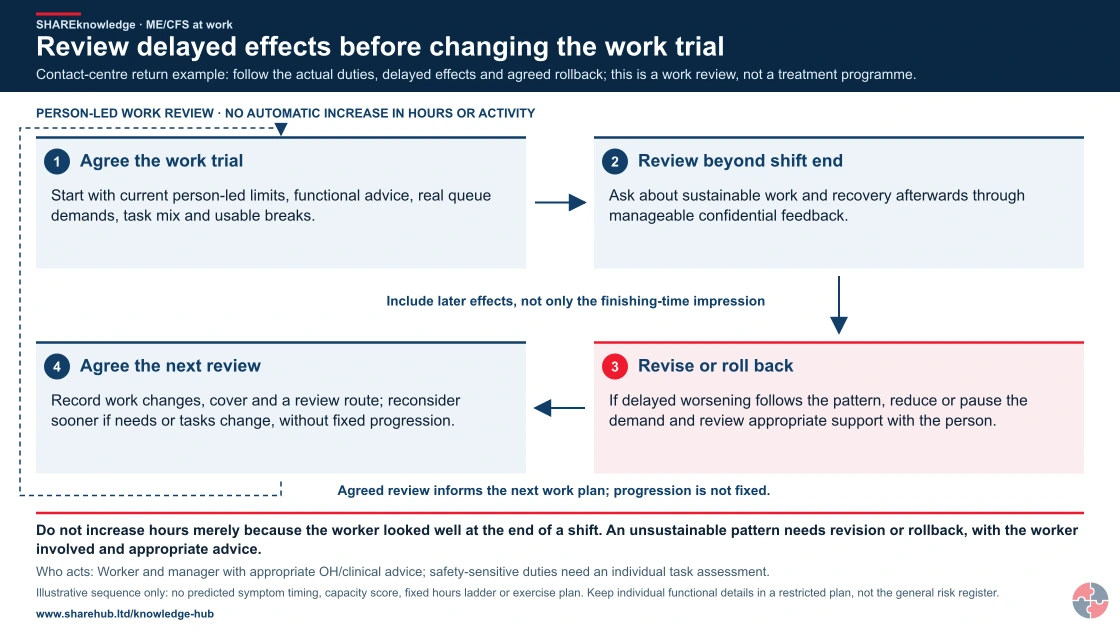
Review delayed effects before changing the work trial
Full written explanation
Contact-centre return example: follow the actual duties, delayed effects and agreed rollback; this is a work review, not a treatment programme.
- Agree the work trial. Start with current person-led limits, functional advice, real queue demands, task mix and usable breaks.
- Review beyond shift end. Ask about sustainable work and recovery afterwards through manageable confidential feedback.
- Revise or roll back. If delayed worsening follows the pattern, reduce or pause the demand and review appropriate support with the person.
- Agree the next review. Record work changes, cover and a review route; reconsider sooner if needs or tasks change, without fixed progression.
When the evidence does not fit: Do not increase hours merely because the worker looked well at the end of a shift. An unsustainable pattern needs revision or rollback, with the worker involved and appropriate advice.
Who acts: Worker and manager with appropriate OH/clinical advice; safety-sensitive duties need an individual task assessment.
Changed workplace
Professional services: Clear priorities, a quieter task mix and usable breaks need review in real work.
Contact centre: A completed shortened shift can still be followed by worsening; the next work plan must be adaptable.
Evidence check: Illustrative sequence only: no predicted symptom timing, capacity score, fixed hours ladder or exercise plan. Keep individual functional details in a restricted plan, not the general risk register.
Full person-led adjustment and delayed-worsening context
Primary references: NICE NG206: ME/CFS recommendations · NHS: ME/CFS symptoms and delayed worsening · Acas: occupational health and work support
Open the complete HD image (new tab)Download image

Full person-led adjustment and delayed-worsening context
Primary references: NICE NG206: ME/CFS recommendations · NHS: ME/CFS symptoms and delayed worsening · Acas: occupational health and work support
ME/CFS should not be reduced to a private medical note if the work itself creates risk. Risk registers may need to cover fatigue-sensitive roles, shift patterns, lone work, driving, machinery, public safety and return-to-work arrangements. The register should describe what will be changed, checked and reviewed.
Leading indicators are useful: delayed adjustments, repeated relapse after shift patterns, long commutes after late finishes, unresolved workload peaks, manager confidence gaps and occupational health referrals that do not lead to action. These indicators show whether the system supports people before harm escalates.
| Risk scenario | Possible consequence | Controls | Evidence |
|---|---|---|---|
| Worker returns too quickly to full duties | Relapse, absence, errors or loss of trust. | Phased return, pacing, review dates and OH input. | Return-to-work plan and review notes. |
| Fatigue affects safety-critical task | Increased error, delayed reaction or unsafe decision. | Temporary duty change, supervision, rest breaks and risk review. | Risk assessment and duty restriction record. |
| Confidentiality is mishandled | Loss of trust, grievance, discrimination risk or delayed disclosure. | Need-to-know sharing, manager training and secure records. | Confidentiality notes and data access controls. |
| Rota design worsens symptoms | Absence, presenteeism and reduced recovery. | Stable rota, reduced nights, no overtime and flexible starts. | Rota review and worker feedback. |
| Manager treats symptoms as conduct issue only | Unfair process, missed adjustment and conflict. | HR guidance, OH referral and supportive conversation. | Case review and management notes. |
A general risk register should describe work demands, control gaps and actions without identifying an individual’s diagnosis or health history. Keep the person’s functional adjustment plan in a restricted case record, following ICO worker-health guidance.
How could Riverside Leisure Ltd support a worker with ME/CFS?

Riverside Leisure Ltd would support ME/CFS by combining confidential conversation, rota control, task pacing, safety review, occupational health input and planned improvement.
Riverside Leisure Ltd
A leisure and hospitality business with holiday parks, pools, maintenance teams, reception, housekeeping, catering and seasonal staff.
Riverside identifies ME/CFS support through its wellbeing and attendance process, not through informal assumptions. A worker in reception reports fatigue, brain fog and worsening symptoms after late shifts and busy changeover days. The line manager holds a private conversation, explains confidentiality, asks what work factors are difficult and agrees to involve HR and occupational health for functional advice.
The site reviews the role rather than only the person. The assessment covers shift length, late finishes, commute, queue pressure, standing time, screen work, noise, customer conflict, lone closing duties and emergency evacuation role. The immediate plan reduces late shifts, adds a seated workstation, protects breaks, gives written task priorities and temporarily removes lone closing duties while advice is obtained.
Riverside checks whether the support is working. Frontline checks confirm breaks happen and the rota is followed. HR checks adjustment records and review dates. The H&S adviser reviews any safety-critical duties and fatigue-sensitive tasks. Lessons are fed back into manager training because the same learning may help workers with long COVID, chronic pain, menopause symptoms, caring fatigue or sleep problems.
| Management area | How Riverside applies the control | Evidence and improvement |
|---|---|---|
| Assess and analyse | Reviews work demands, symptom patterns, rota, commute, public-facing pressure and safety-critical duties. | Conversation record, functional assessment and occupational health referral. |
| Implement adjustments | Uses reduced late shifts, seated work, written priorities, protected breaks, hybrid admin tasks and temporary duty changes. | Adjustment plan, rota evidence and worker feedback. |
| Train managers | Briefs managers on ME/CFS basics, confidentiality, open questions, reasonable adjustments and safety-critical escalation. | Manager training records and scenario practice. |
| Check controls | Supervisors confirm breaks and rota changes happen; HR reviews timeliness; H&S checks fatigue-sensitive duties. | Assurance checks, review dates and action tracker. |
| Protect privacy | Only necessary rota and duty changes are shared with colleagues, not private medical details. | Need-to-know communication record and secure case notes. |
| Learn and improve | Uses anonymised themes to improve rota design, return-to-work planning and wellbeing training. | Management review, absence trend analysis and updated guidance. |
What should each role learn and demonstrate?
Learning must match the decisions people make, from recognising danger to checking that controls work.
Briefings should tell people how to act, but attendance alone does not show competence. Assess the real decision or task, record who assessed it and revisit after a material change, failed control or incident. A local authorisation is task-specific; no universal external certificate is implied.
On a small screen, scroll this table sideways to read all columns.
| Role and learning | Demonstration and assessor | Record and reassessment trigger |
|---|---|---|
| Manager: private work discussion. | Practise asking about tasks and energy limits without diagnosing. | Agreed adjustments and review date; reassess on relapse. |
| Scheduler: pacing. | Test a roster with rest time and no automatic weekly increase. | Worker feedback and rota check. |
| Safety adviser: critical duties. | Review driving, machinery and lone work against current function. | Task control and occupational-health advice. |
| HR/privacy lead: legal boundary. | Compare GB Equality Act and NI DDA cases and restrict medical records. | Jurisdiction decision and access audit. |
How does ME/CFS support study and professional development?
ME/CFS helps learners understand the link between health, work design, risk assessment, human factors, equality, confidentiality and management competence.
For qualification or professional study, this topic is best treated as an applied scenario. A learner should explain the condition in general terms, then focus on how work can create barriers and how a manager should respond. Strong answers avoid medical diagnosis and focus on practical workplace controls.
Scenario-based understanding may include a worker returning after absence, a night-shift worker struggling with fatigue, a safety-critical task affected by brain fog or a manager mishandling confidential health information. The expected answer would connect risk assessment, reasonable adjustments, occupational health referral, working-time review and fair documentation.
| Learning area | What to understand | How to apply it |
|---|---|---|
| Work-related health support | How long-term conditions can affect work without being caused by work. | Focus on functional impact, support and review. |
| Human factors | How fatigue and cognitive difficulty can influence error likelihood. | Review safety-critical duties, shifts and workload. |
| Reasonable adjustments | How barriers can be reduced in work design. | Suggest phased return, flexible work, pacing and communication changes. |
| Confidentiality | How worker health information should be handled. | Record only necessary support decisions and share on a need-to-know basis. |
| Management competence | How managers should have supportive, structured conversations. | Use open questions, escalation routes and review dates. |
How can a management system sustain effective decisions?
Give each hazard or support route an owner, a control, a check and a response to failure.
Track whether agreed adjustments are sustainable and safe. Worker feedback and delayed symptom worsening should change workload before failure becomes entrenched. An owner should sample actual work and corrective actions, not accept a policy or certificate as evidence that the controls work.
The free GB regulator guide HSE Managing for health and safety (HSG65) explains a plan–do–check–act approach: assign controls and owners, involve workers, check work as done, and correct failures. For Northern Ireland, use HSENI risk assessment guidance for the local duty. A certificate alone does not demonstrate that a control works.
What warning signs show ME/CFS support is not working?
Warning signs include symptom worsening, repeated relapse after work peaks, poor confidentiality, delayed adjustments and safety-critical duties continuing without review.
Warning signs should be treated as feedback on the work system. If a worker relapses after every late shift or becomes exhausted after high-pressure days, the response should not be simply to ask for more resilience. The work pattern itself may need redesign.
Confidentiality failures are also warning signs. If workers believe their health information will become gossip, they may delay asking for support until absence or safety risk increases. Trust is therefore a practical control, not a soft extra.
| Warning sign | How harm can develop | What to do |
|---|---|---|
| Relapse after workload peaks | The work pattern may be exceeding sustainable capacity. | Review pacing, rota, breaks and workload. |
| Worker hides symptoms | Support is delayed and risk may increase. | Improve trust, confidentiality and manager approach. |
| Adjustments are agreed but not implemented | The worker experiences avoidable barriers and loss of confidence. | Assign owners, dates and verification checks. |
| Safety-critical duties continue unchanged | Fatigue or brain fog may affect safe performance. | Complete duty-specific risk review and seek advice where needed. |
| Manager records too much medical detail | Privacy and data protection risks increase. | Retrain managers and clean up record templates. |
| Absence is handled only as conduct | Underlying work barriers and reasonable adjustments may be missed. | Review HR process, OH input and adjustment consideration. |
What acronyms are used on this ME/CFS page?
Acronyms should be explained because health, HR and safety language can be unfamiliar to readers.
| Acronym | Meaning | Why it matters |
|---|---|---|
| ME/CFS | Myalgic encephalomyelitis/chronic fatigue syndrome | The term used for the long-term condition discussed on this page. |
| PEM | Post-exertional malaise | Symptom worsening after activity; a key concept for pacing work. |
| OH | Occupational health | Specialist workplace health advice on functional capacity and adjustments. |
| HR | Human resources | Supports fair employment process, absence and adjustments. |
| EAP | Employee assistance programme | A confidential support service some employers provide. |
| HSE | Health and Safety Executive | UK regulator and source of workplace health and safety guidance. |
| ICO | Information Commissioner's Office | UK regulator for data protection and worker health information guidance. |
| NICE | National Institute for Health and Care Excellence | Produces evidence-based health and care guidance. |