NVQ Level 6 Diploma in OSH
Develop and implement proactive monitoring systems for health and safety
Build checks that reveal whether important controls are working before somebody is harmed, and turn findings into accountable action.
Understanding Develop and implement proactive monitoring systems for health and safety
Proactive monitoring is the planned collection and use of evidence about health and safety controls before an injury, ill-health case or major event proves that they have failed. It includes workplace inspections, plant checks, audits, observations, exposure and environmental measurement, health surveillance where required, competence checks, process-safety indicators, worker feedback and monitoring of corrective actions. It is the Check stage in HSE's Plan Do Check Act approach.
Why this matters at work
Every programme needs a common finding classification linked to credible consequence, exposure, control condition and urgency. A practical system can distinguish immediate danger or critical failure, significant deficiency needing prompt action, routine improvement and positive practice. Define examples relevant to the organisation, but make clear that the assessor must apply professional judgement. A low score must never be used to defer a high-consequence defect.
Proactive, active or positive monitoring checks the design, development, installation and operation of management arrangements and physical controls. Its purpose is preventive: find conditions that could lead to harm and act before an adverse event. Reactive monitoring uses evidence after events, such as injury, disease, damage, dangerous occurrence, absence or enforcement. Both belong in a complete management system, but they answer different questions.
How organisations manage this in practice
Report the finding and credible consequence in terms the decision owner can understand. Identify the evidence, sampled scope, missing data, interim protection and action required. Separate a critical exception from routine completion statistics. Explain who must decide, the resources needed and how effectiveness will be verified. Make sure workers receive relevant changes in usable instructions. Monitoring is incomplete where findings remain in a report and exposed work continues unchanged. A green dashboard must be traceable back to reliable field or technical evidence for the actual control. Directors may need the risk and resource decision, technical managers the detailed defect and acceptance criteria, and workers the changed operating instruction. Keep those messages consistent without copying every technical page to every audience. Where a process indicator is used, connect it to the desired outcome and critical control elements. Missing data should appear as uncertainty, not a passed check. Follow the action through to field verification and report that result, so management can distinguish a completed administrative task from restored protection.
Treat early symptoms, adverse health findings, increased absence in a work group or a control failure as a trigger to review exposure and work design. Assess elimination and substitution first, then suitable process and engineering controls at source, supporting organisational measures and assessed PPE where other measures do not adequately control exposure. Workload or rotation changes must not spread uncontrolled exposure or replace suitable source controls. Provide appropriate referral, adjustments and consultation without diagnosing or making unsupported medical claims.
Select monitoring equipment that is suitable for the hazard, range, environment, user and decision. Examples include gas detectors, noise dosimeters, air sampling pumps, direct-reading dust monitors, vibration meters, thermal imaging, light meters, temperature and humidity sensors, LEV test equipment, water-quality meters and fixed process instrumentation. Equipment alone does not make the result valid; method, calibration, use, maintenance, interpretation and action limits matter.
How can I turn study guidance into authentic workplace evidence?
Use the worked example below to understand the decision chain. Build your portfolio from your own authorised workplace activity, preserve its provenance and discuss evidence suitability with your assessor.
A completed checklist misses a failed safeguard
Illustrative example. A monitoring visit discovers that a counted inspection did not test the important control.
Decision. Choose a check that can reveal the failure, establish escalation and verify closure.
Evidence to check. Sampling rationale, observation, responsible person and restoration evidence.
Hold or escalation point. An inspection count or signed checklist cannot substitute for a working safeguard.
Follow-up. Use the learner’s genuine programme to explain limitations and one demonstrated improvement.
How can I check a defined control before an incident?
Monitoring starts with what should work and where/when evidence will be sampled. A checked box is useful only when the standard and limitations are clear.
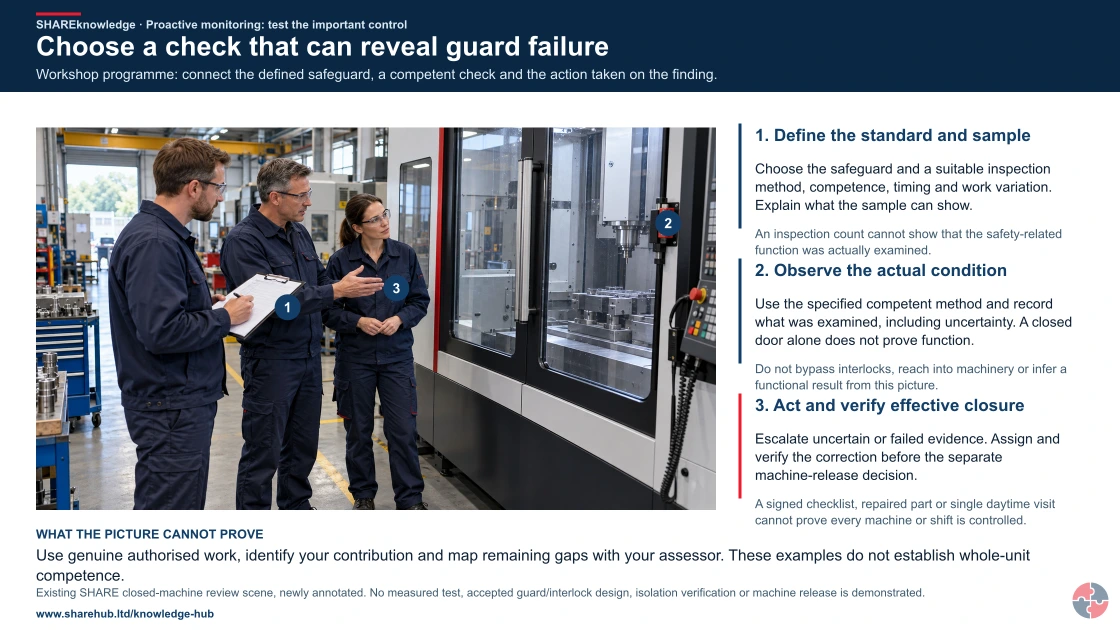
Choose a check that can reveal guard failure
Full written explanation
Workshop programme: connect the defined safeguard, a competent check and the action taken on the finding.
- Define the standard and sample. Choose the safeguard and a suitable inspection method, competence, timing and work variation. Explain what the sample can show.
- Observe the actual condition. Use the specified competent method and record what was examined, including uncertainty. A closed door alone does not prove function.
- Act and verify effective closure. Escalate uncertain or failed evidence. Assign and verify the correction before the separate machine-release decision.
Change the pathway
- Match the check to the control. An inspection count cannot show that the safety-related function was actually examined.
- Keep checks controlled. Do not bypass interlocks, reach into machinery or infer a functional result from this picture.
- Retain the limits of assurance. A signed checklist, repaired part or single daytime visit cannot prove every machine or shift is controlled.
Evidence check: Use genuine authorised work, identify your contribution and map remaining gaps with your assessor. These examples do not establish whole-unit competence.
Risk-led samples, critical failures and genuine control-improvement evidence
Primary references: HSE: risk-led equipment inspection and competence (GB) · HSE: preventive and event-led monitoring (GB)
Open the complete HD image (new tab)Download image

Risk-led samples, critical failures and genuine control-improvement evidence
Primary references: HSE: risk-led equipment inspection and competence (GB) · HSE: preventive and event-led monitoring (GB)
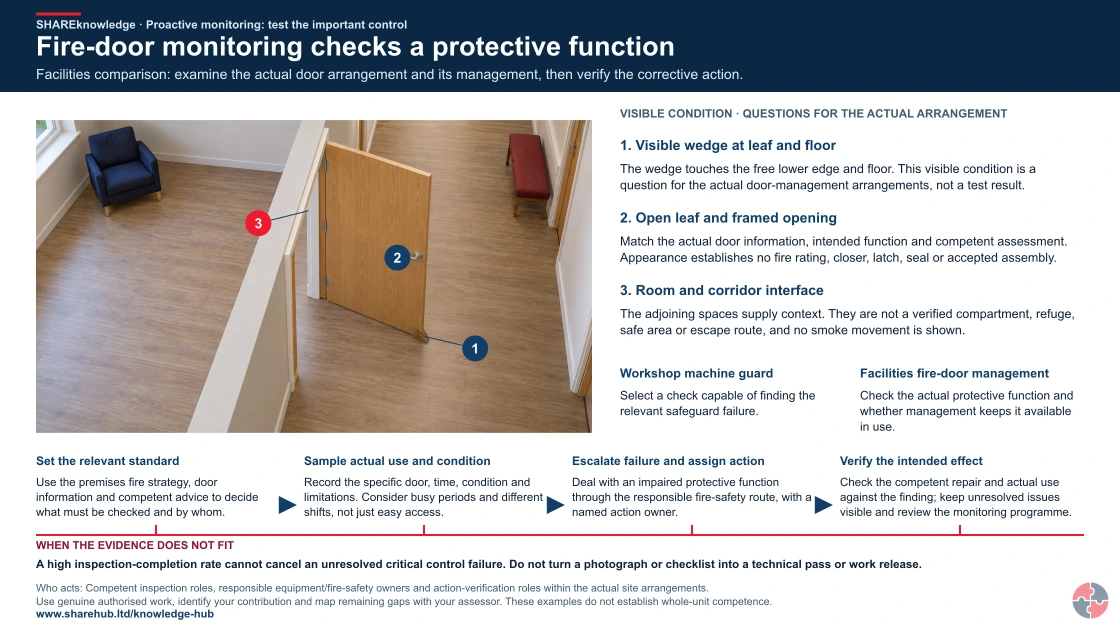
Fire-door monitoring checks a protective function
Full written explanation
An illustrative empty room-and-corridor cutaway shows an attached full-height open hinged leaf within a framed opening and a visible wedge touching its free lower edge and the floor. Picture key: 1 identifies the visible wedge at leaf and floor; 2 identifies the open leaf and framed opening; 3 identifies the room and corridor interface. These physical features locate questions for the actual door information, intended function, use and competent inspection arrangements. The substantial natural context shows no people, fire, smoke, flow, clinical equipment or emergency event. The complete single left-to-right native route retains four full source checks and three short forward arrows: set the relevant standard; sample actual use and condition; escalate failure and assign action; verify the intended effect. Each check also has a common unarrowed hold association. The separate generic band, WHEN THE EVIDENCE DOES NOT FIT, accompanies the full hold, responsible roles, evidence limitation and both workshop-machine-guard and facilities-fire-door-management cases. Independent check headings are unnumbered and distinct from the single literal picture key; no cyclic feedback or door-operating sequence is added. A high inspection-completion rate cannot cancel an unresolved critical control failure. Neither the picture, an inspection count, a signed checklist, the administrative Recorded state in a tracker, a repair part nor one daytime visit establishes functional protection, effective closure, all-shift coverage, a technical pass or work release. The visible leaf, opening, wedge and adjacent spaces establish no fire-door identity or rating, tested assembly, closer, latch, seal, gap, hold-open suitability, functional result, accepted installation, compartment, refuge, safe area, escape performance, strategy, care plan or permission. No door closing, wedge removal, actuation, adjustment, repair, functional test, inspection interval, dimension, force, timing, evacuation, rescue, clinical or other operating recipe is supplied. Use the actual premises strategy and door information with competent inspection and responsible fire-safety roles. Preserve the distinction between observed condition, uncertainty, critical failure, accountable action, verified effect and the separate release decision. Genuine authorised learner contribution, risk-led sampling across relevant shifts and locations, partial-unit coverage, complete H/616/9537 criterion mapping, assessor and IQA decisions, current awarding-body requirements, confidentiality and the stated GB and NI source qualifications remain separate.
Facilities comparison: examine the actual door arrangement and its management, then verify the corrective action.
- Set the relevant standard. Use the premises fire strategy, door information and competent advice to decide what must be checked and by whom.
- Sample actual use and condition. Record the specific door, time, condition and limitations. Consider busy periods and different shifts, not just easy access.
- Escalate failure and assign action. Deal with an impaired protective function through the responsible fire-safety route, with a named action owner.
- Verify the intended effect. Check the competent repair and actual use against the finding; keep unresolved issues visible and review the monitoring programme.
When the evidence does not fit: A high inspection-completion rate cannot cancel an unresolved critical control failure. Do not turn a photograph or checklist into a technical pass or work release.
Who acts: Competent inspection roles, responsible equipment/fire-safety owners and action-verification roles within the actual site arrangements.
Changed workplace
Workshop machine guard: Select a check capable of finding the relevant safeguard failure.
Facilities fire-door management: Check the actual protective function and whether management keeps it available in use.
Evidence check: Use genuine authorised work, identify your contribution and map remaining gaps with your assessor. These examples do not establish whole-unit competence.
Risk-led samples, critical failures and genuine control-improvement evidence
Primary references: HSE: risk-led equipment inspection and competence (GB) · HSE: preventive and event-led monitoring (GB)
Open the complete HD image (new tab)Download image

Risk-led samples, critical failures and genuine control-improvement evidence
Primary references: HSE: risk-led equipment inspection and competence (GB) · HSE: preventive and event-led monitoring (GB)

Standard and sample
Define the control standard, locations, timing and relevant competence for the checks.
Evidence and limits
Record observations and denominator/sample limits; distinguish a pass from uncertain or failed evidence.
Action and assurance
Give failures a named owner and verify effective closure. Show what you personally developed and evaluated.
This is a evidence-planning example, not a completed portfolio, an assessment decision or evidence of whole-unit competence.
How can I demonstrate my workplace practice for unit 6?
Build checks that reveal whether important controls are working before somebody is harmed, and turn findings into accountable action. Unit reference: H/616/9537.
Plan a real activity with your assessor and identify the decisions, work products and witnesses that can show your own competence. The following suggestions are options to adapt, not mandatory document lists or model answers to submit.
What practical work should the evidence demonstrate?
Proactive monitoring tests preventive arrangements before an event occurs. Choose checks for important controls, not merely easy-to-count activities. A completed inspection is an activity measure; evidence that a failed guard was repaired and then verified is stronger evidence of control improvement.
Sampling must reflect work variation. Consider shifts, locations, contractors, maintenance and unusual operating conditions. Explain why the selected sample is useful and where it cannot support a conclusion. A single daytime walk-round cannot prove every shift operates safely.
A usable assurance loop connects a finding to a risk-based action, an accountable owner, an achievable deadline and effectiveness verification. Report critical failures separately from routine completion rates so a high percentage of completed checks does not conceal one dangerous unresolved issue.
What workplace project could I use to develop evidence?
A distribution centre completes inspections but keeps finding the same damaged pedestrian barriers. Redesign checks around critical controls, train the people carrying them out, use risk-based sampling across shifts and make overdue actions visible to managers. Compare the quality and completion of corrective action before and after your intervention.
This is an illustrative project, not an account to copy or a required template. Choose an activity you genuinely undertook and agree its scope with your assessor. If you advise rather than hold operational authority, evidence the recommendations, consultation and follow-up that were yours, alongside the decisions taken by authorised colleagues.
One project may cover only part of the unit. Check the full criterion map and plan additional genuine activities, knowledge evidence and professional development wherever the project leaves gaps. Do not treat an illustrative sample as proof of whole-unit coverage.
Build an evidence trail
- Explain the workplace, your role, the starting problem and the limits of your authority. Identify the activity dates and who can confirm your contribution.
- Keep the information you used, the options considered and your reasons for the decision. Identify specialist advice and distinguish what you knew from what you assumed.
- Show consultation and implementation: who agreed the action, what you personally delivered and how resources, ownership and deadlines were arranged.
- Include a follow-up check and an honest account of the result. Explain remaining gaps and what you would change; do not create outcomes that did not occur.
Prepare the evidence index
For unit 6, give each item an identifier, date, version, author, your contribution, relevant criterion references and exact page or paragraph locations. Record how authenticity can be checked. Cross-reference a genuinely relevant item to other units rather than creating duplicate copies, but explain separately how it supports each criterion.
Obtain permission before sharing workplace records. Redact names, commercial details and health information while preserving enough context for assessment. Arrange secure assessor access or an authenticated witness account where copying is inappropriate. Never upload identifiable incident or medical records to a public page or an unapproved AI tool.
How can I plan workplace evidence against each criterion?
The reference numbers below help you plan work and locate evidence. The activities, evidence suggestions and questions are original SHARE learning guidance, not the official criterion wording or a promise of acceptance. Use your assessor-issued assessment plan and the awarding-body specification for the exact requirements.
Open the ProQual qualification specificationOutcome 1: Design checks that target real control weaknesses
1.1 · Build an inspection programme around critical controls, with a clear method, frequency rationale and escalation rules.
Evidence you could select
Programme and inspection procedure. Keep the relevant extract and explain your personal contribution rather than submitting an unexplained file.
Discuss with your assessor
Why does the frequency fit the risk? Refer to a specific decision, the information available at the time and what happened afterwards.
1.2 · Check whether inspectors can recognise the hazards and judge control performance, not merely complete a form.
Evidence you could select
Competence gap review. Keep the relevant extract and explain your personal contribution rather than submitting an unexplained file.
Discuss with your assessor
What needs specialist support? Refer to a specific decision, the information available at the time and what happened afterwards.
1.3 · Agree the programme with operational owners and plan cover across shifts and sites.
Evidence you could select
Consulted implementation schedule. Keep the relevant extract and explain your personal contribution rather than submitting an unexplained file.
Discuss with your assessor
How did you secure operational participation? Refer to a specific decision, the information available at the time and what happened afterwards.
1.4 · Identify suitable equipment or competent measurement services for the checks, including calibration and limitations.
Evidence you could select
Equipment or service specification. Keep the relevant extract and explain your personal contribution rather than submitting an unexplained file.
Discuss with your assessor
Which checks cannot be done visually? Refer to a specific decision, the information available at the time and what happened afterwards.
1.5 · Review inspection and examination records relevant to your operations for gaps and overdue actions.
Evidence you could select
Record review with findings. Keep the relevant extract and explain your personal contribution rather than submitting an unexplained file.
Discuss with your assessor
Which record needs immediate follow-up? Refer to a specific decision, the information available at the time and what happened afterwards.
1.6 · Test whether reports link to owners, deadlines, follow-up and evidence of effective closure.
Evidence you could select
Document and action-system audit. Keep the relevant extract and explain your personal contribution rather than submitting an unexplained file.
Discuss with your assessor
What breaks the action chain? Refer to a specific decision, the information available at the time and what happened afterwards.
1.7 · Involve workers and representatives in defining what good control performance looks like.
Evidence you could select
Joint walk-round and feedback notes. Keep the relevant extract and explain your personal contribution rather than submitting an unexplained file.
Discuss with your assessor
What did workers notice that you missed? Refer to a specific decision, the information available at the time and what happened afterwards.
1.8 · Retain completed checks and verified outcomes so trends can be traced back to observations.
Evidence you could select
Monitoring register and close-out records. Keep the relevant extract and explain your personal contribution rather than submitting an unexplained file.
Discuss with your assessor
Can you demonstrate the control improved? Refer to a specific decision, the information available at the time and what happened afterwards.
Outcome 2: Make findings useful to different audiences
2.1 · Brief leadership, line managers and worker representatives on findings relevant to their responsibilities.
Evidence you could select
Audience-specific briefings. Keep the relevant extract and explain your personal contribution rather than submitting an unexplained file.
Discuss with your assessor
What action did each audience need to take? Refer to a specific decision, the information available at the time and what happened afterwards.
2.2 · Produce a concise report separating critical failures, repeat findings and completed corrective work.
Evidence you could select
Dated monitoring report. Keep the relevant extract and explain your personal contribution rather than submitting an unexplained file.
Discuss with your assessor
What evidence supports each recommendation? Refer to a specific decision, the information available at the time and what happened afterwards.
2.3 · Explain a technical finding using a familiar operational example and check understanding.
Evidence you could select
Plain-language brief and feedback. Keep the relevant extract and explain your personal contribution rather than submitting an unexplained file.
Discuss with your assessor
What misunderstanding did you prevent? Refer to a specific decision, the information available at the time and what happened afterwards.
2.4 · Recommend actions tied to risk and repeat failures with owners and effectiveness checks.
Evidence you could select
Recommendation register. Keep the relevant extract and explain your personal contribution rather than submitting an unexplained file.
Discuss with your assessor
Why will this address the underlying weakness? Refer to a specific decision, the information available at the time and what happened afterwards.
2.5 · Show your authorised role in responding to a genuine regulatory request; discuss evidence gaps with your assessor if none exists.
Evidence you could select
Correspondence or agreed evidence plan. Keep the relevant extract and explain your personal contribution rather than submitting an unexplained file.
Discuss with your assessor
What must be accurate and traceable? Refer to a specific decision, the information available at the time and what happened afterwards.
Outcome 3: Evaluate the monitoring approach
3.1 · Explain what your checks reveal that incident counts cannot, including limitations in coverage.
Evidence you could select
Monitoring-system evaluation. Keep the relevant extract and explain your personal contribution rather than submitting an unexplained file.
Discuss with your assessor
Which important risks remain unseen? Refer to a specific decision, the information available at the time and what happened afterwards.
3.2 · Justify your choice of control checks using the site's risk profile and management decisions.
Evidence you could select
Programme rationale. Keep the relevant extract and explain your personal contribution rather than submitting an unexplained file.
Discuss with your assessor
Why are these indicators worth collecting? Refer to a specific decision, the information available at the time and what happened afterwards.
3.3 · Compare relevant instruments and survey techniques by purpose, limitations and competence needs.
Evidence you could select
Equipment comparison. Keep the relevant extract and explain your personal contribution rather than submitting an unexplained file.
Discuss with your assessor
When should a specialist take over? Refer to a specific decision, the information available at the time and what happened afterwards.
3.4 · Explain how shifts, seasons, task variation and sample selection affect confidence in your findings.
Evidence you could select
Sampling plan and limitations. Keep the relevant extract and explain your personal contribution rather than submitting an unexplained file.
Discuss with your assessor
Is your sample representative? Refer to a specific decision, the information available at the time and what happened afterwards.
3.5 · Compare inspection findings with observed task performance and revise the method when they disagree.
Evidence you could select
Method evaluation and revision. Keep the relevant extract and explain your personal contribution rather than submitting an unexplained file.
Discuss with your assessor
What did the checklist overlook? Refer to a specific decision, the information available at the time and what happened afterwards.
3.6 · Use your reporting example to explain audience, clarity, feedback and retention of key information.
Evidence you could select
Communication reflection. Keep the relevant extract and explain your personal contribution rather than submitting an unexplained file.
Discuss with your assessor
How do you know the message was understood? Refer to a specific decision, the information available at the time and what happened afterwards.
3.7 · Explain how you adapted checks and feedback for workers, supervisors and technical specialists.
Evidence you could select
Stakeholder response account. Keep the relevant extract and explain your personal contribution rather than submitting an unexplained file.
Discuss with your assessor
Whose need required a different approach? Refer to a specific decision, the information available at the time and what happened afterwards.
3.8 · Discuss applicable obligations, regulator guidance and controlled records when setting assurance arrangements.
Evidence you could select
External-influence analysis. Keep the relevant extract and explain your personal contribution rather than submitting an unexplained file.
Discuss with your assessor
What would trigger a programme revision? Refer to a specific decision, the information available at the time and what happened afterwards.
4.1 · Evidence your professional development
Use a learning episode related to this unit: identify a gap in your capability, set a realistic objective, record the activity and explain how you applied the learning. Discuss an ethical decision, an inclusion issue and a contribution to professional discussion. Finish with a dated review of progress and the next priority. A list of courses attended is not a reflective development record.
Evidence options: a competence self-review, dated development plan, reflective CPD entry, an ethical or inclusive-practice example and a record of professional exchange. Cross-reference the same genuine portfolio across units where appropriate, adding a unit-specific reflection.
Which background reading supports this unit?
Use the linked SHARE topics to strengthen your understanding, then explain the decisions you made in your own organisation. Reading alone is not evidence that you performed the work.
What should I check before submitting evidence to my assessor?
Check that the evidence is authentic, relevant to the registered criteria and clear about your own decisions, actions and results. Resolve gaps with your assessor and protect personal or confidential information before submission.
- Performance: show work you actually did, not just what a practitioner ought to do. Explain your contribution to team-produced documents.
- Reasoning: answer explain, analyse, evaluate and justify questions with decisions, alternatives and limitations, not copied definitions.
- Coverage: map every reference to a precise piece of evidence. Discuss gaps early, including missing authority, specialist tasks or no genuine incident or external request.
- Authenticity and sufficiency: ask what observation, questioning or witness evidence the assessor needs. A job title, course certificate or large upload alone is not proof of competence.
- Exercises: label drills and simulated records accurately. Their acceptability depends on the assessment requirements and assessor agreement; never present them as genuine emergencies or incidents.
- Outcome: the assessor decides whether the evidence meets the requirements, subject to centre and awarding-body quality assurance. These learning pages do not award competence or replace assessment.