NVQ Level 6 Diploma in OSH
Develop and implement the health and safety policy
Show that you helped turn a policy into clear responsibilities, workable arrangements and an implementation programme, not simply a signed document.
Understanding Develop and implement the health and safety policy
A health and safety policy is the organisation's formal statement of intent, the allocation of responsibilities and the arrangements by which it will manage risk. It is a management-control framework, not a generic declaration, induction attachment or a document that can be signed and forgotten. A useful policy turns the employer's legal duties and actual risk profile into visible leadership commitments, authority, resources, expectations and review.
Why this matters at work
Include occupational health as a core policy topic. Arrangements can cover identification and prevention of health risks, exposure assessment, control at source, hygiene and welfare, health surveillance where required, occupational-health referral, reasonable adjustments, rehabilitation and confidentiality. Health surveillance detects early harm where residual exposure remains; it does not make an avoidable exposure acceptable.
Before approving or reviewing a policy, test whether it answers practical questions. Can a worker identify who supervises their work, what to do when a control fails, how to report a concern and where to find the current arrangement? Can a manager identify decision authority, resource routes, specialist advice, contractor interfaces, review triggers and assurance requirements? Can a director identify the organisation's significant risks, critical controls, performance information and unresolved exposures? If the answer depends on informal knowledge, the policy system is incomplete.
How organisations manage this in practice
The arrangements section should explain how hazards are identified, risks assessed, people at risk considered, controls selected, actions resourced, findings recorded, workers consulted and controls reviewed. Refer to the general principles of prevention and distinguish corporate framework from task, project and site assessment. Include non-routine work, maintenance, cleaning, breakdown, emergencies, contractors, visitors, vulnerable people and significant change.
A policy needs planned monitoring and review to stay credible. Measure whether responsibilities are understood and performed, risk assessments are current, actions effective, critical controls healthy, workers consulted, competence available, contractors coordinated, health risks managed and incidents learned from. Use both active and reactive evidence. An annual leadership review is HSE guidance, but material change, incident, enforcement, poor performance or worker concern can require an earlier review.
The change review should compare the corporate statement with local guarding, isolation, contractor and shift arrangements. Identify missing interfaces and who can accept technical advice or commit resources. An interim deputy needs defined limits and enough time to perform the role, not simply an additional title. Explain the revised responsibilities in usable task information and verify workers know where to raise a defect. Record any continuing restriction and its owner so an organisational transition cannot silently turn unsupported work into normal production.
How can I turn study guidance into authentic workplace evidence?
Use the worked example below to understand the decision chain. Build your portfolio from your own authorised workplace activity, preserve its provenance and discuss evidence suitability with your assessor.
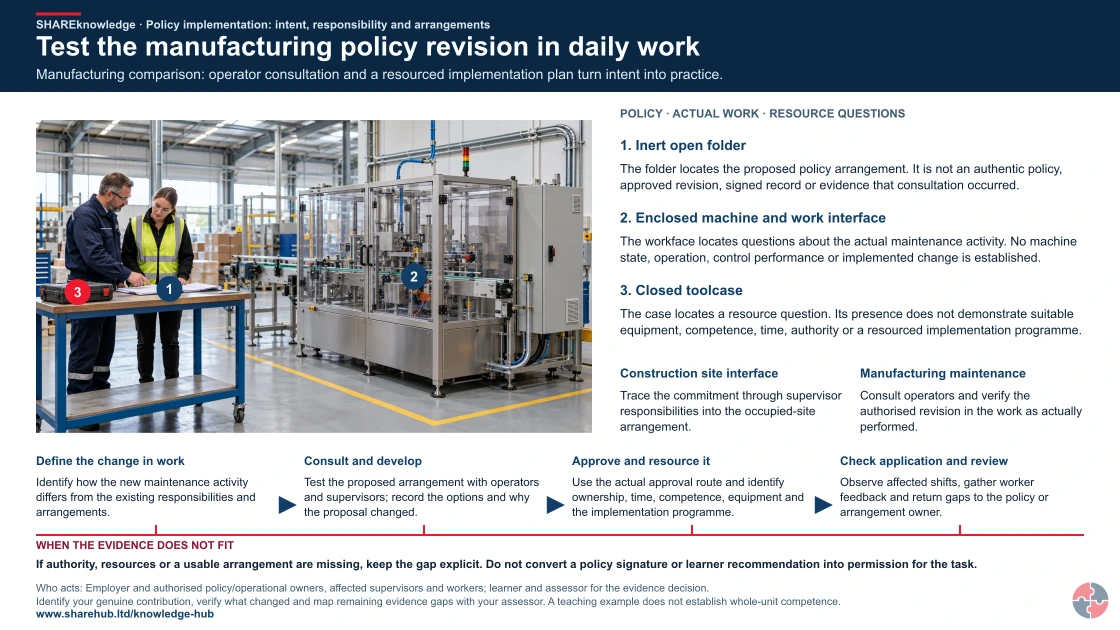
Test the manufacturing policy revision in daily work
Full written explanation
An illustrative manufacturing workface places an inert open folder and a closed toolcase beside an enclosed machine and work interface. Picture key: 1 identifies the inert open folder; 2 identifies the enclosed machine and work interface; 3 identifies the closed toolcase. These physical features locate questions about the proposed arrangement, the actual maintenance activity and the resources needed. They do not show whether consultation occurred, a policy was approved or revised, resources were suitable or an arrangement was implemented and used. The complete single left-to-right analytical band retains all four full checks: Define the change in work; Consult and develop; Approve and resource it; Check application and review. Three forward relationships show the source order, while each check has a common unarrowed association with WHEN THE EVIDENCE DOES NOT FIT. The full hold, responsible roles, evidence limitation and both construction-site-interface and manufacturing-maintenance cases remain visible. Independent check headings are unnumbered and separate from the one literal picture key. No cyclic feedback, approval result, work-release gate or operating method is added. The normal colleagues and inert papers establish no actual policy or signature authenticity, consultation result, organisational role, authority, competence, adequate resources, authorised revision, implemented change, shift use, learner contribution, assessment acceptance or permission. The machine, housing and visible interfaces establish no material, process, service, energy or isolation state, guard or interlock design or function, defect, test, maintenance, PPE or protective performance. Use the actual work, consultation and approval routes. Distinguish the learner’s recommendations from organisational authority, and verify implementation through genuine authorised evidence. Whole-unit evidence decisions, assessor and IQA review, confidentiality, current awarding-body requirements and the stated Great Britain and Northern Ireland source qualifications remain separate.
Manufacturing comparison: operator consultation and a resourced implementation plan turn intent into practice.
- Define the change in work. Identify how the new maintenance activity differs from the existing responsibilities and arrangements.
- Consult and develop. Test the proposed arrangement with operators and supervisors; record the options and why the proposal changed.
- Approve and resource it. Use the actual approval route and identify ownership, time, competence, equipment and the implementation programme.
- Check application and review. Observe affected shifts, gather worker feedback and return gaps to the policy or arrangement owner.
When the evidence does not fit: If authority, resources or a usable arrangement are missing, keep the gap explicit. Do not convert a policy signature or learner recommendation into permission for the task.
Who acts: Employer and authorised policy/operational owners, affected supervisors and workers; learner and assessor for the evidence decision.
Changed workplace
Construction site interface: Trace the commitment through supervisor responsibilities into the occupied-site arrangement.
Manufacturing maintenance: Consult operators and verify the authorised revision in the work as actually performed.
Evidence check: Identify your genuine contribution, verify what changed and map remaining evidence gaps with your assessor. A teaching example does not establish whole-unit competence.
Policy intent, responsibilities, arrangements and genuine learner contribution
Primary references: HSE: intent, responsibilities and practical policy arrangements (GB)
Open the complete HD image (new tab)Download image

Policy intent, responsibilities, arrangements and genuine learner contribution
Primary references: HSE: intent, responsibilities and practical policy arrangements (GB)
Follow policy intent into daily work
Illustrative example. A policy promises suitable contractor control but mobilisation checks are inconsistent.
Decision. Assign an owner, resources and consultation to implement a workable mobilisation change.
Evidence to check. The learner’s approved role, actual arrangements, implementation records and review.
Hold or escalation point. A signed policy is not evidence that the operational arrangement was used.
Follow-up. Demonstrate what changed in practice and distinguish teaching examples from the portfolio.
How can I show that a policy change reached everyday work?
A new maintenance activity can reveal a gap in responsibilities or arrangements. Consultation, authorised resources and a workface check make the revision meaningful.
Make the policy work at the construction interface
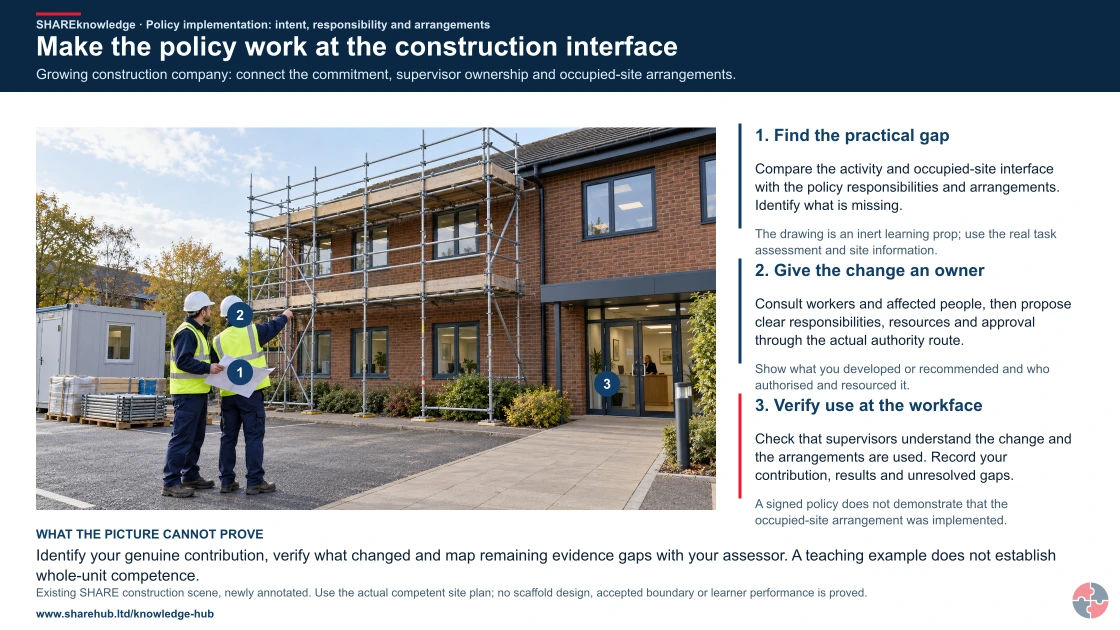
Full written explanation
Growing construction company: connect the commitment, supervisor ownership and occupied-site arrangements.
- Find the practical gap. Compare the activity and occupied-site interface with the policy responsibilities and arrangements. Identify what is missing.
- Give the change an owner. Consult workers and affected people, then propose clear responsibilities, resources and approval through the actual authority route.
- Verify use at the workface. Check that supervisors understand the change and the arrangements are used. Record your contribution, results and unresolved gaps.
Change the pathway
- Start with the actual work. The drawing is an inert learning prop; use the real task assessment and site information.
- Keep advice and authority distinct. Show what you developed or recommended and who authorised and resourced it.
- Look beyond the signature. A signed policy does not demonstrate that the occupied-site arrangement was implemented.
Evidence check: Identify your genuine contribution, verify what changed and map remaining evidence gaps with your assessor. A teaching example does not establish whole-unit competence.
Policy intent, responsibilities, arrangements and genuine learner contribution
Primary references: HSE: intent, responsibilities and practical policy arrangements (GB)
Open the complete HD image (new tab)Download image

Policy intent, responsibilities, arrangements and genuine learner contribution
Primary references: HSE: intent, responsibilities and practical policy arrangements (GB)

Find the gap
Compare the actual new activity with the current responsibilities and arrangements.
Develop the change
Consult affected workers and propose specific ownership/resources through the authorised approval route.
Evidence application
Verify use on the shift and identify the learner’s own contribution, outcome and outstanding assessment gaps.
This is a evidence-planning example, not a completed portfolio, an assessment decision or evidence of whole-unit competence.
How can I demonstrate my workplace practice for unit 2?
Show that you helped turn a policy into clear responsibilities, workable arrangements and an implementation programme, not simply a signed document. Unit reference: F/616/9531.
Plan a real activity with your assessor and identify the decisions, work products and witnesses that can show your own competence. The following suggestions are options to adapt, not mandatory document lists or model answers to submit.
What practical work should the evidence demonstrate?
Policy connects intent, responsibility and practical arrangements. Start with the organisation's actual work and risk profile. A signed commitment has little operational value if supervisors do not know their authority, resources are missing or the arrangements cannot be followed during normal production.
Show development as a decision trail: the gap you identified, the options considered, consultation, revisions and the authorised approval. Implementation is a separate activity. Brief people, give them access to controlled arrangements and check whether responsibility is understood on each affected shift.
An adviser does not need to pretend to be the director signing the policy. Demonstrate the analysis, preparing, consultation, recommendation and implementation support that were yours. Keep an approval record showing who held the authority and why the organisation accepted or modified your proposal.
What workplace project could I use to develop evidence?
A contractor expands from office work into workshop maintenance. Review the existing policy against its new activities, consult workshop supervisors, propose responsibilities and resources, secure approval through the appropriate manager and check that shift teams can use the new arrangements. Keep the old and new versions so your contribution is visible.
This is an illustrative project, not an account to copy or a required template. Choose an activity you genuinely undertook and agree its scope with your assessor. If you advise rather than hold operational authority, evidence the recommendations, consultation and follow-up that were yours, alongside the decisions taken by authorised colleagues.
One project may cover only part of the unit. Check the full criterion map and plan additional genuine activities, knowledge evidence and professional development wherever the project leaves gaps. Do not treat an illustrative sample as proof of whole-unit coverage.
Build an evidence trail
- Explain the workplace, your role, the starting problem and the limits of your authority. Identify the activity dates and who can confirm your contribution.
- Keep the information you used, the options considered and your reasons for the decision. Identify specialist advice and distinguish what you knew from what you assumed.
- Show consultation and implementation: who agreed the action, what you personally delivered and how resources, ownership and deadlines were arranged.
- Include a follow-up check and an honest account of the result. Explain remaining gaps and what you would change; do not create outcomes that did not occur.
Prepare the evidence index
For unit 2, give each item an identifier, date, version, author, your contribution, relevant criterion references and exact page or paragraph locations. Record how authenticity can be checked. Cross-reference a genuinely relevant item to other units rather than creating duplicate copies, but explain separately how it supports each criterion.
Obtain permission before sharing workplace records. Redact names, commercial details and health information while preserving enough context for assessment. Arrange secure assessor access or an authenticated witness account where copying is inappropriate. Never upload identifiable incident or medical records to a public page or an unapproved AI tool.
How can I plan workplace evidence against each criterion?
The reference numbers below help you plan work and locate evidence. The activities, evidence suggestions and questions are original SHARE learning guidance, not the official criterion wording or a promise of acceptance. Use your assessor-issued assessment plan and the awarding-body specification for the exact requirements.
Open the ProQual qualification specificationOutcome 1: Understand the organisation before changing policy
1.1 · Trace who authorises work, controls budgets and supervises contractors at a site you know.
Evidence you could select
Organisation chart with your annotations. Keep the relevant extract and explain your personal contribution rather than submitting an unexplained file.
Discuss with your assessor
Where was accountability unclear? Refer to a specific decision, the information available at the time and what happened afterwards.
1.2 · Use an actual risk-control gap to explain why leadership and workers should engage with the policy.
Evidence you could select
Briefing and stakeholder responses. Keep the relevant extract and explain your personal contribution rather than submitting an unexplained file.
Discuss with your assessor
How did you secure attention? Refer to a specific decision, the information available at the time and what happened afterwards.
1.3 · Compare the written arrangements with field practice and document contradictions rather than reviewing wording alone.
Evidence you could select
Gap review and observation notes. Keep the relevant extract and explain your personal contribution rather than submitting an unexplained file.
Discuss with your assessor
Which weakness mattered most? Refer to a specific decision, the information available at the time and what happened afterwards.
1.4 · Follow one service or product from procurement through work, delivery and waste, including everyone exposed along that route.
Evidence you could select
Process map and requirement register. Keep the relevant extract and explain your personal contribution rather than submitting an unexplained file.
Discuss with your assessor
Which obligations apply to your actual activities? Refer to a specific decision, the information available at the time and what happened afterwards.
1.5 · Identify neighbours, delivery drivers, customers and others outside the payroll who may encounter your work.
Evidence you could select
External-party impact map. Keep the relevant extract and explain your personal contribution rather than submitting an unexplained file.
Discuss with your assessor
How did their needs alter the arrangements? Refer to a specific decision, the information available at the time and what happened afterwards.
Outcome 2: Create an implementable revision
2.1 · Mark obsolete role names, missing arrangements and unsupported commitments in the existing version.
Evidence you could select
Annotated policy gap log. Keep the relevant extract and explain your personal contribution rather than submitting an unexplained file.
Discuss with your assessor
What would fail if nothing changed? Refer to a specific decision, the information available at the time and what happened afterwards.
2.2 · Explain the staffing, budget and time needed for each proposed arrangement; identify interim controls where necessary.
Evidence you could select
Resource proposal and escalation record. Keep the relevant extract and explain your personal contribution rather than submitting an unexplained file.
Discuss with your assessor
How did constraints affect the plan? Refer to a specific decision, the information available at the time and what happened afterwards.
2.3 · Ask operational owners and representatives to test a document against a realistic job before approval.
Evidence you could select
Consultation comments and responses. Keep the relevant extract and explain your personal contribution rather than submitting an unexplained file.
Discuss with your assessor
Which comment changed the document? Refer to a specific decision, the information available at the time and what happened afterwards.
2.4 · Produce a controlled revision that links commitments to named roles and accessible procedures.
Evidence you could select
Tracked changes and approved version. Keep the relevant extract and explain your personal contribution rather than submitting an unexplained file.
Discuss with your assessor
Why is your revision more workable? Refer to a specific decision, the information available at the time and what happened afterwards.
2.5 · Plan how managers will reinforce the policy in induction, planning meetings and supervision.
Evidence you could select
Engagement and rollout plan. Keep the relevant extract and explain your personal contribution rather than submitting an unexplained file.
Discuss with your assessor
What happens beyond the launch email? Refer to a specific decision, the information available at the time and what happened afterwards.
2.6 · Present a reasoned recommendation through the authorised approval route and record the decision.
Evidence you could select
Submission and approval correspondence. Keep the relevant extract and explain your personal contribution rather than submitting an unexplained file.
Discuss with your assessor
What did you personally influence? Refer to a specific decision, the information available at the time and what happened afterwards.
Outcome 3: Put the revision into daily work
3.1 · Phase the rollout around operations, brief owners, offer feedback routes and plan recovery if a change disrupts safe work.
Evidence you could select
Rollout schedule, feedback and adjustments. Keep the relevant extract and explain your personal contribution rather than submitting an unexplained file.
Discuss with your assessor
How did you keep operations safe during transition? Refer to a specific decision, the information available at the time and what happened afterwards.
3.2 · Give documents clear owners, revision identifiers, access arrangements and withdrawal controls for obsolete copies.
Evidence you could select
Document register and access check. Keep the relevant extract and explain your personal contribution rather than submitting an unexplained file.
Discuss with your assessor
How will staff find the current version? Refer to a specific decision, the information available at the time and what happened afterwards.
Outcome 4: Explain the management reasoning
4.1 · Use a site example to connect leadership promises, responsibilities and practical control arrangements.
Evidence you could select
Reflective explanation tied to your policy. Keep the relevant extract and explain your personal contribution rather than submitting an unexplained file.
Discuss with your assessor
What can a policy not do on its own? Refer to a specific decision, the information available at the time and what happened afterwards.
4.2 · Explain how procurement, work activities and outputs create different risks using your process map.
Evidence you could select
Annotated service or production journey. Keep the relevant extract and explain your personal contribution rather than submitting an unexplained file.
Discuss with your assessor
Where must policy arrangements intervene? Refer to a specific decision, the information available at the time and what happened afterwards.
4.3 · Describe how you sampled records, interviewed staff and tested procedures rather than assuming the manual reflected practice.
Evidence you could select
Review method and sampling rationale. Keep the relevant extract and explain your personal contribution rather than submitting an unexplained file.
Discuss with your assessor
How did you avoid a document-only review? Refer to a specific decision, the information available at the time and what happened afterwards.
4.4 · Discuss how your proposal answered different priorities without treating safety as a competition with production.
Evidence you could select
Stakeholder analysis and feedback. Keep the relevant extract and explain your personal contribution rather than submitting an unexplained file.
Discuss with your assessor
How did you deal with resistance? Refer to a specific decision, the information available at the time and what happened afterwards.
4.5 · Compare a relevant legal requirement with industry advice and explain how you kept the policy specific to the jurisdiction.
Evidence you could select
Source decision log. Keep the relevant extract and explain your personal contribution rather than submitting an unexplained file.
Discuss with your assessor
What is mandatory and what is good practice? Refer to a specific decision, the information available at the time and what happened afterwards.
5.1 · Evidence your professional development
Use a learning episode related to this unit: identify a gap in your capability, set a realistic objective, record the activity and explain how you applied the learning. Discuss an ethical decision, an inclusion issue and a contribution to professional discussion. Finish with a dated review of progress and the next priority. A list of courses attended is not a reflective development record.
Evidence options: a competence self-review, dated development plan, reflective CPD entry, an ethical or inclusive-practice example and a record of professional exchange. Cross-reference the same genuine portfolio across units where appropriate, adding a unit-specific reflection.
Which background reading supports this unit?
Use the linked SHARE topics to strengthen your understanding, then explain the decisions you made in your own organisation. Reading alone is not evidence that you performed the work.
What should I check before submitting evidence to my assessor?
Check that the evidence is authentic, relevant to the registered criteria and clear about your own decisions, actions and results. Resolve gaps with your assessor and protect personal or confidential information before submission.
- Performance: show work you actually did, not just what a practitioner ought to do. Explain your contribution to team-produced documents.
- Reasoning: answer explain, analyse, evaluate and justify questions with decisions, alternatives and limitations, not copied definitions.
- Coverage: map every reference to a precise piece of evidence. Discuss gaps early, including missing authority, specialist tasks or no genuine incident or external request.
- Authenticity and sufficiency: ask what observation, questioning or witness evidence the assessor needs. A job title, course certificate or large upload alone is not proof of competence.
- Exercises: label drills and simulated records accurately. Their acceptability depends on the assessment requirements and assessor agreement; never present them as genuine emergencies or incidents.
- Outcome: the assessor decides whether the evidence meets the requirements, subject to centre and awarding-body quality assurance. These learning pages do not award competence or replace assessment.