
SHARE Knowledge Hub
How should workplaces consult and engage workers?
Consultation gives workers timely information, a chance to influence a safety decision, and a response showing what changed. Use the correct representative route in Great Britain or Northern Ireland, include night shifts and contractors at relevant interfaces, and check whether the resulting control works.
Understanding How should workplaces consult and engage workers?
Consultation gives workers timely information, a chance to influence a safety decision, and a response showing what changed. Use the correct representative route in Great Britain or Northern Ireland, include night shifts and contractors at relevant interfaces, and check whether the resulting control works.
Why this matters at work
Use practical methods that reach people who cannot attend a daytime meeting, and give them time to contribute before decisions. Protect personal information while sharing useful risk themes. Record who was represented, the issues raised, unresolved points and feedback. Check that quiet or less secure workers can raise concerns without retaliation. GB and NI representation, consultation and equality rules differ. The aim is comparable opportunity to understand and influence, not simply the same email sent to every person on site.
Protect identifiable health and complaint information and explain appropriate confidential routes. Agree how representatives can seek clarification and obtain competent support. Record what was shared, when, in what format and any justified restrictions. Check comprehension and accessibility with the actual users. GB and NI consultation instruments contain their own conditions and exceptions, while data-protection requirements apply separately. Case-specific disputed disclosure or privileged material needs competent advice, not an assumption that every safety document must be published without restriction.
How organisations manage this in practice
Look for influence on real decisions and improved control: early involvement in changes, hazards identified by workers, accessible participation, reasoned responses and verified action. Sample the path from a concern through decision, resources, implementation and review. Include different shifts, locations and contract types. Meeting frequency, survey response rates and numbers of suggestions are activity measures and may hide poor action or fear of speaking. Discuss findings with representatives and affected workers and agree improvements to the process. Check that managers respond constructively, records are accurate and unresolved material risks have an escalation route. Review after organisational changes, repeated late consultation, incidents or evidence of underrepresentation. Retain proportionate records without turning participation into monitoring of individuals. A culture survey can inform the assessment, but effective consultation remains an ongoing process governed by the actual GB or NI route and the workplace decisions involved.
Give the issue an accountable owner, resources and a feedback date, then verify extraction performance before the relevant restart decision. Explain the outcome to workers and representatives and check whether similar equipment is affected. Review why reports stalled: unclear authority, procurement delays, workload or fear of raising bad news. Record evidence and effectiveness, including the worker’s experience of the corrected method. Closing a meeting action without fixing the control undermines both prevention and future willingness to speak.
Consultation gives employees or their representatives a real opportunity to raise concerns and influence decisions before arrangements are settled. Provide understandable relevant information, adequate time and a route for discussion. Explain the options, reasons and constraints and listen to practical experience. Briefing workers after a final decision may be useful communication, but does not by itself demonstrate timely two-way consultation on matters covered by the applicable rules.
How can I practise this topic in 3D?


Workload pressure and stress: too many bookings
Workers are discouraged from reporting a near miss
All related inspection points 3 across 2 locations
Garage workshop 2 inspection points
Construction site 1 inspection point
Practice in the SHAREhub environment. Browser practice is separate from workplace competence and formal learning records.
Choose the representation route and consult while change is still possible
Begin with location and representation: identify the applicable GB or NI arrangements and which employees are covered by each route. Consultation should happen with usable information and time to influence a proposed decision. A signed toolbox-talk record proves neither the correct legal route nor that an already-final decision was open to influence.
Best-practice guide: Consultation, Participation and Workforce Engagement
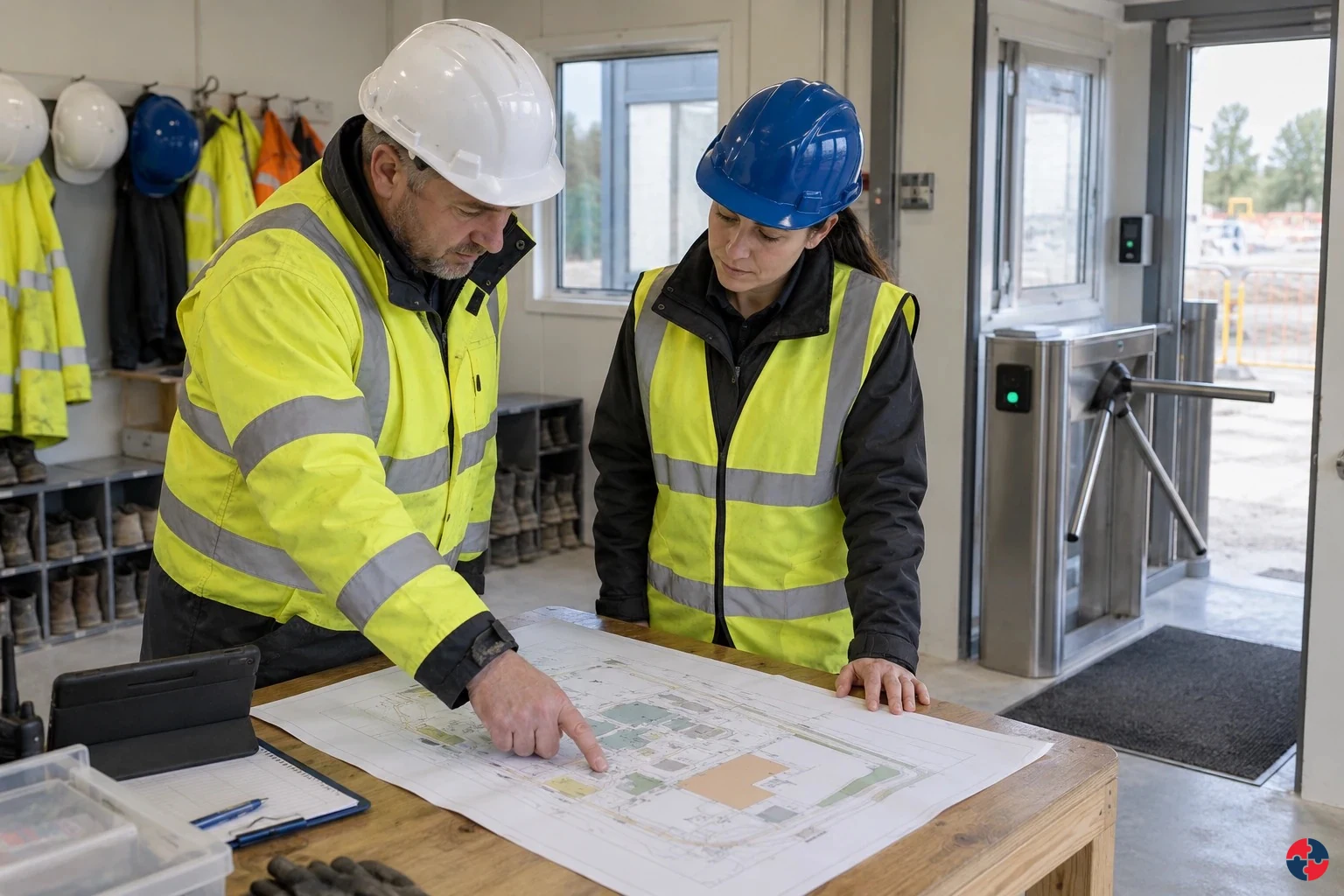
Choose the representation route and consult while change is still possible
Begin with location and representation: identify the applicable GB or NI arrangements and which employees are covered by each route. Consultation should happen with usable information and time to influence a proposed decision. Consultation gives workers timely information, a chance to influence a safety decision, and a response showing what changed.
Turn consultation, participation and workforce engagement knowledge into a decision
Consultation gives workers timely information, a chance to influence a safety decision, and a response showing what changed. Use the correct representative route in Great Britain or Northern Ireland, include night shifts and contractors at relevant interfaces, and check whether the resulting control works. Policy, procedure and consultation triggers.
the site team consultation system
Consultation standard: Defines when consultation is required and which route applies. Evidence / response: Policy, procedure and consultation triggers. Representative mapping: Shows who represents each workforce group and site. Evidence / response: Representative register and election/appointment records.
Consultation warning signs
Consultation happens after decisions: Controls may be impractical and workers lose trust. Committee actions repeat for months: Known risks remain unresolved. Workers do not raise concerns: Weak signals are missed until an incident occurs.
Choose controls for consultation, participation and workforce engagement
Eliminate: Cancel unnecessary transfer or route away from overfill-prone tank. Substitute: Lower rate/batch after operators validate workload and new risks. Engineering: Keep independent high-high trip and clear status display. Administrative: Practised handover, alarm response and worker feedback closure. PPE: Residual intervention PPE only, never an overfill barrier. Read the full control table for qualifications, ownership and verification. Use the actual task and applicable jurisdiction; existing technical approval remains unchanged.
Use the full consultation, participation and workforce engagement lesson
Use the full topic for the decision points, practical examples, detailed control tables and source scope. HSE guidance applies to Great Britain; use HSENI for the Northern Ireland route and the source’s stated jurisdiction. A simplified guide does not change the page’s technical-review or approval status.

Read all six steps as text
1. Choose the representation route and consult while change is still possible
Begin with location and representation: identify the applicable GB or NI arrangements and which employees are covered by each route.
- Avoid / redesign: Cancel unnecessary transfer or route away from overfill-prone tank.
- Control the task: Keep independent high-high trip and clear status display.
- Verify before release: Planner records need; hold if route unclear.
Begin with location and representation: identify the applicable GB or NI arrangements and which employees are covered by each route. Consultation should happen with usable information and time to influence a proposed decision. Consultation gives workers timely information, a chance to influence a safety decision, and a response showing what changed.
Apply it: Which part of this plan would you check at the workface before authorising the task?
2. Turn consultation, participation and workforce engagement knowledge into a decision
Use the evidence to improve the actual work arrangement.
- Change at source: Cancel unnecessary transfer or route away from overfill-prone tank.
- Make it observable: Planner records need; hold if route unclear.
- Keep useful evidence: Policy, procedure and consultation triggers.
Consultation gives workers timely information, a chance to influence a safety decision, and a response showing what changed. Use the correct representative route in Great Britain or Northern Ireland, include night shifts and contractors at relevant interfaces, and check whether the resulting control works. Policy, procedure and consultation triggers.
Apply it: What evidence would show that the change improves this task, rather than only completing a record?
3. the site team consultation system
Example: a practical application of the existing topic lesson.
- Consultation standard: Defines when consultation is required and which route applies.
- Representative mapping: Shows who represents each workforce group and site.
- Risk assessment participation: Workers walk through high-risk methods before approval.
Consultation standard: Defines when consultation is required and which route applies. Evidence / response: Policy, procedure and consultation triggers. Representative mapping: Shows who represents each workforce group and site. Evidence / response: Representative register and election/appointment records.
Apply it: At which point would you hold this example, and what evidence would allow it to proceed?
4. Consultation warning signs
Connect the task, the route to the person and the control that can fail.
- Consultation happens after decisions: Controls may be impractical and workers lose trust.
- Committee actions repeat for months: Known risks remain unresolved.
- Workers do not raise concerns: Weak signals are missed until an incident occurs.
Consultation happens after decisions: Controls may be impractical and workers lose trust. Committee actions repeat for months: Known risks remain unresolved. Workers do not raise concerns: Weak signals are missed until an incident occurs.
Apply it: Who could be exposed, including other trades, cleaners, maintainers and people nearby?
5. Choose controls for consultation, participation and workforce engagement
Start with the stronger practicable options and verify their effect.
- Eliminate: Cancel unnecessary transfer or route away from overfill-prone tank.
- Substitute: Lower rate/batch after operators validate workload and new risks.
- Engineering: Keep independent high-high trip and clear status display.
- Administrative: Practised handover, alarm response and worker feedback closure.
- PPE: Residual intervention PPE only, never an overfill barrier.
Eliminate: Cancel unnecessary transfer or route away from overfill-prone tank. Substitute: Lower rate/batch after operators validate workload and new risks. Engineering: Keep independent high-high trip and clear status display. Administrative: Practised handover, alarm response and worker feedback closure. PPE: Residual intervention PPE only, never an overfill barrier. Read the full control table for qualifications, ownership and verification. Use the actual task and applicable jurisdiction; existing technical approval remains unchanged.
Apply it: Which stronger option can be used here, and who will verify it before accepting the remaining risk?
6. Use the full consultation, participation and workforce engagement lesson
Follow the official sources below and retain the task-specific evidence.
- Official guidance: HSE L146 Consulting workers
- Official guidance: HSE planning consultation checklist
- Task decision: Policy, procedure and consultation triggers.
Use the full topic for the decision points, practical examples, detailed control tables and source scope. HSE guidance applies to Great Britain; use HSENI for the Northern Ireland route and the source’s stated jurisdiction. A simplified guide does not change the page’s technical-review or approval status.
Apply it: Which official source and full-topic section will you use to resolve the next decision?
For a proposed access or work-method change, ask affected workers what the planner has missed. Include the night shift and coordinate affected contractor interfaces even where the client’s employee-representation route does not apply to contractor staff. Record what changed, what could not change and why, then tell people the outcome. Participation has value when it changes or tests the real work.
BuildOut: the first access meeting misses the night shift
Illustrative example. an example site proposes a new materials route after consulting only daytime teams.
Decision. The manager reopens the proposal with the correct representatives and affected groups before final approval.
Evidence to check. Location and representation mapping, proposed layout, worker concerns, changed controls and reasons for retained constraints.
Hold or escalation point. Do not present attendance at a briefing after implementation as consultation before the decision.
Follow-up. Walk the revised route with affected shifts and confirm that feedback and unresolved concerns reach the decision owner.
Show how worker input changes the decision
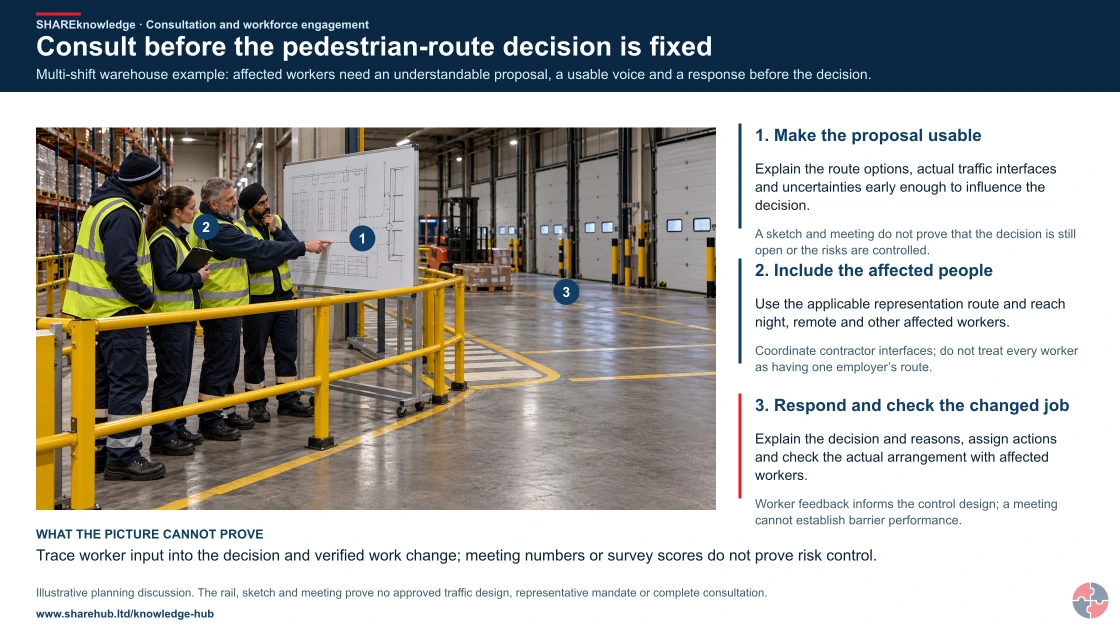
Consultation needs a proposal people can understand, a usable representation route and a response that explains what changed. It is more than collecting attendance signatures.
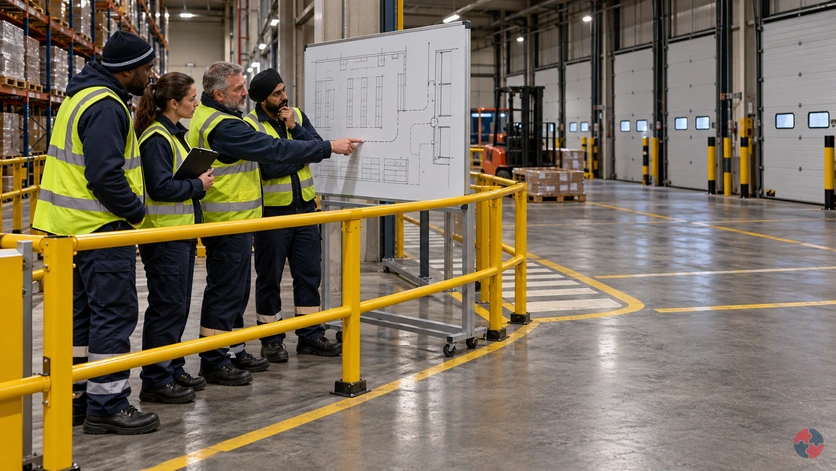
Consult before the pedestrian-route decision is fixed
Full written explanation
Multi-shift warehouse example: affected workers need an understandable proposal, a usable voice and a response before the decision.
- Make the proposal usable. Explain the route options, actual traffic interfaces and uncertainties early enough to influence the decision.
- Include the affected people. Use the applicable representation route and reach night, remote and other affected workers.
- Respond and check the changed job. Explain the decision and reasons, assign actions and check the actual arrangement with affected workers.
Change the pathway
- Attendance is not influence. A sketch and meeting do not prove that the decision is still open or the risks are controlled.
- Use the right representation route. Coordinate contractor interfaces; do not treat every worker as having one employer’s route.
- Keep technical verification separate. Worker feedback informs the control design; a meeting cannot establish barrier performance.
Evidence check: Trace worker input into the decision and verified work change; meeting numbers or survey scores do not prove risk control.
Full workforce representation, contractor coordination and follow-through context
Primary references: HSE: planning to consult employees (GB) · HSE: monitor involvement and review progress (GB)
Open the complete HD image (new tab)Download image

Full workforce representation, contractor coordination and follow-through context
Primary references: HSE: planning to consult employees (GB) · HSE: monitor involvement and review progress (GB)

Include affected workers
Identify the applicable representation route and include remote/night workers and others affected by the task change.
Explain and listen
Make the risks, options and uncertainties accessible, invite questions and consider changes before the decision.
Respond and follow through
Explain the decision and reasons, name action owners and track whether the agreed control works.
Do not treat a feedback form or survey score as proof that the work is controlled.
What are the key points about consultation, participation and workforce engagement?
The key points are that consultation is a legal duty, participation improves control design, and engagement only has value when worker input leads to visible action.
A good consultation system does not wait for an annual survey or committee meeting. It gives people routine ways to influence decisions before work changes, new controls are introduced, risk assessments are reviewed, incidents are investigated or health concerns are raised. It also tells people what happened to their input, because silence after feedback is one of the fastest ways to damage trust.
Participation goes deeper than being asked for an opinion. Workers can help identify hazards, choose practical controls, test procedures, design toolbox talks, inspect the workplace, review near misses, improve welfare and highlight pressures that managers may not see. Engagement is the broader condition created when people believe it is worth speaking up because leaders listen, respond and act fairly.
| Point | What it means | Evidence to look for |
|---|---|---|
| Two-way process | Information flows from management to workers and from workers back into decisions. | Briefings with questions, feedback logs, worker comments and responses. |
| Timely involvement | Workers are consulted early enough to influence the decision. | Risk assessments and change records showing consultation before approval. |
| Representative route | Union-appointed or employee-elected representatives are used where required or appropriate. | Appointments, elections, representative lists and agreed consultation forums. |
| Inclusive reach | Shift, remote, low-literacy, contractor, agency and multilingual groups are considered. | Translated material, multiple channels, shift meetings and contractor forums. |
| Action tracking | Concerns and suggestions are prioritised, owned and closed. | Committee action tracker, close-out evidence and feedback to the workforce. |
| Leadership response | Leaders treat worker voice as risk intelligence, not criticism. | Visible management actions, walkabout records and trend reviews. |
What is consultation, participation and workforce engagement?
Consultation is the legal and practical process of discussing health and safety matters with workers or their representatives before decisions are made.
Consultation, participation and engagement are closely linked but not identical. Consultation is the two-way discussion required by law. Participation is the practical involvement of workers in activities such as risk assessment, procedure design, inspections, incident investigations and safety committees. Engagement is the quality of the relationship: whether people feel listened to, respected, informed and able to influence work safely.
This distinction matters because organisations often confuse a noticeboard, email or toolbox talk with consultation. Those methods may inform people, but they do not automatically consult them. Real consultation gives workers enough information to understand the issue, enough time to respond, a route to challenge or suggest improvements, and feedback explaining what will be done.
| Term | Plain-English meaning | Practical example |
|---|---|---|
| Informing | Giving people information so they know what is expected. | A safety alert, induction slide, email or notice. |
| Consultation | Asking for views before deciding and considering those views properly. | Discussing a new lone-working procedure with workers and representatives before launch. |
| Participation | Workers actively help shape or check arrangements. | Operators walk through a risk assessment and identify a valve access issue. |
| Engagement | People are willing and able to speak up because they trust the process. | Workers report near misses and see improvements made. |
| Representation | A worker or union-appointed representative acts on behalf of a group. | A safety representative raises shift-worker concerns at a committee. |
| Feedback loop | The organisation closes the loop by explaining decisions and actions. | A concern log shows the issue, owner, decision, action and response. |
Which consultation route applies?
Identify work location, recognised union representation and uncovered employees before choosing a direct or elected route.
In GB, HSE L146 explains the 1977 union-appointed safety representative and 1996 direct/elected employee routes; some workplaces need both. HSE’s planning checklist says information must arrive in time to influence decisions and employers should explain their response. NI union-appointed representatives and safety committees have a 1979 statutory rule; NI also has its own 1996 consultation guidance. Contractors are not automatically the client’s employees under these representative rules, but their task interfaces still need coordination and a channel to raise safety concerns.
Which GB and NI consultation duties should be checked?
Use GB HSE L146 or the NI 1979 union-representative and NI 1996 employee routes for the actual group; do not treat a generic meeting as legal consultation.
The GB L146 ACOP and guidance describes the 1977 and 1996 routes, including time, information and representative arrangements. NI guidance for the 1996 employee route and the NI 1979 union representative/committee rule are separate starting points under NI law. Consultation should occur before decisions about risk controls, training or change are settled, with reasons fed back. Additional sector-specific representation or coordination duties may apply, so a competent adviser should verify the live case.
On a small screen, scroll this table sideways to read all columns.
| Location | Official starting point | Practical evidence |
|---|---|---|
| Great Britain | HSE L146: 1977 union and 1996 employee routes. | Timely information, representative/direct input and response. |
| Northern Ireland | HSENI NI 1996 consultation guidance and local law. | NI representation route, input and response. |
GB L146 is the second edition with amendments published in 2014; HSE corrected the online PDF’s ACOP labelling in 2015. The HSENI 1996-route guide has a 1997 landing date and historical cross-law references. The NI 1979 link is the original made PDF, not a consolidated current text. Verify current local amendments and any sector-specific route for a live case. Union-appointed and elected representatives have different statutory functions: for example, do not assume the elected route carries every union representative inspection/investigation power.
Which consultation methods work in practice?
Effective consultation uses a mix of face-to-face, representative, written and digital methods matched to the workforce and the decision being made.
No single method works for every issue. Face-to-face discussion is powerful when the issue is complex, sensitive or task-specific because people can ask questions, show the work as it is really done and sense whether others understand. Digital tools are useful for speed and wide reach, but they can miss people without easy access, people with lower literacy, workers on night shifts or people who do not trust anonymous systems.
A good manager chooses the method based on the risk and the audience. A change to a machine guarding arrangement may need a shop-floor walk-through with operators and maintenance workers. A wellbeing policy may need confidential feedback routes. A multi-contractor shutdown may need interface meetings, permits, shift handovers and supervisor conversations.
| Method | Good use | Limitations to manage |
|---|---|---|
| One-to-one discussions | Small teams, sensitive concerns and understanding individual work realities. | Can miss wider patterns unless themes are recorded. |
| Team meetings | Routine consultation, upcoming changes and shared problem-solving. | Quieter workers may not speak without skilled facilitation. |
| Toolbox talks | Task-specific hazards, control changes and immediate feedback from workers. | Can become one-way unless questions and suggestions are invited. |
| Walkabouts | Leaders see conditions, ask questions and test whether controls work. | Can become theatre unless issues are tracked and closed. |
| Safety committees | Structured review of trends, representative concerns and cross-functional actions. | Weak where actions are vague, repeated or not owned. |
| Digital surveys or portals | Wide reach, quick polling, anonymous reporting and trend analysis. | May exclude some workers and can feel impersonal without feedback. |
| Representative meetings | Efficient route where elected or union-appointed representatives cover groups. | Representatives need time, training and access to the people they represent. |
What do health and safety representatives do?
Health and safety representatives provide a worker voice, raise concerns, take part in consultation and help employers understand how work affects people in practice.
Representatives are not junior managers or a way for the employer to outsource responsibility. Their value is independence and workplace knowledge. Union-appointed representatives have specific functions under the GB 1977 regulations, including representing employees, investigating complaints and potential hazards, inspecting the workplace and taking part in committees. Elected representatives under the GB or NI 1996 regulations, as applicable, support consultation for employees not covered by union-appointed representatives.
In Northern Ireland, union-appointed safety representatives and committee requests follow the 1979 NI Regulations; the NI 1996 route covers employees outside that representation. Good organisations make the representative role visible. Workers should know who their representatives are, what area or group they cover, how to contact them and how concerns are escalated. Representatives need enough time, information and training to perform the role properly, and managers need to respond without defensiveness.
| Representative activity | Why it matters | Management support needed |
|---|---|---|
| Represent worker views | Brings real work experience into decisions. | Provide information early and invite comment before decisions are fixed. |
| Investigate concerns or complaints | Finds weak signals before harm occurs. | Allow access, time and a fair route to raise findings. |
| Inspect the workplace | Checks whether controls match reality. | Agree inspection approach, accompany where useful and track actions. |
| Take part in investigations | Improves trust and helps identify system causes. | Share evidence appropriately and focus on learning. |
| Attend training | Builds competence and confidence. | Provide paid time and recognise the role. |
| Request or attend committees | Connects local issues to management decisions. | Keep agendas focused, balanced and action-led. |
How can the hierarchy of controls turn worker consultation into stronger risk controls?
Ask the people who do the job before approving a change, test the proposal at work and close the feedback loop.
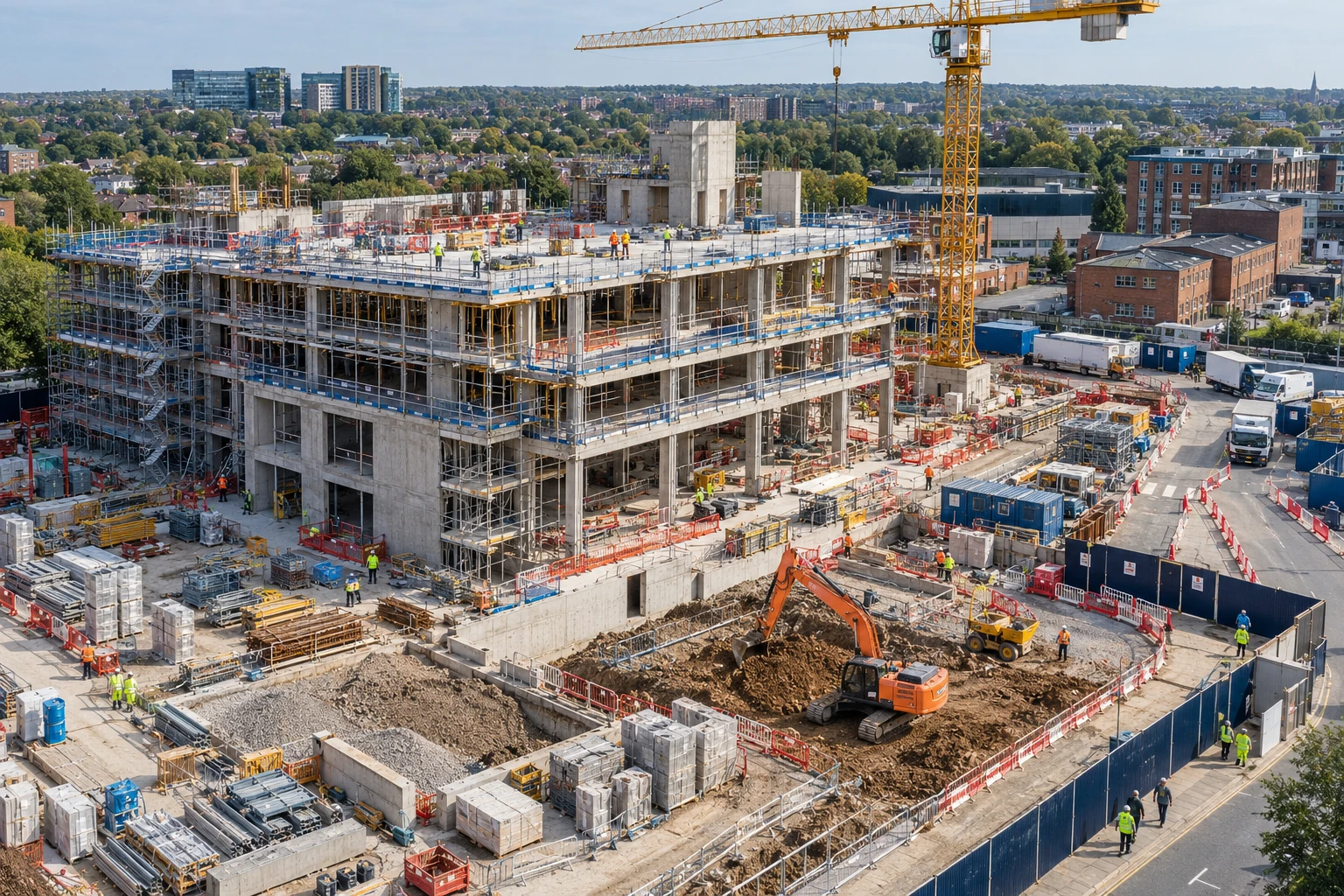
Follow the concern into the changed construction method
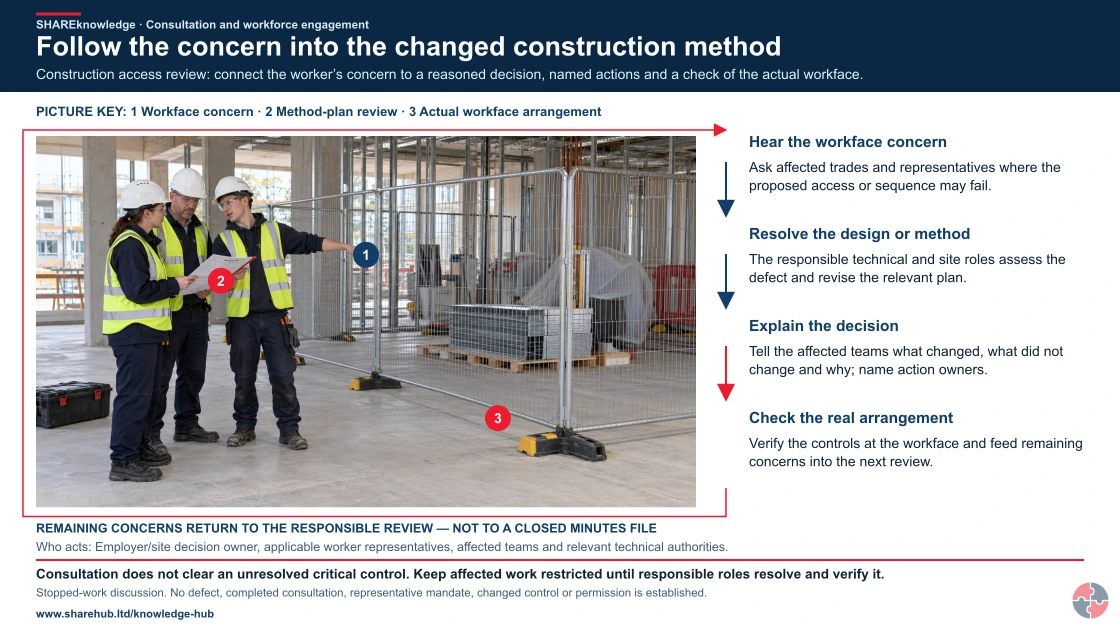
Full written explanation
A construction workface scene connects practical worker knowledge, the method document and the actual access arrangement. Three colleagues remain outside a closed mesh-barrier bay; a receiving-trade worker points towards the physical boundary and materials while another holds the paper plan. Picture key1 identifies the workface concern,2the method-plan review and3the actual workface arrangement. The four independent process headings are unnumbered. The connected process follows the concern through responsible technical/site review, a reasoned decision with named actions, and verification with affected teams. Remaining concerns return to the next responsible review. A meeting or closed minutes file is not evidence that the control works. The scene does not establish a defect, a representative mandate, consultation coverage, a changed control or a completed outcome. Consultation needs timely understandable information, the applicable representation route and ways to hear affected night, remote and contractor groups. Explain what changed, what could not change and why. Technical verification and resolution of an outstanding critical control remain separate responsibilities; affected work stays restricted while the responsible roles resolve and verify it. No GB/NI legal equivalence, consultation deadline, scaffold/load/access geometry, approved arrangement or work permission is supplied.
Construction access review: connect the worker’s concern to a reasoned decision, named actions and a check of the actual workface.
- Hear the workface concern. Ask affected trades and representatives where the proposed access or sequence may fail.
- Resolve the design or method. The responsible technical and site roles assess the defect and revise the relevant plan.
- Explain the decision. Tell the affected teams what changed, what did not change and why; name action owners.
- Check the real arrangement. Verify the controls at the workface and feed remaining concerns into the next review.
When the evidence does not fit: An unresolved critical control is not cleared by consultation. Keep the affected work restricted while the responsible roles resolve and verify the actual arrangement.
Who acts: Employer/site decision owner, applicable worker representatives, affected teams and relevant technical authorities.
Changed workplace
Multi-shift warehouse: Reach the people using the route at the times they work; show how their input affected the decision.
Construction subcontracting: Revisit poor access or sequencing through the responsible method/design review and explain the outcome.
Evidence check: Trace worker input into the decision and verified work change; meeting numbers or survey scores do not prove risk control.
Full workforce representation, contractor coordination and follow-through context
Primary references: HSE: planning to consult employees (GB) · HSE: monitor involvement and review progress (GB)
Open the complete HD image (new tab)Download image

Full workforce representation, contractor coordination and follow-through context
Primary references: HSE: planning to consult employees (GB) · HSE: monitor involvement and review progress (GB)
The HSE bulk-storage technical guide identifies alarms and trips as overfill barriers. A tank-transfer change could move the high-high alarm display off the operator’s normal screen. The process engineer should first avoid the hazardous transfer or reduce volume where feasible, maintain independent engineered trip and clear alarms, then use procedures and a practised handover; PPE is only for residual intervention risk. Ask day and night operators and maintenance staff to walk the actual alarm response and identify missing cues. Record their concerns, the technical decision and how each was addressed. If the trip or status is unclear, stop transfer pending correction. This maps the material hazard to ERICPD and the five-level hierarchy while consultation improves design rather than replacing it.
On a small screen, scroll this table sideways to read all columns.
How can the ERICPD hierarchy of controls turn worker consultation into stronger risk controls?

| Five-level / ERICPD | Decision informed by workers | Owner, check, failure and stop |
|---|---|---|
| Eliminate / eliminate | Cancel unnecessary transfer or route away from overfill-prone tank. | Planner records need; hold if route unclear. |
| Substitute / reduce | Lower rate/batch after operators validate workload and new risks. | Process engineer approves; stop if the lower-rate trial reveals an unassessed hazard. |
| Engineering / isolate and control | Keep independent high-high trip and clear status display. | Instrument engineer proof-tests; stop on failed trip or hidden inhibit. |
| Administrative / discipline | Practised handover, alarm response and worker feedback closure. | Supervisor observes; stop on misunderstood cue. |
| PPE / PPE | Residual intervention PPE only, never an overfill barrier. | Task lead checks selection; stop on uncontrolled intervention. |
How can the ISO 45001 hierarchy of controls turn worker consultation into stronger risk controls?

| Five-level / ERICPD | Decision informed by workers | Owner, check, failure and stop |
|---|---|---|
| Eliminate / eliminate | Cancel unnecessary transfer or route away from overfill-prone tank. | Planner records need; hold if route unclear. |
| Substitute / reduce | Lower rate/batch after operators validate workload and new risks. | Process engineer approves; stop if the lower-rate trial reveals an unassessed hazard. |
| Engineering / isolate and control | Keep independent high-high trip and clear status display. | Instrument engineer proof-tests; stop on failed trip or hidden inhibit. |
| Administrative / discipline | Practised handover, alarm response and worker feedback closure. | Supervisor observes; stop on misunderstood cue. |
| PPE / PPE | Residual intervention PPE only, never an overfill barrier. | Task lead checks selection; stop on uncontrolled intervention. |
HSE’s five-level hierarchy is the GB general framework: elimination, substitution, engineering, administrative controls and PPE. ERICPD is complementary. Apply it to the material hazard in the example, with physical acceptance checks separate from instruction, consultation or permit completion.
For this tank transfer, the engineer sets acceptance criteria from inventory, substance, transfer rate and available response time. HSE control-systems guidance supports checking the sensor, logic, final action and protective independence at commissioning, then maintaining and testing them. Operators from each shift trial alarm visibility, recognition and response under representative workload; record concerns and the resulting design decision. Before transfer, check control status and unresolved inhibits. Planned proof tests, response observations and change reviews check continued performance. A failed trip, unclear inhibit or missed response holds transfer; correct and verify the relevant controls before the process owner records restart authority. Consultation findings inform that decision and do not replace engineering verification.
How should health and safety committees add value?
A health and safety committee should convert workforce concerns, performance data and management decisions into owned actions that reduce risk.
A committee is not valuable because it exists; it is valuable when the right people attend, the agenda is risk-led, worker representatives are not drowned out by management, and actions are specific enough to be completed and verified. Good committees review patterns: repeated defects, overdue actions, near misses, health surveillance themes, training gaps, audit findings, contractor issues, change proposals and worker concerns.
The best committees have a clear scope, chairing discipline and an action tracker. They avoid becoming a general complaints forum by separating immediate facility issues from serious risk decisions, while still showing respect for ordinary concerns. Repeated small issues can be important because they often reveal weak ownership or poor maintenance.
| Feature | Good practice | Weak sign |
|---|---|---|
| Membership | Balanced worker, representative, management and specialist attendance. | Workers are outnumbered or key groups are missing. |
| Agenda | Risk-led agenda covering actions, trends, changes and worker concerns. | Same standing items with little discussion. |
| Action tracking | Named owner, due date, priority, evidence and close-out. | Actions repeated month after month. |
| Feedback | Workers hear what was decided and why. | Minutes are filed but not communicated. |
| Escalation | Serious or stuck issues go to senior leadership. | Committee has no authority or budget route. |
| Learning | Incidents, audits and weak signals change arrangements. | Lessons are noted but controls do not change. |
How should two-way communication and feedback loops work?
Two-way communication works when people can raise issues easily and receive a clear response showing what was done, what was not done and why.
Feedback loops are the difference between consultation and frustration. Workers may raise a concern about a guard, staffing level, welfare issue, chemical smell, defective ladder, high workload or confusing procedure. If they hear nothing back, they may stop reporting. If they see action or a reasoned explanation, the reporting route gains credibility.
The response should match the risk. A serious imminent danger needs immediate escalation and control. A pattern of minor concerns may need trend analysis. A suggestion that cannot be adopted should still be answered respectfully, explaining the decision and any alternative. The important evidence is not just that feedback was received, but that it was considered, prioritised and closed.
| Step | What should happen | Evidence |
|---|---|---|
| Receive | Make it easy to raise concerns through supervisors, reps, meetings or digital tools. | Concern log, meeting notes or report record. |
| Assess | Rank the risk and decide urgency. | Triage decision and interim control where needed. |
| Assign | Give the action to a named owner with a timescale. | Action tracker. |
| Act | Fix the issue or implement a suitable improvement. | Photographs, revised procedure or work order. |
| Verify | Check the control works in real conditions. | Inspection, observation or worker confirmation. |
| Respond | Tell the person or group what happened. | Feedback note, briefing or committee minutes. |
How should consultation include contractors, shift workers and remote workers?
Consultation should be designed around the people affected by the risk, including people who are not present in ordinary office-hours meetings.
Consultation fails when it only reaches the easiest group. Night shifts, mobile workers, home workers, agency staff, subcontractors, workers with English as a second language, low-literacy workers and people in remote locations may all experience risks differently. A single intranet notice or daytime committee meeting will not usually be enough.
Contractors need particular attention because they may create risks, receive risks from the host employer, or be affected by other contractors. Consultation does not remove the need for contractor management, but it does improve interface control. Pre-start meetings, induction feedback, permit handovers, stop-work routes and joint inspections can all reveal conflicts that paperwork misses.
| Group | Risk of exclusion | Better approach |
|---|---|---|
| Shift workers | Decisions made on days without shift input. | Rotate meetings, use shift briefings and include shift representatives. |
| Remote or lone workers | Low visibility and weaker informal feedback. | Scheduled check-ins, digital reporting and supervisor calls. |
| Contractors | Interface hazards missed between organisations. | Pre-start consultation, joint risk review and contractor forums. |
| Agency or temporary workers | Short tenure and unclear representation. | Clear induction, supervisor access and inclusion in briefings. |
| Multilingual workforce | Technical messages misunderstood. | Plain English, translation, visuals and interpreter support where needed. |
| Low-literacy groups | Written-only consultation excludes people. | Use demonstrations, visuals, discussion and teach-back checks. |
What evidence shows consultation is meaningful?
Meaningful consultation evidence shows who was consulted, what was discussed, what changed, what actions were taken and how the workforce was updated.
Evidence should be proportionate, but it should be real. A large high-risk site may need representative lists, terms of reference, inspection records, committee minutes, action trackers, consultation plans and workforce feedback metrics. A small business may rely on simpler meeting notes, toolbox-talk records and a concern log. In both cases, the evidence should show influence, not only attendance.
Auditors and regulators will often look for the chain from worker voice to control improvement. For example: workers raise that dust extraction blocks frequently; the issue is logged; maintenance and procurement review the equipment; a better tool/extraction combination is trialled; training is updated; exposure controls improve; the committee reviews the outcome.
| Evidence type | What it proves | What to watch |
|---|---|---|
| Consultation plan | The organisation has planned who to involve and when. | Plan does not include remote, shift or contractor groups. |
| Representative list | Workers know who represents them. | Outdated names, unclear coverage or no election evidence. |
| Meeting records | Issues were discussed. | No actions, owners or feedback. |
| Action tracker | Concerns lead to owned decisions. | Overdue actions and repeated extensions. |
| Risk assessment involvement | Workers shaped the assessment or procedure. | Names added after the assessment was already approved. |
| Inspection and investigation participation | Representatives or workers helped check reality. | Findings not considered or acted on. |
| Feedback to workforce | People were told what happened. | No visible response, causing reporting fatigue. |
How could BuildOut Ltd manage consultation and workforce engagement?

BuildOut Ltd would involve workers before decisions are fixed, act on what they report and show them what changed and why.
BuildOut Ltd · practical example
Change a delivery route with the people who use it
The key lesson Consultation gives people an opportunity to influence a decision before it is made; a briefing explains the agreed decision afterwards.
The situation: BuildOut proposes moving deliveries to an earlier shift. Workers point out that the proposed route crosses the welfare entrance and that agency staff would miss the normal briefing. Consultation should influence the decision while it can still be changed.
Why this matters: The early-shift workers know where a planned route conflicts with real movement. Asking them after the delivery timetable is fixed can leave an avoidable risk built into the programme.
How BuildOut Ltd would manage it
- Reach the affected people — Site Manager. Use the applicable consultation and representative arrangements to involve employees and their representatives, alongside the contractor interfaces. Include the early shift, agency workers and people with language or access needs.
- Explain the proposal — Project Manager. Share the proposed timing, route and reason for the change early enough to consider alternatives. Give people time to inspect the plan and raise concerns before agreeing the final arrangement.
- Test the concerns — Trade Supervisor. Walk the proposed route with workers and the delivery contact. Record the welfare crossing, briefing gap and suggested alternatives against the actual location rather than treating a meeting attendance list as consultation.
- Decide and respond — Site Manager. Revise the route or timing and the early-shift briefing where needed. Assign each action, explain the decision to the affected groups and keep unresolved access risks from becoming the new working arrangement.
- Check the result — Health and Safety Manager. Speak to workers after implementation and observe a delivery. Confirm whether their concerns were resolved, explain any further change and bring repeated procurement or programme issues to the Construction Director.
When the conditions change
- Recognise the trigger
- Workers identify a route conflict or a group that the proposed communication arrangements exclude.
- Make the immediate decision
- The Site Manager keeps the affected proposal from becoming the working arrangement while the concern and alternatives are considered.
- Verify the next step
- The revised arrangement addresses the risk, affected groups know the decision and the first deliveries are observed to check the result.
What good looks like
A worker can point to a concern, the company's response and a visible change at the workplace. People who could not attend the main meeting still have a meaningful way to contribute.
Evidence to look for: The proposal, representative or worker comments, recorded decisions, revised plan, action owners and worker feedback after the change.
Common mistake to avoid: Counting toolbox-talk signatures as evidence that workers had time and information to shape the proposal.
Apply this to your work: Can you show one decision that changed because workers were consulted before it was made?
Guidance behind the management approach: HSE: planning to consult employees. Use the topic's legal and technical guidance for the applicable work and location.
BuildOut Ltd
BuildOut Ltd is a construction and refurbishment contractor used by SHARE to show how consultation works in a project-based business with changing sites, subcontractors, trades, designers and clients.
BuildOut starts by mapping who needs to be heard: direct employees, trade supervisors, subcontractors, agency labour, night-shift workers, plant operators, temporary works coordinators, designers, client representatives and neighbouring occupied premises where work affects them. Its consultation standard explains when workers must be consulted, including before high-risk method statements are approved, when work sequencing changes, after incidents or near misses, when new plant is introduced and when welfare or health risks are identified.
The business keeps a representative and communication register showing union-appointed representatives where applicable, elected representatives for non-union groups, site contacts for each subcontractor and language or access needs. Site managers run weekly engagement walkabouts with a worker representative and a supervisor. Findings are entered into the project action tracker with a risk rating, owner, due date and close-out evidence. The central HSSE team reviews trends across projects, such as repeated scaffold access issues, dust-control failures or welfare complaints, and escalates recurring themes into procurement, training or leadership review.
At project level, BuildOut links consultation to the construction phase plan and risk register. Before demolition, excavation or work at height starts, supervisors walk the method through with the people doing the work and ask where the plan is likely to fail. The temporary works coordinator, permit issuer and contractor supervisor attend where interfaces exist. If workers identify poor access, unclear exclusion zones or unrealistic sequencing, the method is revised before authorisation. After completion, lessons are reviewed so future tenders and programmes allow realistic time and resources.
BuildOut also checks quality, not only quantity. First-line supervisors use short yes/no engagement checks to confirm whether people know the controls and have raised concerns. Second-line HSSE advisers review committee minutes, risk assessments and action quality. Third-line internal audits sample projects to see whether worker feedback can be traced into actual changes. This creates a visible line from worker voice to risk control, rather than a folder of minutes with no operational effect.
| System element | How BuildOut applies it | Evidence |
|---|---|---|
| Consultation standard | Defines when consultation is required and which route applies. | Policy, procedure and consultation triggers. |
| Representative mapping | Shows who represents each workforce group and site. | Representative register and election/appointment records. |
| Risk assessment participation | Workers walk through high-risk methods before approval. | RAMS review comments and revised controls. |
| Contractor engagement | Subcontractors join pre-start and interface risk reviews. | Coordination minutes and permit handover records. |
| Action tracking | Concerns are risk-rated, owned and verified. | Action tracker with close-out evidence. |
| Learning and improvement | Repeated themes feed into procurement, training and planning. | Trend reviews, leadership minutes and updated standards. |
How does this topic align with ISO 45001?
Use these examples to connect the relevant clauses to your own occupational health and safety management system. For each clause, identify the person responsible, the control in use and the evidence that it works.
Scroll across the table to read all four columns.
| ISO 45001 clause | How it applies | What to put in place | How to verify it works |
|---|---|---|---|
| 5.4 Worker consultation and participation | Consultation gives workers a chance to influence a proposal. Participation brings them into assessing the risks and deciding how controls will work. | Give early-shift, agency and other affected workers time and accessible route information before agreeing the delivery change. Involve their representatives where applicable and walk the route together. | Worker input identifies the welfare entrance conflict and is traceable to a revised route or timing. Workers on the affected shifts can explain the decision and how to raise concerns. |
| 7.4.1 Communication arrangements | A planned communication process helps the right people receive and understand information that affects their safety. | Agree what to tell delivery crews, building users and site workers, who will tell them and when. Provide a way to report a route conflict or a missed briefing. | Check the agreed plan reached the driver and early-shift staff. Ask each group how it will use the route and what it will do if the arrangement changes. |
| 8.1.3 Management of change | Changing delivery times or routes can introduce new interactions that need to be managed before the change takes effect. | Review how early deliveries interact with welfare access, opening hours and site supervision. Trial the revised route with worker input and review unintended effects after introduction. | The change record captures worker concerns, revised controls and first-delivery observations. Follow-up shows whether pedestrian conflicts were removed or need further action. |
Selected applications of ISO 45001:2018 with Amendment 1:2024. Use the current standard for a full assessment and check the legal duties that apply to the work and location.
ISO 45001:2018 · 2024 climate action amendment · ISO 45002 implementation guidance · ISO technical committee clause FAQ
What should each role learn and demonstrate?
Learning must match the decisions people make, from recognising danger to checking that controls work.
Briefings should tell people how to act, but attendance alone does not show competence. Assess the real decision or task, record who assessed it and revisit after a material change, failed control or incident. A local authorisation is task-specific; no universal external certificate is implied.
On a small screen, scroll this table sideways to read all columns.
| Role and learning | Demonstration and assessor | Record and reassessment trigger |
|---|---|---|
| Manager | Run a proposed change before decision; safety adviser assesses response quality. | Consultation log; repeat after process change. |
| Representative | Show how to collect and report shift concerns; senior representative assesses. | Dated issues and feedback; review after missed group. |
| Supervisor | Test a revised task control with night shift; operations lead observes. | Observation and closed action; repeat after failure. |
How does this topic support NEBOSH Diploma study?
For NEBOSH Diploma study, consultation and workforce engagement sit within DN1 culture, leadership, participation and behaviour-change expectations.
A practice answer needs more than a definition. A strong answer explains the difference between consultation, participation and engagement; identifies the legal routes for union-appointed and elected representatives; shows how worker voice improves risk assessment and procedure design; and explains how feedback loops, committees and action tracking support a positive culture.
Scenario answers should apply the topic to the facts. In a construction project, the answer may focus on subcontractor consultation, temporary works, work at height and changing site conditions. In a manufacturing case, it may focus on operators being excluded from procedure changes, poor reporting culture and repeat maintenance defects. In a wellbeing scenario, it may focus on confidential feedback, stress risk assessment and leadership trust.
| Study point | What to know | How to apply it |
|---|---|---|
| Legal routes | 1977 and 1996 consultation regulations and representative roles. | Identify which route applies and what the employer must do. |
| Positive culture | Engagement grows where people are listened to and concerns are acted on. | Link worker voice to trust, reporting and learning. |
| Risk assessment | Workers improve the accuracy and practicality of controls. | Explain how participation changes the assessment or method. |
| Communication | Two-way communication is different from broadcasting information. | Show how feedback is received, assessed, acted on and returned. |
| Committees | Committees need balanced membership and action tracking. | Critique whether a committee is effective or symbolic. |
| Evidence | A competent answer names records that prove implementation. | Use minutes, action trackers, inspection records and revised controls. |
How can a management system sustain effective decisions?
Give each hazard or support route an owner, a control, a check and a response to failure.
Review whether diverse workers received information in time, could influence decisions and saw action closure. Audit the changed control at the workface. An owner should sample actual work and corrective actions, not accept a policy or certificate as evidence that the controls work.
The free GB regulator guide HSE Managing for health and safety (HSG65) explains a plan–do–check–act approach: assign controls and owners, involve workers, check work as done, and correct failures. For Northern Ireland, use HSENI risk assessment guidance for the local duty. A certificate alone does not demonstrate that a control works.
What warning signs show consultation is not working?
Warning signs include silent workers, repeated actions, consultation after decisions, weak representative support and feedback that never changes anything.
Poor consultation often appears as culture before it appears as injury. People stop reporting concerns, representatives are bypassed, committees discuss the same unresolved issues, supervisors become defensive, and risk assessments describe work differently from how it is actually done. These are not soft issues; they are early warnings that controls may be designed without the people who depend on them.
The harm can manifest as poor control design, unsafe workarounds, under-reporting, low trust, weak health surveillance participation, resistance to change, contractor interface failures and delayed escalation of serious risk. A site can have many meetings and still have poor consultation if those meetings do not influence decisions.
| Warning sign | How it can cause harm | Response |
|---|---|---|
| Consultation happens after decisions | Controls may be impractical and workers lose trust. | Consult before approval and record how views were considered. |
| Committee actions repeat for months | Known risks remain unresolved. | Escalate overdue actions and assign resources. |
| Workers do not raise concerns | Weak signals are missed until an incident occurs. | Review reporting routes, culture and supervisor response. |
| Representatives lack time or training | Worker voice becomes tokenistic. | Provide paid time, training and access to information. |
| Remote or shift workers are absent | Risks affecting those groups are misunderstood. | Use targeted routes and representative coverage. |
| Feedback is not returned | People stop participating. | Close the loop with decisions, reasons and evidence. |
| Risk assessments are office-written | Controls do not match real work. | Walk the task with workers and revise controls. |
What acronyms are used on this consultation page?
Acronyms should be explained so consultation duties and study references are accessible.
| Acronym | Meaning | Why it matters |
|---|---|---|
| ACOP | Approved Code of Practice | Gives practical guidance with special legal status. |
| DN1 | NEBOSH Diploma Unit DN1 | Qualification unit covering workplace health and safety principles. |
| HSE | Health and Safety Executive | Great Britain regulator and official guidance source. |
| HSSE | Health, safety, security and environment | Common business function involved in consultation systems. |
| ISO | International Organization for Standardization | Publisher of ISO 45001 management system standard. |
| PDCA | Plan, Do, Check, Act | Management cycle used in HSG65 and management systems. |
| RAMS | Risk assessment and method statement | A common work-planning document that should involve workers where relevant. |
Which BuildOut documents support this topic?
Download individual editable BuildOut documents for this topic. Procedures and plans contain completed arrangements; forms, checklists, assessments, RAMS and permits are blank masters. Registers include separate worked examples.
| Document | Purpose and content | Editable download |
|---|---|---|
| Consultation, toolbox briefing and feedback procedure BOUK-PRO-CONS · Completed worked example · v1.0 | Plan consultation, record worker input and close out concerns with accessible communications. | Download DOCX Read preview |
| Worker consultation and safety-meeting plan BOUK-PLN-CONS-01 · Completed worked example · v1.0 | Choose consultation routes and opportunities that reach employees and subcontractors. | Download DOCX Read preview |
| Safety representative and consultation meeting minutes BOUK-FRM-CONS-01 · Blank editable master · v1.0 | Record suggestions, decisions, unresolved concerns and agreed actions. | Download DOCX Read preview |
| Toolbox talk and worker-feedback record BOUK-FRM-CONS-02 · Blank editable master · v1.0 | Capture topic, attendance, understanding and feedback without equating attendance with competence. | Download DOCX Read preview |
| Hazard, good-catch and improvement suggestion report BOUK-FRM-CONS-03 · Blank editable master · v1.0 | Enable workers to raise practical issues and receive feedback. | Download DOCX Read preview |
Review and adapt the documents for your organisation, activities and jurisdiction before approval and issue. Open the SHAREms management-system hierarchy to find each document under its parent policy.