
SHARE Knowledge Hub
Drops Calculator
Understand dropped-object energy, the limitations of consequence screening and the precautions needed before work starts. The SHARE calculator below estimates ideal free-fall energy and speed and screens potential injury. It does not predict injury, classify a safe height or replace the official DROPS tool.
Open calculatorUnderstanding Drops Calculator
A drops calculator is a decision-support tool that estimates one or more physical features of an uncontrolled object movement, commonly potential energy, idealised free-fall speed, trajectory assumptions or a screening risk band. It is not an HSE-prescribed calculator, a legal test, a proof that an activity is safe, a method for predicting whether a person will be injured, or a substitute for task-specific risk assessment, work-at-height planning, lifting planning, equipment inspection or competent engineering judgement.
Why this matters at work
Avoid unvalidated injury bands. Human tolerance varies with impact location, posture, age, health, secondary fall, protective equipment, object shape, edge, surface, contact duration and emergency care. A number cannot show that a hard hat will prevent injury, that a person can safely work beneath a load or that a barrier can safely absorb an impact. Similarly, engineering components must be assessed against their own design data, standards and energy-absorption capability, not a generic score.
When consequence may include severe injury, fatality, structural damage, loss of containment, electrical damage, vehicle incident or public exposure, use the calculation only to inform a more conservative decision. Eliminate the falling-object potential, isolate the area and seek appropriate engineering, lifting, temporary works, process or asset-integrity advice. A well-governed calculator makes its limitations prominent enough that an inexperienced user cannot mistake a result for authorisation.
How organisations manage this in practice
Use it as a defined screening aid for potential consequences, with visible assumptions and reliable inputs. It cannot authorise work beneath a load, prove a helmet will prevent injury, specify a safe boundary or replace the control hierarchy. Identify the object, release mechanism, people and vulnerable equipment first. Avoid or reduce the elevated task and prevent release, then protect people from the credible path. A low-looking output does not excuse a damaged component, missing containment or unresolved uncertainty.
Leadership assurance should distinguish the tool from the outcome. Ask whether the organisation has reduced the number of items worked above people, increased ground-level assembly, improved physical containment, closed unsafe routes, controlled lifting and storage, reduced near misses and learned from events. Retire calculations that do not drive these outcomes. The enduring evidence of legal and practical adequacy is a safer system of work, supported by a traceable calculation where that calculation was genuinely useful.
Use independent checks for material decisions. A second competent person should review the object description, mass source, height, pathway, scenario selection, units, output, controls and sign-off where the task has high consequence, uncertainty, public interface, critical assets, unusual equipment or substantial change. The review should be meaningful: it must challenge assumptions and confirm physical conditions, not only repeat the arithmetic.
Who can use this page?
Workers, supervisors, lifting and access teams, safety advisers and managers can use this guide to discuss objects above people, challenge assumptions and prepare a task-specific assessment. Learners can explore how mass and height affect energy. Competent planning, inspection and control verification remain essential.
What can the independent dropped-object physics tool explain?
This calculator estimates ideal free-fall energy and speed and gives a separate injury screen. It provides no injury prediction, safe drop height or exclusion radius; the official DROPS resources are a separate consequence-guidance route.
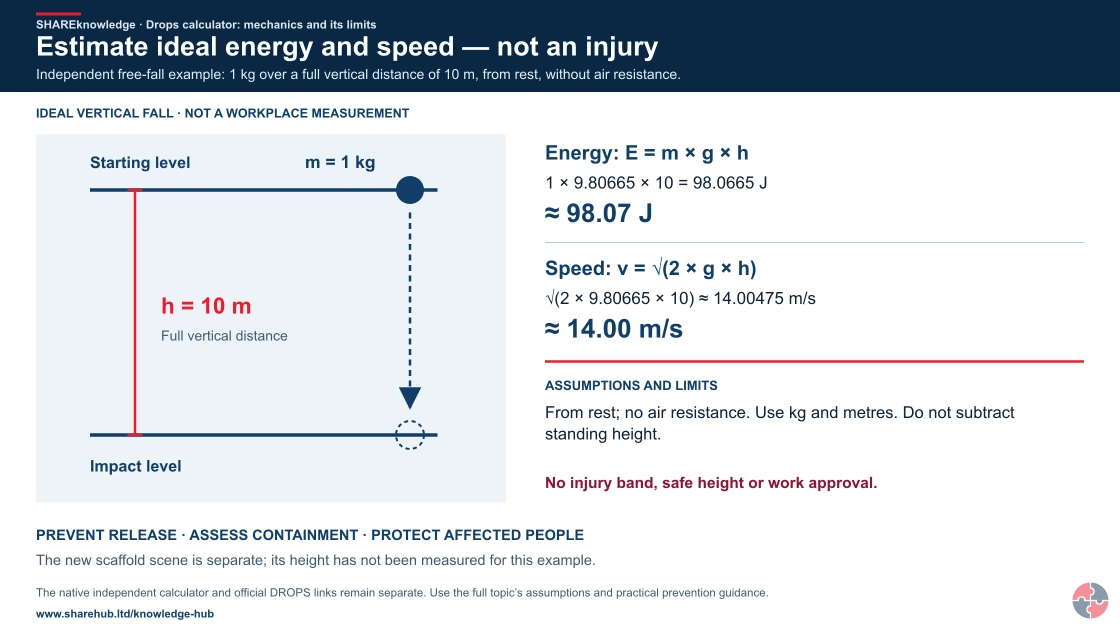
Estimate ideal energy and speed — not an injury
Full written explanation
A conceptual point mass moves from a marked starting level to an impact level over a full ten-metre vertical distance, separate from any workplace photograph. With standard gravity 9.80665 metres per second squared, E=mgh gives 98.0665 joules and v=square root of 2gh gives about 14.00475 metres per second, displayed to two decimal places as 98.07 joules and 14.00 metres per second. Use the full fall height. Review the separate injury screen for a blunt object.
Independent free-fall example: 1 kg over a full vertical distance of 10 m, from rest, without air resistance.
- Define mass and distance. Use kilograms and the full credible vertical fall distance in metres. Do not subtract standing height.
- State the ideal assumptions. The estimate starts from rest and ignores air resistance. Launched or swinging objects need different consideration.
- Keep consequence separate. Shape, impact angle, bounce and deformation affect the event. The estimate supplies no safe height or injury band.
Change the pathway
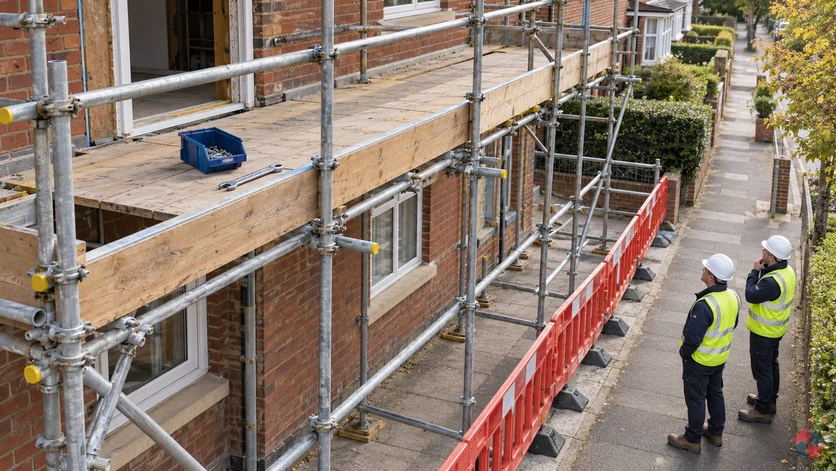
- Full distance. The schematic is not a survey or a measurement of the scaffold photograph.
- Ideal model. Speed and energy are mechanics estimates, not a reconstruction of an actual impact.
- Prevent the fall. Use the separate prevention guide and the official publisher’s stated consequence-tool scope.
Evidence check: The native independent calculator and official DROPS links remain separate. Use the full topic’s assumptions and practical prevention guidance.
Independent physics estimate, full fall distance and separate consequence guidance
Primary references: DROPS: official calculator and stated scope · DROPS: full height and consequence-guide assumptions
Open the complete HD image (new tab)Download image

Independent physics estimate, full fall distance and separate consequence guidance
Primary references: DROPS: official calculator and stated scope · DROPS: full height and consequence-guide assumptions
Compare one kilogram falling ten metres
Illustrative example. The independent estimate is about 98.07 J and 14.00 m/s using g = 9.80665 m/s².
Decision. Use the comparison to explain why prevention is needed, then assess actual retention and exposure.
Evidence to check. Mass, units, full credible distance and assumptions of free fall from rest.
Hold or escalation point. Do not release work based on a calculated value or apply blunt-object assumptions to a sharp object.
Follow-up. Use the related Dropped Objects guide for practical prevention and the publisher’s guidance for its own scope.
How should the ideal calculation inform a safety decision?
Mass and vertical distance can illustrate ideal energy and speed. They cannot predict an injury, certify a safe drop or define the exclusion zone.

Inputs
Use mass in kilograms and the full vertical distance in metres. Identify what is uncertain or omitted.
Ideal model
The from-rest model without air resistance uses energy mgh and speed √(2gh); these answer a mechanics question only.
Controls
Assess actual retention, source, trajectory, deflection and exposure controls. The severity screen gives a potential consequence. It cannot set a safe band or exclusion radius.
Do not use the calculator to justify exposing people beneath a potential dropped object.
How can I calculate ideal dropped-object energy?
Enter the object's mass and the full credible vertical distance from its release point to the impact level. Do not automatically deduct a person's standing height: people may crouch, and objects may strike lower body parts or the ground.
Method: E = m × g × h; v = √(2 × g × h), using g = 9.80665 m/s². This assumes a vertical fall from rest with no air resistance. Launch speed, deflection, bounce, impact angle and material deformation are outside this estimate. Units must be kilograms and metres.
No safe band: an energy value is not a safe working limit. Sharp objects, vulnerable body areas and secondary falls can cause severe harm even when an energy estimate appears small. The SHAREhub dropped-object model screens injury potential for a blunt object and assumes standard PPE.
When should I use the official DROPS consequence tool?
The industry DROPS calculator is a broad consequence guide, not an accurate injury prediction or permission to work. Its published assumptions include a blunt object and standard PPE. Read the publisher's limitations before applying its results; sharp or penetrating objects need separate consideration.
Open the official DROPS calculator · Read the DROPS assumptions and FAQs
How can I prevent an object falling and protect people below?
- Remove unnecessary high-level work, loose objects and stored materials where practicable.
- Select suitable retention, containment and edge protection for the task. Check compatibility, capacity, attachment and condition; do not improvise tool tethers.
- Plan exclusion and coordination around credible falling, deflected and bouncing objects. A vertical energy calculation cannot set an exclusion-zone radius.
- Inspect work areas and equipment, manage weather and changes, and brief workers and contractors on stop-work conditions.
- Arrange emergency response and review incidents or failed controls before restarting. PPE supplements prevention; it does not make an uncontrolled drop acceptable.
HSE's work-at-height guidance prioritises planned, competent work and protection from falling objects. Apply the relevant Great Britain or Northern Ireland duties and any sector-specific requirements to the actual work.
How should maintenance above a walkway be planned?
A 1 kg item could fall 10 m during maintenance. The ideal energy estimate is 98.07 J and the ideal speed is 14.00 m/s. These numbers help explain the concern, but they do not establish the likely injury. The supervisor checks retention, the area below, simultaneous work and the evidence that controls work. If those arrangements cannot be verified, the job is paused and replanned.
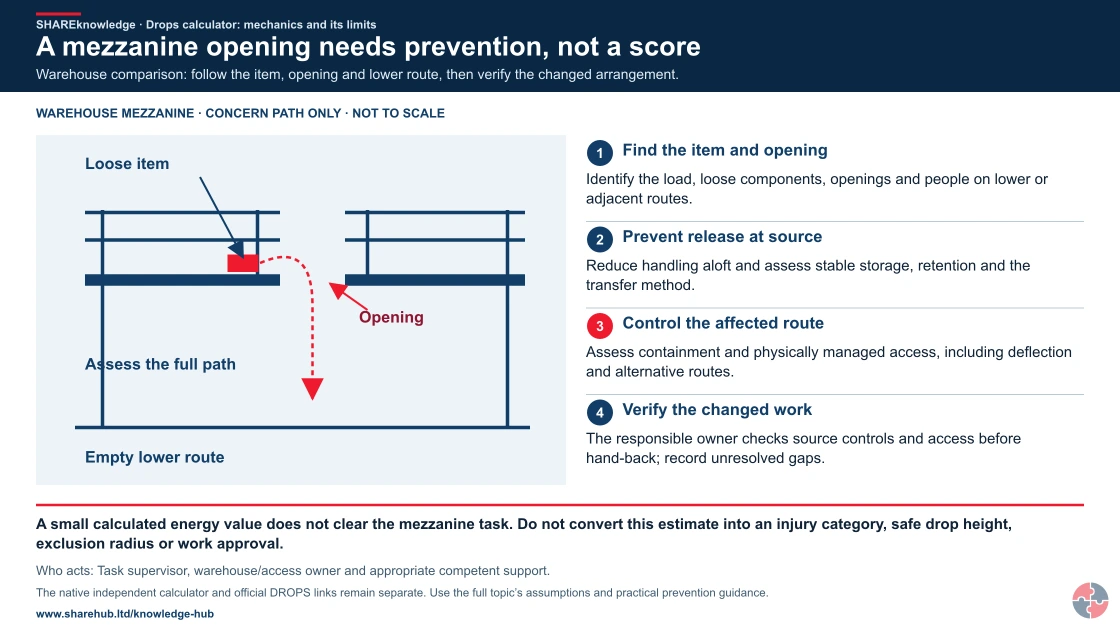
A mezzanine opening needs prevention, not a score
Full written explanation
A schematic warehouse mezzanine shows a loose item behind a permanent edge and an opening through which it could fall toward an empty lower route. Four connected checks address the item and edge, source prevention, containment and affected people, then verification of hand-back. The dashed path represents a concern, not a computed trajectory or a designed exclusion zone.
Warehouse comparison: follow the item, opening and lower route, then verify the changed arrangement.
- Find the item and opening. Identify the load, loose components, openings and people on lower or adjacent routes.
- Prevent release at source. Reduce handling aloft and assess stable storage, retention and the transfer method.
- Control the affected route. Assess containment and physically managed access, including deflection and alternative routes.
- Verify the changed work. The responsible owner checks source controls and access before hand-back; record unresolved gaps.
When the evidence does not fit: A small calculated energy value does not clear the mezzanine task. Do not convert this estimate into an injury category, safe drop height, exclusion radius or work approval.
Who acts: Task supervisor, warehouse/access owner and appropriate competent support.
Changed workplace
Scaffold concern: The new scene shows a loose-item source and closed route; it provides no measured height.
Mezzanine transfer: Assess the edge/opening, item retention and all exposed routes together.
Evidence check: The native independent calculator and official DROPS links remain separate. Use the full topic’s assumptions and practical prevention guidance.
Independent physics estimate, full fall distance and separate consequence guidance
Primary references: DROPS: official calculator and stated scope · DROPS: full height and consequence-guide assumptions
Open the complete HD image (new tab)Download image

Independent physics estimate, full fall distance and separate consequence guidance
Primary references: DROPS: official calculator and stated scope · DROPS: full height and consequence-guide assumptions
Record the item, measured or justified mass, credible fall distance, assumptions, people exposed, prevention measures, exclusion arrangements, responsible roles and verification evidence. Do not record a calculator output as approval.