
SHARE Knowledge Hub · interactive topic lesson
MEWPs: prevent crushing, overturn and falls during the task
MEWPs: prevent crushing, overturn and falls during the task
Explore how this equipment can harm its users and other people, then follow the practical measures that interrupt each pathway. This is a hazards and good-practice lesson; the separate checklist remains the pre-use/safety-check activity.
Hazards and good practice: learn what can hurt people during use, change and maintenance. Pre-use and safety checks stay in the separate checklist.
Checksheets and risk assessments
Equipment checksheets
- Mobile elevating work platforms — 3D checks · Word · PDF
- Harnesses and lanyards — 3D checks · Word · PDF
Risk assessment forms
Risk assessment examples
The model loads when it comes into view. You can also read every step below.
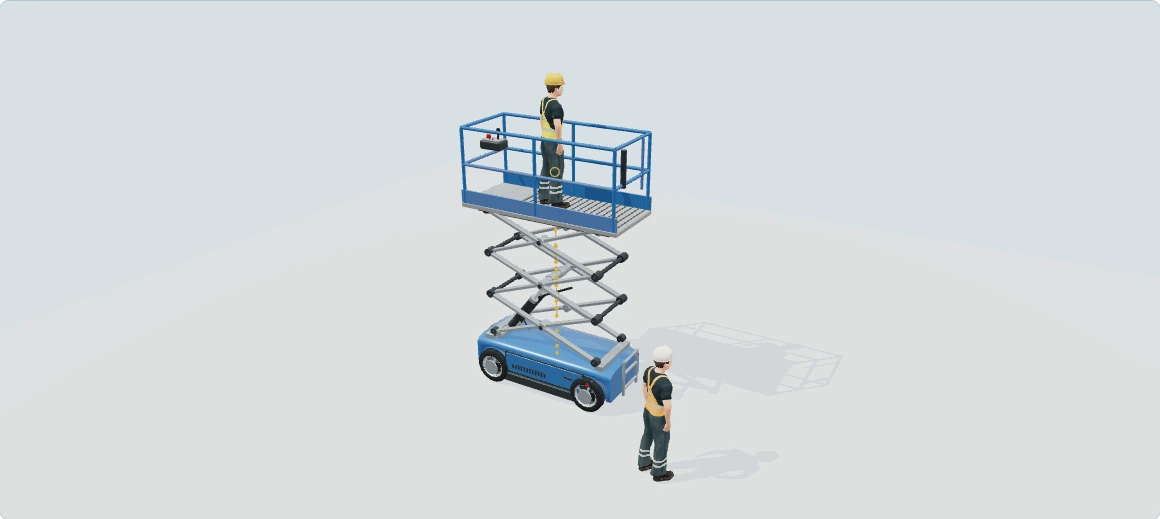 Illustrative teaching model · not a site inspection

If the new light falls during installation
A fitter is securing a 15 kg light unit, 10 m above the floor. Imagine someone steps inside the barriers. The fitting slips before its fixings take the load and strikes the person below.

The SHAREhub dropped-object model flags a potentially fatal injury. Its reference chart ends at 10 kg. Even a 10 kg blunt fitting falling 10 m reaches the fatality band. This screen assumes standard PPE and the full distance to the floor. A sharp edge or broken lens needs separate assessment.
The dot marks the light unit. The lines compare energy. They cannot tell you how much force reaches the person or how likely a particular injury is.
Before raising the platform, plan how the fitting will be supported until its fixings are secure. Check the platform load and keep the fall and deflection area clear. If someone enters, stop work.
Open this example in the SHAREhub dropped-object modelDrag to rotate; use +/− or the camera buttons to zoom. Arrow keys rotate a focused model. Scroll the page outside the model.
Step 1 of 9
Highlighted parts and moving amber dots identify an illustrative route to harm. They do not measure exposure, clearance, energy, safe distance or performance. Equipment remains a teaching representation.
1. Choose access that suits the real job
The scissor platform is one access type, not a universal answer for all height work.
An unsuitable reach, location or work method can create fall, crushing and stability risks.
Avoid height work where reasonably practicable; select the access method for task, reach, surface and surroundings.
Planning the method can remove the need for overreaching or improvising once elevated.
People and harm for this task
- People affected
- Occupant, helpers and people below.
- Hazard
- Fall, crushing, overload and falling tools.
- Mechanism of harm
- A person can be crushed or fall; others can be struck.
- Control to review
- Select suitable access, remain within protection and plan the envelope, load and dropped-object controls.
Full written walkthrough — all 9 steps
1. Choose access that suits the real job
What is happening: The scissor platform is one access type, not a universal answer for all height work.
How harm can occur: An unsuitable reach, location or work method can create fall, crushing and stability risks.
Best practice to apply: Avoid height work where reasonably practicable; select the access method for task, reach, surface and surroundings.
Why this works: Planning the method can remove the need for overreaching or improvising once elevated.
How should construction hazards be controlled? · How can the ISO 45001 hierarchy of controls reduce work-at-height, demolition and excavation risks?2. Do I need a harness in this scissor lift?
What is happening: On a vertical scissor lift, the deck, closed gate and complete guardrails provide collective fall protection. Keep both feet on the floor. Reposition the machine if the job is out of reach.
How harm can occur: Climbing a rail, standing on a box or leaning outside can put you beyond the guardrails. A harness alone cannot prevent a fall, overturn or crushing.
Best practice to apply: In Great Britain, the Work at Height Regulations require the job to be planned and collective protection prioritised. A harness is usually unnecessary on a guarded scissor lift. Follow this machine’s instructions and the task risk assessment. If a residual fall risk requires restraint, use a suitable harness and short restraint lanyard on a manufacturer-designated anchor. This model identifies no such anchor. Never clip to a guardrail.
Why this works: Restraint limits where you can reach. Fall arrest catches a person after a fall has started and needs a suitable rated anchorage, sufficient clearance and a rescue plan. Do not assume a restraint anchor can take arrest loads. If the required protection cannot be provided, stop and choose a suitable machine or method.
How should construction hazards be controlled? · What is the work-at-height decision order?3. Follow the wheel as it drops into a recess
What is happening: Move the travel slider from left to right. On the level approach all four wheels are supported. Watch the nearest leading wheel reach the marked opening, drop below floor level and tilt the chassis and occupied platform.
How harm can occur: The diagonally opposite wheel lifts. With an elevated load the machine can lose stability and overturn, throwing the occupant or crushing someone beside it. The illustration stops at the onset of tipping.
Best practice to apply: Walk and assess the complete wheel route first. Check floor bearing capacity, recesses, edges and the capacity and security of covers. Keep clear of the opening and exclude people from the danger area. Travel elevated only where the manufacturer permits it and the assessed route is suitable.
Why this works: A smooth-looking indoor floor can hide a void. The guardrails move with the machine, and wearing a harness cannot restore support beneath a wheel.
How should construction hazards be controlled? · How should construction hazards be planned together?4. See the trapping gap beneath a fixed beam
What is happening: Start the slider at the left. Look across the operator’s helmet to the steel beam. The beam stays still as the elevated platform travels towards it. Follow the gap until the scene stops just before contact.
How harm can occur: Driving or raising into a beam can trap a head or chest between steelwork and the platform rail or controls. The operator can be pushed onto the controls and unable to release them. Crushing can be fatal even when the chassis stays level.
Best practice to apply: Check overhead and along the whole travel and raising envelope from the ground. Choose a clear route and suitable machine. Stop and reposition if the clearance or view is uncertain. Agree signals and practise the machine-specific rescue plan with someone familiar with the ground controls.
Why this works: Guardrails protect the platform edge. They cannot keep a beam outside the operator’s space. The rescue plan must consider which movement frees the casualty without making the crush worse.
How should construction hazards be controlled? · What is the work-at-height decision order?5. Separate moving access equipment from others
What is happening: People on the ground may not share the operator's view of the route or platform.
How harm can occur: Movement can strike pedestrians, other vehicles, structures or overhead electrical hazards.
Best practice to apply: Coordinate routes, work boundaries and adjacent operations; stop if sight or communication needed for the task is lost.
Why this works: Separation and coordination control people who are outside the platform but inside the task's effects.
How should construction hazards be controlled? · What is the work-at-height decision order?6. Keep people outside the drop zone
What is happening: The wider view shows the linked barriers put in place before the lift was raised. They enclose the drop zone on all four sides. The pedestrian stays outside while work takes place overhead.
How harm can occur: A falling tool or loose material can strike someone below or beside the platform. Excess load or shifting materials can also put the occupants at risk.
Best practice to apply: Before raising the platform, secure tools and materials, check the load and barrier off the assessed drop zone. Keep pedestrian routes outside it. Stop work if anyone enters or the barrier is moved.
Why this works: The barrier controls access. Its position depends on the task, platform travel and where an object could fall or deflect. Reassess the boundary when the lift moves.
How should construction hazards be controlled? · How should plant, vehicles and public interfaces be controlled?If the new light falls during installation
A fitter is securing a 15 kg light unit, 10 m above the floor. Imagine someone steps inside the barriers. The fitting slips before its fixings take the load and strikes the person below.
Potential outcome: fatal injuryThe SHAREhub dropped-object model flags a potentially fatal injury. Its reference chart ends at 10 kg. Even a 10 kg blunt fitting falling 10 m reaches the fatality band. This screen assumes standard PPE and the full distance to the floor. A sharp edge or broken lens needs separate assessment.
The dot marks the light unit. The lines compare energy. They cannot tell you how much force reaches the person or how likely a particular injury is.
Before raising the platform, plan how the fitting will be supported until its fixings are secure. Check the platform load and keep the fall and deflection area clear. If someone enters, stop work.
Open this example in the SHAREhub dropped-object model7. Check overhead power lines before raising the scissor lift
What is happening: The amber arrow shows the platform’s upward travel. Look along the approach route and above the proposed work position. Include the person, extended deck and any long material held above the guardrail.
How harm can occur: A raised platform or a length of metal can approach a conductor closely enough for electricity to arc. Occupants can receive fatal shocks or burns. A helper touching the machine can be injured too.
Best practice to apply: Assume the line is live. Choose a route and set-up position clear of it. If avoidance is impossible, ask the line owner about diversion or confirmed isolation. Any work near a live line needs owner-agreed clearances and physical controls. Stop if the lift or its load could enter the restricted area.
Why this works: The route may clear the lowered platform while the raised deck or a long fitting could still reach the line. The barrier in the model illustrates the decision to stop; its position gives no clearance distance. If contact or flashover is suspected, stay in the platform and warn everyone away. Call 999 and the line owner. Keep off the ground controls and wait for the line owner to confirm safety.
Plan plant movement near overhead lines Respond to contact or flashover8. Make rescue practical before elevation
What is happening: Ground controls and communication form part of a planned response to a stranded or trapped occupant.
How harm can occur: Delay or improvised rescue can worsen injury and expose more people to height or machine hazards.
Best practice to apply: Provide a suitable practised rescue plan and a competent ground response familiar with the actual machine.
Why this works: A reachable control is useful only if someone can safely use it as part of a workable plan.
How should construction hazards be controlled? · How do excavation controls protect nearby structures and other construction work?9. Reassess changes and intrusive work
What is happening: New weather, ground changes, a different task or maintenance changes the original exposure.
How harm can occur: Unexpected descent, stored energy or an invalidated working envelope can injure occupants and fitters.
Best practice to apply: Stop when assumptions change; use the actual isolated/support arrangements for maintenance and competent verified hand-back.
Why this works: A pre-use check does not keep the operation safe after its conditions have materially changed.
How should construction hazards be controlled? · How should temporary works and structural stability be managed?
Check your understanding
The platform can reach the job only if the occupant stands on its guardrail. What is the better decision?
Illustrative awareness learning. Geometry, colours and movement do not establish safe distances, capacity, exposure, isolation or work permission. Use the actual assessment, equipment information and competent arrangements.
The wider workplace has its own account and subscription access. Exploring this lesson does not grant access, record course completion or authorise work.