SHARE Knowledge Hub
Eating disorders and workplace wellbeing
Eating disorders are mental health conditions that affect eating and can seriously affect physical health at any body size. At work, unpredictable breaks, excessive demands and stigma may worsen distress or obstruct support, while faintness or impaired concentration can make a particular task unsafe. Employers should remove harmful work barriers, agree private support and seek clinical or emergency help when symptoms require it.
Understanding Eating disorders and workplace wellbeing
Eating disorders are mental health conditions affecting a person’s relationship with food and eating.
Why this matters at work
When there is credible functional risk in safety-critical work, temporarily remove or adapt the task based on facts: fainting risk, current severe dizziness, inability to concentrate, medication effect, physical illness, acute distress or professional advice.
Use proportionate, aggregated themes from consultation, absence, adjustment reviews and incidents, protecting small groups from identification. Give actions named owners and verify completion in practice. For an individual plan, ask the person whether the arrangement helps and review after a work change, new safety concern or requested change in support. Avoid collecting diet, weight or treatment-compliance data as wellbeing metrics. A temporary restriction should have an accountable review, while general improvements to staffing or respectful behaviour should benefit workers without requiring them to disclose a condition.
How organisations manage this in practice
Process failure: Diagnosis is used as a blanket fitness decision | How it affects support: Person is excluded without individual functional assessment or support | Possible consequence: Discrimination, loss of income/confidence, unsafe concealment and distress | Workplace measures, implementation assurance and support: Avoid: remove discriminatory restriction; Reduce demands/data: reduce only relevant task demand; Protect access/privacy: temporary focused access limit; Organise support: individual assessment, OH advice, adjustments and review; Task protection: task PPE; Implementation assurance: HR and manager review the evidence, scope and timing of restrictions with competent advice and the worker.
Process failure: Manager makes a public or diagnostic confrontation | How it affects support: Worker feels exposed and avoids support; other staff may gossip | Possible consequence: Distress, discrimination risk, withdrawal and delayed care | Workplace measures, implementation assurance and support: Avoid: avoid public discussion/diagnosis; Reduce demands/data: minimise questions/data; Protect access/privacy: use private meeting and restricted records; Organise support: trained manager, open questions, clear confidentiality and referral route; Task protection: none primary; Implementation assurance: supervisor checks managers use private, consent-aware conversations and respect clinical and confidentiality boundaries.
A local operating model should say who receives a concern, who can make a temporary task decision, how a manager accesses HR or occupational-health advice, which emergency route applies, how clinical signposting is given, where functional adjustments are recorded, who reviews them and how confidential information is protected. Make these routes available to agency, night, remote and mobile workers as well as office-based staff. Test the route through a scenario rather than assuming a policy is understood.
Arrange safe relief before the agreed break
At Riverside’s poolside, the duty manager owns competent relief under the pool operating plan. If cover has not arrived, the manager resolves cover or safely changes the operation; the worker must not be left to choose between a missed agreed break and an unattended pool.
- Ongoing support — Discuss functional needs privately and agree practical work arrangements.
- Faintness or unsafe concentration — Use the urgent or emergency route and arrange safe relief.
- Riverside missed-relief example — Follow the full shift, handover and review decision.
New dizziness, faintness, confusion or unsafe concentration interrupts the normal break plan. Protect the person and others, use the appropriate urgent-help route and do not treat food, rest, appearance or BMI as clearance for safety-sensitive work. Pass the next shift the agreed cover, owner and review trigger, with only necessary functional information.
Content amended 19 October 2026 by the SHARE Knowledge Hub editorial team. This records an editorial content change; the existing technical-review and approval status still applies.
Protect the handover and the person’s privacy
A missed relief handover can make an agreed break impossible. Immediate safety needs must be addressed at any stage, while ordinary workplace support stays respectful and private.
Make the agreed break and relief handover work
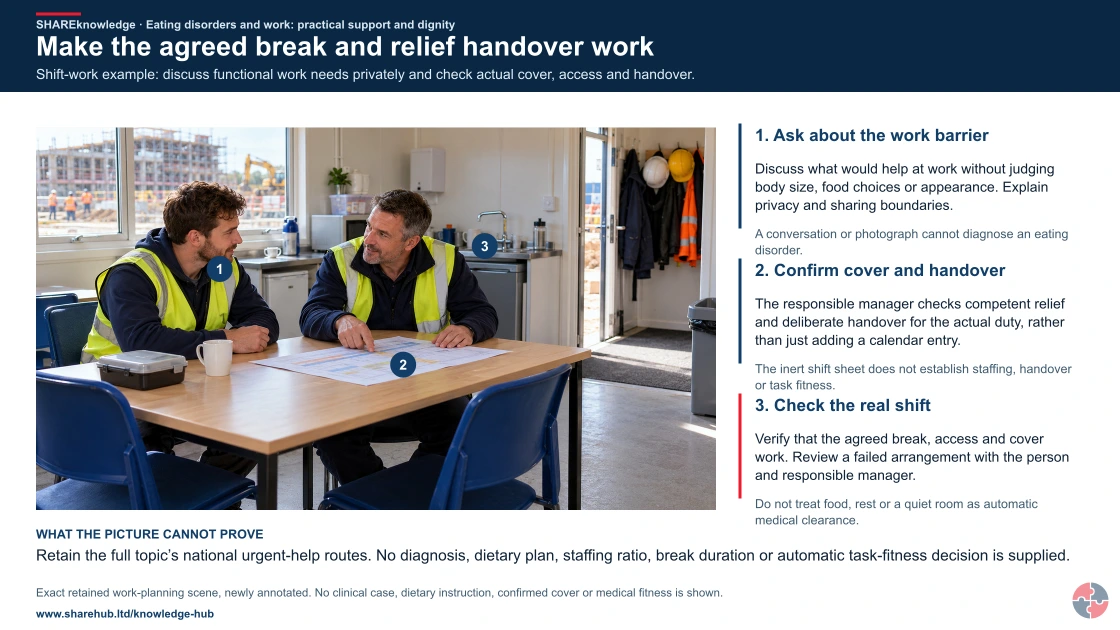
Full written explanation
Shift-work example: discuss functional work needs privately and check actual cover, access and handover.
- Ask about the work barrier. Discuss what would help at work without judging body size, food choices or appearance. Explain privacy and sharing boundaries.
- Confirm cover and handover. The responsible manager checks competent relief and deliberate handover for the actual duty, rather than just adding a calendar entry.
- Check the real shift. Verify that the agreed break, access and cover work. Review a failed arrangement with the person and responsible manager.
Change the pathway
- No appearance-based judgement. A conversation or photograph cannot diagnose an eating disorder.
- Paper is not actual cover. The inert shift sheet does not establish staffing, handover or task fitness.
- Work support is not treatment. Do not treat food, rest or a quiet room as automatic medical clearance.
Evidence check: Retain the full topic’s national urgent-help routes. No diagnosis, dietary plan, staffing ratio, break duration or automatic task-fitness decision is supplied.
Private conversations, actual relief arrangements and lawful information handling
Primary references: NHS: eating disorders and qualified help · Acas: individual reasonable adjustments (GB) · ICO: workers’ health information — check current guidance
Open the complete HD image (new tab)Download image

Private conversations, actual relief arrangements and lawful information handling
Primary references: NHS: eating disorders and qualified help · Acas: individual reasonable adjustments (GB) · ICO: workers’ health information — check current guidance

Ask and agree
Discuss practical work needs privately without making assumptions about appearance, diagnosis or food choices.
Make cover usable
Name the worker, relief and manager responsibilities; confirm competent cover, access and timing rather than merely scheduling a break.
Check and respond
Check whether the handover works on the real shift. Use the appropriate urgent route at any point if there is an immediate safety concern.
The existing break-planning map remains available. A workplace arrangement does not diagnose or treat an eating disorder.
What are eating disorders and why can they be serious?
Eating disorders are mental health conditions that affect eating and can harm physical health. They can affect people of any body size; neither appearance nor a diagnosis label tells a manager whether someone is safe to work.
Anorexia nervosa, bulimia nervosa, binge eating disorder and other specified feeding or eating disorders (OSFED) have different patterns. Avoidant/restrictive food intake disorder (ARFID) can involve sensory sensitivities, fear after an upsetting eating experience or little interest in food; concern about weight or shape is not its cause. The NHS overview explains these differences and encourages early GP help.
Restriction and some compensatory behaviours can disturb nutrition, hydration and the balance of salts needed by the body. Serious physical illness may therefore be present even when someone looks well. Longer-term effects can include bone and other physical-health problems, alongside distress and difficulty concentrating. NICE NG69 requires clinical assessment of physical and mental risk and warns against relying on a single measure such as body mass index (BMI) to decide access to treatment.
These conditions are not a failure of willpower. Their causes are complex and recovery varies. A workplace can remove avoidable barriers and support access to care, but should not prescribe food, exercise, weight targets or treatment. Use the Northern Ireland health information for the local GP and specialist-care route.
What key facts should people know first about eating disorders at work?
Eating disorders are serious health conditions, and workplace support should be confidential, non-judgemental and clinically bounded.
This is workplace guidance only
The page explains workplace support and risk management; it does not diagnose, treat or replace NHS or clinical advice.
Appearance is not a reliable guide
A person can be seriously unwell at any body size, so do not make assumptions based on weight.
Language matters
Comments about weight, dieting, body shape, food choices or appearance can be harmful and should be avoided.
Work may help or hinder
Breaks, shifts, workload, stress, bullying, public comments, travel and food access can affect recovery or distress.
Confidentiality is essential
Health information should be limited, purposeful, secure and shared only where there is a proper need.
Safety can matter
Fatigue, faintness, medication, concentration or physical deterioration may affect safety-sensitive duties and require competent advice.
What signs may indicate that a supportive conversation is needed?
Signs are prompts for care and support, not proof of an eating disorder.
Managers should avoid diagnosing or making assumptions. A worker may show fatigue, dizziness, faintness, mood change, withdrawal, concentration problems, frequent absence after breaks, distress around meal times, changes in performance, or concern from colleagues. These signs can have many causes, so the right response is a private, gentle conversation about wellbeing and work support.
The opening should be simple: 'I have noticed you do not seem yourself, and I wanted to check whether anything at work is making things harder or whether any support would help.' Avoid comments such as 'you look thin', 'you look well', 'are you eating?' or jokes about dieting, weight or body shape.
Do not monitor a colleague’s meals, bathroom visits or body size to build a case. If you observe a work difficulty, name that difficulty and offer support. A worker can request help with breaks or duties without making a public disclosure.
How can eating disorders affect work?
Eating disorders can affect work through energy, concentration, mood, attendance, confidence, physical capability and safety-sensitive tasks.
The same condition can affect two people very differently. One person may work normally with small adjustments; another may need time off, clinical treatment, occupational health advice or temporary changes to duties. The employer should focus on function, risk and support rather than diagnosis.
Potential work impacts include fatigue, reduced concentration, dizziness, sensitivity to comments, anxiety around social eating, difficulty with shift patterns, attendance changes, reduced confidence, strained relationships, or difficulty with physically demanding or safety-critical tasks. Workload and culture can either support recovery or add pressure.
Separate three decisions: does the person need medical help now; can the current task be done safely; and what work change would remove a barrier? A worker may need help with one of these without needing restrictions in every part of their role.
How do I choose between support, urgent advice and an emergency?
Respond to immediate danger first. Stop an unsafe task, use first-aid and emergency arrangements, and seek clinical help according to the symptoms. A routine HR meeting or occupational-health referral must not delay urgent care.
Choose support, urgent advice or emergency help


Read the complete visual as text
- Start: Concern raised at work
- Question 1: Immediate danger or emergency signs? Decision owner: Worker and responsible manager; first aider or clinical service for urgent help.
- YES — EMERGENCY: Stop unsafe work, get first aid and call 999 for an emergency. Follow the call handler; emergency responders take over. Owner: Worker and responsible manager; first aider or clinical service for urgent help. STOP / REFER → APPROPRIATE RESPONSE.
- NO: Continue the work-safety and clinical checks. Owner: Worker and responsible manager; first aider or clinical service for urgent help. CONTINUE → QUESTION 2.
- UNKNOWN: Protect the person, pause unsafe duties and obtain immediate appropriate help; do not wait for a routine meeting. Owner: Worker and responsible manager; first aider or clinical service for urgent help. STOP / REFER → APPROPRIATE RESPONSE.
- Question 2: Can the present task be done safely? Decision owner: Worker and responsible manager; first aider or clinical service for urgent help.
- YES: Continue the separate urgent-health check. Owner: Worker and responsible manager; first aider or clinical service for urgent help. CONTINUE → QUESTION 3.
- NO / UNSURE: Pause or arrange safe relief and contact the responsible manager. The urgent-health check still applies. Owner: Worker and responsible manager; first aider or clinical service for urgent help. CONTINUE → QUESTION 3.
- Question 3: Urgent health advice needed? Decision owner: Worker and responsible manager; first aider or clinical service for urgent help.
- YES: Contact the GP, treatment team or locally available urgent care. Clinical advice and a safe individual work plan are needed. Owner: Worker and responsible manager; first aider or clinical service for urgent help. STOP / REFER → APPROPRIATE RESPONSE.
- NO: Hold a private support conversation, agree changes, an owner and a review trigger. Owner: Worker and responsible manager; first aider or clinical service for urgent help. OUTCOME → RECORD AND HAND OVER.
- UNKNOWN: Seek appropriate clinical advice while the affected duty remains held. HR, occupational health and EAP do not replace urgent care. Owner: Worker and responsible manager; first aider or clinical service for urgent help. STOP / REFER → APPROPRIATE RESPONSE.
- Outcome: Keep clinical help, safe work arrangements and routine support in their proper routes.
- Stop and escalation boundary: After a faint, serious signs include abnormal breathing, incomplete recovery, chest pain or irregular heartbeat, seizure or serious injury. Immediate mental-health danger also needs emergency help. Urgent routes vary by nation; NI uses GP or GP out of hours. No BMI, food or appearance clearance.
Emergency: call 999 for life-threatening illness or injury, or if someone cannot be kept safe because of an immediate mental-health crisis. After a faint, emergency signs include abnormal breathing, not recovering fully, chest pain or an irregular heartbeat, a seizure or serious injury. Follow the call handler’s instructions and the site emergency plan. The NHS fainting guidance gives the fuller emergency criteria; NHS crisis guidance covers immediate mental-health danger.
Urgent but not immediately life-threatening: seek prompt clinical advice for worsening physical or mental health through the person’s GP, existing treatment team or the local urgent-care service. In England, NHS 111 can direct urgent mental-health help. In Northern Ireland, contact the GP or GP out-of-hours service when the practice is closed. Scotland and Wales have their own NHS urgent-care arrangements; confirm the local route in the workplace plan. Do not treat an EAP as an emergency service.
Ongoing concern: encourage early GP help, offer a private work-support conversation and explain available HR, occupational-health and EAP routes. After any faint, medical review is appropriate even if the person recovers. Do not assume the cause is an eating disorder.
How can the hierarchy of controls reduce harmful work pressures for people with eating disorders?
The person or diagnosis is not the hazard. Unpredictable breaks, excessive demands, stigma and poor relief cover can add distress or obstruct an agreed support plan. If faintness or impaired concentration makes a particular duty unsafe, pause that duty and get the right help.
Work may not cause an eating disorder, but HSE notes that work can aggravate existing mental-health difficulties. The harm chain starts with a work demand or barrier, reaches someone through repeated exposure or missed support, and may increase distress, fatigue or difficulty concentrating. The physical effects of an eating disorder require clinical assessment; a manager must not attribute a symptom to work or declare a diagnosis from its appearance. In a safety-sensitive task, delayed response or loss of concentration can also expose the worker or others to immediate injury. Severity depends on the actual task, duration and intensity of work pressure, effective relief, the person’s current functional state and prompt access to care.
| Work factor | Route to harm | Plausible effect or injury | Warning and action |
|---|---|---|---|
| Unpredictable break with no relief | Repeated inability to use an agreed support arrangement; work pressure and fatigue accumulate. | Distress or reduced concentration; in a safety-sensitive role an error could injure the worker or others. | Missed cover or current unsafe concentration: duty manager resolves cover or pauses duty. |
| Weight or food comments and pressure | Public comments or a workplace weight-loss campaign create stigma and may delay asking for help. | Psychological distress and reduced help-seeking; condition impact varies by person. | Report conduct, stop the campaign or behaviour, and offer a private support route. |
| Long driving or isolated duty | A route or lone assignment blocks an agreed break or timely help when symptoms change. | Fatigue or faintness may impair driving; a crash could cause impact injury. | Faintness, confusion or unsafe driving: stop safely and use urgent-help route. |
| Unsafe task after new symptoms | Faintness, confusion or impaired concentration affects observation or response. | A fall or missed hazard can injure the worker or another person; clinical risk needs assessment. | Pause the affected task, arrange safe cover and seek first aid or 999 when indicated. |
HSE Management Standards and HSENI guidance support organisational assessment of demands, control, support, relationships, role and change. They do not diagnose an eating disorder. NICE clinical guidance means physical or mental risk is for qualified assessment, not a manager’s BMI threshold.
How should HSE control hierarchy be adapted to work design?
Apply the HSE hierarchy of controls to harmful work conditions: end stigmatising campaigns and missed-break rotas, then redesign tasks and provide dependable support before relying on procedures. The worker and their condition are not hazards, and personal protective equipment does not treat an eating disorder. Check that agreed controls work on actual shifts.
How can the ERICPD hierarchy of controls reduce harmful work pressures for people with eating disorders?

| Control option | Control and how it breaks harm | Owner and check | Evidence or failure |
|---|---|---|---|
| Elimination | End weight-loss contests, degrading comments and a rota that knowingly prevents the agreed break. This removes avoidable pressure or barrier. | Senior manager and shift planner. | Campaign withdrawn; rota can deliver the break. Repeated comments or missed cover fail. |
| Reduce exposure; test substitution | Replace a mandatory weight-focused event with optional weight-neutral communication if communication is still needed. Separately adjust workload, shift sequence or a safety-sensitive assignment with the worker and provide competent relief. Rota changes are administrative work redesign, not substitution. | Line manager with worker and occupational health where needed. | The replacement activity is voluntary and neutral; the individual plan works on actual shifts. Repeated fatigue or missed relief triggers review. |
| Control of harmful encounters | Do not isolate the person. Temporary separation from a specific harmful encounter may help while misconduct is stopped; separate confidential health details from public rotas. Physical separation alone cannot repair the work system. | Manager and privacy lead. | No diagnosis on shared rota; harmful behaviour addressed. Exclusion or persistent conduct fails. |
| Engineering and administrative controls | Physical/operational: usable private welfare space and dependable relief handover. Administrative: clear rota, private conversation, adjustment review, first-aid and urgent-care route. These make support available and catch changed conditions. | Duty manager, HR and responsible site lead. | Relief observed, space available, action/review recorded. No cover or emergency route stops the affected duty. |
| PPE for separate task hazards | No eating-disorder PPE. Use PPE only for a separate assessed physical task hazard; it cannot prevent stigma, missed breaks or clinical harm. | Task safety lead. | No invented PPE rule; separate PPE assessment exists where the job itself requires it. |
| Administrative assurance | Train managers to follow the agreed plan, protect privacy, check break delivery and act on failures. This sustains higher controls and is not punishment for symptoms. | Senior and line managers. | Observed handovers and closed actions; repeated bypass or delayed urgent help fails. |
How can the ISO 45001 hierarchy of controls reduce harmful work pressures for people with eating disorders?

| Control option | Control and how it breaks harm | Owner and check | Evidence or failure |
|---|---|---|---|
| Elimination | End weight-loss contests, degrading comments and a rota that knowingly prevents the agreed break. This removes avoidable pressure or barrier. | Senior manager and shift planner. | Campaign withdrawn; rota can deliver the break. Repeated comments or missed cover fail. |
| Reduce exposure; test substitution | Replace a mandatory weight-focused event with optional weight-neutral communication if communication is still needed. Separately adjust workload, shift sequence or a safety-sensitive assignment with the worker and provide competent relief. Rota changes are administrative work redesign, not substitution. | Line manager with worker and occupational health where needed. | The replacement activity is voluntary and neutral; the individual plan works on actual shifts. Repeated fatigue or missed relief triggers review. |
| Control of harmful encounters | Do not isolate the person. Temporary separation from a specific harmful encounter may help while misconduct is stopped; separate confidential health details from public rotas. Physical separation alone cannot repair the work system. | Manager and privacy lead. | No diagnosis on shared rota; harmful behaviour addressed. Exclusion or persistent conduct fails. |
| Engineering and administrative controls | Physical/operational: usable private welfare space and dependable relief handover. Administrative: clear rota, private conversation, adjustment review, first-aid and urgent-care route. These make support available and catch changed conditions. | Duty manager, HR and responsible site lead. | Relief observed, space available, action/review recorded. No cover or emergency route stops the affected duty. |
| PPE for separate task hazards | No eating-disorder PPE. Use PPE only for a separate assessed physical task hazard; it cannot prevent stigma, missed breaks or clinical harm. | Task safety lead. | No invented PPE rule; separate PPE assessment exists where the job itself requires it. |
| Administrative assurance | Train managers to follow the agreed plan, protect privacy, check break delivery and act on failures. This sustains higher controls and is not punishment for symptoms. | Senior and line managers. | Observed handovers and closed actions; repeated bypass or delayed urgent help fails. |
ERICPD is a planning aid here: eliminate a harmful campaign or impossible break rota; reduce demand by changing workload or shift sequence; test substitution only when an identified harmful work activity must be replaced, such as replacing a mandatory weight-focused event with optional weight-neutral communication; isolate a specific harmful encounter without isolating the worker; control remaining exposure through reliable relief, privacy and review; use PPE only for a separate physical task hazard; and use Discipline to sustain checks. In the five-level hierarchy, removal is elimination, a genuine replacement of the harmful activity is substitution, dependable physical welfare access and task design are engineering or operational controls, and rota changes, agreed conversations and follow-up are administrative controls. PPE has no role in treating the condition. The line manager checks actual shifts with the worker and stops the affected safety-sensitive duty if relief fails or concentration becomes unsafe.
A changed duty can create a new risk if it removes supervision or leaves an unqualified relief worker; verify task competence and coverage. A private room helps only if the person can actually access it. For immediate danger, the emergency route takes priority over completing a work-design form.
What changes in different workplaces?
The same barriers can occur in several sectors, but each task has a different safe handover. These examples do not assume that a worker with an eating disorder is unfit for work.
| Sector | Task and people | Work barrier and plausible harm | Strongest feasible controls | Check or stop point |
|---|---|---|---|---|
| Manufacturing | Production operator and nearby colleagues on a paced line. | No competent relief for an agreed break adds distress or fatigue; lost attention near machinery could injure someone. | Plan competent relief and actual line handover; adjust pace or staffing; keep machine safeguards. | Supervisor checks cover. If attention is unsafe, pause the task under the line procedure. |
| Construction | Site worker assigned a remote work area with changing break access. | Unplanned travel or absent welfare access frustrates agreed support; faintness at height or near plant could cause injury. | Plan accessible welfare and relief with the contractor; avoid safety-sensitive assignment until an individual safe plan is clear. | Site lead checks access after changes; new faintness stops the affected task. |
| Hospitality | Kitchen worker during a peak service; colleagues and customers nearby. | High pace and weight-related comments add stress and delay a private request for support; distraction around hot equipment may cause burns. | Stop comments, adjust task sequence, provide predictable relief and a private manager contact. | Service manager confirms handover; unsafe concentration or missed cover prompts pause and review. |
| Logistics | Delivery driver on a route with planned stops; road users affected. | A route that defeats the agreed break and new faintness can impair safe driving; a collision can injure others. | Build feasible stops into the route, agree a reporting and replacement-driver plan, seek clinical/occupational advice for uncertainty. | Fleet lead checks route and cover; symptoms affecting driving mean stop safely and get help. |
For each setting, the employer should ask what part of the work is actually harmful, whether a safe adjustment can be delivered, and what would trigger clinical advice or an emergency response. No general staffing ratio, break interval, fitness certificate or food plan is set here.
Which workplace adjustments may help?
Adjustments should be individual, confidential, reviewed and focused on removing work barriers.
Adjustments should not be assumed from a diagnosis or imposed without discussion. Useful changes may include protected meal breaks, flexibility around appointments, adjusted workload, temporary duties, reduced travel, quieter space, predictable shift patterns, avoiding food-focused team events, phased return or a named manager contact.
Where the condition may amount to a disability under equality law, reasonable adjustments should be considered promptly. Even where equality law does not apply, supportive adjustments may still be good risk management and good employment practice.
| Adjustment | When it may help | Review point |
|---|---|---|
| Protected breaks | Where breaks are missed, interrupted or difficult to take. | Are breaks actually being taken without stigma? |
| Appointment flexibility | Where treatment or GP appointments are needed. | Is absence handled confidentially and fairly? |
| Workload review | Where demands, pace or fatigue affect recovery. | Are priorities realistic? |
| Temporary duties | Where safety-sensitive or physical work is affected. | Has occupational health advised? |
| Communication plan | Where the worker wants a named contact and privacy boundaries. | Who needs to know what? |
| Phased return | Where absence or treatment affects stamina. | Is the plan progressing without pressure? |
The legal routes differ: Acas guidance explains reasonable adjustments under the Equality Act in Great Britain; nidirect explains the Disability Discrimination Act route in Northern Ireland. The duty depends on the facts, not simply the diagnostic label. Begin practical discussions promptly rather than waiting for someone to become visibly unwell.
How should managers talk about eating-disorder-related concerns?
Managers should speak privately, calmly and respectfully, focusing on support and work impact rather than appearance or diagnosis.
What at work would help?


Read the complete visual as text
- Listen privately
- Ask about the work barrier
- Agree changes and review
- A private work-support conversation concerns the barrier and possible adjustments. Appearance does not establish a diagnosis or fitness for a task.
A good conversation starts with care and observation, not accusation. Use neutral language: 'I have noticed you seem under pressure' or 'I wanted to check whether any support at work would help.' Let the worker decide what to disclose. Ask what work factors are making things harder, what support may help, and whether they would like HR, occupational health or another person involved.
Avoid comments about body size, weight, appearance, dieting, willpower, food choices or whether the person 'looks healthy'. Avoid promising absolute confidentiality if there may be a serious safety or safeguarding concern; instead explain that information will be kept as private as possible and shared only if needed to protect safety or arrange support.
Close the conversation with an action: “We can arrange relief cover so you can take the agreed break. I will confirm that with the duty manager without sharing your diagnosis. Let us agree when to check whether it works.” If the person declines to discuss health, respect that choice while addressing any observed immediate safety issue.
When should safety-sensitive work be reviewed?
Safety-sensitive work should be reviewed when symptoms, fatigue, faintness, medication, concentration or physical capability could affect safe performance.
Eating disorders can involve physical and mental effects that may matter for safety-critical tasks. A person may be able to work safely with no change, or may need temporary support. The review should be proportionate and confidential, and should normally use occupational health or competent advice where the risk is unclear.
Examples include driving, operating machinery, lone working, work at height, confined spaces, emergency response, healthcare, childcare, security, lifting, hazardous substances or roles requiring sustained attention. The aim is not to exclude the person; it is to make the work safe while supporting dignity and recovery.
| Prompt | Why it matters | Action |
|---|---|---|
| Faintness or collapse | Immediate physical safety may be affected. | First aid/NHS route and work review. |
| Reduced concentration | Errors may affect the worker or others. | Review task risk and workload. |
| Medication effects | Drowsiness or other effects may matter. | Seek OH/medical advice on work impact. |
| Driving or machinery | Loss of concentration or physical weakness can be high consequence. | Temporary restriction or adjustment if needed. |
| Lone work | Support may be delayed if symptoms worsen. | Review contact and escalation arrangements. |
Hold point: where faintness, confusion or impaired concentration makes the current task unsafe, pause that duty and obtain help. Do not use a snack, a brief rest, a reassuring appearance or a BMI value as clearance to resume driving, machinery work, lifeguarding or another safety-sensitive role. The responsible manager must confirm a safe arrangement, informed by occupational-health or clinical advice where needed. Record the functional restriction and review trigger rather than an unsupported permanent ban.
How would Riverside manage a difficult shift safely and respectfully?

A useful plan protects the worker’s agreed support and the safety of others, states who can change the work, and leaves a small, confidential record. The following is a worked example, not a staffing prescription.
Keep practical adjustments and health-information handling distinct
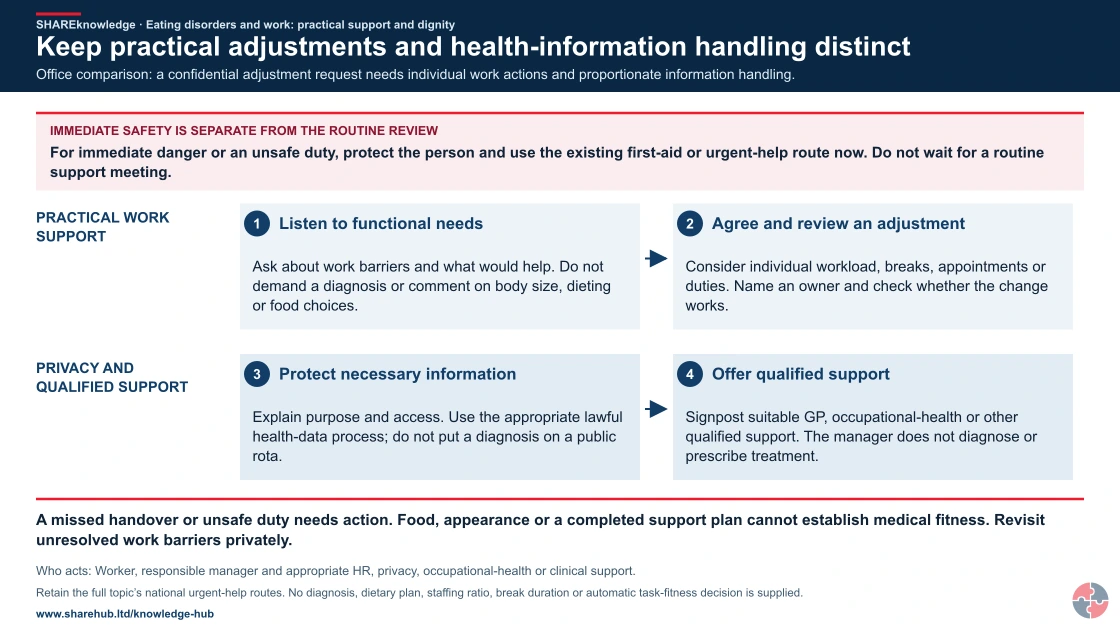
Full written explanation
For immediate danger or an unsafe duty, protect the person and use the existing first-aid or urgent-help route now. Do not wait for a routine support meeting.
An immediate-help band is separate from two routine parallel lanes. The work lane listens to functional needs and agrees/reviews an individual adjustment. The privacy/support lane limits information through the appropriate lawful process and offers qualified support. Agreement about sharing does not by itself establish a data-protection basis, and routine support cannot delay urgent assistance.
Office comparison: a confidential adjustment request needs individual work actions and proportionate information handling.
- Listen to functional needs. Ask about work barriers and what would help. Do not demand a diagnosis or comment on body size, dieting or food choices.
- Agree and review an adjustment. Consider individual workload, breaks, appointments or duties. Name an owner and check whether the change works.
- Protect necessary information. Explain purpose and access. Use the appropriate lawful health-data process; do not put a diagnosis on a public rota.
- Offer qualified support. Signpost suitable GP, occupational-health or other qualified support. The manager does not diagnose or prescribe treatment.
When the evidence does not fit: A missed handover or unsafe duty needs action. Food, appearance or a completed support plan cannot establish medical fitness. Revisit unresolved work barriers privately.
Who acts: Worker, responsible manager and appropriate HR, privacy, occupational-health or clinical support.
Changed workplace
Shift work: Verify competent relief, handover and usable access to the agreed break.
Office adjustment: Agree individual work actions and proportionate health-information handling.
Evidence check: Retain the full topic’s national urgent-help routes. No diagnosis, dietary plan, staffing ratio, break duration or automatic task-fitness decision is supplied.
Private conversations, actual relief arrangements and lawful information handling
Primary references: NHS: eating disorders and qualified help · Acas: individual reasonable adjustments (GB) · ICO: workers’ health information — check current guidance
Open the complete HD image (new tab)Download image

Private conversations, actual relief arrangements and lawful information handling
Primary references: NHS: eating disorders and qualified help · Acas: individual reasonable adjustments (GB) · ICO: workers’ health information — check current guidance
Plan cover · confirm handover · protect the break


Read the complete visual as text
- Plan cover
- Confirm handover
- Protect the break
- An illustrative individual break arrangement. The duty manager maintains competent coverage under the actual pool plan. This scene does not prescribe staffing ratios or establish medical fitness.
Check an agreed break arrangement


Read the complete visual as text
- Start: An individually agreed break is due; normal planning has already occurred.
- Question 1: New symptoms or unsafe conditions? Decision owner: Riverside duty manager with competent relief and the worker.
- YES: Pause the unsafe duty. Use the support or urgent-help route; no automatic return after food or rest. Owner: Riverside duty manager with competent relief and the worker. STOP / REFER → APPROPRIATE RESPONSE.
- NO: Check competent relief. Owner: Riverside duty manager with competent relief and the worker. CONTINUE → QUESTION 2.
- UNKNOWN: Protect the person and keep the unsafe duty paused while the manager obtains suitable advice. Owner: Riverside duty manager with competent relief and the worker. HOLD → OWNER RESOLVES BEFORE RESUMING.
- Question 2: Is competent relief available under the site plan? Decision owner: Riverside duty manager with competent relief and the worker.
- YES: Check that handover is confirmed. Owner: Riverside duty manager with competent relief and the worker. CONTINUE → QUESTION 3.
- NO / UNKNOWN: Duty manager resolves cover or changes the operation safely. Recheck relief only after actual cover is confirmed. Owner: Riverside duty manager with competent relief and the worker. HOLD → REPEAT QUESTION 2 AFTER CORRECTION.
- Question 3: Has the handover been confirmed? Decision owner: Riverside duty manager with competent relief and the worker.
- YES: Take the agreed break with safe cover in place; keep the symptoms/conditions interrupt active. Owner: Riverside duty manager with competent relief and the worker. CONTINUE → QUESTION 4.
- NO / UNKNOWN: Hold the handover and contact the duty manager. Repeat this check after deliberate handover confirmation. Owner: Riverside duty manager with competent relief and the worker. HOLD → REPEAT QUESTION 3 AFTER CORRECTION.
- Question 4: Did the arrangement work? Decision owner: Riverside duty manager with competent relief and the worker.
- YES: Confirm next shift and the agreed review trigger. Owner: Riverside duty manager with competent relief and the worker. OUTCOME → RECORD AND HAND OVER.
- NO / UNKNOWN: Review the barrier privately with the worker and responsible manager; record the revised arrangement and owner. Owner: Riverside duty manager with competent relief and the worker. HOLD → OWNER RESOLVES BEFORE RESUMING.
- Outcome: Record the next shift arrangement or the revised arrangement and its owner.
- Stop and escalation boundary: This does not assess medical fitness, set break duration or replace the pool operating plan. At every stage: New symptoms or unsafe conditions interrupt all steps and use the support or urgent-help route.
Riverside Leisure Ltd
Riverside Leisure Ltd is used here as a leisure operator with gyms, pools, hospitality areas, outdoor activities, public-facing staff and varied shift patterns.
A poolside shift with missed break cover
Task material and setting: Riverside wants a lifeguard to complete a busy indoor-pool shift while maintaining safe surveillance and an agreed break arrangement. The work involves observation, communication equipment and potential emergency response in a noisy, warm environment. The worker has privately reported an eating disorder and says unpredictable breaks are a barrier.
People and prerequisites: The worker, other lifeguards, swimmers, duty manager and an agency relief worker may be affected. The worker’s role competence remains relevant. Before assigning duties, the manager needs the current pool operating plan, competent relief cover, a private adjustment discussion and functional occupational-health advice if fitness is uncertain. A diagnosis alone does not justify exclusion.
Before: Agree the practical break arrangement with the worker and check that it can be staffed. Tell the agency supervisor only the coverage and handover information needed. Confirm first-aid access, the named contact and what change would trigger review. Hold the assignment if required surveillance or break cover cannot be maintained; the duty manager must resolve staffing or alter the operation under the pool plan.
During: Use the planned handover and verify that cover has actually arrived. The worker can report difficulty without explaining the diagnosis to colleagues. If relief is late, the manager arranges competent cover or changes the operation under the site plan; the worker is not left to choose between an agreed break and an unattended pool.
Hold or stop: Dizziness, faintness, confusion or loss of safe concentration requires immediate help and removal from the unsafe duty through the emergency or relief arrangement. Collapse or other emergency signs trigger first aid and 999 as appropriate. Do not send a person who may faint to drive home, leave them unsupported while waiting for help, or let a quick snack serve as fitness clearance. Unknown or conflicting functional advice requires occupational-health or clinical clarification before safety-sensitive duties resume.
Completion and hand-back: The duty manager checks safe cover, the worker’s immediate support and the next shift’s arrangement. Resuming safety-sensitive duties requires an individual decision using current functional advice where needed. Check privately whether the adjustment worked; revisit it after a rota, role or health change. There is no generic waiting period or certificate expiry invented for this decision.
Evidence: Keep a restricted adjustment note containing the barrier, agreed arrangement, responsible manager, information-sharing boundary and review trigger. Keep operational cover and any incident records in their proper systems with minimum necessary health information. Report missed-break trends to management without identifying the worker.
Changed conditions: If a staff room is unavailable, agree an acceptable alternative before the shift rather than simply cancelling the break. If a radio or alarm is defective, apply the equipment-defect and pool operating procedure separately; an individual support plan cannot compensate for failed emergency communication.
Other settings: For a contractor on an outdoor event, the site manager and contractor employer should agree who provides relief, private welfare space and emergency help. For an office worker attending treatment, appointment flexibility and workload planning may be sufficient; a safety-sensitive restriction should not be copied across without a task-based reason.
How should confidentiality and health information be handled?
Health information about eating disorders should be handled as sensitive information with clear purpose, minimal sharing and appropriate protection.
Share what the job needs


Read the complete visual as text
- Restricted record: Work barrier, agreed action and review. Keep health information restricted to the lawful purpose and necessary access.
- Shift instruction: Relief role and handover. Give those implementing cover only the information they need.
- Lawful health-data process: The manager checks the appropriate basis, security and information-sharing boundary. Never put a diagnosis on a public rota.
A worker does not need to tell everyone their diagnosis to receive support. Managers should normally record only what is necessary: work impact, agreed adjustments, review date and who needs to know. Detailed clinical information should usually be handled by occupational health or qualified professionals, not informal line-management notes.
The ICO guidance on workers' health information is important here. Employers should be clear why they need health information, collect the minimum necessary, keep it secure, tell workers how it will be used, and avoid using it in unexpected or unfair ways. Confidentiality should only be overridden where there is a proper safety, safeguarding or legal reason.
| Control | What good looks like | Poor practice |
|---|---|---|
| Purpose | Explain why information is needed and how it will support work. | Collecting medical details out of curiosity. |
| Minimum information | Record work impact and adjustments rather than unnecessary clinical detail. | Detailed notes shared widely. |
| Need to know | Share only with people who need information to implement support. | Telling colleagues without agreement. |
| Secure records | Store health information securely with retention rules. | Keeping notes in informal emails or chats. |
| Review | Check whether information is still needed. | Retaining old health details indefinitely. |
Legal baseline across the UK: identify a lawful basis and an additional special-category condition before processing health information. A worker’s agreement about who may know an adjustment is not automatically valid data-protection consent; the employment power imbalance matters. HR or the privacy lead should apply current ICO guidance. Share necessary information with emergency responders when justified, explaining what was shared when practicable.
Which duties apply in Great Britain and Northern Ireland?
Employers must manage work-related health and safety risks, meet applicable disability duties and handle health information lawfully. Great Britain and Northern Ireland have different health-and-safety and disability legislation; data-protection duties apply across the UK.
The table distinguishes legal regimes. The support measures on this page are practical examples whose suitability depends on the person and job. They are not fixed clinical rules or guaranteed entitlements in every case.
| Where | Legal basis | What the employer should establish |
|---|---|---|
| Great Britain | Health and Safety at Work etc Act 1974; Management of Health and Safety at Work Regulations 1999 | Assess work risks and act on the findings, including harmful work stressors. Use HSE guidance to apply this to work design. |
| Northern Ireland | Health and Safety at Work Northern Ireland Order 1978; Management of Health and Safety at Work Regulations Northern Ireland 2000 | NI employer and risk-assessment duties apply. HSENI confirms the Article 4 and regulation 3 routes. |
| Great Britain | Equality Act 2010 | An eating disorder may meet the disability definition. Assess substantial and long-term effects and the disadvantage at work; make reasonable adjustments where the duty applies. Use Acas guidance. |
| Northern Ireland | Disability Discrimination Act 1995 as amended and applicable in NI; official NI employment-rights guidance | Use the NI disability framework for discrimination and adjustment decisions. Do not substitute the Equality Act employment provisions. |
| United Kingdom | UK GDPR; Data Protection Act 2018 | Apply a lawful basis, a special-category condition and proportionate safeguards. Consult ICO health-data guidance. |
Separate categories: HSE and HSENI Management Standards are guidance approaches to managing work stress. SHARE conversation and review suggestions are good practice. Riverside’s arrangements below are example company rules. No product-supply marking regime or eating-disorder-specific PPE requirement is created by this page.
How should eating-disorder-related wellbeing risks appear in the risk register?
The risk register should capture work factors, support pathways, confidentiality controls and review triggers without recording unnecessary medical detail.
Do not create a risk register entry that labels a worker. Record the work-related risk area instead: meal-break access, shift patterns, fatigue, safety-sensitive duties, stressors, manager training, confidentiality or support pathway. Individual records should be proportionate, secure and restricted.
The risk register should show whether the organisation has a system for sensitive wellbeing topics, not expose private medical information.
| Field | Example | Evidence |
|---|---|---|
| Work factor | Unpredictable breaks in customer-facing shifts. | Rota review and break compliance checks. |
| People affected | Workers with health, recovery or wellbeing needs. | Anonymous trend or role-based risk assessment. |
| Control | Protected breaks, manager guidance and support pathway. | Procedure and training records. |
| Confidentiality | Health information only shared on need-to-know basis. | Access control and privacy note. |
| Review trigger | Disclosure, absence trend, stress findings or safety concern. | Review record and action log. |
What training is needed for eating disorders and workplace wellbeing?
Training should help people respond respectfully, protect confidentiality and know the boundary between support and clinical advice.
General awareness should be short, stigma-reducing and clear that eating disorders can affect anyone. It should avoid graphic content, diet culture and appearance-based messages. It should signpost official support and explain how to raise concerns.
Managers need deeper training on private conversations, work adjustments, confidentiality, data protection, stress risk factors, safety-sensitive duties, occupational health referral and escalation where serious risk is disclosed. HR and wellbeing leads need specialist process training so sensitive cases are handled consistently.
Use short scenarios to check whether managers can distinguish a support request, an unsafe task and an emergency; ask them to practise the handover to the right service. Decide learning and refresher needs from responsibilities, changes and observed gaps. No general eating-disorder awareness certificate or universal renewal period is required by the sources used here.
| Role | Learning and demonstration | Assessment and record | Recheck trigger |
|---|---|---|---|
| All workers and new starters | Recognise a support route and emergency signs without diagnosing a colleague or commenting on appearance. | Supervisor checks a short scenario; induction record shows the signposting route. | New support route, harmful language or observed misunderstanding. |
| Line managers and supervisors | Practise a private, non-judgemental conversation, adjustment request, task-risk decision and urgent escalation. | HR or competent lead observes role-play and retains a limited training/decision record without unnecessary health detail. | Changed duties, disclosure, unsafe task, near miss or observed response gap. |
| HR and wellbeing leads | Route adjustments, consent, information minimisation, occupational-health referral and GB/NI differences. | Competent HR/privacy reviewer checks case simulation and records process decisions. | Law or policy change, complaint or audit finding. |
| Senior managers and safety advisers | Identify work demands, privacy and adjustment barriers; fund systemic changes and check whether actions help. | Competent adviser and leadership team review risk assessment, consultation and closed actions. | Work redesign, repeated cases, incident or trend change. |
How does this topic support study and professional development?
It supports study by showing how wellbeing topics connect to risk assessment, work design, confidentiality and management competence.
For NEBOSH General Certificate style study, this topic links to health and safety management, worker wellbeing, work-related stress, consultation, competence and legal duties. A strong answer would not try to diagnose; it would identify work factors, support routes, privacy, adjustments and review.
For professional development, the key learning is that managers are not clinicians. Their role is to create safe work, respond to concerns, signpost to qualified help, protect privacy and review work barriers.
For study, explain why a diagnosis does not establish work fitness, compare the GB and NI legal routes, and identify the smallest useful adjustment record. Test the answer against the Riverside example: who acts when break cover fails, and what information does the agency worker actually need?
How can management systems keep support dependable?
Give someone responsibility for work-design controls, confidential support routes and review of whether agreed changes happen in practice. Check outcomes with workers, not only whether a policy exists.
Official management guidance: HSE Managing for health and safety (HSG65)
HSE’s work-related stress Management Standards guide assessment of demands, control, support, relationships, role and change. They support work-design action, not a clinical diagnosis. HSE work-related stress Management Standards (official source).
Managers can use missed-break reports, time to implement adjustments and confidential worker feedback to find repeated failures. Check whether workload or rostering changes have worked. Avoid collecting diagnoses or treatment details to create a wellbeing score.
What are the warning signs that workplace support is weak?
Warning signs appear when managers diagnose, gossip, ignore work factors or treat sensitive health information casually.
Weak support can cause harm by delaying help-seeking, increasing shame, worsening stress, damaging trust, causing unfair treatment or making safe work harder. A poor response may also create legal, data protection, equality or employment relations risk.
The practical test is whether a worker would feel safe raising a concern. If the answer is no, the organisation needs to improve culture, manager training and confidentiality controls.
Investigate repeated missed breaks, unexplained delays in agreeing support, pressure to disclose a diagnosis, and managers measuring recovery by appearance. Correct the work system and handling practice. Do not turn an audit into surveillance of an individual’s eating.
What do the acronyms and key terms mean?
Acronyms should be clear before they are used in wellbeing procedures or manager guidance.
| Term | Full expansion | Meaning in this topic |
|---|---|---|
| OH | Occupational health | Clinician-led advice about functional work ability and adjustments, not a manager diagnosis. |
| EAP | Employee Assistance Programme | Confidential support service where the employer offers one; not a substitute for clinical treatment. |
| GP | General practitioner | First clinical contact for assessment and referral; urgent routes apply if immediate risk is present. |
| NHS | National Health Service | Public clinical information and care routes across the UK; specific services vary by nation. |
| HSE | Health and Safety Executive | Great Britain workplace regulator and source of work-related stress guidance. |
| HSENI | Health and Safety Executive for Northern Ireland | Northern Ireland workplace regulator; use NI legislation and guidance for NI work. |
| ICO | Information Commissioner’s Office | UK data regulator; health information needs limited, lawful handling. |
| UK GDPR | United Kingdom General Data Protection Regulation | Data-protection rules relevant to sensitive worker health information. |
| ARFID | Avoidant/restrictive food intake disorder | An eating disorder; it is not a preference or a workplace diagnosis. |
| OSFED | Other specified feeding or eating disorder | A recognised category; severity cannot be dismissed because a person lacks a stereotyped appearance. |
| BMI | Body mass index | Weight-to-height measure; it must not alone determine clinical risk or workplace support. |
| Reasonable adjustments | Plain-language term | Work changes to reduce disadvantage where the applicable equality duty is engaged. |
| Functional advice | Plain-language term | Advice on what a person can safely do at work and support needed, without unnecessary diagnostic detail. |