SHARE Knowledge Hub
Duty of Care
Duty of care is the responsibility to take reasonable steps to avoid foreseeable harm to people who may be affected by work, premises, services, products or decisions. In health and safety it has both statutory and civil-law meaning: organisations must comply with legal duties, but they must also manage risks in a way that a reasonable, competent duty holder could defend if someone is injured or made ill. A good duty-of-care system identifies who may be harmed, what harm is foreseeable, what controls are reasonably practicable, how people are informed and trained, how visitors and vulnerable people are protected, how records are kept, and how incidents, complaints and weak signals are used to improve.
Understanding Duty of Care
Typical hazard: Duty of care is treated as a slogan rather than a working system. How harm occurs: Hazards are not identified or controlled until someone is harmed or makes a claim. Potential injury or illness: Fatal/serious injury, occupational illness, public harm, stress, loss and enforcement.
Why this matters at work
Potential outcomes include fatality, crush or amputation injury, fractures, burns, lacerations, eye injury, hearing loss, hand-arm vibration syndrome, musculoskeletal disorders, dermatitis, asthma, occupational lung disease, cancer, infection, heat illness, stress-related ill health, anxiety, post-traumatic symptoms and long-term functional impairment. The possibility of delayed or irreversible illness is a reason to control exposure early, even where the work appears routine or a person feels well today.
Typical hazard: Risk assessment relies on PPE and warnings. How harm occurs: People remain exposed because hazards are not designed out or controlled at source. Potential injury or illness: Serious injury, exposure-related illness, dermatitis, hearing loss or chronic stress.
How organisations manage this in practice
Examine demand, control, support, relationships, role and change through the work-design assessment without assuming every distress has one proven cause. Verify equipment condition, safe pedestrian and vehicle paths and whether competent relief exists during peaks or absence. Give resource actions named owners and check them on the actual night shift. A low injury count may reflect reporting, exposure or chance and cannot alone assure high-consequence controls. Record worker feedback after the changes so management can see whether the unsafe pressure and missed recovery have actually reduced.
Risk assessment must be translated into work design. A physical control is normally stronger than telling people to be careful, and collective protection normally protects more people than individual PPE. The method should specify limits, tools, inspection, authority, communications, supervision, welfare and what a worker does when a control fails. Training helps people use a good system; it is not a substitute for removing an exposed live part, unstable load, vehicle conflict, uncontrolled chemical release or unsafe workload.
Duty of care should account for foreseeable differences in how people encounter risk. Children and young people, new workers, pregnant workers, older workers, people with disabilities, people with limited English or digital access, lone workers, members of the public, people in distress and people unfamiliar with a site may need different communication, supervision, access, equipment, evacuation or work arrangements. Avoid stereotyping: assess the person, task, environment and relevant advice.
How can I practise this topic in 3D?


Unassessed gate restriction
All related inspection points 6 across 1 location
A safer place to call home 6 inspection points
Practice in the SHAREhub environment. Browser practice is separate from workplace competence and formal learning records.
Start with the person, place and actual hazard
Statutory safety duties, civil negligence and occupiers’ liability have different legal tests. Use jurisdiction and the person affected to select the right route while maintaining practical protection.
Best-practice guide: Duty of Care

Start with the person, place and actual hazard
Statutory safety duties, civil negligence and occupiers’ liability have different legal tests. Use jurisdiction and the person affected to select the right route while maintaining practical protection. Duty of care is the responsibility to take reasonable steps to avoid foreseeable harm to people who may be affected by work, premises, services, products or decisions.
Turn duty of care knowledge into a decision
Duty of care is the responsibility to take reasonable steps to avoid foreseeable harm to people who may be affected by work, premises, services, products or decisions. In health and safety it has both statutory and civil-law meaning: organisations must comply with legal duties, but they must also manage risks in a way that a reasonable, competent duty holder could defend if someone is injured or made ill. Inspection logs, signage checks and incident reports.
the leisure operator duty of care controls
Customers and visitors: Controls slips, access, supervision, emergencies and information. Evidence / response: Inspection logs, signage checks and incident reports. Workers: Manages training, workload, stress, lone work and task risks. Evidence / response: Training matrix, rotas and wellbeing reviews.
Warning signs and outcomes
Repeated complaints: The organisation is on notice. Generic risk assessments: Real hazards and people affected are not considered. Poor inspection records: Cannot prove conditions were checked.
Choose controls for duty of care
Elimination: Remove the wet-route exposure by opening a suitable dry accessible entrance while the recurring water source is corrected. Engineering controls: Select a suitable floor, matting or entrance arrangement for the actual wet conditions after checking grip, cleaning and trip risks. Engineering controls: Physically close the affected wet area and protect a safe alternative route; keep accessible escape and visitor access available. Engineering controls: Repair drainage or water ingress and provide effective fixed matting, lighting and a cleaning method that leaves the surface safe. Administrative controls: Assign inspection and response during actual footfall and weather; signs identify the temporary condition while the physical controls are established. Read the full control table for qualifications, ownership and verification. Use the actual task and applicable jurisdiction; existing technical approval remains unchanged.
Use the full duty of care lesson
Use the full topic for the decision points, practical examples, detailed control tables and source scope. HSE guidance applies to Great Britain; use HSENI for the Northern Ireland route and the source’s stated jurisdiction. A simplified guide does not change the page’s technical-review or approval status.

Read all six steps as text
1. Start with the person, place and actual hazard
Statutory safety duties, civil negligence and occupiers’ liability have different legal tests.
- Avoid / redesign: Remove the wet-route exposure by opening a suitable dry accessible entrance while the recurring water source is corrected.
- Control the task: Physically close the affected wet area and protect a safe alternative route; keep accessible escape and visitor access available.
- Verify before release: If the hazardous step remains, keep it within the task assessment and select the stronger feasible remaining controls.
Statutory safety duties, civil negligence and occupiers’ liability have different legal tests. Use jurisdiction and the person affected to select the right route while maintaining practical protection. Duty of care is the responsibility to take reasonable steps to avoid foreseeable harm to people who may be affected by work, premises, services, products or decisions.
Apply it: Which part of this plan would you check at the workface before authorising the task?
2. Turn duty of care knowledge into a decision
Use the evidence to improve the actual work arrangement.
- Change at source: Remove the wet-route exposure by opening a suitable dry accessible entrance while the recurring water source is corrected.
- Make it observable: If the hazardous step remains, keep it within the task assessment and select the stronger feasible remaining controls.
- Keep useful evidence: Inspection logs, signage checks and incident reports.
Duty of care is the responsibility to take reasonable steps to avoid foreseeable harm to people who may be affected by work, premises, services, products or decisions. In health and safety it has both statutory and civil-law meaning: organisations must comply with legal duties, but they must also manage risks in a way that a reasonable, competent duty holder could defend if someone is injured or made ill. Inspection logs, signage checks and incident reports.
Apply it: What evidence would show that the change improves this task, rather than only completing a record?
3. the leisure operator duty of care controls
Example: a practical application of the existing topic lesson.
- Customers and visitors: Controls slips, access, supervision, emergencies and information.
- Workers: Manages training, workload, stress, lone work and task risks.
- Contractors: Checks competence, provides information and monitors work.
Customers and visitors: Controls slips, access, supervision, emergencies and information. Evidence / response: Inspection logs, signage checks and incident reports. Workers: Manages training, workload, stress, lone work and task risks. Evidence / response: Training matrix, rotas and wellbeing reviews.
Apply it: At which point would you hold this example, and what evidence would allow it to proceed?
4. Warning signs and outcomes
Connect the task, the route to the person and the control that can fail.
- Repeated complaints: The organisation is on notice.
- Generic risk assessments: Real hazards and people affected are not considered.
- Poor inspection records: Cannot prove conditions were checked.
Repeated complaints: The organisation is on notice. Generic risk assessments: Real hazards and people affected are not considered. Poor inspection records: Cannot prove conditions were checked.
Apply it: Who could be exposed, including other trades, cleaners, maintainers and people nearby?
5. Choose controls for duty of care
Start with the stronger practicable options and verify their effect.
- Elimination: Remove the wet-route exposure by opening a suitable dry accessible entrance while the recurring water source is corrected.
- Engineering controls: Select a suitable floor, matting or entrance arrangement for the actual wet conditions after checking grip, cleaning and trip risks.
- Engineering controls: Physically close the affected wet area and protect a safe alternative route; keep accessible escape and visitor access available.
- Engineering controls: Repair drainage or water ingress and provide effective fixed matting, lighting and a cleaning method that leaves the surface safe.
- Administrative controls: Assign inspection and response during actual footfall and weather; signs identify the temporary condition while the physical controls are established.
Elimination: Remove the wet-route exposure by opening a suitable dry accessible entrance while the recurring water source is corrected. Engineering controls: Select a suitable floor, matting or entrance arrangement for the actual wet conditions after checking grip, cleaning and trip risks. Engineering controls: Physically close the affected wet area and protect a safe alternative route; keep accessible escape and visitor access available. Engineering controls: Repair drainage or water ingress and provide effective fixed matting, lighting and a cleaning method that leaves the surface safe. Administrative controls: Assign inspection and response during actual footfall and weather; signs identify the temporary condition while the physical controls are established. Read the full control table for qualifications, ownership and verification. Use the actual task and applicable jurisdiction; existing technical approval remains unchanged.
Apply it: Which stronger option can be used here, and who will verify it before accepting the remaining risk?
6. Use the full duty of care lesson
Follow the official sources below and retain the task-specific evidence.
- Official guidance: What is fee for intervention?
- Official guidance: Health and Safety at Work etc. Act 1974
- Task decision: Inspection logs, signage checks and incident reports.
Use the full topic for the decision points, practical examples, detailed control tables and source scope. HSE guidance applies to Great Britain; use HSENI for the Northern Ireland route and the source’s stated jurisdiction. A simplified guide does not change the page’s technical-review or approval status.
Apply it: Which official source and full-topic section will you use to resolve the next decision?
A leak affects workers, visitors and a contractor
Illustrative example. Riverside finds a wet public route next to a maintenance task.
Decision. Control access and remove the hazard, then preserve the facts for the appropriate review.
Evidence to check. Who controlled the area, people exposed, foreseeable harm and controls actually used.
Hold or escalation point. Do not assume a general duty-of-care slogan determines liability or a claim outcome.
Follow-up. Verify the practical correction and use the relevant legal-process route for any live claim.
Protect the entrance route while fixing the source
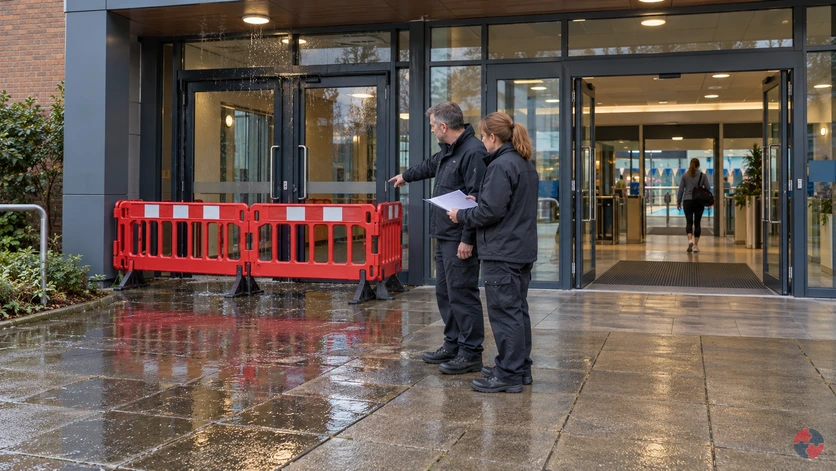
A leisure-centre entrance can affect visitors, workers and contractors differently. Make the route usable and accessible while the water-ingress problem is corrected.

People and hazard
Identify who uses the entrance, including access needs, and establish the actual surface/route hazard.
Protect and repair
Provide an assessed protected alternative and assign ownership to remove the source of the problem.
Verify and interpret
Check the arrangement during real use. Keep statutory-duty, negligence and occupier questions separate for qualified legal assessment.
A warning sign or a completed inspection does not itself resolve the physical hazard or determine liability.
What are the key points about duty of care?
The key points are foreseeability, reasonable care, evidence and learning.
Foreseeability matters
If harm could reasonably be anticipated, the organisation should consider controls before harm occurs.
Reasonable care is practical
It means sensible, proportionate action based on the risk, not perfect safety or paperwork for its own sake.
Civil and criminal routes differ
A breach may lead to regulatory enforcement, civil claims, internal action or several routes at once.
People beyond employees matter
Visitors, contractors, customers, tenants, pupils, service users and the public may all be affected.
Records defend decisions
Good records show what was known, what was done, who was trained and how issues were reviewed.
This is general guidance
This page supports workplace learning and is not medical, legal, HR or claims advice for a specific case.
The scope of these introductory points is set out in HSE - Introduction to managing health and safety: the law.
What does duty of care mean in workplace health and safety?
Duty of care means taking reasonable steps to prevent foreseeable harm to people affected by the undertaking.
In ordinary language, duty of care is about not exposing people to avoidable harm. In workplace risk management, it means recognising who could be affected, understanding the hazards, putting suitable controls in place, explaining those controls, checking they work and improving them when evidence shows weakness.
Duty of care is broader than a single checklist. It applies to physical hazards such as machinery, vehicles, slips, chemicals and fire, but it can also apply to health risks such as stress, fatigue, musculoskeletal strain, noise, dust, infection, poor welfare or unsafe working patterns.
The phrase is often used in civil claims, but it also aligns with statutory health and safety duties. A good organisation does not wait to find out whether the issue is civil or criminal. It asks what a competent, reasonable organisation should have done to prevent harm.
| Question | Practical meaning | Example |
|---|---|---|
| Who might be harmed? | Identify employees, contractors, visitors, customers, tenants and the public. | A wet floor affects staff and customers. Sources: Health and Safety at Work etc. Act 1974; Health and Safety at Work (Northern Ireland) Order 1978. |
| What harm is foreseeable? | Use risk assessments, incidents, complaints and known hazards. | Repeated near slips make a fall foreseeable. Sources: Health and Safety at Work etc. Act 1974; Health and Safety at Work (Northern Ireland) Order 1978. |
| What care is reasonable? | Choose controls proportionate to risk and known good practice. | Clean, dry, sign and inspect the area. Sources: Health and Safety at Work etc. Act 1974; Health and Safety at Work (Northern Ireland) Order 1978. |
| What evidence exists? | Keep records that show the control was implemented and checked. | Cleaning log, inspection and incident record. Sources: Health and Safety at Work etc. Act 1974; Health and Safety at Work (Northern Ireland) Order 1978. |
| What needs to improve? | Use incidents and weak signals to strengthen arrangements. | Change matting, drainage or cleaning frequency. Sources: Health and Safety at Work etc. Act 1974; Health and Safety at Work (Northern Ireland) Order 1978. |
How does duty of care differ between civil and criminal health and safety?
Civil duty of care focuses on compensation for harm, while criminal health and safety law focuses on preventing and punishing unacceptable risk.
Civil claims usually ask whether a duty of care existed, whether it was breached, whether the breach caused harm, and whether damage was foreseeable and compensable. The outcome is normally financial compensation, although the claim may also expose weak management systems.
Criminal enforcement asks whether a legal duty was breached; an enforcing authority need not wait for serious injury where risk exists. Improvement or prohibition notices and prosecution are separate statutory responses. Fee for Intervention is an HSE cost-recovery scheme in Great Britain only where HSE is the enforcing authority and its conditions are met; it is not a UK-wide penalty. See HSE fee-for-intervention guidance.
A civil claim asks whether a relevant duty, breach, causation and loss are established under the applicable jurisdiction. A statutory health and safety offence can concern unmanaged risk without first proving injury. An accident alone proves neither civil negligence nor a criminal breach. Seek competent legal review for a real claim or enforcement decision.
The practical overlap is evidence. Risk assessments, training, maintenance, inspections, consultation, incident investigation and action close-out can matter in both civil and criminal contexts.
The comparison table uses GB workplace law and England and Wales occupiers’ liability as examples. Scotland and Northern Ireland have separate civil and workplace statutes, identified in the legal table below; use the route for the actual place and claim.
| Issue | Civil duty of care | Criminal health and safety law |
|---|---|---|
| Purpose | Compensate a person harmed by negligence or breach. | Protect people and enforce statutory standards. Sources: Health and Safety at Work etc. Act 1974; Occupiers' Liability Act 1957. |
| Question | Was reasonable care taken and did breach cause damage? | Was a legal duty breached or risk created? Sources: Health and Safety at Work etc. Act 1974; Occupiers' Liability Act 1957. |
| Who brings action | Injured person or claimant. | HSE, local authority or other enforcing body. Sources: Health and Safety at Work etc. Act 1974; Occupiers' Liability Act 1957. |
| Outcome | Damages, settlement, legal costs and reputation impact. | Notices, prosecution, fines and possible individual consequences. Sources: Health and Safety at Work etc. Act 1974; Occupiers' Liability Act 1957. |
| Evidence | Records showing reasonable care and causation issues. | Records showing compliance, control and management arrangements. Sources: Health and Safety at Work etc. Act 1974; Occupiers' Liability Act 1957. |
How should organisations judge foreseeable harm?
Foreseeable harm is judged from what was known or should reasonably have been known before the event.
Foreseeability is built from evidence. Previous incidents, near misses, complaints, inspection findings, worker feedback, industry guidance, supplier warnings, HSE guidance, known vulnerable people and repeated defects all increase what the organisation should reasonably anticipate.
A single unexpected event may be difficult to foresee. A repeated pattern is different. If several workers report stress, a machine guard has failed before, a floor becomes wet every shift, or visitors keep entering a restricted area, the organisation has warning signs. Reasonable care then means acting on those signs before injury occurs.
| Prompt | Why it matters | Evidence |
|---|---|---|
| Has it happened before? | Previous events make future harm more foreseeable. | Incident and near-miss records. Sources: HSE - Managing for health and safety HSG65. |
| Has anyone complained or reported concerns? | Reports show the organisation was on notice. | Hazard reports, emails and consultation records. Sources: HSE - Managing for health and safety HSG65. |
| Is there official guidance? | Guidance can define what a reasonable organisation should know. | HSE pages, ACOPs and industry standards. Sources: HSE - Managing for health and safety HSG65. |
| Are vulnerable people exposed? | Young, pregnant, disabled, inexperienced or medically vulnerable people may need specific consideration. | Individual assessments and reasonable adjustments. Sources: HSE - Managing for health and safety HSG65. |
| Has work changed? | New equipment, staffing, workload, environment or contractors may change risk. | Management of change and review records. Sources: HSE - Managing for health and safety HSG65. |
What does reasonable care look like in practice?
Reasonable care is proportionate, risk-based action that a competent organisation can explain and evidence.
Reasonable care normally starts with a suitable risk assessment, but it does not end there. The control must be implemented, communicated, maintained and checked. The level of care expected increases where the harm is severe, the hazard is well known, the control is straightforward or the people affected are vulnerable.
For example, it is reasonable to expect a shop or leisure centre to inspect public walkways, respond to spillages, provide clear warning, repair defects and record significant issues. It is reasonable to expect an employer to assess DSE and work-related stress, not just physical injury hazards. It is reasonable to expect a contractor to protect others from the hazards created by its work.
| Situation | Reasonable care includes | Weak practice |
|---|---|---|
| Slip risk | Cleaning regime, inspections, matting, repairs and prompt response. | Only putting a sign out after someone falls. Sources: HSE - Managing for health and safety HSG65. |
| Remote work | DSE guidance, communication, workload review and reporting route. | Assuming home work is outside employer concern. Sources: HSE - Managing for health and safety HSG65. |
| Visitor access | Clear routes, restricted areas, induction or escort where needed. | Visitors wandering through operational areas. Sources: HSE - Managing for health and safety HSG65. |
| Contractor work | Competence check, information exchange, induction and monitoring. | Contractors left to self-authorise on unfamiliar site. Sources: HSE - Managing for health and safety HSG65. |
| Work-related stress | Stress risk assessment, workload review, support and manager training. | Treating repeated stress reports as personal weakness. Sources: HSE - Managing for health and safety HSG65. |
How can the hierarchy of controls reduce risks while keeping a busy entrance safe in wet weather?
A supermarket entrance needs drainage, matting and rapid inspections when rain is tracked in; a hospital corridor needs safe spill isolation and vulnerable-user access. Neither can simply copy the pool cleaning interval: footfall, floor, moisture and people at risk differ.
Map the people affected by the maintenance interface
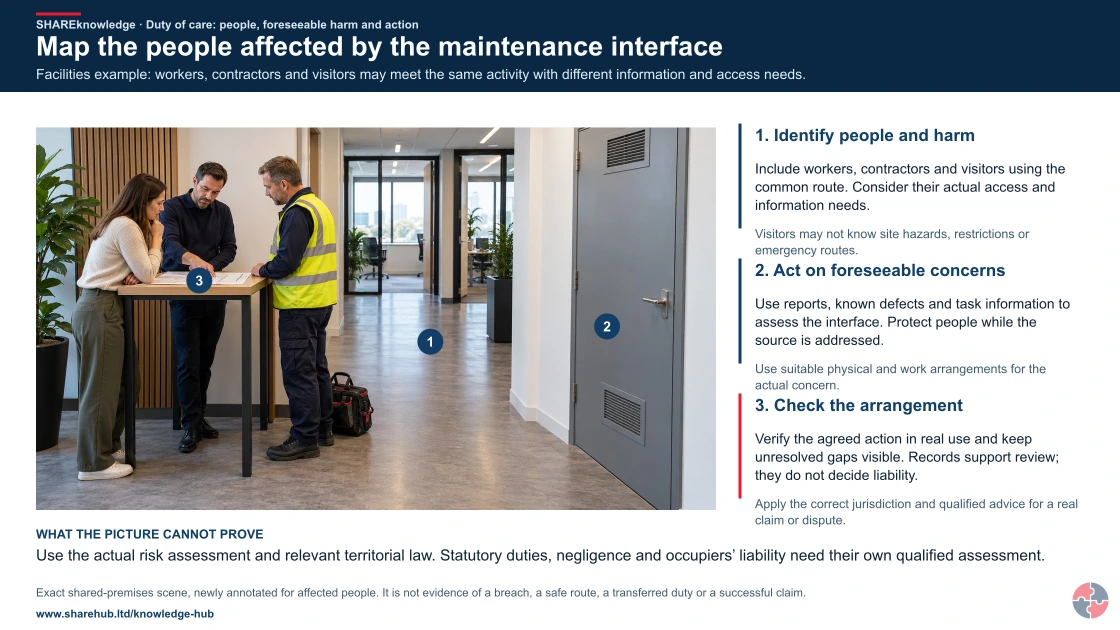
Full written explanation
Facilities example: workers, contractors and visitors may meet the same activity with different information and access needs.
- Identify people and harm. Include workers, contractors and visitors using the common route. Consider their actual access and information needs.
- Act on foreseeable concerns. Use reports, known defects and task information to assess the interface. Protect people while the source is addressed.
- Check the arrangement. Verify the agreed action in real use and keep unresolved gaps visible. Records support review; they do not decide liability.
Change the pathway
- Do not assume familiarity. Visitors may not know site hazards, restrictions or emergency routes.
- A warning is not a repair. Use suitable physical and work arrangements for the actual concern.
- Keep the legal question separate. Apply the correct jurisdiction and qualified advice for a real claim or dispute.
Evidence check: Use the actual risk assessment and relevant territorial law. Statutory duties, negligence and occupiers’ liability need their own qualified assessment.
Affected people, reasonable practical controls and distinct legal routes
Primary references: HSE: slip causes, contamination and prevention · HSE: shared-workplace cooperation (GB)
Open the complete HD image (new tab)Download image

Affected people, reasonable practical controls and distinct legal routes
Primary references: HSE: slip causes, contamination and prevention · HSE: shared-workplace cooperation (GB)
How can the ERICPD hierarchy of controls reduce risks while keeping a busy entrance safe in wet weather?

| Control level | Control for this activity | Owner and verification | Stop / restart decision |
|---|---|---|---|
| Eliminate | Remove the wet-route exposure by opening a suitable dry accessible entrance while the recurring water source is corrected. | Task owner verifies that the proposed change removes the named hazardous step, including foreseeable cleaning, maintenance and work transferred elsewhere. | If the hazardous step remains, keep it within the task assessment and select the stronger feasible remaining controls. |
| Reduce, including substitution | Select a suitable floor, matting or entrance arrangement for the actual wet conditions after checking grip, cleaning and trip risks. | Competent task/process owner validates suitability, compatibility and new hazards against the actual operating requirements before the alternative is adopted. | Reject an alternative if its performance is unproved or its new hazards are unresolved. |
| Isolate | Physically close the affected wet area and protect a safe alternative route; keep accessible escape and visitor access available. | Supervisor checks the actual boundary, affected people and connected work; verify separation or isolation before allowing access. | Hold or stop for uncontrolled water, saturated/slipping mat or no safe accessible alternative route. |
| Control: physical safeguards | Repair drainage or water ingress and provide effective fixed matting, lighting and a cleaning method that leaves the surface safe. | Competent equipment/process owner checks water source, floor condition, matting stability, lighting and accessible diversion. | Hold or stop for uncontrolled water, saturated/slipping mat or no safe accessible alternative route. |
| Control: work method and response | Assign inspection and response during actual footfall and weather; signs identify the temporary condition while the physical controls are established. | Supervisor confirms the work limits, competent cover, communication and stop/restart authority with the people doing this activity. | Hold work when the agreed limits, competent cover or effective communication cannot be maintained. |
| PPE | Select suitable footwear for assessed worker tasks; visitors cannot be protected by assuming everyone wears safety footwear. | Assessor confirms whether personal protection is needed and checks suitability, condition, compatibility and any required fit evidence. | Do not use unsuitable protection or rely on PPE to continue after an essential source control fails. |
| Discipline | Check the route under representative wet use, remove saturated or displaced mats and reopen only after the surface and access are safe. | Release only after premises owner verifies the dry route and effectiveness of the corrected entrance. Retain verification and unresolved restrictions at handover. | Keep the task on hold until required reinstatement evidence and unresolved defects are accepted by the responsible owner. |
How can the ISO 45001 hierarchy of controls reduce risks while keeping a busy entrance safe in wet weather?

| Control level | Control for this activity | Owner and verification | Stop / restart decision |
|---|---|---|---|
| Elimination | Remove the wet-route exposure by opening a suitable dry accessible entrance while the recurring water source is corrected. | Task owner verifies that the proposed change removes the named hazardous step, including foreseeable cleaning, maintenance and work transferred elsewhere. | If the hazardous step remains, keep it within the task assessment and select the stronger feasible remaining controls. |
| Engineering controls | Select a suitable floor, matting or entrance arrangement for the actual wet conditions after checking grip, cleaning and trip risks. | Competent task/process owner validates suitability, compatibility and new hazards against the actual operating requirements before the alternative is adopted. | Reject an alternative if its performance is unproved or its new hazards are unresolved. |
| Engineering controls | Physically close the affected wet area and protect a safe alternative route; keep accessible escape and visitor access available. | Supervisor checks the actual boundary, affected people and connected work; verify separation or isolation before allowing access. | Hold or stop for uncontrolled water, saturated/slipping mat or no safe accessible alternative route. |
| Engineering controls | Repair drainage or water ingress and provide effective fixed matting, lighting and a cleaning method that leaves the surface safe. | Competent equipment/process owner checks water source, floor condition, matting stability, lighting and accessible diversion. | Hold or stop for uncontrolled water, saturated/slipping mat or no safe accessible alternative route. |
| Administrative controls | Assign inspection and response during actual footfall and weather; signs identify the temporary condition while the physical controls are established. | Supervisor confirms the work limits, competent cover, communication and stop/restart authority with the people doing this activity. | Hold work when the agreed limits, competent cover or effective communication cannot be maintained. |
| PPE | Select suitable footwear for assessed worker tasks; visitors cannot be protected by assuming everyone wears safety footwear. | Assessor confirms whether personal protection is needed and checks suitability, condition, compatibility and any required fit evidence. | Do not use unsuitable protection or rely on PPE to continue after an essential source control fails. |
| Administrative controls | Check the route under representative wet use, remove saturated or displaced mats and reopen only after the surface and access are safe. | Release only after premises owner verifies the dry route and effectiveness of the corrected entrance. Retain verification and unresolved restrictions at handover. | Keep the task on hold until required reinstatement evidence and unresolved defects are accepted by the responsible owner. |
Who may be owed a duty of care?
A duty of care may be owed to workers, contractors, visitors, customers, tenants, service users and members of the public.
Health and safety duties extend beyond direct employees. Section 3 of HSWA covers people not in employment who may be affected by the undertaking. Civil duties may arise through occupiers' liability, negligence, product safety or contractual relationships. The precise route depends on the facts, but the management question is similar: who could be harmed by what we do or fail to do?
Organisations should map groups of people because different groups need different controls. Employees can be trained and supervised; visitors may need signage, barriers, escorting or information; contractors need coordination; customers need safe premises; members of the public need protection from site activities.
| Group | Duty of care issue | Example control |
|---|---|---|
| Employees and workers | Work activities, environment, equipment and health risks. | Risk assessment, training and supervision. Sources: Health and Safety at Work etc. Act 1974; Health and Safety at Work (Northern Ireland) Order 1978. |
| Contractors | Site hazards and task hazards interact. | Induction, permits and coordination. Sources: Health and Safety at Work etc. Act 1974; Health and Safety at Work (Northern Ireland) Order 1978. |
| Visitors and customers | They may not understand workplace risks. | Safe routes, signage and restricted access. Sources: Health and Safety at Work etc. Act 1974; Health and Safety at Work (Northern Ireland) Order 1978. |
| Remote workers | Workstation, workload, communication and isolation risks. | DSE assessment and manager contact. Sources: Health and Safety at Work etc. Act 1974; Health and Safety at Work (Northern Ireland) Order 1978. |
| Vulnerable people | Greater susceptibility to harm or different needs. | Individual assessment and adjustments. Sources: Health and Safety at Work etc. Act 1974; Health and Safety at Work (Northern Ireland) Order 1978. |
| Public and neighbours | Work activities can affect people outside the site. | Traffic, dust, noise, barriers and emergency planning. Sources: Health and Safety at Work etc. Act 1974; Health and Safety at Work (Northern Ireland) Order 1978. |
How does duty of care apply to remote work and wellbeing?
Duty of care applies to work-related risks even when work is done away from the employer's premises.
Remote and hybrid work changed the shape of duty of care, but did not remove it. Employers should consider display screen equipment, workstation setup, working hours, fatigue, communication, isolation, stress, reporting routes and access to support. A short self-assessment may be suitable for low-risk home DSE work, but issues should be followed up when symptoms, long hours or unsuitable equipment are reported.
Wellbeing does not mean an employer is responsible for every personal difficulty. It means work-related hazards such as excessive demands, low control, poor support, bullying, unclear role or organisational change should be assessed and managed where they create foreseeable harm.
| Area | Risk | Reasonable care |
|---|---|---|
| DSE | Pain, discomfort, fatigue and poor posture. | Assessment, guidance, equipment and review. Sources: HSE - Working safely with display screen equipment; HSE - Work-related stress and mental health. |
| Workload | Stress, burnout and errors. | Work planning, prioritisation and manager check-ins. Sources: HSE - Working safely with display screen equipment; HSE - Work-related stress and mental health. |
| Isolation | Reduced support and communication. | Regular contact and inclusion in briefings. Sources: HSE - Working safely with display screen equipment; HSE - Work-related stress and mental health. |
| Reporting | Remote workers may not report early symptoms. | Clear reporting route and follow-up. Sources: HSE - Working safely with display screen equipment; HSE - Work-related stress and mental health. |
| Change | Uncertainty and role conflict. | Consultation, communication and support. Sources: HSE - Working safely with display screen equipment; HSE - Work-related stress and mental health. |
How should duty of care be managed for visitors, customers and the public?
Visitors and the public need controls that do not assume workplace knowledge or training.
Customers, visitors and members of the public often do not understand site hazards. They may not know emergency routes, restricted areas, vehicle movements, chemical hazards, uneven surfaces, water risks or food allergen controls. Duty of care therefore relies on safe design, segregation, supervision, warning, maintenance and prompt response.
For public-facing workplaces, inspection quality matters. A leisure centre, shop, school, venue or care setting should know how frequently high-risk areas are checked, who acts on defects, how incidents are recorded and how trends are reviewed.
Premises law is not a single UK Occupiers’ Liability Act: England and Wales use the 1957 and 1984 Acts; Scotland has its 1960 Act; Northern Ireland has a 1957 Act and 1987 Order. Identify the premises controller and visitor status before applying a civil-law route. A warning sign does not automatically make a known wet route reasonably safe; assess whether the visitor can use the route safely in the circumstances.
For lawful visitors in England and Wales, Occupiers’ Liability Act 1957 section 2 makes reasonable safety in the circumstances the test. Under section 2(4), a warning is sufficient only where it enables the visitor to be reasonably safe. For faulty construction, maintenance or repair by an independent contractor, the section considers whether entrusting the work was reasonable and what steps, if any, the occupier reasonably ought to have taken about competence and proper completion. For example, before reopening a customer route after repair, identify remaining defects, the contractor’s completion information and any reasonable competent checks indicated by the circumstances. Do not assume that a warning sign or invoice settles those questions. This example is not a requirement that the occupier personally inspect every specialist task or a prediction of liability. Use the separate Scottish/NI statutes and obtain legal advice for the actual visitor, premises and facts.
| Risk area | Example | Control |
|---|---|---|
| Access and egress | Entrance mats, stairs, ramps and corridors. | Inspection, cleaning, lighting and repairs. Sources: Occupiers' Liability Act 1957; Occupiers' Liability (Scotland) Act 1960; Occupiers' Liability Act (Northern Ireland) 1957. |
| Restricted areas | Plant rooms, kitchens, workshops and chemical stores. | Barriers, locks, signage and escorting. Sources: Occupiers' Liability Act 1957; Occupiers' Liability (Scotland) Act 1960; Occupiers' Liability Act (Northern Ireland) 1957. |
| Traffic | Deliveries, car parks and reversing vehicles. | Segregation, signage, speed control and banksman rules. Sources: Occupiers' Liability Act 1957; Occupiers' Liability (Scotland) Act 1960; Occupiers' Liability Act (Northern Ireland) 1957. |
| Food and allergens | Food service or hospitality areas. | Allergen information, hygiene and cross-contamination controls. Sources: Allergen guidance for food businesses; Food allergen labelling and information technical guidance. |
| Emergency | Fire, evacuation, first aid and missing persons. | Clear instructions, trained staff and drills. Sources: Occupiers' Liability Act 1957; Occupiers' Liability (Scotland) Act 1960; Occupiers' Liability Act (Northern Ireland) 1957. |
What evidence shows duty of care has been met?
Evidence should show what was known, what was assessed, what was done, who was trained and how issues were reviewed.
Evidence is not about creating paperwork after an incident. It is about running the business in a way that leaves a reliable trail of reasonable decisions. Good evidence is timely, specific, complete and connected to action. Poor evidence is generic, unsigned, out of date or impossible to link to the real hazard.
In civil claims, records may be used to understand whether reasonable care was taken. In enforcement, records may show whether statutory duties were met. In management, records help leaders see whether controls are actually working.
| Evidence type | What it shows | Quality check |
|---|---|---|
| Risk assessment | Foreseeable hazards and controls were considered. | Specific to the task, people and premises. Sources: HSE - Managing for health and safety HSG65. |
| Inspection record | Conditions were checked before harm occurred. | Shows date, area, findings, action and close-out. Sources: HSE - Managing for health and safety HSG65. |
| Training record | People were instructed and competent for the role. | Includes content and understanding check. Sources: HSE - Managing for health and safety HSG65. |
| Maintenance record | Equipment or premises defects were managed. | Links defect to action and completion. Sources: HSE - Managing for health and safety HSG65. |
| Consultation record | Workers were involved in health and safety decisions. | Shows feedback and management response. Sources: HSE - Managing for health and safety HSG65. |
| Incident investigation | Lessons were identified and implemented. | Includes root causes and effectiveness review. Sources: HSE - Managing for health and safety HSG65. |
Which legal duties link to duty of care?
Duty of care links to statutory health and safety duties, civil negligence, occupiers' liability and product or premises duties.
Statutory health and safety duties sit mainly under HSWA and supporting regulations. Civil duty of care may arise through negligence, occupiers' liability or product liability. The same poor management issue can therefore create several consequences: harm to a person, a civil claim, enforcement action, insurance problems and reputation damage.
Specific legal advice should be taken for live claims or disputes. For ordinary management, the stronger question is whether the organisation can show reasonable, proportionate control of foreseeable risks.
Use the correct legal route for the place and facts. GB workplace duties differ from NI’s 1978 Order; occupiers’ liability is territorial: 1957/1984 Acts for England and Wales, a 1960 Act for Scotland, and 1957 Act/1987 Order for Northern Ireland. A civil duty, statutory breach and criminal prosecution are different questions.
| Duty or regulation | Jurisdiction | Application to this decision | Practical evidence |
|---|---|---|---|
| Health and Safety at Work etc. Act 1974 | Great Britain | General duties to employees and others affected by work. | Risk controls, training, supervision and monitoring. |
| Management of Health and Safety at Work Regulations 1999 | Great Britain | Risk assessment, arrangements, competent assistance and training. | Risk assessments, management arrangements and review records. |
| Occupiers' Liability Act 1957 | England and Wales | Duty of care to lawful visitors. | Premises inspections, repairs, signage and visitor controls. |
| Occupiers' Liability Act 1984 | England and Wales | Liability framework for some persons other than visitors. | Boundary controls and warnings where relevant. |
| Consumer Protection Act 1987 | United Kingdom | Product safety and liability issues. | Supplier assurance, product information and recall controls. |
| Corporate Manslaughter and Corporate Homicide Act 2007 | United Kingdom | Corporate liability for gross management failures causing death. | Governance, resources and management review. |
| Health and Safety at Work (Northern Ireland) Order 1978 | Northern Ireland | NI general work health and safety duties. | NI assessment, control and training evidence. |
| Management of Health and Safety at Work Regulations (Northern Ireland) 2000 | Northern Ireland | NI risk assessment and management arrangements. | NI risk decisions and action closure. |
| Occupiers' Liability (Scotland) Act 1960 | Scotland | Scottish occupier liability for premises danger. | Scotland premises inspections, repairs and safeguards. |
| Occupiers' Liability Act (Northern Ireland) 1957 | Northern Ireland | NI visitor occupier-liability route. | NI premises checks and visitor protection. |
| Occupiers' Liability (Northern Ireland) Order 1987 | Northern Ireland | NI route for certain people other than visitors. | NI boundary, risk and warning decisions. |
How should duty of care appear in the risk register?
Duty of care should appear as controls for people affected, foreseeable harm, evidence and review triggers.
Protect the entrance while the water-ingress source is fixed
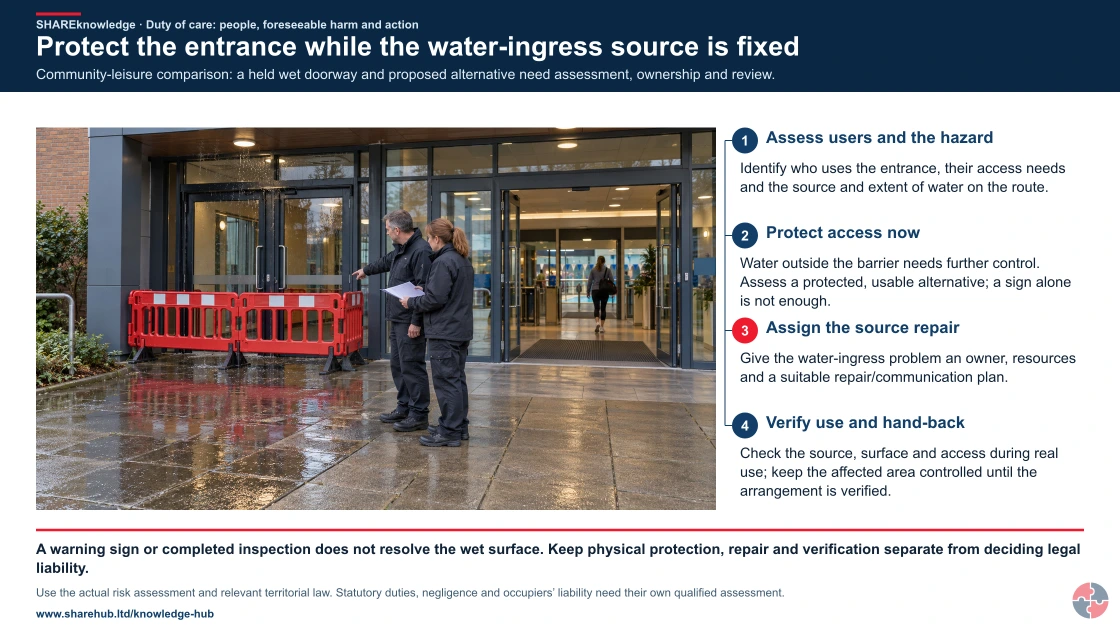
Full written explanation
An illustrative leisure-centre entrance shows water extending beyond a locally barrier-held doorway, colleagues reviewing the concern and an adjacent doorway proposed for alternative access. The pictured barrier therefore cannot demonstrate effective segregation of the whole wet area. The four checks consider users and access needs, effective temporary protection, ownership of the water-ingress repair and verification during use before hand-back. The photograph does not validate route width, accessibility, surface condition, a completed repair or liability.
Community-leisure comparison: a held wet doorway and proposed alternative need assessment, ownership and review.
- Assess users and the hazard. Identify who uses the entrance, their access needs and the source and extent of water on the route.
- Protect access now. Water outside the barrier needs further control. Assess a protected, usable alternative; a sign alone is not enough.
- Assign the source repair. Give the water-ingress problem an owner, resources and a suitable repair/communication plan.
- Verify use and hand-back. Check the source, surface and access during real use; keep the affected area controlled until the arrangement is verified.
When the evidence does not fit: A warning sign or completed inspection does not resolve the wet surface. Keep physical protection, repair and verification separate from deciding legal liability.
Who acts: Responsible facilities/premises and task owners, with affected users and competent support as needed.
Changed workplace
Facilities maintenance: Consider how the contractor/visitor interface may expose people unfamiliar with the work.
Community leisure entrance: Protect access and fix the source before relying on hand-back evidence.
Evidence check: Use the actual risk assessment and relevant territorial law. Statutory duties, negligence and occupiers’ liability need their own qualified assessment.
Affected people, reasonable practical controls and distinct legal routes
Primary references: HSE: slip causes, contamination and prevention · HSE: shared-workplace cooperation (GB)
Open the complete HD image (new tab)Download image

Affected people, reasonable practical controls and distinct legal routes
Primary references: HSE: slip causes, contamination and prevention · HSE: shared-workplace cooperation (GB)
A good risk register does not simply record hazards. It records who could be harmed, why that harm is foreseeable, what level of care is expected, what controls are in place, what evidence proves them and what action is needed when conditions change.
This is especially useful for visitor safety, contractor work, public interface, vulnerable workers, lone working, remote working and wellbeing risks, where assumptions can be weak.
| Field | Purpose | Example |
|---|---|---|
| Affected people | Shows who is owed care. | Visitors, cleaners, contractors and staff. Sources: HSE - Managing for health and safety HSG65. |
| Foreseeable harm | Explains the harm anticipated. | Slip injury from wet changing-room floor. Sources: HSE - Managing for health and safety HSG65. |
| Control standard | Defines reasonable care. | 30-minute inspection and immediate spill response. Sources: HSE - Managing for health and safety HSG65. |
| Evidence | Proves control is implemented. | Inspection log and defect record. Sources: HSE - Managing for health and safety HSG65. |
| Escalation | Shows what happens when control fails. | Centre manager notified and area closed. Sources: HSE - Managing for health and safety HSG65. |
| Review trigger | Keeps assessment live. | Incident, complaint, seasonal change or refurbishment. Sources: HSE - Managing for health and safety HSG65. |
How could Riverside Leisure Ltd manage duty of care?

Riverside Leisure Ltd would act on a foreseeable risk to staff and guests, even when the activity is routine and nobody has yet been injured.
Riverside Leisure Ltd · practical example
Protect guests while fixing an ordinary-looking defect
The key lesson Protecting people affected by the business includes those who are not its employees; the practical response follows the risk.
The situation: A housekeeping worker reports a loose floor covering beside a hotel breakfast route. Guests, kitchen staff and a visiting contractor all use the area.
Why this matters: Repeatedly walking past a known defect can make it seem normal while leaving guests unfamiliar with the hazard exposed.
How Riverside Leisure Ltd would manage it
- Respond to the report — Duty Manager. Inspect the concern promptly from a safe position, identify who uses the route and arrange an effective temporary restriction or alternative where necessary.
- Own the repair — Facilities Coordinator. Arrange a suitable repair and coordinate the contractor with hotel activities. Confirm what remains restricted while work is incomplete.
- Inform the people affected — Department Supervisor. Explain the access change to housekeeping, catering and reception, including agency staff. Give guests usable directions rather than relying on a small warning sign.
- Accept the condition — Hotel Manager. Check the repaired route and any remaining trip, access or cleaning issue. Record the decision and tell the Duty Manager when the restriction may be removed.
- Look for the cause — Operations Director. Review repeated flooring or reporting failures across hotels. Fund the appropriate maintenance or purchasing change and check its result.
When the conditions change
- Recognise the trigger
- The breakfast route has loose flooring that guests or staff could trip over.
- Make the immediate decision
- The Duty Manager restricts that route and communicates the usable alternative.
- Verify the next step
- The Hotel Manager checks the repaired surface, safe access and remaining contractor restrictions before reopening the route.
What good looks like
The original report leads to protection, repair and a checked return. Guests and contractors are considered alongside employees.
Evidence to look for: Defect report, interim arrangement, repair evidence, acceptance and any follow-up action.
Common mistake to avoid: Assuming that a warning sign or the absence of previous injuries settles a known defect.
Apply this to your work: Who might be affected by your work without appearing on your employee list?
Guidance behind the management approach: HSE: managing health and safety and the law. Use the topic's legal and technical guidance for the applicable work and location.
Riverside Leisure Ltd
Riverside Leisure Ltd is used here as a leisure operator with swimming pools, gyms, outdoor activities, hospitality areas, public visitors and contractors.
Riverside maps who may be harmed: lifeguards, gym instructors, reception staff, cleaners, maintenance contractors, swimmers, children, vulnerable users, café customers and members of the public in car parks. The risk register separates staff risks, customer risks, contractor risks and public interface risks so each has a clear owner.
The company uses foreseeable harm evidence. Slips in wet changing areas, pool chemical exposure, gym equipment defects, food allergens, aggressive behaviour, stress, lone working and contractor maintenance are all known risks in leisure settings. Riverside sets control standards for inspections, cleaning, supervision, training, emergency response, contractor permits and reporting.
Evidence is managed rather than hoped for. Duty managers complete opening checks, poolside checks and cleaning records. Maintenance defects are logged and risk-ranked. Staff receive role-specific training. Contractors are inducted and supervised. Customer accidents, complaints and near misses are investigated for trend learning. Senior managers review overdue actions and repeated themes.
Continuous improvement closes the loop. If slips increase in one centre, Riverside reviews flooring, drainage, cleaning frequency, signage, staffing and user behaviour. If stress reports increase, it reviews workload, supervision and staffing. If contractor findings repeat, procurement and induction standards are strengthened.
| Area | How Riverside manages it | Evidence |
|---|---|---|
| Customers and visitors | Controls slips, access, supervision, emergencies and information. | Inspection logs, signage checks and incident reports. Sources: HSE - Managing for health and safety HSG65. |
| Workers | Manages training, workload, stress, lone work and task risks. | Training matrix, rotas and wellbeing reviews. Sources: HSE - Managing for health and safety HSG65. |
| Contractors | Checks competence, provides information and monitors work. | Induction, permits and contractor review. Sources: HSE - Managing for health and safety HSG65. |
| Premises | Maintains plant, fire routes, lighting, flooring and welfare. | Defect logs and maintenance records. Sources: HSE - Managing for health and safety HSG65. |
| Claims defensibility | Keeps specific records before, during and after incidents. | Investigation packs and action close-out. Sources: HSE - Managing for health and safety HSG65. |
Worked decision from warning to hand-back
A leisure centre repeatedly receives reports of a wet route between pool and changing rooms before a visitor falls. This is an illustrative decision; the actual material, people, premises control and applicable law must be checked.
| Decision stage | Worked decision |
|---|---|
| Task and people | Water carried from the pool makes a predictable slip route for children, older visitors, staff and cleaning contractors. |
| Before work | Duty manager reviews reports and inspection data, checks drainage and floor condition, and decides whether to close or divert the route. |
| Decision owner | Operator controls daily access and cleaning; premises owner addresses structural drainage or floor defects according to actual control and agreement. |
| During work | Segregate the route, dry and inspect it, correct drainage or surface defects, communicate a safe alternative and verify the change during busy use. |
| Hold or stop | Close the route if traction or drainage cannot be maintained; do not rely on a warning sign while repeated water remains. |
| Hand-back | Competent facilities lead confirms the repair or safe temporary route; duty manager observes use before reopening. |
| Evidence and change | Keep prior reports, assessment, inspections, closure decision, repair, visitor communication, incident facts and follow-up trend review. |
What training supports duty of care?
Training should help people understand duties, foreseeable risk, reporting, evidence and reasonable action.
General awareness should cover basic duties, hazard reporting, emergency arrangements and how to raise concerns. Task-specific training should cover the hazards people actually control. Supervisors need training on inspection quality, incident response, consultation, vulnerable workers and contractor control.
Managers need a deeper understanding of civil and criminal consequences, records, claims defensibility, risk acceptance and how poor decisions can expose people to foreseeable harm.
| Level | Audience | Content | Observed demonstration | Record and reassessment | Who assesses |
|---|---|---|---|---|---|
| General awareness | All workers. | Basic duty of care, reporting, emergencies and cooperation. Sources: HSE - Health and safety training INDG345. | Report a wet route, protect visitors immediately and preserve incident facts. | Observed induction scenario; recheck after local change. | Line supervisor |
| Task-specific | People controlling specific risks. | Local controls, inspection, PPE and stop-work triggers. Sources: HSE - Health and safety training INDG345. | Demonstrate local inspection, segregation, cleaning and a stop where a defect persists. | Practical observation and contemporaneous inspection record. | Competent task supervisor |
| Supervisor | Duty managers and supervisors. | Checks, briefings, visitor safety, contractors and incident response. Sources: HSE - Health and safety training INDG345. | Compare repeated reports with controls and close or divert an unsafe route. | Supervisor case assessment and documented escalation. | Duty manager |
| Manager | Managers and senior leaders. | Foreseeability, evidence, legal exposure and management review. Sources: HSE - Health and safety training INDG345. | Decide resources, owner and review trigger for drainage repair instead of relying on warning signs. | Management risk review and verified action closure. | Senior manager or premises owner |
| Specialist | HSE, HR, facilities and claims handlers. | Civil claims, record quality, investigations and specialist risk assessment. Sources: HSE - Health and safety training INDG345. | Distinguish statutory and civil routes by jurisdiction without asserting liability from an incident alone. | Specialist source review and investigation quality check. | Competent legal/safety reviewer |
How should the controls be managed and reviewed?
Assign owners to the significant risks, put the chosen controls into the work plan, check that they work in practice and change them when conditions or evidence change.
HSE describes this as a continuing plan, do, check and act process. For duty of care, record who checks the controls, what evidence shows they are working, and which failure stops the work or triggers review. A formal management system is a choice, not a substitute for the applicable legal duties. Read HSE management guidance.
What are the warning signs that duty of care is weak?
Warning signs appear when foreseeable risks are known but not acted on, or when evidence is missing.
Duty of care usually fails before the incident, not after it. Repeated complaints, near misses, inspection defects, staff concerns, vague procedures and unclosed actions are signals that harm may be foreseeable. If they are ignored, the organisation may struggle to show reasonable care.
Weakness can manifest as injury, illness, stress, public harm, civil claims, enforcement action, insurance dispute, reputational damage and loss of worker trust.
| Warning sign | What it reveals | Potential outcome |
|---|---|---|
| Repeated complaints | The organisation is on notice. | Foreseeable harm and weak defence. Sources: HSE - Managing for health and safety HSG65. |
| Generic risk assessments | Real hazards and people affected are not considered. | Controls fail in practice. Sources: HSE - Managing for health and safety HSG65. |
| Poor inspection records | Cannot prove conditions were checked. | Weak evidence after incident. Sources: HSE - Managing for health and safety HSG65. |
| Training not role-specific | People may not know what reasonable care requires. | Unsafe decisions and inconsistent practice. Sources: HSE - Managing for health and safety HSG65. |
| Incidents closed quickly | Learning is not embedded. | Repeat events. Sources: HSE - Managing for health and safety HSG65. |
| No visitor/public controls | Non-workers are not considered. | Customer or public injury. Sources: HSE - Managing for health and safety HSG65. |
What do the acronyms and key terms mean?
Acronyms and legal terms should be clear before they are used in assessments, training or claim reviews.
| Acronym or term | Meaning | Meaning in this context |
|---|---|---|
| HSWA | Health and Safety at Work etc. Act 1974. | GB workplace Act; NI has a separate 1978 Order. |
| MHSWR | Management of Health and Safety at Work Regulations 1999. | GB management regulations; NI has a separate 2000 instrument. |
| DSE | Display Screen Equipment. | Screen-work risks need proportionate assessment at office and home. |
| HSG65 | HSE managing for health and safety guidance using Plan, Do, Check, Act. | HSE management guidance, not a legal test of civil liability. |
| Negligence | Civil wrong involving breach of duty causing foreseeable harm. | Civil claim requires its legal elements and jurisdiction-specific analysis. |
| Foreseeability | Whether harm could reasonably have been anticipated. | Look at what was known or should have been known before harm. |
| Reasonable care | Proportionate steps a competent person or organisation should take to prevent harm. | Proportionate preventive action must be implemented and checked, not just documented. |