SHARE Knowledge Hub
Fire and gas detection, alarms and shutdown
Fire-and-gas systems are engineered recovery barriers, not substitutes for preventing leaks, ignition and dangerous inventory. For each credible scenario, show what the detector senses, what the operator must do, what automatic action occurs and whether the plant reaches a verified safe state. Treat alarm floods, bypasses, faults and uncertain shutdown response as live risk decisions; stop or restrict the operation when a credited barrier cannot be relied upon.
Understanding Fire and gas detection, alarms and shutdown
Fire and gas detection, alarms and shutdown are engineered layers in a wider process-safety and emergency-response system. They can detect abnormal conditions, prompt timely action, initiate an automatic function, support evacuation and limit escalation, but they do not remove the need to control inventory, loss of containment, ignition, process conditions and work activities at source.
Why this matters at work
Survivability asks whether the detection, control room, cable route, field equipment, final element, power source, communication or evacuation route remains effective during the very fire, gas release, blast, heat, smoke, flooding or loss of utility it is meant to control. This is scenario-specific; do not assert a survival rating or separation distance without competent engineering evidence.
Common interfaces can produce common-cause failure: shared power, shared I/O, software, communications, time source, environmental exposure, control room, maintenance team, work permit, sensor impulse line, utility or management process. A combination of individually maintained devices is not necessarily a resilient barrier.
How organisations manage this in practice
HSE warns that centralising control can weaken communications and a hands-on overview of the plant. Control-room design, workload, shift handover, staffing, training, displays, lighting, noise, emergency equipment, access and support must be assessed as part of the barrier. A well-designed system must remain usable during high alarm activity and prolonged upset.
Control the proposed basis, hazard review, approvals, configuration, security, test plan, rollback, training, documentation, temporary arrangements, commissioning, verification and post-change review. HSE identifies cyber security as relevant to safety instrumented, alarm and process control systems; security changes must not quietly compromise availability or delay an emergency function.
Changes can invalidate protection without adding a new device. Different substances, ventilation, software, utilities, geometry or staffing can affect detection, independence and response. Management of change should identify affected assumptions, obtain competent review, verify the installed configuration and update operational information before reliance. Remote maintenance and configuration access also need controlled authority and traceable restoration. Review changes to substance, inventory, layout, ventilation, software, operating mode and staffing against the original protection assumptions. Update drawings, cause-and-effect information, operating instructions and maintenance arrangements before handover. Test affected interfaces and brief those responsible for abnormal response. Keep the previous restrictions where the revised basis is incomplete. A change that appears minor to production can alter gas transport, detector response or final-element demand and therefore needs competent review.
How can I practise this topic in 3D?
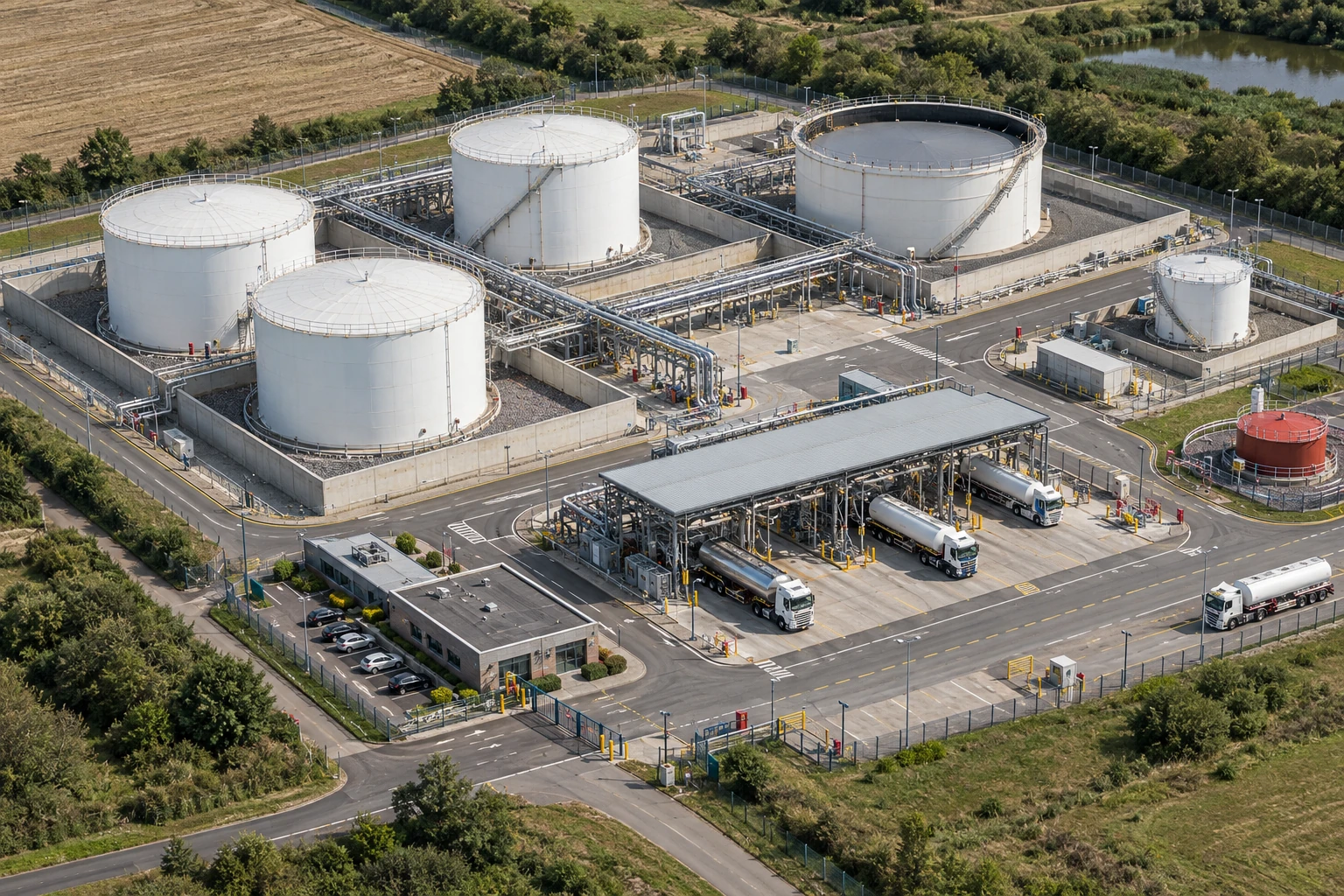

The boundary shutdown command has not been tested end to end
All related inspection points 5 across 1 location
Crown Fuels terminal 5 inspection points
Practice in the SHAREhub environment. Browser practice is separate from workplace competence and formal learning records.
Prove the whole detector-to-safe-state chain before accepting restoration
At a tanker transfer, ask four separate questions: what condition is sensed, what information reaches the operator, what command the logic issues and what the final equipment actually achieves. A healthy display does not establish detector coverage or valve movement. Verify each credited function against its cause-and-effect and operating scenario with competent engineering and operations involvement.
Trace detection, alarm, logic and the achieved plant response

Full written explanation
An illustrative UK tank-terminal scene shows a continuous supported connection from a stationary tanker to fixed pipework, external final-equipment hardware and an inert record review. A separate control-room scene represents operator-information review only. Picture key: 1 Material connection · 2 External final-equipment hardware · 3 Operator-information review. The solid material connection is distinct from dashed conceptual signals and commands. Sensing branches separately to operator warning and protective logic; an alarm is not a required series gate in automatic action. Logic issues a command to final equipment, but actual movement and the defined achieved state require separate evidence. A display or command log does not establish coverage or successful final action. The scenes show no release, test, operating state or detector location. They assign no trip logic, voting, setpoint, delay, SIL, independence, valve position, design, isolation or restart permission.
Tank-terminal example: material connection, operator information and achieved response are different evidence questions.
- Verify what can be sensed. Use the actual substance, release scenario, coverage and detector condition.
- Check warning and command. Compare operator information and automatic logic with the actual cause-and-effect.
- Prove the achieved response. Verify final-element action and the defined safe state; a command log is not movement.
Change the pathway
- No coverage from a sketch. Real location, dispersion, obstruction and detector performance need competent evidence.
- Different functions can fail. Sensing, utilities, messages, logic and final equipment each require appropriate checks.
- Shutdown is not isolation. Stopping transfer need not remove trapped material, pressure or incoming energy.
Evidence check: Functional learning only. No detector location, setting, bypass steps, SIL claim, proof-test method, independence or operating permission is given.
Use the complete detector-to-achieved-state explanation
Primary references: HSE: leak and gas detection — scenario and coverage · HSE: control-system functions, interfaces and utilities · HSE: safe isolation of plant and equipment
Open the complete HD image (new tab)Download image

Use the complete detector-to-achieved-state explanation
Primary references: HSE: leak and gas detection — scenario and coverage · HSE: control-system functions, interfaces and utilities · HSE: safe isolation of plant and equipment
Best-practice guide: Fire and gas detection, alarms and shutdown
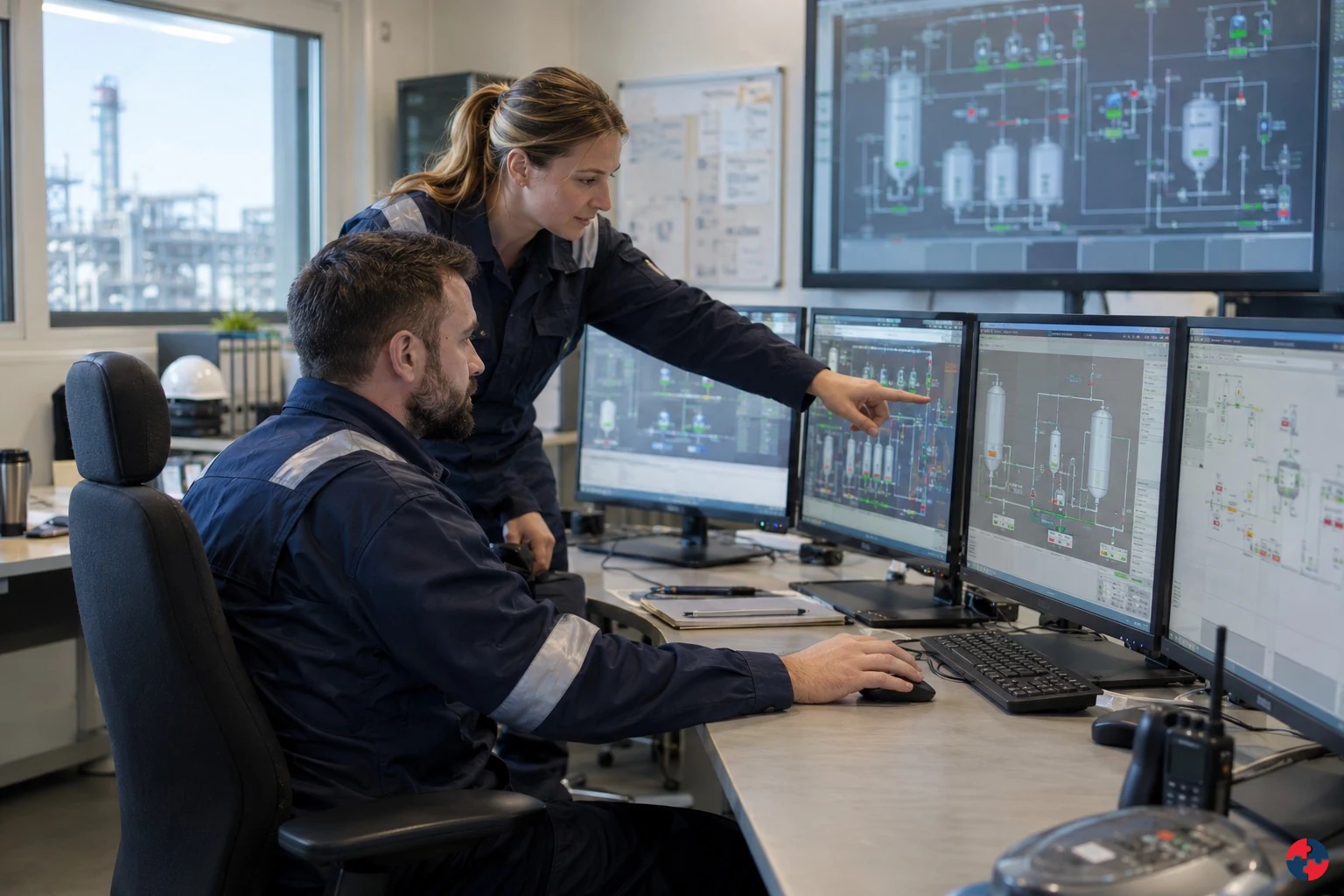
Prove the whole detector-to-safe-state chain before accepting restoration
At a tanker transfer, ask four separate questions: what condition is sensed, what information reaches the operator, what command the logic issues and what the final equipment actually achieves. A healthy display does not establish detector coverage or valve movement. Fire-and-gas systems are engineered recovery barriers, not substitutes for preventing leaks, ignition and dangerous inventory.
Turn fire and gas detection, alarms and shutdown knowledge into a decision
Fire-and-gas systems are engineered recovery barriers, not substitutes for preventing leaks, ignition and dangerous inventory. For each credible scenario, show what the detector senses, what the operator must do, what automatic action occurs and whether the plant reaches a verified safe state. The register has a named owner, review date, risk rating, control standard and action tracker.
A protective-function test with incomplete coverage
Setting: A process operator plans a test of a detector, logic and shutdown final element. Act: Coordinate the test with the control room, identify authorised inhibits and record which parts are simulated and which are physically verified. Hold / review: Keep the affected duty held if essential coverage or restoration evidence is missing; a simulation is not a complete proof test.
How do fire and gas systems reduce major accident risk?
Initiating scenario: A release can create fire, toxic exposure or escalation, depending on the actual substance and process. Protective function fails: A detector, logic, power supply or final element may not deliver its required action. Possible harm: Delayed detection or isolation can leave people exposed and allow escalation; determine consequences through the actual scenario assessment.
Choose controls for the actual task
Elimination: Defer the detector work to a planned shutdown where practicable. Engineering controls: Within an approved operating envelope, reduce the gas inventory or pressure exposed to a potential leak and minimise the detector-out-of-service period. Engineering controls: Apply the assessed process and energy isolations to the affected equipment, secure them against unintended operation and verify their effectiveness. Engineering controls: Where continued operation is justified, provide assessed portable or transportable area detectors before disabling the fixed detector. Administrative controls: Use a time-limited impairment/bypass authorisation stating the detector, zone, functions disabled, remaining fire/gas and shutdown protection, compensating measures and named control-room operator. Read the full control table for qualifications, ownership and verification. Use the actual task and applicable jurisdiction; existing technical approval remains unchanged.
Use the full fire and gas detection, alarms and shutdown lesson
Use the full topic for the decision points, practical examples, detailed control tables and source scope. HSE guidance applies to Great Britain; use HSENI for the Northern Ireland route and the source’s stated jurisdiction. A simplified guide does not change the page’s technical-review or approval status.

Read all six steps as text
1. Prove the whole detector-to-safe-state chain before accepting restoration
At a tanker transfer, ask four separate questions: what condition is sensed, what information reaches the operator, what command the logic issues and what the final equipment actually achieves.
- Avoid / redesign: Defer the detector work to a planned shutdown where practicable.
- Control the task: Apply the assessed process and energy isolations to the affected equipment, secure them against unintended operation and verify their effectiveness.
- Verify before release: Do not treat the hazard as eliminated if gas can remain, leak in or accumulate.
At a tanker transfer, ask four separate questions: what condition is sensed, what information reaches the operator, what command the logic issues and what the final equipment actually achieves. A healthy display does not establish detector coverage or valve movement. Fire-and-gas systems are engineered recovery barriers, not substitutes for preventing leaks, ignition and dangerous inventory.
Apply it: Which part of this plan would you check at the workface before authorising the task?
2. Turn fire and gas detection, alarms and shutdown knowledge into a decision
Use the evidence to improve the actual work arrangement.
- Change at source: Defer the detector work to a planned shutdown where practicable.
- Make it observable: Do not treat the hazard as eliminated if gas can remain, leak in or accumulate.
- Keep useful evidence: The register has a named owner, review date, risk rating, control standard and action tracker.
Fire-and-gas systems are engineered recovery barriers, not substitutes for preventing leaks, ignition and dangerous inventory. For each credible scenario, show what the detector senses, what the operator must do, what automatic action occurs and whether the plant reaches a verified safe state. The register has a named owner, review date, risk rating, control standard and action tracker.
Apply it: What evidence would show that the change improves this task, rather than only completing a record?
3. A protective-function test with incomplete coverage
Example: a practical application of the existing topic lesson.
- Setting: A process operator plans a test of a detector, logic and shutdown final element.
- Act: Coordinate the test with the control room, identify authorised inhibits and record which parts are simulated and which are physically verified.
- Hold / review: Keep the affected duty held if essential coverage or restoration evidence is missing; a simulation is not a complete proof test.
Setting: A process operator plans a test of a detector, logic and shutdown final element. Act: Coordinate the test with the control room, identify authorised inhibits and record which parts are simulated and which are physically verified. Hold / review: Keep the affected duty held if essential coverage or restoration evidence is missing; a simulation is not a complete proof test.
Apply it: At which point would you hold this example, and what evidence would allow it to proceed?
4. How do fire and gas systems reduce major accident risk?
Connect the task, the route to the person and the control that can fail.
- Initiating scenario: A release can create fire, toxic exposure or escalation, depending on the actual substance and process.
- Protective function fails: A detector, logic, power supply or final element may not deliver its required action.
- Possible harm: Delayed detection or isolation can leave people exposed and allow escalation; determine consequences through the actual scenario assessment.
Initiating scenario: A release can create fire, toxic exposure or escalation, depending on the actual substance and process. Protective function fails: A detector, logic, power supply or final element may not deliver its required action. Possible harm: Delayed detection or isolation can leave people exposed and allow escalation; determine consequences through the actual scenario assessment.
Apply it: Who could be exposed, including other trades, cleaners, maintainers and people nearby?
5. Choose controls for the actual task
Control summary. Read the complete task-specific controls and checks in the linked topic.
- Elimination: Defer the detector work to a planned shutdown where practicable.
- Substitution: No separate approved substitution is specified; assess a genuinely safer material or process before relying on lower controls.
- Engineering controls: Use named, time-limited impairment or bypass authority: identify disabled functions, remaining protection, restrictions, control-room coordination and abort actions.
- Administrative controls: Use named, time-limited impairment or bypass authority: identify disabled functions, remaining protection, restrictions, control-room coordination and abort actions.
- PPE: Select compatible task PPE for residual fire, chemical, eye and hand hazards.
Elimination: Defer the detector work to a planned shutdown where practicable. Engineering controls: Within an approved operating envelope, reduce the gas inventory or pressure exposed to a potential leak and minimise the detector-out-of-service period. Engineering controls: Apply the assessed process and energy isolations to the affected equipment, secure them against unintended operation and verify their effectiveness. Engineering controls: Where continued operation is justified, provide assessed portable or transportable area detectors before disabling the fixed detector. Administrative controls: Use a time-limited impairment/bypass authorisation stating the detector, zone, functions disabled, remaining fire/gas and shutdown protection, compensating measures and named control-room operator. Read the full control table for qualifications, ownership and verification. Use the actual task and applicable jurisdiction; existing technical approval remains unchanged.
Apply it: Which stronger option can be used here, and who will verify it before accepting the remaining risk?
6. Use the full fire and gas detection, alarms and shutdown lesson
Follow the official sources below and retain the task-specific evidence.
- Official guidance: HSE leak and gas detection
- Official guidance: COMAH Regulations (NI) 2015
- Task decision: Record actual test scope, untested functions and competent technical acceptance before the operating owner restores the affected duty.
Use the full topic for the decision points, practical examples, detailed control tables and source scope. HSE guidance applies to Great Britain; use HSENI for the Northern Ireland route and the source’s stated jurisdiction. A simplified guide does not change the page’s technical-review or approval status.
Apply it: Which official source and full-topic section will you use to resolve the next decision?
Removing a bypass is a controlled change, not the end of the work. Confirm field status, relevant alarms, shutdown action and the achieved safe state before operations accepts hand-back. Sensor poisoning, loss of power or an ineffective final element can defeat the barrier while a command still appears in a log. Keep the affected operation held when the credited chain is uncertain.
Tanker transfer: bypass removed, valve not proved
Illustrative example. A detector bypass is removed after maintenance, but the transfer isolation valve has not been witnessed reaching its required state.
Decision. The operations owner keeps transfer held while the competent team tests the cause-and-effect through the final element.
Evidence to check. Detector condition and coverage, logic status, alarm response, field valve position and achieved process state.
Hold or escalation point. No transfer on a normal panel indication or command alone when isolation effectiveness is unknown.
Follow-up. Operations accepts the verified function, records residual limitations and reviews bypass and proof-test learning.
Prove the detector-to-safe-state function
Sensor, logic, alarm response and final action are different parts of a protective function. Normal control and an independent protective claim need separate evidence.

Trace the chain
Identify the initiating condition, detector, logic, operator alarm path and final element that produces the required safe state.
Identify common dependencies
Check shared power, instruments and interfaces before claiming independent protection; a simulated signal only proves the portions actually tested.
Control impairment
Use named, time-limited bypass or impairment authority, defined remaining protection, restrictions, abort actions and control-room coordination.
Accept restoration
Record actual test scope, untested functions and competent technical acceptance before the operating owner restores the affected duty.
Read the complete task-specific control examples
ERICPD is a planning cross-map: Discipline verifies and sustains every control. ESEAP compares effectiveness. A label does not authorise the task; retain the owner, evidence and stop or change decision.
Maintaining a fixed gas detector · ERICPD
- Eliminate
- Defer the detector work to a planned shutdown where practicable.
- Reduce
- Use named, time-limited impairment or bypass authority: identify disabled functions, remaining protection, restrictions, control-room coordination and abort actions. Minimise the outage within the approved operating envelope and verify restoration.
- Isolate
- Apply the assessed process and energy isolations to the affected equipment, secure them against unintended operation and verify their effectiveness.
- Control
- Where continued operation is justified, provide assessed portable or transportable area detectors before disabling the fixed detector.
- PPE
- Select compatible task PPE for residual fire, chemical, eye and hand hazards.
- Discipline
- Record every impairment in the bypass register and control-room handover.
Maintaining a fixed gas detector · ESEAP
- Elimination
- Defer the detector work to a planned shutdown where practicable.
- Substitution
- No separate approved substitution is specified; assess a genuinely safer material or process before relying on lower controls.
- Engineering controls
- Use named, time-limited impairment or bypass authority: identify disabled functions, remaining protection, restrictions, control-room coordination and abort actions. Minimise the outage within the approved operating envelope and verify restoration.
- Administrative controls
- Use named, time-limited impairment or bypass authority: identify disabled functions, remaining protection, restrictions, control-room coordination and abort actions. Minimise the outage within the approved operating envelope and verify restoration.
- PPE
- Select compatible task PPE for residual fire, chemical, eye and hand hazards.
Proof testing a gas-initiated shutdown · ERICPD
- Eliminate
- Plan the test during a safe shutdown wherever practicable so testing does not leave operating plant dependent on the function being withdrawn.
- Reduce
- Retain the actual protective sensor, logic and final-element functions with verified coverage. Off-line simulation proves only the portions validly tested; record untested functions explicitly.
- Isolate
- Place affected equipment in the required safe state and control energy, inventory and access around moving shutdown equipment.
- Control
- Use the approved test facilities and verify the required sensor, logic, alarm and final-element actions against the safety-function specification.
- PPE
- Use task-assessed protection and personal gas detection where required; neither substitutes for essential automatic protection or safe plant conditions.
- Discipline
- Remove test equipment and authorised inhibits, reconcile the panel/register and prove normal protection before the operations return-to-service decision.
Proof testing a gas-initiated shutdown · ESEAP
- Elimination
- Plan the test during a safe shutdown wherever practicable so testing does not leave operating plant dependent on the function being withdrawn.
- Substitution
- No separate approved substitution is specified; assess a genuinely safer material or process before relying on lower controls.
- Engineering controls
- Retain the actual protective sensor, logic and final-element functions with verified coverage. Off-line simulation proves only the portions validly tested; record untested functions explicitly.
- Administrative controls
- Coordinate every test step with the control room; distinguish simulated signals from genuine gas alarms, control authorised inhibits and define abort/shutdown actions.
- PPE
- Use task-assessed protection and personal gas detection where required; neither substitutes for essential automatic protection or safe plant conditions.
What are the key points about fire and gas detection, alarms and shutdown?
Fire and gas detection, alarms and shutdown should be managed by understanding ignition, fuel, people at risk, escape, detection, containment and emergency response as connected controls.
- Fire and gas detection, alarms and shutdown is a process safety topic that helps an organisation identify, control and assure the barriers needed to prevent or limit major accidents.
- In practice, fire and gas detection, alarms and shutdown should appear in design reviews, operating procedures, maintenance plans, training matrices, management meetings, audit protocols and emergency exercises.
- For study and website use, treat this part of fire and gas detection, alarms and shutdown as a link between technical hazard understanding and management discipline.
- Trend near misses, alarm problems, leaks, permit findings and maintenance deferrals together for shared barrier failures; escalate patterns to the scenario owner and verify effective corrective action.
- For fire and gas detection, alarms and shutdown, a useful role test is to ask five people in different functions what they would do if a critical control was unavailable.
- Assurance for fire and gas detection, alarms and shutdown should be evidence-based.
- This chapter explains fire and gas detection, alarms and shutdown as a process safety management subject.
How do fire and gas systems reduce major accident risk?
Detection, alarm and shutdown are recovery barriers in a wider prevention and emergency strategy; each claimed function needs a scenario, owner and proof that it works.
Start with release, ignition, toxic exposure and escalation scenarios. Reduce dangerous inventory and prevent containment loss first. For each residual scenario, show what a detector can sense, what the alarm asks a person to do, what automatic action occurs, which final element changes the plant and how people reach safety. Do not credit a box or tag as a barrier without evidence of the complete chain.
Use current government guidance and competent task-specific advice; this section does not establish a technical specification.
In practice, fire and gas detection, alarms and shutdown should appear in design reviews, operating procedures, maintenance plans, training matrices, management meetings, audit protocols and emergency exercises. The subject should not live only in a policy. It should affect real choices: whether a job starts, whether a plant restarts, whether a temporary repair is accepted, whether an alarm is rationalised, whether a relief device is deferred, whether a contractor is authorised and whether production pressure is allowed to override risk information.
How do detection, process alarms and shutdown have different roles?
Detection recognises a condition; a process alarm prompts a defined operator action; a shutdown or trip is intended to move equipment or process toward a specified safe state.
The same gas detector may feed a display, an alarm, a ventilation action, an isolation valve and an emergency plan, but those are distinct functions. For each, define its initiating event, output, responsible person, dependencies and acceptable failure response. A manual action cannot be credited as though it were automatic without credible human response evidence.
A building fire alarm primarily warns relevant people to evacuate; a process alarm may require diagnosis and corrective action before a condition escalates. Fire-and-gas signals can do both. Interface design must prevent an operator misunderstanding a production alert as an evacuation instruction or missing a life-safety warning in an alarm flood.
What can make a gas or flame detector miss the event?
A detector only works for the substance, release path and environmental conditions it was designed and maintained to sense.
Gas or vapour can disperse away from the sensor, stratify, be diluted or be blocked by equipment. Flame detection can depend on fuel and line of sight; smoke and heat devices respond differently in ventilation, dust, steam or high ceilings. A failed-zero reading, contaminated sensing head, lost power or unavailable communication path can look reassuring unless faults are made visible.
Use the actual scenario, fluid properties, ventilation, obstructions, weather, occupancy and response time in competent design and coverage assessment. Test that the device, logic, annunciation and final response work as intended; the page gives no generic placement, threshold, voting or proof-test interval.
How should fire and gas cause-and-effect logic be controlled?
Fire and gas systems should connect detection to alarms, shutdowns and emergency actions through controlled cause-and-effect logic.
For a credible gas release during tanker transfer, trace the detector signal through logic and the control-room message to the isolation-valve command, then verify the valve actually closes and the process reaches its defined safe state. A hand-back record should show the tested initiation, each interface, the final element response, removed overrides and the operations lead accepting the restored function. A normal panel display alone proves none of those outcomes.
| Control point | Expert detail | Evidence |
|---|---|---|
| Detector coverage | Coverage should match credible releases, wind, congestion, ventilation and equipment layout. | Detector mapping and design review. |
| Alarm handling | Operators should know alarm priority, meaning, confirmation and escalation action. | Alarm response procedures and drills. |
| Shutdown logic | Trip, isolation and emergency shutdown actions should match the hazard scenario. | Cause-and-effect matrix and proof-test record. |
| Proof testing | Detectors, alarms, logic solvers and final elements should be tested at defined intervals. | Proof-test plan and overdue-action dashboard. |
| Impairment management | Bypassed or failed detectors should trigger temporary controls and authorisation. | Impairment log and reinstatement evidence. |
| Process safety interface | Detection should link to barrier registers, emergency plans and major accident scenarios. | Barrier health review. |
How should control rooms prevent an alarm flood from hiding a critical signal?
Every alarm should have a useful purpose and defined action; prioritisation and workload must remain usable during an abnormal event.
Standing, repeating and nuisance alarms can mask a new fire, gas or shutdown signal. A flood during an upset can exceed human diagnosis capacity. Record alarm rate, standing duration, suppressed state, operator response and real outcomes; investigate the initiating fault rather than teaching staff to acknowledge messages faster.
Rationalise alarms by consequence and required response, make safety-critical alerts distinct, keep response procedures current and resource the abnormal scenario. Shelving, suppression or mode changes need defined authority, visibility, expiry and return to service. Never silence or bypass a credited safety alarm for convenience.
What does a safe shutdown have to achieve?
A safe state is defined by the hazard scenario and verified process result, not by a motor or pump simply stopping.
Depending on the plant, the response may need to isolate feed, contain inventory, control pressure or temperature, remove ignition, maintain cooling or ventilation, depressurise safely, protect access and coordinate emergency communication. Closing one valve may worsen another hazard, so the cause-and-effect design must reflect process interactions and final-element failure modes.
Trace the chain from sensor through logic, alarm, operator, trip and final element to the physical process. Use competent functional-safety assessment for any claimed risk reduction, independence or safety integrity. Verify after change, test or maintenance, and make clear what operators do if the automatic function does not complete.
Where do fire and gas detection systems commonly fail?
Fire and gas detection systems commonly fail through poor detector coverage, disabled zones, alarm overload, weak cause-and-effect control, missed proof tests, poor impairment management or unclear response ownership.
Unclear ownership
For fire and gas detection, alarms and shutdown, the concept map should connect the initiating event, the top event, the hazardous consequence, the preventive barriers, the mitigative barriers, degradation factors, ownership and assurance evidence. This keeps the scenario and its controls connected.
Generic arrangements
Assurance for fire and gas detection, alarms and shutdown should be evidence-based. Interviews and policy statements are useful, but they are not enough. The assessor should sample real jobs, real deviations, real maintenance history, real training records, real incident actions and real barrier tests.
Failure to review
Fire and gas detection, alarms and shutdown applies across the full process lifecycle. A weakness may be introduced in design, hidden during operation, exposed during maintenance and only fully understood after an incident. The lifecycle view prevents the topic from being owned by one department while other departments make decisions that alter the risk.
How should a bypassed detector, inhibited trip or failed interface be controlled?
First decide whether to defer the detector work or shut down and make the affected plant safe. If a gas hazard remains, any continued operation needs an authorised impairment assessment, suitable temporary detection, a workable alarm response and a verified shutdown route before the bypass is applied.
Where continued operation is justified, provide assessed portable or transportable area detectors before disabling the fixed detector. Select the correct sensors, range and hazardous-area suitability; position them for credible leak paths, ventilation and blind spots. Provide effective local alarms and a tested route to the control room. Any temporary connection to an automatic shutdown function needs competent design, approval and testing.
Use a time-limited impairment/bypass authorisation stating the detector, zone, functions disabled, remaining fire/gas and shutdown protection, compensating measures and named control-room operator. Update the response: on a gas alarm, stop work, withdraw by the agreed route and notify the control room from safety with the location, detector identity and reading if safely available. The control-room operator follows the approved alarm-response procedure to initiate the required plant shutdown, isolation, depressurisation and emergency notifications.
Record every impairment in the bypass register and control-room handover. After maintenance, complete the approved detector and alarm-to-action tests, including relevant logic and shutdown outputs with operations controlling any test inhibition. Remove authorised bypasses, confirm normal coverage and indications, reconcile the register with the plant, and only then obtain the authorised return-to-service decision. Retain temporary protection until the agreed changeover is complete.
Compare the ERICPD and ISO hierarchy tabs for this detector-maintenance activity.
What must change control cover for fire-and-gas systems?
Control changes to logic, setpoints, software, detector position, alarm priority, interfaces, utilities and operating procedures before they alter a credited barrier.
A small software edit, temporary construction screen, new tank or changed ventilation can invalidate detection coverage or response time. Record the design basis, hazard review, affected users, tests, rollback and emergency measures. A rushed production fix is not an exemption from authorised change control.
Review cyber security and access control where a malicious or accidental configuration change could inhibit warning or shutdown. Preserve event logs and configuration history; an alarm reset or normal display cannot prove a protective function has been restored.
How can the hierarchy of controls control fire and gas risks while a detector is out of service?
First decide whether to defer the detector work or shut down and make the affected plant safe. If a gas hazard remains, any continued operation needs an authorised impairment assessment, suitable temporary detection, a workable alarm response and a verified shutdown route before the bypass is applied.
An impaired detector changes the operating decision

Full written explanation
A retained engineering-review inset provides context only beside a native detector-impairment decision route. The diagram separates the unavailable credited function, the actual operation/restriction decision and witnessed restoration. Four checks consider deferral or making plant safe, specify exactly what is impaired, assess remaining coverage/response and verify full restoration. A bold distinction separates instrument bypass from process isolation and safe-state achievement; no bypass procedure or automatic restart follows removal of an inhibit.
Chemical-plant comparison: define the lost function, current restrictions and restoration evidence before hand-back.
- Consider deferral or shutdown. Use the actual process/energy assessment and defined safe-state arrangements.
- Specify the lost function. Identify detector, input, alarm or action affected; preserve unrelated protection.
- Assess the remaining protection. Use authorised impairment review, actual coverage, communications and response.
- Verify complete restoration. Check field status, alarms, final action and achieved state before operations hand-back.
When the evidence does not fit: Hold the affected operation when credited protection is uncertain. An inhibit is not process isolation; removing it is not proof of restoration or permission to restart.
Who acts: Operating authority and competent instrument/process-safety team, with control-room coordination and the actual hand-back owner.
Changed workplace
Tank storage terminal: Trace separate sensing, warning, logic and achieved transfer response.
Chemical process plant: Assess the actual detector impairment and verify controlled restoration.
Evidence check: Functional learning only. No detector location, setting, bypass steps, SIL claim, proof-test method, independence or operating permission is given.
Use the complete detector-to-achieved-state explanation
Primary references: HSE: leak and gas detection — scenario and coverage · HSE: control-system functions, interfaces and utilities · HSE: safe isolation of plant and equipment
Open the complete HD image (new tab)Download image

Use the complete detector-to-achieved-state explanation
Primary references: HSE: leak and gas detection — scenario and coverage · HSE: control-system functions, interfaces and utilities · HSE: safe isolation of plant and equipment
A fixed gas detector needs testing, repair or replacement while the plant it protects may still contain flammable or toxic gas. A bypass or inhibit deliberately disables a specified detector input, alarm or automatic action. Record exactly which function is lost; disabling one input must not silently disable other fire, gas or shutdown protection.
Shutdown stops the operation; it does not necessarily remove trapped gas or pressure. Process isolation prevents further hazardous material or energy entering the affected equipment. Depressurisation reduces pressure through the plant's designed disposal or recovery system. An instrument bypass changes a signal or protective function; it is not process isolation.
This is a worked example for detector maintenance, not permission to operate with protection disabled. The operating authority and competent instrument/process-safety team must accept the actual coverage, response time and remaining safeguards. Loss of essential coverage, communications or shutdown capability means stopping the affected work and taking the plant to the defined safe state.
Choose the activity
How can the ERICPD hierarchy of controls reduce risks while maintaining a fixed gas detector?

| Control level | Control for this activity | Owner and verification | Stop / restart decision |
|---|---|---|---|
| Eliminate | Defer the detector work to a planned shutdown where practicable. Otherwise shut down the affected equipment, isolate gas sources and remove or safely contain the hazardous inventory; depressurise, drain or purge where the approved plant procedure requires it. A stopped compressor or closed control valve alone does not prove the gas hazard has gone. | The operations authority and isolation owner verify the actual plant condition, isolation boundary, residual contents and pressure before authorising the detector impairment. Use the designed disposal/recovery route; do not vent hazardous gas into the work area. | Do not treat the hazard as eliminated if gas can remain, leak in or accumulate. Keep the affected plant stopped until a safe condition or an acceptable alternative protection arrangement is demonstrated. |
| Reduce | Use named, time-limited impairment or bypass authority: identify disabled functions, remaining protection, restrictions, control-room coordination and abort actions. Minimise the outage within the approved operating envelope and verify restoration. Review nearby work: postpone hot work, line breaking or other activities that could create a release or ignition demand while protection is reduced. Do not lower process settings without checking stability and other safeguards. | Operations and process engineering agree the permitted plant condition and concurrent-work restrictions. The control-room operator checks the agreed limits and impairment expiry; the work party confirms the restrictions at the job briefing. | Stop or reassess on a process excursion, conflicting work, extended impairment or a further safeguard failure. Smaller inventory or a shorter job does not itself substitute for the hazardous gas. |
| Isolate | Apply the assessed process and energy isolations to the affected equipment, secure them against unintended operation and verify their effectiveness. Establish the work-area boundary and control access where adjacent plant remains live. Distinguish an isolated process from an inhibited detector: a software bypass does not stop a gas release. | The authorised isolation owner proves the boundary against the actual plant and approved isolation scheme, including possible back-feed or re-pressurisation. The permit issuer and work party confirm the protected work area and safe escape route. | Hold work for uncertain isolation, pressure rebuilding, an unassessed connection or a change in adjacent plant. Re-establish and re-prove the boundary before work resumes. |
| Control: temporary area detection | Where continued operation is justified, provide assessed portable or transportable area detectors before disabling the fixed detector. Select the correct sensors, range and hazardous-area suitability; position them for credible leak paths, ventilation and blind spots. Provide effective local alarms and a tested route to the control room. Any temporary connection to an automatic shutdown function needs competent design, approval and testing. | The instrument lead checks calibration status, the required function/bump test, battery or power provision and detector placement. With the control-room operator, test how the alarm is received and how the necessary action will occur in time. A manual radio report is not assumed equivalent to an automatic trip. | Loss of coverage, power, detector function, communications or the required response means stopping the affected operation and applying the agreed safe-state procedure. Personal meters alone do not demonstrate area coverage or replace a required automatic shutdown. |
| Control: impairment permit and gas-alarm response | Use a time-limited impairment/bypass authorisation stating the detector, zone, functions disabled, remaining fire/gas and shutdown protection, compensating measures and named control-room operator. Update the response: on a gas alarm, stop work, withdraw by the agreed route and notify the control room from safety with the location, detector identity and reading if safely available. The control-room operator follows the approved alarm-response procedure to initiate the required plant shutdown, isolation, depressurisation and emergency notifications. | The operations authority, instrument lead and work supervisor brief the plan and check radio coverage, emergency contacts, who can initiate shutdown, operator availability and the required response time. Specify which actions remain automatic and which depend on people. Emergency action must not wait for someone to approach and confirm a release. | Stop for lost communications, unavailable response personnel, an alarm, an unapproved extension or another impaired safeguard. Acknowledge the alarm to manage the response; do not reset or restart merely because a reading falls. |
| Control: personal gas detectors | Provide suitable personal gas detectors to exposed personnel where the assessment requires them, with sensors for the actual gas and oxygen hazards. Complete the specified pre-use response check, confirm charge and calibration status, and wear the device as instructed. Brief the wearer to withdraw, raise the alarm and contact the control room when it alarms or fails. A wearable detector is a warning device: it does not prevent exposure or provide breathable air. | The work supervisor checks the detector allocation, target gases, wear position, response checks and the wearer's understanding. Test any claimed remote alarm transmission; do not assume that a personal alarm is visible in the control room or connected to plant shutdown. | A personal alarm, failed check, low battery or uncertain sensor suitability triggers the agreed withdrawal and stop procedure. Do not send a worker into a suspected gas cloud to obtain a confirming reading. |
| PPE | Select compatible task PPE for residual fire, chemical, eye and hand hazards. Where the gas assessment requires respiratory or escape equipment, specify its suitability, availability and wearer training. Escape equipment is for the assessed escape arrangement; it does not authorise routine work or unplanned rescue in an unknown atmosphere. Keep personal gas detection and the emergency response as separate control requirements. | The competent PPE/RPE owner and work supervisor confirm compatibility, condition and trained use. Verify that escape equipment can be reached and used along the assessed route without entering the hazard. | Do not release exposed work with required protection missing or unsuitable, or with an unworkable escape plan. PPE cannot justify bypassing essential detection or shutdown protection. |
| Discipline: reinstatement and handover | Record every impairment in the bypass register and control-room handover. After maintenance, complete the approved detector and alarm-to-action tests, including relevant logic and shutdown outputs with operations controlling any test inhibition. Remove authorised bypasses, confirm normal coverage and indications, reconcile the register with the plant, and only then obtain the authorised return-to-service decision. Retain temporary protection until the agreed changeover is complete. | The instrument lead records results; the control-room operator verifies panel status, alarm routing and bypass indications. The operations authority accepts reinstatement and communicates the changed status to the work party and next shift. | A failed test, unresolved bypass, inconsistent field/control-room status or uncertain shutdown response keeps the impairment open. Continue the approved restrictions or leave the affected plant safely shut down; do not close the permit on paperwork alone. |
How can the ISO 45001 hierarchy of controls reduce risks while maintaining a fixed gas detector?

| Control level | Control for this activity | Owner and verification | Stop / restart decision |
|---|---|---|---|
| Elimination | Defer the detector work to a planned shutdown where practicable. Otherwise shut down the affected equipment, isolate gas sources and remove or safely contain the hazardous inventory; depressurise, drain or purge where the approved plant procedure requires it. A stopped compressor or closed control valve alone does not prove the gas hazard has gone. | The operations authority and isolation owner verify the actual plant condition, isolation boundary, residual contents and pressure before authorising the detector impairment. Use the designed disposal/recovery route; do not vent hazardous gas into the work area. | Do not treat the hazard as eliminated if gas can remain, leak in or accumulate. Keep the affected plant stopped until a safe condition or an acceptable alternative protection arrangement is demonstrated. |
| Engineering controls / Administrative controls | Use named, time-limited impairment or bypass authority: identify disabled functions, remaining protection, restrictions, control-room coordination and abort actions. Minimise the outage within the approved operating envelope and verify restoration. Review nearby work: postpone hot work, line breaking or other activities that could create a release or ignition demand while protection is reduced. Do not lower process settings without checking stability and other safeguards. | Operations and process engineering agree the permitted plant condition and concurrent-work restrictions. The control-room operator checks the agreed limits and impairment expiry; the work party confirms the restrictions at the job briefing. | Stop or reassess on a process excursion, conflicting work, extended impairment or a further safeguard failure. Smaller inventory or a shorter job does not itself substitute for the hazardous gas. |
| Engineering controls | Apply the assessed process and energy isolations to the affected equipment, secure them against unintended operation and verify their effectiveness. Establish the work-area boundary and control access where adjacent plant remains live. Distinguish an isolated process from an inhibited detector: a software bypass does not stop a gas release. | The authorised isolation owner proves the boundary against the actual plant and approved isolation scheme, including possible back-feed or re-pressurisation. The permit issuer and work party confirm the protected work area and safe escape route. | Hold work for uncertain isolation, pressure rebuilding, an unassessed connection or a change in adjacent plant. Re-establish and re-prove the boundary before work resumes. |
| Engineering controls | Where continued operation is justified, provide assessed portable or transportable area detectors before disabling the fixed detector. Select the correct sensors, range and hazardous-area suitability; position them for credible leak paths, ventilation and blind spots. Provide effective local alarms and a tested route to the control room. Any temporary connection to an automatic shutdown function needs competent design, approval and testing. | The instrument lead checks calibration status, the required function/bump test, battery or power provision and detector placement. With the control-room operator, test how the alarm is received and how the necessary action will occur in time. A manual radio report is not assumed equivalent to an automatic trip. | Loss of coverage, power, detector function, communications or the required response means stopping the affected operation and applying the agreed safe-state procedure. Personal meters alone do not demonstrate area coverage or replace a required automatic shutdown. |
| Administrative controls | Use a time-limited impairment/bypass authorisation stating the detector, zone, functions disabled, remaining fire/gas and shutdown protection, compensating measures and named control-room operator. Update the response: on a gas alarm, stop work, withdraw by the agreed route and notify the control room from safety with the location, detector identity and reading if safely available. The control-room operator follows the approved alarm-response procedure to initiate the required plant shutdown, isolation, depressurisation and emergency notifications. | The operations authority, instrument lead and work supervisor brief the plan and check radio coverage, emergency contacts, who can initiate shutdown, operator availability and the required response time. Specify which actions remain automatic and which depend on people. Emergency action must not wait for someone to approach and confirm a release. | Stop for lost communications, unavailable response personnel, an alarm, an unapproved extension or another impaired safeguard. Acknowledge the alarm to manage the response; do not reset or restart merely because a reading falls. |
| Engineering controls / Administrative controls | Provide suitable personal gas detectors to exposed personnel where the assessment requires them, with sensors for the actual gas and oxygen hazards. Complete the specified pre-use response check, confirm charge and calibration status, and wear the device as instructed. Brief the wearer to withdraw, raise the alarm and contact the control room when it alarms or fails. A wearable detector is a warning device: it does not prevent exposure or provide breathable air. | The work supervisor checks the detector allocation, target gases, wear position, response checks and the wearer's understanding. Test any claimed remote alarm transmission; do not assume that a personal alarm is visible in the control room or connected to plant shutdown. | A personal alarm, failed check, low battery or uncertain sensor suitability triggers the agreed withdrawal and stop procedure. Do not send a worker into a suspected gas cloud to obtain a confirming reading. |
| PPE | Select compatible task PPE for residual fire, chemical, eye and hand hazards. Where the gas assessment requires respiratory or escape equipment, specify its suitability, availability and wearer training. Escape equipment is for the assessed escape arrangement; it does not authorise routine work or unplanned rescue in an unknown atmosphere. Keep personal gas detection and the emergency response as separate control requirements. | The competent PPE/RPE owner and work supervisor confirm compatibility, condition and trained use. Verify that escape equipment can be reached and used along the assessed route without entering the hazard. | Do not release exposed work with required protection missing or unsuitable, or with an unworkable escape plan. PPE cannot justify bypassing essential detection or shutdown protection. |
| Engineering controls / Administrative controls | Record every impairment in the bypass register and control-room handover. After maintenance, complete the approved detector and alarm-to-action tests, including relevant logic and shutdown outputs with operations controlling any test inhibition. Remove authorised bypasses, confirm normal coverage and indications, reconcile the register with the plant, and only then obtain the authorised return-to-service decision. Retain temporary protection until the agreed changeover is complete. | The instrument lead records results; the control-room operator verifies panel status, alarm routing and bypass indications. The operations authority accepts reinstatement and communicates the changed status to the work party and next shift. | A failed test, unresolved bypass, inconsistent field/control-room status or uncertain shutdown response keeps the impairment open. Continue the approved restrictions or leave the affected plant safely shut down; do not close the permit on paperwork alone. |
How can the ERICPD hierarchy of controls reduce risks while proof testing a gas-initiated shutdown?

| Control level | Control for this activity | Owner and verification | Stop / restart decision |
|---|---|---|---|
| Eliminate | Plan the test during a safe shutdown wherever practicable so testing does not leave operating plant dependent on the function being withdrawn. | Process owner verifies that the revised workflow achieves the required output and the hazardous step is genuinely removed. | If the hazardous step remains, retain a task assessment and select the stronger feasible remaining controls. |
| Reduce, including substitution | Retain the actual protective sensor, logic and final-element functions with verified coverage. Off-line simulation proves only the portions validly tested; record untested functions explicitly. | Process/technical owner validates the alternative, its compatibility and any new risks before adoption. | Reject the alternative if suitability is unproved or its new hazards are unresolved. |
| Isolate | Place affected equipment in the required safe state and control energy, inventory and access around moving shutdown equipment. | Supervisor verifies the task boundaries and that the separation or isolation protects affected people and connected work. | Hold or stop for unexpected plant action, real gas alarm, communication failure or a test result outside the required performance. |
| Control: physical safeguards | Use the approved test facilities and verify the required sensor, logic, alarm and final-element actions against the safety-function specification. | Competent equipment/process owner checks approved test scope, expected cause-and-effect, control-room communication and final-element response. | Hold or stop for unexpected plant action, real gas alarm, communication failure or a test result outside the required performance. |
| Control: work method and response | Coordinate every test step with the control room; distinguish simulated signals from genuine gas alarms, control authorised inhibits and define abort/shutdown actions. | Supervisor confirms the limits, response, communication and restart authority with the people doing this activity. | Stop if the agreed method, communication, competent cover or task limits cannot be maintained. |
| PPE | Use task-assessed protection and personal gas detection where required; neither substitutes for essential automatic protection or safe plant conditions. | Assessor confirms whether PPE is needed and checks selection, condition, compatibility and any required face-fit evidence. | Do not rely on unsuitable or defective protection, or use PPE to continue after an essential source control fails. |
| Discipline | Remove test equipment and authorised inhibits, reconcile the panel/register and prove normal protection before the operations return-to-service decision. | Release only after instrument and operations owners accept complete results, restored protection and reconciled inhibits. Retain the checks and unresolved restrictions at handover. | Keep the activity on hold while defects or required reinstatement evidence remain unresolved. |
How can the ISO 45001 hierarchy of controls reduce risks while proof testing a gas-initiated shutdown?

| Control level | Control for this activity | Owner and verification | Stop / restart decision |
|---|---|---|---|
| Elimination | Plan the test during a safe shutdown wherever practicable so testing does not leave operating plant dependent on the function being withdrawn. | Process owner verifies that the revised workflow achieves the required output and the hazardous step is genuinely removed. | If the hazardous step remains, retain a task assessment and select the stronger feasible remaining controls. |
| Engineering controls | Retain the actual protective sensor, logic and final-element functions with verified coverage. Off-line simulation proves only the portions validly tested; record untested functions explicitly. | Process/technical owner validates the alternative, its compatibility and any new risks before adoption. | Reject the alternative if suitability is unproved or its new hazards are unresolved. |
| Engineering controls | Place affected equipment in the required safe state and control energy, inventory and access around moving shutdown equipment. | Supervisor verifies the task boundaries and that the separation or isolation protects affected people and connected work. | Hold or stop for unexpected plant action, real gas alarm, communication failure or a test result outside the required performance. |
| Engineering controls | Use the approved test facilities and verify the required sensor, logic, alarm and final-element actions against the safety-function specification. | Competent equipment/process owner checks approved test scope, expected cause-and-effect, control-room communication and final-element response. | Hold or stop for unexpected plant action, real gas alarm, communication failure or a test result outside the required performance. |
| Administrative controls | Coordinate every test step with the control room; distinguish simulated signals from genuine gas alarms, control authorised inhibits and define abort/shutdown actions. | Supervisor confirms the limits, response, communication and restart authority with the people doing this activity. | Stop if the agreed method, communication, competent cover or task limits cannot be maintained. |
| PPE | Use task-assessed protection and personal gas detection where required; neither substitutes for essential automatic protection or safe plant conditions. | Assessor confirms whether PPE is needed and checks selection, condition, compatibility and any required face-fit evidence. | Do not rely on unsuitable or defective protection, or use PPE to continue after an essential source control fails. |
| Administrative controls | Remove test equipment and authorised inhibits, reconcile the panel/register and prove normal protection before the operations return-to-service decision. | Release only after instrument and operations owners accept complete results, restored protection and reconciled inhibits. Retain the checks and unresolved restrictions at handover. | Keep the activity on hold while defects or required reinstatement evidence remain unresolved. |
What should the risk or assurance register include for fire and gas detection, alarms and shutdown?
Record each major-accident scenario with prevention, credited detector/alarm/shutdown function, owner, test evidence, impairment state, safe-state response and escalation trigger.
For a tanker transfer, link coupling failure or overfill to the release path, gas detector coverage, control-room message, operator response, isolation valve and evacuation. Record whether a power or communications failure can disable several links at once. A green status indicator is not a field verification; sample real proof, bypass logs, alarm-flood data and operator drills.
| Event or issue | Risk route | Preventing controls | Response or mitigation | Evidence to check |
|---|---|---|---|---|
| Fire and gas detection, alarms and shutdown not identified in real work | People, plant or operations are exposed because the assessment does not reflect the task, environment or people affected. | Task-specific risk assessment, worker involvement, competent review and clear ownership. | Pause the work, reassess the activity, brief affected people and close immediate gaps. | Risk assessment, briefing records, supervisor checks and action close-out. |
| Controls degrade or are bypassed | Controls that were suitable become ineffective through wear, change, pressure, poor maintenance or normalisation of shortcuts. | Inspection, maintenance, monitoring, stop-work authority, defect reporting and management review. | Escalate defects, apply temporary controls, investigate recurrence and check similar areas. | Inspection findings, maintenance records, defect logs, audit results and management review. |
| Weak competence or communication | Workers, supervisors or contractors do not understand the risk, limits, controls or escalation route. | Role-based training, authorisation where needed, supervision, contractor control and refresher triggers. | Re-brief the team, stop unsafe work and update competence records or supervision plans. | Training matrix, authorisations, toolbox talks, observation records and incident learning. |
How should the selected controls be checked in practice?
Plan the detector impairment as a plant-protection task: identify the gas hazard, decide the plant state, prove temporary protection and agree the response before removing a safeguard.
A fixed gas detector needs testing, repair or replacement while the plant it protects may still contain flammable or toxic gas. A bypass or inhibit deliberately disables a specified detector input, alarm or automatic action. Record exactly which function is lost; disabling one input must not silently disable other fire, gas or shutdown protection.
The examples below apply to detector testing, repair or replacement. They do not assume that a loading, unloading or pumping operation is taking place. Gas detectors do not replace an impaired flame, heat or smoke detector. Assess any associated fire-detection impairment and its fire precautions separately.
How could Crownway Fuels Ltd manage fire and gas detection, alarms and shutdown?

At Crownway Fuels Ltd, a tanker is connected for transfer while a gas detector in the bund is under calibration. The supervisor checks the credited transfer scenario and rejects a proposal to rely on a roving operator alone. Transfer is held until the detector, annunciation, isolation command and valve action are tested. During the restart drill, a burst of low-priority alarms obscures the gas alert; the control-room lead moves the plant to the authorised safe state, escalates the design defect and keeps transfer stopped until alarm prioritisation and the operator response are retested.
Crownway Fuels Ltd shows how fire and gas detection, alarms and shutdown can be translated into everyday business control, evidence and improvement.
Crownway Fuels Ltd is used here as an example: a fuel, energy and forecourt business with public interfaces, contractors, hazardous substances, vehicles and planned maintenance. The exact controls would still need to match the real work, people, competent advice and current circumstances.
| Management area | How the business applies the topic | Evidence, oversight and improvement |
|---|---|---|
| Risk register and legal duties | Crownway Fuels Ltd records where fire and gas detection, alarms and shutdown can affect its work and links the entry to relevant UK duties, affected people, credible consequences and current controls. | The register has a named owner, review date, risk rating, control standard and action tracker. Significant changes, complaints or incidents trigger a review. |
| Controls, equipment and procedures | The business turns the assessment into practical controls for its own activities, including suitable equipment, maintenance, supervision, emergency arrangements and contractor controls where relevant. | Supervisors check the work area and record whether controls are actually in place, not only whether a document exists. |
| Training and competence | Workers receive task-specific information on fire and gas detection, alarms and shutdown, while supervisors and managers learn how to check compliance, escalate defects and respond when conditions change. | Competence records are reviewed after incidents, poor audit findings, new equipment or changes in work methods. |
| Oversight, audit and learning | Managers review inspections, incidents, near misses, worker feedback and overdue actions so weak signals are not missed. | Findings are trended and used to improve training, risk assessments, purchasing decisions and management review. |
How do fuel-site detection and protection functions differ?
Separate sensing, operator warning and a defined protective action. The presence of a detector or two labels does not establish coverage, independence or a working shutdown function.
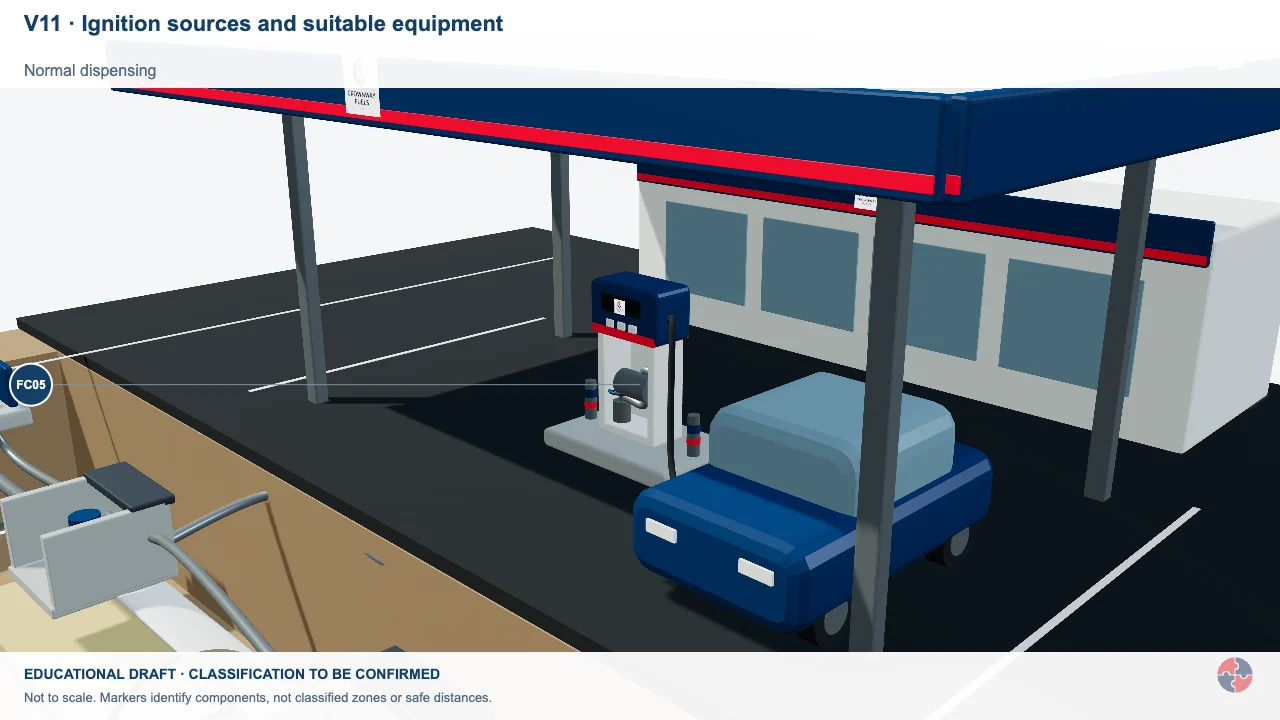
Ignition sources and suitable equipment
Electrical faults, hot work and other ignition sources matter where an explosive atmosphere could form.
Activity focus: Link equipment selection to the assessed atmosphere and actual dossier.
Contextual illustration. The image alone does not establish equipment state, effective controls, individual health or authorisation; use the task-specific checks and competent evidence.
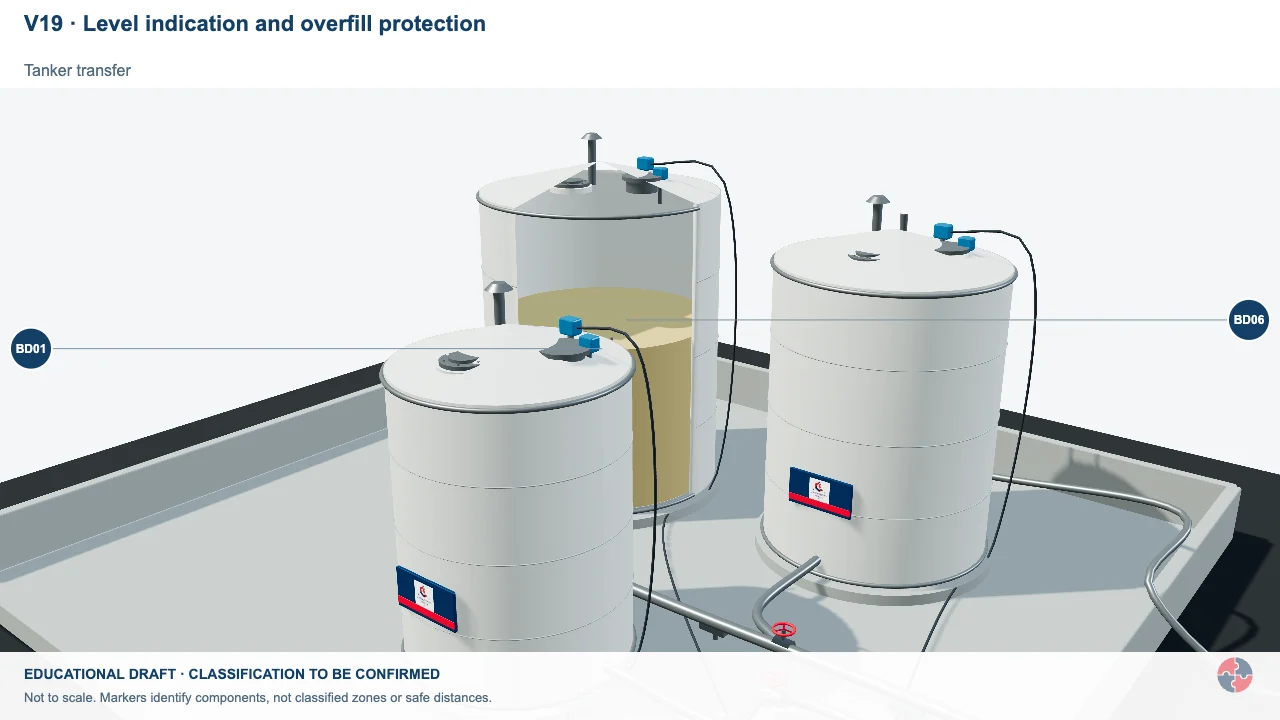
Normal control and independent overfill protection
Compare the normal LT/controller/FCV loop with a separate high-high sensor, safety logic and dedicated inlet ESDV.
Activity focus: Trace the independent sensor-to-action chain and the separate manual ESD input. Red identifies safety duty; blue identifies normal control.
Contextual illustration. The image alone does not establish equipment state, effective controls, individual health or authorisation; use the task-specific checks and competent evidence.
Educational illustration, not to scale. Coloured zones are teaching examples, not a site-specific hazardous-area classification.
What are the warning signs of weak management of fire and gas detection, alarms and shutdown?
Weak management is usually visible before harm occurs if supervisors and leaders look for practical warning signs.
- The risk assessment mentions fire and gas detection, alarms and shutdown but does not describe the actual work, people, equipment or environment.
- Controls rely mainly on people remembering rules rather than removing, reducing or isolating the hazard.
- Training records exist, but supervisors cannot explain what good control looks like at the point of work.
- Inspections repeatedly find the same defects or unsafe behaviours without lasting improvement.
- Incidents, symptoms, complaints or near misses are treated as isolated events rather than management-system learning.
- Senior managers receive activity numbers but not evidence that controls are effective.
Which UK legal duties are relevant to fire and gas detection, alarms and shutdown?
Fire-and-gas duties depend on location, premises, substances and whether a major-accident regime applies; GB and NI have separate DSEAR and COMAH instruments.
Premises fire law governs warning and escape, while work-health, dangerous-substance and major-accident law govern the activity and process. Do not apply GB regulations to Northern Ireland by default. COMAH status depends on the establishment and dangerous-substance inventory; a gas detector alone does not establish it.
For fire and gas detection, alarms and shutdown, good compliance should be visible in the risk assessment, control standard, training, supervision, monitoring, maintenance where relevant and management review.
| Jurisdiction | Duty or regulation | Why it matters | What good management should show |
|---|---|---|---|
| GB | Health and Safety at Work etc. Act 1974 | Sets the broad duty to protect employees and others affected by work involving fire and gas detection, alarms and shutdown. | Translate the duty into risk assessment, control standards, training, supervision and monitoring. |
| GB | Management of Health and Safety at Work Regulations 1999 | Requires suitable assessment, preventive arrangements, competent assistance, cooperation and review for fire and gas detection, alarms and shutdown risks. | Keep the assessment live and check controls after change, incidents, complaints or new information. |
| GB | Dangerous Substances and Explosive Atmospheres Regulations 2002Dangerous Substances and Explosive Atmospheres Regulations 2002 | Applies where dangerous substances can create fire, explosion or similar energy-release risks. | Identify hazardous areas, ignition sources, controls, maintenance precautions and emergency arrangements. |
| E&W | Regulatory Reform (Fire Safety) Order 2005Regulatory Reform (Fire Safety) Order 2005 | Applies to fire risk assessment and fire precautions in England and Wales. | Use devolved fire safety duties where relevant and keep fire risk assessment, maintenance and training current. |
| Scotland | Fire (Scotland) Act 2005 | Scottish non-domestic premises fire route. | Warning, escape and responsible-person coordination. |
| Scotland | Fire Safety (Scotland) Regulations 2006 | Scottish detailed premises precautions. | Maintenance and emergency arrangements for the actual premises. |
| NI | Fire and Rescue Services (NI) Order 2006 | NI non-domestic premises fire route. | Identification of appropriate person and affected premises. |
| NI | Fire Safety Regulations (NI) 2010 | NI detailed premises precautions. | Warning, escape, maintenance and review. |
| NI | Health and Safety at Work (NI) Order 1978 | NI general work-health and safety duties. | Control of work-created release, fire and emergency risk. |
| NI | Management Regulations (NI) 2000 | NI work-risk and emergency arrangements. | Competence, risk assessment, coordination and procedures. |
| NI | DSEAR (NI) 2003 | NI dangerous-substances work-risk route. | Release, ignition, alarm and emergency controls where in scope. |
| GB | COMAH Regulations 2015 | GB major-accident regime for in-scope establishments. | Scenario, barrier and safety-management evidence. |
| NI | COMAH Regulations (NI) 2015 | NI major-accident regime for in-scope establishments. | NI scenario, barrier and emergency planning evidence. |
How can BS EN ISO 45001 support fire and gas detection, alarms and shutdown management?
Use voluntary ISO 45001 management themes to organise ownership, competence, operation and review; process safety functions also require their own competent technical lifecycle. HSE functional safety guidance describes the GB technical lifecycle; the ISO themes in this table are illustrative management prompts, not verified clause claims.
Use current government guidance and competent task-specific advice; this section does not establish a technical specification.
| Management theme | Practical management principle |
|---|---|
| Hazard identification and assessment of OH&S risks and opportunities | Keep release, ignition, exposure and escalation scenarios linked to each credited detector, alarm and trip. Public management context: HSE health and safety management-system overview. |
| Competence | Verify operators, engineers and supervisors can make the decisions required during an upset or impairment. Public management context: HSE health and safety management-system overview. |
| Operational planning and control | Authorise bypasses and changes, control dependencies and verify the final safe-state response. Public management context: HSE health and safety management-system overview. |
| Monitoring, measurement, analysis and performance evaluation | Sample proof tests, bypass duration, nuisance alarms and actual operator response. Public management context: HSE health and safety management-system overview. |
| Incident, nonconformity and corrective action | Investigate failed functions and prove corrective actions in the field. Public management context: HSE health and safety management-system overview. |
These are practical management-system themes, not a clause-by-clause interpretation. A competent reviewer must verify any clause mapping against a lawfully accessed current standard.
Who needs fire-and-gas competence, and how is it demonstrated?
Competence should be practical, role-specific and checked through behaviour and evidence, not assumed from attendance alone.
Competence for fire and gas detection, alarms and shutdown should be matched to the role. Awareness may be enough for some people; others need practical authorisation, technical training, supervision skills or specialist advice.
Training should be refreshed after change, incidents, repeated defects, poor audit findings, new equipment, new guidance or a long gap since the task was last carried out.
| Role | Learning to test | Competence demonstration | Assessor and record | Reassessment trigger |
|---|---|---|---|---|
| Operators and responders | Recognise gas, fire, alarm and trip meanings, priorities and safe-state steps. | Handle a release scenario with alarm flood, failed valve response and evacuation. | Control-room lead observes and records scenario performance. | New alarm, drill failure or process change. |
| Supervisors and shift leaders | Own operational risk decisions, handover and impairment limits. | Decide to hold transfer after detector calibration and reject inadequate substitute. | Process-safety lead reviews authority, evidence and hand-back. | Bypass, incident or repeated nuisance alarm. |
| E,C&I and maintenance specialists | Understand design basis, sensing, logic, utilities, final elements and tests. | Trace a fault through isolation, repair, configuration and end-to-end proof. | Independent technical authority checks work pack and limitations. | Modification, failed proof or standard change. |
| Functional and process-safety specialists | Assess credited risk reduction and independence across the lifecycle. | Challenge assumptions on detector coverage, human response and safe state. | Competent technical reviewer signs design and verification basis. | New scenario, altered inventory or performance drift. |
| Dutyholders and emergency leads | Resource prevention, assurance, drills and incident recovery. | Review combined bypass, alarm flood and loss-of-power tabletop exercise. | Leadership records actions and effectiveness review. | Major change, near miss or management review. |
What do the acronyms and key terms mean?
Use terms to distinguish a detector, operator alarm, automatic trip, safe state and impairment.
| Term | Meaning | Practical use |
|---|---|---|
| F&G | Fire and gas | Detection and linked warning or action for fire, gas or release scenarios. |
| ESD | Emergency shutdown | A designed action intended to move a process toward a defined safe state. |
| SIS | Safety instrumented system | A specific safety function requiring lifecycle and integrity evidence. |
| SIL | Safety integrity level | A technical risk-reduction measure never guessed from a detector label. |
| COMAH | Control of Major Accident Hazards | Separate GB and NI 2015 regimes for establishments in scope. |
| DSEAR | Dangerous Substances and Explosive Atmospheres Regulations | Separate GB 2002 and NI 2003 work-risk regimes. |
| Bypass | Temporary defeat of a protective function | Requires authority, risk controls, visibility and verified removal. |
| Cause and effect | Recorded link from initiating signal to intended output | Must be verified through to the real process response. |
Where the separate tanker examples use “transfer”, this means moving gas or liquid between a tanker, pipework and a storage or process vessel. The detector-maintenance hierarchy does not assume that this operation is taking place.
Unlock another resource
You have used this month’s two free downloads. Publish a post in your own words to unlock one more resource, or choose SHARE Individual for 10 downloads per month.
You decide whether to share. If you do, use the relevant platform disclosure tools and do not make claims you do not genuinely hold.