
SHARE Knowledge Hub
Overhead Power Lines
Overhead power lines can cause fatal shock or burns by contact or flashover from plant, loads and long materials. Identify the line and owner before work; avoid the area, or ask the network operator about diversion or making the line dead. If a live line remains, a competent plan must set site-specific exclusion, barriers, controlled crossings, plant limits, supervision and emergency action. No generic clearance figure or PPE makes close approach safe.
Understanding Overhead Power Lines
Overhead power lines can cause fatal shock or burns by contact or flashover from plant, loads and long materials. Identify the line and owner before work; avoid the area, or ask the network operator about diversion or making the line dead. If a live line remains, a competent plan must set site-specific exclusion, barriers, controlled crossings, plant limits, supervision and emergency action. No generic clearance figure or PPE makes close approach safe.
Why this matters at work
A person or object may bridge to a conductor, or electricity may jump an air gap when sufficiently close. A vehicle, metal structure, load or wet/dirty material can become part of the current path. Severe shock, burns, fire, falls and secondary collisions can follow. Contact is not a prerequisite for a fatal event.
Track near misses, barrier strikes, unauthorised crossings, limit overrides, changed loads and late owner consultations as leading indicators. Reassess after equipment swaps, new subcontractors, altered ground level, weather damage or a change in work sequence. Compare a field observation with the plan and log corrective action, owner, due date and verification. A low injury count is weak assurance where a single error can be fatal.
How organisations manage this in practice
If the line remains live, define robust controls: barriers, exclusion zones, controlled passages, physical plant limits, clear instructions, competent direct supervision and inspection. The work must be planned to prevent any part reaching the dangerous zone, including foreseeable error or movement.
Use the operation’s assessed checks and review triggers, not an invented universal daily-test rule. Before relevant work, compare plant configuration, attachments, loads, route, ground level, barriers, goalposts and visibility with the approved drawing. A rising stockpile, moved crane, damaged goalpost, outage overrun or new load can invalidate assumptions. Check whether workers can exercise stop authority and whether delivery drivers understand the controlled crossing and tipping restrictions. Suspend the affected operation when a critical fact or control differs, protect the area and notify the responsible supervisor and line owner or competent planner as appropriate. Record the defect, interim restriction, correction owner and evidence required for restart. Rebrief receiving shifts and contractors on controlled revisions. Management should sample actual behaviour and investigate barrier strikes, overrides, unplanned crossings and late consultations, including comparable sites. A completed form is evidence of a check, not proof that the physical arrangement works. Never conduct a live approach test to settle a missing clearance fact.
Record maximum machine and load heights, including raised augers, booms and folded/unfolded configurations. Inspect field entrances, slopes and changes in ground level that affect reach. Display the owner's emergency number in relevant cabs and make arrangements for temporary disconnection where needed. Review the plan at the start of each season and whenever plant or crop operations change; a generic farm map is not a task authorisation.
What should happen if plant contacts or flashes over to an overhead line?
Treat contact, suspected contact or flashover as a life-threatening emergency and keep people away.
The first response must prevent additional casualties. A vehicle, load, crane, scaffold, fence, ground area or nearby object may be energised after a line strike or close approach. People rushing towards the operator or casualty can become part of the electrical path.Avoiding danger from overhead power lines, GS6
Warn everyone to stay well away, call the emergency services and the line owner or Distribution Network Operator, and do not touch the vehicle, load, line, casualty or anything that may be energised. If an operator is in a cab and there is no fire or other immediate danger, the usual instruction is to stay in the cab and wait for confirmation from the line owner that it is safe.
If escape is essential because of fire or another immediate danger, emergency training should explain how to jump clear without touching the vehicle and ground at the same time, then shuffle or bunny-hop away so the feet do not bridge different ground voltages. Never attempt to disentangle equipment or recover plant until the line owner confirms the line has been made safe. Power may trip and re-energise without warning.
| Situation | Immediate action | Why it matters |
|---|---|---|
| Plant or load contacts a line | Stop work, warn others away, call 999 and the DNO, and keep the operator in the cab if safe. | The plant, load and surrounding ground may be energised.Avoiding danger from overhead power lines, GS6 Overhead power lines |
| People nearby or moving towards the scene | Shout clear instructions to stay outside the danger area and prevent attempted rescue until competent help confirms safety. | Secondary casualties often occur when people approach energised plant or ground.Avoiding danger from overhead power lines, GS6 Overhead power lines |
| Operator can drive clear safely | Only attempt to move clear if this can be done without making the situation worse and in line with emergency instructions. | Movement can reduce contact, but uncontrolled movement can create further danger.Avoiding danger from overhead power lines, GS6 Overhead power lines |
| Fire or immediate danger in cab | Exit only if essential, jump clear and move away without touching plant and ground together. | Touch potential and step potential can kill during escape.Avoiding danger from overhead power lines, GS6 Overhead power lines |
| Operator has left the cab | Move away by shuffling or bunny-hopping until clear of the danger area and do not return to the vehicle. | Step potential can exist in the ground around energised equipment.Avoiding danger from overhead power lines, GS6 Overhead power lines |
| Person down near the plant | Do not rush in. Remain outside the danger area and follow emergency-service directions; the line owner must confirm electrical safety before ordinary rescue or access. Responders controlling the scene is not electrical clearance. | Well-intentioned rescue can create more casualties.Avoiding danger from overhead power lines, GS6 Overhead power lines |
| After power trips out | Still keep away until the line owner confirms safety. | Automatic re-energisation can occur without warning.Avoiding danger from overhead power lines, GS6 Overhead power lines |
The network operator and competent emergency planner must approve one coherent site escape briefing, including ground-voltage precautions, and reconcile it with every action-card/FAQ instruction. Staying in the cab when safe is the normal option; escape is only for immediate danger. The detailed shuffle/hop choice below requires that operator-approved briefing and must not be represented as a universal GS6 instruction.
What must not happen after overhead line contact?
The wrong rescue or recovery action can create additional fatalities after the first contact or flashover.
This section should be briefed before work starts because people rarely make calm decisions during a line strike. The safest instinct is distance, communication and control of the scene: keep people away, contact the emergency services and the line owner, and wait for confirmation that the line has been made safe.Avoiding danger from overhead power lines, GS6
The danger area can include the vehicle, load, ground, fence, plant, attachment and surrounding surface. A line may trip and then re-energise automatically, so a lack of sparks, sound or visible movement is not proof of safety.
| Do not | Why it is dangerous | Correct response |
|---|---|---|
| Do not climb down from the cab if it is safe to stay there. | Touching the vehicle and ground together can complete an electrical path. | Stay in the cab, warn others away and wait for the line owner or emergency services.Avoiding danger from overhead power lines, GS6 |
| Do not touch the vehicle, load, line, fence, casualty or nearby object. | Anything connected to the strike may be energised. | Keep outside the danger area until competent confirmation that it is safe.Avoiding danger from overhead power lines, GS6 |
| Do not rush in to rescue someone near the plant. | A rescuer can become the next casualty through touch or step potential. | Call 999, control the area and wait for emergency services/line-owner instruction.Avoiding danger from overhead power lines, GS6 |
| Do not assume the line is dead because power appears to have tripped. | Automatic re-energisation may occur without warning. | Treat the line as live until the owner confirms otherwise.Avoiding danger from overhead power lines, GS6 |
| Do not try to disentangle equipment, lower a load or recover tools. | Movement can worsen contact, create arcing or energise more equipment. | Leave plant and loads in place unless instructed by competent emergency control.Avoiding danger from overhead power lines, GS6 |
| Do not walk normally away from an energised area after escape. | Step potential can exist across the ground around the strike. | Jump clear only if escape is essential, then shuffle or bunny-hop away.Avoiding danger from overhead power lines, GS6 |
| Do not restart work or re-enter the area because the visible danger has stopped. | Residual damage, re-energisation, weakened plant or damaged controls may remain. | Restart only after line-owner confirmation, incident control and supervisor authorisation.Avoiding danger from overhead power lines, GS6 |
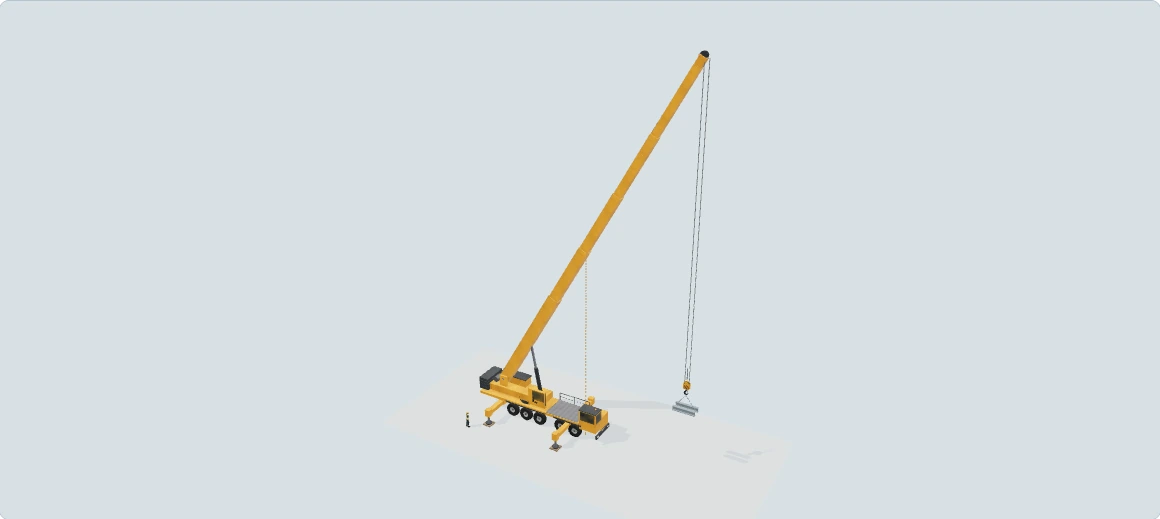

Mobile cranes: follow the load, support and people through a lift
Explore how this equipment can harm its users and other people, then follow the practical measures that interrupt each pathway. This is a hazards and good-practice lesson; the separate checklist remains the pre-use/safety-check activity.
Hazards and good practice: learn what can hurt people during use, change and maintenance. Pre-use and safety checks stay in the separate checklist.
Checksheets and risk assessments
Equipment checksheets
- Mobile cranes and planned lifts — 3D checks · Word · PDF
- Lifting accessories — 3D checks · Word · PDF
Risk assessment forms
Risk assessment examples
Forms and tools
Full written walkthrough — all 8 steps
1. Start with the complete lifting operation
What is happening: The crane, supporting ground, load, route and people form one operation.
How harm can occur: A technically sound crane can still overturn or drop a load in an unsuitable plan.
Best practice to apply: Resource and plan the actual lift through a person with competence proportionate to its complexity and risk.
Why this works: Planning joins equipment selection to the real task instead of treating examination as approval to lift anything.
Load-Handling Equipment and Lifting Operations · What does load-handling equipment and lifting operations mean?2. Establish the real load and configuration
What is happening: The load includes relevant attachments and accessories, not only the labelled object.
How harm can occur: An incorrect mass, centre of gravity or configuration can overload equipment or destabilise the lift.
Best practice to apply: Establish load information and use the actual crane/attachment data and planned configuration; the model supplies no capacity.
Why this works: Correct input data is needed before the equipment's limits can be applied.
Load-Handling Equipment and Lifting Operations · How should a motor lift change when the load is not as expected?3. Trace reactions into the ground
What is happening: Outriggers and spreaders transmit reactions into the supporting surface or structure.
How harm can occur: A void, inadequate support or movement can cause overturn and crush people.
Best practice to apply: Obtain suitable ground/support information and competent design of the set-up and spreading arrangements.
Why this works: Load-spreading and support must be based on reactions and capacity, not how firm the ground feels.
Load-Handling Equipment and Lifting Operations · What technical lifting details should learners understand?4. Connect the load with suitable accessories
What is happening: Hooks, slings and connections form the load path between the crane and the item.
How harm can occur: Failure, unsuitable sling angles or an unstable attachment can drop or shift the load.
Best practice to apply: Use accessories suitable for the load, arrangement and actual duties, with competent selection and required condition/examination controls.
Why this works: Every link has to suit the task; a marked component does not validate the complete arrangement.
Load-Handling Equipment and Lifting Operations · Documents to download5. Keep people out of the load and machine routes
What is happening: The load route, slewing equipment and landing area create different danger interfaces.
How harm can occur: A moving or falling load can strike or crush a person, including someone guiding or receiving it.
Best practice to apply: Plan separation, a controlled landing area and safe positions; avoid lifting over people and protect other operations.
Why this works: The safest contact with the load path is often no contact at all.
Load-Handling Equipment and Lifting Operations · Load-Handling Equipment and Lifting Operations FAQs - what do people ask?6. Coordinate signals and visibility
What is happening: The operator may not see the full load or landing interface.
How harm can occur: Lost signals or conflicting instructions can create unintended movement towards people or obstructions.
Best practice to apply: Agree the communication and responsible roles; stop when essential visibility or communication is lost.
Why this works: An agreed single control arrangement prevents incompatible instructions during a critical movement.
Load-Handling Equipment and Lifting Operations · What should stop a lifting operation?7. Keep the plan valid as conditions change
What is happening: Radius, load condition, weather and nearby work may change during the operation.
How harm can occur: A changed configuration or new obstruction can invalidate the planned controls.
Best practice to apply: Stay within the actual plan and manufacturer limits; pause and re-plan a material change rather than improvise.
Why this works: The plan applies to its stated conditions, not every variation that occurs later.
Load-Handling Equipment and Lifting Operations · What technical lifting details should learners understand?8. Separate lifting from maintenance and hand-back
What is happening: A crane at rest may still contain hydraulic, gravitational and other stored energy.
How harm can occur: Unexpected descent or release can injure a fitter or someone handling equipment.
Best practice to apply: Use competent machine-specific isolation/support and defect arrangements; verify readiness before the next lifting task.
Why this works: A stopped lift does not establish a safe maintenance condition or approve the next operation.
Load-Handling Equipment and Lifting Operations · What checks, inspections and examinations are needed?
Illustrative awareness learning. Geometry, colours and movement do not establish safe distances, capacity, exposure, isolation or work permission. Use the actual assessment, equipment information and competent arrangements.
The wider workplace has its own account and subscription access. Exploring this lesson does not grant access, record course completion or authorise work.
UK guidance for further reading
HSE: Mobile cranes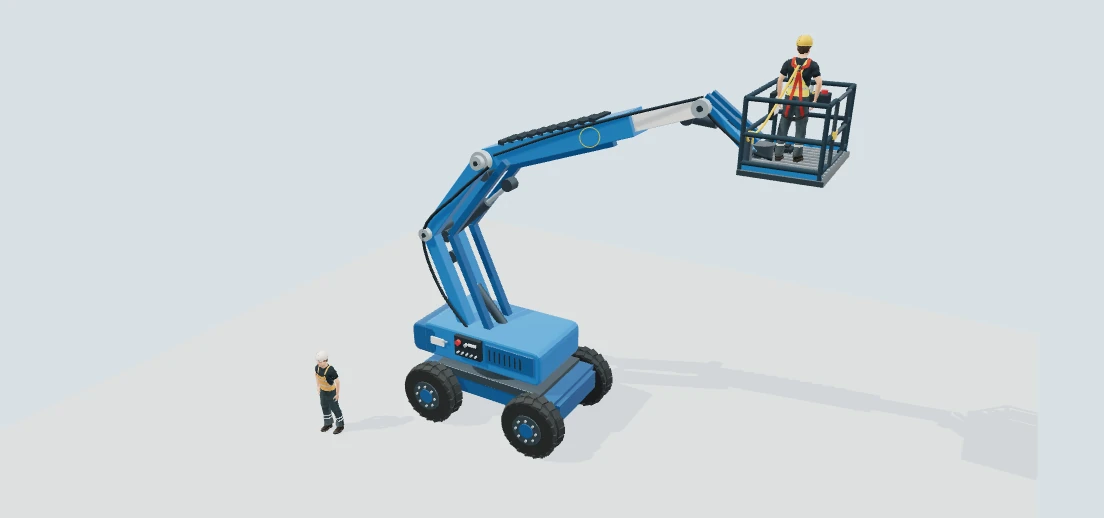
Cherry picker: working safely from an articulated boom
Follow a maintenance team reaching a high-level light. Compare what happens at the wheels and at the basket, find the restraint anchor and plan how the team would bring a stranded colleague down.
Checksheets and risk assessments
Equipment checksheets
- Mobile elevating work platforms — 3D checks · Word · PDF
- Harnesses and lanyards — 3D checks · Word · PDF
Risk assessment forms
Risk assessment examples
Forms and tools
Full written walkthrough — all 11 steps
1. Choose access for the job
What is happening: A high-level light sits beyond an obstruction. The rising arm, extending section and jib let the basket reach sideways. A scissor platform mainly moves vertically.
How harm can occur: Selecting on height alone can leave someone leaning out, or manoeuvring into a structure to reach the work.
Best practice to apply: First consider doing the job from the ground. If a boom is appropriate, check its working envelope for the approach, load and return route. Use a trained operator familiar with this model.
Why this works: Planning the return as well as the approach gives the team a way out if conditions change.
How should construction hazards be controlled? · How can the ISO 45001 hierarchy of controls reduce work-at-height, demolition and excavation risks?2. Follow the restraint from harness to basket
What is happening: Trace the short line from the operator’s full-body harness to the marked basket anchor. On a mobile boom, a sudden chassis movement can throw an occupant upwards even with the gate shut.
How harm can occur: A long lanyard may let someone leave the basket. A guardrail or nearby structure is an unsuitable attachment point.
Best practice to apply: IPAF strongly recommends restraint in a boom. Check harness fit, compatible connectors and the manufacturer-designated anchor for each wearer. Adjust the line so the wearer stays inside. Keep both feet on the platform floor and the gate closed.
Why this works: A guarded vertical scissor lift usually provides collective protection without a harness. A boom adds the risk of ejection. Fall arrest needs a specifically suitable system, enough clearance and a rescue plan.
Belts and harnesses for work at height · What types of belts and harness systems are used?3. Compare a wheel drop with movement at the basket
What is happening: Move the leading tyre towards the open recess. Watch the chassis tilt, then reset the camera to see how far the raised basket moves with it.
How harm can occur: A small movement at ground level can cause a much larger movement at the end of the boom. Loss of support can eject an occupant or overturn the machine.
Best practice to apply: Walk the wheel route first. Verify ground strength, gradients, edges and any covers. Keep the route away from openings. Only travel elevated if the manufacturer permits it and the assessed route is suitable.
Why this works: Restraint may help keep the occupant in the basket. The primary control here is a route that supports every wheel.
Load-Handling Equipment and Lifting Operations · What technical lifting details should learners understand?4. See the closing gap under overhead steelwork
What is happening: Slew the basket in the demonstration. The chassis and gantry stay still. The controls and the operator’s head travel sideways towards the beam.
How harm can occur: Someone pinned between the controls and steelwork may be unable to release the control. Continuing movement can crush them.
Best practice to apply: Assess the whole movement envelope from the ground. Choose a position with clear sight and room for the occupant. Stop when clearance or signals are uncertain. Consider suitable secondary guarding and plan recovery for entrapment.
Why this works: The platform floor can clear an obstruction while the person above it cannot. Reversing or lowering blindly can worsen a crush.
How should construction hazards be controlled? · How can the ISO 45001 hierarchy of controls reduce work-at-height, demolition and excavation risks?5. Keep pedestrians out of the slewing area
What is happening: Turn on the shaded areas to see the counterweight sweep and an example of restricted vision behind the chassis. The responder needs a clear approach to the ground controls.
How harm can occur: A person outside the tyre tracks can still be struck or trapped by the counterweight, or enter beneath the basket.
Best practice to apply: Separate pedestrians and adjacent work from the travel, tail-swing and overhead work areas. Agree how to communicate, who can stop the job and where a signaller can stand safely.
Why this works: The painted arcs explain the mechanism. Set the actual boundary using the machine, site conditions and task.
Load-Handling Equipment and Lifting Operations · What should stop a lifting operation?6. Protect people below and around the boom
What is happening: Follow the dashed line from the basket to the hatched drop zone. Slew the boom and watch the line move. The red and white barriers enclose the full work area, including the counterweight and the space beneath the boom.
How harm can occur: A dropped tool or fitting can strike someone below or bounce beyond the basket footprint. The moving boom, basket or counterweight can strike a passer-by or trap them against a fixed object.
Best practice to apply: Before elevating, barrier off the assessed area and divert pedestrians and nearby work. Allow for the planned reach, tail swing, work height, wind and falling items. Contain loose materials and use suitable tool retention where appropriate. If anyone enters, stop movement and overhead work until the area is clear.
Why this works: The responder stays outside with an agreed safe route to the ground controls for recovery. The hatching illustrates one job. Set the boundary for the actual lift and review it before repositioning.
How should construction hazards be controlled? · How should plant, vehicles and public interfaces be controlled?7. Check the whole boom against overhead power lines
What is happening: The amber arrow shows the basket’s proposed sideways movement. Trace the jib, boom elbow, basket and anything carried through raising, slewing and recovery. The red and white barrier marks a restricted approach.
How harm can occur: A conductor can arc across an air gap before the basket or boom touches it. A flashover or contact can cause fatal shock or burns. The chassis and the ground around it may also be live.
Best practice to apply: Treat the line as live. Move the job outside the boom’s full reach if possible. Otherwise, ask the line owner about diversion or confirmed isolation. For work near a live line, agree site-specific clearances and physical controls with the owner before work. Stop if any part could enter that area.
Why this works: A basket that looks clear can still swing the jib or elbow towards the line. The picture gives no safe working distance. If contact or flashover is suspected, stay in the platform and warn everyone away. Call 999 and the line owner. Keep off the ground controls and wait for the line owner to confirm safety.
Plan plant movement near overhead lines Respond to contact or flashover8. What if a 5 kg hand tool falls 8 metres?
What is happening: A 5 kg hand tool slips clear of the basket, 8 m above the floor. Follow its fall into the empty exclusion zone. People, tools and fittings all count towards the platform load.
How harm can occur: A blunt tool falling this distance carries about 392 J just before impact. DROPS rates this example as having fatality potential if someone is struck. An overloaded platform or a large panel exposed to wind can also make the machine unstable.
Best practice to apply: Check the load and wind limits for this machine and configuration. Secure loose tools and materials, select compatible tool retention for the load, and keep people clear of the fall and deflection area. Stop if anyone enters.
Why this works: Retention prevents the release. The barrier protects people if retention fails. A hard hat alone cannot control this risk. Reassess gusts and the wind area of large materials even when their mass is within the limit.
How should construction hazards be controlled? · How should plant, vehicles and public interfaces be controlled?A 5 kg hand tool falls 8 metres
The model shows a blunt tool slipping from the basket into the empty work zone. The 8 m measurement runs from its release point to the floor.

Ideal fall energy 392.27 J
Potential injury outcome Fatality potentialIdeal speed before impact 12.53 m/s. Someone struck by the tool could be killed. The SHAREhub model assumes a blunt object, standard PPE and a fall to the floor or deck. The actual injury depends on the contact.
Secure tools before raising the basket. Use a compatible, rated retention system where appropriate. Allow for deflection or bounce when setting the exclusion zone. Stop work if anyone enters.
Open these values in the SHAREhub dropped-object model9. Check the machine before use
What is happening: Locate the machine information and instruction holder. Inspect tyres, pins, hydraulic lines, platform gate, anchor and controls; function-test the safety systems as the manual describes.
How harm can occur: A worn joint, disabled safety device or faulty emergency lowering system can leave occupants exposed or stranded.
Best practice to apply: Report defects and take unsafe equipment out of use. Check maintenance and thorough-examination records. In Great Britain, equipment lifting people normally needs thorough examination every six months unless a competent person’s examination scheme sets another interval.
Why this works: Pre-use checks, maintenance and formal thorough examination serve different purposes. A current report cannot clear a fault found today.
Load-Handling Equipment and Lifting Operations · What checks, inspections and examinations are needed?10. Make recovery possible before going up
What is happening: Find the ground control panel. Imagine power is lost with the basket beside the beam. Where can the responder see the occupant and access the recovery controls?
How harm can occur: An unplanned descent may tighten a trapping gap. Waiting without a practicable recovery route can delay urgent care.
Best practice to apply: Before elevation, brief and practise the machine-specific rescue plan. Provide a familiarised ground responder, access to controls and keys, two-way communication and an agreed escalation route. Check the path clear before recovery. Call emergency services when needed.
Why this works: A usable rescue plan identifies who will act and how they will recover someone from the actual position, including if normal lowering fails.
Belts and harnesses for work at height · What rescue arrangements are needed before harness work starts?11. Stop for a change, isolate and hand back
What is happening: A hose fault appears at the articulated riser. The task changes from using the machine to maintaining it.
How harm can occur: Gravity, hydraulic pressure or an unexpected command can move an arm while someone is in a crush zone.
Best practice to apply: Stop and secure the machine. Have authorised maintainers follow the manufacturer’s isolation, pressure-release and mechanical support arrangements. Record the defect and verify repairs and tests before hand-back.
Why this works: A stopped engine or an emergency-stop button alone cannot support a raised boom. Never work beneath an unsupported arm.
Load-Handling Equipment and Lifting Operations · What checks, inspections and examinations are needed?
This generic machine illustrates how harm can occur. Its shape and movements give no working limits, safe clearance or operating sequence. For an actual lift, use the machine manual, the site assessment and a practised rescue plan.
The wider workplace has its own account and subscription access. Exploring this lesson does not grant access, record course completion or authorise work.
UK guidance for further reading
HSE: MEWPsIPAF H1: Fall protection in MEWPsHSE: Entrapment and crushing in MEWPsHSE: working near overhead power linesHSE: thorough examinations of lifting equipmentGreat Britain: Work at Height Regulations 2005HSENI: working at height in Northern IrelandHSE GS6 · Avoiding danger from overhead power linesWhy are overhead power lines so dangerous?
The danger is the electrical energy and the approach envelope, not simply whether a wire is touched.
Best-practice guide: Overhead Power Lines
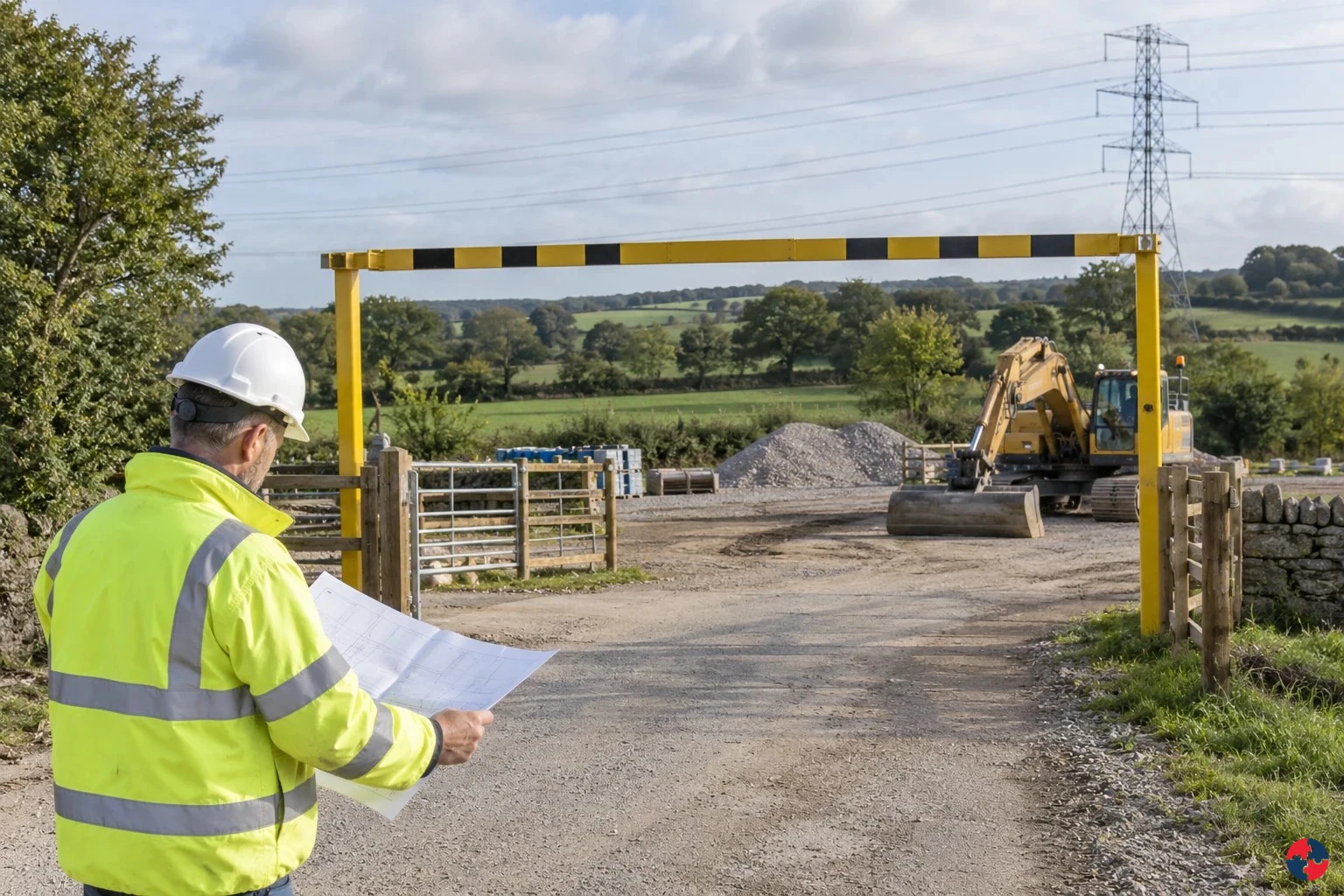
Why are overhead power lines so dangerous?
The danger is the electrical energy and the approach envelope, not simply whether a wire is touched. Overhead power lines can cause fatal shock or burns by contact or flashover from plant, loads and long materials.
Turn overhead power lines knowledge into a decision
Overhead power lines can cause fatal shock or burns by contact or flashover from plant, loads and long materials. Identify the line and owner before work; avoid the area, or ask the network operator about diversion or making the line dead. Move crane position where possible, consult DNO, show line on lift plan, set no-go zone, restrict slew/radius and supervise
Worked scenarios and control lessons
Mobile crane near site boundary: Move crane position where possible, consult DNO, show line on lift plan, set no-go zone, restrict slew/radius and supervise Tipper delivery under a line: Prohibit tipping beneath lines, brief driver before entry, use controlled route and supervise unloading
Electrical harm mechanisms near overhead lines
Direct contact: Plant, load, tool or person touches a live conductor. Flashover: Electricity jumps through air to an object or person close enough to the conductor. Touch potential: A person touches energised plant, load, fence or ground-connected object.
Choose controls for overhead power lines
Eliminate: Move the delivery, unloading or traffic route away from the overhead line so close approach is unnecessary. Reduce, including substitution: Use a suitable alternative delivery vehicle or unloading method that avoids raising equipment in the line area, checking the whole movement envelope. Isolate: Where avoidance is not practicable, arrange line diversion or making dead with the line owner and obtain verified handover before relying on it. Control: Establish suitable physical barriers and controlled crossings/height restrictions from the line-owner and competent planning requirements. Control: Agree vehicle routes, delivery briefing, supervision, weather and changes of load; stop any unplanned tipper, crane or long-load movement near the line. Read the full control table for qualifications, ownership and verification. Use the actual task and applicable jurisdiction; existing technical approval remains unchanged.
Use the full overhead power lines lesson
Use the full topic for the decision points, practical examples, detailed control tables and source scope. HSE guidance applies to Great Britain; use HSENI for the Northern Ireland route and the source’s stated jurisdiction. A simplified guide does not change the page’s technical-review or approval status.

Read all six steps as text
1. Why are overhead power lines so dangerous?
The danger is the electrical energy and the approach envelope, not simply whether a wire is touched.
- Avoid / redesign: Move the delivery, unloading or traffic route away from the overhead line so close approach is unnecessary.
- Control the task: Where avoidance is not practicable, arrange line diversion or making dead with the line owner and obtain verified handover before relying on it.
- Verify before release: If the hazardous step remains, keep it within the task assessment and select the stronger feasible remaining controls.
The danger is the electrical energy and the approach envelope, not simply whether a wire is touched. Overhead power lines can cause fatal shock or burns by contact or flashover from plant, loads and long materials.
Apply it: Which part of this plan would you check at the workface before authorising the task?
2. Turn overhead power lines knowledge into a decision
Use the evidence to improve the actual work arrangement.
- Change at source: Move the delivery, unloading or traffic route away from the overhead line so close approach is unnecessary.
- Make it observable: If the hazardous step remains, keep it within the task assessment and select the stronger feasible remaining controls.
- Keep useful evidence: Move crane position where possible, consult DNO, show line on lift plan, set no-go zone, restrict slew/radius and supervise
Overhead power lines can cause fatal shock or burns by contact or flashover from plant, loads and long materials. Identify the line and owner before work; avoid the area, or ask the network operator about diversion or making the line dead. Move crane position where possible, consult DNO, show line on lift plan, set no-go zone, restrict slew/radius and supervise
Apply it: What evidence would show that the change improves this task, rather than only completing a record?
3. Worked scenarios and control lessons
Example: a practical application of the existing topic lesson.
- Mobile crane near site boundary: Move crane position where possible, consult DNO, show line on lift plan, set no-go zone, restrict slew/radius and supervise
- Tipper delivery under a line: Prohibit tipping beneath lines, brief driver before entry, use controlled route and supervise unloading
- Tree pruning near conductors: Seek Network Operator advice, make line dead where needed and use competent utility-arboriculture controls
Mobile crane near site boundary: Move crane position where possible, consult DNO, show line on lift plan, set no-go zone, restrict slew/radius and supervise Tipper delivery under a line: Prohibit tipping beneath lines, brief driver before entry, use controlled route and supervise unloading
Apply it: At which point would you hold this example, and what evidence would allow it to proceed?
4. Electrical harm mechanisms near overhead lines
Connect the task, the route to the person and the control that can fail.
- Direct contact: Plant, load, tool or person touches a live conductor.
- Flashover: Electricity jumps through air to an object or person close enough to the conductor.
- Touch potential: A person touches energised plant, load, fence or ground-connected object.
Direct contact: Plant, load, tool or person touches a live conductor. Flashover: Electricity jumps through air to an object or person close enough to the conductor. Touch potential: A person touches energised plant, load, fence or ground-connected object.
Apply it: Who could be exposed, including other trades, cleaners, maintainers and people nearby?
5. Choose controls for overhead power lines
Start with the stronger practicable options and verify their effect.
- Eliminate: Move the delivery, unloading or traffic route away from the overhead line so close approach is unnecessary.
- Reduce, including substitution: Use a suitable alternative delivery vehicle or unloading method that avoids raising equipment in the line area, checking the whole movement envelope.
- Isolate: Where avoidance is not practicable, arrange line diversion or making dead with the line owner and obtain verified handover before relying on it.
- Control: Establish suitable physical barriers and controlled crossings/height restrictions from the line-owner and competent planning requirements.
- Control: Agree vehicle routes, delivery briefing, supervision, weather and changes of load; stop any unplanned tipper, crane or long-load movement near the line.
Eliminate: Move the delivery, unloading or traffic route away from the overhead line so close approach is unnecessary. Reduce, including substitution: Use a suitable alternative delivery vehicle or unloading method that avoids raising equipment in the line area, checking the whole movement envelope. Isolate: Where avoidance is not practicable, arrange line diversion or making dead with the line owner and obtain verified handover before relying on it. Control: Establish suitable physical barriers and controlled crossings/height restrictions from the line-owner and competent planning requirements. Control: Agree vehicle routes, delivery briefing, supervision, weather and changes of load; stop any unplanned tipper, crane or long-load movement near the line. Read the full control table for qualifications, ownership and verification. Use the actual task and applicable jurisdiction; existing technical approval remains unchanged.
Apply it: Which stronger option can be used here, and who will verify it before accepting the remaining risk?
6. Use the full overhead power lines lesson
Follow the official sources below and retain the task-specific evidence.
- Official guidance: Avoiding danger from overhead power lines, GS6
- Official guidance: Overhead power lines
- Task decision: Move crane position where possible, consult DNO, show line on lift plan, set no-go zone, restrict slew/radius and supervise
Use the full topic for the decision points, practical examples, detailed control tables and source scope. HSE guidance applies to Great Britain; use HSENI for the Northern Ireland route and the source’s stated jurisdiction. A simplified guide does not change the page’s technical-review or approval status.
Apply it: Which official source and full-topic section will you use to resolve the next decision?
Overhead lines are easy to underestimate because the conductors are above the normal workface and may look like a background feature of the site. They may cross access routes, boundary roads, fields, compounds, stockpiles, crane pads, delivery areas or tree-work zones rather than the exact place where the main task is being done.Avoiding danger from overhead power lines, GS6 Overhead power lines
The key technical learning point is flashover. A crane jib, scaffold tube, ladder, MEWP platform, tipper body, excavator boom, tree branch or suspended load may only need to come close enough for electricity to jump through air. Wet or dirty materials, damp timber, contaminated plastic, poor visibility, conductor movement and ground changes can all undermine assumptions made by sight alone.
Competent management therefore treats overhead lines as a fatal-risk energy-control issue. A safe system does not rely on a driver judging distance from a cab, a banksman shouting at the right moment or a generic note in the RAMS. It uses line-owner advice, planned avoidance, physical barriers, defined crossing points, restrictions, supervision and clear stop-work authority.
| Mechanism | What it means | Workplace example |
|---|---|---|
| Direct contact | Plant, load, tool or person touches a live conductor. | Tipper body, crane jib, scaffold tube, ladder or tree branch contacts a line.Avoiding danger from overhead power lines, GS6 Overhead power lines |
| Flashover | Electricity jumps through air to an object or person close enough to the conductor. | MEWP, excavator boom or long metal pipe enters the danger area without touching the line.Avoiding danger from overhead power lines, GS6 Overhead power lines |
| Touch potential | A person touches energised plant, load, fence or ground-connected object. | Worker touches a truck or load after a line strike.Avoiding danger from overhead power lines, GS6 Overhead power lines |
| Step potential | Voltage spreads through the ground and a person bridges different potentials with their feet. | People walk towards a struck vehicle across energised ground.Avoiding danger from overhead power lines, GS6 Overhead power lines |
| Secondary injury | Shock, arc or panic causes falls, collisions, burns, fire or equipment damage. | Operator falls, vehicle tyres ignite or nearby workers are injured during uncontrolled evacuation.Avoiding danger from overhead power lines, GS6 Overhead power lines |
| Service disruption | Line strikes can interrupt supplies and trigger wider business, public safety and emergency issues. | A utility strike affects nearby premises, road users and emergency response access.Avoiding danger from overhead power lines, GS6 Overhead power lines |
Where do overhead line risks arise in real work?
Risk arises wherever the work envelope, access route or foreseeable change can approach the line.
A proper assessment follows the physical path of the job: how people, plant, vehicles, materials and loads arrive, move, lift, unload, work, change configuration and leave. Many strikes happen away from the main task because the site has not controlled the access route, delivery point, tipping area, stockpile, maintenance position or material storage zone.Avoiding danger from overhead power lines, GS6
The same line can create different risk in different sectors. On a construction site the issue may be a concrete pump or scaffold tube. In agriculture it may be a sprayer boom or irrigation pipe. In quarries it may be a raised skip or changing ground level. In arboriculture it may be a branch-fall path, rope or MEWP. The controls need to match the task, not the label of the industry.
| Activity | Why it matters | Control emphasis |
|---|---|---|
| Construction plant | Excavators, cranes, telehandlers, piling rigs, MEWPs, concrete pumps, dumpers and tippers can raise into danger zones. | Plan movement envelopes, no-go areas, height/slew restrictions and supervision.Avoiding danger from overhead power lines, GS6 |
| Lifting operations | Loads swing, rotate, travel and may approach lines even when the crane base is outside the danger area. | Include the line in the lift plan, load path, radius, exclusion and appointment of competent lifting roles.Avoiding danger from overhead power lines, GS6 |
| Deliveries and unloading | Drivers may be unfamiliar with the site and may raise bodies or booms near lines. | Pre-arrival instructions, route control, supervised unloading and no tipping beneath lines.Avoiding danger from overhead power lines, GS6 |
| Scaffolding and long materials | Tubes, ladders, roof sheets, pipes and reinforcement can be carried or lifted into danger. | Relocate storage, control handling routes and brief workers on long-object movement.Avoiding danger from overhead power lines, GS6 |
| Tree work and vegetation | Branches, ropes, MEWPs and saws may approach conductors or affect fall paths. | Consult the Network Operator and use competent utility-arboriculture arrangements where needed.Avoiding danger from overhead power lines, GS6 |
| Agriculture and horticulture | Sprayer booms, combines, irrigation pipes, trailers and polytunnels create seasonal line risks. | Map lines, lower equipment, control routes and avoid stacking or structures near lines.Avoiding danger from overhead power lines, GS6 |
| Quarries and stockpiles | Changing ground level and raised skips can reduce clearance over time. | Set maximum stockpile limits, remove lines where possible and inspect encroachment.Avoiding danger from overhead power lines, GS6 |
| Maintenance and cleaning | People may climb plant, raise access equipment or handle long tools near lines. | Prohibit maintenance on top of high plant near lines and control isolation/access.Avoiding danger from overhead power lines, GS6 |
Which plant and activities most often create overhead-line risk?
The control method should be chosen from the activity's failure route, not from a generic instruction to avoid overhead lines.
A competent overhead-line assessment separates the work by activity because each has a different failure route. A tipper body rises vertically, a crane slews and changes radius, a MEWP can travel with height and outreach, scaffolders handle long conductive materials, and agricultural machines may fold or unfold booms during seasonal work. The supervisor needs to understand the specific movement that could enter the danger area.Avoiding danger from overhead power lines, GS6 Overhead lines in construction Tree work near power lines
This comparison also helps clients and principal contractors brief non-specialists. Drivers, scaffolders, tree workers, farm contractors, mobile plant operators and delivery firms may all need different controls even though the same overhead line is involved.
| Plant or activity | Typical failure mode | Main control |
|---|---|---|
| Tipper lorry | Body raised under or near a line during tipping, cleaning or departure. | No tipping under lines, designated tipping zone, driver briefing and supervisor control.Avoiding danger from overhead power lines, GS6 Overhead lines in construction Tree work near power lines |
| Excavator | Boom, dipper, bucket or attachment enters the danger area during digging, tracking or loading. | No-go zone, height/reach restriction, route control and competent supervision.Avoiding danger from overhead power lines, GS6 Overhead lines in construction Tree work near power lines |
| Crane | Jib, load, lifting accessory or slewing radius approaches the conductor. | Lift plan with line shown, DNO advice, exclusion zone, appointed person review and lift supervisor control.Avoiding danger from overhead power lines, GS6 Overhead lines in construction Tree work near power lines |
| MEWP | Platform, rails, tools or operator approach the line through height or outreach. | Avoidance, ground/route planning, exclusion zone, emergency lowering/rescue plan and operator briefing.Avoiding danger from overhead power lines, GS6 Overhead lines in construction Tree work near power lines |
| Scaffold | Scaffold tube, board, ladder, handrail or temporary structure is erected or carried near the line. | Design/layout review, storage away from line, long-material handling route and temporary works/interface control.Avoiding danger from overhead power lines, GS6 Overhead lines in construction Tree work near power lines |
| Ladder | Ladder is carried, erected or moved into the danger area, especially if metal or damp/dirty. | Choose safer access, keep outside exclusion zone, use non-conductive equipment where appropriate and supervise set-up.Avoiding danger from overhead power lines, GS6 Overhead lines in construction Tree work near power lines |
| Delivery vehicle | Unfamiliar driver follows the wrong route, unloads in an unsafe place or raises mounted equipment. | Pre-arrival instructions, gate check, signage, supervised route and no unsupervised unloading near lines.Avoiding danger from overhead power lines, GS6 Overhead lines in construction Tree work near power lines |
| Agricultural machine | Sprayer boom, combine, handler, irrigation pipe, trailer or polytunnel frame approaches a line. | Map line routes, lower equipment, set crossing rules, avoid stacking/structures near lines and brief seasonal contractors.Avoiding danger from overhead power lines, GS6 Overhead lines in construction Tree work near power lines |
| Tree work | Branch, rope, saw, MEWP or felled material approaches or contacts the conductor. | Network Operator advice, utility-arboriculture competence, isolation where needed and controlled drop zones.Avoiding danger from overhead power lines, GS6 Overhead lines in construction Tree work near power lines |
What should planning and preparation include?
Planning should identify the line, the owner, the work envelope, the access envelope and the change triggers before work starts.
The planning question is not only 'is there a line over the workface?' It is 'can any person, plant, load, material, route, temporary work, stockpile, delivery or foreseeable change enter the danger area?' That is a wider and more useful test.Avoiding danger from overhead power lines, GS6 Overhead power lines
The line owner or Distribution Network Operator should be contacted early enough for realistic options: advice, site visit, safe clearances, diversion, isolation, shrouding where appropriate to the asset, or other precautions. A late discovery usually creates poor decisions because plant, programme and contractors are already committed.
Plans should be visible and practical. Drawings, photographs, site layout plans, lift plans, route plans, induction materials and briefing sheets should show the actual line location and controls. The people doing the work should not have to interpret a generic statement from a method statement while standing near a live line.
| Planning item | What to check | Evidence expected |
|---|---|---|
| Line information | Location, owner, voltage where provided, sag and swing considerations, and required clearances. | DNO correspondence, plans, marked drawings and site survey.Avoiding danger from overhead power lines, GS6 Overhead power lines |
| Work envelope | Maximum height, reach, radius, slew, load movement, raised bodies, long materials and ground level changes. | Plant data, lift plan, RAMS and movement envelope sketch.Avoiding danger from overhead power lines, GS6 Overhead power lines |
| Access envelope | Delivery routes, crane routes, MEWP travel, waste collection, emergency access and pedestrian routes. | Traffic plan, gate briefing, route map and supervisor checks.Avoiding danger from overhead power lines, GS6 Overhead power lines |
| People interface | Operators, slingers, signallers, scaffolders, roofers, arborists, drivers, visitors and neighbours. | Induction, toolbox talk, driver briefing and contractor coordination notes.Avoiding danger from overhead power lines, GS6 Overhead power lines |
| Change triggers | New plant, altered ground, weather, night work, stockpile growth, route change or changed DNO advice. | Change-control log and reassessment record.Avoiding danger from overhead power lines, GS6 Overhead power lines |
| Emergency planning | DNO contact number, site location, operator instructions, exclusion and emergency service access. | Emergency card, cab sticker, drill record and induction content.Avoiding danger from overhead power lines, GS6 Overhead power lines |
Owner-fitted protection may be suitable for some low-voltage building connections, but shrouding does not permit contact or close approach. Confirm the asset, method and limitations with the owner before work.
What planning decision flow should be followed?
The planning flow should move from line identification to avoidance, elimination, physical control, briefing, supervision and stop-work review.
The flow below gives managers and learners a simple mental model: line present, owner known, work moved if possible, line made safe if needed, and only then physical controls for any residual risk. It helps stop a common failure where barriers or goalposts are discussed before anyone has asked whether the task can be moved or the line can be made dead.Avoiding danger from overhead power lines, GS6
This flow should be built into pre-construction information, construction phase plans, lift planning, traffic management, delivery planning, temporary works reviews and agricultural or tree-work job planning.
| Step | Question | Decision output |
|---|---|---|
| Line present | Is any overhead line within, next to or crossing the work area or access route? | Mark the line on site plans, drawings, route maps and briefing material.Avoiding danger from overhead power lines, GS6 |
| Identify owner and status | Who owns it, what advice is available and is it confirmed live or made dead? | Contact DNO/Network Operator and record advice, contact numbers and assumptions.Avoiding danger from overhead power lines, GS6 |
| Avoid route | Can the work, route, compound, storage, unloading or lift be moved away? | Redesign the work so plant and people cannot enter the danger area.Avoiding danger from overhead power lines, GS6 |
| Isolate or divert | Can the line be diverted or made dead for the work? | Plan work around confirmed line-owner arrangements and written confirmation.Avoiding danger from overhead power lines, GS6 |
| Set exclusion zone | What safe clearance and no-go area is required? | Install robust barriers, signage and controlled passageways based on advice.Avoiding danger from overhead power lines, GS6 |
| Install barriers/goalposts | Where controlled crossing is unavoidable, how will height and access be physically limited? | Use inspected goalposts, defined routes, signs and route supervision.Avoiding danger from overhead power lines, GS6 |
| Brief workers and drivers | Who could approach the line and what exactly must they do? | Site-specific briefings for operators, drivers, scaffolders, lifting teams and contractors.Avoiding danger from overhead power lines, GS6 |
| Supervise and verify | Who checks that the controls remain in place and work has not changed? | Named supervisor, daily checks, stop-work triggers and change-control record.Avoiding danger from overhead power lines, GS6 |
| Stop if conditions change | Has plant, route, weather, ground level, visibility or control condition changed? | Stop, reassess, reauthorise and update the plan before restarting.Avoiding danger from overhead power lines, GS6 |
Who should be contacted before work near overhead lines?
The right people must be contacted early enough to change the work, not just to approve a method statement after the site is already committed.
Overhead-line planning is an interface-control problem. The line owner controls electrical asset information and safe options. The client and principal contractor control site layout and programme. The lift planner controls lifting method and radius. The temporary works or site manager may control scaffold, access, traffic routes, exclusion zones and ground changes. If those people are not involved early, the remaining controls often become weaker and more dependent on frontline judgement.Avoiding danger from overhead power lines, GS6
Contact is also needed when conditions change. A new crane, changed delivery route, raised ground level, relocated scaffold, altered tree-work method, damaged goalpost or new DNO advice should reopen the planning conversation before work continues.
| Person or organisation | When to involve them | What they should clarify |
|---|---|---|
| Distribution Network Operator or Network Operator | As soon as an overhead line is identified near work, access, lifting, storage or traffic routes. | Asset owner, line status, advice, safe clearance, isolation/diversion options, emergency contact and any site-specific restrictions.Avoiding danger from overhead power lines, GS6 Overhead lines in construction |
| Client | At feasibility, design, pre-construction and procurement stages. | Whether the work can be redesigned, sequenced or located away from the line.Avoiding danger from overhead power lines, GS6 Overhead lines in construction |
| Principal contractor / site manager | Before site setup and whenever routes, plant, storage or temporary works change. | CPP controls, site layout, traffic route, induction, supervision and emergency arrangements.Avoiding danger from overhead power lines, GS6 Overhead lines in construction |
| Plant or lift planner / appointed person | Before cranes, MEWPs, telehandlers, concrete pumps, piling rigs or lifting operations are selected. | Maximum work envelope, lift radius, slew limits, exclusion zones and rescue/emergency interface.Avoiding danger from overhead power lines, GS6 Overhead lines in construction |
| Temporary works coordinator / scaffold designer | Before scaffold, hoarding, temporary structures, access towers or long materials are placed near lines. | Design location, erection sequence, material routes and physical separation.Avoiding danger from overhead power lines, GS6 Overhead lines in construction |
| Contractor supervisors and visiting drivers | Before entering site or starting task-specific work. | Actual route, crossing point, no-go areas, no-tipping zones, stop rules and emergency action.Avoiding danger from overhead power lines, GS6 Overhead lines in construction |
| HSE adviser or competent electrical support | Where controls are complex, disputed, changed or audit-critical. | Control adequacy, evidence standard, training content, stop-work criteria and assurance checks.Avoiding danger from overhead power lines, GS6 Overhead lines in construction |
What is the GS6-style hierarchy of control?
Start by removing the need to work near the line, then remove the electrical danger, then physically control access and work.
Overhead-line control should be built around prevention, not reaction. The strongest answers are usually boring but powerful: do not place the task near the line, do not route traffic under it, do not set up the crane there, do not store long materials there, and do not discover the problem on the morning of the job.
If avoidance is not possible, the next question is whether the line can be diverted or made dead by the line owner. Work near a live overhead line should not become the default because isolation takes time or because the programme is tight. Where a live line remains, physical access and work controls must prevent close approach.
| Control layer | What good looks like | Weak practice to challenge |
|---|---|---|
| Avoid | Move the work, route, compound, unloading point, crane position or storage area away from the line. | Keeping the job in place and asking people to be careful.Avoiding danger from overhead power lines, GS6 Overhead power lines |
| Divert | Arrange with the line owner for the line to be moved clear of the work or permanent operating area. | Treating diversion as impossible without asking early.Avoiding danger from overhead power lines, GS6 Overhead power lines |
| Isolate / make dead | Have the line made dead by the owner for the duration of the work or movement. | Working live because the job is short or urgent.Avoiding danger from overhead power lines, GS6 Overhead power lines |
| Barrier no-go areas | Robust barriers prevent people and plant entering areas where clearances could be breached. | Plastic tape or cones treated as a fatal-risk control.Avoiding danger from overhead power lines, GS6 Overhead power lines |
| Defined passageways | Crossing points are narrow, controlled and preferably at right angles to the line. | Uncontrolled travel under the line from multiple directions.Avoiding danger from overhead power lines, GS6 Overhead power lines |
| Goalposts and signs | Height-limiting goalposts and warning notices control defined crossings and access points. | Goalposts treated as the only control for all work nearby.Avoiding danger from overhead power lines, GS6 Overhead power lines |
| Plant restrictions | Physical stops, height restrictors, slew limits or method changes prevent the plant reaching the line. | Relying on operator judgement from the cab.Avoiding danger from overhead power lines, GS6 Overhead power lines |
| Direct supervision | A suitable person actively controls access, lifting, deliveries and changes. | Named supervisor not present or not empowered to stop work.Avoiding danger from overhead power lines, GS6 Overhead power lines |
For the actual task hazard, HSE places elimination first, then substitution, engineering controls, administrative controls and suitable PPE for residual risk. Record why a higher control is not practicable and how the chosen measure is checked in use. HSE hierarchy of controls
| Material task hazard | Higher controls and residual protection | Selection, owner and performance check | Failure, stop and direct source |
|---|---|---|---|
| Mobile crane unloading near live conductors | Move unloading/crane position away from the line; ask network operator whether line can be diverted or made dead. If live, physically segregate an operator-agreed exclusion zone and limit boom/load envelope. | Lift planner records line voltage/status and operator advice, models reach and swing, verifies barriers and spotter position before lift and after changes. | Stop for unverified line status, moved barrier, changed crane/load or possible approach; withdraw and replan with line owner. Gloves or boots cannot make contact safe. Avoiding danger from overhead power lines, GS6 Overhead lines in construction |
| Tipper or telehandler crossing below overhead line | Remove under-line route where feasible; obtain operator advice on diversion/de-energising. If crossing remains, use planned gated passage, goalposts and plant-height controls. | Site manager checks route and ground level, commissions physical controls with operator-agreed dimensions, briefs drivers and checks each shift. | Stop crossing if goalposts/barriers are damaged, plant height changes or route drifts; remake the plan before movement. Avoiding danger from overhead power lines, GS6 Overhead power lines |
| Tree work with branches or tools near conductors | Avoid the tree-work envelope or have network operator isolate/divert; use operator-agreed controls and specialist tree-work competence where work remains. | Arborist lead agrees method and distance with network operator, checks weather and movement, verifies crew brief and rescue plan before start. | Stop for uncertain clearance, branch movement toward line or weather change; keep people clear and seek operator advice. Tree work near power lines Avoiding danger from overhead power lines, GS6 |
How should exclusion zones, barriers and goalposts be used?
Exclusion zones and goalposts are physical controls that make the safe envelope visible, enforceable and checkable.
Safe clearance should not be guessed. It depends on the line, voltage, sag, swing, work method, plant envelope, ground conditions and line-owner advice. The purpose of barriers and goalposts is to stop people, plant and materials entering an unsafe envelope, not merely to remind them that electricity exists.Avoiding danger from overhead power lines, GS6
Where no work or passage is needed near the line, the danger area should be physically blocked. Where plant must pass beneath a line, the crossing should be defined, narrow, preferably at right angles and controlled by goalposts, signage and supervision. Goalposts should be inspected because they are a control, not a decoration.
The control must cover all routes, including subcontractor deliveries, waste collection, emergency access, plant maintenance movements and changed traffic routes. A site can have excellent goalposts at the main crossing and still fail if a delivery vehicle approaches from an unplanned side route.
| Control | Purpose | Checks |
|---|---|---|
| No-go zone | Prevents work, storage, plant travel and material handling where safe clearance could be breached. | Barrier position, condition, signs, route discipline and unauthorised access.Avoiding danger from overhead power lines, GS6 |
| Goalposts | Control the maximum height of vehicles or plant passing through a defined crossing. | Height, stability, visibility, approach route, signage and inspection after impact/weather.Avoiding danger from overhead power lines, GS6 |
| Warning signs | Warn workers and visiting drivers before they enter the controlled area. | Clear wording, visibility in poor light and languages/pictograms where needed.Avoiding danger from overhead power lines, GS6 |
| Defined passageway | Keeps crossings narrow and controlled, ideally at right angles. | Width, route plan, supervisor control and no parking/unloading beneath line.Avoiding danger from overhead power lines, GS6 |
| Physical plant restriction | Prevents boom, jib, body or attachment reaching the line. | Restriction set, locked where needed, tested and not bypassed.Avoiding danger from overhead power lines, GS6 |
| Supervisor checkpoint | Confirms controls are in place before plant or deliveries enter. | Named person, briefing records, gate control and stop-work authority.Avoiding danger from overhead power lines, GS6 |
For a controlled crossing, agree crossbar clearance, goalposts/gates at both ends, suitable non-conducting construction, lowered-boom/body instructions and a level maintained surface. A height indicator is distinct from a physical plant-movement restriction. Plan safe installation and removal without entering the danger zone. The owner-agreed drawing must identify measurement references, conductor movement and plant/load limits; no generic distance is authorised by this example.
How should plant, vehicles and lifting work be controlled near overhead lines?
Plant should be assessed by its maximum movement envelope, not by its normal intended position.
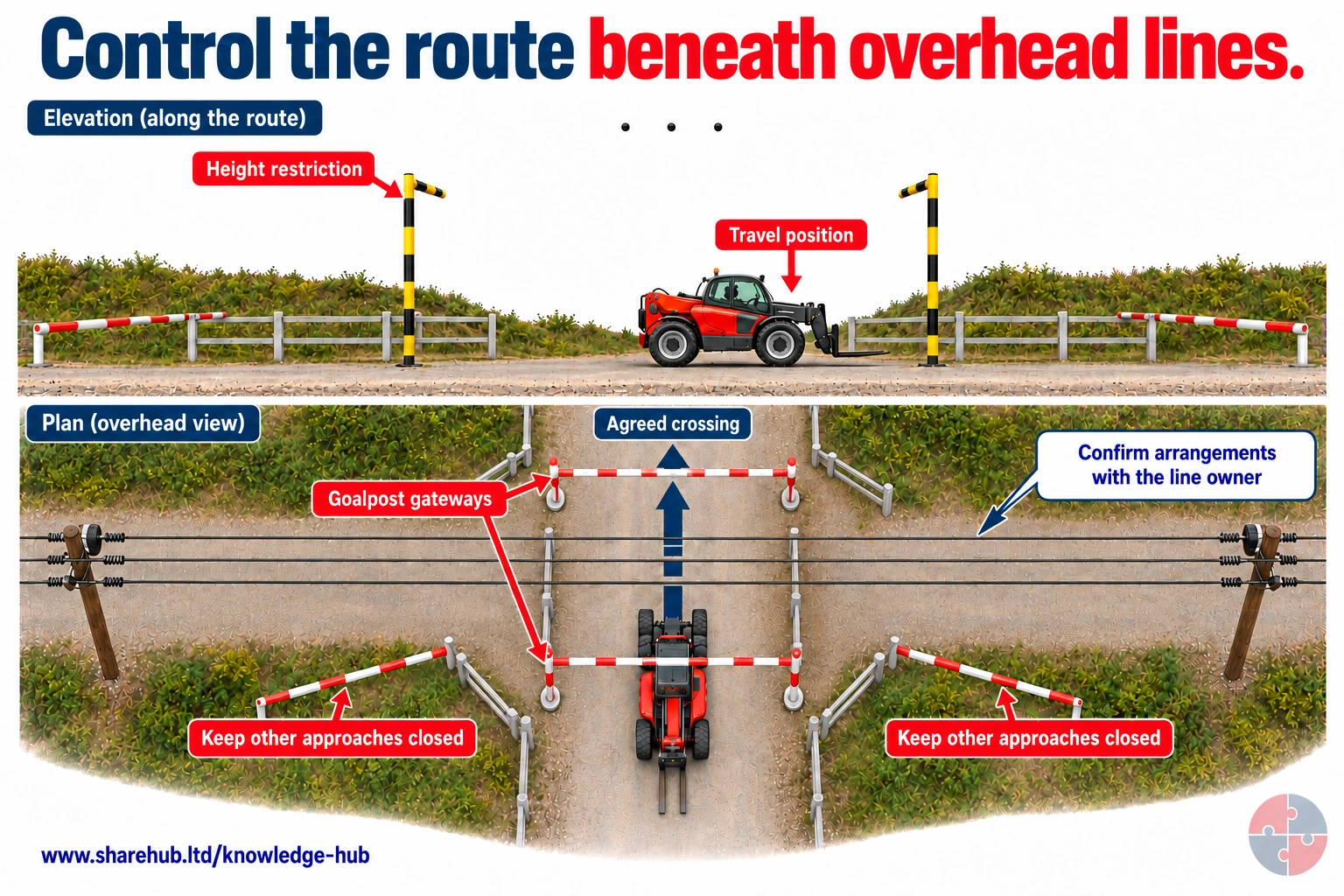

The plan shows one agreed route crossing the overhead conductors at right angles, with transverse goalpost gateways on the two approaches and fences defining the passage. The upper view looks along that route: the three dots are end-on conductor sections. The telehandler remains in its planned travel configuration.
Why is a goalpost alone insufficient?
Goalposts only indicate the agreed height restriction. The line-owner arrangements, vehicle envelope, approach barriers, maintained ground, warning notices and supervision must work together; the crossing is not a place to raise equipment or carry out other work.
Conceptual paired views, not to scale; no height or safety clearance is specified. Consider avoidance, diversion or switching off first. GS6 and the line owner govern safe approach positions, non-conducting gateways, signed clearance heights and site-specific restrictions.
Source guidance: HSE guidance
The work envelope is the full space that plant, loads, materials and attachments can occupy during normal work, foreseeable misuse, maintenance, travel, set-up, dismantling, breakdown recovery and emergency movement. A boom may be safe during the planned lift but unsafe during rigging. A tipper may be safe while travelling but unsafe when the body is raised. A telehandler may be safe unloaded but unsafe with a long load on uneven ground.Avoiding danger from overhead power lines, GS6 Overhead lines in construction
Lifting operations need a higher standard because load movement is dynamic. The lift plan should show the overhead line, the line controls, crane position, radius, boom height, load path, exclusion zones, communication method, emergency action and what happens if the lift cannot be completed as planned.
| Plant or activity | Main line-strike route | Control focus |
|---|---|---|
| Mobile cranes | Jib, fly jib, load, radius change or slew approaches conductor. | Lift plan, DNO advice, exclusion zone, radius/slew limits, appointed person and lift supervisor checks.Avoiding danger from overhead power lines, GS6 Overhead lines in construction |
| MEWPs | Platform height or outreach brings basket, operator or tools close to the line. | Route planning, ground level checks, exclusion, rescue plan and trained operator briefing.Avoiding danger from overhead power lines, GS6 Overhead lines in construction |
| Excavators and telehandlers | Boom, bucket, forks, attachments or raised loads enter danger area. | Height/reach restrictions, no-go zones, supervisor control and attachment-specific assessment.Avoiding danger from overhead power lines, GS6 Overhead lines in construction |
| Tippers and dumpers | Raised body contacts or approaches line during tipping, cleaning or maintenance. | No tipping beneath lines, controlled tipping areas, driver induction and route supervision.Avoiding danger from overhead power lines, GS6 Overhead lines in construction |
| Concrete pumps and piling rigs | Boom, mast or pipework creates height and reach near boundary lines. | Set-up location, exclusion zone, operating envelope, weather and emergency recovery planning.Avoiding danger from overhead power lines, GS6 Overhead lines in construction |
| Scaffold and long materials | Tubes, ladders, sheet materials or pipes carried upright near lines. | Material storage away from line, planned carry routes and long-object briefing.Avoiding danger from overhead power lines, GS6 Overhead lines in construction |
| Delivery vehicles | Unfamiliar drivers follow unsafe route or unload in wrong area. | Pre-booked instructions, gate control, route signage and supervised unloading.Avoiding danger from overhead power lines, GS6 Overhead lines in construction |
When should work stop, be redesigned or need specialist advice?
Stop work when safe clearance, line status, physical controls or competent supervision cannot be verified.
The strongest overhead-line decisions are made before work starts. If a proposed task depends on people judging distance, shouting warnings, moving barriers repeatedly or hoping that a raised body will not reach the line, the work is not ready. The right response may be to redesign the task, relocate plant, change access, consult the DNO, arrange isolation, or use a different method entirely.Avoiding danger from overhead power lines, GS6
A permit or method statement can support control, but it does not replace line-owner advice, physical segregation or competent supervision. The decision should test whether the task can be done away from the line; whether the line can be diverted or made dead; whether all movements are physically prevented from entering danger; and whether emergency arrangements have been briefed.
| Condition | Decision | Reason |
|---|---|---|
| Line crosses work area or access route | Consult the DNO/line owner early and assess avoidance, diversion or isolation. | The line owner controls asset information and safe options.Avoiding danger from overhead power lines, GS6 |
| Work can be relocated | Move the task, plant, route, storage or unloading point. | Avoidance is usually the strongest control.Avoiding danger from overhead power lines, GS6 |
| Line can be made dead | Plan the work around confirmed isolation by the line owner. | Removing electrical energy removes the flashover/contact hazard during the work.Avoiding danger from overhead power lines, GS6 |
| Physical controls cannot be installed | Stop and redesign. | Administrative instruction is not enough for fatal-risk close approach.Avoiding danger from overhead power lines, GS6 |
| Plant envelope is uncertain | Stop, measure, verify and revise the plan. | Maximum reach, radius, attachment and ground level affect line risk.Avoiding danger from overhead power lines, GS6 |
| Goalposts or barriers are moved or damaged | Stop and reauthorise before work continues. | A critical control has been defeated.Avoiding danger from overhead power lines, GS6 |
| DNO advice conflicts with site assumptions | Follow competent line-owner clarification and update the work plan. | Published distances and generic method statements cannot overrule site-specific asset advice.Avoiding danger from overhead power lines, GS6 |
What do realistic overhead line scenarios teach?
Worked scenarios help supervisors recognise how ordinary tasks become fatal-risk events.
Overhead-line incidents often look obvious afterwards, but the failure usually develops through small planning gaps: a route left open, a stockpile growing, a delivery not briefed, a crane moved, a goalpost removed, or a task treated as too quick to justify controls. Good learning asks how the system allowed the work envelope to approach the line.Avoiding danger from overhead power lines, GS6 Overhead lines in construction
These scenarios should be used in supervisor briefings and learner revision because they show the difference between a generic control statement and a competent operational control. The purpose is not to memorise examples, but to learn how to challenge weak assumptions in a method statement or site plan.
For a crane lift near the site boundary, the planner identifies the line owner before accepting the lift position. The line owner and competent lifting team agree the line status, maximum crane-and-load envelope and whether the task can be moved or the electrical danger removed. The supervisor checks the marked exclusion boundary, barriers, access route and briefing against that plan. If ground levels, crane configuration or the load path change, lifting stops until the envelope and controls are reviewed; the hand-back records the agreed line state and removed temporary controls. Avoiding danger from overhead power lines, GS6
| Scenario | Weak plan | Competent control response |
|---|---|---|
| Mobile crane near site boundary | Operator will keep away from line. | Move crane position where possible, consult DNO, show line on lift plan, set no-go zone, restrict slew/radius and supervise.Avoiding danger from overhead power lines, GS6 Overhead lines in construction |
| Tipper delivery under a line | Access route is clear so delivery is accepted. | Prohibit tipping beneath lines, brief driver before entry, use controlled route and supervise unloading.Avoiding danger from overhead power lines, GS6 Overhead lines in construction |
| Tree pruning near conductors | General arborist trims branches carefully. | Seek Network Operator advice, make line dead where needed and use competent utility-arboriculture controls.Avoiding danger from overhead power lines, GS6 Tree work near power lines |
| Quarry stockpile growth | Original clearance assumed still valid. | Set maximum stockpile limits, inspect encroachment and reassess ground-level changes.Avoiding danger from overhead power lines, GS6 |
| Scaffold tubes carried upright | Workers told not to touch line. | Move storage, create safe handling route and brief long-material movement.Avoiding danger from overhead power lines, GS6 Overhead lines in construction |
| Agricultural sprayer crossing field | Operator knows the field. | Map line route, lower boom, avoid crossing where possible and consult line owner if clearance uncertain.Avoiding danger from overhead power lines, GS6 |
How should a competent overhead-line risk assessment be built?
A competent assessment maps the work, the line, the movement envelope, the line owner, controls, supervision and review triggers.
A weak assessment says 'avoid overhead lines' and moves on. A strong assessment follows the job. It identifies what is being built, lifted, delivered, maintained, felled or dismantled; where the line is; who owns it; whether work can avoid it; how far plant and loads can move; who could misunderstand the danger; and how controls will be verified during the work.Avoiding danger from overhead power lines, GS6
The assessment should be reopened when reality changes. New plant, different delivery vehicles, altered ground level, poor visibility, changed access routes, moved barriers, changed scope, different DNO advice or near misses all mean the original assessment may no longer be valid.
| Assessment step | Depth expected | Evidence |
|---|---|---|
| Define the work | Identify which parts of the task create height, reach, long-object movement or raised plant. | Task description, RAMS and method sketch.Avoiding danger from overhead power lines, GS6 |
| Locate the line | Map the line against the work area, access route, storage, crane pad, unloading point and emergency route. | Marked plan, site photos and survey notes.Avoiding danger from overhead power lines, GS6 |
| Identify the asset owner | Find the DNO or line owner and record advice, clearances and isolation/diversion options. | Correspondence, site visit record and contact number.Avoiding danger from overhead power lines, GS6 |
| Define movement envelope | Assess maximum height/reach under normal, foreseeable abnormal and maintenance positions. | Plant data, lift plan, attachment details and route review.Avoiding danger from overhead power lines, GS6 |
| Select controls | Avoid, divert, isolate or physically prevent close approach. | Control plan, barriers, goalposts, restrictions and supervisor checklist.Avoiding danger from overhead power lines, GS6 |
| Communicate and supervise | Brief workers, visiting drivers, contractors and named supervisors. | Induction, briefing record and role allocation.Avoiding danger from overhead power lines, GS6 |
| Verify during work | Check barriers, route discipline, stockpile growth, plant restrictions and weather/visibility effects. | Daily inspection and assurance record.Avoiding danger from overhead power lines, GS6 |
| Review and learn | React to near misses, line-owner feedback, control damage or scope change. | Action tracker and revised assessment.Avoiding danger from overhead power lines, GS6 |
What should people be taught before working near overhead lines?
Training should be role-specific, site-specific and focused on controls, stop-work triggers and emergency behaviour.
Generic posters can help, but they do not replace a briefing on the actual line, actual route and actual task. Workers and visiting drivers should know where the line is, what the no-go areas are, where crossing points are, what goalposts mean, what plant movements are prohibited, who controls changes and what to do after a strike.
Plant operators, lifting teams, scaffolders, roofers, arborists, delivery drivers and supervisors need different levels of detail. Supervisors need enough competence to challenge the plan, recognise drift, stop work and request specialist advice. DNO or specialist electrical support is needed where line status, clearances, isolation, diversion or live-work proximity decisions are uncertain.
A driver or plant operator must demonstrate the marked route, physical boundary and stop action when the load or vehicle configuration changes. A supervisor should rehearse line-owner contact, maximum work-envelope verification and release after a changed-condition hold. A planner or lifting specialist should defend the selected source-control option and the evidence that barriers are in place before work. Avoiding danger from overhead power lines, GS6
| Level | Who and task | Demonstrated competence | Assessor, record and reassessment | Direct source |
|---|---|---|---|---|
| Worker / driver | Plant operator, delivery driver and ground worker | Point out the actual line and approved route, explain goalposts/no-go zone, and rehearse stop/strike response without touching energised plant. | Site supervisor observes a line-specific brief and practical route walk before entry and after route or vehicle change. | Avoiding danger from overhead power lines, GS6 Overhead power lines |
| Supervisor / lift planner | Site lead, appointed person and lifting team | Show line-owner advice, crane/load movement envelope, barrier/goalpost check, controlled crossing and emergency plan. | Competent lift reviewer signs plan and field walk; repeat for plant, ground-level or layout change. | Avoiding danger from overhead power lines, GS6 Overhead lines in construction |
| Technical specialist | Electrical/network liaison and safety adviser | Verify line identity/status and operator-agreed controls; challenge any generic clearance or PPE claim. | Network-operator correspondence and peer-reviewed site plan retained; revalidate when conditions change. | Avoiding danger from overhead power lines, GS6 Electricity and the law |
| Designer / purchaser | Site designer, logistics and plant buyer | Redesign compound, route or crane selection to avoid line; compare diversion/de-energising before equipment reaches site. | Design decision and operator consultation signed before mobilisation, with transition review for changed plant. | Avoiding danger from overhead power lines, GS6 Overhead power lines |
What should supervisors check during the work?
Supervision should verify that physical controls remain in place and that the work has not drifted from the plan.
Overhead-line controls degrade in ordinary ways. Barriers get moved for access. Goalposts are struck. A delivery arrives with a different vehicle. A crane changes radius. A stockpile grows. Ground level changes. Weather affects visibility. Night work begins. A subcontractor takes a shortcut. The supervisor's role is to catch these weak signals before they become a line strike.Avoiding danger from overhead power lines, GS6
The best checks are specific and visible. They do not simply ask whether the RAMS is signed. They ask whether the route is being used as planned, whether the controlled crossing is intact, whether plant can still reach the line, whether drivers have been briefed and whether anyone has authority to restart after a control is damaged.
| Check | What good looks like | Stop trigger |
|---|---|---|
| Barriers and signs | Installed in agreed locations, visible, stable and not bypassed. | Moved, damaged, obscured or ignored barrier.Avoiding danger from overhead power lines, GS6 |
| Goalposts | Height set and checked, crossing controlled and route used correctly. | Goalpost missing, struck, relocated or not covering actual route.Avoiding danger from overhead power lines, GS6 |
| Plant envelope | Plant remains within planned height, reach, slew, route and attachment configuration. | New plant, changed attachment, altered radius or uncertain maximum reach.Avoiding danger from overhead power lines, GS6 |
| Deliveries | Drivers receive instructions before entry and unload only in controlled areas. | Unbriefed driver enters or attempts to tip near line.Avoiding danger from overhead power lines, GS6 |
| Long materials | Storage and handling routes prevent upright carrying near lines. | Scaffold tubes, ladders or sheets moved through danger area.Avoiding danger from overhead power lines, GS6 |
| Change | Weather, ground level, route, work scope and DNO advice are reviewed. | Any change not reflected in the work plan.Avoiding danger from overhead power lines, GS6 |
| Emergency readiness | DNO number, 999 route, exclusion instructions and operator guidance are known. | Workers do not know what to do after contact.Avoiding danger from overhead power lines, GS6 |
What evidence shows overhead line risk is controlled?
Evidence should prove that the line was identified, the owner was consulted, controls were physical and the work was verified.
Evidence matters because overhead-line control can otherwise become a claim that the site 'had a method statement'. A competent review should be able to trace the line from survey through design, planning, route control, plant selection, briefing, inspection, emergency planning and learning.Avoiding danger from overhead power lines, GS6
Auditors should not only ask for documents. They should walk the route, look at the line, compare the site with the drawings, check whether goalposts are in the right place, ask operators what they would do after contact, and verify that change triggers are understood.
A credible work pack links the identified line owner, agreed line state, site drawing, maximum plant envelope and installed physical controls. Compare that pack with a field walk and the operator briefing. If the access route or plant configuration changes, the earlier approval no longer proves the current task is safe. Avoiding danger from overhead power lines, GS6
| Evidence | What it should show | Weakness to challenge |
|---|---|---|
| Line-owner communication | DNO or line-owner advice, contact details, isolation/diversion decisions and clearances. | No evidence that the owner was consulted.Avoiding danger from overhead power lines, GS6 |
| Drawings and site layout | Line route, no-go zones, goalposts, passageways, storage, plant locations and delivery routes. | Line absent from lift plan or traffic plan.Avoiding danger from overhead power lines, GS6 |
| Risk assessment and RAMS | Task-specific work envelope, controls, change triggers and emergency arrangements. | Generic statement to avoid overhead lines.Avoiding danger from overhead power lines, GS6 |
| Lift or plant plan | Maximum reach, load path, exclusion zone, restrictions and supervision. | No line shown despite crane/MEWP/tipper use nearby.Avoiding danger from overhead power lines, GS6 |
| Briefing records | Workers, operators, drivers and contractors briefed on actual controls. | Signed attendance but no evidence of site-specific content.Avoiding danger from overhead power lines, GS6 |
| Inspection records | Barriers, goalposts, signs, route discipline and restrictions checked. | Controls installed once but not maintained.Avoiding danger from overhead power lines, GS6 |
| Change control | Reassessment after new plant, ground changes, damaged controls, route change or weather. | Work continues after controls are moved.Avoiding danger from overhead power lines, GS6 |
| Incident learning | Close approaches and barrier breaches investigated and shared. | Near misses dismissed because no contact occurred.Avoiding danger from overhead power lines, GS6 |
Where do overhead-line controls commonly fail?
Most failures are system failures in planning, route control, supervision or change management before they appear as operator error.
A line strike should not be investigated only as a driver or operator mistake. The deeper questions are why the route allowed the movement, why the tipping point or crane pad was placed there, why the line was missing from the plan, why barriers could be moved, why the driver was not briefed, why changes were not reassessed and why supervisors did not have better evidence.Avoiding danger from overhead power lines, GS6
The same approach applies to close approaches. A near miss is not a lucky escape to be forgotten; it is evidence that one or more controls allowed the work envelope to breach the intended safety envelope. Treat it as a serious weak signal.
| Failure event | Root-cause questions | System improvement |
|---|---|---|
| Operator drove under line with raised body | Why was tipping possible there? Why no route control? Why no driver briefing? | Relocate tipping, install controls, update traffic plan and gate checks.Avoiding danger from overhead power lines, GS6 |
| Crane jib approached conductor | Why did the lift plan allow that radius? Why was line not marked? Why no physical restriction? | Revise lift planning standard and appointed person review.Avoiding danger from overhead power lines, GS6 |
| Goalpost removed for access | Who authorised removal? Was there an alternative route? Was work stopped? | Add change-control rule and supervisor reauthorisation.Avoiding danger from overhead power lines, GS6 |
| Scaffold tube carried upright | Why were long materials stored there? Why was the carrying route unsafe? | Move storage and brief long-material handling.Avoiding danger from overhead power lines, GS6 |
| Tree branch contacted line | Why was Network Operator advice not obtained? Was branch-fall path assessed? | Use utility-arboriculture competence and line-owner planning.Avoiding danger from overhead power lines, GS6 |
| Stockpile encroached on clearance | Who owned ground-level change? Were stockpile limits defined? | Set maximum heights, inspect and link to quarry/traffic planning.Avoiding danger from overhead power lines, GS6 |
What do learners and managers commonly misunderstand?
The most dangerous misunderstandings are that contact is required, short jobs are exempt, or observation is enough.
Overhead-line learning needs clear misconceptions because the hazard is invisible, familiar and often underestimated. A supervisor can see a line every day and still not appreciate flashover, step potential, conductor movement or the limits of operator judgement.Avoiding danger from overhead power lines, GS6
For HSE and professional learning, a strong answer should connect the hazard mechanism to the control hierarchy: avoid, divert, isolate, physically prevent close approach, supervise, verify and learn. A weak answer lists PPE or tells people to be careful without explaining the physical control standard.
| Misconception | Correct position | What to say in a strong answer |
|---|---|---|
| It is safe if we do not touch the line. | Wrong. Electricity can flash over through air. | Contact is not required; control the approach envelope.Avoiding danger from overhead power lines, GS6 |
| Wooden poles mean telephone wires. | Wrong. Electric lines may be on wooden poles. | Assume lines are live power lines unless confirmed otherwise.Avoiding danger from overhead power lines, GS6 |
| Low voltage means low risk. | Wrong. Lower voltages can still kill. | Do not rely on appearance or voltage assumptions.Avoiding danger from overhead power lines, GS6 |
| The operator can judge distance. | Wrong. Cab judgement is unreliable. | Use DNO advice, physical exclusion and restrictions.Avoiding danger from overhead power lines, GS6 |
| The job is too quick for controls. | Wrong. Short-duration work still needs precautions. | Severity, not duration alone, drives the control standard.Avoiding danger from overhead power lines, GS6 |
| Goalposts make the whole job safe. | Wrong. They control defined crossings only. | Use goalposts as part of a planned system.Avoiding danger from overhead power lines, GS6 |
| Rubber tyres protect everyone. | Wrong. Plant and ground can still be dangerous. | Emergency action must prevent touch and step potential exposure.Avoiding danger from overhead power lines, GS6 |
Which legal duties apply to overhead power lines?
Which duty applies depends on where the work takes place. Use the direct GB or Northern Ireland source and have a competent person review the task.
Electrical danger must be assessed against the real line, plant and task rather than a guessed clearance. Use the applicable GB or NI electricity and construction route, and consult the line owner before fixing the work method. GS6 is a GB HSE guide; its planning principles can inform a NI task, but it does not replace NI legal scope or line-owner instructions. Electricity and the lawExcavation method statement example
| Jurisdiction | Duty or decision | Task application | Direct official source |
|---|---|---|---|
| Great Britain | Electrical danger | Apply Electricity at Work duties to the task and line status; plan to prevent contact and close approach. | Electricity and the law Avoiding danger from overhead power lines, GS6 |
| Great Britain | Construction planning | Bring overhead-line location, access and plant envelope into construction planning and control. | Overhead lines in construction Avoiding danger from overhead power lines, GS6 |
| Northern Ireland | NI electrical work and line owner | Apply the Electricity at Work Regulations (Northern Ireland) 1991 to the work; competent legal review must check amendments. Consult the network operator on avoiding, diverting or making the line dead. GS6 is technical guidance. | Excavation method statement example Avoiding danger from overhead power lines, GS6 Electrical safety Electricity at Work Regulations (Northern Ireland) 1991 Avoiding danger from overhead power lines, GS6 |
| Great Britain and Northern Ireland | Clearances and emergency plan | Do not apply a universal clearance; competent site-specific advice from the line owner governs the planned controls. | Avoiding danger from overhead power lines, GS6 Overhead power lines |
For construction, GB CDM 2015 regulation 25 and NI CDM 2016 regulation 24 require diversion away from the risk or isolation and, where necessary, earthing. If those options are not reasonably practicable, the applicable provision requires suitable warnings with barriers, suspended protection or equivalent safety measures. The line owner’s authorised process controls isolation, proving dead and protective arrangements; a site plan alone cannot release the work.
Relevant live-conductor work must also meet GB Electricity at Work regulation 14 conditions: making dead must be unreasonable in all the circumstances, working live must be reasonable in all the circumstances, and suitable injury-prevention precautions must be taken. NI uses its own 1991 Electricity at Work instrument and applicable amendments; retain the page’s amendment-review qualification and obtain the separate competent NI determination.
How should management arrangements verify controls?
Assign an owner, involve workers, check the control in use and act on failures before returning to routine work.
HSE’s Plan, Do, Check, Act guidance provides the government management route for this topic. Apply it to the actual task, equipment, people and jurisdiction, then keep the verification and corrective-action record. Standards-specific claims are held until their rights and competent review are resolved. HSE Plan, Do, Check, Act
How could BuildOut Ltd manage this in practice?

BuildOut would manage overhead-line risk as a fatal-risk planning and verification topic, not as a driver awareness note.Avoiding danger from overhead power lines, GS6 Overhead power lines
On a civil engineering project, BuildOut has an overhead line crossing a temporary haul route and another line beside a crane set-up area. The company would identify both at pre-construction stage, consult the DNO, redesign the haul route where possible, arrange isolation for high-risk work where practicable, install barriers and goalposts before plant arrives, brief delivery drivers before entry, include line locations in lift plans and traffic plans, inspect controls daily and investigate any close approach as a serious near miss.
BuildOut’s planner identifies the line owner while the site layout, lift and delivery routes can still be changed. The line owner’s advice informs the maximum work envelope, electrical state and physical no-go arrangement. The supervisor checks barriers, goalposts and briefing before plant enters the area, then holds work if ground level, reach or vehicle height changes. The hand-back records any restored line state and removal of temporary controls. Avoiding danger from overhead power lines, GS6
| Management element | How the business would manage it | Evidence to review |
|---|---|---|
| Assess | Survey the work area, boundaries, access roads, haul routes, storage, stockpiles and lifting locations for overhead lines. | Survey notes, drawings and marked site plan. |
| Analyse | Map maximum plant reach, raised bodies, loads, ground-level changes, long materials and delivery movements. | Work envelope sketches and plant data. |
| Plan | Consult DNO, avoid lines where possible, arrange isolation/diversion where practicable and design physical controls. | DNO correspondence, CPP, lift plan and traffic plan. |
| Implement | Install barriers, goalposts, warning signs, route controls, plant restrictions and no-tipping areas before work starts. | Installation records and photographs. |
| Train | Brief operators, slingers, signallers, scaffolders, supervisors, drivers and visiting contractors on actual site controls. | Induction, toolbox talk and driver briefing evidence. |
| Check | Inspect barriers, goalposts, route discipline, plant restrictions, delivery compliance and change triggers. | Supervisor checklist and audit record. |
| Learn | Investigate barrier breaches, close approaches and uncontrolled deliveries; update planning standards and contractor rules. | Incident learning, action tracker and revised procedures. |
How can the hierarchy of controls reduce risks while routing deliveries beside overhead power lines?
How can the ERICPD hierarchy of controls reduce risks while routing deliveries beside overhead power lines?

| Control level | Control for this activity | Owner and verification | Stop / restart decision |
|---|---|---|---|
| Eliminate | Move the delivery, unloading or traffic route away from the overhead line so close approach is unnecessary. | Task owner verifies that the proposed change removes the named hazardous step, including foreseeable cleaning, maintenance and work transferred elsewhere. | If the hazardous step remains, keep it within the task assessment and select the stronger feasible remaining controls. |
| Reduce, including substitution | Use a suitable alternative delivery vehicle or unloading method that avoids raising equipment in the line area, checking the whole movement envelope. | Competent task/process owner validates suitability, compatibility and new hazards against the actual operating requirements before the alternative is adopted. | Reject an alternative if its performance is unproved or its new hazards are unresolved. |
| Isolate | Where avoidance is not practicable, arrange line diversion or making dead with the line owner and obtain verified handover before relying on it. | Supervisor checks the actual boundary, affected people and connected work; verify separation or isolation before allowing access. | Hold or stop for unknown line status, breached boundary or a vehicle/load outside the planned envelope. |
| Control: physical safeguards | Establish suitable physical barriers and controlled crossings/height restrictions from the line-owner and competent planning requirements. | Competent equipment/process owner checks line-owner information, verified line status, movement envelope, barriers and route acceptance. | Hold or stop for unknown line status, breached boundary or a vehicle/load outside the planned envelope. |
| Control: work method and response | Agree vehicle routes, delivery briefing, supervision, weather and changes of load; stop any unplanned tipper, crane or long-load movement near the line. | Supervisor confirms the work limits, competent cover, communication and stop/restart authority with the people doing this activity. | Hold work when the agreed limits, competent cover or effective communication cannot be maintained. |
| PPE | No ordinary PPE makes contact or arcing from an overhead line safe; keep the required separation and follow the emergency plan after an incident. | Assessor confirms whether personal protection is needed and checks suitability, condition, compatibility and any required fit evidence. | Do not use unsuitable protection or rely on PPE to continue after an essential source control fails. |
| Discipline | Inspect the route and barriers after changes and verify the line status and delivery conditions before reopening the route. | Release only after site and line owners confirm the authorised route and protective arrangement. Retain verification and unresolved restrictions at handover. | Keep the task on hold until required reinstatement evidence and unresolved defects are accepted by the responsible owner. |
How can the ISO 45001 hierarchy of controls reduce risks while routing deliveries beside overhead power lines?

| Control level | Control for this activity | Owner and verification | Stop / restart decision |
|---|---|---|---|
| Elimination | Move the delivery, unloading or traffic route away from the overhead line so close approach is unnecessary. | Task owner verifies that the proposed change removes the named hazardous step, including foreseeable cleaning, maintenance and work transferred elsewhere. | If the hazardous step remains, keep it within the task assessment and select the stronger feasible remaining controls. |
| Engineering controls | Use a suitable alternative delivery vehicle or unloading method that avoids raising equipment in the line area, checking the whole movement envelope. | Competent task/process owner validates suitability, compatibility and new hazards against the actual operating requirements before the alternative is adopted. | Reject an alternative if its performance is unproved or its new hazards are unresolved. |
| Engineering controls | Where avoidance is not practicable, arrange line diversion or making dead with the line owner and obtain verified handover before relying on it. | Supervisor checks the actual boundary, affected people and connected work; verify separation or isolation before allowing access. | Hold or stop for unknown line status, breached boundary or a vehicle/load outside the planned envelope. |
| Engineering controls | Establish suitable physical barriers and controlled crossings/height restrictions from the line-owner and competent planning requirements. | Competent equipment/process owner checks line-owner information, verified line status, movement envelope, barriers and route acceptance. | Hold or stop for unknown line status, breached boundary or a vehicle/load outside the planned envelope. |
| Administrative controls | Agree vehicle routes, delivery briefing, supervision, weather and changes of load; stop any unplanned tipper, crane or long-load movement near the line. | Supervisor confirms the work limits, competent cover, communication and stop/restart authority with the people doing this activity. | Hold work when the agreed limits, competent cover or effective communication cannot be maintained. |
| PPE | No ordinary PPE makes contact or arcing from an overhead line safe; keep the required separation and follow the emergency plan after an incident. | Assessor confirms whether personal protection is needed and checks suitability, condition, compatibility and any required fit evidence. | Do not use unsuitable protection or rely on PPE to continue after an essential source control fails. |
| Administrative controls | Inspect the route and barriers after changes and verify the line status and delivery conditions before reopening the route. | Release only after site and line owners confirm the authorised route and protective arrangement. Retain verification and unresolved restrictions at handover. | Keep the task on hold until required reinstatement evidence and unresolved defects are accepted by the responsible owner. |
What do the acronyms and key terms mean?
Acronyms should be understood before they are used in assessments, briefings, audits or learning answers.
Acronyms can exclude newer readers if they are not explained. This section keeps the main terms available at the end of the page so the article stays readable while still supporting learners and audit users.
| Acronym | Meaning | Plain-English use |
|---|---|---|
| DNO | Distribution Network Operator | The organisation responsible for the electricity distribution network in the area. |
| GS6 | HSE guidance note on avoiding danger from overhead power lines | The core HSE reference for planning and controls near overhead lines. |
| OHPL | Overhead Power Line | An electric power line carried above ground on poles, towers or structures. |
| NO | Network Operator | A line owner/operator who can provide asset advice and safety requirements. |
| MEWP | Mobile Elevating Work Platform | Access equipment that can approach overhead lines through height or outreach. |
| RAMS | Risk Assessment and Method Statement | Task control document that must be supported by real physical controls. |
| CPP | Construction Phase Plan | Construction planning document that should include overhead-line controls where relevant. |
| PTW | Permit-to-Work | Formal authorisation system sometimes used for high-risk or interface-heavy work near lines. |
Unlock another resource
You have used this month’s two free downloads. Publish a post in your own words to unlock one more resource, or choose SHARE Individual for 10 downloads per month.
You decide whether to share. If you do, use the relevant platform disclosure tools and do not make claims you do not genuinely hold.