SHARE Knowledge Hub
Nitrogen, Inerting and Asphyxiation Hazards
Nitrogen can displace the oxygen people need to breathe, while inerting can be essential to prevent fires or explosions in enclosed plant. Safe work needs a verified design, controlled discharge, isolation, atmosphere monitoring, and a rescue plan before exposure. A failed barrier or uncertain line-up means stop and move to the planned safe state.
Understanding Nitrogen, Inerting and Asphyxiation Hazards
Nitrogen can displace the oxygen people need to breathe, while inerting can be essential to prevent fires or explosions in enclosed plant. Safe work needs a verified design, controlled discharge, isolation, atmosphere monitoring, and a rescue plan before exposure. A failed barrier or uncertain line-up means stop and move to the planned safe state.
Why this matters at work
Define each instrument’s safety function and the atmosphere it actually samples. Check sensor location, response, faults and alarms for that function, and distinguish process readings from workplace oxygen warnings. Verify the whole sampling and response chain through a competent test plan. Record failure responses and maintenance. A convenient common display must not hide different locations, limits, response times or the consequence of an instrument fault.
Inerting replaces an atmosphere to prevent combustion where the flammable hazard cannot otherwise be removed. Its design target depends on the real fuel mixture, temperature, pressure and process, with a justified margin. That process objective is different from providing breathable air. Nitrogen has no useful warning smell, and loss of oxygen may not provide adequate personal warning. Leakage, venting or opening can expose people beyond the vessel itself, so the design needs both process protection and personnel-exposure assessment.
How organisations manage this in practice
Plan the transition as a controlled operation because restoring oxygen can remove the explosion barrier while fuel remains. Establish the removal, isolation and monitoring sequence with competent process and entry specialists. Define hold points and abnormal-state responses. Record the final atmospheric and isolation evidence for the intended next task; a condition accepted for purging is not automatically accepted for cleaning, hot work or human entry. The inert-to-air transition can pass through a flammable region if residual fuel remains as oxygen rises. Improving breathability can therefore weaken an existing explosion barrier before the other hazard is removed. Isolation and removal or cleaning of dangerous substances may be needed before ventilation, with a planned monitoring sequence for all relevant hazards. Avoid assuming that one favourable trend is progress toward every objective. The final conditions must be accepted for the next task and kept under control throughout it.
Manage the explosion-prevention and oxygen-deficiency barriers together. Identify where nitrogen could escape, who could approach and how a process change affects either protection. Obtain the process-specific inerting basis rather than borrowing an oxygen target. Keep entry and maintenance controls separate from the normal production envelope. An atmosphere suitable for the process can be immediately dangerous to someone who breathes it.
Use the risk assessment to identify oxygen, flammable and toxic hazards, the sampling locations and how they may change. Check the actual detector configuration and full sample path, not merely the calibration sticker. Record locations, times, results and isolation state, and specify withdrawal triggers. Testing supports a safe system; it does not replace isolation, ventilation, supervision or rescue readiness and cannot guarantee a changing atmosphere from one reading. The hazard set can include oxygen deficiency, flammables and toxic contaminants, so an oxygen-only check is incomplete where other risks are credible. Sample representative high and low locations, branches, internal obstructions and the intended breathing zones with suitable equipment. Understand response, sensor limits and the complete sampling configuration. A manway reading is a local observation at a time, not a statement about the whole vessel or its future condition. The permit should preserve the test context and withdrawal conditions.
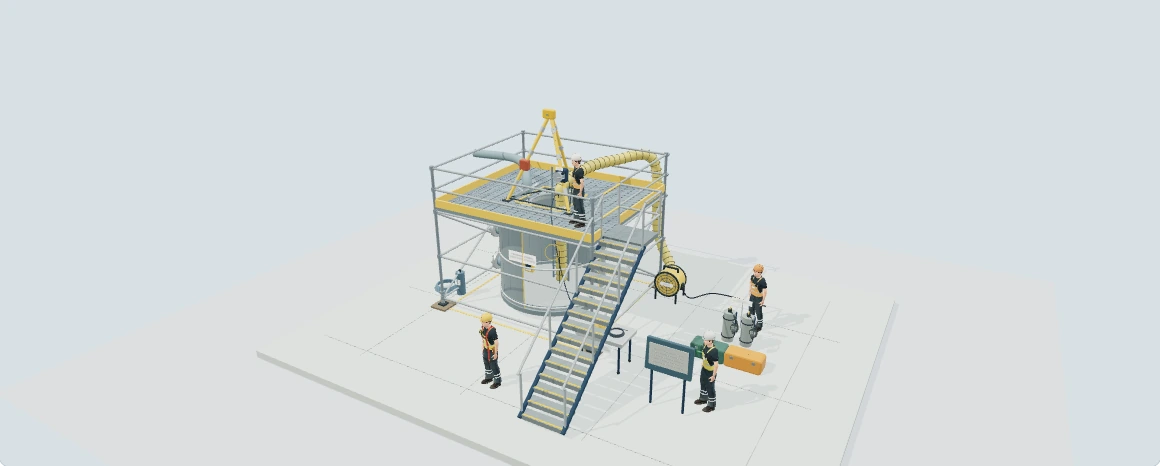

Confined-space tank entry: prepare, monitor and rescue
Follow a fictional tank inspection from avoiding entry through preparation, a supervised entry example and emergency response. Explore the access scaffold, rescue tripod and retrieval line, fresh-air duct, sample probe, personal gas monitor and standby team. Each step explains what the equipment does and what must be verified in the real job.
Checksheets and risk assessments
Risk assessment forms
Risk assessment examples
Forms and tools
Full written walkthrough — all 16 steps
1. First ask: can the task be done outside?
What is happening: A camera, remote inspection or suitable external cleaning may remove the need for anyone to enter. This example considers a tank with previous hydrocarbon service; the internal cutaway is a teaching view, not a second doorway.
How harm can occur: An enclosed space with a foreseeable specified risk can cause fire, explosion, poisoning, loss of consciousness, drowning or asphyxiation. Size alone does not decide whether it is a confined space.
Best practice to apply: Define the task, tank history, residues and connected plant. Avoid entry where reasonably practicable. A competent person develops the safe system and site-specific emergency arrangements before entry is considered.
2. Plan the job, people and permit
What is happening: The supervisor coordinates operations, contractors, the entry team and rescue team. The plan defines the work, duration, tools, exposure controls, access, communications and permit boundaries.
How harm can occur: A change of task, shift or neighbouring operation can defeat an earlier assessment. Hot work, solvents, sludge disturbance and heat can introduce new hazards.
Best practice to apply: Identify named competent roles, suitable entrants and fitness considerations. Decide the permit-to-work requirements, isolation responsibilities, authorised activities and the conditions that suspend work. The model never issues permission.
3. Empty, drain and clean from outside
What is happening: In this fictional preparation stage the tank is emptied, drained and flushed under a planned method before entry. Water is used only if compatible with the previous contents; contaminated washings go to controlled collection.
How harm can occur: Empty does not mean clean: sludge, scale, pockets and connected pipework may retain toxic or flammable material. Cleaning itself can release vapour or create chemical reactions and environmental risks.
Best practice to apply: Before draining or cleaning, establish and verify the isolations required for that preparation stage. Confirm substance compatibility, drainage, safe disposal and effective removal of residues. Do not prescribe a universal flushing time or assume water removes every substance. Reassess if residues remain or will be disturbed.
4. Prove and maintain all isolations
What is happening: Identify every inlet, outlet, bypass, drain, nitrogen and utility connection, plus pumps, agitators and electrical energy. The visible blanks illustrate positive separation; actual isolation must be selected, installed and verified.
How harm can occur: A closed valve may pass. Pressure, gravity inflow, rotating equipment or reconnection can overwhelm someone inside. Temporary preparation hoses can become an overlooked route back into the tank.
Best practice to apply: Use the plant isolation scheme, locks, tags and independent checks where required; establish zero-energy conditions. Control each preparation stage and verify the final entry boundary, including removal/isolation of temporary supplies. See the linked HSG253 lesson.
5. Purging removes a hazard and can create another
What is happening: If a competent hydrocarbon preparation plan requires inert-gas purging, it happens without entrants. Nitrogen can displace flammable vapour, but also displaces oxygen. The stored nitrogen hose is disconnected in the entry example.
How harm can occur: Nitrogen is invisible and can cause rapid unconsciousness without warning. Bringing air into remaining flammable vapour can create an explosive mixture; gases vented outside can also harm the standby team.
Best practice to apply: Use a designed purge and gas-freeing sequence with suitable instruments and controlled discharge. Verify each transition before admitting air. Remove/isolate the nitrogen supply, ventilate with fresh air, and test before considering entry. Never enter to investigate a purge problem.
6. Ventilate with clean fresh air — never oxygen
What is happening: A blower takes uncontaminated outside air through a flexible duct routed through the top manway and down to the lower part of the tank. Air then leaves by the separate outlet. Blue arrows show the intended supply route; amber arrows show the outlet route, not measured gas concentrations.
How harm can occur: Short-circuiting airflow, dead pockets, contaminated intakes or failed fans can leave dangerous conditions. Adding oxygen greatly increases the fire risk. Ventilation does not replace isolation or testing.
Best practice to apply: Select suitable equipment for the assessed atmosphere and ignition risks; position the intake away from exhausts and the discharge away from people and re-entry. Check effective circulation and maintain the required flow throughout work. Keep ducts clear of entry and rescue routes.
7. Sample the atmosphere before anyone enters
What is happening: The tester uses a pump and probe from outside. Sample representative positions, including different heights, the work area and pockets; do not assume gases form neat layers. The model probe and instrument are illustrative.
How harm can occur: One sample at the hatch can miss a dangerous pocket. A blocked tube, wrong sensor, poor calibration or insufficient sample travel time can create false reassurance. Some flammable sensors do not work reliably in low oxygen.
Best practice to apply: Use a competent tester, suitable sensors, current calibration and manufacturer-specified function/bump checks. Check oxygen first, then flammability and relevant toxic contaminants; allow sample transport and instrument response time. Record locations, time and results against the task-specific limits. Normal air is about 20.9% oxygen; departures need investigation, not an automatic green light.
8. Provide safe scaffold access and a clear hatch
What is happening: The access stair, boarded platform, guardrails, toe boards and guarded transfer point give the team a working position at the tank top. The hatch and fixed internal ladder provide the illustrative entry route.
How harm can occur: Falls, dropped tools and a restricted hatch can injure the entrant or prevent casualty recovery. Tank roofs and ordinary guardrails must not be assumed capable of carrying rescue loads.
Best practice to apply: Have competent people design/erect/inspect the access and verify its load paths. Check roof and platform capacity, opening protection, clearances with PPE/BA and a casualty, ladder security and a clear route to ground. The drawn scaffold is not a build specification.
9. Rig the tripod and retrieval equipment
What is happening: The tripod is aligned above the hatch and its feet secured on an engineered supporting arrangement. A personnel retrieval winch/line leads through the head pulley to a compatible harness. A separate fall-protection function is provided where the assessment requires it.
How harm can occur: A normal inertia/fall-arrest reel is not automatically a rescue winch. Incompatible components, inadequate anchors, sharp edges, snags or side loads can defeat recovery. A line is not a guarantee that an unconscious person fits through the hatch.
Best practice to apply: Verify equipment compatibility, ratings, inspections/examinations and pre-use checks; follow the manufacturer’s rescue configuration. Rehearse the actual route with a suitable dummy. Assess entanglement and the need for entry rescue; never improvise by attaching to a guardrail.
10. Fit the entrant’s equipment and escape provision
What is happening: The entrant wears a correctly fitted rescue harness, a personal gas monitor in the breathing zone and suitable PPE. The small escape set is carried where the assessment calls for it. The rescue team’s full breathing apparatus is staged outside.
How harm can occur: A filtering mask does not supply oxygen. An escape set is for leaving a developing emergency, not routine work or re-entry. A gas meter only detects the hazards its sensors are designed for.
Best practice to apply: Check the person is trained and suited to the task; fit and check harness, monitor, communications and escape equipment. Confirm battery, alarms, sensors, cylinders and escape duration for the route. This example assumes a verified breathable atmosphere; work requiring BA needs its own competent plan.
11. Brief the whole team at the entry point
What is happening: The entrant, dedicated standby attendant, supervisor and rescue team agree the job and rehearse the response before the permit is released. The attendant remains outside, maintains an entry log and stays in reliable contact.
How harm can occur: Unclear commands, competing duties or an absent attendant can delay evacuation. Relying solely on calling 999 leaves an incapacitated worker without an immediate suitable rescue arrangement.
Best practice to apply: Point out isolation boundaries, gas-test results, alarm/evacuation triggers, check-in method and backup signal, rescue roles, equipment, casualty route, first aid/AED and emergency rendezvous. Verify responders are ready and enough people are available. Each person repeats their role and stop-work authority.
12. Illustrative entry: maintain all the controls
What is happening: Only at this learning stage does the entrant appear inside, connected to the retrieval line. Assume the actual competent authoriser has verified the safe system. The attendant remains at the hatch; ventilation, an area monitor and the personal monitor remain in use.
How harm can occur: Conditions can deteriorate after a satisfactory pre-entry test. Work can release vapours, consume oxygen or produce heat and fumes; a meter at one location cannot describe every pocket.
Best practice to apply: Maintain the monitoring and communication specified for the work, repeat tests after interruptions/changes, and keep the entry log current. Record real readings; the model shows no invented safe values. Never continue if a critical control is lost.
13. Alarm or loss of a control: stop and get out
What is happening: A gas alarm, failed ventilation, lost communication, unexpected inflow or illness triggers the agreed response. A responsive entrant stops work and leaves immediately using the planned route, using an escape set only as trained and specified.
How harm can occur: Stopping to troubleshoot inside can turn a recoverable problem into a casualty. Silence or a failed instrument is not evidence that the atmosphere is safe.
Best practice to apply: The attendant raises the alarm and starts the site response. Do not silence the alarm and continue or restart from a single better reading. Secure the space and require reassessment, testing and fresh authorisation before any return.
14. Unresponsive entrant: planned non-entry recovery
What is happening: The attendant summons the trained rescue team and emergency services as planned. Where the assessed route and casualty position allow, trained personnel use the prepared system to recover the casualty without another person entering.
How harm can occur: Pulling a trapped casualty, a snagged line or an unplanned angle can cause further injury. An attendant who rushes in may become a second casualty.
Best practice to apply: Use only the practised, compatible recovery method. Keep people outside the hazardous atmosphere. If the route is obstructed or recovery cannot be safely achieved, stop that attempt and use the planned specialist entry-rescue response; do not improvise.
15. Entry rescue requires a protected, trained team
What is happening: Some emergencies need rescuers to enter. The staged full BA, communications, rescue equipment and casualty handling arrangements illustrate preparation for that separate rescue operation.
How harm can occur: A spare mask or escape hood does not make rescue entry safe. The same atmosphere, energy, entrapment or fire that affected the entrant can harm rescuers.
Best practice to apply: Only trained, equipped and properly supported rescuers use the site-specific entry-rescue plan, with suitable BA, control of entry, backup and remaining-air management. Maintain required isolations/plant controls. Emergency-service support complements the arrangements already in place.
16. Receive the casualty, then hand back safely
What is happening: The team moves the casualty to the planned safe area for trained first aid and ambulance handover. After normal work or an incident, account for all people and equipment and close the entry under the agreed handback process.
How harm can occur: A contaminated casualty can expose helpers. Premature reinstatement can trap someone or reintroduce energy; an incident must not be treated as permission to resume.
Best practice to apply: Give responders the tank identity, substances, readings and events. Provide first aid/AED only within training and follow emergency advice. Record the event, inspect affected equipment, review the plan and formally control removal of isolations and return to service.
Awareness example, not an entry permit, engineered rescue design or gas-clearance certificate. Actual entry requires a competent assessment, verified controls and a practised rescue plan for that space. Ventilate with clean fresh air — never oxygen. No entry during nitrogen purging.
The wider workplace has its own account and subscription access. Exploring this lesson does not grant access, record course completion or authorise work.
How can I practise this topic in 3D?
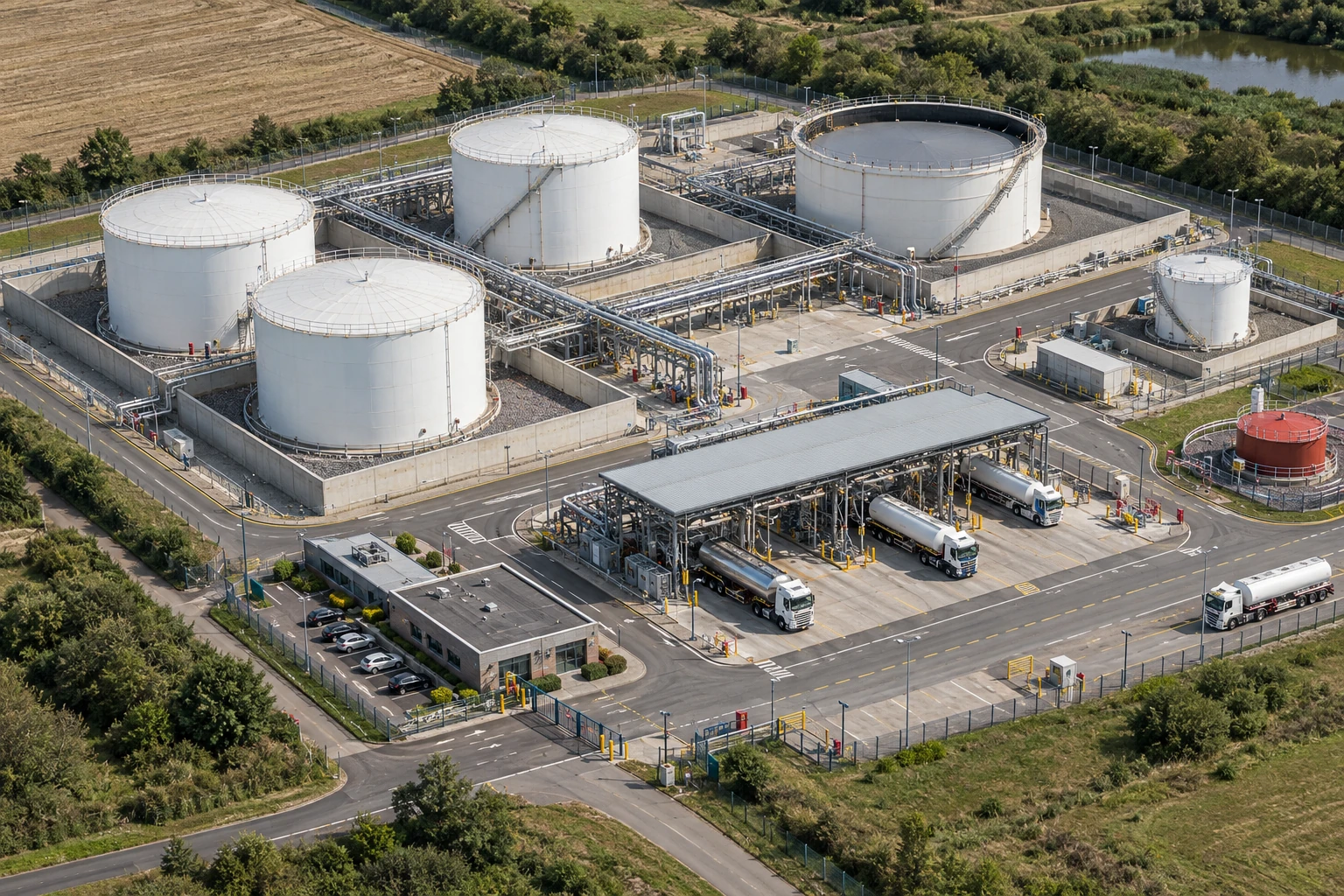
An internal floating deck is mistaken for a gas-free space
All related inspection points 2 across 1 location
Crown Fuels terminal 2 inspection points
Practice in the SHAREhub environment. Browser practice is separate from workplace competence and formal learning records.
What are the critical decisions before work starts?
Keep people out of oxygen-deficient atmospheres, verify the inerting design and supply, and plan safe isolation, testing and rescue before opening or entering equipment.
What are the critical decisions before work starts?


Read the complete visual as text
- Can the work be done without entry?: Why it matters: Nitrogen may displace breathable air in vessels, pits and nearby areas. Hold point: No entry until avoidance has been considered and the confined-space assessment and rescue plan are complete.
- Where can gas escape or collect?: Why it matters: A purge outlet or failed line can expose workers outside the vessel; oxygen deficiency may have no smell or warning. Hold point: Stop if routing, ventilation or gas detection cannot be verified.
- Does inerting remain effective?: Why it matters: Air ingress, supply failure or an untested oxygen control may allow a flammable atmosphere. Hold point: Stop if the approved safe operating envelope or alarm response cannot be demonstrated.
- Who can respond?: Why it matters: An unprotected rescue attempt can create more casualties. Hold point: Do not enter to rescue without the trained team and equipment specified in the plan.
Best-practice guide: Nitrogen, Inerting and Asphyxiation Hazards
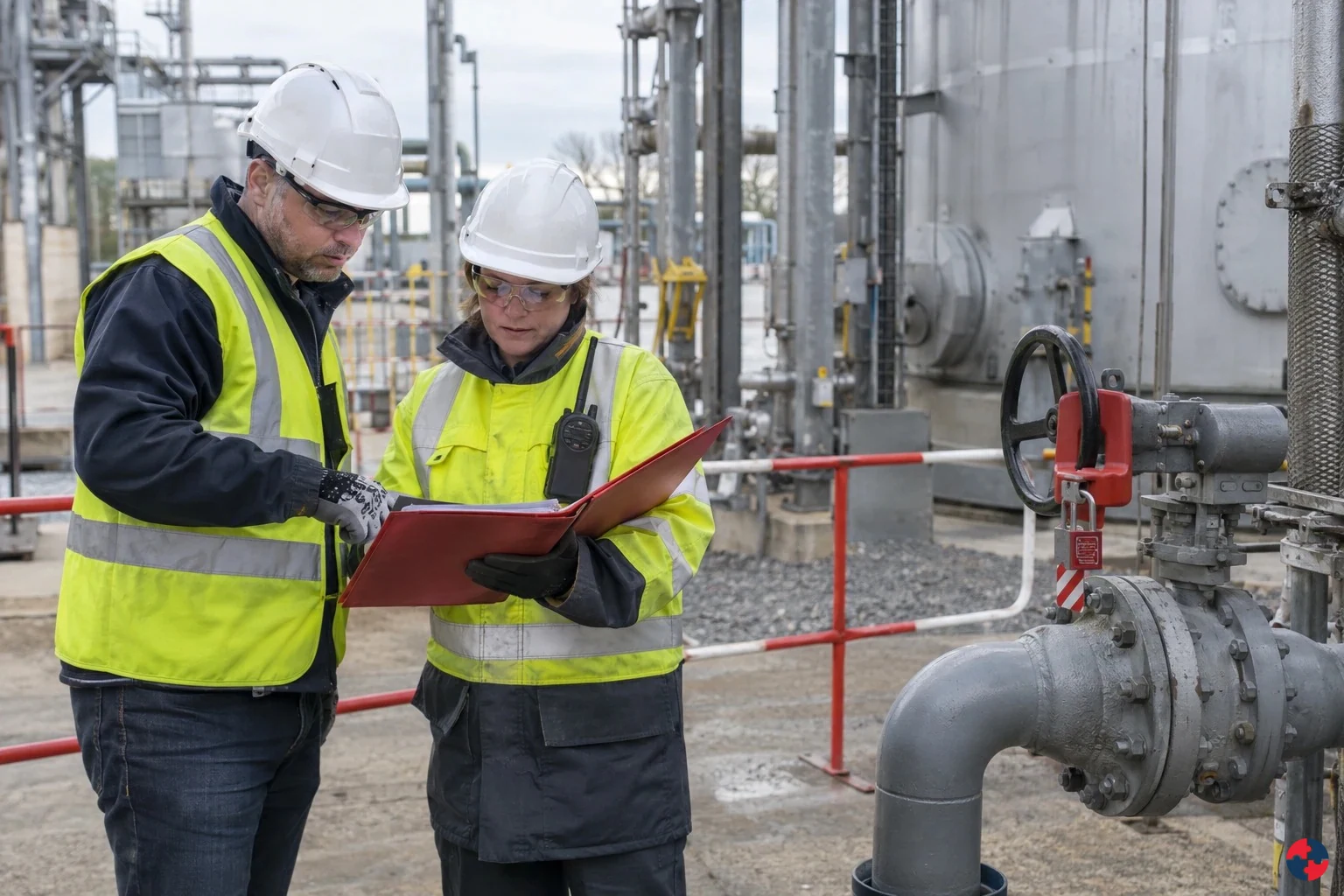
What are the critical decisions before work starts?
Keep people out of oxygen-deficient atmospheres, verify the inerting design and supply, and plan safe isolation, testing and rescue before opening or entering equipment. Nitrogen can displace the oxygen people need to breathe, while inerting can be essential to prevent fires or explosions in enclosed plant.
Turn nitrogen, inerting and asphyxiation hazards knowledge into a decision
Nitrogen can displace the oxygen people need to breathe, while inerting can be essential to prevent fires or explosions in enclosed plant. Safe work needs a verified design, controlled discharge, isolation, atmosphere monitoring, and a rescue plan before exposure. The HSE HSG252 nitrogen tank case illustrates why the atmosphere and entry controls need proof before work.
How could the site team control a nitrogen purge near a basement work area?
Two installers are in a basement plant room, other trades work nearby and the purge outlet was temporarily moved during fit-out. Successful work means the specified line reaches the approved state without exposing anyone to an oxygen-deficient atmosphere. Before.
Follow the exposure and harm route
Nitrogen hose or cryogenic control failure: Gas spreads into a workroom or low area; workers or would-be rescuers inhale oxygen-deficient air and may rapidly collapse. Line opened after an incomplete isolation: Residual nitrogen enters the work area or re-pressurises the line; a maintainer at the opening is exposed. Air enters an inerted flammable vessel: Oxygen rises into a range where ignition could cause fire or explosion, affecting operators, contractors and others.
Choose controls for nitrogen, inerting and asphyxiation hazards
Design and prepare: Review drawings and inventory; eliminate entry or purge where possible; select safe vent location, isolation method, monitoring and ventilation; coordinate contractors. Isolate and purge: Use a site-approved isolation scheme; positively identify and secure lines, depressurise and route discharges safely; test the actual atmosphere with suitable equipment. Entry or intrusive work: Where entry is unavoidable, apply confined-space controls, permit, competent attendants, continuing monitoring as assessed and a realistic rescue plan. Hand back: Account for people and tools; restore plant under authority; verify the intended inerting or breathable state and update the operating status. Read the full control table for qualifications, ownership and verification. Use the actual task and applicable jurisdiction; existing technical approval remains unchanged.
Use the full nitrogen, inerting and asphyxiation hazards lesson
Use the full topic for the decision points, practical examples, detailed control tables and source scope. HSE guidance applies to Great Britain; use HSENI for the Northern Ireland route and the source’s stated jurisdiction. A simplified guide does not change the page’s technical-review or approval status.

Read all six steps as text
1. What are the critical decisions before work starts?
Keep people out of oxygen-deficient atmospheres, verify the inerting design and supply, and plan safe isolation, testing and rescue before opening or entering equipment.
- Avoid / redesign: Review drawings and inventory; eliminate entry or purge where possible; select safe vent location, isolation method, monitoring and ventilation; coordinate contractors.
- Control the task: Where entry is unavoidable, apply confined-space controls, permit, competent attendants, continuing monitoring as assessed and a realistic rescue plan.
- Verify before release: Unmapped connection or vent; an assumption that nitrogen cannot reach people.
Keep people out of oxygen-deficient atmospheres, verify the inerting design and supply, and plan safe isolation, testing and rescue before opening or entering equipment. Nitrogen can displace the oxygen people need to breathe, while inerting can be essential to prevent fires or explosions in enclosed plant.
Apply it: Which part of this plan would you check at the workface before authorising the task?
2. Turn nitrogen, inerting and asphyxiation hazards knowledge into a decision
Use the evidence to improve the actual work arrangement.
- Change at source: Review drawings and inventory; eliminate entry or purge where possible; select safe vent location, isolation method, monitoring and ventilation; coordinate contractors.
- Make it observable: Unmapped connection or vent; an assumption that nitrogen cannot reach people.
- Keep useful evidence: The HSE HSG252 nitrogen tank case illustrates why the atmosphere and entry controls need proof before work.
Nitrogen can displace the oxygen people need to breathe, while inerting can be essential to prevent fires or explosions in enclosed plant. Safe work needs a verified design, controlled discharge, isolation, atmosphere monitoring, and a rescue plan before exposure. The HSE HSG252 nitrogen tank case illustrates why the atmosphere and entry controls need proof before work.
Apply it: What evidence would show that the change improves this task, rather than only completing a record?
3. How could the site team control a nitrogen purge near a basement work area?
Example: a practical application of the existing topic lesson.
- Situation: In this construction example, the site team stops a commissioning purge when the safe discharge route and nearby basement occupancy cannot be proven.
- Decision: Task and people.
- Follow through: A specialist contractor plans to purge new process pipework with nitrogen before handing it to the client.
Two installers are in a basement plant room, other trades work nearby and the purge outlet was temporarily moved during fit-out. Successful work means the specified line reaches the approved state without exposing anyone to an oxygen-deficient atmosphere. Before.
Apply it: At which point would you hold this example, and what evidence would allow it to proceed?
4. Follow the exposure and harm route
Connect the task, the route to the person and the control that can fail.
- Nitrogen hose or cryogenic control failure: Gas spreads into a workroom or low area; workers or would-be rescuers inhale oxygen-deficient air and may rapidly collapse.
- Line opened after an incomplete isolation: Residual nitrogen enters the work area or re-pressurises the line; a maintainer at the opening is exposed.
- Air enters an inerted flammable vessel: Oxygen rises into a range where ignition could cause fire or explosion, affecting operators, contractors and others.
Nitrogen hose or cryogenic control failure: Gas spreads into a workroom or low area; workers or would-be rescuers inhale oxygen-deficient air and may rapidly collapse. Line opened after an incomplete isolation: Residual nitrogen enters the work area or re-pressurises the line; a maintainer at the opening is exposed. Air enters an inerted flammable vessel: Oxygen rises into a range where ignition could cause fire or explosion, affecting operators, contractors and others.
Apply it: Who could be exposed, including other trades, cleaners, maintainers and people nearby?
5. Choose controls for nitrogen, inerting and asphyxiation hazards
Start with the stronger practicable options and verify their effect.
- Design and prepare: Review drawings and inventory; eliminate entry or purge where possible; select safe vent location, isolation method, monitoring and ventilation; coordinate contractors.
- Isolate and purge: Use a site-approved isolation scheme; positively identify and secure lines, depressurise and route discharges safely; test the actual atmosphere with suitable equipment.
- Entry or intrusive work: Where entry is unavoidable, apply confined-space controls, permit, competent attendants, continuing monitoring as assessed and a realistic rescue plan.
- Hand back: Account for people and tools; restore plant under authority; verify the intended inerting or breathable state and update the operating status.
Design and prepare: Review drawings and inventory; eliminate entry or purge where possible; select safe vent location, isolation method, monitoring and ventilation; coordinate contractors. Isolate and purge: Use a site-approved isolation scheme; positively identify and secure lines, depressurise and route discharges safely; test the actual atmosphere with suitable equipment. Entry or intrusive work: Where entry is unavoidable, apply confined-space controls, permit, competent attendants, continuing monitoring as assessed and a realistic rescue plan. Hand back: Account for people and tools; restore plant under authority; verify the intended inerting or breathable state and update the operating status. Read the full control table for qualifications, ownership and verification. Use the actual task and applicable jurisdiction; existing technical approval remains unchanged.
Apply it: Which stronger option can be used here, and who will verify it before accepting the remaining risk?
6. Use the full nitrogen, inerting and asphyxiation hazards lesson
Follow the official sources below and retain the task-specific evidence.
- Official guidance: HSE inerting technical guidance
- Official guidance: HSE confined-space introduction
- Task decision: The HSE HSG252 nitrogen tank case illustrates why the atmosphere and entry controls need proof before work.
Use the full topic for the decision points, practical examples, detailed control tables and source scope. HSE guidance applies to Great Britain; use HSENI for the Northern Ireland route and the source’s stated jurisdiction. A simplified guide does not change the page’s technical-review or approval status.
Apply it: Which official source and full-topic section will you use to resolve the next decision?
| Decision | Why it matters | Hold point |
|---|---|---|
| Can the work be done without entry? | Nitrogen may displace breathable air in vessels, pits and nearby areas. | No entry until avoidance has been considered and the confined-space assessment and rescue plan are complete. |
| Where can gas escape or collect? | A purge outlet or failed line can expose workers outside the vessel; oxygen deficiency may have no smell or warning. | Stop if routing, ventilation or gas detection cannot be verified. |
| Does inerting remain effective? | Air ingress, supply failure or an untested oxygen control may allow a flammable atmosphere. | Stop if the approved safe operating envelope or alarm response cannot be demonstrated. |
| Who can respond? | An unprotected rescue attempt can create more casualties. | Do not enter to rescue without the trained team and equipment specified in the plan. |
HSE inerting technical guidance links the explosion-prevention benefit of inerting to its asphyxiation risk; HSE confined-space introduction explains confined-space avoidance and rescue.
Trace the purge to its actual discharge
Inerting can control a fire hazard inside plant while creating an oxygen-deficient atmosphere for people. Verify every connection and discharge route, including effects on nearby occupied spaces.

Trace every connection
Check the actual plant boundary, connected systems and any temporary changes. A drawing or label alone is not confirmation of the installed route.
Safe discharge
Assess where displaced gases discharge and who can be affected. This schematic supplies no dilution distance or universal gas-pooling rule.
People nearby
Include pits, basements, adjacent work and people outside the vessel. Restrict affected access while the atmosphere or boundary is uncertain.
Inert is not breathable
A reduced fire risk does not mean an atmosphere is safe to breathe; oxygen and other relevant hazards need their own assessment.
Verify the atmosphere
Where entry cannot be avoided, use the assessed isolation, testing, monitoring and entry arrangements with competent verification.
No improvised rescue
Have a planned, equipped rescue route. An unprotected person entering to help can become another casualty.
Keep the work on hold while a connection, discharge boundary or atmosphere is unverified. This sketch is not a purge procedure or an entry permit.
How does nitrogen cause harm and why is it used?
Nitrogen can reduce oxygen in air to a level that will not support life; it can also deliberately keep oxygen out of enclosed plant to prevent fire or explosion. Both effects must be controlled together.
Ordinary air contains oxygen and nitrogen. Nitrogen is colourless and odourless, so a person may not recognise oxygen displacement before collapse. A release, purge outlet, leaky connection or cryogenic liquid rapidly vaporising can produce a hazardous atmosphere in a vessel, room, pit or adjacent space. Symptoms are an unreliable warning and a normal reading earlier in the job does not prove continuing safety. HSE reduced-oxygen environments and HSE asphyxiation hazards in welding explain these routes.
Inerting reduces oxygen in closed process equipment below the level needed for combustion, where that is an appropriate explosion-prevention design. The same atmosphere is unsafe to breathe. An inerted vessel must never be treated as safe for entry because the fire risk was controlled. Conversely, venting and making it safe to breathe may reintroduce the explosion risk if flammable material remains. Engineering must define the sequence and safe limits for both states. HSE inerting technical guidance.
One bounded engineering decision
For an inerted vessel containing a flammable material, the process engineer sets the maximum permitted oxygen concentration from the specific material, temperature, pressure and design basis, then specifies a representative measurement point, calibrated instrument, alarm response and the safe state if nitrogen supply or measurement fails. That process limit is not a breathing-air limit. The entry team separately assesses whether the vessel and surrounding work area are safe for people, with suitable tests at locations where a release could collect and continued monitoring as the task requires. A competent designer positions fixed or portable detectors for the actual release paths and checks response time, alarm visibility and maintenance. If a purge vent moves, the team stops, revises the discharge and occupied-area assessment, rechecks detection and briefs all affected workers before restart. No universal oxygen number is asserted for either decision. HSE inerting guidance; HSE confined-space guidance.
How should purging, line breaking and entry be planned?
Map the nitrogen source, every connection and discharge, the spaces people may occupy, and the change of atmosphere through each work step. Verify isolation and atmosphere before any exposure.
For a vessel purge, the process owner defines which line is supplying nitrogen, where displaced air will vent and who could occupy that route before any valve is opened. The team isolates conflicting services, proves the intended flow and keeps the vent outside occupied and connected spaces. If a line break, detector alarm or changed vent route is found, the supervisor holds both the purge and nearby access until a competent person checks the design and atmosphere; an oxygen reading at one point does not clear the whole area. HSE inerting guidance and HSE reduced-oxygen guidance support the control boundary.
| Stage | Action and evidence | Stop trigger |
|---|---|---|
| Design and prepare | Review drawings and inventory; eliminate entry or purge where possible; select safe vent location, isolation method, monitoring and ventilation; coordinate contractors. | Unmapped connection or vent; an assumption that nitrogen cannot reach people. |
| Isolate and purge | Use a site-approved isolation scheme; positively identify and secure lines, depressurise and route discharges safely; test the actual atmosphere with suitable equipment. | Plant ID, isolation or vent path cannot be verified. |
| Entry or intrusive work | Where entry is unavoidable, apply confined-space controls, permit, competent attendants, continuing monitoring as assessed and a realistic rescue plan. | Reading outside the approved range, alarm, loss of ventilation, change in plant or missing rescue capability. |
| Hand back | Account for people and tools; restore plant under authority; verify the intended inerting or breathable state and update the operating status. | Temporary bypass or uncertain atmosphere remains. |
For intrusive work, HSE safe isolation of plant and equipment discusses high standards of isolation; HSE confined-space introduction describes the requirement to avoid entry if possible and establish safe work and emergency arrangements if entry is necessary. A permit records decisions but cannot make a faulty isolation or detector effective.
What failure chains can lead to asphyxiation or explosion?
A single nitrogen system may create two different severe outcomes: oxygen loss where people are present, and loss of inerting where flammable material is present.
| Initiating event | Mechanism and affected people | Barrier and warning |
|---|---|---|
| Nitrogen hose or cryogenic control failure | Gas spreads into a workroom or low area; workers or would-be rescuers inhale oxygen-deficient air and may rapidly collapse. | Containment, safe discharge, ventilation, suitable oxygen detection, exclusion and rehearsed rescue. Alarm or unexplained collapse means stop and evacuate. |
| Line opened after an incomplete isolation | Residual nitrogen enters the work area or re-pressurises the line; a maintainer at the opening is exposed. | Approved isolation, pressure and atmosphere verification, permit and supervisor check. Stop for any uncertain tag or reading. |
| Air enters an inerted flammable vessel | Oxygen rises into a range where ignition could cause fire or explosion, affecting operators, contractors and others. | Defined inerting envelope, dependable supply, monitoring, alarms, response and change control. Stop or move to a safe state on failed supply or control. |
| Unplanned entry or rescue | A second person enters an oxygen-deficient space and becomes another casualty. | Physical access control, training and a rescue team with suitable breathing equipment. No impulsive entry. |
HSE describes a fatal beverage-tank case involving one worker: one worker entered without adequate atmosphere checks; the HSE HSG252 nitrogen tank case illustrates how an oxygen-deficient atmosphere can cause fatal harm when testing and entry controls fail.
HSE HSG252, page 28, case study 2 describes a fatal beverage-tank case involving one worker positioning a spray ball in a nitrogen-purged tank. The account supports the asphyxiation mechanism and absent pre-entry oxygen test; it does not identify a country. Read that case as evidence of the failed barriers, rather than a universal entry procedure.
Which legal framework applies in Great Britain and Northern Ireland?
The confined-space, dangerous-substance and major-accident rules depend on the work and location. Nitrogen use alone does not automatically put a site under COMAH.
| When relevant | Great Britain | Northern Ireland |
|---|---|---|
| General health and safety risk | Health and Safety at Work etc. Act 1974 and Management of Health and Safety at Work Regulations 1999. | Health and Safety at Work (NI) Order 1978 and Management of Health and Safety at Work Regulations (NI) 2000. |
| Confined-space entry | Confined Spaces Regulations 1997: avoid entry where reasonably practicable; otherwise safe system and rescue. | Confined Spaces Regulations (NI) 1999 apply to NI work. |
| Fire/explosion from dangerous substances | DSEAR 2002 applies where its dangerous-substance risks are present; inerting may be a control but creates an asphyxiation risk. | Dangerous Substances and Explosive Atmospheres Regulations (NI) 2003 apply in their scope. |
| Qualifying major-accident inventories | COMAH 2015 applies only when scheduled dangerous substances reach the relevant thresholds. | COMAH Regulations (NI) 2015 have separate NI scope and competent authority. |
Check the current legislation for the actual site, inventory and task. HSE DSEAR guidance describes the GB fire and explosion scope; HSE COMAH 2015 guidance and HSENI COMAH guidance explain how site inventories determine COMAH coverage. A nitrogen cylinder does not by itself make every workplace a COMAH establishment.
Check the direct legal texts for the site: GB Health and Safety at Work etc. Act 1974; NI Health and Safety at Work Order 1978; GB Confined Spaces Regulations 1997; NI Confined Spaces Regulations 1999; GB DSEAR 2002; NI DSEAR 2003; GB COMAH 2015; and NI COMAH 2015. Confirm scope and amendments for the actual work; these sources do not make every nitrogen installation a COMAH site.
The risk-assessment and preventive-arrangement framework is in the GB Management Regulations 1999 and NI Management Regulations 2000.
What evidence shows controls are working now?
Look beyond a procedure: sample the plant, atmosphere, alarm and permit records for a real job and confirm each critical barrier is currently available.
What evidence shows controls are working now?


Read the complete visual as text
- Containment and vent route: Evidence to sample: Current drawing, walkdown, pressure test or inspection and marked safe discharge. Failure response: Isolate or suspend affected nitrogen use until defect corrected.
- Inerting supply and monitoring: Evidence to sample: Design basis, operating envelope, calibrated instrument, alarm response and trend or test record. Failure response: Move process to defined safe state if supply or measurement is unavailable.
- Human access control: Evidence to sample: Confined-space assessment, isolation certificate, permit, gas-test record, competent attendant and rescue exercise. Failure response: No entry or restart until all entry barriers are restored.
- Learning and change: Evidence to sample: Near misses, impaired safeguards, temporary connections and changes closed with field verification. Failure response: Escalate repeated defects to the technical authority and management.
| Barrier | Evidence to sample | Failure response |
|---|---|---|
| Containment and vent route | Current drawing, walkdown, pressure test or inspection and marked safe discharge. | Isolate or suspend affected nitrogen use until defect corrected. |
| Inerting supply and monitoring | Design basis, operating envelope, calibrated instrument, alarm response and trend or test record. | Move process to defined safe state if supply or measurement is unavailable. |
| Human access control | Confined-space assessment, isolation certificate, permit, gas-test record, competent attendant and rescue exercise. | No entry or restart until all entry barriers are restored. |
| Learning and change | Near misses, impaired safeguards, temporary connections and changes closed with field verification. | Escalate repeated defects to the technical authority and management. |
Assurance samples real work at night, during maintenance and after changes. A green dashboard cannot override a failed detector or ambiguous line identification.
Record the gases the detector measures, the intended sampling locations and conditions, its functional response check, and separate calibration/service evidence. Confirm the alarm response and the named person who holds the process if the instrument is unavailable or fails. A functional response check and calibration establish different things; neither provides a universal human-entry threshold or removes the process-fire assessment.
How can the hierarchy of controls prevent oxygen depletion and nitrogen asphyxiation?
Eliminate exposure where possible, then use engineered containment, isolation and monitoring; permits, training and protective equipment support those barriers but cannot replace them.
How can the ERICPD hierarchy of controls prevent oxygen depletion and nitrogen asphyxiation?

| Level | Application | Check and failure response |
|---|---|---|
| Eliminate | Design out entry or use a non-entry inspection method; remove the flammable atmosphere or process condition that called for inerting if practicable. | Designer and task owner document the option; no entry by default. |
| Design/operating optimisation (administrative context) | Minimise nitrogen inventory and purge duration consistent with process safety; select a lower-risk method where suitable. | Engineer checks both asphyxiation and fire risk after the change. |
| Isolate | Physically separate people from discharge and positively isolate lines or vessels before intrusive work. | Competent isolator proves the boundary; stop for a broken barrier. |
| Control | Ventilate and monitor as assessed; use tested alarms, safe limits, permits, supervision and an emergency plan. | Supervisor tests detector and response; stop on alarm or lost control. |
| PPE | Use task-required protection; ordinary respirators do not supply oxygen in an oxygen-deficient atmosphere. | Only trained personnel use suitable breathing apparatus under an assessed rescue/entry plan. |
| Discipline | Use approved steps, competence checks, change control and stop-work authority for everyone. | Audit real work and act on deviations; avoid blame as a substitute for design. |
How can the ISO 45001 hierarchy of controls prevent oxygen depletion and nitrogen asphyxiation?

| Level | Application | Check and failure response |
|---|---|---|
| Elimination | Design out entry or use a non-entry inspection method; remove the flammable atmosphere or process condition that called for inerting if practicable. | Designer and task owner document the option; no entry by default. |
| Design/operating optimisation (administrative context) | Minimise nitrogen inventory and purge duration consistent with process safety; select a lower-risk method where suitable. | Engineer checks both asphyxiation and fire risk after the change. |
| Engineering controls | Physically separate people from discharge and positively isolate lines or vessels before intrusive work. | Competent isolator proves the boundary; stop for a broken barrier. |
| Engineering controls / Administrative controls | Ventilate and monitor as assessed; use tested alarms, safe limits, permits, supervision and an emergency plan. | Supervisor tests detector and response; stop on alarm or lost control. |
| PPE | Use task-required protection; ordinary respirators do not supply oxygen in an oxygen-deficient atmosphere. | Only trained personnel use suitable breathing apparatus under an assessed rescue/entry plan. |
| Administrative controls | Use approved steps, competence checks, change control and stop-work authority for everyone. | Audit real work and act on deviations; avoid blame as a substitute for design. |
HSE inerting technical guidance and HSE confined-space introduction underpin the hierarchy. The control plan must address both the oxygen-deficient people hazard and the flammable-process hazard.
HSE prioritises eliminating and substituting hazards before engineering controls, administrative controls and PPE, as explained in its five-level hierarchy of controls. SHARE uses ERICPD as a task-planning prompt: Eliminate; Reduce, including substitution; Isolate through engineered separation; Control with other engineered or administrative measures; PPE; and Discipline, meaning continued verification and maintenance. ERICPD is not a sixth HSE level or a separate legal duty. Here, reducing nitrogen inventory is process risk reduction; substitution requires a genuinely lower-risk method after both fire and oxygen-deficiency risks are assessed.
The Discipline row is the SHARE upkeep prompt for maintaining the selected controls, rather than an additional HSE hierarchy level or a substitute for elimination and engineering. HSE five-level hierarchy.
Read the practical categories separately: elimination removes the hazardous task/source; substitution replaces it with a suitable safer alternative; physical separation, containment and capture are engineering decisions. Duration/access/briefing are administrative measures, PPE covers residual exposure, and continued inspection, maintenance and verified action closure sustain the controls. Exposure monitoring or dosimetry measures exposure rather than protecting a person. The detailed text and records below distinguish these decisions; an overview illustration is not task authorisation.
What belongs in the risk and barrier register?
Record each credible scenario, its preventive and mitigating barriers, owner, test evidence, impairment rule and escalation decision.
| Scenario and top event | Barrier and owner | Evidence and escalation |
|---|---|---|
| Nitrogen release to an occupied room | Engineering: containment, safe vent, ventilation and oxygen detection. | Inspection and test dates; evacuate and isolate on alarm or leak. |
| Entry into an inerted vessel | Operations/maintenance: avoid entry, isolate, test, permit, attendant and rescue. | Permit pack and field check; prohibit entry for any missing barrier. |
| Loss of inerting to flammable plant | Process engineering: supply, oxygen monitoring, alarms and safe-state response. | Trend and proof test; hold/restart only under technical authority. |
| Changed connection or temporary bypass | Change owner: drawing update, review and field verification. | Expire temporary arrangement; escalate overdue action. |
A register is useful only if it reflects the plant state. Trace at least one high-consequence scenario from design assumptions through to current barrier test and worker understanding.
How could BuildOut Ltd control a nitrogen purge near a basement work area?

In this construction example, BuildOut Ltd stops a commissioning purge when the safe discharge route and nearby basement occupancy cannot be proven.
How could BuildOut Ltd control a nitrogen purge near a basement work area? — part 1 of 2


Read the complete visual as text
- In this construction example, BuildOut Ltd stops a…: In this construction example, BuildOut Ltd stops a commissioning purge when the safe discharge route and nearby basement occupancy cannot be proven.
- Task and people. A specialist contractor plans to purge…: Task and people. A specialist contractor plans to purge new process pipework with nitrogen before handing it to the client. Two installers are in a basement plant room, other trades work nearby and the purge outlet was temporarily moved during fit-out. Successful work means the specified line reaches the approved state without exposing anyone to an oxygen-deficient atmosphere.
- Before. The principal contractor and process engineer compare the…: Before. The principal contractor and process engineer compare the current drawings with the installed pipework, locate the vent and confirm an outdoor safe discharge. They assess the basement and adjoining voids, isolate the line as specified, agree the monitoring and exclusion plan, brief all affected trades and confirm who can stop work. An unfamiliar temporary hose is treated as a change requiring review.
How could BuildOut Ltd control a nitrogen purge near a basement work area? — part 2 of 2


Read the complete visual as text
- During and hold. The supervisor checks the vent boundary…: During and hold. The supervisor checks the vent boundary and detector before the purge. When the contractor cannot prove where the temporary hose terminates, the purge is not started. A later oxygen alarm would trigger withdrawal, access control and the trained emergency response; no worker enters the basement to investigate or rescue without the plan and suitable equipment.
- Completion and evidence. The approved vent route is installed…: Completion and evidence. The approved vent route is installed and independently checked; the purge proceeds under the revised permit and is logged. The team records the isolation, gas tests, detector check, contractor brief, change decision and hand-back. A supervisor verifies the actual line state before other trades return.
- Transfer to food freezing: A cold-store maintenance team must…: Transfer to food freezing: A cold-store maintenance team must service a line near liquid-nitrogen equipment while packers work beyond a door. The manager first isolates and checks the supply, verifies that venting cannot migrate into the packing area and confirms suitable fixed or portable oxygen monitoring for the actual layout. A leak, alarm or uncertain vent path clears people and holds the job; a competent engineer proves repair and the supervisor records a safe hand-back before both teams return. The HSE HSG252 nitrogen tank case illustrates why the atmosphere and entry controls need proof before work.
Task and people. A specialist contractor plans to purge new process pipework with nitrogen before handing it to the client. Two installers are in a basement plant room, other trades work nearby and the purge outlet was temporarily moved during fit-out. Successful work means the specified line reaches the approved state without exposing anyone to an oxygen-deficient atmosphere.
Before. The principal contractor and process engineer compare the current drawings with the installed pipework, locate the vent and confirm an outdoor safe discharge. They assess the basement and adjoining voids, isolate the line as specified, agree the monitoring and exclusion plan, brief all affected trades and confirm who can stop work. An unfamiliar temporary hose is treated as a change requiring review.
During and hold. The supervisor checks the vent boundary and detector before the purge. When the contractor cannot prove where the temporary hose terminates, the purge is not started. A later oxygen alarm would trigger withdrawal, access control and the trained emergency response; no worker enters the basement to investigate or rescue without the plan and suitable equipment.
Completion and evidence. The approved vent route is installed and independently checked; the purge proceeds under the revised permit and is logged. The team records the isolation, gas tests, detector check, contractor brief, change decision and hand-back. A supervisor verifies the actual line state before other trades return.
Transfer to food freezing: A cold-store maintenance team must service a line near liquid-nitrogen equipment while packers work beyond a door. The manager first isolates and checks the supply, verifies that venting cannot migrate into the packing area and confirms suitable fixed or portable oxygen monitoring for the actual layout. A leak, alarm or uncertain vent path clears people and holds the job; a competent engineer proves repair and the supervisor records a safe hand-back before both teams return. The HSE HSG252 nitrogen tank case illustrates why the atmosphere and entry controls need proof before work.
What competence must each role demonstrate?
Training must match the decisions a person makes: a purge operator, permit issuer, detector user, rescue team and process engineer need different proof of competence.
| Role | Decision and learning | Demonstration, assessor and recheck |
|---|---|---|
| Operator or purge contractor | Identify nitrogen sources, safe limits, vent, alarm and immediate stop route. | Competent supervisor observes a purge and abnormal-condition response; reassess after change or error. |
| Maintainer and confined-space entrant | Verify line isolation, atmosphere test, permit and planned escape; recognise that nitrogen may remain after depressurisation. | Authorised assessor observes isolation and gas-test method; recheck for unfamiliar plant. |
| Permit issuer and supervisor | Coordinate adjacent work, test barriers and reject an incomplete permit or unsafe restart. | Technical authority samples a live permit and stop decision; review after near miss. |
| Engineer and designer | Define inerting envelope, supply reliability, discharge location, detection and safe-state response. | Peer review design basis and field installation; re-evaluate after modification. |
| Rescue team | Use the site rescue plan and breathing apparatus where specified; prevent spontaneous unprotected entry. | Competent rescue trainer witnesses realistic exercise and equipment checks; refresh to site plan. |
Record scope, assessor, date and observed performance. Attendance at a general awareness course cannot authorise entry or rescue.
How can a management system help keep barriers reliable?
HSE explains that a formal health and safety management system is optional. The employer must still plan, control, check and improve the measures for this task. This page does not verify a private standard’s edition, clause text or scope.
A process-safety management system must also retain the technical basis: credible scenarios, safe operating envelope, inspection and test standards, management of change and emergency exercises. COMAH-specific duties apply only to qualifying establishments.
Which warning signs require a pause or escalation?
Stop affected work for an unexplained oxygen alarm, unknown nitrogen connection, unverified isolation, lost ventilation, failed detector, changed purge route or missing rescue capability.
Weak signals include nuisance alarms dismissed as sensor faults, temporary hoses without drawings, repeated permit corrections, overdue calibration, unexplained pressure or oxygen trends, and contractors who disagree about the safe boundary. Treat an unconscious person in a suspect atmosphere as an emergency: raise the alarm, keep others out and use the planned trained rescue response. A worker must not attempt an unprotected rescue.
How can an inert process conflict with a safe maintenance job?
The atmosphere that suppresses a process fire may be unsafe to breathe; changing it for entry can also change the fire risk.
Imagine a vessel normally protected by nitrogen that needs an internal inspection. The maintenance team asks to ventilate it with air, while production wants the inerting system left available for a quick restart. Those are competing plant states. The process specialist must assess remaining flammable material and reactions before accepting a change of atmosphere; the entry assessor must separately establish safe conditions for people. See HSE inerting technical guidance.
Start by asking whether inspection can be performed externally. If entry remains necessary, define the boundary of the job, nitrogen connections, other material feeds, drains and adjoining equipment. An entry permit communicates the accepted method, but it does not physically stop an automatic nitrogen valve opening or a connected line leaking. Isolation must be selected and verified for the actual plant and hazards. See HSE confined-space introduction.
Do not use an oxygen reading as proof that every toxic or flammable hazard is controlled. Equally, a successful process inerting reading is not evidence of a breathable workplace. Record which specialist accepts each question, which instruments answer it and the conditions that cancel that acceptance. The example explains the decision conflict; it is not a vessel commissioning or entry procedure. See HSE confined-space introduction.
Decision basis: HSE inerting technical guidance. HSE confined-space introduction. The scenario and suggested records are illustrative; apply the source within its stated jurisdiction and the assessed work. HSE sources here provide Great Britain technical guidance. Northern Ireland work must use the separate NI confined-space, fire-risk and general-duty routes described above; a GB technical source does not replace the NI legal instrument.
What must change when a nitrogen vent is moved?
Reassess the discharge route and nearby occupied spaces before accepting a new vent location or flow condition.
A temporary hose is moved from an assessed discharge point to a lower doorway to keep the work area tidy. The engineering team must consider where the released gas can go, who occupies the receiving area and whether the assessed flow and ventilation still apply. A tidy hose route does not demonstrate safe dispersal. Do not infer a universal settling pattern from gas name alone; release conditions and airflow matter. See HSE asphyxiation hazards in welding.
Keep the affected purge on hold until its physical route, supports, connections, isolation and exclusion arrangements have been reviewed. The shift handover should show the vent location and plant state so a second team does not alter them unnoticed. Restart evidence includes a check in the field against the accepted design and a named owner; a drawing that no longer matches the installation is insufficient. See HSE safe isolation of plant and equipment.
Decision basis: HSE asphyxiation hazards in welding. HSE safe isolation of plant and equipment. The scenario and suggested records are illustrative; apply the source within its stated jurisdiction and the assessed work. HSE sources here provide Great Britain technical guidance. Northern Ireland work must use the separate NI confined-space, fire-risk and general-duty routes described above; a GB technical source does not replace the NI legal instrument.
How can competence be tested without exposing a trainee?
Use an observed planning and stop exercise with simulated changes, then assess practical work only within the controlled system.
Ask a trainee to walk through a safe external model of the system: identify the nitrogen source and possible receiving spaces, explain the isolation boundary and find the agreed communication route. Introduce a mismatch between the permit and a valve label. The expected decision is to stop and resolve identity, not to select the valve that looks most plausible. See HSE confined-space introduction.
Ask the supervisor what happens if ventilation fails or an entrant becomes unresponsive. They must describe the local alarm and assessed rescue arrangements while keeping unprotected helpers outside the hazardous area. A successful briefing does not authorise rescue entry. Specialist rescue equipment and competence must be established for the actual job. See HSE safe isolation of plant and equipment.
Retain the exercise findings, the scope assessed and any learning action. Reassess after a changed plant connection, work method or barrier failure. Production hand-back must confirm the correct process state; personal fitness and entry competence are separate judgements and should not be merged into one sign-off. See HSE safe isolation of plant and equipment.
Decision basis: HSE confined-space introduction. HSE safe isolation of plant and equipment. The scenario and suggested records are illustrative; apply the source within its stated jurisdiction and the assessed work. HSE sources here provide Great Britain technical guidance. Northern Ireland work must use the separate NI confined-space, fire-risk and general-duty routes described above; a GB technical source does not replace the NI legal instrument.
Which acronyms and terms matter here?
These terms help distinguish a process protected from fire from an atmosphere safe for people to breathe.
| Term | Full form or meaning | Application |
|---|---|---|
| Inerting | Replacing or reducing oxygen in an enclosed process atmosphere | May prevent combustion; can create an asphyxiation hazard. |
| Oxygen deficiency | Air with insufficient oxygen to support safe breathing | Requires exclusion, assessment, monitoring and controlled rescue. |
| PPE | Personal protective equipment | Ordinary respiratory filters do not supply oxygen. |
| DSEAR | Dangerous Substances and Explosive Atmospheres Regulations | Separate GB and NI regulations for relevant dangerous substances. |
| COMAH | Control of Major Accident Hazards | Applies to qualifying establishments, not all nitrogen users. |
| HSENI | Health and Safety Executive for Northern Ireland | NI health and safety regulator. |
| HSE | Health and Safety Executive | Great Britain workplace regulator; use its guidance within scope. |
| GB | Great Britain | England, Scotland and Wales; distinguish the NI legal route. |
| NI | Northern Ireland | Use the Northern Ireland legislation and regulator route. |
| ERICPD | Eliminate; Reduce; Isolate; Control; PPE; Discipline | SHARE planning prompt; Discipline means maintaining controls, not blame. |