SHARE Knowledge Hub
Safety Critical Performance Standards
A safety-critical performance standard states the function and testable performance needed from a barrier credited against a major accident. It links the hazard scenario to availability, reliability, response, survivability, interfaces, verification and what happens when the barrier is impaired. A completed maintenance task is not proof of protection unless its result demonstrates the required function under the conditions that matter.
Understanding Safety Critical Performance Standards
A safety-critical performance standard states the function and testable performance needed from a barrier credited against a major accident. It links the hazard scenario to availability, reliability, response, survivability, interfaces, verification and what happens when the barrier is impaired. A completed maintenance task is not proof of protection unless its result demonstrates the required function under the conditions that matter.
Why this matters at work
Do not claim availability merely because no demand or incident occurred. Restrict, compensate, shut down or otherwise enter the authorised safe state when investigation stops at component or operator error and does not test design, interval, environment or management causes. Record residual scenario exposure, remaining independent barriers, monitoring, expiry and restoration criteria. Identify common-cause and dependency failures, including power, instrument air, cooling, communications, software, access, staffing and emergency conditions that can defeat several barriers together.
Apply consequence and dependency criteria to identify equipment, structures, software and tasks whose failure can cause, prevent, control or mitigate serious harm. Define the major-accident or serious-harm scenario, top event or demand, people and environment at risk, credited prevention or mitigation claim, applicable modes, owner and decision authority. Identify common-cause and dependency failures, including power, instrument air, cooling, communications, software, access, staffing and emergency conditions that can defeat several barriers together.
How organisations manage this in practice
Do not claim availability merely because no demand or incident occurred. Restrict, compensate, shut down or otherwise enter the authorised safe state when normal control failure also defeats credited protection or configuration changes bypass independent review. Record residual scenario exposure, remaining independent barriers, monitoring, expiry and restoration criteria. Separate the design requirement, current as-built configuration, maintenance task, proof or functional test, operating check and independent verification so one record is not mistaken for another.
Separate normal control, monitoring and credited protective functions and define failure behaviour, security and independence where the control system supports safety. Define the major-accident or serious-harm scenario, top event or demand, people and environment at risk, credited prevention or mitigation claim, applicable modes, owner and decision authority. Human action may be credited only where the cue, diagnosis, time, access, tools, competence, workload, communication, authority and recovery margin are demonstrated in realistic conditions.
Review whether measures predict control health and change them when they become targets for gaming. A zero incident figure is not proof of barrier integrity. Link findings back to maintenance, design, competence, staffing and change control.
Show exactly what the safety-function test proves
Trace the demand through sensor, logic, final element and actual plant response. Simulated input may test part of the chain while leaving important elements untested.

Required demand and function
Identify the defined hazardous demand, required action and performance standard. Use the accepted design basis rather than inventing response times or integrity levels.
Sensor boundary
Record whether the real sensor and its response to the relevant condition were tested or whether a signal was substituted. State the untested portion.
Logic path
Record the logic and interfaces exercised and the authorised test/bypass state. A simulated indication is not proof that a real field input reaches the logic.
Final element and response
Establish the specified valve or other final-element action and the plant response required by the standard. A command signal does not by itself prove movement or effective isolation.
Evidence and exclusions
Record methods, results, failures and what the test did not cover. Resolve gaps through competent assessment rather than marking an entire chain passed after a partial test.
Restore and accept
Remove test equipment and authorised inhibits, reconcile the registers and prove the required normal protection. Operations and the designated technical owner accept return to service.
Read the complete controls: ERICPD planning prompts
Discipline verifies and sustains all the controls; it is not a separate substitute for them.
| Prompt or level | Complete task-specific example |
|---|---|
| Eliminate | Plan the test during a safe shutdown wherever practicable so testing does not leave operating plant dependent on the function being withdrawn. |
| Reduce | Use an approved off-line test or simulation for the portions it can validly prove; record which sensor, logic and final-element functions remain untested. |
| Isolate | Place affected equipment in the required safe state and control energy, inventory and access around moving shutdown equipment. |
| Control | Use the approved test facilities and verify the required sensor, logic, alarm and final-element actions against the safety-function specification. Coordinate every test step with the control room; distinguish simulated signals from genuine gas alarms, control authorised inhibits and define abort/shutdown actions. |
| PPE | Use task-assessed protection and personal gas detection where required; neither substitutes for essential automatic protection or safe plant conditions. |
| Discipline | Remove test equipment and authorised inhibits, reconcile the panel/register and prove normal protection before the operations return-to-service decision. Read the accompanying source table for the framework distinctions. |
Read the complete controls: ESEAP effectiveness order
Compare stronger feasible controls while preserving the actual task, checks and release requirements.
| Prompt or level | Complete task-specific example |
|---|---|
| Elimination | Plan the test during a safe shutdown wherever practicable so testing does not leave operating plant dependent on the function being withdrawn. |
| Substitution | No separate measure is specified in this example. |
| Engineering controls | Use an approved off-line test or simulation for the portions it can validly prove; record which sensor, logic and final-element functions remain untested. Place affected equipment in the required safe state and control energy, inventory and access around moving shutdown equipment. Use the approved test facilities and verify the required sensor, logic, alarm and final-element actions against the safety-function specification. |
| Administrative controls | Coordinate every test step with the control room; distinguish simulated signals from genuine gas alarms, control authorised inhibits and define abort/shutdown actions. Remove test equipment and authorised inhibits, reconcile the panel/register and prove normal protection before the operations return-to-service decision. |
| PPE | Use task-assessed protection and personal gas detection where required; neither substitutes for essential automatic protection or safe plant conditions. Read the accompanying source table for the framework distinctions. |
This coverage map provides no proof-test procedure, response time, integrity claim or permission to operate with impaired protection.
Further source background retained from this topic
How can I practise this topic in 3D?

The boundary shutdown command has not been tested end to end
All related inspection points 12 across 1 location
Crown Fuels terminal 12 inspection points
Practice in the SHAREhub environment. Browser practice is separate from workplace competence and formal learning records.
What is a safety critical performance standard?
A safety-critical performance standard states the function and testable performance needed from a barrier credited against a major accident. It links the hazard scenario to availability, reliability, response, survivability, interfaces, verification and what happens when the barrier is impaired. A completed maintenance task is not proof of protection unless its result demonstrates the required function under the conditions that matter.
Best-practice guide: Safety Critical Performance Standards

What is a safety critical performance standard?
A safety-critical performance standard states the function and testable performance needed from a barrier credited against a major accident. It links the hazard scenario to availability, reliability, response, survivability, interfaces, verification and what happens when the barrier is impaired. A safety-critical performance standard states the function and testable performance needed from a barrier credited against a major accident.
Turn safety critical performance standards knowledge into a decision
A safety-critical performance standard states the function and testable performance needed from a barrier credited against a major accident. It links the hazard scenario to availability, reliability, response, survivability, interfaces, verification and what happens when the barrier is impaired. High-high trip detects level at defined set point and closes import valve within required time.
Tank overfill protection worked example
Function: High-high trip detects level at defined set point and closes import valve within required time. Independence: Trip independence from normal level control is defined and verified.
Follow the exposure and harm route
Tank high-high trip bypassed during receipt: The level rises past the safe limit and liquid spills into a flammable-vapour area; ignition can injure workers and the public. Fire-water pump or utility unavailable: A fire grows while mitigation lacks pressure or supply; people cannot rely on the planned response. Common-cause failure of detection and shutdown: A shared power or instrument-air failure defeats more than one credited layer when demand occurs.
Choose controls for safety critical performance standards
Elimination: Plan the test during a safe shutdown wherever practicable so testing does not leave operating plant dependent on the function being withdrawn. Engineering controls: Use an approved off-line test or simulation for the portions it can validly prove; record which sensor, logic and final-element functions remain untested. Engineering controls: Place affected equipment in the required safe state and control energy, inventory and access around moving shutdown equipment. Engineering controls: Use the approved test facilities and verify the required sensor, logic, alarm and final-element actions against the safety-function specification. Administrative controls: Coordinate every test step with the control room; distinguish simulated signals from genuine gas alarms, control authorised inhibits and define abort/shutdown actions. Read the full control table for qualifications, ownership and verification. Use the actual task and applicable jurisdiction; existing technical approval remains unchanged.
Use the full safety critical performance standards lesson
Use the full topic for the decision points, practical examples, detailed control tables and source scope. HSE guidance applies to Great Britain; use HSENI for the Northern Ireland route and the source’s stated jurisdiction. A simplified guide does not change the page’s technical-review or approval status.

Read all six steps as text
1. What is a safety critical performance standard?
A safety-critical performance standard states the function and testable performance needed from a barrier credited against a major accident.
- Avoid / redesign: Plan the test during a safe shutdown wherever practicable so testing does not leave operating plant dependent on the function being withdrawn.
- Control the task: Place affected equipment in the required safe state and control energy, inventory and access around moving shutdown equipment.
- Verify before release: If the hazardous step remains, keep it within the task assessment and select the stronger feasible remaining controls.
A safety-critical performance standard states the function and testable performance needed from a barrier credited against a major accident. It links the hazard scenario to availability, reliability, response, survivability, interfaces, verification and what happens when the barrier is impaired. A safety-critical performance standard states the function and testable performance needed from a barrier credited against a major accident.
Apply it: Which part of this plan would you check at the workface before authorising the task?
2. Turn safety critical performance standards knowledge into a decision
Use the evidence to improve the actual work arrangement.
- Change at source: Plan the test during a safe shutdown wherever practicable so testing does not leave operating plant dependent on the function being withdrawn.
- Make it observable: If the hazardous step remains, keep it within the task assessment and select the stronger feasible remaining controls.
- Keep useful evidence: High-high trip detects level at defined set point and closes import valve within required time.
A safety-critical performance standard states the function and testable performance needed from a barrier credited against a major accident. It links the hazard scenario to availability, reliability, response, survivability, interfaces, verification and what happens when the barrier is impaired. High-high trip detects level at defined set point and closes import valve within required time.
Apply it: What evidence would show that the change improves this task, rather than only completing a record?
3. Tank overfill protection worked example
Example: a practical application of the existing topic lesson.
- Function: High-high trip detects level at defined set point and closes import valve within required time.
- Independence: Trip independence from normal level control is defined and verified.
- Testing: Proof test covers sensor, logic, final element, alarm and valve response.
Function: High-high trip detects level at defined set point and closes import valve within required time. Independence: Trip independence from normal level control is defined and verified.
Apply it: At which point would you hold this example, and what evidence would allow it to proceed?
4. Follow the exposure and harm route
Connect the task, the route to the person and the control that can fail.
- Tank high-high trip bypassed during receipt: The level rises past the safe limit and liquid spills into a flammable-vapour area; ignition can injure workers and the public.
- Fire-water pump or utility unavailable: A fire grows while mitigation lacks pressure or supply; people cannot rely on the planned response.
- Common-cause failure of detection and shutdown: A shared power or instrument-air failure defeats more than one credited layer when demand occurs.
Tank high-high trip bypassed during receipt: The level rises past the safe limit and liquid spills into a flammable-vapour area; ignition can injure workers and the public. Fire-water pump or utility unavailable: A fire grows while mitigation lacks pressure or supply; people cannot rely on the planned response. Common-cause failure of detection and shutdown: A shared power or instrument-air failure defeats more than one credited layer when demand occurs.
Apply it: Who could be exposed, including other trades, cleaners, maintainers and people nearby?
5. Choose controls for safety critical performance standards
Start with the stronger practicable options and verify their effect.
- Elimination: Plan the test during a safe shutdown wherever practicable so testing does not leave operating plant dependent on the function being withdrawn.
- Engineering controls: Use an approved off-line test or simulation for the portions it can validly prove; record which sensor, logic and final-element functions remain untested.
- Engineering controls: Place affected equipment in the required safe state and control energy, inventory and access around moving shutdown equipment.
- Engineering controls: Use the approved test facilities and verify the required sensor, logic, alarm and final-element actions against the safety-function specification.
- Administrative controls: Coordinate every test step with the control room; distinguish simulated signals from genuine gas alarms, control authorised inhibits and define abort/shutdown actions.
Elimination: Plan the test during a safe shutdown wherever practicable so testing does not leave operating plant dependent on the function being withdrawn. Engineering controls: Use an approved off-line test or simulation for the portions it can validly prove; record which sensor, logic and final-element functions remain untested. Engineering controls: Place affected equipment in the required safe state and control energy, inventory and access around moving shutdown equipment. Engineering controls: Use the approved test facilities and verify the required sensor, logic, alarm and final-element actions against the safety-function specification. Administrative controls: Coordinate every test step with the control room; distinguish simulated signals from genuine gas alarms, control authorised inhibits and define abort/shutdown actions. Read the full control table for qualifications, ownership and verification. Use the actual task and applicable jurisdiction; existing technical approval remains unchanged.
Apply it: Which stronger option can be used here, and who will verify it before accepting the remaining risk?
6. Use the full safety critical performance standards lesson
Follow the official sources below and retain the task-specific evidence.
- Official guidance: Primary source
- Official guidance: HSE offshore scope
- Task decision: High-high trip detects level at defined set point and closes import valve within required time.
Use the full topic for the decision points, practical examples, detailed control tables and source scope. HSE guidance applies to Great Britain; use HSENI for the Northern Ireland route and the source’s stated jurisdiction. A simplified guide does not change the page’s technical-review or approval status.
Apply it: Which official source and full-topic section will you use to resolve the next decision?
The term has a defined offshore safety-case and verification context; COMAH operators also need to demonstrate effective major-accident measures, but the regimes are distinct. HSE offshore KP3 describes functionality, availability, reliability and survivability; FARSI adds interaction or independence as a local teaching mnemonic, not an additional statutory list. HSE offshore KP3 asset integrity report
A major-accident barrier can be a physical system, structure, instrumented function or a supported human action. In the offshore legal regime, a safety-critical element has a narrower defined meaning linked to installation or plant; a procedure or human response may be an important barrier without becoming a statutory element. HSE offshore scope. The standard says what success means.
This page uses FARSI as a teaching mnemonic: functionality, availability, reliability, survivability and interaction or independence. Some organisations use slightly different words, but the purpose is the same: define what the barrier must do and how confidence will be maintained.
| Topic area | What it means | Professional test |
|---|---|---|
| Credited critical barrier (general) | A protective measure credited against a defined major-accident scenario; this teaching term includes engineered and supported human actions. | Is its function, demand and evidence linked to the scenario? |
| Safety function | The action the element must perform, such as detect gas, isolate flow, relieve pressure or contain fire. | Is the function specific enough to test? |
| Performance requirement | Measurable criteria such as set point, response time, capacity, rating, integrity or coverage. | Would a technician know whether it passed or failed? |
| Availability | The element must be available when needed, including during abnormal, start-up, shutdown and emergency states. | Are bypasses, impairments and outages controlled? |
| Reliability | The element must perform with enough confidence for its credited risk-reduction role. | Is proof testing aligned with the reliability claim? |
| Survivability | The element must continue to work under the conditions expected during the scenario. | Will fire, explosion, weather, power loss or impact defeat it? |
| Verification | Use competent inspection for the general barrier, with the independence required by an applicable offshore verification scheme. A competent maintenance check does not automatically fulfil statutory independent verification. | Does evidence show live control confidence, not just installation history? |
How can harm occur, and what stops the task?
A performance standard matters when a major-accident sequence demands a barrier: the specified function must work soon enough, for long enough, under the conditions that event creates.
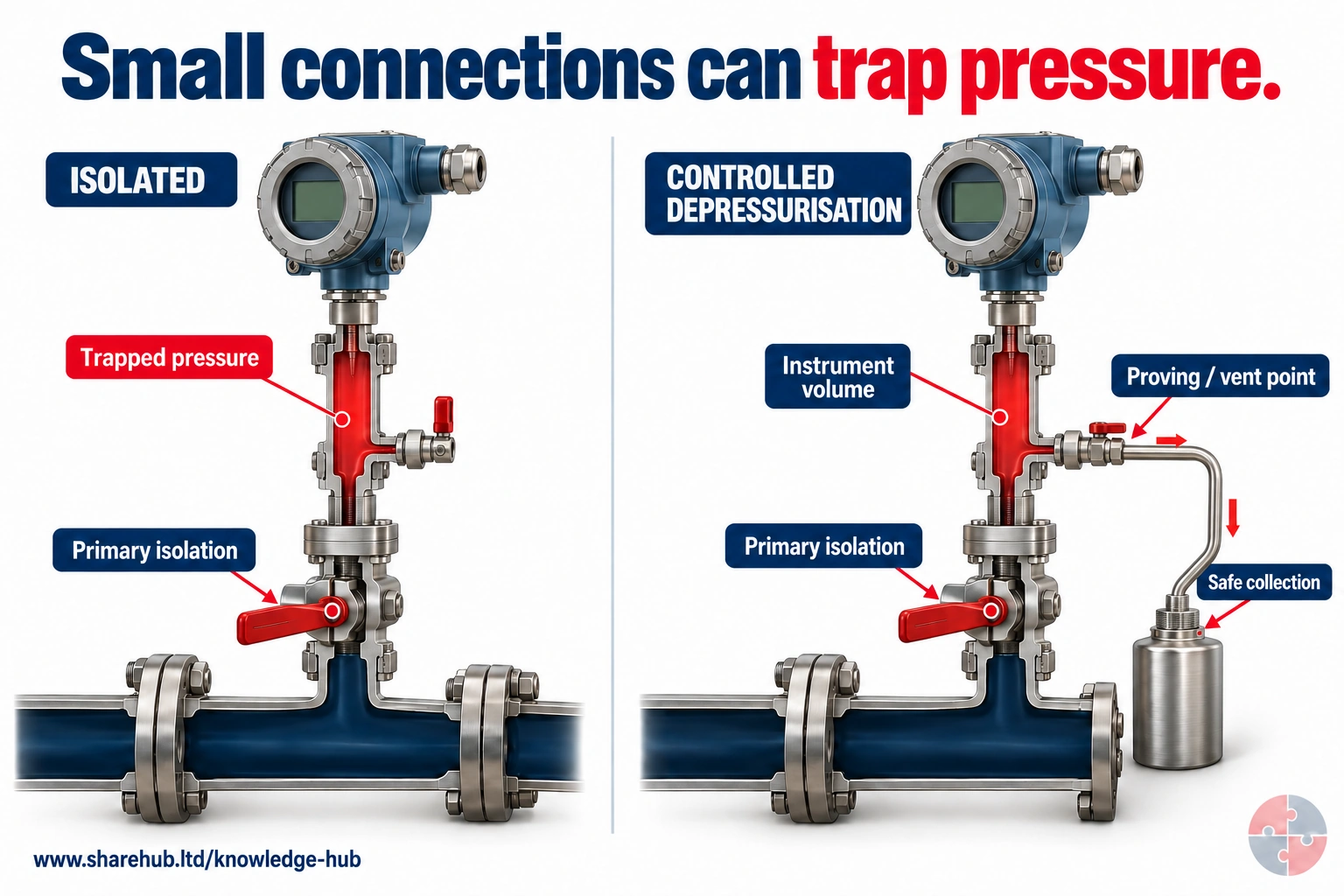

The red area identifies the instrument connection above the closed primary valve: closing that valve can trap process pressure in this small volume. The second view shows a controlled proving/depressurisation path from the same space to collection. Red marks the volume under consideration, not a verified safe pressure state.
Which space can remain pressurised after the root valve closes?
The downstream connection and instrument volume, unless depressurisation and isolation integrity have been established.
Illustrative arrangement only; actual manifolds, primary isolation standards and discharge systems differ. A collection vessel must be suitable for the fluid, pressure and gas release. Manage any lost control or protective instrument function and verify correct reinstatement.
Source guidance: HSE HSG253
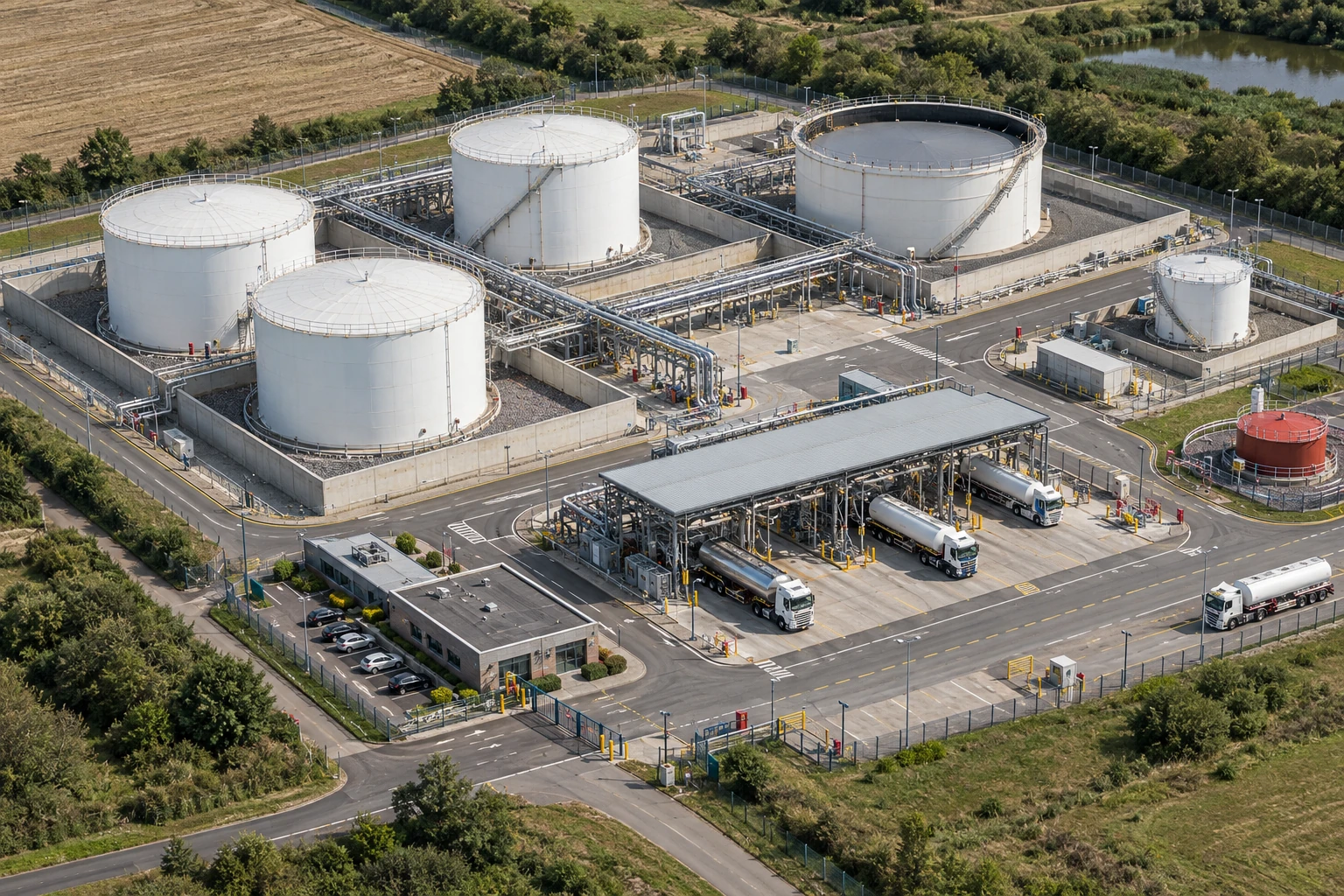
At a tank farm, a high-high trip that is bypassed during receipt leaves rising liquid to escape into a flammable area. A normal instrument reading does not demonstrate that the independent sensor, logic and shutdown valve will act on demand. The transfer owner stops receipt on a bypass or failed proof test; the technical authority assesses the safe state, repairs the fault and verifies the whole function before release. Firewater and emergency shutdown need the same scrutiny of utilities, shared dependencies and degraded states.
Check exposed workers, contractors and others nearby. A weak signal is a reason to inspect the actual control before relying on paperwork or reassurance.
| Source and state | Route and possible harm | Warning and hold decision |
|---|---|---|
| Tank high-high trip bypassed during receipt | The level rises past the safe limit and liquid spills into a flammable-vapour area; ignition can injure workers and the public. | Stop receipt if the credited trip is bypassed or unproven; the authorised technical authority decides a safe state and verified restoration. HSE COMAH control systems |
| Fire-water pump or utility unavailable | A fire grows while mitigation lacks pressure or supply; people cannot rely on the planned response. | Failed start or inadequate flow proof triggers impairment control and an operation restriction matched to the hazard assessment. HSE reliability of utilities |
| Common-cause failure of detection and shutdown | A shared power or instrument-air failure defeats more than one credited layer when demand occurs. | Trace dependencies and test the complete function, not isolated device work orders; escalate an unresolved common dependency. HSE COMAH control systems |
How can the hierarchy of controls verify safety-critical protection during gas-shutdown proof testing?
Remove or reduce the hazard before relying on procedures or personal protection.
For safety critical performance standards, assess the actual task and first look for a way to remove the hazard. Where that is not possible, consider a safer substitute, engineered separation and then clear work procedures. PPE protects against remaining exposure; it does not make an uncontrolled task safe. HSE hierarchy of controls
The selected measures need a named owner, a usable stop point and a check that they still work when the task or conditions change. In Northern Ireland, verify the separate legal route and site instructions.
How can the ERICPD hierarchy of controls verify safety-critical protection during gas-shutdown proof testing?

| Control level | Control for this activity | Owner and verification | Stop / restart decision |
|---|---|---|---|
| Eliminate | Plan the test during a safe shutdown wherever practicable so testing does not leave operating plant dependent on the function being withdrawn. | Task owner verifies that the proposed change removes the named hazardous step, including foreseeable cleaning, maintenance and work transferred elsewhere. | If the hazardous step remains, keep it within the task assessment and select the stronger feasible remaining controls. |
| Reduce, including substitution | Use an approved off-line test or simulation for the portions it can validly prove; record which sensor, logic and final-element functions remain untested. | Competent task/process owner validates suitability, compatibility and new hazards against the actual operating requirements before the alternative is adopted. | Reject an alternative if its performance is unproved or its new hazards are unresolved. |
| Isolate | Place affected equipment in the required safe state and control energy, inventory and access around moving shutdown equipment. | Supervisor checks the actual boundary, affected people and connected work; verify separation or isolation before allowing access. | Hold or stop for unexpected plant action, real gas alarm, communication failure or a test result outside the required performance. |
| Control: physical safeguards | Use the approved test facilities and verify the required sensor, logic, alarm and final-element actions against the safety-function specification. | Competent equipment/process owner checks approved test scope, expected cause-and-effect, control-room communication and final-element response. | Hold or stop for unexpected plant action, real gas alarm, communication failure or a test result outside the required performance. |
| Control: work method and response | Coordinate every test step with the control room; distinguish simulated signals from genuine gas alarms, control authorised inhibits and define abort/shutdown actions. | Supervisor confirms the work limits, competent cover, communication and stop/restart authority with the people doing this activity. | Hold work when the agreed limits, competent cover or effective communication cannot be maintained. |
| PPE | Use task-assessed protection and personal gas detection where required; neither substitutes for essential automatic protection or safe plant conditions. | Assessor confirms whether personal protection is needed and checks suitability, condition, compatibility and any required fit evidence. | Do not use unsuitable protection or rely on PPE to continue after an essential source control fails. |
| Discipline | Remove test equipment and authorised inhibits, reconcile the panel/register and prove normal protection before the operations return-to-service decision. | Release only after instrument and operations owners accept complete results, restored protection and reconciled inhibits. Retain verification and unresolved restrictions at handover. | Keep the task on hold until required reinstatement evidence and unresolved defects are accepted by the responsible owner. |
How can the ISO 45001 hierarchy of controls verify safety-critical protection during gas-shutdown proof testing?

| Five-level control stage(s) | Control for this activity | Owner and verification | Stop / restart decision |
|---|---|---|---|
| Elimination | Plan the test during a safe shutdown wherever practicable so testing does not leave operating plant dependent on the function being withdrawn. | Task owner verifies that the proposed change removes the named hazardous step, including foreseeable cleaning, maintenance and work transferred elsewhere. | If the hazardous step remains, keep it within the task assessment and select the stronger feasible remaining controls. |
| Engineering controls | Use an approved off-line test or simulation for the portions it can validly prove; record which sensor, logic and final-element functions remain untested. | Competent task/process owner validates suitability, compatibility and new hazards against the actual operating requirements before the alternative is adopted. | Reject an alternative if its performance is unproved or its new hazards are unresolved. |
| Engineering controls | Place affected equipment in the required safe state and control energy, inventory and access around moving shutdown equipment. | Supervisor checks the actual boundary, affected people and connected work; verify separation or isolation before allowing access. | Hold or stop for unexpected plant action, real gas alarm, communication failure or a test result outside the required performance. |
| Engineering controls | Use the approved test facilities and verify the required sensor, logic, alarm and final-element actions against the safety-function specification. | Competent equipment/process owner checks approved test scope, expected cause-and-effect, control-room communication and final-element response. | Hold or stop for unexpected plant action, real gas alarm, communication failure or a test result outside the required performance. |
| Administrative controls | Coordinate every test step with the control room; distinguish simulated signals from genuine gas alarms, control authorised inhibits and define abort/shutdown actions. | Supervisor confirms the work limits, competent cover, communication and stop/restart authority with the people doing this activity. | Hold work when the agreed limits, competent cover or effective communication cannot be maintained. |
| PPE | Use task-assessed protection and personal gas detection where required; neither substitutes for essential automatic protection or safe plant conditions. | Assessor confirms whether personal protection is needed and checks suitability, condition, compatibility and any required fit evidence. | Do not use unsuitable protection or rely on PPE to continue after an essential source control fails. |
| Administrative controls | Remove test equipment and authorised inhibits, reconcile the panel/register and prove normal protection before the operations return-to-service decision. | Release only after instrument and operations owners accept complete results, restored protection and reconciled inhibits. Retain verification and unresolved restrictions at handover. | Keep the task on hold until required reinstatement evidence and unresolved defects are accepted by the responsible owner. |
How does this decision transfer between sectors?
The hazard sequence determines which function is credited and how it is tested; the performance standard should say what the barrier must do, in which conditions, and what operation is allowed when it is impaired.
At a fuel terminal, receipt may depend on independent overfill shutdown; on an offshore installation, the safety case and verification scheme define the relevant element; in chemical manufacture, a runaway-reaction safeguard may depend on response time and a reliable final element. In each setting, the owner checks the actual trip or mitigation path and restricts the affected operation if the credited function cannot be demonstrated.
| Setting | Concrete control and stop decision |
|---|---|
| Fuel terminal | For high-high overfill protection, verify level sensing, independent shutdown valve and stop-receipt action; halt transfer when the credited function is bypassed. |
| Offshore installation | For firewater or emergency shutdown, track the element against its safety-case performance standard and independent verification; restrict operations on impairment. |
| Chemical manufacture | For a runaway-reaction safeguard, verify instrument set point, response time, utility independence and final-element action before charging. |
How should performance standards be structured?
The structure should connect the major accident scenario to a defined barrier function, testable criteria, evidence and impairment control.
Weak standards say things like 'maintain trip system' or 'fire pump available'. Strong standards define the hazard, demand scenario, required function, response time, capacity, environmental conditions, interfaces, proof test, owner, failure response and management-of-change trigger.
A standard should be understandable to the people who use it. Operators need to know why a bypass matters; technicians need clear test criteria; managers need to know which overdue defects require escalation; leaders need to see barrier health, not just maintenance activity.
| Model step | What to define | Evidence or decision point |
|---|---|---|
| Major accident scenario | Release, fire, explosion, toxic exposure, overpressure, loss of containment or escalation pathway. | Scenario register, HAZOP, bowtie, LOPA or safety report reference. |
| Credited barrier | A physical safeguard, human action or supporting arrangement relied upon in the scenario. Identify the narrower statutory SCE/SECE subset only where the applicable offshore regime requires it. | Barrier register and ownership. |
| Functionality | What the barrier must do and under what conditions. | Functional description, cause and effect, design basis or procedure. |
| Availability and reliability | When it must be ready and the confidence needed. | Test interval, failure data, proof-test record and outage control. |
| Survivability and independence | What challenge conditions and common-mode threats must be resisted. | Fire rating, separation, power/utility independence and cyber controls. |
| Verification | How performance will be checked and by whom. | Inspection, proof test, audit, field verification and competence evidence. |
| Impairment management | What happens if the barrier is failed, bypassed, unavailable or degraded. | Temporary controls, authorisation, risk assessment and restart rules. |
How would a tank overfill protection standard be written?
A tank-overfill example shows the difference between a vague maintenance task and a useful performance standard.
A fuel terminal credits a high-high level trip to prevent tank overfill. A weak standard says 'test high level alarm annually'. It does not define the trip function, set point, response time, valve closure, independence from normal level control, bypass rules, proof-test method or what happens if the trip is unavailable. HSE COMAH control systems.
A stronger standard defines the full function: detect high-high level before overfill, alarm the operator, close the import valve within the required time, fail to a safe state, remain independent of basic process control, be proof tested at a defined interval and prohibit filling when the trip is bypassed unless a documented temporary risk control has been authorised.
| Stage | Weak handling | Stronger standard |
|---|---|---|
| Function | High-level system should work. | High-high trip detects level at defined set point and closes import valve within required time. |
| Independence | Level alarm and trip share assumptions. | Trip independence from normal level control is defined and verified. |
| Testing | Annual check logged as complete. | Proof test covers sensor, logic, final element, alarm and valve response. |
| Bypass | Operator may bypass for maintenance. | Bypass requires risk assessment, authorisation, time limit, temporary control and log. |
| Defect | Failed test raised as maintenance job. | Filling is restricted until function restored or formally risk assessed. |
| Evidence | Certificate held. | Design basis, C&E, proof test, bypass log, MOC and close-out evidence retained. |
The failed-trip case remains a no-receipt decision unless the designated competent authority demonstrates and verifies effective protection for a bounded operating envelope. Check concurrent impairments; record duration and review triggers, permitted/prohibited operation and verified restoration. Completing an assessment alone is not a release.HSE COMAH control systems
How does FARSI help define barrier performance?
FARSI turns a barrier name into measurable performance criteria.
Learners often memorise barrier names but miss performance. A fire pump, gas detector, trip, alarm or bund is only useful if it performs the required function at the time and under the conditions of the scenario. HSE offshore KP3 asset integrity report.
FARSI also helps challenge overclaiming. A human response to an alarm may be useful, but it should not be credited casually unless response time, workload, alarm clarity, training, staffing and recovery controls are credible.
| FARSI element | Meaning | Example test question |
|---|---|---|
| Functionality | What the element must do. | What exactly must the gas detector detect, at what location and alarm level? |
| Availability | When the element must be ready. | Can the deluge system be unavailable during hot work or plant start-up? |
| Reliability | How likely it is to work on demand. | Does proof testing support the claimed risk reduction? |
| Survivability | Whether it survives the event conditions. | Will the cable, detector or valve survive fire, blast, flood or impact long enough? |
| Interaction/independence | Whether interfaces or common causes can defeat it. | Does it share power, software, instrument air or human response with another credited barrier? |
What would a full safety critical performance standard look like?
A full example standard makes the barrier expectation testable for operations, maintenance, engineers and managers.
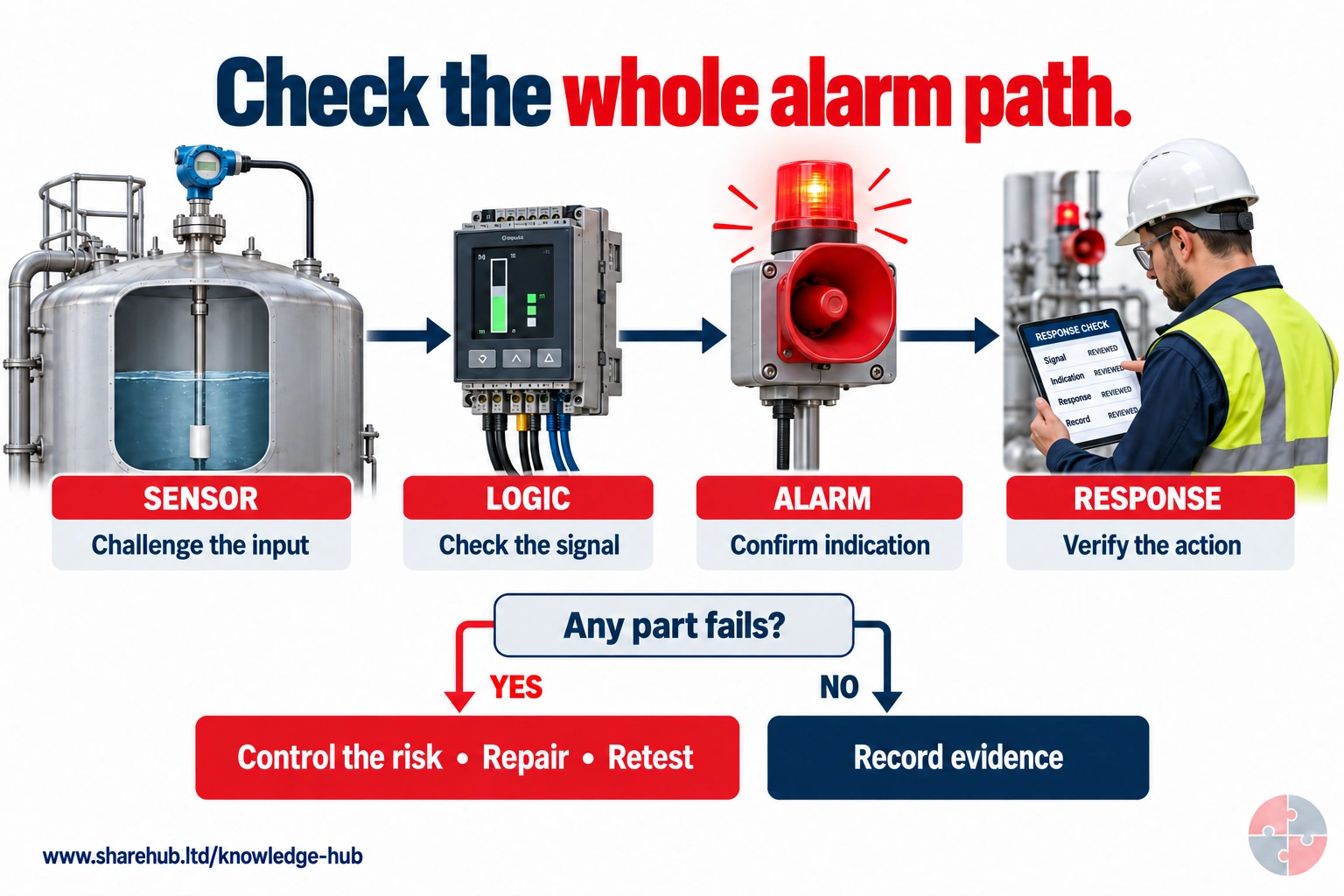

An alarm system's evidence must cover sensing, signal handling, indication and the expected response. Finding a fault requires risk control, correction and confirmation of effectiveness.
Why is a lit indicator insufficient evidence for the whole alarm function?
It does not by itself prove the sensor, signal path, annunciation and response work as intended.
Illustrative alarm chain, distinct from an automatic safety shutdown. Challenge inputs and test responses only through a competent, authorised test procedure with the process risk controlled.
Source guidance: HSE HSG254
For learners, the important shift is from naming a barrier to defining the standard it must meet. A high-high level trip is not simply present or absent. It has a purpose, set point, response time, final element, owner, test method, proof interval, impairment rule, bypass authority and evidence trail. HSE L65 offshore fire, explosion and emergency response guidance.
The exact figures must come from the site design basis and competent engineering judgement. The example below shows the structure, not a universal set point.
| Performance standard field | Example content | Evidence expected |
|---|---|---|
| Purpose | Prevent tank overfill during receipt or transfer by detecting high-high level and stopping inflow before loss of containment. | Scenario register, HAZOP/bowtie link and design basis. |
| Performance requirement | Sensor, logic solver and final valve act together to close inflow within the defined response time at the agreed high-high set point. | Cause and effect chart, set point register and loop test procedure. |
| Owner | Asset owner owns risk; technical authority owns engineering standard; operations owns daily availability; maintenance owns proof testing and defects. | RACI, asset register and maintenance plan. |
| Testing method | Proof test checks sensor, alarm, logic, final element, valve closure and operator indication, not only the instrument reading. | Approved proof-test procedure and completed test sheet. |
| Proof interval | Interval is justified by risk assessment, reliability data, manufacturer guidance, failure history and the credited risk reduction. | Proof-test schedule and interval basis. |
| Impairment rule | Tank filling is restricted or stopped if the trip is failed, overdue, bypassed or cannot be proven before receipt. | Impairment assessment and operating restriction. |
| Bypass authorisation | Time-limited bypass requires operations manager, technical authority and process safety review with compensating controls. | Bypass log, authorisation and handover note. |
| Escalation | Failed proof test, repeated nuisance trip, open bypass, changed set point or changed operating envelope triggers MOC or senior review. | MOC record, defect escalation and restart approval. |
| Evidence pack | Design basis, performance standard, C&E, set point record, proof-test evidence, defect close-out, bypass history and MOC trail. | Retrievable barrier file and dashboard entry. |
A device exercise is not automatically a proof test of the credited complete function. Where demand-condition testing is unsafe or incomplete, the approved method must state coverage, untested dangerous failures, alternative evidence and residual uncertainty. Retain as-found/as-left results and restoration checks; a partial-stroke exercise alone does not demonstrate the full safety function.HSE COMAH control systems
What evidence should prove a safety critical element is healthy?
Evidence should show design basis, performance criteria, maintenance, proof testing, impairment control and management review.
A performance standard is only as good as the evidence behind it. A certificate or inspection record may show something was checked, but it does not always prove the right thing was checked against the right scenario. HSE offshore KP3 asset integrity report.
For major hazards, evidence should be traceable from the scenario through the credited barrier and into the live maintenance, inspection, operations and assurance systems.
| Evidence item | What it proves | Weak signal |
|---|---|---|
| Major accident scenario reference | The barrier is linked to a credible hazard. | Barrier exists with no scenario owner. |
| Performance standard | Function, criteria and verification route are defined. | Standard uses vague words such as adequate or available. |
| Design basis | Capacity, set point, rating or response time is justified. | Design basis cannot be found or has changed. |
| Proof-test procedure | The test checks the actual safety function. | Test only checks part of the loop. |
| Inspection and maintenance record | Tasks are completed and defects managed. | Overdue tasks or repeat failures occur. |
| Bypass and impairment log | Unavailable barriers are authorised and risk assessed. | Bypasses are open-ended or poorly justified. |
| MOC record | Changes to plant, software, alarms, set points or procedures are reviewed. | Change occurs without reassessing the performance standard. |
How should bypass and impairment be controlled?
A safety critical barrier that is bypassed, failed or degraded should trigger formal risk review and clear authority.
Barrier impairment is a live risk condition. The plant may look normal, but the protection layer has changed. Controls should define what can continue, what must stop, what temporary controls are acceptable and who can authorise exceptions. HSE HSG254 process safety indicators.
The hardest failures are often tolerated impairments: alarms inhibited for nuisance, trips bypassed for production, fire systems isolated during maintenance or proof tests deferred because shutdown is inconvenient.
| Impairment condition | Decision rule | Escalation point |
|---|---|---|
| Barrier failed proof test | Keep the affected operation stopped until restored, or until competent assessment demonstrates an acceptable restricted state with effective compensating protection, defined limits and authorisation. | Barrier is credited for a major accident scenario. |
| Safety trip bypassed | Require time-limited authorisation, compensating measures and operator briefing. | Bypass extends beyond agreed time or becomes routine. |
| Fire/gas detection unavailable | Review hot work, occupancy, ignition sources and emergency response. | Detector protects occupied or high-hazard area. |
| Relief or vent system defect | Check safe operating limits and loading conditions immediately. | Overpressure scenario can occur before repair. |
| Procedure unavailable or unvalidated | Do not rely on informal memory for safety critical tasks. | Start-up, line breaking, isolation or abnormal operation is affected. |
| Common utility failure | Review all barriers dependent on the same power, air, network or cooling source. | Multiple credited barriers share the same vulnerability. |
When should a performance standard be reviewed or escalated?
Review is needed whenever the scenario, barrier, test evidence, failure history, operating envelope or organisation changes.
A performance standard is a living assurance tool. It should change when the plant changes, when a proof test fails, when an alarm becomes a nuisance, when a bypass is used repeatedly, when the operating envelope changes or when incident learning shows the barrier is weaker than assumed.
Escalation should be explicit. If a safety critical element is unavailable, the decision to continue operation should sit with the right level of technical and operational authority, supported by risk assessment and temporary controls.
| Trigger or question | Decision route | Escalate if |
|---|---|---|
| Is the barrier credited for a major accident scenario? | Define or review the performance standard. | No standard or owner exists. |
| Has a proof test failed or been missed? | Assess current operation and repair priority. | The barrier is needed before repair can be completed. |
| Is the barrier bypassed or impaired? | Authorise, time-limit and apply temporary controls. | Bypass is open-ended or production-driven. |
| Has plant, software, process or procedure changed? | Run MOC and review performance criteria. | Change affects set point, response, capacity or independence. |
| Are alarms or trips repeatedly challenged? | Investigate nuisance, set point, workload and operating envelope. | Workers develop informal workarounds. |
| Is evidence only certificate-based? | Check whether test and inspection prove the safety function. | Certificate does not map to scenario performance. |
Where do performance standards commonly fail?
Common failures come from vague requirements, missing scenario links, poor test methods and tolerance of degraded barriers.
A weak performance standard can create false confidence. The organisation believes a barrier is controlled because it is in a register, but nobody has defined the success criteria or checked whether the proof test represents a real demand.
Another common failure is loss of independence. Two barriers may look separate on paper but share power, instrument air, software, cable routes, maintenance error, human response or organisational assumptions.
| Failure or weak practice | How it develops | What good looks like |
|---|---|---|
| Vague standard | Words such as effective, adequate or maintained are not measurable. | Define function, response, capacity, rating and test criteria. |
| No scenario link | Barrier is maintained but not linked to a major accident pathway. | Trace each element to HAZOP, bowtie, LOPA or safety report scenario. |
| Partial proof test | Test checks the sensor but not logic, final element or response time. | Test the full safety function where practicable. |
| Bypass normalised | Bypasses become routine to keep production moving. | Time-limit, authorise and review all impairments. |
| Common-mode failure | Multiple barriers share utilities, software, environment or human response. | Assess independence, diversity and survivability. |
| MOC bypass | Set point, alarm, software or process changes without standard review. | Make performance standard review an MOC gate. |
| Weak close-out | Actions closed without field verification. | Require evidence that the barrier is restored and tested. |
What evidence should performance standards hold?
Evidence should prove that the safety critical element remains capable, available and controlled.
The evidence pack should be built for retrieval. A manager, auditor or regulator should be able to move from a scenario to the credited barrier, performance requirement, inspection task, proof test, defect history, impairment record and management decision.
For process safety learners, this is the difference between a control existing and a control being assured. A barrier without evidence may be an assumption.
| Evidence item | What it should show | Assurance question |
|---|---|---|
| Risk assessment or technical assessment | Scope, hazards, affected people, control standard, residual risk, owner and review trigger. | Does it match current work, layout, people and equipment? |
| Action tracker | Actions, owners, priority, dates, interim controls and close-out evidence. | Are high-risk actions verified in the workplace, not just marked complete? |
| Training and briefing records | Who was trained or briefed, by whom, on what standard and how understanding was checked. | Can people explain the control and stop conditions? |
| Inspection and monitoring records | Planned checks, defects, trends, overdue items and corrective actions. | Do inspections sample the controls that prevent serious harm? |
| Incident and near-miss learning | Events, weak signals, investigations, themes and lessons applied. | Are repeated signals driving design or system improvement? |
| Management review | Trend, resources, assurance confidence, escalations and decisions. | Are leaders seeing real control confidence rather than activity counts alone? |
| Credited-barrier register (with the statutory SCE/SECE subset identified where applicable) | All credited barriers, owners, scenarios and performance standards; identify the statutory SCE/SECE subset separately where applicable. | Are elements ranked by major accident relevance? |
| Performance standard document | FARSI criteria, test method, owner, review trigger and impairment rules. | Is the language measurable? |
| Proof-test and inspection records | Whether the safety function meets defined criteria. | Do tests cover full function and response? |
| Bypass and impairment records | Unavailable or degraded barriers are authorised, risk assessed and time limited. | Are repeated or overdue impairments escalated? |
| Management of change records | Changes to plant, control logic, process, materials or procedures reviewed. | Were standards updated after change? |
| Barrier health dashboard | Overdue tests, failures, bypasses, defects and open actions. | Are leaders seeing barrier confidence? |
How should performance standards be assured?
Assurance should test whether the credited barrier can still perform its safety function in the real scenario.
Assurance should sample live safety critical elements and follow the chain from major accident hazard to field evidence. It should challenge whether inspection intervals, proof tests, bypass rules, competence and MOC are strong enough for the claimed risk reduction.
Third-line or specialist assurance is often needed where functional safety, structural integrity, fire and gas, emergency shutdown, relief systems or complex control systems are involved.
| Assurance sample | What good looks like | Escalate if |
|---|---|---|
| Scenario trace | Every safety critical element links to a scenario and required function. | A barrier is maintained but not linked to hazard reduction. |
| Proof test quality | Test checks the safety function, criteria and response time. | Test is incomplete or not understood. |
| Defect management | Failures are risk assessed and repaired within controlled timescales. | Safety critical defects are overdue. |
| Bypass review | All bypasses are authorised, briefed, time-limited and reviewed. | Bypasses become routine or invisible. |
| MOC sampling | Changes update performance standards and test procedures. | Change affects set point, logic, capacity or independence. |
| Leadership review | Barrier health appears in process safety dashboards. | Leaders only see maintenance completion rates. |
Which duties and guidance apply in Great Britain and Northern Ireland?
Use the instrument for the site, workforce and activity. Great Britain and Northern Ireland have separate duties, while HSE, HSENI and voluntary-standard guidance have different legal status.
Check current scope and amendments before applying a duty. COMAH applies only where establishment classification brings the site into scope. For offshore safety cases, SCR 2015 covers GB external waters, while SCR 2005 continues for GB internal waters; the NI 2016 and NI 2007 instruments form separate external- and internal-waters routes. HSE GB scope; NI 2007 instrument. A teaching example is not a site-specific legal decision.
| Route | Direct instrument or guidance | Supporting source | Decision supported |
|---|---|---|---|
| GB general duties | Health and Safety at Work etc. Act 1974 | Management of Health and Safety at Work Regulations 1999 | Assess and manage hazards and competent control under the GB route. |
| NI general duties | Health and Safety at Work (Northern Ireland) Order 1978 | Management of Health and Safety at Work Regulations (Northern Ireland) 2000 | Apply separate NI duties to NI work. |
| GB COMAH establishment | Control of Major Accident Hazards Regulations 2015 | HSE COMAH safety-report technical criteria | Conditional on inventory and classification; show major-accident measures are effective. |
| NI COMAH establishment | Control of Major Accident Hazards Regulations (Northern Ireland) 2015 | HSENI NI COMAH scope | Use the separate NI instrument when establishment scope is met; HSE material is only GB technical context, not proof of NI legal compliance. |
| GB offshore: external waters | Offshore Installations (Offshore Safety Directive) (Safety Case etc.) Regulations 2015 | HSE offshore KP3 asset integrity report | Apply SCR 2015 to an in-scope GB external-waters installation; verify safety/environmental-critical elements. |
| NI offshore: external waters | Offshore Installations (Offshore Safety Directive) (Safety Case etc.) Regulations (Northern Ireland) 2016 | NI offshore verification scheme | Apply the separate NI 2016 external-waters route and its verification scheme where the installation is in scope. |
| GB offshore: internal waters | Offshore Installations (Safety Case) Regulations 2005 | HSE L154 SCR 2015 scope | SCR 2005 remains the GB internal-waters route; check the actual installation and current amendments. |
| NI offshore: internal waters | Offshore Installations (Safety Case) Regulations (Northern Ireland) 2007 | HSENI L30 associated with NI 2007 safety-case regulations | NI 2007 safety-case regulations remain the internal-waters route; check amendments and installation scope. |
How should management check this work?
Use a defined plan, carry out the controls, check performance and correct what does not work.
For safety critical performance standards, assign a competent owner to set the work controls, check their use and review them after change, failure or new evidence. HSE managing health and safety
A management-system label or certificate is not approval of a site limit, procedure or individual work decision. Apply GB and NI duties to the correct location.
What competence does each level need?
Train and assess each person for the decision they make; attendance alone is not proof of competent action.
Record the assessment, authorisation scope and reassessment trigger. A manager still needs to verify that the underlying control works in the field.
| Role | Learning to test | Demonstration, assessor, record and reassessment |
|---|---|---|
| Nearby worker | Recognise alarms, exclusion and reporting route | Explains evacuation and bypass reporting; supervisor checks during induction and after alarm change. |
| Operator | Identify credited barriers, limits and impairment stop decisions | Demonstrates a hold and handback using the actual standard; operations manager records scope and reassesses after change. |
| Maintainer / proof tester | Test the full function and record as-found versus as-left state | Practical test with approved method and defect record; engineering lead assesses after modification. |
| Control / process engineer | Derive criteria from scenario, dependencies and safe state | Peer-reviewed design basis, response and independence evidence; revisit after hazard review. |
| Manager / technical authority | Authorise restrictions, restoration and resources | Scenario-based impairment decision and cumulative-barrier review; director samples record. |
| Specialist / verifier | Trace hazard to standard, field result and independent challenge | Samples end-to-end evidence; competent peer or statutory verifier as applicable. |
How could Crownway Fuels Ltd manage this in practice?

Crownway Fuels Ltd would define a safety-critical safeguard by its required function and assurance evidence, not merely by its presence on an equipment list.
Crownway Fuels Ltd · practical example
Specify what an overfill safeguard must achieve
The key lesson A performance standard describes the required function, relevant operating conditions and how continuing performance is demonstrated.
The situation: The depot register lists an overfill protective system as “installed and serviced”. Managers need to know what demonstrates that the complete protective function remains capable.
Why this matters: Individual components can appear healthy while a shared dependency, interface or final action defeats the overall safeguard.
How Crownway Fuels Ltd would manage it
- Connect the safeguard to the scenario — Health and Safety Lead. Identify the overfill scenario and the protection being credited. Clarify where routine control, alarms, operator response and independent protection perform different roles.
- Define the requirement — Maintenance Coordinator. Obtain competent engineering definition of the required function, relevant response and dependability needs, interfaces and operating conditions. Do not invent a setpoint or test interval from a generic example.
- Define the evidence — Maintenance Coordinator. Agree how inspection, functional testing, defects and restoration records demonstrate the complete function. Include relevant dependencies and any limits in what a test covers.
- Manage impairment — Site Manager. Make a failed or overdue assurance item visible in the operating status. Use the authorised risk and operating decision rather than allowing an unresolved exception to remain a green entry.
- Review delivery — Operations Director. Check compliance with the defined standard, repeat failures and resource needs. Require competent verification before accepting restoration of the credited protection.
When the conditions change
- Recognise the trigger
- The overfill protection cannot demonstrate the complete required protective function.
- Make the immediate decision
- The Site Manager applies the authorised restriction on receipts relying on that function.
- Verify the next step
- The relevant competent specialist verifies the defined function and dependencies; the authorised operating manager accepts restoration before those receipts resume.
What good looks like
Managers can connect the hazard to the safeguard’s required function and current evidence, including an honest statement of uncertainty or impairment.
Evidence to look for: Scenario link, competent performance specification, complete-function test evidence, impairment decisions and restoration checks.
Common mistake to avoid: Copying an offshore standard or a supplier service interval without checking its relevance to this onshore function.
Apply this to your work: Does “tested” mean the complete safety function was demonstrated?
Guidance behind the management approach: HSE: safety-related control systems and integrity. Use the topic's legal and technical guidance for the applicable work and location.
At a fuel terminal, Crownway would link tank overfill, vapour release, bund fire and loading-arm release scenarios to credited barriers, with the statutory SCE/SECE subset identified only where the applicable offshore regime requires it. It would then test whether trips, alarms, valves, fire pumps, foam systems, bunds and procedures remain capable.
| Management element | How the business would manage it | Evidence to review |
|---|---|---|
| Identify | Map major accident scenarios and credited barriers. | Scenario and barrier register. |
| Define | Set FARSI criteria and verification tasks. | Performance standard documents. |
| Maintain | Schedule tests, inspections and repairs. | Maintenance and proof-test records. |
| Control impairment | Authorise bypasses and temporary controls. | Bypass and impairment log. |
| Review | Report barrier health to leadership. | Process safety dashboard. |
How can fuel equipment illustrate safety-critical performance evidence?
Identify the protection function and complete sensing-to-action chain, then the evidence expected to support it. No test interval, acceptance result or reliability claim is supplied.
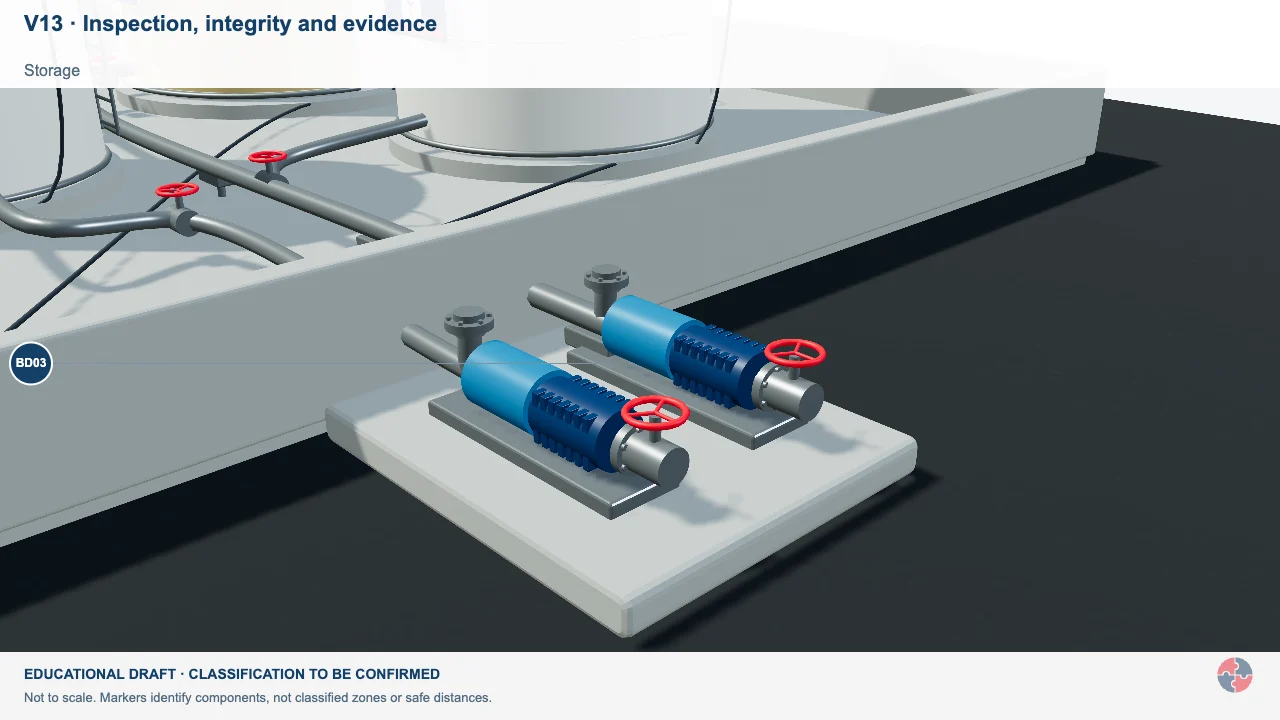
Inspection, integrity and evidence
A hose, tank or protective device has a safety purpose which depends on its condition and supporting checks.
Activity focus: Connect each identified defect to the responsible owner and appropriate operational decision.
Contextual workplace scene. Use the task, control and evidence checks in this section; appearance alone does not establish safe conditions, individual health or approval.
Educational illustration, not to scale. Coloured zones are teaching examples, not a site-specific hazardous-area classification.
What do the acronyms and key terms mean?
These terms identify different legal or operational decisions.
| Term | Full expression | Meaning here |
|---|---|---|
| SCE | Safety-critical element | In offshore law, a defined part of an installation or plant; do not treat every human action as a statutory SCE. |
| SECE | Safety and environmental-critical element | Offshore element considered by the verification scheme. |
| FARSI | Functionality, availability, reliability, survivability, interaction | Teaching mnemonic; the fifth term highlights interface and independence. |
| MOC | Management of change | Review of changes to plant, hazard basis, standard or test. |
| COMAH | Control of Major Accident Hazards | Onshore major-accident regime for in-scope establishments. |
| Proof test | Test of the credited safety function | Records as-found result, coverage, defects and restoration. |
Which BuildOut documents support this topic?
Download individual editable BuildOut documents for this topic. Procedures and plans contain completed arrangements; forms, checklists, assessments, RAMS and permits are blank masters. Registers include separate worked examples.
| Document | Purpose and content | Editable download |
|---|---|---|
| Specialist-work screening and escalation procedure BOUK-PRO-SPEC · Completed worked example · v1.0 | Determine legal triggers and specialist appointments before bidding, mobilisation or scope change. | Download DOCX Read preview |
| Specialist regime and client-site applicability screen BOUK-CHK-SPEC-01 · Blank editable master · v1.0 | Screen for COMAH/client emergency rules, dangerous-goods transport, explosives, pressure systems, lead and ionising radiation. | Download DOCX Read preview |
| Specialist contractor and interface control plan BOUK-PLN-SPEC-01 · Completed worked example · v1.0 | Require competent specialists, permits, design approvals and client/operator coordination. | Download DOCX Read preview |
| Lead and contaminated-coating work assessment BOUK-RA-SPEC-01 · Blank editable master · v1.0 | Assess lead exposure and the need for specialist controls, monitoring and medical surveillance. | Download DOCX Read preview |
| Pressure-system written-scheme and examination evidence index BOUK-REG-SPEC-01 · Blank register with separate worked entries · v1.0 | Verify system scope, competent advice and examinations where the regime applies. | Download XLSX Read preview |
| Dangerous-goods movement and storage interface check BOUK-CHK-SPEC-02 · Blank editable master · v1.0 | Screen classification, quantities, exemptions, packaging and competent transport arrangements. | Download DOCX Read preview |
| Specialist-work authorisation and hold-point record BOUK-FRM-SPEC-01 · Blank editable master · v1.0 | Record evidence that relevant permits, competent appointments and prerequisites exist. | Download DOCX Read preview |
| Artificial optical radiation and EMF screening assessment BOUK-RA-SPEC-02 · Blank editable master · v1.0 | Screen exposure sources and determine competent assessment and additional controls. | Download DOCX Read preview |
| Compressed-air, diving, rail, highways and specialist-site scope screen BOUK-CHK-SPEC-03 · Blank editable master · v1.0 | Identify activities needing additional legal mapping, specialist competence and authorisations before acceptance. | Download DOCX Read preview |
Review and adapt the documents for your organisation, activities and jurisdiction before approval and issue. Open the SHAREms management-system hierarchy to find each document under its parent policy.
Unlock another resource
You have used this month’s two free downloads. Publish a post in your own words to unlock one more resource, or choose SHARE Individual for 10 downloads per month.
You decide whether to share. If you do, use the relevant platform disclosure tools and do not make claims you do not genuinely hold.