
Supporting utilities and their hazards
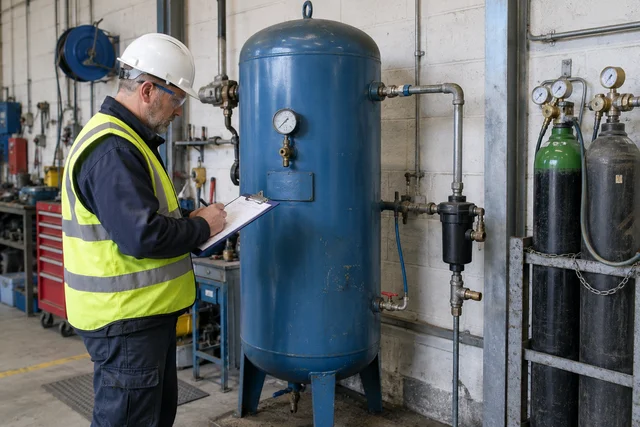

Recognise direct utility hazards and the protective functions lost when a supporting service fails, changes or returns in an unverified state.
Free training · Approx. 75–110 minutes
Public teaching and practice are free. Use a free learner account in Moodle for confirmed saves and recorded assessment. A certificate of completion depends on completing the required learning, scoring at least 80% and answering every critical safety question correctly.
Your practical case
A fictional batch-processing site plans a shared utility outage. Steam maintenance, a temporary nitrogen vent and instrument-air work overlap; the standby supply has been tested only locally. A nearby enclosed work area and the receiving production units are not clearly included in the plan.
Process operators, supervisors, maintenance planners, contractors and managers who need topic awareness.
Independent SHAREhub awareness. This course does not provide a NEBOSH qualification, accreditation or authority to operate, design, isolate, test or maintain plant. Use competent site arrangements for real work.
What you will learn
- Map utility sources, distribution, users and safety dependencies.
- Recognise steam, water, stored-energy and oxygen-displacement harm routes.
- Distinguish inert-process protection from an atmosphere safe for people.
- Identify coordinated outage, backup, restoration and emergency evidence.
Course outline
Map the service
- One service, two kinds of harmDistinguish a utility release from loss of a dependent protection.
- Trace the complete service boundaryIdentify source, distribution, users, backups and shared connections.
- Recognise steam energy and conditionExplain why a steam system needs service-specific control.
Understand direct harm
- Understand condensate-induced water hammerRecognise an operating or maintenance warning without prescribing a start procedure.
- Treat water as a process serviceRecognise structural, protective and biological risk routes.
Protect people from inert gases
- An inert process may be unsafe for peopleDistinguish fire prevention from a breathable atmosphere.
- Follow the nitrogen discharge routeIdentify exposure beyond the equipment being purged.
- Verify isolation and stored energyRecognise why a stop command or zero indication may be insufficient.
Control the outage
- Test the backup path, not just the machineExplain the limits of a local standby test.
- Coordinate outages and temporary suppliesRecognise changes that affect multiple users and safeguards.
Verify restoration
- Plan for an oxygen-deficiency emergencyKeep recognition, alarm and rescue roles distinct.
- Hand back the service and its protectionsIntegrate direct hazards, dependencies and accepted restoration.
Practise and test your reasoning
12 lesson decisions and 6 required activities use evidence sorting, matching, sequencing, branching choices and applied checks. Dragging has equivalent labelled controls. The 20-question final assessment requires 80% and every critical answer, after all learning requirements are complete.
Use the linked risk assessment, toolbox talk, policy and assurance resources with their included fictional exercises. Points and module badges help show progress; they do not replace the assessment requirements.
Duration estimates include teaching, activities, checks and assessment. Your pace and retries may vary.
Sources and scope
Independent awareness study · PSM topic 3.4. Independent SHAREhub learning; this is not the NEBOSH qualification.
- Safe process isolation
- Utility reliability
- Condensate-induced water hammer
- Confined-space precautions
- Inerting and oxygen displacement
- Legionella in water systems
- Pressure-system guidance routes
Knowledge Hub topic coverage
Presentation and model workshop
Use the same course imagery, worked decisions and historical case in a 28-slide teaching companion. Practise classification, compare explained choices and inspect the linked model case.
Open the interactive presentation workshop · Download PowerPoint
This optional companion does not replace the required course activities or final assessment.