
Aerospace manufacturing safety / Hot-resin processes, pressure and chemical control
Aerospace manufacturing safety · SH-AERO-04Hot-resin processes, pressure and chemical control
Free online training · Approximate learning time: 120–180 minutes · Self-paced
Recognise process uncertainty without inventing operating recipes.
Full public teaching and readers are free without an account. A free learner account is required for saved LMS progress and recorded assessment. Completion and any course-completion certificate depend on the configured LMS conditions.
Who this course is for
Resin-cell operators, process support, engineering, cleaning and supervisory teams.
Connect hot contact, reaction behaviour, pressure, safeguards and waste in a resin-processing case. Learn which uncertainties require a hold and which competent functions own the response.
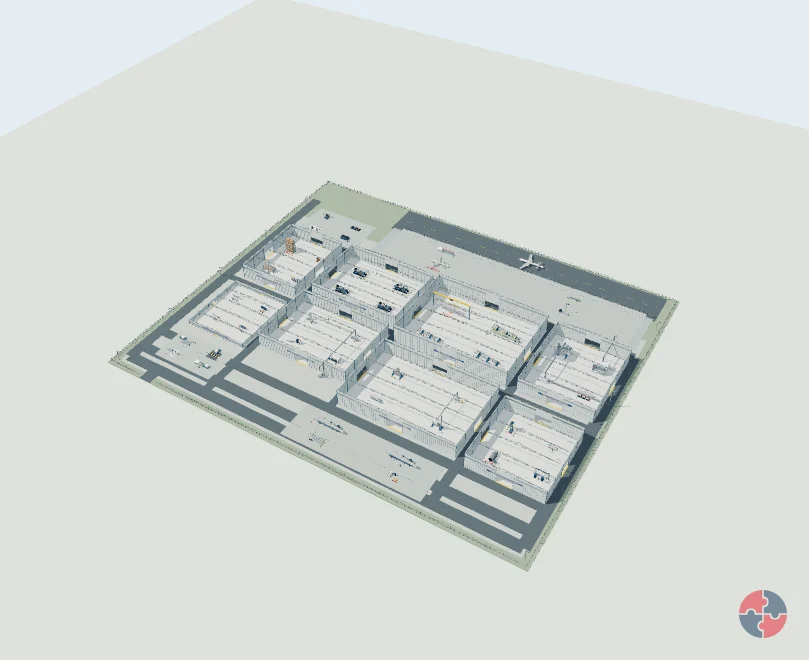
Awareness in an original fictional aerospace manufacturing and airport-interface site. GB occupational guidance has separate NI routes; environmental duties depend on the UK nation and permit. This course does not confer engineering, aircraft maintenance, product-release, lifting, rescue, driving or airside authorisation.
Learning outcomes
- Distinguish nominal process information from a validated operating basis.
- Recognise residual pressure and unsafe intervention.
- Prevent contact and unintended chemical mixing.
- Carry separate process, maintenance and waste restrictions into restart review.
Course outline
Understand heat and reaction mechanisms
- Separate hot contact from a developing reaction hazardRecognise that normal heat, abnormal heat generation and their protective systems require different evidence.
- Verify what is being mixed before relying on the process basisConnect chemical identity, formulation and change control to the actual validated operating information.
Verify the process basis
- Recognise pressure that remains after the cycle stopsRequire a verified safe energy and material state before opening equipment or breaking containment.
- Keep cleaning inside the machinery safety boundaryDistinguish an operating pause from the safe isolation and access arrangements needed for intervention.
Recognise residual pressure
- Prevent uncured adhesive contact throughout the taskControl contact routes at mixing, application, removal and cleanup rather than relying on the absence of symptoms.
- Treat resin waste as a chemical process decisionEstablish waste identity and compatibility before collection or consolidation, including residual reaction and heat hazards.
- 180°C resin contact and hot toolingDo not touch or open the cell until its approved thermal, pressure and reaction conditions are verified.
- Exothermic reaction and loss of temperature controlWithdraw and activate the approved response to uncontrolled reaction; do not improvise intervention.
- Injection pressure and safe depressurisationNever loosen a fitting to test whether pressure remains.
Control intervention and contact
- Machine interlocks, cleaning and isolationStop and isolate the machine when a safety interlock is defeated or unreliable.
- Adhesive mixing and skin sensitisationStop uncontrolled skin contact or uncertain mixing and obtain competent advice.
- Resin and solvent waste segregationDo not mix uncertain waste or approach a reacting container for improvised intervention.
Plan evidence-based recovery
- Hold the process without inventing an emergency recipeSeparate abnormal process response, worker protection and controlled recovery in a resin case.
- Take a verified action into the workplaceConnect one actual task to an owner, evidence and a clear release or escalation decision.
Activities, model practice and assessment
Work through 5 required applied activities and 3 model-practice pauses, with explanatory feedback and independent lesson decisions. Complete 6 distinct model mission sequences across those pauses. Use the actual fictional aerospace manufacturing model or its equivalent accessible route to complete the required decision sequences; launching the model alone does not complete practice.
The 20-question assessment requires at least 80% plus every designated critical safety answer. Complete the required activities, practice and lesson checks. Points and badges cannot offset a critical safety error.
Use the LMS for confirmed save/resume and recorded results. Any certificate follows its configured passed-completion and grade conditions.
Open the public interactive practice copy; public practice is separate from the LMS record.
Sources and learning provenance
Original fictional cases are paired with public SHAREhub teaching and structured topic records. Use the applicable jurisdiction and primary guidance for live work.
- HSE: chemicals in plastics manufacturing
- HSE: reaction hazards and thermal runaway
- HSE: introduction to pressure equipment
- HSE: maintenance of work equipment
- HSE: preventing work-related skin disease
- Environment Agency: hazardous waste segregation and mixing
Topic sections, source identities and versions
| Public topic | Chunk and version | Jurisdiction and sources |
|---|---|---|
| reaction-hazards-and-runaway-reactions · reaction-lifecycle | reaction-hazards-and-runaway-reactions--reaction-lifecycle 2.2 | Great Britain, Northern Ireland reaction-indg254, reaction-reaction-testing, reaction-control-systems, reaction-waste |
| thermal-environments-heat-stress-and-cold-stress · stop-triggers | thermal-environments-heat-stress-and-cold-stress--stop-triggers 2.4 | GB, NI source-hse_heat, an-th7, an-th4, an-th3, an-th6, source-nidirect_heat, source-nidirect_hypothermia |
| management-of-change-in-process-safety · review | management-of-change-in-process-safety--review 2.0 | Great Britain, Northern Ireland hse-moc, hse-controls |
| chemical-compatibility-and-inadvertent-mixing · assessment | chemical-compatibility-and-inadvertent-mixing--assessment 20261016-letter-review-1 | Great Britain, Northern Ireland source-mix-hse-waste, source-mix-hse-sds, source-mix-hse-comah, source-mix-hseni-coshh |
| pressure-relief-venting-and-emergency-depressurisation · learner-confusions | pressure-relief-venting-and-emergency-depressurisation--learner-confusions 2.0 | source-hse_relief_and_vent_systems_technical_measures |
| work-equipment-lifting-equipment-and-pressure-systems · pressure-operation | work-equipment-lifting-equipment-and-pressure-systems--pressure-operation 3.0 | Great Britain, Northern Ireland source-pssr_use, source-l122, source-maintenance, source-gb_pssr, source-ni_pssr |
| guards-and-machinery-interlocks · intervention | guards-and-machinery-interlocks--intervention 2.4 | Great Britain, Northern Ireland src-guards-hse-maint, src-guards-hse-quarry, src-guards-l22, src-guards-hse-interlock |
| maintenance-inspection-and-testing-of-work-equipment-and-machinery · safe-maintenance | maintenance-inspection-and-testing-of-work-equipment-and-machinery--safe-maintenance 2.0 | Great Britain, Northern Ireland hse-maint, hse-l22 |
| skin-health · glove-selection | skin-health--glove-selection | Great Britain skin-health--gloves, skin-health--engineering-gloves |
| chemical-safety · routes | chemical-safety--routes 20261016-letter-review-1 | Great Britain, Northern Ireland source-safety-hse-coshh, source-safety-hse-assess, source-safety-hse-boundary, source-safety-hseni-coshh |
| chemical-compatibility-and-inadvertent-mixing · waste-drains | chemical-compatibility-and-inadvertent-mixing--waste-drains 20261016-letter-review-1 | Great Britain, Northern Ireland source-mix-hse-waste, source-mix-hse-sds, source-mix-hse-comah, source-mix-hseni-coshh |
| dangerous-substances-process-safety-and-chemical-transport · process-conditions | dangerous-substances-process-safety-and-chemical-transport--process-conditions 20261016-letter-review-1 | Great Britain, Northern Ireland dsear, hsg176, hsg254, ni-dsear |
| pressure-relief-venting-and-emergency-depressurisation · worked-example | pressure-relief-venting-and-emergency-depressurisation--worked-example 2.0 | Great Britain, Northern Ireland source-hse_relief_and_vent_systems_technical_measures, source-hse_safety_of_pressure_systems_l122 |
| guards-and-machinery-interlocks · harm-chain | guards-and-machinery-interlocks--harm-chain 2.4 | Great Britain, Northern Ireland src-guards-hse-intro, src-guards-hse-ppe, src-guards-hse-maint, src-guards-l22 |
| skin-health · technical-model | skin-health--technical-model | Great Britain skin-health--hsg262 |
| reaction-hazards-and-runaway-reactions · evidence-pack | reaction-hazards-and-runaway-reactions--evidence-pack 2.2 | Great Britain, Northern Ireland reaction-indg254, reaction-reaction-testing, reaction-hsg254, reaction-control-systems |
| management-of-change-in-process-safety · prestart | management-of-change-in-process-safety--prestart 2.0 | Great Britain, Northern Ireland hse-moc, hse-controls, hse-operating |
Course SH-AERO-04 · version 2026.10.20.2. .
Questions about this course
Is this training free?
Full public teaching and readers are free without an account. A free learner account is required for saved LMS progress and recorded assessment. Completion and any course-completion certificate depend on the configured LMS conditions.
How long should I allow?
Approximately 120–180 minutes, including teaching, lesson checks, required activities, model or accessible practice and one assessment attempt. Individual pace, review and retries vary. Save and resume in the LMS.
Can I learn without a 3D-capable browser?
Yes. The complete HTML reader provides the teaching. Required model practice has an equivalent accessible decision route in the interactive course. Use the LMS route for recorded learning.
What is required to pass?
Complete the required learning, activities, practice and lesson decisions. The 20-question final assessment requires at least 80% plus every designated critical safety answer. Points cannot compensate for a critical safety error. Follow the feedback before retrying.
Does this authorise aerospace operations?
Awareness in an original fictional aerospace manufacturing and airport-interface site. GB occupational guidance has separate NI routes; environmental duties depend on the UK nation and permit. This course does not confer engineering, aircraft maintenance, product-release, lifting, rescue, driving or airside authorisation. This independent course does not award an external qualification or replace competent task assessment, practical training or site authorisation.