
Care home safety / Water safety and safer maintenance
Care home safety · SH-CARE-08Water safety and safer maintenance
Free online training · Approximate learning time: 100–160 minutes · Self-paced
Recognise failed water controls and prevent maintenance from introducing new exposure.
Full public teaching and readers are free without an account. A free learner account is required for saved LMS progress and recorded assessment. Completion and any course-completion certificate depend on the configured LMS conditions.
Who this course is for
Premises staff, managers, maintenance coordinators and care staff reporting building-system concerns.
Recognise failed water controls and prevent maintenance from introducing new exposure. Work through person-centred teaching, original cases and independent decisions before the model-linked practice. Preserve dignity, individual choice and the applicable lawful care process.
Care-home safety awareness with a Great Britain workplace baseline. CQC, DHSC and cited residential-care examples apply to England where stated; confirm the relevant national regime. This course does not confer clinical, medicines, lifting, restraint, maintenance or emergency-response competence or authorisation.
Learning outcomes
- Recognise stagnation, unresolved trends and inaccurate system information.
- Coordinate water hygiene and scald protection without unauthorised adjustment.
- Establish asbestos information and safe isolation before intrusive or hazardous maintenance.
Course outline
Understand the person and activity
- A building system must be understood as a connected systemApply a building system must be understood as a connected system to the current person and task.
- A maintenance permit is a decision record, not a physical barrierApply a maintenance permit is a decision record, not a physical barrier to the current person and task.
Choose suitable controls and support
- A little-used outlet is a system-change signalReport use patterns through the competent control scheme.
- A trend needs investigation, not a fresh tickKeep the history and the relevant measurement point visible.
Verify information and role boundaries
- Asbestos information must cover the actual disturbanceStop before drilling into an excluded or unexamined location.
- Isolation is a verified physical stateCoordinate every relevant source and the care functions affected.
- Low-use outlets belong in the water-control schemeConnect occupancy changes to building-service controls; an empty room is still part of an active water system.
- A water-temperature trend needs an action ownerTreat abnormal trends as management information with an owner and an escalation threshold, not merely a logging task.
- Keep the water schematic aligned with refurbishmentFinish projects with an operational handover: the updated asset, its risks, controls, records and named owners must agree.
Practise the care-home decisions
- Asbestos information must cover the exact maintenance workTurn survey limitations into work-order hold points; a register is useful only when it affects the next maintenance decision.
- Stopping a machine is different from isolating its energyPlan maintenance as a system: energy control, resident continuity, competent work and verified restoration belong in one release process.
Defend the complete readiness plan
- The reopened room and the urgent maintenance jobMatch technical information to the actual care environment.
- Take a verified action into the workplaceConnect one actual task to an owner, evidence and a clear release or escalation decision.
Activities, model practice and assessment
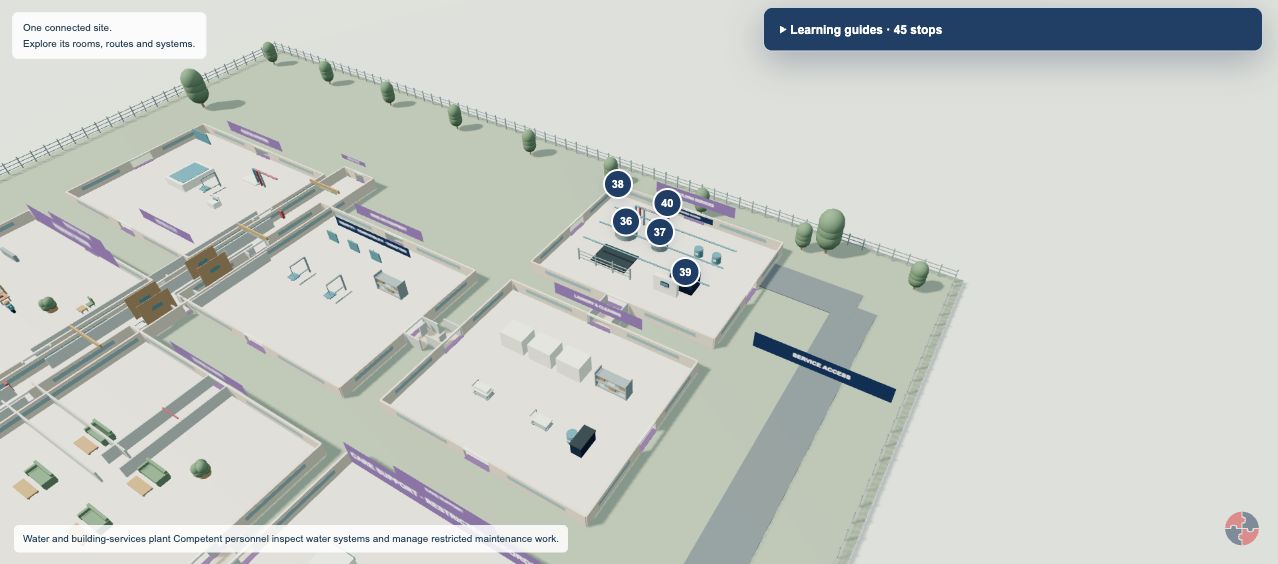
Work through 5 required applied activities and 3 model-practice pauses, with explanatory feedback and independent lesson decisions. Complete 5 distinct model mission sequences across those pauses. Use the actual fictional residential care home model or its equivalent accessible route to complete the required decision sequences; launching the model alone does not complete practice.
The 20-question assessment requires at least 80% plus every designated critical safety answer. Complete the required activities, practice and lesson checks. Points and badges cannot offset a critical safety error.
Use the LMS for confirmed save/resume and recorded results. Any certificate follows its configured passed-completion and grade conditions.
Open the public interactive practice copy; public practice is separate from the LMS record.
Sources and learning provenance
Original fictional cases are paired with public SHAREhub teaching and structured topic records. Use the applicable jurisdiction and primary guidance for live work.
Topic sections, source identities and versions
| Public topic | Chunk and version | Jurisdiction and sources |
|---|---|---|
| legionella-management · risk-assessment | legionella-management--risk-assessment 2026-10-02-additive-1 | Great Britain, Northern Ireland legionella-management-src-01 |
| isolation-lockout-and-line-breaking · verification | isolation-lockout-and-line-breaking--verification | Great Britain, Northern Ireland isol-legacy-01, isol-legacy-02 |
| legionella-management · systems | legionella-management--systems 2026-10-02-additive-1 | Great Britain, Northern Ireland legionella-management-src-01 |
| legionella-management · monitoring | legionella-management--monitoring 2026-10-02-additive-1 | Great Britain, Northern Ireland legionella-management-src-03 |
| asbestos-risk-management-and-compliance · surveys | asbestos-risk-management-and-compliance--surveys 20261016-letter-review-1 | Great Britain, Northern Ireland gb-regs, ni-regs, hse-survey, hsg264, hseni, hseni-accredited |
| isolation-lockout-and-line-breaking · energy-sources | isolation-lockout-and-line-breaking--energy-sources | Great Britain, Northern Ireland isol-legacy-01, isol-legacy-02 |
| legionella-management · worked-scheme | legionella-management--worked-scheme 2026-10-02-additive-1 | Great Britain, Northern Ireland legionella-management-src-01 |
| legionella-management · water-exception-analysis | legionella-management--water-exception-analysis 2026-10-02-additive-1 | Great Britain legionella-management-src-04, legionella-management-src-05, legionella-management-src-03 |
| asbestos-risk-management-and-compliance · register-risk | asbestos-risk-management-and-compliance--register-risk 20261016-letter-review-1 | Great Britain, Northern Ireland gb-regs, ni-regs, hse-register, hseni |
| hazard-identification-and-risk-assessment-foundations · risk-process | hazard-identification-and-risk-assessment-foundations--risk-process | Great Britain, Northern Ireland source-hse-risk, source-hseni-risk |
Course SH-CARE-08 · version 2026.10.20.2. .
Questions about this course
Is this training free?
Full public teaching and readers are free without an account. A free learner account is required for saved LMS progress and recorded assessment. Completion and any course-completion certificate depend on the configured LMS conditions.
How long should I allow?
Approximately 100–160 minutes, including teaching, lesson checks, required activities, model or accessible practice and one assessment attempt. Individual pace, review and retries vary. Save and resume in the LMS.
Can I learn without a 3D-capable browser?
Yes. The complete HTML reader provides the teaching. Required model practice has an equivalent accessible decision route in the interactive course. Use the LMS route for recorded learning.
What is required to pass?
Complete the required learning, activities, practice and lesson decisions. The 20-question final assessment requires at least 80% plus every designated critical safety answer. Points cannot compensate for a critical safety error. Follow the feedback before retrying.
Does this authorise care operations?
Care-home safety awareness with a Great Britain workplace baseline. CQC, DHSC and cited residential-care examples apply to England where stated; confirm the relevant national regime. This course does not confer clinical, medicines, lifting, restraint, maintenance or emergency-response competence or authorisation. This independent course does not award an external qualification or replace competent task assessment, practical training or site authorisation.