SHARE Knowledge Hub
Asbestos risk management and compliance
Asbestos compliance is a live system: identify who controls maintenance, locate or presume asbestos, assess condition and disturbance risk, keep a usable register and plan, brief people before work, and review changes. Hold any intrusive job when the survey does not cover its exact work area and method; a competent employer must classify and control asbestos work.
Understanding Asbestos risk management and compliance
Asbestos risk management is the continuing organisational system used to prevent people from being exposed when asbestos-containing materials, or ACMs, remain in premises, plant or equipment. It begins by identifying who has legal responsibility, what buildings and assets are in scope, where asbestos is known or presumed, and how work or deterioration could disturb it. It then converts that knowledge into a current register, a site-specific management plan, controlled work decisions, communication, monitoring, emergency arrangements and verified action closure.
Why this matters at work
Portfolio management converts individual ACM records into a risk-based investment programme. Combine material condition and fibre-release potential with disturbance likelihood, occupancy, maintenance demand, access, vulnerability, emergency exposure, business criticality and planned projects. Immediate damage and uncontrolled access require prompt protection. Sound material may remain managed in situ where reliable controls exist; removal is not automatically safer if it creates avoidable exposure, but repeated access conflict or deteriorating condition can make planned removal the stronger lifecycle decision.
Nonconformance requires proportionate control: stop unsafe work, secure the area, protect people and evidence, decide whether contamination or exposure occurred, obtain competent cleaning or analyst support, notify or report where required and investigate management causes. Contractor scorecards should use observed control performance, incident openness, plan quality, defect closure, clearance outcomes and record completeness. Repeated weakness changes procurement and supervision decisions even when individual jobs have not produced a reported exposure.
How organisations manage this in practice
The management plan should state who does what to prevent disturbance, maintain information and respond to change or damage. Link the register, risk priorities, condition monitoring, contractor communication and emergency procedure to actual maintenance planning. Sound material may be managed in place where appropriate, but foreseeable disturbance or deterioration changes the decision. A work order or permit should trigger a check of location, task and current asbestos information before authorisation. Define who resolves missing surveys, changed routes, uncertain materials and work classification and who can stop the job. Provide the actual workers with relevant information and confirm their competence and method, rather than rely on an uploaded document or general induction. Reassess changed scope before the changed work begins. Verify completion, required clearance or other handback, waste and register updates through accountable acceptance. Review the plan when incidents, condition findings, capital projects or organisational changes reveal a gap. Track actions to physical or procedural effectiveness instead of closing them when paperwork is issued.
Establish the premises and assets within scope and the people or organisations responsible for maintenance, repair and control. Shared occupation, lease terms and contracted work can create interfaces that need explicit cooperation. Confirm the applicable GB or NI asbestos duty and do not assume that appointing a consultant removes the dutyholder’s responsibility. Define the estate, building areas, plant and information gaps and assemble reliable survey and management evidence. Presume asbestos where the governing assessment requires it unless there is suitable evidence otherwise. Assign owners for the register, plan, condition monitoring, contractor information, work gateways and emergency response, with authority and resources. Include acquisitions, leased areas and changes of use so assets do not disappear between responsibilities. Verify that information reaches people who may disturb materials before the task starts. Keep uninspected areas and limitations visible and review the arrangement after organisational or property change. Compliance is an operating system with accountable decisions, not simply a central survey folder or a contract naming a responsible party.
Manufacturing sites should include both building fabric and production assets. Legacy ovens, furnaces, presses, electrical equipment, brake mechanisms, rope seals, gaskets and heat-resistant panels may contain asbestos. Link the register to asset hierarchy, preventive maintenance, spares, shutdown scope and management of change. A building survey that excludes plant must say so visibly.
Do not drill, cut, break, chase, lift, strip, sand, remove panels, open voids or allow contractors to proceed until competent asbestos information covers the exact work area and method.
Where does the duty to manage apply?
The duty to manage covers non-domestic premises and the common parts of multi-occupancy domestic premises in both Great Britain and Northern Ireland; each has its own 2012 asbestos Regulations and regulator route.
It does not generally cover inside an individual private flat or home under the premises-management duty. That is not permission to start work without asbestos information: employers and trades still have duties to assess and control work liable to disturb asbestos in domestic premises. Shared corridors, risers, roof spaces, plant rooms and grounds may be common parts. Brownfield land and old equipment need their own scope check; do not assume the building register covers them. The lease, contract and actual maintenance control determine who carries the premises duty, and responsibilities may be shared.
This page governs the ongoing system. The general asbestos guide explains materials and work categories; Asbestos dust covers first response and fibre spread after suspect release. None authorises DIY sampling, cleaning or removal.
Connect the register to the work-order gate
A management plan must affect the next maintenance job, not only describe the estate. Identify who controls each part of the premises, who maintains asbestos information and who stops a work order when an ACM action or survey gap is unresolved.
Best-practice guide: Asbestos risk management and compliance
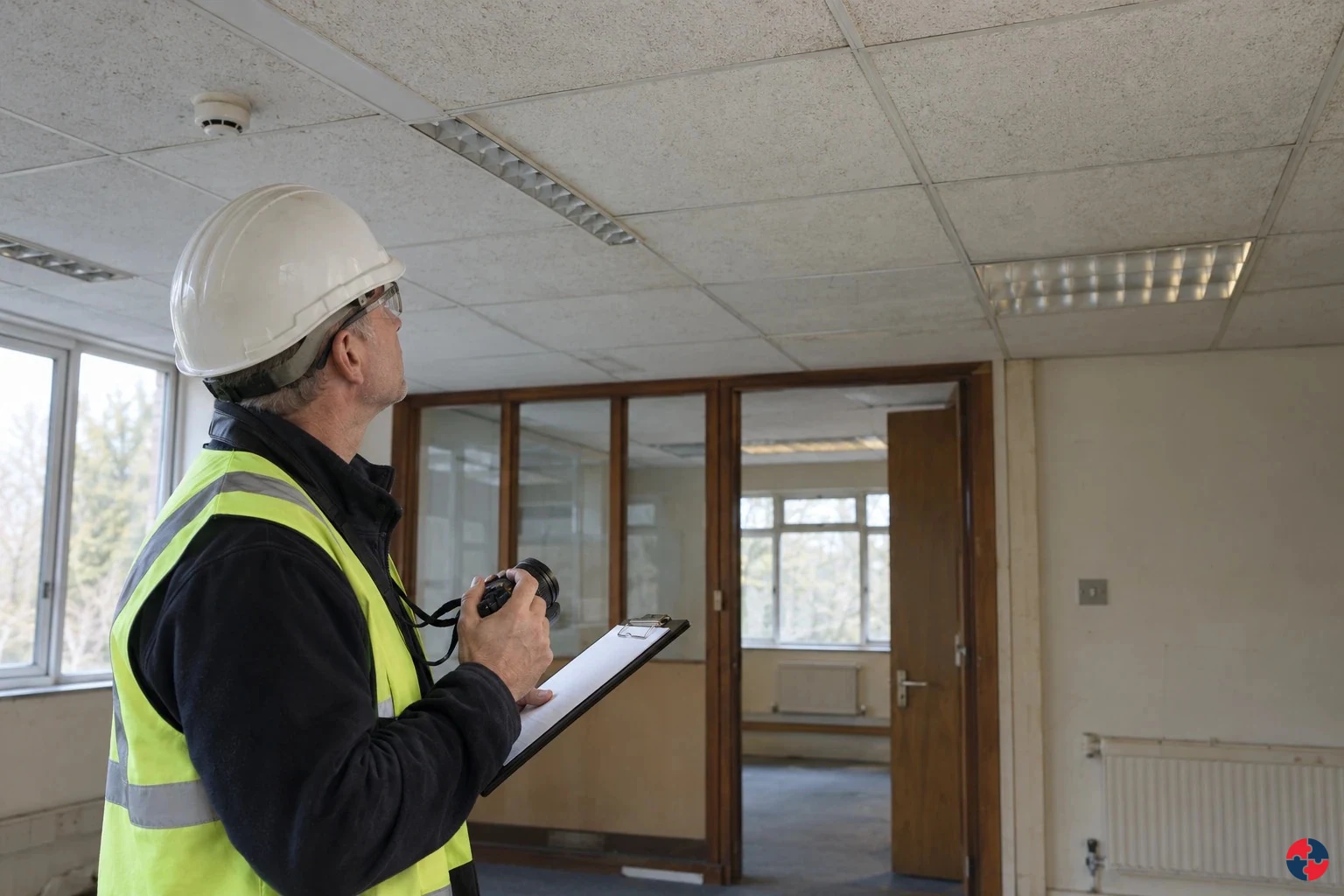
Connect the asbestos register to the work order
The register and management plan must influence real maintenance decisions. Check survey scope and access limitations before releasing intrusive work. Known intact asbestos-containing material does not automatically require removal; the condition, disturbance risk and planned work determine the action.
Turn asbestos risk management and compliance knowledge into a decision
Asbestos compliance is a live system: identify who controls maintenance, locate or presume asbestos, assess condition and disturbance risk, keep a usable register and plan, brief people before work, and review changes. Hold any intrusive job when the survey does not cover its exact work area and method; a competent employer must classify and control asbestos work. Dated condition record, photo, action and review trigger.
Routine condition inspection
Observe without touching; note condition and any changed access. Update register condition and action owner; brief affected maintenance team.
Unplanned disturbance creates the fibre-release route
Asbestos-related disease can develop long after exposure. Prevent disturbance through usable information and work planning. If suspect damage or dust is found, stop, keep people clear and use the competent incident route; a learning card cannot classify or authorise asbestos work.
Prevent disturbance before choosing residual protection
Do not infer that all asbestos must be removed. Manage suitable intact material in place and review its condition and disturbance risk. Where work is necessary, competent assessment determines its category, method, protection, clearance or hand-back and waste arrangements. Existing technical approval remains unchanged.
Use the full asbestos risk management and compliance lesson
Use the full topic for the decision points, practical examples, detailed control tables and source scope. HSE guidance applies to Great Britain; use HSENI for the Northern Ireland route and the source’s stated jurisdiction. A simplified guide does not change the page’s technical-review or approval status.

Read all six steps as text
1. Connect the asbestos register to the work order
An intact material may be managed in place; prevent unplanned disturbance.
- Locate: Check current information and the exact area and method of work.
- Hold: Stop intrusive work when the survey scope or material identity is uncertain.
- Release: A competent owner resolves the work category and required controls.
The register and management plan must influence real maintenance decisions. Check survey scope and access limitations before releasing intrusive work. Known intact asbestos-containing material does not automatically require removal; the condition, disturbance risk and planned work determine the action.
Apply it: Does the available survey cover every part of the proposed route and method?
2. Turn asbestos risk management and compliance knowledge into a decision
Use the evidence to improve the actual work arrangement.
- Change at source: Remove asbestos before refurbishment or choose designs that avoid disturbing asbestos-containing materials.
- Make it observable: Removal scope, clearance evidence and updated register.
- Keep useful evidence: Dated condition record, photo, action and review trigger.
Asbestos compliance is a live system: identify who controls maintenance, locate or presume asbestos, assess condition and disturbance risk, keep a usable register and plan, brief people before work, and review changes. Hold any intrusive job when the survey does not cover its exact work area and method; a competent employer must classify and control asbestos work. Dated condition record, photo, action and review trigger.
Apply it: What evidence would show that the change improves this task, rather than only completing a record?
3. Routine condition inspection
Example: a practical application of the existing topic lesson.
- Setting: Check a known intact ACM panel in a locked plant room without disturbing it.
- Act: Check location, prior photo and inspection method.
- Hold / review: Stop if damage, new debris or uncertain identity is found.
Observe without touching; note condition and any changed access. Update register condition and action owner; brief affected maintenance team.
Apply it: At which point would you hold this example, and what evidence would allow it to proceed?
4. Unplanned disturbance creates the fibre-release route
Connect the task, the route to the person and the control that can fail.
- Missed information: The work order does not identify an asbestos-containing panel.
- Disturbance: Drilling or damage can release fibres and contaminate the area.
- Exposure: Workers, contractors and others nearby can breathe airborne fibres.
Asbestos-related disease can develop long after exposure. Prevent disturbance through usable information and work planning. If suspect damage or dust is found, stop, keep people clear and use the competent incident route; a learning card cannot classify or authorise asbestos work.
Apply it: Who receives the report, secures the area and resolves the work decision?
5. Prevent disturbance before choosing residual protection
Start with the stronger practicable options and verify their effect.
- Avoid disturbance: Plan a route or method that leaves intact material undisturbed where suitable.
- Choose the right action: Assess condition and planned work; removal is one possible specialist action.
- Control access: Protect the material or affected area from unintended contact.
- Manage the work: Use survey information, competent work classification and the required plan.
- Residual protection: Select RPE and other protection for the actual assessed asbestos task.
Do not infer that all asbestos must be removed. Manage suitable intact material in place and review its condition and disturbance risk. Where work is necessary, competent assessment determines its category, method, protection, clearance or hand-back and waste arrangements. Existing technical approval remains unchanged.
Apply it: Can the job avoid disturbance, and what evidence supports the competent decision if work on the material is necessary?
6. Use the full asbestos risk management and compliance lesson
Follow the official sources below and retain the task-specific evidence.
- Official guidance: HSE check if you have the duty (Current web guidance)
- Official guidance: HSENI dutyholder register guide (Current web guidance)
- Task decision: Dated condition record, photo, action and review trigger.
Use the full topic for the decision points, practical examples, detailed control tables and source scope. HSE guidance applies to Great Britain; use HSENI for the Northern Ireland route and the source’s stated jurisdiction. A simplified guide does not change the page’s technical-review or approval status.
Apply it: Which official source and full-topic section will you use to resolve the next decision?
Keep dutyholder responsibility, employer work classification and specialist clearance separate. A contractor appointment does not erase the host interfaces. Link material condition, priority, communication and work release so that a changed or overdue record cannot be bypassed by a fresh permit.
An overdue ACM action intersects a repair order
Illustrative example. A tenant requests cable maintenance beside an ACM with an overdue condition action; landlord and tenant each assume the other controls release.
Decision. Hold the affected work order and reconcile the responsibility map, material condition and survey/work-category evidence.
Evidence to check. Retain the relevant lease/control facts, register entry, overdue action and exact workface assessment.
Hold or escalation point. No release until a named owner resolves the interface and competent information supports the method.
Follow-up. Record verified resolution in both the management plan and affected work orders.
What is the health, legal and competence boundary for asbestos management information?
This page is workplace guidance and learning content, not medical, legal or specialist asbestos consultancy advice.
Asbestos-related disease and personal exposure concerns should be handled through qualified medical or occupational-health routes. Managers should record workplace facts and signpost support, but should not provide medical reassurance or diagnosis.
Legal classification of asbestos work can be fact-specific. Where the material, condition, survey quality, work method or exposure potential is uncertain, the dutyholder should obtain competent asbestos advice before allowing work to continue.
Competent review matters because asbestos compliance relies on accurate technical judgement. Before publication or operational use, this page and any derived procedure should be reviewed by a person competent in asbestos management, surveying, asbestos work or occupational hygiene, depending on the intended use.
What are the key facts about asbestos risk management and compliance?
Asbestos compliance is a live management system, not a one-off survey report.
The duty is about management
A survey helps identify asbestos, but the dutyholder still needs a register, risk assessment, plan, communication, monitoring and review.
Presumption is allowed and sometimes necessary
Where strong evidence is missing, materials should be presumed to contain asbestos and managed accordingly until proven otherwise.
Survey scope drives safety
The survey must match the decision being made. A management survey for normal occupation cannot be stretched to cover destructive refurbishment work.
Information must reach the workface
A register that sits in a folder or database but is not checked before drilling, cutting or removing materials is not controlling risk.
Condition and disturbance risk both matter
An asbestos-containing material in good condition can become high risk when it is damaged, deteriorates or sits in a place where trades may disturb it.
Records matter for years
Management plans, inspection records, work records, exposure information, medical surveillance and contractor evidence may all be needed long after the work.
How can I practise this topic in 3D?


Old roof and wall panels need identification

Suspect asbestos is found during strip-out

Suspected asbestos in damaged packaging
All related inspection points 3 across 3 locations
Garage workshop 1 inspection point
Construction site 1 inspection point
Recover materials. Protect people. 1 inspection point
Practice in the SHAREhub environment. Browser practice is separate from workplace competence and formal learning records.
What is asbestos risk management and compliance?
Asbestos risk management is the system used to prevent asbestos-containing materials being damaged or disturbed and to control asbestos work lawfully.
Good asbestos management starts with a simple question: who could disturb asbestos, where could it be, and what stops that person from exposing themselves or others? The answer is usually a chain of controls: building responsibility, competent surveys, a usable register, work planning, contractor checks, information sharing, permits or work authorisation, emergency arrangements and regular review.
Compliance means more than having an asbestos survey. The dutyholder needs to show that known or presumed asbestos-containing materials are recorded, assessed, monitored and communicated. They must also show that work liable to disturb the building fabric is controlled before it starts.
The management system should be proportionate. A small shop with limited building complexity may need a simple but clear register, plan and contractor briefing process. A hospital, university, local authority estate, refinery, school trust or multi-site property portfolio may need mapped responsibilities, digital registers, inspection schedules, competent advisers, project hold points, contractor portals and formal audit.
| Concept | Plain-English meaning | Why it matters |
|---|---|---|
| Dutyholder | The person or organisation with responsibility for maintenance or repair of the premises. | They must make sure asbestos is identified, recorded, assessed, managed and communicated. |
| Asbestos-containing material | A product or material that contains asbestos, often shortened to ACM. | It can release fibres if damaged, disturbed, drilled, cut, abraded or removed incorrectly. |
| Asbestos register | A live record of known and presumed asbestos-containing materials. | It must be usable before work starts, not merely archived after a survey. |
| Asbestos management plan | The written plan for managing asbestos risk over time. | It should allocate actions, priorities, monitoring, information routes and review triggers. |
| Material assessment | Assessment of the material type, asbestos type, surface treatment, condition and fibre-release potential. | It helps rank the likelihood that a material could release fibres. |
| Priority assessment | Assessment of how likely people are to disturb the material. | It links the material to real occupancy, maintenance, access and activity. |
Who owns each decision in the asbestos system?
The dutyholder owns premises information and the plan; the employer owns the assessment and method for its work; the supervisor checks the workface; workers stop when the evidence does not match.
| Role | Decision or action | Evidence |
|---|---|---|
| Dutyholder, owner or tenant | Clarify maintenance control, commission competent information, keep register and plan live, fund actions and share it before work. | Lease/interface schedule, survey, register, plan, action owner and annual review. |
| Appointed competent person | Coordinate records, condition checks, project information, action closure and escalation within their authority. | Appointment, competence, resources, inspection and change logs. |
| Construction client or designer | Use asbestos information in design and pre-construction planning; commission task-matched intrusive survey where needed. | Design options, survey scope, pre-construction information and contractor brief. |
| Employer or asbestos contractor | Assess the actual task and exposure, decide licensed/NNLW/non-licensed route, train and supervise workers, plan controls and waste. | Task assessment, work category rationale, licence or notice, plan, training and work records. |
| Supervisor or permit issuer | Match location, voids and method to current register and survey at the workface; hold changed or unsupported work. | Briefing, workface check, permit hold/release and change log. |
| Worker or trade | Check task information, follow authorised scope, stop for suspect material, damage or changed route. | Briefing acknowledgement and stop-work report. |
| Surveyor, analyst or auditor | Work within competent scope; state survey limitations, independent clearance where required, and sample whether the system works in practice. | Scope and accreditation/competence check, report, clearance or audit finding. |
How is dutyholder responsibility assigned in a shared building?
Start with who controls maintenance or repair of each part, then document the split and cooperation route; appointing an agent does not erase the underlying duty.
An owner, landlord, tenant or person in control can be a dutyholder. A lease may give a tenant its unit while the owner retains roof, structure and common services. Where the agreement is silent, actual control matters. Map plant rooms, risers, lift shafts, roofs, external areas, common corridors, units and shared services; identify who authorises work, holds the register, pays for action and informs contractors. Resolve gaps before a work order is released. In Northern Ireland check the NI Regulations and HSENI dutyholder guidance; do not assume a GB-only procedure is the legal route.
| Area or interface | Question | Record |
|---|---|---|
| Demised unit | Who controls alterations, services and maintenance inside the unit? | Lease clause, named person and unit register extract. |
| Common parts and shared plant | Who maintains corridors, risers, roofs, lifts, plant and external areas? | Area map, owner/agent contact and common-parts register. |
| Work crossing boundaries | Who gives information and who holds the permit when the job crosses the split? | Joint briefing, survey scope and authorisation record. |
| Unclear or vacant space | Who actually has control when no agreement allocates the task? | Escalated duty decision and interim no-disturbance hold. |
What asbestos management cycle should a dutyholder follow?
A good asbestos cycle identifies what is known, stops uncontrolled disturbance, finds damaged materials, plans compliance, assesses risk, acts and reviews.
Asbestos management should work as a cycle because buildings change. A register may be accurate on the day of survey, then become unreliable after refurbishment, leaks, tenant changes, vandalism, new plant installation, ceiling access, fire damage or removal work. The cycle keeps asbestos information connected to the building as it is actually used.
The early actions are protective: confirm what is already known, stop work that might disturb unknown materials and inspect for obvious damage. The continuing actions are systematic: decide how the duty will be met, obtain suitable information, assess risk, build the plan, implement controls, monitor condition and review the arrangements.
The plan should also have review triggers. Review is needed after material damage, asbestos work, refurbishment, demolition planning, incident learning, survey caveats being closed, changes in tenancy, contractor feedback or evidence that workers are not using the register.
| Step | What the dutyholder should do | Evidence that it is working |
|---|---|---|
| 1. Confirm what is already known | Collect existing surveys, drawings, removal certificates, tenancy duties, maintenance records and previous incidents. | Document review log and gap list. |
| 2. Stop uncontrolled disturbance | Pause intrusive work where asbestos information does not cover the task. | Hold point in work orders, permits and contractor rules. |
| 3. Inspect for damage | Check visible materials and areas where damage or deterioration could expose fibres. | Condition inspection record, photos and urgent actions. |
| 4. Decide the compliance strategy | Choose whether to survey, presume materials, sample specific areas or combine approaches. | Written strategy approved by a competent person. |
| 5. Assess material and priority risk | Rank known and presumed materials by condition, fibre-release potential and likelihood of disturbance. | Register with risk scoring, priorities and action owners. |
| 6. Write and implement the plan | Allocate actions for repair, encapsulation, removal, monitoring, information and work control. | Management plan, action tracker and completion evidence. |
| 7. Monitor and review | Reinspect condition, audit register use and update after changes. | Inspection schedule, audit reports and annual review record. |
Which survey supports the actual decision?
A management survey supports normal occupation and routine maintenance; intrusive refurbishment or demolition needs a survey scoped to the fabric and areas that work will disturb.
HSG264 requires the commission to define purpose, site, areas, access, exclusions and information needed. A management survey may include limited intrusion; it is not blanket clearance for hidden fabric. A refurbishment or demolition survey is more intrusive and the affected area must be vacated while a refurbishment or demolition survey is done in Great Britain. The dutyholder should challenge no-access voids, unclear plans and caveats, and presume uninspected material where appropriate. HSE strongly recommends accredited surveying organisations, but that recommendation is not a claim that every survey must legally hold a particular certificate. Sampling and survey work belong to competent people, not maintenance staff.
| Work question | Survey or evidence | Hold point |
|---|---|---|
| Normal occupation and routine maintenance | Current management survey and register, with known and presumed materials and limitations. | Hold if planned fixing, void or material is outside the survey scope. |
| Intrusive refurbishment or service installation | Competent refurbishment survey covering exact route, fabric, voids and altered scope. | Hold work until exclusions and hidden areas are addressed or presumed and a safe design chosen. |
| Demolition | Competent demolition survey covering all fabric affected by the demolition plan. | Hold demolition if inaccessible material or removal sequence is unresolved. |
| Report acceptance | Plans, material location and extent, sample logic, condition, photographs, exclusions and the competent surveyor's fit-for-reoccupation confirmation after an intrusive GB survey. | Return a report with ambiguous rooms, caveats or missing access for clarification. |
Plan the survey isolation, access, occupants and neighbouring work before intrusive inspection. In Great Britain, HSE says the affected area must be vacant during a refurbishment or demolition survey, and the surveyor must confirm it fit for reoccupation before hand-back. This survey hand-back is distinct from independent four-stage clearance after asbestos removal where that process is required. Check the Northern Ireland survey and release route with HSENI; a normal management survey does not automatically require evacuation.
How should the asbestos register and risk assessment be built?
The register should be a live, usable risk-control document that tells people where asbestos is, what condition it is in and what must happen before work.
An asbestos register should help people make safe decisions at the point of work. If a maintenance worker cannot understand whether a ceiling void, riser, panel, floor, duct or plant item is safe to disturb, the register is not doing its job. The register should use clear location references, photographs or plans where useful, and plain controls for each item.
Risk assessment should combine material condition with disturbance potential. A damaged asbestos insulating board panel in a plant room accessed by contractors is different from an intact asbestos cement roof sheet in an area where no one works on it. The register should support priorities: remove, repair, encapsulate, restrict access, label, monitor or leave in place and manage.
Digital registers can be valuable, but only if they are controlled. Copying old survey data into a platform without checking caveats, room changes, removal works or action close-out can preserve errors. The system should show status, evidence, owner, review date and access route for people who need the information.
| Register field | What it should contain | Why it matters |
|---|---|---|
| Unique reference | A stable ID for each known or presumed item. | Allows tracking across surveys, inspections, work orders and removal records. |
| Location and extent | Building, floor, room, area, item, quantity or extent. | Prevents confusion when workers are at the workface. |
| Material or product type | For example insulation board, pipe lagging, cement sheet, textured coating or floor tile. | Supports work-category decisions and fibre-release judgement. |
| Asbestos status | Known asbestos, presumed asbestos, strongly evidenced non-asbestos or removed. | Tells users whether to treat the material as asbestos. |
| Condition | Good, minor damage, significant damage, deteriorated or debris present. | Drives immediate action, monitoring frequency and exposure concern. |
| Material assessment | Assessment of fibre-release potential based on material and condition. | Supports technical prioritisation. |
| Priority assessment | Assessment of occupancy, accessibility, maintenance activity and likelihood of disturbance. | Connects the material to real people and tasks. |
| Control action | Manage in place, label, restrict, repair, encapsulate, remove, resurvey or sample. | Turns the register into action rather than a list. |
| Review date and owner | Who will check condition and when. | Keeps the register alive after the survey. |
One register entry, two different work orders
The register supplies information; the intended task determines what must be checked next. Match the location, material, condition and survey limitations to the actual work before deciding whether it can proceed.
The register must reach the exact work order
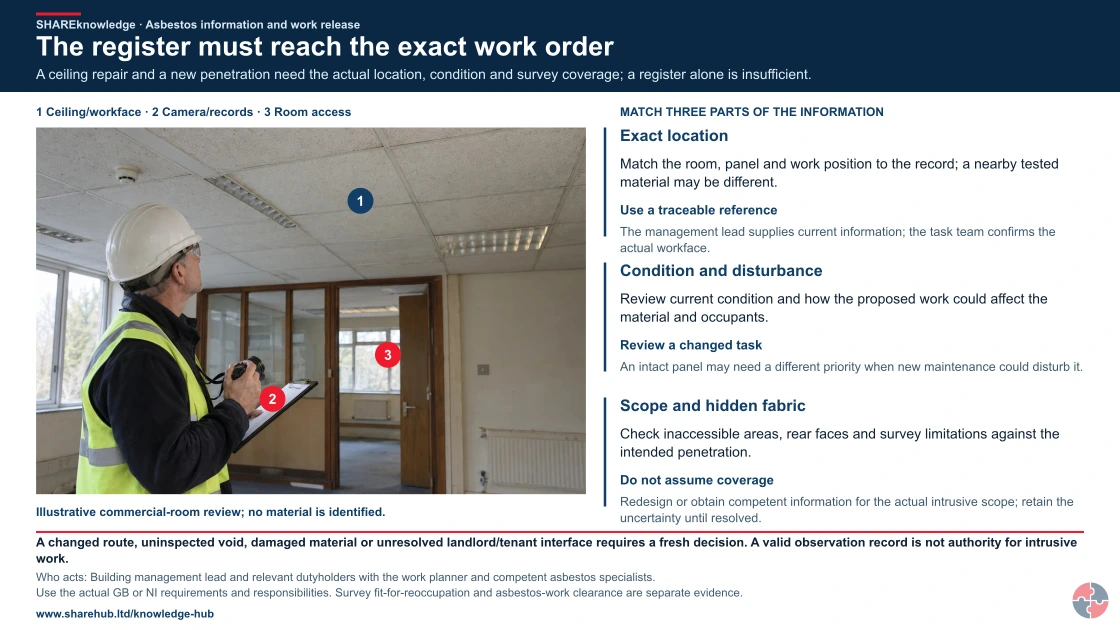
Full written explanation
An illustrative older UK commercial room shows a non-intrusive building-fabric review: intact ceiling/workface, a camera and inert recording papers, and a visible room/access connection. One literal picture key identifies those physical features. No material is identified as asbestos by appearance, and the observer, camera or papers establish no survey result, competent appointment or work permission. Match three parts of the information in parallel: the exact room/panel/work position; current condition and the disturbance proposed by this task; and survey scope, inaccessible rear faces and hidden fabric. Each question has a matched action: use traceable current information, review a changed task and do not assume coverage. They are different questions informing the same work order, not sequential stages of exposure or clearance. A nearby tested item may differ, intact condition does not resolve a changed intrusive task, and an uninspected void remains unresolved until competent information or redesign addresses the actual scope. The image is not a survey, register entry, certificate, released ceiling repair, material finding or control-performance test. Survey fit-for-reoccupation and asbestos-work clearance are separate evidence. Estates ceiling repair: Issue exact location and survey limits to the maintainer; keep the work inside the released scope. Refurbishment contractor: Reconcile the pack with the real route, occupants and tenant/landlord interfaces before opening fabric. A changed route, uninspected void, damaged material or unresolved landlord/tenant interface requires a fresh decision. A valid observation record is not authority for intrusive work. Who acts: Building management lead and relevant dutyholders with the work planner and competent asbestos specialists.
A ceiling repair and a new penetration need the actual location, condition and survey coverage; a register alone is insufficient.
- Exact location. Match the room, panel and work position to the record; a nearby tested material may be different.
- Condition and disturbance. Review current condition and how the proposed work could affect the material and occupants.
- Scope and hidden fabric. Check inaccessible areas, rear faces and survey limitations against the intended penetration.
Change the pathway
- Use a traceable reference. The management lead supplies current information; the task team confirms the actual workface.
- Review a changed task. An intact panel may need a different priority when new maintenance could disturb it.
- Do not assume coverage. Redesign or obtain competent information for the actual intrusive scope; retain the uncertainty until resolved.
Evidence check: Use the actual GB or NI requirements and responsibilities. Survey fit-for-reoccupation and asbestos-work clearance are separate evidence.
Primary references: HSE: arrange an asbestos survey · HSENI: asbestos survey reports
Open the complete HD image (new tab)Download image

Primary references: HSE: arrange an asbestos survey · HSENI: asbestos survey reports
Register entry: Room 12, panel P-04
- Recorded material
- Presumed asbestos-containing panel; retain the basis of that presumption in the register.
- Recorded condition
- No visible damage reported at the last inspection; date and inspector are recorded.
- Scope limitation
- Rear face and void not inspected. The entry does not resolve intrusive work behind the panel.
- Information owner
- The building's named asbestos management lead; responsibility and landlord/tenant interfaces must be settled.
| Work order | Question to resolve | Decision and record |
|---|---|---|
| A. Visual condition check without touching or opening the panel | Can the observation be completed from the agreed safe position without disturbance, and does the current condition match the record? | Use the approved inspection arrangements. Record observed condition and escalate any change; do not infer access behind the panel. |
| B. New fixing through the panel | Does suitable information cover the fixing, hidden material and proposed disturbance? | Hold the intrusive task. Obtain competent information or redesign the task. Resolve the category, plan, competence and controls before release. |
- Receive the change: a new task, damage report or survey result reaches the information owner.
- Reassess: resolve the effect on risk, affected work and shared responsibilities.
- Update and brief: revise the register and management plan as necessary, issue the correct work information and confirm the recipient understands the limits.
- Verify: check the actual work stayed within its released scope and feed new information back into the register.
Work-release evidence · Shared dutyholder responsibilities.
Basis: HSE duty to manage asbestos and survey scope guidance. This entry is not an asbestos survey or a work authorisation.
How do material and priority assessments change action?
Material assessment considers how readily an ACM can release fibres; priority assessment considers how likely people are to disturb it in this building. The dutyholder validates both before setting action.
A surveyor can assess material type and condition, but only the dutyholder knows actual access, maintenance, occupants and planned work. Combine these with the material assessment. Do not use a score as a permission to disturb, and do not assume a high material score always means immediate removal: the action depends on condition, location and disturbance potential. Conversely, an intact item may need urgent planning if a new service route reaches it. HSE says the register should be updated at least once a year as part of the management review and immediately when risk changes.
| BuildOut item | Material and priority evidence | Decision |
|---|---|---|
| Intact cement sheet in locked roof void | Firmly bound and sound; access rare, but roof repair is now planned. | Keep managed until task-matched roof work is assessed; planned access changes priority and survey/work controls. |
| Damaged AIB near a shared riser | More readily releases fibres; trades open riser regularly and panel is damaged. | Restrict access, arrange competent remediation, update plan and brief all trades; do not simply add a warning label. |
| Uninspected boxed service route | Material unknown; cable work would enter the void. | Presume asbestos, hold the cable job and obtain competent scoped survey or redesign route. |
What must the asbestos management plan do in practice?
The plan names responsible people and deputies, links the register to work control, schedules condition checks, sets actions and emergency steps, and is implemented and reviewed.
HSE says to review the plan and register every 12 months or sooner when circumstances change. That is the management-plan review, not a universal 12-month condition-inspection interval for every ACM: set inspection schedules by material, condition, location and disturbance risk. Update the register when ACMs deteriorate, are repaired or removed, or when room use or work changes priority. Sound material unlikely to be disturbed may often be managed in place; damaged material needs competent repair, protection, sealing or removal decisions.
| Plan element | Operational test | Evidence |
|---|---|---|
| Ownership and authority | Can a worker identify who can stop, fund and release work? | Duty map, appointed person, deputy and escalation contact. |
| Register and plans | Can a supervisor find the exact room, void and limitation before issuing work? | Controlled register, location plan and revision log. |
| Risk actions and condition monitoring | Are damaged or vulnerable ACMs controlled and actions closed on time? | Risk-ranked action tracker, checks and completion proof. |
| Work release | Does the work order hold when survey coverage, scope or category is uncertain? | Task-matched check, permit or authorisation and briefing. |
| Unexpected disturbance | Do staff stop, keep others out, report and obtain competent recovery? | Incident route, exercise and actual case review. |
| Review | Was the full plan and register reviewed within 12 months and after changes? | Dated review, corrective actions and next review date. |
How should asbestos information be communicated before work starts?
Asbestos information must reach the people who could disturb the material, in a form they can understand and use.
The biggest gap between paperwork and exposure is often communication. A register may be technically detailed, but a worker needs to know whether the panel they are about to drill, the riser they are about to open or the roof sheet they are about to remove is safe to disturb. Communication should therefore be task-specific, not a generic statement that asbestos may be present.
Work orders should include asbestos hold points. Contractors should receive the relevant register extract, plans, survey limitations and stop-work rules before pricing, planning or starting the job. Supervisors should check that the work area and method still match the asbestos information when the team arrives on site.
Labelling can support communication, but it is not a complete system. Labels may be missing, painted over, inappropriate in public areas or misunderstood. The register, plan and work control process remain essential.
| Route | What good communication includes | Common failure |
|---|---|---|
| Work orders | Task-specific asbestos register reference, restrictions and hold points. | Generic instruction to 'check asbestos' with no location detail. |
| Permits or authorisations | Confirmation that asbestos information covers the exact work area and method. | Permit issued from office without a workface check. |
| Contractor briefing | Relevant survey extract, plans, caveats, stop-work triggers and emergency contact. | Sending a full survey report without explaining what matters for the job. |
| Site induction | Building rules, register access, suspect materials and no-disturbance expectations. | One-off awareness without task-specific control. |
| Occupant communication | Clear information where asbestos work, access restriction or monitoring may affect people. | Over-reassurance, technical jargon or delayed updates. |
| Emergency services | Information on location and condition of known asbestos where relevant. | No accessible information during fire, flood or damage events. |
What evidence releases an intrusive work order?
Release only when the task, exact workface and hidden route match current asbestos information, avoidance has been considered, and the employer's work category, competence and controls are approved.
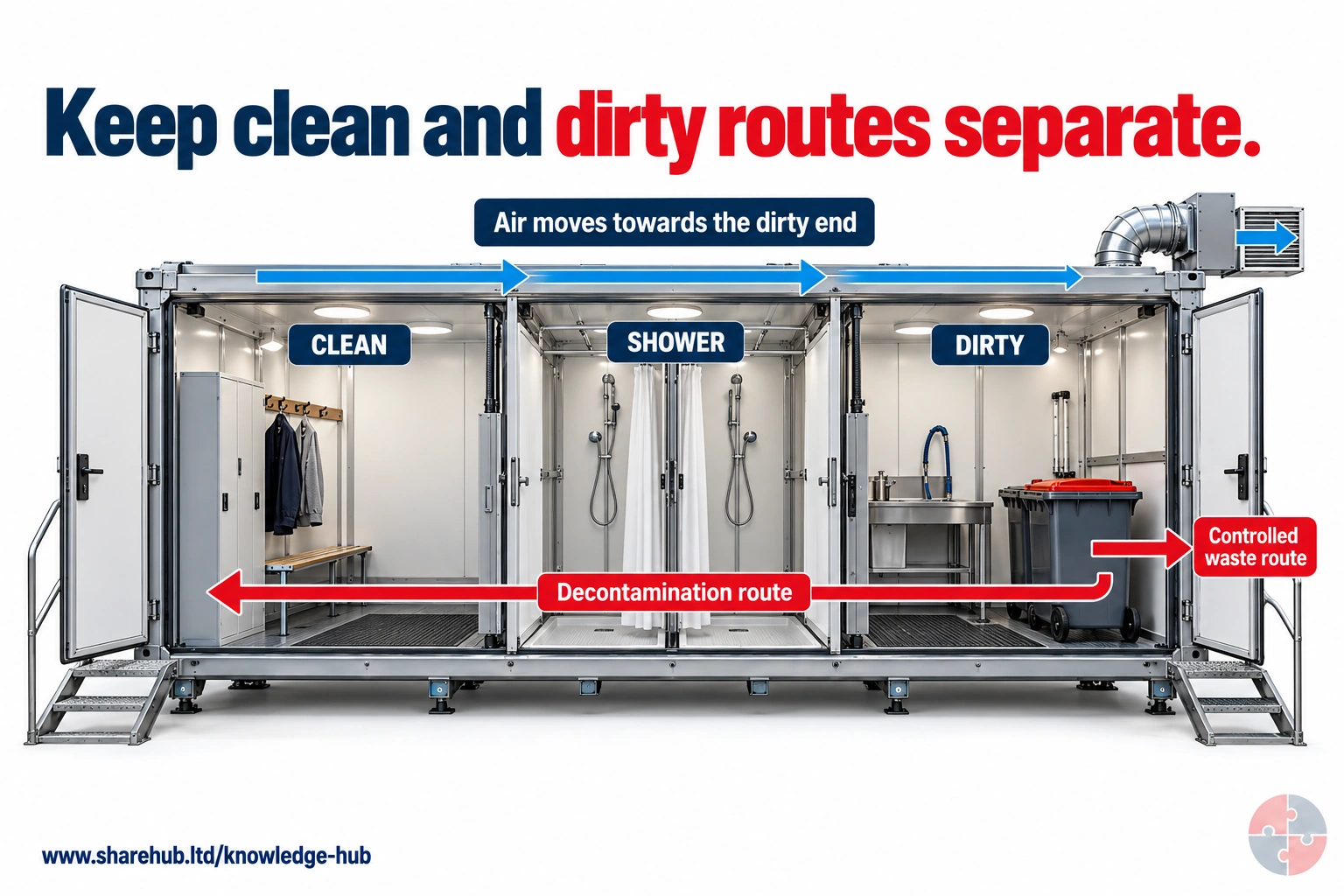

The unit separates clean clothing, showering and dirty work clothing. Air and people leaving contamination move in different directions; waste must not cross the clean route.
Why are air direction and the decontamination route different?
Air is drawn from clean to dirty areas, while a worker leaving the contaminated work follows the controlled dirty-to-shower-to-clean process.
A layout teaching principle rather than an operational decontamination procedure. Follow the reviewed licensed-work arrangements and exact RPE/PPE procedures.
Source guidance: HSE HSG247
| Gate | Check | Stop or record |
|---|---|---|
| Request and design | Define fixings, route, voids and extent; ask if work can avoid ACMs. | Hold vague scope; record chosen no-disturbance design or survey commission. |
| Information | Match register, survey type and exclusions to every work area and planned penetration. | Hold unknown or inaccessible fabric; do not treat management survey as R&D clearance. |
| Employer plan | Competent employer classifies licensed, NNLW or other non-licensed work and checks GB/NI authority route. | Hold missing licence, notification, training, method, waste or emergency arrangements. |
| At workface | Supervisor checks actual location and method; brief workers and other trades. | Stop on changed route, material, condition, control failure or suspect dust. |
| Completion | Confirm controlled cleaning, waste, independent clearance where required and residual ACMs. | No reoccupation or follow-on work without the competent surveyor's fit-for-reoccupation confirmation after an intrusive GB survey and the separate appropriate asbestos-work clearance evidence where required; update register, drawings and plan. |
Worked decision: A BuildOut cable installer wants to move a service through a ceiling void. The management survey notes an inaccessible void and the register has no material entry there. The permit issuer must not infer that the void is clear. The designer first seeks another route. If intrusion remains necessary, the client commissions a scoped refurbishment survey by competent people; the employer then assesses any ACM and work category. Only the revised route and documented controls are released.
How should contractors and asbestos specialists be controlled?
Contractor control should verify competence, scope, survey information, work category, method, supervision, waste and hand-back evidence.
Asbestos contractor management begins before procurement. The dutyholder must know whether the work could disturb asbestos and whether the survey information is suitable. If a contractor prices work without accurate asbestos information, the job may already be heading toward uncontrolled disturbance or delay.
Different contractors play different roles. A general maintenance contractor may only need asbestos awareness and clear stop-work rules. A contractor carrying out non-licensed work needs task-specific training, controls and a plan of work. Licensed asbestos removal contractors need licence checks and arrangements consistent with HSE licensed-work guidance. Analysts and laboratories should be competent and accredited where required.
The dutyholder should also manage interfaces: who isolates services, who controls access, who signs off the area, who manages waste, who reviews air monitoring or clearance evidence and who updates the register after work is complete.
| Control point | What to check | Evidence to keep |
|---|---|---|
| Pre-tender information | Whether asbestos information covers the work area, scope and hidden spaces. | Pre-construction information, register extract and survey report. |
| Competence | Training, experience, supervision and limits of what the contractor may do. | Competence assessment, training records and references. |
| Licence status | Whether the work requires an appropriately licensed asbestos contractor: HSE for Great Britain or HSENI for Northern Ireland. | Licence check, work-category decision and notification where required. |
| Plan of work | The task-specific method, controls, RPE/PPE, waste, decontamination and emergency arrangements. | Reviewed plan, RAMS and supervisor sign-off. |
| Analyst or laboratory | Competent sampling, analysis, air monitoring and clearance arrangements. | For GB commissioned bulk and air analysis, verify the laboratory's current UKAS ISO/IEC 17025 scope; check analyst independence, appointment and reports. Surveyor BS EN ISO/IEC 17020 accreditation is strongly recommended, not universally mandatory. |
| Workface supervision | Controls are used as planned and scope does not drift. | Site inspection records, photographs where appropriate and non-conformance actions. |
| Hand-back | Area is clean, safe, waste removed and register updated. | Clearance evidence, Certificate for Reoccupation where required, waste consignment and updated register. |
What accreditation and standards evidence should a buyer ask for?
Check the activity and method on the current UKAS schedule, not merely a provider's logo. The GB legal requirement for commissioned analysis is different from HSE's surveyor recommendation. In Northern Ireland, confirm the applicable law, accreditation and clearance route directly with HSENI and the provider.
| Service or standard | GB position | Evidence and limit |
|---|---|---|
| Surveyor; BS EN ISO/IEC 17020 | Competence and impartiality are essential. HSE strongly recommends UKAS 17020 accreditation; it is not a universal legal requirement for surveyors. | Scope-specific inspection schedule if claimed; exact brief, exclusions, access and report quality still matter. |
| Bulk analysis; ISO/IEC 17025 | Commissioned asbestos material analysis must use a UKAS-accredited analytical laboratory for the relevant activity. | Check testing schedule and representative sampling; a photo or generic logo is not a material result. |
| Air measurement and clearance; ISO/IEC 17025 | Commissioned airborne-fibre measurement needs relevant UKAS-accredited analysis. Independent HSG248 four-stage clearance and Certificate for Reoccupation apply where required. | Check analyst scope, independence, four stages and certificate; a single low air result does not release the area. |
| NI specialist commission | Apply NI law and HSENI requirements; HSENI lists UKAS testing and inspection providers. | Confirm the current NI route and the exact accredited activity with HSENI and the provider; do not reuse GB paperwork. |
| ISO 45001:2018 | Voluntary OH&S management-system framework for role, risk, monitoring and improvement arrangements. | Useful audit structure, not an asbestos licence, survey, analyst accreditation or clearance certificate. |
How do work categories affect the dutyholder's release decision?
The employer doing the work must classify the actual material, condition, method and expected exposure before disturbance; the dutyholder verifies that the proposed team and paperwork match that decision.
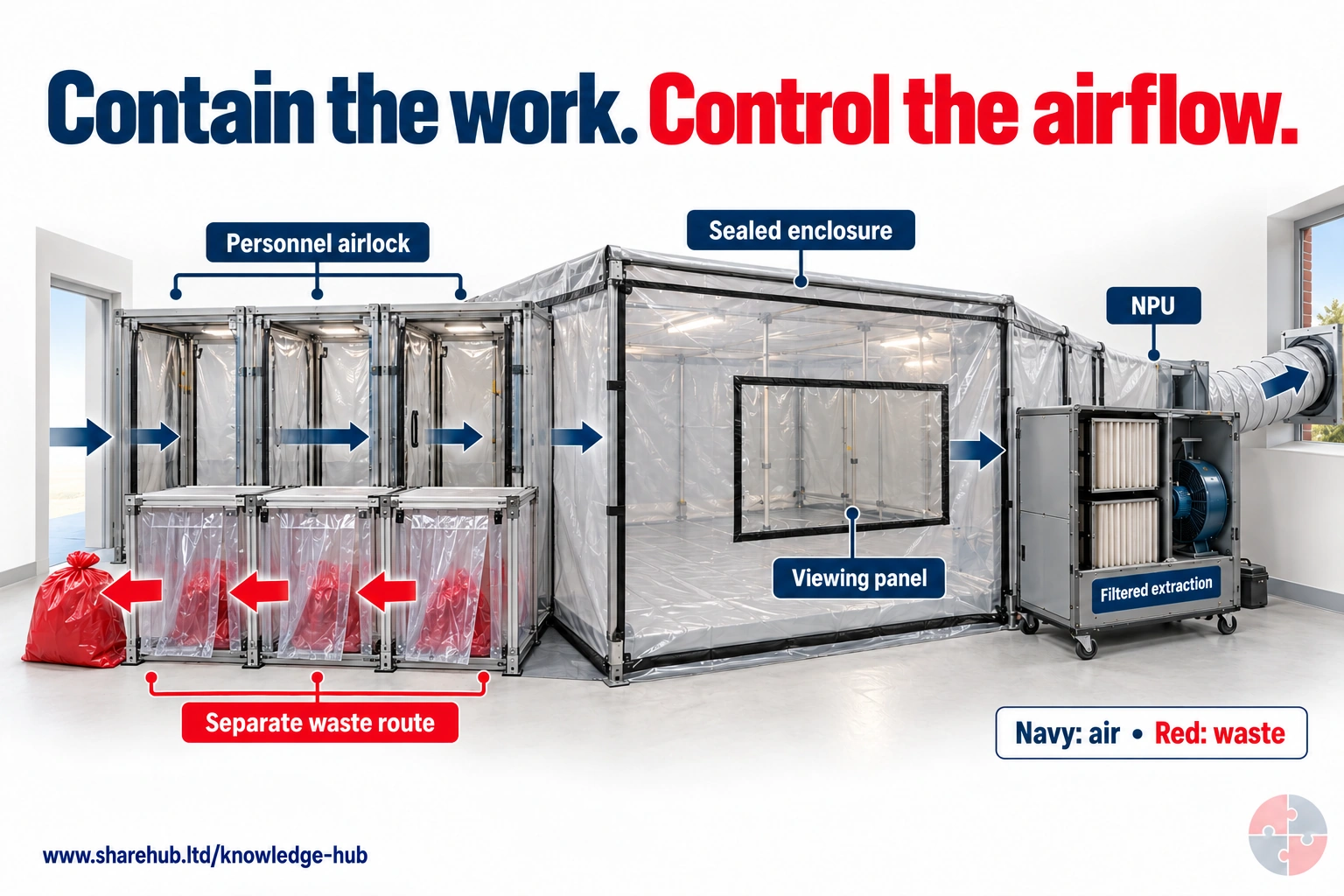

The enclosure, airlock, negative-pressure unit, viewing arrangement and separate waste route work together to limit contamination spread.
Which direction should replacement air move?
From cleaner areas towards the enclosure and on through the controlled filtered extraction route.
Conceptual layout, not a licensed-work plan. Seal integrity, airflow, NPU capacity, discharge, decontamination and clearance require competent project-specific arrangements.
Source guidance: HSE HSG247
| Route | Decision boundary | Evidence before release |
|---|---|---|
| Avoid disturbance | Work can be redesigned or existing ACM left in place and managed. | Revised design, register and no-disturbance briefing. |
| Licensable | Licence exemption cannot be justified or high-release work requires a licence. | Correct HSE GB or HSENI NI licence, advance notification, assessed plan and clearance route. |
| Notifiable non-licensed work | Licence exemption supported but material condition or task meets NNLW criteria. | Site-jurisdiction notification before work, designated area, medical surveillance, health records and task controls. |
| Other non-licensed | Licence exemption and non-NNLW decision supported. | Still need task risk assessment, trained workers, plan, controls, waste and supervision. |
| Uncertain | Identity, condition, method, likely exposure or survey scope unresolved. | Hold and obtain competent classification; duration or a training card alone cannot release work. |
HSE's Great Britain 0.1 fibres/cm3 four-hour control limit and 0.6 fibres/cm3 ten-minute sporadic/low-intensity criterion inform classification, not a safe level or sole permission to proceed. A permit-to-work is a local control, not an asbestos licence or regulator notification. The general asbestos guide explains the work-category criteria in more detail.
How can the hierarchy of controls guide asbestos management and prevent fibre exposure?
ERICPD helps dutyholders avoid asbestos disturbance first, then reduce, isolate and control exposure before relying on PPE.
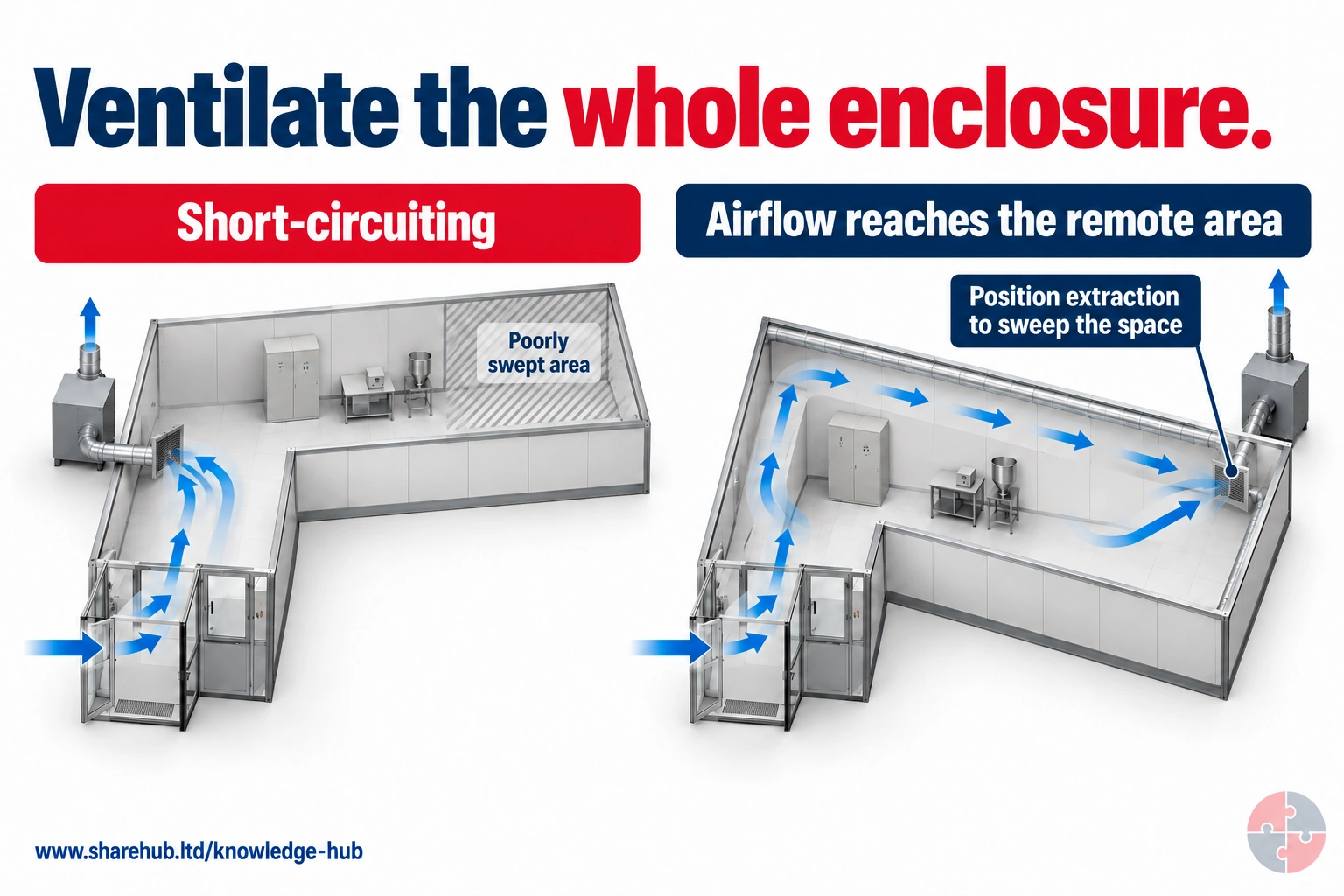

An extraction point close to the inlet can leave poorly swept parts of an enclosure. Geometry, obstructions and extraction positions need verification.
How could the remote leg be addressed?
A suitable revised extraction or trunking arrangement may draw air through the remote area, followed by the required verification.
Arrows are conceptual. Actual air movement, containment and system performance must be tested under the work plan.
Source guidance: HSE HSG247
ERICPD is useful for asbestos because it prevents weak thinking. A mask and warning sign are not the control standard for unknown building fabric. The first question is whether the work can avoid asbestos completely, whether the material can be removed first, or whether the task can be redesigned.
Where asbestos remains in place, the controls must prevent disturbance. That is achieved through information, physical condition management, access control, contractor controls, safe systems of work and review. Respiratory protective equipment and personal protective equipment sit lower in the hierarchy and are mainly relevant where asbestos work is planned and controlled.
In a multi-tenant building, the management plan must prevent a contractor drilling an unknown ceiling. The dutyholder first tests whether the cable can use an existing route, eliminating disturbance; a different fixing or service location may substitute for the proposed penetration. The current register and survey define what is known, but they are information controls, not physical containment. If intrusive work is unavoidable, a competent asbestos specialist determines the lawful category and specifies segregation, method, equipment and completion evidence. ERICPD Eliminate/Reduce/Isolate/Control therefore map to design avoidance, a safer task and engineered containment; permit, handover and supervision are administrative layers. RPE remains a residual method component, never the release condition by itself.
The facilities manager checks that the actual workface matches the register and survey, the contractor has the right scope, occupants are protected and the hand-back evidence is defined before signing release. The manager samples maintenance requests for unrecorded penetrations and updates plans after change. ERICPD Discipline is this continuing register, access and learning loop. If a survey gap, damaged material, unplanned penetration or containment breach appears, stop the affected work, restrict access and obtain competent assessment before cleaning or reopening. An audit score cannot compensate for an unknown workface.
How can the ERICPD hierarchy of controls guide asbestos management and prevent fibre exposure?

| ERICPD level | Practical asbestos management application | Evidence to check |
|---|---|---|
| Eliminate | Remove asbestos before refurbishment or choose designs that avoid disturbing asbestos-containing materials. | Removal scope, clearance evidence and updated register. |
| Reduce | Minimise intrusive work, restrict access to high-risk areas and reduce the number of people who may disturb materials. | Design review, work sequencing and access controls. |
| Isolate | Seal, enclose, label, lock or segregate asbestos-containing materials or damaged areas. | Barriers, signage, locked access and inspection records. |
| Control | Use surveys, registers, permits, contractor competence, plans of work, monitoring and waste controls. | Register checks, permit records, method statements and audit findings. |
| PPE | Use suitable RPE and PPE where asbestos work or emergency response requires it. | RPE selection, face-fit records, PPE issue and doffing checks. |
| Discipline | Train people, enforce stop-work, investigate failures and review the management plan. | Training matrix, incident reviews, action close-out and management review. |
How can the ISO 45001 hierarchy of controls guide asbestos management and prevent fibre exposure?

| ERICPD level | Practical asbestos management application | Evidence to check |
|---|---|---|
| Eliminate | Remove asbestos before refurbishment or choose designs that avoid disturbing asbestos-containing materials. | Removal scope, clearance evidence and updated register. |
| Reduce | Minimise intrusive work, restrict access to high-risk areas and reduce the number of people who may disturb materials. | Design review, work sequencing and access controls. |
| Isolate | Seal, enclose, label, lock or segregate asbestos-containing materials or damaged areas. | Barriers, signage, locked access and inspection records. |
| Control | Use surveys, registers, permits, contractor competence, plans of work, monitoring and waste controls. | Register checks, permit records, method statements and audit findings. |
| PPE | Use suitable RPE and PPE where asbestos work or emergency response requires it. | RPE selection, face-fit records, PPE issue and doffing checks. |
| Discipline | Train people, enforce stop-work, investigate failures and review the management plan. | Training matrix, incident reviews, action close-out and management review. |
How does the management system respond to damage or suspect dust?
Stop work, withdraw safely, keep others out, prevent spread and report; competent people decide contamination, exposure, recovery and hand-back. If clothing, hair or footwear is heavily contaminated, avoid carrying fibres through clean areas: stop movement at a safe location and obtain trained emergency-plan assistance for controlled decontamination. Immediate life danger takes priority. Do not take contaminated clothing home or put it in ordinary laundry.
Do not ask a caretaker or contractor to sweep, bag by hand, dry-wipe or use an ordinary vacuum. The dutyholder coordinates the affected area and supplies the survey and register. The employer and specialist assess who may have been exposed, whether material is asbestos, whether controls failed, and which licensed, NNLW or other work route applies to recovery. Air monitoring and independent clearance are used where competent assessment and the work require them, not as a substitute for controls. Record reporting decisions under the applicable GB or NI route. Update the register, plan, work orders and affected people before reoccupation. The Asbestos dust response gives the first-minute route.
After immediate stop, withdrawal and isolation, the responsible person records the facts and the applicable GB or NI reportability decision. A GB work-related uncontrolled fibre release sufficient to risk health can be a RIDDOR dangerous occurrence; not every encounter is automatically reportable. NI applies its separate 1997 RIDDOR and HSENI reporting route. A reporting decision never delays isolation or competent clean-up.
If clothing, hair or footwear is heavily contaminated, avoid carrying fibres through clean areas: stop movement at a safe location and obtain trained emergency-plan assistance for controlled decontamination. Immediate life danger takes priority. Do not take contaminated clothing home or put it in ordinary laundry. Follow the Asbestos dust controlled first-response boundary and HSE EM1 evidence.
Primary contaminated-person response evidence: HSE EM1 accidental disturbance and contaminated-person response.
Which records prove ongoing control?
Keep the survey scope, current register, plan, condition and action history, work-category decisions, contractor evidence, hand-backs and incident learning linked to the relevant building and task.
Building records should remain available through changes of owner and occupancy as an operational need; do not mistake this for one universal statutory retention period. Licensed and NNLW worker health records and medical surveillance have specific long-term requirements under the relevant Regulations. In Great Britain, HSE says NNLW work registers (health records) are kept for 40 years; medical detail remains with the doctor. Verify the NI requirement for NI workers. Keep personal health information confidential and avoid putting medical details in an open building register.
| Record | Shows | Update trigger |
|---|---|---|
| Survey and limitations | What was inspected, sampled, presumed or inaccessible. | New work scope or access to previously hidden area. |
| Register and plans | Known and presumed ACMs, condition, material and priority assessment. | Damage, repair, removal, new survey or changed use. |
| Management plan | Owners, actions, checks, communication and emergency arrangements. | At least annual review and earlier material change. |
| Work and contractor pack | Category rationale, licence/notice, plan, competence, monitoring, waste and hand-back. | Each task and changed method. |
| Worker exposure/health record | Licensed or NNLW work nature, duration, estimated exposure and medical-surveillance route where applicable. | Each relevant worker and task; statutory retention by route. |
| Incident and assurance log | People, release facts, reportability decision, recovery, root cause and closure. | Disturbance, near miss, audit finding or overdue action. |
Which records belong to the building and which belong to an employer or doctor?
Keep building information accessible to those planning work, but keep worker health information in a restricted employer record and clinical detail with the doctor. The GB 40-year minimum for licensable and NNLW employer health records is distinct from the separate four-year employer medical certificate for NNLW. L143 ACOP advises keeping the health record for 40 years after the last entry or until the worker reaches 80, whichever is longer. Confirm NI retention and transfer arrangements under NI law and HSENI before applying a GB figure there.
| Record and owner | Purpose and access | Retention or transfer |
|---|---|---|
| Building register, survey and plan; dutyholder | Locations, condition, presumptions, limitations, actions and information to people liable to disturb ACMs. No clinical details. | Keep current and available; review the plan at least annually and sooner after change. Preserve useful history at handover; no universal worker-health retention period applies to the building register. |
| Licensed-work employer health record | Worker identity, work type, dates, typical exposure and relevant RPE/medical-exam dates; accessible to the worker on request, not to general building users. | Statutory minimum 40 years from last entry; L143 ACOP advises 40 years or until age 80, whichever is longer. Preserve or transfer appropriately on business closure. |
| NNLW employer health record | Worker, nature and duration of NNLW, estimated exposure and medical-exam dates; separate from the premises register. | Statutory minimum 40 years; L143 gives the longer age-80 ACOP advice. If trading ceases, offer the record to HSE or the individual concerned as HSE directs. |
| NNLW medical-examination certificate; employer | Confirms the examination occurred and its date; it is not the full exposure or clinical record. | Employer keeps the NNLW certificate for four years from issue under HSE guidance. |
| Detailed clinical medical record; doctor | Confidential findings and medical history held under medical confidentiality, not in a building register or open work pack. | Doctor or medical provider manages clinical retention and access under applicable medical rules; do not substitute the employer's certificate for it. |
| NI worker health and medical records | Employer and relevant doctor follow NI asbestos law and HSENI guidance; keep worker and building records separately. | Confirm the current NI record, certificate, retention and closure route before issuing a site-specific instruction; do not project GB forms or periods. |
Which GB and Northern Ireland duties anchor compliance?
The Great Britain Control of Asbestos Regulations 2012 and the separate Control of Asbestos Regulations (Northern Ireland) 2012 anchor the asbestos duties in their respective jurisdictions.
| Jurisdiction and rule | Management decision | Evidence and authority |
|---|---|---|
| GB Control of Asbestos Regulations 2012 | Duty to manage relevant premises; assess and prevent exposure; plan, train and apply licence or NNLW route where required. | HSE or relevant GB enforcing authority; register, plan, work and worker records. |
| NI Control of Asbestos Regulations 2012 | Apply separate NI premises and asbestos-work duties, licence and notification route. | HSENI and NI law; GB licence or notice is not NI authority. |
| GB CDM Regulations 2015 | Coordinate asbestos information before design, tender, refurbishment or demolition. | Client pre-construction information, survey scope and contractor handover. |
| NI CDM Regulations 2016 | Coordinate asbestos information and construction interfaces under NI CDM. | NI client brief, pre-construction information and contractor handover. |
| England hazardous-waste route | Classify, contain and consign asbestos waste; use an appropriately registered carrier where required and authorised receiving facility. | Environment Agency guidance and consignment/receipt trail; separate from asbestos-work notice. |
| Wales hazardous-waste route | Check producer, carrier, receiving site and hazardous-waste consignment requirements. | Natural Resources Wales guidance and receipt trail. |
| Scotland special-waste route | Use the Scottish special-waste consignment and authorised carrier/facility route. | SEPA guidance and receipt trail. |
| NI hazardous-waste route | NIEA movement notice and consignment are separate from HSENI asbestos-work notification; check current advance timing and exceptions with NIEA. | NIEA guidance, carrier, authorised destination and receipt. |
| GB incident reporting | Responsible person assesses whether an uncontrolled airborne-fibre release meets the GB RIDDOR dangerous-occurrence threshold; not every disturbance is automatically reportable. | Record decision after isolation and report through the GB route if required. |
| NI incident reporting | Responsible person applies the separate NI RIDDOR 1997 route and HSENI criteria. | Record the NI decision and use the NI reporting form and deadline if required. |
General health and safety duties also apply. COSHH is not the primary asbestos-specific exposure regime, though other hazardous dusts may need a separate COSHH assessment. This page is a route map, not legal advice for a particular premises.
What should an asbestos risk and assurance register include?
A useful register links credible exposure events to controls, owners, evidence and review triggers.
The asbestos register records materials; the wider risk or assurance register records how the organisation could fail to manage them. That is the difference between knowing where asbestos is and knowing whether the management system is strong enough.
A mature risk register should include credible pathways such as intrusive work started from inadequate survey information, known asbestos damaged by occupancy, contractor removing materials outside scope, waste mishandled, or register information not reaching emergency responders.
| Event or failure route | Possible consequence | Key controls | Evidence to check |
|---|---|---|---|
| Maintenance work starts in an unsurveyed void | Asbestos fibres released during drilling, cutting or opening panels. | Work-order hold point, register check, survey scope review and stop-work authority. | Permit/work-order audit and supervisor observation. |
| Known asbestos deteriorates between inspections | Occupants, cleaners or trades exposed to damaged material. | Condition monitoring, access restriction, repair, encapsulation or removal. | Inspection schedule, photos and action close-out. |
| Management survey used for refurbishment | Hidden asbestos disturbed during intrusive work. | R&D survey requirement and project gate before work. | Project file, pre-construction information and survey report. |
| Contractor not competent for asbestos task | Illegal work, exposure, contamination spread and enforcement. | Competence checks, licence check, plan of work review and supervision. | Procurement records and site inspection findings. |
| Register not updated after removal | Future teams rely on wrong information or duplicate controls. | Hand-back process and register update requirement. | Clearance evidence and updated register revision history. |
| Emergency response unclear | Workers clean contamination incorrectly or continue work. | Emergency procedure, toolbox talks and responsible-person escalation. | Incident drill, report quality and worker interview. |
How does governance change real work?
These eight BuildOut Ltd cases show where the register, survey, work category, interface or audit creates a release decision or hold.
One panel record: two different work decisions
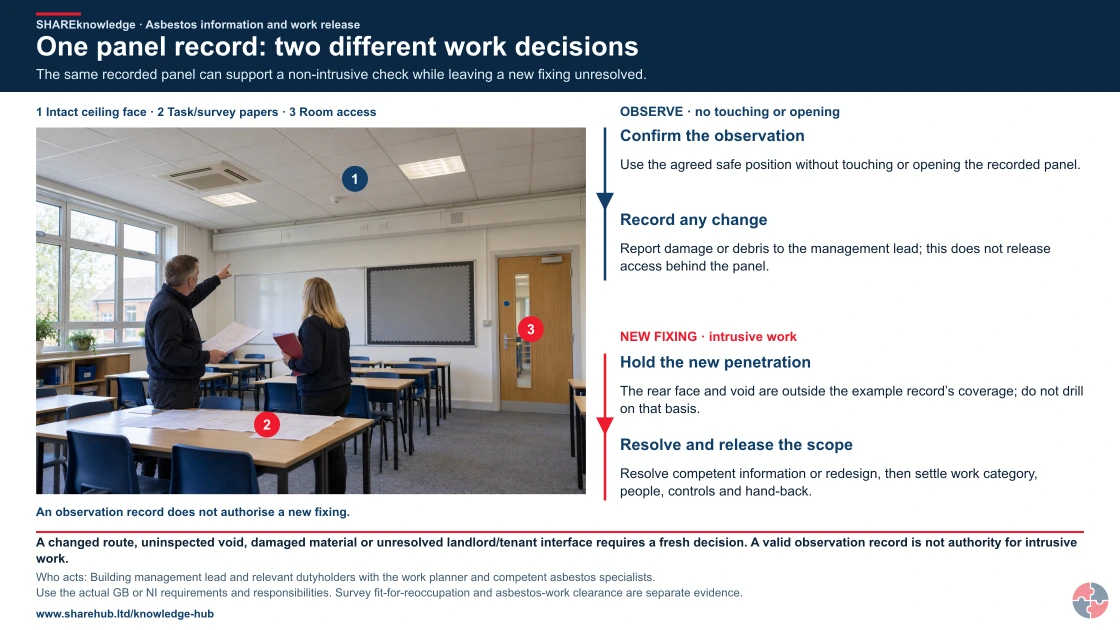
Full written explanation
An illustrative UK school-room planning review shows normal adults, an intact closed ceiling face, inert task/survey drawings and room access. One literal picture key identifies the ceiling face, task/survey papers and doorway. No observation or fixing task is performed, no fabric is touched or opened, and the hidden rear face or void is not shown. The picture is not the illustrative Room12/panelP-04 record and establishes no asbestos identity, survey coverage, permitted observation position or fixing clearance. Two independent tracks use the same example information. OBSERVE: confirm the observation from the agreed safe position without touching/opening, then report any change to the management lead; that record does not release access behind the panel. NEW FIXING: hold the penetration because rear face and void are outside the example coverage, then resolve competent information or redesign and settle the actual work category, people, controls and hand-back. Only within-track arrows show order; completing observation does not lead to intrusive permission. Changed routes, damaged material, uninspected voids and unresolved landlord/tenant interfaces require a fresh decision. The correct GB or NI responsibilities apply, and survey hand-back differs from asbestos-work clearance. No photo, signature, register or familiar building settles the task-specific category, method, competence, clearance or permission. Routine planning does not delay the existing incident or appropriate health route. Estates ceiling repair: Issue exact location and survey limits to the maintainer; keep the work inside the released scope. Refurbishment contractor: Reconcile the pack with the real route, occupants and tenant/landlord interfaces before opening fabric.
The same recorded panel can support a non-intrusive check while leaving a new fixing unresolved.
- Confirm the observation. Use the agreed safe position without touching or opening the recorded panel.
- Record any change. Report damage or debris to the management lead; this does not release access behind the panel.
- Hold the new penetration. The rear face and void are outside the example record’s coverage; do not drill on that basis.
- Resolve and release the scope. Resolve competent information or redesign, then settle work category, people, controls and hand-back.
When the evidence does not fit: A changed route, uninspected void, damaged material or unresolved landlord/tenant interface requires a fresh decision. A valid observation record is not authority for intrusive work.
Who acts: Building management lead and relevant dutyholders with the work planner and competent asbestos specialists.
Changed workplace
Estates ceiling repair: Issue exact location and survey limits to the maintainer; keep the work inside the released scope.
Refurbishment contractor: Reconcile the pack with the real route, occupants and tenant/landlord interfaces before opening fabric.
Evidence check: Use the actual GB or NI requirements and responsibilities. Survey fit-for-reoccupation and asbestos-work clearance are separate evidence.
Primary references: HSE: arrange an asbestos survey · HSENI: asbestos survey reports
Open the complete HD image (new tab)Download image

Primary references: HSE: arrange an asbestos survey · HSENI: asbestos survey reports
Routine condition inspection
Task material and setting: Check a known intact ACM panel in a locked plant room without disturbing it.
People and prerequisites: Appointed person and maintainer; current register and access plan.
Before: Check location, prior photo and inspection method.
During: Observe without touching; note condition and any changed access.
Hold or stop: Stop if damage, new debris or uncertain identity is found.
Completion and hand back: Update register condition and action owner; brief affected maintenance team.
Evidence: Dated condition record, photo, action and review trigger.
Shared landlord and tenant duty
Task material and setting: Replace lighting in a leased unit reached through a landlord riser.
People and prerequisites: Landlord, tenant, electrician and managing agent; written maintenance split.
Before: Map both dutyholders, survey scope and cable route before tender.
During: Jointly brief contractor and verify riser access at workface.
Hold or stop: Hold if lease/interface or riser material is unresolved.
Completion and hand back: Sign joint hand-back and update both register extracts.
Evidence: Lease duty map, shared survey, permit and hand-back.
Refurbishment survey limitation
Task material and setting: Install a new pipe in a boxed void marked no access.
People and prerequisites: Client, designer, surveyor, pipe contractor and occupants.
Before: Compare exact route with survey caveat; seek redesign or scoped survey. For an intrusive GB survey, vacate the affected area and plan occupant isolation before inspection.
During: No opening until competent evidence and category decision release the route.
Hold or stop: Stop on a changed route or material that differs from report.
Completion and hand back: Obtain the surveyor's fit-for-reoccupation confirmation before handing back the surveyed area; separately verify any asbestos-work clearance, then record final pipe route and residual ACMs.
Evidence: Survey commission, caveat resolution, design decision and revised register.
Intact material becomes exposed to work
Task material and setting: New HVAC service will pass beside intact AIB.
People and prerequisites: Facilities team, designer, contractor and nearby occupants.
Before: Reassess priority because maintenance likelihood changed, even if condition did not.
During: Avoid board where possible; competent contractor assesses any necessary work.
Hold or stop: Hold if the plan still rates the area as low priority without considering the new job.
Completion and hand back: Update plan, action, register and future work information.
Evidence: Before/after priority assessment and approved work pack.
Licensed contractor procurement
Task material and setting: Remove damaged lagging in a GB or NI boiler room.
People and prerequisites: Client, licensed contractor, analyst and follow-on trade.
Before: Verify site jurisdiction, actual licence, survey, notification, plan and independent analyst scope.
During: Client manages exclusion and interfaces; contractor follows approved plan.
Hold or stop: Hold for missing licence/notice, enclosure failure or expanded scope.
Completion and hand back: Accept required clearance, waste and residual ACM information before follow-on work.
Evidence: Licence check, notice, plan, clearance, consignment and register revision.
Notifiable non-licensed work
Task material and setting: Repair significantly damaged asbestos cement panel.
People and prerequisites: Competent employer, dutyholder and users of adjacent space.
Before: Assess exemption and NNLW criteria, notify proper GB/NI authority before work.
During: Use approved method, designated area and trained people; dutyholder monitors interfaces.
Hold or stop: Hold for missing notice, medical surveillance, health-record or control evidence.
Completion and hand back: Check cleaning and waste, record workers and update register.
Evidence: NNLW rationale, notification, worker records and hand-back.
Unexpected suspect dust
Task material and setting: Maintenance drill releases dust from board not in register.
People and prerequisites: Worker, supervisor, occupants, dutyholder and asbestos adviser.
Before: Train team on stop/report route before work.
During: Stop, leave safely, restrict access and get competent assessment.
Hold or stop: No ordinary cleaning, return to work or permit continuation on appearance.
Completion and hand back: Specialist recovery and appropriate clearance; investigate survey and work-release failure.
Evidence: People/time log, assessment, reporting decision, clearance and corrective actions.
Portfolio assurance gap
Task material and setting: Three buildings show overdue ACM actions and stale work orders.
People and prerequisites: Asset owner, appointed people, contractors and auditor.
Before: Sample survey limitations, register revisions, work orders and prior actions.
During: Freeze affected intrusive jobs; assign owners and verify actual condition.
Hold or stop: Stop work where records cannot establish exact material and scope.
Completion and hand back: Correct live records, brief teams, close actions and test the release gate again.
Evidence: Audit sample, backlog, owner/deadline, proof and management review.
How could BuildOut Ltd manage asbestos risk management and compliance?

BuildOut Ltd would check that asbestos information covers the work about to disturb the building and resolve survey limitations before allocating the task.
BuildOut Ltd · practical example
Match the asbestos information to the refurbishment scope
The key lesson A management survey supports normal occupation; intrusive refurbishment may need different survey information covering its exact scope.
The situation: A client supplies a management survey for an occupied building. BuildOut's proposed refurbishment opens ceiling voids and removes wall linings. Some relevant locations were inaccessible when the survey was completed.
Why this matters: A document called an asbestos survey does not establish the condition of concealed materials it never examined.
How BuildOut Ltd would manage it
- Define the disturbance — Project Manager. Identify the areas, fabric and services that the work will disturb. Ask the client and relevant dutyholder to provide asbestos information suitable for that precise refurbishment scope.
- Read the limitations — Site Manager. Review the survey coverage, exclusions and recommendations with competent asbestos advice. Map inaccessible areas against the method rather than distributing the report without interpreting it.
- Resolve the information gap — Project Manager. Arrange the necessary competent survey or investigation through the appropriate dutyholder. Allow for access, specialist work and any required approvals or notifications before setting the programme.
- Brief the work boundary — Trade Supervisor. Explain the confirmed information, restricted areas and procedure for an unexpected suspect material. Keep unassessed disturbance on hold and prevent others entering the affected work area.
- Check the current condition — Site Manager. Confirm that any required specialist work and clearance or handover evidence are complete for the affected area. Update information for follow-on trades and retain unresolved restrictions.
When the conditions change
- Recognise the trigger
- Relevant material is unassessed, inaccessible or unexpectedly suspect.
- Make the immediate decision
- Stop disturbance of material outside the surveyed intrusive scope or where unexpected suspect material is found.
- Verify the next step
- The Project Manager obtains competent asbestos information covering the exact disturbance and any required specialist clearance or handover; the Site Manager briefs the resulting work limits.
What good looks like
The work scope and asbestos information match, limitations are resolved or controlled, and workers know what to do when the building differs. No one relies on asbestos-awareness training as authority to disturb suspect material.
Evidence to look for: Scope and survey review, limitations map, competent advice, specialist work evidence, current restrictions and worker briefing.
Common mistake to avoid: Treating the presence of a management survey as permission for all intrusive refurbishment.
Apply this to your work: Does your asbestos information cover the material your next task will actually disturb?
Guidance behind the management approach: HSE: arranging an asbestos survey. Use the topic's legal and technical guidance for the applicable work and location.
BuildOut Ltd
BuildOut Ltd is used as a construction and facilities example because asbestos management often fails at the boundary between property records, project planning, contractors and workface decisions.
BuildOut treats asbestos as a controlled building-risk process. Its property team holds the asbestos register and management plan for each depot, office and live refurbishment site. Each record is tied to a building plan, room reference and action owner. Where the survey contains caveats or no-access areas, the system marks those locations as presumed asbestos until closed by competent survey work.
Before any intrusive maintenance, the job request asks whether the work affects building fabric, services, voids, risers, roof materials, flooring, plant insulation or old fire protection. If the answer is yes, the supervisor must attach the relevant register extract or survey confirmation. The permit or work authorisation cannot be closed as ready until the exact work area and method are covered.
Contractors are controlled through procurement and site checks. BuildOut requires asbestos awareness for trades who may disturb building fabric, task-specific competence for non-licensed asbestos work, licensed-contractor evidence where needed, and UKAS-backed analytical arrangements where sampling, air monitoring or clearance is required. Project managers check survey suitability before tender and again before work starts.
The risk register is reviewed quarterly as a BuildOut Ltd company assurance choice, not a statutory interval, by operations, facilities and health and safety. It looks at overdue condition inspections, open asbestos actions, contractor non-conformances, near misses, training gaps, register changes, waste records and any locations where asbestos information has delayed work. The aim is to learn from weak signals before an exposure event occurs.
| Management area | How BuildOut manages it | Evidence used for assurance |
|---|---|---|
| Policy and ownership | Names a responsible person for each premises and defines escalation to the group estates lead. | Management plan, dutyholder matrix and annual review minutes. |
| Survey and register control | Uses management surveys for occupation and R&D surveys for intrusive projects, with caveats tracked as risks. | Survey scope review, register revision history and caveat close-out. |
| Work planning | Screens all intrusive work orders and requires asbestos information before drilling, cutting, chasing or opening voids. | Work-order hold points, permits and supervisor verification. |
| Contractor management | Checks training, competence, licence status and method before asbestos-related work. | Approved contractor list, licence checks, RAMS and site inspection reports. |
| Training | Runs awareness for all relevant staff, task briefings for supervisors and detailed dutyholder training for estates managers. | Training matrix, refresher log and competence observations. |
| Monitoring and audit | Combines condition inspections, second-line HSSE audits and independent specialist reviews. | Inspection records, audit findings, action tracker and senior review. |
| Incident learning | Investigates every suspected disturbance or register mismatch and updates processes. | Incident report, exposure record decision, register update and toolbox talk. |
How does this topic align with ISO 45001?
Use these examples to connect the relevant clauses to your own occupational health and safety management system. For each clause, identify the person responsible, the control in use and the evidence that it works.
Scroll across the table to read all four columns.
| ISO 45001 clause | How it applies | What to put in place | How to verify it works |
|---|---|---|---|
| 6.1.2.1 Hazard identification | A refurbishment changes what workers may disturb. A ceiling void or wall lining outside the scope of an earlier survey is an uncertainty that needs to be carried into the new assessment. | Match the work scope to the survey before issuing the work package. Presume asbestos in uninspected areas and arrange the appropriate survey and assessment by competent people before releasing affected intrusive work. | Pick one opening on the refurbishment plan and trace it to the survey scope and finding. Where the area was inaccessible, check how the uncertainty was recorded and when it was resolved. |
| 8.1.2 Hierarchy of controls | The hierarchy of controls starts with considering whether the work can be designed to avoid disturbing asbestos-containing material. | Ask the design and maintenance teams to review options such as rerouting services. Where disturbance remains necessary, determine the work category and plan competent specialist control and release arrangements before other trades enter. | Review an agreed design change or controlled work package. Check that the documented approach reflects the route taken on site and that the asbestos information used by later trades is current. |
| 9.1.2 Evaluate compliance | Evaluating compliance means checking the applicable asbestos duties against what the organisation does in practice. The duties come from the relevant law. | For premises within scope, identify the dutyholder and schedule checks of the register, management plan and how people receive information before work. Record the outcome of each check and assign and follow up any gaps. | Sample a maintenance job and verify that the team received the relevant asbestos information before starting. Record whether the applicable duty was met and follow up any corrective action. |
Selected applications of ISO 45001:2018 with Amendment 1:2024. Use the current standard for a full assessment and check the legal duties that apply to the work and location.
ISO 45001:2018 · 2024 climate action amendment · ISO 45002 implementation guidance · ISO technical committee clause FAQ
What asbestos training and competence levels are needed?
Training should match the role, from awareness for people who may encounter asbestos to specialist competence for survey, analysis, removal and dutyholder decisions.
Asbestos awareness training is for people whose work could disturb asbestos, or who supervise or influence such work. It helps them recognise likely asbestos-containing materials, understand health risks, know where asbestos may be found and stop before disturbing it. Awareness training does not authorise someone to work on asbestos.
People who will carry out non-licensed asbestos work need additional, task-specific training covering assessment, safe work methods, control measures, RPE and PPE, waste, emergency procedures and legal requirements. For notifiable non-licensed work, supervisors and managers must also understand notification, designated areas, medical surveillance and health records.
Dutyholders, facilities managers, construction clients and senior managers need a different competence profile. They need to understand the legal duty, survey selection, register usability, contractor procurement, management-plan review, communication, assurance and when to seek specialist advice.
| Role and learning | Practice on the actual task | Competence evidence and record | Assessor and reassessment trigger |
|---|---|---|---|
| Dutyholders: keep the register live | Identify who controls premises, commission appropriate survey, assess ACMs and implement a reviewed management plan. | Current register, plan and documented action closure. | Competent lead reviews after damage, building or occupancy change. |
| Clients and project managers: release work safely | Match survey scope to intrusive work, share asbestos information and decide contractor/permit route. | Pre-start information, scope decision and hold/release record. | Client rechecks after design or work-area change. |
| Surveyors and analysts: give competent evidence | Scope inspection, sampling and analytical work and state inaccessible areas and limitations. | Competence/accreditation decision and traceable survey or clearance report. | Technical peer reviews after incomplete survey or failed stage. |
| Contractors and supervisors: classify the task | Decide licensed, NNLW or other non-licensed work, apply controls, notify where required and stop on unknown material. | Task method, briefing and observed control performance. | Asbestos lead reviews after material or method change. |
| Workers and representatives: use information | Find the register, check exact work area and stop if conditions or information conflict. | Observed pre-task check and defect escalation. | Supervisor rechecks after new area, job or concern. |
Record observed task decisions, assessor and reassessment trigger; attendance alone does not establish competence.
How does asbestos risk management support NEBOSH Diploma study and professional development?
This topic supports Diploma-level advice because it combines law, occupational disease, exposure prevention, technical surveys, contractor control and assurance evidence.
For NEBOSH Diploma DN2 10.7, asbestos management should be understood as a workplace health-hazard topic, not only a construction issue. A strong answer should explain the disease risk, the duty to manage, how asbestos-containing materials are identified, how survey type affects the decision, how the register and management plan prevent exposure, and how licensed, non-licensed and notifiable non-licensed work differ.
Scenario answers should be practical. If a building owner plans refurbishment in a pre-2000 premises, the answer should challenge whether a management survey is enough, require suitable refurbishment or demolition survey information, identify dutyholder and CDM roles, prevent work starting from incomplete information, and define what evidence would show that contractors are competent.
Professional development should focus on judgement: knowing when asbestos can be managed in place, when damaged material must be isolated or remediated, when specialist advice is needed, and how to communicate uncertainty without creating either panic or false reassurance.
| Study requirement | What to know | How to apply it in a scenario |
|---|---|---|
| DN2 10.7 - asbestos risk management | Health effects, duty to manage, surveys, ACMs, exposure prevention, licensed and non-licensed work, training, monitoring, waste and emergencies. | Build an advice chain from dutyholder to survey, register, controls, evidence and review. |
| Legal duties | CAR 2012 is central, supported by HSWA, Management Regulations, CDM and waste duties. | Explain which duty applies to the facts rather than listing regulations. |
| Survey judgement | Management surveys and R&D surveys have different purposes. | Challenge use of the wrong survey before intrusive work. |
| Control selection | ERICPD starts with avoiding disturbance and controlling work before PPE. | Prioritise stopping work and obtaining information over issuing masks. |
| Assurance | Evidence includes register use, condition monitoring, contractor checks and incident learning. | Describe what an auditor or inspector would check. |
How can management-system themes support asbestos risk management and compliance?
A management system should make asbestos responsibilities, information, work release and assurance work in practice.
For asbestos, the useful test is whether the dutyholder knows the materials, keeps the register current, communicates it before work, checks specialist competence and stops intrusive work until the survey and controls match the task.
The table below is a set of practical management themes. It does not identify or paraphrase numbered ISO 45001 clauses, and it does not establish certification or legal compliance.
| Management-system theme | How it supports asbestos management | Example evidence |
|---|---|---|
| Context of the organisation / Needs and expectations of workers and interested parties | Identify premises, lease duties, occupants, contractors, regulators, insurers and worker concerns. | Dutyholder matrix, stakeholder map and property risk profile. |
| Organisational roles, responsibilities and authorities | Name who owns the asbestos register, plan, contractor approval and emergency response. | Responsible-person appointment and role descriptions. |
| Determination of legal and other requirements | Maintain current asbestos legal duties and official guidance expectations. | Legal register with CAR 2012, CDM and waste duties. |
| Hazard identification and assessment of risks and opportunities | Assess known and presumed ACMs, disturbance potential and control gaps. | Register, material assessment, priority assessment and risk register. |
| Competence | Define competence for dutyholders, supervisors, workers, surveyors, analysts and contractors. | Training matrix, competence checks and refresher records. |
| Communication | Make asbestos information available to those who may disturb it. | Register extracts, contractor briefings and permit checks. |
| Operational planning and control | Control intrusive work, maintenance, refurbishment, demolition and contractor activities. | Work-order hold points, permits, RAMS and project gates. |
| Monitoring, measurement, analysis and performance evaluation | Monitor condition, audit register use and review asbestos actions. | Inspection records, audit findings and action close-out. |
| Incident, nonconformity and corrective action | Learn from disturbance events, survey gaps, contractor failures and damaged materials. | Incident investigation, corrective action and updated plan. |
ISO 45001 is a voluntary occupational health and safety management-system standard. It can help organise ownership and review, but it cannot replace asbestos law, a competent survey, a required licence, accredited analysis or clearance.
What HSE enforcement learning shows why asbestos management matters?
HSE enforcement learning repeatedly shows that asbestos failures arise from poor planning, weak surveys, inadequate training and uncontrolled contractors.
Recent HSE campaign messaging has highlighted recurring weaknesses in asbestos management plans, information and training, procedures for work liable to disturb asbestos, active management and condition monitoring. This is useful because it shows inspectors are interested in whether dutyholders can prove the system is live.
The Cannock demolition prosecution reported by HSE in March 2026 is a strong management lesson. Work had been halted after asbestos was discovered, but the clean-up was not controlled by a competent licensed contractor. HSE reported failures in planning, management and measures to prevent exposure and spread. For this topic, the lesson is not only that asbestos is dangerous; it is that procurement, licensing, contractor competence and project control are part of asbestos risk management.
The 2026 HSE campaign press release also sets out a clear regulator view: asbestos in buildings must be proactively managed and monitored. A one-off check is not enough. Accurate identification, assessment, procedures, active management, communication and training need to work together.
| Learning theme | What failed or may fail | Management action |
|---|---|---|
| Management plan not live | The plan exists but condition monitoring, actions and review are weak. | Set inspection schedules, action owners and annual review evidence. |
| Training inadequate | People who may disturb asbestos do not know where it is or what to do. | Role-based training and task-specific briefings before work. |
| Work not properly planned | Demolition, refurbishment or maintenance starts without suitable survey information. | Project gate requiring correct survey type and register update. |
| Contractor competence weak | The wrong contractor is appointed for asbestos work or clean-up. | Check licence, competence, plan of work and supervision. |
| Exposure and spread not prevented | Asbestos debris or damaged material is handled without correct controls. | Stop work, isolate, use competent clean-up and record learning. |
What are the warning signs that asbestos management is failing?
Weak asbestos management usually appears as missing information, uncertain ownership, poor communication and work starting before asbestos risk is understood.
The register is hard to use
If workers cannot locate the relevant room, void, riser, service route or plant item, the register will not prevent disturbance.
Survey caveats are ignored
No-access areas and exclusions should be treated as unresolved risk, not as proof that asbestos is absent.
Maintenance teams bypass the register
Drilling, fixing, ceiling access or minor repairs without register checks indicate the management plan is not embedded.
Contractors receive too much or too little information
A full survey with no briefing, or a vague warning with no location detail, both create unsafe decisions.
Training is treated as competence
A certificate alone does not prove someone can apply asbestos controls to a real task.
Damaged materials stay open
Damaged boards, debris, lagging or suspect materials left awaiting action show weak prioritisation.
Removal work is not fed back
If removal, encapsulation or clearance evidence does not update the register, future work will rely on wrong information.
Incidents are closed too quickly
A disturbance event should trigger register review, work-control review, contractor review, exposure-record decision and learning.
Chemical hazard symbols: what do they mean?

Exploding bomb
Explosive, self-reactive or organic peroxide hazards.
Flame
Flammable, self-heating or pyrophoric substances.

Flame over circle
Oxidising substances that can intensify fire.

Gas cylinder
Gas under pressure.
Corrosion
Skin burns, eye damage or corrosive to metals.

Skull and crossbones
Acute toxicity.

Exclamation mark
Irritation, harmful effects or skin sensitisation; some classifications cover drowsiness, dizziness or ozone-layer hazard. Read the actual hazard statements. Skin sensitisation differs from respiratory sensitisation.

Health hazard
Serious health hazards, including organ damage, aspiration hazard, respiratory sensitisation, cancer and reproductive effects; some can follow a single exposure.
Environment
Hazardous to the aquatic environment.
Standards named on this page are background context. Confirm the current edition, scope and exact requirements from an authorised copy before applying them. The open official sources below support the specific public-law and regulator guidance claims they are cited for.
What do the acronyms and key terms mean?
Acronyms should be defined so readers can follow survey, register, plan, work-category and clearance discussions.
| Acronym or term | Full wording | Meaning in this topic |
|---|---|---|
| ACM | Asbestos-containing material | Any material or product that contains asbestos. |
| AIB | Asbestos insulating board | A board product often linked with higher fibre-release risk when disturbed. |
| CAR 2012 | Control of Asbestos Regulations 2012 | Main Great Britain asbestos legal framework. |
| R&D survey | Refurbishment and demolition survey | Intrusive survey used before refurbishment or demolition work. |
| NNLW | Notifiable non-licensed work | Non-licensed asbestos work with extra notification, medical surveillance and health-record duties. |
| RPE | Respiratory protective equipment | Respirators or breathing apparatus used to reduce inhalation exposure where required. |
| PPE | Personal protective equipment | Protective clothing, gloves and other equipment used as part of the control system. |
| UKAS | United Kingdom Accreditation Service | Accreditation body relevant to asbestos surveying, sampling, analysis and inspection services. |
| RAMS | Risk assessment and method statement | Task-specific assessment and method, especially important before asbestos-related work. |
| Certificate for Reoccupation | Clearance certificate after relevant asbestos work | Evidence that required clearance stages have been completed satisfactorily before reoccupation. |
| Dutyholder | Person or organisation with legal duty to manage asbestos | Usually the party responsible for maintenance or repair of the premises or relevant part. |
| Material assessment | Assessment of the ACM material and condition | Helps assess fibre-release potential. |
| Priority assessment | Assessment of likely disturbance and exposure | Links ACM condition to real activities, access and occupancy. |