SHARE Knowledge Hub
Arsenic poisoning at work
At work, the main arsenic concern is exposure to inorganic arsenic in dust, fume, solutions or contaminated residues. Breathing it in or swallowing contamination from hands can cause acute illness and long-term skin, nerve and cancer effects. Identify the actual compound and task, prevent release, enclose or extract at source, separate clean and dirty areas, and verify controls; after suspected poisoning or significant acute exposure, leave the area, prevent spread and obtain immediate medical assessment; call 999 for serious symptoms. Do not wait for symptoms or test results; use the applicable GB or Northern Ireland COSHH regime and do not treat the air limit as a safe target.
Understanding Arsenic poisoning at work
Arsenic poisoning is a high-hazard occupational-health topic covering acute toxicity, chronic systemic disease and carcinogenic risk from arsenic and its compounds. The principal workplace concerns are inorganic arsenic dust, fume, mist or contaminated surfaces arising in non-ferrous metal production, semiconductor and glass manufacture, legacy pesticide or wood-preservative work, contaminated land, waste, battery and energy activities. Chemical form, solubility, particle size, route, dose and duration materially change the risk.
Why this matters at work
Chronic exposure can disturb cell signalling, proliferation and DNA repair and contribute to carcinogenesis. Inorganic arsenic is a known human carcinogen. Occupational inhalation evidence is sufficient for an association with lung cancer, and chronic environmental evidence also links inorganic arsenic with skin and bladder cancer. Latency means disease may become apparent long after the causal exposure.
The arsine mechanism is different. Arsine is rapidly absorbed by inhalation and causes intravascular haemolysis, destroying red blood cells. Resulting anaemia, free haemoglobin and potassium disturbance can damage kidneys and other organs; symptoms and dark urine may be delayed. This distinct mechanism is why a general arsenic dust control sheet is not an adequate arsine emergency plan.
How organisations manage this in practice
Health surveillance for relevant exposure should be designed and supervised by competent occupational-health professionals. It may include a baseline and periodic enquiry or examination, skin and respiratory review and biological monitoring where indicated. Workers must understand purpose, results, confidentiality and action. Surveillance never certifies an unsafe process. A case, symptom pattern, biological result or exposure exceedance should trigger medical assessment, control review, similar-exposure-group investigation and retention of the required records.
Prevent generation first. Substitute chemistry or material, remove arsenic contamination before acid work, avoid incompatible cleaning, separate reaction stages, use closed systems and minimise inventory. For residual credible risk, use engineered containment, compatible ventilation and scrubbing, appropriately selected fixed and portable detection, remote isolation, interlocks, restricted access and a reviewed safe operating envelope. Detector type, location, alarm set points, calibration and response must be set by competent evidence; generic toxic-gas settings are not acceptable.
Management of change covers substitute raw materials, suppliers, scrap streams, temperatures, chemistry, batch size, ventilation, automation, staffing, maintenance interval and waste contractor. A small arsenic impurity can be critical where chemistry may generate arsine. Require toxicology and reaction-hazard review before introducing the change.
Where does this arsenic guide apply?
Use this guide for workplace exposure to arsenic and its compounds; confirm the substance, task and UK jurisdiction before selecting controls.
This is occupational awareness and control guidance, not a diagnosis or treatment protocol. Arsine gas has a distinct, potentially rapidly fatal haemolytic hazard and requires its own assessment and emergency plan. Organic arsenic in seafood is not equivalent to industrial inorganic arsenic. Product labels and safety data sheets, site analysis and process information are needed to identify the real hazard.
Identify the arsenic form before applying a limit
Record the actual form, process and route. Arsenic-bearing soil, smelter fume and arsine cannot share an unqualified answer. An arsenic-compounds limit must retain its basis and exclusions; it is not an arsine clearance criterion or a clinical diagnosis.
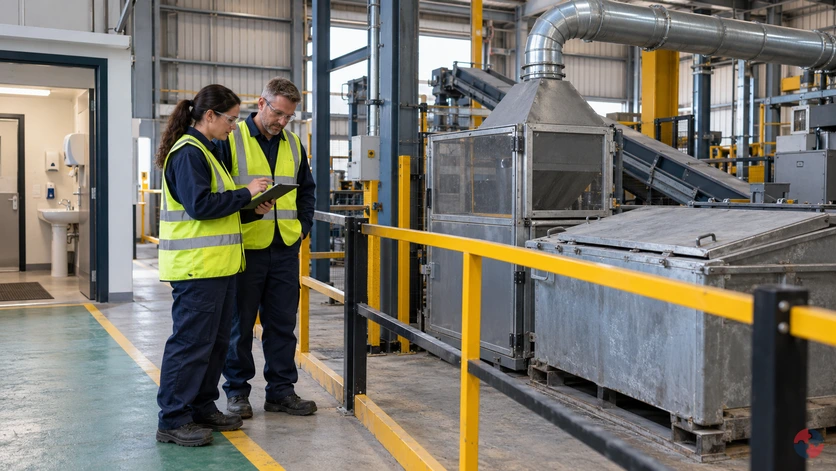
Source control and clean welfare are separate checks
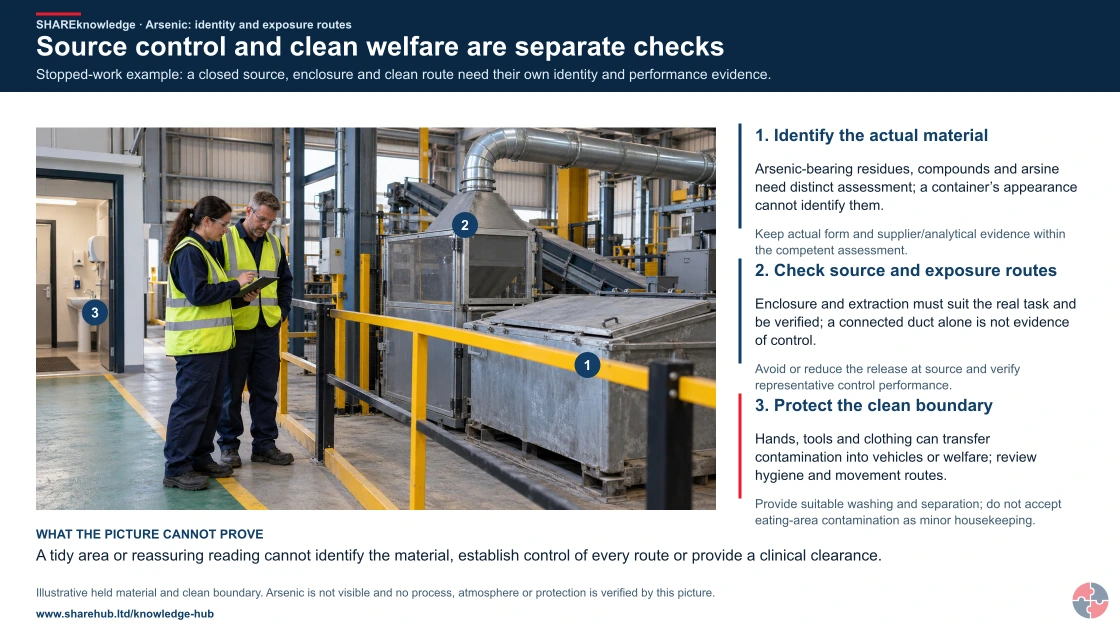
Full written explanation
Stopped-work example: a closed source, enclosure and clean route need their own identity and performance evidence.
- Identify the actual material. Arsenic-bearing residues, compounds and arsine need distinct assessment; a container’s appearance cannot identify them.
- Check source and exposure routes. Enclosure and extraction must suit the real task and be verified; a connected duct alone is not evidence of control.
- Protect the clean boundary. Hands, tools and clothing can transfer contamination into vehicles or welfare; review hygiene and movement routes.
Change the pathway
- Use reliable evidence. Keep actual form and supplier/analytical evidence within the competent assessment.
- Control before exposure. Avoid or reduce the release at source and verify representative control performance.
- Keep welfare clean. Provide suitable washing and separation; do not accept eating-area contamination as minor housekeeping.
Evidence check: A tidy area or reassuring reading cannot identify the material, establish control of every route or provide a clinical clearance.
Chemical form, health mechanism and primary references
Primary references: HSE INDG441 — arsenic/compound work-control context; arsine is excluded · HSE COSHH assessment — actual substance, process, people and exposure routes · UKHSA arsenic general information — chemical form and environmental context
Open the complete HD image (new tab)Download image

Chemical form, health mechanism and primary references
Primary references: HSE INDG441 — arsenic/compound work-control context; arsine is excluded · HSE COSHH assessment — actual substance, process, people and exposure routes · UKHSA arsenic general information — chemical form and environmental context
Follow contamination beyond the workface. Plan low-dust handling, tools, washing, clean welfare and waste movement so the sampling task does not transfer material to vehicles or eating areas. Unknown identity or an uncontrolled route is a reason to hold and investigate.
Brownfield sampling leaves a clean-area question
Illustrative example. A crew can control soil disturbance but has no agreed boundary for dirty tools and welfare access.
Decision. Hold the incomplete method and establish the contamination, hygiene and waste route before sampling.
Evidence to check. Check material analysis, dust generation, workface conditions, tool cleaning arrangements and the separation of clean welfare.
Hold or escalation point. No food, vehicle or welfare contamination accepted as a minor housekeeping issue; unknown form goes to competent assessment.
Follow-up. Review the whole sampling-to-waste cycle and verify the clean boundary remains effective.
What should each role do first?
First establish whether arsenic is present, whether the task can release it, and whether the worker can stay outside the exposure route.
Is Arsenic in This Task
Two linked parts · 6 questions. Open Part 2 to complete the route.

Continue to questions 4–6 · Part 2 of 2


Read this visual as text
- Start: A planned or changed task could disturb a chemical, residue, soil, alloy, treated wood or process emission.
- Question 1: Is material identity and composition supported by reliable evidence? Decision owner: Competent substance assessor / occupational hygienist.
- YES: The required evidence or condition is confirmed. CONTINUE → QUESTION 2.
- NO / UNKNOWN — HOLD: Hold unknown soil, residue, treated wood or process material for competent information or sampling. HOLD → REPEAT QUESTION 1 AFTER CORRECTION.
- Question 2: Could the method release dust, fume or liquid contamination? Decision owner: Competent substance assessor / occupational hygienist.
- No supported route: Record the basis and maintain suitable ordinary controls. OUTCOME → RECORD AND HAND OVER.
- Yes: Assess form, exposure routes and affected people. CONTINUE → QUESTION 3.
- Unknown: Keep the task held until the release mechanism is assessed. HOLD → OWNER RESOLVES BEFORE RESUMING.
- Question 3: Has elimination or redesign been considered first? Decision owner: Competent substance assessor / occupational hygienist.
- YES: The required evidence or condition is confirmed. CONTINUE → QUESTION 4.
- NO / UNKNOWN — HOLD: Assess a method that avoids or reduces disturbance before relying on PPE. HOLD → REPEAT QUESTION 3 AFTER CORRECTION.
- Question 4: Are enclosure, extraction and contamination controls verified? Decision owner: Competent substance assessor / occupational hygienist.
- YES: The required evidence or condition is confirmed. CONTINUE → QUESTION 5.
- NO / UNKNOWN — HOLD: Stop for failed source control or unassessed nearby tasks. HOLD → REPEAT QUESTION 4 AFTER CORRECTION.
- Question 5: Are clean welfare, hygiene and contractor interfaces controlled? Decision owner: Competent substance assessor / occupational hygienist.
- YES: The required evidence or condition is confirmed. CONTINUE → QUESTION 6.
- NO / UNKNOWN — HOLD: Resolve contaminated clean areas and unplanned work interfaces. HOLD → REPEAT QUESTION 5 AFTER CORRECTION.
- Question 6: Release only the assessed task Decision owner: Competent substance assessor / occupational hygienist.
- ACTION: Record the control evidence, owner, worker briefing and stop conditions. OUTCOME → RECORD AND HAND OVER.
- Outcome: A signed task assessment and safe-start release, or a controlled hold pending identification.
- Stop and escalation boundary: Stop for unknown material, unverified composition, failed source control, contaminated welfare or an unplanned contractor interface.
| Role | First decision and action |
|---|---|
| Worker | Check the briefing, source controls and clean/dirty route. Stop for unknown dust, failed extraction, unsafe RPE or symptoms. |
| Supervisor | Confirm material identity, approved method, enclosure/extraction, welfare, waste and emergency route before release of work. |
| Manager or purchaser | Obtain surveys and supplier data; remove or substitute arsenic where feasible; fund competent hygiene and occupational-health input. |
| Maintainer or cleaner | Treat filters, ducts and settled deposits as potentially contaminated; isolate equipment and use an approved cleaning method. |
| Hygiene, occupational health or safety specialist | Set a representative monitoring strategy, interpret results and symptoms, advise surveillance, and specify restart evidence. |
What are the key facts about arsenic poisoning?
Inorganic arsenic can enter by inhalation or ingestion and must be controlled at source. Suspected poisoning requires immediate clinical assessment, not a wait for workplace monitoring.
This is general workplace guidance, not medical, legal or HR advice. Suspected poisoning, possible toxic ingestion, significant acute inhalation or contamination, or symptoms after exposure require immediate clinical assessment. Call 999 for serious symptoms. Do not wait for symptoms, urine results or an investigation.
What symptoms should be noticed early?
- Nausea, vomiting, diarrhoea, abdominal pain, headache, weakness, confusion or unusual tiredness after a suspected exposure.
- Coughing, throat irritation or respiratory discomfort after dust, fume or process emissions.
- Tingling, numbness, skin darkening, thickened skin on palms or soles, persistent dermatitis or unexplained nail changes after repeated exposure.
What should happen immediately?
- Stop the work, move away from the exposure source and prevent further spread of contaminated dust, fume or clothing.
- Wash hands and exposed skin, remove contaminated clothing safely and use the site exposure-response procedure.
- Preserve task, substance, monitoring and safety data sheet information so the exposure can be assessed properly.
When is medical assessment needed?
- Symptoms after a known or suspected arsenic exposure, especially gastrointestinal, neurological, breathing or persistent skin symptoms.
- Possible ingestion, contaminated cuts, high dust or fume exposure, uncontrolled release or exposure affecting more than one person.
- Any occupational-health concern where biological monitoring, clinical review or specialist advice may be needed.
The form of arsenic matters
Inorganic arsenic compounds are generally the main occupational concern, while organic arsenic from some foods is a different context and can affect how biological-monitoring results are interpreted.
Dust and fume are not just nuisance exposure
Arsenic-containing dust or fume can be inhaled into the respiratory tract and can also settle onto gloves, tools, phones, welfare areas and vehicles, creating ingestion risk.
Hand-to-mouth transfer is a serious route
Workers may swallow arsenic unintentionally if contaminated hands, gloves or sleeves touch food, cigarettes, drinks, chewing gum or the face.
Chronic signs can develop gradually
Skin changes, thickened skin, pigmentation changes, nerve symptoms and respiratory effects may not appear immediately, which is why routine reporting and surveillance decisions matter.
Cancer risk changes the control standard
Because inorganic arsenic is carcinogenic, the aim is to reduce exposure as far as reasonably practicable, not merely to work up to a numeric limit.
Medical confidentiality still matters
Exposure records, health-surveillance results and biological-monitoring data must be managed carefully and shared only through appropriate occupational-health and data-protection arrangements.
What is arsenic poisoning?
Arsenic poisoning is toxic harm caused when arsenic or arsenic compounds enter the body in sufficient quantity or over sufficient time.
Arsenic is a naturally occurring element that may be present in ores, industrial residues, contaminated land, old materials, treated timber, some alloys, pigments, process chemicals and specialist manufacturing environments. In occupational health, the most important distinction is often between inorganic arsenic compounds, which are the main toxic and carcinogenic concern, and other arsenic forms that may have different toxicology or interpretation issues.
The phrase poisoning covers both short-term and long-term effects. Acute exposure may cause gastrointestinal symptoms, airway irritation, neurological effects and serious systemic illness. Repeated or chronic exposure may damage the skin and nerves and increase cancer risk. The practical workplace question is not whether arsenic is famous for being toxic, but whether the real task can generate airborne dust, fume, contaminated surfaces or contaminated clothing that allows uptake into the body.
Arsenic exposure control is an occupational hygiene discipline. It requires identifying the material, understanding how the work changes it, preventing dust or fume at source, separating contaminated and clean areas, controlling hygiene, providing suitable respiratory protective equipment where residual risk remains, and checking whether the controls are actually limiting exposure.
| Aspect | Details | Why it matters |
|---|---|---|
| Condition name | Arsenic poisoning or arsenic exposure-related toxic effect. | The term covers acute illness and chronic effects after occupational exposure to arsenic or arsenic compounds. |
| Main occupational concern | Inorganic arsenic and inorganic arsenic compounds. | These are associated with serious toxic effects and cancer risk. |
| Main exposure routes | Inhalation of dust or fume and ingestion from contaminated hands or surfaces. | Controls must cover both the air people breathe and the contamination they carry. |
| Main affected systems | Skin, peripheral nerves, respiratory tract, gastrointestinal system, liver, kidneys, cardiovascular system and cancer-related organs. | A narrow focus on immediate irritation can miss long-latency harm. |
| Exposure pattern | May be acute after a release or high exposure, or chronic after repeated smaller exposures. | Monitoring and health-surveillance decisions should reflect both patterns. |
| Control standard | Prevent exposure where possible and control remaining exposure under COSHH. | The presence of a workplace exposure limit does not remove the need for good design and hygiene. |
Where can occupational arsenic exposure happen?
Occupational exposure can occur wherever arsenic-containing materials are mined, processed, heated, disturbed, cleaned, maintained, disposed of or encountered in contaminated environments.
Modern workplaces rarely use arsenic casually, but exposure can still arise in specialist industries and legacy environments. Smelting, refining, ore processing and some metal operations may generate arsenic-containing dust or fume. Electronics and semiconductor work may involve arsenic compounds such as gallium arsenide. Contaminated land and demolition work can expose people to historical industrial contamination or residues in buildings and ground.
The highest-risk tasks are usually those that create airborne material or spread contamination: cutting, grinding, drilling, thermal work, furnace work, filter cleaning, waste handling, sweeping, dry brushing, plant strip-out, soil disturbance and maintenance inside dusty extraction systems. Arsenic is also a risk-management issue for procurement and change control because an unfamiliar material, imported component, legacy stock or subcontracted process can introduce exposure routes that were not in the original risk assessment.
| Workplace or task | Typical arsenic source | How exposure can occur | Higher-risk conditions |
|---|---|---|---|
| Metal smelting and refining | Arsenic impurities in ores, concentrates, slags, dusts or process residues. | Dust and fume from heating, handling, maintenance, cleaning and waste movements. | Poor enclosure, open transfer, dry sweeping, furnace maintenance and weak LEV. |
| Ore processing and mineral work | Arsenic-bearing minerals and contaminated process streams. | Dust from crushing, screening, bagging, sampling or residue handling. | Dry materials, high-energy handling, old equipment and poor housekeeping. |
| Contaminated land and remediation | Historical industrial contamination in soil, Made Ground, waste or demolition residues. | Soil dust, hand contamination, vehicle contamination and transfer into welfare areas. | Dry weather, excavation, stockpiling, inadequate wheel wash and poor decontamination. |
| Demolition and refurbishment | Legacy process buildings, contaminated dust, old coatings, treated timber or residues. | Cutting, breaking out, stripping, cleaning ducts, handling waste or disturbing hidden contamination. | Unknown site history, poor survey information and mixed contractors. |
| Electronics and semiconductor activity | Arsenic compounds such as gallium arsenide in specialist manufacturing or research. | Handling, cutting, grinding, polishing, waste management or maintenance. | Fine particulate generation and poor specialist competence. |
| Chemical, alloy or historic pesticide contexts | Arsenic compounds in specialist processes, legacy stocks or residues. | Decanting, sampling, leaks, damaged containers or waste disposal. | Unlabelled legacy materials and poor chemical inventory control. |
Which forms of arsenic should be distinguished?
The substance form matters because dust, fume, solution, residue, contaminated soil and arsine gas create different exposure routes and control needs.
A good COSHH assessment does not stop at the word arsenic. It identifies the specific compound or material, whether it is inorganic or organic, whether it is present as dust, fume, solution, residue or contaminated soil, and whether the task changes the exposure profile. Heating a material can create fume; abrasive work can create respirable dust; wet handling can reduce airborne dust but may increase contaminated slurry and skin-transfer issues.
Arsine gas deserves particular care. It contains arsenic, but it is not the same exposure pattern as arsenic dust or contaminated soil. Arsine is an acutely toxic gas with distinct emergency and process controls, so it should be assessed separately where it could be generated, for example by reaction between arsenic-containing materials and acids or reducing conditions.
| Form or context | What it means | Exposure concern | Control focus |
|---|---|---|---|
| Inorganic arsenic compounds | The main occupational toxic and carcinogenic concern. | Inhalation, ingestion and chronic health effects. | Substitution, enclosure, dust control, hygiene, monitoring and surveillance decisions. |
| Arsenic-containing dust | Solid particles from cutting, grinding, crushing, soil disturbance or residue handling. | Respirable and inhalable dust plus settled contamination. | Wet methods, LEV, on-tool extraction, segregation, cleaning and RPE. |
| Arsenic fume | Very fine airborne particulate generated by heat or high-temperature process work. | Deep lung deposition and difficult-to-see airborne exposure. | Process enclosure, extraction, hot-work controls and exposure monitoring. |
| Contaminated soil or waste | Arsenic present in ground, Made Ground, waste, slag, ash or demolition residue. | Dust, hand-to-mouth contamination and spread to welfare areas. | Site investigation, dust suppression, hygiene zoning and waste control. |
| Arsenic solutions or residues | Liquids, sludges, wash waters or process residues containing arsenic. | Skin contamination, ingestion and splashes. | Closed handling, bunding, gloves, face protection and decontamination. |
| Arsine gas | A separate arsenic-containing gas hazard. | Severe acute toxicity by inhalation. | Assess separately; use specialist process, detection, emergency and medical arrangements. |
How can arsenic enter the body at work?
Arsenic can enter the body by breathing contaminated dust or fume, swallowing contamination and, in some contexts, contact with contaminated skin or wounds.
Inhalation is the obvious route when dusty or fume-generating work is taking place, but ingestion is often underestimated. A worker can wear a respirator and still swallow arsenic if contaminated gloves touch food, if welfare areas become contaminated, if handwashing is poor, or if dust settles on phones, water bottles or cigarettes. This is why occupational hygiene controls must cover behaviour, layout and housekeeping, not only air sampling.
Skin absorption is usually less dominant for inorganic arsenic than inhalation and ingestion, but skin contact still matters because it can contaminate hands, clothing, wounds and personal items. Skin effects can also be a health outcome. Where biological monitoring is used, the assessor should consider all routes together rather than treating the result as an air-monitoring substitute.
| Route | How exposure happens | Typical harm or concern | Practical controls |
|---|---|---|---|
| Inhalation | Breathing dust or fume from cutting, grinding, heating, smelting, soil disturbance, residues or poor cleaning. | Respiratory irritation, systemic uptake and long-term cancer risk. | Enclosure, LEV, wet suppression, process control, exposure monitoring and suitable RPE. |
| Ingestion | Contaminated hands, gloves, food, drinks, cigarettes, tools, phones or welfare surfaces. | Systemic uptake and acute or chronic toxic effects. | Clean/dirty zoning, handwashing, no eating or drinking in work areas, welfare cleaning and clothing controls. |
| Skin contact | Handling contaminated materials, sludges, soil, residues, PPE or clothing. | Skin irritation, contamination transfer and possible uptake through damaged skin. | Gloves, coveralls, hygiene, contaminated-clothing rules and skin checks. |
| Contaminated wounds | Cuts or abrasions contacting contaminated soil, residues or liquids. | Local contamination and possible uptake. | Cover cuts, use suitable gloves, cleanse wounds and seek medical assessment where contamination is suspected. |
| Secondary contamination | Dust carried into vehicles, welfare, offices or homes on boots, clothing, hair or equipment. | Exposure to workers and others who were not doing the task. | Decontamination, laundry rules, equipment cleaning and site-exit controls. |
| Dietary confounding | Seafood and some foods can affect total urinary arsenic measurements through less toxic organic arsenic forms. | Monitoring results may be misinterpreted if speciation and context are ignored. | Use competent occupational-health or occupational-hygiene interpretation. |
How does arsenic poisoning cause harm?
Arsenic harms the body by interfering with cellular processes, damaging tissues and contributing to long-term disease after repeated exposure.
Follow the material and the contamination boundary
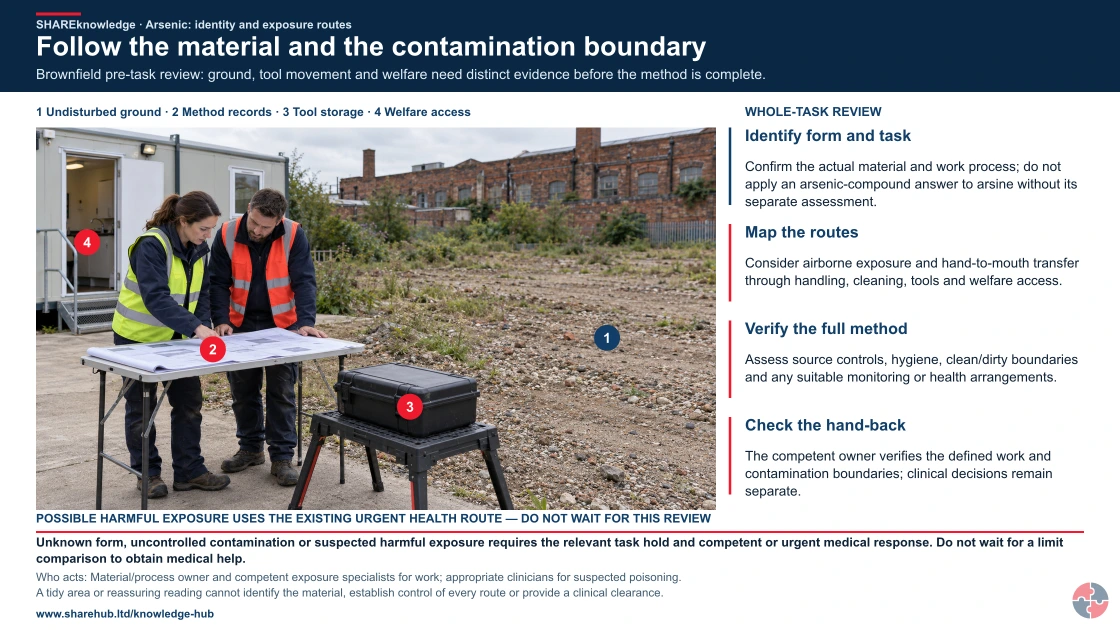
Full written explanation
An illustrative UK brownfield pre-task setting shows normal colleagues reviewing inert material and method records, unexcavated ground, a closed tool-storage case on a separate stand and a separate welfare-cabin doorway. One literal numbered picture key identifies those four physical features. The scene illustrates locations and evidence questions; it does not identify arsenic, contamination, a clean zone or a safe work arrangement. Four unnumbered checks connect the actual material and process to its distinct assessment, the possible airborne and hand-to-mouth routes, the complete source/hygiene/tool/welfare boundary, and the competent work review. Arsine and arsenic compounds remain different assessment questions. Source records, air evidence, surface evidence and individual clinical interpretation cannot substitute for one another. A covered tool case, sink, tidy area or reassuring reading cannot establish material identity, control every route or provide clinical clearance. Suspected harmful exposure goes to the relevant urgent medical route without waiting for routine task review or a limit comparison. The ground is not disturbed and no sample is taken or tested. No dust plume, symptoms, abnormal anatomy, treatment, respirator choice, cleaning, washing, decontamination, disposal, chemical-production or sampling method is shown. The picture grants no work, access, hand-back or fitness permission.
Brownfield pre-task review: ground, tool movement and welfare need distinct evidence before the method is complete.
- Identify form and task. Confirm the actual material and work process; do not apply an arsenic-compound answer to arsine without its separate assessment.
- Map the routes. Consider airborne exposure and hand-to-mouth transfer through handling, cleaning, tools and welfare access.
- Verify the full method. Assess source controls, hygiene, clean/dirty boundaries and any suitable monitoring or health arrangements.
- Check the hand-back. The competent owner verifies the defined work and contamination boundaries; clinical decisions remain separate.
When the evidence does not fit: Unknown form, uncontrolled contamination or suspected harmful exposure requires the relevant task hold and competent or urgent medical response. Do not wait for a limit comparison to obtain medical help.
Who acts: Material/process owner and competent exposure specialists for work; appropriate clinicians for suspected poisoning.
Changed workplace
Metal recovery: Follow the actual residue, handling and cleaning routes, not just the main machine enclosure.
Contaminated land: Include tool, welfare and waste movement in the assessed method; this visual does not teach a sampling technique.
Evidence check: A tidy area or reassuring reading cannot identify the material, establish control of every route or provide a clinical clearance.
Chemical form, health mechanism and primary references
Primary references: HSE INDG441 — arsenic/compound work-control context; arsine is excluded · HSE COSHH assessment — actual substance, process, people and exposure routes · UKHSA arsenic general information — chemical form and environmental context
Open the complete HD image (new tab)Download image

Chemical form, health mechanism and primary references
Primary references: HSE INDG441 — arsenic/compound work-control context; arsine is excluded · HSE COSHH assessment — actual substance, process, people and exposure routes · UKHSA arsenic general information — chemical form and environmental context
Arsenic toxicity is not a simple irritant-only effect. Inorganic arsenic can interfere with enzyme systems, cellular energy processes and tissue function. The body can absorb arsenic through the gastrointestinal tract and, to a lesser degree, through the lungs depending on particle form and solubility. Once absorbed, it can affect multiple systems, which is why symptoms may not fit one neat pattern.
Short-term high exposure can produce gastrointestinal illness and neurological effects. Longer-term occupational exposure is associated with skin changes, peripheral neuropathy and cancer risk. In practical workplace terms, this means that the absence of immediate collapse does not prove control. Routine dust deposits, dirty welfare areas and repeated minor symptoms can be early signs of a system that is allowing uptake over time.
| Health mechanism | Explanation | Workplace meaning |
|---|---|---|
| Systemic toxicity | Absorbed inorganic arsenic can affect cellular function and several organ systems. | The assessment should consider whole-body uptake, not only local irritation. |
| Respiratory exposure | Dust or fume can irritate airways and contribute to internal dose. | Dust control and air monitoring are central where processes generate airborne material. |
| Gastrointestinal effects | Swallowed arsenic can cause nausea, vomiting, diarrhoea and abdominal pain. | Hygiene failures and hand-to-mouth transfer are not minor housekeeping issues. |
| Skin effects | Repeated exposure can be associated with pigmentation changes, thickened skin and keratotic lesions. | Skin reporting and health-surveillance decisions may be needed for exposed groups. |
| Peripheral neuropathy | Longer-term or significant exposure may affect peripheral nerves. | Tingling, numbness or weakness should trigger review and appropriate health input. |
| Carcinogenic effect | Inorganic arsenic is recognised as a human carcinogen. | Exposure should be reduced as far as reasonably practicable and not managed only against a limit number. |
What symptoms and health effects are linked with arsenic exposure?
Symptoms can include acute gastrointestinal and neurological effects, respiratory irritation, skin changes, nerve symptoms and long-term cancer risk.
The symptom picture depends on dose, duration, route and chemical form. A one-off significant exposure may produce illness quickly, while repeated lower exposure may first appear as skin change, nerve symptoms or unexplained irritation. Managers should not try to diagnose arsenic poisoning themselves, but they must have a system that treats symptoms as potential exposure evidence.
The best workplace response is early reporting, medical or occupational-health referral where appropriate, and an investigation that asks what exposure route was possible. If several workers report irritation or similar symptoms, the site should treat that as a potential control failure until proven otherwise.
| Effect type | Possible signs or outcomes | What it may indicate | Workplace response |
|---|---|---|---|
| Acute gastrointestinal effects | Nausea, vomiting, diarrhoea and abdominal pain after exposure. | Possible significant ingestion or systemic uptake. | Stop exposure, collect exposure information and arrange medical assessment. |
| Respiratory irritation | Cough, throat irritation, nasal irritation or breathing discomfort after dust or fume exposure. | Airborne control may be inadequate. | Review dust/fume control, LEV, RPE, task method and monitoring. |
| Skin changes | Pigmentation change, thickening of skin on palms or soles, dermatitis or keratotic lesions. | Possible chronic exposure or skin contamination. | Review hygiene, clothing, glove use and health-surveillance arrangements. |
| Neurological symptoms | Tingling, numbness, weakness or peripheral neuropathy symptoms. | Possible systemic effect requiring competent medical review. | Refer for medical assessment and investigate exposure history. |
| Nail or visible chronic signs | Lines or unusual nail changes may be reported in some cases. | Potential marker of systemic exposure but not diagnostic by itself. | Do not diagnose on site; record and refer appropriately. |
| Cancer risk | Long-latency risk, particularly associated with inorganic arsenic exposure. | Control must focus on prevention and lifetime exposure reduction. | Reduce exposure as far as reasonably practicable and maintain exposure records. |
What should happen after suspected arsenic exposure?
Stop the release if safe, leave the contaminated area and prevent others entering. Suspected poisoning or significant acute exposure needs immediate medical assessment; call 999 for collapse, breathing difficulty, seizures or other serious illness.
Suspected Exposure Response
Two linked parts · 6 questions. Open Part 2 to complete the route.

Continue to questions 4–6 · Part 2 of 2


Read this visual as text
- Start: A worker reports a spill, contaminated clothing, possible ingestion, symptoms or uncontrolled dust/fume.
- Question 1: Leave and isolate safely Decision owner: Competent substance assessor / occupational hygienist.
- ACTION: Warn others and keep untrained helpers out of contamination. CONTINUE → QUESTION 2.
- Question 2: Is there collapse, severe breathlessness, seizure or serious illness? Decision owner: Emergency services.
- YES — STOP / REFER: Call 999 immediately and follow the emergency plan. STOP / REFER → APPROPRIATE RESPONSE.
- NO: No such warning is identified; continue the remaining checks. CONTINUE → QUESTION 3.
- UNKNOWN — PROTECT FIRST: Protect people and hold the affected work. Obtain the responsible specialist’s assessment; do not assume the warning is absent. HOLD → OWNER RESOLVES BEFORE RESUMING.
- Question 3: Is toxic ingestion or significant acute poisoning suspected? Decision owner: Clinical service.
- YES — STOP / REFER: Arrange immediate emergency clinical assessment; do not wait for symptoms or urine results. STOP / REFER → APPROPRIATE RESPONSE.
- NO: No such warning is identified; continue the remaining checks. CONTINUE → QUESTION 4.
- UNKNOWN — PROTECT FIRST: Protect people and hold the affected work. Obtain the responsible specialist’s assessment; do not assume the warning is absent. HOLD → OWNER RESOLVES BEFORE RESUMING.
- Question 4: Has an uncertain lesser exposure received prompt local clinical advice? Decision owner: Competent substance assessor / occupational hygienist.
- YES: The required evidence or condition is confirmed. CONTINUE → QUESTION 5.
- NO / UNKNOWN — HOLD: Use the current nation-specific route; occupational follow-up does not replace urgent care. HOLD → REPEAT QUESTION 4 AFTER CORRECTION.
- Question 5: Provide safe first aid and handover Decision owner: Competent substance assessor / occupational hygienist.
- ACTION: Follow trained advice for skin/eye contamination; provide substance and timing facts. Do not induce vomiting. CONTINUE → QUESTION 6.
- Question 6: Are recovery, investigation and restart separately authorised? Decision owner: Competent substance assessor / occupational hygienist.
- YES: The required evidence or condition is confirmed. OUTCOME → RECORD AND HAND OVER.
- NO / UNKNOWN — HOLD: Keep the area held until competent cleanup and control verification are accepted. HOLD → REPEAT QUESTION 6 AFTER CORRECTION.
- Outcome: Person receives appropriate clinical advice; area is contained, decontaminated, investigated and formally released.
- Stop and escalation boundary: Do not induce vomiting, wait for symptoms or urine results, substitute occupational health for emergency care, send an untrained rescuer into contamination or reopen before investigation.
For suspected toxic swallowing, significant inhalation or other suspected acute poisoning, get emergency assessment now: call 999 if seriously ill or if an ambulance is needed, otherwise go to an emergency department with safe transport as directed by a clinician. In Scotland, NHS inform advises 999 when a poisonous substance is known to have been swallowed; in Northern Ireland, nidirect directs an apparently well person to a GP or out-of-hours GP immediately and to an emergency department if prompt advice is unavailable. If harm is uncertain and there is no suspected poisoning, seek prompt advice: NHS 111 in England or Wales, NHS 24 on 111 in Scotland, or a GP/out-of-hours GP in Northern Ireland. Do not wait for symptoms, a urine result or the workplace investigation. Occupational health supports follow-up, not first-line emergency triage. Give clinicians the compound identity, safety data sheet, route, time and likely amount; only clinicians diagnose, interpret tests or prescribe treatment. Do not induce vomiting or give food or drink after possible ingestion unless a clinician directs it. Follow the site emergency plan.
| Scenario | Immediate worker response | Escalation |
|---|---|---|
| Dust or fume inhaled | Move to fresh air without entering a contaminated zone to rescue another person. Keep others out. | Call 999 for breathing difficulty, collapse or serious illness. Suspected toxic or significant acute inhalation needs immediate clinical assessment even before symptoms; uncertain lesser exposure needs prompt nation-specific clinical advice. |
| Skin or clothing contaminated | Remove contaminated clothing carefully and wash exposed skin with water, avoiding spread into clean areas. | Suspected toxic or significant contamination, contaminated wounds or symptoms need immediate medical assessment; call 999 for serious illness. For uncertain lesser contact, seek prompt clinical advice. |
| Eyes splashed or dusty | Begin prompt gentle irrigation with water; remove contact lenses if easy. Do not delay irrigation. | Seek immediate medical assessment for a suspected toxic or corrosive splash, pain or injury; continue irrigation while help is arranged. Call 999 for serious illness. |
| Possible swallowing | Stop work, leave the area and avoid further ingestion. Do not induce vomiting. | Treat suspected toxic ingestion as an immediate medical emergency even if the person looks well: call 999 if seriously ill or an ambulance is needed; otherwise obtain emergency-department assessment without delay. NHS inform in Scotland says call 999 when a poisonous substance is known to have been swallowed. In Northern Ireland, an apparently well person should receive immediate GP/out-of-hours advice and attend an emergency department if this is not quickly available. |
| Site and coworkers | Isolate the release; retain the product and exposure details; arrange controlled decontamination. | Make people safe and obtain clinical help before investigating. The supervisor and specialist assess reportability under the relevant GB or NI RIDDOR regime before a controlled restart. |
UKHSA incident-management material is for trained responders and clinicians. This page deliberately does not give chelation, laboratory cut-offs or hospital treatment instructions.
How can the hierarchy of controls reduce occupational arsenic exposure and poisoning risk?
Arsenic exposure should be controlled by eliminating or reducing the hazard first, then using engineering, procedural and PPE controls for remaining risk.
ERICPD is useful because it stops the assessment jumping straight to a respirator. For arsenic, the strongest controls are usually material substitution, avoiding disturbance, enclosing the process, using wet methods, extracting dust at source and physically separating contaminated and clean areas. PPE and respiratory protective equipment are important, but they sit on top of good control design rather than replacing it.
The hierarchy should be applied separately to routine work, maintenance, cleaning, waste handling and emergency or abnormal tasks. A process may be well enclosed during production but expose workers during filter changes or duct cleaning. A remediation job may control excavation dust but fail at welfare, boot cleaning or vehicle movements. Those differences should appear clearly in the COSHH assessment and risk register.
For sampling known arsenic-bearing soil, first ask whether the design can avoid disturbing that area or use existing information. A different sample location or non-intrusive method may substitute only if it answers the technical question. If disturbance is necessary, a competent hygienist specifies containment, dust suppression, suitable tools and controlled sample transfer for the actual material; these are engineering measures within ERICPD Isolate/Control. The field lead checks ground information, equipment condition, containment and handwashing before starting. A respirator and gloves are selected for assessed residual routes, with fit and compatibility checked, but cannot compensate for uncontrolled dust or contaminated eating areas.
Work zoning, hygiene instruction, sampling supervision and waste transfer are administrative layers. The hygienist decides the appropriate air or surface evidence and the relevant averaging period; an eight-hour WEL is neither a skin-contact clearance nor a permission to create a short dust cloud. ERICPD Discipline means checking the controls, maintaining equipment and learning from unexpected deposits. If unknown material appears, suppression fails, dust reaches others or a worker develops concerning symptoms, stop disturbance, restrict access and use the site exposure and medical escalation route before any restart.
How can the ERICPD hierarchy of controls reduce occupational arsenic exposure and poisoning risk?

| ERICPD level | What it means for arsenic | Practical workplace examples | Assurance evidence |
|---|---|---|---|
| Eliminate | Remove arsenic-containing materials or avoid tasks that disturb them where reasonably practicable. | Use alternative materials, avoid dry cutting, remove legacy stock, design out manual handling of residues. | Design review, procurement standard, substitution record and change-control approval. |
| Reduce | Reduce the amount, concentration, duration, number of people exposed and dust-generating energy. | Use smaller batches, pre-clean plant, dampen material, shorten exposure time and restrict access. | Task plan, exposure group list, permit controls and supervisor sign-off. |
| Isolate | Separate people from arsenic sources and contaminated areas. | Enclosed process, glove box, segregated remediation area, exclusion zone, sealed waste route and clean/dirty welfare split. | Barrier inspection, access logs, negative-pressure or enclosure checks and contamination surveys. |
| Control | Capture or suppress dust and fume at source. | Local exhaust ventilation, on-tool extraction, wet methods, mist suppression, enclosed transfer, suitable industrial vacuum and no dry sweeping. | LEV thorough examination, airflow checks, maintenance records and exposure monitoring. |
| PPE | Use personal protection for residual exposure or short tasks where higher controls cannot fully prevent contact. | Suitable RPE, face-fit testing, disposable coveralls, gloves, eye protection, boot covers and changing facilities. | PPE assessment, RPE records, training, inspection and disposal/laundry records. |
| Discipline | Use rules, supervision, hygiene, cleaning and review to keep controls working. | No eating or drinking in dirty areas, handwashing, contaminated clothing rules, toolbox talks, audits and stop-work authority. | Inspection findings, behaviour observations, welfare checks, incident learning and management review. |
How can the ISO 45001 hierarchy of controls reduce occupational arsenic exposure and poisoning risk?

| ESEAP control level | What it means for arsenic | Practical workplace examples | Assurance evidence |
|---|---|---|---|
| Elimination / Substitution | Remove arsenic-containing materials or avoid tasks that disturb them where reasonably practicable. | Use alternative materials, avoid dry cutting, remove legacy stock, design out manual handling of residues. | Design review, procurement standard, substitution record and change-control approval. |
| Engineering controls / Administrative controls | Reduce the amount, concentration, duration, number of people exposed and dust-generating energy. | Use smaller batches, pre-clean plant, dampen material, shorten exposure time and restrict access. | Task plan, exposure group list, permit controls and supervisor sign-off. |
| Engineering controls / Administrative controls | Separate people from arsenic sources and contaminated areas. | Enclosed process, glove box, segregated remediation area, exclusion zone, sealed waste route and clean/dirty welfare split. | Barrier inspection, access logs, negative-pressure or enclosure checks and contamination surveys. |
| Engineering controls / Administrative controls | Capture or suppress dust and fume at source. | Local exhaust ventilation, on-tool extraction, wet methods, mist suppression, enclosed transfer, suitable industrial vacuum and no dry sweeping. | LEV thorough examination, airflow checks, maintenance records and exposure monitoring. |
| PPE | Use personal protection for residual exposure or short tasks where higher controls cannot fully prevent contact. | Suitable RPE, face-fit testing, disposable coveralls, gloves, eye protection, boot covers and changing facilities. | PPE assessment, RPE records, training, inspection and disposal/laundry records. |
| Administrative controls | Use rules, supervision, hygiene, cleaning and review to keep controls working. | No eating or drinking in dirty areas, handwashing, contaminated clothing rules, toolbox talks, audits and stop-work authority. | Inspection findings, behaviour observations, welfare checks, incident learning and management review. |
Three evidence records answer different questions
In this soil-handling task, a competent assessment has identified an arsenic concern. The scene alone cannot establish contamination. No numerical result is invented in these examples.
Air: what was breathed during this task?
Record: breathing-zone sampling during the stated activity, with task, time, method and controls documented.
Interpretation: the occupational hygienist considers representativeness and the correct chemical form and limit. A result for that period cannot establish skin/ingestion control or clear every future task.
Contamination: where can material travel?
Record: a planned check of work surfaces and clean/dirty boundaries after soil handling.
Interpretation: assess spread, cleaning and hand-to-mouth opportunities. Surface evidence is not an inhaled dose, a measure of absorbed dose or a diagnosis.
Biological sample: what may have entered the body?
Record: a sample arranged and interpreted through occupational health, with timing and relevant exposure history.
Interpretation: the clinician considers arsenic species and relevant non-work sources. A total urine result alone cannot identify the occupational cause or diagnose poisoning.
Use the records together without exchanging their meanings. The responsible assessor checks the task and control evidence; occupational health handles individual clinical interpretation. Unresolved exposure questions keep the appropriate task review open.
How should exposure limits and monitoring be used?
The 2020 EH40 edition lists 0.1 mg/m3 as As over eight hours for arsenic and its compounds except arsine; HSENI approves that edition for Northern Ireland COSHH. This is not a safe target.
Air, contamination and uptake are different questions


Read this visual as text
- AIR EXPOSURE: Representative personal air sampling helps assess airborne exposure for the actual task.
- SPREAD AND HYGIENE: Check contamination of hands, surfaces, clothing and welfare routes, including ingestion risk.
- BODY UPTAKE: Occupational-health interpretation of biological monitoring considers species, timing and non-work sources such as seafood.
What Does Monitoring Tell Us
Two linked parts · 6 questions. Open Part 2 to complete the route.

Continue to questions 4–6 · Part 2 of 2


Read this visual as text
- Start: A COSHH assessment or incident raises uncertainty about arsenic exposure and control effectiveness.
- Question 1: Which question must the evidence answer? Decision owner: Competent substance assessor / occupational hygienist.
- Airborne exposure: Use competent representative personal sampling for the task. CONTINUE → QUESTION 2.
- Contamination spread: Check affected surfaces, clothing and welfare routes. CONTINUE → QUESTION 2.
- Body uptake / health: Use occupational-health-led biological interpretation or clinical assessment as appropriate. CONTINUE → QUESTION 2.
- UNKNOWN / NONE FITS: Keep affected work or the decision held. The named owner resolves the facts; immediate protection takes priority. HOLD → OWNER RESOLVES BEFORE RESUMING.
- Question 2: Are form, task, timing and sampling representativeness established? Decision owner: Competent substance assessor / occupational hygienist.
- YES: The required evidence or condition is confirmed. CONTINUE → QUESTION 3.
- NO / UNKNOWN — HOLD: Resolve an unsuitable sample or unrecorded exposure before interpreting it. HOLD → REPEAT QUESTION 2 AFTER CORRECTION.
- Question 3: Are applicable jurisdiction and reference criteria confirmed? Decision owner: Competent substance assessor / occupational hygienist.
- YES: The required evidence or condition is confirmed. CONTINUE → QUESTION 4.
- NO / UNKNOWN — HOLD: Check the current GB or NI basis and competent interpretation. HOLD → REPEAT QUESTION 3 AFTER CORRECTION.
- Question 4: Have non-work contributions and arsenic species been considered for urine evidence? Decision owner: Competent substance assessor / occupational hygienist.
- YES: The required evidence or condition is confirmed. CONTINUE → QUESTION 5.
- NO / UNKNOWN — HOLD: Do not equate a total result with occupational dose or diagnosis. HOLD → REPEAT QUESTION 4 AFTER CORRECTION.
- Question 5: Have results been considered alongside actual controls and symptoms? Decision owner: Competent substance assessor / occupational hygienist.
- YES: The required evidence or condition is confirmed. CONTINUE → QUESTION 6.
- NO / UNKNOWN — HOLD: One low air result does not clear every exposure route. HOLD → REPEAT QUESTION 5 AFTER CORRECTION.
- Question 6: Act and follow up Decision owner: Competent substance assessor / occupational hygienist.
- ACTION: Record interpretation, control actions, privacy limits and further evidence needed. OUTCOME → RECORD AND HAND OVER.
- Outcome: Documented interpretation, corrective controls and follow-up; or a hold while evidence is incomplete.
- Stop and escalation boundary: Do not call a worker safe from one low air result or equate total urine arsenic with diagnosis. HSENI approves EH40 2020 for NI COSHH, but verify the current edition and site-specific interpretation before reliance.
EH40 (January 2020) marks this entry as carcinogenic. Under GB COSHH, exposure to carcinogens must also be reduced as low as reasonably practicable. Arsine has a separate EH40 entry and its hazard must not be folded into this one. HSENI states that the 2020 fourth edition of EH40 is approved for use with COSHH (NI) 2003, so the same arsenic entry applies through that separate NI route. A named NI legal and occupational-hygiene reviewer must verify current edition and application before publication or site-specific compliance reliance.
Worked interpretation: If representative personal air samples showed 0.20 mg/m3 for two hours and 0.03 mg/m3 for six hours, the illustrative eight-hour time-weighted average would be (2 x 0.20 + 6 x 0.03) / 8 = 0.0725 mg/m3. This illustrative average is below the 0.1 mg/m3 entry used in GB and approved for NI, but the peak task still calls for source-control review, carcinogen ALARP analysis and a check for ingestion or skin contamination. Do not infer actual exposure from a single static sample or assume zero exposure during unmeasured periods.
| Question | Appropriate evidence | Limit |
|---|---|---|
| Is airborne control effective? | Task-based personal air samples and representative eight-hour interpretation by a competent hygienist. | Air results do not measure swallowed contamination. |
| Is contamination spreading? | Welfare inspection, housekeeping checks and targeted surface samples where useful. | A clean-looking surface is not proof of absence. |
| Is arsenic entering the body? | Occupational-health-led urinary testing and speciation where indicated. | Seafood can raise total urinary arsenic; timing, species and clinical context matter. |
When are health surveillance and biological monitoring appropriate?
Decide health surveillance from the COSHH risk assessment, the likelihood of exposure and whether early adverse effects can be detected; arrange the programme with competent occupational-health advice.
HSE's 2013 arsenic leaflet expects exposed workers' health to be monitored by an occupational-health professional, including consideration of skin and urine findings. The exact programme, timing and clinical tests must fit the task and current law; this page sets no universal testing interval or action value. A worker's skin changes, tingling, persistent gastrointestinal or respiratory symptoms warrant medical review, not a site diagnosis. Urinary arsenic can indicate recent uptake, but seafood-derived organic arsenic can distort total results; an occupational-health professional may request speciation and interpret the result privately.
Exposure monitoring measures contact or uptake; health surveillance looks for health effects. Neither replaces source control. Keep individual health records confidential, share fitness or control recommendations on a need-to-know basis, and act on group trends. NI dutyholders should use HSENI's health and medical surveillance guidance under COSHH (NI) regulation 11.
Which legal duties apply in Great Britain and Northern Ireland?
Great Britain uses COSHH 2002 and HSE EH40; Northern Ireland uses its separate COSHH (NI) 2003 and HSENI-approved EH40 2020. The arsenic and compounds except arsine entry is 0.1 mg/m3 as As over eight hours in both routes, subject to current-edition verification and named specialist review.
| Jurisdiction | Duty and decision | Evidence |
|---|---|---|
| Great Britain | COSHH 2002: assess, prevent or adequately control exposure, maintain and use controls, monitor and surveil where required, inform/train and plan emergencies. Keep carcinogen exposure ALARP as well as below the WEL. | COSHH assessment, source-control design, monitoring, LEV records, hygiene checks, training and incident plan. Official source |
| Northern Ireland | COSHH (NI) 2003 has its own assessment, control, monitoring, surveillance, information and emergency provisions; HSENI states carcinogen exposure must be ALARP. HSENI approves EH40 2020 for NI COSHH; use its 0.1 mg/m3 as As eight-hour entry for arsenic and compounds except arsine, subject to current-edition and specialist verification. | NI-specific assessment, HSENI reference, monitoring plan, maintenance, training and health-surveillance decision. Official source |
| GB or NI | Assess injury, dangerous occurrence or occupational disease reporting under the relevant RIDDOR regime; arsenic exposure alone is not automatically reportable. | Incident facts, diagnosis where required, statutory criteria and report decision. GB source NI source |
| Four nations | Classify contaminated waste and follow the jurisdiction's waste duty-of-care and hazardous-waste rules; do not infer that all arsenic-bearing soil is legally hazardous without classification. | Analysis, waste classification, authorised carrier and facility, movement records. Official source |
Product supply, classification and labelling duties are separate from workplace-use COSHH duties. Confirm the actual substance and current safety data sheet. ISO 45001 can support a management system but is not a substitute for either jurisdiction's law.
What should be checked before, during and after arsenic work?
Release work only when the material, exposure route, containment, hygiene, monitoring and emergency arrangements have been checked for that task.
| Stage | Check and hold point | Evidence |
|---|---|---|
| Before | Confirm compound and survey/SDS; avoid or redesign dusty work; verify enclosure, extraction, washing, clean/dirty route, RPE and waste plan. Hold for unknown material or absent controls. | Approved COSHH assessment, briefing, inspection and specialist release. |
| During | Watch for escaping dust, failed extraction, damaged seals, contaminated gloves or food areas, changed material and symptoms. Stop and isolate on failure. | Supervisor observations, defect log, monitoring and worker reports. |
| After | Clean without re-aerosolising dust, decontaminate people and tools, segregate waste, review monitoring and close defects before hand-back. | Clearance/cleaning record, waste paperwork, exposure record and restart approval. |
How should arsenic appear in a risk register?
Arsenic should appear as a specific exposure and contamination risk, with named controls, owners, monitoring evidence and restart criteria.
A useful risk register does not say only 'arsenic - toxic'. It describes where arsenic is present, how the work could release it, who could inhale or swallow it, how contamination could spread, what prevents exposure and how the organisation checks those controls. It should separate routine work from abnormal work such as cleaning, maintenance, waste removal and emergency response.
The register should also connect occupational hygiene and management arrangements. If the control is local exhaust ventilation, the assurance evidence is inspection, maintenance, thorough examination and exposure monitoring. If the control is welfare segregation, the evidence is site layout, cleaning, worker behaviour and contamination checks. If biological monitoring is used, the register should show how results lead back to exposure-control improvement.
| Risk scenario | Exposure route | Critical controls | Assurance evidence |
|---|---|---|---|
| Dry cutting or grinding arsenic-containing material | Dust inhalation and settled contamination. | Avoid task, wet cutting, on-tool extraction, exclusion zone, RPE and cleaning. | Method statement, monitoring, RPE records, inspection and supervisor sign-off. |
| Smelting, heating or hot work on contaminated material | Fume inhalation and process-residue contact. | Process enclosure, LEV, hot-work assessment, air monitoring and competent supervision. | LEV report, exposure results, permit records and maintenance close-out. |
| Contaminated land excavation | Dust inhalation, ingestion and spread to welfare or vehicles. | Site investigation, dust suppression, clean/dirty zoning, welfare, wheel wash and decontamination. | Dust logs, hygiene inspection, monitoring and contractor audit. |
| Cleaning filters, ducts or residues | High dust exposure during maintenance or waste handling. | Permit-to-work, isolation, pre-wetting, controlled vacuuming, RPE and waste controls. | Permit file, waste transfer notes, air monitoring and task observation. |
| Worker symptom report | Possible acute or chronic uptake. | Stop-work review, exposure history, medical assessment and control investigation. | Symptom record, occupational-health note, investigation and corrective actions. |
| Change in product or supplier | Unrecognised arsenic content or different physical form. | Procurement approval, SDS review, lab analysis and COSHH update. | Change-control record, chemical register and briefing evidence. |
How do controls change across real arsenic tasks?
The control method changes with material identity, dust or fume generation, people nearby and the work environment; these cases are examples to adapt after assessment.
Control dust and the hand-to-mouth route


Read this visual as text
- Identify the actual material and form. Low-dust methods, clean welfare routes and handwashing address different parts of exposure; a respirator alone does not prevent contaminated hands reaching food.
- CONTROL THE SOURCE
- SEPARATE CLEAN AND DIRTY
- WASH BEFORE BREAKS
Illustrative contaminated-land task; visible soil does not establish arsenic content. Confirm the actual material and form through the assessment. Low-dust methods, clean welfare routes and handwashing address different exposure pathways; a respirator alone does not prevent contaminated hands reaching food.
Routine ground investigation
Task material and setting: Sampling a known arsenic-bearing brownfield area without contaminating the crew. Soil, hand tools and sample pots; groundworkers and nearby staff; outdoors, wind variable.
People and prerequisites: Groundworkers, nearby staff and a competent supervisor need the site analysis and agreed sampling method.
Before: Mark the small work zone, check wind, low-dust tools, washing and labelled sample containers before opening the ground.
During: Use low-dust sampling and small controlled work zone; cap samples; keep food out; wash and bag waste.
Hold or stop: Hold if sampling opens a different layer; stop for visible uncontrolled dust or failed welfare.
Completion and hand back: Seal samples, clean the zone and tools, and release the area only after the supervisor checks no contamination has spread.
Evidence: Sampling plan and analysis, chain-of-custody form, hygiene check, waste record and supervisor release.
Non-routine smelter filter change
Task material and setting: Remove an arsenic-contaminated filter without releasing deposits. Captured fume residue, filter housing and lifting tools; maintenance team and adjacent operators; enclosed plant room.
People and prerequisites: Trained fitters, adjacent operators and a competent permit issuer need residue identity and an agreed isolation plan.
Before: Confirm the permit, isolation, enclosure, extraction test, waste container and emergency arrangements before opening.
During: Enclose and depressurise; remove intact into sealed container; verify negative-pressure or local capture and decontaminate.
Hold or stop: Hold for isolation sign-off; stop for broken housing, airborne dust or extraction failure.
Completion and hand back: Seal the filter and waste, decontaminate the enclosure and plant, then obtain supervisor hand-back before restart.
Evidence: Residue analysis, permit and isolation sign-off, capture check, waste consignment and hand-back record.
Unknown material during demolition
Task material and setting: Avoid disturbing an unidentified pale deposit while opening a duct. Unknown deposit and duct; demolition crew, cleaners and occupants; occupied refurbishment.
People and prerequisites: Demolition workers, cleaners and occupants may be affected; a competent surveyor or hygienist must identify the deposit.
Before: Check the survey and building history and set a controlled sampling route before disturbing the duct.
During: Do not brush or sweep; isolate the opening and commission analysis before a method is selected.
Hold or stop: Stop immediately if identity or scope differs from the pack; no restart on visual guess.
Completion and hand back: Keep the opening isolated until analysis supports a revised method, briefing and authorised release.
Evidence: Location and photographs, sampling chain and laboratory result, revised assessment and restart authorisation.
Changed alloy or process
Task material and setting: Control hot work when a replacement alloy may contain arsenic. Alloy and hot-cutting process; fabricators and nearby trades; indoor bay.
People and prerequisites: Fabricators and adjacent trades need procurement evidence; a competent hygienist assesses the changed fume route.
Before: Verify supplier composition and SDS, consider a cold alternative, and check source capture before authorising hot work.
During: Choose cold alternative if possible; otherwise contain/extract and monitor the changed task.
Hold or stop: Hold for procurement and hygiene review; stop when composition is unverified or extraction fails.
Completion and hand back: Release the revised process only after the changed control method and nearby-worker interface are confirmed.
Evidence: Supplier declaration, SDS, revised COSHH assessment, extraction check and monitoring decision.
Contractor remediation interface
Task material and setting: Keep a waste contractor from spreading contamination through shared access. Excavated material, skips, vehicles; remediation team, drivers and other trades; shared yard.
People and prerequisites: Remediation workers, drivers and other trades need a competent waste classifier and named interface supervisor.
Before: Agree analysed waste classification, authorised carrier and facility, segregated haul route and cleaning point.
During: Segregate dirty route, cover loads, clean wheels/tools and control handover.
Hold or stop: Hold if carrier/facility or classification is unknown; stop for dust escape to shared area.
Completion and hand back: Inspect shared access and vehicles, hand over a clean route and close any dust-escape action before release.
Evidence: Classification analysis, carrier/facility checks, movement note, cleaning inspection and interface sign-off.
Worker reports symptoms
Task material and setting: Respond to tingling and skin changes in a long-running dusty task. Arsenic-bearing residue; worker and exposure group; repeated shifts.
People and prerequisites: The affected worker and similarly exposed group need a supervisor who can activate immediate clinical triage.
Before: Keep task and substance details available and check the emergency contact route before dusty work starts.
During: Remove worker from further exposure pending clinical advice; preserve task and exposure history; review group controls.
Hold or stop: Stop related work if controls cannot be shown effective; do not diagnose from symptoms.
Completion and hand back: The worker follows clinician advice; the supervisor holds affected work until controls and group exposure are reviewed.
Evidence: Confidential clinical/occupational-health referral, exposure history, control review and authorised restart record.
Abnormal powder spill
Task material and setting: Protect people after a container of arsenic compound breaks. Powder and damaged pack; storekeeper, responders and visitors; indoor store.
People and prerequisites: Storekeepers, visitors and trained responders need the actual SDS, spill plan and emergency contact route.
Before: Verify container identity, segregation, trained response capability and safe evacuation route before handling.
During: Evacuate and isolate; call trained responders; avoid dry sweeping or unprotected entry.
Hold or stop: Stop for unknown quantity, airborne plume or affected people; emergency services where needed.
Completion and hand back: Reopen only after trained cleanup, contamination check, waste classification and supervisor release.
Evidence: Incident and potentially exposed-person log, clinical referral, cleanup check, waste note and restart approval.
How could BuildOut Ltd manage arsenic exposure?

BuildOut Ltd could manage arsenic exposure by treating it as a controlled contaminated-material risk across survey, procurement, task planning, contractor management, hygiene and assurance.
BuildOut Ltd workplace example
BuildOut Ltd is a construction and refurbishment contractor working on older industrial buildings, brownfield plots and demolition interfaces. In this example, arsenic exposure is managed through the pre-construction information pack, site investigation, COSHH register and project risk register before work begins. The company does not wait for operatives to find dusty residues during breaking-out work.
At tender and mobilisation stage, BuildOut checks historical land use, surveys, waste reports, safety data sheets and client information for possible arsenic contamination. If arsenic is identified or suspected, the project team defines exposure groups such as groundworkers, demolition operatives, plant operators, waste handlers, supervisors, cleaners and visitors. The risk register identifies which activities could create dust, which areas are dirty zones, what welfare arrangement is required and whether occupational-hygiene monitoring is needed.
Controls are then built into the method: avoid disturbance where possible, wet down material, use extraction or controlled plant, keep contaminated and clean areas separate, provide washing and changing facilities, ban food and drink in work zones, specify RPE and protective clothing only after higher controls, and control waste movements. Supervisors carry out task observations, welfare checks and housekeeping inspections. The safety adviser reviews monitoring results and worker feedback. Lessons from exposure concerns, failed checks or changing ground conditions are discussed at the project review and used to update the method statement, procurement controls, briefing packs and subcontractor requirements.
| Management element | How BuildOut applies it | Evidence, oversight and improvement |
|---|---|---|
| Assessing and analysing | Reviews site history, surveys, soil reports, SDS information and intrusive-work plans to identify arsenic sources and exposure groups. | Pre-construction information, site investigation, COSHH register, risk register and project exposure map. |
| Planning controls | Designs out disturbance where possible and specifies wet methods, extraction, exclusion zones, clean/dirty routes, hygiene and waste controls. | Construction phase plan, RAMS, COSHH assessment, permit controls and logistics plan. |
| Training and communication | Briefs operatives on arsenic routes into the body, hygiene rules, symptoms, RPE limits, welfare use and stop-work triggers. | Induction, toolbox talk records, supervisor questions, task observations and worker feedback. |
| Contractor management | Requires subcontractors to provide competent RAMS, exposure controls, RPE evidence, waste arrangements and supervision plans before access. | Approved contractor checks, RAMS review, permit records, site audits and close-out meetings. |
| Monitoring and assurance | Uses dust observations, welfare inspections, exposure monitoring and, where appropriate, occupational-health advice or biological monitoring. | Monitoring reports, inspection data, occupational-health recommendations and action trackers. |
| Learning and improvement | Reviews symptoms, contamination findings, non-conformances, audit results and ground-condition changes to improve future work packs. | Lessons-learned log, updated templates, procurement changes, training refreshers and management review. |
How should a release and contaminated waste be managed?
Isolate a release, use trained responders and classify waste before moving it; do not sweep arsenic dust into air or send unknown material to ordinary disposal.
Make people safe first. The supervisor records who may have been exposed, the material and the failed control, arranges medical advice where needed and prevents further access. Cleanup should follow the specific SDS and a competent method using containment and appropriate extraction or wet methods where suitable. Check surrounding clean zones, footwear, tools, vehicles and welfare before reopening. Record the incident and assess reporting requirements in the correct jurisdiction.
Waste classification depends on the chemical form, concentration and waste stream, not merely the presence of arsenic. A competent person should classify soil, filters, PPE, washings and packaging under the local waste regime, use an authorised carrier and receiving facility, and retain the correct movement evidence. Do not mix or dilute waste to avoid classification.
What training is needed for arsenic exposure control?
Training should be role-based, moving from general awareness to task training, supervision competence and specialist occupational-hygiene input.
Good arsenic training is practical. Workers need to know that invisible residues and settled dust can matter, that a respirator does not prevent contaminated hands causing ingestion, and that welfare rules protect families as well as workers. Supervisors need to know how to verify controls rather than simply checking that a document has been signed.
Training should be refreshed when the work changes, new monitoring results are received, symptoms are reported, a contractor fails to follow controls or a new arsenic-containing material is identified. The aim is not to turn every worker into a toxicologist; it is to make sure each role can make the right decision at the right moment.
| Role and learning | Practice on the actual task | Competence evidence and record | Assessor and reassessment trigger |
|---|---|---|---|
| Workers: identify and stop exposure | Identify arsenic-containing material, prevent dust/hand contamination and report symptoms or spills. | Observed task check, hygiene practice and stop decision. | Supervisor rechecks after material, task or monitoring change. |
| Supervisors: verify barriers | Check enclosure, extraction, cleaning, PPE and decontamination before release. | Observed setup and documented hold/hand-back. | Competent manager rechecks after failed control or incident. |
| Hygienists: interpret exposure | Design and interpret task air and surface sampling; support exposure reconstruction and explain uncertainty. | Air/surface sampling plan, method rationale and interpreted exposure results. | Technical peer checks after process or exposure change. |
| Occupational health and first aid | Occupational health decides and oversees biological monitoring and clinical interpretation with laboratory/speciation input; coordinate first-aid referral and keep treatment with clinicians. | Qualified surveillance/referral and confidential follow-up. | Clinical lead checks after symptoms or guidance change. |
| Managers and waste leads: assure controls | Assign COSHH, waste, contractor and NI/GB duties with corrective-action evidence. | Approved assessment, waste route and verified closure. | Accountable lead reviews after new product, waste stream or event. |
Record product-specific control practice, assessor and reassessment trigger; awareness training does not authorise exposure sampling or clinical interpretation.
How can management-system themes support arsenic poisoning at work?
ISO 45001 can strengthen arsenic control by linking hazard identification, competence, operational control, performance evaluation and improvement.
ISO 45001 is useful where it turns arsenic exposure from a one-off COSHH form into a managed system. At a management-system level, link ownership, worker participation, competence, documented information, procurement controls, contractor expectations, monitoring, audits and improvement to actual arsenic tasks. It is especially useful where exposure may be created by non-routine work or legacy materials.
The table below gives SHARE management prompts, not verified ISO clauses or certification wording. It connects actual arsenic-control decisions to owners and evidence; use applicable COSHH and current HSE or HSENI guidance for the duties.
| Management-system theme | What this means | How it supports arsenic control |
|---|---|---|
| Context of the organisation | Map legacy materials, arsenic species, routine production and intrusive maintenance tasks. | Recognise arsenic exposure as a site, project, process or legacy-material risk where relevant. |
| Leadership and worker participation | Assign an accountable manager, competent hygiene advice and a route for workers to report failed controls. | Set ownership for COSHH, occupational hygiene, contractor control and worker reporting of symptoms or contamination concerns. |
| Planning | Decide prevention, remaining exposure routes, emergency arrangements and change-review triggers before release. | Identify arsenic hazards, legal duties, exposure groups, objectives, risk controls and monitoring needs. |
| Support | Provide assessed equipment, task instruction, supervision and restricted occupational-health referral routes. | Provide competence, awareness, communication, documented information, SDS access and occupational-health pathways. |
| Operation | Keep source capture, clean/dirty segregation and waste interfaces effective during production and abnormal work. | Control procurement, work planning, contaminated zones, LEV, RPE, welfare, waste, maintenance, permits and contractors. |
| Performance evaluation | Compare representative exposure evidence with control observations and act on deterioration or group concerns. | Review exposure monitoring, biological-monitoring themes, audit findings, LEV records, training, symptoms and incidents. |
| Improvement | Track corrective action to verified closure and revise methods before repeating the failed task. | Investigate exposure concerns, non-conformances and monitoring exceedances, then improve controls and learning. |
What are the warning signs that arsenic exposure is not controlled?
Warning signs include visible dust, poor hygiene, weak monitoring, contaminated welfare, overreliance on RPE and symptoms that are not investigated.
Arsenic control often fails quietly. A dusty boot room, dry sweeping, dirty gloves in a canteen or a respirator worn with stubble may not look dramatic, but each can create a real exposure route. The warning signs matter because arsenic can enter through inhalation and ingestion, and chronic harm may only become visible after repeated weak controls.
The most important management behaviour is to treat warning signs as evidence. If monitoring is missing, the organisation does not know whether control is adequate. If welfare is contaminated, ingestion risk is foreseeable. If workers report tingling or skin changes and nobody reviews the task, the system is ignoring early health intelligence.
| Warning sign | How it can cause harm | What to do |
|---|---|---|
| Visible dust during work | Dust can be inhaled and can settle on clothing, skin and surfaces. | Stop and improve wet methods, extraction, exclusion and cleaning before continuing. |
| Dry sweeping or compressed-air cleaning | Contaminated dust can be re-suspended into the breathing zone. | Use controlled vacuuming, wet cleaning and defined waste procedures. |
| Food, drinks or smoking near work areas | Hand-to-mouth transfer can lead to ingestion. | Enforce clean/dirty zoning, handwashing and welfare rules. |
| Dirty welfare, vehicles or personal items | Contamination can spread beyond the task and expose people indirectly. | Improve decontamination, cleaning frequency, lockers, laundry and vehicle controls. |
| RPE used as the main control | A poor fit, wrong filter or inconsistent use can allow inhalation exposure. | Strengthen source control and verify RPE selection, face fit, training and supervision. |
| No exposure monitoring for dusty high-risk work | The employer cannot prove whether airborne exposure is controlled. | Arrange competent monitoring and review the control standard. |
| Symptoms not linked back to work | Early signs of uptake or irritation may be missed. | Use reporting, occupational-health review and incident investigation. |
| Unlabelled legacy materials | Workers may disturb arsenic-containing residues without controls. | Pause work, identify the material and update COSHH and method statements. |
What can and cannot be concluded from exposure evidence?
No single measurement proves a worker safe or diagnoses poisoning; interpret air, surface, biological and clinical information together.
An eight-hour air average can hide a high-exposure task and cannot show hand-to-mouth uptake. A urine result reflects recent uptake but total arsenic can include relatively low-toxicity seafood-derived forms; speciation and sample timing may matter. Skin or nerve symptoms are not specific to arsenic. Much chronic-health evidence comes from high-arsenic drinking-water populations and cannot be translated directly into an individual occupational diagnosis. Occupational-health and hygiene specialists should explain uncertainty and decide further tests, exposure controls or referral. Hair and nail results are not a routine test for recent exposure.
The absence of visible dust is not clearance. Where material identity, exposure history, monitoring quality or jurisdiction is uncertain, stop the relevant activity and obtain the missing evidence.
Which standards can support an arsenic control system?
ISO 45001 can organise ownership, competence, contractor control and improvement, while the applicable COSHH law and current substance information determine the duty.
Use ISO 45001 as a management-system framework, not a numeric arsenic exposure standard or a legal certificate. An occupational hygienist may select an appropriate recognised sampling method for the actual arsenic species and airborne fraction; this page does not impose one method on every workplace. Ventilation and RPE selection must follow the current HSE guidance, design information and task assessment. Supplier instructions govern the actual equipment or product.
Chemical hazard symbols: what do they mean?
Exploding bomb
Explosive, self-reactive or organic peroxide hazards.
Flame
Flammable, self-heating or pyrophoric substances.
Flame over circle
Oxidising substances that can intensify fire.

Gas cylinder
Gas under pressure.
Corrosion
Skin burns, eye damage or corrosive to metals.
Skull and crossbones
Acute toxicity.

Exclamation mark
Irritation, harmful effects or skin sensitisation; some classifications cover drowsiness, dizziness or ozone-layer hazard. Read the actual hazard statements. Skin sensitisation differs from respiratory sensitisation.
Health hazard
Serious health hazards, including organ damage, aspiration hazard, respiratory sensitisation, cancer and reproductive effects; some can follow a single exposure.
Environment
Hazardous to the aquatic environment.
Standards named on this page are background context. Confirm the current edition, scope and exact requirements from an authorised copy before applying them. The open official sources below support the specific public-law and regulator guidance claims they are cited for.
What do the acronyms and key terms mean?
Acronyms should be explained because many readers will be learning the topic as they read.
| Acronym | Full wording | Meaning in this topic |
|---|---|---|
| COSHH | Control of Substances Hazardous to Health. | The main UK regulatory framework for assessing and controlling arsenic exposure. |
| EH40 | HSE publication EH40/2005 Workplace exposure limits. | The official HSE publication used to check workplace exposure limits. |
| WEL | Workplace exposure limit. | A legal airborne exposure limit used as part of the COSHH control assessment. |
| LEV | Local exhaust ventilation. | Engineering control used to capture dust or fume at source. |
| RPE | Respiratory protective equipment. | Respirators or breathing apparatus used where residual inhalation risk remains. |
| PPE | Personal protective equipment. | Protective clothing, gloves, eye protection and other equipment used after higher controls. |
| SDS | Safety data sheet. | Supplier document describing hazards, handling, controls, emergency measures and exposure information. |
| OH | Occupational health. | Competent health support for surveillance, biological monitoring and medical interpretation. |
| UKHSA | UK Health Security Agency. | UK public health agency providing toxicological information used for deeper health-effect background. |