SHARE Knowledge Hub
Globally Harmonised System (GHS), CLP and Chemical Labelling
The Globally Harmonised System (GHS) classifies chemical hazards and communicates them through labels and safety data sheets. Great Britain applies GB CLP to chemicals supplied to its market, while Northern Ireland applies EU CLP; workplace use still needs task-specific exposure and fire-risk assessment. Reading the whole label and SDS helps prevent burns, poisoning, asthma, fire and dangerous mixing.
Understanding Globally Harmonised System (GHS), CLP and Chemical Labelling
The Globally Harmonised System (GHS) classifies chemical hazards and communicates them through labels and safety data sheets. Great Britain applies GB CLP to chemicals supplied to its market, while Northern Ireland applies EU CLP; workplace use still needs task-specific exposure and fire-risk assessment. Reading the whole label and SDS helps prevent burns, poisoning, asthma, fire and dangerous mixing.
Why this matters at work
A COSHH assessment identifies harmful substances, how people may be exposed, who can be harmed, existing controls and further action. HSE identifies inhalation, skin/eye contact and ingestion as exposure routes and says assessments must consider frequency, duration, maintenance workers, contractors, visitors and process-generated contaminants. Exposure to a substance can be immediate or lead to long-term ill health; some outcomes such as sensitisation or chronic disease can be serious and may be irreversible.
An SDS should be reviewed against the actual product, task and workplace. Relevant sections may inform identification, composition, hazards, first aid, fire, accidental release, handling/storage, exposure controls/PPE, physical/chemical properties, stability/reactivity, toxicology, ecology, disposal, transport and regulatory information. The employer must determine which advice applies, whether exposure scenarios cover the use and whether additional controls are necessary. An SDS must be accessible to those who need its information, without exposing confidential business information improperly.
How organisations manage this in practice
Start with prevention at source. HSE advises considering whether the substance or process can be avoided, substituted, changed to a safer form or enclosed. If exposure cannot be prevented, control it through suitable engineering, containment, local exhaust ventilation, work organisation, cleaning, storage, maintenance, information, training and supervision. PPE is a residual part of the control system, not the automatic first choice. The assessment must be reviewed when substance, task, process, people, equipment, monitoring or incidents indicate change.
An SDS provides product information, but workplace risk depends on how the material is used, released, stored and disposed of, who is exposed and which controls actually work. Open transfer, heating, spraying, confined locations and maintenance can differ markedly from the supplier's general description. Assess mixtures, process-generated substances and skin or eye contact as well as routine inhalation. Choose prevention and suitable engineering before relying only on gloves or masks. Confirm product compatibility and the basis for any exposure limit, sampling or health-surveillance decision. Check whether physical safety, DSEAR or environmental controls also apply. Record task-specific findings, action owners, verification and change triggers. Train users in relevant conditions and stop responses, not merely where the SDS folder is stored. Review after product or process changes and concerns. A supplier recommendation is valuable input but cannot establish that the site's extraction, protection, emergency arrangements or actual work method are adequate, or provide operational authorisation without the necessary competent assessment.
Chemical information must remain current. Reclassification, new GB MCL information, formulation change, supplier change, SDS revision, label revision, packaging change, new task, different process conditions, new equipment, storage change, acquisition, cross-border supply or incident can require review. HSE notes that GB CLP and mandatory classifications can change, so relying on an historic PDF or label is unsafe. Appointed owners should monitor official updates relevant to their products and roles.
Read the full product label and use the matching safety data
A hazard pictogram is one part of chemical communication. The actual product label, safety data sheet and task exposure assessment answer different questions.

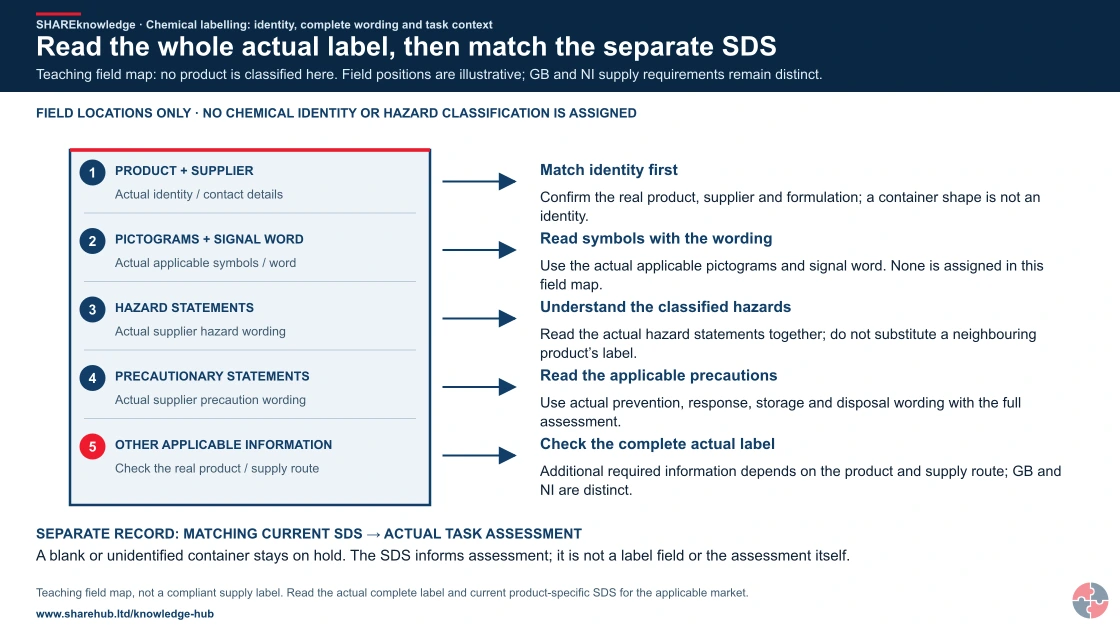
Read the whole actual label, then match the separate SDS
Full written explanation
A complete native label-reading map locates five related areas on one enlarged teaching label: product and supplier identity; applicable pictograms and signal word; the actual hazard statements; the actual precautionary statements; and other applicable label information. It deliberately supplies no product name, classification, hazard symbol, signal word or statement for a real chemical. The diagram labels field locations rather than presenting a compliant supply label. A separate current product-specific safety data sheet must match the identity and formulation and helps a task-specific assessment; the SDS is not a field on the physical label and is not itself the assessment. All nine authentic hazard pictograms and existing substance-form/chemical-entry controls on the topic remain available. The new warehouse scene depicts a closed unidentified container with a blank area: that unresolved identity is a hold, not an acceptable label or permission to use it.
Teaching field map: no product is classified here. Field positions are illustrative; GB and NI supply requirements remain distinct.
- Product and supplier identity. Match the actual product and supplier; confirm the applicable market and formulation.
- Pictograms and signal word. Read the actual applicable symbols and signal word with all the wording; none is assigned in this map.
- Hazard statements. Read the supplier’s actual statements describing the classified hazards.
- Precautionary statements. Read the actual prevention, response, storage and disposal wording as applicable.
- Other applicable information. Check any additional required label information for this product and supply route; the field map is not a compliance template.
- Separate matching SDS and assessment. Obtain the current product-specific SDS. Assess actual use and exposure separately; a blank or unidentified container stays on hold.
Change the pathway
- Unknown means hold. Do not identify a substance from a container shape, colour or a neighbouring label.
- A symbol is not a PPE selection. Use the actual product and task assessment rather than one pictogram.
- Records do not complete controls. A matching SDS informs assessment; it does not prove the work arrangement is effective.
Evidence check: No product classification, compliant supply label, mixture compatibility, PPE specification or use permission is assigned.
Keep product identity, supply information and actual work assessment connected
Primary references: HSE complete hazard label · HSE statements and signal words · HSE separate GB and NI supply routes · HSE SDS and task assessment
Open the complete HD image (new tab)Download image

Keep product identity, supply information and actual work assessment connected
Primary references: HSE complete hazard label · HSE statements and signal words · HSE separate GB and NI supply routes · HSE SDS and task assessment

Identify the product
Check the container identity and supplier information against the material actually used; keep an unknown bottle out of use.
Read the whole label
Use the actual signal word, hazard and precautionary statements as applicable, rather than inferring a complete hazard from one symbol.
Match the safety data
Check the relevant current product record and the actual activity, release route and people exposed.
Control the task
A competent assessment determines controls. A training label has placeholders only and cannot supply a chemical classification or permission to handle an unknown substance.
Read the complete task-specific control examples
ERICPD is a planning cross-map: Discipline verifies and sustains every control. ESEAP compares effectiveness. A label does not authorise the task; retain the owner, evidence and stop or change decision.
Globally Harmonised System (GHS), CLP and Chemical Labelling · ERICPD
- Eliminate
- Avoid the chemical task or use a process that does not generate harmful substance; no release occurs.
- Reduce
- Choose a less hazardous product, lower concentration or non-spray method; reduce the released amount and route to lungs or skin.
- Isolate
- Use closed dosing, enclosed transfer, segregated storage and physical separation from bystanders; prevent contact or incompatible mixing.
- Control
- Engineering: suitable local exhaust and spill containment.
- PPE
- Choose compatible gloves, eye/face protection or respiratory protection for assessed residual routes after source controls.
- Discipline
- Train and practically assess users, check labels and controls, report symptoms and defects, and close actions.
Globally Harmonised System (GHS), CLP and Chemical Labelling · ESEAP
- Elimination
- Remove an unnecessary chemical task or harmful process so its release no longer occurs.
- Substitution
- Replace the product or process with a suitable less hazardous alternative, such as an assessed ready-to-use or non-spray form.
- Engineering controls
- Closed dosing, enclosed transfer, physical segregation, local exhaust ventilation and spill containment control release or contact physically.
- Administrative controls
- Use product approval, task-specific COSHH/DSEAR assessment, maintenance arrangements, training, label checks and incident response.
- PPE
- Select compatible gloves, eye/face protection and suitable RPE for assessed residual exposure.
What is the Globally Harmonised System?
GHS is a system for classifying chemical hazards and communicating them consistently through labels and safety data sheets.
GHS is a United Nations framework, not itself a UK workplace law. Great Britain uses GB Classification, Labelling and Packaging (GB CLP) rules for chemical supply, while Northern Ireland uses EU CLP for its market. Employers use the resulting label and safety data sheet (SDS) with the actual task to assess and control exposure; transport labels and supplier classification answer different questions. HSE GB/NI guidance explains the boundary.
The system exists because chemicals are traded, stored and used across borders. Without a harmonised approach, the same substance could be described differently in different countries, making it harder for workers, suppliers, transporters and emergency responders to understand the hazard.
GHS focuses on intrinsic hazard properties. It asks whether a substance or mixture is flammable, explosive, oxidising, corrosive, acutely toxic, sensitising, carcinogenic, hazardous to the environment or otherwise harmful. That classification then informs label elements and safety data sheet content.
How should a GHS or CLP chemical label be read?
A chemical label should be read as a hazard communication tool, not as a complete workplace risk assessment.
For beginners, the label is the first warning. It tells the user what the supplier says the chemical can do in hazardous conditions: burn, explode, corrode, poison, sensitise, damage organs or harm the environment. For professionals, the label is a trigger for deeper review of the safety data sheet, COSHH assessment, storage compatibility, emergency arrangements and training.
Use one sequence: confirm product identifier and supplier, match the container and SDS, read the pictograms and signal word, then the hazard and precautionary statements. Check supplementary information and relevant market details. Finally assess how task, quantity, concentration, exposure route and local conditions change the risk.
The product identifier must match the container and SDS. Hazard statements explain the harm and precautionary statements the advised response; pictograms and signal words aid recognition. A red diamond alone cannot establish whether spraying, heating or mixing is safe: that needs the task assessment.
| Label element | What it tells the reader | How to use it at work |
|---|---|---|
| Product identifier | The chemical or mixture name linked to the SDS. | Check it matches the container, COSHH assessment and approved chemical list. |
| Hazard pictogram | A visual warning of hazard class such as flammable, corrosive or toxic. | Use it as a quick prompt, then read the detailed statements. |
| Signal word | Danger or Warning, indicating relative severity. | Use it to prioritise attention but do not ignore Warning products. |
| Hazard statement | The nature of the hazard, such as causes burns or may cause cancer. | Link the hazard to exposure routes and control measures. |
| Precautionary statement | Recommended prevention, response, storage or disposal precautions. | Convert into task controls, emergency actions and storage rules. |
| Supplier details | Supplier name, address and telephone number. | Use for updated SDS, technical queries and incident follow-up. |
| Supplemental information | Additional warnings, EUH statements or specific information. | Check for sensitisation, environmental or use-specific warnings. |
Labels should be readable, durable and matched to the container. Problems often arise when chemicals are decanted into unlabelled bottles, old containers are reused, labels are damaged, or workers rely on colour or smell rather than formal identification.
The label should prompt a user to stop and check the SDS or COSHH assessment before use. It should not be treated as the whole instruction for the task.
Cross-check the label against the matching SDS. The label should be consistent with the current safety data sheet; use the SDS to complete the COSHH assessment and training. A separate SDS-reference field is not generally a required CLP label element. This table covers main elements, not a complete supplier-compliance template. Nominal quantity applies to relevant consumer packages. NI suppliers should check applicable UFI requirements for in-scope mixtures; neither every product nor every GB label requires a UFI. HSE hazard labels; ECHA label elements; ECHA UFI scope.
How does chemical classification work at professional level?
Professional chemical classification separates the supplier's legal classification duty from the employer's workplace risk-control duty.
For learners, the first distinction is simple: GHS provides a global framework, while CLP is the legal mechanism that applies classification, labelling and packaging requirements in the UK context. In Great Britain, GB CLP applies to substances and mixtures placed on the GB market, with HSE acting as the GB CLP agency. Northern Ireland has specific arrangements because chemicals placed on the Northern Ireland market are subject to EU CLP. Check the market and supply-chain role, including any separate GB supply.
For experienced professionals, the important distinction is mandatory classification versus self-classification. Some substances have legally binding classifications that suppliers must apply. Mixtures and other hazard classes may require the supplier to evaluate available data and classify appropriately. The downstream employer then uses that information as one input into COSHH, DSEAR, emergency planning, waste and training.
For a substance supplied in GB, check whether the GB mandatory classification and labelling (MCL) list covers the relevant hazard class. The supplier applies mandatory entries and assesses uncovered classes; mixtures require assessment of available data and ingredient classifications. An employer using a bought product does not simply change its legal supplier label because the local task has low exposure. HSE classification guidance and the GB MCL list set this route.
| Concept | Professional meaning | Workplace implication |
|---|---|---|
| GB CLP | Great Britain legal framework for classification, labelling and packaging. | Suppliers placing substances or mixtures on the GB market must follow relevant duties. Sources: GB CLP legislation. |
| Mandatory classification | Legally binding classification that must be applied where it exists. | Check whether the product classification has changed and whether assessments need review. Sources: HSE GB mandatory classification list. |
| Self-classification | Supplier evaluates data and classification criteria where mandatory classification does not fully cover the hazard. | Ask competent questions where classification seems inconsistent with use or SDS information. Sources: HSE GB classification and labelling. |
| Mixture classification | Hazard can depend on ingredient concentration, properties and mixture rules. | Do not assume a diluted product is low risk without checking classification and task exposure. Sources: HSE GB classification and labelling. |
| GB and NI distinction | Regulatory route can differ depending on market and supply chain. | Procurement and compliance teams should know which regime applies. Sources: HSE CLP in GB or NI. |
| Downstream use | Employer uses label and SDS information to control real work. | Translate hazard communication into COSHH, DSEAR, storage, emergency and training controls. Sources: HSE COSHH assessment; COSHH Regulations (NI) 2003. |
From 21 May 2026, the technical notes formerly in points 1.1.3–1.1.3.2 of Annex 6 to GB CLP sit in the GB MCL list. A supplier making a current classification checks that list and its notes rather than relying on an older copy of the Regulation. This is a GB market decision; Northern Ireland uses EU CLP.
GHS is an international chemical-classification framework; GB CLP and EU CLP provide the applicable market rules. Use the HSE chemical-classification guidance for the GB route and check the Northern Ireland supply route separately. No private standard or unverified clause is used to assign a supplier’s legal classification.
What is the difference between chemical hazard and workplace risk?
Hazard is the chemical's inherent potential to cause harm; risk is the chance and severity of harm in the way it is used.
This distinction is essential for learners and supervisors. A corrosive liquid in a sealed, labelled container in a ventilated store is a different risk from the same liquid being decanted by hand in a busy workshop. The label is the same, but the exposure scenario has changed.
Risk depends on quantity, concentration, form, route of exposure, duration, temperature, ventilation, controls, competence, emergency arrangements and who may be affected.
Classification describes the chemical; the workplace assessment asks how it reaches a person. Inhalation of vapour or mist affects airways and lungs, splashes affect skin and eyes, and contaminated hands may lead to swallowing. A sealed bottle, hand decant and spray application can therefore need very different controls even when the label is unchanged.
How can a chemical hazard reach and injure people?
A chemical can harm through inhaled vapour, mist or dust; skin or eye contact; swallowing; or a fire, explosion or reactive release. Immediate effects include irritation, burns, poisoning and injury; some substances can cause asthma, dermatitis, cancer or other disease after repeated or delayed exposure. The actual product classification and task determine which outcomes are credible.
Trace source, release, route and tissue before choosing controls. Spraying a sensitising coating can carry mist into the lungs; decanting corrosive cleaner can splash eyes and skin; a solvent spill can form an ignitable vapour cloud. Temperature, concentration, quantity, ventilation, duration, enclosed work and who is nearby change the exposure. A label warning is a starting signal, not a measurement of dose.
| Task and source | Exposure and likely harm | Warning or stop point |
|---|---|---|
| Spraying a sensitising coating | Aerosol is inhaled; airway irritation or occupational asthma may follow. | Unexpected mist, failed extraction, breathing symptoms or wrong product: stop and seek competent/medical advice. |
| Decanting a corrosive cleaner | Splash reaches eyes or skin; chemical burns or serious eye damage may be immediate. | Leaking container, missing identity or splash: stop, use site first aid and urgent advice. |
| Using solvent near ignition | Vapour reaches air and ignites; burns, fire or blast trauma. | Spill, strong vapour, failed ventilation or ignition source: evacuate/control by the site emergency plan. |
| Mixing incompatible pool products | Reaction releases heat or toxic gas; lung injury, burns and wider exposure. | Unknown contents, damaged label or unexpected gas/heat: withdraw and call competent responders. |
Long-latency outcomes depend on the chemical and exposure history; the page does not diagnose a worker or invent a safe threshold. Use the SDS, the actual COSHH assessment and medical advice for a suspected exposure. For task-specific exposure prevention, use HSE COSHH task assessment guidance.
What do the GHS hazard pictograms mean?
GHS pictograms are quick visual warnings for major hazard types, but they need to be interpreted with the label and SDS.
Pictograms are designed for recognition, not full explanation. Workers should know the broad meaning of each symbol and then check the hazard statements, precautionary statements and SDS for the detail.
Some products carry more than one pictogram. A chemical can be both flammable and harmful to health, or corrosive to skin and corrosive to metals. The control plan should address the full hazard profile.
The symbol is a prompt to identify the full hazard class. A flame may call for ignition and storage controls; corrosion can mean serious skin or eye injury as well as metal damage; the health-hazard silhouette can signal delayed outcomes such as sensitisation or carcinogenicity. Read the actual hazard statements rather than assuming one pictogram captures every effect.
For the exact symbol artwork, use the HSE hazard-pictogram gallery. The names in the table below are educational; only the supplier’s actual label and SDS establish the product warning. The images below use OSHA public-domain pictogram artwork; use HSE guidance for GB meanings and the applicable CLP rules for GB or NI.
| Pictogram | Broad meaning | Workplace example |
|---|---|---|
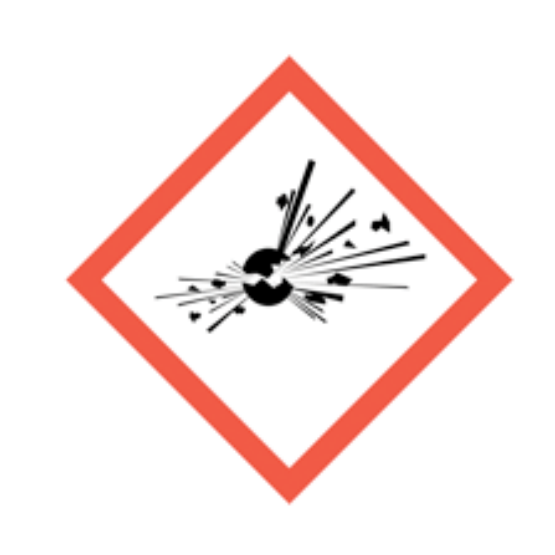 Exploding bomb | Explosive, self-reactive or organic peroxide hazards. | Unstable substances requiring specialist storage and handling. |
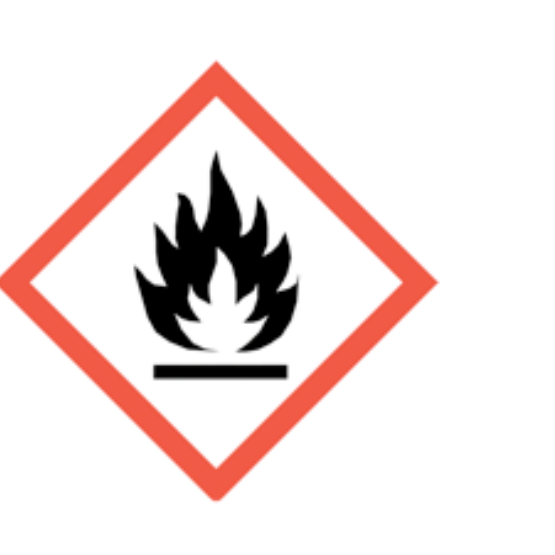 Flame | Flammable, self-heating or pyrophoric substances. | Solvents, petrol, aerosols or some adhesives. |
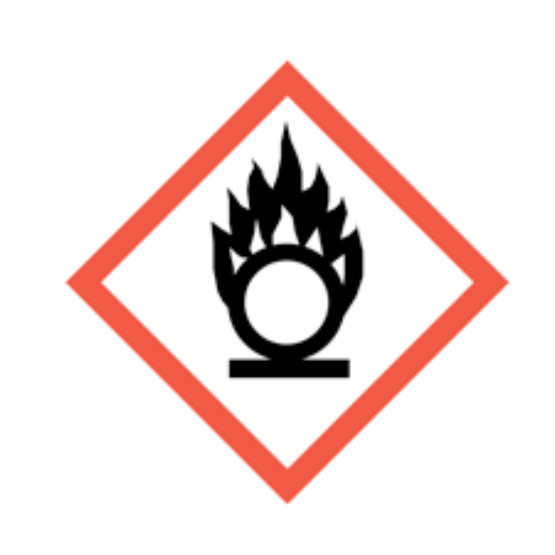 Flame over circle | Oxidising substances that can intensify fire. | Peroxides or oxidising pool chemicals. |
 Gas cylinder | Gas under pressure. | Compressed gas cylinders and some refrigerants. |
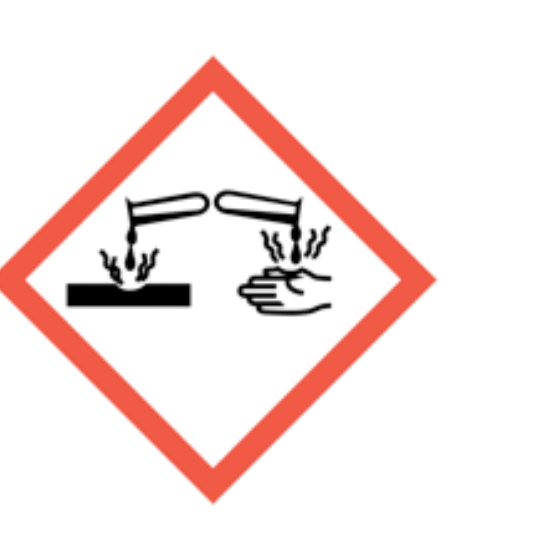 Corrosion | Skin burns, eye damage or corrosive to metals. | Acids, caustics or strong cleaners. |
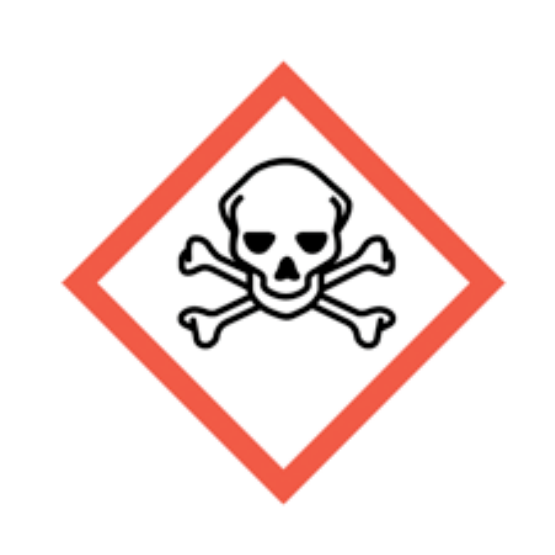 Skull and crossbones | Acute toxicity. | Highly toxic substances needing strict control. |
 Exclamation mark | Irritation, harmful effects or skin sensitisation; some classifications cover drowsiness, dizziness or ozone-layer hazard. Read the actual hazard statements. Skin sensitisation differs from respiratory sensitisation. | Many cleaning products and lower-level irritants. |
 Health hazard | Serious health hazards, including organ damage, aspiration hazard, respiratory sensitisation, cancer and reproductive effects; some can follow a single exposure. | Carcinogens, respiratory sensitisers, reproductive toxins or a product with an aspiration warning. Follow the actual product-specific emergency advice immediately after a suspected exposure. |
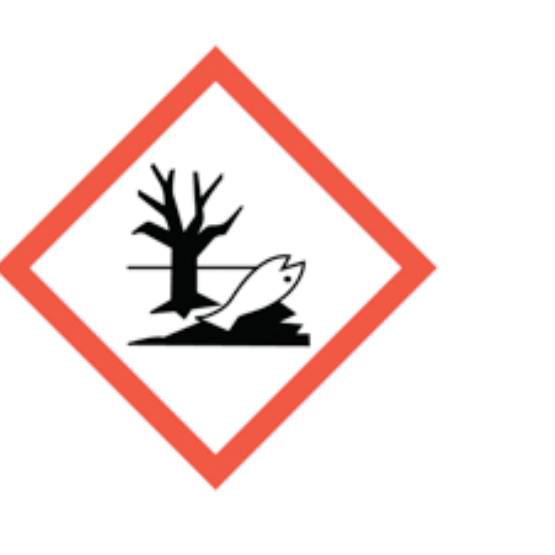 Environment | Hazardous to the aquatic environment. | Chemicals requiring spill and drainage protection. |
How should safety data sheets be used?
Safety data sheets should be used to support COSHH assessment, safe storage, emergency planning, training and waste decisions.
An SDS is not a finished workplace assessment. It is supplier information that needs to be interpreted against the actual task. A product may be safe to store unopened but hazardous when sprayed, heated, mixed, used in a confined space or applied to a large surface.
Managers should make sure the SDS is current, accessible and linked to the approved chemical list. Workers should know where to find the information they need without searching through a long document during an emergency.
Read identification and hazards first, then the first-aid, fire, accidental-release, handling/storage and exposure-control information relevant to the job. The SDS is supplier information, not a local Control of Substances Hazardous to Health (COSHH) assessment; check product version and use it to design the actual work controls. HSE SDS guidance makes this distinction.
| SDS area | What it helps with | Workplace decision |
|---|---|---|
| 1 — Identification | Product and supplier details. | Is this the approved product? |
| 2 — Hazard identification | Classification, pictograms and statements. | What harm could occur? |
| 3 — Composition | Hazardous ingredients. | Does substitution or health surveillance need review? |
| 4 — First aid | Initial response for exposure routes. | What should workers do after splash or inhalation? |
| 5 — Firefighting | Fire hazards and extinguishing media. | How should fire risk be controlled? |
| 6 — Accidental release | Spill precautions and clean-up. | What spill kit and responder competence are needed? |
| 7 — Handling and storage | Safe handling, incompatibilities and storage. | How should stores and decanting be controlled? |
| 8 — Exposure controls | WELs, ventilation and PPE. | What controls should the COSHH assessment specify? |
| 10 — Stability and reactivity | Incompatibilities, conditions to avoid and hazardous reactions. | Check what must never be mixed or exposed to heat. |
| 13 — Disposal considerations | Waste handling and disposal information. | Plan the applicable waste route; do not infer permission to discharge. |
| 14 — Transport information | Dangerous-goods transport classification and precautions. | Use competent transport advice; supply labels do not replace transport duties. |
| 16 — Other information | Revision date, changes and further information. | Confirm the product and current revision before approving a change. |
An SDS has 16 sections. These are selected key sections; use all sections relevant to the actual task, including the revision check.
What common GHS and CLP mistakes should be avoided?
Common mistakes happen when labels are noticed but not translated into task-specific control, storage and emergency arrangements.
A label can be correct and the workplace can still be unsafe. That happens when the chemical is decanted into an unlabelled bottle, mixed with an incompatible product, sprayed instead of wiped, heated, used in poor ventilation or stored next to substances that make a fire or reaction worse.
The key learning point is that GHS and CLP communicate intrinsic hazard. COSHH, DSEAR and good chemical management decide how that hazard is controlled in the real task.
Do not copy a label onto an unverified product, decant into an unmarked food container, or assume a transport diamond replaces a workplace label. A missing SDS, old formulation or unreadable label means the supervisor should hold use until identity and precautions are confirmed. No pictogram does not prove that a generated dust or fume is harmless.
How should safety data sheet information become workplace controls?
Safety data sheet information should be converted into task-specific decisions for exposure, storage, emergency response, waste and training.
A safety data sheet is a technical supply-chain document, not a finished workplace procedure. It may describe generic uses, product hazards, exposure controls, first-aid information, firefighting measures, stability, incompatibilities and disposal considerations. The employer must still decide what the substance is doing in the actual task: poured, sprayed, heated, mixed, brushed, wiped, cut, cleaned, stored, transported or disposed of.
Professional review should look for the control gaps between the SDS and the task. For example, an SDS may state 'use in a well-ventilated area', but the workplace must define whether general ventilation is enough, whether local exhaust ventilation is required, whether exposure monitoring is needed, whether RPE is suitable and whether the task creates flammable vapour under DSEAR.

At Riverside Leisure Ltd, a new concentrated cleaner would be held at purchasing until its identity and current SDS are checked. A supervisor would compare dilute-use and decanting tasks, identify skin and eye routes, seek substitution or closed dosing, then specify storage separation, spill response, suitable protection and worker instruction. The product label remains supplier information; the resulting COSHH assessment belongs to the site.
Where suitable tight-fitting RPE is selected, arrange the required wearer-specific face-fit test as well as the user’s pre-use fit check each time. A fit check does not replace testing; other RPE types may not depend on a tight facial seal. Face-fit testing and RPE decisions.
How should workplaces use GHS information in practice?
Workplaces should use GHS information to control chemical selection, approval, labelling, storage, use, emergency response and review.
The practical system starts at procurement. If workers can buy chemicals locally without approval, the business may not know what hazards are on site. Approved chemical lists, SDS review and substitution checks prevent uncontrolled introduction.
GHS information should also follow the chemical after delivery. Stores, secondary containers, cleaning cupboards, contractor chemicals, waste containers and spill kits all need clear ownership and labelling discipline.
A worker should be able to match the label to the approved product, understand the main exposure route and follow the task controls without memorising the full SDS. Managers should inspect physical stores, decanted containers and contractor materials against the register. If a safer product is substituted, the purchasing and training decisions must move with it.
What decisions should supervisors make before chemicals are used?
Supervisors should confirm that chemical identity, labelling, SDS, COSHH controls, storage and emergency arrangements are ready before work starts.
A supervisor does not need to be a chemist to ask strong questions. Is the chemical approved? Is the container labelled? Is the SDS current? Does the COSHH assessment cover the actual task? Could the method create mist, dust, vapour or splash? Are incompatible products nearby? Do people know what to do if something goes wrong?
This is where GHS becomes useful for everyday work. The label starts the conversation; the supervisor closes the loop by checking whether the job is controlled.
Before use, the supervisor checks the container identity, approved product and SDS, the specific mixing or application method, exposure routes, ventilation, nearby people and waste route. If any item differs from the approved task, the product is held while a competent assessor updates the control decision. A damaged label or leaking package is quarantined without an untrained worker opening it.
What chemical governance system should sit behind GHS and CLP?
Chemical governance should control the full lifecycle from product approval through use, storage, change, emergency response and withdrawal.
High-performing organisations do not leave chemical control to individual departments buying products independently. They use a chemical approval process that asks whether the product is needed, whether a safer alternative exists, whether the SDS is current, whether COSHH and DSEAR assessments are required, whether storage is compatible and whether workers need training before use.
The system should also control change. A new supplier, changed concentration, new task method, larger quantity, aerosolised application, heating, confined use, incompatible storage or contractor introduction can change the risk even when the label looks familiar. Professional governance makes those changes visible before exposure occurs.
The manager owns a chemical register that links each approved product to supplier information, tasks, assessment, storage, training and emergency action. Procurement blocks unapproved substitutions; stores quarantine damaged deliveries; supervisors check the real task; a competent specialist reviews changed formulations, symptoms and incidents. Defects have an owner and a closure test rather than a paper-only sign-off.
How does GHS link to COSHH?
GHS helps identify hazards; COSHH requires employers to prevent or control exposure from the way substances are used at work.
A label can tell a worker that a product is corrosive, flammable or harmful, but it cannot tell whether the local exhaust ventilation captures vapour, whether gloves are compatible, whether the worker has been trained or whether emergency washing is close enough.
COSHH assessment should therefore use GHS and SDS information as inputs, then add the task, people, routes of exposure, controls, monitoring and health surveillance decisions.
COSHH control follows a hierarchy: avoid the substance or task where possible, change the process or form, enclose and extract at source, and then add safe work arrangements and suitable personal protection. Some process-generated hazards, such as dust and welding fume, have no product label or SDS; they still need assessment. HSE COSHH assessment guidance explains both points.
How can the hierarchy of controls turn GHS and CLP hazard information into stronger chemical controls?
Start by eliminating an unnecessary chemical or process, then substitute or reduce the exposure. Isolate releases through enclosure and separation, control what remains with extraction and work systems, add suitable personal protection for residual exposure, and sustain the controls through checks and training. A label or PPE alone is not adequate control.
ERICPD means Eliminate, Reduce or substitute, Isolate, Control, Personal Protective Equipment and Discipline. It is a planning framework, not an additional statute. In this context “Control” includes physical extraction and dosing systems as well as administrative arrangements; “Discipline” means reliable follow-through, not blaming a worker for a failed design. HSE COSHH guidance prioritises prevention at source.
The HSE five-level hierarchy is elimination, substitution, engineering controls, administrative controls and PPE. ERICPD overlaps but separately names Reduce, Isolate and Discipline; its Discipline stage sustains safeguards through maintenance and supervision, rather than blaming a worker. The two are planning lenses, while the applicable GB or NI chemical-use rules supply the duty. For a pool-cleaner task, remove unnecessary chemical use or buy a safer ready-to-use product where it meets the hygiene requirement; if a concentrated chemical remains necessary, closed dosing and segregated storage take priority over gloves or a warning label. The facilities manager checks installation, worker method, defects and product changes before release.
How can the ERICPD hierarchy of controls turn GHS and CLP hazard information into stronger chemical controls?

Use the five-level table to distinguish physical engineering controls from administrative arrangements. Read the illustration alongside this explanation.
| Level | Concrete control and broken link | Owner, evidence and failure sign | HSE five-level position |
|---|---|---|---|
| Eliminate | Avoid the chemical task or use a process that does not generate harmful substance; no release occurs. Sources: HSE COSHH assessment; COSHH Regulations (NI) 2003. | Buyer and task owner test the alternative. If harmful fume is still generated, the hazard was not eliminated. | Elimination: remove the chemical task or harmful process where feasible. |
| Reduce or substitute | Choose a less hazardous product, lower concentration or non-spray method; reduce the released amount and route to lungs or skin. Sources: HSE COSHH assessment; COSHH Regulations (NI) 2003. | Assessor compares product data and real task. A new formulation or uncontrolled dilution requires reassessment. | Substitution: less hazardous product, concentration or non-spray form; compare new risks. |
| Isolate | Use closed dosing, enclosed transfer, segregated storage and physical separation from bystanders; prevent contact or incompatible mixing. Sources: HSE COSHH assessment; COSHH Regulations (NI) 2003. | Engineer and supervisor inspect containment and access. Leaks or unlabelled decants stop use. | Engineering: closed transfer, enclosure and segregation from people/incompatible stock. |
| Control | Engineering: suitable local exhaust and spill containment. Administrative: COSHH/DSEAR assessment, approved list, maintenance, monitoring and emergency arrangements. Sources: HSE COSHH assessment; COSHH Regulations (NI) 2003; HSE DSEAR; Northern Ireland DSEAR 2003. | Competent assessor and manager verify function and records. Failed extraction or a changed task triggers hold. | Engineering extraction/containment first; administrative COSHH method and maintenance follow. |
| PPE | Choose compatible gloves, eye/face protection or respiratory protection for assessed residual routes after source controls. Sources: HSE Managing risk using PPE; HSENI Personal protective equipment. | Supervisor checks selection, fit and condition. PPE cannot justify an uncontrolled spill or vapour cloud. | PPE only for assessed residual splash or contact; it cannot repair leaking dosing. |
| Discipline | Train and practically assess users, check labels and controls, report symptoms and defects, and close actions. Sources: HSE COSHH assessment; COSHH Regulations (NI) 2003. | Manager samples observations and incidents. Repeated mislabelling or bypass calls for system redesign. | Administrative sustainment: instruction, inspection and corrective action; not worker blame. |
How can the five-level hierarchy of controls turn GHS and CLP hazard information into stronger chemical controls?

Use the five-level table to distinguish physical engineering controls from administrative arrangements. Read the illustration alongside this explanation.
| Control level | Topic-specific control | Owner, check and hold point | Sources and full task context |
|---|---|---|---|
| Elimination | Remove an unnecessary chemical task or harmful process so its release no longer occurs. | Buyer and task owner verify that the hazard is removed; generated dust or fume still needs assessment. | HSE COSHH assessment · COSHH Regulations (NI) 2003 · HSE DSEAR · Northern Ireland DSEAR 2003 · HSE Managing risk using PPE · HSENI Personal protective equipment |
| Substitution | Replace the product or process with a suitable less hazardous alternative, such as an assessed ready-to-use or non-spray form. | Competent assessor compares product identity, concentration, exposure routes and new risks; dilution alone does not establish safety. | HSE COSHH assessment · COSHH Regulations (NI) 2003 · HSE DSEAR · Northern Ireland DSEAR 2003 · HSE Managing risk using PPE · HSENI Personal protective equipment |
| Engineering controls | Closed dosing, enclosed transfer, physical segregation, local exhaust ventilation and spill containment control release or contact physically. | Engineer and supervisor verify containment and extraction; a leak or failed extraction stops use. | HSE COSHH assessment · COSHH Regulations (NI) 2003 · HSE DSEAR · Northern Ireland DSEAR 2003 · HSE Managing risk using PPE · HSENI Personal protective equipment |
| Administrative controls | Use product approval, task-specific COSHH/DSEAR assessment, maintenance arrangements, training, label checks and incident response. | Chemical owner verifies current product/SDS and the released method; changed product or uncontrolled task means hold. | HSE COSHH assessment · COSHH Regulations (NI) 2003 · HSE DSEAR · Northern Ireland DSEAR 2003 · HSE Managing risk using PPE · HSENI Personal protective equipment |
| PPE | Select compatible gloves, eye/face protection and suitable RPE for assessed residual exposure. | Supervisor checks selection, fit and condition; a pre-use fit check never replaces required face-fit testing. | HSE COSHH assessment · COSHH Regulations (NI) 2003 · HSE DSEAR · Northern Ireland DSEAR 2003 · HSE Managing risk using PPE · HSENI Personal protective equipment |
A workplace exposure limit in EH40, where one exists, is an additional assessment input with units and averaging period; it is not permission to expose people up to that value. Product-specific controls and any monitoring or health surveillance decision require competent assessment.
HSE sets out the five-level hierarchy. ERICPD is the six-part planning framework used here; the task assessment determines the controls. HSE hierarchy of controls.
How should chemical labels support storage and compatibility?
Chemical labels should help workers identify incompatible substances, storage conditions and emergency response needs.
Chemical storage failures often begin with poor identification. Unlabelled containers, damaged labels, mixed chemical cupboards and old stock make it difficult to control incompatibility, fire load, spill response and emergency information.
Pictograms are useful, but compatibility decisions should not rely on pictograms alone. The SDS and competent chemical assessment should guide segregation of acids, alkalis, oxidisers, flammables, toxics, compressed gases and water-reactive substances.
For example, a pool treatment oxidiser and an acid cleaner must not share an uncontrolled store simply because both have familiar pictograms. Check the actual product SDS for incompatibility, containers, ventilation and spill response; put the segregation and inspection into the site store plan. Hold an unlabelled or damaged container until competent identification and disposal are arranged.
How does GHS and CLP judgement change across sectors?
The same label leads to different controls because the task, release route and people differ. Read the label and SDS, then choose the strongest feasible control for the actual exposure.
A corrosive cleaning product in a public leisure centre, a solvent in a maintenance workshop, an isocyanate-containing coating in construction, an oxidising pool chemical and a flammable liquid in a laboratory all use the same hazard communication language, but the control decisions differ. That is why the page should teach the label as the starting point, not the end point.
Sector examples help both beginners and professionals see the judgement step. The label tells you the hazard class; the task tells you whether the real concern is splash, inhalation, sensitisation, fire, explosion, incompatible mixing, public exposure or emergency response.
These examples are applications of GHS communication to workplace assessment. Manufacturing aerosol control and hospitality closed dosing do not follow from the pictogram alone; the product SDS, process and COSHH or DSEAR assessment determine the final design.
| Sector, people and harm route | Control and stop check |
|---|---|
| Manufacturing — paint sprayer breathes sensitising aerosol; asthma may develop. | Use a less hazardous coating or non-spray process where feasible, enclosure and extraction; verify controls and respiratory protection. Stop for mist escape or symptoms. |
| Construction — worker cuts coated material or handles solvent; dust/vapour reaches lungs, skin or ignition source. | Choose safer material/method, capture dust at source and control ignition; stop for unknown coating, failed extraction or incompatible chemical. |
| Hospitality — cleaner decants corrosive concentrate; splash can burn eyes or skin. | Use ready-to-use product or closed dosing, labelled containers and assessed eye/hand protection. Stop for unlabelled bottle or damaged dosing. |
| Logistics — goods-in staff handle leaking mixed chemical packages; contact, vapour or fire may affect workers. | Quarantine and segregate by product information, keep people clear and involve trained responders. Stop for leak, absent label or incompatible storage. |
How does GHS relate to transport labels and dangerous goods?
GHS sits alongside dangerous goods transport systems, so workplace labels and transport labels should not be confused.
Transport labels focus on hazards during carriage and emergency response in transport. GHS and CLP labels focus on supply and use. The systems are related, but a workplace should not assume that a transport diamond gives enough information for COSHH assessment.
Goods-in teams should know when a delivery needs to be quarantined because labels are damaged, paperwork is missing, containers are leaking or the product is not on the approved list.
A package can need both supply/use hazard communication and dangerous-goods transport information. The transport classification depends on the product and carriage mode; a goods-in team should preserve the supplier label and documents and involve the transport specialist where required. Neither the transport diamond nor the workplace pictogram authorises decanting or mixing.
Which UK legal duties apply to GHS, CLP and chemical labelling?
GHS is a voluntary international framework. GB CLP governs classification, labelling and packaging for products supplied to Great Britain; EU CLP governs products placed on the Northern Ireland market. Separate GB and NI workplace duties require employers to assess and control actual chemical exposure.
A supplier may also have UK REACH or EU REACH information duties depending on the market and role. A user’s COSHH assessment is a different decision from a supplier’s classification; a GB product mark or label does not automatically establish NI market compliance. Check jurisdiction before acting on a legal row or transferring a chemical across the supply chain.
For example, a GB business buying a cleaner for its own staff checks the GB supply label and current SDS, then assesses the actual cleaning task under GB COSHH. If that business plans to place the same product on the Northern Ireland market, the supplier role must separately check the applicable EU CLP route; a GB mandatory classification entry is not itself the NI supply rule. In either workplace, the user still assesses exposure, storage and any fire or mixing risk for the real task. HSE explains the GB and NI boundary.
| Jurisdiction and authority | Decision for this page |
|---|---|
| Great Britain — GB CLP | Suppliers classify, label and package chemicals for the GB market, using the GB mandatory list where applicable; check the current HSE route. HSE GB/NI. |
| Northern Ireland — EU CLP | Products placed on the NI market follow EU CLP under current arrangements; do not apply the GB mandatory list as if it were NI law. HSE boundary. |
| Great Britain — COSHH 2002 | Employer assesses and prevents or controls task-specific exposure; SDS is an input, not an assessment. GB regulation. |
| Northern Ireland — COSHH (NI) 2003 | Employer follows the separate NI hazardous-substances instrument for workplace use. NI regulation. |
| Great Britain and Northern Ireland — fire and explosion | Where dangerous substances can create fire or explosion risk, assess and control the actual activity under the applicable national DSEAR rules. A CLP pictogram alone does not decide the assessment or any major-hazard threshold. GB HSE DSEAR; NI DSEAR instrument. |
How could Riverside Leisure Ltd manage this in practice?

Riverside Leisure Ltd would manage GHS and chemical labelling through chemical approval, SDS review, COSHH assessment, storage checks and worker training.
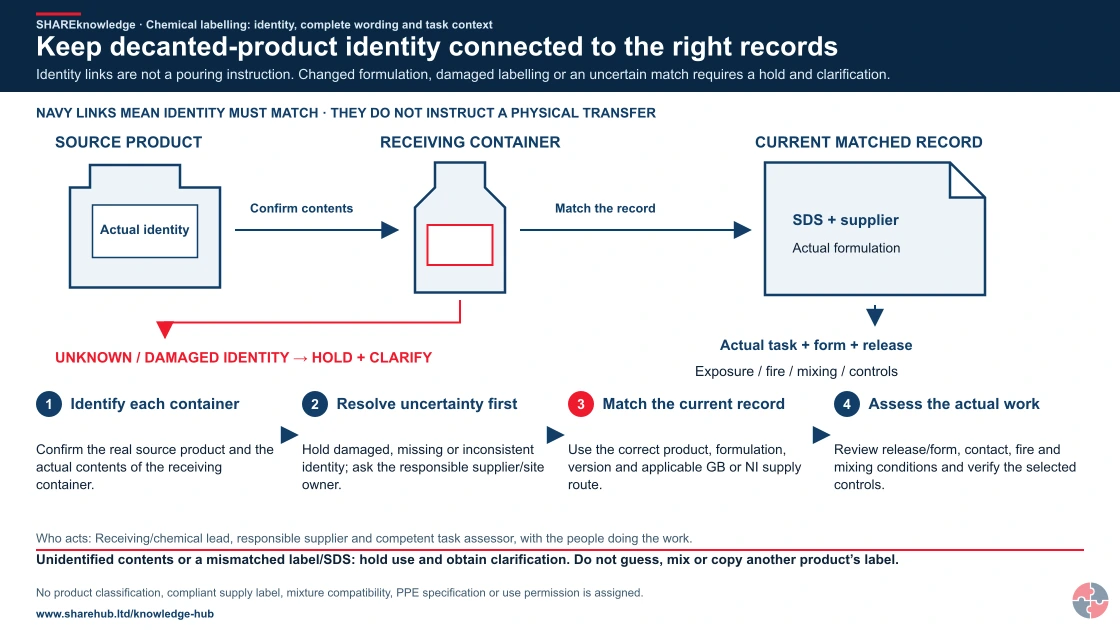
Keep decanted-product identity connected to the right records
Full written explanation
A complete native identity-and-evidence map shows a source container, a separate decanted container and a separate current supplier/SDS record. Navy links mean identity must match; they do not instruct physical transfer, mixing or decanting. A red branch from an uncertain or damaged receiving label ends in a hold rather than guessing a product from a similar container. A confirmed identity feeds a fresh task-specific COSHH and relevant fire assessment, considering physical form, exposure, incompatibility and actual controls. The existing substance-forms visual supports the separate exposure-form question and does not classify this product. A supplier label or SDS alone cannot establish compatible gloves, dilution, ventilation performance, storage compatibility or permission to use a mixture.
Identity links are not a pouring instruction. Changed formulation, damaged labelling or an uncertain match requires a hold and clarification.
- Identify each container. Confirm the real source product and the actual contents of the receiving container.
- Resolve uncertainty first. Hold damaged, missing or inconsistent identity; ask the responsible supplier/site owner.
- Match the current record. Use the correct product, formulation, version and applicable GB or NI supply route.
- Assess the actual work. Review release/form, contact, fire and mixing conditions and verify the selected controls.
When the evidence does not fit: Unidentified contents or a mismatched label/SDS: hold use and obtain clarification. Do not guess, mix or copy another product’s label.
Who acts: Receiving/chemical lead, responsible supplier and competent task assessor, with the people doing the work.
Changed workplace
Receiving a chemical: Read the complete actual label and resolve missing identity before use.
Matching a decanted product: Trace contents to the correct current record, then assess the actual task separately.
Evidence check: No product classification, compliant supply label, mixture compatibility, PPE specification or use permission is assigned.
Keep product identity, supply information and actual work assessment connected
Primary references: HSE complete hazard label · HSE statements and signal words · HSE separate GB and NI supply routes · HSE SDS and task assessment
Open the complete HD image (new tab)Download image

Keep product identity, supply information and actual work assessment connected
Primary references: HSE complete hazard label · HSE statements and signal words · HSE separate GB and NI supply routes · HSE SDS and task assessment
This leisure-centre case shows why a familiar hazard symbol is only the beginning of a decision. The product, market, actual dosing task and chemicals already in the store determine the controls; the damaged label creates an immediate hold point before anyone tries to use or identify the container by guesswork.
Approve a new pool cleaner and hold a damaged delivery
Task material and setting: Riverside Leisure Ltd plans to introduce a concentrated pool cleaner at an occupied leisure centre. Workers may dose or decant it near other treatment chemicals and public areas.
People and prerequisites: The facilities manager obtains the product identity and current SDS, checks whether a safer ready-to-use product meets the task, and confirms which staff and contractors may handle it. The assessor compares actual dosing, storage and emergency conditions with the supplier information.
Before: Approve the product only after checking the GB or NI market route, segregation from existing chemicals, a controlled dosing method, public separation, first-aid provision and worker instruction. Record the task COSHH assessment and approved chemical entry.
During: A worker notices that the delivered container label is damaged. They do not decant, mix or guess its contents. The supervisor quarantines the delivery, keeps others clear and asks the supplier for verified identity and replacement information.
Hold or stop: Keep the chemical out of use while identity, formulation or compatibility is uncertain. A leak, reaction or suspected exposure triggers the site emergency and medical route, with trained responders rather than improvisation.
Completion and hand-back: When the product and controls are verified, the manager updates the chemical register, assessment, store plan and task instruction; affected workers demonstrate the revised method. A named supervisor releases use only after the damaged-label issue is closed.
Evidence: Keep the current SDS, approval and substitution decision, storage/decanting assessment, training observation, defect report and release record. A changed formulation or contractor chemical restarts the assessment.
Control chain: The supervisor matches the cleaner’s current label and SDS to the product and identifies splash, mist and incompatible-mixing routes in the actual task. The assessor prefers suitable closed dosing to hand decanting because it prevents release at source. The supervisor checks the dosing enclosure, connections and defects before use; a leak, damaged label or changed product stops use. The chemical owner releases the assessed method only after engineering checks and any residual PPE selection are recorded. No universal glove material, dilution ratio or ventilation rate follows from a pictogram.
What training is needed for GHS and chemical labelling?
Awareness, practical authorisation and specialist classification competence differ. Train each role on the products and decisions it actually controls, test the response to a missing label or exposure, and reassess after change or failure.
A short pictogram briefing is not permission to spray, decant, respond to a spill or classify a product. Health surveillance or exposure monitoring is assessed for the particular substance and task, not inferred from a generic label. Keep an authorisation record that a supervisor can use before assigning the work.
| Role | Learning and practical evidence | Assessor, record and reassessment |
|---|---|---|
| Nearby staff and new starters | Recognise damaged labels, spills, symptoms and emergency route; demonstrate stop-and-report. | Supervisor records induction and checks response; update after new products or site changes. |
| Users and operators | Match product, label, SDS and COSHH task controls; demonstrate dosing, storage and stop points on the actual job. | Supervisor observes practice and authorises task; reassess after product, equipment or method change. |
| Stores and specialist chemical workers | Check deliveries, segregation, secondary labels and release/response within role; specialists classify or assess only within competence. | Manager checks supplier and technical scope, inventory and training record; review after new hazard or incident. |
| Supervisors and contractor coordinators | Challenge unapproved chemical, missing information or failing extraction; hold, coordinate and hand back work. | Manager samples real holds and action closure; reassess after poor observations. |
| Managers, purchasers and safety advisers | Set approved list, GB/NI market route, substitution, COSHH/DSEAR evidence and assurance decisions. | Accountable leader checks specifications, assessments and corrective actions; update for law or risk changes. |
What warning signs show GHS and labelling controls are weak?
Warning signs include unlabelled containers, missing SDS, uncontrolled purchasing and workers who cannot explain pictograms or exposure routes.
When a decanted bottle has no reliable identity or a new delivery does not match the approved SDS, the supervisor keeps it out of use, protects others and asks the supplier or authorised chemical owner to establish its identity. The product is released only after the label, SDS, task assessment, storage position and worker instructions agree. Repeated spills or workers unable to explain the control are reasons to review the task, not just replace a label. Symptoms or a large release follow the site emergency and medical route.
Which acronyms and terms matter for chemical labels?
Acronyms should be explained so chemical labels, SDS and COSHH assessments are understood.
| Acronym or term | Full expansion | Meaning at work |
|---|---|---|
| GHS | Globally Harmonised System | UN framework for chemical hazard classification and communication. |
| CLP | Classification, Labelling and Packaging | Chemical supply rules; GB and NI market routes differ. |
| GB MCL | Great Britain mandatory classification and labelling | Legally binding GB substance entries for listed hazards. |
| SDS | Safety data sheet | Supplier information for a product; not a site assessment. |
| COSHH | Control of Substances Hazardous to Health | Workplace assessment and control of hazardous-substance exposure. |
| DSEAR | Dangerous Substances and Explosive Atmospheres Regulations | Fire and explosion risk control where relevant. |
| WEL | Workplace exposure limit | EH40 value with units and averaging period; not a target exposure. |
| PPE | Personal protective equipment | Residual protection after feasible source controls. |
| RPE | Respiratory protective equipment | Selected and fit-checked breathing protection where assessment requires it. |
Unlock another resource
You have used this month’s two free downloads. Publish a post in your own words to unlock one more resource, or choose SHARE Individual for 10 downloads per month.
You decide whether to share. If you do, use the relevant platform disclosure tools and do not make claims you do not genuinely hold.