SHARE Knowledge Hub
Arthritis and joint health
Joint pain or arthritis can affect grip, movement, stamina and safe work. Reduce force, repetition and awkward postures through task design, equipment and recovery time; discuss individual barriers privately and review adjustments. Do not diagnose from symptoms or assume work caused a condition. Sudden severe swelling, a hot joint or illness needs prompt medical advice.
Understanding Arthritis and joint health
Arthritis is an umbrella term for conditions that cause joint pain, swelling, stiffness or restricted movement. It is not one disease and it is not synonymous with a work-related musculoskeletal disorder. Osteoarthritis, rheumatoid arthritis, gout, psoriatic arthritis and axial spondyloarthritis have different causes and clinical pathways. Work may be unrelated to the underlying disease, may aggravate symptoms or functional limitations, or may expose the same body region to a separate work-related injury.
Why this matters at work
Organisational hazards include excessive pace, low task control, understaffing, unpredictable overtime, punitive attendance systems, inadequate breaks and poor reporting culture. These can extend exposure, suppress early reporting and make a manageable flare become prolonged absence. Harassment or disbelief can cause psychological harm and undermine cooperation.
Osteoarthritis affects the whole joint and commonly causes pain, stiffness and difficulty moving; hips, knees and small hand joints are often affected. Age, previous joint injury, family history, body weight and other joint disease can influence risk. It should not be dismissed as inevitable 'wear and tear'. Symptoms vary greatly and may be episodic or persistent. Work assessment focuses on exposure and function rather than predicting disease from age.
How organisations manage this in practice
Reduce and isolate remaining demand: smaller containers, lower forces, shorter routes, reduced frequency, powered handling, enclosed or remote operation and separation from vibration or cold. Engineering controls include lift tables, hoists, conveyors, manipulators, adjustable workstations, low-force controls, improved casters, suitable seating and access. Equipment must fit the task, environment and user and be maintained.
Good practice begins with a respectful conversation about functional effects: what movements, forces, durations, environments or schedules create difficulty, what varies during a flare, and what helps. It then examines the work itself, using elimination and ergonomic redesign before relying on training, individual coping or personal protective equipment. Adjustments are agreed, recorded, implemented and reviewed. Occupational health may advise on functional capacity and restrictions with informed consent, but managers remain responsible for work design and employment decisions.
A written adjustment record should state the barrier, agreed control, responsible owner, provision date, interim arrangement, worker instructions, confidentiality boundary, success criteria and review triggers. Acceptance is based on safe and sustainable performance, not merely equipment delivery. Review after a flare, treatment change, absence, shift or task change, control failure, worker concern or evidence that colleagues face the same underlying ergonomic hazard.
Where does this guide apply, and what is its status?
Use it for workplace joint-load prevention and support for a person with joint symptoms; confirm the task, the person's functional needs and whether the site is in Great Britain or Northern Ireland.
This page is not a diagnosis, treatment plan, individual fitness-for-work certificate or substitute for an ergonomics or clinical assessment. Osteoarthritis, inflammatory arthritis, gout and injury-related joint pain differ. A manager should not infer a diagnosis from pain, age or an absence record. Health and safety controls apply to task risks for everyone; reasonable-adjustment duties depend on the person and the applicable GB or NI disability law.
Redesign the task and agree individual support
Begin with what the task demands and what is difficult, not assumptions about a named condition. Reduce unnecessary carrying, force, awkward posture and repeated work before relying on personal coping. A method that helps one person should be checked for effects on the whole team.
Agree adjustments with the worker, use appropriate professional advice and review actual performance. Functional support, legal disability decisions and clinical diagnosis remain separate. Keep personal health details out of the shared task-redesign record.
Plasterboard delivery moves closer to use
Illustrative example. A crew carries boards through a long route to the installation area, with repeated gripping and awkward handling.
Decision. Trial delivery closer to the workface and suitable mechanical handling, then check residual reach and team interaction.
Evidence to check. Compare the whole route, aids, load stability, access, pace and worker feedback before and after the trial.
Hold or escalation point. Do not approve an aid that reduces carrying but introduces unstable loading or new awkward transfers.
Follow-up. Review the accepted method during normal demand and after layout or individual needs change.
Where is the medical, work and confidentiality boundary?
Healthcare professionals diagnose and treat; the workplace controls task risk and considers support based on function, without demanding an arthritis label.
Joint pain can have many causes. Work may cause or worsen some musculoskeletal disorders, and load or posture may aggravate symptoms, but the presence of arthritis does not prove occupational causation. Inflammatory arthritis such as rheumatoid arthritis is not simply caused by lifting or poor posture. Avoid a medical interrogation. Ask which tasks are difficult, what has helped, whether any duty is currently unsafe and what can be shared with those implementing support.
Worker health information is special-category data. The employer needs a lawful basis and a special-category condition, protects it with appropriate access and retention controls, and records only what is needed. Consent alone is not automatically a suitable employment data-protection basis. A general task-risk register should show work hazards and controls; individual health details belong in a restricted HR or occupational-health route.
What should each role do first?
Start with the real work demand and the person's reported barrier, then put source controls and a confidential support route in place.
Worker
Report pain, reduced grip, swelling or a task that feels unsafe early. Use agreed aids and stop a task you cannot control safely; seek healthcare advice for persistent or urgent symptoms.
Supervisor or contractor lead
Check the task, route, tools, pace and current controls. Reassign an unsafe task temporarily, consult the worker privately and refer uncertainty rather than diagnosing.
Manager, purchaser or planner
Design out avoidable handling and awkward access at planning and procurement. Fund equipment and staffing, agree owners for adjustments and review whether they work.
DSE, safety, HR and occupational-health roles
Use the assessment suited to the task; advise on functional capacity and possible adjustments within professional scope. Keep clinical detail in restricted records, not a general risk register.
What are the key points about arthritis and joint health at work?
The key points are that arthritis affects people differently, work can increase or reduce joint load, and useful management focuses on function rather than labels.
Arthritis is not one condition
Osteoarthritis, inflammatory arthritis, gout and other joint conditions can have different causes, patterns and treatments, so workplace support should not rely on assumptions.
Functional impact matters most
The same diagnosis can affect two people differently. One person may need help with grip and tool use; another may need more movement variation, travel changes or a phased return.
Pain is useful information
Pain, stiffness, swelling, reduced grip, numbness, tingling, fatigue or reduced range of movement should prompt a conversation and task review, not blame or silence.
Work design can protect or overload joints
Manual handling, repetition, force, awkward posture, vibration, static sitting, kneeling and poor workstation setup can increase load and reduce recovery.
Early changes are often small but valuable
Movement breaks, task rotation, ergonomic tools, mechanical aids, altered sequencing and clearer pacing can prevent symptoms becoming more disabling.
Support must be confidential and reviewed
Adjustments should have an owner and review date, and only the information needed to implement them should be shared.
What is arthritis and joint health?
Arthritis is a group of conditions that can cause pain, swelling and stiffness in joints, while joint health covers the wider function of joints, muscles, tendons, ligaments and nerves.
A joint is where two bones meet. Joints rely on cartilage, ligaments, tendons, muscles, nerves, blood supply and surrounding tissues to move smoothly and tolerate load. When those tissues are inflamed, irritated, worn, injured or overloaded, a person may experience pain, stiffness, swelling, reduced grip, weakness, reduced range of movement or fatigue.
Arthritis can affect hands, wrists, elbows, shoulders, neck, spine, hips, knees, ankles, feet and toes. Some people have symptoms that come and go. Some have flare-ups. Some are mainly affected by morning stiffness, cold conditions, gripping, stairs, kneeling, standing, driving, keyboard work or repetitive hand tasks. Some people will have medication effects, fatigue or appointments that affect work planning.
The workplace does not need to know every clinical detail to act sensibly. The important workplace questions are practical: what tasks are difficult, what makes symptoms worse, what helps, whether the work creates safety risk, whether aids or equipment are needed, what can be changed now, and when the arrangement should be reviewed.
| Area | Plain-language explanation | Workplace meaning |
|---|---|---|
| Joint pain | Pain may come from inflammation, irritation, injury, overload, degenerative change or another health condition. | Review loads, posture, force, recovery, equipment and whether medical advice is needed. |
| Stiffness | Joints may feel harder to move, especially after rest, early in the day or during a flare-up. | Consider start times, warm-up time, movement variation and task sequencing. |
| Swelling | A joint may be enlarged, tender, warm or restricted. | Do not diagnose; discuss safe duties and signpost to clinical advice where needed. |
| Grip and dexterity | Hands, wrists and fingers may be painful, weak or less coordinated. | Review tools, handles, controls, keyboards, lifting, PPE fit and fine manual tasks. |
| Mobility | Walking, climbing, kneeling, reaching, bending, twisting or standing may be affected. | Review access routes, work position, platforms, stairs, travel and job planning. |
| Fatigue and recovery | Pain, sleep disruption, inflammation or medication can reduce stamina. | Review pace, breaks, shifts, overtime, travel and phased return after absence. |
How do common joint conditions differ?
Osteoarthritis, inflammatory arthritis, gout and non-arthritis joint pain can produce overlapping symptoms, so use NHS assessment for the condition and functional assessment for work.
| Condition or symptom | General NHS pattern | Work decision, not diagnosis |
|---|---|---|
| Osteoarthritis | Pain and stiffness, often in knees, hips or hands; severity and course vary. | Check walking, stairs, kneeling, grip, tool force and recovery. Do not assume inevitable decline. |
| Rheumatoid or other inflammatory arthritis | Joint inflammation may involve hands, feet and wrists, flares and fatigue; early clinical assessment matters. | Plan flexible tasks and review during flares; leave diagnosis and treatment to healthcare professionals. |
| Gout or other acute arthritis | Can cause sudden severe pain and swelling, often in one joint. | Keep the person off an unsafe task and direct them to healthcare advice; do not label a hot joint as a routine flare. |
| Sprain, tendon, nerve or other joint symptoms | Pain, numbness or reduced movement may have another cause. | Assess the task and seek appropriate healthcare input; do not assume all joint pain is arthritis. |
How can arthritis and joint symptoms affect work?
Joint symptoms can affect work by changing comfort, strength, stamina, dexterity, movement, concentration, attendance and safe capability.
The practical effects often appear before anyone uses the word arthritis. A person may slow down on stairs, avoid kneeling, grip tools differently, stretch frequently, struggle with zips or gloves, take longer after breaks to loosen up, avoid manual handling, make more errors with small controls or become tired after standing work. Some of this can be hidden because people may compensate for a long time before they report pain.
Pain and fatigue can also affect concentration and mood. A worker who is using energy to tolerate discomfort may have less attention available for detail, communication, driving, coordination or safety-critical judgement. This does not mean the person cannot work; it means the task, pace, environment and support need to be matched to current capability.
Good management avoids two mistakes: ignoring symptoms until absence occurs, and removing meaningful work without discussion. The better route is to talk early, assess the work, agree proportionate changes and review them with the person.
| Work impact | How it may show up | What to review |
|---|---|---|
| Manual handling | Difficulty lifting, carrying, pushing, pulling, lowering, gripping, twisting or team handling. | Load weight, distance, frequency, posture, route, aids, team method and mechanical handling options. |
| DSE and office work | Neck, shoulder, arm, wrist, hand, back or hip discomfort during keyboard, mouse, laptop or seated work. | Chair, desk, screen, input devices, breaks, posture, reach distances and home-working setup. |
| Tool and equipment use | Painful grip, poor leverage, vibration sensitivity, difficulty pressing controls or holding tools for long periods. | Tool weight, handle design, vibration, trigger force, anti-vibration features, maintenance and task rotation. |
| Mobility and access | Difficulty with stairs, ladders, uneven ground, long walking routes, parking, site cabins or welfare access. | Access routes, site layout, temporary works, parking, welfare location, alternative access and travel demands. |
| Fatigue and recovery | Reduced stamina, slower recovery after heavy work, flare-ups after long shifts or poor sleep. | Shift length, overtime, pacing, breaks, workload, travel, phased return and rest opportunities. |
| Psychological impact | Worry about pain, fear of being judged, frustration, low mood or reluctance to report symptoms. | Trust, confidentiality, manager behaviour, team culture, wellbeing signposting and adjustment review. |
Which work factors can increase joint load or symptoms?
Joint symptoms can be aggravated when work repeatedly combines force, posture, repetition, vibration, static loading and poor recovery.
Work-related musculoskeletal risk is usually about the dose of physical load over time. A single lift may be manageable, but repeated lifting from floor level, carrying over distance, twisting with a load, working with arms raised, kneeling on hard surfaces or gripping vibrating tools can build strain. Static work can be just as important: sitting without movement, standing on hard floors or holding a fixed posture can increase stiffness and discomfort.
Psychosocial and organisational factors matter too. Time pressure, low control, poor staffing, unclear priorities, lack of breaks, fear of reporting pain and unsupportive supervision can increase the risk that symptoms are hidden until they become harder to manage. A good assessment looks at the task, the environment, the equipment and the way the work is organised.
| Factor | Why it matters | Control examples |
|---|---|---|
| Force | High force increases load through joints, muscles, tendons and grip. | Mechanical aids, lighter materials, better handles, powered tools, team handling where suitable and procurement standards. |
| Repetition | Repeated movement can reduce recovery and aggravate wrists, hands, elbows, shoulders, knees or back. | Task rotation, automation, job redesign, staffing review and recovery breaks. |
| Awkward posture | Bending, twisting, reaching, kneeling, squatting or overhead work can increase local joint stress. | Raise work height, use platforms, improve access, use long-handled tools and redesign sequencing. |
| Static posture | Holding one position can increase stiffness and discomfort. | Movement variation, sit-stand options, micro-breaks, workstation changes and active supervision of break patterns. |
| Vibration | Hand-arm vibration can affect hands, wrists and circulation, and may worsen discomfort for some workers. | Lower-vibration tools, exposure planning, maintenance, trigger-time records and health surveillance where required. |
| Cold or damp conditions | Some people report more pain or stiffness in cold or damp environments. | Warm clothing, shelter, heated welfare, job rotation and planning high-dexterity work in better conditions where practicable. |
| Pace and recovery | Long shifts, overtime, travel and poor breaks can reduce recovery. | Workload planning, phased return, break planning, adjusted targets and review after flare-ups. |
When should someone seek medical help for joint symptoms?
A suddenly severe, hot or red swollen joint, especially with fever or feeling unwell, needs urgent clinical advice; severe injury, deformity, loss of feeling or inability to bear weight needs the appropriate local emergency route. Call 999 for a life-threatening emergency.
Symptom or Task Risk
Two linked parts · 6 questions. Open Part 2 to complete the route.

Continue to questions 4–6 · Part 2 of 2


Read this visual as text
- Start: A worker reports pain, swelling, lost grip or reduced mobility during a task.
- Question 1: Is the current task safe for the worker and others? Decision owner: Supervisor with HR / occupational-health advice.
- YES: The required evidence or condition is confirmed. CONTINUE → QUESTION 2.
- NO / UNKNOWN — HOLD: Stop or change an unsafe duty and protect the work area. HOLD → REPEAT QUESTION 1 AFTER CORRECTION.
- Question 2: Is there sudden severe or hot swollen joint, fever or significant injury? Decision owner: Clinical service.
- YES — STOP / REFER: Seek urgent local clinical triage; a life-threatening emergency needs 999. Do not assume an ordinary flare. STOP / REFER → APPROPRIATE RESPONSE.
- NO: No such warning is identified; continue the remaining checks. CONTINUE → QUESTION 3.
- UNKNOWN — PROTECT FIRST: Protect people and hold the affected work. Obtain the responsible specialist’s assessment; do not assume the warning is absent. HOLD → OWNER RESOLVES BEFORE RESUMING.
- Question 3: Are actual movements, force, grip and duration understood? Decision owner: Supervisor with HR / occupational-health advice.
- YES: The required evidence or condition is confirmed. CONTINUE → QUESTION 4.
- NO / UNKNOWN — HOLD: Observe the work and ask privately about functional barriers. HOLD → REPEAT QUESTION 3 AFTER CORRECTION.
- Question 4: Can task demands be reduced or redesigned now? Decision owner: Supervisor with HR / occupational-health advice.
- YES: The required evidence or condition is confirmed. CONTINUE → QUESTION 5.
- NO / UNKNOWN — HOLD: Avoid the task, use suitable aids or change layout and timing where appropriate. HOLD → REPEAT QUESTION 4 AFTER CORRECTION.
- Question 5: Is capability sufficiently clear for the revised duty? Decision owner: Supervisor with HR / occupational-health advice.
- YES: The required evidence or condition is confirmed. CONTINUE → QUESTION 6.
- NO / UNKNOWN — HOLD: Keep the relevant hold and obtain appropriate functional advice. HOLD → REPEAT QUESTION 5 AFTER CORRECTION.
- Question 6: Review with the worker Decision owner: Supervisor with HR / occupational-health advice.
- ACTION: Record agreed work controls and follow-up without workplace diagnosis. OUTCOME → RECORD AND HAND OVER.
- Outcome: Safe revised task with agreed follow-up, or a hold and medical/occupational-health referral.
- Stop and escalation boundary: Do not diagnose, send a worker back to unsafe work, or treat sudden hot swelling as an ordinary flare.
A worker with persistent or recurring pain should seek a GP or local NHS service. A supervisor stops an unsafe task, helps the person access care and records only the functional work impact. Do not label a hot joint as a routine flare or diagnose an infection at work. If severe injury or sudden loss of function is suspected, obtain urgent clinical triage. Local access arrangements vary; Phone First is a Northern Ireland route for urgent care that is not immediately life-threatening, never a prerequisite to calling 999.
| Nation | Urgent non-emergency route | Emergency boundary |
|---|---|---|
| England | GP or NHS 111 for urgent advice when a joint is suddenly hot, swollen or very painful. | Use emergency services for severe injury or life-threatening illness; call 999 in an emergency. |
| Wales | GP or NHS 111 Wales for urgent non-emergency care. | Call 999 for a life-threatening emergency. |
| Scotland | GP during opening hours or NHS 24 on 111 for urgent non-emergency care. | Call 999 for a life or limb threatening emergency. |
| Northern Ireland | GP or GP out-of-hours for a suspected hot swollen joint; urgent ED assessment may be needed. Phone First supports non-life-threatening urgent care where the local route applies. | Do not delay a critical emergency for Phone First; call 999 for an immediately life-threatening situation. |
How should task risk and individual work needs be assessed?
Assess the task for everyone, then discuss the person's functional barriers privately; use the assessment tool that matches the actual exposure.
Trial the office setup with the person
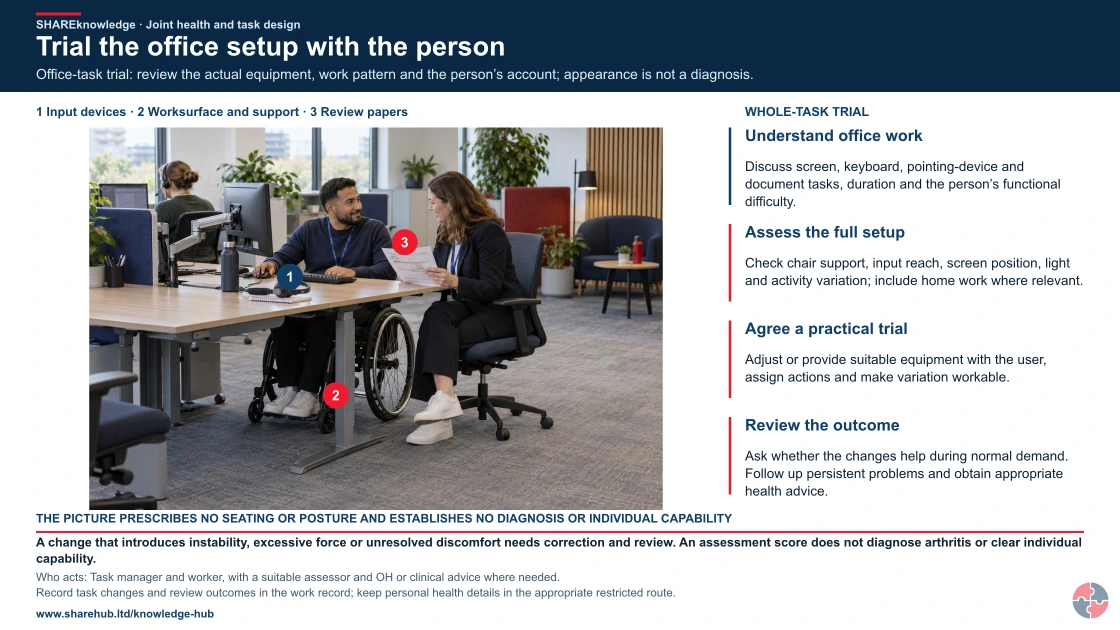
Full written explanation
An illustrative UK office work review shows the whole desk/support context, keyboard and pointing device, screen and inert review papers. One literal numbered picture key identifies input devices, worksurface/support and review papers. The complete scene keeps the person and furniture visible in their natural proportions. Wheelchair use, age or appearance conveys no arthritis diagnosis, disability cause, personal capability or prescribed seating arrangement. Four unnumbered checks explain the actual whole-task relationship: understand screen, input and document work and the person’s functional difficulty; assess support, reach, screen, light and variation including relevant home work; agree a practical equipment or work-pattern trial with the user and accountable actions; then review whether it helps during normal demand and seek appropriate advice for persistent problems. The image is a trial/review context, not a universal correct posture or a completed assessment. An unstable change, excessive force or unresolved discomfort needs correction and review. A score or tidy desk cannot diagnose a condition or clear individual capability. Shared work records describe task changes and outcomes; necessary health detail uses the appropriate restricted route. Existing urgent healthcare remains separate from routine setup review. No symptom display, abnormal anatomy, treatment, ergonomic angle/dimension/duration, safe weight, fitness certificate or new disability/employment/privacy rule is supplied.
Office-task trial: review the actual equipment, work pattern and the person’s account; appearance is not a diagnosis.
- Understand office work. Discuss screen, keyboard, pointing-device and document tasks, duration and the person’s functional difficulty.
- Assess the full setup. Check chair support, input reach, screen position, light and activity variation; include home work where relevant.
- Agree a practical trial. Adjust or provide suitable equipment with the user, assign actions and make variation workable.
- Review the outcome. Ask whether the changes help during normal demand. Follow up persistent problems and obtain appropriate health advice.
When the evidence does not fit: A change that introduces instability, excessive force or unresolved discomfort needs correction and review. An assessment score does not diagnose arthritis or clear individual capability.
Who acts: Task manager and worker, with a suitable assessor and OH or clinical advice where needed.
Changed workplace
Engineering stores: Assess the whole pick, transfer and packing cycle; a trolley does not resolve every grip or reach demand.
Office work: Use the DSE assessment for the actual workstation; a lifting assessment cannot answer keyboard or seating problems.
Evidence check: Record task changes and review outcomes in the work record; keep personal health details in the appropriate restricted route.
Primary references: HSE: advice for workers with MSDs · HSE DSE assessment — whole equipment, furniture, work conditions and user needs · HSE DSE overview — actual workstation and work pattern
Open the complete HD image (new tab)Download image

Primary references: HSE: advice for workers with MSDs · HSE DSE assessment — whole equipment, furniture, work conditions and user needs · HSE DSE overview — actual workstation and work pattern
Observe the full task: load, grip, reach, force, repetitions, duration, route, equipment, pace, recovery and interactions with other work. Ask the worker what is difficult and what they can do safely, without assuming a diagnosis. A manager can change a task immediately for safety while occupational health or a clinician advises on uncertain capability. Do not use a single lifting score as clearance for a worker with symptoms; HSE filters are not universal safe weight limits.
| Task | Useful tool | Decision and limit |
|---|---|---|
| Lift, carry or team handle | HSE MAC or full manual-handling assessment. | Reduce high-risk features and check individual capability; MAC colour is a screening aid, not a medical clearance. |
| Push or pull a loaded trolley | HSE RAPP. | Observe start force, route, wheels, slope and control. RAPP can underestimate small-wheel force on uneven or sloped outdoor routes; use a fuller site-specific push/pull assessment with worker input where needed. A MAC lifting score cannot answer this. |
| Repetitive hand or arm task | HSE ART where suitable. | Examine repetition, force, posture and recovery; not a diagnosis of arthritis. |
| Screen work at home or on site | DSE workstation assessment and CK1 checklist where appropriate. | Check workstation, input devices and activity variation in each relevant setting. |
Worked selection: A worker both unloads boards and pushes a roll cage. Assess the board lifts with MAC or a fuller handling assessment, the cage with RAPP and the route/pace across both tasks. If hand pain also affects keyboard work, add a DSE assessment. No single tool answers all three exposures or determines the clinical cause.
How can the hierarchy of controls reduce harmful workplace demands on people with arthritis?
ERICPD can be used to reduce joint loading by changing the work before relying on individual effort, reminders or personal resilience.
ERICPD stands for Eliminate, Reduce, Isolate, Control, PPE and Discipline. For joint health, the hierarchy is about reducing unnecessary physical load and barriers. The strongest controls are usually design and procurement decisions: avoiding heavy manual work, buying lighter materials, designing access correctly, providing mechanical aids, choosing tools with better handles and reducing the need for prolonged awkward postures.
Personal protective equipment has a smaller role than in some hazard topics. Knee pads, gloves, supportive footwear or thermal clothing can help in specific tasks, but they should not be used to justify poor work design. The real improvement usually comes from changing the task, tool, environment, staffing, pace or access.
For plasterboard delivery, first ask whether boards can arrive at the floor of use, eliminating repeated carrying. Smaller compatible boards or a changed installation sequence may substitute for a high-load lift if the design and quality allow it. A suitable hoist, board trolley or lift table is an engineering aid; the site lead checks access, load, floor conditions and the aid’s condition before use. Team lifting, route planning and task rotation are administrative layers and cannot replace a feasible mechanical aid. Gloves or knee protection may help residual contact or kneeling but do not reduce the load itself. These decisions map ERICPD Eliminate/Reduce/Isolate/Control/PPE to the five-level hierarchy without treating arthritis or the worker as the hazard.
The supervisor observes the actual route and worker feedback, records whether the redesigned delivery avoided manual carrying, and maintains the chosen aid. ERICPD Discipline is that follow-through and learning from discomfort reports, not blame or an expectation that someone work through pain. If the route changes, the equipment cannot fit, the load is unstable or a worker reports worsening symptoms, hold the lift and reassess the task. Individual health information and any adjustment discussion remain confidential and separate from the general manual-handling assessment; urgent medical symptoms follow the clinical route.
How can the ERICPD hierarchy of controls reduce harmful workplace demands on people with arthritis?

| ERICPD level | What it means for joint health | Practical examples | Evidence to check |
|---|---|---|---|
| Eliminate | Remove unnecessary joint loading or avoidable awkward tasks. | Order materials pre-cut, use off-site fabrication, design out kneeling work, avoid manual lifting through delivery planning. | Design review, procurement standard, method statement and pre-start review. |
| Reduce | Reduce weight, force, repetition, distance, duration or exposure to poor posture. | Lighter loads, smaller packs, shorter carrying distances, low-force tools, shared rotation and improved task sequencing. | Risk assessment, MAC/RAPP scores, worker feedback and supervisor checks. |
| Isolate | Separate the person from the load or poor posture by using equipment or layout. | Hoists, trolleys, pallet trucks, conveyors, adjustable benches, access platforms and remote handling. | Equipment inspections, maintenance records and observation of actual use. |
| Control | Use work controls that keep remaining load tolerable. | Movement breaks, job rotation, DSE setup, task planning, pace control, warm-up time, safe access and housekeeping. | DSE records, rota review, site inspection, action tracker and return-to-work plan. |
| PPE | Use suitable personal items only for remaining task-specific risk. | Knee protection, gloves with suitable grip, supportive footwear or weather protection where relevant. | PPE assessment, issue record, fit/comfort feedback and replacement checks. |
| Discipline | Make early reporting, adjustment review and safe task planning normal. | Briefings, manager training, stop-work culture, near-miss review, no-blame symptom reporting and periodic audits. | Training records, completed reviews, worker consultation and management review minutes. |
How can the ISO 45001 hierarchy of controls reduce harmful workplace demands on people with arthritis?

| ERICPD level | What it means for joint health | Practical examples | Evidence to check |
|---|---|---|---|
| Eliminate | Remove unnecessary joint loading or avoidable awkward tasks. | Order materials pre-cut, use off-site fabrication, design out kneeling work, avoid manual lifting through delivery planning. | Design review, procurement standard, method statement and pre-start review. |
| Reduce | Reduce weight, force, repetition, distance, duration or exposure to poor posture. | Lighter loads, smaller packs, shorter carrying distances, low-force tools, shared rotation and improved task sequencing. | Risk assessment, MAC/RAPP scores, worker feedback and supervisor checks. |
| Isolate | Separate the person from the load or poor posture by using equipment or layout. | Hoists, trolleys, pallet trucks, conveyors, adjustable benches, access platforms and remote handling. | Equipment inspections, maintenance records and observation of actual use. |
| Control | Use work controls that keep remaining load tolerable. | Movement breaks, job rotation, DSE setup, task planning, pace control, warm-up time, safe access and housekeeping. | DSE records, rota review, site inspection, action tracker and return-to-work plan. |
| PPE | Use suitable personal items only for remaining task-specific risk. | Knee protection, gloves with suitable grip, supportive footwear or weather protection where relevant. | PPE assessment, issue record, fit/comfort feedback and replacement checks. |
| Discipline | Make early reporting, adjustment review and safe task planning normal. | Briefings, manager training, stop-work culture, near-miss review, no-blame symptom reporting and periodic audits. | Training records, completed reviews, worker consultation and management review minutes. |
How do manual handling and DSE controls support arthritis and joint health?
Manual handling and DSE controls reduce two of the most common workplace routes for aggravating joint pain and musculoskeletal discomfort.
Choose the assessment for the task


Read this visual as text
- LOAD MOVEMENT: Consider load, carry distance, grip, access and handling aids. Use an appropriate manual-handling assessment.
- REPEATED UPPER-LIMB WORK: Examine repetition, force, posture, recovery and tool design.
- SCREEN OR SEATED WORK: Review workstation fit, reach, seating, task variation and suitable adjustments.
Which Assessment Fits
Two linked parts · 6 questions. Open Part 2 to complete the route.

Continue to questions 4–6 · Part 2 of 2


Read this visual as text
- Start: A task combines materials handling, repetitive tool work, pushing and screen work.
- Question 1: Can hazardous handling be avoided? Decision owner: Supervisor with HR / occupational-health advice.
- Yes: Redesign the flow and assess any new equipment or task. CONTINUE → QUESTION 2.
- No: Assess the actual handling route and residual demands. CONTINUE → QUESTION 2.
- Unknown: Compare practical alternatives before allocating the task. HOLD → OWNER RESOLVES BEFORE RESUMING.
- Question 2: Which task assessment applies? Decision owner: Supervisor with HR / occupational-health advice.
- Lifting / carrying: Use MAC or a fuller task-specific manual-handling assessment. CONTINUE → QUESTION 3.
- Pushing / pulling: Use the appropriate pushing/pulling assessment such as RAPP. CONTINUE → QUESTION 3.
- Repetition / screens: Use ART or a DSE assessment as relevant; combine routes for mixed work. CONTINUE → QUESTION 3.
- UNKNOWN / NONE FITS: Keep affected work or the decision held. The named owner resolves the facts; immediate protection takes priority. HOLD → OWNER RESOLVES BEFORE RESUMING.
- Question 3: Are combined exposures, individual needs and recovery considered? Decision owner: Supervisor with HR / occupational-health advice.
- YES: The required evidence or condition is confirmed. CONTINUE → QUESTION 4.
- NO / UNKNOWN — HOLD: One score or a universal weight limit cannot settle the whole job. HOLD → REPEAT QUESTION 3 AFTER CORRECTION.
- Question 4: Are aids, route, layout and method suitable in real work? Decision owner: Supervisor with HR / occupational-health advice.
- YES: The required evidence or condition is confirmed. CONTINUE → QUESTION 5.
- NO / UNKNOWN — HOLD: Correct the actual conditions with worker input. HOLD → REPEAT QUESTION 4 AFTER CORRECTION.
- Question 5: Has changed equipment, material or function triggered review? Decision owner: Supervisor with HR / occupational-health advice.
- YES: The required evidence or condition is confirmed. CONTINUE → QUESTION 6.
- NO / UNKNOWN — HOLD: Reassess rather than carrying forward an old score. HOLD → REPEAT QUESTION 5 AFTER CORRECTION.
- Question 6: Release and monitor the agreed task Decision owner: Supervisor with HR / occupational-health advice.
- ACTION: Record the controls, owner and reassessment triggers. OUTCOME → RECORD AND HAND OVER.
- Outcome: Task-specific controls and documented release, or hold until the missing assessment and aid are provided.
- Stop and escalation boundary: Do not rely on one score, a universal weight limit or an old assessment after changed materials, equipment or capability.
Manual handling is not just heavy lifting. HSE describes it as transporting or supporting a load by hand or bodily force, including lifting, putting down, pushing, pulling, carrying or moving. For people with joint symptoms, a task may become difficult because of grip, reach, twist, frequency, floor condition, distance, pace or recovery, not only because the load is heavy. Tools such as the MAC and RAPP help assess these factors rather than guessing.
DSE work can also affect joint health. Poor chair setup, unsupported wrists, excessive reach to a mouse, laptop-only working, screen height, poor foot support, fixed sitting, unsuitable home setup or long periods without change can aggravate neck, shoulder, back, hip, wrist or hand symptoms. Good DSE management gives people enough information, suitable equipment, breaks or changes in activity and review where discomfort is reported.
The main lesson is to use the right assessment for the work. A manual handling assessment will not fix a poor workstation, and a DSE checklist will not control carrying loads across a site. Many people need both, especially supervisors or workers who split their day between operational work, driving and screen-based administration.
| Work area | What to assess | Practical controls |
|---|---|---|
| Lifting and carrying | Load weight, shape, grip, frequency, distance, posture, floor condition, team handling and individual capability. | Avoid, mechanise, reduce weight, improve handles, store between knee and shoulder height and use MAC where helpful. |
| Pushing and pulling | Initial force, sustained force, wheels, handles, route, slope, floor condition, visibility and stopping control. | Use suitable trolleys, maintain wheels, improve routes and reduce load. RAPP can help, but assess small wheels on uneven or sloped outdoor routes directly with workers because RAPP may underestimate force. |
| Kneeling, crouching and low work | Duration, surface, access, frequency, tools, posture and recovery. | Raise the work, use platforms or benches, plan rotation, use suitable knee protection and reduce time in fixed posture. |
| Hand tool use | Grip diameter, weight, trigger force, wrist posture, vibration, torque, repetition and maintenance condition. | Select ergonomic tools, maintain sharpness, reduce vibration, use supports and rotate tasks. |
| Desk and screen work | Chair, desk height, screen height, keyboard, mouse, laptop use, reach distances, legroom and breaks. | DSE assessment, separate keyboard/mouse for laptops, adjustable chair, document holder, foot support and movement variation. |
| Driving and travel | Vehicle seat, route time, breaks, loading/unloading, vibration and fatigue. | Plan routes, adjust seats, schedule breaks, review loading methods and reduce unnecessary travel. |
Follow the whole board-moving task, not just the lift
A handling aid can remove one difficult lift while leaving long carries, awkward reaches or repeated positioning unchanged. Review the complete job with the worker before agreeing a revised method.
Illustrative task: delivering plasterboard to an internal work area. The changes below are options to assess, not a prescribed method or a safe-weight limit.
Delivery
Demand: carrying boards from a distant unloading point.
Change to assess: arrange delivery closer to the work, with a suitable unloading and storage position.
Check: vehicle access, ground conditions, stability and the remaining carrying distance.
Transfer
Demand: sustained grip and pushing or carrying through doorways.
Change to assess: a suitable board trolley or handling aid.
Check: the load and aid are compatible; the whole route, gradients and turning space work in practice.
Positioning
Demand: reaching, twisting or holding the board while it is fixed.
Change to assess: supported positioning at an appropriate working height.
Check: the assessed method controls the board and leaves access for the actual fitting task.
Follow-on work
Demand: repeated movements and cumulative joint loading.
Change to assess: redesign the sequence, pace and recovery opportunities.
Check: observed task demands and worker feedback after a supervised trial, with a named review date.
Review before continuing: if the aid does not fit, the route changes or the agreed task remains difficult, revisit the method. A diagnosis, pain score or completed handling course does not decide individual fitness for work. Use agreed adjustments and review and the medical advice route where needed.
Basis: HSE manual handling at work. The task comparison is an original teaching example.
How should managers talk about arthritis and joint health?
Managers should talk privately, respectfully and practically, focusing on work barriers and support rather than diagnosis.
A good conversation is calm and specific. The manager should explain what they have noticed in terms of work impact, ask whether the person is okay, ask whether work is making anything harder and ask what support might help. The worker should be given choice about what they disclose. Some people may have a diagnosis; others may still be seeking advice; some may simply know that a task is hurting them.
The manager should not ask intrusive medical questions, promise confidentiality that cannot be kept, share information widely, or assume that a person with arthritis cannot do certain work. The right question is usually: what needs to change so the work is safer and more manageable?
Conversations should end with agreed actions. If nothing is written down, support can drift. A short note should record the work issue, agreed control or adjustment, who will do what, what can be shared, and when the arrangement will be reviewed.
| Conversation area | Helpful wording | What to avoid |
|---|---|---|
| Opening | I have noticed you seem uncomfortable when doing this task. Is work making anything harder at the moment? | Do not say you think they have arthritis or that they are not fit for the job. |
| Functional impact | Which parts of the job are most difficult: lifting, gripping, stairs, sitting, standing, travel or pace? | Do not ask for detailed diagnosis unless it is genuinely needed and appropriately handled. |
| Support options | What has helped before, and what temporary or longer-term changes should we consider? | Do not assume one adjustment will work for every person. |
| Confidentiality | What information are you comfortable with me sharing, and who needs to know so the support can be put in place? | Do not discuss health information with the wider team without a clear need. |
| Escalation | Would occupational health, HR, physiotherapy advice or a further workplace assessment help us make better decisions? | Do not delay specialist input where safety, absence or capability is uncertain. |
| Review | Let us agree what changes we will make and when we will check whether they are working. | Do not leave adjustments open-ended without ownership or review. |
How should support, adjustments and review be managed?
Support should be agreed with the worker, linked to the work activity, documented proportionately and reviewed as symptoms or work change.
Joint-health support works best when it is visible as a management process but private in personal detail. The organisation should know what controls and adjustments exist, who owns them and whether they are working. The whole team does not need to know someone's diagnosis, medication or medical history.
Adjustments can be temporary or long term. They can involve equipment, hours, tasks, location, travel, targets, supervision, breaks or communication. Some will be simple and quick; others will need procurement, occupational-health advice, HR input, ergonomics, building access changes or consultation with the worker and team.
Review is essential because symptoms can fluctuate. A person may need more support during a flare-up, after treatment, after a manual job change or during return to work. Good review prevents two common failures: adjustments being forgotten, or old restrictions remaining after they no longer fit.
| Support area | Possible options | Review questions |
|---|---|---|
| Work equipment | Ergonomic tools, lighter tools, easy-grip handles, adjustable chair, alternative mouse, sit-stand option or trolley. | Is the equipment used, maintained, comfortable and still suitable for the work? |
| Task design | Reduce high-force work, rotate tasks, avoid prolonged kneeling, alter sequencing or add mechanical handling. | Has the task risk reduced or has strain simply moved to another person or activity? |
| Hours and pace | Flexible start, planned breaks, reduced overtime, gradual workload increase or phased return. | Does the person have enough recovery without unfair workload transfer? |
| Access and travel | Parking, welfare location, stairs, walking distance, vehicle setup, site routes or remote-working arrangements. | Can the person reach work areas safely and with dignity? |
| Communication and supervision | Clear priorities, written instructions, regular check-ins and agreed escalation route. | Does the person know who to speak to and what has been agreed? |
| Specialist support | Occupational health, physiotherapy, ergonomics, HR or Access to Work consideration where relevant. | Has the advice been translated into practical workplace actions? |
Separate two decisions. Remove an immediate task hazard for anyone who cannot control the load safely; that is a work-risk control. In parallel, consider the applicable GB or NI reasonable-adjustment duty where disability-related substantial disadvantage, employer knowledge or reasonable knowledge and a reasonable step are factually established. Ask about the barrier and desired work outcome, not for a diagnosis in a shared team record. A confidential OH or HR route can hold any necessary clinical detail.
Which duties apply in Great Britain and Northern Ireland?
Both jurisdictions require management of work-related musculoskeletal risk and disability-related adjustments when the legal conditions are met, but their health and safety and equality statutes differ.
| Where | Legal route | Workplace decision and evidence |
|---|---|---|
| Great Britain | Health and Safety at Work etc. Act 1974; Management Regulations 1999; Manual Handling Operations Regulations 1992; DSE Regulations 1992 for defined users. | Assess and reduce MSD risks; avoid, assess and reduce hazardous handling; assess DSE where applicable. Keep task assessments, controls, training and review evidence. Official source |
| Northern Ireland | Health and Safety at Work (NI) Order 1978; Management Regulations (NI) 2000; Manual Handling Operations Regulations (NI) 1992; DSE Regulations (NI) 1992 for defined users. | Use HSENI guidance and NI legislation for local duties; document task controls and changes. HSE GB guidance can inform technique but is not itself NI law. Official source |
| Great Britain | Equality Act 2010 disability provisions. | A legal adjustment assessment considers whether an applicable disability causes substantial disadvantage from a work rule or physical feature, what the employer knows or could reasonably know, and which step is reasonable. Consult the worker; obtain HR or OH advice where needed. Official source |
| Northern Ireland | Disability Discrimination Act 1995 section 4A as modified for NI, with the Equality Commission NI employment code. | Assess substantial disadvantage, employer knowledge or reasonable knowledge, and reasonable steps under the NI route. Consult the worker; obtain HR, OH or legal advice rather than applying the GB Equality Act. Official source |
| Across the UK | UK GDPR and Data Protection Act 2018 for worker health information. | Identify lawful basis and special-category condition; restrict access and retain only necessary functional/adjustment information. Official source |
Operational test: if a board carrier reports painful grip and cannot safely hold the load, stop that carry and redesign it now as a safety measure, regardless of any legal disability status. Separately, assess whether the worker meets the applicable GB or NI disability definition, whether a task rule or workplace feature causes substantial disadvantage, what the employer knew or should reasonably have known, and what adjustment is reasonable. A diagnosis alone settles none of those questions. Discuss functional needs and seek HR, occupational-health or legal advice as needed; do not demand a diagnosis as the price of a safer task. Keep the shared task-control record separate from restricted clinical information. No universal safe lifting weight, arthritis certificate or fixed adjustment-review interval follows from this guide.
What should happen before, during and after joint-loading work?
Release a task only when the method, aids, route, pace and worker capability are suitable today; stop and review when those conditions change.
| Stage | Check and hold point | Evidence |
|---|---|---|
| Before | Check handling avoidance, tool and aid condition, route, access, task duration and agreed adjustments. Hold for missing aids, unknown load, changed work or a worker who reports unsafe capability. | Task assessment, equipment check, worker briefing and confidential adjustment instruction. |
| During | Observe force, grip, posture, repetition and recovery. Stop for sudden pain, lost grip, instability, new swelling, a defective aid or a method that diverges from the assessment. | Supervisor observation, worker report, defect/action log and safe reassignment. |
| Completion and hand-back | Check the task is complete without hidden strain or an unsafe backlog; return equipment, record defects and review whether controls and adjustments worked. | Hand-back note, action owner, task reassessment and worker feedback. |
What should the risk or support register include for arthritis and joint health?
A useful register links the task, possible harm, controls, support route and evidence that the arrangement is working.
Arthritis and joint health can sit in more than one register. The health and safety risk register may track manual handling, DSE, vibration, work equipment and workplace access controls. HR or occupational-health case management may track individual adjustments where the worker has agreed support. These records should connect, but they should not expose unnecessary medical detail.
The register should not become a list of diagnoses. It should capture work barriers and control decisions: which tasks create joint load, which controls reduce that load, who owns them, what evidence will be checked and what would trigger review.
| Scenario or issue | How harm or barrier can develop | Preventing or reducing controls | Support or mitigation | Evidence to check |
|---|---|---|---|---|
| Repeated manual handling with joint symptoms | Pain, stiffness or reduced grip worsens because heavy or frequent handling continues without redesign. | Avoid handling, reduce load, use aids, improve storage height, assess with MAC/RAPP and train supervisors. | Temporary duty change, occupational-health advice, phased return or physiotherapy signposting. | Manual handling assessment, action tracker, equipment use observations and worker feedback. |
| Poor DSE setup for a worker with hand, wrist, shoulder or back symptoms | Static posture, reach distance or poor input devices increase discomfort and fatigue. | DSE assessment, suitable chair, screen height, separate keyboard/mouse, movement variation and laptop control. | Alternative equipment, adjusted breaks, home-working review or specialist ergonomic assessment. | DSE checklist, equipment record, review note and symptom feedback. |
| Grip-heavy or vibrating tool use | Hand, wrist or arm symptoms worsen through force, vibration, poor handle design or long trigger time. | Procure lower-vibration/ergonomic tools, maintain tools, reduce trigger time, rotate tasks and use suitable grips. | Temporary restriction, health surveillance where vibration duties apply, occupational-health input. | Tool register, maintenance records, vibration plan and training records. |
| Return to work after flare-up or absence | Person returns to full workload too quickly and symptoms escalate. | Phased return, graded duties, workload planning, manager check-ins and review dates. | Occupational-health advice, HR support, flexible working discussion or Access to Work consideration. | Return-to-work plan, review dates, agreed confidentiality boundaries and closed actions. |
| Access barriers on site or premises | Stairs, long walking routes, uneven ground or poor welfare access increase pain and fatigue. | Plan routes, improve housekeeping, provide suitable parking/access, adjust work area and review temporary works. | Alternative work location, buddy arrangements or mobility-related support. | Workplace inspection, access review, worker feedback and facilities actions. |
How do controls change across real joint-health tasks?
Different tasks need different exposure controls and individual support; these eight BuildOut examples show how to pause, redesign and verify work without diagnosing anyone.
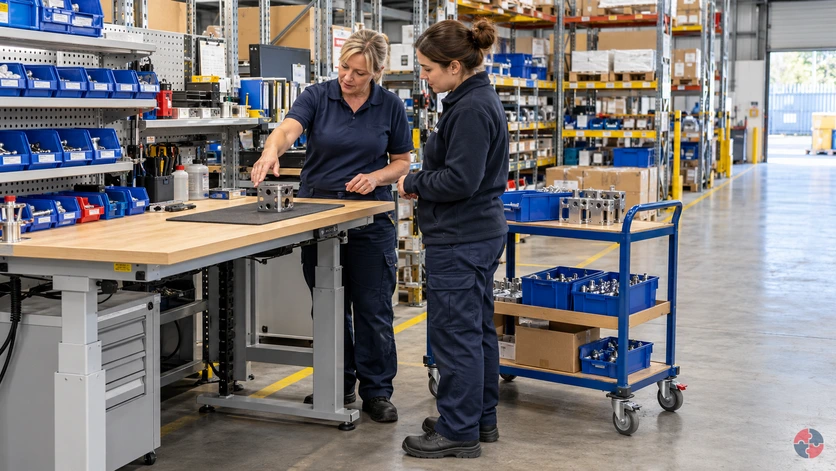
Redesign the stores task around actual function
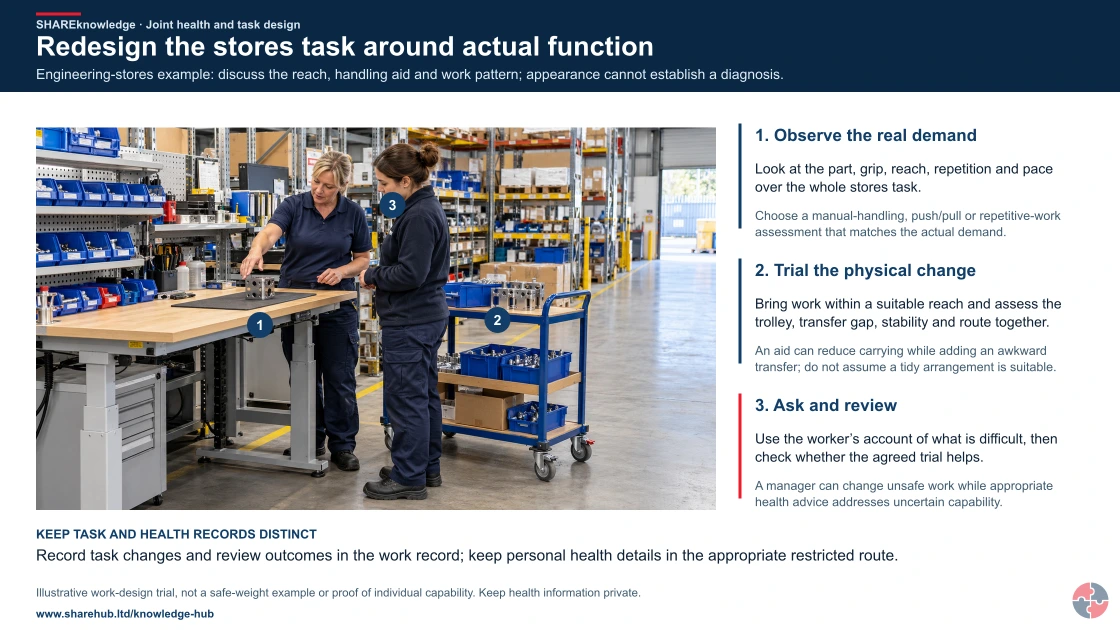
Full written explanation
Engineering-stores example: discuss the reach, handling aid and work pattern; appearance cannot establish a diagnosis.
- Observe the real demand. Look at the part, grip, reach, repetition and pace over the whole stores task.
- Trial the physical change. Bring work within a suitable reach and assess the trolley, transfer gap, stability and route together.
- Ask and review. Use the worker’s account of what is difficult, then check whether the agreed trial helps.
Change the pathway
- Assess the task. Choose a manual-handling, push/pull or repetitive-work assessment that matches the actual demand.
- Check new risks. An aid can reduce carrying while adding an awkward transfer; do not assume a tidy arrangement is suitable.
- Use private support. A manager can change unsafe work while appropriate health advice addresses uncertain capability.
Evidence check: Record task changes and review outcomes in the work record; keep personal health details in the appropriate restricted route.
Primary references: HSE: advice for workers with MSDs · HSE DSE assessment — whole equipment, furniture, work conditions and user needs · HSE DSE overview — actual workstation and work pattern
Open the complete HD image (new tab)Download image

Primary references: HSE: advice for workers with MSDs · HSE DSE assessment — whole equipment, furniture, work conditions and user needs · HSE DSE overview — actual workstation and work pattern
Redesign the plasterboard move


Read this visual as text
- Delivery close to use, a suitable board aid and a clear route can reduce the work demand. Discuss grip or knee difficulties privately; no image or assessment tool diagnoses a joint condition.
- BRING DELIVERY CLOSER
- USE A SUITABLE AID
- REVIEW THE ACTUAL TASK
Delivery position, handling aid and route must be assessed together. Check the aid against the actual board, doorway widths, surface, gradient and positioning task; trial agreed changes with the worker. The illustration does not establish a safe load or individual fitness for work.
Routine plasterboard delivery
Task material and setting: Move boards to a floor workface without unnecessary carrying.
People and prerequisites: Boards, pallet truck and board lifter; delivery crew and installers; level site route.
Before: Plan delivery close to use, check route and aids, brief crew and consider individual limitations privately.
During: Use mechanical aid and suitable lift method only for residual handling; vary tasks and keep access clear.
Hold or stop: Hold for blocked route or absent lifter; stop for loss of grip, pain or unstable load.
Completion and hand back: Park and inspect aids, record delivery and any changed handling risk.
Evidence: Delivery route and aid check, handling assessment or MAC note for residual lifts, crew briefing and defect close-out; keep individual health detail restricted.
Changed material specification
Task material and setting: Respond to heavier blocks supplied after the method was approved.
People and prerequisites: Blocks, trolleys and scaffold access; bricklayers and subcontractors; outdoor build.
Before: Check actual unit weight, frequency, access and procurement alternative before release.
During: Revise handling method, use suitable aids and plan work height and staffing.
Hold or stop: Do not assume the old MAC result applies; hold until assessment and briefing are updated.
Completion and hand back: Record revised product, assessment, briefing and procurement decision.
Evidence: Changed product weight and frequency, revised handling or MAC assessment, approved method and worker briefing; keep health detail on the restricted route.
Defective handling aid
Task material and setting: Move materials when a trolley wheel binds on an uneven route.
People and prerequisites: Loaded trolley and sloped yard; storekeeper and nearby staff; wet ground.
Before: Inspect trolley, load, brakes and route; have defect reporting route.
During: Remove defective trolley from use and choose a suitable replacement or redesign the move.
Hold or stop: Stop pushing a seized or unstable trolley; do not substitute an unassessed manual drag.
Completion and hand back: Tag defect, repair and verify aid before return to service.
Evidence: Trolley defect tag and repair record, full site-specific force and route assessment with worker input (RAPP as an aid only), replacement aid check and named release to use.
Non-routine overhead fit
Task material and setting: Install a small component without prolonged overhead arm loading.
People and prerequisites: Powered tool, access platform and fixings; fitter and coworker; occupied refurbishment.
Before: Check alternative preassembly, platform height, tool weight and task duration.
During: Adjust work height, support tools where feasible and vary work with planned recovery.
Hold or stop: Hold for unsuitable access or dropped-object risk; stop if grip or shoulder control is lost.
Completion and hand back: Inspect installation and record method learning and any symptoms.
Evidence: Platform and tool setup check, revised work method, task variation plan and completion review; any personal symptom detail remains confidential.
Changed hybrid workstation
Task material and setting: Support a planner with hand stiffness using laptop and site-office screens.
People and prerequisites: Laptop, mouse and keyboard; planner and team; home and temporary site office.
Before: Confirm DSE-user status and assess both regular work locations; discuss barriers privately.
During: Provide suitable input and display setup and activity variation; test the arrangement with the worker.
Hold or stop: Hold an unsuitable setup that aggravates symptoms; seek assessment if pain persists.
Completion and hand back: Record workstation actions and review functional feedback without storing diagnosis in a shared file.
Evidence: Home and site-office DSE assessments, equipment actions and the worker's functional feedback; store any clinical information separately.
Contractor task allocation
Task material and setting: Coordinate two trades sharing a material lift and narrow access route.
People and prerequisites: Board lifter, trolley and materials; principal contractor and subcontractors; stair landing.
Before: Agree equipment ownership, booking, route and worker consultation before work.
During: Sequence deliveries, avoid carrying through congestion and check aid availability.
Hold or stop: Hold when the lift is unavailable or access changes; stop improvised manual carrying.
Completion and hand back: Record coordination decision, revised method and handover to the next trade.
Evidence: Interface briefing, task allocation and handling control record, supervisor sign-off and restricted individual support agreement if needed.
Flare on a safety-sensitive task
Task material and setting: Respond when a worker says knee pain makes ladder work unsafe today.
People and prerequisites: Ladder task, materials and access platform; worker and supervisor; active construction site.
Before: Know reporting route, alternative safe duties and occupational-health contact.
During: Stop ladder assignment, discuss functional restrictions privately and consider platform or alternative work.
Hold or stop: No climb where stable movement cannot be assured; urgent medical route for hot swollen joint or systemic illness.
Completion and hand back: Document temporary work plan, referral decision and agreed review, not an assumed diagnosis.
Evidence: Stopped-task record and safe alternative duty, care signposting and agreed review point; do not put diagnosis or treatment notes in the shared task log.
Return after absence
Task material and setting: Build back a worker after treatment without transferring high load to teammates.
People and prerequisites: Manual tasks, hours and aids; worker, supervisor and team; multiple sites.
Before: Review fit note or occupational-health advice where available, current task risks and worker preference.
During: Agree phased duties or hours if appropriate, equipment, check-ins and team resourcing.
Hold or stop: Hold any task outside current agreed capability; stop and revise for worsening symptoms or failed adjustment.
Completion and hand back: Record duties, owners and review point; assess the actual response before increasing work.
Evidence: Worker-agreed phased duties, task risk assessment, restricted OH/HR advice where obtained and proportionate review record; no unsupported fitness declaration.
How could BuildOut Ltd manage arthritis and joint health?

BuildOut Ltd could manage arthritis and joint health by treating it as both a work-design issue and a confidential support issue.
BuildOut Ltd
BuildOut Ltd is a construction and refurbishment contractor used to show how arthritis and joint health can be managed across site work, trade tasks, driving, office planning and return-to-work situations.
BuildOut starts by identifying where joint load is created: manual handling of plasterboard and blocks, kneeling during floor work, repetitive screw fixing, grip-heavy tool use, access up stairs and ladders, carrying materials through uneven routes, driving between sites and office-based planning on laptops. These are recorded in the health and safety risk register as work factors, not as assumptions about individual workers.
At tender and planning stage, BuildOut designs out some strain by specifying mechanical handling, board lifters, smaller material packs, delivery close to point of use, raised work platforms, pre-cut materials and welfare/access arrangements. Procurement rules require supervisors to consider tool weight, grip, vibration, trigger force, battery weight and maintenance. Contractor pre-start information asks subcontractors how they will control manual handling, DSE for site offices and ergonomic tool use.
When a worker reports joint pain or returns after arthritis-related absence, the supervisor holds a private conversation and records only what is needed: work tasks affected, agreed support, who needs to know and the review date. HR and occupational health are involved where capability, medication, absence, disability or safety-critical duties need specialist advice. Adjustments may include rotating away from kneeling work, using a board lifter, changing start times to allow stiffness to ease, improving welfare access, providing alternative tools or grading duties back up over several weeks.
BuildOut checks the system through three assurance layers. Frontline supervisors complete simple binary checks: are handling aids available, are materials stored at a sensible height, have affected workers had agreed reviews, and are DSE setups completed in site offices? Safety advisers carry out second-line audits of manual handling assessments, DSE records, training, equipment procurement and subcontractor controls. Senior managers review trends in absence, injury reports, adjustment delays, worker feedback and repeated task problems, then fund improvements through procurement, planning and training.
| Management element | How BuildOut applies it | Evidence, oversight and improvement |
|---|---|---|
| Risk register and task assessment | Records manual handling, kneeling, tool grip, vibration, DSE, access, driving and return-to-work barriers as work factors to be controlled. | Risk register reviews, MAC/RAPP assessments, DSE checklists, worker consultation and trend review. |
| Procurement and equipment | Buys lighter tools, ergonomic handles, board lifters, trolleys, adjustable chairs, suitable site-office setups and handling aids before relying on manual effort. | Procurement specification, equipment inspection, maintenance records and feedback on whether aids are actually used. |
| Training and competence | Briefs workers on early symptom reporting, tool choice, manual handling, DSE setup and how to ask for support without stigma. | Training matrix, toolbox talks, supervisor coaching records and worker understanding checks. |
| Contractor management | Requires subcontractors to plan handling, access, tool use and site-office DSE rather than arriving with generic RAMS. | Pre-start reviews, contractor audits, site observations and non-conformance close-out. |
| Confidential support and adjustments | Uses private conversations, occupational-health referral prompts, agreed adjustments, review dates and limited sharing of health information. | Support plans, HR/OH referrals, privacy controls and review outcomes. |
| Learning and improvement | Compares absence trends, near misses, handling defects, worker feedback and audit findings to improve planning and procurement. | Management review minutes, action tracker, equipment changes and revised method statements. |
How should a flare or return to work be handled?
Agree a practical temporary work plan, stop duties that cannot be done safely, and review the plan with the worker as symptoms and work change.
Adjustment and Return
Two linked parts · 6 questions. Open Part 2 to complete the route.

Continue to questions 4–6 · Part 2 of 2


Read this visual as text
- Start: A worker with joint symptoms asks for support or returns after absence.
- Question 1: Discuss function privately Decision owner: Supervisor with HR / occupational-health advice.
- ACTION: Ask what work is manageable and what creates a barrier; make unsafe duties safe now. CONTINUE → QUESTION 2.
- Question 2: Are the actual duties and relevant barriers understood? Decision owner: Supervisor with HR / occupational-health advice.
- YES: The required evidence or condition is confirmed. CONTINUE → QUESTION 3.
- NO / UNKNOWN — HOLD: Assess the task rather than deciding from a diagnosis label alone. HOLD → REPEAT QUESTION 2 AFTER CORRECTION.
- Question 3: Has the applicable GB or NI adjustment route been considered? Decision owner: Supervisor with HR / occupational-health advice.
- YES: The required evidence or condition is confirmed. CONTINUE → QUESTION 4.
- NO / UNKNOWN — HOLD: Use appropriate HR/OH advice on employer knowledge, disadvantage and reasonable steps. HOLD → REPEAT QUESTION 3 AFTER CORRECTION.
- Question 4: Are the agreed controls resourced without unsafe transfer to coworkers? Decision owner: Supervisor with HR / occupational-health advice.
- YES: The required evidence or condition is confirmed. CONTINUE → QUESTION 5.
- NO / UNKNOWN — HOLD: Resolve aids, allocation, supervision and work pace before release. HOLD → REPEAT QUESTION 4 AFTER CORRECTION.
- Question 5: Is necessary information sharing restricted to duties and controls? Decision owner: Supervisor with HR / occupational-health advice.
- YES: The required evidence or condition is confirmed. CONTINUE → QUESTION 6.
- NO / UNKNOWN — HOLD: Keep confidential clinical information in the appropriate professional route. HOLD → REPEAT QUESTION 5 AFTER CORRECTION.
- Question 6: Does the reviewed arrangement work for the person and task? Decision owner: Supervisor with HR / occupational-health advice.
- YES: The required evidence or condition is confirmed. OUTCOME → RECORD AND HAND OVER.
- NO / UNKNOWN — HOLD: Revise it with the worker or maintain the relevant duty hold pending advice. HOLD → REPEAT QUESTION 6 AFTER CORRECTION.
- Outcome: Documented plan with owner and review, or a hold for clinical/occupational-health and task evidence.
- Stop and escalation boundary: Stop an unsafe duty, prevent unsupported work transfer to coworkers and escalate persistent or urgent symptoms to healthcare.
Ask what tasks are manageable today, what creates pain or instability, whether any safety-sensitive activity should pause and whether a healthcare or occupational-health opinion is needed. A flare is not a reason to assume permanent incapacity. Possible changes include mechanical aids, avoiding prolonged kneeling, different start times, shorter exposure, different access, adjusted targets or a phased return. Agree what colleagues need to know to implement controls, not the underlying clinical history. If treatment or medication may affect safety-critical work, obtain competent advice without giving medication instructions.
Set an agreed review point based on the change, rather than a universal interval. Check that support is effective and does not move hazardous load to coworkers. Increase duties only after the actual task and functional response support it. Consider reasonable adjustments under the applicable GB or NI law, even when an absence is short or the diagnosis is not settled.
What training helps workplaces manage arthritis and joint health?
Training should be layered so everyone understands the basics while higher-risk roles learn how to assess tasks, support people and improve controls.
Training should not imply that people can prevent all arthritis by lifting correctly or sitting up straight. The better message is that work design affects joint load, early reporting matters and managers need enough confidence to respond without diagnosing. Training should also explain common acronyms such as MSD, DSE and OH so the content is useful to people who are new to health and safety.
A layered approach works well. General awareness can be short and digital for all staff. Task-specific training should be practical for people doing manual handling, DSE-heavy work, tool use, kneeling work, driving or standing work. Supervisors and managers need deeper training on conversations, adjustments, risk assessment, confidentiality and when to seek occupational-health input.
| Role and learning | Practice on the actual task | Competence evidence and record | Assessor and reassessment trigger |
|---|---|---|---|
| Workers: report functional barriers | Practise an early report and task-safe adjustment request without disclosing a diagnosis to the whole team. | Observed task discussion and agreed route to support. | Supervisor rechecks after symptoms, task or aid changes. |
| Supervisors: adapt the actual task | Assess force, repetition, posture, duration and recovery; test a practical change with the worker. | Observed work review and recorded action effectiveness. | Competent manager rechecks after a flare or task change. |
| Ergonomics and safety advisers: assess exposure | Select appropriate manual-handling, push/pull or DSE tools and redesign the work before relying on technique. | Assessment method rationale and verified control. | Technical peer reviews after equipment or workload change. |
| Occupational health and HR: support the person | Use functional advice, privacy boundaries and the applicable GB or NI adjustment route. | Qualified opinion, agreed support plan and lawful data handling. | Clinical/HR lead reviews on change or return to work. |
| Managers: check prevention and fairness | Check work design across the team, fund aids and verify adjustments without diagnosing staff. | Worker feedback, action closure and review record. | Accountable lead reviews trends and policy changes. |
Record observed task decisions, assessor and reassessment trigger; attendance alone does not establish competence.
How can management-system themes support arthritis and joint health?
Management-system themes can help turn joint-health support into a planned, consulted, controlled and reviewed activity.
ISO 45001 is not a medical standard and it does not replace HR, occupational-health or equality duties. Its value is structure. It helps an organisation show that musculoskeletal risks and wellbeing arrangements are identified, resourced, controlled, communicated, monitored and improved.
The table gives original SHARE prompts for worker consultation, hazard assessment, competence, task control and review. It does not reproduce verified ISO clause wording. The practical decisions are supported by HSE work-risk guidance; authorised standards evidence remains necessary for exact clause claims.
| Management-system theme | What this means | How it supports this topic |
|---|---|---|
| Consultation and participation of workers | Ask workers which real tasks and work barriers need redesign. | Use worker feedback to identify joint-loading tasks, barriers, early symptoms and whether adjustments are practical. |
| Hazard identification and assessment of risks and opportunities | Assess force, repetition, posture, vibration, routes and recovery for actual tasks. | Identify manual handling, DSE, posture, repetition, vibration, access and recovery risks that can affect joint health. |
| Competence | Observe correct task control, assessment-tool selection and support decisions. | Define competence for workers, supervisors, DSE assessors, manual handling assessors and people managing adjustments. |
| Awareness | Explain early reporting, urgent care and confidential support routes. | Make workers aware of early reporting, safe task design, support routes and confidentiality boundaries. |
| Operational planning and control | Agree aids, duties, sequencing and review without transferring strain to coworkers. | Control work methods, staffing, task rotation, equipment, procurement, contractor activities and return-to-work arrangements. |
| Monitoring, measurement, analysis and performance evaluation | Compare task observations and effective support while keeping clinical records restricted. | Monitor assessment completion, action close-out, absence trends, discomfort reports, equipment use and audit findings. |
| Incident, nonconformity and corrective action | Investigate failed controls, verify correction and review the changed task. | Investigate repeated discomfort, adjustment failure, MSD reports and poor task design as improvement opportunities. |
These standards are voluntary technical references unless adopted in a contract or other applicable requirement. They support design and assessment but cannot diagnose arthritis, clear a person for work, replace a GB or NI task risk assessment, or establish a universal safe lifting weight.
| Standard | Task it can inform | Boundary |
|---|---|---|
| ISO 45001 (edition to verify) | Management of consultation, work-risk assessment, control and review. | Not a clinical assessment or proof of legal compliance. |
| ISO 6385 (edition to verify) | Design a board-delivery system around people, equipment, route and work organisation. | Work-system principles, not a person-specific fitness test. |
| ISO 9241-5 (edition to verify) | Specify and arrange display-workstation equipment for the hybrid planner. | Does not replace the actual user and workstation DSE assessment. |
| ISO 11228-1 (edition to verify) | Examine lifting, lowering and carrying variables for repeated board or block moves. | Not for pushing/pulling, seated handling or individual disability; no universal safe weight. |
What are the warning signs that arthritis and joint health are not being managed well?
Weak management usually appears as repeated discomfort, hidden symptoms, poor task design, late adjustments and records that do not change the work.
Warning signs are not proof that someone has arthritis; they are signals that the work system may be failing to control musculoskeletal risk or support known needs. The danger is delay. A worker may keep quiet because they fear being judged, losing work or being seen as weak. By the time absence occurs, small changes that could have helped may have been missed.
A good manager treats these signs as prompts for review. The aim is to understand how harm or exclusion can develop, then change the task, equipment, support or supervision before the problem becomes embedded.
| Warning sign | How it can cause harm or exclusion | What to do |
|---|---|---|
| People report pain but tasks do not change | Symptoms may worsen and workers may stop reporting because nothing happens. | Review the task, agree actions, assign an owner and set a review date. |
| Manual handling assessments are generic | The real load, grip, route, repetition or individual barriers may be missed. | Observe the task, use MAC/RAPP where useful and involve workers in redesign. |
| DSE assessments are treated as tick-box records | Poor chair, screen, input device or laptop setup may keep aggravating symptoms. | Check the workstation, provide equipment and review after changes. |
| Adjustments rely on goodwill | Support disappears when the supervisor, shift or workload changes. | Document the adjustment, confidentiality boundary, owner and review date. |
| Workers hide symptoms | Late reporting can increase absence, injury risk, fatigue and loss of trust. | Build a no-blame reporting culture and train managers in private conversations. |
| Procurement ignores ergonomics | Cheap or unsuitable tools, seats, PPE or materials can increase joint load. | Include ergonomic and usability requirements in procurement and contractor standards. |
| Return to work jumps straight to full duties | Symptoms may flare and absence may recur. | Use graded duties, occupational-health advice where needed and planned review. |
| Health information is shared too widely | Trust, dignity and data protection can be damaged. | Limit sharing to work restrictions and support needs; keep clinical detail secure. |
What can task and health evidence show?
A task assessment can identify modifiable strain; it cannot diagnose arthritis or prove that one person's condition was caused by work.
MAC, RAPP, ART and DSE tools ask different questions and are screening or assessment aids, not fitness certificates. A low score may miss a worker's current limitation or combined exposure from several tasks. Symptom trends and worker feedback can trigger a review but are not a diagnosis. Occupational health may advise on work restrictions and adjustments without sharing full medical detail. Check control use in the field, not just completion of a form. Avoid calling a load safe solely because it is below a guide value: HSE states there is no legal universal safe lifting weight.
Standards named on this page are background context. Confirm the current edition, scope and exact requirements from an authorised copy before applying them. The open official sources below support the specific public-law and regulator guidance claims they are cited for.
What do the acronyms and key terms mean?
Acronyms should be explained because workers, learners and new managers may not know the shorthand used in health and safety or occupational health.
| Acronym | Full wording | Meaning in this topic |
|---|---|---|
| HSE | Health and Safety Executive | Great Britain workplace health and safety regulator. |
| DSE | Display screen equipment | Screens and workstations such as computers and laptops that may need assessment and adjustment. |
| EAP | Employee assistance programme | A confidential support service offered by some employers. |
| GP | General practitioner | A doctor who can assess health symptoms and refer to other services where needed. |
| HR | Human resources | The business function that may support absence, adjustments, policy and employment decisions. |
| ICO | Information Commissioner's Office | UK regulator for information rights and data protection. |
| MAC | Manual Handling Assessment Charts | HSE tool for assessing lifting, carrying and team handling tasks. |
| MSD | Musculoskeletal disorder | A condition affecting muscles, bones, joints, tendons, ligaments, nerves or related tissues. |
| OH | Occupational health | Specialist health advice focused on how health affects work and how work affects health. |
| RAPP | Risk Assessment of Pushing and Pulling | HSE tool for assessing pushing and pulling operations. |