SHARE Knowledge Hub
Benzene poisoning
Benzene poisoning means harmful effects from benzene exposure; exposure or a biomarker result alone does not establish a clinical diagnosis. Benzene can cause acute nervous-system effects after substantial exposure and, with repeated exposure, serious blood and bone-marrow disease including leukaemia. Workplaces handling fuel or benzene-containing streams must prevent or tightly control inhalation and skin exposure, investigate suspected releases and obtain qualified medical assessment when health effects are suspected.
Understanding Benzene poisoning
Benzene poisoning means harmful effects from benzene exposure; exposure or a biomarker result alone does not establish a clinical diagnosis. Benzene can cause acute nervous-system effects after substantial exposure and, with repeated exposure, serious blood and bone-marrow disease including leukaemia. Workplaces handling fuel or benzene-containing streams must prevent or tightly control inhalation and skin exposure, investigate suspected releases and obtain qualified medical assessment when health effects are suspected.
Why this matters at work
A background or earlier production sample may not represent the short, intrusive task of opening equipment. Establish the relevant agent, reference period, breathing-zone exposure, peaks, skin contact and unsampled work. Review sampling strategy and uncertainty with a competent hygienist. Do not assign zero to unmeasured time or compare a brief reading directly with an eight-hour value as though they described the same period. The retained guide stresses that carcinogen exposure reduction as low as reasonably practicable remains relevant after a below-limit result. Assess the actual line-opening sequence, residual contents, isolation, draining or purging, ventilation, waste and emergency response. A permit coordinates the job but is not a physical exposure barrier. Record what the data represent, what they do not represent and the resulting control decision. Stop when handover conditions differ from the equipment found. A reassuring average cannot erase a release peak, demonstrate skin protection or authorise maintenance outside the assessed task and operating state.
The responsible owner and contractor should reconcile the permit and handover with the physical condition before breaking containment. Keep the task stopped if identity, isolation, residual material or protection differs from the assessed basis. Do not improvise a generic purge duration, respiratory selection or safe gas reading from this example. Record the accepted conditions, restrictions, responsible people and the evidence needed for closure and handback. Include cleaning and contaminated waste in the exposure assessment rather than ending it when the pump is opened. Following the job, retain significant exposure and control findings and review whether the method worked under actual conditions.
How organisations manage this in practice
Prevent or reduce releases through the assessed process, containment and handling method, with suitable supplementary protection and hygiene. Retain exposure history and obtain competent monitoring and occupational-health advice where required. A normal single blood result cannot prove absence of future cancer risk. A clinician evaluates illness and individual causation; the employer should investigate and improve the exposure conditions without waiting for a diagnosis to be attributed to work. GB and NI COSHH routes are separate. The guide cannot prescribe a universal test panel, glove breakthrough time, respirator or safe exposure threshold for an unspecified task.
Ensure the relevant information can be obtained out of hours or when the usual operator is unavailable. Follow emergency-service instructions about moving or transporting an affected person and explain possible contamination before transfer. Keep an event record of the task, material, conditions, duration, controls and actions for competent exposure and occupational-health follow-up. Do not turn specialist drug or treatment instructions into a universal operator checklist. Review the failed release or protection pathway and similarly exposed work before a separately authorised restart. Confidential health assessment and the employer's control investigation have different records and purposes, even when both arise from the same event.
Confirm the vehicle and system, equipment instructions, ventilation, ignition controls, suitable protection, collection and waste arrangements. Assess the actual product and duration of contact; a general mention of nitrile gloves is not a universal chemical-resistance specification for every task. Train the staff on the revised sequence and stop conditions and verify the method during real work. Record any release, defect or exposure concern and obtain appropriate help for affected people. The garage guidance is scoped practical advice, not permission to transfer its low-risk assumptions to refinery streams, confined spaces or other benzene-rich work. Keep task and jurisdiction details explicit.
Suspected significant benzene exposure should be reported and assessed through suitable medical, occupational health or emergency response arrangements. People with dizziness, drowsiness, confusion, collapse, unusual fatigue, pallor, easy bruising, recurrent infection or abnormal blood results after benzene exposure should not rely on workplace guidance alone.
Keep immediate response and exposure evidence distinct
A benzene task needs identified material, controlled transfer and skin as well as inhalation prevention. Use the existing response route if exposure is suspected. A low total-VOC reading cannot establish the benzene concentration or release a contaminated task.
Keep exact EH40 edition/table, units, annotations and sampling period with a limit answer. Area, personal-task and shift-average results answer different questions. The absence of a separately listed short-term limit does not create a safe peak or remove the need for competent interpretation and carcinogen control.
Open petrol drainage moves indoors
Illustrative example. A workshop proposes draining petrol indoors into an open container using a general VOC meter as reassurance.
Decision. Hold the method and select an assessed closed-transfer arrangement with appropriate ventilation, ignition and skin controls.
Evidence to check. Identify the product, actual benzene evidence, task conditions, containment and competent exposure-measurement plan.
Hold or escalation point. No release from a non-selective meter or a comparison using the wrong averaging period.
Follow-up. Verify the approved method and disconnection under representative conditions before normal use.
Control vapour, contact and ignition separately
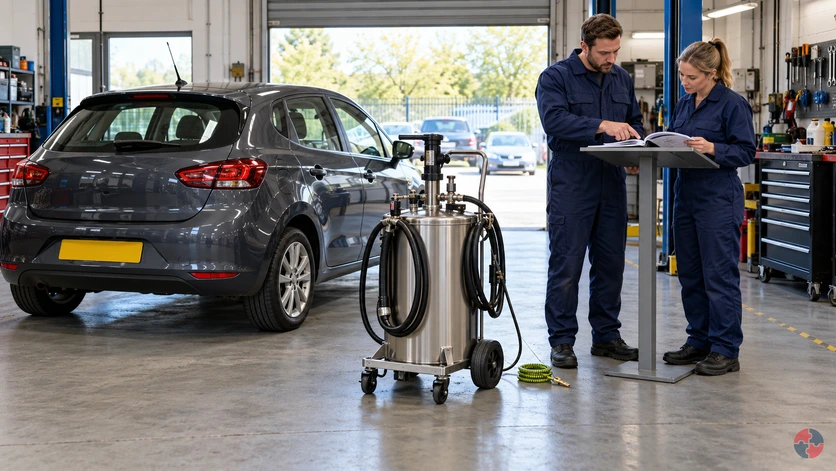
For an indoor petrol-recovery task, establish the actual equipment, connections and working conditions. An outdoor forecourt scene cannot demonstrate that indoor draining is controlled.
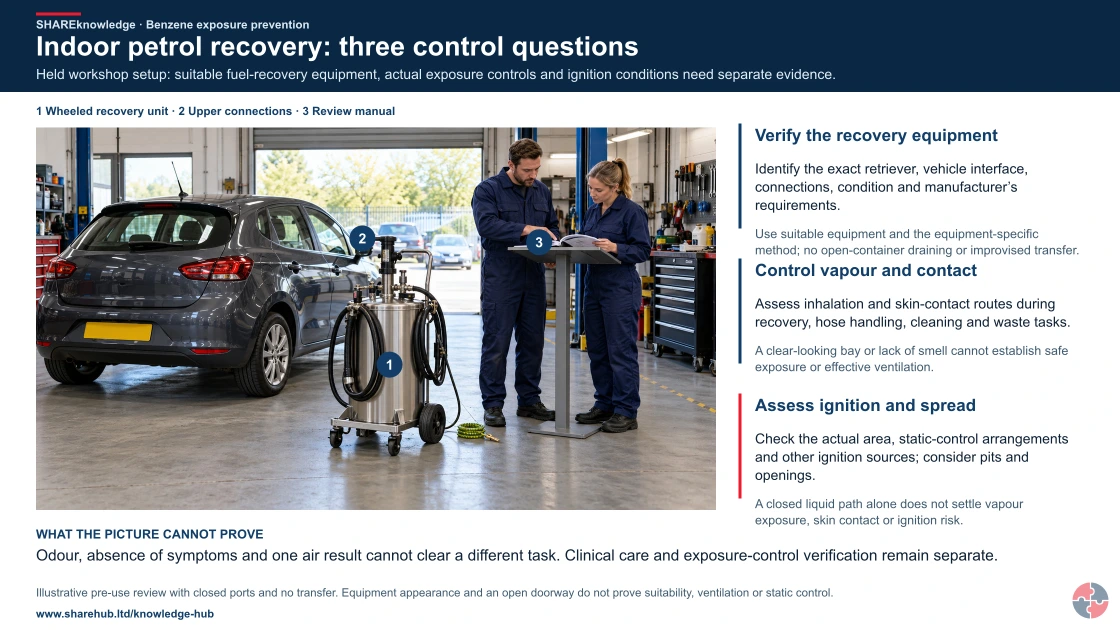
Indoor petrol recovery: three control questions
Full written explanation
Held workshop setup: suitable fuel-recovery equipment, actual exposure controls and ignition conditions need separate evidence. Picture key: 1 Wheeled recovery unit · 2 Upper connections · 3 Review manual. Illustrative pre-use review with closed ports and no transfer. Equipment appearance and an open doorway do not prove suitability, ventilation or static control.
Held workshop setup: suitable fuel-recovery equipment, actual exposure controls and ignition conditions need separate evidence.
- Verify the recovery equipment. Identify the exact retriever, vehicle interface, connections, condition and manufacturer’s requirements.
- Control vapour and contact. Assess inhalation and skin-contact routes during recovery, hose handling, cleaning and waste tasks.
- Assess ignition and spread. Check the actual area, static-control arrangements and other ignition sources; consider pits and openings.
Change the pathway
- Keep the transfer contained. Use suitable equipment and the equipment-specific method; no open-container draining or improvised transfer.
- Use task-specific evidence. A clear-looking bay or lack of smell cannot establish safe exposure or effective ventilation.
- Resolve all three questions. A closed liquid path alone does not settle vapour exposure, skin contact or ignition risk.
Evidence check: Odour, absence of symptoms and one air result cannot clear a different task. Clinical care and exposure-control verification remain separate.
Existing immediate-exposure and medical-response guidance
Primary references: HSE: safe use of petrol in garages (INDG331) · HSE: benzene in motor vehicle repair
Open the complete HD image (new tab)Download image

Existing immediate-exposure and medical-response guidance
Primary references: HSE: safe use of petrol in garages (INDG331) · HSE: benzene in motor vehicle repair

- Vehicle / source
- Suitable closed recovery
- Air, skin and ignition evidence
Read the labels in the full-size drawing
- VEHICLE / FUEL SOURCE
- SUITABLE RECOVERY
- Vapour / contact / ignition
- Verify the actual task
| Part or route | Question | Evidence |
|---|---|---|
| Recovery path | Is suitable fuel-recovery equipment used as instructed, with the required vapour and static controls? | Equipment identity, connections, condition and manufacturer’s instructions. |
| Air and contact | How are vapour release and breathing-zone exposure controlled? How is liquid contact prevented? | Task-specific COSHH/ventilation evidence and compatible handling/protection arrangements. |
| Ignition and spread | What could ignite vapour, including near pits and openings? | DSEAR assessment and actual-area checks; a closed liquid path alone does not settle ignition risk. |
| Defect | What must stop if a connection, control or evidence is missing? | Named hold, defect referral and competent release decision. |
Use a competent person and the equipment-specific method. Do not infer safe exposure from smell or absence of symptoms. Immediate symptoms and longer-term exposure concerns follow their separate health routes on this page.
What are the key facts about benzene poisoning?
The key facts are that benzene is volatile, readily absorbed, acutely intoxicating at high levels and dangerous to blood-forming tissue over time.
Benzene is mainly an inhalation risk
Vapour can be released during fuel transfer, tank work, sampling, cleaning, leaks and process operations.
Skin exposure matters
Liquid contact can add to dose and can contaminate gloves, clothing, tools and surfaces.
The long-term target is bone marrow
Chronic exposure can reduce normal blood-cell production and increase serious blood disease risk.
Cancer risk changes the control standard
Because benzene is carcinogenic, exposure should be prevented or reduced as low as reasonably practicable.
Symptoms can be non-specific
Headache, fatigue or dizziness may be missed unless linked to task and exposure history.
Monitoring and surveillance are evidence
Air monitoring, biological monitoring where appropriate and health surveillance help test whether controls are working.
What is benzene poisoning?
Benzene poisoning is a clinical description of harmful benzene effects; it is not established merely because exposure or uptake occurred.
Benzene is a colourless, highly flammable, volatile liquid with a sweet aromatic odour. It occurs in crude oil and petrol and is used or generated in some chemical, petrochemical, coke and foundry processes. Modern controls have reduced many historic uses, but benzene remains important because even low-level repeated exposure can be serious.
Benzene exposure, absorbed dose, a biological marker and a diagnosed illness answer different questions. Acute high exposure can depress the central nervous system; long-term exposure can harm blood-forming tissue and increase leukaemia risk. A qualified clinician considers the exposure history, examination and investigations before diagnosing poisoning or attributing disease to benzene.
Benzene should be treated as a high-consequence COSHH substance because it is a carcinogen and bone marrow toxicant. Controls must be based on exposure assessment, not on whether workers notice smell or irritation.
Condition name. Benzene poisoning or benzene toxicity. Used for acute or chronic harmful exposure.
Related terms. Benzene-induced bone marrow suppression, aplastic anaemia, benzene-related leukaemia. Important in occupational health records and referrals.
Main systems affected. Central nervous system during high exposure; blood and bone marrow during chronic exposure. Short-term impairment and long-term disease can both matter.
Onset pattern. Acute effects may occur soon after high exposure; chronic effects may develop over time. Exposure history is important.
Reversibility. Some acute symptoms may improve after exposure stops; serious blood disease may be life-changing. Early control and assessment matter.
Workplace relevance. Fuel, petroleum, chemical, coke, foundry and maintenance activities. COSHH controls, monitoring and surveillance may be needed.
How can benzene enter the body and what forms does it take at work?
Benzene mainly enters the body through inhalation of vapour, but skin contact and accidental ingestion can also contribute.
Benzene is volatile, so liquid benzene and benzene-containing mixtures can release vapour into the breathing zone. Vapour release is more likely when liquids are open, agitated, sprayed, warmed, transferred, spilled or handled in poorly ventilated areas.
Benzene may be present as a pure substance, as part of petrol or crude oil vapour, in process streams, in residues, in contaminated sludge, in tank atmospheres or in small quantities within solvent or petrochemical mixtures. It may also be present where combustion or process conditions generate aromatic hydrocarbons.
Routes of entry matter because controls need to protect breathing, skin and hygiene. Respiratory Protective Equipment (RPE) may reduce inhalation exposure where properly selected, but it does not stop skin absorption or contaminated hand-to-mouth transfer.
Vapour inhalation. Breathing vapour during fuel, tank, process or maintenance work. Enclosure, ventilation, vapour recovery and monitoring.
Skin contact. Liquid splashes, wet gloves, contaminated tools or clothing. Closed transfer, suitable gloves, hygiene and decontamination.
Ingestion. Contaminated hands, food, drink or smoking materials. Welfare, handwashing and no eating/drinking in contaminated areas.
Pure benzene or process stream. Chemical manufacture, sampling, transfer and reactor work. COSHH assessment and specialist controls.
Petrol vapour. Vehicle recovery, fuelling, tank work or contaminated spaces. Ventilation, task planning and exposure awareness.
Residues and sludge. Tank cleaning, line-breaking or maintenance. Permit control, isolation, testing and PPE/RPE.
What causes benzene poisoning at work?
Benzene poisoning at work is caused by inhaling, absorbing or ingesting benzene during tasks where vapour or liquid contact is not properly controlled.
The highest risks usually come from tasks that disturb liquid, vapour or residues: loading and unloading, sampling, tank dipping, maintenance, line-breaking, cleaning, spill response, draining, hose disconnection, filter change and work in pits or confined areas.
Dose matters. Harm depends on concentration, duration, frequency, peak exposure, ventilation, skin contact, PPE reliability and individual susceptibility. A short high exposure may cause acute symptoms, while repeated lower exposures may create long-term blood and cancer risk.
Underlying causes often include poor substance identification, weak COSHH assessments, missing Safety Data Sheets (SDS), inadequate ventilation, poor containment, poor hygiene, no exposure monitoring, weak training and failure to act on symptoms or monitoring results.
Fuel and petroleum vapour. Benzene vapour is inhaled and absorbed into blood. Fuel transfer, tank work, recovery and poor ventilation.
Chemical process streams. Benzene may be present in raw materials or intermediates. Sampling, charging, transfer and maintenance.
Tank or vessel residues. Sludge and residues release vapour when disturbed. Cleaning, entry, heating, cutting or line-breaking.
Skin contamination. Liquid benzene adds to absorbed dose. Wet gloves, splashes, contaminated clothing or poor washing.
Leaks and fugitive emissions. Small releases create repeated background exposure. Pumps, valves, flanges, hoses and storage areas.
Emergency or spill response. Peak exposure can occur quickly. Uncontrolled spills, damaged containers and delayed exclusion.
What is the damage mechanism of benzene poisoning?
Benzene damages health because it is metabolised into reactive compounds that can injure bone marrow and disrupt blood-cell production.
Two health routes, one source-control priority


Read the complete visual as text
- ENTRY: Petrol or a benzene-containing stream can expose people through inhalation and skin contact. Identify the actual substance and task.
- ACUTE EFFECTS: Substantial exposure can affect the nervous system. Serious symptoms or credible substantial exposure need the emergency route.
- REPEATED EXPOSURE: Reactive metabolites can damage bone marrow and blood-cell production. Prevent exposure rather than waiting for symptoms.
- FALSE REASSURANCE: Odour and a generic low spot reading do not establish adequate control. Use suitable exposure assessment and qualified clinical interpretation.
After benzene enters the body, it is distributed through the blood and metabolised, mainly in the liver and other tissues, into compounds that can affect the blood-forming system. The bone marrow is a key target because it produces red cells, white cells and platelets.
Acute high exposure can depress the central nervous system, causing dizziness, drowsiness, confusion and collapse. Chronic exposure is more insidious. It can suppress marrow activity, leading to reduced blood cells, anaemia, infection vulnerability, bleeding tendency and serious blood disorders.
Benzene's carcinogenic effect is linked to these biological pathways. Because cancer risk is treated cautiously, workplace control aims to prevent exposure or reduce it as low as reasonably practicable, not merely keep people below a number on paper.
Exposure pathway. Vapour inhalation is usually dominant; skin contact can add dose. Control both breathing-zone vapour and liquid contamination.
Initial body effect. High exposure can affect the central nervous system. Workers may become dizzy, drowsy or impaired.
Metabolism. Benzene is converted into reactive metabolites. Toxicity can continue beyond the moment of exposure.
Bone marrow effect. Blood-cell production can be suppressed. Fatigue, pallor, bruising or recurrent infection may develop.
Cancer mechanism. Genotoxic and marrow effects are linked to leukaemia risk. Exposure should be minimised even where levels seem low.
Progression. Repeated exposure can increase cumulative risk. Monitoring and health surveillance must be reviewed over time.
What are the typical symptoms of benzene poisoning?
Symptoms can include acute solvent-like effects after high exposure and more subtle blood-related signs after repeated or chronic exposure.
Acute exposure may cause headache, tiredness, nausea, dizziness, drowsiness, confusion, tremor, unsteady movement or collapse. These signs should be taken seriously when they occur during or after work with fuels, solvents, tanks, vapours or benzene-containing streams.
Long-term effects may not begin with dramatic irritation. A person may feel unusually tired or weak, appear pale, bruise easily, have frequent infections or have abnormal blood results. These signs can have many causes, so they need qualified medical assessment and a clear exposure history.
Workers should be encouraged to report symptoms early. Delayed reporting makes it harder to link symptoms to tasks and harder to correct exposure controls before others are affected.
Early or mild acute exposure. Headache, dizziness, tiredness, nausea or light-headedness. Possible vapour exposure or solvent effect.
Higher acute exposure. Drowsiness, confusion, tremor, poor coordination or collapse. Significant exposure needing immediate workplace response and medical assessment.
Early chronic concern. Unusual fatigue, weakness, pallor or reduced stamina. Possible blood effect requiring assessment.
Blood-related warning signs. Easy bruising, bleeding, recurrent infections or abnormal blood counts. Possible marrow suppression or blood disorder.
Long-term serious disease. Diagnosed aplastic anaemia, leukaemia or other blood disorder. Requires specialist medical management and exposure investigation.
No obvious symptoms. A person may feel well despite exposure. Monitoring and surveillance are needed because symptoms are not reliable controls.
How can benzene poisoning affect working life and future health?
Benzene poisoning can affect working life through acute impairment, exposure restrictions, blood disorders, cancer risk and long-term health monitoring.
Acute benzene effects can impair judgement, coordination and alertness, making safety-critical tasks unsafe. A worker who feels dizzy or drowsy around vapour should be removed from exposure and the work area should be reviewed.
Chronic effects can affect stamina, infection resistance, bruising and fitness for safety-critical roles. A worker may need occupational health advice, temporary removal from exposure, role adjustment or specialist medical referral depending on the circumstances.
Benzene-related disease can be life-changing. The workplace response should protect the individual, investigate exposure sources and check whether other workers may have been affected.
Alertness and coordination. Unsafe driving, plant operation or safety-critical tasks. Usually linked to acute exposure if controlled quickly.
Blood-cell production. Fatigue, infection risk, bruising and absence. Potentially serious haematological disease.
Fitness for exposed work. Restriction from benzene tasks may be needed. Long-term occupational health review.
Mental wellbeing. Anxiety after suspected exposure or abnormal tests. Need for clear communication and support.
Employability. Some roles may no longer be suitable. Retraining, redeployment or adjustments may be needed.
Family and daily life. Fatigue or treatment may affect daily activity. Long-term quality-of-life impact in serious cases.
Which industries and occupations are most at risk of benzene poisoning?
Risk is highest where benzene is produced, present in petroleum streams, released as vapour or handled during maintenance and cleaning.
The job title alone does not define risk. A fuel technician who briefly works in a well-ventilated, controlled system may have lower exposure than a maintenance contractor opening contaminated pipework in a poorly ventilated pit.
Benzene risk should be assessed by task: whether vapour is released, how long the person is exposed, whether the work is enclosed, whether liquid contact occurs, whether ventilation is effective, and whether monitoring confirms control.
Particular attention is needed for non-routine work, because opening systems, cleaning residues, draining lines and responding to leaks can create exposure that routine operations do not.
Oil refining and petrochemicals. Process operators, samplers, maintenance workers. Sampling, transfer, line-breaking, tank and vessel work.
Fuel storage and distribution. Terminal workers, tanker drivers, maintenance contractors. Loading, unloading, vapour release, hose handling and spill response.
Motor vehicle repair and recovery. Mechanics, recovery operators, workshop staff. Petrol draining, fuel tank work and poor-ventilation tasks.
Chemical manufacture. Operators, chemists, engineers and maintenance teams. Benzene use as feedstock or process stream component.
Coke works and foundries. Process and maintenance workers. By-product streams, emissions and contaminated residues.
Emergency and environmental response. Spill responders and clean-up contractors. Unplanned releases, contaminated absorbents and waste handling.
What should someone do if they think they have benzene poisoning?
Move away from suspected exposure if safe, raise the site alarm and seek the right medical help. For collapse, confusion, seizure, severe breathing difficulty or a credible substantial exposure, call 999; nobody should enter a contaminated or oxygen-uncertain atmosphere for an improvised rescue.
Do not let an unprotected bystander approach an incapacitated casualty in a hazardous atmosphere. Use the planned emergency response with trained, equipped rescuers; preserve your own safety and give responders the substance, task and location details. Obtain medical help promptly for suspected poisoning; do not wait for a routine occupational-health appointment. For medical advice after chemical exposure without an emergency, England, Scotland and Wales use their 111 service. In Northern Ireland, nidirect advises GP or GP out-of-hours advice when the person has no symptoms and appears well; if advice cannot be obtained quickly after suspected exposure to a hazardous substance, use an emergency department. Call 999 for life-threatening symptoms anywhere in the UK.
The first priority is to stop further exposure without creating additional danger. Move to fresh air if vapour exposure is suspected, remove contaminated clothing where safe and follow site emergency arrangements for spills, collapse or serious symptoms.
The person should report the event and provide a clear exposure history: task, substance, duration, ventilation, PPE/RPE used, skin contact, symptoms and whether others were affected. This helps occupational health and managers decide what assessment and controls are needed.
The employer should review the COSHH assessment, Safety Data Sheet (SDS), monitoring data, ventilation, PPE, health surveillance and whether other workers may need information or assessment.
Stop exposure. Move away from vapour or liquid contamination if safe. Prevents further absorption.
Use emergency arrangements. Follow site response for collapse, confusion, fire, spill or serious symptoms. Protects the person and others.
Report and record. Tell a supervisor and record task, material, duration and symptoms. Creates exposure history and triggers investigation.
Seek medical assessment. Use GP, occupational health, the nation-specific 111 or GP route, or emergency response as appropriate. Symptoms and blood effects need qualified assessment.
Review controls. Check COSHH assessment, ventilation, monitoring and PPE/RPE. Prevents repeat exposure.
Follow up. Check health surveillance and whether others were exposed. Protects wider workforce and supports learning.
How can benzene poisoning be prevented at work?
Benzene poisoning is prevented by eliminating or tightly controlling vapour and skin exposure through the ERICPD hierarchy.
Prevention should start with process and task design. Because benzene is carcinogenic, employers should prevent exposure where reasonably practicable and otherwise control it to a high standard. Relying on smell, short task duration or generic gloves is not adequate.
Engineering controls are usually central: closed transfer, vapour recovery, local exhaust ventilation, fixed detection where appropriate, leak prevention, sealed sampling and maintained plant. Procedural controls then support the engineering controls through permits, isolation, hygiene, supervision and emergency planning.
PPE and RPE may be needed for residual or abnormal risks, but they must be selected against the substance and task. Gloves must resist benzene and be changed before breakthrough. RPE must be suitable, face-fit tested where tight-fitting, maintained and used by trained people.
Eliminate. Remove benzene from the task or process. Use benzene-free alternatives, redesign cleaning or remove unnecessary open handling. Not always possible in petroleum or chemical processes.
Reduce. Reduce quantity, duration, vapour release and people exposed. Smaller containers, shorter open tasks, lower benzene content and restricted access. Residual carcinogen risk remains.
Isolate. Separate people from benzene sources. Enclosed systems, remote operation, segregated tank areas and exclusion zones. Maintenance and sampling may still create exposure.
Control. Capture vapour and prevent skin contamination. LEV, vapour recovery, sealed sampling, leak detection, ventilation and hygiene. Controls must be maintained and checked.
PPE. Protect against residual inhalation and skin exposure. Suitable gloves, chemical clothing, eye protection and RPE where justified. Can fail through poor selection, fit, breakthrough or misuse.
Discipline. Use rules, permits, training and supervision. No eating/drinking, decontamination, task briefings, permits and monitoring review. Relies on people and should support stronger controls.
How should benzene exposure be monitored?
Benzene exposure should be monitored where assessment shows that measurement is needed to prove control and protect health.
Air monitoring can measure benzene in the breathing zone or workplace atmosphere. It helps confirm whether controls are effective during normal and non-routine tasks, and whether exposure is below current workplace exposure limits.
Biological monitoring may be relevant in some circumstances because benzene can be absorbed through both inhalation and skin contact. It should be managed carefully, with competent interpretation and confidentiality.
Monitoring should not be a one-off exercise if tasks, plant, fuel composition, ventilation, maintenance or work patterns change. Results should be reviewed with workers and used to improve controls.
Personal air monitoring. Benzene in the worker's breathing zone. Compare with WEL and identify task controls.
Static area monitoring. Background or local area benzene levels. Check sources, ventilation and access control.
Short-term task monitoring. Peak exposure during high-risk tasks. Improve permits, ventilation, PPE/RPE and task duration.
Biological monitoring. Total absorbed dose where appropriate. Assess inhalation plus skin contribution.
Control monitoring. LEV, vapour recovery and ventilation performance. Maintain engineering controls before exposure rises.
Trend review. Changes over time, shifts or locations. Trigger investigation and management review.
Does the monitoring result represent this fuel task?
Before using an earlier result to justify work, identify what was sampled: the worker or a fixed location, the activity, its duration, fuel or material, ventilation and any protective equipment. A result from routine closed transfer may not represent opening a fuel system, draining a tank or clearing contaminated equipment. A fixed-location sample cannot automatically describe the concentration in the breathing zone of someone leaning over the source.
For an illustrative workshop review, separate routine handling from the short tasks that open the system. The competent occupational hygienist decides whether the existing sampling strategy represents those tasks and what further measurement is needed. Inspect the control method and skin-contact opportunities as well as the air result. If the task or controls differ materially from the assessment, hold the affected activity for reassessment. Biological monitoring, where appropriate, needs specialist interpretation and does not authorise uncontrolled exposure or replace the task controls.
Guidance and scope: Original SHARE monitoring comparison applying HSE GB guidance. The motor-vehicle page supports petrol/benzene task controls; the older INDG329 leaflet gives benzene prevention and health-check context. Current limits follow the EH40/NI route above; no new biomarker cut-off or clinical test schedule is set. HSE benzene in motor vehicle repair HSE INDG329: controlling benzene exposure
When is health surveillance relevant for benzene exposure?
Health surveillance is relevant where benzene exposure could affect health and surveillance is needed to detect early signs of harm.
Health surveillance should be based on COSHH assessment and occupational health advice. For benzene, the key concern is blood and bone marrow effects, so surveillance may involve health questionnaires, exposure history review and appropriate clinical or laboratory assessment where indicated.
Surveillance is not a substitute for exposure control. If abnormal results or symptoms appear, the employer should investigate the work, review monitoring, improve controls and consider whether others may be exposed.
Health information must be handled confidentially. Managers normally need fitness and work-restriction advice, not unnecessary clinical detail.
Baseline information. Understands starting health and exposure history. Occupational health record before or early in exposed work.
Periodic review. Looks for early signs or reported symptoms. Scheduled review based on risk and competent advice.
Blood-related assessment. Checks for potential marrow effects where indicated. Managed by qualified health professionals.
Exposure link. Connects health findings to tasks and monitoring. Review COSHH, WEL data and skin exposure.
Confidentiality. Protects sensitive health information. Share fitness advice proportionately.
Action trigger. Ensures abnormal findings lead to control review. Remove from exposure where advised and investigate.
Which legal duties apply in Great Britain and Northern Ireland?
The applicable legal route depends on where the work takes place. The duties below are scoped to Great Britain and Northern Ireland; a task assessment and the current instruments determine the actual requirements.
Great Britain
COSHH 2002 requires a suitable assessment, prevention where reasonably practicable, and adequate control of residual exposure. Because benzene is a carcinogen, reduce exposure as low as reasonably practicable and below the WEL; use the carcinogen provisions, controls, monitoring, health surveillance where appropriate, training and incident arrangements. DSEAR 2002 separately addresses its flammable vapour. The 8-hour WEL is 1 ppm or 3.25 mg/m³; EH40 lists no separate 15-minute WEL.
Northern Ireland
Use COSHH (Northern Ireland) 2003 and DSEAR (Northern Ireland) 2003 with the NI Health and Safety at Work Order and Management Regulations. HSENI confirms that EH40 is approved in Northern Ireland. Check current NI instruments, site conditions and the applicable EH40 edition; GB COSHH and DSEAR instrument numbers are not the NI legal route.
For Northern Ireland disease reporting, the HSENI RIDDOR (NI) booklet lists poisoning by benzene or a homologue of benzene in Schedule 3 item 28. Exposure, a biomarker or a symptom alone is not a reportable diagnosis. When a doctor notifies an employer of diagnosed work-related poisoning, assess the NI reporting duty against the actual case; consider any diagnosed occupational cancer under its separate route.
How should benzene exposure appear in a risk register?
Benzene should appear as a substance-specific exposure risk with clear routes, tasks, controls, monitoring and health surveillance decisions.
A risk register entry should not simply say 'chemical exposure'. It should identify benzene-containing materials, how vapour or liquid contact can occur, who may be exposed, what the health effects are and which controls prove exposure is reduced.
For petrol or petroleum operations, the register should recognise that benzene may be present even where it is not the main product. For maintenance and tank work, it should consider residues, vapours, confined spaces, flammability and skin contamination together.
The register should assign owners for controls such as ventilation, monitoring, health surveillance, training, permits, PPE/RPE, emergency response and contractor management.
| Scenario | Exposure concern | Controls and evidence |
|---|---|---|
| Fuel tanker unloading | Vapour inhalation and hose contamination. | Closed transfer, vapour control, gloves, spill kit and training. |
| Tank cleaning | Residue vapour, confined atmosphere and skin contact. | Permit, isolation, testing, ventilation, RPE/PPE and rescue plan. |
| Refinery sampling | Short peak vapour exposure. | Closed sampling, LEV, task monitoring and competency check. |
| Vehicle fuel system repair | Petrol vapour in workshop or pit. | Draining procedure, ventilation and no ignition sources. |
| Process leak | Fugitive benzene emissions. | Leak detection, repair priority and exposure monitoring. |
| Waste handling | Contaminated absorbents or sludge. | COSHH assessment, packaging, labelling and contractor controls. |
How could Crownway Fuels Ltd manage benzene exposure?

Crownway Fuels Ltd could manage benzene exposure by treating petrol vapour, tank residues and maintenance tasks as controlled COSHH and DSEAR risks.
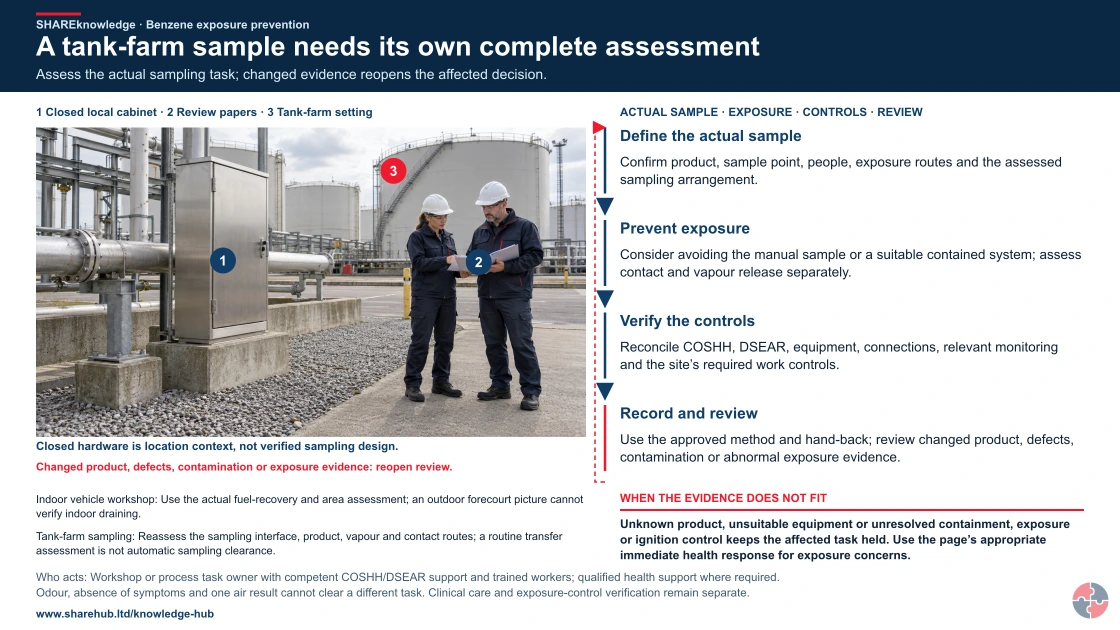
A tank-farm sample needs its own complete assessment
Full written explanation
An illustrative UK tank-farm pre-task setting shows closed ground-level local cabinet and external pipework, normal adults reviewing inert papers and storage tanks beyond. One literal picture key identifies 1 closed local cabinet, 2 review papers and 3 tank-farm setting. The cabinet is location context, not a verified sampling design, contained system, chemical identity, compatibility, ventilation, static control or permission. No one opens a cabinet or valve, takes a sample, touches hardware, handles a substance or demonstrates an operating method. The assessment is specific to the proposed sample: Define the actual sample: Confirm product, sample point, people, exposure routes and the assessed sampling arrangement. Prevent exposure: Consider avoiding the manual sample or a suitable contained system; assess contact and vapour release separately. Verify the controls: Reconcile COSHH, DSEAR, equipment, connections, relevant monitoring and the site’s required work controls. Record and review: Use the approved method and hand-back; review changed product, defects, contamination or abnormal exposure evidence. Three forward arrows show the review order. Changed product, defects, contamination or abnormal exposure evidence reopens the affected review; the arrows do not depict a material path or authorise work. Unknown product, unsuitable equipment or unresolved containment, exposure or ignition control keeps the affected task held. Use the page’s appropriate immediate health response for exposure concerns. Who acts: Workshop or process task owner with competent COSHH/DSEAR support and trained workers; qualified health support where required. Odour, absence of symptoms and one air result cannot clear a different task. Clinical care and exposure-control verification remain separate. Indoor vehicle workshop: Use the actual fuel-recovery and area assessment; an outdoor forecourt picture cannot verify indoor draining. Tank-farm sampling: Reassess the sampling interface, product, vapour and contact routes; a routine transfer assessment is not automatic sampling clearance. Routine transfer evidence does not automatically establish sampling clearance. Clinical care and the appropriate immediate national healthcare route remain independent of papers, work review or monitoring.
- Define the actual sample. Confirm product, sample point, people, exposure routes and the assessed sampling arrangement.
- Prevent exposure. Consider avoiding the manual sample or a suitable contained system; assess contact and vapour release separately.
- Verify the controls. Reconcile COSHH, DSEAR, equipment, connections, relevant monitoring and the site’s required work controls.
- Record and review. Use the approved method and hand-back; review changed product, defects, contamination or abnormal exposure evidence.
When the evidence does not fit: Unknown product, unsuitable equipment or unresolved containment, exposure or ignition control keeps the affected task held. Use the page’s appropriate immediate health response for exposure concerns.
Who acts: Workshop or process task owner with competent COSHH/DSEAR support and trained workers; qualified health support where required.
Changed workplace
Indoor vehicle workshop: Use the actual fuel-recovery and area assessment; an outdoor forecourt picture cannot verify indoor draining.
Tank-farm sampling: Reassess the sampling interface, product, vapour and contact routes; a routine transfer assessment is not automatic sampling clearance.
Evidence check: Odour, absence of symptoms and one air result cannot clear a different task. Clinical care and exposure-control verification remain separate.
Existing immediate-exposure and medical-response guidance
Primary references: HSE: safe use of petrol in garages (INDG331) · HSE: benzene in motor vehicle repair
Open the complete HD image (new tab)Download image

Existing immediate-exposure and medical-response guidance
Primary references: HSE: safe use of petrol in garages (INDG331) · HSE: benzene in motor vehicle repair
Crownway Fuels Ltd
Crownway Fuels Ltd stores and distributes fuel products, so benzene exposure control has to cover routine transfer, tanker loading, vapour release, tank maintenance, contractor work and emergency response.
Crownway would start with a substance inventory and COSHH register identifying where benzene may be present: petrol, crude-related residues, vapour spaces, contaminated waste, drainage systems and maintenance equipment. Each relevant task would have a COSHH assessment linked to a DSEAR assessment where flammable vapours could arise.
Risk analysis would distinguish routine and non-routine work. Routine loading would focus on closed transfer, vapour recovery, hose handling, spill prevention and hygiene. Non-routine tasks such as tank cleaning, line-breaking or pump maintenance would need permits, isolation, atmospheric testing, ventilation, RPE/PPE, emergency arrangements and contractor verification.
Training would be layered. All fuel-handling staff would receive awareness on benzene routes, symptoms, hygiene and reporting. Higher-risk workers would receive face-to-face task training on transfer, spill response, sampling, tank work and PPE/RPE. Supervisors would learn to review monitoring data, challenge poor practice and stop work where controls are uncertain.
Crownway would maintain exposure monitoring records, health surveillance decisions, LEV or vapour-control maintenance, PPE issue records, training matrices, permit audits and incident learning. Repeated odour complaints, vapour alarms, skin contamination, failed glove selection or abnormal monitoring would trigger management review.
Continuous improvement would be visible in procurement, engineering and behaviour. For example, if monitoring showed peak exposure during hose disconnection, Crownway would review coupling design, drain-down, vapour capture, procedure, gloves, training and supervisor verification rather than relying on a reminder.
COSHH register. Identifies benzene-containing products, vapours and residues. Substance inventory, SDS and COSHH assessments.
Risk register. Separates routine transfer from tank work and maintenance. Task risk entries with control owners.
Engineering control. Uses closed transfer, vapour recovery and ventilation. Maintenance records and exposure monitoring.
Training. Uses awareness, task-specific and supervisor training. Training matrix and practical assessment.
Health surveillance. Applies occupational health advice where exposure risk justifies it. Surveillance decision and confidential fitness advice.
Assurance. Audits permits, monitoring, PPE/RPE, contractor controls and action close-out. Audit findings and trend review.
How should a refuelling example distinguish benzene exposure from ignition risk?
Use the nozzle and fuel cards to discuss the substance and possible exposure task. A classified-area boundary is not a health-exposure limit or evidence of controlled benzene exposure.
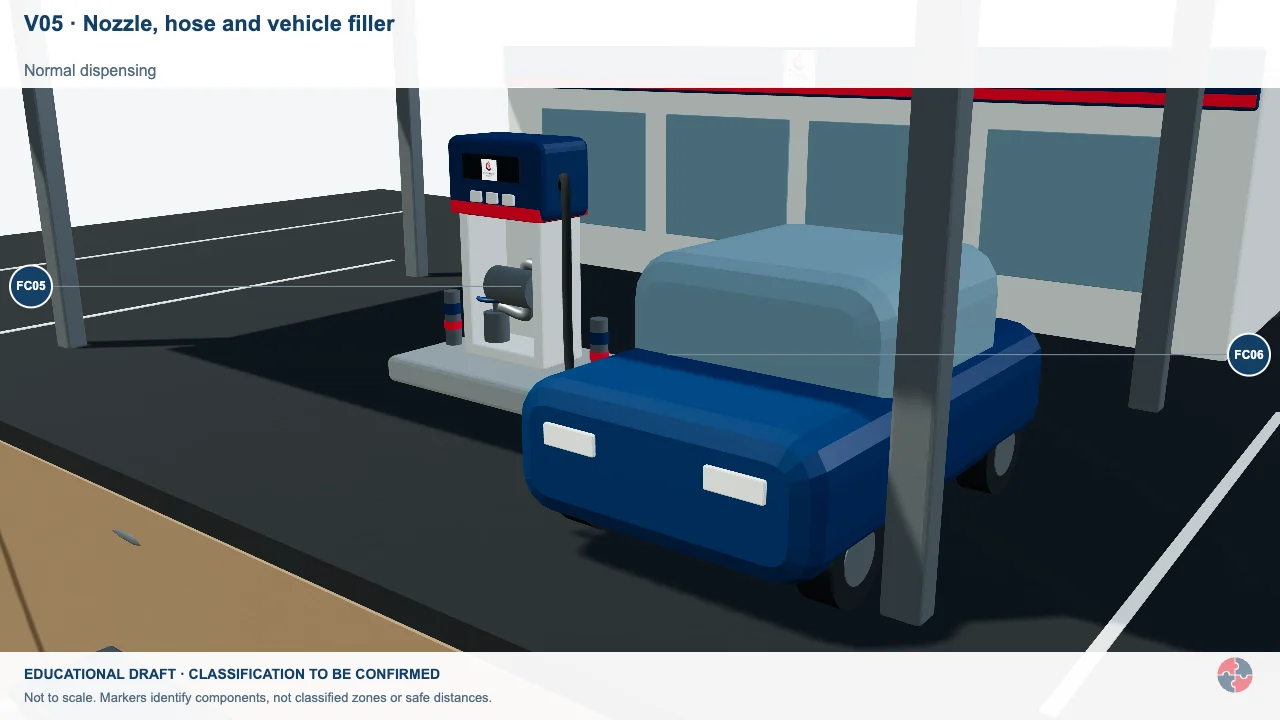

Nozzle, hose and vehicle filler
An extended hose places the nozzle tip and vehicle filler farther from the island. The local rounded teaching envelope follows that interface, with the hose kept slack.
Activity focus: Select near or extended hose, trace its fixed island connection, and inspect where the nozzle enters the filler. Compare recovery operating with no Stage II recovery.
Outdoor forecourt model context: nozzle, hose and vehicle filler. This is separate from the indoor recovery task; it does not establish indoor ventilation, equipment suitability, exposure control or hazardous-area classification.
Educational illustration, not to scale. Coloured zones are teaching examples, not a site-specific hazardous-area classification.
Occupational exposure is separate; hazardous-area boundaries are not health exposure limits.
What training is needed for benzene exposure control?
Training should be matched to exposure risk, with deeper training for workers and supervisors who handle benzene-containing materials.
General awareness training should explain what benzene is, where it may be found, why it is dangerous, how it enters the body and why hygiene matters. This can be suitable for wider site teams who may enter fuel, petrochemical or maintenance areas.
Task-specific training should be practical and face to face where the risk is higher. Workers should learn how to use transfer systems, ventilation, closed sampling, spill response, PPE/RPE, decontamination and reporting routes.
Supervisor and manager training should go deeper into COSHH, WELs, monitoring results, health surveillance, contractor control, DSEAR interfaces and action planning.
Competence means a person can carry out the actual task safely, recognise a changed condition and respond correctly. Attendance alone is insufficient. The matrix makes assessment, ownership, records and reassessment explicit.
| Role | Required learning | How competence is assessed | Assessor or owner | Record | Reassess when |
|---|---|---|---|---|---|
| Exposed workers and contractors | Identify benzene streams, inhalation and skin routes, acute warning signs, controls, hygiene and stop conditions. | Walk-through of the actual task with response to a leak or alarm. | Task supervisor | Induction and observed task record | After process change, failed observation, release or new exposure evidence. |
| Supervisors and permit issuers | Verify containment, isolation, atmosphere, PPE/RPE, contractor handover and emergency readiness. | Observed permit review and abnormal-condition drill. | Operations manager | Permit sample and drill record | After change or incident. |
| Occupational hygienists and monitoring advisers | Plan representative sampling, validate analytical method and interpret WEL, peaks, skin route and uncertainty. | Peer-reviewed monitoring strategy and interpretation. | Competent hygiene lead | Sampling plan and signed interpretation | When process or exposure profile changes. |
| Health-surveillance professionals | Select surveillance, preserve confidentiality, interpret findings and escalate medical concerns. | Professional competence and case-based review. | Occupational-health lead | Surveillance plan and clinical records | At programme review or new evidence. |
How does benzene poisoning support study and professional development?
Benzene poisoning supports study by connecting toxicology, COSHH, carcinogen control, monitoring and health surveillance in one practical example.
For NEBOSH National General Certificate learners, benzene is a strong example for hazardous substances. Good scenario answers should identify routes of entry, acute and chronic effects, COSHH assessment, hierarchy of control, WELs, health surveillance, training and emergency arrangements.
For Diploma-level learners and occupational hygiene professionals, benzene provides a deeper example of carcinogen control. The answer should cover exposure profile, measurement strategy, biological uptake, skin absorption, long-latency disease, data interpretation and management-system assurance.
In professional practice, this topic helps supervisors and managers see why a substance with no obvious immediate irritation can still require very tight control.
New learner. Benzene is a volatile hazardous substance and carcinogen. Explain inhalation, skin exposure and basic COSHH control.
NEBOSH NGC learner. COSHH requires assessment, control, information and review. Use ERICPD, WELs, training and health surveillance in scenario answers.
NEBOSH Diploma learner. Carcinogens need stronger exposure management. Discuss monitoring strategy, ALARP, health records and assurance.
Supervisor. Non-routine work can create peak exposure. Verify permits, PPE/RPE, ventilation and worker briefings.
Manager. Exposure control needs resources and evidence. Review monitoring trends, maintenance and health surveillance actions.
Occupational health or hygiene link. Symptoms and exposure history must be connected. Use surveillance, monitoring and confidential referral routes.
How can a management system make benzene control robust?
A management system makes benzene control robust by linking substance information, risk assessment, controls, monitoring, health surveillance and learning.
Benzene control can fail when ownership is split between operations, maintenance, occupational health and contractors. The management system should make clear who owns the COSHH assessment, who reviews monitoring, who maintains controls, who manages health surveillance and who authorises non-routine work.
ISO-style clauses help organise this evidence. Leadership sets risk appetite for carcinogens. Planning identifies exposure tasks. Support maintains competence and SDS information. Operation controls transfer, maintenance and emergency response. Performance evaluation reviews monitoring and surveillance trends. Improvement acts on incidents and abnormal results.
The system should be able to prove that benzene exposure is controlled today, not only that a historic assessment exists.
| Management-system stage | Plain-English expectation | Benzene evidence |
|---|---|---|
| Leadership and worker participation | Leaders support conservative carcinogen controls and worker reporting. | Risk reviews, consultation and stop-work support. |
| Planning | Benzene exposure tasks and affected groups are identified. | COSHH register, risk register and monitoring plan. |
| Support | People, SDS information and competence are maintained. | Training matrix, SDS library and occupational hygiene competence. |
| Operation | Routine and non-routine work is controlled. | Procedures, permits, ventilation, PPE/RPE and emergency arrangements. |
| Performance evaluation | Monitoring, health surveillance and inspections are reviewed. | Exposure data, surveillance trends and audits. |
| Improvement | Findings lead to stronger controls. | Action close-out, engineering changes and lessons learned. |
What are the warning signs that benzene controls are failing?
Warning signs include vapour odour, skin contamination, weak monitoring, poor hygiene, symptoms after exposure and repeated maintenance leaks.
Control failure may appear before illness is diagnosed. People may report headaches after fuel tasks, gloves may be wet or unsuitable, vapour recovery may be bypassed, ventilation may be poor, or monitoring may be missing for the highest-risk tasks.
These signs can cause harm by increasing inhaled or absorbed dose. A worker may experience acute solvent effects, and repeated uncontrolled exposure can contribute to long-term bone marrow and cancer risk.
The response should be to investigate the task and strengthen controls, not simply tell people to be careful. Monitoring, maintenance and occupational health advice should be reviewed where warning signs appear.
Headache or dizziness after fuel work. May indicate vapour exposure. Review ventilation, work method and monitoring.
Routine skin contamination. Adds absorbed dose and spreads contamination. Improve closed transfer, gloves and hygiene.
No monitoring for high-risk tasks. Exposure may be unknown and uncontrolled. Create monitoring plan and review WELs.
LEV or vapour recovery defects. Vapour can reach breathing zone. Repair, test and restrict work if needed.
Poor eating, drinking or smoking controls. Contaminated hand-to-mouth transfer may occur. Improve welfare, hygiene and supervision.
Abnormal blood findings or repeated symptoms. Possible health effect requiring assessment. Occupational health review and exposure investigation.
How should the benzene workplace exposure limit be interpreted?
EH40 lists benzene at 1 ppm or 3.25 mg/m³ as an eight-hour time-weighted average (TWA), with carcinogen and skin notations. It lists no separate 15-minute short-term exposure limit (STEL). This is a legal ceiling for the stated averaging period, not a safe target; control task peaks and skin uptake even if the average is below it.
Use representative personal breathing-zone sampling for the person and task. A direct-reading or area instrument can help find a release but may not selectively measure benzene. Biological monitoring can show uptake and health surveillance can detect effects; neither replaces exposure control or turns a reading into a clinical diagnosis. A competent occupational hygienist should interpret uncertainty and whether exposure is as low as reasonably practicable.
What does a sound benzene exposure decision look like?
These two examples show how a duty holder can move from an observed problem to a verified control decision. They are illustrations, not site instructions.
Indoor petrol draining: six evidence checkpoints


Read the complete visual as text
- 1. ACTUAL TASK: Identify the petrol-draining method, open transfer points, worker position and possible skin contact.
- 2. PEOPLE AND BASIS: A competent task owner reviews the actual COSHH and DSEAR assessment, containment, ventilation and ignition risks.
- 3. BEFORE: Stop open draining; arrange a suitable closed recovery system and controls for vapour, ignition and skin contamination.
- 4. VERIFY DURING: Verify containment, ventilation, suitable monitoring, glove compatibility, hygiene and spill arrangements for the real task.
- 5. HOLD OR REFER: Hold for escape of vapour or liquid, ventilation failure, uncontrolled ignition sources or an unverified exposure method.
- 6. HAND BACK AND REVIEW: Record verified corrections and the named release decision. Clinical advice remains separate from an exposure reading or task hand-back.
Fuel transfer in a motor vehicle workshop
Task material and setting: A mechanic drains petrol from a tank indoors and notices a strong odour. A spot monitor gives a low reading, but the method is open and skin contact is possible.
People and prerequisites: The named task owner, competent workers and affected contractors need the task assessment, equipment information and a communication route before work starts.
Before: Stop the open transfer. Use a suitable closed drainage and recovery system, ventilate the area, control ignition sources and prevent skin contact. Review the COSHH and DSEAR assessments with the actual task.
During: A competent person verifies containment, ventilation and worker breathing-zone exposure using a suitable method; check gloves, hygiene and spill response.
Hold or stop: Hold if vapour or liquid escapes, ventilation fails, ignition sources cannot be controlled, or the exposure method is unverified. Do not use odour or a generic spot reading as proof of compliance.
Decision owner: The workshop manager owns the method and equipment; a competent occupational hygienist advises on sampling; trained workers stop abnormal work.
Completion and hand back: The supervisor confirms controls are restored, defects are recorded and the work area is handed back only after the stop conditions are closed.
Evidence: Retain the assessment, equipment maintenance, training, monitoring interpretation and incident record. Reassess when fuel, volume or process changes.
Changed conditions: Even a compliant eight-hour average would not excuse avoidable open handling or skin exposure.
Petrochemical closed sampling
Task material and setting: An operator must take a sample from a benzene-containing stream. The sampling cabinet has a history of small leaks during disconnection.
People and prerequisites: The named task owner, competent workers and affected contractors need the task assessment, equipment information and a communication route before work starts.
Before: Engineer a closed-loop sample system and suitable isolation and purge. Review seal integrity, drained residue, ventilation, ignition control and emergency actions.
During: Before release, inspect and function-test the system, confirm isolation, purge and drain-down acceptance criteria, train the operator and plan task-based and full-shift exposure measurements. Maintenance on a leaking connection remains isolated under the site permit; respiratory protection, decontamination and waste controls follow the competent task assessment and manufacturer information.
Hold or stop: Stop on a leak, failed ventilation, unexpected detector reading, contaminated clothing or missing spill controls. If someone collapses or becomes confused, call 999 and use trained, equipped rescue; nobody enters a contaminated or oxygen-uncertain space to improvise a rescue.
Decision owner: The plant manager owns containment; maintenance owns integrity; the occupational hygienist interprets exposure; the operator has stop-work authority.
Completion and hand back: The plant manager releases sampling only after maintenance has recorded the as-found defect and repair, leak and function tests meet written criteria, contamination is cleared, the exposure event and potentially affected people are assessed, and emergency and monitoring arrangements are restored.
Evidence: Keep the permit and isolation, as-found condition, repair and component identity, leak/function tests, contamination and waste record, exposure reconstruction, task and full-shift monitoring interpretation, health-surveillance or clinical-referral decision, technical release and corrective-action closure. Reassess after repair or process change.
Changed conditions: A low shift average can hide a high task peak; biological monitoring indicates uptake, not a diagnosis or proof of control.
Source scope: The HSE benzene and EH40 sources provide Great Britain technical guidance. The HSENI COSHH source and separate NI legal map govern Northern Ireland duties; do not treat GB guidance alone as NI legal authority.
What does official guidance add to this decision?
A competent exposure assessment must consider the actual task, sampling method, variation, controls and applicable exposure limit. A single non-detect or mean does not establish zero exposure.
Use the current HSE EH40 workplace exposure limits and the jurisdiction-specific duties listed on this page to verify the actual task and controls.
If a contract or competent design specifies a published technical standard, obtain authorised access to its current text and check its exact scope and edition. Apply the standard only within its stated scope; this guidance does not reproduce its clauses.
Which national legal route governs this decision?
Use the rule for the place and the actual activity. These rows identify the topic-specific work-risk route; existing legal sections explain other relevant instruments.
| Direct authority | Jurisdiction | Application to this topic | Practical evidence |
|---|---|---|---|
| Control of Substances Hazardous to Health Regulations 2002 | Great Britain | GB benzene exposure must be assessed and prevented or adequately controlled under COSHH. | Applicability, task assessment, control owner and review record. |
| Control of Substances Hazardous to Health Regulations (Northern Ireland) 2003 | Northern Ireland | NI benzene work follows its separate COSHH regulations. | Applicability, task assessment, control owner and review record. |
| Dangerous Substances and Explosive Atmospheres Regulations 2002 | Great Britain | Apply DSEAR where flammable benzene creates fire or explosive-atmosphere risk. | Applicability, task assessment, control owner and review record. |
| Dangerous Substances and Explosive Atmospheres Regulations (Northern Ireland) 2003 | Northern Ireland | Use NI DSEAR for the corresponding flammable-atmosphere route. | Applicability, task assessment, control owner and review record. |
How can the hierarchy of controls reduce benzene exposure and occupational health risk?
For each controllable work hazard, the five HSE levels and ERICPD guide a specific decision. A stronger measure is assessed for feasibility before reliance on procedures or personal protection; the owner checks whether it works and stops the task on failure. HSE examples are GB regulator guidance applied as technical principles in NI, not NI law; use the separate NI legal map. See HSE five-level hierarchy of control; HSE five-level hierarchy of control
How can the ERICPD hierarchy of controls reduce benzene exposure and occupational health risk?

| Material harm route | Five levels and ERICPD control choice | Higher-order feasibility and risk transfer | Owner, effectiveness check and stop condition |
|---|---|---|---|
| Benzene vapour inhalation in transfer or sampling | Elimination / ERICPD Eliminate: Eliminate benzene-containing task or unnecessary opening; Substitution / Reduce: Use less hazardous compatible material where process permits; Engineering / Isolate and Control: Use closed transfer, capture and verified ventilation; Administrative / Control and Discipline: Assess exposure, monitor, maintain controls and respond to alarms; PPE / PPE: Fit-tested RPE only for assessed residual/temporary task. | Substitution may change product properties; a WEL is not permission to leave avoidable exposure uncontrolled | COSHH owner checks task sample and extraction; stop on leak, failed capture or unexplained reading See HSE INDG329: controlling benzene exposure |
| Liquid benzene contact and contaminated maintenance | Elimination / ERICPD Eliminate: Avoid manual opening and direct liquid handling; Substitution / Reduce: Use closed sampling or less hazardous cleaning fluid; Engineering / Isolate and Control: Drain, isolate and contain equipment before access; Administrative / Control and Discipline: Permit, decontaminate, plan waste and health response; PPE / PPE: Select chemical-resistant gloves/clothing for residual contact. | Maintenance may remain necessary; skin PPE cannot replace containment and isolation | Maintenance lead checks isolation and glove compatibility; stop on unknown contents or contaminated clothing See HSE INDG329: controlling benzene exposure |
| Benzene release with fire or explosion potential | Elimination / ERICPD Eliminate: Remove unnecessary flammable benzene inventory; Substitution / Reduce: Use safer compatible solvent after full hazard review; Engineering / Isolate and Control: Use closed containment, ventilation and ignition control; Administrative / Control and Discipline: Assess GB or NI DSEAR scope, inspect and rehearse response; PPE / PPE: Fire PPE for trained responders is residual. | Substitution can create new toxicity or flammability; assess both exposure and ignition | Site owner checks leak and ignition controls; stop transfer on release See Dangerous Substances and Explosive Atmospheres Regulations 2002; Dangerous Substances and Explosive Atmospheres Regulations (Northern Ireland) 2003 |
How can the ISO 45001 hierarchy of controls reduce benzene exposure and occupational health risk?

| Material harm route | Five levels and ERICPD control choice | Higher-order feasibility and risk transfer | Owner, effectiveness check and stop condition |
|---|---|---|---|
| Benzene vapour inhalation in transfer or sampling | Elimination / ERICPD Eliminate: Eliminate benzene-containing task or unnecessary opening; Substitution / Reduce: Use less hazardous compatible material where process permits; Engineering / Isolate and Control: Use closed transfer, capture and verified ventilation; Administrative / Control and Discipline: Assess exposure, monitor, maintain controls and respond to alarms; PPE / PPE: Fit-tested RPE only for assessed residual/temporary task. | Substitution may change product properties; a WEL is not permission to leave avoidable exposure uncontrolled | COSHH owner checks task sample and extraction; stop on leak, failed capture or unexplained reading See HSE INDG329: controlling benzene exposure |
| Liquid benzene contact and contaminated maintenance | Elimination / ERICPD Eliminate: Avoid manual opening and direct liquid handling; Substitution / Reduce: Use closed sampling or less hazardous cleaning fluid; Engineering / Isolate and Control: Drain, isolate and contain equipment before access; Administrative / Control and Discipline: Permit, decontaminate, plan waste and health response; PPE / PPE: Select chemical-resistant gloves/clothing for residual contact. | Maintenance may remain necessary; skin PPE cannot replace containment and isolation | Maintenance lead checks isolation and glove compatibility; stop on unknown contents or contaminated clothing See HSE INDG329: controlling benzene exposure |
| Benzene release with fire or explosion potential | Elimination / ERICPD Eliminate: Remove unnecessary flammable benzene inventory; Substitution / Reduce: Use safer compatible solvent after full hazard review; Engineering / Isolate and Control: Use closed containment, ventilation and ignition control; Administrative / Control and Discipline: Assess GB or NI DSEAR scope, inspect and rehearse response; PPE / PPE: Fire PPE for trained responders is residual. | Substitution can create new toxicity or flammability; assess both exposure and ignition | Site owner checks leak and ignition controls; stop transfer on release See Dangerous Substances and Explosive Atmospheres Regulations 2002; Dangerous Substances and Explosive Atmospheres Regulations (Northern Ireland) 2003 |
What do the acronyms and key terms mean?
Acronyms should be defined because benzene control involves COSHH, exposure limits, monitoring and occupational health terms.
| Acronym or term | Full wording | Meaning in this topic |
|---|---|---|
| COSHH | Control of Substances Hazardous to Health | Main UK framework for assessing and controlling benzene exposure. |
| WEL | Workplace Exposure Limit | Legal or guidance limit used to assess airborne exposure. |
| EH40 | HSE Workplace Exposure Limits publication | HSE source for current WELs. |
| SDS | Safety Data Sheet | Supplier document describing hazards, controls and emergency measures. |
| LEV | Local Exhaust Ventilation | Engineering control that captures vapour near the source. |
| RPE | Respiratory Protective Equipment | Respirator or breathing protection used where inhalation exposure remains. |
| PPE | Personal Protective Equipment | Gloves, coveralls, eye protection and other worn controls. |
| DSEAR | Dangerous Substances and Explosive Atmospheres Regulations | Fire and explosion regulations relevant to benzene and petrol vapours. |