SHARE Knowledge Hub
Broken Windows Theory and safety culture
Broken Windows Theory in health and safety is the idea that visible neglect, tolerated defects and inconsistent standards can quietly teach people that poor control is normal. Used well, it helps leaders spot weak signals such as damaged guards, poor housekeeping, overdue actions, unclear rules, ignored near misses and low-quality supervision before they become accepted ways of working. Used badly, it can become superficial rule-policing, so it must be balanced with human factors, worker involvement, fair culture, risk profiling and assurance of the hazards that could cause serious injury, ill health or major accidents.
Understanding Broken Windows Theory and safety culture
Broken Windows Theory in health and safety is the idea that visible neglect, tolerated defects and inconsistent standards can quietly teach people that poor control is normal. Used well, it helps leaders spot weak signals such as damaged guards, poor housekeeping, overdue actions, unclear rules, ignored near misses and low-quality supervision before they become accepted ways of working. Used badly, it can become superficial rule-policing, so it must be balanced with human factors, worker involvement, fair culture, risk profiling and assurance of the hazards that could cause serious injury, ill health or major accidents.
Why this matters at work
Visible issues are easy to observe and count, while low-probability high-consequence failures may remain hidden in testing, maintenance or engineering records. An observation programme can encourage dialogue but can also shift attention toward easy actions and onto individuals. HSE behavioural guidance identifies this limitation. Clean floors and PPE observations do not establish the availability of isolation, overfill protection or fire safeguards. Maintain ordinary access and housekeeping controls while asking substantive questions about the major harm mechanisms. Review critical impairment, verification quality, deferral decisions and management resources. Give workers a route from observations to accountable correction and include management behaviour in the inquiry. Do not claim a fixed culture improvement from a campaign, card quota or injury trend. Check whether difficult engineering and organisational actions are actually resolved. A site tour is valuable when it prompts the right questions and follow-through, not because a large number of photographs or slogans makes the operation appear well controlled.
Describe the actual condition, location, task and possible harm, avoiding speculation about motives. Workers should report it and avoid exposure. The authorised people then determine stopping, isolation, access prevention and repair under the assessed method. A tag communicates status but does not physically isolate stored energy or prove safe function. Do not improvise an unfamiliar valve, lock, reset or set-point from general advice.
How organisations manage this in practice
Assign an owner and response appropriate to risk, with clear temporary restrictions and escalation for uncertain critical status. Coordinate maintenance and operations and explain what will change, when and what still requires assessment. Verify the repair and the experience of people doing the job before closure. A photograph of a tidy area or a completed work-order status is insufficient evidence where the protective function has not been tested. Record the factual basis, interim controls, action and restoration evidence. Repeated defects should trigger examination of design, workload, budgeting or assurance rather than repeated blame or cosmetic repair.
Check whether people receive a useful response, temporary restrictions remain clear and competent repairs restore the required function. Investigate recurrent damage and whether layout, vehicle movements or protection design need change. Record the measure's scope and limitations and keep severe cases visible. Explain to workers what has been resolved and what requires further assessment. A count of closed reports cannot establish effectiveness if the same rail is repeatedly struck or its repair has not been verified. Use the information to improve the defect-response process and underlying controls, with management resources and ownership, rather than judging culture from one trend.
Check why the test was deferred, whether budgeting, workload, pressure or organisational change contributed and whether similar functions are affected. Record uncertainty, responsible authority, interim restrictions and the evidence required for restoration. Verify the function and action quality before closing the finding. The visible tour should prompt this deeper review rather than generate a global safety score. Do not assume the equipment is unsafe solely from age or paint condition, or safe because it is clean. Each conclusion must match its evidence. Communicate the decision to affected workers and ensure operational targets support any necessary restriction instead of encouraging an informal workaround.
Visible defects, poor housekeeping, ignored actions and inconsistent supervision can normalise unsafe behaviour, but leaders must not confuse tidy-looking workplaces with safe workplaces. The strongest use of the theory is to fix weak signals quickly while still checking high-consequence risks, safety-critical controls, maintenance backlogs, fatigue, pressure, competence and design weaknesses.
Use the signal to investigate the risk, not blame a person
A visible defect prompts assessment, ownership and investigation; it does not establish who caused it or predict a serious accident. The historical analogy is context, while workplace action needs the actual hazard, exposure and control evidence.

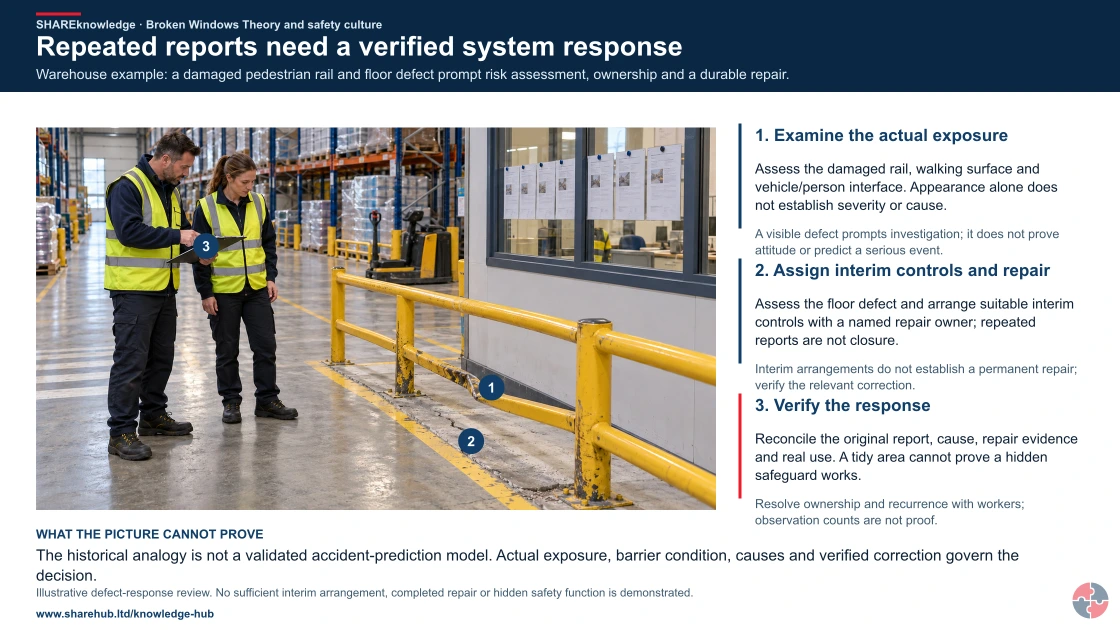
Repeated reports need a verified system response
Full written explanation
Warehouse example: a damaged pedestrian rail and floor defect prompt risk assessment, ownership and a durable repair.
- Examine the actual exposure. Assess the damaged rail, walking surface and vehicle/person interface. Appearance alone does not establish severity or cause.
- Assign interim controls and repair. Assess the floor defect and arrange suitable interim controls with a named repair owner; repeated reports are not closure.
- Verify the response. Reconcile the original report, cause, repair evidence and real use. A tidy area cannot prove a hidden safeguard works.
Change the pathway
- Use risk evidence. A visible defect prompts investigation; it does not prove attitude or predict a serious event.
- Resolve the underlying condition. Interim arrangements do not establish a permanent repair; verify the relevant correction.
- Check the management loop. Resolve ownership and recurrence with workers; observation counts are not proof.
Evidence check: The historical analogy is not a validated accident-prediction model. Actual exposure, barrier condition, causes and verified correction govern the decision.
Primary references: HSE: investigating accidents and incidents (HSG245) · HSE: managing for health and safety (HSG65)
Open the complete HD image (new tab)Download image

Primary references: HSE: investigating accidents and incidents (HSG245) · HSE: managing for health and safety (HSG65)
Compare visible nuisance with hidden critical failure. A tidy area can conceal an overdue shutdown test, and repeated cleaning can conceal a continuing leak. Prioritise credible harm and verify a durable repair rather than reward appearance or observation counts.
The tidy area has the more serious unknown
Illustrative example. A leadership walk finds a recurring press oil leak and a spotless process bay whose credited shutdown test is overdue.
Decision. Control the leak/slip exposure and use the appropriate impairment route for the uncertain shutdown; do not rank solely by tidiness.
Evidence to check. Record leak source, actual exposure, barrier function, proof status and responsible owners.
Hold or escalation point. No closure of the leak by repeated mopping or of the shutdown by a clean bay and normal display.
Follow-up. Verify repair under representative demand and accepted barrier evidence before concluding improvement.
Visible defect, hidden barrier: both need proof
Broken Windows Theory is a limited analogy in safety discussion. A tidy workplace does not establish that critical safeguards work, and a visible defect does not prove inevitable escalation or identify its cause.
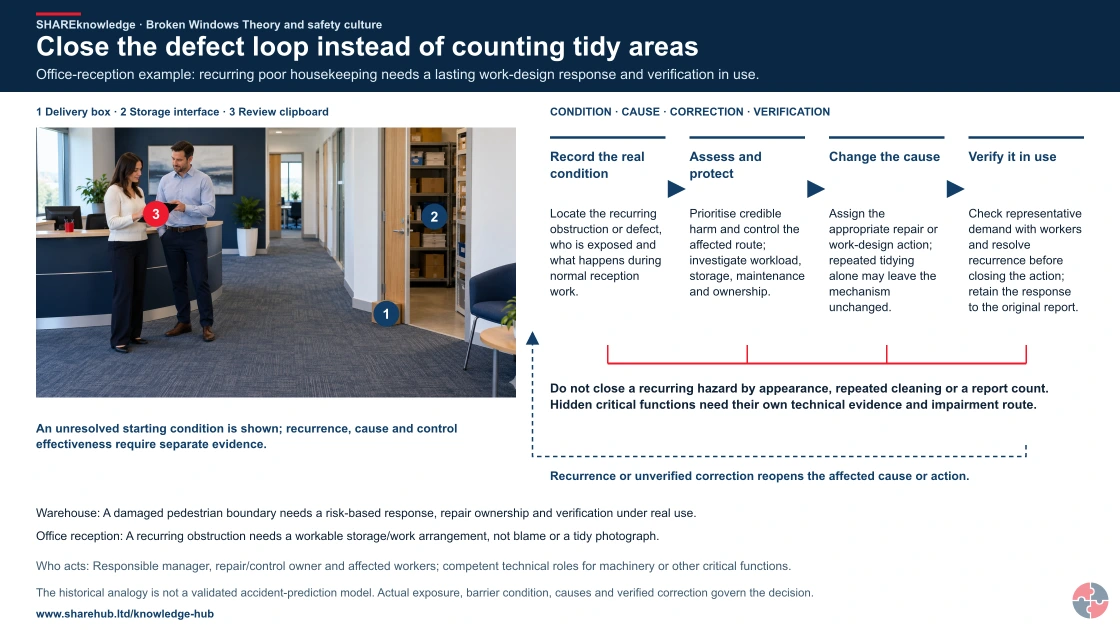
Close the defect loop instead of counting tidy areas
Full written explanation
An illustrative UK office reception shows a connected reception counter, receiving and storage interface and ordinary walking passage. A small delivery box projects partly outside storage, while two normal staff stand clear reviewing an inert clipboard. One literal picture key identifies 1 delivery box, 2 storage interface and 3 review clipboard. This is an unresolved starting condition for assessment, not a photograph of a verified risk level, cause or safe arrangement. Four full checks retain the evidence-led review order: Record the real condition: Locate the recurring obstruction or defect, who is exposed and what happens during normal reception work. Assess and protect: Prioritise credible harm and control the affected route; investigate workload, storage, maintenance and ownership. Change the cause: Assign the appropriate repair or work-design action; repeated tidying alone may leave the mechanism unchanged. Verify it in use: Check representative demand with workers and resolve recurrence before closing the action; retain the response to the original report. Three short forward arrows show the review order; a separate return shows that recurrence or unverified correction reopens the affected cause or action. A common unarrowed hold applies across the checks: Do not close a recurring hazard by appearance, repeated cleaning or a report count. Hidden critical functions need their own technical evidence and impairment route. Who acts: Responsible manager, repair/control owner and affected workers; competent technical roles for machinery or other critical functions. The historical analogy is not a validated accident-prediction model. Actual exposure, barrier condition, causes and verified correction govern the decision. Warehouse: A damaged pedestrian boundary needs a risk-based response, repair ownership and verification under real use. Office reception: A recurring obstruction needs a workable storage/work arrangement, not blame or a tidy photograph. The scene establishes no recurring history, acceptance of poor standards, worker attitude, blame, causal policing theory, accident prediction, sufficient interim control, approved route, route width or capacity, emergency exit, usable alternative, completed repair, hidden protective function, compliance or operating permission. No one is stepping over the box, moving loads, cleaning or repairing. A tidy photograph or a count of reports does not verify sustained correction; hidden critical functions need their own technical evidence and impairment route.
Office-reception example: recurring poor housekeeping needs a lasting work-design response and verification in use.
- Record the real condition. Locate the recurring obstruction or defect, who is exposed and what happens during normal reception work.
- Assess and protect. Prioritise credible harm and control the affected route; investigate workload, storage, maintenance and ownership.
- Change the cause. Assign the appropriate repair or work-design action; repeated tidying alone may leave the mechanism unchanged.
- Verify it in use. Check representative demand with workers and resolve recurrence before closing the action; retain the response to the original report.
When the evidence does not fit: Do not close a recurring hazard by appearance, repeated cleaning or a report count. Hidden critical functions need their own technical evidence and impairment route.
Who acts: Responsible manager, repair/control owner and affected workers; competent technical roles for machinery or other critical functions.
Changed workplace
Warehouse: A damaged pedestrian boundary needs a risk-based response, repair ownership and verification under real use.
Office reception: A recurring obstruction needs a workable storage/work arrangement, not blame or a tidy photograph.
Evidence check: The historical analogy is not a validated accident-prediction model. Actual exposure, barrier condition, causes and verified correction govern the decision.
Primary references: HSE: investigating accidents and incidents (HSG245) · HSE: managing for health and safety (HSG65)
Open the complete HD image (new tab)Download image

Primary references: HSE: investigating accidents and incidents (HSG245) · HSE: managing for health and safety (HSG65)

- Visible leak / protect route
- Hidden interlock / verify function
- Different evidence, shared learning
Read the labels in the full-size drawing
- VISIBLE DEFECT
- HIDDEN SAFETY FUNCTION
- DIFFERENT VERIFICATION
- Separate responsibilities; connect necessary evidence
Visible cue: press leak
Protect people from the affected route, hold the relevant task and identify the leak source. A clean floor without repair leaves the mechanism unresolved.
Hidden function: conveyor interlock
An orderly area cannot show that the interlock works. Use the authorised machinery-safety route to verify the designed function under controlled conditions.
Common evidence loop
Name the repair owner, investigate task/system causes, restore the required function, verify actual use and review recurrence. Use different technical evidence for each defect.
Keep the detailed task hierarchies below as reference. Do not infer a universal severity ranking, accident ratio or worker attitude from appearance; a defect report is a starting point for investigation.
What are the key facts about Broken Windows Theory?
The key facts are that visible standards influence behaviour, but they do not replace proper risk control.
It is about signals
People read the workplace constantly: what is repaired, what is ignored, what leaders challenge and what supervisors walk past.
It can expose normalisation
Repeated defects can become so familiar that people stop seeing them as unacceptable.
It is not just housekeeping
Housekeeping is visible, but the same principle applies to overdue maintenance, weak permits, missing records and action drift.
It must be fair
The aim is to fix systems and standards, not blame individuals for symptoms of poor work design or pressure.
It must be risk-based
Small defects should be fixed, but leaders must still focus on the controls that prevent serious harm.
It needs evidence
Inspection trends, defect logs, worker feedback and audit findings show whether standards are genuinely improving.
What is Broken Windows Theory?
Broken Windows Theory is a historical policing analogy. At work, visible defects are prompts to investigate actual risk and management response; they do not predict an accident or prove anyone is at fault. HSE organisational culture overview
Visible neglect is a prompt, not the whole risk picture


Read the complete visual as text
- WEAK SIGNAL: Repeated oil on a walkway may show that a defect has become normal. Ask how often it occurs and who owns it.
- IMMEDIATE CONTROL: Restrict the slippery route and contain the leak; a clean-up alone does not repair the machine.
- SYSTEM CAUSE: Examine equipment condition, maintenance access, production pressure and action closure with operators. Avoid blame-based rule policing.
- ASSURANCE: Verify the repaired machine and route across representative work. Serious hidden barriers still need attention even when the area looks tidy.
The workplace application is a prompt to ask whether a visible condition signals a missed control, weak ownership or a need for repair. It is not a validated causal law for workplace injuries.
In health and safety, a broken window might be a damaged guard that everyone knows about, a blocked fire exit, a leaking drum, a missing ladder tag, poor storage, a permit that is copied from the last job, an overdue corrective action, or supervisors walking past people without required protection.
The value of the theory is not that every small fault directly causes a serious accident. Its value is that small tolerated faults reveal what the organisation actually accepts. They show whether standards are alive, resourced, checked and corrected.
Visible disorder. People can see that something is neglected. A spill, defect, damaged sign, missing guard or poor handback remains unresolved.
Signal. The environment tells people what is tolerated. Workers infer that the standard is optional or low priority.
Normalisation. A poor condition becomes familiar. Repeated shortcuts or defects stop feeling abnormal.
Escalation. Weak standards spread or become harder to challenge. More serious control failures become easier to miss or excuse.
Intervention. Fixing signals early protects expectations. Leaders restore standards, remove causes and check whether learning sticks.
The original theory came from policing and remains contested as an explanation of crime. In occupational safety, use it only as an analogy for responding to visible weak signals; do not assume a direct causal path from minor disorder to a major accident.
How does Broken Windows Theory translate into workplace health and safety?
It translates into the way people interpret visible standards, supervision and action close-out. HSE introduction to human factors
A workplace standard is not only what the policy says. It is what workers repeatedly see. If a site says eye protection is mandatory but leaders tour the area without it, the written rule is weakened. If defects are reported but sit open for months, reporting loses credibility. If a supervisor challenges some people but ignores others, the standard becomes personal rather than organisational.
The theory is especially useful where small issues are repeated: housekeeping, pedestrian routes, tool condition, storage, signage, permit quality, PPE use, guards, isolation locks, handover, defect tags, spill response and close-out of corrective actions.
The practical question is: what does this condition teach people? If the answer is that nobody owns it, nobody checks it, or nobody acts, the organisation has found a culture signal that should be corrected.
Trailing cables across a walkway. Trips are tolerated if work is busy. Remove the cable route problem, brief the team and check similar areas.
Repeated missing PPE in a mandatory area. The rule is unclear, inconvenient or inconsistently supervised. Check signage, availability, task design, supervision and leadership behaviour.
Machine guard damaged but still used. Production is being prioritised over equipment condition. Stop unsafe use, repair, review defect reporting and check guard inspection routines.
Overdue investigation actions. Learning is discussed but not closed. Assign owners, due dates, evidence and escalation for aged actions.
Poor permit handback. The site accepts weak control of non-routine work. Review permit training, supervisor checks, isolation evidence and shift handover.
What do workplace broken windows look like?
Workplace broken windows are the small visible failures that make weak control look normal.
The examples below are not trivial because each one reveals something about ownership. A single spill may be a housekeeping issue. A recurring spill in the same place may be a maintenance issue, a design issue, a procurement issue, a supervision issue or a culture issue.
The best organisations do not treat these examples as cosmetic. They ask whether the same weak signal appears elsewhere, whether workers have reported it before, whether actions are being closed, and whether the underlying cause has been removed.
Housekeeping. Waste build-up, blocked walkways, spills, poor segregation, cluttered stores. Ownership, standards, cleaning frequency, storage design and supervision.
Equipment. Damaged guards, missing inspection tags, taped cables, leaking hoses, poor temporary repairs. Maintenance route, defect priority, stop-use rules and procurement.
Rules and behaviour. PPE not worn, pedestrian routes ignored, phones used in restricted areas, shortcuts through barriers. Task design, expectations, leadership consistency and worker involvement.
Documents. Copied risk assessments, vague permits, out-of-date procedures, unread briefings. Quality review, competence and whether documents match real work.
Actions. Repeated overdue actions, no evidence of close-out, actions closed without verification. Action ownership, escalation, verification and management review.
Leadership. Managers walk past defects, accept excuses or focus only on appearance before visitors arrive. Leadership routines, challenge quality and follow-through.
What signals do small defects send to workers?
Small defects can signal whether management attention, resources and standards are real or only written down.
People learn from what happens after a concern is raised. If a worker reports a leak and nothing happens, the next leak may not be reported. If a supervisor walks past an unsafe condition, the workforce may conclude that the standard is negotiable. If actions are closed without evidence, the management system starts to lose authority.
These signals shape trust. Good cultures make reporting worthwhile, fix causes, explain decisions and involve workers. Weak cultures ask for reporting but give no response, or challenge individuals without removing the conditions that caused the problem.
Defects are fixed quickly. Reporting works and standards matter. Keep response visible and thank reporters.
Defects stay open. There is no point reporting. Review backlog, resources and escalation.
Leaders challenge fairly. The rule applies to everyone. Use coaching and listen for barriers.
Leaders ignore poor conditions. Production or convenience matters more. Reset expectations and model standards.
Actions are verified. Close-out means real improvement. Require evidence and sample checks.
Actions are administratively closed. The system is paperwork. Reopen weak actions and improve governance.
What are the limits of Broken Windows Theory in health and safety?
The theory is limited because tidy workplaces can still have serious hidden risks.
The most important limitation is the illusion of safety. A workplace can look orderly while critical risks are poorly controlled: ageing equipment, weak isolation, poor fatigue management, pressure to continue, overdue inspection, poor contractor control or a hazard study action that has never been verified.
There is also a fairness risk. If leaders use Broken Windows Theory as a reason to punish minor non-compliance without understanding why it happened, workers may hide problems. Poor conditions may be created by lack of time, poor layout, unsuitable tools, unclear instructions or production pressure.
The mature use is balanced: maintain visible standards, but also test the controls that prevent serious injury, ill health, fire, explosion, structural failure, exposure and loss of containment.
Useful use. Fixes visible weak signals and investigates why they exist. Improves standards and system learning.
Poor use. Counts minor observations without prioritising risk. Creates activity without reducing serious harm.
Useful use. Checks safety-critical controls as well as housekeeping. Avoids the tidy-but-unsafe trap.
Poor use. Blames workers for every visible issue. Suppresses reporting and trust.
Useful use. Uses trends, worker feedback and evidence. Shows whether improvement is real.
Poor use. Prepares only for audits or visitors. Produces temporary appearance rather than control.
How should leaders use Broken Windows Theory without creating blame?
Leaders should use it to restore standards, understand causes and make safe work easier. HSE INDG417 leading health and safety at work
A good leader does not simply say, “tidy this up”. They ask who owns the standard, whether people have the right equipment, whether the layout encourages the problem, whether the reporting route works, and whether previous actions have failed.
Consistency is crucial. A rule that is challenged on Monday and ignored on Friday becomes a preference, not a standard. Leaders should model the standard, explain why it matters, listen to workers and ensure actions are closed with evidence.
The best leadership conversations are curious and firm: “This condition is not acceptable. What has made it happen, what do we need to change, who owns it, and how will we know it has stayed fixed?”
Set visible standards. Define what good looks like for key areas and tasks. Area standards, photographs, briefings and induction.
Model standards. Leaders follow site rules and correct weak signals respectfully. Leadership tour notes and worker feedback.
Ask why. Challenge the condition and understand the cause. Improvement actions that remove root causes.
Close the loop. Tell workers what happened after they raised a concern. You said, we did communication.
Verify actions. Check that the fix works after implementation. Evidence photos, inspections and sampled follow-up.
Escalate drift. Treat repeated weak signals as management information. Review of trends at management meetings.
How does Broken Windows Theory fit with HSG65 Plan, Do, Check, Act?
It fits best when visible standards are managed through planned arrangements, active checks and improvement loops. HSE HSG65 managing for health and safety
HSG65 describes health and safety management as part of good management, using Plan, Do, Check, Act. Broken Windows Theory can support this by making visible standards part of the management system rather than a campaign of tidying up.
Plan means deciding which standards matter and why. Do means providing people, tools, training and supervision. Check means inspecting, listening, monitoring action close-out and reviewing trends. Act means improving the work system when repeated weak signals appear.
This turns the theory from a slogan into a disciplined management routine.
Plan. Define standards for housekeeping, access, equipment condition, permits, defects and action close-out. Standards, risk assessments and communication plan.
Do. Resource cleaning, maintenance, supervision, reporting routes and worker involvement. Roles, training, equipment and defect routes.
Check. Use inspections, tours, audits, action ageing and worker feedback. Inspection records and dashboard trends.
Act. Improve layout, procurement, maintenance, procedures, supervision or training. Completed actions and management review.
How does Broken Windows Theory connect to human factors and safety culture?
It connects to human factors because behaviour is shaped by the job, the individual and the organisation. HSE introduction to human factors
HSE’s human factors approach is broader than individual behaviour. It looks at job design, equipment, environment, competence, workload, supervision, communication, leadership and organisational priorities. Broken Windows Theory should therefore be used to ask what the work system is teaching people.
A worker stepping over a barrier may be making a poor choice, but it may also reveal that the barrier blocks the only practical route, the job is under time pressure, the rule is not understood, or previous concerns were ignored. The visible behaviour is a clue, not the whole answer.
For culture, the theory helps explain “the way we do things around here”. If people see high standards every day, they are easier to maintain. If people see unmanaged drift every day, drift becomes the workplace norm.
Job. Does the task make the safe way practical? Tools, layout or time pressure make shortcuts tempting.
Equipment. Is equipment designed, maintained and available? Poor storage causes guards or PPE to be damaged.
Environment. Does the workplace support the expected standard? Lighting, access or weather makes housekeeping difficult.
Individual. Do people have competence and confidence to act? New starters do not know how to report defects.
Organisation. Do leadership messages match real priorities? Production pressure causes action close-out to be deferred.
How should active monitoring use Broken Windows Theory?
Active monitoring should look for patterns in visible weak signals and verify that actions actually improve control. HSE HSG65 managing for health and safety
Active monitoring should not become a long list of random observations. The best checks are structured around the controls that matter: access routes, storage, guards, isolations, permits, ventilation, fire precautions, training, welfare, emergency arrangements and action close-out.
First-line checks by workers and supervisors should be simple and repeatable. Second-line checks by managers or safety advisers should test evidence and trend quality. Third-line audits should sample whether the management system is controlling risk across locations and time.
The data is only useful if it produces action. A site with hundreds of observations but no close-out discipline is collecting proof of drift.
First line. Workers, team leaders and supervisors. Area condition, immediate defects, PPE availability, access, simple rule compliance and immediate hazards. Use short, mostly binary checks so results can be compared between teams and shifts.
Second line. Managers, HSSE advisers and department leads. Quality of first-line checks, records, procedures, action close-out, supervision and repeated themes. Focus on quality over quantity and rank findings so improvement actions are clear.
Third line. Internal auditors, external auditors or specialist reviewers. Whether the whole management system finds, prioritises and closes weak signals reliably. Use planned, evidence-based audits with samples of workplaces, records, interviews and management review.
Are inspections seeing the conditions that recur during work?
Compare the inspection time with the work that creates the defect. A clear route before deliveries may become blocked whenever stock arrives. Repeatedly clearing it before a leadership tour can make the evidence look better while leaving the storage and delivery problem intact. Ask when the condition develops, who is affected and which control should prevent it.
For an illustrative store entrance, observe unloading and stock put-away as well as the quiet period. If materials occupy a needed route, control the immediate obstruction safely and have the manager redesign receiving space, storage and delivery timing with the workers. Check the revised arrangement during a representative delivery rather than closing the action on a photograph of an empty corridor. An attractive floor marking is useful only if the route remains usable when people need it. Prioritise the actual escape, collision or handling consequence and verify the relevant control; the appearance of disorder alone does not establish the risk level.
Guidance and scope: Original SHARE inspection example applying HSE GB risk-assessment and management guidance. It uses the analogy to ask better questions, without asserting a proven causal theory or a mandatory inspection frequency. HSE risk assessment guidance HSE HSG65 managing for health and safety
How can investigations use Broken Windows Theory?
Investigations can use visible weak signals to understand drift, but they must still identify deeper causes. HSE HSG245 investigating accidents and incidents
Investigations should look beyond the event itself. If an accident involved a trip on a cable, the question is not only why the cable was there. It is whether similar cable routes exist elsewhere, whether people reported them before, whether supervision noticed them, whether work planning caused them and whether action close-out failed.
HSG245-style investigation thinking is useful: gather information, analyse it, identify risk control measures and implement an action plan. Broken Windows Theory adds a cultural question: what did people repeatedly see and learn before the event?
Evidence should include photographs, inspection records, maintenance logs, previous near misses, action trackers, worker interviews, training evidence and management meeting minutes.
Was the condition visible before the event?. Whether the weak signal was known or knowable. Photos, inspections, worker reports and supervisor notes.
Was it previously reported?. Whether reporting and response worked. Near misses, defect logs and maintenance requests.
Were similar issues present elsewhere?. Whether it was isolated or systemic. Area inspections and audit samples.
What made the condition repeat?. Whether root causes were removed. Work design, layout, resources and supervision.
Were actions closed properly?. Whether improvement was verified. Action tracker, evidence and post-action checks.
How should risk registers and action trackers capture Broken Windows signals?
Registers should capture repeated weak signals as risk intelligence, not just individual housekeeping actions. HSE risk assessment guidance
A single broken pallet may be a local action. Ten broken pallets across a warehouse may indicate poor procurement, storage, traffic routes, supervision or inspection. The difference matters because the control response changes.
The risk register should record themes that could affect harm: blocked routes, poor segregation, repeated guard defects, permit quality problems, overdue maintenance, weak supervision, action ageing and recurring near misses. The action tracker should show owner, due date, priority, evidence and verification.
Management review should focus on patterns: which issues repeat, which actions age, which teams need support, and which controls keep failing.
| Field | Why it matters | Example |
|---|---|---|
| Theme | Groups repeated weak signals. | Repeated poor segregation in stores. HSE risk assessment guidance |
| Risk link | Connects visible issue to harm pathway. | Blocked route could delay evacuation or cause collision. HSE risk assessment guidance |
| Control owner | Prevents no-one owning the fix. | Warehouse manager. HSE risk assessment guidance |
| Priority | Ensures serious controls are not lost in minor actions. | High for blocked emergency route. HSE risk assessment guidance |
| Due date | Allows action ageing to be managed. | Seven days for local fix; longer for layout redesign. HSE risk assessment guidance |
| Verification | Proves the fix worked. | Reinspection and worker feedback after one month. HSE risk assessment guidance |
Prioritise defects by the harm route, exposure and failed control, alongside recurrence and the time taken to make them safe. A repaired paint blemish must not outweigh an unverified shutdown, guard or escape route. Report whether the control works in use and who accepted hand-back, not only how many tickets were closed.
Which legal duties apply to visible workplace standards and safety culture?
There is no Broken Windows regulation, but UK law requires employers to manage risks, maintain safe workplaces and consult workers.
Legal duties do not require an organisation to adopt Broken Windows Theory. They require suitable arrangements for managing health and safety, safe systems of work, suitable workplace condition, maintained equipment, information and training, consultation and learning from incidents.
The theory is therefore best understood as a practical management lens that helps dutyholders see whether those legal arrangements are actually working in the workplace.
| Duty or regulation | Jurisdiction | How it connects | Practical evidence |
|---|---|---|---|
| Health and Safety at Work etc. Act 1974 | Great Britain | General duties to protect employees and others affected by the undertaking. | Management arrangements, supervision, safe systems and improvement actions. |
| Management of Health and Safety at Work Regulations 1999 | Great Britain | Requires risk assessment, preventive and protective measures, organisation and arrangements. | Risk registers, inspections, action tracking and review. |
| Workplace (Health, Safety and Welfare) Regulations 1992 | Great Britain | Requires workplaces to be maintained, clean, safe and suitable. | Housekeeping standards, access checks, cleaning and maintenance records. |
| Provision and Use of Work Equipment Regulations 1998 | Great Britain | Requires work equipment to be suitable, maintained and used safely. | Guard checks, defect reporting, maintenance logs and stop-use rules. |
| Reporting of Injuries, Diseases and Dangerous Occurrences Regulations 2013 | Great Britain | Requires certain injuries, diseases and dangerous occurrences to be reported. | Incident classification, investigation and learning records. |
| Safety Representatives and Safety Committees Regulations 1977 | Great Britain | Supports worker representation and involvement in health and safety. | Safety committee minutes, inspections and consultation evidence. |
| Health and Safety (Consultation with Employees) Regulations 1996 | Great Britain | Requires consultation where employees are not represented under the 1977 Regulations. | Consultation plans, feedback and employee involvement. |
| Health and Safety at Work (Northern Ireland) Order 1978 | Northern Ireland | Core employer duties for safe work. | Safe-system and supervision evidence. |
| Management of Health and Safety at Work Regulations (Northern Ireland) 2000 | Northern Ireland | Risk assessment and preventive arrangements. | NI risk and action record. |
| Provision and Use of Work Equipment Regulations (Northern Ireland) 1999 | Northern Ireland | Maintain equipment and safeguards. | Guard and maintenance checks. |
| Health and Safety (Consultation with Employees) Regulations (Northern Ireland) 1996 | Northern Ireland | Consult affected employees where applicable. | Consultation and action records. |
The cited table lists Great Britain instruments. Northern Ireland has separate health-and-safety, management, workplace, equipment and consultation instruments; apply the NI route to work there. The theory itself creates no statutory duty in either jurisdiction.
How could BuildOut Ltd use Broken Windows Theory on construction projects?

BuildOut Ltd could use the theory to turn visible site standards into a disciplined leadership, inspection and improvement routine.
BuildOut Ltd
a regional construction contractor delivering refurbishment, civils and fit-out projects across occupied and live environments
BuildOut does not treat Broken Windows Theory as a poster campaign. It builds the idea into project planning, supervisor routines, contractor management and close-out. Before work starts, each project risk register identifies visible standards that matter: access routes, segregation, lifting areas, temporary works, welfare, storage, dust controls, waste, permits, electrical leads, scaffold handover and emergency routes.
Supervisors complete short daily checks that are mostly binary: access clear, waste controlled, scaffold tags current, exclusion zones intact, welfare usable, fire points available and permits live. The aim is not to collect paragraphs of opinion; it is to quickly show whether the baseline is being held across teams and shifts.
The health and safety adviser then samples quality each week. They review whether defects are repeated, whether subcontractors understand the standard, whether actions are closed with evidence and whether any weak signal points to a deeper issue such as poor sequencing, rushed procurement, inadequate supervision or unrealistic programme pressure.
Monthly, the project manager reviews themes with supervisors and subcontractors. Repeated defects are escalated from local snagging into management actions. For example, repeated trailing leads may lead to revised temporary power distribution, additional cable management, procurement of cordless equipment, revised RAMS and a subcontractor briefing. The improvement is checked after implementation rather than assumed.
Assess. Identifies visible standards linked to significant risks in the project risk register. Risk register and pre-start review.
Analyse. Trends repeated defects by trade, area, supervisor, contractor and control type. Inspection dashboard and action-ageing report.
Train. Briefs supervisors and subcontractors on what good looks like and why visible drift matters. Induction, toolbox talks and supervisor coaching records.
Implement. Provides storage, signage, waste routes, power distribution, access control and clear ownership. Site layout plan, procurement records and daily checks.
Check. Uses first-line checks, second-line HSSE sampling and project manager leadership tours. Daily checks, weekly inspections and tour notes.
Learn. Uses incidents, near misses and worker feedback to identify repeated weak signals. Learning briefings and revised controls.
Improve. Changes design, sequencing, contractor controls or resources where defects keep returning. Verified corrective actions and management review.
What training helps people apply Broken Windows Theory well?
Training should help people recognise weak signals, respond fairly and connect visible standards to risk control.
General awareness should be short and practical: what visible standards mean, why defects should be reported, how to raise concerns and why small repeated problems matter. It should avoid turning the idea into a blame message.
Supervisors need more detail because they set the daily tone. They need to know how to challenge respectfully, how to ask why, how to close actions, how to escalate repeated defects and how to avoid focusing only on easy-to-see issues while missing high-risk work.
Managers and safety professionals need to understand trend analysis, assurance, culture, human factors, action governance and the difference between superficial compliance and genuine risk reduction.
Competence means a person can carry out the actual task safely, recognise a changed condition and respond correctly. Attendance alone is insufficient. The matrix makes assessment, ownership, records and reassessment explicit.
| Role | Required learning | How competence is assessed | Assessor or owner | Record | Reassess when |
|---|---|---|---|---|---|
| Worker | Spot and report defects without assuming cause | Describe a live defect, exposure and report route in a walkthrough | Supervisor | Observed task check and defect report | Task or reporting route changes |
| Supervisor | Triage by credible harm; assign repair | Work through recurring spill and unseen barrier-failure cases | Safety adviser and maintenance lead | Scenario assessment and closure | Control fails or defect recurs |
| Manager | Resource repair and verify assurance | Challenge a tidy audit score against a missed proof test | Senior duty holder | Review and barrier verification | Major change or assurance gap |
| Adviser | Explain analogy, evidence limit and jurisdiction | Review a case without inferring blame or accident prediction | Competent peer reviewer | Case and source review | Law or evidence changes |
How does Broken Windows Theory support study and professional development?
It supports learning about culture, leadership, active monitoring, incident causation and continual improvement.
For NEBOSH National General Certificate learners, the value is in explaining how management behaviour, supervision, worker involvement and active monitoring influence workplace standards. A scenario might ask why repeated poor housekeeping, ignored near misses and overdue actions show weakness in management arrangements.
For diploma-level and professional learners, the topic should be handled more critically. The answer should recognise that visible disorder can reveal cultural weakness, but serious accidents may arise from hidden technical and organisational failures. A strong answer balances visible standards with risk profiling, human factors, maintenance, competence and safety-critical controls.
In practice, learners should be able to describe what they would inspect, who they would speak to, what records they would review, what trends they would analyse and how they would verify that improvement had actually happened.
Safety culture. How accepted standards shape behaviour. Explain what repeated defects say about leadership and expectations.
Active monitoring. How inspections identify weak signals before harm. Design a practical inspection and action close-out process.
Incident causation. How visible drift can be part of a wider chain. Investigate repeated near misses and identify root causes.
Human factors. How work design and organisational pressures influence behaviour. Avoid blaming workers without checking task, equipment and supervision.
Management systems. How Plan, Do, Check, Act turns standards into evidence. Use trends and management review to improve arrangements.
How can management systems make Broken Windows Theory useful?
A management system makes visible standards owned, checked, evidenced and improved.
Without a management system, Broken Windows Theory can become a burst of housekeeping activity. With a management system, it becomes a way to monitor whether controls are being maintained and whether the organisation is learning from weak signals.
A management cycle helps assign leadership, planning, competence, safe operations, performance review and improvement. A voluntary management framework is a voluntary system reference; a licensed current text is needed for exact clause applications.
The best indicators are not just counts of findings. They include repeat findings, action ageing, overdue high-risk actions, percentage of actions verified, worker feedback, leadership-tour quality and the number of systemic improvements made from trends.
| Management-system stage | How it supports the topic | Practical evidence |
|---|---|---|
| Leadership and commitment | Leaders set consistent visible standards and provide resources. | Leadership tours, budget decisions and visible close-out. |
| Consultation and participation of workers | Workers help identify practical weak signals and workable controls. | Worker feedback, safety committee actions and consultation records. |
| Hazard identification and assessment of risks and opportunities | Repeated weak signals are assessed as risk information. | Risk register updates and trend analysis. |
| Competence | People know what to look for and how to respond fairly. | Training matrix and supervisor competence records. |
| Operational planning and control | Visible standards are built into work planning and supervision. | Inspection standards, RAMS and contractor requirements. |
| Monitoring, measurement, analysis and performance evaluation | Findings, trends and actions are analysed. | Dashboards, audits and management review inputs. |
| Incident, nonconformity and corrective action | Weak signals and repeated defects drive corrective action. | Root-cause actions, evidence and verification. |
What are the warning signs that Broken Windows Theory is being used badly?
Warning signs include blame, superficial tidiness, action counting and failure to address serious risks. HSE risk assessment guidance
The theory should improve control, not create a culture of fear. If workers are punished for reporting defects, reports will reduce and weak signals will become harder to see. If managers celebrate a tidy site but ignore maintenance, fatigue or design risk, the theory has been misunderstood.
Warning signs should trigger a review of leadership behaviour, inspection quality, worker involvement, resources, action close-out and risk prioritisation.
Leaders focus only on cosmetics. Hidden serious risks remain uncontrolled. Add risk profiling and safety-critical control checks.
Workers are blamed for every defect. Reporting drops and problems are hidden. Use fair culture and ask why conditions exist.
Inspection numbers become the goal. Quality falls and actions do not reduce risk. Review findings quality and action effectiveness.
Actions stay overdue. People lose trust that reporting leads to change. Escalate ageing actions and verify close-out.
Rules are enforced inconsistently. Standards become personal rather than organisational. Train supervisors and align leadership expectations.
Repeated issues are treated as new issues. Root causes remain unresolved. Trend findings and update risk controls.
What can a visible defect prove?
A visible defect proves that a condition needs assessment and ownership. It does not prove that a serious accident will follow, that a worker caused it, or that a tidy area is safe. The 1982 Broken Windows essay was a criminology argument, not a validated occupational-risk model.
Use the observation to find the actual hazard, exposure, failed control and reason the condition persisted. Compare it with less visible but high-consequence barriers such as isolation, containment, structural integrity and emergency response. Prioritise by credible harm and urgency, then verify a durable fix.
Historical origin: a historical 1982 policing essay. This is not occupational evidence or official guidance. This is historical context, not evidence that a workplace intervention is effective.
What does official guidance add to this decision?
Treat visible defects as prompts to investigate and repair controls. Do not infer that tidiness or a low defect count proves a critical barrier is effective.
Use the current HSE safety-culture guidance and the jurisdiction-specific duties listed on this page to verify the actual task and controls.
If a contract or competent design specifies a published technical standard, obtain authorised access to its current text and check its exact scope and edition. Apply the standard only within its stated scope; this guidance does not reproduce its clauses.
How do the decisions work in practice?
These examples show the prerequisites, controls, stop conditions, decision owner and hand-back for an actual scenario. Adapt them to the assessed site or building. HSE HSG245 investigating accidents and incidents
Repair the recurring cause, not the appearance


Read the complete visual as text
- Protect the slippery route
- Find why the leak returns
- Verify the repair in real operation
- The photograph provides topic context. Repeated oil spill by a press is an illustrative learning example; the checks below must be adapted to the actual task.
Recurring press leak: evidence for a durable fix


Read the complete visual as text
- 1. ACTUAL TASK: Record when oil reaches the pedestrian route and how the press and people are exposed across shifts.
- 2. PEOPLE AND BASIS: Operations and maintenance agree immediate protection, repair ownership and a representative operating test.
- 3. BEFORE: Restrict the slippery route, contain the leak and isolate the press using the assessed repair method.
- 4. VERIFY DURING: Repair the cause and test under controlled conditions; verify a clean usable route and watch for recurrence.
- 5. HOLD OR REFER: Keep the route or machine held when exposure is uncontrolled or repair evidence is incomplete.
- 6. HAND BACK AND REVIEW: Record repair and acceptance, then revisit during the next busy shift; repeated leakage reopens the cause investigation.
Repeated oil spill by a press
Task material and setting: A machine leaks oil across a pedestrian route after every shift. Workers have repeatedly cleaned it and supervisors have called for more care.
People and prerequisites: The press operator and maintenance lead identify the oil source, safe shutdown/isolation method, route diversion and repair authority before work starts; affected pedestrians need a usable alternative route.
Before: Restrict the slippery route, contain the leak and assess both slip harm and the equipment defect. Ask operators and maintenance what makes the leak recur.
During: Maintenance isolates the press using the assessed method before repairing the leak, then tests under controlled operating conditions. Operations verifies the route is cleaned and usable and checks for recurrence across a representative shift. Investigate equipment condition and production pressure rather than assuming poor care.
Hold or stop: Hold use of the route or machine when the leak creates uncontrolled exposure or repair cannot be verified.
Decision owner: The operations manager owns safe access; maintenance owns repair; workers report recurrence.
Completion and hand back: Return the route and machine after repair, cleaning and a representative operating test; revisit after the next busy shift.
Evidence: Record the source defect, isolation/repair and representative test, safe route hand-back and worker feedback at the next busy shift. Count recurrence as failed control, even if each cleaning ticket was closed.
Changed conditions: Reassess when the task, people, equipment, evidence or legal scope changes.
Source scope: HSE maintenance and human-factors guidance support GB work-risk principles; this illustration is not proof of the historical analogy or NI legislation.
Tidy area with an overdue shutdown test
Task material and setting: A plant looks orderly during a leadership tour, but a critical automatic shutdown proof test is overdue. The tour score is green.
People and prerequisites: The duty holder and competent shutdown-barrier owner need the affected hazard scenario, required safety function, current test/impairment record, plant configuration and operating restrictions.
Before: Treat the missing proof as a separate high-consequence control question. Identify the affected scenario, test history, redundancy, bypasses and actual operating state.
During: A competent barrier owner assesses the impairment and applies the site restriction, compensating-control and repair rules.
Hold or stop: Hold or reduce affected operation if the required protection cannot be demonstrated; housekeeping score cannot authorise operation.
Decision owner: The duty holder owns risk acceptance; engineering verifies the barrier; operations enforces the restriction.
Completion and hand back: Hand back only when the required safety function is demonstrated by appropriate testing, or a competent authorised alternative is explicitly bounded under site rules. Communicate configuration, restrictions, expiry and monitoring to the operating shift; remove temporary overrides when restoration is verified.
Evidence: Keep impairment, decision, test and restart records, and correct the assurance metric.
Changed conditions: Reassess when the task, people, equipment, evidence or legal scope changes.
Source scope: HSE management guidance supports checking real control effectiveness. A clean tour score supplies no barrier proof; any alternative needs a specific competent case and current applicable law.
How can the hierarchy of controls address unsafe workplace conditions before relying on daily discipline?
Start by removing or redesigning the actual harm route. ERICPD (Eliminate, Reduce including substitution, Isolate, Control, PPE, Discipline) and the five-level HSE hierarchy (elimination, substitution, engineering, administrative, PPE) overlap but are not identical. Discipline sustains stronger controls through checks and learning; it is not blame. The table applies both to one realistic task and explains why a higher-level measure is or is not feasible. See HSE hierarchy; HSE five-level hierarchy of control
- ObserveRecord the recurring spill, guard defect or ignored near miss and who may be exposed.
- AssessFind the actual harm route and check serious hidden hazards too; appearance alone does not rank risk.
- RepairRemove the leak or defect, then correct the design, maintenance or decision process that allowed recurrence.
- VerifyThe owner checks the control under normal work and closes the action only when the defect stays fixed.
Choose the activity
How can the ERICPD hierarchy of controls reduce risks while repairing a recurring press oil leak?

| Control level | Control for this activity | Owner and verification | Stop / restart decision |
|---|---|---|---|
| Eliminate | Take the leaking press out of use and remove the leakage source through a verified repair. | Process owner verifies that the revised workflow achieves the required output and the hazardous step is genuinely removed. | If the hazardous step remains, retain a task assessment and select the stronger feasible remaining controls. |
| Reduce, including substitution | Evaluate a suitable less leak-prone component or process after reviewing pressure rating and material compatibility. | Process/technical owner validates the alternative, its compatibility and any new risks before adoption. | Reject the alternative if suitability is unproved or its new hazards are unresolved. |
| Isolate | Securely isolate the press for repair and keep people away from the contaminated floor and moving equipment. | Supervisor verifies the task boundaries and that the separation or isolation protects affected people and connected work. | Hold or stop for oil reappears, isolation cannot be proved or the walkway cannot be protected. |
| Control: physical safeguards | Repair the failed line or seal, clean the affected route and prove containment under representative operating conditions. | Competent equipment/process owner checks isolation, repair integrity, floor condition and operation under load. | Hold or stop for oil reappears, isolation cannot be proved or the walkway cannot be protected. |
| Control: work method and response | Assign a repair owner and interim restriction; check concealed spread and communicate the condition at shift handover. | Supervisor confirms the limits, response, communication and restart authority with the people doing this activity. | Stop if the agreed method, communication, competent cover or task limits cannot be maintained. |
| PPE | Use suitable oil-resistant hand protection and assessed slip-resistant footwear for clean-up; footwear does not remove the spill. | Assessor confirms whether PPE is needed and checks selection, condition, compatibility and any required face-fit evidence. | Do not rely on unsuitable or defective protection, or use PPE to continue after an essential source control fails. |
| Discipline | Recheck under load and across shifts; reopen the repair if oil returns instead of recording the area as tidy. | Release only after maintenance and production accept a leak-free test and restored route. Retain the checks and unresolved restrictions at handover. | Keep the activity on hold while defects or required reinstatement evidence remain unresolved. |
How can the ISO 45001 hierarchy of controls reduce risks while repairing a recurring press oil leak?

| Control level | Control for this activity | Owner and verification | Stop / restart decision |
|---|---|---|---|
| Elimination | Take the leaking press out of use and remove the leakage source through a verified repair. | Process owner verifies that the revised workflow achieves the required output and the hazardous step is genuinely removed. | If the hazardous step remains, retain a task assessment and select the stronger feasible remaining controls. |
| Engineering controls | Evaluate a suitable less leak-prone component or process after reviewing pressure rating and material compatibility. | Process/technical owner validates the alternative, its compatibility and any new risks before adoption. | Reject the alternative if suitability is unproved or its new hazards are unresolved. |
| Engineering controls | Securely isolate the press for repair and keep people away from the contaminated floor and moving equipment. | Supervisor verifies the task boundaries and that the separation or isolation protects affected people and connected work. | Hold or stop for oil reappears, isolation cannot be proved or the walkway cannot be protected. |
| Engineering controls | Repair the failed line or seal, clean the affected route and prove containment under representative operating conditions. | Competent equipment/process owner checks isolation, repair integrity, floor condition and operation under load. | Hold or stop for oil reappears, isolation cannot be proved or the walkway cannot be protected. |
| Administrative controls | Assign a repair owner and interim restriction; check concealed spread and communicate the condition at shift handover. | Supervisor confirms the limits, response, communication and restart authority with the people doing this activity. | Stop if the agreed method, communication, competent cover or task limits cannot be maintained. |
| PPE | Use suitable oil-resistant hand protection and assessed slip-resistant footwear for clean-up; footwear does not remove the spill. | Assessor confirms whether PPE is needed and checks selection, condition, compatibility and any required face-fit evidence. | Do not rely on unsuitable or defective protection, or use PPE to continue after an essential source control fails. |
| Administrative controls | Recheck under load and across shifts; reopen the repair if oil returns instead of recording the area as tidy. | Release only after maintenance and production accept a leak-free test and restored route. Retain the checks and unresolved restrictions at handover. | Keep the activity on hold while defects or required reinstatement evidence remain unresolved. |
How can the ERICPD hierarchy of controls reduce risks while testing a reported conveyor interlock defect?

| Control level | Control for this activity | Owner and verification | Stop / restart decision |
|---|---|---|---|
| Eliminate | Remove the need to open the guard through external inspection or redesigned access where feasible. | Process owner verifies that the revised workflow achieves the required output and the hazardous step is genuinely removed. | If the hazardous step remains, retain a task assessment and select the stronger feasible remaining controls. |
| Reduce, including substitution | Use an approved off-line test rig or replaceable module where it safely removes hazardous live diagnosis. | Process/technical owner validates the alternative, its compatibility and any new risks before adoption. | Reject the alternative if suitability is unproved or its new hazards are unresolved. |
| Isolate | Securely isolate hazardous motion and stored energy before repair; restrict access to the test zone. | Supervisor verifies the task boundaries and that the separation or isolation protects affected people and connected work. | Hold or stop for unexpected motion, a defeated safeguard or an incomplete function test. |
| Control: physical safeguards | Repair and function-test the guard interlock and stopping behaviour using the approved machine procedure. | Competent equipment/process owner checks guard alignment, interlock function, stopping response and removal of temporary test arrangements. | Hold or stop for unexpected motion, a defeated safeguard or an incomplete function test. |
| Control: work method and response | Agree test authority, restart communication and any controlled diagnostic mode; never improvise a bypass to continue production. | Supervisor confirms the limits, response, communication and restart authority with the people doing this activity. | Stop if the agreed method, communication, competent cover or task limits cannot be maintained. |
| PPE | Use protection for assessed maintenance contact hazards; PPE cannot compensate for a defective interlock. | Assessor confirms whether PPE is needed and checks selection, condition, compatibility and any required face-fit evidence. | Do not rely on unsuitable or defective protection, or use PPE to continue after an essential source control fails. |
| Discipline | Retain the test result and defect closure evidence; escalate overdue tests and repeated failures to the equipment owner. | Release only after competent maintainer and operations sign the tested return to service. Retain the checks and unresolved restrictions at handover. | Keep the activity on hold while defects or required reinstatement evidence remain unresolved. |
How can the ISO 45001 hierarchy of controls reduce risks while testing a reported conveyor interlock defect?

| Control level | Control for this activity | Owner and verification | Stop / restart decision |
|---|---|---|---|
| Elimination | Remove the need to open the guard through external inspection or redesigned access where feasible. | Process owner verifies that the revised workflow achieves the required output and the hazardous step is genuinely removed. | If the hazardous step remains, retain a task assessment and select the stronger feasible remaining controls. |
| Engineering controls | Use an approved off-line test rig or replaceable module where it safely removes hazardous live diagnosis. | Process/technical owner validates the alternative, its compatibility and any new risks before adoption. | Reject the alternative if suitability is unproved or its new hazards are unresolved. |
| Engineering controls | Securely isolate hazardous motion and stored energy before repair; restrict access to the test zone. | Supervisor verifies the task boundaries and that the separation or isolation protects affected people and connected work. | Hold or stop for unexpected motion, a defeated safeguard or an incomplete function test. |
| Engineering controls | Repair and function-test the guard interlock and stopping behaviour using the approved machine procedure. | Competent equipment/process owner checks guard alignment, interlock function, stopping response and removal of temporary test arrangements. | Hold or stop for unexpected motion, a defeated safeguard or an incomplete function test. |
| Administrative controls | Agree test authority, restart communication and any controlled diagnostic mode; never improvise a bypass to continue production. | Supervisor confirms the limits, response, communication and restart authority with the people doing this activity. | Stop if the agreed method, communication, competent cover or task limits cannot be maintained. |
| PPE | Use protection for assessed maintenance contact hazards; PPE cannot compensate for a defective interlock. | Assessor confirms whether PPE is needed and checks selection, condition, compatibility and any required face-fit evidence. | Do not rely on unsuitable or defective protection, or use PPE to continue after an essential source control fails. |
| Administrative controls | Retain the test result and defect closure evidence; escalate overdue tests and repeated failures to the equipment owner. | Release only after competent maintainer and operations sign the tested return to service. Retain the checks and unresolved restrictions at handover. | Keep the activity on hold while defects or required reinstatement evidence remain unresolved. |
A tidy area with an overdue shutdown proof test is a separate high-consequence impairment: stop or restrict affected operation until a competent barrier owner verifies the safety function or authorises a bounded alternative. A housekeeping score cannot substitute for that test.
Which national legal route governs this decision?
Use the rule for the place and the actual activity. These rows identify the topic-specific work-risk route; existing legal sections explain other relevant instruments.
| Direct authority | Jurisdiction | Application to this topic | Practical evidence |
|---|---|---|---|
| Workplace (Health, Safety and Welfare) Regulations 1992 | Great Britain | GB workplace repair and maintenance duties apply to actual defects, not to the theory itself. | Applicability, task assessment, control owner and review record. |
| Workplace (Health, Safety and Welfare) Regulations (Northern Ireland) 1993 | Northern Ireland | NI workplace maintenance, cleanliness and traffic-route duties apply to the corresponding spill and access route. | Applicability, task assessment, control owner and review record. |
| NI Provision and Use of Work Equipment Regulations 1999 | Northern Ireland | NI work-equipment duties apply where the observed defect affects equipment safety. | Applicability, task assessment, control owner and review record. |
How should the selected controls be checked in practice?
For each controllable work hazard, the five HSE levels and ERICPD guide a specific decision. A stronger measure is assessed for feasibility before reliance on procedures or personal protection; the owner checks whether it works and stops the task on failure. HSE examples are GB regulator guidance applied as technical principles in NI, not NI law; use the separate NI legal map. See HSE five-level hierarchy of control; HSE five-level hierarchy of control
What do the acronyms and key terms mean?
Acronyms and terms help readers connect visible standards to management systems and culture.
| Acronym or term | Meaning | Why it matters |
|---|---|---|
| BWT | Broken Windows Theory | The theory used as a lens for visible standards and tolerated defects. |
| PDCA | Plan, Do, Check, Act | HSG65 management cycle for turning standards into routine control. |
| HSSE | Health, Safety, Security and Environment | Common business function involved in assurance and culture improvement. |
| KPI | Key Performance Indicator | A measure used to track findings, actions and performance. |
| RAMS | Risk Assessment and Method Statement | Documents used to plan and communicate safe work. |
| RCA | Root Cause Analysis | Analysis method used to understand why weak signals or incidents occurred. |
| 5S | Sort, Set in order, Shine, Standardise, Sustain | Workplace organisation approach sometimes linked to visible standards. |
| PD | Professional Development | Learning that strengthens competence in culture, assurance and leadership. |