SHARE Knowledge Hub
Accident and investigation
Accident and incident investigation establishes what happened, how a hazard reached people, why controls failed and what must change. It begins with rescue and scene control, then uses evidence and worker accounts to choose and verify measures that prevent recurrence. Reporting duties differ between Great Britain and Northern Ireland, and a non-reportable near miss can still warrant a detailed investigation.
Understanding Accident and investigation
Accident and incident investigation is a structured learning process undertaken after an event, near miss or dangerous occurrence. It is not a live-work risk activity in the same sense as using work equipment or handling hazardous substances. The purpose is to understand what happened, why it happened, what controls failed or were missing, and what must change so that similar events are prevented.
Why this matters at work
In a workplace investigation, the top event should be specific: 'forklift struck pedestrian in loading bay', 'flammable vapour ignited during decanting', or 'worker fell through fragile rooflight'. Below that, the tree shows the necessary paths, such as access failure, detection failure, segregation failure, planning failure and supervision failure.
Actual harm is important, but potential harm is often more important for learning. A dropped object that narrowly misses a worker may deserve a deeper investigation than a minor first-aid injury, because the credible outcome could have been fatal. Repetition also matters. A series of minor events may reveal a systemic weakness that one event alone would not show.
How organisations manage this in practice
Scene management includes isolating equipment, preventing unauthorised access, preserving positions of tools, materials and controls, taking photographs, recording environmental conditions and identifying witnesses. Where equipment may be unsafe, it should be quarantined. Where a process or plant is involved, control room logs, alarms, permits, gas tests, isolation records and maintenance records may need urgent preservation.
Corrective actions should address immediate and underlying causes. If a procedure was missing, write or revise it, but also ask why the gap was not identified earlier. If training was weak, improve training, but also define competence and supervisor verification. If equipment failed, repair or replace it, but also review maintenance, inspection, procurement and assurance.
Effectiveness review should ask whether the action removed the cause, whether people understand the change, whether the change is being used, whether it works during non-routine conditions, whether it created new problems and whether similar risks elsewhere were addressed. Evidence may include observation, audit, maintenance checks, worker feedback, trend data and management review.
Actions should be prioritised by risk. High-risk actions may need immediate interim controls, senior management review and escalation if deadlines are missed. The action owner should have the authority and resources to complete the action. A person should not be named as owner simply because they attended the investigation meeting.
What is the scope and authority of this page?
An investigation starts after people are protected and the scene is made safe. It should establish the event, the failed controls and changes that prevent recurrence; any regulator report must follow the correct Great Britain or Northern Ireland route.
Use a proportionate, fair process: preserve evidence without exposing others, involve people who know the task, address immediate danger and verify corrective actions in real work.
HSG245 supports the investigation method, but its 2004 RIDDOR references are superseded. Current HSE or HSENI guidance controls reporting decisions; local emergency, privacy and employment arrangements still apply.
Separate the first hour from the investigation
A safe scene comes before a complete evidence file. Once life safety permits, identify who controls the scene, preserve fragile evidence and keep witness accounts independent. Record observed facts separately from explanations that still need corroboration.

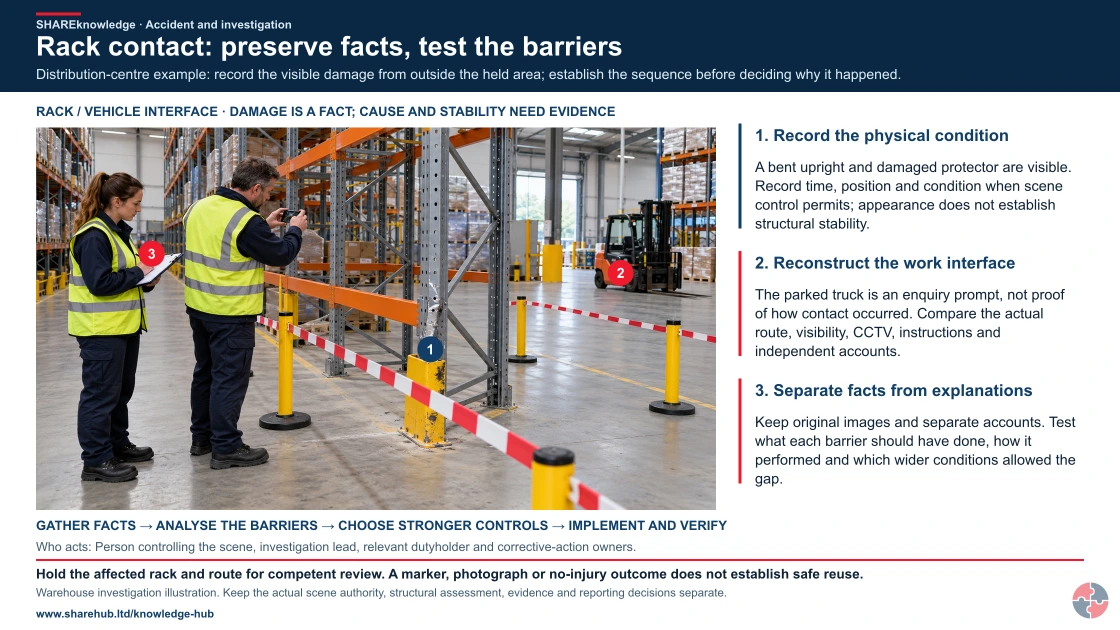
Rack contact: preserve facts, test the barriers
Full written explanation
A realistic HD distribution-centre scene shows a visibly bent empty-rack upright, a damaged yellow protector, a stationary forklift and two staff recording from outside an exclusion boundary. Native numbered callouts distinguish the physical damage from the event reconstruction and the testing of preventive barriers. A continuous four-stage investigation line connects factual information, analysis, control selection and implementation with verification. Neither a parked truck nor the picture establishes the cause, rack stability or safe reuse. Protecting people and competent structural/scene control precede routine evidence collection. The full original hazard-to-barrier-to-event analysis, stronger controls, source examples and responsible work-release conditions remain in the accessible written explanation.
Distribution-centre example: record the visible damage from outside the held area; establish the sequence before deciding why it happened.
- Record the physical condition. A bent upright and damaged protector are visible. Record time, position and condition when scene control permits; appearance does not establish structural stability.
- Reconstruct the work interface. The parked truck is an enquiry prompt, not proof of how contact occurred. Compare the actual route, visibility, CCTV, instructions and independent accounts.
- Separate facts from explanations. Keep original images and separate accounts. Test what each barrier should have done, how it performed and which wider conditions allowed the gap.
Change the pathway
- Protect life and the scene. Control continuing danger and obtain the required emergency help first.
- Build reliable explanations. Preserve fragile evidence, keep accounts independent and test alternative explanations.
- Check effective actions. Select stronger controls and verify their effect in representative work.
Evidence check: No injury does not establish low potential harm; a completed report does not prove the control works.
Read the full scene-control, evidence and hand-back examples
Primary references: HSE HSG245 investigation workbook and four-stage process (2004) · HSE maintenance: actual energy boundaries and competent work · HSE workplace transport: site, vehicle and driver interfaces · HSE conveyor guarding: belt and roller nip mechanism (quarry examples)
Open the complete HD image (new tab)Download image

Read the full scene-control, evidence and hand-back examples
Primary references: HSE HSG245 investigation workbook and four-stage process (2004) · HSE maintenance: actual energy boundaries and competent work · HSE workplace transport: site, vehicle and driver interfaces · HSE conveyor guarding: belt and roller nip mechanism (quarry examples)
Best-practice guide: Accident and investigation

Separate the first hour from the investigation
A safe scene comes before a complete evidence file. Once life safety permits, identify who controls the scene, preserve fragile evidence and keep witness accounts independent. Accident and incident investigation establishes what happened, how a hazard reached people, why controls failed and what must change.
Turn accident and investigation knowledge into a decision
Accident and incident investigation establishes what happened, how a hazard reached people, why controls failed and what must change. It begins with rescue and scene control, then uses evidence and worker accounts to choose and verify measures that prevent recurrence. Keep the near-miss report, original photos or CCTV, lift plan and changes, equipment and examination records, witness accounts, RIDDOR decision and reference if applicable, action owners, authorisation and effectiveness check.
A dropped load misses people on a shared site
Interview people separately and build a timeline from their accounts and physical evidence. Test equipment suitability, rigging, ground and load information, exclusion practice, supervision and earlier defects. Release only the work that a competent person has found safe, with a revised plan and briefing.
Task, exposure route, injury or ill-health, and intervention trigger
Yard delivery: moving or reversing vehicle: A pedestrian enters the vehicle path or is trapped against a fixed object; kinetic energy reaches the whole body. Construction lift: suspended or unstable load: A load or component falls or swings into people below or beside the lift. Manufacturing maintenance: moving machinery: A hand, clothing or body reaches a nip or moving part during a fault or cleaning intervention.
Choose controls for accident and investigation
Eliminate: Design deliveries so reversing is unnecessary, for example a workable one-way flow; remove unnecessary vehicle-pedestrian crossing points. Reduce: Where movement remains, reduce speed with a suitable low-speed layout, vehicle speed limiting or traffic calming. Isolate: Provide separate, convenient pedestrian paths and suitable physical barriers, with controlled crossing points. Control: Engineering: improve sightlines, lighting, mirrors, reversing aids and vehicle condition. PPE: Suitable high-visibility clothing can make a pedestrian easier to see when residual vehicle exposure remains; it does not physically prevent impact. Read the full control table for qualifications, ownership and verification. Use the actual task and applicable jurisdiction; existing technical approval remains unchanged.
Use the full accident and investigation lesson
Use the full topic for the decision points, practical examples, detailed control tables and source scope. HSE guidance applies to Great Britain; use HSENI for the Northern Ireland route and the source’s stated jurisdiction. A simplified guide does not change the page’s technical-review or approval status.

Read all six steps as text
1. Separate the first hour from the investigation
A safe scene comes before a complete evidence file.
- Avoid / redesign: Design deliveries so reversing is unnecessary, for example a workable one-way flow; remove unnecessary vehicle-pedestrian crossing points.
- Control the task: Provide separate, convenient pedestrian paths and suitable physical barriers, with controlled crossing points.
- Verify before release: A new route creates a blind turn or pushes vehicles into a public/worker area: redesign before release.
A safe scene comes before a complete evidence file. Once life safety permits, identify who controls the scene, preserve fragile evidence and keep witness accounts independent. Accident and incident investigation establishes what happened, how a hazard reached people, why controls failed and what must change.
Apply it: Which part of this plan would you check at the workface before authorising the task?
2. Turn accident and investigation knowledge into a decision
Use the evidence to improve the actual work arrangement.
- Change at source: Design deliveries so reversing is unnecessary, for example a workable one-way flow; remove unnecessary vehicle-pedestrian crossing points.
- Make it observable: A new route creates a blind turn or pushes vehicles into a public/worker area: redesign before release.
- Keep useful evidence: Keep the near-miss report, original photos or CCTV, lift plan and changes, equipment and examination records, witness accounts, RIDDOR decision and reference if applicable, action owners, authorisation and effectiveness check.
Accident and incident investigation establishes what happened, how a hazard reached people, why controls failed and what must change. It begins with rescue and scene control, then uses evidence and worker accounts to choose and verify measures that prevent recurrence. Keep the near-miss report, original photos or CCTV, lift plan and changes, equipment and examination records, witness accounts, RIDDOR decision and reference if applicable, action owners, authorisation and effectiveness check.
Apply it: What evidence would show that the change improves this task, rather than only completing a record?
3. A dropped load misses people on a shared site
Example: a practical application of the existing topic lesson.
- Setting: A contractor's lift drops a load into a segregated construction bay; nobody is struck, but workers and a visiting delivery driver were close enough for a credible fatal outcome.
- Act: Stop the lift and nearby work, account for people, and make the suspended or unstable load safe through the competent lifting team.
- Hold / review: The local lifting and site leads hold any restart until the equipment and method are checked, interim controls are in place and the investigation owner has recorded the reporting decision.
Interview people separately and build a timeline from their accounts and physical evidence. Test equipment suitability, rigging, ground and load information, exclusion practice, supervision and earlier defects. Release only the work that a competent person has found safe, with a revised plan and briefing.
Apply it: At which point would you hold this example, and what evidence would allow it to proceed?
4. Task, exposure route, injury or ill-health, and intervention trigger
Connect the task, the route to the person and the control that can fail.
- Yard delivery: moving or reversing vehicle: A pedestrian enters the vehicle path or is trapped against a fixed object; kinetic energy reaches the whole body.
- Construction lift: suspended or unstable load: A load or component falls or swings into people below or beside the lift.
- Manufacturing maintenance: moving machinery: A hand, clothing or body reaches a nip or moving part during a fault or cleaning intervention.
Yard delivery: moving or reversing vehicle: A pedestrian enters the vehicle path or is trapped against a fixed object; kinetic energy reaches the whole body. Construction lift: suspended or unstable load: A load or component falls or swings into people below or beside the lift. Manufacturing maintenance: moving machinery: A hand, clothing or body reaches a nip or moving part during a fault or cleaning intervention.
Apply it: Who could be exposed, including other trades, cleaners, maintainers and people nearby?
5. Choose controls for accident and investigation
Start with the stronger practicable options and verify their effect.
- Eliminate: Design deliveries so reversing is unnecessary, for example a workable one-way flow; remove unnecessary vehicle-pedestrian crossing points.
- Reduce: Where movement remains, reduce speed with a suitable low-speed layout, vehicle speed limiting or traffic calming.
- Isolate: Provide separate, convenient pedestrian paths and suitable physical barriers, with controlled crossing points.
- Control: Engineering: improve sightlines, lighting, mirrors, reversing aids and vehicle condition.
- PPE: Suitable high-visibility clothing can make a pedestrian easier to see when residual vehicle exposure remains; it does not physically prevent impact.
Eliminate: Design deliveries so reversing is unnecessary, for example a workable one-way flow; remove unnecessary vehicle-pedestrian crossing points. Reduce: Where movement remains, reduce speed with a suitable low-speed layout, vehicle speed limiting or traffic calming. Isolate: Provide separate, convenient pedestrian paths and suitable physical barriers, with controlled crossing points. Control: Engineering: improve sightlines, lighting, mirrors, reversing aids and vehicle condition. PPE: Suitable high-visibility clothing can make a pedestrian easier to see when residual vehicle exposure remains; it does not physically prevent impact. Read the full control table for qualifications, ownership and verification. Use the actual task and applicable jurisdiction; existing technical approval remains unchanged.
Apply it: Which stronger option can be used here, and who will verify it before accepting the remaining risk?
6. Use the full accident and investigation lesson
Follow the official sources below and retain the task-specific evidence.
- Official guidance: HSE HSG245 Investigating accidents and incidents (HSG245, published 2004; live publication page checked 2026-09-25)
- Official guidance: HSE INDG453 Reporting accidents and incidents at work (INDG453 rev1, October 2013)
- Task decision: Keep the near-miss report, original photos or CCTV, lift plan and changes, equipment and examination records, witness accounts, RIDDOR decision and reference if applicable, action owners, authorisation and effectiveness check.
Use the full topic for the decision points, practical examples, detailed control tables and source scope. HSE guidance applies to Great Britain; use HSENI for the Northern Ireland route and the source’s stated jurisdiction. A simplified guide does not change the page’s technical-review or approval status.
Apply it: Which official source and full-topic section will you use to resolve the next decision?
Choose investigation depth using credible potential harm as well as the actual outcome. Internal recording, learning and statutory reporting are separate decisions: use the applicable reporting route rather than assume every investigation creates the same legal report. Close actions only after the changed control has worked in the real task.
A dropped load with no injury
Illustrative example. A contractor load falls inside a construction bay; nearby workers and a visiting driver were within a credible strike area.
Decision. Keep lifting stopped, establish scene ownership and investigate both lifting failure and the ineffective exclusion arrangement.
Evidence to check. Preserve lifting plans, equipment condition, photographs and separate accounts; compare the planned bay with actual access.
Hold or escalation point. No reconstruction or restart while scene control, equipment integrity or the revised exclusion is unresolved.
Follow-up. Test the revised delivery and lifting interface on a representative lift and record what the sample does not establish.
What is the difference between an accident, incident, near miss and dangerous occurrence?
These terms describe different kinds of adverse event, but all of them can reveal weaknesses in workplace controls.
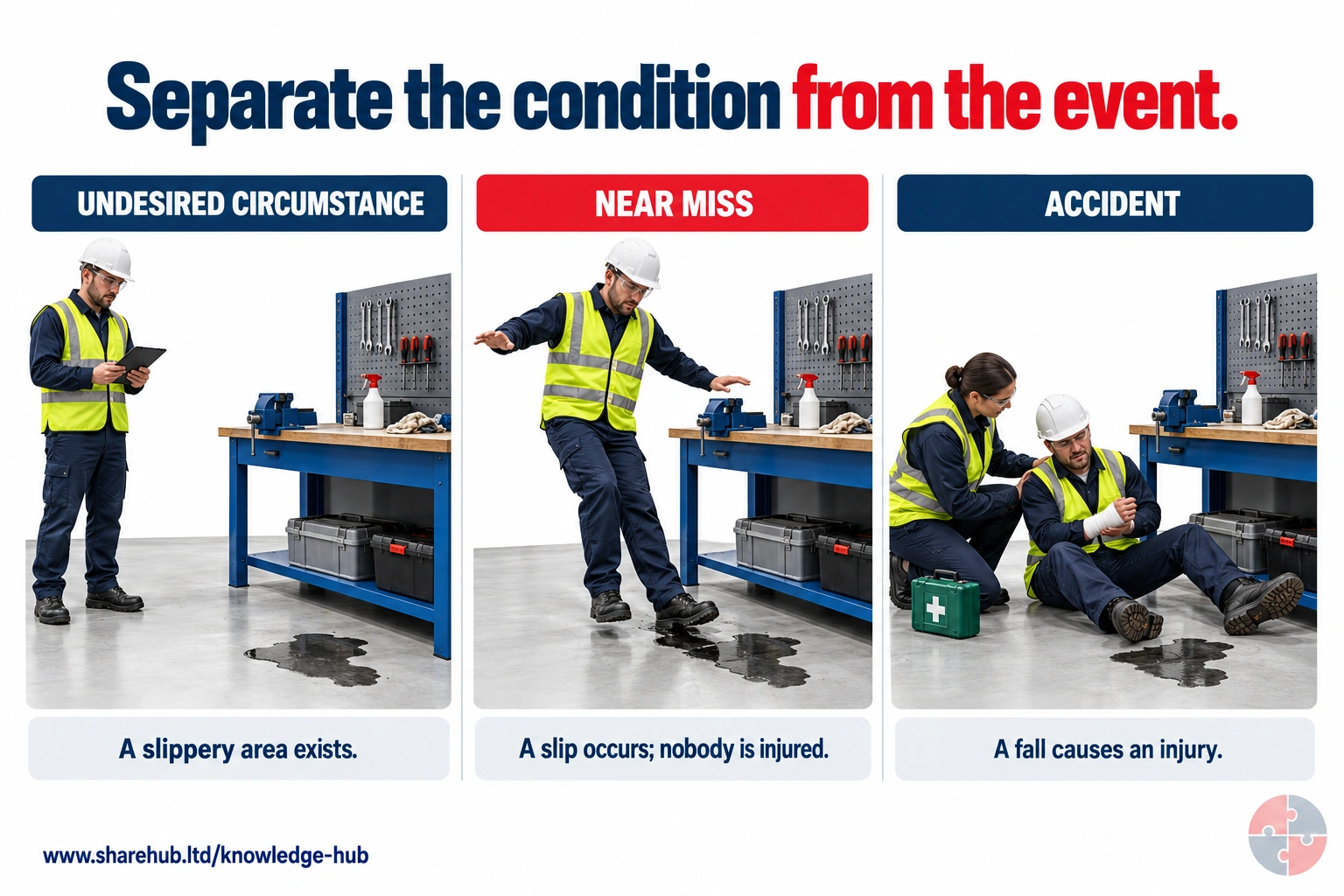

The panels compare a slippery condition before a slip, a slip without injury and a fall causing injury. These are alternative observations, not an inevitable sequence. HSG245 includes undesired circumstances as well as near misses and accidents within its investigation framework.
Which panel shows the hazardous condition before a slip occurs?
The left panel: the oil makes the floor slippery before anyone slips. It is the undesired circumstance; the middle panel adds an event without injury.
Uses the HSG245 investigation terminology. Organisational definitions can vary; whether an event is reportable under current RIDDOR is a separate decision.
Source guidance: HSE HSG245
Many organisations use incident as the broad term because the word accident can imply that the event was unavoidable. What matters is not the label alone, but the learning potential: a minor injury, a high-potential near miss and a dangerous occurrence may all point to the same failing barrier.
The first triage decision should consider actual harm and potential harm. A dropped object that misses someone by a metre may deserve a deeper investigation than a minor cut if the realistic outcome could have been fatal. Good reporting systems therefore capture near misses, unsafe conditions, property damage, environmental releases and work-related ill health as well as injuries.
| Term | Plain-English meaning | How it should influence the response |
|---|---|---|
| Accident | An unintended event that results in injury, ill health, damage, loss or environmental harm. | Treat the event as evidence that one or more controls failed, were missing or were not strong enough. |
| Incident | A broad term often used for any undesired work-related event, including accidents, near misses and dangerous occurrences. | Use it to encourage reporting without suggesting the event was inevitable or harmless. |
| Near miss | An event that did not cause harm on this occasion but had the potential to do so. | Investigate high-potential near misses seriously because luck should not be accepted as a control measure. |
| Dangerous occurrence | A specified near-miss event that may be reportable under RIDDOR. | Check the RIDDOR criteria, preserve evidence and escalate quickly where the event indicates serious failure. |
| Immediate cause | The direct condition, act or failure closest to the event. | Record it, but do not stop the investigation there. |
| Underlying or root cause | A deeper system weakness that allowed the immediate cause to exist. | Use it to select actions that change the system rather than only reminding people to be careful. |
How should an incident be categorised and reviewed?
Start with what is known. Record the type of event, its actual consequences and any reporting duties separately. One event can have several labels. These labels help organise the record; credible potential harm and recurrence still guide investigation depth and the team needed.
This is not an exhaustive list. Categories can overlap and may change as the investigation unfolds: new evidence, a diagnosis, treatment, time away from normal duties or environmental effects can change the picture. Record the initial category and each revision, with the date, reason and supporting evidence. Review protective action and reporting promptly as facts emerge; do not wait for the final investigation report.
What happened?
- Incident
- In this guide, a broad label for an unplanned work event, including a near miss, an accident or an event causing other loss. Terminology varies: HSG245 uses adverse event as its umbrella term and distinguishes accidents from incidents. Check the definitions used in your organisation.
- Near miss
- An event that caused no injury or ill health but had the potential to do so, such as a falling tool narrowly missing a person. No injury does not mean low investigation priority.
- Accident
- An unintended event causing injury or ill health. For RIDDOR accident reporting, check the narrower requirement for an identifiable event causing physical injury; gradual exposure is considered through the relevant ill-health route.
- Property damage
- Damage to a building, vehicle, equipment, materials or other property, whether or not anyone is injured. A vehicle striking an empty storage rack may also reveal serious potential for injury.
- Environmental incident
- A spill, release or other event that harms, or threatens to harm, water, land, air or wildlife. Assess containment, impact and the correct environmental reporting route for the UK nation and incident; a RIDDOR check does not replace this.
- Occupational ill health
- A health condition caused or made worse by work, including conditions that develop over time. Obtain appropriate clinical advice and check whether a diagnosed condition meets the relevant statutory reporting criteria.
What was the outcome for the person?
First-aid, medical-treatment, restricted-duty and lost-time labels are common internal performance measures. Apply your organisation’s written definitions consistently; they are not interchangeable with statutory RIDDOR categories.
- First-aid case
- An injury managed with first-aid care only under the organisation’s classification, for example a minor cut initially cleaned and dressed. Review the label if the diagnosis or care changes.
- Medical-treatment case
- An injury requiring treatment beyond the first-aid boundary in the organisation’s scheme. Attendance at a clinic or hospital alone does not establish this label or whether an event is RIDDOR-reportable.
- Restricted-duty case
- A person remains at work or returns to work but cannot perform their normal duties because of the injury. Record the actual restrictions and dates; being present at work does not rule out statutory incapacity.
- Lost-time injury (LTI)
- A work-related injury resulting in time away from work under the organisation’s lost-time definition. Record absence and inability to perform normal duties accurately. An internal LTI count is not itself a RIDDOR decision.
- Fatality
- An event resulting in a person’s death. Activate the emergency response and urgent escalation arrangements, preserve evidence when safe and have the responsible person check statutory notification duties immediately.
Does a statutory reporting category apply?
- RIDDOR-reportable event
- An event meeting the applicable Reporting of Injuries, Diseases and Dangerous Occurrences Regulations. Relevant categories include work-related deaths, specified injuries in Great Britain (major injuries in Northern Ireland), qualifying incapacity, certain diagnosed occupational diseases and listed dangerous occurrences. The responsible person checks the criteria and reporting deadline; not every workplace event is reportable.
- Over-three-day injury / incapacity
- Great Britain: more than 3 consecutive days away from work or unable to do normal duties triggers recording; this threshold alone does not require a RIDDOR report. Northern Ireland retains an over-three-day reporting threshold for qualifying work-related injuries. Check the applicable jurisdiction rather than using the GB threshold in NI.
- Over-seven-day injury / incapacity
- Great Britain: a work-related accident causing a worker to be away from work or unable to do normal duties for more than 7 consecutive days is reportable. Exclude the accident day and include weekends and rest days. HSE states a 15-day reporting deadline. Northern Ireland uses its separate over-three-day rules.
- Dangerous occurrence
- A particular event listed in the applicable RIDDOR regulations that may need reporting even without injury, such as some equipment failures. A near miss is not automatically a statutory dangerous occurrence; check the listed conditions.
How to make and review the classification
- Protect people and identify the event. Arrange care, control continuing danger and preserve evidence when safe. Record what happened and when, who or what was affected, and what is still uncertain. A category label must never delay the response.
- Record several dimensions separately. Describe the event type, actual injury or loss, treatment and normal-duty restrictions, environmental effects and credible potential harm. Keep the investigation-depth decision separate from injury statistics and the statutory reporting decision.
- Check the correct reporting route. Identify the UK jurisdiction, work-relatedness, the person’s work status and the applicable reportable category. Ask the responsible person to check current criteria, exclusions and deadlines. Check environmental, sector and permit reporting separately where relevant.
- Keep the classification live. Review after new evidence, clinical information, changes in treatment or normal-duty incapacity, and emerging damage or pollution. Retain the original entry and add a dated revision showing the evidence, reason, decision-maker and any reporting update. Do not erase the history or wait for investigation closure.
Count incapacity and check the reporting deadline
Great Britain: count incapacity, not just shifts missed
For the over-seven-day test, count consecutive days during which the injury prevents normal work. Exclude the accident day; include weekends and rest days. Restricted duties can count even when the person attends work. More than seven means at least eight consecutive days. Do not wait for that threshold if a different reportable category already applies.
Recording and reporting are different decisions
In GB, over-three-day incapacity requires a record; that duration alone does not trigger a RIDDOR report. The GB over-seven-day category has a 15-day reporting deadline. Other reportable events can require notification without delay. Northern Ireland retains its separate over-three-day reporting rule; use HSENI guidance rather than copying GB thresholds or deadlines.
First aid can become a different injury outcome
Example: a worker receives first aid after a vehicle clips a storage rack. Record the accident, property damage and provisional first-aid outcome, alongside the credible potential for a rack collapse.
Later treatment or a diagnosis may change the internal injury category. Track actual normal-duty incapacity, including restricted work, and review reportability under the correct jurisdiction. A later revision does not make the initial entry disappear, and severe potential still warrants an appropriate inquiry.
One event can be both damage and an environmental incident
Example: a vehicle damages a pipe and liquid reaches a surface-water drain. There may be property damage and an environmental incident even if nobody is injured.
Identify the substance, route and known or possible effects through competent arrangements. Check the correct national environmental reporting route and any relevant permit requirements. A RIDDOR decision and an environmental notification are separate checks; do not assume one replaces the other.
What should the classification record contain?
- A stable incident reference, event date/time/location, known facts and immediate protective actions.
- The event labels, actual outcome, credible potential and relevant organisational definitions; mark provisional judgements clearly.
- Treatment and inability to do normal duties, with relevant dates. Keep only necessary health information in the investigation record and use authorised restricted arrangements for clinical details.
- The jurisdiction, responsible person, reporting decision and rationale, deadline, report reference and any later update.
- Each change of category: previous and revised label, new evidence, who made the decision, when it was made and the next review trigger.
Current official definitions and reporting guidance
Reporting sources checked 2026-11-01. Check current criteria and deadlines for the event and jurisdiction. HSG245 supplies investigation terminology and method; its historical reporting references are not the current reporting test.
Why should accidents, incidents and near misses be investigated?
Investigation prevents repeat harm by turning an unwanted event into evidence, learning and stronger controls.
The best investigations are not paperwork exercises carried out after the real work has moved on. They are part of risk management. They test whether the risk assessment matched the real task, whether supervision and competence were sufficient, whether equipment and workplace conditions were suitable, and whether earlier warning signs were missed.
Investigation also protects trust. Workers are more likely to report near misses and speak openly when they see that investigations are fair, factual and aimed at improving the work system. Where the process feels like blame, people hide weak signals and the organisation loses the chance to learn while the consequences are still small.
For serious events, investigation sits alongside legal reporting, regulator contact, victim and family communication, insurance, employment processes and possible criminal or civil proceedings. That is why the process must be controlled, documented and competent from the start.
How can I practise this topic in 3D?
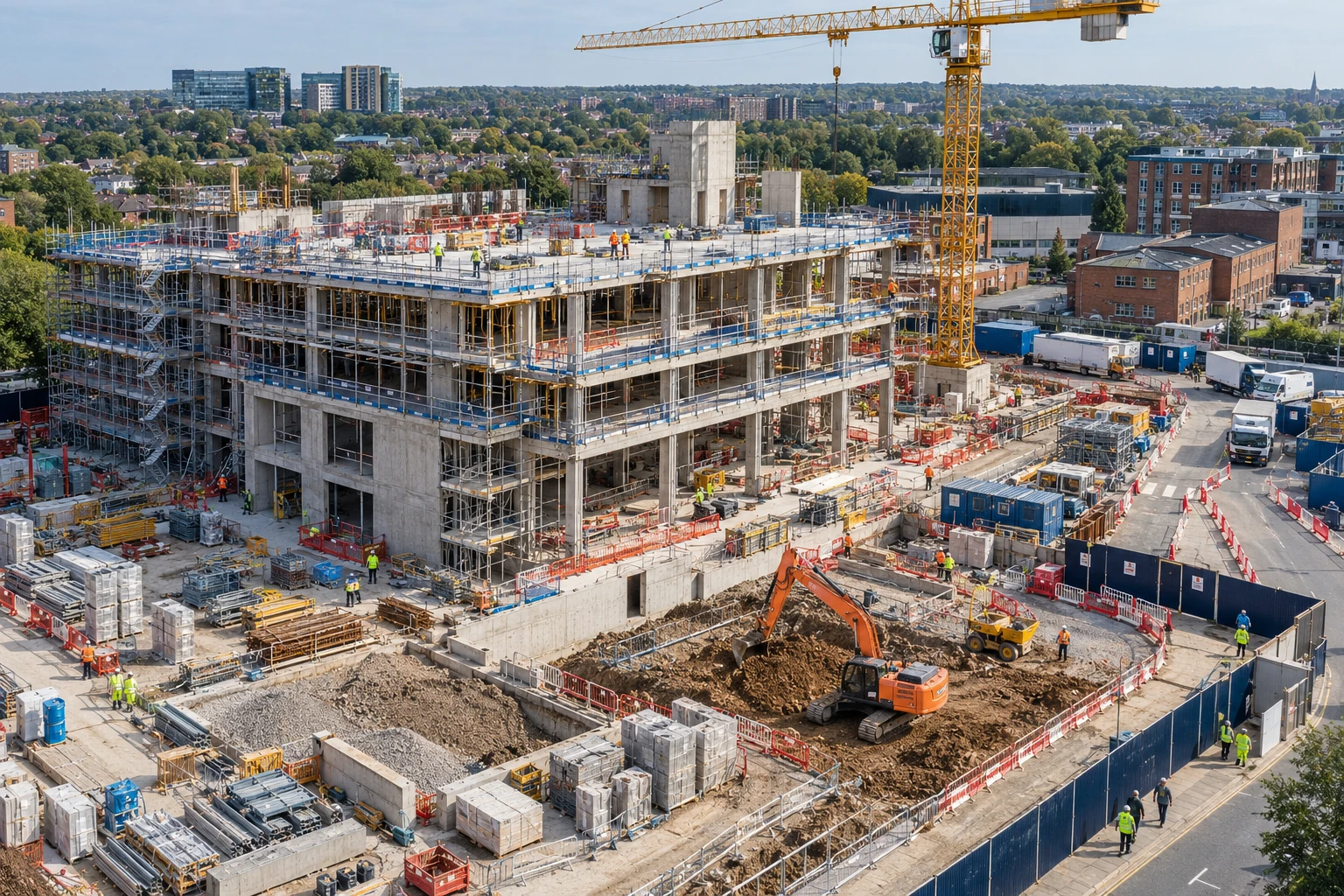

An injury is recorded but no one learns from it
All related inspection points 1 across 1 location
Construction site 1 inspection point
Practice in the SHAREhub environment. Browser practice is separate from workplace competence and formal learning records.
How does HSG245 structure a good investigation?
HSG245 uses four practical stages: gather information, analyse it, identify risk controls and implement an action plan.
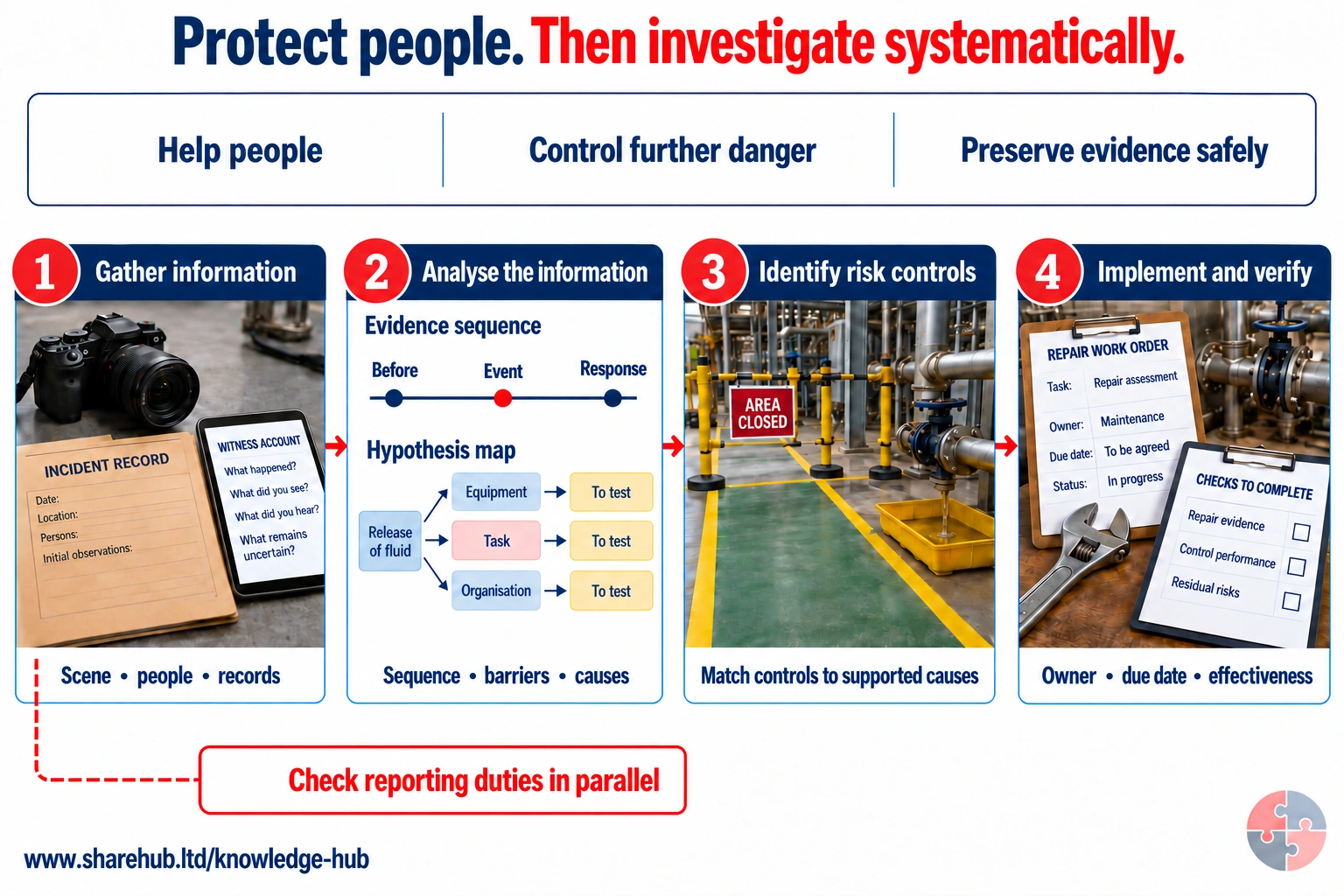

Emergency help and preventing further harm take priority. Preserve the scene and fragile records as safely as the circumstances allow, documenting any necessary changes. Then gather information, analyse it, identify risk controls and implement the action plan. Revisit earlier stages when new evidence changes the picture. Reporting duties run alongside the investigation; do not wait for a final causal report before checking the applicable route and timescale.
The response comes first
Arrange the appropriate emergency help, prevent further harm and support the people affected. Preserve evidence only as safely as the situation permits. If rescue or making safe changes the scene, record what changed and why when practicable. Do not recreate an unsafe event to make a convincing photograph or demonstrate an injury mechanism.
Use all four investigation stages
Gather information from the scene, people, records and technical examination. Analyse the sequence, compare intended controls with actual conditions and test the causal explanations. Identify controls that address supported causes. Implement the action plan, check completion and test effectiveness. New evidence may require the team to return to an earlier stage.
Set a proportionate enquiry
Consider credible potential harm, recurrence, similar events and the opportunity to learn, not only the injury on this occasion. Include people who understand the work, worker representatives where appropriate and the necessary technical skills. Give the team authority, time and a clear scope. Support witnesses and injured people; collecting a form is not the same as a respectful interview.
Keep reporting separate
Check the current reporting duties and jurisdiction alongside the response. The HSG245 framework is investigation guidance, published in 2004; its historical reporting detail must not be used as a current deadline guide. Use the relevant current Great Britain or Northern Ireland reporting source. An internal investigation neither replaces a required report nor waits for that report to create learning.
Does completing an incident form finish the investigation?
No. A form records information. The investigation must still test the sequence and causes, select controls, implement them and check effectiveness.
A teaching adaptation of HSG245's four stages. It is not an emergency procedure or statutory reporting decision tool; use the applicable current Great Britain or Northern Ireland requirements.
Source guidance: HSE HSG245 · HSE guidance
The value of the HSG245 model is its simplicity. It stops an investigation from becoming either a blame conversation or a disconnected form. The investigator first builds a factual picture, then analyses causes, then chooses controls, then makes sure the action plan is implemented.
This is also a useful teaching structure. A new supervisor can use it to organise a local review, while a competent investigation team can apply the same four stages to a serious event with more evidence, technical input and senior oversight.
| HSG245 stage | What it means in practice | Evidence or output |
|---|---|---|
| Step 1: gather the information | Build the factual picture before judging causes. Capture what happened, where and when it happened, who was involved, what work was being done, what equipment or substances were involved, what conditions existed and what immediate action was taken. | Scene photographs, sketches, measurements, witness accounts, injured-person account where appropriate, permits, risk assessments, maintenance records, training records, CCTV, alarms, shift logs and first aid records. |
| Step 2: analyse the information | Look for immediate, underlying and root causes. Compare accounts with physical evidence, test assumptions and ask why the existing risk controls did not prevent the event. | Timeline analysis, cause analysis, human factors review, barrier analysis and comparison with risk assessments, procedures, HSE guidance, industry standards and normal work as done. |
| Step 3: identify risk control measures | Decide what must change to prevent recurrence. Actions should address immediate causes, underlying causes and root causes rather than only repairing damage or reminding people to take care. | Elimination, design change, guarding, segregation, isolation, engineering control, safer equipment, maintenance improvement, supervision, competence, communication and emergency response improvements. |
| Step 4: action plan and implementation | Turn findings into owned, prioritised, resourced and time-bound actions. Implementation must be tracked and verified so the organisation knows the risk has actually reduced. | Action owner, due date, priority, interim controls, completion evidence, effectiveness check, communication plan, review of similar work and management review. |
How can the hierarchy of controls turn incident findings into stronger risk controls?
Start with the actual energy or exposure source, the route to a person and the tissue or body system affected. Then choose a control that blocks that route and check it during real work before closing the action.
Jam clearing: test the energy and access barriers
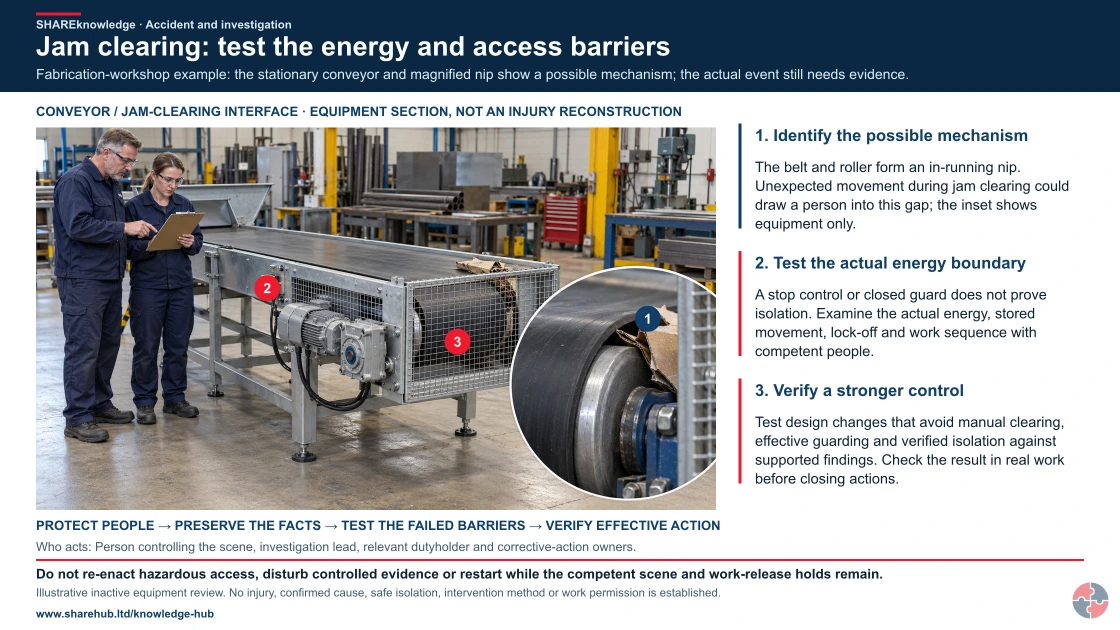
Full written explanation
A realistic HD British fabrication-workshop illustration shows a stationary belt conveyor with a closed mesh end/drive guard, connected motor and visible normal stop control. Two staff review records outside the closed guard without touching controls or reaching into the machine. A magnified conceptual equipment section shows the converging belt/roller gap and trapped material; no hand, injured person or clinical anatomy is depicted. Native labels connect the possible in-running nip mechanism, the unproven actual isolation boundary and stronger corrective actions. The investigation sequence runs across the complete landscape image. The image reconstructs no actual injury or established cause and demonstrates no isolation procedure, safe access or restart. Keep independent accounts, actual equipment/energy records, competent scene control, the original full four-step investigation, reporting decision and work-release holds in the accessible alternative.
Fabrication-workshop example: the stationary conveyor and magnified nip show a possible mechanism; the actual event still needs evidence.
- Make the scene safe. Prioritise people and continuing danger; establish who controls the scene.
- Preserve facts. Record time, positions and condition when safe; keep witness accounts independent.
- Test the causes. Separate fact from assumption, compare evidence and identify immediate and wider control failures.
- Verify the corrective action. Assign an owner, strengthen controls and check the actual result before closing actions.
When the evidence does not fit: Do not restart hazardous work, discard failed parts or disturb controlled evidence without the appropriate authority. Check reporting duties promptly; the investigation need not be finished first.
Who acts: Person controlling the scene, investigation lead, relevant dutyholder and corrective-action owners.
Changed workplace
Distribution centre: A rack contact with no reported injury still needs a safe exclusion boundary and competent structural assessment.
Fabrication workshop: A jam-clearing injury requires the actual isolation and work sequence to be tested, without assuming a cause from the outcome.
Evidence check: No injury does not establish low potential harm; a completed report does not prove the control works.
Read the full scene-control, evidence and hand-back examples
Primary references: HSE HSG245 investigation workbook and four-stage process (2004) · HSE maintenance: actual energy boundaries and competent work · HSE workplace transport: site, vehicle and driver interfaces · HSE conveyor guarding: belt and roller nip mechanism (quarry examples)
Open the complete HD image (new tab)Download image

Read the full scene-control, evidence and hand-back examples
Primary references: HSE HSG245 investigation workbook and four-stage process (2004) · HSE maintenance: actual energy boundaries and competent work · HSE workplace transport: site, vehicle and driver interfaces · HSE conveyor guarding: belt and roller nip mechanism (quarry examples)
An incident report describes the event; it does not by itself identify the failed barrier. A vehicle may transfer force to the whole body, a falling load may strike the head or torso, a moving machine may draw in a limb, and a substance may enter the lungs or contact skin. Whether harm is immediate or develops later depends on the task, substance, intensity, duration and conditions. Capture those facts without assuming a diagnosis or treating the injured person as the hazard.
What actually causes harm in the events we investigate?
Suppose a reversing vehicle strikes a pedestrian in a delivery yard. Investigation first protects the person and the scene, then tests the complete harm chain: vehicle movement, a shared route, visibility and the failed decision point. The corrective-action owner should ask whether the pedestrian movement or reversing manoeuvre can be eliminated by redesigning the delivery route. A one-way traffic flow or different unloading position may substitute for the hazardous manoeuvre; physical kerbs, gates or segregated walkways are engineering separation. These map to ERICPD Eliminate, Reduce and Isolate. Paint, signs and a banksman are administrative layers, and high-visibility clothing is residual PPE, not a substitute for separation.
The site manager records the selected layout, vehicle and pedestrian flow trial, commissioning walk-through, worker feedback and a dated effectiveness check. The investigator tests whether the barrier actually prevents the original crossing at busy times and whether contractor deliveries follow the same route. ERICPD Discipline means maintaining the layout and reviewing new near misses, not finding an individual to blame. If a gate is bypassed, a new delivery pattern defeats the layout or visibility remains poor, hold the affected movement and reopen the risk decision before declaring the action closed. Reporting duties and the investigation are separate decisions: neither should wait for the other.
| Task and source | Route to the person | Likely harm and what changes risk | Early sign; stop or escalate |
|---|---|---|---|
| Yard delivery: moving or reversing vehicle | A pedestrian enters the vehicle path or is trapped against a fixed object; kinetic energy reaches the whole body. | Impact or crush injury may fracture limbs, injure the head or be fatal. Poor sightlines, changing routes, reversing and mixed traffic increase risk. | Missing barrier, near miss, blind corner or uncontrolled reversal: stop movements and protect the route. |
| Construction lift: suspended or unstable load | A load or component falls or swings into people below or beside the lift. | High-energy impact or crushing may cause multiple serious injuries or death. Load stability, lifting gear, wind and exclusion integrity matter. | Unclear load weight, damaged sling, lost exclusion or unexpected movement: stop the lift; competent team makes it safe. |
| Manufacturing maintenance: moving machinery | A hand, clothing or body reaches a nip or moving part during a fault or cleaning intervention. | Draw-in, shearing or crushing can cause severe hand or limb injury. Unexpected restart and defeated guards increase risk. | Missing guard, failed interlock or uncertain isolation: stop and lock off before access; obtain competent help. |
| Hospitality kitchen: wet or greasy floor | A foot loses grip and the person falls, possibly against hot or sharp equipment. | Sprain or fracture is plausible; a fall onto a hot or sharp surface may add burns or cuts. Busy service and repeated leaks increase risk. | Spill, recurring leak or unsafe cleaning route: keep people out, clean and dry, then check the floor. |
| Unknown release or repeated hazardous-substance exposure | Vapour, fume or dust is breathed in; liquid may contact skin or eyes. The actual route depends on the substance and task. | Immediate eye or airway irritation is possible; some substances can cause later asthma, dermatitis or lung disease. Do not assign a diagnosis without the product identity and exposure evidence. | Unidentified substance, symptoms, ineffective extraction or missing safety data: isolate the area, use the emergency plan and seek specialist assessment. |
For the yard example, plan controls in the six ERICPD planning stages. HSE's general hierarchy groups elimination, substitution, engineering, administration and PPE; ERICPD separates physical isolation and the discipline that keeps an agreed safe system working. The framework is a planning aid, not a statute. Use it on the actual risk; no single level guarantees safety.
ERICPD applied to a yard vehicle strike
How can the ERICPD hierarchy of controls turn incident findings into stronger risk controls?

| ERICPD level | Concrete control and break in the harm chain | Owner and check | Failure or limit |
|---|---|---|---|
| Eliminate | Design deliveries so reversing is unnecessary, for example a workable one-way flow; remove unnecessary vehicle-pedestrian crossing points. This removes the interaction or manoeuvre at source. | Site/transport lead tests the whole route with drivers, pedestrians and deliveries. | A new route creates a blind turn or pushes vehicles into a public/worker area: redesign before release. |
| Reduce / substitute | Where movement remains, reduce speed with a suitable low-speed layout, vehicle speed limiting or traffic calming. Substitute a safer delivery method only when the task and site assessment support it; this reduces collision energy but does not remove the strike route. | Fleet and site leads check vehicle suitability, speed controls and the changed task. | Speed signs alone or a smaller vehicle that still shares the footway leave the collision pathway open. |
| Isolate | Provide separate, convenient pedestrian paths and suitable physical barriers, with controlled crossing points. Separation stops vehicle energy reaching a person. | Site lead inspects barriers, crossings, doors and delivery-driver route during real use. | Open gates, broken barriers, detours or people forced onto the road: hold the route and repair. |
| Control | Engineering: improve sightlines, lighting, mirrors, reversing aids and vehicle condition. Administrative: schedule movements, use a safe system and a trained signaller only where needed. These reduce conflict but depend on design and use. | Transport lead verifies equipment and observes a complete delivery cycle. | Failed aid, obscured view or signaller placed in the vehicle path: stop, fix the design and re-check. |
| PPE | Suitable high-visibility clothing can make a pedestrian easier to see when residual vehicle exposure remains; it does not physically prevent impact. | Supervisor checks issue, condition and use only after higher controls are in place. | Do not reopen a mixed route because people wear high visibility clothing. |
| Discipline | Induct drivers and pedestrians, supervise the agreed route, report near misses and follow through on defects. This sustains the system; it is not blame or a substitute for segregation. | Manager reviews observations, near misses and corrective-action effectiveness. | Repeated shortcuts or missed reports show the route may be impractical: revisit the design rather than repeat a reminder. |
How can the ISO 45001 hierarchy of controls turn incident findings into stronger risk controls?

| ESEAP control level | Concrete control and break in the harm chain | Owner and check | Failure or limit |
|---|---|---|---|
| Elimination | Design deliveries so reversing is unnecessary, for example a workable one-way flow; remove unnecessary vehicle-pedestrian crossing points. This removes the interaction or manoeuvre at source. | Site/transport lead tests the whole route with drivers, pedestrians and deliveries. | A new route creates a blind turn or pushes vehicles into a public/worker area: redesign before release. |
| Engineering controls / Administrative controls | Where movement remains, reduce speed with a suitable low-speed layout, vehicle speed limiting or traffic calming. Substitute a safer delivery method only when the task and site assessment support it; this reduces collision energy but does not remove the strike route. | Fleet and site leads check vehicle suitability, speed controls and the changed task. | Speed signs alone or a smaller vehicle that still shares the footway leave the collision pathway open. |
| Engineering controls | Provide separate, convenient pedestrian paths and suitable physical barriers, with controlled crossing points. Separation stops vehicle energy reaching a person. | Site lead inspects barriers, crossings, doors and delivery-driver route during real use. | Open gates, broken barriers, detours or people forced onto the road: hold the route and repair. |
| Engineering controls / Administrative controls | Engineering: improve sightlines, lighting, mirrors, reversing aids and vehicle condition. Administrative: schedule movements, use a safe system and a trained signaller only where needed. These reduce conflict but depend on design and use. | Transport lead verifies equipment and observes a complete delivery cycle. | Failed aid, obscured view or signaller placed in the vehicle path: stop, fix the design and re-check. |
| PPE | Suitable high-visibility clothing can make a pedestrian easier to see when residual vehicle exposure remains; it does not physically prevent impact. | Supervisor checks issue, condition and use only after higher controls are in place. | Do not reopen a mixed route because people wear high visibility clothing. |
| Administrative controls | Induct drivers and pedestrians, supervise the agreed route, report near misses and follow through on defects. This sustains the system; it is not blame or a substitute for segregation. | Manager reviews observations, near misses and corrective-action effectiveness. | Repeated shortcuts or missed reports show the route may be impractical: revisit the design rather than repeat a reminder. |
The strongest available control can differ by task. A protective barrier can create a new blind spot or obstruct emergency access; a one-way delivery route can shift conflict to another entrance; isolation can introduce stored-energy hazards if it is incomplete. Test the full change with workers and contractors, record who owns it, and reopen the action if real work exposes a failure. PPE and reminders alone do not justify reopening a route that can be physically segregated.
How does the investigation transfer across sectors?
| Sector; task and people | Mechanism and likely outcome | Strongest feasible controls; residual safeguard | Check or stop point |
|---|---|---|---|
| Manufacturing: technician clears a conveyor jam | Unexpected movement draws a hand into a nip; severe crush or amputation is possible. | Eliminate avoidable manual clearing through design; isolate/lock off energy and maintain effective guarding. Competent intervention procedure and supervision remain. | Missing guard, uncertain isolation or unexpected motion: stop; verify lock-off and guard before restart. |
| Construction: contractor lifts materials over shared work | Dropped or swinging load strikes workers or a delivery driver; serious impact or fatal injury is possible. | Plan to avoid lifting over people; use suitable equipment and a physical exclusion with competent lift supervision. Brief changing site interfaces. | Damaged gear, unstable load or broken exclusion: stop; competent lifting lead verifies the revised lift. |
| Hospitality: kitchen team serves beside a leaking wash area | Water or grease reduces shoe grip; a worker slips, with fall injury and possible hot-surface contact. | Eliminate the leak and choose effective drainage/floor condition; isolate the spill until cleaned and dry. Suitable footwear and prompt reporting support this. | Recurring contamination or floor still slippery after cleaning: hold access and repair the source. |
| Logistics: driver unloads in a shared yard | A reversing vehicle or lift truck meets a pedestrian; crush injury or death is possible. | Eliminate unnecessary reversing and separate the pedestrian route with barriers. Use suitable vehicle aids, controlled crossings and driver induction for residual risk. | Temporary detour, failed barrier or uncontrolled reversing: stop movements; check the route during an actual delivery. |
These sector examples are investigation prompts. For a real event, check the task-specific risk assessment, product or equipment instructions, current GB or Northern Ireland law and the relevant regulator. The HSE transport, lifting, machinery, catering slip and COSHH pages provide task-specific GB guidance; NI duty and reporting decisions must be checked separately.
What should the step-by-step accident investigation process look like?
A good investigation follows a clear sequence from making the situation safe through to verified learning.
The steps below are deliberately practical. They are suitable for a supervisor investigating a high-potential near miss, a manager investigating a lost-time injury, or a safety adviser supporting a serious event. The depth changes with the event, but the logic remains the same.
The most common weakness is jumping straight from the event to a favourite solution. A strong process slows the team down just enough to protect evidence, understand the work as it really happened, and select actions that deal with causes rather than symptoms.
First make the area safe and record a time-stamped initial account. Then decide who owns the investigation and any urgent reporting decision. Gather accounts, photographs, plans, permits, equipment data and changed conditions before they disappear. Reconstruct the sequence, test possible causes against evidence, choose stronger controls, and verify them at the workface before closure.
Keep the internal investigation and statutory report as related but separate decisions. A reportable event still needs learning; a non-reportable high-potential near miss may warrant a detailed investigation.
How should the investigation response change in real situations?
Match the response to actual and potential harm, but always put rescue and control first, protect fragile evidence, set a competent hold point and record the reason for restart.
The examples are decision patterns, not fixed procedures. Use the task risk assessment, emergency arrangements, manufacturer information, sector rules and the applicable GB or Northern Ireland reporting route.
A dropped load misses people on a shared site
Task material and setting: A contractor's lift drops a load into a segregated construction bay; nobody is struck, but workers and a visiting delivery driver were close enough for a credible fatal outcome. The desired result is a safe scene, a sound account of how the lift and exclusion failed, and controls that prevent a repeat.
People and prerequisites: The lift team, site supervisor, people below, client and investigator may be affected. The response lead needs authority to stop the lift, control the area and call a competent lifting specialist. Emergency arrangements and the lift plan must be available; nobody enters beneath an unstable load to collect evidence.
Before: Stop the lift and nearby work, account for people, and make the suspended or unstable load safe through the competent lifting team. Preserve the load, sling, equipment position, plan, pre-use checks, communications, exclusion layout, weather and contractor briefing as far as safety allows. Record the time and who controlled the scene.
During: Interview people separately and build a timeline from their accounts and physical evidence. Test equipment suitability, rigging, ground and load information, exclusion practice, supervision and earlier defects. Check the current GB or NI dangerous-occurrence list; a dropped load is not automatically reportable merely because it was a near miss. Escalate immediately if a listed failure or another reportable outcome may have occurred.
Hold or stop: The local lifting and site leads hold any restart until the equipment and method are checked, interim controls are in place and the investigation owner has recorded the reporting decision. Stop if load stability, exclusion, competence or the cause of equipment failure is uncertain, or if an external authority controls the scene.
Completion and hand back: Release only the work that a competent person has found safe, with a revised plan and briefing. Verify the physical exclusion and any equipment repair or replacement during a real lift; check similar lifting work elsewhere before closing the wider action.
Evidence: Keep the near-miss report, original photos or CCTV, lift plan and changes, equipment and examination records, witness accounts, RIDDOR decision and reference if applicable, action owners, authorisation and effectiveness check. Restrict personal records to the people who need them.
A worker suffers a confirmed leg fracture in a yard vehicle strike
Task material and setting: A reversing work vehicle strikes a worker in a private workplace yard after a delivery route changes. The fracture is medically confirmed. The desired result is urgent care, a controlled yard, a correct jurisdiction-specific report and a verified traffic-control change before movements resume.
People and prerequisites: The injured worker, driver, other yard users, first aider, supervisor and investigator are affected. The response lead follows emergency arrangements, stops traffic and secures safe access for responders. The responsible person for statutory reporting is identified from the employment and site-control facts rather than assumed from job title.
Before: Call emergency services as needed, give first aid within competence and protect others. Stop yard movements, isolate the vehicle safely, preserve CCTV and telematics before overwrite, photograph route and barrier positions, and record the changed delivery instruction. Respect police or enforcing-authority control of the scene.
During: The reporting owner checks the confirmed injury and work connection: in Great Britain a leg fracture normally falls within the specified-injury route; in Northern Ireland it is assessed against the major-injury route. For these serious reportable outcomes, notify the appropriate enforcing authority without delay and complete the formal report within the applicable ten-day period. Keep the HSE or HSENI reference. Interview witnesses separately, examine route design, visibility, segregation, reversing arrangements, workload and prior warnings without treating the driver's last action as the whole cause.
Hold or stop: The yard lead holds traffic until a safe interim route is physically established, communicated and checked. Stop any reconstruction that would expose people, any attempt to restart through the held scene, or any conclusion that assumes the injury or reporting facts without confirmation. Refer complex legal or external-investigation issues to the competent lead.
Completion and hand back: Record who released the route, what barriers and instructions changed and how they were tested with drivers and pedestrians. Check the same traffic weakness at other yards. Close actions only after an observed workface check shows they work.
Evidence: Retain the time log, medical confirmation needed for the reporting decision, statutory report reference, traffic plan, CCTV original, vehicle and maintenance records, photographs, separate accounts, action plan, welfare contact and effectiveness review. Hold detailed health information in a restricted record.
Short variations: A routine slip with minor harm may need a concise supervisor review, while an unknown chemical release requires substance identification and specialist scene control before investigation entry. A defective machine guard calls for isolation and examination of similar equipment. A fatal event requires emergency, police and regulator cooperation, controlled family communication and no internal restart until the scene and risk controls are formally released.
What checks are needed before, during and after an investigation?
Use explicit hold points for scene entry, evidence collection, interviews, testing, hand-back and closure so urgency never overrides safety, evidence integrity or competent approval.
Before entry, the person controlling the scene confirms rescue is complete and residual energy, substances, traffic, structure and atmosphere are controlled. Before moving or testing evidence, record its original state and agree the method with any external authority that controls the scene.
Before interviews, check welfare and arrange separate, fair conversations. Before restart, the authorised local decision maker checks interim controls, affected similar work and any specialist findings. Before closing the record, verify that actions are complete and effective, then share lessons with those exposed to the same risk.
What should happen during an emergency or fatal event?
Protect life and control continuing danger first; then preserve the scene, use the applicable emergency and regulator route, and do not let the internal investigation interfere with external control.
Call emergency services where needed; give first aid and rescue only within safe arrangements. Stop the affected work, isolate continuing hazards, protect others and preserve evidence once life safety allows. Record who controls the scene and when control changes hands. For a death or serious injury, notify the responsible person immediately so the relevant GB or NI reporting route and any police or other authority involvement are handled promptly.
Do not ask witnesses to settle a common story, move equipment for a reconstruction, publish speculation or restart while the scene is held by an external authority. Arrange a named welfare and family contact and seek competent legal or regulatory advice where serious processes overlap.
How should the investigation level be decided?
The investigation level should be proportionate to the actual outcome, realistic worst-case outcome, complexity and learning value.
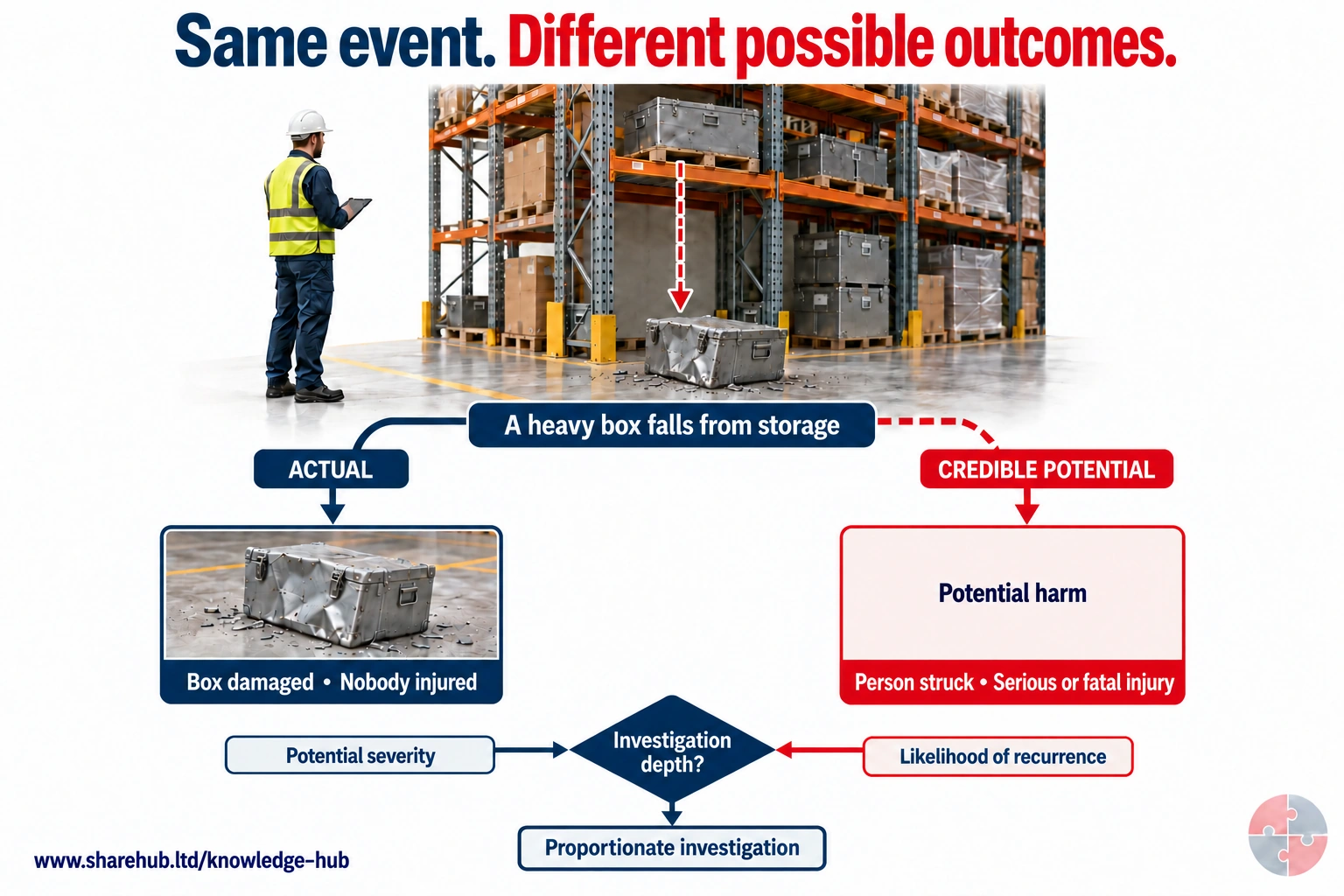

The actual outcome is damage to the box without injury. A person being struck is a separate credible potential outcome. Both potential severity and the likelihood of recurrence inform a proportionate investigation.
Would no injury justify a minimal investigation?
No. Assess credible potential severity and recurrence likelihood, rather than relying only on the injury outcome.
Learning illustration; review against the full topic and source before use.
Source guidance: HSE HSG245
A proportionate system avoids two opposite failures: over-investigating every small matter until people stop reporting, and under-investigating high-potential events because nobody was hurt. Potential severity is often the deciding factor. A near miss involving a moving vehicle, live electricity, a dropped load, a confined space, a release of hazardous substance or a failed isolation may justify a formal investigation even if nobody was injured.
The level should also reflect recurrence. Several small events in the same area may reveal a management-system weakness that one isolated event would not show. Investigation level should therefore be reviewed if patterns emerge through first aid records, near-miss reports, maintenance defects or audit findings.
For example, a minor cut from a known one-off packaging edge may need a short supervisor review. A lifting-load near miss with a realistic fatal outcome needs a fuller, multi-person investigation even if nobody was hurt. Repeated small injuries or a shared equipment defect can also justify escalation. Record the reason for the chosen depth and revise it if new evidence changes the potential outcome.
Who should be on an accident investigation team?
The team should combine investigation skill, local knowledge, worker insight, technical competence and enough authority to make change happen.
A single supervisor can deal with a simple low-potential event, but serious or complex investigations need a balanced team. The aim is not to create a large committee. The aim is to bring in the people needed to understand the evidence properly and implement actions that last.
Independence matters. Where a manager may have influenced the conditions that led to the event, they may still provide evidence but should not be the only person deciding causes or actions. For fatal, high-potential or regulatory events, the organisation should also think about legal privilege, family liaison, police or regulator contact and welfare support.
Set one lead, one decision owner and a clear route to senior authority. Include the worker and contractor knowledge needed to understand the real job, a safety or technical specialist when the cause is complex, and employee representatives where appropriate. A person whose own decisions are under review can give evidence but should not be the sole judge of the findings.
Use the organisation's consultation arrangements at the start, not after conclusions are drafted. HSE guidance on consulting representatives explains that prescribed safety-representative functions include investigating accidents and potential hazards and recommends early involvement. Record who was notified, how worker insight was obtained and how any representative comments affected the findings or action plan.
What investigation training and competence does each role need?
People need different skills: everyone should know how to report and protect themselves, while investigators need evidence, interviewing and analysis skills, and managers need to make sound reporting and corrective-action decisions.
HSG245 expects the team to combine knowledge of the work with investigation skills and enough authority to act. A course attendance record alone does not show that a person can gather a fair account, distinguish a legal report from an internal investigation or test a corrected control. Use observed exercises and reviewed case work before giving someone an independent lead role.
| Role | Learning and practice | Competence evidence and record | Assessor and reassessment trigger |
|---|---|---|---|
| All staff and witnesses | Recognise an event, get help, report promptly and avoid disturbing a dangerous scene. | Can state the alarm/report route and give a factual account; induction or briefing record. | Supervisor checks at induction and after a reporting-route change. |
| Supervisors and first responders | Make people safe, secure the scene, record initial facts and preserve evidence without delaying care. | Scenario exercise or observed response; initial decision and handover record. | Competent manager checks after an incident, drill or changed emergency arrangement. |
| Investigators and worker representatives | Gather physical, verbal and written evidence; interview fairly; separate immediate, underlying and root causes. | Assessed case exercise or reviewed investigation file showing an evidence trail and worker involvement. | Experienced investigation lead checks before lead assignment and after a weak or disputed investigation. |
| Technical and occupational specialists | Test mechanism, exposure, equipment or health questions within their professional scope. | Traceable expert findings, method and uncertainty in the case record. | Relevant technical lead checks competence for the actual subject and after a new hazard or method. |
| Managers and reporting decision makers | Choose investigation depth and team, protect privacy, check GB/NI RIDDOR and resource stronger corrective action. | Documented reporting rationale, signed action decision and field effectiveness check. | Senior dutyholder or legal/safety adviser checks after law, event severity or recurring failure changes. |
| Auditors and action owners | Sample closed cases for source evidence, root-cause quality, completed controls and repeat-event trends. | Audit sample, worker feedback and observed control performance, with reopened actions where needed. | Independent competent reviewer checks after repeat findings, weak closure or system change. |
Refresh the relevant skills after a changed process, law, reporting route, poor case quality or repeated event. Do not infer a universal investigator certificate or fixed renewal interval from this guidance.
How should injured people, witnesses and families be supported?
A serious investigation must protect people as well as evidence.
Accident investigation can be emotionally difficult. An injured person may be in pain, witnesses may be distressed, supervisors may feel under pressure and families may need clear information. The response should therefore include welfare, communication and dignity from the start.
Where a serious injury, death or possible HSE investigation is involved, the organisation should control communication carefully. People affected by the incident should know who will contact them, what is happening next and where support is available. This is not separate from investigation quality; it helps maintain trust and reduces confusion while the facts are established.
HSE52 and HSE53 in the retained source pack describe the England and Wales process. Scotland and Northern Ireland use different justice and regulator arrangements, so the organisation must identify the applicable route and avoid promising a process that does not apply.
Give injured people, witnesses and families accurate contact points, privacy and time to speak. HSE has separate information for victims and bereaved families; the applicable police, coroner, procurator fiscal or Northern Ireland process depends on location. Do not use an internal investigation to promise an external outcome.
What evidence should be gathered and protected?
Evidence should show what happened, what conditions existed and how the work system allowed the event to occur.
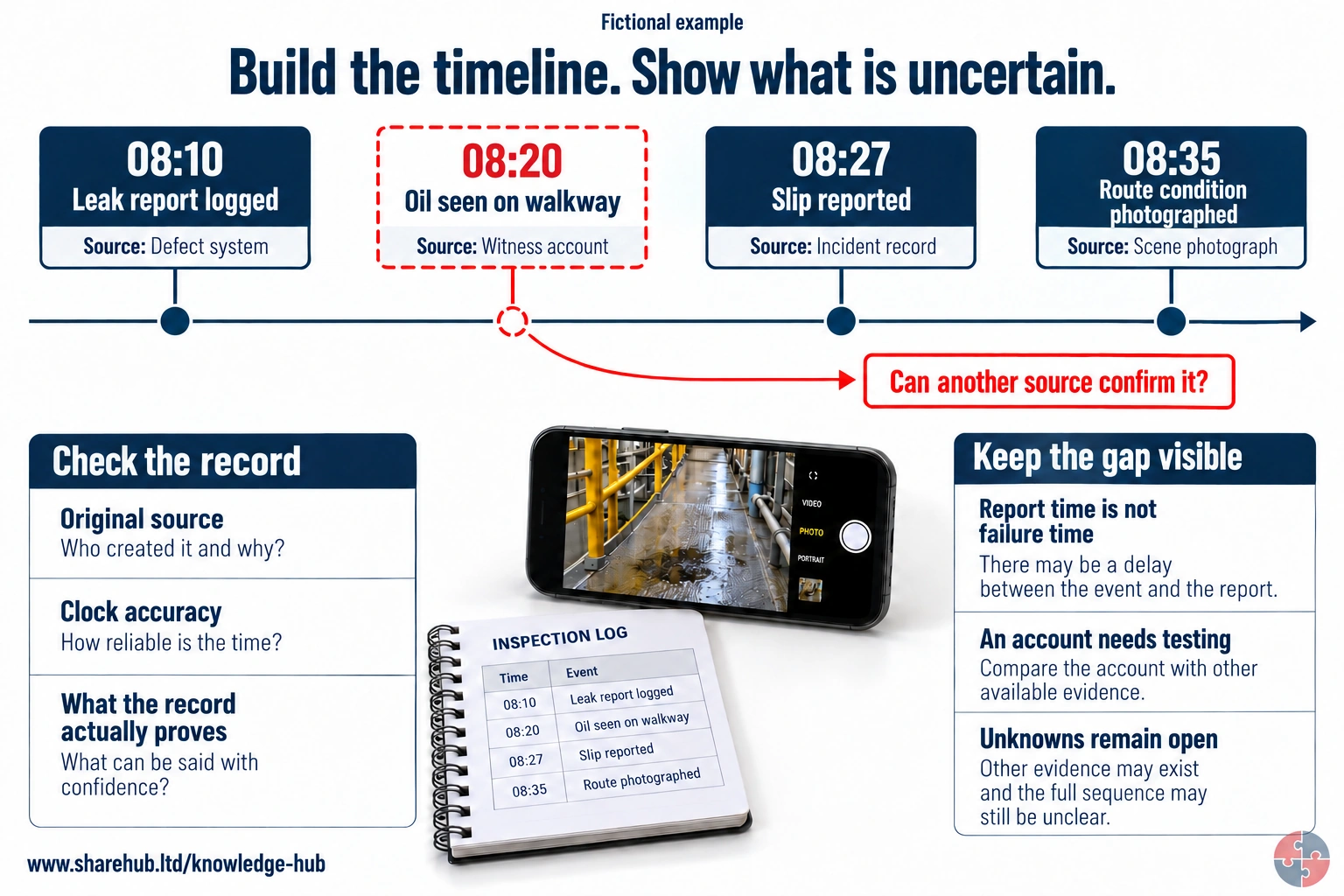

A timeline separates the order of events from the order in which they were reported. In this worked example the 08:10 entry proves that a report was logged then, not that the seal first failed at 08:10. The 08:20 observation is a witness account to test against other evidence. Preserve the original source, record timestamp conventions and check whether device clocks align. Show gaps and conflicting accounts instead of smoothing them into a tidy narrative. The 08:35 photograph records route condition; the depicted open walkway does not document a route closure.
Separate four different times
An event time, an observation time, a report time and a system-entry time may differ. In this sequence the 08:10 entry establishes when a leak report was recorded, subject to clock checks; it does not establish the first moment of release. The 08:27 incident record is a report of a slip, not automatic proof of the exact slip time.
Preserve source and context
Record the original file or document, its author or system, collection time, location, device-clock information and where the original is held. Work from controlled copies when possible. Note any time-zone, clock-drift or transcription issue. Keep original witness wording separate from the investigator's interpretation, and record a change history rather than silently rewriting accounts.
Use gaps as enquiries
The dashed 08:20 observation invites a corroboration check; it is not a declaration that a witness is unreliable. Ask what could confirm or challenge it, including photographs, other accounts, activity logs and the physical condition. A record created later may refer to an earlier event. Label uncertainty rather than inventing a precise time to complete the line.
Learning check
A photograph is saved at 08:35. Does that prove the route was first closed then? No. The depicted open walkway does not document closure at all. Check what the timestamp means and what the image actually shows, then compare other records. Real incident media and health details require authorised access and appropriate privacy safeguards.
Can the defect-system timestamp establish when the leak began?
It establishes when that record was created, subject to system-clock checks. The leak could have begun earlier; its start time remains an evidence question.
All times and records are example. Handle real CCTV, health information and identifiable accounts under authorised access, preservation and data-protection arrangements.
Source guidance: HSE HSG245 · HSE guidance
Investigators should collect only what is necessary for a defined investigation purpose, record who has access and preserve original files securely. Keep the statutory incident record distinct from restricted health details, witness accounts and identifiable CCTV or photographs. The organisation must document a lawful basis and, for worker health information, an applicable special-category condition and safeguards; set retention for each record class rather than using the RIDDOR minimum as a blanket period. Before any identifiable incident material is used with SHARE Intelligence or another AI service, the authorised data owner must check the organisation's approved system, purpose, access permissions, minimisation and redaction rules. Use anonymised facts where sufficient; do not paste medical records or identifiable media into an unapproved chat. These are permission and assessment gates, not a ban on lawful investigation use. ICO worker-health data guidance is under review, so check its current status.
Good evidence gathering is disciplined but not theatrical. The investigator should capture the fragile evidence first: people’s recollection, CCTV, temporary conditions, equipment positions, alarms, permits, photographs and digital logs that may be overwritten. Physical safety still comes first, but evidence should not be lost simply because people tidy the area too quickly.
The strongest investigation usually uses several types of evidence. If a witness account conflicts with CCTV, or a procedure conflicts with actual practice, that conflict is not a nuisance; it is useful learning. It shows where the organisation’s written system and real work may have drifted apart.
Maintain an evidence log recording what was captured, by whom, when, from where and where the original is held. Copy digital records without altering the original where possible; preserve relevant CCTV before overwrite. Restrict health details, identifiable images and witness accounts to people who need them for a defined purpose, with lawful retention and access controls.
Use the Four P's to check evidence coverage
People, Positions, Parts and Papers help you check that evidence gathering covers people, the scene, equipment and records.

Open the full-size visual (new tab) · Download the Four P's visual (PNG)

- People: Listen to independent accounts and preserve the witness's own words.
- Positions: Record the layout, locations and changes, distinguishing observation from reconstruction.
- Parts: Document equipment and material condition; test possible failures through competent, safe examination.
- Papers: Check the relevant versions of records and compare the planned system with work as done.
Supplementary evidence-coverage mnemonic. Emergency care and continuing protection take priority. It does not establish a cause or authorise access, testing or work.
Read the full Four P's explanation and investigation examples.
Source context: HSE HSG245: Investigating accidents and incidents. The Four P's provide an additional coverage prompt alongside the four-stage investigation method.
How should witnesses and people involved be interviewed?
Investigation interviews should be fair, calm, structured and focused on understanding the work system.
Interviewing is one of the most important parts of an investigation because people explain what the documents cannot: what normally happens, where workarounds exist, what pressures were present, what instructions were understood and which controls looked different at the point of work. The tone matters. A blame-heavy interview can shut down the very information the organisation needs.
Where the event is serious, interviews should be planned carefully. Witnesses may be distressed, injured, tired or worried about consequences. The investigator should avoid public interviews, avoid group discussions that allow accounts to influence each other, and avoid asking the same question repeatedly in a way that feels accusatory. Where employment, legal or police processes may follow, competent legal or HR advice may be needed.
Ask an open first question such as “Tell me what you saw from the start.” Then use the timeline and physical evidence to clarify, without supplying an answer. Record what the person knows first-hand, what they inferred and what remains uncertain. Offer a chance to check the recorded account; follow local representation and welfare arrangements.
How should Five Whys and root cause analysis be used?
Root cause analysis should identify correctable system weaknesses, not simply attach blame to the person closest to the event.
2 related visuals
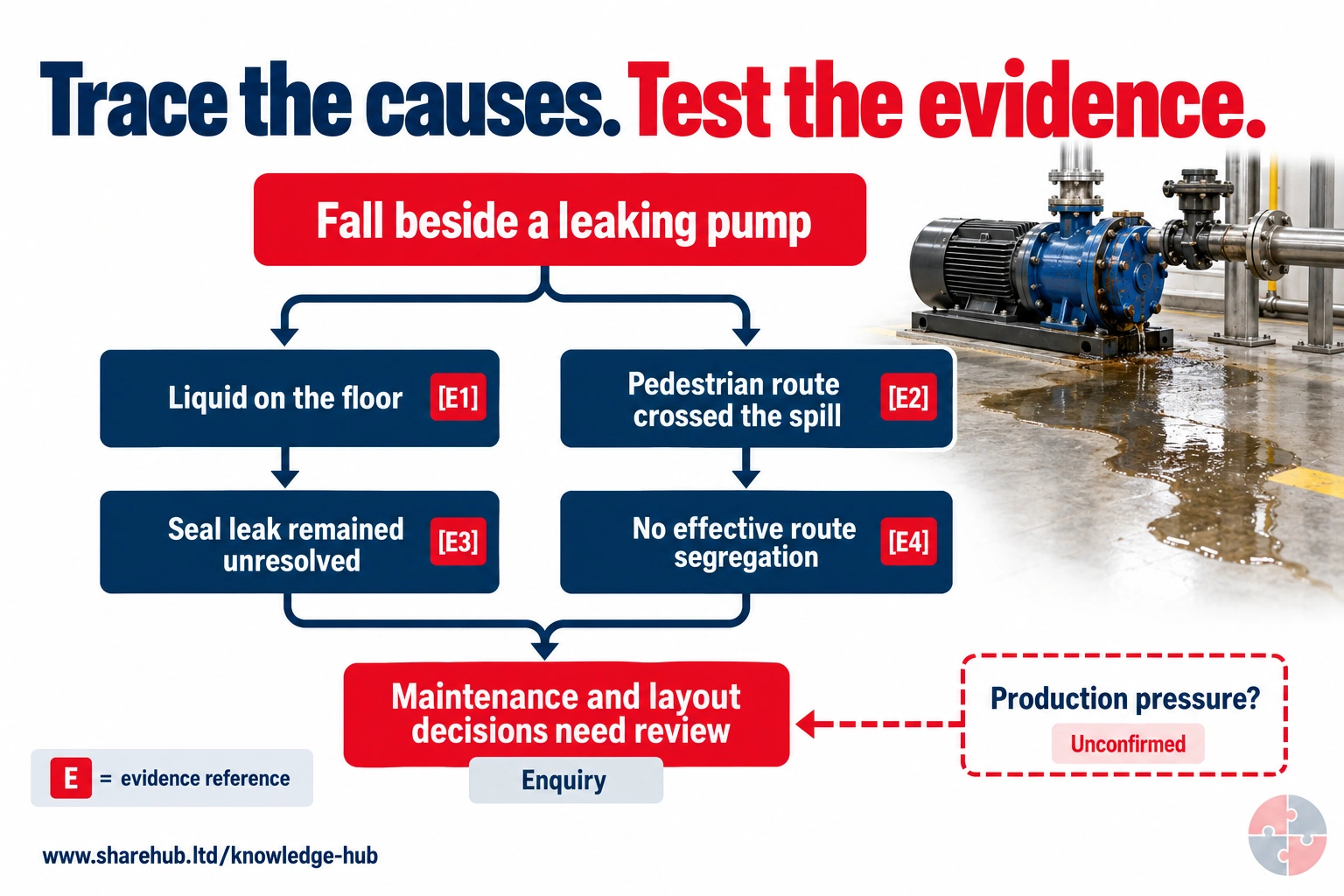

The map starts at the fall and traces recorded immediate conditions to unresolved maintenance and route-segregation issues. Those findings prompt enquiry into management decisions. Production pressure remains an unconfirmed hypothesis; it must not be presented as an established root cause.
What should happen to the production-pressure branch?
Seek independent corroborating evidence before accepting or rejecting it; keep its unconfirmed status visible.
Causal map. Evidence identifiers are examples, not records from a real investigation.
Source guidance: HSE HSG245
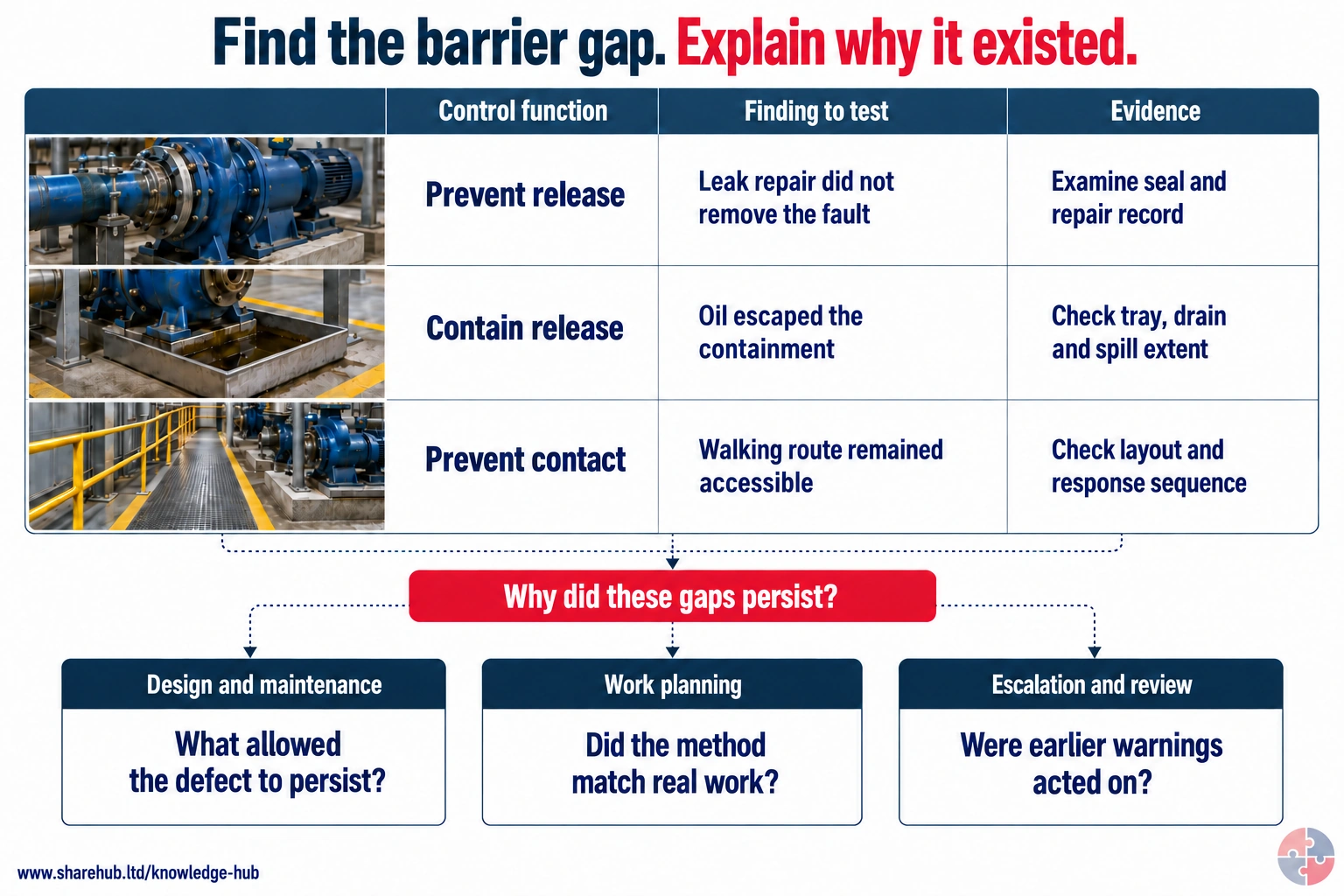

Identify what each control was meant to do, then compare it with the evidence of what happened. A failed seal, ineffective containment and an accessible route are different control questions, with different evidence and actions. Investigate how design, maintenance, planning and escalation created or sustained the gaps. The table deliberately presents hypotheses to test; neither a missing barrier nor a deeper management cause should be asserted merely because it makes the diagram complete. The photographs illustrate intended control functions, not real incident evidence.
Start with the intended control function
Ask what should have prevented the release, what should have contained it and what should have prevented a person reaching it. The photographs illustrate those functions; they are not evidence from a real accident. The findings column lists hypotheses to test. A tray or rail appearing in an illustration is not proof that the actual arrangement was suitable.
Connect immediate conditions to the work system
Oil on a walking surface is close to the harmful event. Why the seal continued leaking, why containment did not retain it and why the route remained available are deeper enquiries. Trace relevant maintenance decisions, design assumptions, inspection coverage, priorities, handovers and escalation. Cause labels differ between methods; evidence and a clear connection to the event matter more than filling every category.
Do not stop at the person
Investigate what people could see, understand and do at the time. Compare written arrangements with real work, including workload, usable equipment, time pressure and supervision. A deliberate act, error or departure from a procedure can be a relevant fact, but it does not by itself explain the conditions that allowed harm or how to prevent recurrence.
Learning check
Would a warning notice alone have prevented a recurring pump leak? It may communicate a temporary restriction, but it does not remove the leak mechanism. Match each proposed action to the control gap it is intended to address and verify the actual performance.
Why is 'the worker did not look' an incomplete finding?
It does not explain the release, containment or route conditions. Test what the person could see and do at the time, then examine the control system and the evidence for each causal link.
Conceptual control functions and findings. Actual containment, drainage, machinery access and pedestrian segregation require task-specific assessment.
Source guidance: HSE HSG245 · HSE guidance
Five Whys is useful because it forces the investigator beyond the immediate cause, but it can become shallow if used mechanically. A chain that ends with 'operative failed to follow procedure' is rarely good enough. The next questions are why the procedure was not followed, whether it was realistic, whether the person was trained, whether supervision checked it, whether the equipment made the safe way easy, and whether previous warning signs existed.
Root cause analysis is strongest when it is evidence-led. The team should separate what is known, what is inferred and what is still uncertain. The chosen method should fit the event. A simple slip may need a short timeline and Five Whys; a serious lifting, electrical, chemical or vehicle event may need barrier analysis, technical specialist input and a formal root cause review.
HSG245 separates immediate causes, underlying conditions and root or management causes. If a vehicle struck a pedestrian, “driver did not see them” is a starting observation; the investigation must also test route design, segregation, visibility, reversing arrangements, staffing, supervision and previous near misses. Five Whys can open this inquiry, but stop when the evidence runs out rather than inventing a single root cause.
From a dropped load to a tested action
Warehouse example: a package falls during unloading. First aid, immediate danger control and evidence preservation come first. The investigation then separates an observation from an explanation that still needs testing.
| Stage | Example record | Next evidence or decision |
|---|---|---|
| What we know | A damaged strap was photographed after the event; the damaged item was retained. | Record when and by whom it was found. Establish whether the damage occurred before, during or after the fall. |
| What may explain it | The strap may have been unsuitable, damaged before use or affected by the load edge. These are hypotheses. | Compare the load and packaging specification, strap identification, handling method, pre-use checks and witness accounts. Check contradictory evidence. |
| What we change | Remove the affected stock from use while its condition is assessed. Review selection and protection of the load-restraint system. | Name the responsible owner, completion date and checks that will show the chosen controls work. |
| What closes the action | The replacement arrangement is checked against the actual load and observed during a representative delivery. | Record the competent acceptance, remaining limitations and a follow-up trigger. A purchase order or training signature alone is not evidence of control effectiveness. |
Keep original evidence, record uncertainty and revisit a conclusion when new facts emerge. Statutory reporting runs alongside this process; it need not wait for a final causal explanation.
How should human factors be considered during an investigation?
Human factors analysis asks why people acted as they did and how the workplace made error more or less likely.
A worker may press the wrong button, miss a defect, take a shortcut, misunderstand an instruction or enter an area at the wrong time. Those facts matter, but they are not the end of the investigation. The useful question is what shaped the decision or action: workload, fatigue, interface design, noise, poor visibility, confusing labels, time pressure, staffing, training, supervision, culture, conflicting goals or a procedure that did not match the real job.
HSE human factors guidance commonly frames human performance through the job, the individual and the organisation. That is a practical way to avoid blaming the person closest to the event while still recognising that behaviour matters. Strong recommendations change the conditions that made error likely, such as design, maintenance, staffing, briefing, supervision, alarms, procedures or recovery controls.
Slips and lapses
These are unintended actions, such as forgetting a step or selecting the wrong control. Better design, prompts, checklists, labelling, lighting and pace of work may reduce them.
Mistakes
These are wrong decisions or misunderstandings, often linked to poor information, training, complexity or unfamiliar conditions. Better competence, supervision and clearer procedures may be needed.
Violations or shortcuts
These are deliberate departures from rules, but the investigation should still ask whether the rule was known, practical, supervised, enforced and compatible with the pressures of the job.
Performance influencing factors
Fatigue, staffing, workload, distractions, emergency conditions, stress, competence, layout and equipment design can all influence performance.
Compare the written procedure with how work was actually organised and performed. Check whether the safe action was practical at the time, whether controls were available and usable, and what made error likely or recovery difficult. Record deliberate rule breaking only when evidence supports it and still examine the conditions that allowed it.
How should corrective and preventive actions be selected and verified?
Actions should match the causes, reduce the risk and be checked after completion to prove they work.
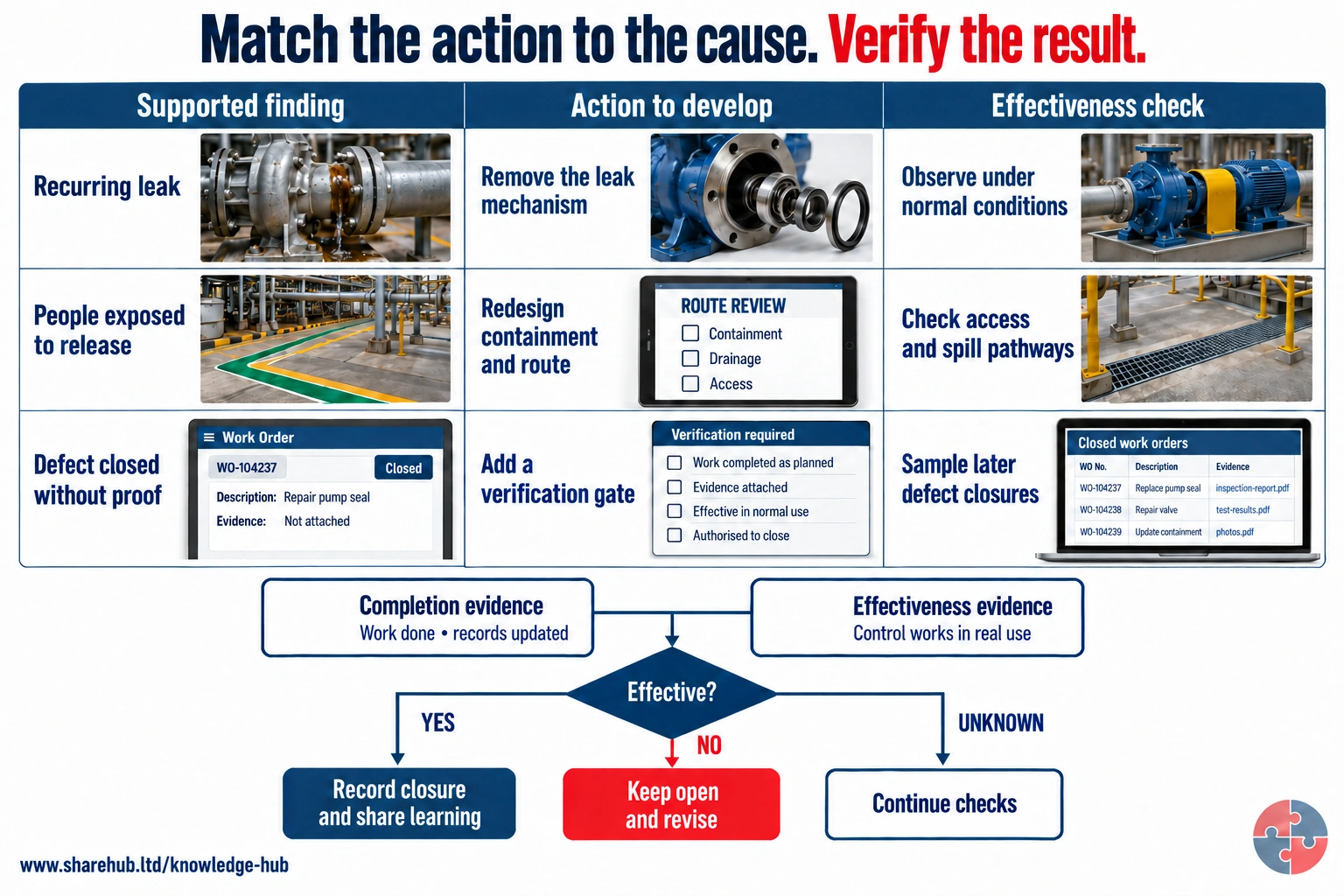

The action should address a supported cause, not simply the last person in the sequence. Develop stronger controls before defaulting to reminders, and check that the change does not introduce a new risk. Define an owner, due date, interim protection, completion evidence and effectiveness check. A repair record shows work was recorded; observation under representative conditions tests whether the control works. Keep the action open if effectiveness is poor or still unknown, and check similar equipment or tasks for the same weakness.
Build an action that can be checked
State the supported finding and the risk-control function to improve. Define the change, an accountable owner, a realistic due date, interim protection, completion evidence and the effectiveness check. Consider elimination and design or engineering measures before relying on procedures, reminders or PPE. Assess any new risks introduced by the proposed change.
Completion is not effectiveness
A work order, updated drawing or training record can show that a task was completed. Effectiveness asks whether the control performs in representative use and continues to do so. A dry seal photograph alone cannot establish performance over the relevant operating conditions. Plan competent, safe checks with appropriate observation periods and technical acceptance criteria; do not expose people to danger to gather evidence.
Close, revise or keep checking
If evidence supports effectiveness, record the basis for closure and communicate what changed to the people who need it. If the control fails, retain interim protection and revise the action. If the result is still unknown, keep the action open and continue the planned checks. Review similar equipment, tasks and locations so that the same weakness is not left elsewhere.
Learning check
A completed defect record has no evidence attachment and no follow-up result. Should it be treated as verified? No. Recover the completion evidence and perform the required effectiveness check. Closure of the investigation action is distinct from any competent authorisation needed to restart hazardous work.
What evidence is needed beyond a completed work order?
Evidence that the intended control performs under representative conditions, residual risks are addressed and the change is sustained. The nature and timing of that check depend on the control and task.
Example action-development framework. An editorial action closure is not permission to restart hazardous work; restart needs the applicable competent release and control checks.
Source guidance: HSE HSG245 · HSE guidance
An action is not strong simply because it is quick. Re-training everyone after every event may look decisive, but it often avoids the harder questions about equipment, design, workload, maintenance, supervision and planning. A good investigator asks what action would have prevented the event even if a person made a foreseeable mistake.
Corrective actions should be written in a way that can be closed properly: what will change, who owns it, when it is due, what evidence proves completion, and how effectiveness will be checked. For serious events, actions should also be reviewed across similar areas so the organisation does not fix one location while leaving the same weakness elsewhere.
| Action type | Example | Investigation quality check |
|---|---|---|
| Eliminate the hazard or task | Remove the need for the activity, exposure or energy release that caused the event. | Strongest action where reasonably practicable; check whether the work can be designed out or substituted. |
| Engineering or design change | Guarding, interlocks, segregation, extraction, automation, fail-safe design, safer access, alarm redesign or physical modification. | Strong because it reduces reliance on memory and supervision. |
| Isolation, access control or permit change | Lockout, exclusion zones, barriers, permit-to-work controls, handover improvements or contractor coordination. | Useful where people need to be separated from energy, vehicles, substances or simultaneous work. |
| Maintenance, inspection or procurement change | Replace defective equipment, change inspection frequency, specify safer equipment or remove unsuitable items from stores. | Useful where deterioration, wrong equipment or poor purchasing contributed. |
| Procedure, briefing or training update | Clarify the safe system, update training and brief those affected. | Necessary where knowledge was weak, but should not be the only action if the work design remains poor. |
| Behaviour-only reminder | Posters, toolbox talks or reminders to take care. | Weak unless it supports stronger controls and there is evidence that the task, equipment and supervision are also improved. |
What should an accident investigation report include?
A good report is factual, structured, evidence-led and clear about what must change.
The report should be written for its real audience. A supervisor may need a concise local learning record; a serious event may need a formal report suitable for senior review, regulator attention or legal scrutiny. In all cases, the report should distinguish fact from assumption and avoid loaded language.
The strongest reports are readable. They explain the event clearly enough for someone who was not there to understand the sequence, causes and actions. They should not bury the learning in unnecessary jargon, but they should include enough detail to support decisions, audit, insurance, legal reporting and future review.
Include the event and jurisdiction, people and work context, a dated timeline, evidence and its limits, immediate and underlying causes, reporting decision and reference, controls, action owners and deadlines, restart decision and later effectiveness check. Keep restricted personal or health information in controlled records rather than a broadly shared learning summary.
Which Great Britain and Northern Ireland legal routes apply?
Accident investigation supports legal compliance, but the primary duties and RIDDOR route depend on whether the event occurred in Great Britain or Northern Ireland. See Health and Safety at Work etc Act 1974, Health and Safety at Work Northern Ireland Order 1978 for the applicable decision.
There is no single statutory investigation template or universal investigator certificate. The organisation should appoint people with competence proportionate to the event, protect evidence, make required notifications and use findings to review risk controls. Serious events may also involve police, coronial or procurator-fiscal processes, sector regulators, insurers and employment procedures.
| Jurisdiction | Legal or official route | Why it matters | Operational boundary |
|---|---|---|---|
| Great Britain | Health and Safety at Work etc Act 1974 | General duties to protect employees and others affected by work. | Use the investigation to test planning, control, supervision, information, equipment and organisational decisions; do not describe the Act as the NI primary law. Direct source: Health and Safety at Work etc Act 1974 |
| Great Britain | Management of Health and Safety at Work Regulations 1999 | Risk assessment, arrangements, competent assistance, emergency planning, cooperation, information and training. | Review the relevant assessments and arrangements when evidence shows they may no longer be suitable or effective. Direct source: Management of Health and Safety at Work Regulations 1999 |
| Great Britain | RIDDOR 2013 | Specified reporting and record-keeping duties for responsible persons. | Make and document the GB decision promptly; reporting does not replace investigation or insurer notification. Direct source: Reporting of Injuries Diseases and Dangerous Occurrences Regulations 2013; HSE RIDDOR hub |
| Northern Ireland | Health and Safety at Work Northern Ireland Order 1978 | Northern Ireland's primary general health and safety duties. | Use this NI baseline rather than importing the GB Act wording without qualification. Direct source: Health and Safety at Work Northern Ireland Order 1978 |
| Northern Ireland | Management of Health and Safety at Work Regulations Northern Ireland 2000 | NI risk assessment, arrangements, competence, emergency, cooperation and training framework. | Feed investigation findings into NI assessments and preventive arrangements and verify current amendments. Direct source: Management of Health and Safety at Work Regulations Northern Ireland 2000 |
| Northern Ireland | RIDDOR Northern Ireland 1997 as amended | NI reporting and record-keeping duties. | Use the current HSENI route. The GB over-seven-day category must not be used as the NI threshold. Direct source: Reporting of Injuries Diseases and Dangerous Occurrences Regulations Northern Ireland 1997; HSENI Report an incident |
| England and Wales or Scotland | Work-related death liaison protocols | Police, HSE and other authorities coordinate fatal-event investigations through nation-specific protocols. | Preserve the scene and follow the authority controlling it; Scotland and England and Wales have separate criminal and death-investigation systems. Direct source: HSE Work-related Death Protocol |
| All jurisdictions | Sector-specific and organisation requirements | Major hazards, rail, aviation, marine, healthcare, safeguarding, environmental, contractual and insurer rules may add notifications or investigation controls. | Identify the sector and enforcing authority early. Treat SHARE and company rules as guidance or local requirements, not as legislation. Direct source: HSE HSG245 Investigating accidents and incidents; HSENI Report an incident |
Choose the reporting jurisdiction before the deadline
Reporting and learning are separate decisions. Identify where the incident occurred, the applicable RIDDOR regime and the responsible person. Check the exact reportable category promptly; do not wait for the investigation to finish.
Great Britain
Use HSE’s RIDDOR 2013 guidance. Deaths, specified worker injuries, relevant non-worker hospital-treatment cases and dangerous occurrences require notification without delay, with the report received within 10 days. Over-seven-day worker incapacitation is reported within 15 days. Occupational-disease reporting follows receipt of the relevant diagnosis.
Northern Ireland
Use HSENI’s RIDDOR 1997 route. It retains major-injury and over-three-day injury categories; the GB threshold changes do not transfer to NI. Use HSENI’s current guidance for the exact category, notification method and deadline.
Record the jurisdiction, category considered, decision maker, date, reason and report reference. A decision that an event is not reportable does not end the duty to control risk or the need to learn from it. Read the full legal scope.
How should RIDDOR reporting and record keeping fit into the investigation?
Decide the jurisdiction first. In Northern Ireland, reportable deaths, major injuries and specified dangerous occurrences need notification without delay and a report within 10 days; an over-three-day injury needs a separate NI2508 report within 10 days, not automatic immediate notification. The responsible person must check the current HSENI route, while Great Britain uses its distinct HSE RIDDOR 2013 categories and deadlines. Reporting never replaces a proportionate investigation. See HSE When do I need to report an incident, HSENI Report an incident for the applicable decision.
Record the event location and date, work connection, worker or non-worker status, confirmed injury outcome, hospital treatment, days unable to do normal work, possible dangerous-occurrence category, responsible person and current regulator guidance. Keep unconfirmed facts explicit. Record the deadline, submission reference and review trigger. Escalate uncertainty rather than delaying a time-critical report.
| Jurisdiction | Route | Core categories | Decision and timing |
|---|---|---|---|
| Great Britain | RIDDOR 2013 | Deaths from work-related accidents; specified injuries to workers; over-seven-day incapacity; certain non-worker injuries; listed diseases; dangerous occurrences; specified gas events. | Most deaths, specified injuries, qualifying non-worker cases and dangerous occurrences: notify without delay and report received within 10 days. Over-seven-day incapacity: within 15 days. Check live HSE guidance for the actual case. Direct source: HSE Types of reportable incidents; HSE When do I need to report an incident; Reporting of Injuries Diseases and Dangerous Occurrences Regulations 2013 |
| Great Britain | Over-three-day record | A worker unable to do normal duties for more than three consecutive days may require a record even when the over-seven-day reporting threshold is not met. | Count using current HSE guidance and retain the accident record; do not submit a RIDDOR report solely because the over-three-day record threshold is met. Direct source: HSE Types of reportable incidents; HSE What RIDDOR records do I need to keep |
| Northern Ireland | Immediate notification cases under RIDDOR (NI) 1997 | Work-related death, major injury, qualifying injury to a person not at work, or a specified dangerous occurrence. | The responsible person must notify the enforcing authority without delay by the quickest practicable means, then send the approved NI2508 report within 10 days of the accident or occurrence. Check the exact category and current HSENI route. Direct source: HSENI Report an incident; HSENI Accident reporting; Reporting of Injuries Diseases and Dangerous Occurrences Regulations Northern Ireland 1997 |
| Northern Ireland | Over-three-day injury under RIDDOR (NI) 1997 | A work-related injury prevents a worker from doing their normal work for more than three consecutive days; this is a report route, not an automatic immediate-notification case. | The responsible person sends NI2508 as soon as practicable and within 10 days of the accident. Exclude the accident day; include weekends and rest days. Check actual or likely ability to do normal duties, not absence alone. Reassess if the outcome changes. Direct source: HSENI Report an incident; HSENI Accident reporting; Reporting of Injuries Diseases and Dangerous Occurrences Regulations Northern Ireland 1997 |
| Both regimes | Separate investigation and other notifications | A non-reportable event may still require investigation, first-aid or accident-book recording, insurer or client notification, occupational-health action or sector reporting. | Record the decision, evidence checked, responsible person and any advice received; revisit it if diagnosis, absence, restricted work or facts change. Direct source: HSE HSG245 Investigating accidents and incidents; HSE RIDDOR hub; HSENI Report an incident |
What should an accident investigation register record?
An investigation register should make reporting decisions, evidence, causes, actions and learning visible.
A register is not a substitute for investigation, but it helps the organisation control the process. It should show which events are open, which actions are overdue, which themes are recurring and whether high-potential events are getting the attention they deserve.
The register should also connect back to the risk register. If a fall, vehicle strike, chemical exposure or machinery injury occurs, the question is whether that event was already recognised as a credible risk and whether the controls recorded in the risk register were actually in place.
Keep the required RIDDOR event record for at least the applicable minimum period, but set separate, justified retention and access for investigation files, health information, witness accounts and identifiable media. The data owner should record why longer preservation is needed for claims, regulatory holds or latent harm, and review it; do not treat the statutory minimum as permission to keep all personal data indefinitely.
A practical register needs an event ID, date and location, actual and potential harm, owner, investigation level, GB or NI reporting decision and deadline, evidence location, causes, action owner and due date, restart authority, closure evidence and effectiveness review. Link repeated themes to the risk register and management review.
How could BuildOut Ltd manage accident and incident investigation?

BuildOut Ltd manages investigation as a live learning process that connects site reporting, evidence, root cause analysis, legal duties, action tracking and management review.
BuildOut Ltd is a construction and maintenance business working across changing sites, subcontractors, plant, tools and client premises. Its incident profile includes slips, trips, cuts, dropped objects, vehicle movements, temporary works issues, electrical contact, dust exposure, lifting operations, defects and high-potential near misses.
The example below shows how accident investigation becomes a management system, not a folder of completed forms.
In one illustrative BuildOut Ltd yard event, a contractor is nearly struck by a reversing vehicle after a temporary route change. The supervisor stops movements and preserves CCTV. The traffic lead and contractor jointly compare the approved route with the route actually used, lighting, barriers, briefings and previous near misses. BuildOut changes the physical segregation and verifies it on a live shift before the route is released. The manager checks the same layout weakness at other sites and records the action owner, evidence and follow-up date.
BuildOut roles and release points illustrate one company system. They are not statutory job titles or fixed legal time limits.
How does accident investigation support NEBOSH National General Certificate study?
Accident investigation links directly to GNC-015 / Element 4.1 on incident investigation, recording and reporting.
For NEBOSH National General Certificate learners, this is a scenario-rich topic. Questions may describe an injury, near miss, poor reporting culture, repeated accidents, weak supervision or a serious event and ask what should be done. Strong answers are practical: make safe, preserve evidence, report where required, choose the investigation level, gather information, analyse causes, identify controls and track actions.
Learners should avoid writing only that the employer must 'investigate and retrain staff'. That is too thin. A better answer explains the investigation stages, evidence sources, interview approach, root cause analysis, RIDDOR decision and how findings improve the risk assessment and management system.
How can HSG65 and ISO 45001 strengthen accident investigation and learning?
HSG65 and ISO 45001 are useful where they turn investigation findings into planning, checking, corrective action and continual improvement.
HSG65 is helpful because it puts investigation inside the normal management loop. The organisation plans how reporting and investigation will work, does the work by training people and gathering evidence, checks whether reports and actions are effective, then acts by changing risk assessments, controls and leadership priorities.
ISO 45001 adds a management-system lens. It helps connect incident investigation to consultation, hazard identification, competence, documented information, emergency response, performance evaluation, corrective action and continual improvement. The clauses should not be treated as a certification checklist; they are practical prompts for whether learning has changed real work.
The current ISO 45001 edition and amendments are not established by the open sources on this page; use an authorised copy before any formal mapping. It is voluntary unless adopted contractually or organisationally and does not replace applicable law.
ISO 45001 is used here at framework level. For a formal clause audit, use the current licensed edition and competent specialist interpretation; current law and actual risk-control evidence still govern the investigation decision.
What are the warning signs that accident investigation is not working?
Weak investigation systems usually reveal themselves through blame, poor evidence, repeated events and actions that do not change real work.
The warning signs are practical and visible. They show up in repeated incidents, identical action plans, superficial reports, weak interviews and a culture where people quietly fix damage rather than report what nearly happened.
The harm is not only the original accident. A poor investigation can create future harm because the business believes the matter is closed when the real causes are still present.
Watch for repeated “operator error” findings, photographs taken only after clean-up, identical retraining actions, actions closed without a workface check, near misses treated as unimportant, or a RIDDOR decision recorded without the jurisdiction and facts. Reopen the investigation when these signs could have hidden a credible cause or continuing exposure.
Standards named on this page are background context. Confirm the current edition, scope and exact requirements from an authorised copy before applying them. The open official sources below support the specific public-law and regulator guidance claims they are cited for.
What do the acronyms and key terms mean?
Accident investigation uses several legal, human factors, investigation and management-system terms that should be clear to non-specialists.
| Acronym or term | What it means | Why it matters |
|---|---|---|
| RCA | Root cause analysis. | Structured analysis of deeper system causes that allowed an event to occur. |
| RIDDOR | Reporting of Injuries, Diseases and Dangerous Occurrences Regulations. | The UK reporting framework for specified work-related events. |
| HSE | Health and Safety Executive. | The national regulator for many workplaces in Great Britain. |
| HSWA | Health and Safety at Work etc. Act. | The primary general health and safety Act for Great Britain. |
| MHSWR | Management of Health and Safety at Work Regulations. | Regulations requiring risk assessment and preventive arrangements. |
| COMAH | Control of Major Accident Hazards Regulations. | Applies to qualifying major accident hazard establishments. |
| PIF | Performance influencing factor. | A condition that affects how likely a person is to make an error or recover from one. |
| FTA | Fault tree analysis. | A structured technique for analysing combinations of failures leading to a top event. |
| FMEA | Failure modes and effects analysis. | A structured review of how equipment, process or task elements could fail and what the effects would be. |
| CCTV | Closed-circuit television. | Digital evidence that may be time-limited and should be secured quickly. |
| GNC | NEBOSH National General Certificate. | Qualification context for learners studying incident investigation, recording and reporting. |
| ISO | International Organization for Standardization. | Used here in relation to ISO 45001 occupational health and safety management systems. |
Which BuildOut documents support this topic?
Download individual editable BuildOut documents for this topic. Procedures and plans contain completed arrangements; forms, checklists, assessments, RAMS and permits are blank masters. Registers include separate worked examples.
| Document | Purpose and content | Editable download |
|---|---|---|
| Incident response, statutory reporting and learning procedure BOUK-PRO-INC · Completed worked example · v1.0 | Make safe, preserve evidence, assess reportability and timescales, identify causes and verify action effectiveness. | Download DOCX Read preview |
| Immediate incident and near-miss notification BOUK-FRM-INC-01 · Blank editable master · v1.0 | Capture factual circumstances, affected people, immediate controls and escalation. | Download DOCX Read preview |
| RIDDOR reportability and deadline decision checklist BOUK-CHK-INC-01 · Blank editable master · v1.0 | Determine responsible person, report category, timing and submission evidence. | Download DOCX Read preview |
| Proportionate incident investigation report BOUK-FRM-INC-02 · Blank editable master · v1.0 | Capture evidence, chronology, immediate/underlying/root causes and preventive action. | Download DOCX Read preview |
| Incident and statutory-report evidence register BOUK-REG-INC-01 · Blank register with separate worked entries · v1.0 | Index incidents, report references, dates, classifications and restricted evidence. | Download XLSX Read preview |
| Lessons learned, communication and effectiveness review BOUK-FRM-INC-03 · Blank editable master · v1.0 | Share appropriate learning and test whether controls improved. | Download DOCX Read preview |
Review and adapt the documents for your organisation, activities and jurisdiction before approval and issue. Open the SHAREms management-system hierarchy to find each document under its parent policy.