SHARE Knowledge Hub
Behavioural change in health and safety
Behavioural change in health and safety is the planned improvement of the conditions, decisions and habits that influence how work is actually done. It is not a substitute for eliminating hazards, engineering controls, competent supervision or good work design. Used well, it helps organisations understand why people take shortcuts, why procedures are ignored, how leaders shape norms, and what practical changes make safe work easier, clearer and more reliable.
Understanding Behavioural change in health and safety
Behavioural change in health and safety is the planned improvement of the conditions, decisions and habits that influence how work is actually done. It is not a substitute for eliminating hazards, engineering controls, competent supervision or good work design. Used well, it helps organisations understand why people take shortcuts, why procedures are ignored, how leaders shape norms, and what practical changes make safe work easier, clearer and more reliable.
Why this matters at work
Match the proposed change to the cause: redesign a confusing control for a slip, improve information and practice for a knowledge gap, remove unrealistic scheduling for a routine shortcut, or make a critical cue more visible.
Use measures tied to the actual harm pathway and verify that protection works during representative busy and abnormal conditions. Ask workers whether the intended action is feasible and whether obstacles have been removed. Include action quality and recurrence rather than only observation totals. Keep uncertainty explicit and avoid converting a small pilot into a claim of universal effectiveness. A fall in minor injury reports cannot by itself establish control of low-probability major hazards or long-latency ill health. Review whether the programme supports the wider management system and whether leadership is addressing costly or difficult engineering and organisational problems identified through it.
How organisations manage this in practice
Identify the actual safety problem and why the proposed behaviour matters. Examine capability, available tools, staffing, time, procedures and social expectations before deciding that motivation is the gap. A behavioural approach can support discussion and reliable use of an effective system, but it cannot replace engineering controls or make an unsafe job acceptable. Include management decisions and actions as well as worker behaviour. Pilot the approach with workers, define the intended task-specific change and record obstacles to safe performance. Check whether the programme diverts attention toward easy observations while high-consequence process hazards remain unresolved. HSE identifies this as a particular limitation. Agree how findings generate accountable system improvements, protect fair reporting and evaluate results. Scaling up needs evidence of feasibility and control performance, not just observation volume. Treat psychological models as investigative frameworks rather than legal duties or proof of an individual's motives. GB and NI legal routes for the underlying hazard remain separate from the programme's terminology.
Record technical review, worker consultation, document ownership and control of obsolete copies. Resolve labelling, isolation, workload or supervision defects before attributing the event solely to motivation. Then address genuine learning needs with instruction, practice and assessment. Verify the revised method in representative work and review handback quality or other relevant outcomes. Keep the distinction between an error-prone system and a fair assessment of individual conduct. The goal is reliable protection in the real job. Repeated reminders without correcting conditions can leave the same failure pathway available to the next worker or shift.
Investigate why the mismatch and workaround occurred, including document control, equipment changes, time pressure and the practical availability of help. Apply the appropriate fair process without assuming that an observed action reveals the person's motives. Correct the system and provide instruction or practice where a genuine competence gap remains. Check handback and similar labels or permits for wider effects. Record the evidence, action owner and verification of the revised method under normal work conditions. A campaign urging people to be more careful cannot substitute for reliable identification and isolation, and a completed observation card cannot authorise the suspended task to resume.
Good behavioural change starts by understanding the task, the person and the organisation. It asks why a shortcut makes sense to people at the time, which controls are difficult to use, what leaders reinforce, and whether the workplace makes safe performance the easiest reliable option.
Turn observations into a better way to work
Use observation to understand how work is actually done and why the safe method is difficult. Ask about access, waste, equipment and production constraints before prescribing coaching. A count of observation cards says little about whether a guard remains effective.
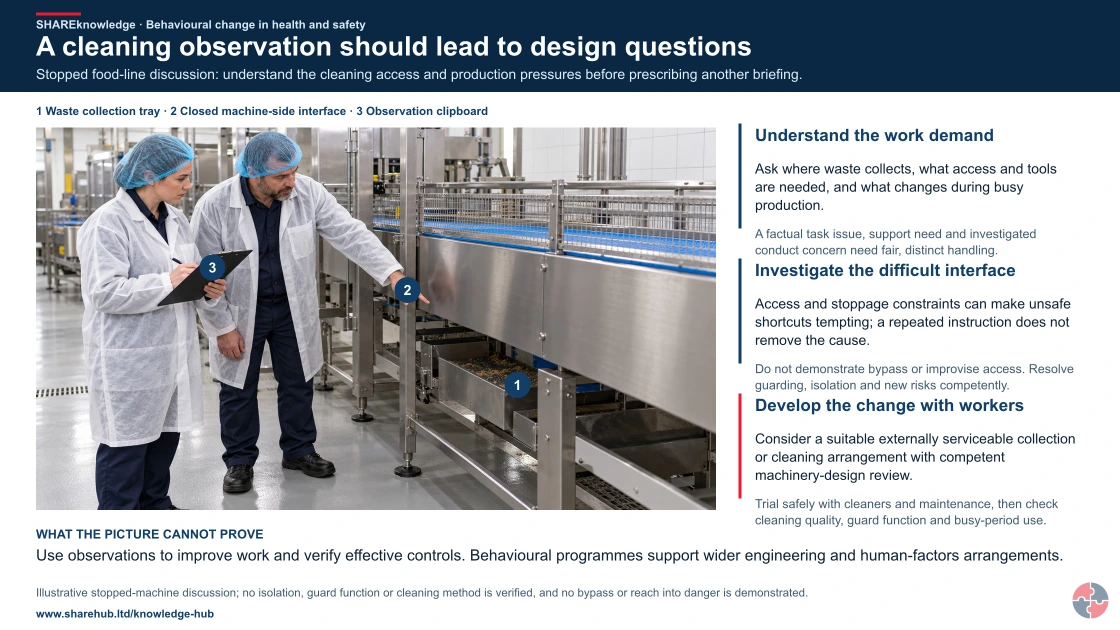
A cleaning observation should lead to design questions
Full written explanation
Stopped food-line discussion: understand the cleaning access and production pressures before prescribing another briefing. Picture key: 1 Waste collection tray · 2 Closed machine-side interface · 3 Observation clipboard. Illustrative stopped-machine discussion; no isolation, guard function or cleaning method is verified, and no bypass or reach into danger is demonstrated.
Stopped food-line discussion: understand the cleaning access and production pressures before prescribing another briefing.
- Understand the work demand. Ask where waste collects, what access and tools are needed, and what changes during busy production.
- Investigate the difficult interface. Access and stoppage constraints can make unsafe shortcuts tempting; a repeated instruction does not remove the cause.
- Develop the change with workers. Consider a suitable externally serviceable collection or cleaning arrangement with competent machinery-design review.
Change the pathway
- Listen without blame. A factual task issue, support need and investigated conduct concern need fair, distinct handling.
- Keep the machine protected. Do not demonstrate bypass or improvise access. Resolve guarding, isolation and new risks competently.
- Verify the real result. Trial safely with cleaners and maintenance, then check cleaning quality, guard function and busy-period use.
Evidence check: Use observations to improve work and verify effective controls. Behavioural programmes support wider engineering and human-factors arrangements.
Primary references: HSE: behavioural safety · HSE: maintenance of work equipment
Open the complete HD image (new tab)Download image

Primary references: HSE: behavioural safety · HSE: maintenance of work equipment
Agree a stronger work-design change with the people doing the task, then test it during representative demand. Behavioural programmes sit within wider human-factors and risk-control arrangements. Keep a fair distinction between a factual task issue, support needs and a properly investigated conduct concern.
Repeated guard bypass survives repeated reminders
Illustrative example. A cleaning task repeatedly leads to guard bypass because waste is hard to reach and stoppages are discouraged.
Decision. Protect the task, investigate the access and production constraint with workers, and redesign the cleaning/control arrangement.
Evidence to check. Compare observed work, worker explanation, guarded access, waste build-up and stoppage expectations.
Hold or escalation point. Do not close the issue after another signed briefing while the same bypass pressure remains.
Follow-up. Check the revised arrangement during a busy shift and verify the guard still performs its function.
Change the cleaning interface
An observation should lead to a question about the work. If waste accumulates behind a difficult access point, repeating an instruction does not remove the reason that unsafe access is tempting.
Change the conditions behind a rushed construction task
Full written explanation
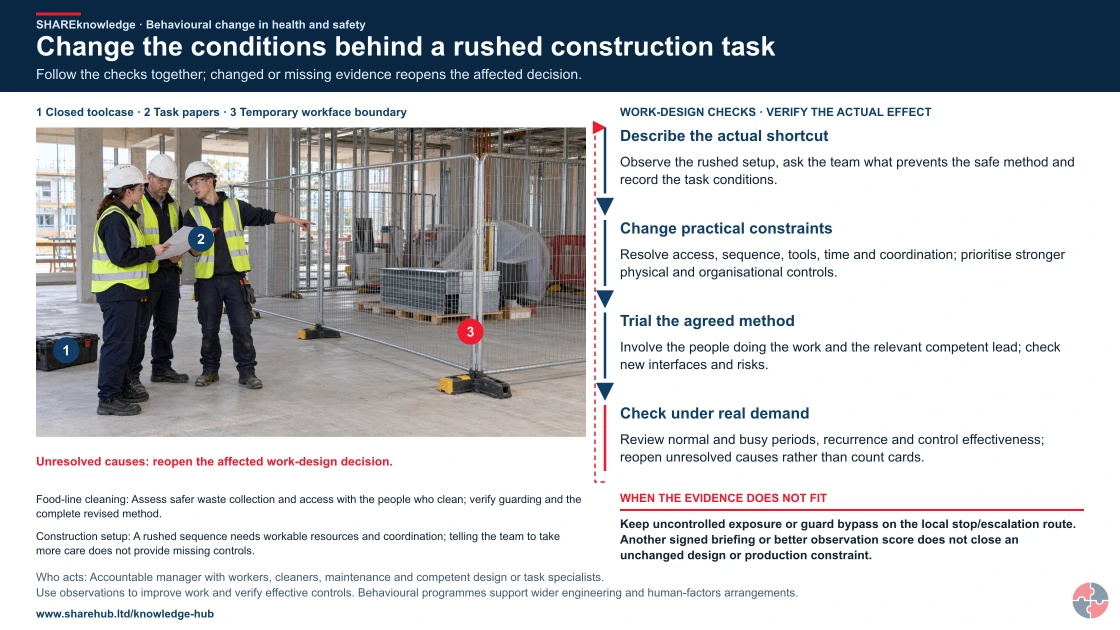
An illustrative construction-shell workface shows three normal colleagues discussing inert task papers beside a closed toolcase and a temporary fenced material/work interface. One literal picture key identifies 1 closed toolcase, 2 task papers and 3 temporary workface boundary. The normal scene establishes no rushing, unsafe shortcut, worker intent or blame, competence, assessed boundary, approved method, completed trial or successful change. Four work-design checks follow: Describe the actual shortcut: Observe the rushed setup, ask the team what prevents the safe method and record the task conditions. Change practical constraints: Resolve access, sequence, tools, time and coordination; prioritise stronger physical and organisational controls. Trial the agreed method: Involve the people doing the work and the relevant competent lead; check new interfaces and risks. Check under real demand: Review normal and busy periods, recurrence and control effectiveness; reopen unresolved causes rather than count cards. Three forward arrows show the order of the checks; a separate feedback arrow returns unresolved causes to the affected work-design decision. It is not a physical access route or automatic work release. Keep uncontrolled exposure or guard bypass on the local stop/escalation route. Another signed briefing or better observation score does not close an unchanged design or production constraint. Who acts: Accountable manager with workers, cleaners, maintenance and competent design or task specialists. Use observations to improve work and verify effective controls. Behavioural programmes support wider engineering and human-factors arrangements. Food-line cleaning: Assess safer waste collection and access with the people who clean; verify guarding and the complete revised method. Construction setup: A rushed sequence needs workable resources and coordination; telling the team to take more care does not provide missing controls. A signed briefing, pictured toolcase or observation score cannot establish that a practical constraint has been removed. Keep the local stop/escalation route independent of routine review; no operating method, legal allocation, disciplinary rule or personal capability finding is added.
- Describe the actual shortcut. Observe the rushed setup, ask the team what prevents the safe method and record the task conditions.
- Change practical constraints. Resolve access, sequence, tools, time and coordination; prioritise stronger physical and organisational controls.
- Trial the agreed method. Involve the people doing the work and the relevant competent lead; check new interfaces and risks.
- Check under real demand. Review normal and busy periods, recurrence and control effectiveness; reopen unresolved causes rather than count cards.
When the evidence does not fit: Keep uncontrolled exposure or guard bypass on the local stop/escalation route. Another signed briefing or better observation score does not close an unchanged design or production constraint.
Who acts: Accountable manager with workers, cleaners, maintenance and competent design or task specialists.
Changed workplace
Food-line cleaning: Assess safer waste collection and access with the people who clean; verify guarding and the complete revised method.
Construction setup: A rushed sequence needs workable resources and coordination; telling the team to take more care does not provide missing controls.
Evidence check: Use observations to improve work and verify effective controls. Behavioural programmes support wider engineering and human-factors arrangements.
Primary references: HSE: behavioural safety · HSE: maintenance of work equipment
Open the complete HD image (new tab)Download image

Primary references: HSE: behavioural safety · HSE: maintenance of work equipment

- Waste-access demand
- Assess external collection
- Cleaner trial and busy-period check
Read the labels in the full-size drawing
- BEFORE: access demand
- OPTION TO ASSESS
- Inaccessible collection
- Externally serviceable collection
- Both views isolated and non-running
Understand the demand
Ask cleaners where waste collects, what access the task requires, which tools are usable and what changes during busy production. Record design and production constraints without blaming the worker.
Assess a physical redesign
Consider a suitable externally serviceable collection or cleaning arrangement that removes the need to reach the danger zone. A competent machinery designer must assess guarding, isolation, maintenance and new risks.
Trial and review
Trial the agreed method under safe conditions with cleaners and maintenance. Then check busy-period use, cleaning quality, recurrence and any transferred work.
Both illustrative states are isolated and non-running. This is not a guard-bypass demonstration or a generic isolation procedure. Keep operating instructions distinct from later monitoring of whether the new method works.
What are the key facts about behavioural change?
The key facts are that behaviour is shaped by task design, capability, leadership, culture and consequences.
Behaviour has context
People rarely act in isolation; their choices are shaped by equipment, workload, supervision, time pressure, competence and workplace norms.
Unsafe acts are signals
A shortcut may reveal a poorly designed job, impractical procedure, weak communication or competing priority.
Leadership sets the climate
Workers learn what really matters from what leaders ask about, tolerate, fund, praise and challenge.
Observation needs learning
Counting observations is weak unless the findings drive better controls, coaching and system improvement.
Fairness matters
A blame culture suppresses reporting and hides weak controls; a just approach improves learning.
Evidence beats slogans
The test is whether risk-critical controls are easier to use, better understood and more consistently applied.
What is behavioural change in health and safety?
Behavioural change is the deliberate improvement of workplace conditions and habits that influence safe or unsafe performance.
A useful behavioural change approach does not start with the assumption that workers are careless. It starts by asking what the job demands from people, whether the equipment and workplace layout support safe work, whether the procedure matches reality, and what the organisation rewards or tolerates.
Behavioural safety programmes often use observation, feedback and coaching. These can be valuable, but only if they sit inside a wider human-factors approach. If a programme records that workers are not wearing eye protection, the next question is not simply 'why did they fail?' It is whether the task creates fogging, discomfort, poor vision, incompatible PPE, weak supervision or pressure to rush.
The strongest programmes connect behaviour to risk. They focus on activities where the consequence matters, such as isolation, work at height, driving, manual handling, confined spaces, hot work, chemical handling or guarding. The output should be practical improvement, not a poster campaign.
Job. The task, equipment, environment and workload shape performance. Usable procedures, suitable tools, realistic staffing and work observations.
Individual. People need capability, attention, health, experience and confidence to perform safely. Training, competence checks, fatigue controls and supervision.
Organisation. Leadership, culture, resources and priorities influence what people actually do. Management review, action close-out, consultation and resource decisions.
Consequences. People respond to what is reinforced or tolerated. Leaders challenge unsafe speed and recognise good reporting.
Learning. Behavioural evidence should improve the system. Actions remove barriers, improve work design and prevent repeat drift.
Why do people behave unsafely at work?
People may behave unsafely when the workplace makes the unsafe way easier, faster, more familiar or more rewarded than the safe way.
A shortcut is a signal to investigate


Read the complete visual as text
- ACCESS: Waste builds up where safe cleaning is difficult. Observe reach, tools and access with the people doing the work.
- PRESSURE: Production targets, staffing and stoppage time can reward a shortcut. Change the conditions that make it attractive.
- PROTECTION: Restore suitable guarding, isolation and a usable cleaning method. A behaviour observation cannot replace them.
- LEARNING: Test the redesigned method in normal and busy periods. Repeated bypass reopens the task review.
Many unsafe behaviours are not deliberate rule-breaking. They can be predictable responses to awkward access, poor tool availability, confusing instructions, fatigue, production pressure, lack of feedback, weak supervision, poor lighting, noise, heat, PPE problems or normalised shortcuts.
A worker may bypass a guard because cleaning cannot be completed otherwise. A driver may ignore segregation because the yard layout forces poor reversing. A maintenance technician may improvise because the isolation procedure does not match the plant. A supervisor may accept poor housekeeping because the programme rewards output but not control health.
Behavioural change therefore needs diagnosis. Before telling people to 'be careful', the organisation should understand performance-influencing factors and remove the conditions that repeatedly push people towards risk.
Time pressure. People compress checks or take shortcuts. What planning or resourcing makes the safe method realistic?
Work design. Controls are awkward, slow or physically difficult. Can the task be redesigned, engineered or simplified?
Procedure quality. Instructions do not match real work. Have workers tested and improved the procedure?
Competence. People do not understand the risk or control reason. What task-specific competence is needed?
Supervision. Unsafe work is not challenged early. What should supervisors verify and coach?
Culture. Teams learn what is normal from repeated signals. What do leaders reward, tolerate and follow up?
How does human performance affect this work?
Use the examples to investigate why behaviour made sense in its context and which constraints influenced the work. Avoid choosing a behaviour intervention before checking task design, equipment, workload and organisational expectations.
Select any box to open its explanation below. You can also use the grouped text headings. Several explanations can stay open for comparison.

Original SHARElearn teaching overview. Arrows show groupings, not a causal sequence. Examples are fictional; no box establishes an actual cause, diagnosis or responsibility.
Inspect the full-size overview (new tab)
Start with the work context
Human performance in context
Human factors considers how the job, the individual and the organisation interact. A human action is a starting point for inquiry, not a complete explanation.
Fictional example: A pump control is operated incorrectly. The team examines what the operator could see, the control layout and the work arrangements.
Investigate and improve: Reconstruct the information and options available at the time. Ask what made the action understandable and what would prevent or tolerate it.
Unintended errors
An action or decision goes wrong without an intended departure from the expected method. Distinguish doing the wrong action from choosing an unsuitable plan.
Fictional example: A person intends to stop pump A but presses the adjacent control for pump B.
Investigate and improve: An outcome alone does not establish intent. Compare the person’s account, task sequence, equipment and available records; retain uncertainty.
Unintended errors: actions and decisions
Skill-based action errors
A familiar task is intended correctly but its execution goes wrong through a slip or lapse. Experienced people can be affected.
Fictional example: A routine restart is interrupted and the person resumes at the wrong point.
Investigate and improve: Examine distractions, task design and place-keeping aids. Repeating training alone does not remove the conditions that permit these errors.
Slips of action
The intended action is clear, but a different action is performed.
Fictional example: While reaching to stop a pump, a person operates a similar-looking neighbouring switch.
Investigate and improve: Check control spacing, identification, feedback, visibility and interruption. Consider clearer separation or error-tolerant design, with competent review and testing.
Lapses of memory
A needed step is forgotten or the person loses their place.
Fictional example: After an interruption, a person omits a required check while believing the sequence is complete.
Investigate and improve: Check the interruption and restart arrangements. Consider point-of-use prompts, reliable step records and proportionate independent checks for critical steps.
Mistakes in planning or judgement
The chosen action is carried out as intended, but the plan or judgement is unsuitable.
Fictional example: A person selects a familiar response to a warning, believing it fits the present conditions.
Investigate and improve: Check what was known, what the rule covered and how the situation was understood. Consider information, decision support and task-specific competence.
Rule-based mistakes
A remembered rule is misapplied, or an unsuitable rule is used. An apparently missing good rule also needs inquiry: was it known, understood and applicable?
Fictional example: A response suitable for pump A is applied to pump B even though their isolation requirements differ.
Investigate and improve: Inspect the actual procedure and its scope, access and revision. Explore interpretation. Missing a step does not by itself prove a deliberate deviation.
Knowledge-based mistakes
An unfamiliar situation is approached through reasoning without a suitable established solution; the resulting judgement is wrong.
Fictional example: An unusual pump condition is interpreted using incomplete information, leading to an inappropriate response.
Investigate and improve: Examine information gaps and available support. Improve escalation, diagnostic aids and arrangements for obtaining competent advice before uncertain work proceeds.
Deliberate deviations: understand why
Deliberate deviations / violations
A rule or procedure is knowingly departed from. The departure is intentional; harm need not be intended. Establish this distinction through evidence.
Fictional example: A required verification is knowingly bypassed to continue a task.
Investigate and improve: Ask why the rule was bypassed, whether it was workable and what the organisation encouraged or tolerated. Fair accountability and system improvements can both be needed.
Routine deviations
Departures become the usual way work is carried out.
Fictional example: A team commonly skips a required handover check and supervisors accept the practice.
Investigate and improve: Compare written arrangements with everyday work, including management knowledge and response. Make the safe method workable and verify that practice changes.
Situational deviations
A departure is associated with conditions such as time pressure, insufficient resources or unsuitable equipment. These conditions do not authorise unsafe work.
Fictional example: The correct equipment is unavailable and a deadline encourages an improvised shortcut.
Investigate and improve: Check resources, conflicting targets and whether people can stop and escalate. Remove the pressure or constraint rather than treating the shortcut as the solution.
Exceptional deviations
A departure occurs in unusual circumstances outside normal practice. This label is not an automatic justification.
Fictional example: During an unfamiliar equipment upset, a person knowingly bypasses a rule while trying to restore operation.
Investigate and improve: Reconstruct the situation and information available. Review abnormal-event preparation, support, escalation and protection; do not infer malicious intent from the outcome.
Check factors across every branch
Performance influencing factors
Conditions affecting performance can sit within the job, the individual or the organisation. Consider them across errors and deviations.
Fictional example: A difficult control layout combines with an interrupted shift and a production target.
Investigate and improve: Identify specific conditions, their evidence and how they interacted. Do not turn a list of factors into unsupported causal conclusions.
Job and task factors
Consider the work itself: equipment, interface design, instructions, workload, environment, timing and communication.
Fictional example: Two similar controls are poorly lit while alarms and interruptions compete for attention.
Investigate and improve: Observe representative work safely, compare intended and actual demands, and test feasible design changes with the people doing the task.
Individual factors
Consider relevant knowledge, experience, abilities and current needs fairly. Observed behaviour does not establish a health diagnosis or intent.
Fictional example: A newly assigned worker does not understand an unfamiliar alarm; a colleague also reports yawning after a long shift.
Investigate and improve: Check induction, understanding, shift and welfare information through appropriate private routes. Yawning alone proves neither fatigue nor the cause of an event; seek competent support when needed.
Organisational factors
Consider staffing, resources, supervision, targets, planning, culture, change management and learning from earlier events.
Fictional example: A known leak remains open because repair responsibility is unclear and closure is recorded without checking the work.
Investigate and improve: Trace decisions, ownership and earlier warnings. Improve the underlying arrangements and verify effectiveness, rather than closing the investigation at “operator error”.
Try the evidence questions
Choose one fictional pump or travel example. What is observed, what remains a hypothesis, which job or organisational factor needs checking, and what improvement would you test? Explain what evidence would change your view.
Explore at your own pace. These are optional thinking prompts: this page does not save answers, assess performance or create a learning record.
Sources and scope
Original SHARElearn overview informed by HSE guidance. The diagram groups concepts for learning; it does not model a causal sequence. Guidance checked 1 November 2026.
Continue with the incident and accident investigation course. The course outline explains its learning, optional reflections and completion requirements.
Which behaviour change models are useful?
Models are useful thinking aids, but they are not legal tests and should not replace risk assessment or proper control.
Behaviour models can help an organisation structure its thinking. The Theory of Planned Behaviour draws attention to attitudes, perceived norms and perceived control. ABC approaches consider antecedents, behaviours and consequences. Nudge thinking looks at how choice architecture, prompts and default options influence decisions.
These models become practical when they are applied to a real task. For example, if workers skip pre-use checks, the issue may be an antecedent problem because the checklist is hidden or too long, a capability problem because people do not understand what defects matter, or a consequence problem because supervisors only react when production is delayed.
The limitation is important. A model can help explain behaviour, but it does not prove that a duty holder has controlled risk. The controls still need to be suitable, implemented, monitored and reviewed.
Job, individual and organisation. Explains how human performance is shaped. Assess task design, competence and organisational conditions.
Theory of Planned Behaviour. Explores attitudes, norms and perceived control. Understand why people believe a shortcut is acceptable or unavoidable.
ABC approach. Looks at antecedents, behaviour and consequences. Improve prompts, remove obstacles and reinforce safe performance.
Nudge and choice design. Looks at defaults, cues and friction. Make correct storage, PPE, reporting or isolation easier to do.
Just culture lens. Separates system weakness from culpable behaviour. Investigate incidents fairly and keep reporting open.
Plan-Do-Check-Act. Structures implementation and review. Turn behaviour findings into managed improvement.
What are the limits of behavioural safety programmes?
Behavioural safety is limited when it is used to compensate for weak engineering, poor work design or ineffective management.
A behaviour programme can be useful where it improves observation, feedback, consultation and learning. It becomes harmful when it shifts attention away from hazards that should be eliminated, substituted, engineered out or tightly managed.
For high-risk work, behaviour is only one part of the barrier set. A worker's attention should not be the main control for unguarded machinery, uncontrolled chemical exposure, fragile roofs, live electrical conductors, confined atmospheres, overpressure or major accident hazards.
The strongest test is fairness: would the organisation still blame behaviour if it had failed to provide the correct equipment, realistic procedure, competent supervision, adequate staffing or a safe system of work?
Worker-blame focus. People stop reporting and learning is lost. Investigate job, individual and organisational factors.
Observation counts as the main target. Quantity replaces useful learning. Measure risk reduction, quality of findings and action closure.
Ignoring engineering controls. Hazards remain uncontrolled. Apply hierarchy of control before behaviour coaching.
Generic campaigns. Messages do not change real work. Target risk-critical tasks and specific barriers.
Punitive league tables. Teams hide problems. Use coaching, consultation and fair accountability.
No management action. Workers see reporting as pointless. Close actions visibly and explain decisions.
In a refinery, rising observation and PPE-compliance counts can coexist with overdue shutdown proof tests and recurring leaks. The process-safety owner should sample the critical-barrier register, demand owners and dates for each impairment, and hold affected operations if the assessed protection is unavailable. Worker observations may reveal weak conditions, but the decision measure is restored and verified containment and shutdown protection—not the card count.
How should behavioural change interventions be designed?
Interventions should target risk-critical work, involve the people doing the task and change the conditions that make unsafe behaviour likely.
Start with a specific problem rather than a broad slogan. Examples include workers entering a segregated vehicle route, supervisors accepting missing permits, maintenance teams skipping isolation verification, or employees failing to report early signs of stress or fatigue.
Then diagnose the context. Observe the task, talk to workers, review incidents, inspect equipment, check training and look at leadership pressures. Decide whether the answer is engineering change, better procedure, improved supervision, training, communication, procurement, planning or a combination.
Implementation should be tested. A new prompt, checklist or coaching session is only successful if it changes the real task and does not create new problems.
Define the risk-critical behaviour. Describe the exact action and task context. Clear link to risk register, incident trend or assurance finding.
Consult workers. Ask what makes the safe method difficult. Worker feedback and agreed improvement options.
Identify performance factors. Look at job, individual and organisational causes. Observation notes, evidence review and causal analysis.
Choose controls. Improve work design before relying on reminders. Engineering, planning, procedure, competence and supervision actions.
Pilot and learn. Test the change with the people affected. Feedback, adjustment and practical usability checks.
Monitor and review. Check whether the behaviour and risk outcome improve. Trend data, inspection results and management review.
How should behaviour observations be used without creating clutter?
Behaviour observations should be short, specific and useful enough to improve controls, not a numbers exercise.
Observation programmes often fail when they become a monthly quota. People complete cards because the system asks for numbers, not because the finding improves risk control. Good observations focus on the real work, the conditions around the behaviour and whether a control is usable.
For frontline checks, binary questions can be useful because they create comparable data. A short yes/no check on whether a pre-use inspection was completed, whether the isolation was proven, or whether the task-specific briefing was understood can reveal patterns across teams.
For supervisor and HSSE observations, more interpretation is appropriate. The observer should look at documents, conditions, behaviours and records, then rank findings and assign verifiable actions.
Frontline verification. Short checks completed by workers or supervisors during real work. Use binary questions for repeatable data; if 6 of 10 people have not received task training, the trend is immediately visible.
Second-line checks. Leader, supervisor or HSSE checks of documents, behaviour and records. Keep checks repeatable but allow experienced judgement; rank findings and assign verifiable actions.
Third-line assurance. Internal audit, independent review or specialist verification. Use an audit plan, sample evidence, interview people and test whether actions genuinely reduce risk.
Worker conversations. Short coaching discussion at the task location. Ask what makes safe work difficult and what would make the control easier to use.
Trend review. Review findings across teams, shifts and locations. Look for repeated conditions rather than isolated worker fault.
Could an improving observation count hide a weaker control?
A rising proportion of positive observation cards is useful only if the observations still represent the work and the controls that matter. Check which tasks, shifts and contractors were observed, whether the definition of a positive result changed and whether difficult activities were avoided. A quiet reporting system may mean fewer problems, but it can also mean people do not expect a useful or fair response.
For an illustrative isolation campaign, compare observations of actual maintenance interventions with the reported improvement. Speak with maintainers about unavailable isolation points, time pressure and workarounds, and check a sample of completed jobs against the intended isolation method. If cards look better but the same access problem remains, fund the physical or planning change and test its use. Ask whether workers can raise a concern and see an action completed. Coaching can support that change; the card total alone cannot demonstrate that hazardous energy was controlled.
Guidance and scope: Original SHARE assurance questions applying HSE GB behavioural-safety guidance. No target percentage, reporting quota or predictive accident-rate relationship is proposed. HSE behavioural safety guidance HSE behavioural safety introduction
How do leaders influence behavioural change?
Leaders influence behavioural change by shaping priorities, resources, expectations, accountability and trust.
Leadership is not just communication. Workers notice whether leaders stop unsafe work, fund improvements, give supervisors time to coach, act on concerns, protect maintenance windows and avoid rewarding unsafe speed.
Strong leaders create conditions where safe performance is expected and practical. They ask better questions: what is making this difficult, what have we learned, what actions are overdue, and what controls are we asking people to rely on?
Behavioural change becomes credible when leaders respond to evidence. If workers report repeated guarding defects or workload pressure and nothing changes, the programme will quickly lose trust.
Stop-work support. People pause when controls are uncertain. Examples of work stopped without blame.
Action close-out. People keep reporting because they see results. Closed actions with effectiveness checks.
Resource decisions. Teams believe controls matter as much as output. Budget, staffing and maintenance decisions.
Supervisor coaching. Safe methods are reinforced in real work. Planned conversations and field verification.
Learning reviews. Incidents become system improvements. Management review of trends and recurring causes.
Fair accountability. People disclose honest error and challenge reckless behaviour. Just-culture guidance and consistent decisions.
How does consultation support behavioural change?
Consultation supports behavioural change by bringing real work knowledge into risk assessment, procedures and improvement decisions.
Workers and safety representatives often know which controls are awkward, which procedures are out of date, which shortcuts are normal and which messages are not believed. Consultation turns that knowledge into better design.
Effective consultation should happen before changes are made, during implementation and after use. It should include contractors, temporary workers and affected teams where their work is part of the risk picture.
The test is whether consultation changes decisions. If the same issue is raised repeatedly with no visible response, consultation becomes a ritual rather than a control.
Task walk-through. Understand how the job is really done. Observed gaps between procedure and practice.
Worker workshop. Design practical controls with affected teams. Options considered and agreed actions.
Safety representative meeting. Review themes across teams. Minutes, actions and feedback to workforce.
Contractor feedback. Understand interface and SIMOPS pressures. Contractor concerns included in planning.
Post-change review. Check whether the intervention works. Changes adjusted after worker feedback.
Anonymous feedback route. Capture concerns people may not raise openly. Trends reviewed and acted upon.
How should fairness and just culture be handled?
Fairness means investigating behaviour in context while still holding people accountable for deliberate or reckless choices.
A fair approach does not remove accountability. It improves it. Honest error, unclear procedure, poor design, lack of training, routine drift, conscious risk-taking and reckless disregard should not be treated as the same thing.
After an incident or unsafe act, the organisation should ask what the person was trying to achieve, what they knew, what was normal in the team, what supervision existed, what equipment or procedure was available, and whether the same behaviour had been tolerated before.
This protects learning. If workers fear automatic discipline, they may hide near misses. If reckless behaviour is ignored, trust is also damaged. Just culture sits between those extremes.
Human error. Slip, lapse or mistake in a system that should catch it. Improve design, checking, prompts and competence.
At-risk behaviour. Shortcut chosen because it seems normal or easier. Coach, remove incentives and improve controls.
Routine drift. Unsafe method becomes accepted over time. Leadership intervention, supervision and system redesign.
Rule violation under pressure. Known rule bypassed to meet competing demand. Review planning, supervision, resource and accountability.
Reckless behaviour. Conscious disregard of serious risk. Formal accountability alongside system review.
Management failure. Unsafe conditions knowingly tolerated. Senior action, governance review and corrective measures.
Which legal duties apply in Great Britain and Northern Ireland?
The applicable legal route depends on where the work takes place. The duties below are scoped to Great Britain and Northern Ireland; a task assessment and the current instruments determine the actual requirements.
Great Britain
GB Health and Safety at Work etc. Act 1974 and Management Regulations 1999 require risk assessment, suitable arrangements, safe systems, information, training and supervision. Behavioural observation is a tool, not a substitute for those duties. Consult workers on health and safety matters and test whether the actual task can be done safely.
Northern Ireland
The Health and Safety at Work (Northern Ireland) Order 1978 and Management Regulations (Northern Ireland) 2000 provide the parallel NI foundation. Apply the relevant NI consultation and task-specific duties. Check HSENI guidance and the current instrument for a particular workplace; a GB instrument should not be presented as NI law.
How should behavioural change appear in a risk register?
Behavioural change should appear as specific risk-critical behaviours, performance-influencing factors and improvement controls.
A risk register should not simply say 'poor behaviour'. That phrase hides the real cause. A better entry describes the task, the hazardous outcome, the behaviour that defeats a control, the conditions that make that behaviour likely and the actions needed to improve the system.
For example, if operatives remove gloves during chemical decanting, the register should explore glove suitability, dexterity, heat, contamination, supervision, procedure, training and availability. If drivers walk through vehicle routes, it should explore yard layout, convenience, barriers, signage, lighting and supervision.
The control owner should be able to show evidence that the behaviour has changed because the underlying condition has been improved.
| Scenario | Behavioural issue | Controls and evidence |
|---|---|---|
| Permit handover | Incoming team signs without understanding isolations. | Handover checklist, supervisor verification, field check and permit audit. |
| PPE non-use | Workers remove PPE because it interferes with task. | PPE trial, fit, comfort, compatibility, training and observation feedback. |
| Work at height | Short access tasks completed without proper equipment. | Planning threshold, access equipment availability and supervisor checks. |
| Chemical handling | Decanting steps altered to save time. | Task redesign, closed transfer, COSHH briefing and exposure monitoring. |
| Maintenance | Isolation verification skipped during pressure. | Permit hold point, competent authorisation and stop-work support. |
| Reporting | Near misses not reported because nothing changes. | Visible close-out, feedback to teams and trend review. |
How could Riverside Leisure Ltd manage behavioural change?

Riverside Leisure Ltd could manage behavioural change by linking worker feedback, supervision, training and assurance to real risks across leisure operations.
Riverside Leisure Ltd
Riverside Leisure Ltd operates leisure, hospitality and outdoor activity sites where safe behaviour depends on clear work design, visible supervision, seasonal-worker competence and fast learning from everyday observations.
Riverside would start with a behaviour risk profile rather than a generic campaign. Its risk register would identify where behaviour matters most: pool supervision, chemical dosing, food hygiene, lifting and handling, lone working, guest interaction, vehicle movements, emergency response and outdoor activity controls.
Managers would consult lifeguards, maintenance teams, cleaners, activity leaders and contractors to understand real work. If staff skip pre-opening checks, the organisation would look at shift start times, checklist design, staffing, access to equipment, supervisor review and whether defects are acted on quickly.
Training would be layered. All staff would receive awareness on speaking up, reporting, stop-work and fair culture. Higher-risk staff would receive task coaching on pool plant, manual handling, work at height or emergency response. Supervisors would be trained to use short coaching conversations, verify critical controls and close actions with evidence.
Riverside would analyse observation data by theme rather than by blame. Frontline checks would use simple yes/no questions for repeatability. Second-line supervisor reviews would examine records, task conditions and worker feedback. Third-line audits would sample higher-risk activities, interview staff and check whether actions have actually changed the task.
Continuous improvement would be visible: repeated findings would trigger procedure changes, procurement decisions, refresher training, layout improvements or leadership review. Teams would be told what changed because they raised concerns, so consultation feels worthwhile and reporting remains open.
Risk register. Identifies risk-critical behaviours by activity and consequence. Behavioural risk profile and action owners.
Policies and standards. Sets expectations for reporting, supervision, fair culture and stop-work. Policy, induction and manager briefings.
Training. Uses awareness, task coaching and supervisor development. Training matrix and observed competence.
Contractor management. Includes contractor behaviours in induction, permits and monitoring. Contractor briefings and joint inspections.
Monitoring. Uses frontline checks, leader walks and independent audits. Trend dashboards and sampled evidence.
Learning. Turns repeated observations into design and system improvements. Action close-out with effectiveness review.
What training supports behavioural change?
Training should be matched to role, risk and influence rather than delivered as one generic behavioural safety course.
Everyone needs enough awareness to understand reporting, stop-work, speaking up and why procedures matter. People in risk-critical roles need more practical coaching on the specific behaviours and controls that protect them and others.
Supervisors need a different level of skill. They need to observe work without turning every conversation into a fault-finding exercise, challenge drift, coach respectfully, identify system barriers and escalate issues they cannot fix.
Managers and HSSE professionals need to understand human factors, consultation, data quality, just culture and how to turn trends into improvement plans.
Competence means a person can carry out the actual task safely, recognise a changed condition and respond correctly. Attendance alone is insufficient. The matrix makes assessment, ownership, records and reassessment explicit.
| Role | Required learning | How competence is assessed | Assessor or owner | Record | Reassess when |
|---|---|---|---|---|---|
| All workers and contractors | Recognise task hazards, speak up, report defects and use stop-work routes. | Scenario discussion plus a live demonstration of reporting or stopping a task. | Supervisor | Induction and sampled on-task check | When the task, work system or reporting route changes; after drift or incident. |
| Risk-critical task operators | Explain why the critical barrier matters, check it and respond to an abnormal condition. | Observed performance on the actual task or realistic simulation. | Task owner or competent assessor | Task authorisation and observation record | After process change, lapse, failed observation or new risk. |
| Supervisors | Diagnose conditions behind an act, coach fairly, verify control and escalate system barriers. | Observed coaching and review of a real case with action closure. | Operations manager | Competence review and closed-action sample | After repeated findings or change in role. |
| Managers and HSSE advisers | Evaluate whether the programme reduces risk and whether action data hides major hazards. | Review a trend, test evidence on site, and justify engineering or organisational action. | Senior manager | Review decision and assurance record | At management review and after significant event. |
How does behavioural change support study and professional development?
Behavioural change supports study by helping learners explain how people, jobs and organisations interact in real workplace scenarios.
For NEBOSH National General Certificate learners, this topic connects strongly to leadership, consultation, competence, supervision, monitoring and incident investigation. Scenario answers should not simply say 'train the workers'. They should explain why behaviour occurred and what management actions would prevent recurrence.
For Diploma-level learners and experienced professionals, the topic becomes more analytical. Strong answers examine human failure, performance-influencing factors, culture, organisational learning, assurance evidence and the ethical limits of behaviour-based programmes.
In practical professional development, behavioural change is useful for managers, supervisors, auditors and investigators because it improves the quality of questions asked at the workplace.
New learner. Behaviour is shaped by job, individual and organisation. Use examples such as PPE, reporting, supervision and shortcuts.
NEBOSH NGC learner. Leadership, consultation and monitoring influence behaviour. Explain controls, evidence and improvement in scenario answers.
NEBOSH Diploma learner. Human factors and culture need deeper analysis. Discuss performance-influencing factors, just culture and assurance.
Supervisor. Coaching and verification are daily controls. Use observations to remove barriers and reinforce safe work.
Manager. Resource and priority decisions shape behaviour. Review trends and act on repeated findings.
Auditor or investigator. Behavioural evidence should be triangulated. Compare documents, observations, interviews and outcomes.
How can a management system make behavioural change robust?
A management system makes behavioural change robust by linking leadership, planning, competence, operation, monitoring and improvement.
Behavioural change should not sit outside the management system as a separate campaign. It should be part of risk assessment, safe systems of work, consultation, supervision, inspection, audit, incident learning and management review.
A management cycle is useful because it connects leadership, planning, competence, operations, performance checks and improvement. Use A voluntary management framework as a voluntary system reference; the current licensed text is needed for any exact clause application.
The management system should be able to show that behavioural findings lead to real change in work design, equipment, procedure, supervision or resources.
| Management-system stage | Plain-English expectation | Behavioural change evidence |
|---|---|---|
| Leadership and worker participation | Leaders involve workers and shape priorities. | Consultation records, leadership walks and stop-work support. |
| Planning | Risk-critical behaviours and performance factors are identified. | Risk register, incident themes and improvement plans. |
| Support | People have competence, information and confidence to act safely. | Training, communication and supervisor coaching records. |
| Operation | Work is designed and controlled so safe performance is practical. | Procedures, equipment, staffing and task verification. |
| Performance evaluation | Behavioural evidence is monitored and reviewed. | Inspections, audits, observation trends and management review. |
| Improvement | Findings lead to better controls and learning. | Action close-out, effectiveness checks and shared learning. |
What should organisations learn from behaviour-related incidents?
Organisations should learn how the system shaped behaviour before deciding what action is fair and effective.
Behaviour-related incidents often reveal a mismatch between written work and real work. A procedure may require two people, but only one is rostered. A checklist may require careful inspection, but the lighting is poor. A rule may prohibit a shortcut, but supervisors have tolerated it for months.
Investigation should identify immediate actions, but it should not stop there. The deeper learning is about performance-influencing factors, decision pressure, leadership signals, competence, supervision, equipment condition and whether previous warning signs were missed.
Actions should change the conditions that made the behaviour likely. A toolbox talk may be useful, but it is rarely enough on its own if the underlying issue is poor design, resource pressure or weak supervision.
Was the rule understood?. People may not know the control reason. Training, briefing and interviews.
Was the safe method practical?. Procedures may not match real work. Task observation and worker feedback.
Was there time and resource?. Production pressure can override controls. Planning, workload and staffing evidence.
Was the issue normalised?. Repeated drift shows management tolerance. Inspection, audit and previous reports.
Did supervision detect it?. Supervision is a live control. Supervisor checks and challenge records.
Did actions improve the system?. Learning fails if only blame is assigned. Effectiveness review and repeat trend.
What are the warning signs that behavioural change is not managed well?
Warning signs include blame language, weak consultation, repeated shortcuts, poor action close-out and observation programmes that measure activity instead of learning.
A poor behavioural programme often looks busy but changes little. There may be many observation cards, posters and briefings, yet workers still report that equipment is poor, procedures are unrealistic and leaders only react after incidents.
The harm can manifest as repeated injuries, near misses, non-reporting, degraded trust, unsafe improvisation, poor PPE use, permit drift, weak isolation, production pressure and repeated audit findings. These are not just attitude problems; they are signals that the system is failing to learn.
The organisation should respond by reviewing whether the programme targets risk-critical work, whether workers are genuinely involved, whether findings are acted on and whether leadership removes the barriers that make unsafe work likely.
Observation quotas dominate. People chase numbers and miss serious conditions. Measure quality, learning and action effectiveness.
Workers blamed first. Near misses go unreported and root causes are hidden. Use just-culture investigation and system review.
Same shortcut repeats. Unsafe method becomes normal practice. Redesign the task and strengthen supervision.
Actions close without evidence. Controls may remain weak. Require verification and effectiveness checks.
Consultation ignored. Workers stop raising practical problems. Feed back decisions and show what changed.
Leadership rewards speed. Teams prioritise output over controls. Align targets, resources and visible leadership behaviour.
How should teams make and test behavioural change decisions?
These two examples show how a duty holder can move from an observed problem to a verified control decision. They are illustrations, not site instructions.
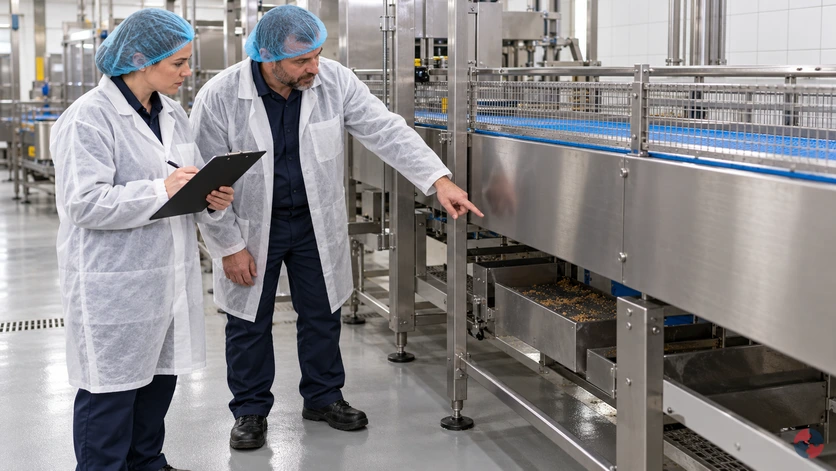
Make safe cleaning achievable


Read the complete visual as text
- Stop the unsafe cleaning task
- Ask what drives the shortcut
- Change the job before another briefing
- The photograph provides topic context. Guard cleaning shortcut is an illustrative learning example; the checks below must be adapted to the actual task.
Guard cleaning: evidence for a lasting correction


Read the complete visual as text
- 1. ACTUAL TASK: Describe where waste collects and how cleaners reach it during normal and busy production.
- 2. PEOPLE AND BASIS: Involve cleaners, the production manager and maintenance. Establish who can stop the line and authorise release.
- 3. BEFORE: Stop the unsafe task, isolate, and examine access, waste build-up, tools, staffing and time pressure.
- 4. VERIFY DURING: Demonstrate the redesigned cleaning method with cleaners; verify guarding and isolation before restart.
- 5. HOLD OR REFER: Keep the task held if safe cleaning still requires guard bypass or isolation cannot be demonstrated.
- 6. HAND BACK AND REVIEW: Record restored controls and outstanding defects; check whether the revised method works during the next busy period.
Guard cleaning shortcut
Task material and setting: A cleaner has repeatedly opened a machine guard to clear waste while the line is moving. A supervisor has recorded three observations and proposes another briefing.
People and prerequisites: The named task owner, competent workers and affected contractors need the task assessment, equipment information and a communication route before work starts.
Before: The production manager and maintenance lead stop the unsafe task, isolate the equipment and observe a normal and busy cleaning cycle with cleaners. They record access, reach, waste build-up, cleaning time, available tools, staffing, stoppage pressure and the reasons people say the guard is opened; the baseline is work-design evidence, not a score against individuals.
During: Before restart, redesign access or cleaning, confirm guarding and isolation, demonstrate the method with cleaners and document who authorises release.
Hold or stop: Hold the job if safe cleaning still requires bypassing a guard or the isolation method cannot be demonstrated.
Decision owner: Maintenance owns the engineering fix; operations owns the safe system; the supervisor verifies use.
Completion and hand back: The supervisor confirms controls are restored, defects are recorded and the work area is handed back only after the stop conditions are closed.
Evidence: Keep the baseline task observations, worker consultation, modification and competence check. After change, sample normal and peak shifts and record whether waste can be cleared with the guard effective, cleaning time and stoppages, defects, reported workarounds and near misses. Set an owner and review date; any renewed bypass, impracticable step or adverse trend reopens the design decision rather than triggering coaching alone.
Changed conditions: A spike in observation cards or short-term compliance is not success. Evidence is that guarding remains effective, the task is practicable on a busy shift and the redesigned method removes the reason for the shortcut without shifting risk elsewhere.
Source scope: The HSE human-factors and behavioural-safety sources are Great Britain technical guidance. Their control-design principles may inform work in Northern Ireland, but they are not NI legal authority; apply the separate NI duties and task assessment.
Vehicle-route shortcut
Task material and setting: Workers cross a vehicle route to reach stores despite signs and coaching. The crossing is the shortest path from the work area.
People and prerequisites: The named task owner, competent workers and affected contractors need the task assessment, equipment information and a communication route before work starts.
Before: The site manager maps pedestrian journeys and vehicle movement with drivers and walkers. Segregation, barrier placement and a convenient safe route come before reminders.
During: Test the revised route in day and night conditions, brief contractors, and inspect barriers and crossing visibility.
Hold or stop: Stop vehicle operations where people and vehicles cannot be separated or controlled under the current layout.
Decision owner: The site manager owns layout and traffic rules; supervisors verify compliance and report defects.
Completion and hand back: The supervisor confirms controls are restored, defects are recorded and the work area is handed back only after the stop conditions are closed.
Evidence: Keep route drawings, consultation notes, change records, training and near-miss trend checks.
Changed conditions: If deliveries or shift patterns change, reassess the route before treating noncompliance as worker behaviour.
How does the control hierarchy limit behavioural interventions?
Eliminate a hazardous task or exposure first. Reduce it through substitution or redesign, isolate people from the hazard, use engineering controls, then procedures, supervision and competence. PPE is a final layer for residual risk. Behavioural prompts and observation can support every level, but they cannot carry a failed guard, unsafe layout or missing isolation on their own.
A useful intervention records the risk-critical barrier, what makes it hard to use, who can change that condition, how the change will be demonstrated and what finding triggers a further redesign.
What does official guidance add to this decision?
Use worker participation and observations to find weak controls and work design. Verify the hazard controls themselves rather than treating behaviour counts as proof of safety.
Use the current HSE behavioural safety guidance and the jurisdiction-specific duties listed on this page to verify the actual task and controls.
If a contract or competent design specifies a published technical standard, obtain authorised access to its current text and check its exact scope and edition. Apply the standard only within its stated scope; this guidance does not reproduce its clauses.
Which national legal route governs this decision?
Use the rule for the place and the actual activity. These rows identify the topic-specific work-risk route; existing legal sections explain other relevant instruments.
| Direct authority | Jurisdiction | Application to this topic | Practical evidence |
|---|---|---|---|
| Management of Health and Safety at Work Regulations 1999 | Great Britain | Risk assessment and preventive arrangements must address actual task design, not rely on behaviour messaging. | Applicability, task assessment, control owner and review record. |
| Management of Health and Safety at Work Regulations (Northern Ireland) 2000 | Northern Ireland | NI risk assessment and arrangements follow the separate NI regulations. | Applicability, task assessment, control owner and review record. |
How can the hierarchy of controls reduce risk before relying on changes in worker behaviour?
For each controllable work hazard, the five HSE levels and ERICPD guide a specific decision. A stronger measure is assessed for feasibility before reliance on procedures or personal protection; the owner checks whether it works and stops the task on failure. HSE examples are GB regulator guidance applied as technical principles in NI, not NI law; use the separate NI legal map. See HSE five-level hierarchy of control; HSE five-level hierarchy of control
How can the ERICPD hierarchy of controls reduce risk before relying on changes in worker behaviour?

| Material harm route | Five levels and ERICPD control choice | Higher-order feasibility and risk transfer | Owner, effectiveness check and stop condition |
|---|---|---|---|
| Guard bypass during cleaning | Elimination / ERICPD Eliminate: Remove the need to reach moving parts by redesigning cleaning; Substitution / Reduce: Use a different cleaning method that avoids access while running; Engineering / Isolate and Control: Provide fixed guarding and verified isolation; Administrative / Control and Discipline: Consult cleaners, create workable instructions and review drift; PPE / PPE: PPE cannot control moving machinery contact. | Cleaning is needed, but a briefing cannot compensate for an impossible guarded method | Maintenance and operations test the revised method; stop when safe cleaning still needs bypass See HSE HSG48: Reducing error and influencing behaviour |
| Pedestrian shortcut across vehicle route | Elimination / ERICPD Eliminate: Eliminate the crossing through route redesign; Substitution / Reduce: Move stores or access to a safer side of the site; Engineering / Isolate and Control: Install segregation and a convenient protected crossing; Administrative / Control and Discipline: Set delivery times, brief users and inspect for recurring shortcuts; PPE / PPE: High-visibility clothing is residual visibility only. | A crossing may remain, but its location must work during real shifts | Site manager checks actual pedestrian desire lines and conflict events; stop traffic when barrier is breached See HSE introduction to human factors |
| Major-hazard barrier masked by good observation scores | Elimination / ERICPD Eliminate: Remove unnecessary hazardous operation; Substitution / Reduce: Reduce inventory or severity after engineering review; Engineering / Isolate and Control: Maintain independent shutdown and leak barriers; Administrative / Control and Discipline: Track proof tests and impairment, consult operators on real work; PPE / PPE: PPE is residual only. | Observation-card counts cannot prove critical barrier integrity | Process-safety owner checks tests and defects; stop on failed or overdue critical protection See HSE behavioural safety |
How can the ISO 45001 hierarchy of controls reduce risk before relying on changes in worker behaviour?

| Material harm route | Five levels and ERICPD control choice | Higher-order feasibility and risk transfer | Owner, effectiveness check and stop condition |
|---|---|---|---|
| Guard bypass during cleaning | Elimination / ERICPD Eliminate: Remove the need to reach moving parts by redesigning cleaning; Substitution / Reduce: Use a different cleaning method that avoids access while running; Engineering / Isolate and Control: Provide fixed guarding and verified isolation; Administrative / Control and Discipline: Consult cleaners, create workable instructions and review drift; PPE / PPE: PPE cannot control moving machinery contact. | Cleaning is needed, but a briefing cannot compensate for an impossible guarded method | Maintenance and operations test the revised method; stop when safe cleaning still needs bypass See HSE HSG48: Reducing error and influencing behaviour |
| Pedestrian shortcut across vehicle route | Elimination / ERICPD Eliminate: Eliminate the crossing through route redesign; Substitution / Reduce: Move stores or access to a safer side of the site; Engineering / Isolate and Control: Install segregation and a convenient protected crossing; Administrative / Control and Discipline: Set delivery times, brief users and inspect for recurring shortcuts; PPE / PPE: High-visibility clothing is residual visibility only. | A crossing may remain, but its location must work during real shifts | Site manager checks actual pedestrian desire lines and conflict events; stop traffic when barrier is breached See HSE introduction to human factors |
| Major-hazard barrier masked by good observation scores | Elimination / ERICPD Eliminate: Remove unnecessary hazardous operation; Substitution / Reduce: Reduce inventory or severity after engineering review; Engineering / Isolate and Control: Maintain independent shutdown and leak barriers; Administrative / Control and Discipline: Track proof tests and impairment, consult operators on real work; PPE / PPE: PPE is residual only. | Observation-card counts cannot prove critical barrier integrity | Process-safety owner checks tests and defects; stop on failed or overdue critical protection See HSE behavioural safety |
What do the acronyms and key terms mean?
Acronyms should be defined because behaviour, human factors and management systems use shorthand that can be misunderstood.
| Acronym or term | Full wording | Meaning in this topic |
|---|---|---|
| ABC | Antecedent, Behaviour, Consequence | A model for understanding prompts, actions and outcomes that influence behaviour. |
| BBS | Behaviour-Based Safety | A programme that commonly uses observation and feedback to influence safer behaviour. |
| HF | Human Factors | How people interact with tasks, equipment, organisations and environments. |
| PIF | Performance-Influencing Factor | A condition that makes good or poor performance more likely. |
| PDCA | Plan, Do, Check, Act | Management-cycle approach used to plan, implement, evaluate and improve controls. |
| HSSE | Health, Safety, Security and Environment | Common organisational function involved in assurance and improvement. |
| KPI | Key Performance Indicator | Measure used to monitor performance, but only useful if linked to risk and action. |
| SOP | Safe Operating Procedure or Standard Operating Procedure | Written instruction that should match how safe work is actually done. |