
SHARE Knowledge Hub
How does community and belonging affect work?
Belonging is a practical feature of work: people can obtain support, raise concerns, understand their role and take part without exclusion. Manage harmful demands, weak support and unacceptable behaviour through the work system. Social events and individual resilience offers are supplementary, not replacements for risk control.
Understanding How does community and belonging affect work?
Belonging is a practical feature of work: people can obtain support, raise concerns, understand their role and take part without exclusion. Manage harmful demands, weak support and unacceptable behaviour through the work system. Social events and individual resilience offers are supplementary, not replacements for risk control.
Why this matters at work
Consult drivers and night workers about recurring delays, hostility, isolation and unrealistic schedules. Fix the practical barriers through staffed contacts, accessible briefings and reliable welfare arrangements rather than inviting drivers to a daytime social event. Record responsibility, opening arrangements, exceptions and escalation. Verify during the night shift that the arrangements work, including for unfamiliar drivers and language needs. Wider belonging improves when people can use the resources and information needed for their work without being treated as outsiders.
Agree practical changes such as clearer responsibilities, reliable supervisory contact, fair rota criteria, accessible briefings and realistic workload. Allocate an owner and resources, then check whether the change works for different shifts and contract types. Offer confidential support alongside prevention. Record aggregate themes and actions, protecting individuals in small teams. HSE’s Management Standards are a structured prevention approach, not a clinical test or a guarantee that a particular individual will feel included.
How organisations manage this in practice
Make the arrangement specific: who will provide updates, how urgent messages are confirmed and when the manager will review progress. Ask whether adjustments are needed, without requiring disclosure of a diagnosis merely to improve communication. Keep records focused on work barriers and agreed support, with restricted access to health information. Review actual access and task understanding, not camera use, online presence or number of social events attended. Escalate persistent exclusion or unacceptable behaviour through an impartial route.
Start with work conditions and fair access rather than an attendance target for social events. Ask workers and representatives about demands, control, support, relationships, role clarity and change. Compare their accounts with staffing, hours, missed breaks, incidents, turnover and absence information. A credible concern about bullying, isolation or exclusion from safety information warrants action even without a diagnosis. Do not infer mental illness or a protected characteristic from a survey answer.
Fair participation may require different support for different barriers. For example, a briefing may need an accessible format, an interpreter, additional explanation or a quieter setting. Ask the person what would help them do the work safely and consider the task demands. Do not assume that identical hours, equipment or communication produce equivalent opportunity. Avoid allocating people to restricted work based on stereotypes about age, disability, ethnicity or health.
Fix access to work information before measuring belonging
Seasonal, remote and contractor workers need a usable route to say that a briefing, system or support service is inaccessible. Ask which work information or opportunity was missed, who else may be affected and what alternative would work. Do not make social-event attendance or disclosure of personal experience a test of belonging.

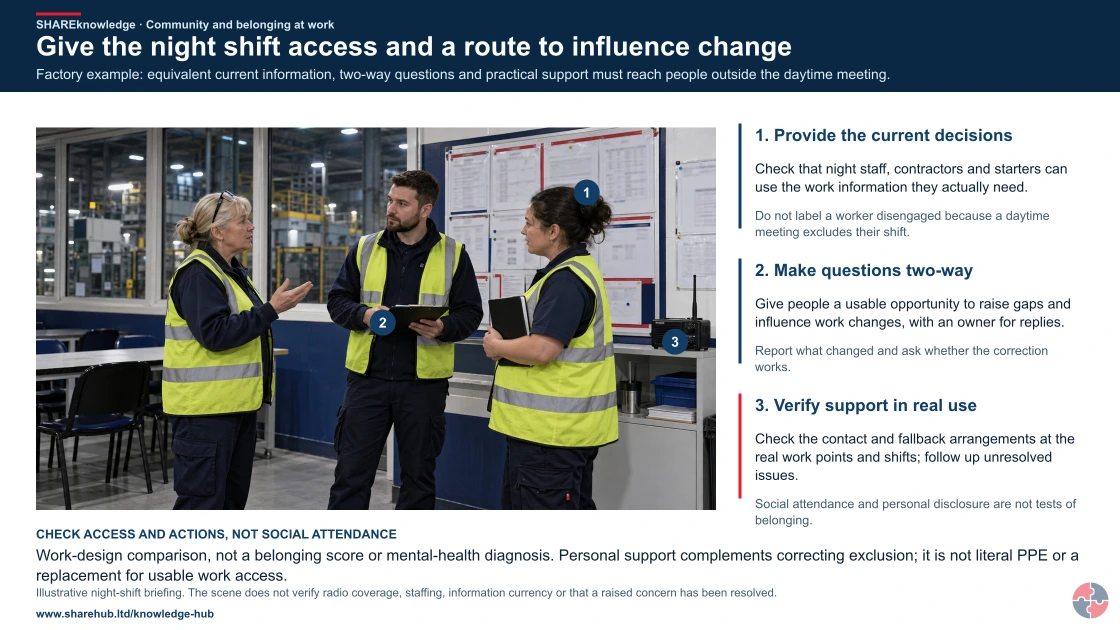
Give the night shift access and a route to influence change
Full written explanation
Factory example: equivalent current information, two-way questions and practical support must reach people outside the daytime meeting.
- Provide the current decisions. Check that night staff, contractors and starters can use the work information they actually need.
- Make questions two-way. Give people a usable opportunity to raise gaps and influence work changes, with an owner for replies.
- Verify support in real use. Check the contact and fallback arrangements at the real work points and shifts; follow up unresolved issues.
Change the pathway
- Fix the access barrier. Do not label a worker disengaged because a daytime meeting excludes their shift.
- Close the feedback loop. Report what changed and ask whether the correction works.
- Keep personal choices private. Social attendance and personal disclosure are not tests of belonging.
Evidence check: Work-design comparison, not a belonging score or mental-health diagnosis. Personal support complements correcting exclusion; it is not literal PPE or a replacement for usable work access.
Complete access, private feedback and shift-coverage example
Primary references: HSE: usable information and support (GB) · HSE: developing solutions with workers (GB)
Open the complete HD image (new tab)Download image

Complete access, private feedback and shift-coverage example
Primary references: HSE: usable information and support (GB) · HSE: developing solutions with workers (GB)
Riverside can compare the briefing access of day staff with early cleaners and evening lifeguards. Correct the access barrier, offer a way to ask questions and report back what changed. Measure whether people received usable information and whether concerns were acted on; a small-team score must not expose an individual’s private health or personal circumstances.
Riverside: the evening team misses every briefing
Illustrative example. A evening lifeguard and contract cleaner cannot attend the daytime team update.
Decision. The manager provides an equivalent paid work-briefing route and a two-way question channel suited to their shifts.
Evidence to check. Actual shift coverage, accessible information, worker feedback and a named owner for unresolved questions.
Hold or escalation point. Do not mark people as disengaged because the organisation’s chosen meeting time excludes them.
Follow-up. Ask the affected groups whether the correction works and check access after seasonal recruitment or rota change.
Give every shift access to the changed risk decision
Day, night and remote workers need a usable route to receive the same important change and raise questions. Belonging does not depend on attending a particular social activity.

Reach the people
Identify affected day, night, agency and remote workers and provide an accessible handover route.
Invite challenge
Make questions and concerns safe to raise, with a named action owner and expected response.
Close the loop
Tell workers what was decided and changed. Keep optional confidential support outside the ranking of technical hazard controls.
A community initiative cannot replace exposure controls or justify collecting unnecessary personal information.
What are the key facts about community and belonging at work?
The key facts are that belonging affects wellbeing, risk reporting, stress, relationships and safe performance, and it must be managed through work design as well as support.
This page is workplace wellbeing guidance, not medical, legal or HR advice. Individual concerns should be handled privately and, where needed, supported through occupational health, HR, GP, NHS, employee-assistance or specialist routes.
What does belonging affect?
- Confidence, trust, willingness to speak up, cooperation, learning, recovery, retention and day-to-day wellbeing.
- Work-related stress factors such as support, relationships, role clarity, control and change.
- Safety culture, because people are less likely to report concerns where they feel excluded or judged.
What should employers protect?
- Fair treatment, respectful relationships, worker voice, psychological safety and access to support.
- Connection for remote, lone, night, new, young, temporary, agency and contractor workers.
- Confidential handling of personal health, disability, wellbeing or protected-characteristic information.
When is specialist support needed?
- When distress, conflict, isolation, bullying, discrimination, absence, performance change or safety concerns are significant or repeated.
- When a worker may need reasonable adjustments, occupational-health advice or support with a long-term health condition.
- When a manager is unsure how to respond fairly, confidentially or lawfully.
Belonging is not forced friendship
It means fair inclusion, respect, contribution, worker voice and support in the normal working system.
Work factors come first
Support is weaker if excessive demands, poor relationships, unclear roles or badly managed change are left untouched.
Isolation can be hidden
Remote workers, lone workers, new starters, agency workers, night workers and carers may look fine while disconnected from support.
Psychological safety helps reporting
People speak up more readily when they expect curiosity and action rather than blame or ridicule.
Confidentiality underpins trust
Workers are less likely to ask for help if personal information is handled loosely.
Evidence should be mixed
Use surveys, conversations, absence data, turnover, incident reporting, audits and action tracking together.
What is community and belonging at work?
Community and belonging at work mean people feel included, connected, respected and able to participate in the workplace community.
Belonging is not about making everyone socialise in the same way. It is about whether people can be themselves at work, understand where they fit, receive support, have a voice, access information, build trust and contribute without being excluded or treated as an outsider.
A healthy workplace community is visible in ordinary behaviours. People greet new starters, involve remote colleagues, explain unwritten rules, challenge poor behaviour, share learning, consult workers before changes, support people after absence and make it easy to report concerns.
The opposite is not always dramatic. It may show as silence in meetings, cliques, poor handover between shifts, jokes that exclude, isolated lone workers, new starters left to work things out, remote workers forgotten, or people who stop reporting hazards because nobody acts.
| Element | What it looks like | Why it matters |
|---|---|---|
| Connection | People have useful work relationships and routes to support. | Reduces isolation and improves help-seeking. |
| Respect | People are treated fairly and poor behaviour is challenged. | Reduces conflict, fear and psychological harm. |
| Voice | Workers can raise concerns and influence decisions. | Improves risk control and learning. |
| Inclusion | Systems work for different roles, locations, languages, needs and backgrounds. | Prevents hidden exclusion. |
| Purpose | People understand how their work contributes. | Supports engagement and confidence. |
Why can belonging matter for work-related stress and safety?
Weak support, poor relationships, unclear roles and unmanaged change are assessable work factors; “belonging” itself is not a clinical diagnosis or guaranteed safety outcome.
The HSE Management Standards and HSENI equivalent identify demands, control, support, relationships, role and change. A new starter excluded from shift briefings may miss a plant defect and feel unable to challenge it. A remote colleague without access to the same decisions may work with outdated instructions. Those are concrete communication and support failures; a survey score alone does not prove an individual’s mental state or causation. Ask workers about specific obstacles, compare shifts and roles, and verify whether fixes improve access to information and voice.
How does belonging link to HSE work-related stress factors?
Belonging links to work-related stress factors because support, relationships, role, control, demands and change shape how included and safe people feel.
Belonging should not be separated from work design. Social events will not fix unrealistic workload, poor supervision, bullying, lack of control, unclear roles or badly communicated change. The system needs to remove or reduce harmful work factors before expecting individuals to build resilience.
The HSE Management Standards provide a useful structure. They encourage employers to look at demands, control, support, relationships, role and change. Each one has a belonging dimension: who is overloaded, who has no voice, who lacks support, who is exposed to conflict, who does not understand their role and who is left out during change?
| Standard | Belonging question | Control example |
|---|---|---|
| Demands | Are workload and pace stopping people from connecting or recovering? | Workload review and realistic resourcing. |
| Control | Do people have a say in how they organise their work? | Team planning and choice where possible. |
| Support | Can people access help from managers and colleagues? | Regular check-ins and supervisor availability. |
| Relationships | Are conflict, bullying or exclusion being prevented? | Behaviour standards and early intervention. |
| Role | Do people know what is expected and where they fit? | Clear role descriptions and induction. |
| Change | Are people involved and informed before change lands? | Consultation, impact review and feedback loop. |
What workplace factors can weaken community and belonging?
Workplace factors that weaken belonging include isolation, poor supervision, unfair treatment, bullying, excessive workload, unclear roles, exclusion during change and weak consultation.
Risk factors are often structural. A lone worker may rarely see a supervisor. A night-shift team may miss training and communication. A new starter may not know the unwritten rules. A disabled worker may face barriers others do not see. A contractor may be excluded from welfare, briefings or hazard reporting.
The risk assessment should identify groups who may be disconnected from normal support routes. This includes remote workers, agency workers, apprentices, migrant workers, workers with caring responsibilities, neurodivergent workers, people returning after illness, people affected by conflict and people working in small isolated teams.
| Risk factor | How it affects belonging | Practical response |
|---|---|---|
| Remote or hybrid work | People miss informal support and information. | Structured check-ins and inclusive meeting habits. |
| Lone work | Limited contact and slower escalation. | Contact plan, supervision and welfare checks. |
| New starters | Unwritten rules and team norms are unclear. | Buddy system and staged induction. |
| Bullying or conflict | People withdraw or feel unsafe speaking up. | Early intervention and behaviour standards. |
| Language or cultural barriers | People may not understand expectations or feel able to contribute. | Plain English, visuals, translation and check-back. |
| Organisational change | Uncertainty creates rumours and exclusion. | Consultation, clear updates and manager support. |
How can inclusion and psychological safety be built into everyday work?
Inclusion and psychological safety are built by making respect, voice, fairness and learning part of daily management.
Psychological safety means people believe they can speak up, ask questions, admit uncertainty and report concerns without being humiliated or punished. It does not mean avoiding standards or accepting poor behaviour; it means people can raise reality early enough for the organisation to learn.
Inclusion becomes practical when systems are checked for hidden barriers. Are meetings dominated by the same voices? Are agency workers briefed properly? Can neurodivergent workers access information in a usable format? Are disabled workers involved in adjustment decisions? Are safety representatives given real time and information?
| Practice | What it achieves | Evidence |
|---|---|---|
| Buddy and mentor systems | Supports new starters and returners. | Induction records and feedback. |
| Inclusive meetings | Makes sure remote, quieter or lower-status voices are heard. | Action log and participation review. |
| Behaviour standards | Sets expectations for respect and early challenge. | Policy, training and intervention records. |
| Accessible information | Improves understanding across language, literacy and neurodiversity needs. | Plain-language briefings and check-back. |
| Worker voice routes | Gives people options for raising issues. | Survey results, suggestion actions and committee minutes. |
How should belonging be managed for remote, lone and shift workers?
Remote, lone and shift workers need deliberate connection because they can miss informal support, learning and early intervention.
Belonging often happens in small moments: asking a quick question, seeing how others solve problems, being included in decisions and noticing when someone is not themselves. Remote, lone and shift workers may lose those moments unless managers design them back in.
Good practice includes predictable contact, accessible information, fair access to training, team check-ins, clear escalation routes, buddy arrangements, inclusive meetings, welfare checks and review of whether people outside the main office are receiving the same opportunities and support.
| Worker group | Belonging challenge | Control |
|---|---|---|
| Remote workers | Isolation and missed informal communication. | Regular one-to-ones, inclusive meetings and shared learning. |
| Lone workers | Limited support if conditions worsen. | Contact arrangements and escalation procedure. |
| Night shift | Reduced access to leaders, training and support services. | Night-shift briefings and manager visibility. |
| Agency workers | May be outside normal team systems. | Equal induction, welfare and reporting routes. |
| Mobile workers | Disconnected from site-based support. | Digital and supervisor contact that is actually used. |
How should personal information be handled?
Record work barriers and agreed actions with restricted access; do not place diagnoses or private disclosures in a general team dashboard.
The ICO workers’ health guidance treats health information as sensitive. Ask only what is necessary to design a safe work arrangement. Occupational health may give functional advice while keeping clinical detail separate. A small night team can make even “anonymous” survey comments identifiable; aggregate carefully and let workers know who will see results. If a worker reports bullying, use a protected reporting and fair investigation route rather than a public wellbeing campaign.
How can the hierarchy of controls reduce isolation and exclusion in the workplace?
Redesign the work and reporting routes first; offer confidential individual support as a complement.
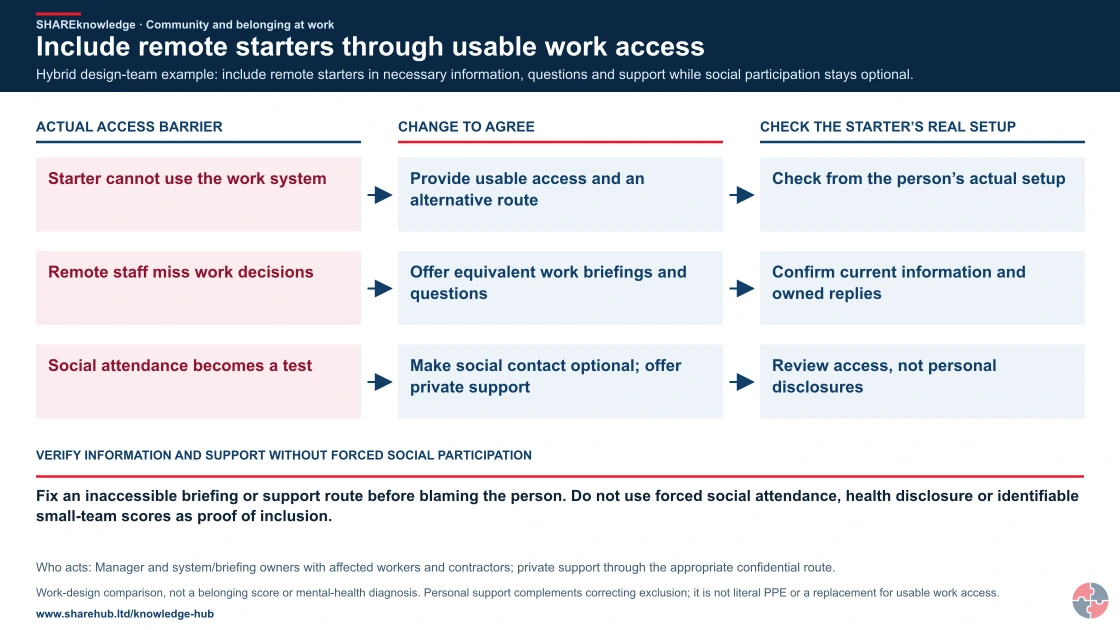
Include remote starters through usable work access
Full written explanation
Hybrid design-team example: include remote starters in necessary information, questions and support while social participation stays optional.
- Identify what was missed. Ask which work information, system, contact or opportunity to contribute the starter cannot use.
- Agree a workable route. Provide equivalent access, a current briefing and a two-way question/support route suited to the work pattern.
- Verify from the real setup. Check that the person can obtain the information, ask a question and reach a responsible owner.
- Review and report back. Act on remaining gaps and repeat after role, rota or system changes; protect private feedback and personal choices.
When the evidence does not fit: Fix an inaccessible briefing or support route before blaming the person. Do not use forced social attendance, health disclosure or identifiable small-team scores as proof of inclusion.
Who acts: Manager and system/briefing owners with affected workers and contractors; private support through the appropriate confidential route.
Changed workplace
Factory night shift: Verify current decisions, questions and contact routes across real shifts.
Hybrid starter: Check the remote setup and replies, without requiring social events or personal disclosures.
| ACTUAL ACCESS BARRIER | CHANGE TO AGREE | CHECK THE STARTER’S REAL SETUP |
|---|---|---|
| Starter cannot use the work system | Provide usable access and an alternative route | Check from the person’s actual setup |
| Remote staff miss work decisions | Offer equivalent work briefings and questions | Confirm current information and owned replies |
| Social attendance becomes a test | Make social contact optional; offer private support | Review access, not personal disclosures |
Evidence check: Work-design comparison, not a belonging score or mental-health diagnosis. Personal support complements correcting exclusion; it is not literal PPE or a replacement for usable work access.
Complete access, private feedback and shift-coverage example
Primary references: HSE: usable information and support (GB) · HSE: developing solutions with workers (GB)
Open the complete HD image (new tab)Download image

Complete access, private feedback and shift-coverage example
Primary references: HSE: usable information and support (GB) · HSE: developing solutions with workers (GB)
ERICPD and the five-level hierarchy are analogies for this psychosocial hazard. Eliminate bullying and avoidable exclusion, substitute a less isolating work pattern where feasible, engineer dependable access to briefings and support, use administrative supervision and fair processes, then offer personal support for remaining needs. The HSE solutions guide favours interventions at the source with workers involved. A manager cannot “eliminate loneliness” by decree; they can remove a rota that leaves one person without induction, peer contact or a route to raise a concern.
On a small screen, scroll this table sideways to read all columns.
How can the ERICPD hierarchy of controls reduce isolation and exclusion in the workplace?

| Five-level / ERICPD | Task change and feasibility | Owner, check, failure and stop |
|---|---|---|
| Elimination / eliminate | Stop exclusionary behaviour and ensure the night shift receives the same risk decisions as day shift. | Site manager investigates reports; stop punitive behaviour and protect reporting. |
| Substitution / reduce | Trial overlapping shifts or buddy cover for high-risk, isolated duties where staffing allows. | Operations lead tests workload and cover; reject if it simply moves overload elsewhere. |
| Engineering / isolate and control | Install a tested night-shift radio or call point with monitored coverage, an accessible live decision log and a backup escalation route at the work point. | Facilities/IT tests coverage and backup contact on each shift and logs outages; suspend the lone high-risk task if the link or decision log fails. |
| Administrative / discipline | Set inclusive handover, supervisor check-in, consultation and fair behaviour response with action tracking. | Shift lead observes participation and closes actions; escalate repeated exclusion. |
| Personal support / PPE analogy | Offer occupational health, adjustment and peer/EAP routes confidentially. This is support, not a substitute for fixing work. | HR limits access to health detail; revisit work design after a concern. |
How can the ISO 45001 hierarchy of controls reduce isolation and exclusion in the workplace?

| Five-level / ERICPD | Task change and feasibility | Owner, check, failure and stop |
|---|---|---|
| Elimination / eliminate | Stop exclusionary behaviour and ensure the night shift receives the same risk decisions as day shift. | Site manager investigates reports; stop punitive behaviour and protect reporting. |
| Substitution / reduce | Trial overlapping shifts or buddy cover for high-risk, isolated duties where staffing allows. | Operations lead tests workload and cover; reject if it simply moves overload elsewhere. |
| Engineering / isolate and control | Install a tested night-shift radio or call point with monitored coverage, an accessible live decision log and a backup escalation route at the work point. | Facilities/IT tests coverage and backup contact on each shift and logs outages; suspend the lone high-risk task if the link or decision log fails. |
| Administrative / discipline | Set inclusive handover, supervisor check-in, consultation and fair behaviour response with action tracking. | Shift lead observes participation and closes actions; escalate repeated exclusion. |
| Personal support / PPE analogy | Offer occupational health, adjustment and peer/EAP routes confidentially. This is support, not a substitute for fixing work. | HR limits access to health detail; revisit work design after a concern. |
The HSE five-level hierarchy is a GB general hazard-control framework. Here its use is a work-design analogy: personal support is not literal PPE for stress. For the isolated shift, facilities should commission radio/call-point coverage and the backup route at the actual work points, including foreseeable dead zones, and record acceptance and maintenance checks. The shift lead verifies contact and access to the current decision log before the duty, then checks outages and changes during the shift. A failed contact or uncertain decision log suspends the affected lone high-risk task; restore/test the route and confirm the correct work instruction before the supervisor authorises restart.
Agree the shift-overlap trial with affected workers and a named operations owner. Compare workload, access to support and actual action closure across day/night/agency groups, then review with workers at the agreed date. Repair an arrangement that moves overload elsewhere. Use feedback and operating evidence together; a survey score or absence trend does not diagnose an individual. HSE’s review guidance supports checking effectiveness with workers.
Which duties apply to community and belonging?
There is no standalone legal duty to make everyone feel they belong; assess work-related stress, consult on safety, prevent discrimination and protect health data under the applicable local law.
For GB work, HSE’s Management Standards explain stress-risk assessment and source control. Acas adjustment guidance addresses the Equality Act 2010 employment route. In NI, HSENI identifies the NI 1978 Order and Management Regulations 2000, and the Equality Commission NI sets out the Disability Discrimination Act 1995 adjustment route. Do not present GB Equality Act duties as NI law. Consultation and data-protection obligations need their own assessment. Managers should seek competent HR/legal advice for an actual complaint or adjustment decision.
On a small screen, scroll this table sideways to read all columns.
| Location | Stress-risk route | Disability employment route |
|---|---|---|
| Great Britain | HSE Management Standards and GB health-and-safety risk duties. | Equality Act 2010 with Acas guidance. |
| Northern Ireland | NI 1978 Order, Management Regulations 2000 and HSENI Standards. | DDA 1995 route with Equality Commission NI guidance. |
HSE GB consultation guidance treats consultation as two-way influence on health-and-safety decisions. HSENI’s NI guidance explains the separate local employee consultation route. Make the route usable by each shift and contract group; record the issue, decision, owner and feedback.
How could Riverside Leisure Ltd improve community and belonging at work?

Riverside Leisure Ltd would improve belonging by treating connection, fairness and worker voice as part of its wellbeing and safety management system.
Riverside Leisure Ltd
A leisure and hospitality business running a swimming pool, gym, cafe, events space and outdoor activity centre with seasonal workers, young workers, contractors, instructors and public-facing teams.
Riverside identifies groups most likely to feel disconnected: casual instructors, evening lifeguards, new cafe staff, cleaners working early shifts, young workers, outdoor activity staff, agency cover and workers returning after illness. The wellbeing risk register links these groups to HSE stress factors such as support, relationships, role and change.
The business creates practical connection routes. New starters have buddies, supervisors run short team check-ins, workers can raise issues through managers or representatives, and shift teams receive the same information as day staff. Managers are trained to hold private conversations, avoid diagnosis, record only necessary information and involve HR or occupational health when support becomes complex.
Riverside also checks whether belonging is real. It reviews worker feedback, turnover, absence, complaints, incident reporting, induction quality, training access and whether actions from consultation are closed. If a team has low reporting but high conflict or turnover, leaders treat that as a weak signal rather than proof that everything is fine.
| Management area | How Riverside applies it | Evidence and improvement |
|---|---|---|
| Assess and analyse | Maps isolation and stress risks by role, shift, contract type and work location. | Wellbeing risk register and workforce profile. |
| Consult and listen | Uses safety representatives, team meetings, surveys and informal walkabouts to hear worker views. | Consultation records and action tracker. |
| Implement support | Uses buddy systems, manager check-ins, fair rota reviews, return-to-work support and clear reporting routes. | Induction records, support plans and review dates. |
| Train managers | Trains supervisors on respectful conversations, confidentiality, inclusion and early intervention. | Training matrix and observed practice. |
| Audit and learn | Reviews absence, turnover, complaints, reporting levels and worker feedback for weak signals. | Wellbeing dashboard and leadership review. |
| Improve culture | Updates procedures, rota practices, communication routes and behaviour standards after learning. | Closed actions and repeated worker feedback. |
What should each role learn and demonstrate?
Learning must match the decisions people make, from recognising danger to checking that controls work.
Briefings should tell people how to act, but attendance alone does not show competence. Assess the real decision or task, record who assessed it and revisit after a material change, failed control or incident. A local authorisation is task-specific; no universal external certificate is implied.
On a small screen, scroll this table sideways to read all columns.
| Role and learning | Demonstration and assessor | Record and reassessment trigger |
|---|---|---|
| Manager: work factors. | Safety adviser assesses the manager using a real shift pattern to identify support, role and relationship gaps. | Worker-validated action plan; reassess after rota change or recurring concern. |
| Supervisor: raise concerns. | HR lead observes the supervisor handle a confidential report fairly without diagnosing. | Scenario check and restricted escalation record; reassess after mishandled concern or policy change. |
| HR: local route. | Employment-law adviser checks HR can separate GB Equality Act and NI DDA adjustment routes. | Jurisdiction decision and restricted record; reassess after legal or work-location change. |
How can a management system sustain effective decisions?
Give each hazard or support route an owner, a control, a check and a response to failure.
Measure whether workers can access decisions and support and whether agreed changes work; use mixed feedback and action closure, protecting privacy. An owner should sample actual work and corrective actions, not accept a policy or certificate as evidence that the controls work.
The free GB regulator guide HSE Managing for health and safety (HSG65) explains a plan–do–check–act approach: assign controls and owners, involve workers, check work as done, and correct failures. For Northern Ireland, use HSENI risk assessment guidance for the local duty. A certificate alone does not demonstrate that a control works.
What warning signs show community and belonging are weak?
Warning signs include silence, isolation, cliques, repeated conflict, poor reporting, high turnover, low trust, weak consultation and people avoiding support.
Weak belonging often appears as absence of voice rather than visible crisis. A team with no reported concerns may be healthy, but it may also be silent because workers do not believe anything will change. Managers should look for patterns, not isolated incidents.
These signs can cause harm by delaying support, increasing stress, reducing hazard reporting, weakening teamwork and making incidents more likely. The response should identify what in the work system is causing disconnection before relying on awareness campaigns.
| Warning sign | How harm can develop | What to improve |
|---|---|---|
| People stop reporting concerns | Weak signals are missed until harm occurs. | Worker voice routes and action feedback. |
| New starters are left unsupported | Mistakes, anxiety and early turnover increase. | Buddy system and staged induction. |
| Conflict becomes normal | Stress, distraction and poor cooperation grow. | Early manager intervention and behaviour standards. |
| Remote or shift workers miss updates | Inconsistent controls and exclusion develop. | Inclusive communication and manager visibility. |
| High absence or turnover in one team | Underlying stressors may be unmanaged. | Team review and psychosocial risk assessment. |
| Wellbeing activity replaces work design | Real causes remain unchanged. | Review workload, role, support, relationships and change. |
What acronyms are used on this community and belonging page?
Acronyms should be explained so wellbeing, HR and management-system language remains accessible.
| Acronym | Meaning | Why it matters |
|---|---|---|
| Acas | Advisory, Conciliation and Arbitration Service | Official employment relations guidance. |
| EAP | Employee assistance programme | Confidential support service sometimes provided by employers. |
| GP | General practitioner | Primary-care route for personal health advice. |
| HSE | Health and Safety Executive | Great Britain regulator for work-related stress guidance. |
| HR | Human resources | Supports employment, absence, adjustments and confidential processes. |
| ICO | Information Commissioner’s Office | UK data protection regulator. |
| NHS | National Health Service | Official health and wellbeing advice source. |
| OH | Occupational health | Work-health advice on fitness, restrictions and adjustments. |