
SHARE Knowledge Hub
What is health and safety culture and how is it improved?
Culture is how safety decisions are made when work is pressured or changing. Leaders set priorities and resources, workers must be able to influence controls, and the organisation should test physical barriers and act on weak signals rather than rely on slogans or injury counts.
Understanding What is health and safety culture and how is it improved?
Culture is how safety decisions are made when work is pressured or changing. Leaders set priorities and resources, workers must be able to influence controls, and the organisation should test physical barriers and act on weak signals rather than rely on slogans or injury counts.
Why this matters at work
No. Observation and discussion can help identify residual risks and practical barriers, but they cannot make missing guarding, ineffective extraction or unsafe isolation acceptable. Assess the harm mechanism and apply suitable prevention and physical controls first. Examine whether the safe method is achievable with the available equipment, staffing and time. Behaviour often reflects those conditions and should not be treated as an isolated cause without investigation.
Examine how leaders allocate resources, respond to bad news and resolve conflicts between production and protection. Ask workers whether they can stop unsafe work, obtain suitable equipment and see concerns acted on. Observe real tasks, handovers, maintenance and supervision across shifts. Safety culture includes the management context shaping behaviour, not only whether frontline people follow rules. A low recorded injury rate may hide weak reporting or uncontrolled rare hazards.
How organisations manage this in practice
Define the observation programme’s purpose, feedback, privacy and management responsibilities. Avoid targets that reward silence or shift attention to easy PPE counts while critical barriers remain defective. Record technical and organisational actions as well as useful learning. Verify correction in the workplace and involve workers and representatives. HSE’s culture guidance emphasises management style, leadership, involvement, competence and communication. A score for observed behaviour is not evidence that the whole management system controls the risk.
Make the immediate situation safe through the actual trained arrangements and establish the facts. Ask what differed from the expected conditions, what was uncertain and which control was missing. Obtain competent technical help where needed. Do not make a worker prove the whole legal case before a credible concern is examined. Equally, a pause does not itself establish misconduct or that every part of the operation must remain stopped indefinitely. Define the affected scope, interim restrictions and evidence required for a separate authorised restart. Record the decision, owner, correction and verification proportionately and communicate with affected people. Review whether procedure design, resources, workload or unclear authority contributed. Give feedback and check that no informal penalty discourages future reporting. Protect fair accountability and privacy. Culture improves when leaders demonstrate that a well-founded pause leads to useful investigation and reliable control rather than blame or an undocumented workaround.
Use fair fact-finding that considers equipment, workload, supervision and organisational conditions as well as individual actions. Assign corrective work and verify the guarding before the real restart decision. Give feedback on what changed and check whether similar incentives or defects exist elsewhere. Record facts, decisions and effectiveness without publishing unnecessary personal information. The scenario does not determine disciplinary guilt or approve a particular machinery repair; it shows how a credible management response supports both prevention and future reporting.
Judge the response to a concern alongside the survey
A positive survey score does not show what happens when a concern threatens a busy programme. Look at the manager’s response, any task change, the action owner and feedback to the reporter. Combine worker accounts, observation and barrier checks so low incident counts cannot conceal unresolved warnings.

Show what changes after someone speaks up
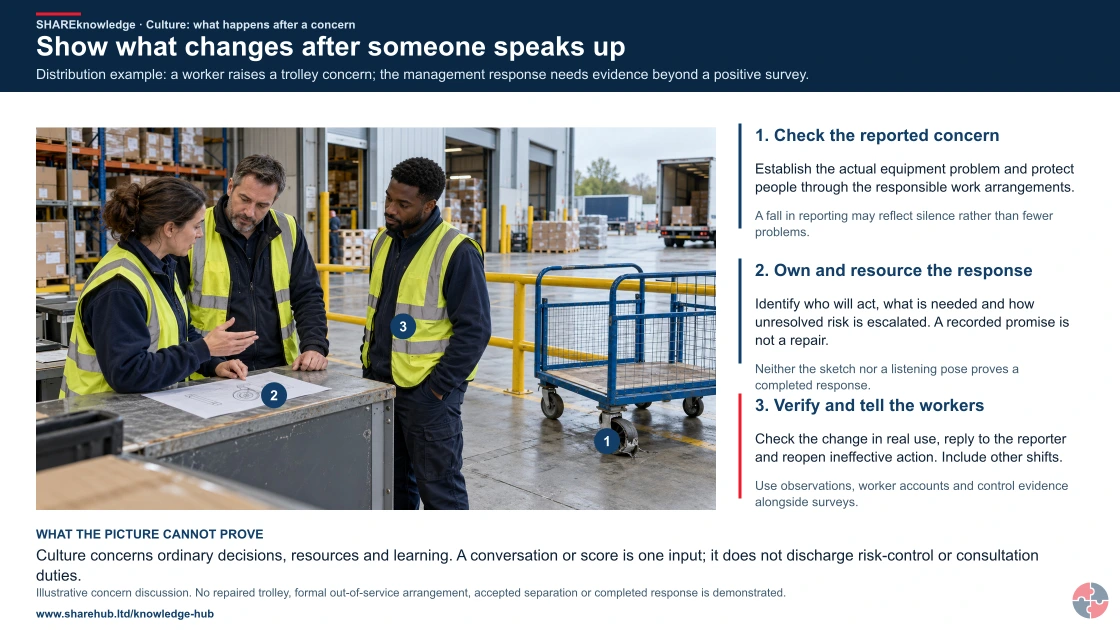
Full written explanation
Distribution example: a worker raises a trolley concern; the management response needs evidence beyond a positive survey.
- Check the reported concern. Establish the actual equipment problem and protect people through the responsible work arrangements.
- Own and resource the response. Identify who will act, what is needed and how unresolved risk is escalated. A recorded promise is not a repair.
- Verify and tell the workers. Check the change in real use, reply to the reporter and reopen ineffective action. Include other shifts.
Change the pathway
- Listen without blame. A fall in reporting may reflect silence rather than fewer problems.
- Keep the physical issue visible. Neither the sketch nor a listening pose proves a completed response.
- Test the response under pressure. Use observations, worker accounts and control evidence alongside surveys.
Evidence check: Culture concerns ordinary decisions, resources and learning. A conversation or score is one input; it does not discharge risk-control or consultation duties.
Full work-location duties, consultation and evidence context
Primary references: HSE: organisational culture and the response to findings (GB) · HSE: leadership and work decisions (GB)
Open the complete HD image (new tab)Download image

Full work-location duties, consultation and evidence context
Primary references: HSE: organisational culture and the response to findings (GB) · HSE: leadership and work decisions (GB)
Best-practice guide: Culture (Health and Safety)
Judge the response to a concern alongside the survey
A positive survey score does not show what happens when a concern threatens a busy programme. Look at the manager’s response, any task change, the action owner and feedback to the reporter. Culture is how safety decisions are made when work is pressured or changing.
Turn culture (health and safety) knowledge into a decision
Culture is how safety decisions are made when work is pressured or changing. Leaders set priorities and resources, workers must be able to influence controls, and the organisation should test physical barriers and act on weak signals rather than rely on slogans or injury counts. Culture report, action plan and worker feedback.
the leisure operator management example
Assessment: Uses surveys, focus groups, incident data and observations to identify cultural strengths and weaknesses. Evidence / response: Culture report, action plan and worker feedback. Leadership: Managers complete visible safety conversations and close actions raised by workers. Evidence / response: Leadership visit records and action close-out.
What are the key points about health and safety culture?
The key point is that culture is proved by normal decisions and behaviours, not by what the policy says.
Choose controls for culture (health and safety)
Eliminate: Redesign storage away from exit. Substitute: Reduce delivery and stock volume after service check. Engineering: Dedicated storage; maintain the assessed fire-door design and closing function. Administrative: Shift inspection, reporting and rapid closure. PPE: Responder equipment only for residual emergency risk. Read the full control table for qualifications, ownership and verification. Use the actual task and applicable jurisdiction; existing technical approval remains unchanged.
Use the full culture (health and safety) lesson
Use the full topic for the decision points, practical examples, detailed control tables and source scope. HSE guidance applies to Great Britain; use HSENI for the Northern Ireland route and the source’s stated jurisdiction. A simplified guide does not change the page’s technical-review or approval status.

Read all six steps as text
1. Judge the response to a concern alongside the survey
A positive survey score does not show what happens when a concern threatens a busy programme.
- Avoid / redesign: Redesign storage away from exit.
- Control the task: Dedicated storage; maintain the assessed fire-door design and closing function.
- Verify before release: Facilities owner records plan; hold area use if route blocked.
A positive survey score does not show what happens when a concern threatens a busy programme. Look at the manager’s response, any task change, the action owner and feedback to the reporter. Culture is how safety decisions are made when work is pressured or changing.
Apply it: Which part of this plan would you check at the workface before authorising the task?
2. Turn culture (health and safety) knowledge into a decision
Use the evidence to improve the actual work arrangement.
- Change at source: Redesign storage away from exit.
- Make it observable: Facilities owner records plan; hold area use if route blocked.
- Keep useful evidence: Culture report, action plan and worker feedback.
Culture is how safety decisions are made when work is pressured or changing. Leaders set priorities and resources, workers must be able to influence controls, and the organisation should test physical barriers and act on weak signals rather than rely on slogans or injury counts. Culture report, action plan and worker feedback.
Apply it: What evidence would show that the change improves this task, rather than only completing a record?
3. the leisure operator management example
Example: a practical application of the existing topic lesson.
- Assessment: Uses surveys, focus groups, incident data and observations to identify cultural strengths and weaknesses.
- Leadership: Managers complete visible safety conversations and close actions raised by workers.
- Worker involvement: Seasonal, casual and permanent workers are included in consultation and briefings.
Assessment: Uses surveys, focus groups, incident data and observations to identify cultural strengths and weaknesses. Evidence / response: Culture report, action plan and worker feedback. Leadership: Managers complete visible safety conversations and close actions raised by workers. Evidence / response: Leadership visit records and action close-out.
Apply it: At which point would you hold this example, and what evidence would allow it to proceed?
4. What are the key points about health and safety culture?
Connect the task, the route to the person and the control that can fail.
- Source / exposure: The key point is that culture is proved by normal decisions and behaviours, not by what the policy says.
The key point is that culture is proved by normal decisions and behaviours, not by what the policy says.
Apply it: Who could be exposed, including other trades, cleaners, maintainers and people nearby?
5. Choose controls for culture (health and safety)
Start with the stronger practicable options and verify their effect.
- Eliminate: Redesign storage away from exit.
- Substitute: Reduce delivery and stock volume after service check.
- Engineering: Dedicated storage; maintain the assessed fire-door design and closing function.
- Administrative: Shift inspection, reporting and rapid closure.
- PPE: Responder equipment only for residual emergency risk.
Eliminate: Redesign storage away from exit. Substitute: Reduce delivery and stock volume after service check. Engineering: Dedicated storage; maintain the assessed fire-door design and closing function. Administrative: Shift inspection, reporting and rapid closure. PPE: Responder equipment only for residual emergency risk. Read the full control table for qualifications, ownership and verification. Use the actual task and applicable jurisdiction; existing technical approval remains unchanged.
Apply it: Which stronger option can be used here, and who will verify it before accepting the remaining risk?
6. Use the full culture (health and safety) lesson
Follow the official sources below and retain the task-specific evidence.
- Official guidance: HSE leadership of health and safety
- Official guidance: HSENI communication and consultation
- Task decision: Culture report, action plan and worker feedback.
Use the full topic for the decision points, practical examples, detailed control tables and source scope. HSE guidance applies to Great Britain; use HSENI for the Northern Ireland route and the source’s stated jurisdiction. A simplified guide does not change the page’s technical-review or approval status.
Apply it: Which official source and full-topic section will you use to resolve the next decision?
Riverside’s pre-event concern is a useful test: does the manager thank the worker, verify the problem and change the plan, or pressure the team to continue because bookings are full? Measure whether the correction works and tell workers the result. Keep private wellbeing disclosures out of open incident discussion and avoid reports that identify people in small teams.
Riverside: a concern before the busy event
Illustrative example. A seasonal worker reports that the planned public route conflicts with a delivery movement shortly before opening.
Decision. The duty manager pauses the conflicting activity, checks segregation with the team and changes the sequence before opening the route.
Evidence to check. Workface observation, the concern, actual barrier condition, revised plan and feedback to the reporter.
Hold or escalation point. Do not override a failed control because survey results are favourable or no incident has occurred.
Follow-up. Check the revised arrangement during the event and use the response, not the reporting count alone, as culture evidence.
Show what happens after a worker raises a concern
The response to an obstructed exit reveals whether the organisation listens, makes safe, resources action and checks closure. A survey is only one input.
Production pressure tests the stated priority
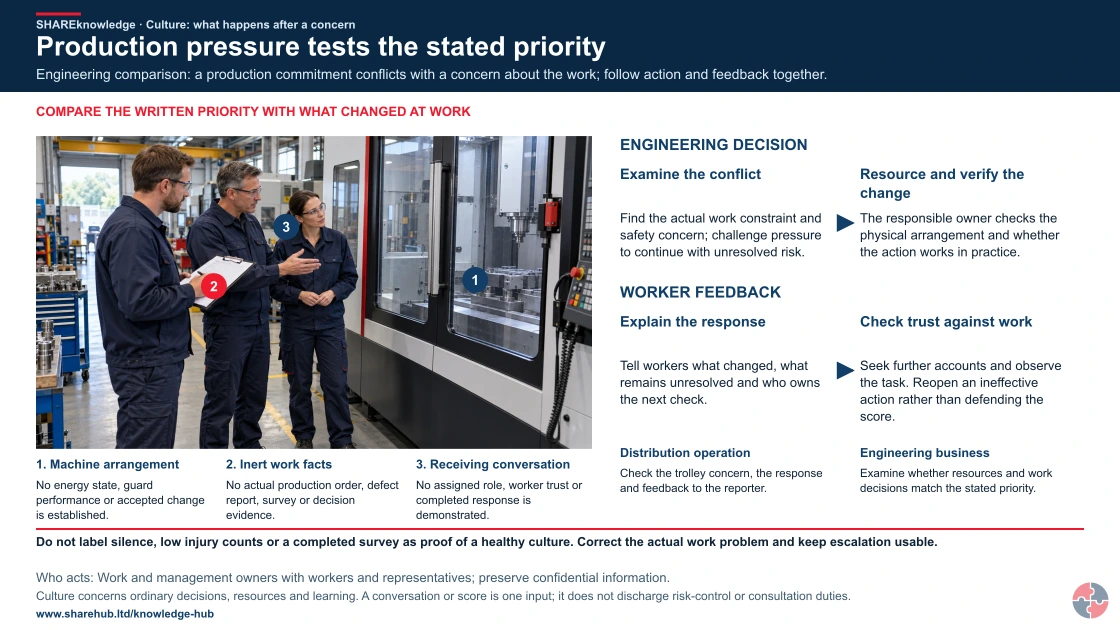
Full written explanation
An illustrative inactive engineering workface shows enclosed machinery, inert clipboard papers and ordinary uninjured colleagues discussing the work from outside the enclosure. Picture key: 1 identifies the physical machine arrangement; 2 identifies inert work facts; 3 identifies the receiving conversation. The scene establishes no actual defect, production target, deadline pressure, machine operation, energy state, guard or interlock performance, repair, accepted change, test result or permission. The people are not assigned management, worker-representative or technical qualifications by appearance. Their conversation supplies no worker-trust finding, culture score, actual report, survey result or completed feedback. The complete explanation keeps two coordinated tracks. ENGINEERING DECISION connects examining the actual conflict and unresolved risk with resourcing and verifying the physical change. WORKER FEEDBACK connects explaining the response and unresolved concerns with further worker accounts, task observation and reopening ineffective action. Arrows remain within each track; a feedback check does not wait for a favourable culture score or an engineering acceptance inferred from the picture. Independent check and lane headings are unnumbered, separate from the literal picture key. The band reads COMPARE THE WRITTEN PRIORITY WITH WHAT CHANGED AT WORK. All four full checks, full hold, responsible roles, evidence limits and both distribution and engineering cases accompany the tracks. Silence, low injury counts or a completed survey do not prove healthy culture. A promise, meeting or record does not replace correction of the actual work problem and usable escalation. This engineering comparison supplies no new fire-exit arrangement or door-performance finding. Use the complete topic for the existing distribution example, task-specific hierarchy, fire-assessment and national-source qualifications, fair fact-finding, confidential individual support, historical inquiry limits and separate GB and NI duties. No operating method, legal test, clinical detail, disciplinary classification, causal outcome or work release is supplied.
Engineering comparison: a production commitment conflicts with a concern about the work; follow action and feedback together.
- Examine the conflict. Find the actual work constraint and safety concern; challenge pressure to continue with unresolved risk.
- Resource and verify the change. The responsible owner checks the physical arrangement and whether the action works in practice.
- Explain the response. Tell workers what changed, what remains unresolved and who owns the next check.
- Check trust against work. Seek further accounts and observe the task. Reopen an ineffective action rather than defending the score.
When the evidence does not fit: Do not label silence, low injury counts or a completed survey as proof of a healthy culture. Correct the actual work problem and keep escalation usable.
Who acts: Work and management owners with workers and representatives; preserve confidential information.
Changed workplace
Distribution operation: Check the trolley concern, the response and feedback to the reporter.
Engineering business: Examine whether resources and work decisions match the stated priority.
Evidence check: Culture concerns ordinary decisions, resources and learning. A conversation or score is one input; it does not discharge risk-control or consultation duties.
Full work-location duties, consultation and evidence context
Primary references: HSE: organisational culture and the response to findings (GB) · HSE: leadership and work decisions (GB)
Open the complete HD image (new tab)Download image

Full work-location duties, consultation and evidence context
Primary references: HSE: organisational culture and the response to findings (GB) · HSE: leadership and work decisions (GB)

Listen and check
Thank the worker, establish the facts and protect people from the actual obstruction.
Own and resource
Name the person who will correct the source of the problem and provide the means to do it.
Verify and reply
Check the route in use, confirm closure with evidence and tell the worker what changed. Reopen ineffective action.
Do not substitute a culture score or a blame label for correcting the physical work problem.
What are the key points about health and safety culture?
The key point is that culture is proved by normal decisions and behaviours, not by what the policy says.
Culture is local and practical
Different teams, shifts and sites may have different cultures even within one organisation.
Leaders set the tone
People notice what leaders fund, tolerate, praise, challenge and ignore.
Trust controls reporting
Workers are more likely to report concerns where they believe they will be listened to and treated fairly.
Blame blocks learning
A blame culture drives problems underground and prevents root causes being understood.
Good culture needs good systems
Motivation cannot compensate for poor staffing, bad procedures, weak equipment or unrealistic work plans.
Measurement needs mixed evidence
Surveys help, but should be combined with interviews, observation, audit, incident trends and action evidence.
What does culture mean in health and safety?
It is the shared pattern of decisions and priorities that determines whether people can control risk, raise concerns and stop unsafe work.
The HSE organisational-culture guide points to leadership, worker involvement, communication, competence and learning. A manager who praises output while leaving a failed fire-door closer unrepaired sends a stronger signal than a “safety first” poster. Culture is not solely worker behaviour; it includes design, staffing, purchasing, supervision and how management responds to bad news. Test it by asking workers what happens after they report a defect and verifying the physical control.
What influences health and safety culture?
Culture is influenced by leadership, communication, involvement, competence, resources, procedures, work design and learning.
Culture does not improve because a poster tells people to care. It improves when the organisation changes the conditions that shape behaviour. If people lack time, tools, training, supervision or clear priorities, unsafe behaviour may be a predictable outcome of poor system design. If the organisation designs work well and acts on feedback, safe behaviour becomes easier and more normal.
HSE identifies leadership, employee involvement, training and competence, communication, compliance with procedures and organisational learning as important influences. These are practical levers: each can be assessed, strengthened and reviewed.
| Influence | Positive signal | Negative signal |
|---|---|---|
| Leadership | Leaders ask about risk, act on bad news and resource controls. | Leaders focus only on output, cost or injury-rate appearance. |
| Worker involvement | Workers help identify hazards, review controls and improve work. | Consultation is tokenistic or only happens after decisions are made. |
| Communication | Messages are clear, two-way and connected to real work. | Communication is one-way, jargon-heavy or inconsistent. |
| Competence | People are trained, assessed and supported for the risks they manage. | Training attendance is treated as competence. |
| Procedures | Procedures are usable, current and reflect actual work. | People rely on memory or workarounds because procedures are poor. |
| Learning | Incidents, near misses and weak signals change the system. | Actions close on paper but problems repeat. |
What does a positive health and safety culture look like?
A positive culture is visible when people control risks even when nobody senior is watching.
Positive culture is not about being cheerful or never having conflict. It is about shared confidence that the organisation will do the right thing when risk is real. People understand hazards, follow critical controls, challenge drift, report concerns, learn from mistakes and believe that managers will act.
A positive culture also includes mental health and wellbeing. Fatigue can reduce alertness and information processing. Assess harmful work demands, support and relationships, and listen to individual concerns. A serious culture treats work design, workload and dignity as part of risk control.
| Indicator | What it looks like | Evidence to check |
|---|---|---|
| Open reporting | People report hazards, near misses and mistakes without fear. | Reporting trends, quality of reports and worker interviews. |
| Visible leadership | Leaders visit work areas, ask good questions and act on findings. | Leadership tour records, actions and feedback loops. |
| Control discipline | Critical procedures are followed and challenged when impractical. | Observation records, permit audits and procedure reviews. |
| Learning mindset | Incidents lead to system improvement, not only reminders to be careful. | Investigation quality, root causes and effectiveness checks. |
| Fair accountability | Mistakes, violations and reckless behaviour are treated differently. | Investigation decisions, disciplinary consistency and just culture guidance. |
| Worker trust | People believe concerns are heard and acted upon. | Survey results, focus groups, safety representative feedback and action close-out. |
What does a poor health and safety culture look like?
A poor culture is visible when unsafe conditions become normal and people stop expecting the system to improve.
Poor culture often develops gradually. A small shortcut saves time, then becomes accepted. A defect is reported but not fixed, then people stop reporting. A manager says safety is important but rewards output at any cost. A near miss is blamed on the worker rather than investigated. Over time, the formal system and the real system drift apart.
This is why poor culture can exist in organisations with good-looking policies. The question is not whether the policy says the right thing; it is whether work is planned, resourced, supervised and reviewed in a way that makes safe performance realistic.
| Indicator | How harm can develop | What to do |
|---|---|---|
| Under-reporting | Hazards and near misses remain hidden until a serious event occurs. | Build trust, simplify reporting and act visibly on reports. |
| Normalised shortcuts | People learn that bypassing controls is accepted if the job gets done. | Investigate why shortcuts occur and redesign work or controls. |
| Blame | People hide mistakes and investigations miss system causes. | Use fair investigation and just culture principles. |
| Production pressure | Controls are deferred or ignored to meet targets. | Review planning, resources, incentives and stop-work authority. |
| Weak supervision | Standards vary by shift, team or contractor. | Clarify expectations, train supervisors and sample real work. |
| Complacency | Low accident rates are mistaken for low risk. | Use leading indicators, weak signals and high-consequence scenario review. |
How can health and safety culture be measured?
Use worker perception as one signal and compare it with control condition, action closure and independent observations.
A survey can reveal trust and reporting barriers, but a score does not prove the fire doors, interlocks or isolation points work. The HSE culture guide describes safety-climate surveys as snapshots; HSE HSG254 supports leading and lagging process-barrier indicators. Sample night shifts and contractors, protect confidentiality, publish what changed and revisit whether the hazard is better controlled. Treat falling near-miss reports with unchanged exposure as a possible silence signal, not automatic improvement.
HSG254 is2006 major-hazard performance guidance. Adapt its barrier-assurance approach to the actual risks; it is not a universal culture questionnaire or a prescribed injury-rate target.
How can the hierarchy of controls strengthen workplace conditions that support safe behaviour?
Make it safe and useful to report a hazard, then close the loop with an owner, deadline and verified control change.
At a leisure centre, staff repeatedly report a blocked emergency exit. Eliminate storage in the escape route through layout redesign; reduce delivered stock, provide dedicated storage, mark and inspect the route, and use emergency PPE only for responders. The facilities lead checks the physical exit and logs clearance; stop public use of the affected area if egress cannot be kept clear. The HSE leadership guide and HSENI communication guide support management response and worker voice. For the physical route, check England and Wales evacuation guidance, Scottish premises guidance or Northern Ireland fire guides for the site. Door specification needs the competent fire-risk assessment; do not prescribe a self-closing door without it.
On a small screen, scroll this table sideways to read all columns.
How can the ERICPD hierarchy of controls strengthen workplace conditions that support safe behaviour?

| Five-level / ERICPD | Control choice | Owner, evidence, failure and stop |
|---|---|---|
| Eliminate / eliminate | Redesign storage away from exit. | Facilities owner records plan; hold area use if route blocked. |
| Substitute / reduce | Reduce delivery and stock volume after service check. | Operations manager approves; stop if stock still encroaches. |
| Engineering / isolate and control | Dedicated storage; maintain the assessed fire-door design and closing function. | Facilities lead checks door/route; stop on door failure. |
| Administrative / discipline | Shift inspection, reporting and rapid closure. | Supervisor logs check; stop public use on obstruction. |
| PPE / PPE | Responder equipment only for residual emergency risk. | Emergency lead verifies; no occupied use if egress fails. |
How can the ISO 45001 hierarchy of controls strengthen workplace conditions that support safe behaviour?

| Five-level / ERICPD | Control choice | Owner, evidence, failure and stop |
|---|---|---|
| Eliminate / eliminate | Redesign storage away from exit. | Facilities owner records plan; hold area use if route blocked. |
| Substitute / reduce | Reduce delivery and stock volume after service check. | Operations manager approves; stop if stock still encroaches. |
| Engineering / isolate and control | Dedicated storage; maintain the assessed fire-door design and closing function. | Facilities lead checks door/route; stop on door failure. |
| Administrative / discipline | Shift inspection, reporting and rapid closure. | Supervisor logs check; stop public use on obstruction. |
| PPE / PPE | Responder equipment only for residual emergency risk. | Emergency lead verifies; no occupied use if egress fails. |
HSE five-level hierarchy provides the underlying priority for this ERICPD example. The following is an illustrative assurance sequence: the facilities/fire lead confirms the actual occupancy, escape needs and assessed door assembly; a competent installer verifies compatible frame, leaf, glazing, seals and ironmongery against the accepted specification and installation instructions. Record safe acceptance checks of closing, latching where required, release devices and unobstructed escape before handover. Keep servicing, defect and repair records. Before admitting visitors and throughout occupied use, check the escape route, door condition, permitted locking arrangements and closing/release function; reassess changes to layout or use. If escape or the assessed fire/smoke barrier fails, stop affected-area use, implement the premises contingency/evacuation plan, correct the defect and verify the required performance before authorised reopening. Scottish guidance chapter4 supports competent installation, routine checks, maintenance and records; chapter6 considers the whole door assembly and closing/release function. These are Scottish technical principles, not a UK-wide inspection schedule; confirm the local fire regime and current requirements for the site.
What is just culture and why does it matter?
Just culture matters because people need confidence that honest reporting will be treated fairly while reckless behaviour is still addressed.
A just culture is not a no-blame culture in the simplistic sense. It recognises that human error is normal and that many unsafe acts are shaped by work design, supervision, pressure, training and equipment. It also recognises that deliberate, reckless or knowingly unsafe behaviour may require accountability.
The practical benefit is trust. Workers are more likely to report mistakes, near misses and uncertainty where they believe the organisation will seek learning first and only use discipline where it is fair, proportionate and evidence-based.
The HSE learning-organisations guidance distinguishes systems learning from scapegoating while recognising accountability and discipline. Investigate work design and evidence before making an individual-behaviour judgment.
| Behaviour type | Typical response | Culture risk if handled badly |
|---|---|---|
| Human error | Console, understand context and improve the system. | Blaming error drives reporting underground. |
| At-risk behaviour | Coach, understand incentives and remove pressures or traps. | Ignoring it normalises drift. |
| Reckless behaviour | Apply fair accountability and protect others. | Failing to act undermines trust in standards. |
| Procedure breach | Ask whether the procedure was usable, known and realistic before judging. | Automatic discipline may miss system causes. |
| Repeated unsafe act | Review competence, supervision, workload and behaviour history. | Treating every repeat as simple carelessness may miss deeper issues. |
The table is an illustrative set of management decision themes. HSE supports learning from systems and addressing accountability; it does not prescribe these behaviour categories as a statutory classification or an automatic disciplinary algorithm. Establish the facts, work conditions, training, procedure usability and management decisions, hear those involved, and use fair organisational procedures with competent HR/legal advice where needed.
How does mental health connect to safety culture?
Mental health connects to safety culture because stress, fatigue, workload and trust affect attention, communication and decision-making.
A culture that supports mental health is not separate from safety culture. Fatigue can reduce alertness and information processing. Excessive work demands, poor support and harmful relationships require risk assessment and action; listen to individual concerns rather than infer performance from a diagnosis. Supervisors may also miss weak signals if the organisation treats mental health as a private issue rather than part of work design.
Good practice includes psychosocial risk assessment, realistic workloads, dignity and respect, trained managers, early support, confidential routes, reasonable adjustments where appropriate and action on organisational causes of stress. Wellbeing campaigns can help, but they do not replace fixing harmful work conditions.
Use the HSE work-stress guide for GB work-design risk assessment and HSENI mental-wellbeing guidance for the NI route. Assess fatigue and shift design separately where relevant.
| Issue | How it affects safety | Culture response |
|---|---|---|
| Fatigue | Reduces alertness, slows reactions and can impair decision-making. | Manage working time, rest, staffing and high-risk tasks. |
| Stress | Can narrow attention and reduce communication. | Assess causes and improve workload, control and support. |
| Bullying or fear | Stops people raising concerns or admitting uncertainty. | Act on dignity, respect and fair treatment. |
| Isolation | Reduces informal support and weak-signal detection. | Improve supervision, contact and escalation routes. |
| Burnout | Assess prolonged work demands, exhaustion and support needs. | Review workload, resources, priorities and recovery. |
Assess actual work demands, support, relationships and individual needs. A diagnosis alone does not establish that someone will act unsafely. Use confidential discussion and appropriate occupational-health or clinical advice for individual support; leadership must still address harmful work conditions. The HSE and HSENI sources describe work-design risk assessment and action, not a guarantee that a wellbeing campaign will reduce injuries.
HSE fatigue guidance links prolonged work, sleep loss and shift design to slower reactions and reduced information processing. Assess actual hours, breaks, overtime, staffing and task demands; manage fatigue as a hazard and verify that the controls work.
Which duties are relevant to safety culture?
Culture itself is not a certificate or a single legal test; employers still need effective arrangements, risk controls and worker consultation under the work-location regime.
The HSE GB management guide explains leadership duties and control review; HSENI NI communication guidance is a local worker-consultation route. A climate survey can inform action but cannot discharge an inspection, maintenance or statutory consultation duty. Treat ISO 45001 as voluntary management-system context unless an authorised copy supports a specific clause.
What should the risk register include for culture?
Culture entries should describe the risk routes through which poor culture could defeat controls.
Culture should not be recorded as a vague risk with a low-quality action such as ‘improve culture’. The register should describe specific failure routes: under-reporting, normalised deviation, weak supervision, poor learning, fatigue, contractor exclusion, blame, low trust or production pressure overriding controls.
Each entry should identify how harm could arise, what controls are used, what evidence shows the controls work and what would trigger escalation.
| Event or issue | Risk route | Preventing controls | Response or mitigation | Evidence to check |
|---|---|---|---|---|
| Under-reporting | Hazards and near misses remain hidden. | Simple reporting, feedback, fair treatment and visible action. | Run listening sessions and review barriers to reporting. | Reporting trends, worker interviews and action evidence. |
| Production pressure overrides controls | People bypass safeguards to meet deadlines. | Planning review, stop-work authority and leadership challenge. | Pause work and reset priorities. | Permits, observations, overtime, defects and management decisions. |
| Blame culture | People hide mistakes and investigations miss causes. | Just culture approach and investigation training. | Review recent investigations for fairness and depth. | Investigation reports, disciplinary records and worker confidence data. |
| Weak supervision | Standards vary and unsafe drift becomes normal. | Supervisor competence, field verification and coaching. | Support supervisors and clarify non-negotiable controls. | Observation records, supervisor checks and audit findings. |
| Learning failure | Incidents repeat because actions do not change the system. | Root cause analysis, action tracking and effectiveness review. | Reopen weak actions and check similar work areas. | Repeat-event data and action close-out evidence. |
How could Riverside Leisure Ltd manage health and safety culture?

Riverside Leisure Ltd would manage culture by connecting leadership behaviour, worker trust, visitor safety and wellbeing into normal operating routines.
Riverside Leisure Ltd
Riverside Leisure Ltd is a leisure and hospitality operator. It is useful here because culture affects seasonal workers, customer-facing teams, maintenance, events, water safety, fire safety, wellbeing and incident reporting.
Riverside begins with a culture assessment using short surveys, worker interviews, supervisor observations, safety representative feedback, incident trends, absence data and customer safety reports. The leadership team does not treat the survey score as the answer; it uses the findings to identify practical issues such as poor handover, weak event briefings, under-reporting by seasonal staff and inconsistent supervisor standards.
The business creates a culture improvement plan linked to the risk register. It includes manager safety conversations, event-planning checks, wellbeing support, fair investigation training, simple near-miss reporting, induction refreshers for seasonal workers, contractor control and monthly action review. Frontline workers are asked which controls are hard to follow and which hazards are not being acted on.
Riverside checks improvement through first-line supervisor checks, second-line HSE audits and third-line independent review of higher-risk areas such as water safety, fire arrangements and public events. Findings are shared with workers so they can see that raising issues changes decisions.
| Management area | How Riverside applies it | Evidence, oversight and improvement |
|---|---|---|
| Assessment | Uses surveys, focus groups, incident data and observations to identify cultural strengths and weaknesses. | Culture report, action plan and worker feedback. |
| Leadership | Managers complete visible safety conversations and close actions raised by workers. | Leadership visit records and action close-out. |
| Worker involvement | Seasonal, casual and permanent workers are included in consultation and briefings. | Consultation notes, induction records and safety representative input. |
| Reporting | Near-miss and concern reporting is simple, non-punitive and feedback is given. | Report quality, trend data and feedback records. |
| Wellbeing | Workload, customer aggression, fatigue and lone working are reviewed as part of culture. | Stress risk assessment, absence trends and support actions. |
| Learning | Incidents and customer safety events lead to practical changes in supervision, training and controls. | Investigation reports, revised procedures and effectiveness checks. |
What should each role learn and demonstrate?
Learning must match the decisions people make, from recognising danger to checking that controls work.
Briefings should tell people how to act, but attendance alone does not show competence. Assess the real decision or task, record who assessed it and revisit after a material change, failed control or incident. A local authorisation is task-specific; no universal external certificate is implied.
On a small screen, scroll this table sideways to read all columns.
| Role and learning | Demonstration and assessor | Record and reassessment trigger |
|---|---|---|
| Leader | Challenge critical-control condition and worker feedback; board peer reviews. | Minutes and barrier sample; repeat after drift. |
| Supervisor | Close reports and verify controls at workface; site manager observes. | Closure evidence; revisit on recurrence. |
| Worker representative | Test whether concerns influence decisions; consultation lead assesses. | Feedback log; review after missed group. |
How can culture be studied and applied at work?
Use real work evidence to test whether leadership, worker voice and learning improve control of risk.
A useful practice question is whether reported concerns change decisions: inspect worker feedback, critical-control checks, investigation actions and close-out. Explain the evidence that would reveal a gap between a policy and work as done. Current qualification requirements need an independent check with the awarding body before this page is used as a syllabus map.
How can a management system sustain effective decisions?
Give each hazard or support route an owner, a control, a check and a response to failure.
Join leadership decisions, worker voice, physical-barrier checks, reports, investigation and verified action. An owner should sample actual work and corrective actions, not accept a policy or certificate as evidence that the controls work.
The free GB regulator guide HSE Managing for health and safety (HSG65) explains a plan–do–check–act approach: assign controls and owners, involve workers, check work as done, and correct failures. For Northern Ireland, use HSENI risk assessment guidance for the local duty. A certificate alone does not demonstrate that a control works.
Which major incidents show why culture matters?
Major incidents show that culture matters when warning signs, weak leadership and poor learning are allowed to persist.
Incident examples should be used carefully. The aim is not to simplify a disaster into one word such as culture. Major incidents usually involve technical, human and organisational failures interacting over time. Culture is relevant where decisions, priorities, communication, competence, challenge and learning shaped those failures.
The examples below are included because they show why leadership, governance, resident or worker voice, learning and challenge matter.
| Incident | Culture-related learning | Practical question for a workplace |
|---|---|---|
| Grenfell Tower Inquiry Phase 2 report | The inquiry materials identify long-running failures involving governance, fire safety management, resident trust, competence and response to warnings. | Are concerns from occupants, workers or contractors listened to, escalated and acted on? |
| Piper Alpha public inquiry | The disaster provides learning on permit systems, handover, emergency arrangements and major hazard leadership. | Would a shift team reliably know the true plant state and challenge unsafe restart? |
| HSE - Learning organisations | HSE explains that organisations must learn from their own experience and external lessons and must amplify weak signals. | Are near misses, audits and worker concerns treated as early warning signs or administrative noise? |
The Grenfell Phase2 Volume1 executive summary, paragraphs2.53–2.64, sets out resident mistrust, weak oversight/reporting, assessor competence and unresolved fire-safety defects. The Piper Alpha inquiry Volume1, paragraphs1.5/1.11 and1.18–1.20, describes permit/handover failures, unsafe recommissioning and emergency/management assurance. Use each inquiry as historical evidence; do not assume its recommendations are the current statutory rules.
What warning signs show that culture needs attention?
Warning signs show up when trust, reporting, challenge, supervision or learning starts to weaken.
People say one thing and do another
The written standard and the real working practice have drifted apart.
Managers hear only good news
Bad news may be filtered out because people fear blame or believe nothing will change.
Near-miss reporting falls suddenly
A drop may mean fewer events, but it may also mean under-reporting or reporting fatigue.
Workers joke about shortcuts
Humour can reveal normalised deviation and frustration with impractical controls.
Actions stay open
Open actions signal that the organisation tolerates unresolved risk.
Different shifts have different standards
Inconsistent supervision can create unfairness and unpredictable control of risk.
Which acronyms are useful for health and safety culture?
These acronyms often appear in culture, management-system and human-factors material.
| Acronym | Meaning | Why it matters |
|---|---|---|
| HSE | Health and Safety Executive | Main regulator and guidance source for many GB workplaces. |
| HSG | Health and Safety Guidance | HSE guidance series such as HSG48 and HSG65. |
| KPI | Key performance indicator | Used to monitor culture-related performance but must be meaningful. |
| PDCA | Plan, Do, Check, Act | Management cycle used in HSG65 and many management systems. |
| PPE | Personal protective equipment | A visible control that can also indicate whether standards are followed. |
| RCA | Root cause analysis | Helps investigations look beyond immediate behaviours. |