
SHARE Knowledge Hub
How do corporate social responsibility, sustainability and health and safety connect?
Social-responsibility claims should be backed by safer work for employees, contractors and affected communities. Test environmental changes for new safety risks, assign board and supply-chain owners, and report evidence honestly rather than treating ESG language as a substitute for legal duties.
Check transferred risk before making the sustainability claim
A material substitution may reduce one environmental impact while introducing a dust, handling, fire or skin-contact problem. Delivery consolidation may reduce trips while changing loading, storage or time pressure. The project owner should involve the relevant safety, procurement and worker input before the change, checking both reduced and transferred risks.

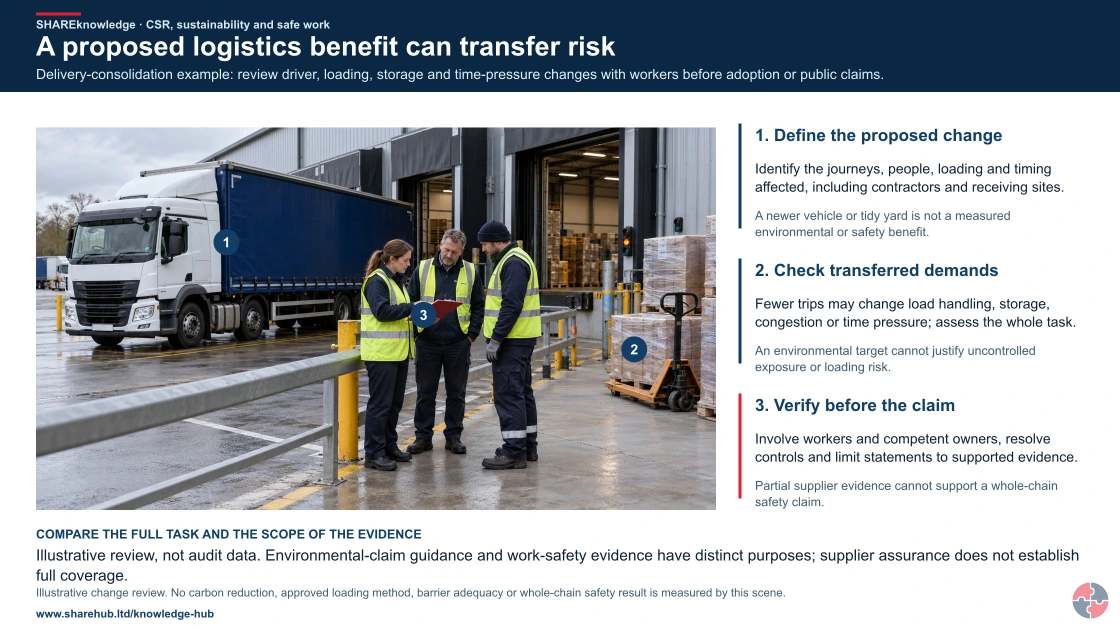
A proposed logistics benefit can transfer risk
Full written explanation
Delivery-consolidation example: review driver, loading, storage and time-pressure changes with workers before adoption or public claims.
- Define the proposed change. Identify the journeys, people, loading and timing affected, including contractors and receiving sites.
- Check transferred demands. Fewer trips may change load handling, storage, congestion or time pressure; assess the whole task.
- Verify before the claim. Involve workers and competent owners, resolve controls and limit statements to supported evidence.
Change the pathway
- Do not judge from appearance. A newer vehicle or tidy yard is not a measured environmental or safety benefit.
- Do not trade away protection. An environmental target cannot justify uncontrolled exposure or loading risk.
- Keep scope and gaps visible. Partial supplier evidence cannot support a whole-chain safety claim.
Evidence check: Illustrative review, not audit data. Environmental-claim guidance and work-safety evidence have distinct purposes; supplier assurance does not establish full coverage.
Complete transferred-risk and evidence-scope example
Primary references: HSE: loading-area risks (GB) · HSE: using contractors (GB) · CMA: environmental claims across supply chains (2026 scope)
Open the complete HD image (new tab)Download image

Complete transferred-risk and evidence-scope example
Primary references: HSE: loading-area risks (GB) · HSE: using contractors (GB) · CMA: environmental claims across supply chains (2026 scope)
For a claim-to-evidence review, compare “safer, sustainable work across our supply chain” with the evidence actually held. If contractor or exposure data covers only part of the work, narrow the statement and identify what remains unverified. Voluntary targets do not prove legal compliance, and an environmental benefit cannot justify uncontrolled exposure. Apply statutory reporting rules only where their specific scope is established.
BuildOut: a lower-impact material changes the task
Illustrative example. A procurement proposal replaces a material for an environmental target, but the new preparation method creates a different exposure.
Decision. The project and procurement owners hold adoption until competent task review and worker input establish suitable controls.
Evidence to check. Material information, full task comparison, contractor conditions, control verification and the scope of supporting data.
Hold or escalation point. Do not accept uncontrolled exposure to meet a target or publish a whole-chain safety claim from partial evidence.
Follow-up. Verify performance after the change and update the public claim only to the extent the evidence supports.
Compare benefits with who carries the work risks
A renewable-energy design choice can change installation, maintenance and wider impacts. Compare evidence across the lifecycle without an unsupported net-benefit score.

Claimed benefit
State the benefit, who receives it and what evidence supports the claim.
Distributed risk
Assess installation/maintenance access, supply-chain and community effects, including people outside the purchasing organisation.
Design and verify
Compare safer maintenance options, check supplier evidence and report remaining trade-offs honestly.
A sustainability claim or financial saving does not remove the need to control health and safety risks.
What are the key points about CSR, sustainability and health and safety?
The key point is that CSR and sustainability only have health and safety value when they change decisions, controls and evidence.
CSR starts with people affected by work
Employees, agency workers, contractors, supply-chain labour, customers, visitors and communities may all be affected by business decisions.
Sustainability changes can create new risks
Battery systems, recycled materials, low-carbon fuels, waste handling, remote work and new technologies may change fire, chemical, ergonomic, competence or emergency risks.
Supply chains are part of the risk system
Unsafe subcontracting, labour exploitation and poor procurement decisions can move risk out of sight without removing responsibility or reputational exposure.
Reporting must be evidence-led
Statements in reports, websites and tenders should be supported by policies, risk assessments, audits, data and verified actions.
Stakeholders test credibility
Workers, regulators, insurers, investors, clients, communities and the media may challenge whether claims match lived reality.
Diploma answers need judgement
Strong answers distinguish law, good practice, ethical expectation, proportionality, evidence and review.
What does CSR mean for health and safety?
It means using governance and purchasing power to prevent harm to workers and others, with claims tied to verified outcomes.
The HSE leadership guide asks boards to plan, deliver, check and act on safety risk. A sustainability report can describe goals, but the safety evidence is what happened at the workface: critical-barrier checks, worker voice, contractor conditions and corrected defects. HSENI contractor guidance shows why supply-chain work needs host coordination. Avoid claiming a voluntary framework is a standalone UK health-and-safety law.
How does CSR support worker protection?
CSR supports worker protection when the organisation uses its influence to improve real working conditions and reduce harm.
The social part of sustainability includes safe work, fair treatment, consultation, access to training, protection of vulnerable people, respect for workers who raise concerns and control of health risks that may not appear in short-term accident statistics. A responsible employer does not treat injury rates as the only measure of harm. It looks at occupational disease, stress, fatigue, musculoskeletal risk, violence, exposure, under-reporting and contractor experience.
CSR should also influence difficult decisions. If a schedule cannot be met without excessive overtime, weak supervision or unsafe subcontracting, the responsible choice is to change the plan rather than push risk down the chain. If a new sustainable material reduces carbon but introduces chemical exposure or fire risk, the organisation must assess and control that risk before adoption.
| Theme | What good practice looks like | Evidence to check |
|---|---|---|
| Safe work | Risk assessments and controls reflect real work, including contractors and non-routine tasks. | Risk assessments, method statements, inspections and worker feedback. |
| Occupational health | Long-latency and chronic health risks are measured and controlled. | Exposure monitoring, health surveillance, LEV checks and wellbeing data. |
| Fair treatment | People can report unsafe work without fear and are not pressured to hide issues. | Speak-up routes, consultation records and incident reporting trends. |
| Vulnerable workers | Young, new, migrant, temporary, agency and lone workers receive proportionate support. | Induction records, language support, supervision and competence checks. |
| Wellbeing | Work design, workload, change and psychosocial risks are considered. | Stress risk assessments, absence trends, consultation and action plans. |
| Contractor protection | Contractors receive clear standards, supervision and fair control of risk. | Pre-qualification, induction, audits, permits and performance reviews. |
How can the hierarchy of controls reduce worker and community risks in sustainability decisions?
Assess new physical hazards before approving an environmental improvement; a lower-carbon choice is incomplete if installation or maintenance becomes unsafe.
A roof-solar retrofit may cut energy use but introduce fall, electrical, structural and contractor-interface risks. First consider a ground-mounted or existing safe location; then reduce roof visits with modular design, engineer collective edge protection and isolation, coordinate permits and inspections, and use PPE for residual work. The HSE leadership guide supports board assurance; HSE contractor guide supports procurement and workface checks. HSE height guidance and HSENI height guidance cover work-location fall controls; HSE electrical work guidance covers secure isolation. Stop when roof capacity, edge protection or electrical isolation is unverified.
On a small screen, scroll this table sideways to read all columns.
How can the ERICPD hierarchy of controls reduce worker and community risks in sustainability decisions?

| Five-level / ERICPD | Control choice | Owner, check, failure and stop |
|---|---|---|
| Eliminate / eliminate | Ground-mount or relocate maintenance to ground level if feasible. | Designer records choice; hold roof job if safer route works. |
| Substitute / reduce | Modular design reduces visits after structural review. | Engineer approves; stop on unverified roof load. |
| Engineering / isolate and control | Collective edge protection and electrical isolation. | Site lead witnesses checks; stop on failure. |
| Administrative / discipline | Contractor plan, permit and worker consultation. | Host supervisor observes; hold work on interface change. |
| PPE / PPE | Residual fall/electrical protection with rescue. | Contractor lead checks; no work if protection fails. |
How can the ISO 45001 hierarchy of controls reduce worker and community risks in sustainability decisions?

| Five-level / ERICPD | Control choice | Owner, check, failure and stop |
|---|---|---|
| Eliminate / eliminate | Ground-mount or relocate maintenance to ground level if feasible. | Designer records choice; hold roof job if safer route works. |
| Substitute / reduce | Modular design reduces visits after structural review. | Engineer approves; stop on unverified roof load. |
| Engineering / isolate and control | Collective edge protection and electrical isolation. | Site lead witnesses checks; stop on failure. |
| Administrative / discipline | Contractor plan, permit and worker consultation. | Host supervisor observes; hold work on interface change. |
| PPE / PPE | Residual fall/electrical protection with rescue. | Contractor lead checks; no work if protection fails. |
HSE five-level hierarchy complements ERICPD. For the solar retrofit, competent designers check actual roof fragility, geometry, array and work loads, access and compatible collective protection. Competent installers verify the installed support, barriers, access and electrical system against the design and record acceptance before handover or roof work. Keep maintenance, inspection and defect records. Check protection, access, electrical arrangements and relevant weather before work and as conditions change. Stop for damage, an unverified load or failed protection; correct the cause and reverify the accepted arrangement before authorised restart. HSE roof-work guidance and HSE electrical-safety guidance support suitable installation and maintained controls. The EU-OSHA solar-risk checklist explains that mains disconnection does not stop PV generation. The qualified electrical lead must identify all supply and stored-energy paths and establish safe isolation/protection for the exact PV arrangement; a mains-off indication alone is insufficient.
How should supply-chain ethics and procurement be managed?
Supply-chain ethics should be managed through pre-qualification, contract standards, due diligence, monitoring and improvement.
Procurement decisions shape risk before work starts. If a buyer selects the cheapest supplier without checking competence, labour standards, supervision, equipment, insurance, training or subcontracting arrangements, the organisation may create conditions where unsafe work becomes predictable. Ethical procurement means price is considered alongside capability, worker protection and legal compliance.
Modern slavery risk should be treated as a real supply-chain risk, not a statement-writing exercise. The GOV.UK guidance explains that certain organisations must publish an annual modern slavery statement and describes areas such as structure, policies, due diligence, risk assessment, key performance indicators and training. Smaller organisations may not have the same reporting duty, but the underlying worker-protection principles still support good governance.
| Control area | What to do | Evidence to keep |
|---|---|---|
| Pre-qualification | Check supplier competence, labour standards, insurance, enforcement history, accident performance and sector risk. | Supplier questionnaires, certificates, references and due-diligence notes. |
| Contract standards | Set health, safety, welfare, employment and reporting expectations before work starts. | Contract clauses, scope documents, contractor rules and bridging documents. |
| Modern slavery risk assessment | Identify higher-risk countries, sectors, labour providers, subcontracting chains and low-margin work. | Risk map, supplier declarations, audit programme and improvement actions. |
| Onboarding and induction | Explain site hazards, reporting routes, welfare standards and worker rights. | Induction records, translations, supervisor checks and worker interviews. |
| Monitoring | Check conditions on site and in supply chains instead of relying only on declarations. | Audits, inspections, worker feedback, nonconformities and corrective actions. |
| Improvement and exit | Support improvement where possible, but stop using suppliers who cannot or will not meet minimum standards. | Supplier reviews, escalation records and procurement decisions. |
How should organisations govern CSR and sustainability commitments?
CSR and sustainability commitments should be governed through clear ownership, reliable data, board review and action tracking.
Governance turns values into decisions. A credible organisation can show who owns the policy, who owns each risk area, how data is collected, how claims are approved, how worker views are heard, how suppliers are checked, how serious risks are escalated and how leaders know whether improvement is real.
The strongest governance models integrate health and safety with strategy rather than treating it as a compliance appendix. Board packs should include meaningful leading and lagging indicators, major risk themes, worker consultation, contractor performance, occupational health data, serious incident learning, overdue critical actions, enforcement issues and assurance findings.
| Governance element | Good practice | Weak practice |
|---|---|---|
| Policy ownership | Board or senior leadership owns commitments and reviews implementation. | Policy is signed but not used in decisions. |
| Stakeholder engagement | Workers, contractors and affected communities have meaningful routes to raise issues. | Engagement is limited to surveys with no feedback loop. |
| Data quality | Metrics are defined, checked and explained with context. | Only easy or flattering indicators are reported. |
| Risk integration | CSR risks are linked to risk registers, procurement and management review. | CSR sits outside operational risk management. |
| Action tracking | Findings are assigned, resourced, verified and reviewed. | Reports contain broad commitments without owners or deadlines. |
| External reporting | Public claims are supported by evidence and limitations are stated. | Claims overstate performance or hide unresolved problems. |
How can organisations avoid superficial CSR or sustainability claims?
Organisations avoid superficial claims by making sure public statements are specific, evidenced, proportionate and connected to operational reality.
A claim such as ‘safety is our first priority’ is weak if the business cannot show how it affected resources, procurement, staffing, planning, maintenance, training or decisions to stop work. A sustainability claim is weak if it ignores new risks created by the change. A supply-chain ethics claim is weak if the organisation does not understand who actually performs the work.
For health and safety professionals, the role is to test the claim against evidence. If the organisation says it protects worker wellbeing, what does work design data show? If it says contractors are part of the team, what do contractor audits and induction records show? If it says learning is embedded, what repeat-event data shows improvement?
| Claim | Evidence that would support it | Question to ask |
|---|---|---|
| We protect workers | Risk controls, consultation, occupational health data and action close-out. | Which high-risk worker groups are still experiencing harm or poor conditions? |
| We have an ethical supply chain | Supplier due diligence, modern slavery assessment, audits and worker feedback. | How far down the subcontract chain has the organisation checked? |
| We are sustainable | Lifecycle assessment, safe design, risk assessment and environmental reporting. | Did the change introduce new health, fire, chemical, ergonomic or emergency risks? |
| We learn from incidents | Investigations, root-cause actions, effectiveness checks and trend improvement. | What has changed in the system since the last serious event? |
| We consult workers | Consultation records, feedback loops and examples of changed decisions. | Can workers name an issue they raised that led to action? |
| We are transparent | Balanced reporting, limitations, open metrics and independent assurance where needed. | Are unresolved issues explained or quietly omitted? |
Which duties and reporting claims need checking?
Work-health-and-safety duties apply regardless of CSR language; any separate disclosure duty needs its own eligibility and jurisdiction check.
The HSE leadership guide addresses GB management responsibilities; HSENI contractor guidance is a NI work-control route. The GOV.UK modern-slavery statement guide applies only to organisations meeting its statutory scope and is not a general ESG report requirement. Verify any environmental or corporate disclosure rule separately; do not present voluntary sustainability targets as legal compliance.
HSG159 is the second edition from 2011; use its contractor-management principles with current GB/NI duties. The Home Office scope guidance, updated 25 April 2024 sets a specific commercial-organisation, UK-business, goods/services and turnover test. It is not a universal sustainability disclosure rule; check applicability and board/signatory requirements for the actual organisation.
What should the risk register include for CSR and sustainability?
The risk register should connect CSR and sustainability commitments to credible operational, ethical, legal and reputational failure routes.
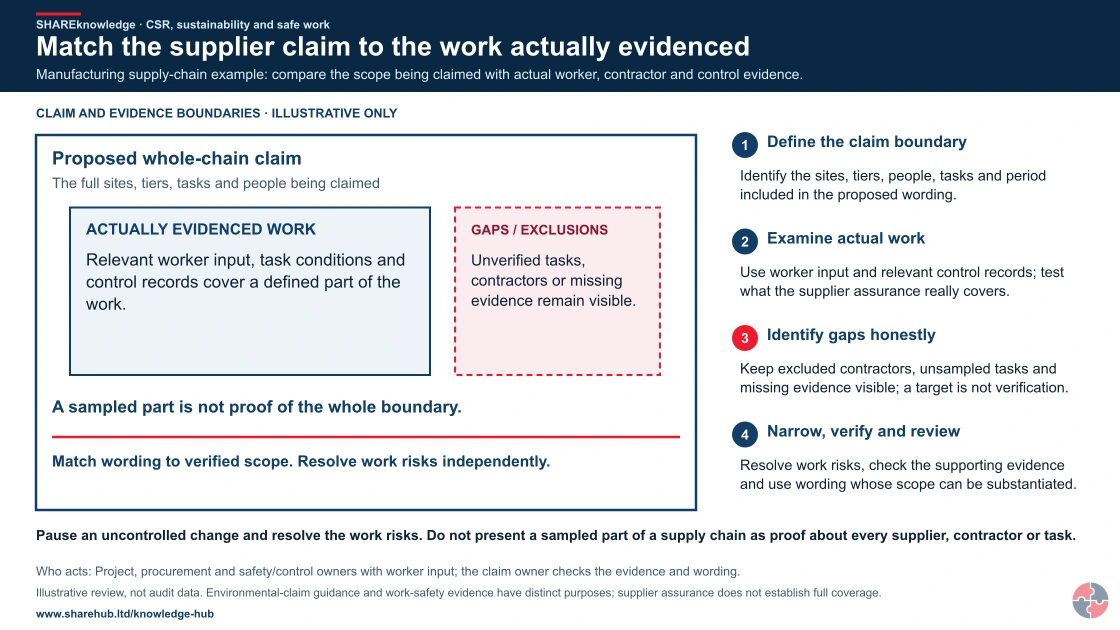
Match the supplier claim to the work actually evidenced
Full written explanation
Manufacturing supply-chain example: compare the scope being claimed with actual worker, contractor and control evidence.
- Define the claim boundary. Identify the sites, tiers, people, tasks and period included in the proposed wording.
- Examine actual work. Use worker input and relevant control records; test what the supplier assurance really covers.
- Identify gaps honestly. Keep excluded contractors, unsampled tasks and missing evidence visible; a target is not verification.
- Narrow, verify and review. Resolve work risks, check the supporting evidence and use wording whose scope can be substantiated.
When the evidence does not fit: Pause an uncontrolled change and resolve the work risks. Do not present a sampled part of a supply chain as proof about every supplier, contractor or task.
Who acts: Project, procurement and safety/control owners with worker input; the claim owner checks the evidence and wording.
Changed workplace
Distribution change: Compare the whole loading, storage and driver task before claiming a benefit.
Manufacturing supplier: Ask whose work and which controls were actually checked; record exclusions and unresolved gaps.
Evidence check: Illustrative review, not audit data. Environmental-claim guidance and work-safety evidence have distinct purposes; supplier assurance does not establish full coverage.
Complete transferred-risk and evidence-scope example
Primary references: HSE: loading-area risks (GB) · HSE: using contractors (GB) · CMA: environmental claims across supply chains (2026 scope)
Open the complete HD image (new tab)Download image

Complete transferred-risk and evidence-scope example
Primary references: HSE: loading-area risks (GB) · HSE: using contractors (GB) · CMA: environmental claims across supply chains (2026 scope)
A useful register does not list ‘CSR’ as a vague topic. It identifies specific risk routes: unsafe subcontracting, modern slavery exposure, sustainability change introducing new hazards, misleading public claims, poor worker consultation, failure to control occupational health risks or serious incident learning not being embedded.
Each entry should have an owner, controls, evidence, review date, escalation route and connection to policy, procurement or management review.
| Event or issue | Risk route | Preventing controls | Response or mitigation | Evidence to check |
|---|---|---|---|---|
| Unsafe subcontracting | Risk is pushed to lower-tier suppliers with weak supervision or competence. | Supplier pre-qualification, contractor rules, audits and contract controls. | Suspend unsafe work, review supplier and strengthen procurement standards. | Supplier checks, audit records, inductions and corrective actions. |
| Sustainability change creates new hazard | A low-carbon or waste-reduction initiative introduces fire, chemical, ergonomic or emergency risk. | Change risk assessment, competent review and training before rollout. | Pause implementation and reassess controls. | MOC records, risk assessment, training and emergency review. |
| Modern slavery exposure | Labour exploitation or coercive conditions occur in operations or supply chain. | Due diligence, worker engagement, reporting routes and supplier audits. | Escalate to competent legal/HR/procurement support and protect affected people. | Modern slavery assessment, supplier records and action logs. |
| Misleading public claims | CSR or ESG statements are unsupported or overstate performance. | Claim approval process, evidence packs and balanced reporting. | Correct statements and improve data controls. | Report records, evidence files, approval records and assurance findings. |
| Worker voice ignored | Consultation is superficial and warning signs are missed. | Worker engagement, safety representatives and feedback loops. | Reopen consultation and act on unresolved issues. | Meeting records, actions, close-out and workforce feedback. |
How could BuildOut Ltd manage CSR, sustainability and health and safety?

BuildOut Ltd would manage CSR by making sure its construction promises are backed by procurement, site control, worker protection and evidence.
BuildOut Ltd
BuildOut Ltd is a construction and refurbishment contractor. It is a useful example because construction sustainability choices, subcontracting and public commitments can directly affect worker protection and supply-chain risk.
BuildOut’s leadership team creates a CSR and sustainability register linked to its health and safety risk register. It covers dust, noise, manual handling, work at height, welfare, mental health, subcontractor labour standards, waste segregation, recycled material use, plant emissions, temporary works, fire risk and community impact. Each item has a named owner, evidence requirement and review route.
Procurement teams pre-qualify subcontractors before tender award, not after mobilisation. They check competence, labour provider arrangements, training, insurance, enforcement history, modern slavery risk, supervision capacity, accident performance and ability to meet BuildOut’s site rules. Contracts include clear welfare, reporting, PPE, working time, induction, waste and environmental requirements.
Site managers verify that CSR commitments are visible on site: suitable welfare, dust controls, safe waste segregation, safe battery charging, plant traffic controls, fair treatment of subcontractors, understandable inductions, language support where needed and worker routes for concerns. HSE advisers complete second-line assurance checks and report trends to directors.
| Management area | How BuildOut applies it | Evidence, oversight and improvement |
|---|---|---|
| Governance | Board reviews CSR, sustainability, H&S and supply-chain risk together rather than as separate reports. | Quarterly dashboard, director minutes, action tracker and risk register updates. |
| Procurement | Supplier selection includes competence, welfare, labour standards, insurance, enforcement history and sustainability risk. | Pre-qualification records, tender scoring and supplier review meetings. |
| Site controls | Sustainability initiatives are assessed for health and safety impact before site rollout. | Change assessments, site briefings, inspections and worker feedback. |
| Training | Awareness training is provided to all; managers receive deeper training on ethical procurement, worker protection and reporting evidence. | Training matrix, toolbox talks, supervisor briefings and assessment records. |
| Monitoring | First-line site checks, second-line HSE audits and third-line external reviews sample whether commitments match site conditions. | Inspection results, audit findings, photographs, interviews and verified actions. |
| Learning | Incidents, complaints, near misses and supplier issues are trended and used to update standards. | Learning bulletins, revised procurement rules and management review decisions. |
What should each role learn and demonstrate?
Learning must match the decisions people make, from recognising danger to checking that controls work.
Briefings should tell people how to act, but attendance alone does not show competence. Assess the real decision or task, record who assessed it and revisit after a material change, failed control or incident. A local authorisation is task-specific; no universal external certificate is implied.
On a small screen, scroll this table sideways to read all columns.
| Role and learning | Demonstration and assessor | Record and reassessment trigger |
|---|---|---|
| Board sponsor | Challenge verified worker and contractor outcomes; board peer reviews. | Minutes/actions; revisit after incident. |
| Designer | Test safety impacts of retrofit choices; engineer assesses. | Design risk record; repeat on change. |
| Buyer | Specify supplier safety and labour controls; procurement lead assesses. | Selection evidence; review after performance issue. |
How can this support advanced safety study?
For advanced safety study, the topic should be analysed as policy strategy, CSR awareness and change-management capability.
A strong Diploma answer defines CSR and sustainability, then applies them to the organisation in the scenario. It should identify relevant stakeholders, explain legal and ethical expectations, consider supply-chain and procurement risk, show how sustainability changes may affect health and safety, and define evidence that would demonstrate genuine implementation.
A strong answer should explain specific claims rather than use phrases such as ‘improve reputation’ unless it explains how reputation is linked to governance, transparency, worker protection, reporting and risk control. Diploma-level writing should show professional judgement: what is mandatory, what is good practice, what is proportionate, what requires specialist advice and how success will be reviewed.
For scenario-based questions, start with context. A construction contractor, fuel terminal, leisure operator, healthcare provider and manufacturer will have different stakeholder expectations and evidence needs. The principle is the same, but the application must be specific.
| Part of answer | What to include | Common weakness to avoid |
|---|---|---|
| Definition | CSR, sustainability, stakeholders and governance in plain English. | Giving a slogan without linking to workplace decisions. |
| Legal baseline | HSWA, risk assessment, reporting and modern slavery duties where relevant. | Treating CSR as purely voluntary. |
| Application | Worker protection, procurement, sustainability change, consultation and reporting. | Using a generic list that ignores the organisation. |
| Evidence | Policies, risk registers, audits, supplier checks, training, metrics and action close-out. | Assuming a published statement proves control. |
| Evaluation | Strengths, gaps, proportionality, stakeholder credibility and review triggers. | Only describing what should happen without judging adequacy. |
| Recommendation | Prioritised actions with owners, timescales and verification. | Making broad recommendations with no implementation route. |
How can a management system sustain effective decisions?
Give each hazard or support route an owner, a control, a check and a response to failure.
Tie public claims to material hazards, worker input, contractor controls, board challenge and evidence of improvement. An owner should sample actual work and corrective actions, not accept a policy or certificate as evidence that the controls work.
The free GB regulator guide HSE Managing for health and safety (HSG65) explains a plan–do–check–act approach: assign controls and owners, involve workers, check work as done, and correct failures. For Northern Ireland, use HSENI risk assessment guidance for the local duty. A certificate alone does not demonstrate that a control works.
What are the warning signs that CSR and sustainability are not credible?
Warning signs appear when public commitments are disconnected from worker experience, operational controls and evidence.
The most common failure is a gap between language and lived reality. The organisation says people are its priority, but procurement rewards the cheapest unsafe contractor. It says it values wellbeing, but staffing levels create predictable fatigue. It says it is sustainable, but new materials are introduced without COSHH review. It says it learns, but serious actions remain overdue.
These signs matter because they undermine trust and may indicate deeper governance weakness. Regulators, clients, investors, workers and the public are more likely to trust balanced reporting that acknowledges challenges and demonstrates progress than polished statements with little evidence.
CSR language is vague
Broad values are not supported by owners, controls, metrics or review dates.
Procurement ignores worker protection
Price and speed dominate supplier selection even where labour, competence or welfare risks are foreseeable.
Sustainability projects bypass H&S review
New equipment, materials or processes are introduced without assessing health, fire, chemical or emergency risks.
Reporting uses only positive indicators
The organisation hides occupational health, contractor or serious-risk weaknesses behind easy metrics.
Worker voice is weak
Employees and contractors do not believe concerns will be heard or acted upon.
Actions are not verified
The organisation records promises but does not check whether conditions improved.
Which acronyms are useful for CSR, sustainability and health and safety?
These acronyms often appear in reporting, governance and health and safety strategy.
| Acronym | Meaning | Why it matters |
|---|---|---|
| CSR | Corporate social responsibility | Describes wider business responsibility for social and ethical impact. |
| ESG | Environmental, social and governance | Common investor and stakeholder lens for wider business performance. |
| HSE | Health and Safety Executive | Main regulator for many Great Britain workplace health and safety matters. |
| KPI | Key performance indicator | Used to monitor performance but must be meaningful and balanced. |
| SECR | Streamlined Energy and Carbon Reporting | UK reporting framework for energy and carbon information for applicable organisations. |
| OSH | Occupational safety and health | Professional term for workplace health and safety. |