SHARE Knowledge Hub
Shift Work and Circadian Rhythm
Shift work and circadian rhythm risk management covers the way working time, night work, early starts, long shifts, overtime, on-call work and rapid rota changes affect alertness, sleep, recovery, health and safety-critical performance. It is not enough to tell workers to sleep better. Employers must assess fatigue and shift-work risks, design safer schedules so far as reasonably practicable, manage workload, breaks, handover, commuting, supervision, welfare, lone work, health assessments and review evidence from incidents, errors and worker feedback.
Understanding Shift Work and Circadian Rhythm
Shift work and circadian rhythm risk management covers the way working time, night work, early starts, long shifts, overtime, on-call work and rapid rota changes affect alertness, sleep, recovery, health and safety-critical performance. It is not enough to tell workers to sleep better. Employers must assess fatigue and shift-work risks, design safer schedules so far as reasonably practicable, manage workload, breaks, handover, commuting, supervision, welfare, lone work, health assessments and review evidence from incidents, errors and worker feedback.
Why this matters at work
Give the review an accountable owner and use findings to change staffing, timing or task design. Keep a clear escalation route when a worker is too tired for safety-critical duties, and ensure supervisors can use it without production pressure defeating the policy. Review after rota or workload changes and after serious warning signs. Individual sleep advice can help, but the employer must still manage the work organisation that creates the risk.
Compare feasible rosters against these hazards and the applicable working-time or sector rules. Consult workers, but explain why preference cannot authorise an unsafe arrangement. Establish a manageable trial with reporting and review, actual-hours records and a way to correct emerging problems. A fatigue index can inform assessment but is not personal fitness clearance. Seek competent occupational-health or specialist advice where health or safety-critical demands require it.
How organisations manage this in practice
Working-time rules provide minimum protections, but HSE says compliance alone is insufficient to control fatigue. Workload, duration, timing, consecutive shifts, breaks, overtime, on-call duties and recovery opportunity interact. Night work can conflict with the body clock and daytime sleep may be shorter or disrupted. A willing worker or popular rota is not proof that safety-critical performance is adequate. Assess the actual work and hours, consult workers and consider individual circumstances without diagnosing them. Record overtime and swaps so the assessment reflects hours worked rather than the published rota. Plan relief and a response when someone is too sleepy to work safely. Review incidents, near misses, errors and fatigue reports alongside staffing. HSE design recommendations are guidance to apply intelligently; they are not a single universally safe shift system.
Keep the process confidential and focused on appropriate work advice. A questionnaire can form part of an assessment when properly designed; a supervisor should not diagnose sleep disorders from it. If a health professional confirms that night duties have harmed the worker's health, the employer must arrange other suitable work wherever possible under the applicable night-work rules. Obtain occupational-health advice on the work and any adjustments. Offering assessments does not compensate for a harmful rota. Retain appropriate evidence of the offer and management actions separately from private medical details.
For workers within the relevant night-work provisions, employers must offer a free health assessment before night work and at regular intervals. The GOV UK guidance says workers do not have to accept and the interval depends on the assessment for the individual; do not invent a universal annual examination requirement. Use competent healthcare input and the current rules, including any sector exceptions and separate NI provisions.
Compare rostered work, actual overtime and recovery
Night work, handover, travel and sleep opportunity belong in the same fatigue assessment. A person’s biological response varies; a clock band cannot calculate fitness for work.

Rostered hours
Review the intended shift pattern, task demands and staffing with the people who work it. Include transitions between days, nights and rest days.
Actual hours
Record overruns, call-outs, swaps and missed breaks rather than assuming the roster describes reality. Investigate persistent pressure to extend shifts.
Critical task timing
Assess high-consequence work, supervision and human-performance demands. Use competent staffing and suitable relief rather than assigning a universal safe time from a body-clock curve.
Relief and handover
Make cover, breaks and two-way handover practicable. Fatigue can affect the incoming/outgoing exchange as well as operation.
Travel and recovery
Consider the journey home and realistic sleep opportunity, including other essential demands. Time away from work is not guaranteed restorative sleep.
Fatigue concern
Stop or reassign unsafe critical work under the agreed arrangements and arrange suitable support or safe travel. Review the schedule and health-assessment route where applicable.
The illustrative bands are untimed and do not establish legal hours, a safe sleep minimum or a fitness score.
What is the circadian rhythm and why does it matter?
Circadian timing makes night work and early starts harder for many people; rota, workload, breaks and recovery determine whether fatigue threatens safe performance.
Best-practice guide: Shift Work and Circadian Rhythm
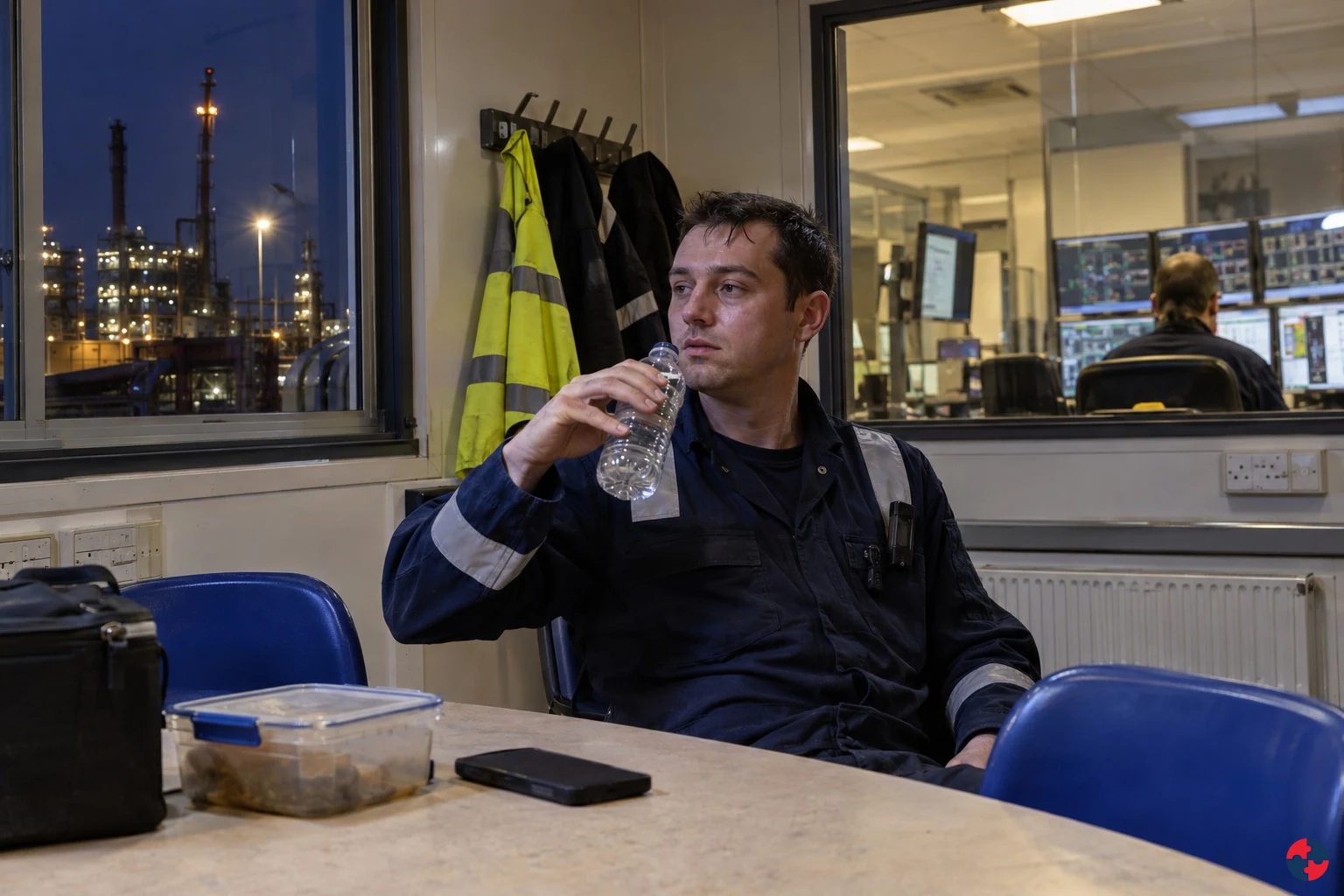
What is the circadian rhythm and why does it matter?
Circadian timing makes night work and early starts harder for many people; rota, workload, breaks and recovery determine whether fatigue threatens safe performance. Shift work and circadian rhythm risk management covers the way working time, night work, early starts, long shifts, overtime, on-call work and rapid rota changes affect alertness, sleep, recovery, health and safety-critical performance.
Turn shift work and circadian rhythm knowledge into a decision
Shift work and circadian rhythm risk management covers the way working time, night work, early starts, long shifts, overtime, on-call work and rapid rota changes affect alertness, sleep, recovery, health and safety-critical performance. It is not enough to tell workers to sleep better. Retain actual hours, exception approval, alarm and bypass log, handover confirmation, fatigue report and corrective-action close-out.
Hold a fatigued maintenance handover
If fatigue signs or a repeated alarm appear, pause the safety-critical task, verify plant state, authorise any bypass and give a protected written and verbal handover. The incoming supervisor confirms the bypass status and plant state; the manager resolves staffing and reviews the rota before repeating the pattern.
Where do shift-work controls commonly fail?
Controls fail when planned rotas ignore actual hours, workload, break quality, handover and worker feedback.
Choose controls for shift work and circadian rhythm
Rota design: Night work, early starts, rotation direction, consecutive shifts, shift length and recovery time. Staffing and workload: Whether people can take breaks, complete work without rushing and avoid excessive overtime. Task timing: High-consequence tasks during circadian lows, end-of-shift fatigue or after call-outs. Breaks and recovery: Protected rest, meal breaks, welfare access and recovery between shifts. Commute risk: Driving home after nights, long shifts, overtime or broken sleep. Read the full control table for qualifications, ownership and verification. Use the actual task and applicable jurisdiction; existing technical approval remains unchanged.
Use the full shift work and circadian rhythm lesson
Use the full topic for the decision points, practical examples, detailed control tables and source scope. HSE guidance applies to Great Britain; use HSENI for the Northern Ireland route and the source’s stated jurisdiction. A simplified guide does not change the page’s technical-review or approval status.

Read all six steps as text
1. What is the circadian rhythm and why does it matter?
Circadian timing makes night work and early starts harder for many people; rota, workload, breaks and recovery determine whether fatigue threatens safe performance.
- Avoid / redesign: Night work, early starts, rotation direction, consecutive shifts, shift length and recovery time.
- Control the task: High-consequence tasks during circadian lows, end-of-shift fatigue or after call-outs.
- Verify before release: Rota rules, fatigue assessment, exceptions and actual hours worked.
Circadian timing makes night work and early starts harder for many people; rota, workload, breaks and recovery determine whether fatigue threatens safe performance. Shift work and circadian rhythm risk management covers the way working time, night work, early starts, long shifts, overtime, on-call work and rapid rota changes affect alertness, sleep, recovery, health and safety-critical performance.
Apply it: Which part of this plan would you check at the workface before authorising the task?
2. Turn shift work and circadian rhythm knowledge into a decision
Use the evidence to improve the actual work arrangement.
- Change at source: Night work, early starts, rotation direction, consecutive shifts, shift length and recovery time.
- Make it observable: Rota rules, fatigue assessment, exceptions and actual hours worked.
- Keep useful evidence: Retain actual hours, exception approval, alarm and bypass log, handover confirmation, fatigue report and corrective-action close-out.
Shift work and circadian rhythm risk management covers the way working time, night work, early starts, long shifts, overtime, on-call work and rapid rota changes affect alertness, sleep, recovery, health and safety-critical performance. It is not enough to tell workers to sleep better. Retain actual hours, exception approval, alarm and bypass log, handover confirmation, fatigue report and corrective-action close-out.
Apply it: What evidence would show that the change improves this task, rather than only completing a record?
3. Hold a fatigued maintenance handover
Example: a practical application of the existing topic lesson.
- Setting: A maintenance technician ends several nights with unplanned overtime; a plant alarm and temporary bypass must pass to the morning team.
- Act: Plan the rota with recovery time, limit unplanned overtime, assign relief and agree how alarms and bypasses are recorded and challenged.
- Hold / review: Stop or reassign for microsleep, missed critical alarm, unknown bypass state, absent relief or a worker unable to travel home safely.
If fatigue signs or a repeated alarm appear, pause the safety-critical task, verify plant state, authorise any bypass and give a protected written and verbal handover. The incoming supervisor confirms the bypass status and plant state; the manager resolves staffing and reviews the rota before repeating the pattern.
Apply it: At which point would you hold this example, and what evidence would allow it to proceed?
4. Where do shift-work controls commonly fail?
Connect the task, the route to the person and the control that can fail.
- Source / exposure: Controls fail when planned rotas ignore actual hours, workload, break quality, handover and worker feedback.
- Possible consequence: A rota can look acceptable on paper while the real system is unsafe.
- Control failure: People may stay late, swap shifts, miss breaks, cover vacancies, commute long distances and handle demanding tasks at the worst alertness times.
Controls fail when planned rotas ignore actual hours, workload, break quality, handover and worker feedback.
Apply it: Who could be exposed, including other trades, cleaners, maintainers and people nearby?
5. Choose controls for shift work and circadian rhythm
Start with the stronger practicable options and verify their effect.
- Rota design: Night work, early starts, rotation direction, consecutive shifts, shift length and recovery time.
- Staffing and workload: Whether people can take breaks, complete work without rushing and avoid excessive overtime.
- Task timing: High-consequence tasks during circadian lows, end-of-shift fatigue or after call-outs.
- Breaks and recovery: Protected rest, meal breaks, welfare access and recovery between shifts.
- Commute risk: Driving home after nights, long shifts, overtime or broken sleep.
Rota design: Night work, early starts, rotation direction, consecutive shifts, shift length and recovery time. Staffing and workload: Whether people can take breaks, complete work without rushing and avoid excessive overtime. Task timing: High-consequence tasks during circadian lows, end-of-shift fatigue or after call-outs. Breaks and recovery: Protected rest, meal breaks, welfare access and recovery between shifts. Commute risk: Driving home after nights, long shifts, overtime or broken sleep. Read the full control table for qualifications, ownership and verification. Use the actual task and applicable jurisdiction; existing technical approval remains unchanged.
Apply it: Which stronger option can be used here, and who will verify it before accepting the remaining risk?
6. Use the full shift work and circadian rhythm lesson
Follow the official sources below and retain the task-specific evidence.
- Official guidance: Direct guidance
- Official guidance: Source
- Task decision: Retain actual hours, exception approval, alarm and bypass log, handover confirmation, fatigue report and corrective-action close-out.
Use the full topic for the decision points, practical examples, detailed control tables and source scope. HSE guidance applies to Great Britain; use HSENI for the Northern Ireland route and the source’s stated jurisdiction. A simplified guide does not change the page’s technical-review or approval status.
Apply it: Which official source and full-topic section will you use to resolve the next decision?
HSE explains fatigue as a system risk affecting reaction, memory and judgement. HSE.
Most people are biologically prepared for wakefulness in the day and sleep at night. Night work, early starts and rotating shifts can disrupt sleep timing, reduce sleep quality, create fatigue and affect attention, reaction time, judgement, mood, digestion and long-term wellbeing.
The risk is not limited to feeling tired. Fatigue can affect driving home after a shift, responding to alarms, operating plant, administering care, supervising contractors, making isolation decisions, communicating during handover and noticing weak signals.
People vary in how they adapt. Age, health, caring responsibilities, commute, sleep environment, second jobs, medication, workload and personal circumstances all influence tolerance. That is why good systems combine rota design with individual support and confidential routes for concern.
| Concept | Meaning | Workplace implication |
|---|---|---|
| Circadian rhythm | Internal body clock influencing sleep, alertness, hormones, digestion and performance. | Night work and early starts may conflict with natural alertness patterns. HSE |
| Sleep debt | Accumulated sleep loss over days or shifts. | Risk can build before a person appears visibly tired. HSE |
| Low-alertness window | Period, often overnight and early morning, when alertness can fall. | Avoid highest-risk tasks where possible or add supervision and controls. HSE |
| Sleep inertia | Grogginess after waking, especially from deep sleep. | Can affect call-out, emergency response or early-shift decisions. HSE |
| Cumulative fatigue | Fatigue from repeated long shifts, poor breaks or insufficient recovery. | Review overtime, consecutive shifts and workload. HSE |
| Commuting risk | Driving home after nights or long shifts can be safety-critical. | Journey planning and fatigue stop rules may be needed. HSE |
| Individual vulnerability | Health, medication, pregnancy, age or caring responsibilities can affect tolerance. | Use confidential support and reasonable adjustments. HSE |
How should shift-work risk be managed as a system?
A good shift-work system designs schedules, workload, breaks, handover, supervision and recovery before relying on personal coping.
The starting point is a fatigue and shift-work risk assessment. It should cover shift length, start/finish times, rotation direction, consecutive shifts, overtime, on-call demands, commute, task criticality, workload, breaks, lone work, staffing, welfare and worker feedback.
Controls should target the work system. Rota design, staffing levels, work allocation, breaks, lighting, handover, supervision, transport arrangements and fatigue reporting matter more than telling workers to be resilient.
| Control area | Good practice question | Evidence |
|---|---|---|
| Rota design | Are nights, early starts, long shifts and consecutive shifts controlled? | Rota review and fatigue-risk assessment. HSE |
| Workload | Is demanding, monotonous or safety-critical work planned for better alertness where possible? | Task schedule and supervisor review. HSE |
| Breaks | Are breaks regular, usable and protected? | Break records, worker feedback and observation. HSE |
| Handover | Is critical information transferred reliably between shifts? | Handover log and quality checks. HSE |
| Supervision | Is supervision increased during low-alertness or high-risk periods? | Shift supervisor plan. HSE |
| Welfare | Are rest, food, drink, toilets, lighting and security available at night? | Welfare inspections. HSE |
| Commuting | Is post-shift driving fatigue considered? | Journey guidance and fatigue reporting. HSE |
| Health support | Are night-worker assessments and OH routes available where needed? | Health assessment and referral records. HSE |
How can a poor shift pattern create a safety incident?
A worked example shows how fatigue, handover and pressure can align to weaken controls.
HSE fatigue guidance supports the rota and workload pathway in this illustrative case. HSE.
Hold a fatigued maintenance handover
Task material and setting: A maintenance technician ends several nights with unplanned overtime; a plant alarm and temporary bypass must pass to the morning team.
People and prerequisites: The shift manager owns staffing; the technician, incoming operator and maintenance supervisor need a current bypass log, escalation route and safe travel plan.
Before: Plan the rota with recovery time, limit unplanned overtime, assign relief and agree how alarms and bypasses are recorded and challenged.
During: If fatigue signs or a repeated alarm appear, pause the safety-critical task, verify plant state, authorise any bypass and give a protected written and verbal handover.
Hold or stop: Stop or reassign for microsleep, missed critical alarm, unknown bypass state, absent relief or a worker unable to travel home safely.
Completion and hand back: The incoming supervisor confirms the bypass status and plant state; the manager resolves staffing and reviews the rota before repeating the pattern.
Evidence: Retain actual hours, exception approval, alarm and bypass log, handover confirmation, fatigue report and corrective-action close-out.
A maintenance technician finishes a run of night shifts with overtime because staffing is short. During the final shift, an alarm repeats and is treated as nuisance. Handover is rushed, a temporary bypass is not clearly recorded and the morning team starts work believing the system is normal.
The root issue is not one tired person. The system allowed cumulative fatigue, poor alarm response, overtime pressure, weak handover and lack of bypass control to combine. A better system would limit overtime, protect handover, require bypass authorisation, increase supervision during low-alertness periods and review fatigue indicators.
| Failure pathway | Weak system | Stronger system |
|---|---|---|
| Rota | Repeated nights plus overtime accepted as normal. | Consecutive nights and overtime controlled with fatigue trigger. HSE |
| Alertness | Low-alertness period not recognised. | High-risk tasks avoided or supervised during circadian low. HSE |
| Alarm | Repeated alarm treated as nuisance. | Alarm response and escalation rule defined. HSE |
| Temporary bypass | Breach noted informally. | Bypass logged, authorised, time-limited and handed over. HSE |
| Handover | Rushed verbal update only. | Written log, verbal confirmation and incoming questions. HSE |
| Learning | Worker reminded to concentrate. | Rota, alarm, handover and bypass controls reviewed. HSE |
What is the fatigue-risk hierarchy for shift work?
Fatigue control should start with rota and work design before relying on individuals to cope.
A strong fatigue system works like a hierarchy. It starts by designing safer schedules and staffing levels, then controls the timing and difficulty of tasks, protects breaks and welfare, considers commute risk, offers health assessment, encourages reporting and checks whether the system is working.
This hierarchy is important because fatigue is not solved by telling workers to sleep better. Personal habits matter, but they cannot overcome excessive hours, poor staffing, low-alertness task timing, missed breaks or a culture where people fear reporting fatigue.
| Control layer | What it controls | Evidence to review |
|---|---|---|
| Rota design | Night work, early starts, rotation direction, consecutive shifts, shift length and recovery time. | Rota rules, fatigue assessment, exceptions and actual hours worked. HSE |
| Staffing and workload | Whether people can take breaks, complete work without rushing and avoid excessive overtime. | Staffing plan, overtime data, missed-break records and worker feedback. HSE |
| Task timing | High-consequence tasks during circadian lows, end-of-shift fatigue or after call-outs. | Task schedule, permit timing, supervision plan and start-up/shutdown readiness checks. HSE |
| Breaks and recovery | Protected rest, meal breaks, welfare access and recovery between shifts. | Break cover, welfare checks and fatigue reports. HSE |
| Commute risk | Driving home after nights, long shifts, overtime or broken sleep. | Journey-risk prompts, rest options, travel arrangements and no-penalty fatigue stop rule. HSE |
| Health assessment | Night-worker health, medication concerns, pregnancy, sleep problems and individual vulnerability. | Confidential assessment route, OH advice and work-focused adjustments. HSE |
| Worker reporting | Ability to report fatigue, near misses, errors or unsafe alertness without blame. | Reporting trends, manager response and action closure. HSE |
| Assurance | Whether controls are used, exceptions are authorised and weak signals are acted on. | Monthly dashboard, audit sample, incident timing review and leadership decisions. HSE |
What shift-design factors should be assessed?
Shift design should assess timing, duration, rotation, recovery, workload and vulnerability.
HSE guidance makes clear that good shift design is a risk-control issue. The details will vary by business, but the assessment should not ignore early starts, long shifts, night work, consecutive shifts, rotation pattern or workload.
The most dangerous patterns are often those that look operationally convenient: long shifts, back-to-back nights, short turnaround, high overtime, on-call duties and shift swaps that leave people without recovery.
| Factor | Risk issue | Control prompt |
|---|---|---|
| Shift length | Longer shifts can increase fatigue, especially in demanding or safety-critical work. | Limit long shifts and review task demands. HSE |
| Night work | Circadian disruption and reduced alertness. | Reduce consecutive nights and provide health assessments. HSE |
| Early starts | Short sleep and commuting risk. | Avoid very early starts where possible and check travel options. HSE |
| Rotation direction | Backward rotation can be harder for many people. | Consider forward rotation where practicable. HSE |
| Consecutive shifts | Cumulative fatigue and reduced recovery. | Set maximum consecutive days/nights. HSE |
| Overtime | Hidden fatigue exposure. | Monitor actual hours, not only planned rota. HSE |
| On-call work | Sleep interruption and unpredictable recovery. | Include call-outs in fatigue assessment. HSE |
| Shift swaps | Can bypass rota controls. | Approve swaps against fatigue rules. HSE |
HSE describes its schedule recommendations as general goals to apply to the actual industry and work. Its guidance includes limiting shifts to 12 hours including overtime, or 8 hours for night work or demanding, monotonous, dangerous or safety-critical tasks. These are risk-reduction recommendations, not a universal legal entitlement to work those hours. Compare options against task demand, actual overtime, recovery and worker feedback; separately check the applicable working-time law and exceptions. HSE schedule-design goals.
Which tasks become higher risk during fatigue?
Fatigue matters most when errors can cause serious harm before recovery is possible.
Not every tired moment has the same consequence. A fatigue-risk assessment should identify tasks where reduced alertness, slower reaction, poorer memory or weaker judgement could cause serious harm.
Examples include driving, plant operation, lifting, isolation, line breaking, alarm response, medicines, lone work, violence response, care work, process start-up and emergency actions.
| Task | Why fatigue matters | Control |
|---|---|---|
| Driving | Microsleeps and slow reaction can cause fatal crashes. | Journey planning, rest, no-penalty fatigue stop and alternatives. HSE |
| Plant operation | Reduced situational awareness around people and equipment. | Supervision, exclusion zones and task rotation. HSE |
| Alarm response | Nuisance alarms and low alertness can delay action. | Clear response logic, escalation and alarm review. HSE |
| Isolation/permit work | Memory and checklist errors can leave energy uncontrolled. | Independent verification and hold points. HSE |
| Care or healthcare | Decision and documentation errors affect vulnerable people. | Staffing, breaks and handover quality. HSE |
| Security/lone work | Delayed response to violence or emergency. | Check-in, escalation and supervision. HSE |
| Process start-up | Abnormal conditions and control logic require high attention. | Readiness gate and competent authorisation. HSE |
For a night care team, the illustrative control decision is to provide competent relief for breaks and protect the incoming handover before assigning a task requiring sustained attention. For an industrial maintenance team, the same fatigue assessment may move a non-urgent isolation to a better-rested shift and require a competent verification before release. The shift supervisor checks actual hours, relief and task readiness, while the manager compares missed breaks and near misses across the rota. Neither example authorises an unfit worker to continue because an extra checker is present. HSE task timing and supervision context.
How should night-worker health assessment be handled?
Night-worker health assessment should support fitness and adjustments while protecting medical confidentiality.
GB night-worker health-assessment rules need a free offer before night work and on a regular basis. GOV.UK.
Night work can interact with sleep disorders, medication, pregnancy, diabetes, epilepsy, mental health, digestive problems and caring responsibilities. Workers should have a confidential route to raise concerns and access competent advice.
Managers do not need diagnostic detail. They need work-focused advice: whether adjustments, restrictions, review dates or occupational health input are recommended.
| Issue | Good practice | Boundary |
|---|---|---|
| Health assessment | Offer appropriate assessment for night workers. | Do not share clinical detail with line managers. |
| Medication | Review safety-critical impact if worker raises concern or OH advises. | Do not ask for medication lists without a clear need and process. |
| Pregnancy/new mother | Assess fatigue, night work, welfare and individual risk. | Use individual assessment and privacy. |
| Sleep problem | Signpost GP/OH and review work impact. | Do not diagnose insomnia. |
| Adjustment | Consider rota, duties, breaks, travel or temporary restrictions. | Record work adjustment, not medical history. |
| Review | Set review date for fluctuating or changing health. | Avoid indefinite informal arrangements. |
The free offer is before night work and regularly afterwards; workers can decline. Use the GB or NI route in the legal table. Where the relevant health professional identifies health problems caused by night work, consider the applicable requirement to move the worker to suitable day work where possible. Keep assessment and offer records confidential. GB night-work health route; NI night-work health route.
The table’s medication, pregnancy, sleep and adjustment situations illustrate work-impact conversations; they are not clinical rules supplied by the night-health-assessment guide. Managers seek competent advice for individual needs and keep information necessary and restricted. UK GDPR purpose limitation and minimisation.
Why is commuting after shifts part of fatigue risk?
Driving home after long shifts, night shifts or early starts can be a serious risk even though it happens after clock-off.
The fatigue risk does not end at the gate. Workers may drive home when their alertness is lowest, especially after nights, overtime, emergency call-outs or emotionally demanding work.
Employers should not take over private travel choices, but they can design safer systems: avoid excessive hours, provide fatigue education, encourage alternatives, allow rest before driving and create a no-blame route for saying 'I am too tired to drive safely'.
| Risk factor | Example | Control |
|---|---|---|
| Long drive after night shift | Worker drives 60 minutes at 07:00 after 12 hours. | Rota review, rest option, lift share or alternative travel. HSE |
| Early start commute | Worker wakes at 03:30 for site travel. | Plan start times and accommodation where needed. HSE |
| Emergency call-out | Worker drives after broken sleep. | Call-out fatigue assessment and rest rule. HSE |
| Overtime | Shift extended after demanding work. | Approval threshold and transport consideration. HSE |
| Monotonous route | Motorway driving after low-alertness shift. | Fatigue briefing and stop rule. HSE |
| Fear of discipline | Worker drives because they feel they cannot say no. | No-penalty fatigue escalation. HSE |
What should managers review each month?
Managers should review actual hours, overtime, incidents, fatigue reports, shift swaps, sickness and worker feedback.
Shift-work risk can drift quietly. A planned rota may look compliant, while actual hours show overtime, call-outs, short rest, missed breaks and unofficial shift swaps.
Monthly review should combine numbers with worker voice. If workers say breaks are not usable, welfare is closed at night or handover is rushed, the risk assessment needs attention.
| Measure | What it may show | Action prompt |
|---|---|---|
| Actual hours worked | Overtime and cumulative fatigue. | Compare with planned rota and fatigue limits. HSE |
| Consecutive nights/early starts | Recovery pressure. | Adjust schedule where practicable. HSE |
| Missed breaks | Workload or staffing issue. | Review cover and task design. HSE |
| Shift swaps | Rota controls may be bypassed. | Approve against fatigue rules. HSE |
| Incident/error timing | Low-alertness pattern. | Review timing and supervision. HSE |
| Commute concerns | Post-shift driving risk. | Discuss travel options and rest. HSE |
| Sickness/absence trends | Health or fatigue signal. | Use supportive review, not blame. HSE |
| Worker feedback | Practical barriers. | Act on welfare, handover and workload issues. HSE |
Why is fatigue not just a personal resilience issue?
Workers can use good sleep and lifestyle habits, but employers must still design safer working patterns and controls.
Personal advice helps, but it cannot compensate for a bad rota, understaffing, excessive overtime or high-risk work scheduled during low-alertness periods. A worker may do everything right and still be fatigued if the system does not allow recovery.
The professional standard is shared: workers report fatigue and follow controls; managers design safe work and respond to evidence; leaders resource staffing and accept that fatigue management may limit output.
| Issue | Personal coping is not enough when | System control |
|---|---|---|
| Sleep | Turnaround is too short for recovery. | Rota redesign. HSE |
| Caffeine | Used to push through unsafe alertness. | Breaks, workload planning and fatigue stop rule. HSE |
| Motivation | Worker wants overtime for income. | Overtime control and supervisor approval. HSE |
| Experience | Experienced worker still faces circadian low. | Independent checks for critical tasks. HSE |
| Wellbeing advice | No food, water or rest facility at night. | Equivalent night-shift welfare. HSE |
| Fitness | Safety-critical task scheduled after long wakefulness. | Task timing and supervision. HSE |
When should shift-work risks trigger escalation?
Escalate when fatigue could affect safety-critical work, driving, health, lone work, handover, overtime or emergency response.
Escalation should be practical and non-punitive. A worker saying they are too tired to drive, operate plant or continue a safety-critical task should be treated as a risk-control signal, not a disciplinary problem.
Managers should also escalate repeated system signals: missed breaks, excessive overtime, incidents at night, poor handover, understaffing, worker fatigue reports or sickness trends linked to shift patterns.
| Trigger | Why it matters | Immediate action |
|---|---|---|
| Worker too tired for safety-critical task | Error could cause serious harm. | Stop/pause the affected safety-critical task; arrange competent relief or safe reassignment/rest and safe travel. Reassess safe capability before resumption. Extra supervision alone is insufficient. HSE |
| Too tired to drive safely | Commuting collision risk. | Allow rest, alternative travel or safe delay. HSE |
| Repeated missed breaks | Workload/staffing control failing. | Review cover and workload. HSE |
| Overtime exceeds fatigue rule | Cumulative fatigue increasing. | Senior approval or stop additional hours. HSE |
| Handover quality poor | Critical information can be lost. | Use written log and supervisor review. HSE |
| Night-shift incident pattern | Circadian risk may be influencing events. | Investigate shift timing, workload and supervision. HSE |
| Health concern raised | Shift work may affect wellbeing or fitness. | Private conversation and OH/GP signposting. HSE |
Where do shift-work controls commonly fail?
Controls fail when planned rotas ignore actual hours, workload, break quality, handover and worker feedback.
A rota can look acceptable on paper while the real system is unsafe. People may stay late, swap shifts, miss breaks, cover vacancies, commute long distances and handle demanding tasks at the worst alertness times.
The best investigations ask whether fatigue was possible, not only whether someone admitted being tired. Fatigue is often under-reported because people fear being blamed or losing income.
| Failure or weak practice | How it develops | What good looks like |
|---|---|---|
| Planned-hours blindness | Only planned rota reviewed. | Actual hours, overtime and call-outs reviewed. HSE |
| Breaks not usable | Breaks exist but workload prevents taking them. | Protected cover and supervisor monitoring. HSE |
| Handover rushed | Critical information passed verbally in corridor. | Structured handover with written log. HSE |
| Fatigue stigma | Workers hide tiredness. | No-blame fatigue reporting. HSE |
| Night welfare weak | Food, toilets, security or rest facilities poor at night. | Equivalent welfare for all shifts. HSE |
| Safety-critical tasks poorly timed | High-risk tasks during circadian low. | Task timing, supervision and hold points. HSE |
| No review after incidents | Fatigue not considered in investigations. | Fatigue included in incident and near-miss review. HSE |
What evidence shows shift work is being managed well?
Evidence should show rota risk assessment, actual-hours review, fatigue controls, handover quality, worker support and management review.
Good evidence combines planned arrangements with reality. Planned rotas, actual time records, overtime, incident timing, break quality, handover records, worker feedback and health assessment routes all help show whether shift-work risk is managed.
For safety-critical work, evidence should also show that the organisation has identified fatigue-sensitive tasks and added controls such as supervision, scheduling, independent checks or stop-work authority.
| Evidence item | What it should show | Assurance question |
|---|---|---|
| Risk assessment or work-impact assessment | Scope, affected people, risks, controls, actions, owner and review date. | Does it match the work as done? |
| Action tracker | Actions, owners, dates, priority, interim controls and close-out evidence. | Are important actions verified rather than marked complete? |
| Training and briefing records | Who was briefed, on what, when and how understanding was checked. | Can workers and managers explain the control? |
| Inspection or monitoring records | Planned checks, defects, findings, trends and corrective action. | Are checks focused on real controls and weak signals? |
| Worker feedback | Concerns, suggestions, barriers, confidential routes and follow-up. | Do workers trust the system enough to speak up? |
| Management review | Trends, resources, assurance confidence, exceptions and decisions. | Are leaders seeing useful risk and wellbeing information? |
| Fatigue risk assessment | Shift design, workload, breaks, commute, safety-critical tasks and vulnerable workers. | Does it reflect actual work patterns? |
| Actual hours/overtime data | What workers actually worked, including swaps and call-outs. | Are fatigue limits being bypassed? |
| Handover records | Critical information transferred and accepted. | Would incoming shift understand abnormal conditions? |
| Night-worker health assessment route | Confidential assessment and OH referral where needed. | Are medical details protected? |
| Fatigue incident review | Whether fatigue contributed to errors, near misses or weak signals. | Are shift factors considered in investigations? |
How should shift-work risk be assured?
Assurance should test real hours, real breaks, real handover and real worker experience, not just rota design.
First-line checks should happen on shift: supervisors checking break use, alertness, staffing, handover and workload. Second-line assurance should sample rota design, actual hours, incident timing and fatigue-sensitive tasks. Third-line review may be needed for safety-critical operations, major hazard sites or repeated fatigue signals.
The best assurance includes worker voice. People on nights often know where the system is thin: welfare, lighting, security, supervision, food access, handover and travel.
| Assurance layer | What to check | Example test |
|---|---|---|
| First line | Breaks, alertness, workload and handover on the shift. | Ask whether breaks were actually taken and usable. |
| Second line | Rota risk assessment, actual hours and fatigue indicators. | Compare planned rota with real overtime and swaps. |
| Third line | Safety-critical fatigue management system. | Audit incidents, assurance and leadership decisions. |
| Worker voice | Practical barriers and health concerns. | Hold confidential shift-worker feedback sessions. |
| Contractor interface | Contractor hours and handover during shutdowns/projects. | Check contractor fatigue arrangements. |
| Management review | Trends, resources and staffing decisions. | Escalate repeated fatigue indicators to leaders. |
Which duties and guidance apply in Great Britain and Northern Ireland?
Working-time rules set minimum limits and night-worker protections; employers must also assess the actual fatigue risk from rota, workload, staffing, breaks and recovery. HSE warns that compliance with working-time rules alone is insufficient to manage fatigue.
Choose the row for the work location and issue. A legal minimum is a floor; the actual work-risk decision also needs task evidence, a named owner and review when circumstances change.
| Jurisdiction | Route | Direct source | Decision supported |
|---|---|---|---|
| Great Britain | GB health and safety | Health and Safety at Work etc. Act 1974, HSE fatigue and shift-working risks | Assess fatigue from the work system, including overtime, handover and safety-critical periods. |
| Northern Ireland | NI health and safety | Health and Safety at Work (Northern Ireland) Order 1978, HSE fatigue and shift-working risks | Use the separate NI duty while treating HSE fatigue material as GB regulator guidance, not NI law. |
| Great Britain | GB hours and rest | Working Time Regulations 1998, Night-worker health assessments | Check the 1998 Regulations and offer eligible night workers a free health assessment. |
| Northern Ireland | NI hours and rest | Working Time Regulations (Northern Ireland) 2016, Working at night in Northern Ireland | Apply the 2016 NI Regulations and offer eligible night workers a free health assessment. |
Planning example: identify the applicable GB/NI working-time instrument and any sector-specific scope; check actual hours, rest and night-work classification, then record any lawful exception and compensatory-rest route with its responsible approver. A weekly-hours opt-out does not remove night-work or fatigue protections. Separately assess actual fatigue. Where statutory conditions apply, transfer to suitable daytime work is required if possible following the relevant night-health assessment advice.Working Time Regulations 1998 Working Time Regulations (Northern Ireland) 2016 GOV.UK NI night-work health route
How should management check this work?
Use a defined plan, carry out the controls, check performance and correct what does not work.
For shift work and circadian rhythm, assign a competent owner to set the work controls, check their use and review them after change, failure or new evidence. HSE managing health and safety
A management-system label or certificate is not approval of a site limit, procedure or individual work decision. Apply GB and NI duties to the correct location.
What should each role learn and demonstrate?
Competence means making the right decision for an actual shift or return-to-work case, then demonstrating what to do when conditions change.
HSE shift-work guidance supports consultation, rota design and checking actual working patterns. HSE.
Brief the route, practise a realistic scenario, record an observed decision and reassess after a missed control, incident, role change or new work arrangement. A training attendance record alone does not show that the control works.
| Role | Learning | Demonstration | Assessor record | Reassess when |
|---|---|---|---|---|
| Shift worker | Recognise fatigue signs and report a changed ability to work safely. | Explain when to pause a safety-critical task and how to arrange a safe commute. | Scenario observation and a reported fatigue concern. | Before shift change; after an incident or drift. HSE |
| Rota planner | Compare nights, early starts, overtime, breaks and recovery across teams. | Revise a rota when overtime and poor sleep cluster. | Rota option record, consultation and risk review. | At rota redesign or staffing change. HSE |
| Supervisor | Check alertness, handover and bypass controls without blaming individuals. | Reassign or stop a high-risk task after a fatigue warning. | Observed decision and signed handover sample. | At change, near miss or repeated fatigue reports. HSE |
| Manager or safety adviser | Set limits and assurance for hours, shift-swaps, staffing and fatigue reports. | Explain why a legal hours check does not prove fatigue is controlled. | Trend review, action owner and close-out. | At planned management review and incident. HSE |
| Occupational-health adviser | Assess individual night-work health issues privately within competence. | Advise on work impact without sharing unnecessary diagnosis. | Restricted referral and advice record. | When health assessment or work impact changes. HSE |
How could Crownway Fuels Ltd manage this in practice?

Crownway Fuels Ltd can manage shift-work risk through fatigue assessment, rota design, handover standards, overtime controls, night welfare, process safety task planning and worker feedback.
A fuel terminal or process operation may rely on night-shift operators, maintenance call-outs, alarm response, tanker loading, permits and emergency response. Fatigue can weaken every one of those barriers.
| Management element | How the business would manage it | Evidence to review |
|---|---|---|
| Control room nights | Alarm response and situational awareness during low-alertness periods. | Alarm logs, staffing and supervisor checks. |
| Shift handover | Temporary overrides, abnormal conditions and permits transferred clearly. | Written log and incoming-shift confirmation. |
| Maintenance call-out | Broken sleep before isolation or line breaking. | Fatigue check and independent verification. |
| Tanker loading | Vehicle, process and human performance risk at night. | Lighting, supervision, breaks and error checks. |
| Emergency response | Night-shift staffing and readiness. | Drills, staffing and communication checks. |
This business illustration applies the cited general guidance to a hypothetical setting; site-specific rota, staffing and facility decisions still require competent assessment. Source context.
What do the acronyms and key terms mean?
These terms explain the decision routes used in this topic; the jurisdiction labels matter when reading employment or safety law.
| Acronym or term | Meaning | Plain-English use |
|---|---|---|
| HSE | Health and Safety Executive | Great Britain work-safety regulator; its fatigue guidance is not the NI working-time instrument. |
| NI | Northern Ireland | Separate working-time and general work-safety duties apply. |
| GB | Great Britain | England, Scotland and Wales for the legal rows on this page. |
| OH | Occupational health | Qualified work-health advice, including confidential night-worker assessment. |
| Circadian rhythm | 24-hour biological timing pattern | Helps explain why night work and early starts can reduce alertness. |
| Fatigue | Reduced mental or physical performance | Can result from sleep loss, hours, workload and disrupted body timing. |
Unlock another resource
You have used this month’s two free downloads. Publish a post in your own words to unlock one more resource, or choose SHARE Individual for 10 downloads per month.
You decide whether to share. If you do, use the relevant platform disclosure tools and do not make claims you do not genuinely hold.