SHARE Knowledge Hub
Fertility Health at Work
Fertility health at work means controlling occupational exposures that may affect reproductive health while supporting people who need investigation or treatment. Relevant risk depends on the actual substance, process, route and work conditions; it can affect people of any sex. Managers should prevent exposure at source, protect private health information and make practical work adjustments without diagnosing infertility or assuming that work caused an individual outcome.
Understanding Fertility Health at Work
Fertility health at work is about preventing foreseeable occupational exposures and working conditions from causing or contributing to reproductive harm, while supporting people respectfully when they disclose a health need. It is not an employer-led investigation into a person's private life, a diagnosis of infertility, or a claim that work explains every difficulty conceiving. Fertility problems have many possible causes and may affect either partner; NHS information notes that a cause cannot be identified for some couples. The workplace duty is to identify and control relevant occupational risk, not to decide clinical causation.
Why this matters at work
Physical work conditions should be assessed honestly but without overstating a direct link to fertility. Heavy or awkward handling, slips and trips, work at height, vehicle interfaces, heat or cold, noise, vibration, prolonged standing or sitting, poor workstation design, long hours, night work and stress can cause injury, fatigue or other health effects. During pregnancy or after birth, physical change may increase vulnerability or alter safe reach, agility, comfort or recovery. HSE identifies posture, lifting, temperature, work-related stress, noise, vibration and physical injury as common topics for individual review.
Exposure can occur by breathing in dust, fume, vapour, mist or gas; skin or eye contact; ingestion following contamination of hands, food or cigarettes; puncture or injection injuries; biological contact; or external or internal ionising radiation. The route determines the controls and the evidence needed. An air sample cannot demonstrate control of skin exposure, and a generic glove instruction does not control vapour, aerosol, ingestion, sharps or radiation. Consider routine, cleaning, maintenance, upset, spill, sampling and emergency activities.
How organisations manage this in practice
A COSHH assessment identifies harmful substances, decides who could be harmed and how, selects controls, records findings and reviews whether the controls work. It should include the product label and SDS, but also process-generated contaminants and practical observations. Check the task as performed: opened lids, split bags, spray techniques, extraction positioning, pressure washing, maintenance, cleaning and waste handling can make a documented control ineffective. Contractors may introduce substances to site, so coordinate information and controls before work begins.
Consider a technician whose occupational-health adviser recommends avoiding a specified exposure pending review. Operations records the restricted task, safe allocation, responsible supervisor and review trigger. The clinical service controls the clinical material through its own professional process. Decide who genuinely needs each type of information and what can be communicated as a functional restriction. Avoid copying consultation notes or treatment results into a general roster, training file or contractor register.
Assign a senior owner and clear delivery roles. Operations owns task controls; procurement owns product information and safer substitution; facilities and engineering own ventilation and welfare; HR and occupational health own confidential support routes; safety coordinates assurance; and line managers apply day-to-day controls. Bring these roles together when change or an individual concern crosses boundaries. A single policy owner cannot make an ineffective extraction system, unsuitable rota or inaccessible welfare arrangement safe.
Where does workplace fertility advice stop?
The employer controls work risks and offers confidential support; diagnosis, treatment and individual causation belong to clinicians and specialist advisers.
Start with the task, agent, route, frequency and existing controls. A fertility concern, treatment schedule or pregnancy disclosure may lead to an individual conversation, but it does not turn a manager into a clinician. Ask only about functional restrictions and practical support needed to keep work safe.
Fertility difficulties can have many causes. Workplace exposure assessment must address identified reproductive hazards without claiming causation in an individual worker. Keep pregnancy, recent birth and breastfeeding protections separate from general fertility support; written notification triggers a specific assessment route. Northern Ireland legislation and equality protections are distinct from those in Great Britain.
Updated 2026-09-25.
How should confidentiality and health data be handled?
Fertility health information should be treated as sensitive health information and shared only where there is a clear need and appropriate basis.
People may avoid disclosure because they fear stigma, gossip, discrimination or being seen as unreliable. Managers should explain what they need to know, why they need it, who may need access and how records will be kept. Routine management notes should focus on agreed support, work restrictions and review dates rather than unnecessary clinical detail.
Health information about fertility treatment, reproductive symptoms, medication, pregnancy, miscarriage, sexual health or occupational health advice should be handled carefully. Apply the current data-protection rules for sensitive health information: explain the purpose, limit access and retention, and keep records secure.
| Principle | What good looks like | Poor practice to avoid |
|---|---|---|
| Purpose | The worker understands why information is being collected and how it will be used to support work arrangements. | Asking for broad medical detail because it is interesting rather than necessary. |
| Data minimisation | Records focus on work impact, agreed support, restrictions and review dates. | Recording diagnosis, treatment details or personal circumstances that are not needed. |
| Need-to-know sharing | Only people who need information to manage work support or safety receive it. | Sharing details with colleagues, supervisors or rota planners without a proper reason. |
| Security | Health-related notes are held securely and separately from casual management commentary. | Leaving sensitive information in shared inboxes, informal messages or general team files. |
| Transparency | The worker is told who will see information and what will happen next. | Making referrals or sharing notes without explaining the route. |
| Retention | Records are kept only for as long as needed under the organisation's retention rules. | Keeping sensitive notes indefinitely without review. |
| Occupational health boundary | Occupational health advice is used to translate health information into work advice, not to disclose unnecessary clinical detail. | Treating an occupational health referral as permission to ask intrusive questions. |
What is the work-health boundary for Fertility Health at Work?
Managers should address work exposures and support needs without diagnosing fertility problems, while keeping health information confidential.
| Boundary | Good practice | Evidence |
|---|---|---|
| Advice boundary | This is workplace guidance, not medical, legal or HR advice. | Page boundary and signposting. |
| Confidential route | Workers can raise concerns privately without unnecessary personal detail being shared. | Confidential reporting/support route. |
| Occupational health route | Use occupational health where work-health fitness, restrictions or adjustments need professional advice. | Referral and recommendations. |
| Reasonable adjustments | Consider duties and practical adjustments where health conditions may affect work. | Adjustment discussion and review. |
| Safety-critical trigger | Pause or restrict safety-critical work if symptoms, medication, fatigue or injury could create immediate risk. | Fitness-for-task review. |
| What managers should not ask | Avoid diagnosis, intrusive medical detail or speculative assumptions. | Manager guidance and record quality. |
| What managers should not record | Do not record unnecessary health detail; record work impact, adjustments and agreed support. | Minimum necessary records. |
Who needs to understand fertility health at work?
Workers, managers, HR, occupational health, wellbeing leads, safety advisers and worker representatives all need enough understanding to respond respectfully.
Workers
Need to know support can be discussed without unnecessary disclosure.
Line managers
Need to start private conversations and avoid intrusive or discriminatory assumptions.
HR teams
Need to support policy, absence, appointments, equality and data handling.
Occupational health
Need to advise on functional impact, restrictions and adjustments where needed.
Safety advisers
Need to assess reproductive hazards, COSHH, infection and workplace exposure risks.
Wellbeing leads
Need to reduce stigma and signpost official sources responsibly.
Separate exposure prevention from confidential support for appointments
An exposure concern begins with the substance, process, route and controls, not a request for a worker to disclose fertility plans. A product change should trigger the relevant competent assessment, consideration of substitution or containment and verification of controls for everyone who could be exposed. Do not infer individual causation from a diagnosis or use the absence of disclosure to skip prevention.
A treatment-support conversation has a different purpose. Agree practical appointment flexibility, recovery needs or a rota change privately with the worker, record what managers need to implement, and set a review date. Do not collect intimate history to justify ordinary support. Keep any pregnancy or new-mother assessment on its specific route instead of assuming it replaces reproductive exposure control.
A new product and a separate appointment request
Illustrative example. Riverside proposes a replacement maintenance chemical while a worker privately requests appointment flexibility.
Decision. The chemical owner holds introduction for competent exposure review; the manager agrees practical scheduling separately.
Evidence to check. Product and task information, verified controls, the agreed rota adjustment and restricted access to support records.
Hold or escalation point. Do not approve the product from familiarity or make prevention conditional on personal disclosure.
Follow-up. Check controls at use and ask privately whether the support arrangement works, without seeking clinical detail.
Separate exposure control from private support
Control relevant work exposures for everyone. A person can also choose a confidential discussion about work impact, treatment appointments or adjustments.
Control the work exposure without requiring fertility disclosure
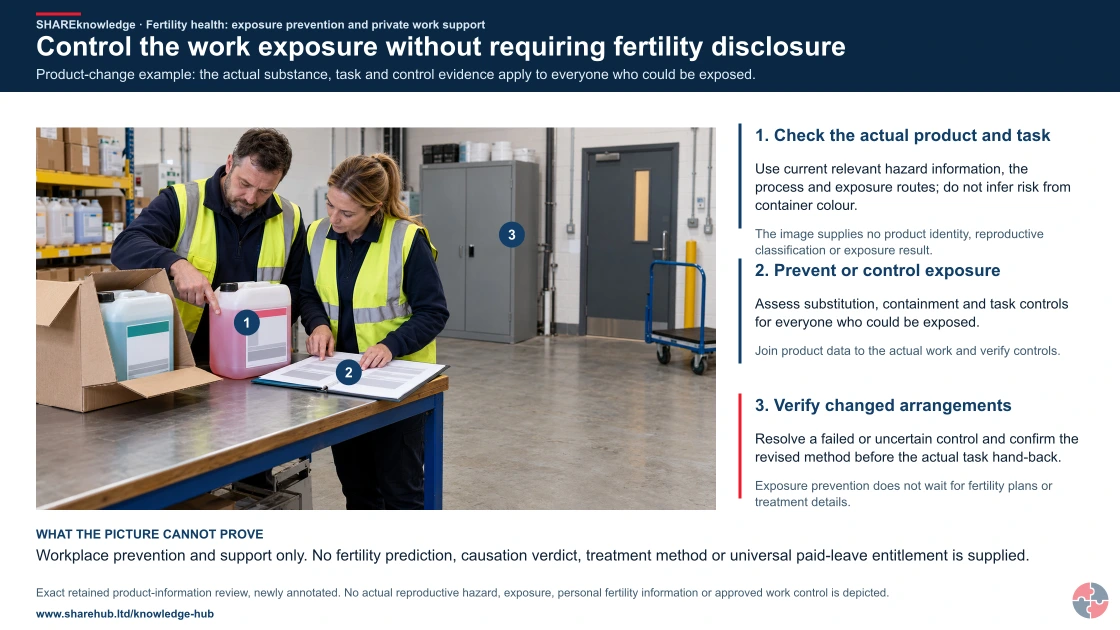
Full written explanation
The exact retained chemical-store scene shows two colleagues reviewing closed replacement-product containers and an inert information binder, with a handling trolley behind them. Markers identify the replacement container, binder and storage cabinet. The generic labels do not identify a real reproductive hazard or exposure, and no pictured person’s fertility, pregnancy, treatment or clinical status is known. The actual material, task, exposure route and control performance require authoritative information and competent assessment.
Product-change example: the actual substance, task and control evidence apply to everyone who could be exposed.
- Check the actual product and task. Use current relevant hazard information, the process and exposure routes; do not infer risk from container colour.
- Prevent or control exposure. Assess substitution, containment and task controls for everyone who could be exposed.
- Verify changed arrangements. Resolve a failed or uncertain control and confirm the revised method before the actual task hand-back.
Change the pathway
- The container is illustrative. The image supplies no product identity, reproductive classification or exposure result.
- An SDS is information, not the assessment. Join product data to the actual work and verify controls.
- Personal disclosure is not the trigger. Exposure prevention does not wait for fertility plans or treatment details.
Evidence check: Workplace prevention and support only. No fertility prediction, causation verdict, treatment method or universal paid-leave entitlement is supplied.
Keep general exposure prevention separate from confidential work support
Primary references: HSE: assess and control hazardous-substance work · Acas: IVF treatment and work — apply the actual jurisdiction and circumstances · HSE: pregnancy/new-mother risk assessment is a separate route
Open the complete HD image (new tab)Download image

Keep general exposure prevention separate from confidential work support
Primary references: HSE: assess and control hazardous-substance work · Acas: IVF treatment and work — apply the actual jurisdiction and circumstances · HSE: pregnancy/new-mother risk assessment is a separate route

General work controls
Identify the actual substance, task and route; assess and verify controls without requiring disclosure of fertility information.
Private support
Discuss functional needs and possible adjustments with the person, using competent advice where relevant. Managers do not diagnose or predict fertility.
Keep legal routes distinct
Pregnancy and new-mother assessment requirements have their own applicable route; do not assume every fertility concern belongs to it.
Agree a work plan
Name the action owner and review trigger. Share only necessary operational information and protect private records.
Read the complete task-specific control examples
ERICPD is a planning cross-map: Discipline verifies and sustains every control. ESEAP compares effectiveness. A label does not authorise the task; retain the owner, evidence and stop or change decision.
Fertility Health at Work · ERICPD
- Eliminate
- Remove the hazardous process if feasible.
- Reduce
- Select a lower-risk product only after identifying the substance, reviewing its safety data and assessing the new exposure route.
- Isolate
- Enclose or extract the identified airborne contaminant only after a task-specific exposure assessment identifies the route and verifies the control.
- Control
- Assess the actual COSHH exposure, consult privately and review the task.
- PPE
- Choose compatible PPE only after substance, route and residual exposure are known; do not infer a glove or mask from a generic cleaning-task label.
- Discipline
- Track exposure measurements, control checks and confidential action closure.
Fertility Health at Work · ESEAP
- Elimination
- Remove the hazardous process if feasible.
- Substitution
- Select a lower-risk product only after identifying the substance, reviewing its safety data and assessing the new exposure route.
- Engineering controls
- Enclose or extract the identified airborne contaminant only after a task-specific exposure assessment identifies the route and verifies the control.
- Administrative controls
- Assess the actual COSHH exposure, consult privately and review the task.
- PPE
- Choose compatible PPE only after substance, route and residual exposure are known; do not infer a glove or mask from a generic cleaning-task label.
What are the key facts about fertility health at work?
The key facts are that fertility health is sensitive, variable and sometimes linked to work exposures or work barriers.
It is not only a private issue
Work can affect appointments, symptoms, fatigue, stress, exposure, dignity and recovery.
People are affected differently
The same treatment or condition can have different physical, emotional and work effects.
Privacy is central
Sensitive health information should be limited, secure and shared only where necessary.
Support can be simple
Flexible appointments, breaks, toilet access, temporary duties or remote work may help.
Hazards must be assessed
Some substances, infections or physical conditions may need reproductive health consideration.
Formal decisions need care
Absence, performance, treatment, pregnancy and disability issues may overlap with legal rights.
What does fertility health mean in plain English?
Fertility health refers to reproductive wellbeing, fertility problems, investigations, treatment and related symptoms that may affect work.
Fertility health can include difficulty conceiving, fertility investigations, IVF or other fertility treatment, medication effects, hormonal symptoms, pelvic pain, heavy bleeding, fatigue, nausea, stress, anxiety, grief, relationship pressure and appointments. It may also overlap with reproductive health conditions such as endometriosis, polycystic ovary syndrome, fibroids, miscarriage, menopause, sexual health issues or male fertility concerns.
Managers should focus on the work: exposure, hours, facilities, workload, privacy and safety-critical duties. They can discuss adjustments while the worker gets clinical advice from an appropriate healthcare professional.
| Area | What it may involve | Workplace relevance |
|---|---|---|
| Fertility problems | Investigations, tests, uncertainty and emotional strain. | Appointment flexibility, confidentiality and supportive management. |
| Fertility treatment | Medication, scans, procedures, side effects and recovery. | Planning absence, duties, breaks and privacy. |
| Reproductive symptoms | Pain, bleeding, nausea, fatigue or bowel and bladder symptoms. | Facilities, flexibility, workload and occupational health advice. |
| Workplace exposure | Substances, infections or physical stressors that may affect reproductive health. | Risk assessment, COSHH controls and specialist advice. |
| Emotional impact | Stress, grief, anxiety or reduced concentration. | Compassionate support and signposting. |
| Pregnancy overlap | If pregnancy begins, specific pregnancy and maternity protections may apply. | Risk assessment and HR guidance. |
How can fertility health affect work?
Fertility health can affect attendance, concentration, stamina, mood, privacy, treatment scheduling and safe task allocation.
Work signs may include short-notice appointments, repeated short absences, fatigue, pain flares, needing toilet access, emotional distress, reduced concentration or temporary difficulty with physical tasks. These signs are not proof of a condition and should not be treated as misconduct without first exploring support and work barriers.
A person may be functioning well one week and struggling the next because treatment cycles, symptoms and appointments can fluctuate. Managers should therefore use review dates and flexible planning rather than one fixed assumption about capability.
| Impact | How it may appear | Practical response |
|---|---|---|
| Appointments | Scans, tests, procedures or clinic visits. | Agree appointment flexibility and notice expectations. |
| Fatigue | Lower stamina after treatment, poor sleep or stress. | Review workload, breaks and safety-critical work. |
| Pain or bleeding | Need for toilet access, rest or reduced physical demand. | Provide facilities, breaks and temporary duty changes. |
| Medication effects | Nausea, headaches, mood changes or reduced concentration. | Occupational health advice where work safety may be affected. |
| Emotional strain | Distress, distraction or withdrawal. | Private conversation and signposting. |
| Privacy pressure | Fear of disclosure or gossip. | Need-to-know handling and clear confidentiality. |
Which workplace hazards may be relevant to fertility health?
Relevant hazards depend on the work and may include hazardous substances, reproductive toxins, biological agents, radiation, heat, stress, fatigue and physical demands.
The presence of a fertility concern does not automatically mean the job is unsafe. It does mean that any relevant workplace exposures should be assessed properly, especially where safety data sheets, COSHH assessments or specialist guidance identify reproductive toxicity, infection risks or other health concerns.
For substances, the assessment should consider the form and route of exposure: inhalation of vapour, gas, fume, mist or dust; skin contact with liquids, powders or contaminated surfaces; ingestion through poor hygiene; injection through sharps; or transfer from contaminated clothing. Controls should focus on elimination, substitution, enclosure, local exhaust ventilation, safe handling, hygiene, PPE and health advice where needed.
| Hazard area | Examples | Control focus |
|---|---|---|
| Hazardous substances | Reproductive toxicity warnings, solvents, some metals, pesticides or medicines. | COSHH assessment, substitution, exposure control and health advice. |
| Biological agents | Infections relevant to pregnancy or reproductive health. | Infection risk assessment, hygiene and occupational health input. |
| Ionising radiation | Work requiring radiation protection controls. | Specialist radiation protection advice and dose controls. |
| Heat and physical demand | Hot work, heavy work, prolonged standing or exhausting shifts. | Task adjustment, breaks and individual risk assessment where relevant. |
| Stress and workload | High demand during treatment or uncertainty. | Workload review and supportive management. |
| Facilities | Poor toilet, washing, rest or privacy arrangements. | Accessible welfare and dignity controls. |
Lead work needs the lead-specific assessment, monitoring and competent advice route; a generic chemical checklist is insufficient. For ionising radiation, involve the appointed radiation-protection specialists and apply the relevant radiation regime before setting task limits or emergency actions. Do not infer a safe exposure from a job title or an ordinary COSHH entry.
Biological agents need a task-specific infection route: identify the agent or credible source, exposure pathway, containment, hygiene, sharps and incident response, with competent infection-control advice where appropriate. A worker who reports an exposure needs prompt follow-up through the employer’s procedure; a manager should not make a diagnosis or decide reproductive effects.
For Northern Ireland work, use the separate Control of Lead at Work Regulations (NI) 2003 and Ionising Radiations Regulations (NI) 2017 with competent specialist advice. GB HSE lead and radiation pages do not replace NI instruments.
How should reproductive exposure be controlled at source?
Assess the work as done, then eliminate or contain hazardous exposure before relying on personal protective equipment.
Read the current safety data sheet and classification, but also check contaminants generated by the process, maintenance, cleaning and waste. In a paint shop, the risk may arise when a spray gun is cleaned or extraction is bypassed, not only during the planned spray cycle. Review inhalation, skin contact, ingestion and sharps routes for all affected workers, including contractors.
Eliminate unnecessary hazardous materials or substitute a safer process where feasible. Reduce release and quantity, enclose or isolate the process, use suitable local extraction and hygiene, and verify that controls work in real use. PPE addresses residual exposure and must be selected for the task. ERICPD is a planning aid, not a replacement for COSHH or the separate lead and radiation regimes.
Build recovery into the assessment: a spill, extraction failure or contaminated clothing needs a stop route, isolation, decontamination, exposure record and prompt competent health advice. Do not wait for proof of a fertility effect before controlling a known hazardous exposure.
How do the controls change across sectors?
The same prevention principle applies, but the exposure pathway and safe alternative task differ by workplace.
In manufacturing or a garage, inspect solvent mixing, welding fumes, batteries, lead, cleaning and non-routine maintenance as well as routine production. In energy and petrochemical work, sampling, opening plant, shutdowns and contractor handovers can defeat normal containment; use the permit, isolation, ventilation and emergency system for the actual unit.
Retail and hospitality may have cleaning chemicals, standing, heat and late shifts; a warehouse may add vehicle traffic, lifting and battery charging. Adjust products, dosing, handling aids, thermal conditions, staffing, breaks and welfare to the task. Avoid a generic job-title label such as “garage workers are infertile”: verify the material and route before making a claim.
A contractor or agency worker needs the same clear hazard information, hygiene facilities, stop authority and private support route. Agree who controls the work, communicates restrictions and responds to a spill before the person starts.
How should fertility treatment and appointments be supported?
Fertility treatment should be handled consistently, compassionately and confidentially, with practical flexibility where possible.
Fertility treatment can involve repeated appointments, scans, medication, procedures, waiting, uncertainty and side effects. Appointment leave and pregnancy-related protection depend on jurisdiction and individual facts. Agree practical flexibility, and obtain a current legal check before advising on paid leave, embryo-transfer dates or the end of any protected period. Keep those protections separate from paid appointment entitlement, and use Northern Ireland guidance for NI employment decisions.
A good manager does not need private clinical detail to plan work. They can ask what notice is likely, whether flexibility is needed, whether duties need temporary adjustment, what should remain confidential, and when to review.
| Issue | Support option | Management point |
|---|---|---|
| Medical appointments | Flexible start, finish, leave or appointment planning. | Treat consistently with other medical appointments. |
| Treatment cycles | Short-term flexibility around scans, procedures and recovery. | Use temporary planning and review dates. |
| Medication effects | Breaks, workload adjustment or safety-critical review. | Seek occupational health advice where safety may be affected. |
| Emotional strain | Compassionate conversation and support route. | Avoid intrusive questions or judgement. |
| Privacy | Agree what can be shared with supervisors or colleagues. | Record only necessary work information. |
| Pregnancy after treatment | Apply pregnancy and maternity arrangements once relevant. | Use HR and HSE pregnancy risk assessment guidance. |
What changes after a pregnancy or new-mother notification?
A written notification triggers an individual risk assessment in addition to the general assessment of risks to women of childbearing age.
Discuss the worker’s actual tasks, exposure and any medical recommendations, then record the work-control decision and share it with them. Review it as pregnancy progresses, duties or processes change, and after birth or during breastfeeding. The assessment must consider substances, infection, radiation, physical work, travel, emergency roles, hours, welfare and protective equipment where relevant.
If a significant risk remains, first control or remove it. If that cannot be done, adjust conditions or hours; if that is not possible, offer suitable alternative work on no less favourable terms; if no suitable option exists, suspend on full pay for as long as necessary. Use the current Great Britain or Northern Ireland legal route and competent HR advice for the individual circumstances. Fertility treatment alone does not automatically activate every pregnancy-specific protection.
For Great Britain, check the current statutory and contractual position for IVF appointments before stating any paid-leave entitlement; discuss practical flexibility. Northern Ireland has its own employment-rights route, including protection from less favourable treatment related to IVF. Rights after embryo transfer and pregnancy need current local employment guidance and facts, not assumptions based on a treatment disclosure.
How should managers talk about fertility health?
Managers should talk privately, respectfully and focus on work support rather than medical detail.
The best conversations are calm and practical. A manager can say they have noticed a work barrier or that the person has asked for support, then ask what would help. They should not ask about fertility status, sex life, treatment choices, pregnancy intentions or personal relationships.
The worker should be able to choose how much to share. The manager can still agree support without knowing every clinical detail. Where evidence is needed for policy reasons, it should be proportionate and handled through the normal HR or occupational health route.
| Question | Why it helps | Boundary |
|---|---|---|
| What is work making harder at the moment? | Focuses on barriers. | Does not ask for diagnosis. |
| What support or flexibility would help? | Moves towards action. | Does not promise everything is possible. |
| Are any duties, hours or exposures a concern? | Connects to risk assessment. | Escalate to safety or OH where needed. |
| What information are you comfortable sharing? | Protects confidentiality. | Agree need-to-know limits. |
| Would occupational health advice help? | Offers specialist support. | Do not force unnecessary referral. |
| When should we review this? | Recognises change over time. | Set a practical review date. |
What practical workplace adjustments may help?
Adjustments should be based on functional impact, safety needs, dignity and what the worker says would help.
Not every person will need adjustments, and not every adjustment needs to be permanent. Some support may be short term around treatment or symptoms. Useful options often involve time, workload, location, privacy, facilities, exposure controls and communication.
Where fertility health overlaps with a disability or pregnancy-related need, reasonable adjustments or specific pregnancy arrangements may become relevant. Formal decisions should be handled through competent HR, occupational health or legal advice where needed.
| Adjustment area | Example | How to manage it |
|---|---|---|
| Time flexibility | Flexible start, finish, appointment time or remote work. | Agree notice, review and record only necessary detail. |
| Breaks and welfare | Extra toilet, rest or hydration breaks. | Protect dignity and avoid drawing attention. |
| Duties | Temporary reduction in heavy, hot, lone or safety-critical tasks. | Base on risk assessment and OH advice where needed. |
| Exposure | Remove or control reproductive hazards. | Review COSHH and specialist controls. |
| Workload | Temporary target or workload adjustment. | Set review date and avoid unfair pressure. |
| Communication | Named contact and confidentiality agreement. | Limit who needs to know. |
Which legal duties apply to fertility health at work?
Legal duties may involve health and safety risk assessment, equality, health-data protection, pregnancy-related duties and fair employment handling.
Great Britain statutes in the table do not substitute for Northern Ireland instruments. Apply the separate NI health-and-safety and COSHH framework to NI work; medical, equality and employment rights also depend on the person and facts.
| Jurisdiction | Duty or regulation | How it applies | Typical evidence |
|---|---|---|---|
| GB | Health and Safety at Work etc. Act 1974 | Requires employers to protect health, safety and welfare so far as reasonably practicable. | Risk assessment, safe systems, welfare and exposure controls. |
| GB | Management of Health and Safety at Work Regulations 1999 | Requires suitable risk assessment, preventive arrangements and review. | Individual or task risk assessment where work factors are relevant. |
| GB | Control of Substances Hazardous to Health Regulations 2002 | Relevant where substances may affect reproductive health or pregnancy. | COSHH assessment, SDS review, exposure controls and health advice. |
| GB | Equality Act 2010 | Relevant where disability, sex, pregnancy, maternity or discrimination considerations arise. | Adjustment records and fair decision-making. |
| UK | Data Protection Act 2018 | Relevant to handling sensitive health information. | Privacy information, secure records and restricted access. |
| GB | HSE - Pregnant workers and new mothers | Relevant if pregnancy, recent birth or breastfeeding applies. | Individual risk assessment and review. |
| NI | Health and Safety at Work (Northern Ireland) Order 1978 | Northern Ireland general work-risk duties. | NI risk assessment and controls. |
| NI | Management of Health and Safety at Work Regulations (NI) 2000 | Northern Ireland general and new-mother risk-assessment route. | Individual assessment and review. |
| NI | COSHH Regulations (Northern Ireland) 2003 | Control of relevant hazardous-substance exposure in NI. | Task assessment, source controls and exposure response. |
| NI | Control of Lead at Work Regulations (NI) 2003 | Separate NI lead-exposure control route where lead work is relevant. | Lead assessment, controls and specialist advice. |
| NI | Ionising Radiations Regulations (NI) 2017 | Separate NI ionising-radiation route where regulated sources are relevant. | Radiation assessment and specialist control. |
How should fertility health appear in risk assessment?
Fertility health should appear where work hazards, welfare conditions or individual circumstances make support or exposure control necessary.
The safety adviser records the actual agent or process, SDS and classification, task and exposure routes, groups affected, existing source controls and person responsible. The supervisor checks the task as done, including maintenance, cleaning and contractor work; occupational health advises on individual work restrictions without putting clinical detail in the general register.
Set a verification method for extraction, containment, hygiene and the worker’s understanding of the stop route. A changed substance, failed control, spill, pregnancy notification or worker concern triggers review. If exposure cannot be controlled or its route is unclear, stop the activity, arrange safe interim work and escalate to a competent specialist before restart.
| Scenario | Concern | Controls and evidence |
|---|---|---|
| Laboratory or chemical work | Potential reproductive hazard exposure. | COSHH review, substitution, LEV, PPE and OH advice. |
| Fertility treatment appointments | Unplanned absence, fatigue or treatment side effects. | Confidential plan, flexibility and review. |
| Physically demanding role | Pain, fatigue or symptoms affecting stamina. | Temporary duty review and supervisor support. |
| Shift work | Treatment timing, recovery and stress. | Roster flexibility and fatigue review. |
| Poor welfare facilities | Lack of toilet, washing, rest or privacy. | Facilities improvement and dignity controls. |
| Sensitive disclosure | Privacy, stigma or discrimination risk. | Need-to-know handling and manager training. |
How can the hierarchy of controls control workplace exposures and demands relevant to fertility health?
Remove the actual hazard where possible, then use substitution and verified physical controls before relying on procedures or PPE. Discipline checks that the chosen barriers still work.
The cleaning product and reproductive hazard are not identified here. Check its safety data, actual exposure route and relevant legal duties before selecting substitution, extraction or PPE; do not infer a medical diagnosis or pregnancy status.
The scenario is reproductive hazard in a cleaning task. The controls below are reasoned task applications of linked guidance, not a prescribed design or evidence that each intervention appears verbatim in a source. A competent owner must check feasibility, local law and stop criteria.
Use current government guidance and competent task-specific advice; this section does not establish a technical specification.
How can the ERICPD hierarchy of controls control workplace exposures and demands relevant to fertility health?

| Hazard and harm route | ERICPD → five-level control | Task intervention and feasibility | Owner, test and evidence | Failure and stop decision |
|---|---|---|---|---|
| Reproductive hazard in a cleaning task | Eliminate → Elimination | Remove the hazardous process if feasible. Source: HSE - COSHH. | Confirm the substance and exposure route, then verify that the hazardous cleaning task was removed; reassess other exposures separately. | Stop or redesign if uncontrolled reproductive exposure. |
| Same scenario | Reduce → Substitution | Select a lower-risk product only after identifying the substance, reviewing its safety data and assessing the new exposure route. Source: HSE - COSHH. | COSHH assessor trials the replacement method and documents new hazards, residual risk and worker feedback before release. | Pause until the alternative and its new risks are assessed. |
| Same scenario | Isolate → Engineering | Enclose or extract the identified airborne contaminant only after a task-specific exposure assessment identifies the route and verifies the control. Source: HSE - COSHH. | COSHH assessor must measure or otherwise verify the selected enclosure or extraction against the identified substance and route. | Stop or redesign if uncontrolled reproductive exposure. |
| Same scenario | Control → Administrative | Assess the actual COSHH exposure, consult privately and review the task. Source: HSE - COSHH. | COSHH assessor spot-checks the actual instruction, authorisation and shift handover against work in progress. | Pause if the procedure or handover cannot be verified. |
| Same scenario | PPE → PPE | Choose compatible PPE only after substance, route and residual exposure are known; do not infer a glove or mask from a generic cleaning-task label. Source: HSE - COSHH. | COSHH assessor confirms the assessed residual hazard, verifies PPE selection, fit or condition, and observes correct use; PPE remains subordinate to source controls. | PPE cannot be the sole credited barrier. |
| Same scenario | Discipline → Administrative assurance | Track exposure measurements, control checks and confidential action closure. Source: HSE - COSHH. | Track exposure measurements, control checks and confidential action closure. | Stop or redesign if uncontrolled reproductive exposure. |
How can the ISO 45001 hierarchy of controls control workplace exposures and demands relevant to fertility health?

| Hazard and harm route | ERICPD → five-level control | Task intervention and feasibility | Owner, test and evidence | Failure and stop decision |
|---|---|---|---|---|
| Reproductive hazard in a cleaning task | Eliminate → Elimination | Remove the hazardous process if feasible. Source: HSE - COSHH. | Confirm the substance and exposure route, then verify that the hazardous cleaning task was removed; reassess other exposures separately. | Stop or redesign if uncontrolled reproductive exposure. |
| Same scenario | Reduce → Substitution | Select a lower-risk product only after identifying the substance, reviewing its safety data and assessing the new exposure route. Source: HSE - COSHH. | COSHH assessor trials the replacement method and documents new hazards, residual risk and worker feedback before release. | Pause until the alternative and its new risks are assessed. |
| Same scenario | Isolate → Engineering | Enclose or extract the identified airborne contaminant only after a task-specific exposure assessment identifies the route and verifies the control. Source: HSE - COSHH. | COSHH assessor must measure or otherwise verify the selected enclosure or extraction against the identified substance and route. | Stop or redesign if uncontrolled reproductive exposure. |
| Same scenario | Control → Administrative | Assess the actual COSHH exposure, consult privately and review the task. Source: HSE - COSHH. | COSHH assessor spot-checks the actual instruction, authorisation and shift handover against work in progress. | Pause if the procedure or handover cannot be verified. |
| Same scenario | PPE → PPE | Choose compatible PPE only after substance, route and residual exposure are known; do not infer a glove or mask from a generic cleaning-task label. Source: HSE - COSHH. | COSHH assessor confirms the assessed residual hazard, verifies PPE selection, fit or condition, and observes correct use; PPE remains subordinate to source controls. | PPE cannot be the sole credited barrier. |
| Same scenario | Discipline → Administrative assurance | Track exposure measurements, control checks and confidential action closure. Source: HSE - COSHH. | Track exposure measurements, control checks and confidential action closure. | Stop or redesign if uncontrolled reproductive exposure. |
What happens after a spill or unplanned exposure?
Stop the exposure, make the area safe, arrange decontamination and obtain prompt specialist and medical advice when the agent or symptoms warrant it.
The first responder should identify the agent if safe to do so, isolate or evacuate the area, prevent secondary exposure, use the site emergency procedure and preserve the safety data sheet or process information. Do not ask a worker to remain in a potentially contaminated area to finish the task or collect unnecessary samples.
Record who may have been exposed, the route, duration, controls and actions without broadcasting private fertility or pregnancy information. Occupational health, radiation protection, infection control or the relevant specialist can advise on individual follow-up. Investigation should identify why containment, extraction, hygiene or communication failed and verify the correction before restart.
How could Riverside Leisure Ltd support fertility health?

Riverside Leisure would support fertility health through confidential conversations, fair flexibility, exposure checks, manager training and practical adjustments.
Exposure controls and appointment support follow separate routes
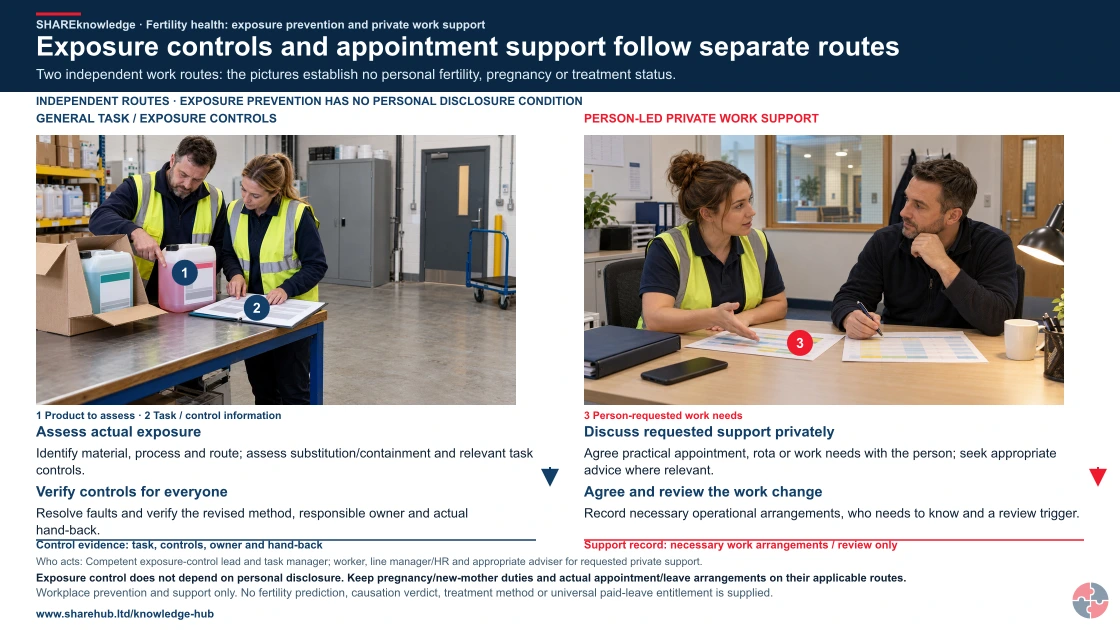
Full written explanation
Two workplace scenes illustrate independent exposure-control and person-led work-support routes. The closed-product/inert-information-binder scene supports actual substance, task, exposure-route and control-evidence questions for everyone; container colour and generic labels identify no reproductive hazard, measured exposure or approved control. A separate private rota discussion supports a person-led request about functional appointment, scheduling or work needs; no pictured person is known to have fertility treatment, infertility, pregnancy or any clinical condition. Exposure protection does not depend on personal disclosure; the two routes are independent. The work checks cover the following: assess actual exposure and verify controls for everyone, separately discuss requested support privately and agree/review the work change. Separate record bands distinguish control evidence from only necessary operational support information. No product reproductive classification, exposure threshold, diagnosis, causation, clinical tissue/harm model, fertility score, test result, treatment stage, employment-rights or pay/leave rule is supplied. Picture key: 1 Product to assess · 2 Task / control information · 3 Person-requested work needs. The separate process headings are unnumbered.
Two independent work routes: the pictures establish no personal fertility, pregnancy or treatment status.
- Assess actual exposure. Identify material, process and route; assess substitution/containment and relevant task controls.
- Verify controls for everyone. Resolve faults and verify the revised method, responsible owner and actual hand-back.
- Discuss requested support privately. Agree practical appointment, rota or work needs with the person; seek appropriate advice where relevant.
- Agree and review the work change. Record necessary operational arrangements, who needs to know and a review trigger.
When the evidence does not fit: Exposure control does not depend on personal disclosure. Keep pregnancy/new-mother duties and actual appointment/leave arrangements on their applicable routes.
Who acts: Competent exposure-control lead and task manager; worker, line manager/HR and appropriate adviser for requested private support.
Changed workplace
Replacement work product: Assess and verify relevant exposure controls for everyone.
Treatment appointments and shifts: Agree practical private support within the applicable arrangements.
Evidence check: Workplace prevention and support only. No fertility prediction, causation verdict, treatment method or universal paid-leave entitlement is supplied.
Keep general exposure prevention separate from confidential work support
Primary references: HSE: assess and control hazardous-substance work · Acas: IVF treatment and work — apply the actual jurisdiction and circumstances · HSE: pregnancy/new-mother risk assessment is a separate route
Open the complete HD image (new tab)Download image

Keep general exposure prevention separate from confidential work support
Primary references: HSE: assess and control hazardous-substance work · Acas: IVF treatment and work — apply the actual jurisdiction and circumstances · HSE: pregnancy/new-mother risk assessment is a separate route
Riverside Leisure Ltd
a leisure, hospitality and outdoor activity business with gyms, pools, catering, cleaning, maintenance, events, public-facing teams and shift patterns
Riverside treats fertility health as a sensitive wellbeing and risk-management topic. Its policy explains that workers do not need to disclose fertility treatment or reproductive health concerns unless they want support, adjustments or exposure review. When someone does disclose, the line manager records practical support only: agreed flexibility, duties, privacy arrangements, review date and who needs to know.
The business checks work factors that may make symptoms or treatment harder: long shifts, public-facing pressure, access to toilets, cleaning chemicals, pool chemicals, manual handling, hot kitchens, lone working and late finishes. The safety adviser reviews COSHH assessments for reproductive hazard information and involves occupational health where a worker's health, medication, pregnancy status or safety-critical work creates uncertainty.
Learning is built into the system. HR reviews appointment flexibility and absence patterns without exposing private details. Managers receive conversation training. Complaints about gossip, stigma or intrusive questions are treated as management failures. The leadership team reviews whether welfare facilities, staffing and work design are supporting dignity as well as compliance.
For example, before a leisure-centre maintenance task Riverside checks the product SDS, substitutes a lower-hazard product where possible, confirms ventilation and briefs the worker on hygiene and a private reporting route. During the task a ventilation fault is reported: the supervisor holds the work, isolates the affected area and arranges safe alternative duties rather than asking anyone to work through uncertain exposure.
The safety adviser records the failed barrier and exposure facts, seeks occupational-health or other specialist advice where warranted, and verifies the repaired ventilation and revised method. The authorised manager hands the task back only after the control check and briefing are recorded; HR holds any individual treatment or pregnancy information separately.
| Stage | How Riverside applies it | Evidence |
|---|---|---|
| Assess | Reviews jobs for chemical exposure, shift pressure, welfare access and public-facing demands. | COSHH, welfare and role risk assessments. |
| Support | Agrees confidential flexibility, breaks, duties and review dates with the worker. | Adjustment plan with minimum necessary detail. |
| Train | Trains managers on privacy, respectful conversations and escalation to HR/OH. | Manager training records. |
| Implement | Controls who needs to know and adjusts rosters or duties without public explanation. | Roster notes and supervisor briefing. |
| Check | Reviews whether support is working and whether welfare or exposure controls need improvement. | Review notes and worker feedback. |
| Improve | Updates policy, facilities, COSHH controls and manager guidance after trends or feedback. | Action tracker and policy review. |
Who needs fertility-health competence, and how is it checked?
Training should help people respond respectfully, protect privacy and connect health concerns to practical work controls.
Organisation-wide awareness can explain that fertility and reproductive health may affect work and should be handled with dignity. This is usually short e-learning, intranet guidance or a wellbeing briefing. It should avoid medical detail and focus on respect, support routes and confidentiality.
Managers need deeper, scenario-based training because they may receive sensitive disclosures. They should learn what to ask, what not to ask, how to document support, when to involve HR or occupational health, and how to manage work exposures or safety-critical tasks without discrimination.
| Role | Learning to test | Competence demonstration | Assessor and record | Reassessment trigger |
|---|---|---|---|---|
| All workers and contractors | Recognise relevant substances, hygiene rules, exposure signs, stop and private report routes. | Identify a mock spill or failed extraction and demonstrate a safe report without disclosing another person’s health. | Supervisor observes induction and records task briefing. | New agent, task, contractor arrangement or failed response. |
| People working with hazardous agents | Use the specific controls, PPE limits, decontamination and emergency route. | Walk through the real task, check extraction and hygiene, then stop on a simulated defect. | Competent safety or operations assessor signs the task record. | Material/process change, defect, exposure event or observed misuse. |
| Supervisors | Separate task control from clinical discussion; arrange safe interim work and confidential escalation. | Lead a scenario with a private concern and an uncontrolled exposure while preserving dignity. | Operations lead reviews the decision and records corrective action. | New task, complaint, control failure or missed assessment. |
| HR and occupational-health partners | Apply the relevant pregnancy, treatment, equality and health-data routes to functional support. | Review an anonymised case for lawful information handling, alternative work and review date. | Competent HR/OH lead records the case review and limits. | Law/guidance change, privacy incident or ineffective adjustment. |
| Managers and technical specialists | Resource substitution, engineering controls, competent lead/radiation/infection advice and assurance. | Trace one material from procurement to exposure assessment, failed barrier, recovery and verified fix. | Independent safety/technical lead samples evidence and signs action closure. | New process, contractor, exposure pattern or audit finding. |
How can BS EN ISO 45001 support fertility-health management?
ISO-style systems help make confidentiality, risk assessment, competence, operational control and review visible.
Use current government guidance and competent task-specific advice; this section does not establish a technical specification.
| Management theme | How it supports fertility health | Useful evidence |
|---|---|---|
| Consultation and participation of workers | Uses worker feedback to improve dignity, facilities and support routes. | Consultation and action records. |
| Actions to address risks and opportunities | Identifies reproductive hazards, welfare barriers and work design issues. | Risk assessments and COSHH reviews. |
| Competence | Ensures managers know how to handle sensitive disclosures. | Training records. |
| Communication | Controls what is communicated, to whom and why. | Confidentiality guidance. |
| Operational planning and control | Applies adjustments, exposure controls and appointment flexibility. | Support plans and work controls. |
| Monitoring, measurement, analysis and evaluation | Reviews trends without exposing private health data. | Anonymised trends and management review. |
| Incident, nonconformity and corrective action | Learns from complaints, stigma, poor handling or control failures. | Corrective actions and policy updates. |
These are practical management-system themes, not a clause-by-clause interpretation. A competent reviewer must verify any clause mapping against a lawfully accessed current standard.
What are the warning signs that fertility health is being handled poorly?
Warning signs include intrusive questions, gossip, rigid appointments, ignored exposure concerns, poor facilities and formal action before support is considered.
Poor handling can cause harm by discouraging disclosure, delaying support, increasing stress, worsening symptoms, damaging trust or exposing a worker to unmanaged hazards. It can also create legal, equality, data protection and employee relations risks.
A lack of requests for support does not always mean there is no issue. It may mean workers do not trust the organisation with sensitive information. Review manager behaviour, facilities, policy visibility and worker feedback.
| Warning sign | How it can cause harm | Management response |
|---|---|---|
| Intrusive questions | Worker feels judged or unsafe disclosing. | Train managers and use conversation prompts. |
| Gossip or unnecessary sharing | Privacy breach and loss of trust. | Restrict information and address conduct. |
| Rigid appointment handling | Treatment becomes harder and absence conflict increases. | Review flexibility and consistency. |
| Ignored exposure concerns | Relevant reproductive hazards may remain uncontrolled. | Review COSHH and specialist advice. |
| Poor welfare facilities | Symptoms become harder to manage with dignity. | Improve toilets, washing, rest and privacy. |
| Formal action too early | Health barriers are treated as misconduct. | Explore support, adjustments and OH input first. |
Fertility health FAQs - what do people ask?
People usually ask about privacy, appointments, treatment, work adjustments, exposure concerns and manager responsibilities.
Is this page medical advice?
No. It gives workplace guidance only. Fertility concerns, symptoms, treatment choices and medication questions should be discussed with a GP, regulated fertility clinic or appropriate local health service.
What is fertility health at work?
It is the way fertility problems, treatment, reproductive health symptoms and workplace exposures may affect work, wellbeing, privacy, dignity and safe performance.
Does an employee have to tell their employer about fertility treatment?
Usually no, unless they need workplace support, time off, risk controls or adjustments. Any information shared should be handled confidentially and proportionately.
Is there a legal right to paid time off for IVF appointments?
For Great Britain, check the current statutory and contractual position for IVF appointments; discuss the medical-appointment policy and practical flexibility. In Northern Ireland, NI Direct says paid antenatal time off begins only after the fertilised embryo has been implanted. Check the local employment route and the individual circumstances before deciding how to record or pay for an appointment.
What should a manager ask?
Ask privately what work is making things harder, what support would help, what information can be shared, whether occupational health input is useful and when to review.
What should managers avoid?
Avoid asking intrusive clinical questions, making assumptions about pregnancy, fertility, sex life, future plans or commitment, and avoid sharing health information unnecessarily.
Can workplace hazards affect reproductive health?
Some substances, infections, radiation, heat, stressors or physical demands may be relevant depending on the work and individual circumstances, so risk assessment and specialist advice may be needed.
When is occupational health useful?
Occupational health can help translate health needs into work restrictions, adjustments, exposure controls, return-to-work plans or safety-critical duty advice.
How should health data be handled?
Collect only what is necessary, explain why, restrict access, keep records secure and avoid recording unnecessary clinical detail.
What if fertility health overlaps with pregnancy or disability?
Use HR or competent advice because pregnancy, maternity, disability, sex and other equality considerations may affect how support and formal decisions are handled.
Which acronyms and terms matter here?
Acronyms should be explained so readers understand official sources, treatment terms and support routes.
| Acronym | Meaning | Plain English use |
|---|---|---|
| COSHH | Control of Substances Hazardous to Health | UK regulations and approach for controlling hazardous substances. |
| EAP | Employee Assistance Programme | Confidential support service where provided by the employer. |
| HR | Human Resources | People management function. |
| IVF | In vitro fertilisation | A fertility treatment where an egg is fertilised outside the body. |
| OH | Occupational Health | Specialist work-health advice service. |
| ERICPD | Eliminate, Reduce, Isolate, Control, PPE, Discipline | A planning aid for stronger controls, not a replacement for the legal hierarchy. |
| SDS | Safety data sheet | Supplier hazard and control information to read alongside the actual process assessment. |
| RPE | Respiratory protective equipment | Breathing protection for residual exposure after source controls. |
| Reproductive toxicant | Substance hazardous to reproduction | A classification or evidence flag that needs task-specific exposure assessment. |
| New or expectant mother | Pregnant, recently given birth or breastfeeding worker | A worker for whom specific risk-assessment protections may apply after written notification. |