SHARE Knowledge Hub
Financial Risk Architecture
Financial risk architecture maps direct and indirect, insured and uninsured consequences of health-and-safety failures to hazards, controls, owners and decisions. Loss can extend well beyond an invoice or claim, but uncertain estimates must be labelled honestly. Insurance and budgets do not remove prevention duties: cost information helps leaders choose and sustain safe controls, not approve unsafe work.
Understanding Financial Risk Architecture
Financial risk architecture is the structured way an organisation identifies, owns, records, reviews and learns from the financial consequences of health-and-safety risk. It connects a real operational hazard to the people who may be harmed, the controls needed to prevent harm, the evidence that those controls work, and the direct, indirect, insured and uninsured consequences if they fail.
Why this matters at work
Every incident-cost discussion must begin with the person affected. A workplace injury, occupational illness, dangerous occurrence or loss of control can affect life, health, family, work, income, dignity and trust. Financial analysis is useful only when it strengthens prevention, recovery, fair treatment and learning; it must never be used to minimise suffering or compare people as budget items.
A control failure can be hidden when managers record only the invoice total. For example, a machine repair may reveal a guarding, isolation, maintenance, competence or supervision failure; a medical absence may reveal a longer-term exposure pattern. Direct-cost records should therefore link back to the relevant hazard register, risk assessment, maintenance system, contractor arrangement or operational change.
How organisations manage this in practice
Review cadence should reflect how quickly the evidence or control can change. A stable long-life design decision may need periodic assurance and review after modification; a temporary repair, impaired barrier, emergency staffing arrangement or volatile estimate may need daily or shift-based review. Calendar review is not enough when trigger events occur sooner.
Evidence includes risk assessments, significant findings where required, board and management-review minutes, delegated authority, approved actions, resource decisions, worker consultation, inspection and maintenance records, incident and near-miss records, assurance findings and proof that decisions were implemented and tested in work.
Change can introduce new hazards or weaken existing controls when a site changes plant, materials, layout, software, process parameters, workload, staffing, supplier, contractor, maintenance method, shift pattern or emergency arrangement. Savings targets, capital constraints and short-term delivery promises are change triggers, not reasons to bypass the assessment or approval process.
A decision record preserves the reasoning that linked an operational risk to resources and control. It should identify the question, decision date, accountable owner, competent advisers, people consulted, evidence considered, options, assumptions, uncertainty, selected action, implementation conditions and residual matters. The record should be understandable to a later reviewer who was not present at the meeting.
How should Financial Risk Architecture support business risk decisions?
Risk architecture should connect risk appetite, ownership, controls, assurance and escalation so leaders can make better decisions.
Start with the hazard and people exposed, then identify the barrier, accountable owner, verification evidence and escalation trigger. A board risk appetite statement can guide authority and investment, but it cannot replace the legal standard for a particular activity. Evidence from actual work, including maintenance, worker reports and change control, matters more than a tidy register.
| Area | What good looks like | Evidence |
|---|---|---|
| Risk appetite | Define which risks are acceptable, tolerable only with controls, or unacceptable. | Board or leadership risk appetite statement. |
| Risk taxonomy | Use consistent categories so operational, financial, legal, safety and strategic risks can be compared. | Risk taxonomy and register structure. |
| Ownership | Each material risk needs an owner with authority to act. | Named owner and review cadence. |
| Control evidence | Controls should be real activities with testing, not descriptions of intent. | Control testing and assurance results. |
| Escalation | Breaches, weak controls, major change or new threats should escalate to leadership. | Escalation thresholds and committee papers. |
| Assurance | First, second and third line assurance should give leaders confidence that risk controls work. | Assurance plan and audit findings. |
Updated 2026-10-02.
What can financial risk architecture decide—and what can it not?
It helps leaders fund prevention and recovery; it cannot price away a duty, certify a task safe or decide an insurance claim.
A risk register should show the hazard, credible harm, controls, control owner, assurance result, resource need and stop or escalation trigger. It should keep human safety, legal compliance and environmental consequences visible beside money. A low expected loss or a generous insurance limit is not evidence that an uncontrolled high-consequence task can continue.
Risk appetite, tolerance and capacity are governance terms. Use them to show when a local manager must escalate a barrier failure, not as universal permission for injury, toxic release or loss of containment. Where a necessary control is unavailable, pause or make the work safe while competent people determine the route to restart.
The financial model is a decision aid: finance can test assumptions, operations can describe the task, safety and engineering can assess controls, and authorised legal or insurance specialists can handle their own determinations.
Who needs to understand financial risk architecture?
Leaders, managers, safety teams, finance, insurers, auditors and learners need to understand that incident cost is wider than the visible claim.
Senior leaders
Need to see prevention as protection of people, continuity and business value.
Managers
Need to understand how weak controls create disruption, rework and uninsured cost.
Health and safety teams
Need to use incident cost learning without reducing harm to money.
Finance teams
Need to see hidden costs that sit outside insurance claims and repair bills.
Insurers and brokers
Need evidence of controls, claims learning and risk improvement.
Learners
Need to explain the financial argument for good health and safety management.
Show the loss range, but make the prevention decision on the actual risk
Build a decision model from a credible hazard and failed barrier. Separate immediate repair from interruption, alternative premises, investigation and retained costs; distinguish potential insurance response from confirmed cover. State which assumptions are known, estimated or unresolved, show a range and avoid a universal incident-cost multiplier.
Map the loss pathways without assuming an insurance payout
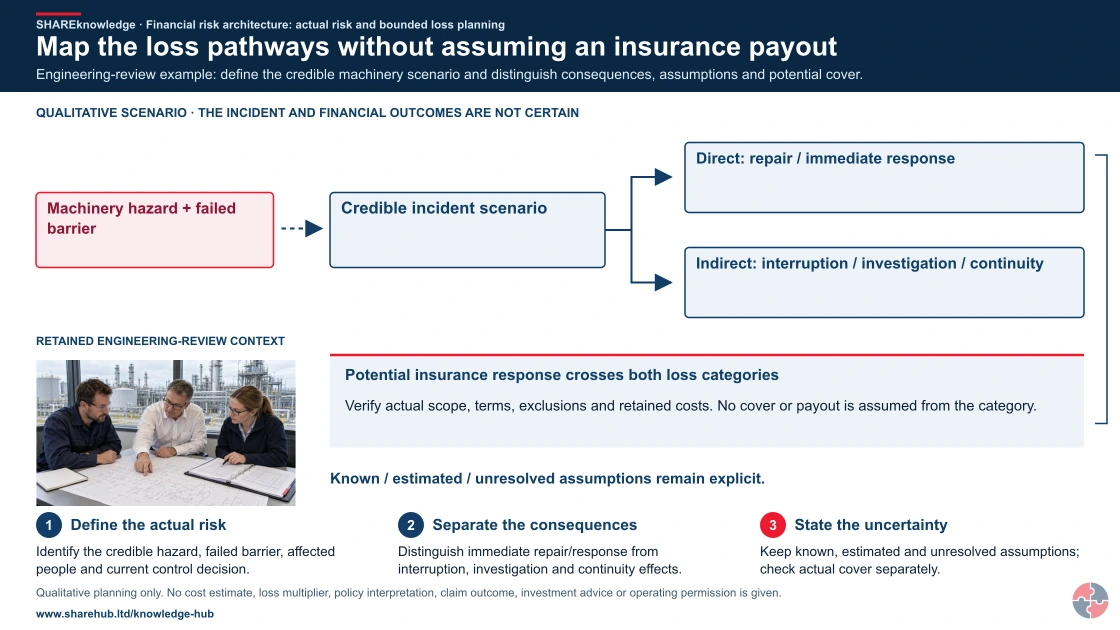
Full written explanation
A qualitative cause-and-consequence map links a machinery hazard and failed barrier to a credible incident scenario, then separates direct repair/response effects from interruption/investigation/continuity effects. A separate cross-cutting insurance question applies to either loss category; it does not declare direct costs insured or indirect costs uninsured. A retained engineering-review inset provides context only. No incident is certain, cost figure or multiplier is assigned, or policy/claim is decided.
Engineering-review example: define the credible machinery scenario and distinguish consequences, assumptions and potential cover.
- Define the actual risk. Identify the credible hazard, failed barrier, affected people and current control decision.
- Separate the consequences. Distinguish immediate repair/response from interruption, investigation and continuity effects.
- State the uncertainty. Keep known, estimated and unresolved assumptions; check actual cover separately.
Change the pathway
- A scenario is not a prediction. Use actual exposure and barrier evidence; a precise loss estimate is not a prerequisite for protection.
- Avoid a universal multiplier. State the scope and range of assumptions rather than a fixed incident-cost ratio.
- Cover remains conditional. Check the actual policy and competent insurance advice; no payout is promised.
Evidence check: Qualitative planning only. No cost estimate, loss multiplier, policy interpretation, claim outcome, investment advice or operating permission is given.
Make the prevention decision on the actual risk and retain bounded assumptions
Primary references: HSE: management ownership and assurance — HSG65 · HSENI: insurance context — actual policy advice remains separate · HSE: assess and control actual work risks
Open the complete HD image (new tab)Download image

Make the prevention decision on the actual risk and retain bounded assumptions
Primary references: HSE: management ownership and assurance — HSG65 · HSENI: insurance context — actual policy advice remains separate · HSE: assess and control actual work risks
For a warehouse, a failed fire-door control may lead to several possible interruption periods. Compare short, extended and severe disruption assumptions against the cost and effectiveness of restoring that barrier, with an owner and verification plan. These are planning scenarios, not predicted losses or a promised payout. Necessary risk control does not wait for a precise loss model, a favourable premium or a cost-benefit result.
A barrier investment with uncertain interruption costs
Illustrative example. A warehouse has a recurring fire-door defect and an uncertain estimate of business interruption after smoke spread.
Decision. The manager commissions competent correction and uses a transparent range to plan funding and resilience.
Evidence to check. The actual defect, affected operation, control specification, alternative-service assumptions and policy confirmation from the insurer.
Hold or escalation point. Do not continue unsafe use while waiting for a narrower loss estimate or expected insurance payment.
Follow-up. Verify the installed control and replace assumptions with incident or exercise learning when available.
Keep losses, recovery and uncertainty separate
A financial comparison helps a duty owner understand the consequences and timing of decisions. It cannot price away harm or turn insurance into permission to operate.

Gross loss
List credible direct and indirect loss headings against the actual scenario; identify evidence and omissions without invented amounts.
Potential recovery
Identify policy scope, conditions, exclusions and recovery uncertainty separately from the loss.
Uninsured and timing effects
Retain deductibles, disruption and cash-flow timing as explicit uncertainties; do not assume every cost is recoverable.
Duty and control decision
The accountable owner considers legal duties, people and effective controls outside the financial arithmetic; keep an essential impaired protection held.
Read the complete task-specific control examples
ERICPD is a planning cross-map: Discipline verifies and sustains every control. ESEAP compares effectiveness. A label does not authorise the task; retain the owner, evidence and stop or change decision.
Financial Risk Architecture · ERICPD
- Eliminate
- Avoid the hazardous operation while the credited system is unavailable.
- Reduce
- Use a safer operation that does not depend on the failed protection.
- Isolate
- No separate physical-isolation measure is specified. Verify the applicable engineered protection and work arrangements under Control.
- Control
- Restore or replace the engineered protection before normal operation.
- PPE
- PPE is not a substitute for the missing fire system.
- Discipline
- Reconcile risk register, repair evidence, expenditure approval and restart decision.
Financial Risk Architecture · ESEAP
- Elimination
- Avoid the hazardous operation while the credited system is unavailable.
- Substitution
- Use a safer operation that does not depend on the failed protection.
- Engineering controls
- Restore or replace the engineered protection before normal operation.
- Administrative controls
- Escalate the risk decision with duty owner, cost uncertainty and stop criteria.
- PPE
- PPE is not a substitute for the missing fire system.
What are the key facts about financial risk architecture?
The key facts are that visible costs are incomplete, insurance is limited and hidden costs often drive the real organisational impact.
Human harm comes first
Financial analysis should support prevention, not minimise injury, illness or suffering.
Visible costs are incomplete
Invoices, claims and repair bills rarely show downtime, morale, reputation or lost opportunity.
Insurance has limits
Cover may help with claims but not criminal fines, disruption or many indirect losses.
FFI can add cost
A material breach found by HSE can lead to cost recovery under Fee for Intervention.
Cost data should improve controls
Incident cost learning should influence risk assessment, audit, training and management review.
Leaders need full context
Board decisions are stronger when direct, indirect, insured and uninsured losses are visible.
What does financial risk architecture mean in health and safety?
It means mapping how an incident creates financial consequences across people, plant, process, premises, prosecution, claims, insurance, production and reputation.
A simple accident cost discussion often asks one narrow question: will the insurer pay? Financial risk architecture asks a better question: what is the gross loss to the organisation and affected people, what part is insured, what part is uninsured, what hidden losses are absorbed by the business and what management-system weaknesses allowed the exposure to exist?
The concept is useful because health and safety failures rarely create one clean financial line. A fall, fire, exposure event or dangerous occurrence may create first-aid time, absence, overtime, temporary labour, equipment repair, production delay, customer complaints, investigation work, regulator time, legal advice, claim management, retraining, future premium attention and leadership distraction.
| Component | What it means | Why it matters |
|---|---|---|
| Direct cost | Visible cost directly linked to the event. | Usually easier to evidence but incomplete. |
| Indirect cost | Hidden or dispersed cost across operations. | Often much larger than the visible cost. |
| Insured cost | Cost potentially recoverable under policy terms. | Depends on cover, excesses and conditions. |
| Uninsured cost | Cost the organisation bears itself. | Often surprises leaders after the event. |
| Enforcement cost | Regulatory investigation, FFI, notices or prosecution exposure. | Shows the cost of non-compliance and poor control. |
| Business continuity cost | Disruption to operations, contracts and capability. | Can become a strategic risk. |
How do direct, indirect, insured and uninsured costs differ?
The four cost categories help leaders see that the real loss is wider than the visible invoice or claim.
Direct costs are normally easy to find because they create invoices, payments, claim records or repair orders. Indirect costs are harder because they sit inside normal budgets: supervisors spending days on investigation, skilled workers covering absence, production being delayed, rework being completed or a client losing confidence.
Insured and uninsured are different from direct and indirect. Some direct costs may be uninsured because of excesses, exclusions or policy limits. Some insured costs still create uninsured consequences such as premium changes, management time and reputational harm.
| Cost category | Examples | Management significance |
|---|---|---|
| Direct | First aid, repair, replacement, investigation, sick pay, legal activity and clean-up. | Visible but not complete. |
| Indirect | Downtime, overtime, retraining, rescheduling, rework and leadership time. | Often hidden across budgets. |
| Insured | Compensation or some legal costs within policy terms. | Transfers some cost but not duty or disruption. |
| Uninsured | Fines, excess, lost production, poor morale, lost contract and reputation harm. | Usually borne directly by the business. |
| Delayed | Civil claim, ill health case, insurance review or enforcement action months later. | Requires longer-term tracking. |
| Opportunity | Improvement projects delayed because leaders are dealing with a failure. | Hard to invoice but real. |
How should insurance be understood in health and safety risk?
Insurance is a financial protection mechanism, not a risk control and not a substitute for legal compliance.
Compulsory employers’ liability insurance has separate legal routes. The 1969 Act applies in Great Britain and expressly does not extend to Northern Ireland; Northern Ireland uses the Employer’s Liability (Defective Equipment and Compulsory Insurance) Order 1972. Check exemptions and policy terms with authorised specialists. Insurance transfers some financial consequence, not the duty to prevent harm.
Employers' liability insurance is required for most employers and helps ensure compensation liabilities can be met. That is important, but insurance does not make an accident acceptable. It does not remove the duty to prevent harm, and it does not normally cover criminal fines, weak-control disruption, management time, lost goodwill or the human cost of injury and illness.
Insurance information should still be used intelligently. Claims history, insurer surveys, premium attention, excess levels, policy conditions and repeated loss patterns can all provide useful risk intelligence. The better question is not 'are we insured?' but 'what are we learning from the fact that this loss pathway exists?'
| Issue | Common misunderstanding | Better interpretation |
|---|---|---|
| Employers' liability | The policy means the risk is financially controlled. | The policy supports compensation but prevention duties remain. |
| Policy excess | Small claims do not matter. | Low-level losses may reveal repeated control weakness. |
| Premiums | Premiums are fixed background cost. | Claims and risk quality can affect insurer view and future cost. |
| Fines | Insurance will deal with legal consequences. | Criminal fines are not a normal insured recovery. |
| Insurer surveys | Survey findings are paperwork. | They are external risk intelligence and should be actioned. |
| Reputation | Insurance handles public consequences. | Trust, tenders and customer confidence are business risks. |
How should a control investment be justified?
Start with the required level of protection and credible options, then compare whole-life delivery without treating payback as proof of legal compliance.
Describe the hazard, people at risk, existing control weakness and viable options in the hierarchy: eliminate unnecessary work, reduce exposure or inventory, isolate people, strengthen engineered and administrative barriers, use personal protection for residual exposure, and plan recovery. Compare installation, maintenance, inspection, competence, spare parts, operating limits and end-of-life costs as well as purchase price.
In a warehouse, a cheaper traffic layout that relies on perfect pedestrian attention is not equivalent to physical segregation. In a process plant, a saving from deferred inspection may weaken a critical barrier long before a loss appears in the accounts. Ask the technical owner to define acceptance tests and field verification before release of funds or restart.
The Great Britain reasonably-practicable duty requires an informed risk-control judgement; an arbitrary internal return-on-investment threshold is not a safety standard. Specialist ALARP or safety-case demonstrations belong to the applicable regime and competent technical process.
How can enforcement and civil liability change the cost picture?
Enforcement and civil liability can add cost through regulator time, notices, prosecution, legal advice, claims, evidence gathering and business disruption.
HSE Fee for Intervention is a Great Britain cost-recovery scheme for HSE-enforced material breaches under its own rules. It is not a generic Northern Ireland charge and should not be assumed from an incident alone. Regulatory notices, civil claims, criminal proceedings and insurance recovery are different processes with different decision makers.
A serious incident can create several tracks at once. The regulator may inspect, investigate, issue notices, recover time under FFI where applicable or prosecute. A claimant may bring civil proceedings. The insurer may investigate liability and policy conditions. The business may need to stop work, repair assets, retrain people and redesign controls.
Financial risk architecture keeps these tracks separate so the organisation does not mistake one closed action for full recovery. Paying a repair bill is not the same as closing an investigation. Settling a claim is not the same as fixing the management-system weakness.
| Route | Potential cost | Evidence to manage |
|---|---|---|
| FFI | HSE cost recovery for material breach work. | Inspection correspondence and action close-out. |
| Improvement notice | Management time, remedial work and possible reputational effect. | Notice response and verified corrective action. |
| Prohibition notice | Immediate stoppage and business interruption. | Safe restart evidence. |
| Prosecution | Legal costs, fines and leadership attention. | Investigation file and sentencing factors. |
| Civil claim | Compensation, legal handling and evidence disclosure. | Insurance and claim records. |
| Client response | Lost work, audit, suspension or tender disadvantage. | Contract and assurance records. |
How should an incident-cost model be built?
An incident-cost model should start with the event and map gross loss, insured recovery, uninsured loss, delayed costs and learning actions.
A useful model does not pretend every indirect loss can be measured precisely. It separates evidenced costs from estimates and records assumptions. This allows leaders to see scale without false accuracy. The model should be updated as costs emerge because civil claims, ill health, enforcement and insurance consequences can arrive later.
The model is most valuable when it changes future decisions. If it only sits in an investigation appendix, it misses the point. Use the findings to improve risk assessment, control budgets, maintenance priority, training, supervision, audit planning and management review.
Illustration only: assume £18,000 repair, £12,000 clean-up, £20,000 documented downtime and £5,000 overtime. Gross recorded loss is £55,000. If an insurer later confirms £15,000 recoverable under the actual policy, the remaining recorded cost is £40,000; until then, £15,000 is only a possible recovery and the gross loss stays £55,000. The example excludes uncertain claims, long-term harm, enforcement and reputational effects. Do not turn it into a value placed on injury or a reason to defer a required control.
| Step | What to record | Example evidence |
|---|---|---|
| Define event | What happened, who was affected and what controls failed. | Investigation summary. |
| Capture direct costs | Repair, first aid, absence, overtime and immediate recovery. | Invoices, payroll and repair orders. |
| Estimate indirect costs | Downtime, rework, delays, morale and management time. | Production and manager-time estimates. |
| Separate insured recovery | What policy may pay and what excess applies. | Claim file and policy terms. |
| Identify uninsured costs | Fines, FFI, lost output, reputation and internal time. | Finance and legal records. |
| Feed learning back | Risk register and control changes. | Management review and closed actions. |
How should uncertain and delayed costs be shown?
Separate observed facts, approved estimates, scenarios and unknowns so a precise-looking total does not conceal weak evidence.
Record a base date, source, owner, assumptions and a range only where the range has a defensible basis. Keep gross loss and potential insurance recovery separate. A repair invoice, downtime estimate and future claim exposure have different confidence and timescales; do not add speculative worst cases to a factual total without labels.
Test the assumptions that could change the decision: downtime, recovery time, maintenance effort, staffing, barrier reliability and supplier lead time. If a control remains necessary under all plausible cases, act on the safety need now rather than waiting for a more elegant estimate. Reopen the model when an incident, new work, insurer decision or technical finding changes the evidence.
National cost statistics describe a population in a specified year; they do not set the monetary value of one person, predict a specific claim or replace local incident evidence.
How should leaders use financial risk architecture?
Leaders should use financial risk architecture to make better prevention, assurance and resource decisions.
The purpose is not to turn people into cost units. It is to show leaders that prevention protects people and also protects the organisation's capacity to operate. A weak control that looks cheap today may be extremely expensive after an injury, prosecution, fire, illness cluster or enforcement intervention.
Good leadership review asks: what did the event really cost, what part was uninsured, which budget absorbed hidden cost, did we close the root controls, are similar exposures present elsewhere and what resource decision now needs to change?
| Question | Why it matters | Useful evidence |
|---|---|---|
| What was the gross loss? | Shows the full impact before insurance recovery. | Cost model. |
| What was uninsured? | Shows retained business exposure. | Finance and claim records. |
| Which controls failed? | Connects cost to prevention. | Investigation findings. |
| Where else could this happen? | Prevents repeat loss. | Risk register review. |
| Were actions verified? | Avoids paper close-out. | Audit and observation. |
| What investment is now justified? | Turns learning into prevention. | Management review decision. |
Where do financial pressures weaken controls in real work?
Look for decisions that defer maintenance, reduce staffing or compress safe work under a budget or deadline.
In manufacturing or a garage, repeated small stoppages may hide failing guards, lifting equipment or vehicle controls inside routine variance. In energy or petrochemical work, inspection deferral, contractor handover and emergency readiness can affect major-accident barriers; the applicable safety case or process-safety specialist must decide the technical standard. In retail and hospitality, understaffing and rush can combine with slips, violence, hot work or manual handling.
Procurement should fund safe design, competence, commissioning, spare parts, maintenance and decommissioning across the lifecycle. A low tender price that moves risk to a contractor or leaves no relief capacity is not a complete business case. During an incident, continuity planning must resource safe isolation, inspection, repair and competent release before revenue pressure drives a restart.
Review real indicators: overdue critical maintenance, temporary bypasses, failed tests, fatigue, worker concerns, repeat near misses and unclosed actions. Financial trends can reveal pressure, but the absence of claims does not demonstrate that controls work.
Which legal duties apply to financial risk architecture?
Legal duties do not require a specific cost model, but they create the framework that makes incident cost, insurance, enforcement and prevention relevant.
These are jurisdiction-specific routes. The GB Employers’ Liability (Compulsory Insurance) Act 1969 expressly excludes Northern Ireland. HSE Fee for Intervention applies where HSE is the enforcing authority under its scheme; do not treat it as a general NI fee. Legal duties do not require this financial model, and a low estimated cost cannot override a control duty.
| Jurisdiction | Duty or regulation | How it applies | Typical evidence |
|---|---|---|---|
| GB | Health and Safety at Work etc. Act 1974 | Creates broad duties to protect employees and others affected by work. | Risk controls, supervision and management review. |
| GB | Management of Health and Safety at Work Regulations 1999 | Requires risk assessment and arrangements for effective planning, organisation, control, monitoring and review. | Risk assessments, audits and action close-out. |
| GB | Employers' Liability (Compulsory Insurance) Act 1969 | Requires most employers to insure against liability for employee injury or disease arising from employment. | Insurance certificate and cover review. |
| GB | Health and Safety and Nuclear (Fees) Regulations 2022 | Supports HSE cost recovery where relevant fees apply. | FFI correspondence and invoice records. |
| GB | Reporting of Injuries, Diseases and Dangerous Occurrences Regulations 2013 | Creates reporting duties for specified injuries, diseases and dangerous occurrences. | RIDDOR report and investigation records. |
| NI | Health and Safety at Work (NI) Order 1978 | Northern Ireland general health-and-safety duty framework. | Task risk assessment and control. |
| NI | Management Regulations (NI) 2000 | Northern Ireland planning, risk assessment and review. | Control ownership and assurance. |
| NI | Employer’s Liability (Defective Equipment and Compulsory Insurance) (NI) Order 1972 | Northern Ireland compulsory employers’ liability route, subject to current scope and exemptions. | Insurance certificate and specialist review. |
How should financial risk architecture appear in a risk register?
The risk register should show credible loss routes, not only likelihood and injury severity.
The operations owner records the hazard, credible human and operational consequences, barriers, test evidence, owner and stop trigger; finance records cost assumptions in a separate, labelled model. Safety and engineering challenge whether the controls work on the real task. The board sees unresolved high-consequence exposure, not only a net insured number.
An overdue critical inspection, failed barrier test, release, near miss or changed throughput triggers immediate review and escalation to the authorised technical decision maker. Where a necessary barrier is unavailable, hold the work and resource safe isolation. Restart requires technical verification and formal hand-back; a low estimated loss or possible insurance payment cannot authorise it.
| Scenario | Financial loss route | Controls and evidence |
|---|---|---|
| Serious manual handling injury | Absence, claim, overtime, retraining and reduced capacity. | Manual handling controls and return-to-work review. |
| Fire in workshop | Asset loss, downtime, client delay, investigation and premium attention. | Fire risk assessment and maintenance records. |
| COSHH exposure failure | Ill health, investigation, civil claim and reputational impact. | COSHH assessment and health surveillance evidence. |
| Prohibition notice | Immediate stoppage, recovery cost and customer disruption. | Inspection response and verified corrective action. |
| Repeated low-level accidents | Claims pattern, morale loss and supervision time. | Trend analysis and improvement plan. |
| Contractor incident | Interface failure, contract delay, investigation and insurer scrutiny. | Contractor assurance and induction records. |
How can the hierarchy of controls guide spending decisions towards stronger workplace risk controls?
Remove the actual hazard where possible, then use substitution and verified physical controls before relying on procedures or PPE. Discipline checks that the chosen barriers still work.
A funding decision does not restore an impaired fire barrier
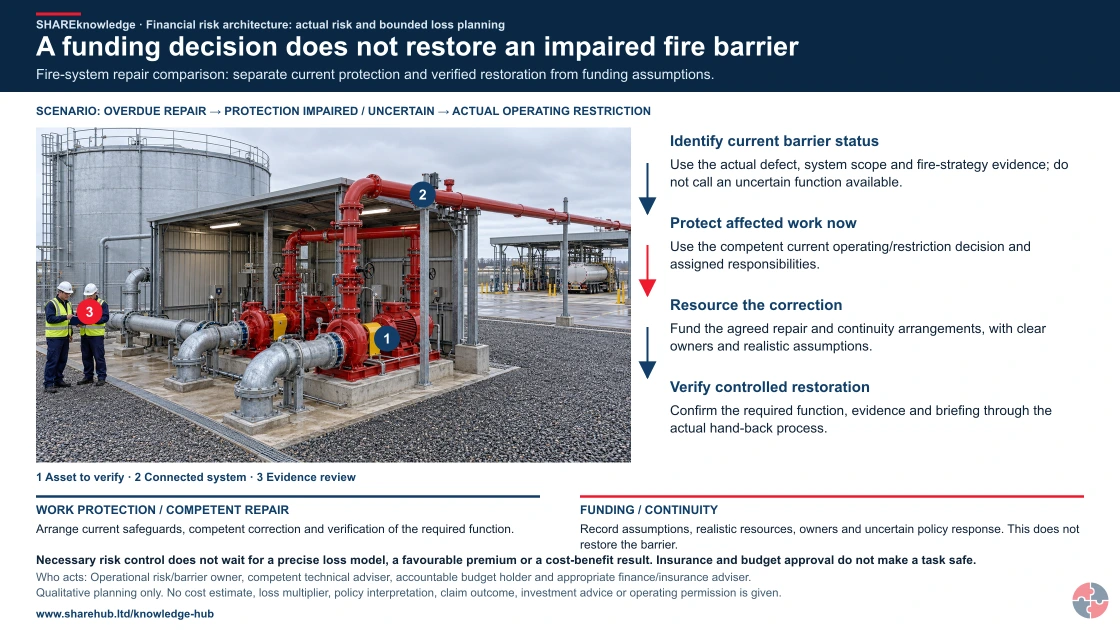
Full written explanation
A complete realistic HD landscape places the exact retained UK firewater pump and connected-system evidence-review scene inside the current contracting-business comparison. A single numbered picture key identifies 1 the physical asset whose required function must be verified, 2 the connected system scope, and 3 the inert evidence review; it identifies no actual defect, due date, valve state, installed protection credit or readiness. The native conditional chain retains overdue fire-system repair, impaired or uncertain required protection and the actual operating restriction. Four unnumbered source steps retain their genuine ordered arrows: identify current barrier status, protect affected work now, resource competent correction and verify controlled restoration. Two separate action bands keep work safeguards/competent repair/function evidence distinct from funding, continuity and uncertain policy assumptions. No arrow or numbering turns a funding decision into proof of restoration. The original hold, responsible roles, worked contexts and qualitative evidence remain complete. No repair design, test sequence, loss metric, cost threshold, insurance/payout decision, financial advice or operating permission is provided.
Fire-system repair comparison: separate current protection and verified restoration from funding assumptions.
- Identify current barrier status. Use the actual defect, system scope and fire-strategy evidence; do not call an uncertain function available.
- Protect affected work now. Use the competent current operating/restriction decision and assigned responsibilities.
- Resource the correction. Fund the agreed repair and continuity arrangements, with clear owners and realistic assumptions.
- Verify controlled restoration. Confirm the required function, evidence and briefing through the actual hand-back process.
When the evidence does not fit: Necessary risk control does not wait for a precise loss model, a favourable premium or a cost-benefit result. Insurance and budget approval do not make a task safe.
Who acts: Operational risk/barrier owner, competent technical adviser, accountable budget holder and appropriate finance/insurance adviser.
Changed workplace
Engineering review: Map credible machinery consequences and uncertain policy response.
Contracting business: Separate funding/continuity from correction of impaired fire protection.
Evidence check: Qualitative planning only. No cost estimate, loss multiplier, policy interpretation, claim outcome, investment advice or operating permission is given.
Make the prevention decision on the actual risk and retain bounded assumptions
Primary references: HSE: management ownership and assurance — HSG65 · HSENI: insurance context — actual policy advice remains separate · HSE: assess and control actual work risks
Open the complete HD image (new tab)Download image

Make the prevention decision on the actual risk and retain bounded assumptions
Primary references: HSE: management ownership and assurance — HSG65 · HSENI: insurance context — actual policy advice remains separate · HSE: assess and control actual work risks
The scenario is deferred fire-system repair for budget reasons. The controls below are reasoned task applications of linked guidance, not a prescribed design or evidence that each intervention appears verbatim in a source. A competent owner must check feasibility, local law and stop criteria.
Use current government guidance and competent task-specific advice; this section does not establish a technical specification.
How can the ERICPD hierarchy of controls guide spending decisions towards stronger workplace risk controls?

| Hazard and harm route | ERICPD → five-level control | Task intervention and feasibility | Owner, test and evidence | Failure and stop decision |
|---|---|---|---|---|
| Deferred fire-system repair for budget reasons | Eliminate → Elimination | Avoid the hazardous operation while the credited system is unavailable. Source: HSE - Managing for health and safety HSG65. | Verify the hazardous operation is suspended while the credited fire system is unavailable; record the residual risk and restart authority. | Stop or redesign if unprotected operation justified only by cost. |
| Same scenario | Reduce → Substitution | Use a safer operation that does not depend on the failed protection. Source: HSE - Managing for health and safety HSG65. | Accountable director trials the replacement method and documents new hazards, residual risk and worker feedback before release. | Pause until the alternative and its new risks are assessed. |
| Same scenario | Control → Engineering | Restore or replace the engineered protection before normal operation. Source: HSE - Managing for health and safety HSG65. | Accountable director must witness the repaired fire-system function and record the authorised restart basis. | Stop or redesign if unprotected operation justified only by cost. |
| Same scenario | Control → Administrative | Escalate the risk decision with duty owner, cost uncertainty and stop criteria. Source: HSE - Managing for health and safety HSG65. | Accountable director spot-checks the actual instruction, authorisation and shift handover against work in progress. | Pause if the procedure or handover cannot be verified. |
| Same scenario | PPE → PPE | PPE is not a substitute for the missing fire system. Source: HSE - Managing for health and safety HSG65. | Accountable director records why PPE cannot control this mapped harm, checks the operative higher-level barrier, and stops the task if that barrier fails. | PPE cannot be the sole credited barrier. |
| Same scenario | Discipline → Administrative assurance | Reconcile risk register, repair evidence, expenditure approval and restart decision. Source: HSE - Managing for health and safety HSG65. | Reconcile risk register, repair evidence, expenditure approval and restart decision. | Stop or redesign if unprotected operation justified only by cost. |
How can the ISO 45001 hierarchy of controls guide spending decisions towards stronger workplace risk controls?

| Hazard and harm route | ERICPD → five-level control | Task intervention and feasibility | Owner, test and evidence | Failure and stop decision |
|---|---|---|---|---|
| Deferred fire-system repair for budget reasons | Eliminate → Elimination | Avoid the hazardous operation while the credited system is unavailable. Source: HSE - Managing for health and safety HSG65. | Verify the hazardous operation is suspended while the credited fire system is unavailable; record the residual risk and restart authority. | Stop or redesign if unprotected operation justified only by cost. |
| Same scenario | Reduce → Substitution | Use a safer operation that does not depend on the failed protection. Source: HSE - Managing for health and safety HSG65. | Accountable director trials the replacement method and documents new hazards, residual risk and worker feedback before release. | Pause until the alternative and its new risks are assessed. |
| Same scenario | Control → Engineering | Restore or replace the engineered protection before normal operation. Source: HSE - Managing for health and safety HSG65. | Accountable director must witness the repaired fire-system function and record the authorised restart basis. | Stop or redesign if unprotected operation justified only by cost. |
| Same scenario | Control → Administrative | Escalate the risk decision with duty owner, cost uncertainty and stop criteria. Source: HSE - Managing for health and safety HSG65. | Accountable director spot-checks the actual instruction, authorisation and shift handover against work in progress. | Pause if the procedure or handover cannot be verified. |
| Same scenario | PPE → PPE | PPE is not a substitute for the missing fire system. Source: HSE - Managing for health and safety HSG65. | Accountable director records why PPE cannot control this mapped harm, checks the operative higher-level barrier, and stops the task if that barrier fails. | PPE cannot be the sole credited barrier. |
| Same scenario | Discipline → Administrative assurance | Reconcile risk register, repair evidence, expenditure approval and restart decision. Source: HSE - Managing for health and safety HSG65. | Reconcile risk register, repair evidence, expenditure approval and restart decision. | Stop or redesign if unprotected operation justified only by cost. |
How could Crownway Fuels Ltd use financial risk architecture?

Crownway Fuels would use financial risk architecture to connect safety-critical controls to business continuity, insurance, enforcement exposure and board decisions.
Crownway Fuels Ltd
a fuel storage and distribution business with tanker loading, fuel storage, maintenance contractors, process safety barriers, vehicle operations and emergency arrangements
Crownway builds financial consequence categories into its risk register for major accident hazards, vehicle incidents, contractor failures, spills, fire, enforcement action and occupational ill health. A fuel release is not recorded only as repair cost; it is mapped across emergency response, product loss, clean-up, environmental control, depot downtime, regulator scrutiny, customer supply interruption, insurance excess and management time.
After an event, the HSSE manager, finance manager and operations manager complete a cost-learning review. They separate gross cost from insured recovery, identify uninsured loss, record any FFI or enforcement exposure, and decide which controls need investment. They do not use the numbers to downplay harm; they use them to show why better barriers and assurance are justified.
The board receives a short quarterly view: high-potential incidents, cost of weak controls, overdue critical actions, insurer findings, enforcement themes, and the top five risk scenarios where uninsured loss could be severe. That keeps safety investment connected to real business risk instead of being treated as a discretionary overhead.
For example, before a tanker unloading operation Crownway checks coupling integrity, containment, isolation and emergency cover, with named operators and a current test record. During transfer a leak and failed alarm are reported; the operator stops transfer and isolates safely, the incident lead controls the area, and finance waits for verified facts rather than presenting an early net-loss figure.
Engineering tests and repairs the failed barriers, the incident lead verifies the revised procedure and briefing, and the authorised manager signs hand-back before another transfer. Finance then separates gross repair, clean-up and interruption costs from any policy recovery, while the board funds prevention and tracks overdue actions.
| Stage | How Crownway applies it | Evidence |
|---|---|---|
| Assess | Maps direct, indirect, insured and uninsured cost routes for major risk scenarios. | Risk register and bowtie consequence notes. |
| Analyse | Compares gross loss, insured recovery, FFI, downtime and management time after events. | Incident cost model. |
| Implement | Funds controls where cost learning shows significant retained exposure. | Board-approved action plan. |
| Check | Audits critical actions, insurer findings and repeat incident themes. | Audit reports and close-out evidence. |
| Learn | Feeds cost learning into investigations and management review. | HSG245-style investigation file. |
| Improve | Updates insurance evidence, controls, training, emergency plans and contractor standards. | Management review minutes. |
Who needs financial-risk competence, and how is it checked?
Training should help people understand incident cost without losing sight of human harm and legal duty.
A manager should be able to explain why a failed control requires a safety decision before a cost discussion. Finance should show its calculations, assumptions and policy uncertainty; supervisors should know who can stop work and who can authorise restart. Rehearse a scenario together, record observed decisions and refresh competence when barriers, policy or duties change.
| Role | Learning to test | Competence demonstration | Assessor and record | Reassessment trigger |
|---|---|---|---|---|
| All managers | Understand direct/indirect and insured/uninsured categories without treating money as a safety threshold. | Explain a sample incident with human harm, failed controls, uncertain costs and immediate stop action. | Safety lead checks a scenario and records management briefing. | New role, risk-appetite revision or misleading board report. |
| Supervisors and incident leads | Preserve facts, secure work, report barrier failure and avoid premature cost or liability claims. | Work through a stopped task and trace evidence to the authorised investigation lead. | Operations manager witnesses scenario and records action. | Serious event, changed critical control or missed escalation. |
| Finance and insurance specialists | Separate gross loss, recovery, assumptions and policy determinations. | Reconcile sample invoices and estimates without double counting or declaring cover. | Finance/insurance lead reviews model and limitation note. | Policy change, new cost category or audit error. |
| Safety, engineering and procurement | Define safe options, whole-life critical controls and field verification. | Compare two control options and demonstrate that minimum safety acceptance is met. | Competent technical lead signs option and commissioning record. | Design change, failed test, contractor change or maintenance deferral. |
| Senior leaders and board | Challenge appetite, escalation, assurance, investment and restart decisions. | Review a high-consequence scenario and authorise pause, resource or independent review. | Board or independent assurance samples decisions and closure. | Major change, recurring exception, incident or failed barrier. |
How does financial risk architecture support study and professional development?
It supports the financial argument for health and safety and helps learners explain why prevention protects people and business performance.
For exam-style study, learners should be able to define direct and indirect costs, insured and uninsured costs, and explain why an organisation cannot rely on insurance as a control. Strong answers connect the financial argument to moral and legal duties, not just profit.
Scenario answers should include examples such as sick pay, repairs, investigation time, overtime, temporary cover, production delay, civil claim, enforcement action, FFI, reputational damage and increased management attention. The best answers also explain what evidence a competent organisation should collect.
| Study area | What to know | Scenario application |
|---|---|---|
| General health and safety study | Financial reasons for good health and safety management. | Explain visible and hidden incident costs. |
| Leadership | Senior managers need complete risk information. | Recommend board review of uninsured losses. |
| Investigation | Cost data should support learning, not blame. | Include cost prompts in investigation. |
| Insurance | Insurance is not a substitute for prevention. | Explain why fines and downtime may remain uninsured. |
| Risk assessment | Financial consequences can support proportionate control decisions. | Add business interruption to risk scenario review. |
How can BS EN ISO 45001 support financial risk architecture?
ISO-style management systems help connect financial risk learning to leadership, risk assessment, monitoring and improvement.
Use current government guidance and competent task-specific advice; this section does not establish a technical specification.
| Management theme | How it supports financial risk architecture | Useful evidence |
|---|---|---|
| Understanding the organisation and its context | Recognises business continuity, stakeholder and financial consequences of health and safety failure. | Risk profile and context review. |
| Leadership and commitment | Leaders resource prevention and review performance. | Board minutes and investment decisions. |
| Actions to address risks and opportunities | Considers credible loss routes and control priorities. | Risk register and action plans. |
| Operational planning and control | Controls operations that could create serious financial and human harm. | Operational standards and evidence. |
| Monitoring, measurement, analysis and evaluation | Uses incidents, cost trends, insurer findings and audits to evaluate performance. | Dashboards and management review. |
| Incident, nonconformity and corrective action | Uses incident learning to correct system weakness. | Investigation records and verified close-out. |
These are practical management-system themes, not a clause-by-clause interpretation. A competent reviewer must verify any clause mapping against a lawfully accessed current standard.
HSE public guidance supports practical management themes in Great Britain. ISO clause mapping, conformity and certification claims remain held for current licensed-text and specialist review; this page does not establish compliance or certification.
What are the warning signs that financial risk architecture is weak?
Warning signs include relying on insurance, ignoring indirect costs, closing actions without verification and failing to brief leaders on uninsured exposure.
Weak financial risk architecture usually appears when the organisation treats health and safety loss as a claims issue rather than a management-system signal. The result is shallow learning: the claim is passed to insurers, the repair is paid, the action is closed, and the same exposure remains.
The warning signs should trigger leadership review because they show that the organisation may be underestimating real risk and underfunding prevention.
| Warning sign | How it can cause harm | Management response |
|---|---|---|
| Only insured costs are reported | Leaders underestimate retained exposure. | Report gross loss and uninsured loss separately. |
| Indirect costs are ignored | Downtime and management time are normalised. | Add indirect cost prompts to investigations. |
| FFI not understood | Material breach cost is not anticipated. | Brief managers and track enforcement correspondence. |
| Actions closed on paperwork | Risk reduction is not verified. | Require evidence of control effectiveness. |
| Insurer findings are not actioned | External warnings are lost. | Add insurer actions to the risk register. |
| No board review | Prevention investment is not informed by loss learning. | Escalate significant retained exposures. |
Financial risk architecture FAQs - what do people ask?
People usually ask how incident costs are categorised, what insurance covers and how leaders should use cost learning.
What is financial risk architecture?
It is a structured way of mapping the full cost of incidents and weak controls, including direct, indirect, insured, uninsured, enforcement, civil, operational and reputational consequences.
Why is insurance not enough?
Insurance may transfer some liability, but it does not remove legal duties and does not normally cover criminal fines, lost productivity, management time, poor morale or reputation damage.
What are direct costs?
Direct costs are visible costs such as treatment, repair, replacement, investigation, legal activity, insurance excess and immediate clean-up.
What are indirect costs?
Indirect costs are hidden or dispersed costs such as downtime, overtime, retraining, lost output, management distraction, rework and lost customer confidence.
What is an uninsured cost?
An uninsured cost is a loss the business bears itself, such as fines, excesses, disruption, lost contracts, reputation harm and many internal recovery costs.
What is Fee for Intervention?
In Great Britain, HSE Fee for Intervention can apply where HSE is the enforcing authority and an inspector identifies and notifies a material breach under the scheme. It is not a general Northern Ireland fee.
Should incident costs be included in risk assessment?
Yes, where it helps leaders understand credible consequences, but financial analysis should support prevention and never reduce human harm to a spreadsheet exercise.
How should senior leaders use incident cost data?
They should use it to strengthen prevention budgets, risk controls, audit priorities, action close-out and management review.
What evidence matters after an incident?
Preserve the incident facts, failed-control evidence, corrective actions and management decisions. Separately record gross cost, possible insurance recovery, uninsured loss and downtime; include HSE Fee for Intervention only when its Great Britain scheme actually applies. Do not assume an insurer will pay or that an NI incident attracts HSE FFI.
How does this support health and safety study?
It supports the financial argument for good health and safety management and helps learners explain why prevention protects people, business continuity and organisational performance.
Which acronyms and terms matter here?
Acronyms should be explained so readers understand enforcement, insurance and management-system language.
| Acronym | Meaning | Plain English use |
|---|---|---|
| EL | Employers' Liability | Insurance or liability relating to employee injury or disease arising from employment. |
| FFI | Fee for Intervention | HSE cost recovery where relevant material breach conditions are met. |
| HSE | Health and Safety Executive | Great Britain workplace health and safety regulator. |
| HSG | Health and Safety Guidance | HSE guidance publication series. |
| PDCA | Plan, Do, Check, Act | Management cycle used in HSG65. |
| RIDDOR | Reporting of Injuries, Diseases and Dangerous Occurrences Regulations | Reporting framework for specified workplace events. |
| ALARP | As low as reasonably practicable | Specialist risk-reduction concept; not a generic spreadsheet permission for unsafe work. |
| ERICPD | Eliminate, Reduce, Isolate, Control, PPE, Discipline | A control-planning prompt that keeps prevention ahead of insurance. |
| Gross loss | Loss before recovery | Shows the underlying consequence before possible insurance payment. |
| Risk appetite | Level of uncertainty leaders choose to pursue within lawful controls | Governance guide, not a waiver of safety duties. |
| Control assurance | Evidence a safeguard is present and works | Testing, observation and corrective action rather than a policy statement. |