
SHARE Knowledge Hub
How do civil proceedings and health and safety claims work?
When a workplace claim or legal letter arrives, record receipt, protect the person, preserve relevant evidence and notify the insurer or legal lead promptly. The pre-action process differs by claim type and country. Keep factual investigation and safety improvements moving while specialists manage disclosure, privilege and deadlines.
Understanding How do civil proceedings and health and safety claims work?
When a workplace claim or legal letter arrives, record receipt, protect the person, preserve relevant evidence and notify the insurer or legal lead promptly. The pre-action process differs by claim type and country. Keep factual investigation and safety improvements moving while specialists manage disclosure, privilege and deadlines.
Why this matters at work
Settlement also needs authorised, informed advice. It can address liability, losses, costs, timing and other terms, but compromise does not prove every original allegation or remove the need to learn from credible hazards. England and Wales CPR Part 36 is a formal regime with detailed requirements and potential costs consequences; a casual offer should not be presented as one. Other jurisdictions and offer types differ. Record decisions through the proper claims process and keep support and prevention working. This answer does not assert privilege for a document, draft a binding offer or recommend acceptance of an individual settlement.
No automatic protection should be assumed. Statutory limitation and procedural timetables are distinct, and the applicable analysis can change with jurisdiction, claim type, date of knowledge and claimant circumstances. An insurer discussion, HSE investigation, grievance, treatment, inquest or negotiation does not itself stop statutory time. A general three-year statement is insufficient to calculate a real deadline, and discretionary relief is not guaranteed.
How organisations manage this in practice
Preserve historical assessments, process descriptions, product information, maintenance, training and insurance evidence, including accessible legacy and third-party systems. Seek occupational health material through the proper confidential route. State missing records and uncertain recollections honestly instead of reconstructing them as contemporaneous fact. Obtain prompt legal and insurer advice on jurisdiction, limitation and the applicable disease or specialist protocol. A claim route can differ from a single-event personal-injury process. Continue appropriate worker support and prevention review while the allegation is investigated. Do not infer liability, reportability or benefit eligibility merely from the disease name.
Take prompt factual accounts separately with open questions, distinguishing what each person saw, heard or did from estimates, normal practice and later inference. Preserve uncertainty and the witness's own recollection rather than circulating a preferred group narrative. An internal interview note is not automatically a compliant court witness statement. Formal statements, language and statement-of-truth requirements should follow the relevant rules with appropriate legal supervision. Experts must work within competence and assist the court objectively, considering adverse material as well as supportive facts. Provide balanced instructions, documents, assumptions and questions and preserve relevant samples, measurements and custody. In England and Wales, the court controls expert evidence and permission under CPR Part 35; other jurisdictions have their own process. Do not ask an engineer to diagnose disease or a clinician to decide the legal result. Record limitations and changed opinions through the proper route. The court decides disputed facts and law; paying for an expert does not make them an advocate or guarantee a favourable outcome.
Within England and Wales, identify injury or disease type, value, dates, parties and exclusions before choosing a protocol or electronic route. A general personal-injury protocol may not govern a disease, specialist or otherwise excluded claim. Check the current rules and required response through advisers rather than copying a deadline from an old training table. Record receipt, routing, responsible owner and dates and preserve evidence promptly. An employer's safety investigation, regulatory reporting and claims process can proceed in parallel, with appropriate coordination. None automatically suspends the other or determines the final civil result.
Preserve the evidence trail when a claim arrives
A received claim needs an owner immediately. Record when and how it arrived, protect people from any continuing hazard and preserve relevant originals and audit trails. Use the applicable insurer and legal process to decide retention, disclosure and procedural action; there is no single deadline or privilege promise that fits every UK claim.
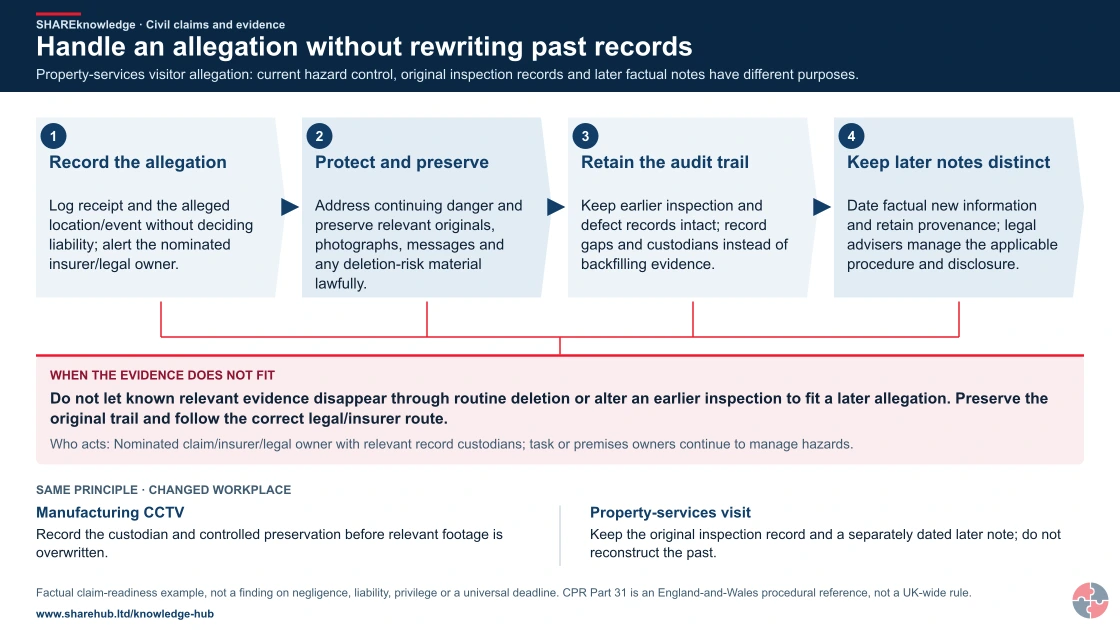
Handle an allegation without rewriting past records
Full written explanation
Property-services visitor allegation: current hazard control, original inspection records and later factual notes have different purposes.
- Record the allegation. Log receipt and the alleged location/event without deciding liability; alert the nominated insurer/legal owner.
- Protect and preserve. Address continuing danger and preserve relevant originals, photographs, messages and any deletion-risk material lawfully.
- Retain the audit trail. Keep earlier inspection and defect records intact; record gaps and custodians instead of backfilling evidence.
- Keep later notes distinct. Date factual new information and retain provenance; legal advisers manage the applicable procedure and disclosure.
When the evidence does not fit: Do not let known relevant evidence disappear through routine deletion or alter an earlier inspection to fit a later allegation. Preserve the original trail and follow the correct legal/insurer route.
Who acts: Nominated claim/insurer/legal owner with relevant record custodians; task or premises owners continue to manage hazards.
Changed workplace
Manufacturing CCTV: Record the custodian and controlled preservation before relevant footage is overwritten.
Property-services visit: Keep the original inspection record and a separately dated later note; do not reconstruct the past.
Evidence check: Factual claim-readiness example, not a finding on negligence, liability, privilege or a universal deadline. CPR Part 31 is an England-and-Wales procedural reference, not a UK-wide rule.
Complete preservation timeline, insurer and jurisdiction context
Primary references: HSE: civil compensation claims and insurer evidence · Justice: CPR Part 31 (England and Wales scope)
Open the complete HD image (new tab)Download image

Complete preservation timeline, insurer and jurisdiction context
Primary references: HSE: civil compensation claims and insurer evidence · Justice: CPR Part 31 (England and Wales scope)
In a timeline, an incident happens on Monday, the claim arrives later and CCTV is due for routine deletion that evening. The nominated owner arranges a lawful relevant preservation hold, records who holds each source and notes gaps honestly. Witnesses provide their own recollections; an internal learning review should not turn them into a shared narrative or recreate missing historical records.
Crownway: CCTV is approaching routine deletion
Illustrative example. A depot receives a claim shortly before relevant footage would be overwritten.
Decision. The manager alerts the insurer or legal owner and arranges controlled preservation of relevant material and its provenance.
Evidence to check. Received date, original files and metadata, source custodians, access history and a record of anything unavailable.
Hold or escalation point. Do not let routine deletion destroy known relevant evidence or promise that an internal document is legally privileged.
Follow-up. Follow the correct jurisdiction’s procedure and verify that the preservation instruction reaches all relevant custodians.
Preserve the claim and the evidence trail
Record what arrived and when, notify the designated legal/insurer contact and preserve relevant originals. Care and prevention continue alongside the controlled response.

Record receipt
Keep the actual communication, date and delivery details; identify the relevant jurisdiction and designated response owner.
Preserve evidence
Protect original records and access logs. Make transparent dated clarifications rather than overwrite or recreate a historical record.
Specialist response
Follow qualified legal/insurer directions for the particular claim; do not invent a generic response deadline. Maintain appropriate care and learning.
A document journey is not advice on limitation periods, admissions or the prospects of a claim.
What are the key facts about civil proceedings and health and safety claims?
The key facts are that claim response is an evidence, communication, insurer and learning process, not a scramble to rewrite history.
Civil claims are separate from enforcement
A civil claim is usually about compensation; HSE or local authority enforcement is about criminal duties and risk control.
Evidence must be preserved early
Documents, photographs, CCTV, equipment, permits, logs and witness details can disappear quickly if no one owns the response.
Witnesses need fair handling
Witness accounts should be factual, prompt and not coached into a preferred version of events.
Personal data needs discipline
Health information, absence records and occupational health advice require careful handling and limited sharing.
Insurers need prompt notification
Late notification or poor evidence can weaken claims handling and policy response.
Learning still matters
An incident can be defended legally and still reveal controls that need improvement.
What are civil proceedings in a health and safety context?
Civil proceedings are the formal steps used to pursue, defend, settle or determine a compensation claim linked to workplace injury, illness or loss.
In health and safety, civil proceedings often start with a letter of claim, insurer notification, evidence requests or legal correspondence. They may end in settlement, denial, mediation, court judgment or withdrawal. The process is legal and insurance-led, but the quality of the workplace evidence is often shaped by operational managers long before any lawyer is involved.
The safety professional's role is normally to support facts, risk-control understanding and learning. That may involve building an incident chronology, identifying relevant records, explaining risk assessments, helping investigators understand the work, checking whether corrective actions are suitable and feeding lessons back into the management system.
The boundary matters. Safety professionals should not give legal opinions on liability, privilege, disclosure duties or settlement strategy unless they are competent and authorised to do so. Their strength is helping the business understand what happened, what controls existed, what failed and how recurrence will be prevented.
| Element | What it means | Workplace significance |
|---|---|---|
| Claim notification | A person alleges injury, illness or loss and may seek compensation. | The organisation must notify insurers and preserve evidence. |
| Liability assessment | Insurers and advisers consider duty, breach, causation and loss. | Records and witness evidence become important. |
| Disclosure | Relevant documents may need to be identified and exchanged. | Document control, retention and confidentiality matter. |
| Settlement or defence | The claim may be settled, defended or decided by a court. | Operational teams should avoid speculation and follow the claims route. |
| Learning | The incident and claim evidence should inform improvement. | Risk registers, training, inspections and supervision may need change. |
How does a health and safety claim progress?
The path usually runs from notice and evidence preservation through insurer or legal assessment, pre-action exchange, resolution or proceedings. The precise steps depend on the claim and jurisdiction.
In England and Wales an accident claim may follow the Personal Injury Protocol or a low-value employer/public liability route, whereas an occupational illness may fall under the Disease and Illness Protocol. Scottish and NI procedures differ. Pre-action steps do not suspend a limitation period; send legal correspondence immediately to the named lead. Keep a dated claim log of receipt, insurer notice, evidence hold, advice, deadlines and safety actions.
On a small screen, scroll this table sideways to read all columns.
| Stage | Immediate owner | Output |
|---|---|---|
| Receipt | Site or central intake | Timestamp and secure forwarding |
| Evidence hold | Claims lead with IT and operations | Scope, custodians and preservation confirmation |
| Legal route | Insurer or solicitor | Jurisdiction, protocol and deadline plan |
| Learning | Risk owner | Action plan and verified closure |
What should happen when a claim or legal letter arrives?
Log the received date, forward it to the insurer or legal lead at once, protect the injured person and preserve relevant material.
Do not let a letter remain in a local inbox. Suspend routine deletion for relevant CCTV, email, messages, equipment logs and documents; record custodians and any unavailable items. If a hazard remains, make it safe immediately after capturing what can safely be recorded. Staff should avoid speculation or promises about liability, while communicating respectfully and providing practical support.
On a small screen, scroll this table sideways to read all columns.
| Action | Why | Owner |
|---|---|---|
| Secure notice and dates | Deadlines and policy conditions may apply | Claims lead |
| Preserve evidence | Prevent routine loss or altered context | IT and operations |
| Make safe | Prevent further injury | Risk owner |
| Support affected person | Care and clear contact | HR or nominated liaison |
What evidence should be preserved for a health and safety claim?
Evidence should show the work as it was planned, how it was actually done, what happened, what controls existed and what changed afterwards.
Good evidence is contemporaneous, specific, dated and connected to the real task. It is weaker when it is generic, incomplete, reconstructed later or written in a way that overclaims control. A risk assessment that says workers were trained is not enough if no one can produce training records or demonstrate understanding.
Evidence should include both documents and reality checks. Photographs, witness accounts, maintenance logs, permits, inspection records, training evidence and supervisor notes may all matter. So can absence records, occupational health advice, exposure monitoring, health surveillance and contractor documents where they are relevant and lawfully handled.
| Evidence type | Examples | Quality test |
|---|---|---|
| Planning records | Risk assessments, method statements, permits, pre-task briefings and work packs. | Were they task-specific, current and understood? |
| Competence records | Training matrix, authorisations, inductions, refresher training and supervisor checks. | Do they show role-specific competence rather than attendance only? |
| Operational records | Inspections, maintenance, defect logs, isolation certificates and equipment checks. | Do they show defects were found, prioritised and closed? |
| Incident evidence | Photos, sketches, CCTV, damaged parts, witness details and first report. | Was evidence captured before conditions changed? |
| Health evidence | Occupational health referral, health surveillance outputs and fit-note information. | Was sensitive data limited and handled lawfully? |
| Learning evidence | Investigation report, action tracker, management review and revised controls. | Did actions address root causes and verify improvement? |
HSE’s civil-claim guidance supports prompt insurer referral and honest evidence. CPR Part31 is an England/Wales disclosure source; the legal lead selects the applicable duties, track and orders. Use ICO worker-health guidance for health records. These operational checks illustrate a preservation exercise rather than a universal court timetable.
Worked exercise: claim notice and imminent CCTV overwrite
| Decision | Owner and action | Verification, failure response and evidence |
|---|---|---|
| Notice received | Receipt owner logs time, sender and attachments and forwards the complete material to the insurer/legal lead through the agreed route. | Confirm receipt by the responsible handler. Missing acknowledgement or an imminent deadline is escalated immediately; the legal lead owns the response timetable. |
| CCTV overwrite risk | System owner identifies relevant cameras/time windows and promptly protects potentially relevant footage from routine overwrite under the preservation instruction. | Record camera, clock offset if known, export time, operator and file location; verify a preserved copy plays and covers the required period. Export failure or already-missing footage is logged and escalated, not silently recreated. |
| Originals and privacy | Evidence coordinator keeps original records, dated copies and a change log; health material goes to restricted case storage with necessary access. | Check permissions and transfer history. Broad circulation of clinical details is stopped and corrected; advisers decide disclosure/redaction and privilege, and a label alone does not establish privilege. |
| Make safe and learn | Operational owner makes the affected task safe and records the original condition where this can be done safely, then records repairs separately. | Verify the corrective control before restart and keep a dated account of what changed. Do not delay urgent protection for evidence capture or rewrite the original risk assessment as though it predated the event. |
How should witness accounts be handled?
Take individual, prompt, uncoached factual accounts; a legal professional manages any formal court witness statement.
Ask open questions and distinguish direct observation from what the witness later heard. Retain original notes and later corrections with dates. Do not merge accounts or tell a witness what conclusion to reach. In England and Wales, CPR Part 32 governs formal witness evidence; Scotland and NI have their own rules. A safety investigation interview is for learning, not a substitute for a court statement.
On a small screen, scroll this table sideways to read all columns.
| Capture | Avoid | Record |
|---|---|---|
| Who, when, where | Collective reconstruction | Witness’s own words and date |
| What was seen or heard | Leading conclusions | Observation versus inference |
| Later clarification | Silent overwriting | Dated addendum |
How should disclosure and confidentiality be handled?
Preserve potentially relevant material broadly, but let legal advisers decide disclosure, privilege, redaction and court-specific obligations.
A safety team should not delete, tidy or selectively retain records once a claim is reasonably anticipated. Nor should it broadcast medical or witness details to managers who do not need them. Health information is special category data: the organisation needs an Article 6 lawful basis and Article 9 condition, with restricted access, retention and audit. Legal privilege is a specialist determination; simply labelling a document “privileged” does not make it so.
On a small screen, scroll this table sideways to read all columns.
| Information | Preserve or use | Decision owner |
|---|---|---|
| Contemporaneous operational records | Original plus provenance and retention hold | Claims and IT lead |
| Worker health information | Minimum necessary, secure access | Privacy/occupational health lead |
| Potentially privileged advice | Segregate pending legal assessment | Solicitor |
| Disclosure request | Route under applicable court/protocol rules | Solicitor |
How should an incident investigation support civil proceedings without losing learning?
An investigation should establish facts, causes and improvement actions while keeping the claims process disciplined and factual.
HSE HSG245 investigation guidance is built around learning: gather information, analyse what happened, identify immediate and underlying causes, decide risk-control improvements and ensure actions are completed. That discipline also helps claims handling because it creates a clear, evidence-based record rather than scattered opinions.
The investigation should not be a search for a person to blame. Civil claims often expose system weaknesses: missing supervision, ambiguous instructions, unsuitable tools, poor maintenance, time pressure, contractor interface gaps, weak training or a management decision that accepted drift.
| Step | What to do | Output |
|---|---|---|
| Secure the scene | Make the area safe and preserve relevant evidence. | Photos, evidence log and scene control record. |
| Gather facts | Review documents, interview witnesses and inspect equipment. | Chronology and evidence bundle. |
| Analyse causes | Separate immediate, underlying and root causes. | Causal analysis such as five whys or root cause analysis. |
| Identify controls | Compare actual controls with required controls. | Gap analysis linked to risk assessment. |
| Assign actions | Rank actions by risk and give owners and dates. | Action tracker with close-out evidence. |
| Review wider learning | Check whether similar risks exist elsewhere. | Management review, audit plan and updated standards. |
How should affected people and bereaved families be considered?
Affected people should be treated with dignity, practical support and clear communication, while formal investigations and claims are handled through the right channels.
A workplace claim is not only an administrative event. Someone may be injured, ill, anxious, bereaved, off work or worried about income and future work ability. Managers need to avoid defensive silence, rumour or insensitive language while still keeping legal and insurer communication controlled.
For serious incidents, communication should be coordinated, factual and humane. HSE publishes guidance for victims and bereaved families in its regulatory investigation context, distinct from civil compensation advice, and organisations should make sure affected people know how to report concerns, access support and obtain information through appropriate routes.
| Need | Good practice | Risk if ignored |
|---|---|---|
| Immediate welfare | First aid, medical route, safe transport and welfare contact. | Harm worsens and trust is damaged. |
| Clear communication | Explain who will contact them and what happens next. | People rely on rumour or inconsistent information. |
| Confidentiality | Limit personal details to those who need to know. | Privacy breach and distress. |
| Return to work | Consider rehabilitation, adjustments and occupational health advice. | Avoidable absence or reinjury. |
| Family liaison | For serious or fatal incidents, manage contact sensitively and consistently. | Additional distress and reputational harm. |
Which procedural rules matter?
Choose the procedure by court, claim type and date; no single UK pre-action protocol covers every workplace injury or illness.
England and Wales CPR lists distinct personal-injury, low-value EL/PL and disease/illness protocols, with Parts 31 and 32 addressing disclosure and evidence where applicable. Scottish Courts publish a separate personal-injury protocol. Northern Ireland judiciary has its own pre-action materials, including a 2023 County Court protocol whose scope must be checked. Limitation, service, disclosure and privilege require case-specific legal advice. A RIDDOR report, regulator outcome or insurer notification does not decide civil liability.
On a small screen, scroll this table sideways to read all columns.
| Location | Official starting point | Specialist check |
|---|---|---|
| England and Wales | CPR protocol index; disease or accident route | Threshold, exclusions, limitation and applicable track |
| Scotland | Scottish Courts rules and pre-action protocol | Court, event date and claim category |
| Northern Ireland | Judiciary NI protocols and NI court rules | Current court and claim scope |
How should civil proceedings risk appear in the risk register?
Civil proceedings risk should appear through underlying harm scenarios, evidence vulnerabilities and the controls that prevent harm and preserve defensibility.

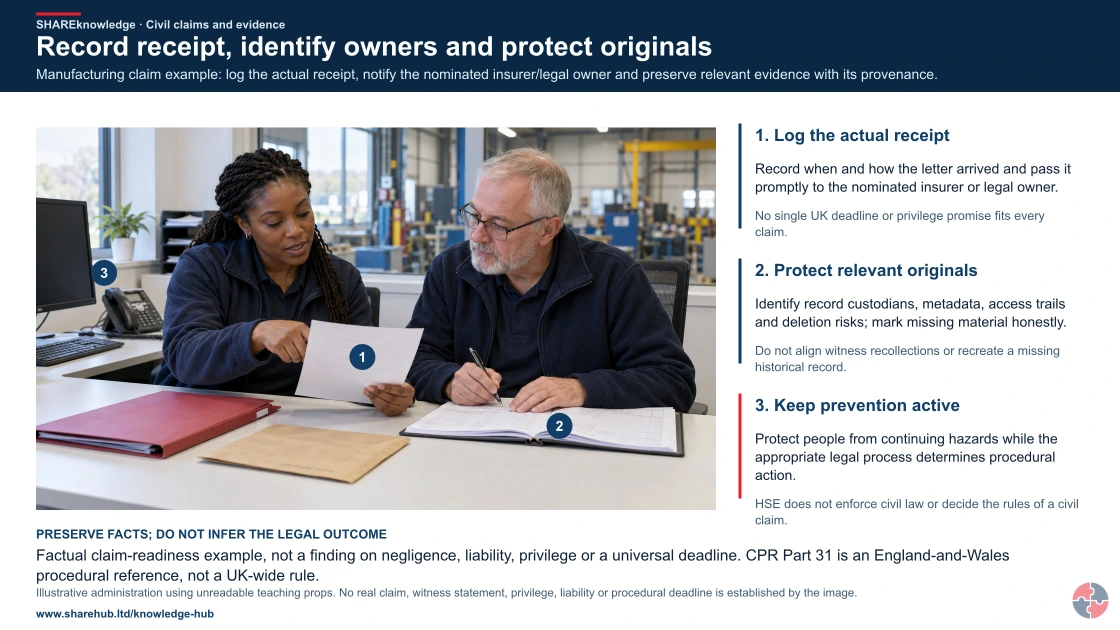
Record receipt, identify owners and protect originals
Full written explanation
Manufacturing claim example: log the actual receipt, notify the nominated insurer/legal owner and preserve relevant evidence with its provenance.
- Log the actual receipt. Record when and how the letter arrived and pass it promptly to the nominated insurer or legal owner.
- Protect relevant originals. Identify record custodians, metadata, access trails and deletion risks; mark missing material honestly.
- Keep prevention active. Protect people from continuing hazards while the appropriate legal process determines procedural action.
Change the pathway
- Use the applicable process. No single UK deadline or privilege promise fits every claim.
- Keep accounts independent. Do not align witness recollections or recreate a missing historical record.
- Separate roles and jurisdictions. HSE does not enforce civil law or decide the rules of a civil claim.
Evidence check: Factual claim-readiness example, not a finding on negligence, liability, privilege or a universal deadline. CPR Part 31 is an England-and-Wales procedural reference, not a UK-wide rule.
Complete preservation timeline, insurer and jurisdiction context
Primary references: HSE: civil compensation claims and insurer evidence · Justice: CPR Part 31 (England and Wales scope)
Open the complete HD image (new tab)Download image

Complete preservation timeline, insurer and jurisdiction context
Primary references: HSE: civil compensation claims and insurer evidence · Justice: CPR Part 31 (England and Wales scope)
The risk register should not list 'civil claim' as if that were the hazard. The hazard is the unsafe work, exposure, poor premises condition, missing supervision or weak contractor control that could harm someone. The civil proceeding is one possible consequence of that failure.
A useful register captures both prevention and evidence. It asks what could go wrong, what prevents it, how the business proves the control was working, what evidence may be needed after an event and who is responsible for preserving it.
| Scenario | Claim pathway | Controls | Evidence |
|---|---|---|---|
| Fall from access equipment | Alleged failure to plan, inspect or supervise work at height. | Selection, inspection, training, supervision and exclusion zones. | Risk assessment, inspection record, training and photographs. |
| Occupational exposure illness | Alleged long-term exposure to dust, fume, noise, vibration or chemicals. | Exposure control, monitoring, health surveillance and PPE/RPE. | COSHH/noise/vibration records, exposure data and surveillance. |
| Contractor injury | Alleged poor coordination or unsafe handover. | Contractor competence, permits, induction, RAMS and supervision. | Prequalification, permit, briefing and handover records. |
| Public injury near works | Alleged failure to segregate or warn members of the public. | Barriers, signage, traffic routes and inspection. | Site inspection, temporary works layout and incident photos. |
| Known defect not fixed | Alleged failure after prior warning. | Defect reporting, prioritisation, isolation and repair. | Defect log, escalation record and close-out evidence. |
How could Crownway Fuels Ltd manage civil proceedings and claim readiness?

Crownway Fuels Ltd would manage claim readiness by connecting high-hazard operational controls to disciplined evidence preservation, insurer notification and learning review.
Crownway Fuels Ltd
A fuel storage, distribution and maintenance business operating bulk tanks, tanker loading, contractors, hazardous areas and safety-critical equipment.
Crownway treats claim readiness as part of major-accident and occupational-risk management, not a paperwork exercise. Its risk register includes scenarios such as tanker loading injuries, slips in wet bunded areas, burns from hot work, contractor injury during isolation, chemical exposure, stress after serious incidents and public damage from vehicle movements.
For each scenario, Crownway identifies the control barrier and the proof expected: permits, isolations, gas testing, DSEAR zoning, inspection logs, maintenance history, loading procedures, driver competence, spill drills, CCTV retention and supervision evidence. Frontline leaders complete short binary checks for critical controls; second-line HSE specialists sample permits, maintenance records and contractor files; third-line audits test whether the management system is working across depots.
When an incident or claim is received, the depot manager notifies the insurer through a defined route, preserves CCTV before overwrite, photographs the scene, retains damaged equipment where safe, identifies witnesses and opens a factual evidence log. The HSE adviser leads the learning investigation and keeps claim opinions separate from root-cause findings. Senior leaders review actions, insurer feedback and repeat themes in the quarterly risk review.
| Management area | How Crownway applies it | Evidence and improvement |
|---|---|---|
| Assess and analyse | Maps civil-claim scenarios to fuel handling, contractors, loading, maintenance, slips, chemical exposure and road risk. | Risk register, legal register and depot scenario review. |
| Implement controls | Uses permits, isolation, DSEAR controls, traffic segregation, loading procedures, spill controls and contractor supervision. | Permit records, maintenance logs, inspections, training and CCTV retention controls. |
| Train and supervise | Trains depot managers and supervisors on factual records, witness handling, insurer notification and avoiding speculative comments. | Role-based training, toolbox talks and supervisor observation records. |
| Check and audit | Uses frontline binary checks, second-line HSE sampling and third-line audits of claims evidence and control reliability. | Inspection scores, audit findings, action tracker and management review. |
| Learn from claims | Reviews incident themes, claim trends and insurer surveys to improve standards and procurement. | Claims dashboard, revised procedures and verified close-out. |
| Protect confidentiality | Limits health, HR and claim file access and coordinates disclosure through insurer/legal routes. | Access controls, retention rules and data-handling notes. |
What should each role learn and demonstrate?
Learning must match the decisions people make, from recognising danger to checking that controls work.
Briefings should tell people how to act, but attendance alone does not show competence. Assess the real decision or task, record who assessed it and revisit after a material change, failed control or incident. A local authorisation is task-specific; no universal external certificate is implied.
On a small screen, scroll this table sideways to read all columns.
| Role and learning | Demonstration and assessor | Record and reassessment trigger |
|---|---|---|
| Intake staff: recognise legal notice. | Route a mock letter to the named claims lead without delay. | Timed drill and routing log. |
| IT and operations: preserve. | Test a CCTV and email retention hold, with provenance. | Hold receipt and retrieval test. |
| Investigators: fact and care. | Take uncoached accounts and separate safety action from legal opinion. | Reviewed exercise and corrective actions. |
| Claims lead: procedure. | Identify E&W, Scotland or NI and accident/disease route. | Solicitor-confirmed case checklist. |
How does civil proceedings knowledge support NEBOSH Diploma study?
Civil proceedings knowledge supports NEBOSH Diploma study by linking legal action to information management, witness evidence, disclosure, claims defensibility and management-system learning.
In advanced safety study, a strong answer can explain how a health and safety professional contributes to legal actions without pretending to be the legal adviser. The professional may support fact-finding, evidence preservation, investigation quality, chronology, records, witness handling and corrective actions.
Scenario-based answers should show professional judgement. If a serious injury claim follows a poorly controlled task, do not only list documents. Explain which documents matter, why they matter, how witness evidence should be gathered, how confidential information is protected and how the incident feeds back into risk assessment and management review.
| Criteria area | What to know | How to apply it |
|---|---|---|
| Civil claim lifecycle | How claims move from notification to evidence, liability review and outcome. | Describe the organisation's response steps. |
| Information management | How records are preserved, controlled, retrieved and protected. | Build an evidence log and retention approach. |
| Witness evidence | How to gather factual statements fairly and promptly. | Use interview principles and avoid leading accounts. |
| Disclosure and confidentiality | How relevant documents and sensitive data are handled. | Escalate legal and data-protection decisions. |
| Claims defensibility | How management systems create reliable evidence before incidents. | Link Plan, Do, Check, Act to defensible controls. |
| Learning | How claims and incidents improve the system. | Assign actions, verify close-out and review similar risk. |
How can a management system sustain effective decisions?
Give each hazard or support route an owner, a control, a check and a response to failure.
Assign owners for receipt, preservation, affected-person support, legal conduct and learning; test the process with a realistic claim scenario. An owner should sample actual work and corrective actions, not accept a policy or certificate as evidence that the controls work.
The free GB regulator guide HSE Managing for health and safety (HSG65) explains a plan–do–check–act approach: assign controls and owners, involve workers, check work as done, and correct failures. For Northern Ireland, use HSENI risk assessment guidance for the local duty. A certificate alone does not demonstrate that a control works.
What warning signs show claims readiness is weak?
Warning signs include missing evidence, late insurer notification, speculative emails, weak witness records, uncontrolled health data and repeat incidents with no learning.
Weak claims readiness usually looks ordinary before it becomes serious. A supervisor writes vague inspection notes, a training matrix is out of date, CCTV is overwritten, a witness account is taken after group discussion, or HR health data is emailed more widely than needed. Each weakness can also indicate poor control of the underlying risk.
The corrective action should fix both the legal-process gap and the safety-management gap. A new claims checklist helps, but if the real issue is poor supervision, poor maintenance or a weak contractor system, the improvement must go deeper.
| Warning sign | How it can cause harm or weaken response | What to improve |
|---|---|---|
| Claim letters sit with the wrong person | Notification is delayed and insurer handling is weakened. | Single claims route and trained document handlers. |
| CCTV is overwritten | Important evidence is lost. | Retention trigger and evidence preservation checklist. |
| Witnesses discuss events before statements | Accounts become contaminated or inconsistent. | Prompt individual witness process. |
| Risk assessments are generic | They do not prove foreseeable task risks were controlled. | Task-specific assessments and field verification. |
| Health information is over-shared | Privacy harm and data-protection exposure may occur. | Access controls and HR/OH/legal route. |
| Repeat incidents continue | The system is not learning and people remain exposed. | Trend review, root-cause action and leadership oversight. |
What acronyms are used on this civil proceedings page?
Acronyms should be explained so legal, insurance and safety terms remain accessible.
| Acronym | Meaning | Why it matters |
|---|---|---|
| CPR | Civil Procedure Rules | Rules for civil proceedings in England and Wales. |
| EL | Employers' liability | Insurance and civil liability relating to employee injury or illness. |
| HSE | Health and Safety Executive | Great Britain regulator for many workplace health and safety duties. |
| HR | Human resources | Often involved in absence, employee relations, records and communication. |
| ICO | Information Commissioner's Office | UK regulator for data protection and information rights. |
| OH | Occupational health | Clinical or health-professional support relating to work and health. |
| RAMS | Risk assessment and method statement | Common construction and contractor planning documents. |
| RCA | Root cause analysis | A method for identifying deeper causes of an incident or failure. |