SHARE Knowledge Hub
FMEA, LOPA and Safety Integrity Decisions
FMEA identifies failure modes, LOPA tests independent layers for a defined scenario, and SIL applies to a specific safety instrumented function. Competent teams must verify assumptions, common-cause risks, proof tests and stop decisions. Apply the relevant GB or NI major-hazard route rather than treating a study number or certificate as proof of safety.
Understanding FMEA, LOPA and Safety Integrity Decisions
FMEA identifies failure modes, LOPA tests independent layers for a defined scenario, and SIL applies to a specific safety instrumented function. Competent teams must verify assumptions, common-cause risks, proof tests and stop decisions. Apply the relevant GB or NI major-hazard route rather than treating a study number or certificate as proof of safety.
Why this matters at work
Describe each failure mode, cause, local and wider effects, detection and current controls before scoring. Define the scoring method and its limits. Different combinations can produce the same product score, so a low ranking must not conceal a severe consequence, an unverified safeguard or a mandatory design requirement. Qualitative judgement and competent challenge remain necessary.
Treat the data source and its applicability as separate questions. A frequency from another plant may describe a different valve, material, operating mode, maintenance regime or reporting period. An incident count may omit demands that were hidden by manual intervention. The reviewer should be able to follow the origin, definition, scope and uncertainty of each input. If a measurement or model cannot resolve a consequence endpoint, retain that limitation visibly and obtain the necessary specialist work. Do not turn an unknown input into zero. In the teaching record, distinguish an observed fact, an engineering assumption, a method rule and an unresolved action so that future review can change the right part.
How organisations manage this in practice
Choose the method from the decision and system. FMEA examines component or functional failure modes and effects; LOPA evaluates defined hazardous scenarios and qualifying independent protection layers; safety-integrity decisions form part of a managed functional-safety lifecycle. They can complement wider hazard studies, but none is a universal substitute for identifying credible hazards and consequences. A supplier's SIL label does not determine the integrity required of a plant safety function. Define scope, operating modes, interfaces, data quality and competent team roles before the study. Use actual design and process information and document assumptions and unresolved questions. HSE technical guidance emphasises independence and systematic as well as random failures. Keep the applicable GB or NI legal framework and major-hazard scope clear. Study outputs need action ownership, design verification, installation acceptance and operating arrangements. A workshop score, risk-priority number or calculation does not itself demonstrate adequate risk reduction, ALARP or permission to operate a system whose safeguards are not installed and verified.
Specify supplier deliverables in language the dutyholder can evaluate. If a supplier claims a function can achieve an integrity target, ask what assumptions, application constraints, configuration, failure evidence and test arrangements the claim depends on. The competent customer must compare those with the site requirement; a label on the logic solver is not an answer for the full chain. HSE competence guidance recognises that competence may transfer poorly to a different hazard or application. Use evidence against the actual role, with appropriate supervision and reassessment when circumstances change. Retain enough knowledge and controlled records for the operator to manage the function after the supplier leaves.
Handover must make changed responsibilities usable at the time they matter. An operator needs the approved limits and response; a maintainer needs the function and task-specific test/restoration requirements; a supervisor needs impairment status and escalation; responders need accurate site information and agreed interfaces. Test whether night, weekend and contractor arrangements can provide those roles. HSE emergency guidance stresses clear responsibilities, rehearsal and coordination with others sharing the workplace. It also says work should not resume while serious danger remains. A study sign-off or emergency exercise alone does not authorise a restart. Preserve the actual emergency plan and competent restoration decision as separate controlled records.
Who needs to understand FMEA, LOPA and safety integrity decisions?
This topic is for people who make, use, review or rely on process safety risk reduction decisions.
Process safety engineers
Need to structure credible scenarios, challenge assumptions and link studies to barrier management.
Control and instrumentation engineers
Need to define safety functions, proof testing, lifecycle evidence and modification controls.
Operations and maintenance teams
Need to understand the barriers they operate, test, override, maintain or reinstate.
Managers and technical authorities
Need to make risk acceptance decisions based on evidence rather than optimism.
Auditors and regulators
Need to sample whether study assumptions match field conditions and current barrier health.
Process-safety learners
Need to explain the methods, their purpose, their limitations and their link to major accident prevention.
Updated 2026-10-02.
How can I practise this topic in 3D?
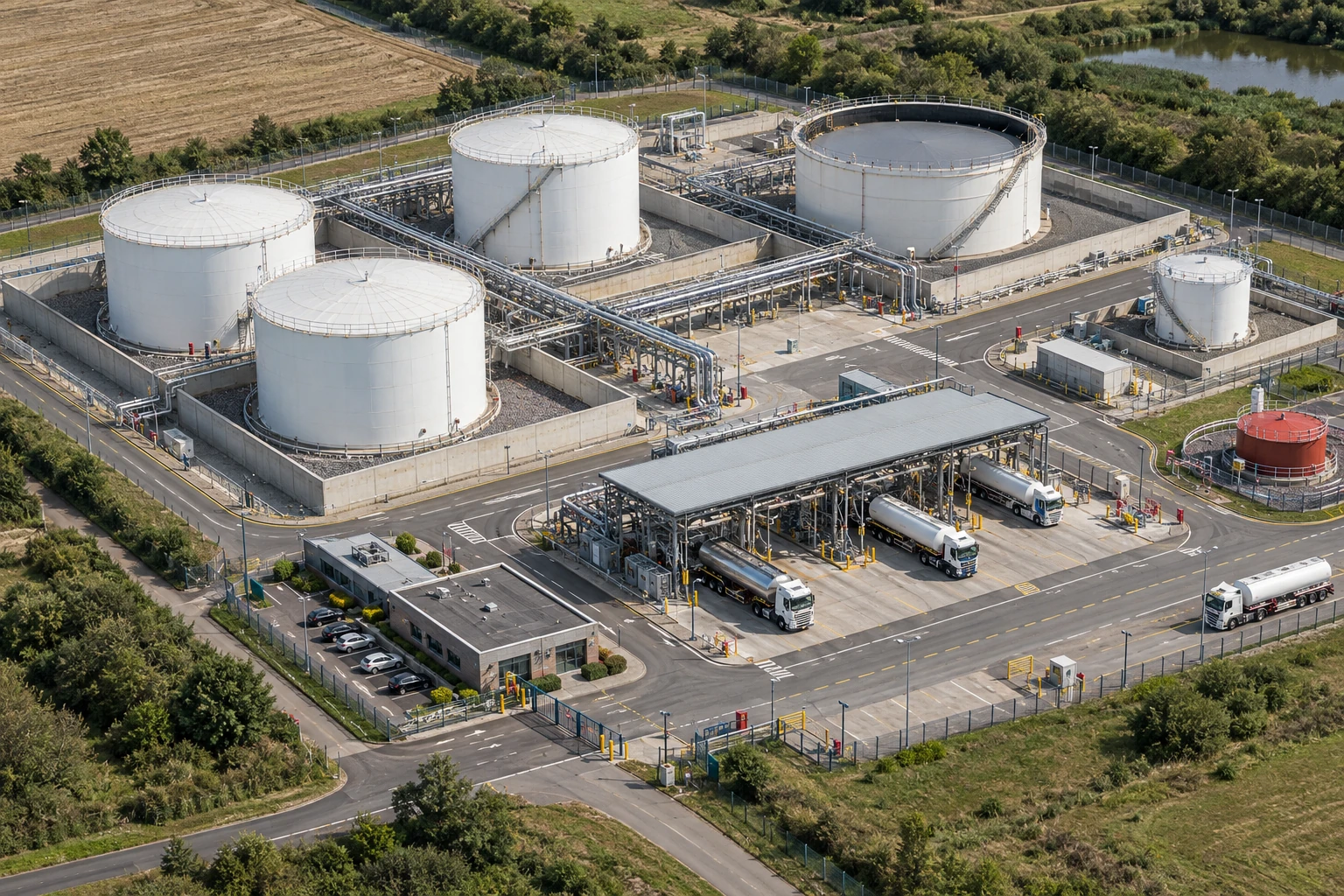

The boundary shutdown command has not been tested end to end
All related inspection points 5 across 1 location
Crown Fuels terminal 5 inspection points
Practice in the SHAREhub environment. Browser practice is separate from workplace competence and formal learning records.
Remove a dependent layer before using the teaching arithmetic
Use the worked LOPA as a challenge to the assumptions. Its invented starting frequency of 0.01 per year and two independent 0.1 failure-on-demand factors give a nominal 0.0001 per year. Against the invented 0.00001 criterion, the gap is ten. Those values teach the method; they neither establish a plant risk criterion nor determine a SIL.
Two claimed layers may still share one failure dependency
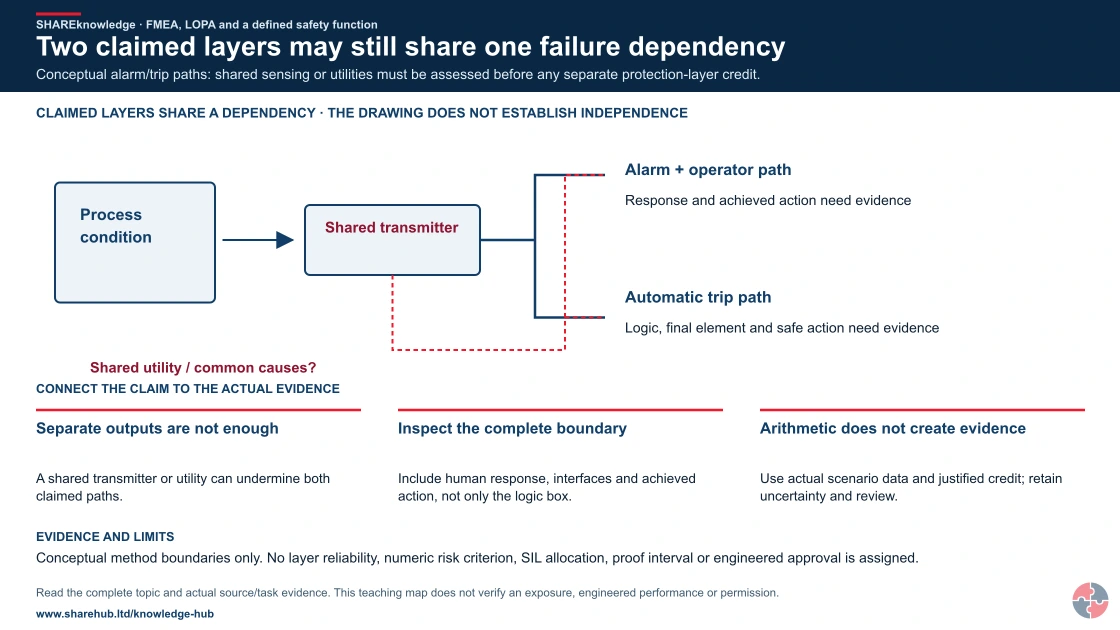
Full written explanation
A native joined dependency schematic shows one process measurement feeding a common transmitter, then branching into an alarm/operator path and an automatic trip path. A common utility line reaches the sensing/logic paths. Red dependency labels identify questions to examine, not a finding about a real plant. Two drawn outputs do not establish independent protection layers. The actual initiating event, sensor/logic/final-element boundary, utilities, human response and common causes determine what can be credited. Existing explicitly invented LOPA arithmetic remains in the current topic; no new reliability factor or SIL is assigned by the schematic.
Conceptual alarm/trip paths: shared sensing or utilities must be assessed before any separate protection-layer credit.
- Define the actual scenario. Establish the initiating event, consequence and protection actually required.
- Trace shared dependencies. Check sensing, logic, final elements, utilities and management/common causes.
- Credit only justified layers. Use competent independence and performance evidence, not the number of labels.
Change the pathway
- Separate outputs are not enough. A shared transmitter or utility can undermine both claimed paths.
- Inspect the complete boundary. Include human response, interfaces and achieved action, not only the logic box.
- Arithmetic does not create evidence. Use actual scenario data and justified credit; retain uncertainty and review.
Evidence check: Conceptual method boundaries only. No layer reliability, numeric risk criterion, SIL allocation, proof interval or engineered approval is assigned.
Challenge actual dependencies before using the existing labelled teaching arithmetic
Primary references: HSE control systems: independence, utilities and lifecycle
Open the complete HD image (new tab)Download image

Challenge actual dependencies before using the existing labelled teaching arithmetic
Primary references: HSE control systems: independence, utilities and lifecycle
Best-practice guide: FMEA, LOPA and Safety Integrity Decisions
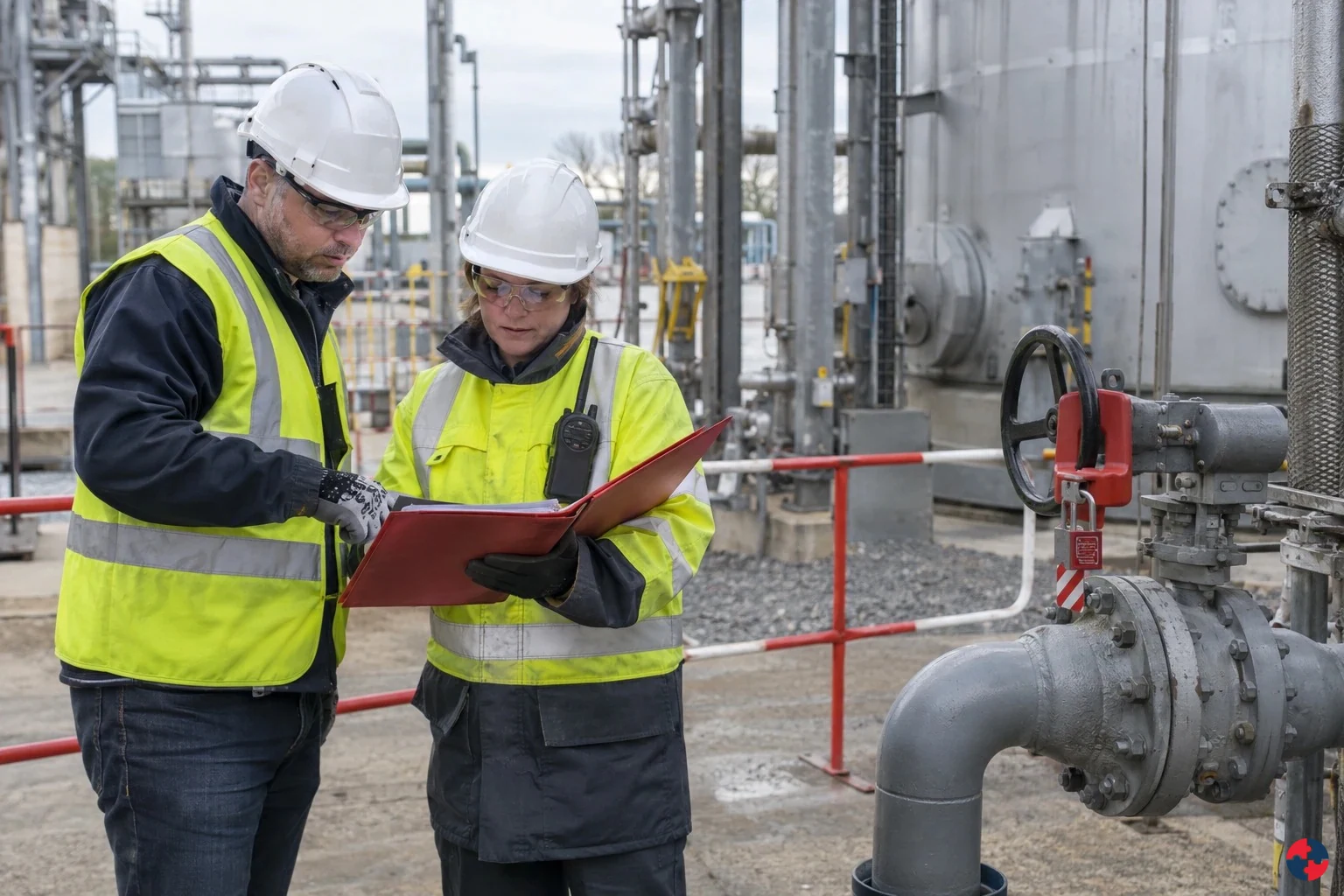
Remove a dependent layer before using the teaching arithmetic
Use the worked LOPA as a challenge to the assumptions. Its invented starting frequency of 0.01 per year and two independent 0.1 failure-on-demand factors give a nominal 0.0001 per year. FMEA identifies failure modes, LOPA tests independent layers for a defined scenario, and SIL applies to a specific safety instrumented function.
Turn fmea, lopa and safety integrity decisions knowledge into a decision
FMEA identifies failure modes, LOPA tests independent layers for a defined scenario, and SIL applies to a specific safety instrumented function. Competent teams must verify assumptions, common-cause risks, proof tests and stop decisions. Study records, assumptions log and action tracker.
the process operator management cycle
Assess and analyse: Uses HAZOP, FMEA and LOPA for tank overfill, transfer and loading scenarios. Evidence / response: Study records, assumptions log and action tracker. Implement barriers: Defines independent alarms, trips, relief, isolation and procedural controls. Evidence / response: Barrier register and performance standards.
Warning signs and consequences
Vague scenarios: Hazard sequence is misunderstood and wrong layers are selected. Double-counted safeguards: Risk reduction is overstated. Overdue proof tests: SIS or final element may fail on demand.
Choose controls for the actual task
Elimination: Remove an unnecessary transfer or hazardous stock through a validated supply or process redesign. Substitution: Evaluate a less hazardous stored material or suitable alternative supply arrangement through change review. Engineering controls: Separate delivery operations from people and incompatible plant; control the credible spill and escalation area. Engineering controls: Provide compatible connections, containment and specified independent overfill prevention and shutdown functions. Administrative controls: Confirm tank/product identity, available ullage, transfer limits and the receiving operator’s communication and stop authority. Read the full control table for qualifications, ownership and verification. Use the actual task and applicable jurisdiction; existing technical approval remains unchanged.
Use the full fmea, lopa and safety integrity decisions lesson
Use the full topic for the decision points, practical examples, detailed control tables and source scope. HSE guidance applies to Great Britain; use HSENI for the Northern Ireland route and the source’s stated jurisdiction. A simplified guide does not change the page’s technical-review or approval status.

Read all six steps as text
1. Remove a dependent layer before using the teaching arithmetic
Use the worked LOPA as a challenge to the assumptions.
- Avoid / redesign: Remove an unnecessary transfer or hazardous stock through a validated supply or process redesign.
- Control the task: Separate delivery operations from people and incompatible plant; control the credible spill and escalation area.
- Verify before release: If the hazardous step remains, retain a task assessment and select the stronger feasible remaining controls.
Use the worked LOPA as a challenge to the assumptions. Its invented starting frequency of 0.01 per year and two independent 0.1 failure-on-demand factors give a nominal 0.0001 per year. FMEA identifies failure modes, LOPA tests independent layers for a defined scenario, and SIL applies to a specific safety instrumented function.
Apply it: Which part of this plan would you check at the workface before authorising the task?
2. Turn fmea, lopa and safety integrity decisions knowledge into a decision
Use the evidence to improve the actual work arrangement.
- Change at source: Remove an unnecessary transfer or hazardous stock through a validated supply or process redesign.
- Make it observable: If the hazardous step remains, retain a task assessment and select the stronger feasible remaining controls.
- Keep useful evidence: Study records, assumptions log and action tracker.
FMEA identifies failure modes, LOPA tests independent layers for a defined scenario, and SIL applies to a specific safety instrumented function. Competent teams must verify assumptions, common-cause risks, proof tests and stop decisions. Study records, assumptions log and action tracker.
Apply it: What evidence would show that the change improves this task, rather than only completing a record?
3. the process operator management cycle
Example: a practical application of the existing topic lesson.
- Assess and analyse: Uses HAZOP, FMEA and LOPA for tank overfill, transfer and loading scenarios.
- Implement barriers: Defines independent alarms, trips, relief, isolation and procedural controls.
- Train and authorise: Assesses operators, maintainers and C&I contractors for safety critical tasks.
Assess and analyse: Uses HAZOP, FMEA and LOPA for tank overfill, transfer and loading scenarios. Evidence / response: Study records, assumptions log and action tracker. Implement barriers: Defines independent alarms, trips, relief, isolation and procedural controls. Evidence / response: Barrier register and performance standards.
Apply it: At which point would you hold this example, and what evidence would allow it to proceed?
4. Warning signs and consequences
Connect the task, the route to the person and the control that can fail.
- Vague scenarios: Hazard sequence is misunderstood and wrong layers are selected.
- Double-counted safeguards: Risk reduction is overstated.
- Overdue proof tests: SIS or final element may fail on demand.
Vague scenarios: Hazard sequence is misunderstood and wrong layers are selected. Double-counted safeguards: Risk reduction is overstated. Overdue proof tests: SIS or final element may fail on demand.
Apply it: Who could be exposed, including other trades, cleaners, maintainers and people nearby?
5. Choose controls for the actual task
Control summary. Read the complete task-specific controls and checks in the linked topic.
- Elimination: Remove an unnecessary transfer or hazardous stock through a validated supply or process redesign.
- Substitution: Evaluate a less hazardous stored material or suitable alternative supply arrangement through change review.
- Engineering controls: Separate delivery operations from people and incompatible plant; control the credible spill and escalation area.
- Administrative controls: Confirm tank/product identity, available ullage, transfer limits and the receiving operator’s communication and stop authority.
- PPE: Select splash and other protection for the actual product; PPE is not protection against a major tank release.
Elimination: Remove an unnecessary transfer or hazardous stock through a validated supply or process redesign. Substitution: Evaluate a less hazardous stored material or suitable alternative supply arrangement through change review. Engineering controls: Separate delivery operations from people and incompatible plant; control the credible spill and escalation area. Engineering controls: Provide compatible connections, containment and specified independent overfill prevention and shutdown functions. Administrative controls: Confirm tank/product identity, available ullage, transfer limits and the receiving operator’s communication and stop authority. Read the full control table for qualifications, ownership and verification. Use the actual task and applicable jurisdiction; existing technical approval remains unchanged.
Apply it: Which stronger option can be used here, and who will verify it before accepting the remaining risk?
6. Use the full fmea, lopa and safety integrity decisions lesson
Follow the official sources below and retain the task-specific evidence.
- Official guidance: control-systems guidance
- Official guidance: HSE reasonably practicable risk guidance
- Task decision: Record gaps and operating restrictions; a permit, simulation or duplicate label cannot prove independence or full isolation. No SIL or failure-probability value is invented.
Use the full topic for the decision points, practical examples, detailed control tables and source scope. HSE guidance applies to Great Britain; use HSENI for the Northern Ireland route and the source’s stated jurisdiction. A simplified guide does not change the page’s technical-review or approval status.
Apply it: Which official source and full-topic section will you use to resolve the next decision?
Now discover that the alarm and trip share the same transmitter. They cannot simply remain as two independent layers in that model. Remove the invalid independence credit and return to the competent scenario and functional-safety review; do not repair the answer by adding another nominal multiplier. Keep FMEA failure analysis, LOPA layer evaluation, defined safety functions and lifecycle integrity assurance as different decisions.
The second layer shares the first layer’s transmitter
Illustrative example. A teaching tank-overfill model initially credits an alarm and trip separately, then identifies their shared transmitter.
Decision. The competent team removes the unsupported separate-layer credit and reopens scenario and safety-function decisions.
Evidence to check. Initiator basis, consequence, criterion, independence, response time, final elements and lifecycle/proof-test evidence.
Hold or escalation point. Do not allocate a SIL from the nominal factor-ten gap or rely on a product certificate for whole-function integrity.
Follow-up. Revise the justified protection strategy and requirements, then verify lifecycle assurance before the real function is credited.
Two protective claims can share one cause of failure
FMEA, LOPA and functional-safety decisions need a defined scenario and defensible evidence. Counting two functions does not establish independent risk reduction.

Define the functions
Identify the initiating event, claimed protective action and actual final safe state.
Trace shared dependencies
Check sensors, power, logic, utilities, final elements and maintenance or bypass arrangements for common cause.
Check credited evidence
The competent team establishes test scope, coverage, assumptions and limits before using quantitative credit.
Hold unsupported credit
Record gaps and operating restrictions; a permit, simulation or duplicate label cannot prove independence or full isolation. No SIL or failure-probability value is invented.
Read the complete task-specific control examples
ERICPD is a planning cross-map: Discipline verifies and sustains every control. ESEAP compares effectiveness. A label does not authorise the task; retain the owner, evidence and stop or change decision.
Filling a storage tank · ERICPD
- Eliminate
- Remove an unnecessary transfer or hazardous stock through a validated supply or process redesign.
- Reduce
- Evaluate a less hazardous stored material or suitable alternative supply arrangement through change review.
- Isolate
- Separate delivery operations from people and incompatible plant; control the credible spill and escalation area.
- Control
- Provide compatible connections, containment and specified independent overfill prevention and shutdown functions.
- PPE
- Select splash and other protection for the actual product; PPE is not protection against a major tank release.
- Discipline
- Test credited safeguards, maintain delivery equipment and reconcile delivery quantities and abnormal events.
Filling a storage tank · ESEAP
- Elimination
- Remove an unnecessary transfer or hazardous stock through a validated supply or process redesign.
- Substitution
- Evaluate a less hazardous stored material or suitable alternative supply arrangement through change review.
- Engineering controls
- Separate delivery operations from people and incompatible plant; control the credible spill and escalation area.
- Administrative controls
- Confirm tank/product identity, available ullage, transfer limits and the receiving operator’s communication and stop authority.
- PPE
- Select splash and other protection for the actual product; PPE is not protection against a major tank release.
Charging a cooling-dependent batch · ERICPD
- Eliminate
- Use a validated non-reactive route or suitable supplied intermediate where it removes the hazardous reaction step.
- Reduce
- Evaluate less energetic chemistry or formulation using reaction testing; do not assume dilution or a smaller batch is inherently safe.
- Isolate
- Use closed charging and segregate people from credible release and relief paths.
- Control
- Prove cooling, agitation, feed permissives and required protective functions against the reaction-hazard study.
- PPE
- Select chemical splash and other assessed protection for normal residual tasks; PPE cannot protect someone from an uncontrolled runaway.
- Discipline
- Hold restart after an excursion until process engineering explains the batch condition and authorises the next step.
Charging a cooling-dependent batch · ESEAP
- Elimination
- Use a validated non-reactive route or suitable supplied intermediate where it removes the hazardous reaction step.
- Substitution
- Evaluate less energetic chemistry or formulation using reaction testing; do not assume dilution or a smaller batch is inherently safe.
- Engineering controls
- Use closed charging and segregate people from credible release and relief paths.
- Administrative controls
- Verify reagent identity and charge order; define addition holds and control-room actions for cooling loss or abnormal temperature.
- PPE
- Select chemical splash and other assessed protection for normal residual tasks; PPE cannot protect someone from an uncontrolled runaway.
What are the key facts about FMEA, LOPA and safety integrity decisions?
FMEA identifies failure modes, LOPA tests risk reduction for a defined scenario, and SIL applies to a specific safety instrumented function. None produces a valid answer without site data, independent safeguards, competent challenge and lifecycle evidence.
FMEA starts with failure modes
It asks how equipment, components, controls or tasks can fail and what the effects would be.
LOPA starts with a scenario
It takes one hazardous event sequence and tests whether existing independent protection layers reduce risk enough.
Independence is central
A layer should not be defeated by the same cause, utility, human action, software, maintenance error or design weakness as another layer.
SIL is a safety function decision
A SIL target belongs to a defined safety instrumented function, not a whole plant or a generic device.
Numbers can mislead
Semi-quantitative methods can create false confidence if data, human response, proof testing or common cause assumptions are weak.
Assurance keeps studies alive
Barrier owners, proof tests, overrides, impairments, MOC and performance indicators keep decisions valid after the workshop ends.
HSE COMAH assessment criteria identify FMEA, LOPA and SIL studies as possible hazard-study methods for appropriate major-hazard sites; functional safety guidance explains the process-sector SIS lifecycle.
What do FMEA, LOPA and safety integrity decisions mean in process safety?
They are structured ways of turning hazard understanding into practical risk reduction and evidence-based barrier decisions.
FMEA, LOPA and safety integrity decisions sit between hazard identification and live control. A HAZOP may identify a high-pressure, overfill, wrong-material, reverse-flow or runaway reaction scenario. FMEA can explore how parts of the system fail. LOPA can test whether the claimed protection layers are enough. Safety integrity decisions then define whether a safety instrumented function is required and how reliable it must be.
The methods should never be treated as paperwork exercises. They influence design, alarm philosophy, interlock selection, relief systems, operating procedures, proof testing, maintenance strategy, bypass rules, emergency response and management of change.
The strongest studies are specific. They name the initiating event, top event, consequence, safeguards, assumptions, independence checks, occupancy or exposure assumptions, enabling conditions and action owners. Weak studies use vague language such as 'operator will respond' or 'alarm in place' without proving time, training, reliability and independence.
| Method | Main question | Useful output |
|---|---|---|
| FMEA | How can this item, system or process fail and what happens next? | Failure modes, effects, causes, detection and priorities for control. |
| LOPA | Do independent layers reduce a specific scenario to a tolerable target? | Risk gap, credited IPLs, extra controls and assumptions. |
| SIL determination | What integrity is required for a specific safety instrumented function? | Safety function, target reliability, proof-test interval and lifecycle requirements. |
| Barrier assurance | Are the credited barriers still present, effective and independent today? | Proof tests, inspection, override records, impairments and action closure. |
How does FMEA support process safety decisions?
FMEA supports process safety by identifying credible failure modes before they become hidden causes of major accident scenarios.
FMEA examines an item or system in a structured way: what is the function, how could it fail, what would cause that failure, what would the effect be, how would it be detected and what action is needed? It is useful for equipment packages, control loops, valves, pumps, utilities, loading systems, transfer systems and safety critical tasks.
FMEA is not normally the only major hazard study method. It is strongest when connected to HAZOP, maintenance strategy, spares, proof testing, pre-start-up safety review and management of change. A failure mode that appears minor at component level may become serious if it defeats containment, cooling, isolation, detection or emergency shutdown.
| FMEA element | Meaning | Example question |
|---|---|---|
| Function | What the item is intended to do. | What must this valve, sensor, pump or procedure achieve? |
| Failure mode | How the function could fail. | Could it fail open, fail closed, stick, leak, drift, give wrong signal or be unavailable? |
| Cause | Why the failure could occur. | Could corrosion, fouling, wrong calibration, human error or loss of utility cause it? |
| Effect | What the failure could lead to. | Could it cause overfill, overpressure, loss of cooling, release or ignition? |
| Detection | How the failure would be found. | Would operators, alarms, proof tests or inspections detect it in time? |
| Action | What must change. | Is design, maintenance, testing, training or operating procedure improvement needed? |
How does LOPA test whether protection layers are enough?
A LOPA is a semi-quantitative test of one defined cause–consequence path. Credit only effective, independent, auditable layers whose performance and common-cause dependencies are evidenced; a number cannot repair a weak scenario.
A LOPA should start with a clear scenario, usually developed from HAZOP or another hazard study. The scenario should describe the initiating event, enabling conditions, consequence and existing safeguards. The team then decides which safeguards can legitimately be credited as independent protection layers.
The important word is independent. A high-level alarm and a high-high trip may not be independent if they share the same level transmitter, power supply, logic solver or maintenance practice. An operator response is not independent if the same operator action creates the initiating event or if there is not enough time to diagnose and respond.
LOPA is semi-quantitative. It helps structure judgement, but it does not remove uncertainty. The study should record the basis of the numbers and the reasons for excluding weak or dependent safeguards.
| Step | What is decided | Quality check |
|---|---|---|
| Define scenario | One cause, one top event and one consequence path. | Is the scenario specific enough to test? |
| Estimate initiating event | Frequency of the event starting the sequence. | Is the data relevant and conservative enough? |
| Identify IPLs | Safeguards that prevent or mitigate the consequence. | Are they effective, independent and auditable? |
| Apply PFD values | Probability that each layer fails on demand. | Are proof tests and human response assumptions justified? |
| Compare with target | Whether mitigated frequency meets the risk criterion. | Is the target suitable for the consequence? |
| Close the gap | Additional design, SIS, procedure or management controls. | Are actions owned, funded and verified? |
HSE control-systems guidance warns that shared instruments, utilities and management practices can defeat claimed independence.
What should safety integrity decisions cover?
Determine required safety integrity for a defined safety instrumented function only after the scenario, other controls and risk reduction gap are justified. A product certificate or generic “SIL-rated” label does not prove that the whole function meets its required performance.
A SIL decision is not a label that can be attached to a whole plant. It applies to a defined safety instrumented function: a sensor or input detects a dangerous condition, logic decides action is needed, and a final element moves the process to a safe state within the required time.
HSE functional safety guidance points to BS EN 61511 as the benchmark for safety instrumented systems in the process industries. The decision should therefore be managed through a lifecycle: hazard and risk assessment, allocation of safety functions, safety requirements specification, design, installation, validation, operation, maintenance, proof testing, modification and decommissioning.
The practical test is whether a future engineer can understand why the function exists, what hazard it protects against, what integrity is required, what proof-test interval is assumed, what bypass controls apply and what happens if the function is impaired.
| Decision area | What should be recorded | Why it matters |
|---|---|---|
| Hazard link | The specific scenario and consequence being controlled. | Prevents generic or orphaned safety functions. |
| Safety function | What the SIS must detect and what safe action must occur. | Defines the required function and response. |
| Integrity target | Required risk reduction or SIL basis. | Links design to risk reduction need. |
| Proof testing | Test method, interval, coverage and action on failed test. | Maintains availability and validates assumptions. |
| Bypass and override | Which competent person assesses loss of protection, verifies suitable alternatives or stops/restricts use, sets time limits and verifies restoration. | Controls temporary loss of protection. |
| Lifecycle ownership | Responsible roles for design, operation, maintenance, audit and change. | Prevents gaps between engineering and operations. |
HSE functional-safety guidance points to BS EN 61511 for process-sector safety instrumented systems and requires lifecycle management.
Stop or restrict activity that depends on an unavailable credited barrier. A competent assessment must establish and verify any suitable time-limited alternative before reliance; permit, senior approval or manager acceptance alone does not establish safety.
What makes a protection layer independent and credible?
A protection layer is credible when it is effective for the scenario, independent from the cause and other layers, auditable and maintained.
A safeguard should not be credited simply because it exists. It must act in time, withstand the event, be available when demanded and have enough reliability for the risk reduction claimed. It should also be testable, owned and understood by the people who depend on it.
Human response can be valuable, but it is often over-credited. The team should ask whether the alarm is clear, the operator is present, the response time is sufficient, the diagnosis is realistic, the procedure is usable and the action has been practised.
| Criterion | Meaning | Example challenge |
|---|---|---|
| Effectiveness | The layer can prevent or mitigate the scenario. | Would it actually stop overfill or only warn that it is happening? |
| Independence | It is not defeated by the same failure as other layers. | Does the alarm use the same transmitter as the trip? |
| Specificity | It is designed for this hazard and consequence path. | Is the layer relevant to the scenario being analysed? |
| Auditability | Its condition can be checked and evidenced. | Where is the test, inspection or drill evidence? |
| Availability | It is ready when demanded. | Are bypasses, overrides or failed proof tests controlled? |
| Survivability | It can function during the event conditions. | Will fire, power loss, flood or vibration defeat it? |
Stop or restrict activity that depends on an unavailable credited barrier. A competent assessment must establish and verify any suitable time-limited alternative before reliance; permit, senior approval or manager acceptance alone does not establish safety.
What makes a strong FMEA or LOPA scenario?
A strong scenario is specific, credible, consequence-based and clear about assumptions, barriers and uncertainty.
Good scenarios are not generic hazards. They describe a realistic sequence: for example, high flow into a storage tank while the level instrument is stuck low, the operator misses the alarm during a busy transfer, overfill creates a vapour cloud and ignition occurs near a road tanker bay.
Scenario quality matters because every later decision depends on it. A weak scenario can understate consequence, miss an enabling condition, double-count safeguards or select a SIL that does not match the real hazard.
| Check | Good question | Weak sign |
|---|---|---|
| Initiating event | What starts the sequence? | Several different causes are mixed together. |
| Top event | What loss of control occurs? | The top event is vague or not measurable. |
| Consequence | What harm or major accident outcome follows? | The study screens out credible escalation too early. |
| Enabling conditions | What must be present for the event to matter? | Occupancy, ignition, weather or mode is assumed away. |
| Safeguards | Which layers are preventive and which are mitigative? | The same safeguard is counted twice. |
| Uncertainty | Which assumptions need conservative treatment? | The team treats uncertain data as precise. |
What are the limitations of semi-quantitative tools?
Semi-quantitative tools support judgement, but they can mislead if assumptions, data, independence and human response are weak.
LOPA and similar methods can create a comforting number. That number is only useful if the inputs are valid. Initiating event frequencies may not represent the actual plant, proof-test intervals may not match practice, human response may be optimistic and common-cause failure may be ignored.
The team should record uncertainty and avoid using LOPA to justify a preferred answer. Where consequence is severe, uncertainty is high or layers are complex, additional analysis, independent review or more conservative risk reduction may be needed.
| Limitation | How it misleads | Control |
|---|---|---|
| Poor data | Numerical output looks more certain than it is. | Record basis, sensitivity and conservative assumptions. |
| Double counting | One safeguard is credited as two layers. | Check independence and common cause. |
| Optimistic human response | Operator action is credited without time or usability evidence. | Validate alarms, procedures, workload and response time. |
| Hidden dependencies | Shared utilities, sensors or logic defeat several layers. | Review power, instrument air, software and maintenance commonality. |
| Static study | Plant changes make assumptions obsolete. | Link to MOC and periodic review. |
| Action drift | Study actions remain overdue or closed without verification. | Track to physical close-out and effectiveness review. |
What do learners commonly confuse about FMEA, LOPA, IPLs and SIL?
Learner confusion usually comes from treating related tools as interchangeable or treating judgement methods as mathematical proof.
A strong learner can explain what each method is for, what evidence it needs and what it cannot prove. This matters in exams, but it matters even more in practice because poor method selection can produce unsafe confidence.
The practical discipline is to keep the scenario, safeguard and safety function separate in your mind. A study team should be able to say what can go wrong, how it is prevented, how it is detected, what mitigates the consequence and which evidence proves the credited layer is healthy.
| Common confusion | Better understanding | Why it matters |
|---|---|---|
| FMEA is the same as HAZOP | FMEA starts from item or system failure modes; HAZOP usually starts from process deviations using guide words. | Choosing the wrong method can leave important scenarios unexplored. |
| LOPA is a full QRA | LOPA is a semi-quantitative screening and decision tool, not a full quantitative risk assessment. | It supports judgement but does not remove uncertainty. |
| Any safeguard is an IPL | An IPL must be effective, independent, auditable and reliable for the specific scenario. | Counting weak safeguards can understate the real risk. |
| SIL is a label for equipment | SIL belongs to a defined safety instrumented function with a required action and response time. | A device can be part of different functions with different integrity needs. |
| Human response can always be credited | Human response needs time, clear alarm, training, procedure, workload capacity and independence. | Operator action is often over-credited in weak studies. |
| Proof testing is a maintenance detail | Proof testing is part of the risk reduction claim and must match the assumptions used in the SIL decision. | Longer intervals or poor test coverage can invalidate the claimed reliability. |
| A bypass is only temporary admin | Bypass and override control is a live loss of protection that needs authorisation, compensating controls and time limits. | A bypassed safeguard may mean the LOPA result no longer represents the plant. |
Stop or restrict activity that depends on an unavailable credited barrier. A competent assessment must establish and verify any suitable time-limited alternative before reliance; permit, senior approval or manager acceptance alone does not establish safety.
Which workplace examples make FMEA, LOPA and SIL decisions easier to understand?
Workplace examples help learners see that the method is only useful when the scenario, barriers and evidence are specific.
Good process safety learning comes alive when the words are attached to plant, people and decisions. An FMEA on a pump should consider how the pump can fail, what happens to flow, pressure or temperature, and whether alarms, trips, relief or operator response still protect the process. A LOPA should then ask whether each credited layer is truly independent and reliable for that scenario.
These examples are deliberately practical. They show why a study team should avoid generic safeguards such as procedure, training or operator awareness unless there is evidence that the layer can work within the time available and is independent of the initiating event.
| Example | What learners should notice | Barrier or evidence challenge |
|---|---|---|
| Pump seal failure releases solvent | FMEA explores seal degradation, vibration, wrong seal material and maintenance error. | LOPA challenges whether gas detection, bunding, isolation and emergency response are independent and available. |
| High-level tank alarm during transfer | The alarm may detect rising level but does not prevent overfill by itself. | Check response time, alarm clarity, operator workload, independent shutdown and proof-test evidence. |
| Cooling-water failure on a reactor | Loss of cooling can escalate from temperature rise to runaway reaction. | Challenge trips, relief, quench, emergency shutdown and whether utilities failure creates common-cause loss. |
| Gas detector in a congested area | Detection depends on sensor location, calibration and cloud movement. | Gas detection is often a warning barrier; shutdown credit needs defined logic and testing. |
| SIS bypass for maintenance | A bypass changes the live risk picture, even if the design study looked acceptable. | Review authorisation, time limit, compensating controls, handover and reinstatement evidence. |
| Human response after an alarm | People need time, clear instruction, training and authority to act. | Do not credit human action casually where alarm flooding, stress or short response time is credible. |
Stop or restrict activity that depends on an unavailable credited barrier. A competent assessment must establish and verify any suitable time-limited alternative before reliance; permit, senior approval or manager acceptance alone does not establish safety.
Use competent controlled simulations and safely planned field observations or equipment tests. Do not create hazardous releases, defeat a live protection layer, expose customers to allergens, or create live traffic/height/energy danger for training.
Which worked examples help learners understand FMEA, LOPA and SIL decisions?
Worked examples help learners connect the method to real process safety judgement rather than memorising terminology.
A SIL claim belongs to a specified function, not the whole site
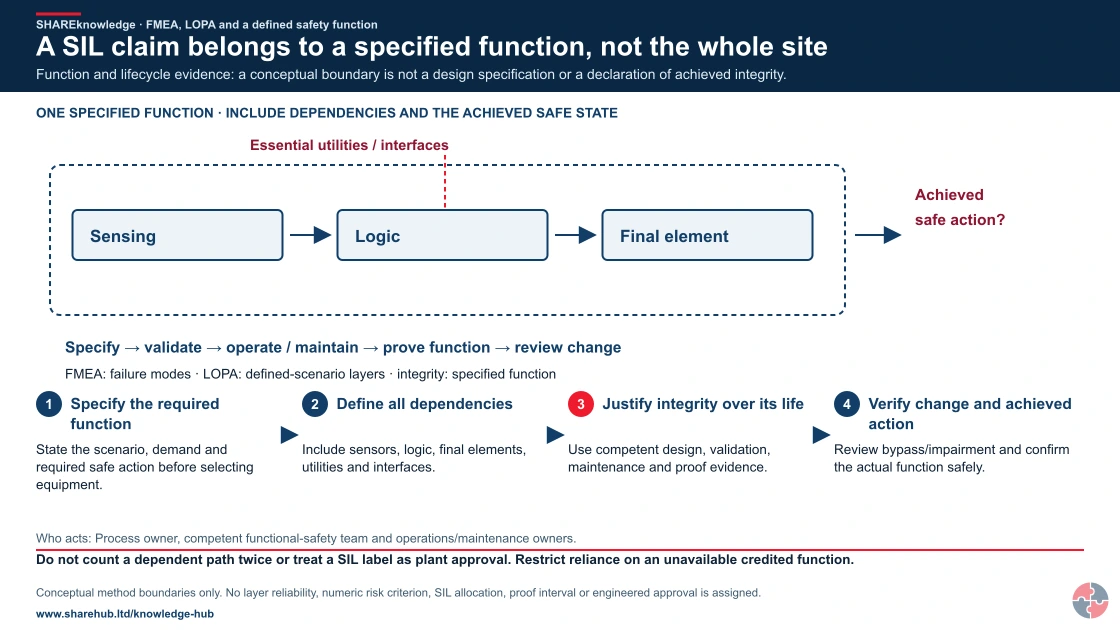
Full written explanation
An editable native functional boundary encloses sensing, logic and the final element, with a separate essential-utility dependency entering the function. The achieved safe state is outside the element sequence as the outcome to verify, not an assumed consequence of a command. A labelled lifecycle band connects specification, validation, operation, proof evidence and change review. FMEA examines failure modes, LOPA challenges layers for a defined scenario and the integrity decision concerns a specified safety instrumented function. No whole-plant SIL, failure-on-demand value, proof interval, wiring design or permission to operate is provided.
Function and lifecycle evidence: a conceptual boundary is not a design specification or a declaration of achieved integrity.
- Specify the required function. State the scenario, demand and required safe action before selecting equipment.
- Define all dependencies. Include sensors, logic, final elements, utilities and interfaces.
- Justify integrity over its life. Use competent design, validation, maintenance and proof evidence.
- Verify change and achieved action. Review bypass/impairment and confirm the actual function safely.
When the evidence does not fit: Do not count a dependent path twice or treat a SIL label as plant approval. Restrict reliance on an unavailable credited function.
Who acts: Process owner, competent functional-safety team and operations/maintenance owners.
Changed workplace
Shared-sensor process case: Challenge independence before multiplying claimed protection factors.
Engineering integrity review: Trace a specific function and lifecycle instead of labelling a whole plant.
Evidence check: Conceptual method boundaries only. No layer reliability, numeric risk criterion, SIL allocation, proof interval or engineered approval is assigned.
Challenge actual dependencies before using the existing labelled teaching arithmetic
Primary references: HSE control systems: independence, utilities and lifecycle
Open the complete HD image (new tab)Download image

Challenge actual dependencies before using the existing labelled teaching arithmetic
Primary references: HSE control systems: independence, utilities and lifecycle
The best way to learn these tools is to follow a credible event path and ask what each method contributes. FMEA is useful when the question is how equipment or a control loop can fail. LOPA is useful when the question is whether enough independent protection exists for a defined hazardous scenario. SIL determination is useful when a safety instrumented function is being selected, specified or maintained.
These examples are deliberately simplified. A real study needs competent facilitation, site data, agreed risk criteria, drawings, operating history, proof-test evidence, human factors challenge and management approval.
| Scenario | What FMEA helps reveal | What LOPA or SIL decision should challenge |
|---|---|---|
| Tank overfill during road tanker transfer | Level transmitter drift, failed high-level alarm, stuck inlet valve, operator distraction and poor handover. | Whether the overfill protection is independent, proof-tested and fast enough; Buncefield-style learning should challenge common-cause failure. |
| Reactor cooling failure | Cooling-water valve closed, pump trip, fouled exchanger, wrong recipe or failed temperature sensor. | Whether detection, trip, relief, quench, emergency shutdown and operator response are independent and reliable. |
| Flammable solvent charging error | Wrong valve line-up, static ignition, incompatible material addition or failed nitrogen purge. | Whether the initiating event frequency is realistic and whether inerting, interlocks and permit controls can be credited. |
| Gas detector alarm in compressor house | Sensor poisoning, blocked sample path, calibration drift or alarm flood. | Whether the detector is only a warning barrier or also part of shutdown logic, and what proof testing proves. |
| SIS bypass during maintenance | Bypass left in place, poor shift handover, unclear compensating controls or weak override log. | Whether the assumed protection layer is actually available and how impairment risk is authorised. |
| Relief valve failure on blocked outlet | Incorrect set pressure, corrosion, fouling, isolation valve closed or missed inspection. | Whether relief is the right layer, whether it is independent and how inspection evidence supports the claimed reliability. |
Stop or restrict activity that depends on an unavailable credited barrier. A competent assessment must establish and verify any suitable time-limited alternative before reliance; permit, senior approval or manager acceptance alone does not establish safety.
Use competent controlled simulations and safely planned field observations or equipment tests. Do not create hazardous releases, defeat a live protection layer, expose customers to allergens, or create live traffic/height/energy danger for training.
How does a worked LOPA reveal a risk-reduction gap?
In this teaching example, a defined tank-overfill path starts at 10⁻² events per year. Two genuinely independent protection layers each have an illustrative failure-on-demand probability of 10⁻¹, giving a nominal residual of 10⁻⁴ per year. Against an assumed site criterion of 10⁻⁵ per year, the gap is a factor of ten; no SIL can be selected from this arithmetic alone.
Before using the calculation, verify the initiating-event evidence, consequence and risk criterion, demand mode, two layer functions, proof-test results, response time, final elements and common-cause exposures. Do not credit a high-level alarm and trip as independent when they share the same transmitter or power.
If any input is missing, dependent or impaired, stop the numerical decision and return to the hazard study. Seek inherent reduction first, then competent functional-safety allocation and a documented safety requirements specification. The example figures are invented to teach the method and are not plant design values.
The HSE control-system source explains integrity and independence; HSE reasonably practicable risk guidance reminds dutyholders to test reasonably practicable risk reduction, not a calculation alone.
How should FMEA, LOPA and SIL outputs be assured?
Outputs should be assured by checking whether credited barriers are present, suitable, independent, tested, maintained and understood today.
The study should feed a live barrier register or equivalent evidence system. Each credited layer should have an owner, performance standard, inspection or test frequency, bypass rule, impairment process and management review route.
Assurance should not rely only on engineering files. Sample the field: check tags, proof-test records, bypass logs, alarm response drills, operator understanding, maintenance backlog, MOC records and action close-out.
| Barrier type | Evidence to sample | Assurance question |
|---|---|---|
| SIS or trip | Proof-test record, bypass log and safety requirements specification. | Would it function when demanded within required time? |
| Alarm and operator response | Alarm rationalisation, training and drill evidence. | Can the operator diagnose and act in time? |
| Relief or vent system | Design basis, inspection and maintenance records. | Is capacity, condition and discharge route still valid? |
| Mechanical containment | Inspection, corrosion review and repair history. | Is the integrity assumption still true? |
| Procedure | Field verification and competence assessment. | Is the procedure usable under real conditions? |
| Emergency response | Scenario drill, learning and equipment checks. | Would mitigation reduce consequences as assumed? |
Stop or restrict activity that depends on an unavailable credited barrier. A competent assessment must establish and verify any suitable time-limited alternative before reliance; permit, senior approval or manager acceptance alone does not establish safety.
Use competent controlled simulations and safely planned field observations or equipment tests. Do not create hazardous releases, defeat a live protection layer, expose customers to allergens, or create live traffic/height/energy danger for training.
Which major accidents show why FMEA, LOPA and safety integrity decisions matter?
Buncefield is the strongest UK learning anchor because overfill protection, alarms, independent layers and safety integrity were central to the event.
At Buncefield in 2005, a tank overfilled during a fuel transfer, leading to a large vapour cloud explosion and fire. The event exposed weaknesses in overfill protection, instrumentation, alarm response, independent high-level protection and management control of major accident risk. It is directly relevant to LOPA because tank overfill analysis must test initiating events, enabling conditions, operator response, independent alarms and trips, ignition probability and escalation.
Texas City shows how start-up scenarios, level control, alarms, fatigue, temporary siting and leadership decisions can combine. Torrance shows the need to understand equipment failure, isolation and escalation to larger inventories. Anacortes shows how damage mechanisms and start-up decisions need conservative assessment and live barrier assurance.
The learning is not that every site has the same equipment. The learning is that major accidents happen when study assumptions, barrier independence, operating discipline, maintenance evidence and leadership challenge are weaker than people believe.
| Event | Relevance to this topic | Local learning question |
|---|---|---|
| Buncefield | Tank overfill, alarm response, independent protection layers and safety integrity of overfill protection. | Could an overfill, loss of containment or vapour cloud scenario be underestimated here? |
| BP Texas City | Start-up, high level, alarms, siting, fatigue and leadership failures. | Are start-up and abnormal operation scenarios assessed with enough challenge? |
| ExxonMobil Torrance | Equipment failure, safeguard analysis and escalation potential. | Could one equipment failure threaten a higher-consequence inventory? |
| Tesoro Anacortes | Damage mechanisms, start-up risk and mechanical integrity assumptions. | Do hazard studies reflect current degradation mechanisms and start-up risk? |
How can the hierarchy of controls guide stronger controls after FMEA and LOPA studies?
ERICPD keeps risk reduction focused on stronger controls before relying on procedural or human response layers.
A LOPA that repeatedly solves risk gaps with alarms and procedures may be technically weak. The first question should be whether the hazardous inventory, energy, pressure, temperature or route can be eliminated, reduced or simplified.
Where engineered controls are needed, they should be robust, independent and maintainable. PPE and discipline are rarely suitable as primary major accident prevention layers, although training, supervision and procedure compliance remain important supporting controls.
Choose the activity
How can the ERICPD hierarchy of controls reduce risks while filling a storage tank?

| Control level | Control for this activity | Owner and verification | Stop / restart decision |
|---|---|---|---|
| Eliminate | Remove an unnecessary transfer or hazardous stock through a validated supply or process redesign. | Process owner verifies that the revised workflow achieves the required output and the hazardous step is genuinely removed. | If the hazardous step remains, retain a task assessment and select the stronger feasible remaining controls. |
| Reduce, including substitution | Evaluate a less hazardous stored material or suitable alternative supply arrangement through change review. | Process/technical owner validates the alternative, its compatibility and any new risks before adoption. | Reject the alternative if suitability is unproved or its new hazards are unresolved. |
| Isolate | Separate delivery operations from people and incompatible plant; control the credible spill and escalation area. | Supervisor verifies the task boundaries and that the separation or isolation protects affected people and connected work. | Hold or stop for uncertain ullage, leak, failed safeguard or loss of transfer communication. |
| Control: physical safeguards | Provide compatible connections, containment and specified independent overfill prevention and shutdown functions. | Competent equipment/process owner checks product identity, tank capacity, connections and credited overfill safeguards. | Hold or stop for uncertain ullage, leak, failed safeguard or loss of transfer communication. |
| Control: work method and response | Confirm tank/product identity, available ullage, transfer limits and the receiving operator’s communication and stop authority. | Supervisor confirms the limits, response, communication and restart authority with the people doing this activity. | Stop if the agreed method, communication, competent cover or task limits cannot be maintained. |
| PPE | Select splash and other protection for the actual product; PPE is not protection against a major tank release. | Assessor confirms whether PPE is needed and checks selection, condition, compatibility and any required face-fit evidence. | Do not rely on unsuitable or defective protection, or use PPE to continue after an essential source control fails. |
| Discipline | Test credited safeguards, maintain delivery equipment and reconcile delivery quantities and abnormal events. | Release only after receiving operator approves capacity and functioning safeguards before delivery. Retain the checks and unresolved restrictions at handover. | Keep the activity on hold while defects or required reinstatement evidence remain unresolved. |
How can the ISO 45001 hierarchy of controls reduce risks while filling a storage tank?

| Control level | Control for this activity | Owner and verification | Stop / restart decision |
|---|---|---|---|
| Elimination | Remove an unnecessary transfer or hazardous stock through a validated supply or process redesign. | Process owner verifies that the revised workflow achieves the required output and the hazardous step is genuinely removed. | If the hazardous step remains, retain a task assessment and select the stronger feasible remaining controls. |
| Substitution | Evaluate a less hazardous stored material or suitable alternative supply arrangement through change review. | Process/technical owner validates the alternative, its compatibility and any new risks before adoption. | Reject the alternative if suitability is unproved or its new hazards are unresolved. |
| Engineering controls | Separate delivery operations from people and incompatible plant; control the credible spill and escalation area. | Supervisor verifies the task boundaries and that the separation or isolation protects affected people and connected work. | Hold or stop for uncertain ullage, leak, failed safeguard or loss of transfer communication. |
| Engineering controls | Provide compatible connections, containment and specified independent overfill prevention and shutdown functions. | Competent equipment/process owner checks product identity, tank capacity, connections and credited overfill safeguards. | Hold or stop for uncertain ullage, leak, failed safeguard or loss of transfer communication. |
| Administrative controls | Confirm tank/product identity, available ullage, transfer limits and the receiving operator’s communication and stop authority. | Supervisor confirms the limits, response, communication and restart authority with the people doing this activity. | Stop if the agreed method, communication, competent cover or task limits cannot be maintained. |
| PPE | Select splash and other protection for the actual product; PPE is not protection against a major tank release. | Assessor confirms whether PPE is needed and checks selection, condition, compatibility and any required face-fit evidence. | Do not rely on unsuitable or defective protection, or use PPE to continue after an essential source control fails. |
| Administrative controls | Test credited safeguards, maintain delivery equipment and reconcile delivery quantities and abnormal events. | Release only after receiving operator approves capacity and functioning safeguards before delivery. Retain the checks and unresolved restrictions at handover. | Keep the activity on hold while defects or required reinstatement evidence remain unresolved. |
How can the ERICPD hierarchy of controls reduce risks while charging a cooling-dependent batch?

| Control level | Control for this activity | Owner and verification | Stop / restart decision |
|---|---|---|---|
| Eliminate | Use a validated non-reactive route or suitable supplied intermediate where it removes the hazardous reaction step. | Process owner verifies that the revised workflow achieves the required output and the hazardous step is genuinely removed. | If the hazardous step remains, retain a task assessment and select the stronger feasible remaining controls. |
| Reduce, including substitution | Evaluate less energetic chemistry or formulation using reaction testing; do not assume dilution or a smaller batch is inherently safe. | Process/technical owner validates the alternative, its compatibility and any new risks before adoption. | Reject the alternative if suitability is unproved or its new hazards are unresolved. |
| Isolate | Use closed charging and segregate people from credible release and relief paths. | Supervisor verifies the task boundaries and that the separation or isolation protects affected people and connected work. | Hold or stop for cooling or agitation loss, wrong charge, abnormal temperature or unavailable safeguard. |
| Control: physical safeguards | Prove cooling, agitation, feed permissives and required protective functions against the reaction-hazard study. | Competent equipment/process owner checks reagent identity, cooling flow, agitation, feed isolation and protective functions. | Hold or stop for cooling or agitation loss, wrong charge, abnormal temperature or unavailable safeguard. |
| Control: work method and response | Verify reagent identity and charge order; define addition holds and control-room actions for cooling loss or abnormal temperature. | Supervisor confirms the limits, response, communication and restart authority with the people doing this activity. | Stop if the agreed method, communication, competent cover or task limits cannot be maintained. |
| PPE | Select chemical splash and other assessed protection for normal residual tasks; PPE cannot protect someone from an uncontrolled runaway. | Assessor confirms whether PPE is needed and checks selection, condition, compatibility and any required face-fit evidence. | Do not rely on unsuitable or defective protection, or use PPE to continue after an essential source control fails. |
| Discipline | Hold restart after an excursion until process engineering explains the batch condition and authorises the next step. | Release only after process owner approves batch disposition and tested safeguards. Retain the checks and unresolved restrictions at handover. | Keep the activity on hold while defects or required reinstatement evidence remain unresolved. |
How can the ISO 45001 hierarchy of controls reduce risks while charging a cooling-dependent batch?

| Control level | Control for this activity | Owner and verification | Stop / restart decision |
|---|---|---|---|
| Elimination | Use a validated non-reactive route or suitable supplied intermediate where it removes the hazardous reaction step. | Process owner verifies that the revised workflow achieves the required output and the hazardous step is genuinely removed. | If the hazardous step remains, retain a task assessment and select the stronger feasible remaining controls. |
| Substitution | Evaluate less energetic chemistry or formulation using reaction testing; do not assume dilution or a smaller batch is inherently safe. | Process/technical owner validates the alternative, its compatibility and any new risks before adoption. | Reject the alternative if suitability is unproved or its new hazards are unresolved. |
| Engineering controls | Use closed charging and segregate people from credible release and relief paths. | Supervisor verifies the task boundaries and that the separation or isolation protects affected people and connected work. | Hold or stop for cooling or agitation loss, wrong charge, abnormal temperature or unavailable safeguard. |
| Engineering controls | Prove cooling, agitation, feed permissives and required protective functions against the reaction-hazard study. | Competent equipment/process owner checks reagent identity, cooling flow, agitation, feed isolation and protective functions. | Hold or stop for cooling or agitation loss, wrong charge, abnormal temperature or unavailable safeguard. |
| Administrative controls | Verify reagent identity and charge order; define addition holds and control-room actions for cooling loss or abnormal temperature. | Supervisor confirms the limits, response, communication and restart authority with the people doing this activity. | Stop if the agreed method, communication, competent cover or task limits cannot be maintained. |
| PPE | Select chemical splash and other assessed protection for normal residual tasks; PPE cannot protect someone from an uncontrolled runaway. | Assessor confirms whether PPE is needed and checks selection, condition, compatibility and any required face-fit evidence. | Do not rely on unsuitable or defective protection, or use PPE to continue after an essential source control fails. |
| Administrative controls | Hold restart after an excursion until process engineering explains the batch condition and authorises the next step. | Release only after process owner approves batch disposition and tested safeguards. Retain the checks and unresolved restrictions at handover. | Keep the activity on hold while defects or required reinstatement evidence remain unresolved. |
How should the selected controls be checked in practice?
A LOPA risk gap should prompt inherently safer design and engineered prevention before adding operator response or PPE. Use the hierarchy to challenge the actual scenario, then verify the remaining credited barriers.
A fuel-transfer tank may overfill after erroneous level indication.
A cooling failure could create a high-temperature runaway path.
Use competent controlled simulations and safely planned field observations or equipment tests. Do not create hazardous releases, defeat a live protection layer, expose customers to allergens, or create live traffic/height/energy danger for training.
Which GB and NI duties govern process-safety studies?
FMEA, LOPA and SIL are methods, not universal statutory requirements. The dutyholder must use suitable hazard study and risk reduction evidence for the plant and legal regime; qualifying GB and NI COMAH sites have separate regulations.
HSE COMAH assessment criteria list FMEA, LOPA and SIL among possible studies where appropriate. A method label, certificate or numerical study does not itself demonstrate that all major accident risks are reduced as far as reasonably practicable.
GB Health and Safety at Work etc. Act 1974, Management Regulations 1999 and COMAH 2015 may be relevant. NI uses the Health and Safety at Work (NI) Order 1978, Management Regulations (NI) 2000 and COMAH (NI) 2015. The actual site and inventory categories, quantities at the thresholds, aggregation and exclusions determine COMAH scope under its own GB or NI instrument.
| Jurisdiction | Duty or regulation | How it applies | Typical evidence |
|---|---|---|---|
| GB | GB Health and Safety at Work Act 1974 | GB safe-plant and safe-system duties. | Competent study and action close-out. |
| GB | GB Management Regulations 1999 | GB risk assessment and arrangements. | Study competence, change and review. |
| GB | GB COMAH 2015 | Qualifying GB major-hazard establishments. | Major accident prevention and barrier evidence. |
| NI | NI Health and Safety Order 1978 | NI general work-safety duties. | NI hazard and control decisions. |
| NI | NI Management Regulations 2000 | NI risk assessment and arrangements. | NI competence and change control. |
| NI | NI COMAH 2015 | Qualifying NI major-hazard establishments. | NI major accident control evidence. |
For methods and limits use HSE COMAH study criteria and HSE functional-safety guidance; check the corresponding NI legal scope separately.
How should FMEA, LOPA and safety integrity decisions appear in a risk register?
The register should link each major accident scenario to initiating events, consequences, credited barriers, owners and evidence.
A process safety register should not just say 'LOPA complete'. It should make the basis of risk visible. That includes the scenario, the layers credited, proof-test status, action closure, expired assumptions and any impaired safeguards.
Where a scenario depends on a safety instrumented function, the register should link to the safety requirements specification, proof testing, bypass rules and management of change history.
| Field | What it records | Why it matters |
|---|---|---|
| Scenario | Initiating event, top event and consequence. | Keeps focus on credible major accident hazard. |
| Risk basis | Frequency, consequence and acceptance criterion. | Shows why risk reduction is needed. |
| Credited layers | IPLs, SIS, alarms, relief, procedures and mitigation. | Makes dependencies visible. |
| Owners | Technical, operational and maintenance ownership. | Prevents orphaned barriers. |
| Evidence | Proof tests, inspections, drills and competence records. | Shows current barrier health. |
| Review trigger | MOC, incident, failed test, new data or overdue action. | Keeps study assumptions alive. |
For live barrier evidence, HSE HSG254 process safety performance indicators links critical control condition to management review.
How could Crownway Fuels Ltd manage FMEA, LOPA and safety integrity decisions?

Crownway Fuels would manage the topic by linking tank-farm scenarios to overfill protection, independent alarms, trips, proof tests, MOC and leadership review.
Crownway Fuels Ltd
a fuel storage and distribution business with bulk tanks, road tanker loading, transfer pumps, vapour hazards, contractors, maintenance tasks and public receptors nearby
Crownway identifies credible scenarios in its major accident hazard register: tank overfill, transfer line rupture, pump dead-heading, wrong product transfer, vapour release at loading, ignition in a zoned area and loss of containment during maintenance. The process safety engineer runs HAZOP for operating nodes and uses FMEA on safety critical equipment such as level instruments, trips, valves, pumps and transfer interlocks.
For higher-consequence scenarios, Crownway uses LOPA to check whether independent layers are enough. A high-level alarm is not automatically credited unless operator response time, alarm reliability, training, workload and independence from the trip system are demonstrated. If an independent high-high trip is credited, the proof-test interval, final element reliability, bypass arrangements and MOC controls are entered into the barrier register.
Leaders review overdue LOPA actions, proof-test failures, bypasses, nuisance alarms, transfer deviations and maintenance deferrals as process safety indicators. Contractors working on instrumentation or tanks are controlled through competence checks, permits, isolation and handback verification.
| Stage | How Crownway applies it | Evidence |
|---|---|---|
| Assess and analyse | Uses HAZOP, FMEA and LOPA for tank overfill, transfer and loading scenarios. | Study records, assumptions log and action tracker. |
| Implement barriers | Defines independent alarms, trips, relief, isolation and procedural controls. | Barrier register and performance standards. |
| Train and authorise | Assesses operators, maintainers and C&I contractors for safety critical tasks. | Competence matrix and authorisation records. |
| Check and test | Schedules proof tests, alarm response checks and field verification. | Proof-test records, bypass logs and audit findings. |
| Manage change | Screens changes to instrumentation, tanks, products, software, staffing and procedures. | MOC records and pre-start-up review. |
| Learn and improve | Trends failed tests, near misses, overfills, alarm floods and deferred actions. | HSG254 indicators and management review minutes. |
The tank-farm example follows HSE COMAH assessment criteria for competent scenario studies and barrier evidence.
Use competent controlled simulations and safely planned field observations or equipment tests. Do not create hazardous releases, defeat a live protection layer, expose customers to allergens, or create live traffic/height/energy danger for training.
What should a fuel-protection example establish before a LOPA or integrity decision?
Distinguish the protection function, its dependencies and its assurance evidence. The scene supplies no reliability value, SIL, risk-reduction factor or independence claim.
Normal control and independent overfill protection
Compare the normal LT/controller/FCV loop with a separate high-high sensor, safety logic and dedicated inlet ESDV.
Activity focus: Trace the independent sensor-to-action chain and the separate manual ESD input. Red identifies safety duty; blue identifies normal control.
Contextual illustration. The image alone does not establish equipment state, effective controls, individual health or authorisation; use the task-specific checks and competent evidence.
Educational illustration, not to scale. Coloured zones are teaching examples, not a site-specific hazardous-area classification.
Who must demonstrate FMEA, LOPA and SIL competence?
Test scenario quality, independence, uncertainty and stop decisions; attendance alone cannot validate a study.
| Role | Learning to test | Competence demonstration | Assessor and record | Reassessment trigger |
|---|---|---|---|---|
| Study facilitators | Define scenario, assumptions and method limits. | Facilitate a challenge of shared sensors and utilities. | Lead process engineer observes. | New process or incident. |
| Process engineers | Build failure, consequence and risk-reduction basis. | Work a scenario with uncertainty and sensitivity. | Independent specialist checks study. | Design or inventory change. |
| Functional-safety engineers | Specify and verify complete safety function. | Trace SRS, proof test, final element and bypass. | Competent peer signs. | Modification or test failure. |
| Operators and maintainers | Know barrier limits and impairment response. | Demonstrate stop and handback decision. | Supervisor records field drill. | New alarm, trip or procedure. |
| Leaders | Challenge action closure and impaired barriers. | Review one risk-gap decision and its evidence. | Independent assurance samples record. | Overdue action or near miss. |
Functional-safety roles should be tested against HSE lifecycle guidance including proof testing, modification and impairment.
Stop or restrict activity that depends on an unavailable credited barrier. A competent assessment must establish and verify any suitable time-limited alternative before reliance; permit, senior approval or manager acceptance alone does not establish safety.
Use competent controlled simulations and safely planned field observations or equipment tests. Do not create hazardous releases, defeat a live protection layer, expose customers to allergens, or create live traffic/height/energy danger for training.
How does this topic support process-safety study?
For process-safety study, learners should explain how technical risk methods support major accident prevention and where their limits sit.
This topic links strongly to Element 2 because it concerns risk assessment methods and the selection of safeguards for process safety. A strong exam answer would not just define FMEA or LOPA. It would explain a credible major accident scenario, identify initiating events, describe layers, challenge independence and state what evidence proves the barriers remain effective.
Scenario-based questions may ask about tank overfill, reactor runaway, loss of cooling, blocked outlet, wrong material addition or failed trip. The learner should explain how FMEA could identify failure modes, how LOPA could test risk reduction and how a SIL decision would define a safety instrumented function if extra risk reduction were needed.
| Question type | Strong answer includes | Weak answer |
|---|---|---|
| Define FMEA | Failure modes, effects, causes, detection and action. | Only says it lists failures. |
| Define LOPA | Scenario, initiating event, consequence, IPLs and risk target. | Only says it counts layers. |
| Explain SIL | Safety function, integrity, proof testing and lifecycle. | Treats SIL as a device label. |
| Apply to scenario | Specific layers and independence challenge. | Lists generic safeguards. |
| Explain limitations | Data uncertainty, common cause and human response assumptions. | Claims the calculation proves safety. |
| Audit evidence | Proof tests, bypass logs, action closure and MOC. | Accepts completed study report only. |
How can BS EN ISO 45001 support fmea, lopa and safety integrity decisions management?
A voluntary occupational health and safety system can assign owners, competence, change controls and verification for process safety studies, while scenario analysis and safety-function design require specialist evidence.
HSE public guidance supports practical GB management themes only. Use the current authorised standard and competent advice for ISO clause mapping, conformity and certification decisions; these themes do not establish compliance.
What are the warning signs that FMEA, LOPA and safety integrity decisions are weak?
Warning signs include vague scenarios, double-counted safeguards, untested layers, overdue actions, uncontrolled bypasses, optimistic operator response and studies not linked to MOC.
These warning signs are serious because they make the organisation believe risk is lower than it really is. A study may look complete while credited barriers are unavailable, not independent, poorly maintained or not understood by operators.
Field verification is essential. If the study says an alarm is a protection layer, check the alarm in the control room. If a trip is credited, check the proof-test history and bypass log. If a procedure is credited, watch the task and see whether the procedure works under real conditions.
| Warning sign | How harm can develop | Response |
|---|---|---|
| Vague scenarios | Hazard sequence is misunderstood and wrong layers are selected. | Rewrite scenario with cause, top event and consequence. |
| Double-counted safeguards | Risk reduction is overstated. | Review independence and common cause. |
| Overdue proof tests | SIS or final element may fail on demand. | Stop or restrict activity that depends on an unavailable credited barrier. A competent assessment must establish and verify any suitable time-limited alternative before reliance; permit, senior approval or manager acceptance alone does not establish safety. |
| Uncontrolled bypasses | Protection is absent during operation. | Stop or restrict activity that depends on an unavailable credited barrier. A competent assessment must establish and verify any suitable time-limited alternative before reliance; permit, senior approval or manager acceptance alone does not establish safety. |
| Optimistic operator response | Alarm response fails during workload or abnormal conditions. | Validate time, training and alarm quality. |
| MOC not linked | Plant change invalidates study assumptions. | Trigger revalidation after change. |
Use HSE HSG254 process safety performance indicators to interpret bypass, overdue test and incident signals as process-safety indicators.
Stop or restrict activity that depends on an unavailable credited barrier. A competent assessment must establish and verify any suitable time-limited alternative before reliance; permit, senior approval or manager acceptance alone does not establish safety.
FMEA, LOPA and safety integrity FAQs - what do people ask?
People usually ask how the methods differ, when to use them and how to avoid false confidence.
Is FMEA the same as HAZOP?
No. FMEA starts from failure modes; HAZOP typically explores process deviations. Choose methods for the hazard and system.
Can an alarm and trip sharing one sensor count as two independent layers?
No. Shared sensors or utilities may defeat both; demonstrate independence before credit.
Does a SIL label on a device prove the complete safety function?
No. Verify the full sensor–logic–final-element function and lifecycle against the required performance.
Does every site need LOPA under COMAH?
No single study method is universally mandated; use methods suitable to the site and demonstrate major-accident control where COMAH applies.
Does GB COMAH 2015 govern an NI establishment?
No. Qualifying NI establishments use NI COMAH 2015 and NI work-safety law.
Can the teaching LOPA numbers select SIL 1?
No. They are invented; a competent site study must establish the real risk gap, function and integrity basis.
What if a credited IPL is bypassed or its proof test is overdue?
Treat it as impaired, assess the scenario and restrict or stop operation until verified controls are restored.
What do the acronyms and key terms mean?
Acronyms should be explained because this topic is technical and easily misunderstood.
| Acronym | Meaning | Plain English use |
|---|---|---|
| ALARP | As Low As Reasonably Practicable | UK principle for proportionate risk reduction. |
| FMEA | Failure Modes and Effects Analysis | Structured analysis of how things fail and what happens. |
| IPL | Independent Protection Layer | Credited safeguard that is effective, independent and auditable. |
| LOPA | Layer of Protection Analysis | Semi-quantitative scenario method for testing risk reduction. |
| PFD | Probability of Failure on Demand | Chance that a safeguard fails when required. |
| SIF | Safety Instrumented Function | Defined detection, logic and final action to reach a safe state. |
| SIL | Safety Integrity Level | Target integrity for a safety instrumented function. |
| SIS | Safety Instrumented System | Instrumented system providing one or more safety instrumented functions. |
| GB | Great Britain | Separate COMAH route. |
| NI | Northern Ireland | Separate COMAH route. |
| SRS | Safety requirements specification | Defines safety function and its performance basis. |