SHARE Knowledge Hub
Frostbite and Hypothermia at Work
Frostbite is local freezing injury; hypothermia is dangerous whole-body cooling below 35°C. Plan cold work around wind, wetness, time, shelter, dry clothing and communication. Confusion or poor coordination can mean hypothermia: call 999 and use the emergency plan.
Understanding Frostbite and Hypothermia at Work
Frostbite is local freezing injury; hypothermia is dangerous whole-body cooling below 35°C. Plan cold work around wind, wetness, time, shelter, dry clothing and communication. Confusion or poor coordination can mean hypothermia: call 999 and use the emergency plan.
Why this matters at work
Translate a forecast into task decisions. A supervisor should identify exposed tasks, routes and people, then review shelter, warm facilities, communications and the ability to delay or stop. HSE recommends warming facilities, suitable PPE, more frequent rest and considering delay without compromising safety. A UKHSA cold-health alert is public-health planning information; it is not an occupational permission or a universal wind-chill threshold. Review local conditions during the shift, especially wetting, ice and changing visibility. Record who can suspend work and how contractors learn the decision. A programme or customer deadline cannot demonstrate that the exposure is controlled.
Use an individual discussion to improve work arrangements without collecting unnecessary clinical detail. Acas describes reasonable adjustments in a GB Equality Act context; the NI disability route is separate and its contents link is only a route here. Seek competent occupational-health advice for work restrictions or fitness questions. ICO guidance requires a lawful basis and a special-category condition for health information; keep managers’ access limited to what they need, with justified retention and suitable security. The ICO guidance is under review. Store clinical information separately from general cold-exposure action logs. No universal adjustment, screening programme or record-retention period is prescribed.
How organisations manage this in practice
Avoid or reduce exposure through work design, shelter, suitable equipment, scheduling and warm rest arrangements before relying only on clothing. Check dexterity, visibility, grip and compatibility with other hazards. Consult workers about conditions and early concerns. NHS information distinguishes hypothermia as a medical emergency from frostbite affecting tissue; managers must not diagnose severity from an online checklist. Plan communication, assistance and rescue, especially for lone or remote work. Record controls, checks and stop triggers using the applicable GB or NI duties. Review changes and incidents rather than waiting for someone to become ill before adjusting the system.
Treat loss of sensation or function as a report requiring action, not evidence that the person can tolerate more cold. NHS describes frostbite as freezing of skin, commonly involving fingers, toes, nose and ears, and explains serious tissue damage and lasting effects. A workplace source cannot distinguish severity from a photograph, colour description or room thermometer. Keep prevention focused on exposure, dry compatible protection, direct contact, access to warmth and communication. Escalate suspected injury to medical help and urgent signs through the emergency plan. The manager should record the exposure and control failure without inventing a diagnosis or recommending treatment.
Check whether clothing remains dry, usable and suitable for the task, and whether it allows safe movement, grip, hearing and visibility. Bulky gloves may interfere with controls or create entanglement concerns, while inadequate gloves can impair dexterity through cold. Resolve compatibility through task design and suitable equipment rather than expecting workers to choose between two uncontrolled hazards. Confirm warm rest facilities, drying or replacement arrangements, drinking water, communication and supervision are available on every relevant shift. Agree stop triggers for worsening conditions or symptoms and a prompt reporting route. Individual support or restrictions may need occupational-health advice, handled confidentially. Record control defects and corrective actions; check effectiveness through observation and worker feedback under representative conditions. Maintenance and contractor work need the same planning as routine production. A clothing issue receipt, a generic weather app or a signed briefing does not prove protection. Review after changes and incidents, and keep clinical assessment and task authorisation with the appropriate qualified and responsible people.
Local tissue cooling and whole-body heat loss differ
Serious cold exposure needs prompt help through the emergency arrangements. Local freezing injury and hypothermia can coexist, and appearance alone cannot diagnose either.
Wet clothing and missed support change the cold-work review
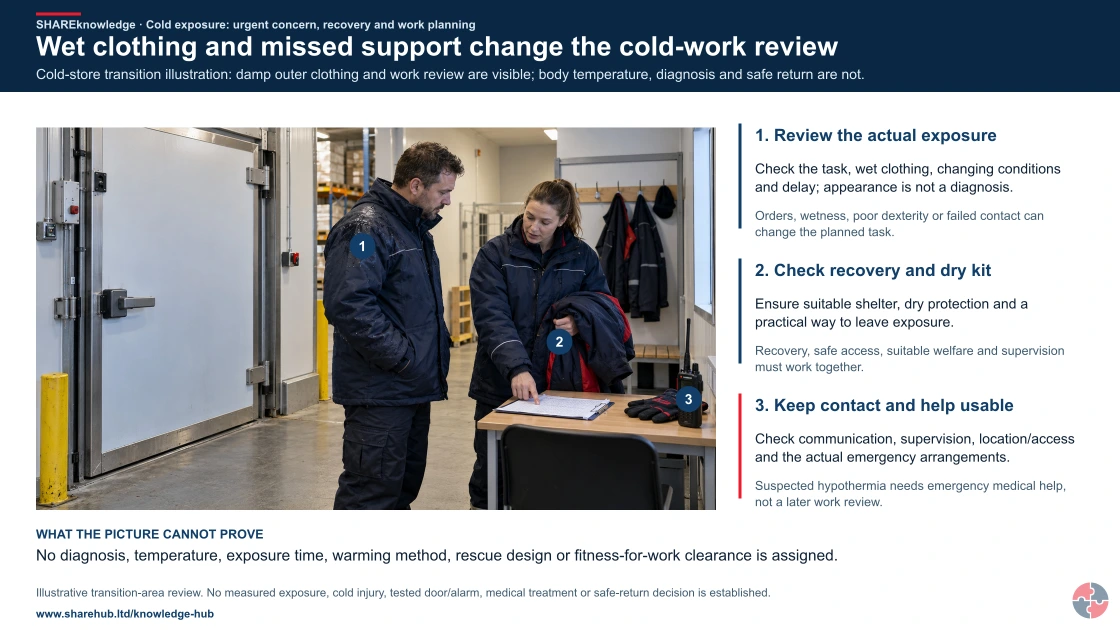
Full written explanation
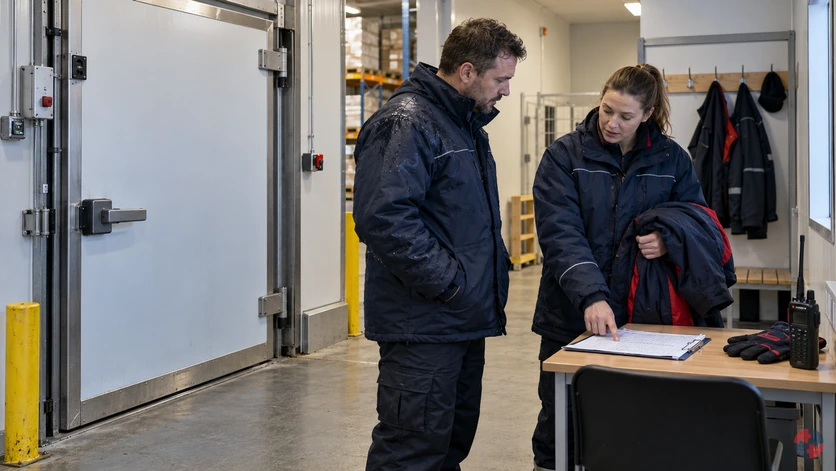
A new realistic UK cold-store transition illustration shows a closed insulated door, one worker with damp outer-jacket fabric and a colleague reviewing inert task information beside dry clothing, gloves and a radio. The people are in a transition/welfare area and no medical treatment, frostbite, measured temperature or collapse is depicted. Numbered prompts connect actual exposure/wetness, recovery and dry clothing, and communications/supervision. Visible door fittings do not prove inside escape or alarm function. Suspected hypothermia retains the immediate emergency route in the current topic, separate from planned work review and any later fitness decision.
Cold-store transition illustration: damp outer clothing and work review are visible; body temperature, diagnosis and safe return are not.
- Review the actual exposure. Check the task, wet clothing, changing conditions and delay; appearance is not a diagnosis.
- Check recovery and dry kit. Ensure suitable shelter, dry protection and a practical way to leave exposure.
- Keep contact and help usable. Check communication, supervision, location/access and the actual emergency arrangements.
Change the pathway
- A schedule can be defeated. Orders, wetness, poor dexterity or failed contact can change the planned task.
- Clothing is one part of the system. Recovery, safe access, suitable welfare and supervision must work together.
- Do not wait on urgent concern. Suspected hypothermia needs emergency medical help, not a later work review.
Evidence check: No diagnosis, temperature, exposure time, warming method, rescue design or fitness-for-work clearance is assigned.
Keep urgent cold-related concern ahead of the longer prevention programme
Primary references: NHS hypothermia emergency scope · NHS frostbite: separate local freezing injury · HSE chilled/frozen workrooms · HSE outdoor work planning
Open the complete HD image (new tab)Download image

Keep urgent cold-related concern ahead of the longer prevention programme
Primary references: NHS hypothermia emergency scope · NHS frostbite: separate local freezing injury · HSE chilled/frozen workrooms · HSE outdoor work planning

Act on urgent concern
Leave the exposure safely and obtain appropriate emergency help; do not delay for an anatomy model or a symptom checklist.
Distinguish the mechanisms
Local tissue freezing and loss of core heat are different processes requiring professional interpretation.
Prevent exposure
The work planner reviews cold tasks, wetness, shelter, recovery, communications and rescue before sending people into the conditions.
Reassess the work
Hold unsafe exposure or failed protection and seek competent advice. This explanation gives no warming temperature, colour-based severity test or fitness clearance.
Read the complete task-specific control examples
ERICPD is a planning cross-map: Discipline verifies and sustains every control. ESEAP compares effectiveness. A label does not authorise the task; retain the owner, evidence and stop or change decision.
Inspecting outdoor access equipment in winter · ERICPD
- Eliminate
- Avoid optional exposure or inspect suitable components remotely where valid; do not waive an inspection required before use.
- Reduce
- Use a safer accessible location or validated remote inspection method for the parts it can actually examine.
- Isolate
- Keep users out of unsafe equipment and segregate icy access or falling-material zones.
- Control
- Provide safe access, lighting, ice control and suitable shelter without introducing unsafe heating or access arrangements.
- PPE
- Use suitable dry insulated clothing, gloves and footwear that preserve dexterity and grip; replace wet or ineffective protection.
- Discipline
- Recheck weather and access after changes; record inspection limitations and prevent use until unresolved defects are cleared.
Inspecting outdoor access equipment in winter · ESEAP
- Elimination
- Avoid optional exposure or inspect suitable components remotely where valid; do not waive an inspection required before use.
- Substitution
- No separate approved substitution is specified; assess a genuinely safer material or process before relying on lower controls.
- Engineering controls
- Use a safer accessible location or validated remote inspection method for the parts it can actually examine.
- Administrative controls
- Plan weather limits, warm-up opportunities, communication and competent cover for the complete inspection.
- PPE
- Use suitable dry insulated clothing, gloves and footwear that preserve dexterity and grip; replace wet or ineffective protection.
Unloading goods into a cold store · ERICPD
- Eliminate
- Use suitable automated transfer or reorganised storage so routine occupied cold-room entry is unnecessary.
- Reduce
- Use a suitable alternative transfer or packaging arrangement that reduces manual exposure while preserving product requirements.
- Isolate
- Separate pedestrians from handling equipment and maintain controlled access to the cold-room loading zone.
- Control
- Provide maintained doors with effective internal release, alarms where needed, suitable handling aids and safe floor conditions.
- PPE
- Provide suitable insulated clothing, gloves and footwear for the actual temperature and work; check grip, mobility and wetness.
- Discipline
- Test door release and communication, inspect floor icing and review delays that lengthen occupied cold exposure.
Unloading goods into a cold store · ESEAP
- Elimination
- Use suitable automated transfer or reorganised storage so routine occupied cold-room entry is unnecessary.
- Substitution
- No separate approved substitution is specified; assess a genuinely safer material or process before relying on lower controls.
- Engineering controls
- Use a suitable alternative transfer or packaging arrangement that reduces manual exposure while preserving product requirements.
- Administrative controls
- Plan exposure and recovery, staffing, communication and the response to a trapped or unwell worker.
- PPE
- Provide suitable insulated clothing, gloves and footwear for the actual temperature and work; check grip, mobility and wetness.
Use the immediate-action route before discussing the cold-work programme
Suspected hypothermia needs emergency medical help. Confusion, clumsiness or unusual drowsiness must not wait for a later supervisor review or the affected person’s own judgement. Stop exposure, activate the emergency plan and arrange safe shelter and protection while help is obtained. Do not create another casualty, rub affected tissue or use direct intense heat.
Extend the winter-work assessment beyond warm clothing. Wet clothing, failed communications, remote access and a worker unable to recognise their condition can defeat a simple break schedule. Plan a safe way to locate, reach and hand the person over to clinical help, with someone remaining with them. Warming up is not self-clearance for return; resolve the exposure, welfare and communication failures before reassessing work.
BuildOut: wet clothing and a missed radio call
Illustrative example. During winter work, a worker becomes wet, confused and poorly coordinated while the radio link is unreliable.
Decision. The team stops the task, calls 999 for suspected hypothermia and uses safe access, shelter and insulation while arranging clinical handover.
Evidence to check. Location and access details, a safe assistance route, known exposure information and an observed handover to medical help.
Hold or escalation point. Do not leave the worker to judge their condition, delay for managerial review or send an unplanned rescuer into danger.
Follow-up. Reassess the work, weather, communications, clothing and welfare before any task resumes; clinical recovery is not a workplace self-certification.
What are the key facts about frostbite and hypothermia?
Frostbite is local freezing injury; hypothermia is dangerous whole-body cooling, defined clinically as core temperature below 35°C. Cold, wet, wind, immobility and time combine. Confusion, slurred speech, poor coordination or collapse require immediate emergency action; call 999 if hypothermia is suspected.
Frostbite is local tissue freezing
It usually affects exposed or poorly protected extremities such as fingers, toes, ears, nose and cheeks.
Hypothermia affects the whole body
Cooling can cause shivering, confusion, poor coordination, drowsiness, collapse and life-threatening deterioration.
Wet and wind change the risk
Rain, sweat, immersion and wind chill can make moderate cold dangerous.
People may not recognise deterioration
Cold stress can reduce judgement, so buddy checks and supervision matter.
Work design is a control
Shorter exposure, warm breaks, dry clothing and realistic programmes are often more effective than telling people to tough it out.
What should happen if frostbite or hypothermia is suspected?
Treat suspected hypothermia as a medical emergency. Call 999, move the person to shelter if safe, replace wet clothing and insulate them while waiting for help. Do not rub frostbitten tissue or use direct intense heat. Follow trained first-aid and emergency-service advice; this page does not provide a treatment protocol.
This page is workplace guidance, not medical advice. Workers should be briefed on local emergency arrangements before cold work starts, including how to summon help, where warm shelter is, who supervises lone workers and how to communicate location information.
Do not rely on the affected person to make good decisions if hypothermia is possible. Confusion, slurred speech, stumbling, unusual behaviour or stopping shivering can be signs that judgement is already impaired.
| Situation | Workplace action | Why it matters |
|---|---|---|
| Mild cold discomfort | Move to shelter, add layers, warm gradually and review work-rest arrangements. | Prevents discomfort progressing into cold stress. |
| Numb fingers or toes | Stop exposure, warm gently, keep dry and report to a supervisor. | Can be an early frostbite warning. |
| Confusion or poor coordination | Call 999 for suspected hypothermia, move to shelter if safe, keep dry and insulated, and stay with the person. | The person may be unable to protect themselves. |
| Severe shivering or shivering stops | Call 999 for suspected hypothermia and keep the person dry and insulated while waiting for help. | Worsening hypothermia can become life-threatening. |
| Hard, pale, waxy or blackened skin | Protect the area, avoid rubbing/direct intense heat and seek urgent medical advice. | Frostbite can cause tissue damage and needs competent care. |
Detailed rewarming, refreezing management, clinical diagnosis and return-to-work advice require emergency/clinical guidance. Safe shelter and dry insulation do not justify delayed emergency help.
What should be done immediately when cold-related symptoms appear?
Stop exposure and assess the person. Numb, painful or colour-changed fingers, toes, ears or nose may be frostbite; seek medical assessment. If the person is confused, clumsy, unusually drowsy or stops shivering, call 999 for suspected hypothermia and do not leave them alone.
Cold-related illness can worsen while people are still trying to finish the task. The first practical control is permission to stop. A worker with numb hands, clumsy movement, confusion, slurred speech or severe shivering should not be expected to make the decision alone.
The response should be rehearsed in plain language: stop the job, make the area safe, move the person out of the cold if it is safe to do so, replace wet clothing where possible, keep them warm, do not rub frostbitten skin and use the workplace emergency plan for medical assessment.
| Trigger | Immediate action | Supervisor decision |
|---|---|---|
| Numb fingers, toes, ears or cheeks | Stop cold exposure, warm gently, keep dry and report the symptom. | Review gloves, footwear, wind chill, duration and break frequency. |
| Wet clothing or boots | Move to shelter, change into dry clothing and reassess whether work can continue. | Do not restart until dry clothing and warm recovery are available. |
| Severe shivering | Call 999 if hypothermia is suspected; move to shelter if safe, keep dry and insulated, and stay with the person. | Suspected hypothermia requires 999, not a delayed workplace review. |
| Confusion, slurred speech or poor coordination | Call 999 for suspected hypothermia, stop safety-critical work, move to shelter if safe and stay with the person. | Do not leave the person alone or allow them to drive or work at height. |
| Hard, waxy, blistered or discoloured skin | Protect the area, avoid rubbing/direct intense heat and seek urgent medical advice. | Preserve details of exposure time, conditions and PPE used. |
| Lone worker missed check-in | Attempt contact and escalate according to the lone-worker plan. | Assume risk has increased until contact and welfare are confirmed. |
Detailed rewarming, refreezing management, clinical diagnosis and return-to-work advice require emergency/clinical guidance. Safe shelter and dry insulation do not justify delayed emergency help.
What are frostbite and hypothermia?
Frostbite freezes a local tissue area, often exposed extremities. Hypothermia lowers the body’s core temperature below 35°C and can impair judgement before the person recognises danger. Non-freezing cold injury can also follow prolonged wet cold and needs separate assessment.
Frostbite happens when tissue freezes. It is often linked to exposed skin, inadequate gloves or footwear, contact with cold surfaces, wind chill or long periods without warm breaks. The early signs may be numbness, tingling, pain or colour change; severe injury can damage tissue permanently.
Hypothermia develops when the body loses heat faster than it can produce it. It can happen outdoors, in cold stores, after immersion, in wet clothing or when a person is exhausted. The danger is not only temperature; it is the combination of cold, time, wind, wetness, clothing, workload and health status.
| Cold illness | Main effect | Workplace concern |
|---|---|---|
| Frostbite | Local freezing of skin and deeper tissues. | Permanent tissue damage, loss of dexterity, infection or amputation in severe cases. |
| Hypothermia | Core body temperature falls dangerously low. | Confusion, collapse, unconsciousness and death if not managed. |
| Non-freezing cold injury | Cold and wet exposure damages nerves and soft tissues without freezing. | Pain, numbness and long-term sensitivity, especially after repeated wet cold exposure. |
| Cold stress | The body is under strain from cold exposure. | Reduced performance, poor judgement and progression to more serious illness. |
Detailed non-freezing nerve injury, long-term sensitivity, infection and individual prognosis require separate current clinical evidence and review. The government sources support the freezing versus wet-cold distinction only.
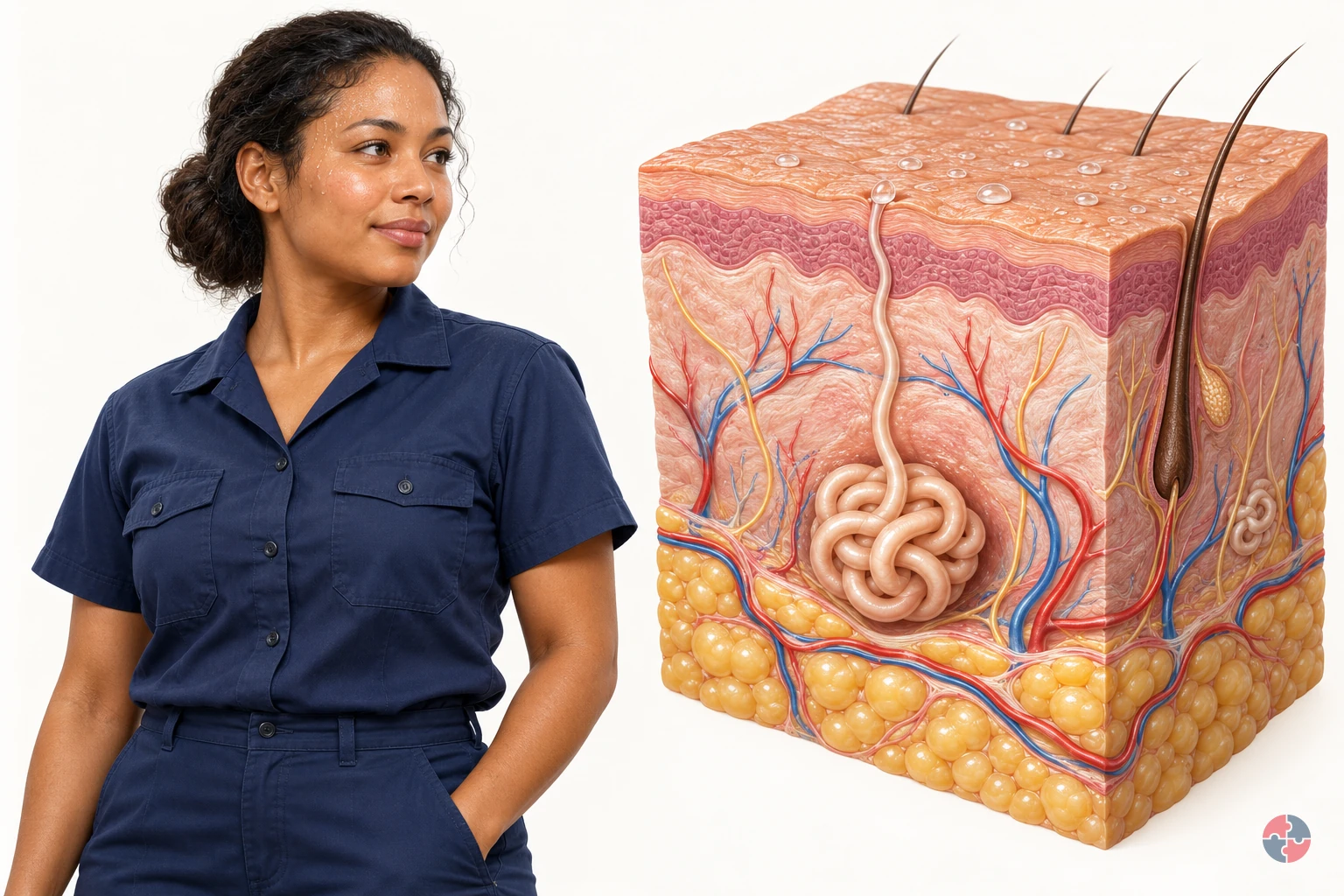

How do heat and cold affect the body, and what controls protect people during work?
Interactive anatomy · Heat balance, heat illness and cold injury · Updated 2026-10-23
Read all anatomy and process explanations without the viewer
Qualitative education about heat balance and separate harm mechanisms, not personal physiology simulation. Core-temperature, time-to-collapse, safe-duration or risk-percentage prediction Universal drinking quota or work/rest ratio Return-to-work decisions or clearance from a colour, timer or environmental card Removing required PPE and continuing hazardous work Local tissue freezing used as a model for every cold problem Heat illness, cold illness, chemical skin burns and eye irrigation each require distinct guidance. Heat and cold action is readable before interaction and scenario answers.
Working muscles
Physical work produces heat inside the body. The activity symbol represents metabolic heat production. It is not a measure of the person’s temperature. Health and Safety Executive: Temperature in the workplace: Heat stress · Health and Safety Executive: Thermal comfort
Body core
Internal temperature needs to stay within a workable range. The whole-body balance depends on heat production, gains and losses. This diagram displays no predicted core temperature. NHS Education for Scotland and University of Dundee: Core Clinical Assessment Skills Manual — temperature regulation
Skin
The skin exchanges heat with the surroundings. It forms an important surface in heat balance. Its separate barrier function is covered in the skin lesson. Health and Safety Executive: Thermal comfort · Health and Safety Executive: Structure and functions of the skin
Skin blood vessels
Changes in skin blood flow help regulate heat transfer. Skin blood vessels help regulate the transfer of heat between the body’s interior and its surface. Compare the warm and cold explanations to see the contrasting roles of skin blood flow. The vessel label identifies a physiological response; the illustrated width is not a measurement and cannot establish how effectively a person is maintaining temperature. NHS Education for Scotland and University of Dundee: Core Clinical Assessment Skills Manual — temperature regulation · NHS 111 Wales: Frostbite — causes
Sweat gland
Sweat reaches the surface; evaporation provides cooling. The gland supplies sweat to the skin surface. Cooling depends on water evaporating from that surface, so making sweat and successfully losing heat are related but different events. Follow the evaporation label outside the skin to complete the explanation. Neither a wet-looking surface nor the number of displayed droplets measures the body’s cooling. Health and Safety Executive: Thermal comfort · NHS Education for Scotland and University of Dundee: Core Clinical Assessment Skills Manual — temperature regulation · Health and Safety Executive: Structure and functions of the skin
Evaporation
Humidity and some clothing can restrict evaporation. Water vapour leaves the skin surface. These water symbols must not be mistaken for blood or a measured heat dose. Health and Safety Executive: Thermal comfort
Radiant heat
Sunlight and nearby hot surfaces can add heat load. The heat source stays outside the body. Its effect is not captured by air temperature alone. Health and Safety Executive: Thermal comfort
Clothing and PPE
Clothing changes insulation and heat loss. Required protection needs suitable work planning. Do not simply remove essential PPE and continue the hazardous task. Health and Safety Executive: Thermal comfort · Health and Safety Executive: Temperature in the workplace: Managing workplace temperatures
Shivering muscles
Shivering is a heat-producing response to cold. It does not guarantee safety. A cold, confused or unusually drowsy person needs help regardless of the animation. NHS: Hypothermia · NHS Education for Scotland and University of Dundee: Core Clinical Assessment Skills Manual — temperature regulation
Fingers and toes
Extremities can suffer local freezing injury in sufficiently cold conditions. Frostbite concerns local tissue. Hypothermia concerns whole-body temperature; neither requires the other. NHS: Hypothermia · NHS: Frostbite
Water loss
Sweating loses water, and dehydration can add to heat strain. The droplets explain loss; they do not generate a personalised drinking amount. Work must provide suitable access to water and rest. Health and Safety Executive: Temperature in the workplace: Heat stress · Health and Safety Executive: Temperature in the workplace: Dehydration
Open the complete process transcript
The process, step by step
Start with work
Working muscles release heat as they use energy. Follow the working-muscle label towards the body-core label, then look at the surrounding heat gains and losses. The important idea is balance: producing or receiving more heat than the body can lose can increase heat strain. Heat is energy, not a substance travelling along the illustrated blood vessels. This view introduces the parts of that balance; it does not calculate a temperature. Read each label in turn before comparing the work and environmental examples. Health and Safety Executive: Temperature in the workplace: Heat stress · NHS Education for Scotland and University of Dundee: Core Clinical Assessment Skills Manual — temperature regulation
What to watch: Locate the working-muscle and body-core labels, then follow their relationship to the whole-body balance rather than treating them as separate pictures.
Why it matters: A task can add heat from inside the body as well as from the surroundings. Understanding both sources helps explain why air temperature alone cannot describe the whole problem.
Explore this step: Compare the muscle and body-core labels, then describe which side of the heat balance each represents.
Separate sweat from evaporation
Sweat glands release liquid onto the skin. Cooling occurs when that liquid evaporates into water vapour, taking heat away from the surface. Follow the gland, the skin surface and the evaporation label as three connected parts of one explanation. A wet skin surface does not, on its own, show that sufficient cooling is happening. The water symbols identify the route being discussed; they do not measure sweat rate or heat loss. Pause on each label and explain the difference between making sweat and successfully losing heat. Health and Safety Executive: Thermal comfort · NHS Education for Scotland and University of Dundee: Core Clinical Assessment Skills Manual — temperature regulation
What to watch: Find the sweat gland beneath the surface, the skin above it and the evaporation label outside the body.
Why it matters: Sweating provides water at the surface; evaporation provides cooling. Keeping these roles separate explains why visible sweat is not a reliable measure of how well the body is losing heat.
Explore this step: Select the gland and evaporation labels in turn and explain what happens at each location.
Compare the context
Compare the examples with the stated air temperature held the same. Heavier work increases heat production; clothing and humidity can change how readily heat is lost. The examples are intended to separate these influences so that one temperature reading does not stand in for the whole assessment. Read the caption to identify what changed and what stayed constant, then return to the normal view. These are explanatory comparisons, not a calculation of safe working time, a prediction of body temperature or permission to remove essential protection. Health and Safety Executive: Temperature in the workplace: Heat stress · Health and Safety Executive: Thermal comfort
What to watch: Read the work, clothing and evaporation labels alongside the comparison caption, checking what changed and what remained the same.
Why it matters: Work rate, clothing and moisture in the air can alter the balance in different ways. A shared air temperature therefore does not mean that two work situations place the same demands on a person.
Explore this step: Choose two comparisons and name the different factor before explaining its place in heat production or heat loss.
Explore cold responses
In the cold example, reduced blood flow near the skin limits heat transfer from the warmer interior to the surface. Shivering adds heat through muscle activity. Find the skin-vessel label and then the shivering-muscle label so that conserving heat and producing heat remain distinct ideas. These are protective responses, but they can be insufficient. The illustration does not establish that a cold person is safe, nor does it measure core temperature. Use the normal and cold views to explain the responses without treating the model as a clinical check. NHS: Hypothermia · NHS Education for Scotland and University of Dundee: Core Clinical Assessment Skills Manual — temperature regulation · NHS 111 Wales: Frostbite — causes
What to watch: Locate the skin-vessel label near the surface and the separate muscle label used to explain heat production by shivering.
Why it matters: Conserving existing body heat and generating additional heat can both help the balance. Their presence does not prove that heat loss has been controlled or that further cooling cannot occur.
Explore this step: Compare the normal and cold labels and identify which response limits loss and which produces heat.
Choose the right comparison
Use the normal view as a reference, then compare the separate heat-illness, whole-body-cooling and local-freezing examples. Whole-body cooling concerns the temperature of the body as a whole; frostbite concerns freezing injury to a local area, often an extremity. One is not simply the next step after the other. Read the title and scope of each branch before looking at its highlighted region. The pictures help organise these different mechanisms; they cannot determine a person’s condition from skin colour, a selected label or the amount of visible movement. NHS: Hypothermia · NHS: Heat exhaustion and heatstroke · NHS: Frostbite
What to watch: Compare the body-core label with the extremity label, keeping the selected branch title visible as you examine each region.
Why it matters: Distinguishing the mechanisms prevents a local skin change being mistaken for a measure of the whole body. The selected branch is an explanation, not a sequence that every affected person follows.
Explore this step: Select each comparison and state whether it concerns heat balance, whole-body cooling or a local tissue injury.
Mechanisms and their limits
Hypothermia: dangerous whole-body cooling When heat loss exceeds replacement, internal body temperature can fall dangerously. Confusion, slurred speech, tiredness or slowed breathing in a cold person are warning signs. Suspected hypothermia needs emergency medical help. The body is not shown freezing solid. Slowed thinking and coordination use text labels rather than a brain lesion. Frostbite is not required for hypothermia, and the absence of a visible skin change does not provide reassurance. Warm clothing or shivering does not establish that a person is safe. NHS: Hypothermia · NHS Education for Scotland and University of Dundee: Core Clinical Assessment Skills Manual — temperature regulation
NHS: hypothermia and first aid
Frostbite: local freezing injury In very cold conditions, skin and underlying local tissue can freeze. A finger or toe inset marks the possible affected area with a labelled pattern. This local injury is different from whole-body cooling. No graphic tissue loss or literal ice crystals slicing cells are shown. This illustrative patch does not diagnose frostbite or calculate injury depth. Local frostbite and hypothermia can occur together; one does not exclude the other. NHS: Frostbite · NHS 111 Wales: Frostbite — causes
NHS: frostbite and when to seek help
HSE: workplace temperature planning
Hypothermia: dangerous whole-body cooling — follow the anatomy
Look at: The body’s core and the blood flow towards the skin.
What changes: The body loses heat faster than it can replace it, reducing internal temperature.
Why it matters: Thinking, movement and normal body functions can deteriorate; this is different from local freezing.
What to do: For suspected hypothermia, call 999, move to shelter and follow the emergency guidance for safe warming while help comes.
Wet outdoor work and whole-body cooling
Grounds maintenance continues in cold wet conditions; a colleague later becomes confused and speaks unclearly. A time jump represents continuing heat loss over a variable period. Thirty-two seconds cannot predict core temperature, safe duration or deterioration. Frostbite is not required. Shivering, warm clothing or the absence of visible skin changes does not establish that the person is safe.
Cold, wet work needs a plan Wet clothing and cold surroundings can increase heat loss. Plan suitable protection, shelter and work arrangements; confusion or slurred speech in a cold colleague needs emergency help now. Health and Safety Executive: Temperature in the workplace: Outdoor working · NHS: Hypothermia
Heat loss continues over time The timeline jumps through continuing exposure. Shivering produces heat and skin-vessel responses conserve it, but these responses may not keep the body warm enough. NHS: Hypothermia · NHS Education for Scotland and University of Dundee: Core Clinical Assessment Skills Manual — temperature regulation
Possible dangerous whole-body cooling The body-core panel carries warning labels for confusion, slurred speech, tiredness or slow breathing. The diagram does not freeze the body solid or display a measured temperature. NHS: Hypothermia
Shelter and obtain emergency assessment Get emergency help for suspected hypothermia, move to shelter where safe and follow the separate first-aid panel for warmth and monitoring. Do not rub limbs or use direct intense heat. NHS: Hypothermia
Frostbite: local freezing injury — follow the anatomy
Look at: The exposed fingers, toes or other local tissue.
What changes: Tissue can freeze in very cold conditions, damaging cells and their blood supply.
Why it matters: Numbness and colour changes can hide a serious local injury.
What to do: Prevent freezing exposure and follow medical guidance; do not rub the affected tissue.
A local extremity exposed during very cold work
A worker in very cold conditions develops numb, painful fingers while local cold protection is ineffective. This local example uses a time jump through cold exposure; it supplies no safe duration, tissue-freezing temperature calculation or injury-depth estimate. Frostbite differs from hypothermia and non-freezing cold injury. Local symptoms do not show that the rest of the person is safe.
Protect the whole person and exposed extremities Review very cold work, suitable dry protection and access to shelter. The finger inset is a local example, not a substitute for checking the person’s condition. NHS: Frostbite · Health and Safety Executive: Temperature in the workplace: Outdoor working
Cold affects local circulation and tissue The timeline moves forward during exposure. Local blood flow may reduce as the body conserves heat; sufficiently cold tissue can freeze. This is not the same mechanism as wet-work dermatitis. NHS: Frostbite · NHS 111 Wales: Frostbite — causes
Possible local freezing injury A restrained patterned patch marks a possible affected area. Numbness or colour cannot establish depth, and the animation does not show graphic tissue loss or inevitable amputation. NHS: Frostbite
Leave the cold and obtain medical help Seek medical help for suspected frostbite and follow the reviewed cold-injury panel. Do not rub the area or use fires/direct heat. Serious local signs or hypothermia warning signs need emergency assessment. NHS: Frostbite · NHS: Hypothermia
Read the practice situations and all answer explanations
TH-Q1: What takes priority?
After strenuous hot work, a worker becomes confused and collapses. Their skin is sweaty.
Rule out heatstroke because the worker is sweating. — Sweating can occur in exertional heatstroke. Confusion and collapse require emergency action; do not let the skin appearance delay help.
Call 999 and begin appropriate cooling while help is arranged. — Correct. Call 999 immediately, cool the person while waiting and follow the call handler’s advice. The emergency panel is available before this question.
Wait for the model to predict their temperature. — There is no temperature prediction. Do not delay calling or cooling to complete the activity or wait for a timer.
NHS: Heat exhaustion and heatstroke · Aylesford Medical Centre — NHS GP practice: Heat-related IllnessTH-Q2: Which action fits the warning signs?
A wet, cold colleague becomes confused and their speech is unclear.
Rub their arms and legs vigorously. — Do not rub their limbs or use a hot bath or direct intense heat. Get emergency help and follow the reviewed guidance.
Get emergency help, move them to shelter and follow hypothermia first aid. — Yes. Call 999, shelter the person, replace wet clothing where possible, wrap them and stay with them while help comes.
Wait for frostbite to appear before considering hypothermia. — Hypothermia can occur without frostbite. Confusion and unclear speech in a cold person need immediate attention.
NHS: HypothermiaTH-Q3: Which change should the team review?
A warm industrial process requires chemical-protective clothing.
Remove essential PPE and carry on despite the chemical hazard. — Do not continue unprotected. Review the process and protection together so that controlling heat does not create another exposure.
Review heat sources, workload, suitable PPE, cooler rest arrangements and water access. — Correct. Use environmental and task controls, suitable protection and planned rest/water arrangements. Check the changes with workers.
Decide the risk from air temperature alone. — Workload, humidity, radiant heat, air movement and clothing also affect the demands.
Health and Safety Executive: Temperature in the workplace: Heat stress · Health and Safety Executive: Thermal comfort · Health and Safety Executive: Temperature in the workplace: Managing workplace temperaturesSources and how the model is made
The opening images are AI-generated anatomical illustrations. The interactive 3D models and labelled SVG diagrams use original procedural artwork. These teaching images are not medical scans or diagnostic tools. Source references support the learner explanations and do not grant artwork rights.
- Health and Safety Executive: Temperature in the workplace: Heat stress — Work-generated heat, clothing/humidity, heat storage, water loss and work/environment controls. No universal hydration, exposure duration or clinical temperature prediction.
- Health and Safety Executive: Thermal comfort — Workload, radiant heat, air movement, humidity, clothing/PPE and evaporation. Air temperature alone insufficient. No occupational numerical thresholds imported.
- NHS: Hypothermia — Whole-body cooling, symptoms and immediate first aid/emergency escalation. Printed review due June 2026 is overdue; recheck at qualified first-aid sign-off.
- NHS: Heat exhaustion and heatstroke — Distinct heat-exhaustion and heatstroke explanations, emergency warning signs and cooling while waiting. No 30-minute delay imposed when emergency signs are already present.
- Aylesford Medical Centre — NHS GP practice: Heat-related Illness — Narrow corroboration that profuse sweating/wet skin can occur with exertional heatstroke. NHS-hosted clinical education article dated 18 June 2026; first-aid reviewer must reconcile this with simplified dry-skin descriptions. No treatment doses or prediction copied.
- NHS: Frostbite — Local freezing injury, extremities, coexistence with hypothermia and emergency signs. No diagnostic tissue depth or home rewarming programme simulated.
- Health and Safety Executive: Temperature in the workplace: Outdoor working — Work planning, weather and protection for outdoor hot/cold conditions. Replaces the brief’s US cold-work source.
- NHS Education for Scotland and University of Dundee: Core Clinical Assessment Skills Manual — temperature regulation — Normal heat-production/loss balance, sweat evaporation, skin-vessel responses and heat production by shivering, pages 13–14. July 2015 physiology reference only; no clinical assessment procedure or illustration copied.
- Health and Safety Executive: Structure and functions of the skin — Normal skin, sweat gland/duct and temperature regulation. Anatomy reference only.
- NHS 111 Wales: Frostbite — causes — Cold-related vessel narrowing and local tissue-freezing context only. Emergency wording uses current national NHS source TH6; no universal 111 route or bath-temperature protocol supplied.
- Health and Safety Executive: Temperature in the workplace: Managing workplace temperatures — Review process/work systems, suitable PPE and correct continued protection, rather than simply undoing essential protection.
- Health and Safety Executive: Temperature in the workplace: Dehydration — Sweat-related water loss and provision of suitable water access. No personal drinking prescription generated.
How does the body lose heat at work?
The body loses heat through exposed skin, wind, wet clothing, cold surfaces and breathing cold air.
Understanding heat loss helps supervisors design better controls. A worker standing still in wet gloves on an exposed scaffold may cool faster than a worker doing moderate activity in dry layered clothing. A cold-store worker may be protected from rain but still lose heat through long exposure, metal surfaces and inadequate recovery time.
Cold work planning should also consider fatigue. Tired workers move less efficiently, make poorer decisions and may not notice early symptoms quickly enough.
| Mechanism | How it affects workers | Control example |
|---|---|---|
| Convection | Wind strips warm air away from the body. | Wind breaks, sheltered work areas and weather planning. |
| Conduction | Contact with cold surfaces transfers heat away. | Insulated gloves, mats, tool handles and footwear.This specific conduction/respiratory mechanism and technical design remain held for direct government evidence and competent thermal review; general cold/thermal sources support work controls only. |
| Evaporation | Sweat or wet clothing removes heat as moisture evaporates. | Layering, breathable clothing, dry spares and warm changing. |
| Radiation | The body loses heat to a colder environment. | Thermal clothing, warm shelters and reduced exposure duration. |
| Respiratory heat loss | Cold air and heavy breathing increase heat loss. | Work pacing, warm breaks and task rotation.This specific conduction/respiratory mechanism and technical design remain held for direct government evidence and competent thermal review; general cold/thermal sources support work controls only. |
Where can frostbite and hypothermia occur at work?
Cold injury can occur outdoors, in refrigerated environments, during water exposure or anywhere workers cannot stay warm and dry.
Cold exposure is not limited to extreme winter work. It can occur during early starts, night shifts, wind, rain, freezer work, breakdowns, lone working, vehicle recovery, open excavations, roofing, coastal work or events where workers stand still for long periods.
The risk often rises when plans assume normal conditions but the job runs late, clothing gets wet, welfare is too far away or people push on because the programme is under pressure.
| Setting | Typical exposure | Management focus |
|---|---|---|
| Construction and utilities | Wind, rain, exposed ground, steelwork, scaffolds and long outdoor duration. | Weather review, warm welfare, dry gloves and supervision. |
| Cold stores and food logistics | Chilled rooms, freezers, loading bays and cold handling. | Thermal PPE, work-rest, access control and warm recovery areas. |
| Water or flood work | Immersion, wet clothing, mud and wind chill. | Rescue plan, dry spares, welfare and buddy system. |
| Security and events | Standing still outdoors for long periods. | Rotation, shelter, warm drinks and symptom checks. |
| Vehicle breakdown or remote work | Delayed rescue, lone working and poor communication. | Lone-worker contact, emergency kit and location reporting. |
What cold-work scenarios should managers plan for?
Managers should plan for ordinary cold-work situations where exposure builds gradually or emergency arrangements are harder to deliver.
The risk picture changes by setting. A freezer warehouse has predictable cold but repeated exposure; winter construction adds wind, wet clothing and programme pressure; roadside recovery adds lone working and traffic; marine work adds wetness and rescue complexity. The control package should match the setting rather than using one generic cold-weather briefing.
The useful learning point is that cold risk often develops through combinations: wet gloves plus wind, a delayed shift plus poor welfare, a lone worker plus low phone battery, or a vulnerable worker plus a task that removes dexterity.
| Scenario | How harm can develop | Controls that should be visible |
|---|---|---|
| Freezer warehouse picking | Repeated short entries become long exposure because orders overrun and gloves become damp. | Entry limits, warm recovery, dry gloves, buddy checks and supervisor review. |
| Winter construction groundworks | Rain, wind chill and static plant-watching cool workers while welfare is distant. | Weather triggers, warm welfare, rotation, waterproofs and stop-work authority. |
| Roadside recovery | A lone worker waits beside a vehicle in wind and rain while focusing on traffic risk. | Lone-worker contact, high-visibility thermal clothing, vehicle shelter and escalation plan. |
| Outdoor security | Long stationary periods reduce heat generation and symptoms may be normalised. | Rotation, shelter, warm drinks, check-ins and clothing standards. |
| Marine or dock work | Spray, wet decks and wind increase cooling and rescue may be delayed. | Task-assessed waterproof/thermal protection, flotation and rescue arrangements where water entry is possible, buddy working and communication; a dry suit alone is not a flotation or rescue system. |
| Vulnerable worker | A health condition, medication or poor circulation increases susceptibility. | Confidential adjustment route and occupational-health advice where needed. |
Water-entry prevention, flotation, cold-water survival and retrieval require competent task/vessel/rescue design. Cold-weather clothing or a dry suit alone does not establish that system.
What symptoms should workers and supervisors recognise?
Workers and supervisors should recognise early cold stress before it becomes severe frostbite or hypothermia.
Training should make symptoms plain and memorable. Workers may describe numbness, painful cold, clumsy fingers, stumbling, confusion or unusual quietness before a serious event. Supervisors should not dismiss these signs as ordinary discomfort.
Buddy checks are useful because people affected by cold may not judge their own condition accurately. A simple check-in can spot slurred speech, poor coordination, confusion or changes in behaviour.
| Sign | Possible meaning | Workplace response |
|---|---|---|
| Numbness or tingling | Early frostbite or cold stress affecting extremities. | Stop exposure, warm gently, dry clothing and report. |
| White, pale or waxy skin | Possible frostbite. | Protect the area without rubbing or direct intense heat and seek urgent medical advice. |
| Uncontrollable shivering | Body struggling to maintain temperature. | Call 999 if hypothermia is suspected; move to shelter if safe and keep dry and insulated. |
| Confusion or slurred speech | Possible hypothermia. | Call 999 for suspected hypothermia and do not leave the person alone. |
| Clumsiness or stumbling | Cold affecting coordination or judgement. | Stop safety-critical work and call 999 for suspected hypothermia; stay with the person. |
| Drowsiness or collapse | Severe cold illness possible. | Call 999 for suspected hypothermia and keep dry and insulated while help arrives. |
Who may be more vulnerable to cold-related harm?
Vulnerability depends on exposure, health, fitness, clothing, fatigue, medication and whether people can recover between cold periods.
Cold risk assessment should avoid assumptions. A physically strong worker can still be at risk if wet and exposed for too long. A worker with a health condition, poor circulation or certain medication may need individual advice. New starters may not know how quickly a site becomes cold when activity stops.
Privacy matters. Managers do not need unnecessary medical detail, but they do need a confidential route for workers to request adjustments or occupational-health advice.
| Risk factor | Why it matters | Control response |
|---|---|---|
| Wet clothing | Greatly increases heat loss. | Dry spares, waterproof outer layers and drying facilities. |
| Wind chill | Makes exposed skin cool faster. | Weather checks, shelter and face/hand protection. |
| Long duration | Heat loss accumulates over time. | Work-rest cycles and warm breaks. |
| Fatigue or poor nutrition | Reduces heat production and judgement. | Pacing, breaks, warm food/drink and supervision. |
| Lone working | Symptoms may be missed. | Contact schedule, escalation and buddy arrangements. |
| Health conditions | Some conditions affect circulation or temperature regulation. | Confidential occupational-health advice where needed. |
How should vulnerable workers and lone workers be protected from cold exposure?
Vulnerable workers and lone workers need confidential planning, closer check-ins and practical adjustments rather than assumptions.
Managers should avoid asking for unnecessary medical details, but they should create a safe route for people to raise concerns. A worker with poor circulation, diabetes, certain medication, pregnancy, fatigue, low fitness, recent illness or previous cold injury may need individual controls or occupational-health advice.
Lone working changes the risk because early signs may not be seen. Cold-work plans should define contact frequency, missed-check escalation, communication equipment, location information and when lone work is unsuitable.
| Issue | Practical control | Evidence |
|---|---|---|
| Confidential health disclosure | Provide a route to request adjustments without disclosing unnecessary detail to line managers. | Adjustment record and occupational-health referral where needed. |
| Medication or circulation concern | Assess whether exposure duration, clothing or work pace needs adjustment. | Individual risk review. |
| New starter | Brief symptoms, welfare, clothing and stop-work expectations. | Induction and supervisor check. |
| Lone working | Set check-in frequency, escalation and location reporting. | Lone-worker log and missed-check procedure. |
| Remote work area | Confirm warm recovery, communication and rescue access before work starts. | Pre-start checklist and emergency plan. |
How can the hierarchy of controls reduce cold exposure, frostbite and hypothermia risks?
Plan cold work from a task and weather assessment: avoid exposure where feasible; provide shelter, dry changes, warm breaks, suitable layers and communication. Set a trigger to stop or shorten work when wind, wetness, duration, fatigue or a control failure increases risk.
The strongest controls change the work rather than expecting people to endure exposure. Reschedule the job, shorten exposure, provide shelter, improve welfare, rotate people and avoid unnecessary cold work where possible.
PPE is important, but clothing cannot compensate for unrealistic programmes, poor welfare or wet work without recovery. Controls should be reviewed when weather changes, work overruns or workers report symptoms.
Choose the activity
How can the ERICPD hierarchy of controls reduce risks while inspecting outdoor access equipment in winter?

| Control level | Control for this activity | Owner and verification | Stop / restart decision |
|---|---|---|---|
| Eliminate | Avoid optional exposure or inspect suitable components remotely where valid; do not waive an inspection required before use. | Process owner verifies that the revised workflow achieves the required output and the hazardous step is genuinely removed. | If the hazardous step remains, retain a task assessment and select the stronger feasible remaining controls. |
| Reduce, including substitution | Use a safer accessible location or validated remote inspection method for the parts it can actually examine. | Process/technical owner validates the alternative, its compatibility and any new risks before adoption. | Reject the alternative if suitability is unproved or its new hazards are unresolved. |
| Isolate | Keep users out of unsafe equipment and segregate icy access or falling-material zones. | Supervisor verifies the task boundaries and that the separation or isolation protects affected people and connected work. | Hold or stop for unsafe ice, wet ineffective clothing, impaired dexterity or cold-illness signs. |
| Control: physical safeguards | Provide safe access, lighting, ice control and suitable shelter without introducing unsafe heating or access arrangements. | Competent equipment/process owner checks inspection scope, weather, safe access, dry protection and warm recovery. | Hold or stop for unsafe ice, wet ineffective clothing, impaired dexterity or cold-illness signs. |
| Control: work method and response | Plan weather limits, warm-up opportunities, communication and competent cover for the complete inspection. | Supervisor confirms the limits, response, communication and restart authority with the people doing this activity. | Stop if the agreed method, communication, competent cover or task limits cannot be maintained. |
| PPE | Use suitable dry insulated clothing, gloves and footwear that preserve dexterity and grip; replace wet or ineffective protection. | Assessor confirms whether PPE is needed and checks selection, condition, compatibility and any required face-fit evidence. | Do not rely on unsuitable or defective protection, or use PPE to continue after an essential source control fails. |
| Discipline | Recheck weather and access after changes; record inspection limitations and prevent use until unresolved defects are cleared. | Release only after competent inspector accepts the equipment and access conditions. Retain the checks and unresolved restrictions at handover. | Keep the activity on hold while defects or required reinstatement evidence remain unresolved. |
How can the ISO 45001 hierarchy of controls reduce risks while inspecting outdoor access equipment in winter?

| Control level | Control for this activity | Owner and verification | Stop / restart decision |
|---|---|---|---|
| Elimination | Avoid optional exposure or inspect suitable components remotely where valid; do not waive an inspection required before use. | Process owner verifies that the revised workflow achieves the required output and the hazardous step is genuinely removed. | If the hazardous step remains, retain a task assessment and select the stronger feasible remaining controls. |
| Engineering controls | Use a safer accessible location or validated remote inspection method for the parts it can actually examine. | Process/technical owner validates the alternative, its compatibility and any new risks before adoption. | Reject the alternative if suitability is unproved or its new hazards are unresolved. |
| Engineering controls | Keep users out of unsafe equipment and segregate icy access or falling-material zones. | Supervisor verifies the task boundaries and that the separation or isolation protects affected people and connected work. | Hold or stop for unsafe ice, wet ineffective clothing, impaired dexterity or cold-illness signs. |
| Engineering controls | Provide safe access, lighting, ice control and suitable shelter without introducing unsafe heating or access arrangements. | Competent equipment/process owner checks inspection scope, weather, safe access, dry protection and warm recovery. | Hold or stop for unsafe ice, wet ineffective clothing, impaired dexterity or cold-illness signs. |
| Administrative controls | Plan weather limits, warm-up opportunities, communication and competent cover for the complete inspection. | Supervisor confirms the limits, response, communication and restart authority with the people doing this activity. | Stop if the agreed method, communication, competent cover or task limits cannot be maintained. |
| PPE | Use suitable dry insulated clothing, gloves and footwear that preserve dexterity and grip; replace wet or ineffective protection. | Assessor confirms whether PPE is needed and checks selection, condition, compatibility and any required face-fit evidence. | Do not rely on unsuitable or defective protection, or use PPE to continue after an essential source control fails. |
| Administrative controls | Recheck weather and access after changes; record inspection limitations and prevent use until unresolved defects are cleared. | Release only after competent inspector accepts the equipment and access conditions. Retain the checks and unresolved restrictions at handover. | Keep the activity on hold while defects or required reinstatement evidence remain unresolved. |
How can the ERICPD hierarchy of controls reduce risks while unloading goods into a cold store?

| Control level | Control for this activity | Owner and verification | Stop / restart decision |
|---|---|---|---|
| Eliminate | Use suitable automated transfer or reorganised storage so routine occupied cold-room entry is unnecessary. | Process owner verifies that the revised workflow achieves the required output and the hazardous step is genuinely removed. | If the hazardous step remains, retain a task assessment and select the stronger feasible remaining controls. |
| Reduce, including substitution | Use a suitable alternative transfer or packaging arrangement that reduces manual exposure while preserving product requirements. | Process/technical owner validates the alternative, its compatibility and any new risks before adoption. | Reject the alternative if suitability is unproved or its new hazards are unresolved. |
| Isolate | Separate pedestrians from handling equipment and maintain controlled access to the cold-room loading zone. | Supervisor verifies the task boundaries and that the separation or isolation protects affected people and connected work. | Hold or stop for failed door release/alarm, unsafe ice, loss of contact or cold-illness signs. |
| Control: physical safeguards | Provide maintained doors with effective internal release, alarms where needed, suitable handling aids and safe floor conditions. | Competent equipment/process owner checks cold-room conditions, door release, communication, handling aids and recovery arrangements. | Hold or stop for failed door release/alarm, unsafe ice, loss of contact or cold-illness signs. |
| Control: work method and response | Plan exposure and recovery, staffing, communication and the response to a trapped or unwell worker. | Supervisor confirms the limits, response, communication and restart authority with the people doing this activity. | Stop if the agreed method, communication, competent cover or task limits cannot be maintained. |
| PPE | Provide suitable insulated clothing, gloves and footwear for the actual temperature and work; check grip, mobility and wetness. | Assessor confirms whether PPE is needed and checks selection, condition, compatibility and any required face-fit evidence. | Do not rely on unsuitable or defective protection, or use PPE to continue after an essential source control fails. |
| Discipline | Test door release and communication, inspect floor icing and review delays that lengthen occupied cold exposure. | Release only after cold-store supervisor verifies safe entry, escape and recovery provision. Retain the checks and unresolved restrictions at handover. | Keep the activity on hold while defects or required reinstatement evidence remain unresolved. |
How can the ISO 45001 hierarchy of controls reduce risks while unloading goods into a cold store?

| Control level | Control for this activity | Owner and verification | Stop / restart decision |
|---|---|---|---|
| Elimination | Use suitable automated transfer or reorganised storage so routine occupied cold-room entry is unnecessary. | Process owner verifies that the revised workflow achieves the required output and the hazardous step is genuinely removed. | If the hazardous step remains, retain a task assessment and select the stronger feasible remaining controls. |
| Engineering controls | Use a suitable alternative transfer or packaging arrangement that reduces manual exposure while preserving product requirements. | Process/technical owner validates the alternative, its compatibility and any new risks before adoption. | Reject the alternative if suitability is unproved or its new hazards are unresolved. |
| Engineering controls | Separate pedestrians from handling equipment and maintain controlled access to the cold-room loading zone. | Supervisor verifies the task boundaries and that the separation or isolation protects affected people and connected work. | Hold or stop for failed door release/alarm, unsafe ice, loss of contact or cold-illness signs. |
| Engineering controls | Provide maintained doors with effective internal release, alarms where needed, suitable handling aids and safe floor conditions. | Competent equipment/process owner checks cold-room conditions, door release, communication, handling aids and recovery arrangements. | Hold or stop for failed door release/alarm, unsafe ice, loss of contact or cold-illness signs. |
| Administrative controls | Plan exposure and recovery, staffing, communication and the response to a trapped or unwell worker. | Supervisor confirms the limits, response, communication and restart authority with the people doing this activity. | Stop if the agreed method, communication, competent cover or task limits cannot be maintained. |
| PPE | Provide suitable insulated clothing, gloves and footwear for the actual temperature and work; check grip, mobility and wetness. | Assessor confirms whether PPE is needed and checks selection, condition, compatibility and any required face-fit evidence. | Do not rely on unsuitable or defective protection, or use PPE to continue after an essential source control fails. |
| Administrative controls | Test door release and communication, inspect floor icing and review delays that lengthen occupied cold exposure. | Release only after cold-store supervisor verifies safe entry, escape and recovery provision. Retain the checks and unresolved restrictions at handover. | Keep the activity on hold while defects or required reinstatement evidence remain unresolved. |
Check HSE outdoor-working guidance; HSENI temperature guidance.
How should the selected controls be checked in practice?
Avoid or shorten exposure where feasible, then use shelters and dry recovery arrangements. Clothing and supervision support the plan, but do not make a prolonged, wet or isolated task safe by themselves.
The scenarios are reasoned task applications of the linked control principles, not a prescribed design or proof that each exact intervention appears in a source. A competent person must verify the method, local law and stop criteria.
A crew inspects an exposed scaffold in wind and rain.
A technician may work still for a long period in a freezer.
Use safe simulations and planned observations. Do not create cold illness or expose people to unsafe weather for training; required inspections and safe stop conditions still apply.
What clothing and PPE help control cold exposure?
Cold clothing should keep workers warm, dry, visible and able to move safely without creating new risks.
Layering is usually more effective than a single heavy garment because it allows workers to adjust warmth as activity changes. Inner layers should help manage moisture, insulating layers retain warmth and outer layers protect against wind and rain.
Gloves and footwear are critical because fingers and toes are common frostbite sites. The selected PPE must still allow safe grip, tool control, dexterity, visibility and communication.
| Item | What to consider | Failure mode |
|---|---|---|
| Base layer | Moisture management and comfort. | Sweat stays against skin and increases cooling. |
| Insulating layer | Warmth matched to activity and exposure. | Too little insulation or overheating then sweating. |
| Outer layer | Windproof and waterproof protection. | Rain and wind penetrate clothing. |
| Gloves | Warmth, waterproofing, grip and dexterity. | Workers remove gloves to do detailed tasks. |
| Footwear | Insulation, dryness, grip and circulation. | Wet socks, tight boots or poor grip increase harm. |
| Head and face protection | Protection of ears, cheeks, nose and head. | Exposed skin in wind chill develops frostbite risk. |
What welfare and supervision controls matter most?
Welfare and supervision matter because workers need somewhere to warm, dry, report symptoms and recover safely.
Warm welfare must be close enough and available enough to be used. A heated cabin that is too far away, overcrowded or not available during night work will not control cold stress in practice.
Supervisors should make cold risk visible during briefings. They should talk about weather, wind chill, wet clothing, task duration, buddy checks, lone working and what conditions will stop the job.
| Control | What good looks like | Evidence |
|---|---|---|
| Warm shelter | Accessible, heated and available during the whole shift. | Welfare inspection and worker feedback. |
| Drying facilities | Wet PPE and clothing can be dried or replaced. | Drying area and spare clothing arrangements. |
| Warm drinks and breaks | Breaks are planned, not treated as a sign of weakness. | Work-rest plan and supervisor checks. |
| Buddy checks | Workers look for symptoms in each other. | Briefing record and supervisor observation. |
| Lone-worker contact | Regular contact and escalation if missed. | Contact log and emergency plan. |
| Weather triggers | Defined review points for cold, wind, rain, snow or ice. | Weather checks and stop-work decisions. |
What evidence shows cold exposure is being managed?
Evidence should show that cold exposure is assessed, controls are provided, symptoms are reported and learning leads to change.
Cold exposure records should not become a tick-box exercise. The useful evidence is whether weather was checked, welfare was available, work-rest arrangements were adapted, workers were briefed, symptoms were followed up and supervisors changed the work when conditions deteriorated.
Near misses matter. A worker who becomes confused, loses dexterity, slips because of ice, or reports numb fingers is giving the business information before a more serious incident occurs.
| Evidence | What it shows | Review trigger |
|---|---|---|
| Cold-work assessment | Tasks, weather, duration, workers and controls are considered. | New task, severe weather or incident. |
| Weather and wind-chill check | Conditions are being monitored. | Weather warning, exposed location or overnight work. |
| Briefing record | Workers know symptoms and controls. | New worker, new location or changed conditions. |
| Welfare inspection | Warm, dry recovery facilities are available. | Complaint, site move or shift change. |
| Symptom and near-miss record | Early signs are captured and investigated. | Numbness, confusion, collapse, repeated cold complaints. |
| Action tracker | Improvements are assigned and verified. | Overdue actions or repeat themes. |
What work-temperature duties apply in GB and NI?
GB and NI employers must assess and control cold-related work risks, provide suitable workplace conditions and PPE where needed. There is no universal legal minimum temperature for outdoor work; assess the actual task and conditions. Indoor workplaces have separate reasonable-temperature requirements under the applicable GB or NI workplace regulations.
Emergency arrangements should cover lone work, communication, shelter, wet clothing and delayed rescue; refer suspected clinical injury to medical services.
The HSE and HSENI guidance explains cold-stress management, suitable clothing, breaks and welfare. Do not treat an indoor comfort threshold as permission to expose outdoor workers to unsafe wind, wetness or duration.
| Jurisdiction | Duty or regulation | How it applies | Practical implication |
|---|---|---|---|
| GB | GB Health and Safety at Work Act | Assess and manage foreseeable cold-work harm. | Task assessment, welfare, work-rest and emergency plan. |
| GB | GB Workplace Regulations | Reasonable indoor workroom temperature route. | Indoor conditions and monitoring. |
| NI | NI Health and Safety Order | NI general duty to protect workers. | NI assessment and cold plan. |
| NI | NI Workplace Regulations | Reasonable indoor workroom temperature route. | NI indoor conditions and monitoring. |
| NI | NI PPE Regulations | Suitable residual personal protection route. | PPE assessment, issue and checks. |
See HSE outdoor-working guidance for GB practice; HSENI temperature guidance for NI and the outdoor threshold caveat.
How can BS EN ISO 45001 support frostbite and hypothermia at work management?
A voluntary occupational health and safety system can assign owners for cold-exposure assessment, work design, shelter, clothing, checks and emergency readiness.
HSE public guidance supports practical GB management themes only. Use the current authorised standard and competent advice for ISO clause mapping, conformity and certification decisions.
How could BuildOut Ltd manage this in practice?

BuildOut Ltd would manage cold exposure by treating weather, welfare, work sequencing, PPE and supervision as connected controls.
Grounds work links cold exposure to access, shelter and contact
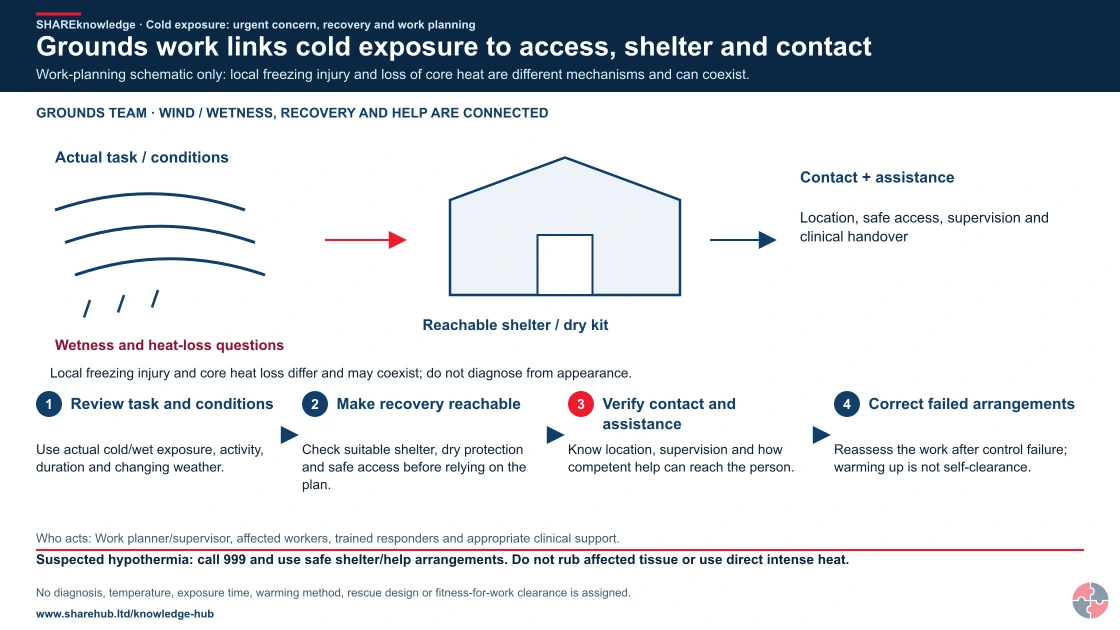
Full written explanation
A complete native grounds-work planning map connects a conceptual wind/rain exposure area and wet-work task to questions about heat loss, leaving exposure, shelter/dry clothing and a functioning communication/help route. It does not give a safe weather boundary, route survey, exposure schedule or warming procedure. A separate urgent strip retains the source-backed emergency distinction: suspected hypothermia needs emergency medical help and work-planning checks must not delay it. Local tissue freezing and loss of core heat can coexist; no injury anatomy, colour-based severity test, temperature or fitness clearance is shown.
Work-planning schematic only: local freezing injury and loss of core heat are different mechanisms and can coexist.
- Review task and conditions. Use actual cold/wet exposure, activity, duration and changing weather.
- Make recovery reachable. Check suitable shelter, dry protection and safe access before relying on the plan.
- Verify contact and assistance. Know location, supervision and how competent help can reach the person.
- Correct failed arrangements. Reassess the work after control failure; warming up is not self-clearance.
When the evidence does not fit: Suspected hypothermia: call 999 and use safe shelter/help arrangements. Do not rub affected tissue or use direct intense heat.
Who acts: Work planner/supervisor, affected workers, trained responders and appropriate clinical support.
Changed workplace
Refrigerated-store task: Review wet clothing, task overrun, recovery, escape/contact and supervision.
Grounds team in cold wind: Connect actual conditions to shelter, communication, assistance and work review.
Evidence check: No diagnosis, temperature, exposure time, warming method, rescue design or fitness-for-work clearance is assigned.
Keep urgent cold-related concern ahead of the longer prevention programme
Primary references: NHS hypothermia emergency scope · NHS frostbite: separate local freezing injury · HSE chilled/frozen workrooms · HSE outdoor work planning
Open the complete HD image (new tab)Download image

Keep urgent cold-related concern ahead of the longer prevention programme
Primary references: NHS hypothermia emergency scope · NHS frostbite: separate local freezing injury · HSE chilled/frozen workrooms · HSE outdoor work planning
In this worked example, BuildOut Ltd undertakes winter refurbishment and groundwork. The company would not rely on workers simply bringing warm clothing; it would plan cold exposure into the programme and site management system.
| Management element | How the business would manage it | Evidence to review |
|---|---|---|
| Assessing | Check weather, wind exposure, wet work, cold surfaces, task duration, lone working and vulnerable workers. | Cold-work assessment and weather review. |
| Planning | Sequence work to reduce exposure and define cold-weather stop or review triggers. | Programme notes, daily briefing and stop-work criteria. |
| Implementing | Provide warm welfare, drying facilities, suitable gloves, footwear, waterproofs and warm drinks. | Welfare checklist and PPE issue records. |
| Checking | Supervisors observe dexterity, behaviour, wet clothing, welfare use and whether breaks are taken. | Supervisor check sheets and observation notes. |
| Learning | Review numbness reports, slips, welfare complaints, weather overruns and near misses. | Incident log, action tracker and revised cold-work plan. |
| Improving | Upgrade shelters, change shift patterns, add spare clothing or alter procurement based on learning. | Procurement changes and management review decisions. |
The response decision uses HSE outdoor-working guidance.
Who needs cold-work competence?
Test recognition, prevention, communication and escalation, with role-appropriate evidence.
| Role | Learning to test | Competence demonstration | Assessor and record | Reassessment trigger |
|---|---|---|---|---|
| Workers | Recognise local and whole-body cold signs. | Explain stop, shelter and 999 trigger. | Supervisor observes drill. | Season or task changes. |
| Supervisors | Plan exposure, breaks and communication. | Run lost-contact and wet-clothing scenario. | Manager signs plan. | Weather or crew change. |
| First aiders | Use the current government health guidance and trained emergency pathway. | Simulate suspected hypothermia escalation. | Trainer assesses. | Guidance or training renewal. |
| Managers | Resource shelter and stop-work authority. | Review incident and missed break evidence. | Director samples closure. | Recurring symptoms. |
| Occupational advisers | Assess individual vulnerability confidentially. | Recommend task adjustment without diagnosis disclosure. | Clinical lead reviews. | Health or task change. |
The response decision uses HSE outdoor-working guidance.
Use safe simulations and planned observations. Do not create cold illness or expose people to unsafe weather for training; required inspections and safe stop conditions still apply.
What warning signs show cold exposure is not controlled?
Warning signs include symptoms, wet clothing, missing welfare, pressure to continue and supervisors not changing the plan when conditions change.
| Warning sign | How harm can develop | Action |
|---|---|---|
| Workers continue in wet clothing | Heat loss increases and hypothermia risk rises. | Stop, dry, replace clothing and review work method. |
| No warm welfare nearby | Workers skip breaks and cold exposure accumulates. | Provide accessible warm shelter before continuing. |
| People remove gloves to work | Dexterity needs are not matched by PPE selection. | Review glove type, tools, task method and work-rest. |
| Symptoms are treated as weakness | Workers hide early signs until severe illness develops. | Reset reporting culture and supervisor expectations. |
| Weather warnings ignored | Programme pressure overrides risk assessment. | Escalate and revise schedule or controls. |
| Lone workers miss check-ins | Deterioration may go unnoticed. | Activate escalation and review lone-worker arrangements. |
What do the acronyms and key terms mean?
Acronyms should be explained so cold exposure controls are understood by workers and supervisors.
| Acronym | Meaning | Plain-English use |
|---|---|---|
| PPE | Personal Protective Equipment | Cold-weather clothing and protective items. |
| HSE | Health and Safety Executive | Great Britain workplace health and safety regulator. |
| NHS | National Health Service | Public health information and medical care route. |
| GB | Great Britain | HSE occupational guidance and GB law. |
| NI | Northern Ireland | Separate NI law and HSENI guidance. |
Unlock another resource
You have used this month’s two free downloads. Publish a post in your own words to unlock one more resource, or choose SHARE Individual for 10 downloads per month.
You decide whether to share. If you do, use the relevant platform disclosure tools and do not make claims you do not genuinely hold.