SHARE Knowledge Hub
Personal Protective Equipment (PPE)
Personal protective equipment (PPE) is equipment worn or held to protect a worker from a remaining risk after stronger controls have been considered. Its protection depends on correct hazard matching, fit, compatibility, use, storage and replacement; merely issuing an item does not control exposure. Great Britain’s 2022 change extended workplace PPE duties to qualifying limb (b) workers, while Northern Ireland has its own workplace-use regulations.
Understanding Personal Protective Equipment (PPE)
Personal protective equipment (PPE) is equipment worn or held to protect a worker from a remaining risk after stronger controls have been considered. Its protection depends on correct hazard matching, fit, compatibility, use, storage and replacement; merely issuing an item does not control exposure. Great Britain’s 2022 change extended workplace PPE duties to qualifying limb (b) workers, while Northern Ireland has its own workplace-use regulations.
Why this matters at work
A confined-space or emergency scenario needs atmosphere testing, entry controls, rescue planning and competent equipment selection under the applicable specialist rules. Never send an untrained person in with a filtering mask to rescue someone. Compare the expected exposure with the chosen RPE performance, taking account of wear time, work rate and realistic fit. Where exposure data are uncertain or the consequence is immediate harm, obtain competent specialist advice and delay entry.
A cleaner substitutes a new solvent blend while retaining the old nitrile gloves. The supplier sheet lists nitrile as an example, but the chosen glove model has no verified performance for the new mixture or exposure time. A worker reports softening and skin contact. The manager stops the transfer, obtains first aid or clinical advice as appropriate, and isolates the affected gloves and solvent.
How organisations manage this in practice
Consider maintenance on a solvent-transfer connection. Eliminate exposure by redesigning to avoid opening the system, or perform the work through an enclosed method where practicable. Reduce the hazard by substituting a less hazardous substance/process after checking fire, compatibility and product-quality consequences. Isolate the inventory and energy, prevent unintended inflow and segregate people from the opening. Control the remaining release by verified extraction, a safe method, limited exposed workers, hygiene and a planned sequence.
Before a substitute is issued, compare the protection specification, compatibility, fit-test implication and user instructions. For tight-fitting RPE a new model or size can require a new fit test. For gloves, chemical resistance can differ by maker and thickness. Quarantine unapproved stock and tell purchasing and supervisors which exact items may be issued. Keep a route for urgent shortages that redesigns or suspends work rather than accepting an unverified substitute.
A short maintenance task, commissioning test or spill response can create exposure unlike the normal process. The team should first isolate or contain the hazard and change the method where practicable. If PPE remains necessary, specify the temporary task, who is authorised, the protective ensemble, duration and stop conditions. A one-day task is not automatically low risk and an emergency mask is not a substitute for a rehearsed response plan.
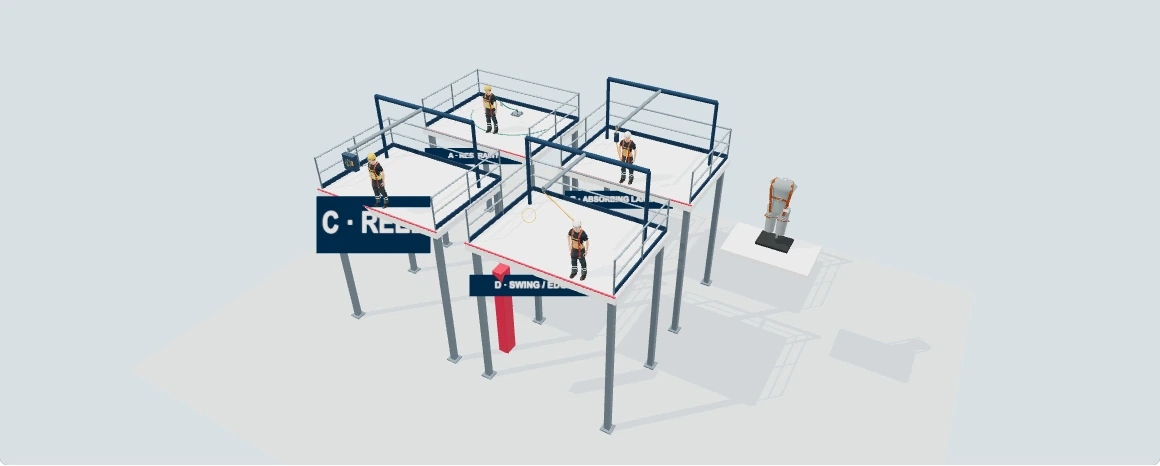

Roof-edge protection: restraint, fall arrest and rescue
Compare four roof-edge bays in one detailed scene: travel restraint, an energy-absorbing lanyard, a retractable reel and an offset/edge-contact arrangement. Follow the people, components and mechanisms of harm, then apply the source-linked good practice. The separate checklist is for pre-use checks. See suspended-person clearance views, compare two lanyard lengths and read the redesigned clearance diagram.
Hazards and good practice: learn what can hurt people during use, change and maintenance. Pre-use and safety checks stay in the separate checklist.
Checksheets and risk assessments
Equipment checksheets
Risk assessment forms
Risk assessment examples
Full written walkthrough — all 21 steps
1. Start with prevention, not a harness choice
What is happening: Four roof bays compare different personal systems. The open edges are teaching contrasts, not a recommended work layout.
How harm can occur: Every bay can expose the user to a fall; other workers can be struck by dropped equipment.
Best practice to apply: First avoid height or provide a protected place, collective edge protection or suitable access equipment. Personal protection needs a justified task-specific system.
Why this works: Preventing exposure protects people before a fall sequence starts.
Belts and harnesses for work at height · How does ERICPD apply to belts and harnesses?2. Anatomy: the full-body harness
What is happening: Inspect the separate detailed mannequin: shoulder/back webbing, chest strap, thigh loops, load-bearing stitching, adjusters, identification and dorsal ring. Other products have different approved attachment arrangements.
How harm can occur: Wrong body support or attachment can concentrate force, allow ejection or defeat the system.
Best practice to apply: Use the exact full-body harness and fall-arrest attachment specified for the system. A side positioning ring, tool loop or convenient strap is not automatically a fall-arrest point.
Why this works: Body support and load paths are designed functions; a ring-shaped part alone does not establish its purpose.
Belts and harnesses for work at height · What types of belts and harness systems are used?3. Fit the person and the complete task
What is happening: Fit includes leg and chest adjustment, strap routing, loose-tail control, clothing, movement and the total user-plus-tools mass. The mannequin is only a component display.
How harm can occur: Loose, twisted or incorrectly routed webbing can move during arrest and injure the wearer.
Best practice to apply: Follow the manufacturer’s fitting sequence and adjustment checks on the actual wearer. Confirm size, rated mass range, compatible PPE and supervised practical competence.
Why this works: Correct fit helps keep the designed load paths in position; appearance on a mannequin cannot prove fit.
Belts and harnesses for work at height · How should belts and harnesses be selected?4. Connectors, locking gates and absorber pack
What is happening: The close-up identifies the connector body, gate and locking sleeve, plus an energy absorber’s protective cover and folded webbing.
How harm can occur: An open gate, cross-loading, incompatible connection or bypassed absorber can cause connection failure or excessive arrest force.
Best practice to apply: Use compatible connectors and correct orientation, verify closure/locking and preserve the approved energy-dissipating element. Follow instructions for spare-leg stowage; do not clip it to an arbitrary ring.
Why this works: A complete compatible system must function together under load.
Belts and harnesses for work at height · How should belts and harnesses be selected?5. The structure is part of the system
What is happening: The illustrative gantry extends its connection point beyond the roof edge. The arrest line hangs clear of the edge and directly above the suspended dorsal attachment. The structure is illustrative, with no design rating.
How harm can occur: An unsuitable structure or wrongly placed anchor can fail or increase free fall, swing and rescue difficulty.
Best practice to apply: Use a competently specified and accepted anchor/structure for the actual system, load direction and number of users. Attach from a safe position before exposure and maintain connection through transitions. Have any outboard anchor, cantilever and support designed and accepted for the actual load paths; never improvise an extension. Check the entire fall path, swing and deflection, not just the final hanging position.
Why this works: A visible eye or a convenient handrail is not evidence of a suitable anchorage.
Belts and harnesses for work at height · What should be checked about anchor points?6. Bay A: travel restraint prevents reaching the edge
What is happening: An adjustable restraint lanyard limits travel. The green arc represents a constrained route, not a universal safe radius. The wearer remains inside the roof edge.
How harm can occur: A setting that still allows the person’s body to pass an edge or reach a fragile rooflight fails to restrain the fall.
Best practice to apply: Plan the anchor, full line length, stretch, adjuster setting, body reach and every accessible edge/opening. Establish that the whole task can be performed without reaching a fall position.
Why this works: True restraint prevents the fall beginning; merely wearing a short lanyard does not establish restraint.
Belts and harnesses for work at height · What types of belts and harness systems are used?7. Worked task: rooflight beside a ventilation unit
What is happening: A worker needs to inspect a unit beside a fragile rooflight. An outer-edge restraint setting may still allow access to the rooflight.
How harm can occur: Falling through an internal fragile surface can occur while the worker remains far from the outside edge.
Best practice to apply: Review ground-based inspection and protected access first. If personal restraint is justified, verify all openings, access routes and changing anchor geometry; stop if the task cannot remain within the protected route.
Why this works: The relevant boundary includes every fall position, not only the roof perimeter.
Belts and harnesses for work at height · How should a harness system be selected and released for use?8. Bay B: an energy absorber arrests a fall
What is happening: Fall arrest permits a fall to begin. A compatible system then dissipates energy and supports the person; it does not turn the open edge into a safe working platform.
How harm can occur: The user may strike a lower obstruction, experience arrest forces or remain suspended awaiting rescue.
Best practice to apply: Verify the exact product, anchorage geometry, user mass, clearance, edge compatibility and rescue plan before use. Prefer a high suitable anchor and avoid slack in the approved configuration.
Why this works: Energy absorption needs space and compatible components; it does not eliminate the fall or its consequences.
Belts and harnesses for work at height · Why does fall clearance matter?9. Worked free fall: what happens before arrest
What is happening: Imagine standing directly under the anchor with the line vertical. The anchor is 2.20 m above the deck and the dorsal ring is 1.40 m above it. A 1.50 m assembly could move 0.70 m vertically before taking load (1.50 − 0.80). The pictured worker starts inboard and moves over an edge. Their actual free fall cannot be read from this subtraction.
How harm can occur: Additional absorber deployment, anchor/line deflection and harness movement increase total descent after free fall.
Best practice to apply: Use a common reference and the exact manufacturer’s diagram. This simplified arithmetic omits edge transition, swing and device dynamics and must not be used to approve a real setup.
Why this works: Free fall and total stopping distance are different quantities.
Belts and harnesses for work at height · Why does fall clearance matter?10. Worked clearance: keep one anchor datum
What is happening: Start at the unloaded anchor. The lowest soles in this example are 4.20 m below it. Allow another 1.00 m beneath the soles, giving 5.20 m required. The top of the obstruction is only 4.80 m below the anchor. Read the two rulers from the same starting point.
How harm can occur: Missing an allowance, mixing platform and anchor datums, or double-counting a manufacturer’s combined term can give a misleading result.
Best practice to apply: Read the actual product-specific clearance diagram and definition of each term. Account for the real user, anchor/line system and obstructions, without reusing or double-counting the fictional allowances.
Why this works: A consistent datum makes the calculation auditable; only the actual system instructions establish required clearance.
Belts and harnesses for work at height · Why does fall clearance matter?11. Worked decision: this example does not fit
What is happening: There is daylight under the boots, but only 0.60 m of it. The example needs 1.00 m under the boots, so it falls short by 0.40 m. The red obstruction enters the required reserve. Reject this arrangement.
How harm can occur: The arrest path or its required margin conflicts with the obstruction; a harness is not a reason to proceed.
Best practice to apply: Reject this configuration. Reconsider avoidance, collective prevention, restraint or a different competently specified system. Do not reduce the stated allowance or guess that a reel will solve the shortfall.
Why this works: Changing the control or task is necessary when the chosen configuration cannot meet its clearance requirement.
Belts and harnesses for work at height · Why does fall clearance matter?12. More room: compare the same 1.5 m system
What is happening: Only the obstruction moves. Its top is now 5.60 m below the anchor and the lowest soles are still 4.20 m down. The gap is 1.40 m. After allowing 1.00 m, there is 0.40 m left in this vertical comparison.
How harm can occur: Passing this one arithmetic comparison does not verify edge contact, system compatibility, rescue or structural capacity.
Best practice to apply: Verify every part of the actual system and work route. The clear line path shown requires a designed and accepted outboard anchorage; do not make an improvised cantilever.
Why this works: Available space is compared with the whole stopping envelope, including the clearance allowance.
Belts and harnesses for work at height · Why does fall clearance matter?13. 2 m lanyard: the complete stopping envelope
What is happening: With the 2.00 m assembly, the lowest soles are 5.45 m below the unloaded anchor. Add the 1.00 m reserve for 6.45 m required. An obstruction 6.90 m down leaves 1.45 m under the boots, or 0.45 m beyond the reserve.
How harm can occur: Confusing the total height of the person with the dorsal-to-feet term, or omitting real line deflection, can understate required clearance.
Best practice to apply: These are invented teaching values, not a universal minimum or a specification for a 2 m product. Use its exact instructions, actual wearer and complete anchor system. Do not add a term twice if the manufacturer already includes it.
Why this works: The drawing and the suspended-person model use the same inputs. With an initial dorsal height of 1.40 m, idealised vertical free fall is 2.00 − (2.20 − 1.40) = 1.20 m; absorber extension and other movement follow.
Belts and harnesses for work at height · Why does fall clearance matter?14. Bay C: the self-retracting fall arrester
What is happening: Often called an inertia or tension reel, this device pays line out/retracts during permitted movement and locks during a fall, with product-specific energy dissipation. It is not automatically a restraint system.
How harm can occur: A reel can still allow a fall, collision, swing or edge contact; a taut-looking line does not prove sufficient clearance.
Best practice to apply: Confirm the exact device’s mounting, orientation, user mass, line path, allowed working area and clearance. For a non-vertical or edge application obtain the manufacturer’s suitability confirmation.
Why this works: Locking behaviour, braking distance and permitted geometry vary by device; there is no universal “reel drop distance”.
Belts and harnesses for work at height · What types of belts and harness systems are used?15. Reel: hanging does not establish enough clearance
What is happening: Read from the deck in this bay. The first obstruction is 2.60 m below it. The suspended pose illustrates where the line connects. The exact reel and its instructions are needed to decide whether it can stop a fall in the space available.
How harm can occur: A reel still needs room for activation, stopping, harness movement and the required allowance; sideways travel also creates swing and edge-contact hazards.
Best practice to apply: Find the exact reel’s required clearance for this orientation, user mass and anchorage. Use its stated datum and compare with the measured available space. No generic numerical reel requirement is supplied here.
Why this works: Different reels and configurations have different stopping envelopes. A short visible line or a stationary hanging person is not proof that the fall can be arrested safely.
Belts and harnesses for work at height · What types of belts and harness systems are used?16. Reel anatomy and clearance decision
What is happening: Use the inspection toggle to reveal a schematic spool, return spring and locking pawl. This illustrates separate return and locking functions; it is not a service drawing.
How harm can occur: A damaged device, unsuitable edge or arrangement outside its tested limits can defeat protection even if the line retracts.
Best practice to apply: Use the manufacturer’s clearance table for the actual overhead/offset/edge arrangement. Inspect and function-check as instructed; never open, modify or repair a safety device from this model.
Why this works: Line retraction is not a fall-arrest test and does not establish a fixed stopping distance.
Belts and harnesses for work at height · How should belts and harnesses be selected?17. Bay D: swing fall and leading-edge contact
What is happening: The offset anchor introduces a pendulum path towards a side obstruction. The line can also run over the roof edge. The red curve is qualitative, not a calculated swing envelope.
How harm can occur: The person can strike the structure and the line can abrade or cut. Vertical clearance alone does not address these mechanisms.
Best practice to apply: Plan anchor position and lateral working limits; avoid swing and edge contact. If edge contact cannot be avoided, use only equipment confirmed for the exact edge/configuration and the full rescue/clearance assessment.
Why this works: Edge-rated or retractable equipment is not permission for unlimited offset or every edge material.
Belts and harnesses for work at height · Why does fall clearance matter?18. Restraint is different from work positioning
What is happening: Restraint restricts travel. Work positioning supports someone in tension while they work. These roof bays do not demonstrate a complete positioning or rope-access system.
How harm can occur: Loss of primary support can expose a positioned worker to a fall. A belt alone is not a general substitute for full-body fall-arrest support.
Best practice to apply: Specify the intended function and the required independent backup where failure of positioning could cause a fall. Specialist positioning, rope access and rescue require their own methods, compatible equipment and training.
Why this works: The task function determines the required system; tension in a line does not make different systems interchangeable.
Belts and harnesses for work at height · What types of belts and harness systems are used?19. After arrest: suspension intolerance / trauma
What is happening: The lowered worker illustrates a conscious or incapacitated casualty awaiting rescue. Motionless upright suspension can reduce effective blood circulation and lead to faintness or loss of consciousness; injury from the fall may also be present.
How harm can occur: Delay, leg-strap pressure and an inability to move can worsen the emergency. There is no universal safe time to remain hanging.
Best practice to apply: Raise the alarm and implement the planned trained rescue promptly. Relief straps, if provided and usable as instructed, do not replace rescue; do not unclip or improvise a dangerous self-rescue.
Why this works: Preventing a long unsupported wait is part of the original work plan, not an optional response after a fall.
Belts and harnesses for work at height · What rescue arrangements are needed before harness work starts?20. Rescue must work from this actual position
What is happening: A rescue plan needs a reachable casualty route, suitable anchors/equipment, trained people, communications, supervision and a controlled practice before reliance on it.
How harm can occur: Unplanned rescuers can become additional casualties; relying only on emergency services can leave a suspended worker without timely help.
Best practice to apply: Rehearse the chosen method safely, without exposing people to uncontrolled falls or suspension. Summon appropriate emergency help and follow current standard first aid and medical guidance after recovery. Do not use outdated rules about keeping everyone upright after rescue.
Why this works: A practical task-specific rescue capability is needed wherever fall arrest is used.
Belts and harnesses for work at height · What rescue arrangements are needed before harness work starts?21. After use or an arrest: record and withdraw
What is happening: The final step returns to the component display. A visual lesson does not complete an equipment inspection or release it for use.
How harm can occur: Fall-loaded, damaged, contaminated or uncertain-history equipment can return to service if withdrawal and records are weak.
Best practice to apply: Stop using and quarantine affected equipment after an arrest or suspected defect. Follow exact manufacturer withdrawal, inspection and disposition instructions. Use the separate pre-use checklist and formal inspection process for actual equipment.
Why this works: Clear separation of learning, inspection and competent release prevents an animation being mistaken for safety approval.
Belts and harnesses for work at height · How should belts and harnesses be inspected?
Fictional awareness examples, not equipment selection, structural approval or a working clearance calculator. Geometry and figures are teaching inputs. Use the exact manufacturer’s instructions and competent task-specific planning. Preserve separate GB and Northern Ireland legal routes.
The wider workplace has its own account and subscription access. Exploring this lesson does not grant access, record course completion or authorise work.
What is PPE and when should it be used?
PPE is protective equipment worn or held by workers when residual risk remains after better controls have been applied.
Best-practice guide: Personal Protective Equipment (PPE)
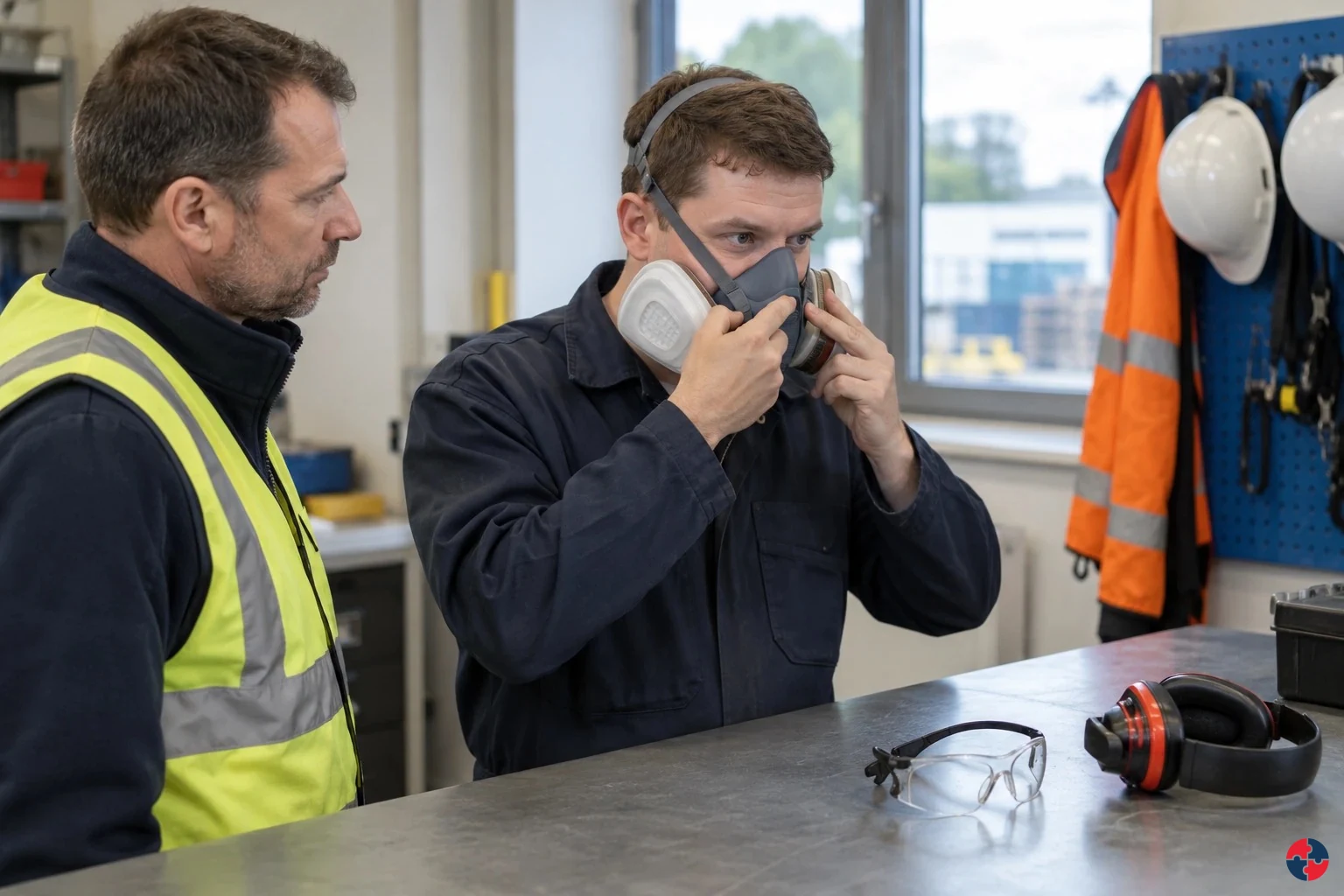
What is PPE and when should it be used?
PPE is protective equipment worn or held by workers when residual risk remains after better controls have been applied. Personal protective equipment (PPE) is equipment worn or held to protect a worker from a remaining risk after stronger controls have been considered.
Turn personal protective equipment (ppe) knowledge into a decision
Personal protective equipment (PPE) is equipment worn or held to protect a worker from a remaining risk after stronger controls have been considered. Its protection depends on correct hazard matching, fit, compatibility, use, storage and replacement; merely issuing an item does not control exposure. Substance assessment, extraction check/repair, fit and compatibility record, defect and restart decision.
Operational example and hold points
Check airflow indication, containment and correct PPE use during the task. Repair and verify extraction; check PPE condition and doffing before supervised restart.
Where does PPE commonly fail?
PPE fails when selection, fit, compatibility, maintenance, behaviour or upstream control decisions are weak.
Choose controls for personal protective equipment (ppe)
Eliminate: Avoid the hazardous task or material. Substitute: Use a less hazardous chemical or quieter tool. Engineer: LEV, guarding, enclosure, extraction or barriers. Administrative: Permit, training, rotation, exclusion and procedures. PPE: Gloves, RPE, eyewear, hearing protection or helmets. Read the full control table for qualifications, ownership and verification. Use the actual task and applicable jurisdiction; existing technical approval remains unchanged.
Use the full personal protective equipment (ppe) lesson
Use the full topic for the decision points, practical examples, detailed control tables and source scope. HSE guidance applies to Great Britain; use HSENI for the Northern Ireland route and the source’s stated jurisdiction. A simplified guide does not change the page’s technical-review or approval status.

Read all six steps as text
1. What is PPE and when should it be used?
PPE is protective equipment worn or held by workers when residual risk remains after better controls have been applied.
- Avoid / redesign: Avoid the hazardous task or material.
- Control the task: LEV, guarding, enclosure, extraction or barriers.
- Verify before release: No PPE needed for a removed hazard.
PPE is protective equipment worn or held by workers when residual risk remains after better controls have been applied. Personal protective equipment (PPE) is equipment worn or held to protect a worker from a remaining risk after stronger controls have been considered.
Apply it: Which part of this plan would you check at the workface before authorising the task?
2. Turn personal protective equipment (ppe) knowledge into a decision
Use the evidence to improve the actual work arrangement.
- Change at source: Avoid the hazardous task or material.
- Make it observable: No PPE needed for a removed hazard.
- Keep useful evidence: Substance assessment, extraction check/repair, fit and compatibility record, defect and restart decision.
Personal protective equipment (PPE) is equipment worn or held to protect a worker from a remaining risk after stronger controls have been considered. Its protection depends on correct hazard matching, fit, compatibility, use, storage and replacement; merely issuing an item does not control exposure. Substance assessment, extraction check/repair, fit and compatibility record, defect and restart decision.
Apply it: What evidence would show that the change improves this task, rather than only completing a record?
3. Operational example and hold points
Example: a practical application of the existing topic lesson.
- Setting: Solvent-coating spray in a workshop booth, with respiratory, eye and skin exposure.
- Act: Confirm coating, booth extraction, suitable respirator/goggles and their combined fit.
- Hold / review: Failed airflow, visible plume escape, damaged item or broken face seal; stop spraying.
Check airflow indication, containment and correct PPE use during the task. Repair and verify extraction; check PPE condition and doffing before supervised restart.
Apply it: At which point would you hold this example, and what evidence would allow it to proceed?
4. Where does PPE commonly fail?
Connect the task, the route to the person and the control that can fail.
- Source / exposure: PPE fails when selection, fit, compatibility, maintenance, behaviour or upstream control decisions are weak.
- Possible consequence: A filter for particles will not automatically control a solvent vapour, and even the correct respirator fails if the seal is poor.
- Control failure: Check the hazard route, fit, compatibility and condition before issue; stop the task when the required protection cannot be demonstrated.
PPE fails when selection, fit, compatibility, maintenance, behaviour or upstream control decisions are weak.
Apply it: Who could be exposed, including other trades, cleaners, maintainers and people nearby?
5. Choose controls for personal protective equipment (ppe)
Start with the stronger practicable options and verify their effect.
- Eliminate: Avoid the hazardous task or material.
- Substitute: Use a less hazardous chemical or quieter tool.
- Engineer: LEV, guarding, enclosure, extraction or barriers.
- Administrative: Permit, training, rotation, exclusion and procedures.
- PPE: Gloves, RPE, eyewear, hearing protection or helmets.
Eliminate: Avoid the hazardous task or material. Substitute: Use a less hazardous chemical or quieter tool. Engineer: LEV, guarding, enclosure, extraction or barriers. Administrative: Permit, training, rotation, exclusion and procedures. PPE: Gloves, RPE, eyewear, hearing protection or helmets. Read the full control table for qualifications, ownership and verification. Use the actual task and applicable jurisdiction; existing technical approval remains unchanged.
Apply it: Which stronger option can be used here, and who will verify it before accepting the remaining risk?
6. Use the full personal protective equipment (ppe) lesson
Follow the official sources below and retain the task-specific evidence.
- Official guidance: HSE PPE hierarchy and risk
- Task decision: Substance assessment, extraction check/repair, fit and compatibility record, defect and restart decision.
Use the full topic for the decision points, practical examples, detailed control tables and source scope. HSE guidance applies to Great Britain; use HSENI for the Northern Ireland route and the source’s stated jurisdiction. A simplified guide does not change the page’s technical-review or approval status.
Apply it: Which official source and full-topic section will you use to resolve the next decision?
PPE is important, but it is vulnerable because it depends on correct selection, fit, comfort, use, behaviour, storage, cleaning, maintenance and replacement. It does not remove the hazard. A dust mask does not remove dust, gloves do not remove corrosive chemicals and ear defenders do not reduce noise at source.
The hierarchy of control should be visible in every PPE decision. First ask whether the hazard can be eliminated, substituted, isolated, engineered out or controlled by safer systems of work. PPE is then selected for the residual risk that remains. This is why a high-quality PPE assessment includes the task, hazard, exposure route, user, duration, compatibility, environment and failure consequences.
| PPE type | Protects against | Key suitability issue |
|---|---|---|
| Head protection | Falling objects, impact and some electrical/thermal risks. | Correct standard, fit, expiry and compatibility. |
| Eye/face protection | Flying particles, dust, splash, radiation or impact. | Hazard-specific lens/face coverage and comfort. |
| Hand protection | Cuts, chemicals, heat, cold, biological agents or warmth and dryness; gloves must not be relied on to control hand-arm vibration exposure. | Material compatibility, breakthrough time and dexterity. |
| Foot protection | Impact, puncture, slip, chemical or electrical risks. | Sole, toe, midsole, grip and environment. |
| Hearing protection | Residual noise exposure. | Correct attenuation without overprotection. |
| RPE | Dust, mist, fumes, gas or vapour inhalation. | Assigned protection factor, fit test, filters and maintenance. |
| Fall protection | Fall arrest/restraint where collective protection is not enough. | Anchor, lanyard, harness fit, rescue and inspection. |
How can the hierarchy of controls reduce exposure before relying on personal protective equipment?
Consider a painter spraying a hazardous coating inside a workshop. Aerosol can travel from the spray plume into the breathing zone, eyes and skin. Eliminate, Reduce, Isolate, Control, personal protective equipment (PPE) and Discipline (ERICPD) prompts decisions alongside the five-level hierarchy of elimination, substitution, engineering, administrative controls and PPE. The coating safety data, spray method, actual exposure and equipment instructions determine the selection.
Eliminate: the designer asks whether a pre-coated component removes the site spray task. Quality, fire, installation and rework consequences must be checked before changing specification. If the spray is removed, document the process decision rather than keeping respirators as a default control.
Substitute and reduce: if coating remains necessary, assess a lower-hazard product or an application method that creates less aerosol. Procurement and a competent substance assessor verify the new product and performance; “water-based” alone does not prove harmlessness. Trial the actual spray and record whether exposure falls.
Isolate and engineer: use a suitable enclosed or segregated spray area and effective extraction where required. The process owner checks containment and airflow before spraying and arranges maintenance and examination. Failed extraction, visible plume escape or loss of segregation stops spraying and prompts repair and reassessment before restart.
Control, PPE and Discipline: restrict access, plan cleaning and provide instruction. For residual risk, select respiratory, eye, skin and clothing protection against the exact substances and exposure route; check fit, filter or cartridge limits, compatibility between items, maintenance and replacement. A seal broken by another item or contaminated gloves during removal defeats protection. The supervisor observes use and records defects; PPE never replaces the failed booth or extraction.
Direct source: HSE PPE hierarchy and risk
Direct source: HSE 2022 extended PPE scope
Direct source: HSE PPE selection and use
How can the ERICPD hierarchy of controls reduce exposure before relying on personal protective equipment?

| ERICPD control level | Topic-specific example | Source and full task context |
|---|---|---|
| Eliminate | Choose a pre-coated component where feasible to avoid site spraying, after assessing new consequences. | Read the full task example, checks and stop points on this page. HSE PPE hierarchy and risk · HSE 2022 extended PPE scope · HSE PPE selection and use |
| Reduce | Assess a genuinely lower-hazard coating/application method; water-based alone does not mean harmless. | Read the full task example, checks and stop points on this page. HSE PPE hierarchy and risk · HSE 2022 extended PPE scope · HSE PPE selection and use |
| Isolate | Provide suitable enclosure/segregation and effective extraction for the actual spray task. | Read the full task example, checks and stop points on this page. HSE PPE hierarchy and risk · HSE 2022 extended PPE scope · HSE PPE selection and use |
| Control | Control access, cleaning, instructions, observed use and review after task/product changes. | Read the full task example, checks and stop points on this page. HSE PPE hierarchy and risk · HSE 2022 extended PPE scope · HSE PPE selection and use |
| PPE | Select suitable RPE/eye/skin protection, face fit and full-ensemble compatibility. A failed seal or contaminated glove is a stop cue. | Read the full task example, checks and stop points on this page. HSE PPE hierarchy and risk · HSE 2022 extended PPE scope · HSE PPE selection and use |
| Discipline | Verify correct wearing/removal and act on loss of protection; a conformity mark does not prove task suitability. | Read the full task example, checks and stop points on this page. HSE PPE hierarchy and risk · HSE 2022 extended PPE scope · HSE PPE selection and use |
How can the ISO 45001 hierarchy of controls reduce exposure before relying on personal protective equipment?

| ESEAP control level | Topic-specific example | Source and full task context |
|---|---|---|
| Elimination | Choose a pre-coated component where feasible to avoid site spraying, after assessing new consequences. | Read the full task example, checks and stop points on this page. HSE PPE hierarchy and risk · HSE 2022 extended PPE scope · HSE PPE selection and use |
| Substitution | Assess a genuinely lower-hazard coating/application method; water-based alone does not mean harmless. | Read the full task example, checks and stop points on this page. HSE PPE hierarchy and risk · HSE 2022 extended PPE scope · HSE PPE selection and use |
| Engineering controls | Provide suitable enclosure/segregation and effective extraction for the actual spray task. | Read the full task example, checks and stop points on this page. HSE PPE hierarchy and risk · HSE 2022 extended PPE scope · HSE PPE selection and use |
| Administrative controls | Control access, cleaning, instructions, observed use and review after task/product changes. | Read the full task example, checks and stop points on this page. HSE PPE hierarchy and risk · HSE 2022 extended PPE scope · HSE PPE selection and use |
| PPE | Select suitable RPE/eye/skin protection, face fit and full-ensemble compatibility. A failed seal or contaminated glove is a stop cue. | Read the full task example, checks and stop points on this page. HSE PPE hierarchy and risk · HSE 2022 extended PPE scope · HSE PPE selection and use |
What does a complete PPE lifecycle look like?
A complete PPE lifecycle runs from risk assessment and selection through issue, use, maintenance, replacement, review and upstream control improvement.
PPE should never be managed as a store cupboard transaction. The question is not simply whether a worker has been given gloves, goggles or a mask. The question is whether the equipment is needed after higher controls, whether it is suitable for the hazard, whether it fits the person and the task, whether workers know its limits, whether it stays clean and effective, and whether failures lead to better risk control.
This lifecycle is especially important for high-risk PPE such as RPE, fall-arrest equipment, chemical suits, arc-flash clothing, hearing protection and cut-resistant gloves. For these items, poor selection or poor maintenance can create a false sense of protection.
| Lifecycle stage | Key question | Evidence |
|---|---|---|
| Risk assessment | What residual risk remains after higher controls? | Risk assessment, exposure data, task analysis and control hierarchy review. |
| Specification | What protection level, standard, material, fit and compatibility are required? | PPE suitability assessment and procurement specification. |
| Worker consultation | Will the PPE work for the real task and wearer? | Trial feedback, comfort/useability review and representative involvement. |
| Issue | Has suitable PPE been provided free of charge where required? | Issue record and worker group check including limb (b) workers. |
| Training | Does the wearer know why, when, how and the limitations? | Training record, practical demonstration and supervisor observation. |
| Use and supervision | Is PPE worn correctly during the actual task? | Field verification and intervention records. |
| Maintenance/storage | Is PPE clean, inspected, stored and replaced correctly? | Inspection, cleaning, storage and replacement records. |
| Review | Do PPE failures show upstream controls need improvement? | Incident, audit, defect and exposure trend review. |
Why does 'PPE issued' not mean 'PPE controlled'?
PPE is controlled only when it is suitable, compatible, fitted, understood, worn correctly, maintained, replaced and verified during the real task.
A PPE issue record proves that equipment was handed over. It does not prove that the item controls the risk. The equipment may be the wrong type, the wrong size, incompatible with other PPE, uncomfortable for the task, worn incorrectly, stored in a contaminated area, past its service life or unsupported by training and supervision.
The core teaching point is simple: PPE issued is not PPE controlled. The control only exists when the right person has the right item, it fits the real task, it works with other PPE, the wearer understands its limits and supervisors verify it during work.
This is why PPE assurance should look at work as done. Are workers wearing the PPE at the point of exposure? Does it fit with helmets, glasses, hearing protection or clothing? Is RPE face fit tested and clean-shaven/seal controlled? Are filters changed? Do workers know when to replace gloves? Do supervisors act when PPE problems show upstream controls are weak?
| Control question | Issued-only answer | Controlled-system answer |
|---|---|---|
| Is the PPE suitable? | The stores issued the standard item. | Selection is based on hazard, route, exposure level, task and wearer. |
| Does it fit? | The worker was given a size. | Fit, comfort and face fit testing where relevant are confirmed. |
| Is it compatible? | Each item is compliant on its own. | The full PPE combination is trialled and does not compromise seals, hearing, vision or dexterity. |
| Is it used correctly? | The rule says it must be worn. | Workers are trained and supervisors verify use during the actual task. |
| Is it maintained? | Replacement is available on request. | Inspection, cleaning, storage, filter changes and replacement are planned. |
| Does it reveal upstream weakness? | Issue more PPE after problems. | Use PPE failures to review elimination, substitution, engineering and safe systems. |
Why is PPE the last line of defence?
PPE is the last line because it protects the person rather than removing or controlling the hazard at source.
A page that says 'wear PPE' without explaining higher controls is not good health and safety guidance. If a worker is exposed to silica dust, the first answer is not simply RPE; it is design, low-dust methods, water suppression, on-tool extraction, exclusion, cleaning and then RPE where residual risk remains. The same logic applies to noise, chemicals, heat, sharp tools and falling objects. See HSE PPE hierarchy and risk.
PPE becomes more reliable when it is part of a layered system. The weaker the upstream controls, the more pressure is placed on PPE and human behaviour. That pressure should trigger management review, not acceptance.
| Hierarchy level | Example | PPE relationship |
|---|---|---|
| Eliminate | Avoid the hazardous task or material. | No PPE needed for a removed hazard. |
| Substitute | Use a less hazardous chemical or quieter tool. | PPE may reduce or change. |
| Engineer | LEV, guarding, enclosure, extraction or barriers. | PPE supports residual risk. |
| Administrative | Permit, training, rotation, exclusion and procedures. | PPE use is specified and supervised. |
| PPE | Gloves, RPE, eyewear, hearing protection or helmets. | Last layer that depends on correct use. |
How does PPE shift control from safe place to safe person?
PPE is a safe-person control, so it should be used only after stronger safe-place controls have reduced the hazard as far as reasonably practicable.
For dust work, first reduce dust at source and use enclosure or extraction; then select RPE for the remaining exposure. If extraction fails, a worker’s mask is not a reason to continue unchanged. Stop, restore the upstream control and reassess the residual risk before handback. GB source: HSE PPE hierarchy and risk
| Control approach | Example | What it means for PPE |
|---|---|---|
| Safe place: eliminate | Remove the hazardous substance, work at height or noisy process. | PPE may no longer be needed. |
| Safe place: engineer | LEV, machine guarding, edge protection, enclosure or segregation. | PPE supports residual risk rather than carrying the whole burden. |
| Safe place: collective protection | Scaffold guardrails, extraction booth, acoustic enclosure or fixed barrier. | Protects everyone in the area with less reliance on individual behaviour. |
| Safe person: administrative | Training, signs, rotation, permits and supervision. | Helps specify when PPE is required but still depends on people. |
| Safe person: PPE | Mask, gloves, hearing protection, harness or goggles. | Protects only the wearer and fails if selected, fitted, worn or maintained badly. |
How should PPE suitability be assessed?
PPE suitability should be assessed against hazard, task, user, fit, compatibility, duration and environment.
A suitable PPE assessment is more than choosing a product from a catalogue. It should ask what harm mechanism the PPE must protect against, what level of protection is required, whether PPE interferes with other PPE, whether the user can perform the task safely, whether the PPE fits, whether the environment affects performance and how it will be cleaned, stored and replaced.
Compatibility is a common failure. Safety glasses may break the seal of tight-fitting RPE. Gloves may reduce dexterity and create entanglement risk. Hearing protection may block communication or alarms. A harness may be useless without a rescue plan. PPE selection must therefore consider the whole system.
| Assessment question | Why it matters | Evidence |
|---|---|---|
| What is the hazard? | Different hazards need different protection. | Risk assessment and SDS/task analysis. |
| What route of harm? | Inhalation, skin, eye, hearing, impact or fall routes differ. | Exposure-route map. |
| What level of protection? | Under-protection leaves risk; over-protection can create new risk. | APF/attenuation/standard selection. |
| Does it fit? | Poor fit can make PPE ineffective. | Fit test or fitting record where relevant. |
| Is it compatible? | One item may compromise another. | Compatibility check. |
| Can the worker do the job? | PPE can affect vision, hearing, dexterity, heat stress and communication. | Task trial and worker feedback. |
| How is it maintained? | Dirty, damaged or expired PPE may fail. | Inspection, cleaning and replacement records. |
Where does PPE compatibility commonly fail?
Compatibility failures happen when one protective item reduces the effectiveness, comfort or usability of another.
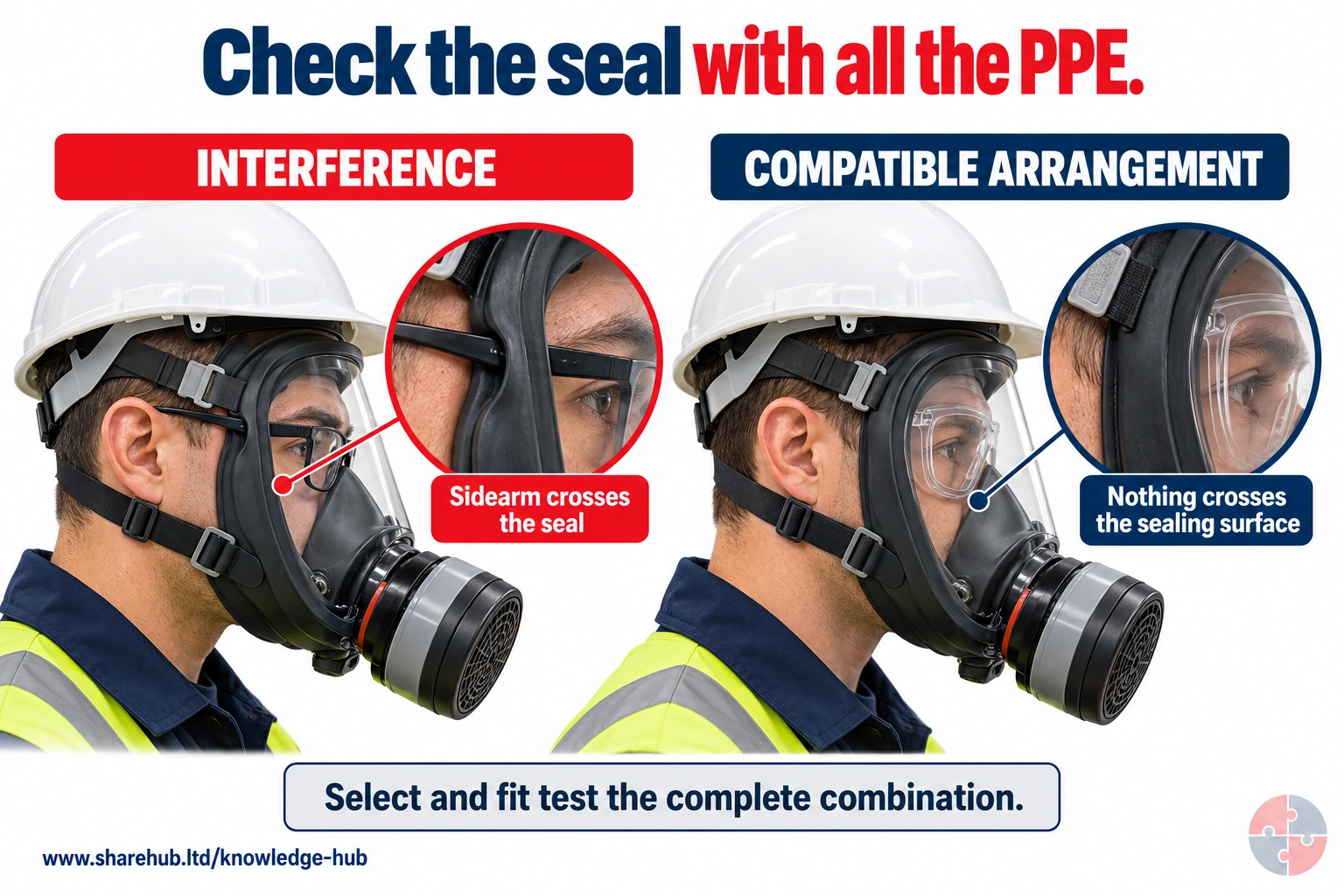

A spectacle sidearm can cross and disrupt a full-face mask seal. The comparison shows an internal spectacle insert that leaves the sealing surface clear. Confirm the manufacturer-compatible combination through selection and fit testing with the other head-worn PPE.
What must be considered when the worker also needs eye protection or head protection?
Assess compatibility and fit with the actual combination; use the manufacturer's compatible arrangements and appropriate fit testing.
Conceptual compatibility example, not approval of an insert or mask. The wearer must be clean-shaven where the tight-fitting facepiece seals; fit testing and a pre-use fit check remain necessary.
Source guidance: HSE HSG53
Trial the equipment together on the actual wearer: spectacle arms can disturb a tight-fitting respirator seal, and a helmet can displace ear defenders. If one item defeats another, choose a compatible combination and check fit during the task rather than signing off each item in isolation. GB source: HSE PPE selection and use
| Combination | Failure mode | Better control |
|---|---|---|
| Safety glasses + tight-fitting RPE | Spectacle arms can break the respirator seal. | Use compatible eyewear, full-face RPE or integrated protection where suitable. |
| Helmet + ear defenders | Poor attachment or fit reduces attenuation. | Use compatible helmet-mounted defenders and check fit. |
| Gloves + rotating tools | Loose gloves may increase entanglement risk. | Assess glove need against machinery entanglement and select task-specific controls. |
| Chemical gloves + dexterity task | Poor grip or loss of feel can increase spill or tool risk. | Trial glove type, thickness and task method. |
| Hearing protection + communication | Warnings, alarms or instructions may be missed. | Use suitable attenuation, visual alarms and communication systems. |
| Harness + high-vis/weather clothing | Harness may be worn incorrectly over bulky clothing. | Train, inspect and use compatible layers. |
| Chemical suit + hot work/heat | Heat stress and fatigue can increase risk. | Review task timing, cooling, duration and alternative controls. |
Where does PPE commonly fail?
PPE fails when selection, fit, compatibility, maintenance, behaviour or upstream control decisions are weak.
A filter for particles will not automatically control a solvent vapour, and even the correct respirator fails if the seal is poor. Check the hazard route, fit, compatibility and condition before issue; stop the task when the required protection cannot be demonstrated. The failure record should lead back to selection and upstream controls, not just re-training. GB source: HSE PPE selection and use
| Failure mode | What it looks like | Control response |
|---|---|---|
| Wrong type | Safety glasses used where sealed goggles or face shield are needed; dust mask used for vapour. | Match PPE to hazard route, exposure level and manufacturer limits. |
| Poor fit | Gaps around goggles, loose gloves, oversized harness or RPE seal failure. | Fit checks, sizing, wearer trials and face fit testing where required. |
| Incompatible items | Spectacles break RPE seal; helmet prevents ear defender fit; gloves reduce safe grip. | Trial the complete PPE combination for the real task. |
| No face fit | Tight-fitting RPE issued without individual fit testing. | Fit-test users, manage clean-shaven/seal rules and consider alternative RPE. |
| Expired or saturated filters | RPE filters used too long or changed only when smell is noticed. | Set filter change schedule from substance, concentration, use and manufacturer advice. |
| Poor storage | Masks in dusty toolboxes, gloves contaminated in pockets, helmets in direct sunlight. | Provide clean, dry, protected storage and inspection rules. |
| No training | Workers wear PPE incorrectly or do not understand limitations. | Practical training, demonstrations and supervisor observation. |
| Uncomfortable for task | PPE removed because it causes heat, fogging, poor grip or communication problems. | Redesign task, select better PPE and involve users in trials. |
| Upstream controls weak | PPE is expected to cope with visible dust, high noise or chemical splash. | Improve elimination, substitution, engineering or safe-system controls first. |
Why does respiratory protective equipment need special care?
RPE needs special care because inhalation hazards can be invisible and tight-fitting RPE depends on correct fit and use.
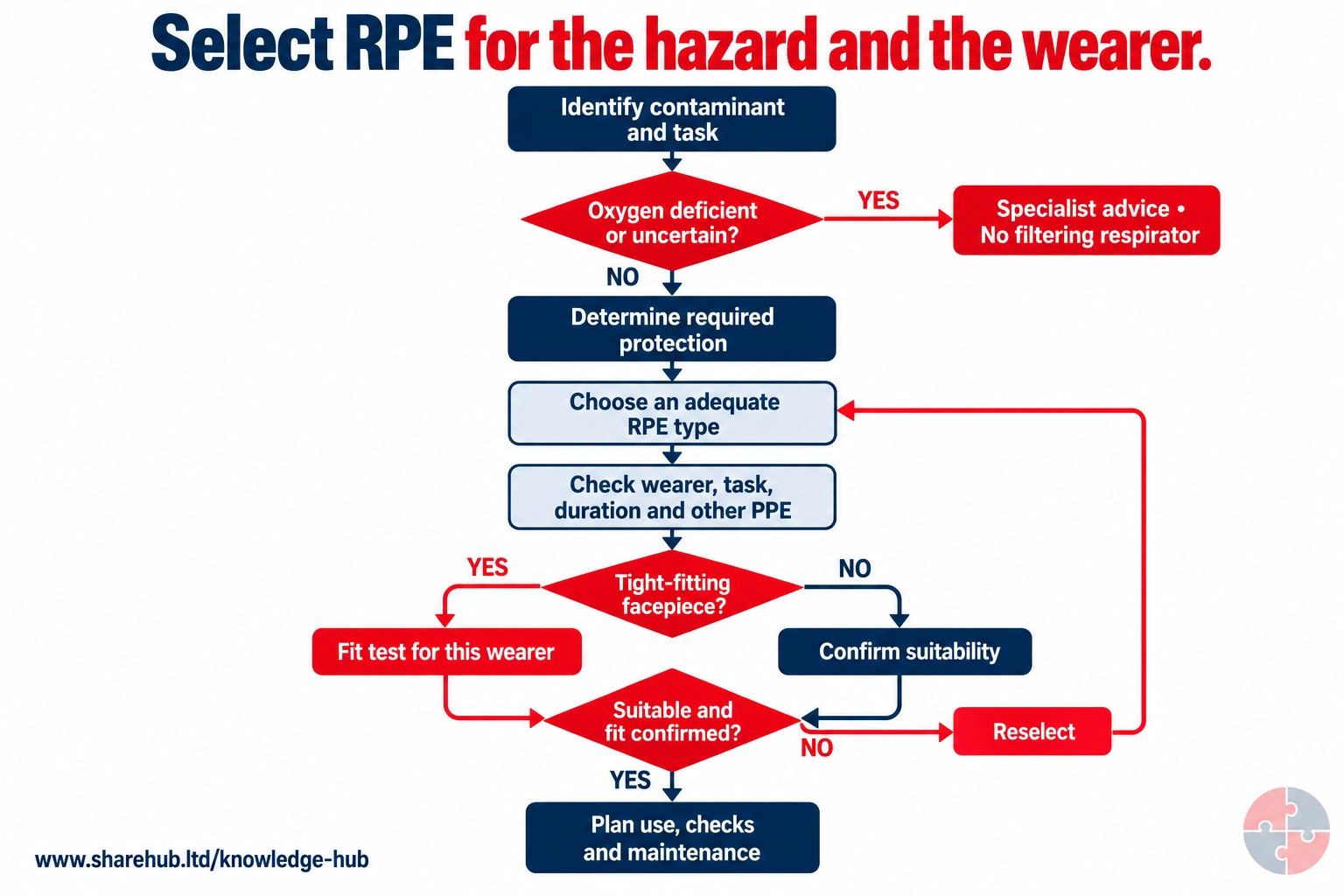

Select RPE that is adequate for the contaminant and required protection, and suitable for the wearer, task, duration, environment and other PPE. Tight-fitting facepieces require fit testing for the selected make, model, type and size. Oxygen deficiency, a potentially life-threatening concentration or uncertainty needs specialist assessment before work.
What should happen after failed fit testing?
Do not use the facepiece that failed. Review donning and selection with a competent person, choose an adequate and suitable alternative where needed, and obtain a successful fit test for the tight-fitting facepiece selected.
High-level selection aid only. It omits detailed protection-factor calculations and emergency arrangements. Fit testing does not replace a pre-use fit check, clean-shaven sealing area, training or maintenance.
Source guidance: HSE HSG53
RPE is often the most technically demanding PPE. Selection should consider the contaminant, form, concentration, exposure limit, oxygen level, filter type, assigned protection factor, duration, wearer characteristics and compatibility with eye or head protection. Tight-fitting RPE needs face fit testing and users need to be clean-shaven in the seal area unless the equipment is designed otherwise.
RPE should not be used to compensate for poor COSHH control. If dust, fume or vapour exposure is significant, the employer should review substitution, containment, extraction and process control first. RPE then protects against residual exposure or short-term controlled tasks.
| Decision point | Question | Common failure |
|---|---|---|
| Contaminant | Dust, mist, fume, gas or vapour? | Wrong filter type selected. |
| Protection level | What APF is needed? | Disposable mask used for high exposure. |
| Fit | Does tight-fitting RPE seal to the wearer? | No face fit test or stubble breaks seal. |
| Duration | How long is it worn? | Discomfort leads to removal. |
| Compatibility | Does eyewear or helmet affect seal? | Glasses break face seal. |
| Maintenance | Are filters changed and masks cleaned/stored? | Dirty mask kept in toolbox. |
| Training | Can users fit-check and recognise failure? | Users put it on incorrectly. |
How should RPE filters and protection factors be understood?
RPE selection should match the contaminant form, concentration, exposure limit, oxygen level and wearer/task needs.
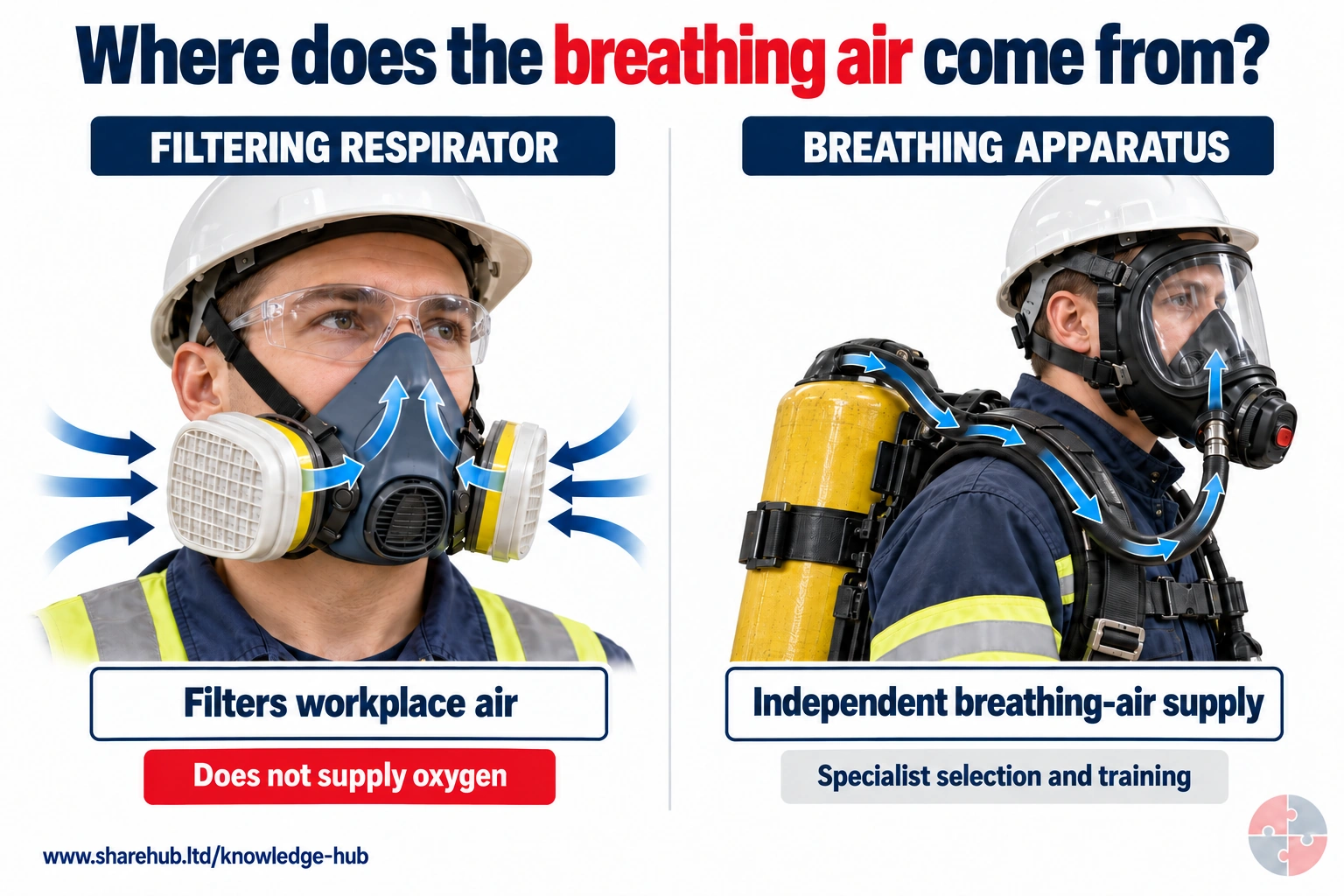

A filtering respirator removes selected contaminants from ambient air but does not provide oxygen. Suitable breathing apparatus provides an independent breathing-air source and needs specialist selection and use arrangements.
Can a better filter make oxygen-deficient air suitable for a respirator?
No. Filtering respirators do not supply oxygen; oxygen-deficient or uncertain dangerous atmospheres require appropriate specialist arrangements.
Principle comparison only. The apparatus, filters and air-path arrows are illustrative; they do not select rescue equipment or authorise entry into a hazardous atmosphere.
Source guidance: HSE HSG53
Identify whether the contaminant is a particle, gas or vapour and compare the measured or assessed exposure with the protection needed. Then select a suitable filter or supplied-air device for the task and wearer, including fit testing for a tight-fitting facepiece. Do not use a filtering facepiece where oxygen deficiency or unknown conditions require a different system. GB source: HSG53 respiratory protective equipment guidance.
Filter classes, assigned protection factors and limits in oxygen-deficient atmospheres require equipment-specific selection. HSE’s HSG53 respiratory protective equipment guidance explains the selection process; HSE face-fit guidance applies to tight-fitting facepieces.
| RPE decision | What it means | Common learner mistake |
|---|---|---|
| Particulate filter | Used for dusts, fumes and mists; classes such as P1, P2 and P3 reflect filtration performance. | Using a particulate filter for solvent vapour. |
| Gas/vapour filter | Selected by gas/vapour type and capacity, such as organic vapour, acid gas or ammonia filters. | Assuming all cartridge filters protect against all gases. |
| Combined filter | Used where particles and vapours are both present, such as some spraying tasks. | Ignoring one phase of the exposure. |
| APF | Assigned Protection Factor indicates expected protection when selected, fitted and used correctly. | Choosing RPE by appearance rather than required protection. |
| Face fit | Tight-fitting RPE must seal to the individual wearer's face. | Using one mask model for everyone without fit testing. |
| Oxygen-deficient atmosphere | Filtering RPE does not supply oxygen. | Using filters where breathing apparatus is required. |
| Filter change | Filters have limited life and can become saturated, clogged or damaged. | Keeping filters until they look dirty or smell breaks through. |
How should PPE be maintained, stored and replaced?
PPE must be kept effective through inspection, cleaning, storage, maintenance and timely replacement.
A pre-use check should find damage, contamination or expiry before the worker enters the exposure. Clean and store reusable PPE to the manufacturer’s instructions, replace worn components and record the person responsible. If compatible clean protection is unavailable, arrange supply before restarting the task. GB source: HSE - PPE maintenance
| PPE issue | What good looks like | Weakness to challenge |
|---|---|---|
| Inspection | Pre-use and periodic checks for damage, expiry or contamination. | PPE assumed safe because it was issued. |
| Cleaning | Cleaned according to manufacturer and hygiene needs. | Reusable PPE dirty or chemically contaminated. |
| Storage | Stored dry, clean, protected and accessible. | PPE left in vans, lockers or dusty areas. |
| Replacement | Damaged, expired or contaminated PPE replaced promptly. | Workers keep using damaged items. |
| Shared PPE | Hygiene and fit controlled. | Shared items not cleaned or assigned. |
| Records | Inspection and issue records proportionate to risk. | No trace for critical PPE. |
What changed for limb (b) workers?
In Great Britain, from 6 April 2022, workplace PPE duties were extended to limb (b) workers as well as employees.
The practical message is simple: if the risk assessment shows a worker needs PPE for the work, the employer must provide suitable PPE free of charge where the duties apply. Organisations should not create different PPE standards for casual workers, agency-type arrangements or other limb (b) workers when they are within scope.
This amendment is specific to the Great Britain workplace PPE regulations; Northern Ireland has its own 1993 instrument. Worker status depends on the actual relationship. See HSE 2022 extended PPE scope.
The Great Britain 2022 extension concerns PPE within the PPE at Work Regulations. Some protection, including PPE for hazardous substances and noise, is governed by separate regulations; check the applicable instrument and worker duties for the actual exposure. See HSE guidance on the extension and exclusions.
This matters in sectors such as construction, logistics, hospitality, events, cleaning and platform-style work where employment arrangements can be mixed. The PPE programme should identify who is covered, what PPE is required, how it is issued, how training is provided and how defects are replaced.
| Worker group | What to check | Good practice |
|---|---|---|
| Employees | PPE required by risk assessment. | Provide suitable PPE free of charge. |
| Limb (b) workers | Whether 2022 extension applies. | Provide and train to same standard where in scope. |
| Contractors | Who supplies PPE and how compatibility/standard is checked. | Set contractor PPE rules and verify on site. |
| Visitors | Whether temporary PPE is needed for exposure areas. | Provide suitable visitor PPE and briefing. |
| Agency workers | Clarify host and agency responsibilities. | No gap in issue, training or replacement. |
Northern Ireland has its own extension: S.R. 2024/161 took effect on 21 October 2024, extending duties in regulations 4–11 of the 1993 PPE Regulations to workers. The definition covers employment and qualifying personal-service contracts, excluding a client/customer relationship with the individual’s business. New regulation 3A applies the Article 10 no-charge duty for these PPE duties. Check the actual relationship and separate hazard-specific law; the GB 2022 amendment is not the NI instrument. NI PPE Amendment Regulations 2024
How should construction PPE be managed?
Construction PPE should separate site baseline requirements from task-specific PPE needed after the risk assessment.
Construction sites often use baseline PPE such as safety helmets, safety footwear and high-visibility clothing. That baseline helps manage common site risks, but it is not a substitute for task assessment. Cutting concrete, sanding plasterboard, handling cement, using grinders, working at height or entering a confined space each needs task-specific PPE decisions after higher controls are considered.
A robust PPE system makes this distinction visible. It tells workers what is required to enter a site, what is required for each task, who authorises changes, what must be face fit tested, what PPE is incompatible, and when poor PPE use should trigger a review of the method rather than blame.
| PPE layer | Examples | Management rule |
|---|---|---|
| Site baseline | Helmet, safety footwear, high-visibility clothing and eye protection where site rules require. | Set by site risk profile and communicated at induction. |
| Task respiratory protection | FFP3/P3 RPE for residual silica, wood or drywall dust where required. | Only after dust suppression/extraction; face fit and clean-shaven/seal rules apply. |
| Task hand protection | Cut, chemical, heat, cement or handling gloves. | Select by hazard and avoid creating entanglement or dexterity risk. |
| Task hearing protection | Ear defenders or plugs for residual noise. | Choose correct attenuation and do not block critical communication. |
| Task eye/face protection | Impact goggles, face shields, splash goggles or welding protection. | Match to particle, splash, arc or radiation hazard. |
| Fall protection | Harness, lanyard, fall restraint or arrest equipment. | Use only with anchor, rescue plan, inspection and competence. |
| Weather/thermal PPE | Waterproofs, cold-weather PPE, sun protection or heat-stress controls. | Assess workload, duration, welfare and secondary risks. |
How can PPE fail even when it is issued?
A worked example shows why PPE management must include suitability, fit, use and supervision.
A contractor cutting concrete is issued disposable masks, safety glasses and gloves. Dust levels are high because on-tool extraction is not connected properly. The masks are not face fit tested, workers have facial hair, the glasses break the mask seal and the gloves reduce grip on the tool. The site has PPE, but the control system is failing.
The competent response is to fix dust control at source, verify extraction, select RPE with the correct APF, face fit test, check eyewear compatibility, train users, supervise wearing and review whether the task can be redesigned.
| Failure | Why it matters | Better control |
|---|---|---|
| Extraction poor | PPE overloaded by uncontrolled exposure. | Fix engineering control first. |
| No fit test | Mask may not protect the wearer. | Face fit test tight-fitting RPE. |
| Facial hair | Seal compromised. | Use suitable alternative RPE if needed. |
| Incompatible eyewear | Breaks face seal. | Select compatible eye/RPE combination. |
| No supervision | PPE worn incorrectly. | Observe, coach and enforce fairly. |
Operational example and hold points
Task material and setting: Solvent-coating spray in a workshop booth, with respiratory, eye and skin exposure.
People and prerequisites: Operator, supervisor, competent booth maintainer and PPE selector; substance and equipment instructions are known.
Before: Confirm coating, booth extraction, suitable respirator/goggles and their combined fit.
During: Check airflow indication, containment and correct PPE use during the task.
Hold or stop: Failed airflow, visible plume escape, damaged item or broken face seal; stop spraying.
Completion and hand back: Repair and verify extraction; check PPE condition and doffing before supervised restart.
Evidence: Substance assessment, extraction check/repair, fit and compatibility record, defect and restart decision.
Before selecting RPE for spray coating, identify the actual ingredients. If isocyanates are present, use the HSE isocyanate spraying route, including its specialist air-fed breathing-apparatus, booth and clearance requirements. A generic solvent label is not enough to select a cartridge respirator. Lower-vibration methods/tools and assessed trigger time control vibration upstream; do not credit generic gloves with an exposure reduction.
How should PPE and RPE be handled in a COSHH example?
A COSHH/RPE worked example shows how PPE supports source control rather than replacing it.
A refurbishment team needs to chase a short channel in concrete blockwork. The weak method is to issue FFP3 masks and goggles and let the work proceed dry. Dust clouds spread to nearby trades and welfare areas, the masks are not face fit tested, and cleaning is done by sweeping. The PPE exists, but the COSHH control strategy has failed.
The stronger method is to plan the task, avoid or reduce cutting where possible, use water suppression or on-tool extraction with an appropriate vacuum, segregate the area, protect nearby workers, use suitable RPE for residual respirable dust, face fit test tight-fitting RPE, check eye/RPE compatibility, clean with vacuum/wet methods and verify that visible dust is not escaping.
| Control decision | Weak approach | Best-practice direction |
|---|---|---|
| Task design | Cut dry because it is quicker. | Avoid, reduce or redesign cutting where possible. |
| Engineering control | Extraction not connected or not checked. | Use effective extraction/suppression and verify capture. |
| Exclusion | Other trades work nearby. | Set exclusion, signage and sequencing. |
| RPE | Generic mask issued. | Select APF/filter, face fit test and train wearer. |
| Compatibility | Glasses break mask seal or fog. | Choose compatible eye/RPE protection. |
| Cleaning | Dry sweeping after the job. | Use suitable vacuum or wet method and prevent welfare contamination. |
| Evidence | PPE issue record only. | COSHH assessment, extraction check, face fit, briefing and supervisor verification. |
What evidence shows PPE is managed well?
Evidence should show PPE is selected from risk assessment, fitted, trained, maintained and verified.
Evidence should be read as a chain rather than a filing exercise. A single record rarely proves good management on its own; stronger assurance comes from matching records, observations, interviews, trends and verified action closure.
| Evidence | What good looks like | Weakness to challenge |
|---|---|---|
| PPE assessment | Hazard, route, level, fit, compatibility and duration considered. | Product issued without assessment. |
| Issue record | Correct PPE issued free of charge to covered workers. | Workers buy their own required PPE. |
| Training | Workers know when, why, how, limitations and defect reporting. | PPE handed out without explanation. |
| Fit testing | Tight-fitting RPE face fit tested. | Mask use without fit test. |
| Maintenance | Cleaning, storage, replacement and inspection controlled. | Dirty or damaged PPE in use. |
| Supervision | Use checked in the real task. | Policy says PPE must be worn but nobody verifies. |
| Review | PPE failures trigger upstream control review. | More PPE added instead of fixing source. |
Which legal duties apply to PPE?
PPE duties include suitability, provision, compatibility, maintenance, storage, information, instruction, training and correct use.
The rows distinguish Great Britain and Northern Ireland. Choose the instrument for the work location and the actual equipment or task; a guidance page or voluntary standard does not replace legal text.
| Duty or regulation | What it requires | How to apply it |
|---|---|---|
| Personal Protective Equipment at Work Regulations 1992 | Requires suitable PPE to be provided where risks remain after other controls. | Assess suitability, compatibility, fit, maintenance, storage, information, training and use. |
| Personal Protective Equipment at Work (Amendment) Regulations 2022 | Extended PPE duties to limb (b) workers from 6 April 2022. | Provide required PPE free of charge to employees and limb (b) workers. |
| Health and Safety at Work etc. Act 1974 | Requires employers to protect workers and others. | Treat PPE as part of a wider safe system, not the whole control strategy. |
| Management of Health and Safety at Work Regulations 1999 | Requires prevention principles and collective protection before individual protection. | Use the hierarchy of control before relying on PPE. |
| COSHH Regulations 2002 | Requires exposure to hazardous substances to be prevented or adequately controlled. | Use RPE, gloves and chemical PPE only after source control and with proper selection. |
| Control of Noise at Work Regulations 2005 | Requires noise risks to be controlled. | Select hearing protection after reducing noise at source and managing exposure. |
| Personal Protective Equipment (Enforcement) Regulations 2018 | Product-supply conformity and placing-on-market requirements, separate from employer workplace-use duties. | Purchasers should verify supplied product conformity while separately applying workplace PPE assessment, provision and training duties. |
| Personal Protective Equipment at Work Regulations (Northern Ireland) 1993 | Provide, assess, maintain and instruct in suitable workplace PPE where required. | Use the NI workplace-use instrument; do not assume the GB 2022 limb (b) extension applies in NI. |
| Health and Safety at Work (Northern Ireland) Order 1978 | Protect workers and others from work risks. | Assess the task and use PPE for residual risks after stronger controls. |
Apply the PPE at Work Regulations to equipment within their scope, and use the separate COSHH or noise duties where those govern protection. The Great Britain 2022 amendment does not replace those substance-specific duties. See HSE PPE scope guidance.
The Great Britain 2022 amendment extended workplace PPE duties to qualifying limb (b) workers; check worker status and do not assume the same amendment applies in Northern Ireland. Source: HSE 2022 extended PPE scope
NI worker scope must be read with the 2024 amendment, not the unamended 1993 PDF alone. NI PPE Amendment Regulations 2024 Product conformity under Regulation 2016/425 and the applicable GB/NI supply framework is separate from employer workplace-use suitability, fit and compatibility.
How should the control be managed and reviewed?
For a GB workplace, HSE guidance supports identifying the actual risk, taking practical protective steps and reviewing whether they work. Name the decision owner, check the control during the real task and correct a failed arrangement. Apply the separate Northern Ireland duties and guidance where the work is in NI.
GB management guidance: HSE managing health and safety
What training and competence helps?
PPE training should cover why PPE is needed, its limits, fitting, use, storage, maintenance and defect reporting.
Training should be role-based. General awareness creates a baseline, but supervisors, managers, advisers and senior leaders need different levels of decision-making, verification and escalation competence.
| Role | Demonstration | Assessor | Record and reassessment |
|---|---|---|---|
| Wearers and nearby workers | Know the hazard, protection limits, fit, donning, removal and defect route. | Supervisor observes correct use with other worn items. | Issue and instruction record; revisit after product or task change. |
| Specialist fit testers and maintainers | Check fit, filter choice, compatibility, cleaning and replacement conditions. | Competent lead witnesses the actual test and equipment inspection. | Fit-test and maintenance record within authorised scope. |
| Supervisors and contractors | Check stronger controls, supply suitable PPE and stop work for failed protection. | Manager samples a failed-booth and poor-fit scenario. | Task check and corrective-action closure. |
| Purchasers, managers and advisers | Specify products against exact hazards, compare declarations and assure availability. | Competent reviewer checks specification, field use and failure trend. | Procurement and reassessment record. |
How could BuildOut Ltd manage this in practice?

BuildOut Ltd would select personal protective equipment for the residual risks and the wearer, check that the items work together and keep them usable.
BuildOut Ltd · practical example
Select protection as a compatible set for the task
The key lesson Suitable PPE must protect against the identified risk, fit the wearer and remain effective alongside the other equipment being worn.
The situation: A fit-out worker needs eye, head, hearing and respiratory protection for an assessed task. The available items individually meet purchase specifications, but wearing them together displaces the goggles and affects the respirator seal.
Why this matters: Buying compliant items separately does not demonstrate that the combined arrangement protects a person carrying out real work.
How BuildOut Ltd would manage it
- Revisit the risk at source — Site Manager. Check that elimination, substitution and engineering measures have been considered and implemented where appropriate. Identify the remaining exposure rather than issuing every item as a substitute for work planning.
- Describe the complete task — Health and Safety Manager. Specify the hazards, duration, movement, environment and other equipment involved. Obtain specialist or supplier advice where protection requirements or compatibility are unclear.
- Involve the wearer — Trade Supervisor. Try suitable options with the worker in a controlled fitting exercise. Check fit, visibility, communication and compatibility; do not improvise modifications to make unsuitable equipment fit.
- Make use sustainable — Plant and Procurement Coordinator. Provide the selected equipment, replacements, appropriate storage and maintenance arrangements. Ensure users understand checks, limitations, cleaning and how to report loss or damage.
- Observe performance — Site Manager. Check the full set during the actual task and listen to discomfort or interference reports. Reassess changes rather than blaming a worker for removing equipment that prevents them doing the job.
When the conditions change
- Recognise the trigger
- Items interfere, protection is damaged or the wearer cannot use the set correctly.
- Make the immediate decision
- Do not rely on the ineffective combination for the affected exposure.
- Verify the next step
- The Site Manager observes a suitable fitting and compatibility check of the complete PPE set, confirms source controls and ensures correct issue and user instruction.
What good looks like
The selected set fits and functions together, the worker understands its limitations, and replacement arrangements prevent unsuitable substitutions.
Evidence to look for: Task-specific selection, compatibility checks, wearer instruction, maintenance and issue records.
Common mistake to avoid: Treating possession of PPE as proof that the risk is controlled.
Apply this to your work: Have you checked the complete combination of equipment rather than each purchase in isolation?
Guidance behind the management approach: HSE: PPE selection and use. Use the topic's legal and technical guidance for the applicable work and location.
A construction contractor needs hard hats, eye protection, gloves, hearing protection, RPE, high-visibility clothing and fall-protection equipment. BuildOut would avoid relying on PPE alone by first designing out risks, using engineering controls and then managing PPE compatibility, issue, training and assurance.
| Management element | How the business would manage it | Evidence to review |
|---|---|---|
| Assess | Identify residual risk after higher controls. | Risk assessment. |
| Select | Choose suitable and compatible PPE. | PPE assessment. |
| Issue | Provide to covered workers free of charge. | Issue record. |
| Train | Explain use, limits, maintenance and reporting. | Training record. |
| Verify | Check fit, condition and real-world use. | Inspection and audit. |
Chemical hazard symbols: what do they mean?
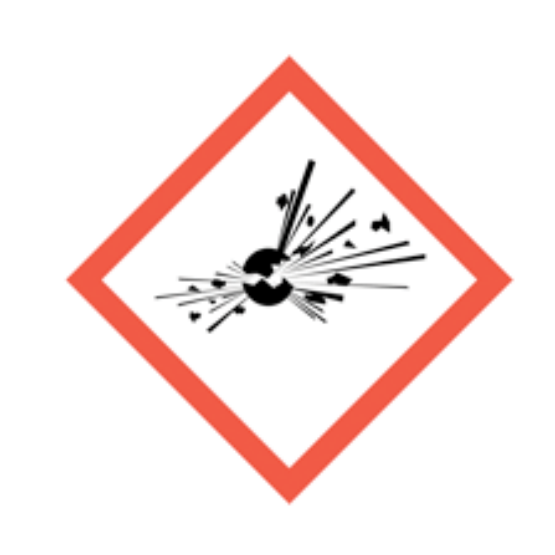
Exploding bomb
Explosive, self-reactive or organic peroxide hazards.
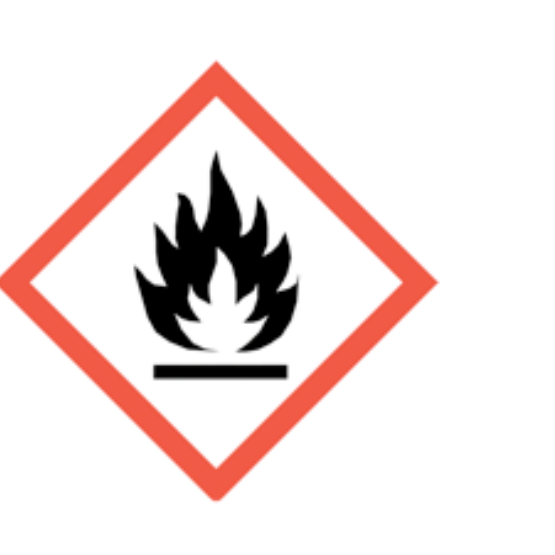
Flame
Flammable, self-heating or pyrophoric substances.
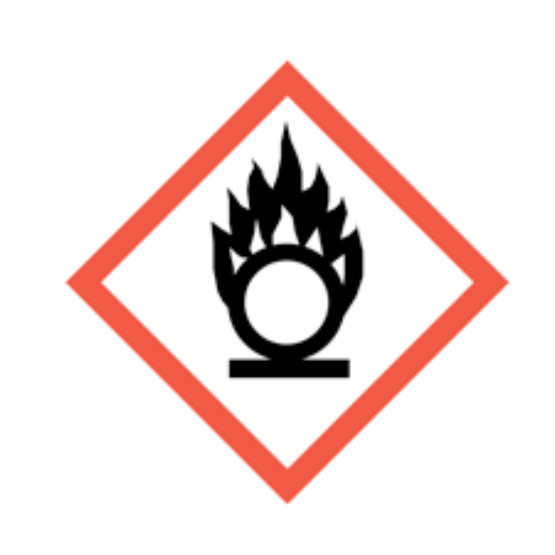
Flame over circle
Oxidising substances that can intensify fire.
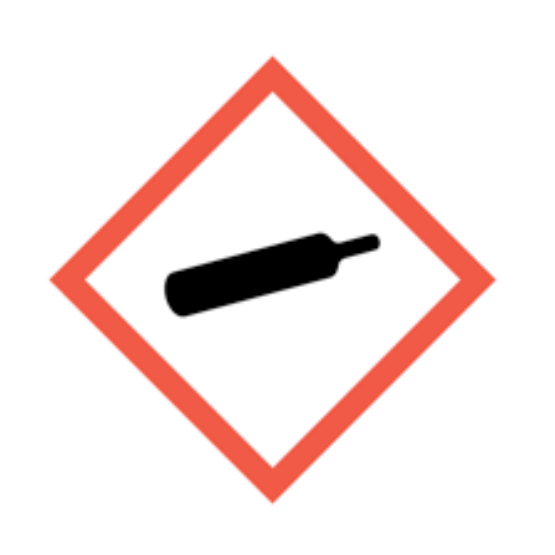
Gas cylinder
Gas under pressure.
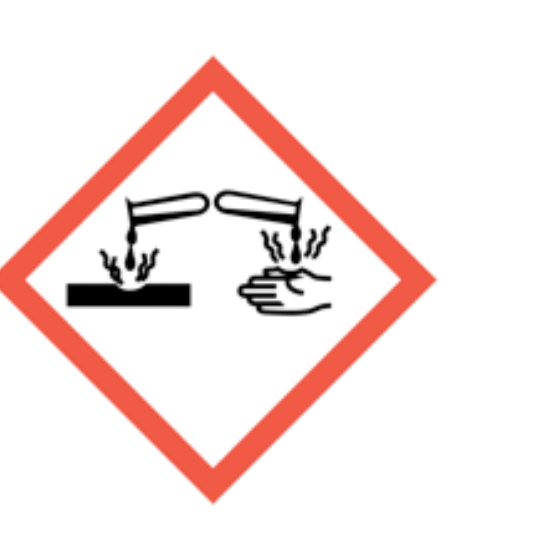
Corrosion
Skin burns, eye damage or corrosive to metals.
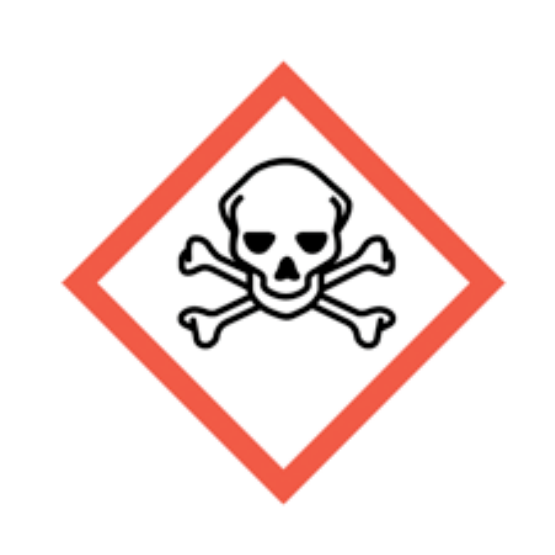
Skull and crossbones
Acute toxicity.
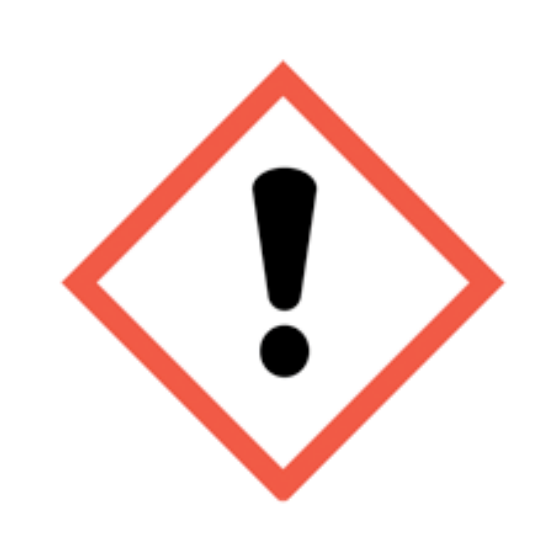
Exclamation mark
Irritation, harmful effects or skin sensitisation; some classifications cover drowsiness, dizziness or ozone-layer hazard. Read the actual hazard statements. Skin sensitisation differs from respiratory sensitisation.
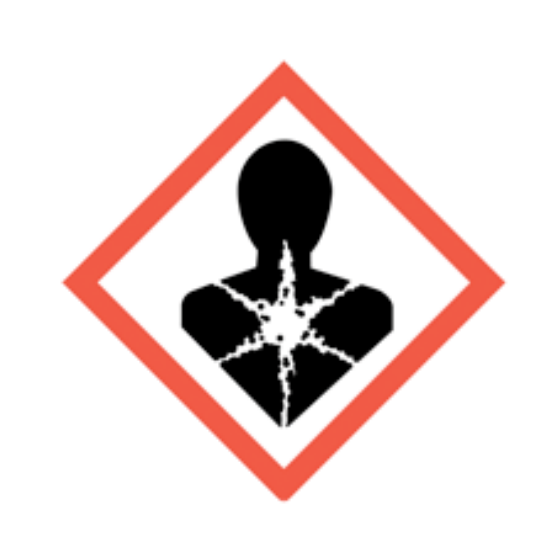
Health hazard
Serious health hazards, including organ damage, aspiration hazard, respiratory sensitisation, cancer and reproductive effects; some can follow a single exposure.
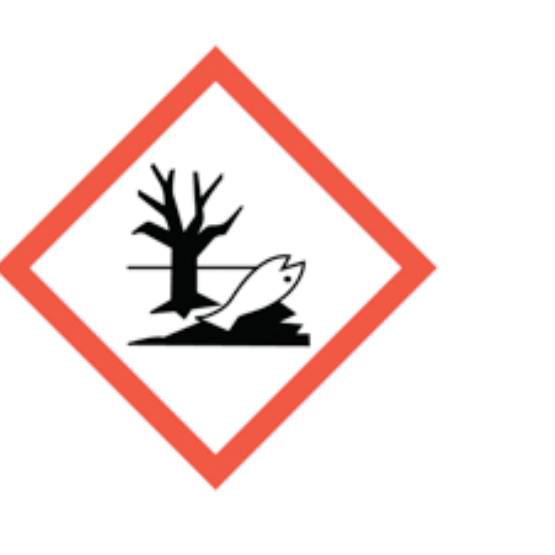
Environment
Hazardous to the aquatic environment.
What do the acronyms and key terms mean?
Acronyms should be understood before they are used in assessments, briefings, audits or learning answers.
Acronyms can exclude newer readers if they are not explained. This section keeps the main terms available at the end of the page so the article stays readable while still supporting learners and audit users.
| Acronym | Meaning | Plain-English use |
|---|---|---|
| PPE | Personal Protective Equipment | Equipment worn or held to protect against risk. |
| RPE | Respiratory Protective Equipment | Equipment protecting against inhalation exposure. |
| APF | Assigned Protection Factor | Expected protection factor for RPE when properly selected and used. |
| FFP | Filtering Facepiece | Disposable or reusable filtering mask classification. |
| COSHH | Control of Substances Hazardous to Health | Substance exposure regulations. |
| PPER | Personal Protective Equipment at Work Regulations | PPE legal framework. |
Which BuildOut documents support this topic?
Download individual editable BuildOut documents for this topic. Procedures and plans contain completed arrangements; forms, checklists, assessments, RAMS and permits are blank masters. Registers include separate worked examples.
| Document | Purpose and content | Editable download |
|---|---|---|
| PPE selection, issue, care and replacement procedure BOUK-PRO-PPE · Completed worked example · v1.0 | Match equipment to hazards and wearer, arrange fit testing where needed and replace defective equipment. | Download DOCX Read preview |
| Task and role PPE selection matrix BOUK-REG-PPE-01 · Blank register with separate worked entries · v1.0 | Specify hazard-linked suitable/compatible equipment and limitations. | Download XLSX Read preview |
| PPE issue, instruction and replacement record BOUK-FRM-PPE-01 · Blank editable master · v1.0 | Record provision, training, checks and timely replacement. | Download DOCX Read preview |
| PPE condition, compatibility and use check BOUK-CHK-PPE-01 · Blank editable master · v1.0 | Check fit, damage, compatibility and whether higher-level controls are functioning. | Download DOCX Read preview |
| Specialist PPE examination and defect record BOUK-FRM-PPE-02 · Blank editable master · v1.0 | Track competent checks where equipment or risk requires them. | Download DOCX Read preview |
Review and adapt the documents for your organisation, activities and jurisdiction before approval and issue. Open the SHAREms management-system hierarchy to find each document under its parent policy.
Unlock another resource
You have used this month’s two free downloads. Publish a post in your own words to unlock one more resource, or choose SHARE Individual for 10 downloads per month.
You decide whether to share. If you do, use the relevant platform disclosure tools and do not make claims you do not genuinely hold.