SHARE Knowledge Hub
Health and Safety Management Systems
Build a health and safety management system around what the business actually does. Review its activities, identify the risks and applicable legal duties, then develop practical systems of work with clear responsibilities, competent people and effective controls. Link the activity assessments, risk register and legal register to those arrangements. Use Plan, Do, Check, Act to implement them, check that they work and improve them as the business changes.
Explore the Build Out UK management system Explore the Crownway Fuels management systemUnderstanding Health and Safety Management Systems
A health and safety management system is an organised way to identify and control work risks, assign responsibility, check performance and improve.
Why this matters at work
Trace how defects are reported, prioritised, repaired and verified. Determine whether the audit criteria and sample could detect the recurring failure, and whether management received contradictory operational evidence. Allocate responsibility for immediate protection and the underlying design or resource issue. Verify the repair and review comparable machines or shifts where appropriate. Record the limits of the audit conclusion and the subsequent review; certification or a pass result must not be used to erase a specific unresolved control failure.
For higher-consequence hazards, identify critical barriers by function and performance standard: what they must prevent or mitigate, required availability, how they are tested and who owns impairments. A safety-critical alarm cannot be treated as healthy because the dashboard is green while it is bypassed. Separate a process-control function from an independent protection measure where the risk analysis requires it. HSE's COMAH technical pages on pumps, tanker loading, refrigeration and warehouse storage illustrate the difference between prevention, detection/control and mitigation; applicability depends on the site and hazard.
How organisations manage this in practice
Ask what prevented previous corrective actions from working. The same recurring issue across sites may indicate weak procurement, design standards, staffing, contractor coordination or governance. Reassess the risk rather than endlessly extending a deadline. Check whether controls still work at night, at production peaks and after maintenance. Compare internal experience with relevant external incident learning, HSE alerts and regulatory changes without copying controls that do not fit the operation.
Operational control translates assessed risk into physical safeguards and workable methods. Define the essential conditions for a task to proceed, the devices or arrangements that prevent the harmful event and the action when a barrier is missing. Use engineered safeguards, segregation, ventilation, isolation, maintenance, supervision and suitable PPE according to the risk and applicable law. Written procedures matter where tasks are complex or error-prone, but should be concise, accessible, current and tested against how the task can actually be done.
Define which activities, sites, workers, contractors, visitors and affected public the arrangements cover. Draw boundaries around the actual undertaking, not merely payroll or property ownership. A warehouse may control traffic routes shared with hauliers; a retailer may rely on landlord maintenance; an energy operator may use several engineering contractors. Record the interface and who can decide, inspect and stop work. Avoid a policy that covers headquarters but leaves night shifts, remote work and temporary activities outside the effective system.
How can you practise health and safety management-system decisions in 3D?
Practise health and safety management-system decisions by using the linked inspection points to connect a task, its controls and the evidence needed to verify them.


FOD check before a load crosses the boundary
All related inspection points 1 across 1 location
Aerosystems Engineering 1 inspection point
Practice in the SHAREhub environment. Browser practice is separate from workplace competence and formal learning records.
How does leadership connect Plan, Do, Check, Act in a health and safety management system?
Plan, Do, Check, Act (PDCA) connects what an organisation intends to achieve with what people do, the evidence of results and the changes needed to improve. Leadership keeps those four parts connected; the arrows show a repeating cycle, not a one-off paperwork exercise.
The document hierarchy shows what supports the system. PDCA explains how that system stays alive: turn policy and legal duties into controlled work, test the results and change what is ineffective.


ISO 45001:2018 + Amd 1:2024
Plan: risks, obligations and objectives
Understand the activities and people affected, identify hazards, assess risks and opportunities, establish applicable requirements and set owned OH&S objectives. Risk profiling informs planning as well as implementation.
Evidence to connect: Activity review; risk and legal registers; worker input; objectives, owners, resources and measures of success.
Connected work
Do: put the arrangements into practice
Provide competent people, usable current information and suitable resources. Operate the agreed controls and manage procurement, contractors, change and emergencies with worker involvement.
Evidence to connect: Current policies and procedures; competence evidence; maintenance and operational records; contractor, change and emergency arrangements.
Connected work
Check: test performance and control effectiveness
Evaluate reliable monitoring and measurement, relevant compliance evidence, internal audits and management review. Routine checks and independent audit serve different purposes; low accident numbers alone cannot show that controls work.
Evidence to connect: First-line checks; exposure and control-performance information; compliance evaluations; audit samples and management-review decisions.
Connected work
Act: improve and verify the change
Respond to incidents, nonconformities and ineffective controls. Protect people, address the causes, assign action and verify effectiveness, then update affected risks, arrangements and competence requirements.
Evidence to connect: Corrective actions with owners and dates; cause analysis; verified changes; revised documents and feedback into the next plan.
Connected work
Leadership connects every stage
Leaders own the effectiveness of the OH&S system, set priorities and provide resources. Context defines what the system must address; worker consultation and participation inform decisions throughout the cycle, not just at the centre.
Evidence to connect: An accurate system scope; policy commitments; clear authority and responsibilities; worker participation; resource and review decisions followed through.
Connected work
Read the picture as a learning aid, not an official ISO clause diagram. Its risk-profiling label sits under Do; ISO planning also addresses hazards, risks, opportunities and relevant obligations before work begins. Likewise, formal ISO management review is part of performance evaluation, with its decisions feeding subsequent improvement. Activities can span more than one stage.
- Plan
What must we achieve and what could prevent it? Understand the organisation and its activities, identify requirements and significant risks, and agree objectives, responsibilities, resources and measures of success.
Useful evidence: Policy commitments; activity and risk registers; applicable obligations; objectives with owners and baselines.
- Do
Are the planned arrangements working in daily practice? Provide competent people, suitable equipment and current instructions. Operate and maintain controls, involve workers, and manage suppliers, contractors, changes and emergencies.
Useful evidence: Controlled procedures; competence evidence; operating and maintenance records; contractor and change decisions.
- Check
What does reliable evidence tell us? Use operational checks, monitoring, appropriate compliance evaluation, internal audit and management review to test results and control effectiveness. Low accident numbers alone are not enough.
Useful evidence: Routine checklist findings; measurements and trends; audit samples; compliance evaluations; management-review decisions.
- Act
What will change and how will we know it helped? Correct the immediate problem, address its causes, assign improvements and verify their effectiveness. Feed the learning back into the next plan and the affected documents, risks and training.
Useful evidence: Corrective actions with owners; revised controls and documents; verification results; updated objectives and lessons.
| Stage | Main connection | Practical question |
|---|---|---|
| Plan | 6 - Planning | What must we achieve and what could prevent it? |
| Do | 7-8 - Support and operation | Are the planned arrangements working in daily practice? |
| Check | 9 - Performance evaluation | What does reliable evidence tell us? |
| Act | 10 - Improvement | What will change and how will we know it helped? |
Clause 4 (context) and clause 5 (leadership) shape the whole system, not just one quadrant. ISO 45001 also places worker consultation and participation at the heart of the system. Support, risk decisions and learning continue across stage boundaries.
The same cycle, different intended outcomes
- ISO 45001:2018 + Amd 1:2024: Prevent work-related injury and ill health through effective OH&S arrangements and worker participation. Plan exposure controls; put them into use; check their performance with the people doing the work; improve any failing barrier.
- ISO 9001:2026: Deliver conforming products and services and improve customer and process outcomes. Agree a customer's training requirements; deliver with competent tutors and controlled materials; review feedback and errors; improve the delivery process.
- ISO 14001:2026: Manage environmental aspects, applicable obligations and environmental performance. Identify a fuel-transfer pollution pathway; implement containment and operating controls; evaluate monitoring and exercise findings; improve the weakest controls.
An integrated system may share a document register, audit programme or change process, but it must retain the distinct safety, quality and environmental criteria. Success in one area does not excuse failure in another.
Build Out UK: close the loop, not just the document
For concrete cutting, connect the relevant policy and assessment to the actual dust-control method. Put the agreed equipment, instruction and supervision in place. Check the control in use and review suitable exposure evidence. If it is ineffective, restrict the affected work, resolve the cause, verify the revised method and update the linked records. This is an illustrative system trail, not a task-specific safe method or completed assessment.
In the SHAREhub environment: link the risk or objective, its current arrangement, monitoring evidence and any improvement action. Retain a responsible owner, relevant dates and evidence that the change worked; a link between records is not proof of effectiveness.
The cycle can organise a management system, but the diagram, a document library or a completed checklist does not establish conformity, certification or legal compliance. Use the authorised applicable standard and actual workplace evidence. Do not wait for the next audit or annual review to address an ineffective control.
How should a health and safety management system start with business activities?
Review what the business actually does, identify the risks arising from those activities, establish the applicable legal requirements and build practical arrangements that control the work. Use Plan, Do, Check, Act to keep those arrangements effective.
Build the arrangements from the actual task
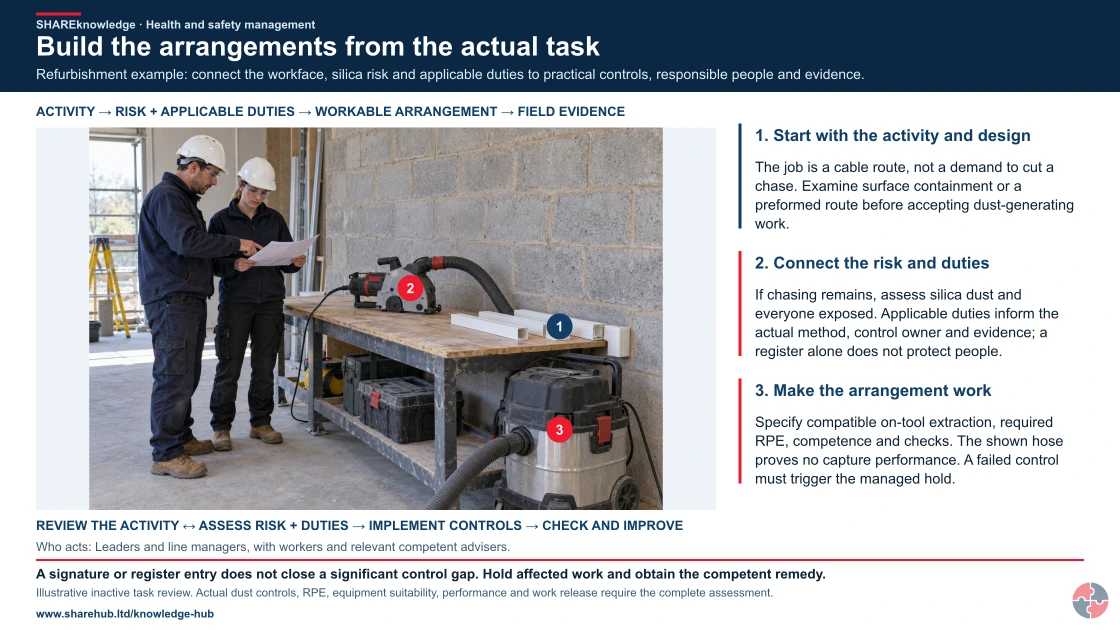
Full written explanation
A realistic HD British refurbishment scene shows an intact masonry wall, an inactive guarded wall chaser, its continuous dust-extraction hose and a sealed extractor, with surface-mounted cable containment as a possible design alternative. Two site professionals review a drawing without operating the equipment. Native markers connect the cable-route activity and no-chase design question, the silica-inhalation risk and applicable duties, and actual arrangements with required RPE, competent ownership and control-performance evidence. A complete landscape connection traces activity review through risk and legal reviews to implementation, workface checks and improvement. The image establishes no extracted dust level, equipment classification, safe isolation or permission to cut. The full original activity/barrier/harm pathway, register relationships and PDCA source explanation remain in the accessible written route.
Refurbishment example: connect the workface, silica risk and applicable duties to practical controls, responsible people and evidence.
- Start with the activity and design. The job is a cable route, not a demand to cut a chase. Examine surface containment or a preformed route before accepting dust-generating work.
- Connect the risk and duties. If chasing remains, assess silica dust and everyone exposed. Applicable duties inform the actual method, control owner and evidence; a register alone does not protect people.
- Make the arrangement work. Specify compatible on-tool extraction, required RPE, competence and checks. The shown hose proves no capture performance. A failed control must trigger the managed hold.
Change the pathway
- Plan from activities. Identify significant risks and applicable legal and other requirements.
- Put arrangements into practice. Provide competent people, resources, responsibilities and workable controls.
- Check and improve. Use field evidence, worker feedback, monitoring and management review.
Evidence check: Certification and closed actions are inputs to assurance, not proof of effective field control.
Follow the full activity, risk, legal-register and PDCA connections
Primary references: HSE managing health and safety: continual Plan, Do, Check, Act · HSE HSG65 management guidance overview (2013) · HSE concrete chasing: assess, prevent, control and review
Open the complete HD image (new tab)Download image

Follow the full activity, risk, legal-register and PDCA connections
Primary references: HSE managing health and safety: continual Plan, Do, Check, Act · HSE HSG65 management guidance overview (2013) · HSE concrete chasing: assess, prevent, control and review
Best-practice guide: Health and Safety Management Systems

Start with the business: activities, risks, duties and practical controls
Review what the business actually does, identify the risks arising from those activities, establish the applicable legal requirements and build practical arrangements that control the work. Use Plan, Do, Check, Act to keep those arrangements effective. Build a health and safety management system around what the business actually does.
Turn health and safety management systems knowledge into a decision
Build a health and safety management system around what the business actually does. Review its activities, identify the risks and applicable legal duties, then develop practical systems of work with clear responsibilities, competent people and effective controls. Risk register and CDM project risk profile.
the site team worked example
Assessing: Map significant risk areas and decide which need corporate standards, project controls and specialist review. Evidence / response: Risk register and CDM project risk profile. Analysing: Compare policy, project plans, RAMS, inspections, audits and incidents to see where the system drifts. Evidence / response: Assurance dashboard and audit themes.
Management system warning signs
Policy is not linked to arrangements: Intent does not reach the work. Risk assessments are copied: Controls do not match real work. Actions close without proof: Weak controls remain.
Choose controls for health and safety management systems
Eliminate: Design surface-mounted containment or a preformed service route so no chase is cut. Reduce: Select a compatible lower-dust board or prefabricated route where specification allows. Isolate: Keep other trades out of the dust release path with a verified enclosure. Control: Use suitable chaser and on-tool extraction for the actual material and depth. Control: Schedule the work, limit cut length and prohibit dry sweeping. Read the full control table for qualifications, ownership and verification. Use the actual task and applicable jurisdiction; existing technical approval remains unchanged.
Use the full health and safety management systems lesson
Use the full topic for the decision points, practical examples, detailed control tables and source scope. HSE guidance applies to Great Britain; use HSENI for the Northern Ireland route and the source’s stated jurisdiction. A simplified guide does not change the page’s technical-review or approval status.

Read all six steps as text
1. Start with the business: activities, risks, duties and practical controls
Review what the business actually does, identify the risks arising from those activities, establish the applicable legal requirements and build practical arrangements that control the work.
- Avoid / redesign: Design surface-mounted containment or a preformed service route so no chase is cut.
- Control the task: Keep other trades out of the dust release path with a verified enclosure.
- Verify before release: New layout holds work until checked.
Review what the business actually does, identify the risks arising from those activities, establish the applicable legal requirements and build practical arrangements that control the work. Use Plan, Do, Check, Act to keep those arrangements effective. Build a health and safety management system around what the business actually does.
Apply it: Which part of this plan would you check at the workface before authorising the task?
2. Turn health and safety management systems knowledge into a decision
Use the evidence to improve the actual work arrangement.
- Change at source: Design surface-mounted containment or a preformed service route so no chase is cut.
- Make it observable: New layout holds work until checked.
- Keep useful evidence: Risk register and CDM project risk profile.
Build a health and safety management system around what the business actually does. Review its activities, identify the risks and applicable legal duties, then develop practical systems of work with clear responsibilities, competent people and effective controls. Risk register and CDM project risk profile.
Apply it: What evidence would show that the change improves this task, rather than only completing a record?
3. the site team worked example
Example: a practical application of the existing topic lesson.
- Assessing: Map significant risk areas and decide which need corporate standards, project controls and specialist review.
- Analysing: Compare policy, project plans, RAMS, inspections, audits and incidents to see where the system drifts.
- Implementing: Use project start-up gates, contractor onboarding, supervisor checklists and role-based competence requirements.
Assessing: Map significant risk areas and decide which need corporate standards, project controls and specialist review. Evidence / response: Risk register and CDM project risk profile. Analysing: Compare policy, project plans, RAMS, inspections, audits and incidents to see where the system drifts. Evidence / response: Assurance dashboard and audit themes.
Apply it: At which point would you hold this example, and what evidence would allow it to proceed?
4. Management system warning signs
Connect the task, the route to the person and the control that can fail.
- Policy is not linked to arrangements: Intent does not reach the work.
- Risk assessments are copied: Controls do not match real work.
- Actions close without proof: Weak controls remain.
Policy is not linked to arrangements: Intent does not reach the work. Risk assessments are copied: Controls do not match real work. Actions close without proof: Weak controls remain.
Apply it: Who could be exposed, including other trades, cleaners, maintainers and people nearby?
5. Choose controls for health and safety management systems
Start with the stronger practicable options and verify their effect.
- Eliminate: Design surface-mounted containment or a preformed service route so no chase is cut.
- Reduce: Select a compatible lower-dust board or prefabricated route where specification allows.
- Isolate: Keep other trades out of the dust release path with a verified enclosure.
- Control: Use suitable chaser and on-tool extraction for the actual material and depth.
- Control: Schedule the work, limit cut length and prohibit dry sweeping.
Eliminate: Design surface-mounted containment or a preformed service route so no chase is cut. Reduce: Select a compatible lower-dust board or prefabricated route where specification allows. Isolate: Keep other trades out of the dust release path with a verified enclosure. Control: Use suitable chaser and on-tool extraction for the actual material and depth. Control: Schedule the work, limit cut length and prohibit dry sweeping. Read the full control table for qualifications, ownership and verification. Use the actual task and applicable jurisdiction; existing technical approval remains unchanged.
Apply it: Which stronger option can be used here, and who will verify it before accepting the remaining risk?
6. Use the full health and safety management systems lesson
Follow the official sources below and retain the task-specific evidence.
- Official guidance: HSG65 Managing for health and safety
- Official guidance: HSE health and safety management systems
- Task decision: Risk register and CDM project risk profile.
Use the full topic for the decision points, practical examples, detailed control tables and source scope. HSE guidance applies to Great Britain; use HSENI for the Northern Ireland route and the source’s stated jurisdiction. A simplified guide does not change the page’s technical-review or approval status.
Apply it: Which official source and full-topic section will you use to resolve the next decision?
The activity review is the foundation of the management system. Involve workers and supervisors, observe the work and compare existing arrangements with what happens in practice. Leadership sets the scope, responsibilities and resources; the activity and risk review determines which operating arrangements the business needs.
Review the business activities
Map services, processes, sites, people, equipment and materials. Include routine work, deliveries, cleaning, maintenance, contractors, unusual conditions and emergencies. Record where activities interact and who may be affected.
Output: an activity map with a responsible manager for each area.
Identify and assess the activity risks
For each activity, identify hazards, who could be harmed and how, and whether current controls work. Include immediate injury and longer-term health risks. Prioritise gaps by risk, with action owners and completion dates.
Output: activity risk assessments and a prioritised risk register linked to the activity map.
Identify applicable duties through a legal register
Check which legal requirements apply to the actual work and location. Record the duty, why it applies, the action needed and the evidence that will demonstrate it is being met. Resolve uncertainty with competent support before finalising arrangements.
Output: a legal register linked to activities, risk assessments and control arrangements.
Design controls and practical systems of work
Use the hierarchy of controls to remove hazards or reduce risks at source. Decide how the activity will be planned, authorised, carried out, maintained and handed back. Specify essential controls, responsibilities and conditions that require work to stop.
Output: workable operating standards and safe methods, supported by maintenance, procurement, contractor and emergency arrangements where relevant.
Put the arrangements into everyday use
Provide the equipment, time, competent people, instruction and supervision needed. Test the method with those doing the work. Keep instructions accessible, check understanding and confirm controls are in place before work starts.
Output: working controls, clear responsibilities and evidence of implementation.
Check, learn and improve through PDCA
Check critical controls during work and evaluate compliance against the legal register. Review inspections, incidents, worker feedback and audit findings. Leaders assign and resource improvements, verify their effectiveness and update the activity map, assessments and arrangements when things change.
Output: verified actions and a revised plan for the next cycle.
Keep the connections visible: activity → risk assessment → applicable duty → control and safe method → responsible person → check and evidence → review and improvement. The risk and legal reviews inform one another; revisit both when the activity or requirements change.
Continue with the legal register, Plan, Do, Check, Act and the Build Out UK management system explorer.
How should a legal register turn health and safety duties into practical action?
A useful legal register connects each applicable requirement to the activities it affects, the controls required, a responsible person and evidence of implementation. A list of legislation alone does not show compliance.
The legal register and risk register answer different questions. The risk register describes what could cause harm and how it is controlled. The legal register identifies the applicable duties and how the business will meet and check them. Link the two to the same activities and procedures.
| Record | Connect it to the business |
|---|---|
| Activity and location | Identify the process, site, people and jurisdiction covered; link the relevant activity and risk assessment. |
| Requirement and applicability | Record the current instrument and relevant provision, the duty in practical terms and why it applies. Record the reason for any exclusion. |
| Required arrangements | Link the duty to operating controls, procedures, competence, maintenance, examinations or other actions it requires. |
| Owner and resources | Name the responsible role, competent support, resources, action deadline and any escalation route. |
| Evidence and evaluation | Record what was checked, when and by whom, with links to observations and records. Distinguish a planned action from a control verified in use. |
| Gaps and review | Track unresolved duties, corrective actions and review dates. Recheck after legal, activity, equipment, site or workforce changes and relevant findings. |
Worked connection — refurbishment dust: the activity review identifies concrete chasing; the assessment identifies silica exposure; the legal review identifies the applicable substance-control duties. The operating arrangement considers avoiding the chase, then specifies the necessary dust controls, competent users, equipment checks and stop conditions for any remaining cutting. Inspections and maintenance evidence test whether the controls work; defects feed back into the method and management review. This is an illustrative connection, not a complete assessment or legal-register entry. HSE concrete chasing guidance.
A legal register is a practical management tool; there is no general requirement for every business to keep a document with that name. The underlying duties are to comply with applicable law and maintain effective arrangements. Use current requirements for the relevant jurisdiction, including separate Northern Ireland instruments and nation-specific requirements where applicable. HSE management duties; GB and Northern Ireland duties.
Worked example to download. See how a requirement becomes a practical duty, an owner and an evidence check in the Crownway Fuels legal and permissions register (XLSX). It includes worked applicability decisions and separate blank legal and permissions sheets. Run the discussion using the Risk register workshop guide (DOCX). These worked examples cover ten English forecourts, head-office/mobile support and a separately labelled illustrative bulk terminal. Use the blank sheets for your own organisation, checking its activities, jurisdiction and controls.
A system in practice
How does the Build Out UK example organise its health and safety management system?
The Build Out UK example connects business activities and risks to policies, practical arrangements, responsibilities and supporting records in an explorable management-system hierarchy.
Open all 35 Build Out UK Limited policies · Read the main policy, intent, organisation and arrangements, then explore the 34 linked activity policies.
A management system connects leadership commitments and legal duties to the way work is planned, carried out, checked and improved. This construction and fit-out example catalogues 271 documents across 34 activity branches, with 35 completed policy examples, 233 editable supporting arrangements, 199 expected record types and 45 laws linked to the arrangements they support.

Planning example, not evidence of compliance. The 35 policies and their intent, organisation and arrangements components are available as completed worked examples, without company approval or issue. All 233 supporting arrangements are available as editable Word documents or Excel workbooks. Procedures and plans show completed arrangements; forms, checklists, assessments, RAMS and permits are blank masters. Registers include separate worked examples. No completed operational records are supplied. The legal baseline is Great Britain, with nation-specific fire law. Northern Ireland requires a separately reviewed overlay. Register snapshot: 16 October 2026.
Review all 233 editable arrangements
Loading the document register…
Scope, sources and ISO alignment
The visual map follows the register's parent-child hierarchy. Each document's explicit legal duty links appear alongside it, with the register application note and official legislation. Record types inherit only their source template's links. Legal duty links, connected processes and ISO examples are separate associations, not additional hierarchy parents. Filtering retains ancestor documents as context.
The company hierarchy and explicit legal links come from the supplied Build Out UK planning register. A policy title or blank template is not itself a legal requirement or proof of effective controls. P1 and P2 are preparation priorities, not risk ratings; conditional work must be controlled before it starts.
ISO 45001:2018, including Amendment 1:2024, is a voluntary management-system standard. The clause examples are a SHARE editorial interpretation and are not a complete gap analysis, certification or a claim of conformity. Legal compliance depends on applicable duties and what happens in practice.
The supplied legal register records a review date of 16 October 2026; that is not a fresh line-by-line verification of every law by this page. Check jurisdiction, dutyholder, thresholds, amendments and current guidance before applying it. Review and retention intervals need an approved, applicable basis.
HSE management systems · HSE ISO 45001 advice · ISO 45001 and its amendment · ISO clause-structure preview
How does the Build Out excavation example connect work, evidence and planned controls?
Follow one drainage task from service information to work limits, inspection and handback. The linked company catalogue is planned and not approved; it contains no completed survey, inspection, excavation design or permit authorisation.
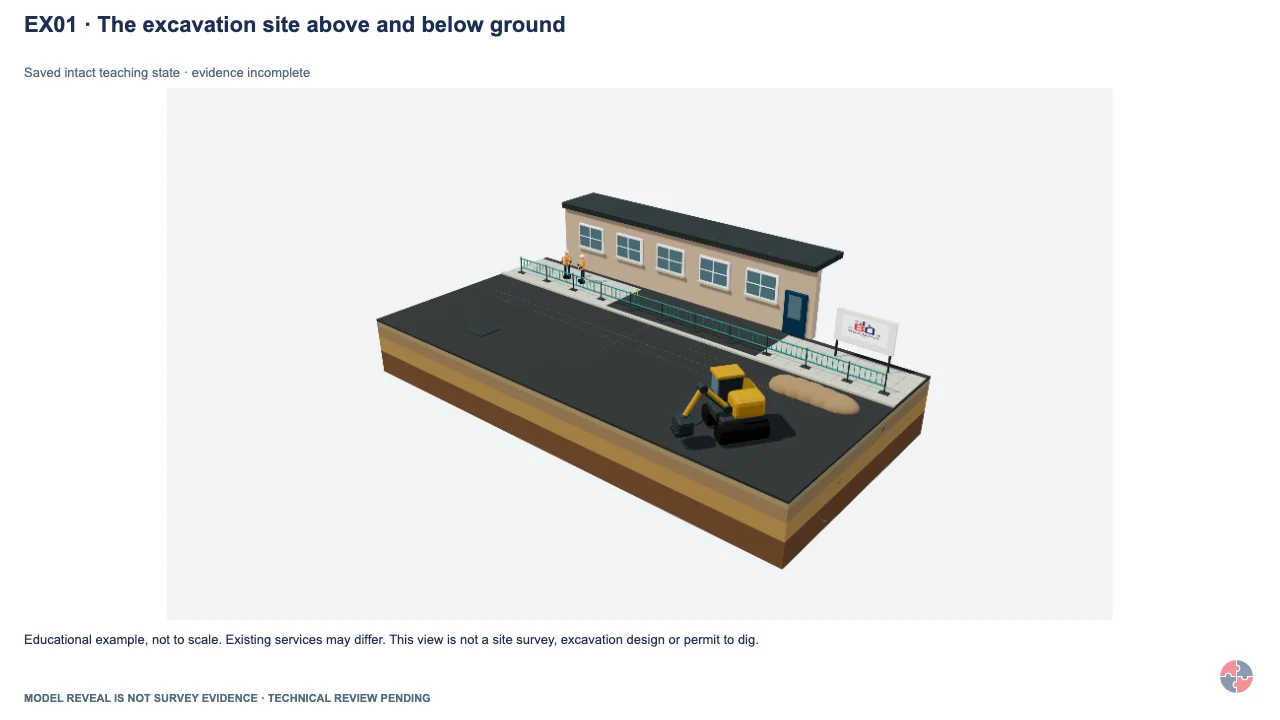
The excavation site above and below ground
The surface shows only part of the site. Combine plans, detection and point verification while also assessing stability, plant and public interfaces.
Learning focus: The surface shows only part of the site. Combine plans, detection and point verification while also assessing stability, plant and public interfaces.
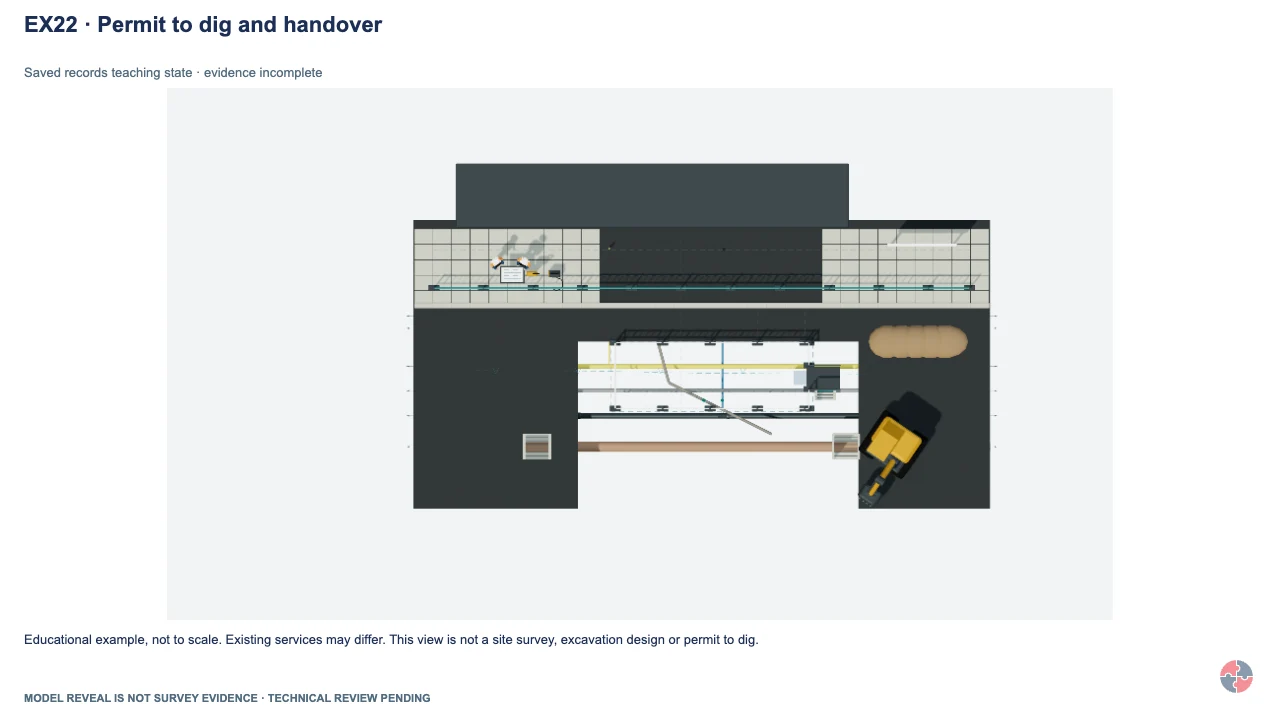
Permit to dig and handover
A permit coordinates a defined task and its controls. Check evidence, limits, unknowns and handover status; paperwork alone does not establish safe ground.
Learning focus: A permit coordinates a defined task and its controls. Check evidence, limits, unknowns and handover status; paperwork alone does not establish safe ground.
Educational example, not to scale. Existing services may differ. This view is not a site survey, excavation design or permit to dig.
A fuel business in practice
How does the Crownway Fuels example organise its health and safety management system?
The Crownway Fuels example connects its fictional operating activities to policies, risks, practical controls and evidence through a sector-specific management-system hierarchy.

Follow the connections from legal duties to fuel-site policies, procedures, practical controls and expected evidence. This fictional example contains 269 editable reference documents across 37 activity branches, 191 expected record types and 51 laws with 1,023 explicit document links.
Planning example, not operational approval. An additional lower-tier COMAH bulk-fuel establishment is an illustrative scenario, not a verified eleventh address or a reclassification of a forecourt. Actual inventories, capacities, locations, permits, site controls and dutyholders need confirmation. England is the operational baseline; nation-specific conditions remain and Northern Ireland needs a separate review. Register snapshot: 16 October 2026.
All 269 component documents are available as editable Word or Excel resources, with 49 printable PDFs. Policies, procedures and plans contain fictional arrangements; recording tools are blank masters and registers separate fictional entries from actual working sheets. No company approval or completed operational records are supplied. ISO 45001 alignment is an indicative teaching interpretation, not certification.
Related free resources: legal and permissions register (XLSX), organisational risk register (XLSX) and risk register workshop guide (DOCX). The registers contain completed fictional examples and separate blank working sheets. The detailed registers retain their own review dates and unresolved applicability decisions; no full fresh legal audit is implied.
Review all 269 editable Crownway resources
Ten fictional petrol-station DSEAR assessments and terminal MAPP · Realistic forecourt visual guide
Loading the Crownway document register...
Fuel-site scope, sources and ISO alignment
The three profiles describe retail forecourts, an additional bulk-fuel scenario and head-office/mobile support. They are not actual site records. Document/profile links and 22 applicability decisions retain their conditions and verification needs; a missing link is not a legal exemption.
DSEAR controls remain relevant alongside COMAH where dangerous-substance risks arise. COMAH scope and tier depend on actual substance classification, maximum inventory and aggregation. The illustrative lower-tier scenario does not make upper-tier safety-report or statutory internal/external emergency-plan requirements unconditional.
The tanker-delivery assessment and checklist are siblings beneath the delivery procedure. The expected checklist record series belongs to the checklist. Legal links, site-profile links, connected processes and ISO examples are associations, not additional hierarchy parents.
How to apply, why it matters, evidence to retain and stop/escalation criteria are proposed company controls. They require competent site-specific review, approved engineering limits and clear restart authority before use. Preparation priorities are not risk ratings or permission to defer a necessary control.
The supplied register's review date is not a fresh legal audit of every entry. The fuel/process-safety scope is not a complete retail, food, consumer or employment-law register. Original private planning sources remain private. No operational record capture, live permits or approval actions are provided here.
HSE COMAH operator duties · HSE DSEAR requirements · HSE ISO 45001 advice
What are the key points for health and safety management systems?
Start with business activities, identify their risks and legal duties, and build practical controls that improve through Plan, Do, Check, Act.
Review the activities first
Map the work, assess its risks and identify applicable duties before selecting the operating arrangements.
The system should fit the risk
A small low-risk office needs different arrangements from a construction contractor or process site.
PDCA keeps control alive
Plan, Do, Check, Act prevents the system stopping at written arrangements.
Paperwork is not proof
Documents need field evidence, worker understanding and maintained controls.
Certification has limits
ISO certification may help, but it does not replace legal responsibility or practical control.
Review should change decisions
Management review should lead to resources, revised priorities and verified improvements.
What does a health and safety management system mean?
It means the repeatable arrangements that make risk control happen before, during and after work.
A management system connects policy, risk assessment, people, controls, monitoring and learning. It should make clear who does what, when and how. It should also show how decisions are made when circumstances change, such as a new contractor, new equipment, a near miss, a health surveillance trend or a maintenance backlog.
The most useful way to test a system is to follow a risk from identification to control. If a dust hazard is identified, the system should show how exposure is assessed, how controls are selected, how workers are trained, how LEV is maintained, how health surveillance is considered and how performance is reviewed.
| Test question | What it checks | Example evidence |
|---|---|---|
| Is risk identified? | Hazards and affected people are recognised. | Risk assessment, register and worker consultation. HSE health and safety management systems |
| Is ownership clear? | Someone has authority and accountability. | Role descriptions and action owners. HSE health and safety management systems |
| Are controls implemented? | Controls exist and are used in the field. | Observation, inspection and maintenance records. HSE health and safety management systems |
| Is competence managed? | People understand tasks and limits. | Training, assessment and supervision records. HSE health and safety management systems |
| Is performance reviewed? | Evidence changes decisions. | Audit reports and management review actions. HSE health and safety management systems |
A system connects a named owner, the site risk profile, working controls and feedback; a procedure library alone cannot show whether silica extraction works. HSE health and safety management systems
How does Plan, Do, Check, Act keep a health and safety management system working?
Plan, Do, Check, Act is a continuous cycle that keeps health and safety arrangements controlled and improving.
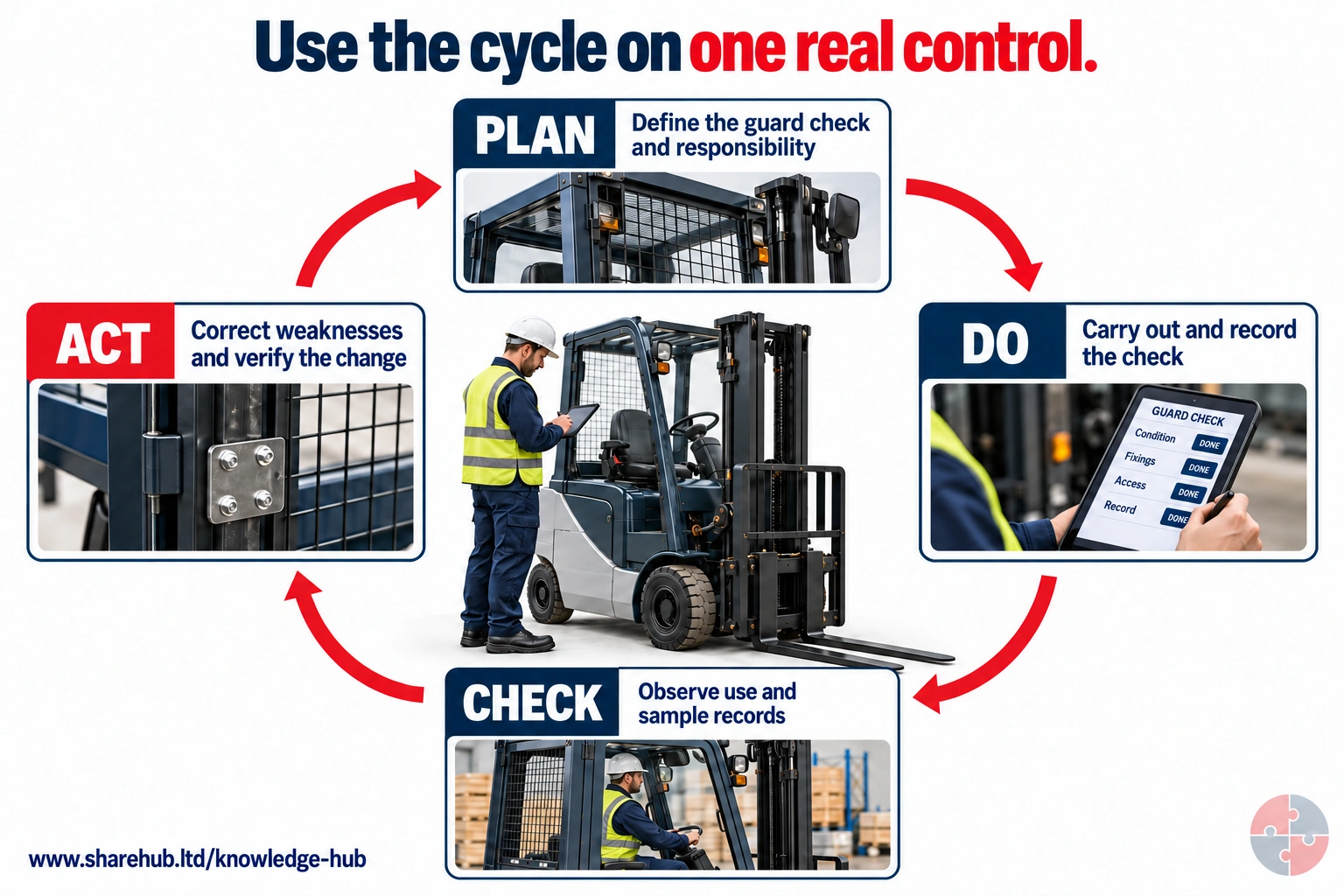

The Plan, Do, Check, Act cycle is applied to a lift-truck guard-check arrangement. Define the check and responsibility, implement it, observe normal use and sample records, then correct weaknesses and verify improvement. Check asks whether the intended arrangements work in practice.
What evidence belongs in Check?
Representative records, discussion with users and observation of normal use provide evidence about implementation. Corroborate that the prescribed checks happen and controls remain effective; completed forms alone do not prove this.
Management-cycle example only. The lift-truck guard and operating scenes do not prescribe a guard design, inspection test or permission to operate.
Source guidance: HSE HSG65
Plan starts with the business activity review: assess the risks, identify applicable duties through the legal register, and design the controls, responsibilities, resources and objectives. Do puts the safe methods, equipment, competence and supervision into use. Check tests control effectiveness and compliance through observation, monitoring, inspection and audit. Act uses the findings to improve arrangements and update the activity, risk and legal reviews.
The business review and PDCA belong together. The review establishes what must be managed; PDCA keeps it managed. Involve workers throughout and repeat the review when activities, people, equipment, legal requirements or evidence of control effectiveness change.
| Stage | Practical question | Typical evidence |
|---|---|---|
| Plan | What risks, legal duties, resources and objectives need attention? | Activity review, risk assessments, risk register, legal register, policy, objectives and resourced programme. HSG65 Managing for health and safety |
| Do | Are controls implemented and understood? | Procedures, training, supervision and contractor rules. HSG65 Managing for health and safety |
| Check | Are controls working and are weak signals visible? | Inspections, monitoring, audits and incident findings. HSG65 Managing for health and safety |
| Act | What needs to change because of evidence? | Management review, action closure and revised arrangements. HSG65 Managing for health and safety |
Plan the no-chase route, implement compatible extraction if cutting remains, check capture during work and act on defects before repeating the task. HSG65 Managing for health and safety
How formal should a health and safety management system be?
The system should be proportionate to the size, complexity and risk profile of the organisation.
The right level of formality depends on the risk, complexity and pace of change. A small business may control simple risks with simple arrangements, while construction, public-facing and major-hazard settings need stronger standards, evidence and assurance.
| Organisation | Suitable approach | Where more formality is needed |
|---|---|---|
| Small low-risk office | Simple policy, risk assessments, basic training and periodic review. | If work changes, contractors attend or vulnerable workers need support. HSE health and safety management systems |
| Riverside leisure centre | Formal arrangements for public interface, fire, pool safety, food, contractors and safeguarding. | Seasonal activities, events and young workers. HSE health and safety management systems |
| BuildOut construction contractor | Project-level CPPs, contractor control, inspections, permits and audit programme. | High-risk work, temporary works and multiple sites. HSE health and safety management systems |
| Crownway fuel site | Formal process safety, legal register, barrier assurance and emergency management. | COMAH/DSEAR hazards, major accident scenarios and safety-critical assets. HSE health and safety management systems |
| Multi-site business | Corporate standards with local implementation evidence. | Different sites, managers, cultures and risk profiles. HSE health and safety management systems |
A small low-risk operation may need simple arrangements, but a multi-project contractor needs enough coordination to keep high-risk controls consistent. HSE health and safety management systems
How do formal, certified and informal health and safety management systems differ?
Informal systems can manage simple risks; formal and certified systems add structure, evidence and assurance where complexity increases.
A formal system can help because it defines responsibilities, standards, records and review. Certification can provide external assurance and supply-chain confidence. But both can fail if attention shifts from risk control to maintaining certificates and documents.
An informal system can be effective in simple settings when the owner understands the risks, talks to workers, fixes problems and reviews change. It becomes weak when knowledge sits in one person's head or when growth, contractors and complexity outpace the arrangements.
| System type | Best fit | Strength | Failure mode |
|---|---|---|---|
| Informal | Small, low-risk, stable work. | Simple and close to the work. | Relies on memory and one person's knowledge. HSE health and safety management systems |
| Formal internal system | Growing or higher-risk business. | Clear standards, roles and records. | Can become paperwork-heavy. HSE health and safety management systems |
| Certified ISO 45001 system | Complex, multi-site or supply-chain driven organisation. | Structured clauses, audit and external challenge. | Certification mistaken for proof of control. HSE health and safety management systems |
| Sector framework | Specialist industries such as process safety, construction or transport. | Targets sector risks and common controls. | Copied without local adaptation. HSE health and safety management systems |
Certification can demonstrate a system was assessed against a standard; it does not establish that this contractor’s extraction captures dust today. HSE health and safety management systems
What elements should a health and safety management system include?
A management system should cover leadership, policy, planning, risk control, competence, communication, monitoring, audit and review.
The elements below should work together. If leadership, policy, risk assessment, operational control, competence, consultation, monitoring and review sit in separate silos, the system can look complete while failing in practice.
| Element | Purpose | Good evidence |
|---|---|---|
| Leadership | Set direction, resources and accountability. | Management review and risk decisions. HSG65 Managing for health and safety |
| Policy | State intent, responsibilities and arrangements. | Signed, current and communicated policy. HSG65 Managing for health and safety |
| Risk assessment | Identify hazards and controls. | Suitable assessments and risk register. HSG65 Managing for health and safety |
| Operational control | Make controls work in the field. | Procedures, permits, inspections and supervision. HSG65 Managing for health and safety |
| Competence | Ensure people can perform safely. | Role-based training and assessment. HSG65 Managing for health and safety |
| Consultation | Use worker knowledge and legal consultation routes. | Meeting notes and feedback loops. HSG65 Managing for health and safety |
| Monitoring and audit | Check control health and system performance. | Inspections, audits and indicators. HSG65 Managing for health and safety |
| Learning and review | Improve after evidence changes. | Action tracker and updated arrangements. HSG65 Managing for health and safety |
Policy, risk assessment, competence, consultation, operating checks and learning must connect to the same task owner. HSG65 Managing for health and safety
How does a health and safety management system flow from policy to improvement?
A good management system connects leadership intent and the business activity review to risks, applicable duties, practical controls, evidence and improvement.
The policy sets direction and responsibilities. Review the business activities and assess their risks. Use a legal register to identify applicable duties. Design and implement practical arrangements for each activity, with named owners and competent people. Monitoring and compliance evaluation check the result; management review resources improvements and closes the PDCA loop.
This flow is especially useful for learners because it turns HSG65 and Plan, Do, Check, Act into a practical story. It also helps managers avoid isolated documents: a policy without a risk register is vague; a risk register without controls is a list; controls without monitoring are assumptions; actions without verification are hope.
| Flow step | What happens | Example output |
|---|---|---|
| Business activity review | Map actual work, people, locations and interfaces, then assess the activity risks. | Activity map and linked risk assessments with owners and priorities. |
| Applicable legal duties | Identify duties for each activity and jurisdiction and translate them into required arrangements. | Legal register linked to activities, control standards, owners and compliance evidence. |
| Policy | Leadership states intent, scope, responsibilities and commitment to prevent harm. | Signed policy with clear accountabilities. HSG65 Managing for health and safety |
| Risk register | Significant risk scenarios are captured, prioritised and owned. | Register showing work at height, workplace transport, dust and contractor risks. HSG65 Managing for health and safety |
| Controls | ERICPD-style controls are selected and translated into standards, procedures and task controls. | Edge protection standard, traffic segregation plan and COSHH controls. HSG65 Managing for health and safety |
| Competence | Roles are matched to training, assessment, authorisation and supervision requirements. | Supervisor competence matrix and contractor onboarding record. HSG65 Managing for health and safety |
| Monitoring | First-line checks confirm controls are present and used during work. | Closed-question site inspection and permit check. HSG65 Managing for health and safety |
| Audit | System audits and independent reviews sample documents, interviews and work as done under a defined mandate. | Internal audit report with risk-ranked findings. HSG65 Managing for health and safety |
| Review | Leaders review trends, repeated weaknesses, change and resource needs. | Management review minutes with decisions and owners. HSG65 Managing for health and safety |
| Improvement | Actions are implemented and verified in the workplace. | Action closure evidence, re-audit and updated standards. HSG65 Managing for health and safety |
A defect report should travel from the cutting crew to repair, competent verification and a changed project standard if the problem recurs. HSG65 Managing for health and safety
How should a health and safety management system connect policy to real work?
The system should show a visible line from the policy promise to the control used by the worker.
This worked flow shows how a broad policy promise becomes a task control. It helps learners and managers see the route from a signed policy to risk assessment, supervision, verification and review.
| System layer | Example for work at height | Evidence |
|---|---|---|
| Policy | Commitment to prevent falls and manage contractors. | Signed policy and objectives. HSE: Working at height—planning, prevention and rescue |
| Standard | Work at height standard sets hierarchy and permit requirements. | Controlled standard. HSE: Working at height—planning, prevention and rescue |
| Assessment | Task-specific assessment identifies roof edge and fragile surface risk. | RAMS and site survey. HSE: Working at height—planning, prevention and rescue |
| Implementation | Edge protection, MEWP, rescue plan and competent operators. | Inspection, training and equipment records. HSE: Working at height—planning, prevention and rescue |
| Verification | Supervisor checks controls before work and during task. | Closed-question checklist and photos. HSE: Working at height—planning, prevention and rescue |
| Review | Near miss leads to revised contractor mobilisation gate. | Investigation and action closure. HSE: Working at height—planning, prevention and rescue |
For this separate work-at-height flow, ask the site supervisor to show the actual access/edge or fragile-surface controls, rescue arrangements and the stop rule when protection fails. The concrete-chasing example elsewhere is a different task. HSE concrete chasing and mortar raking
How should a risk register support a health and safety management system?
A risk register should help leaders prioritise controls, ownership, monitoring and review instead of acting as a static list.
Put field-control evidence through PDCA
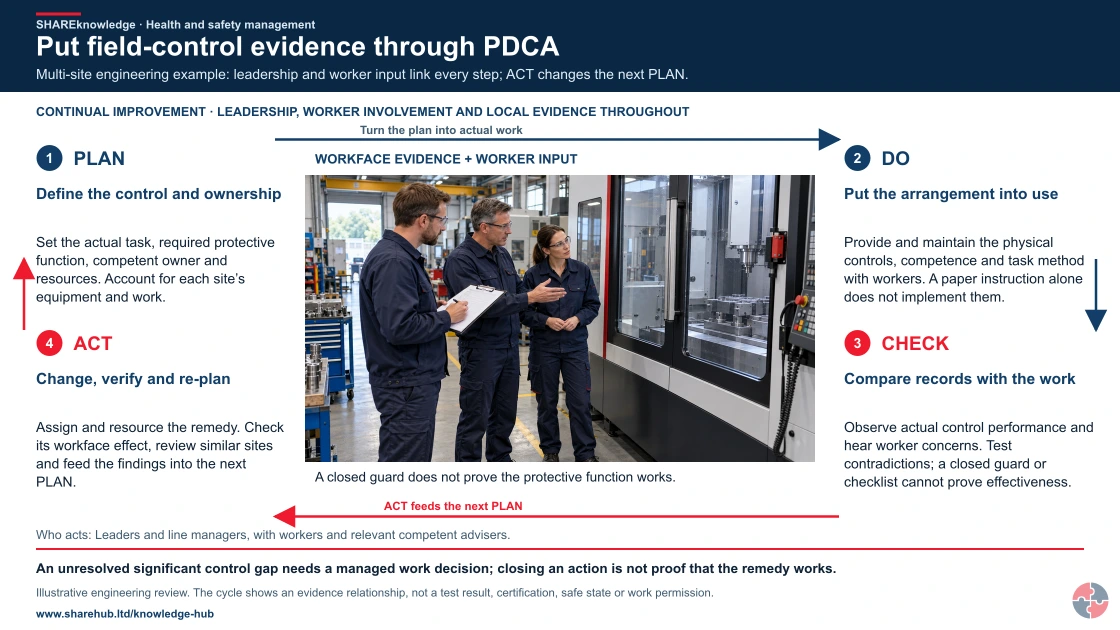
Full written explanation
A complete native landscape Plan, Do, Check, Act cycle surrounds a realistic HD British engineering-workplace scene. Workers and a supervisor compare a record with a closed machining-centre guard. Four labelled stages and directional arrows connect defining the actual protective function and ownership, putting arrangements into practice, testing field performance and worker concerns, and resourced improvement with verification. The ACT-to-PLAN feedback arrow explicitly updates the next plan and highlights local differences before changes are copied to other sites. Leadership and worker involvement run throughout the cycle. No missing guard, failed test, real incident, verified cause or certification outcome is invented from the pictured scene; a closed guard or a recorded check is not proof that its protective function works. Preserve the full original four-step PDCA text, task/risk/legal relationships, practical controls, work hold and multi-site qualifications in the written alternative.
Multi-site engineering example: leadership and worker input link every step; ACT changes the next PLAN.
- PLAN: understand the business. Review activities, people, risks and applicable requirements; set priorities and ownership.
- DO: control the work. Implement practical arrangements with resources, competence and worker involvement.
- CHECK: examine evidence. Observe work, check control performance and learn from concerns, incidents and monitoring.
- ACT: improve the system. Complete effective changes and management review; feed learning back into the next plan.
When the evidence does not fit: An unresolved significant control gap needs a managed work decision and action; a policy signature does not close the gap.
Who acts: Leaders and line managers, with workers and relevant competent advisers.
Changed workplace
Growing construction business: Build arrangements from changing projects, trades and subcontractor interfaces.
Multi-site engineering: Check how local risks and resources differ before copying an arrangement across sites.
Evidence check: Certification and closed actions are inputs to assurance, not proof of effective field control.
Follow the full activity, risk, legal-register and PDCA connections
Primary references: HSE managing health and safety: continual Plan, Do, Check, Act · HSE HSG65 management guidance overview (2013) · HSE concrete chasing: assess, prevent, control and review
Open the complete HD image (new tab)Download image

Follow the full activity, risk, legal-register and PDCA connections
Primary references: HSE managing health and safety: continual Plan, Do, Check, Act · HSE HSG65 management guidance overview (2013) · HSE concrete chasing: assess, prevent, control and review
Build the risk register from the activity review and assessments. Link each significant scenario to the relevant legal-register entry, operating procedure, control owner, assurance checks and review triggers. These connections turn the register into a tool for decisions and follow-up.
| Field | Why it matters | Example |
|---|---|---|
| Risk scenario | Describes what can happen. | Forklift collision with pedestrian at dispatch. HSG65 Managing for health and safety |
| Current controls | Shows what is relied on now. | Segregated route, barriers and marshal. HSG65 Managing for health and safety |
| Control owner | Defines accountability. | Warehouse manager. HSG65 Managing for health and safety |
| Assurance method | Shows how control health is checked. | Weekly route inspection and audit sample. HSG65 Managing for health and safety |
| Action and due date | Turns review into improvement. | Barrier upgrade by named date. HSG65 Managing for health and safety |
| Review trigger | Keeps the register current. | Layout change, near miss or traffic increase. HSG65 Managing for health and safety |
Record the inhalation harm route, exposed trades, control owner, failed-capture stop point and evidence of recovery. HSG65 Managing for health and safety
Worked example to download. Use the Crownway Fuels organisational risk register (XLSX) to explore 37 enduring organisational risks, their controls, assurance actions and review decisions. Compare the worked rows with the blank working sheets; target ratings depend on verified controls. Run the discussion using the Risk register workshop guide (DOCX). These worked examples cover ten English forecourts, head-office/mobile support and a separately labelled illustrative bulk terminal. Use the blank sheets for your own organisation, checking its activities, jurisdiction and controls.
How should competence fit into a health and safety management system?
Competence should be defined by role, risk and task, then checked through evidence of performance.
Competence is more than attending a course. A supervisor needs to know what good looks like, when to stop work and how to verify controls. A maintenance engineer needs technical knowledge, isolation discipline and limits of authority. A senior leader needs enough understanding to challenge dashboards and resource risk-based decisions.
A management system should therefore define competence requirements, assessment methods, refresher triggers and supervision needs.
| Role | Competence need | Evidence |
|---|---|---|
| Director | Understand legal duties, risk profile and resource decisions. | Leadership training and board review. HSG65 Managing for health and safety |
| Supervisor | Verify controls and manage change at the workface. | Field assessment and inspection quality. HSG65 Managing for health and safety |
| Worker | Understand hazards, controls and stop-work triggers. | Task briefing and observation. HSG65 Managing for health and safety |
| HSE adviser | Advise within competence and escalate specialist issues. | CPD, qualification and advice records. HSG65 Managing for health and safety |
| Contractor | Meet site standards and task competence. | Prequalification and induction. HSG65 Managing for health and safety |
Assess the cutter and supervisor on the installed tool and extraction method, not on attendance at a generic induction. HSG65 Managing for health and safety
How should worker consultation support a health and safety management system?
Consultation improves control quality by involving the people who understand the work and its practical barriers.
Consultation is strongest when it is matched to the decision being made. The routes below range from formal safety representatives to task-level briefings and design reviews, because different issues need different conversations.
| Route | Best used for | Evidence |
|---|---|---|
| Safety representatives | Formal worker consultation and inspection feedback. | Committee minutes and action tracker. HSE consulting and involving workers |
| Toolbox talks | Task-level feedback and immediate learning. | Briefing notes and actions. HSE consulting and involving workers |
| Design reviews | Controls before equipment or process changes. | Design risk review. HSE consulting and involving workers |
| Incident learning sessions | Understanding why controls failed. | Learning notes and revised controls. HSE consulting and involving workers |
| Surveys or focus groups | Culture, workload and wellbeing signals. | Themes and action plan. HSE consulting and involving workers |
Ask cutters why hoses are disconnected and let their answers change tool selection and procurement. HSE consulting and involving workers
How should monitoring and review keep a health and safety management system effective?
Monitoring and review should show whether controls are working, drifting or needing stronger action.
Monitoring and review keep the system alive after arrangements have been written. The examples below show how inspection, audit, incident learning, health data and management review should lead to action.
| Evidence source | What it shows | Management response |
|---|---|---|
| Inspections | Condition of workplace and controls. | Fix defects and identify repeated causes. HSG65 Managing for health and safety |
| Audits | Whether the system matches requirements and field reality. | Rank findings and verify action closure. HSG65 Managing for health and safety |
| Incident investigations | Where controls failed or were missing. | Update assessments and standards. HSG65 Managing for health and safety |
| Health surveillance | Early signs of work-related ill health. | Review exposure controls and role arrangements. HSG65 Managing for health and safety |
| Management review | Whether the whole system is effective. | Set resources, objectives and priorities. HSG65 Managing for health and safety |
A management review should challenge repeat extraction failures and fund a design or supplier change. HSG65 Managing for health and safety
What records show that a health and safety management system is working?
Records should prove decision quality, control implementation and review, not just document existence.
Records should prove that controls were selected, implemented, checked and improved. The table helps distinguish useful evidence from records that exist only because someone expected a document.
| Record | What it should prove | Weak version |
|---|---|---|
| Risk assessment | Significant risks and controls are understood. | Generic document copied between tasks. HSG65 Managing for health and safety |
| Training record | Role competence is managed. | Attendance only, no assessment. HSG65 Managing for health and safety |
| Inspection log | Controls are checked and defects escalated. | Ticked without findings or action. HSG65 Managing for health and safety |
| Action tracker | Improvements are owned and verified. | Closed by email without evidence. HSG65 Managing for health and safety |
| Management review | Leaders make decisions from evidence. | Minutes with no actions. HSG65 Managing for health and safety |
Match equipment checks and action logs to observations of actual dust capture; a completed form alone is weak evidence. HSG65 Managing for health and safety
Which health and safety management duties apply in Great Britain and Northern Ireland?
Effective management duties apply in each jurisdiction; an ISO certificate or policy document does not replace control of the work.
Use the instrument for the site and workforce. Reporting a specified dangerous occurrence is distinct from recording an ordinary near miss; neither replaces checking the actual control. Management of Health and Safety at Work Regulations 1999 Management of Health and Safety at Work Regulations (NI) 2000 Reporting of Injuries, Diseases and Dangerous Occurrences Regulations 2013 Reporting of Injuries, Diseases and Dangerous Occurrences Regulations (NI) 1997
| Decision | Great Britain | Northern Ireland |
|---|---|---|
| General duties | GB Health and Safety at Work etc. Act 1974: protect employees and affected others. Instrument | NI Health and Safety at Work Order 1978: separate NI general-duty route. Instrument |
| Assessment and arrangements | GB Management Regulations 1999: assess risk and plan, organise, control, monitor and review. Instrument | NI Management Regulations 2000: separate NI assessment and arrangements route. Instrument |
| Recognised union representatives | GB Safety Representatives and Safety Committees Regulations 1977 where recognised-union representatives are appointed. Instrument | NI Safety Representatives and Safety Committees Regulations 1979 for the NI route. Instrument |
| Other employee consultation | GB Consultation with Employees Regulations 1996 where the union route does not cover workers. Instrument | NI Consultation with Employees Regulations 1996 for the NI route. Instrument |
| Specified reports | GB RIDDOR 2013 covers specified injuries, diseases and dangerous occurrences; ordinary near misses need internal learning. Instrument | NI RIDDOR 1997 is separate; ordinary near misses are not automatically reportable. Instrument |
How can the hierarchy of controls guide practical risk reduction within a management system?
ERICPD is used here as a planning mnemonic. The linked HSE five-level hierarchy is the official source for the order and relative reliability of controls; the two labels are not identical.
The document, dashboard or audit can assign and test a control; the hierarchy applies to the real hazard and people exposed.
BuildOut Ltd plans concrete chasing during refurbishment. Cutting can release respirable crystalline silica; breathing it can cause silicosis, COPD and lung cancer. The management system must let a designer remove the cut, a supervisor hold failed extraction and leaders verify the repair. HSE concrete chasing and mortar raking HSE silica cancer and lung-disease risk
ERICPD is a six-stage planning aid. HSE’s five levels place elimination and substitution before engineering, administration and residual PPE. Isolate normally maps to engineered separation; ERICPD Control may be physical or administrative. Discipline sustains the selected control through maintenance, supervision and learning. HSE five-level hierarchy HSE five-level hierarchy
How can the ERICPD hierarchy of controls guide practical risk reduction within a management system?

| ERICPD stage | HSE level | Task intervention and harm-chain break | Owner and evidence | Failure or stop point |
|---|---|---|---|---|
| Eliminate | Elimination | Design surface-mounted containment or a preformed service route so no chase is cut. | Designer approves route; project manager checks installed method. | New layout holds work until checked. HSE concrete chasing and mortar raking |
| Reduce / substitute | Substitution | Select a compatible lower-dust board or prefabricated route where specification allows. | Designer tests performance and new hazards. | Unproved material fails release. HSE concrete chasing and mortar raking |
| Isolate | Engineering | Keep other trades out of the dust release path with a verified enclosure. | Supervisor observes barrier and airflow. | Dust escapes: stop cut. HSE concrete chasing and mortar raking |
| Control: physical | Engineering | Use suitable chaser and on-tool extraction for the actual material and depth. | Maintainer tests capture; supervisor witnesses live cut. | Failed capture: stop and repair. HSE concrete chasing and mortar raking |
| Control: method | Administrative | Schedule the work, limit cut length and prohibit dry sweeping. | Supervisor checks work method in field. | Changed task triggers reassessment. HSE concrete chasing and mortar raking |
| PPE | PPE | Select suitable fit-tested RPE for residual dust alongside extraction. | Competent assessor verifies selection and fit. | RPE cannot release failed extraction. HSE concrete chasing and mortar raking |
| Discipline | Sustains controls | Trend defects, review contractor feedback and close recurring fixes. | Project manager checks field effectiveness. | Repeat escape triggers redesign. HSE concrete chasing and mortar raking |
How can the ISO 45001 hierarchy of controls guide practical risk reduction within a management system?

| ESEAP control level | HSE level | Task intervention and harm-chain break | Owner and evidence | Failure or stop point |
|---|---|---|---|---|
| Elimination | Elimination | Design surface-mounted containment or a preformed service route so no chase is cut. | Designer approves route; project manager checks installed method. | New layout holds work until checked. HSE concrete chasing and mortar raking |
| Substitution | Substitution | Select a compatible lower-dust board or prefabricated route where specification allows. | Designer tests performance and new hazards. | Unproved material fails release. HSE concrete chasing and mortar raking |
| Engineering controls | Engineering | Keep other trades out of the dust release path with a verified enclosure. | Supervisor observes barrier and airflow. | Dust escapes: stop cut. HSE concrete chasing and mortar raking |
| Engineering controls | Engineering | Use suitable chaser and on-tool extraction for the actual material and depth. | Maintainer tests capture; supervisor witnesses live cut. | Failed capture: stop and repair. HSE concrete chasing and mortar raking |
| Administrative controls | Administrative | Schedule the work, limit cut length and prohibit dry sweeping. | Supervisor checks work method in field. | Changed task triggers reassessment. HSE concrete chasing and mortar raking |
| PPE | PPE | Select suitable fit-tested RPE for residual dust alongside extraction. | Competent assessor verifies selection and fit. | RPE cannot release failed extraction. HSE concrete chasing and mortar raking |
| Administrative controls | Sustains controls | Trend defects, review contractor feedback and close recurring fixes. | Project manager checks field effectiveness. | Repeat escape triggers redesign. HSE concrete chasing and mortar raking |
How should a health and safety management system verify controls for a task?
For concrete chasing on a refurbishment project, the management check should start with a real control decision: Design surface-mounted containment or a preformed service route so no chase is cut. Name the person who will test it, keep evidence from the actual work, and reopen the assessment when the failure condition in the hierarchy table occurs. HSE management-system guidance.
A review should compare the planned control with what workers and supervisors can use in practice. Record the defect, owner, interim protection, verification and next review trigger so that a policy statement or certificate does not stand in for a working control.
How could BuildOut Ltd connect its system to project controls?
BuildOut Ltd would use its management system to make an agreed dust-control method available, usable and checked across changing projects.
BuildOut Ltd · practical example
Make dust control survive the next project
The key lesson A management system connects planning, resources, work and learning; a document library covers only part of that chain.
The situation: A refurbishment team reports that its planned extraction equipment was unavailable, so cutting was delayed. The next project is about to order the same work package.
Why this matters: Without a business-level response, the next supervisor may inherit exactly the same equipment and programme problem.
How BuildOut Ltd would manage it
- Define the intended result — Construction Director. Set the objective: the assessed dust-control method must be ready when the task is scheduled, including arrangements for equipment failure.
- Plan the package — Project Manager. Use the task assessment to specify the method, suitable equipment, competence and realistic procurement lead time. Consult the people doing the cutting.
- Make it possible — Plant and Procurement Coordinator. Check availability, compatibility, servicing and replacement arrangements before confirming the order. Escalate gaps rather than substituting an unreviewed method.
- Check work as done — Site Manager. Observe whether the delivered arrangement matches the plan and can be used in the available space. Hold affected cutting where its controls are absent.
- Change the system — Health and Safety Manager. Trace the delay to its cause, revise the purchasing or programme process and sample the next project to confirm that the change works.
When the conditions change
- Recognise the trigger
- The specified extraction arrangement is unavailable when cutting is due.
- Make the immediate decision
- The Site Manager keeps that cutting operation paused and protects adjacent trades.
- Verify the next step
- The Site Manager checks the assessed cutting setup; procurement confirms suitable equipment, servicing and replacement arrangements.
What good looks like
The next team receives the right resources before starting and can explain what to do if a control fails. Management can show how field feedback changed procurement.
Evidence to look for: Task assessment, purchase specification, readiness check, work observation and evidence from the next project.
Common mistake to avoid: Counting approved procedures while ignoring whether teams have the time and equipment to follow them.
Apply this to your work: Which recurring site problem should change the way your business plans and buys work?
Guidance behind the management approach: HSE: managing health and safety through Plan, Do, Check, Act. Use the topic's legal and technical guidance for the applicable work and location.
In this worked example, BuildOut Ltd has multiple refurbishment and construction projects. Its system must connect corporate policy to project-level planning, contractor control, work at height, temporary works, dust, lifting, plant, fire and welfare arrangements.
| Management element | How the business would manage it | Evidence to review |
|---|---|---|
| Assessing | Map significant risk areas and decide which need corporate standards, project controls and specialist review. | Risk register and CDM project risk profile. HSE concrete chasing and mortar raking |
| Analysing | Compare policy, project plans, RAMS, inspections, audits and incidents to see where the system drifts. | Assurance dashboard and audit themes. HSE concrete chasing and mortar raking |
| Implementing | Use project start-up gates, contractor onboarding, supervisor checklists and role-based competence requirements. | CPP, induction records and supervisor standards. HSE concrete chasing and mortar raking |
| Checking | Use site inspections, management-system audits and independent specialist reviews classified by the function directing them for high-risk work. | Inspection data, audit reports and expert reviews. HSE concrete chasing and mortar raking |
| Learning | Convert incidents, near misses and repeat findings into changes to standards, procurement and training. | Learning log and revised procedures. HSE concrete chasing and mortar raking |
| Improving | Review performance with directors and resource recurring weaknesses such as dust control or contractor supervision. | Management review actions and verified closure. HSE concrete chasing and mortar raking |
BuildOut’s project records matter only if its supervisors can hold work when silica control fails. HSE concrete chasing and mortar raking
How does this topic align with ISO 45001?
Use these examples to connect the relevant clauses to your own occupational health and safety management system. For each clause, identify the person responsible, the control in use and the evidence that it works.
Scroll across the table to read all four columns.
| ISO 45001 clause | How it applies | What to put in place | How to verify it works |
|---|---|---|---|
| 4.4 Health and safety management system | A safety management system connects processes that affect one another. A dust assessment only influences the job when its controls reach purchasing, site readiness and supervision. | Carry BuildOut’s extraction specification from the task assessment into the purchase order, equipment receipt and pre-start check. Assign an owner for each handover. | Trace a cutting job from its assessment to the equipment received, the setup observed and the response to any gap. |
| 6.2.2 Plan how to achieve objectives | Safety objectives need a delivery plan that makes progress and results visible. | For a dust-control objective, assign the procurement and site leads, resource extraction and servicing, and agree how to measure readiness and control use across projects. | An objective record names owners, resources and review dates. Site observations and readiness records show whether crews can use the specified control when work starts. |
| 10.3 Continual improvement | Continual improvement carries a successful change into the next job and checks whether it improves safety performance. | Use the extraction shortfall to improve purchase specifications, replacement arrangements and supervisor checks. Ask crews whether the revised setup is practical. | The next project has the specified setup available and supervisors see it used during cutting. Worker feedback and recurring exceptions inform further changes. |
Selected applications of ISO 45001:2018 with Amendment 1:2024. Use the current standard for a full assessment and check the legal duties that apply to the work and location.
ISO 45001:2018 · 2024 climate action amendment · ISO 45002 implementation guidance · ISO technical committee clause FAQ
How can health and safety management-system decisions transfer across sectors?
Transfer the decision method, not the assumed control: identify people, harm route, strongest feasible safeguard and hold point.
A policy, system or indicator becomes useful when the owner tests the actual barrier under the conditions of work. HSG65 Managing for health and safety HSE health and safety management systems
| Sector | Task and harm route | Physical decision and stop point |
|---|---|---|
| Construction | Concrete chasing exposes workers and other trades to respirable silica. | System owner specifies no-chase design, supervisor checks live capture, and repeat defects feed procurement review; stop on failed capture. HSE concrete chasing and mortar raking |
| Fuel logistics | Tank overfill can release fuel and form an ignitable vapour cloud. | Process owner assigns independent protection, test evidence and change control; hold transfer on bypass. HSE Buncefield learning |
| Leisure | Reversing delivery vehicle crosses a public entrance. | Facilities owner maintains the separated route and reviews incident feedback; hold conflicting delivery. HSE separating pedestrians and vehicles |
How can readers practise health and safety management-system decisions?
Use health and safety management systems as a workplace case: identify the real task, the person who owns the control decision and the evidence that shows the control is working. State what would make work pause and who would authorise a safe restart.
Then trace each legal or medical claim to a direct source in Official links, checking whether it applies in Great Britain, Northern Ireland or both. Explain any uncertainty and the specialist advice needed rather than filling the gap with an assumed rule.
These are SHARE practice prompts, not an accredited syllabus or marking rule. For management-system context, see HSE management-system guidance.
What must each role demonstrate before acting within a health and safety management system?
Role awareness must be followed by a practical demonstration, an assessor and a reassessment trigger.
Use the live or simulated task to test the stop decision and control evidence. A briefing, certificate or dashboard does not release a failed physical safeguard. HSE concrete chasing and mortar raking HSG65 Managing for health and safety HSE health and safety management systems
| Role | Practical demonstration | Assessor and record | Reassess when |
|---|---|---|---|
| Construction worker | Recognise dust escape, report it and hold the cut. | Supervisor observes a real or simulated stop. | Material or tool changes. HSE concrete chasing and mortar raking |
| Supervisor | Verify on-tool capture and other-trade exclusion before release. | Manager samples field check and defect hand-back. | Failed extraction or new crew. HSE concrete chasing and mortar raking |
| Designer or purchaser | Assess no-chase route and tool compatibility. | Technical peer checks design and purchase record. | Specification change. HSE concrete chasing and mortar raking |
| Project manager | Resource repair and verify contractor controls across jobs. | Director checks risk register and site evidence. | Repeat defect or new contractor. HSG65 Managing for health and safety |
| System auditor or adviser | Trace policy, risk and records to tested field capture. | Independent competent reviewer samples evidence. | Audit finding or legal update. HSE health and safety management systems |
What warning signs show a management system is failing?
Warning signs appear when the system creates documents but does not change control, behaviour or decisions.
Warning signs are included because failure usually appears before a serious event. Treat these points as prompts for inspection, audit, supervision and management review rather than as simple compliance statements.
| Warning sign | How harm can develop | Action |
|---|---|---|
| Policy is not linked to arrangements | Intent does not reach the work. | Map policy commitments to procedures and evidence. HSE health and safety management systems |
| Risk assessments are copied | Controls do not match real work. | Review with workers and field observation. HSE health and safety management systems |
| Actions close without proof | Weak controls remain. | Require verification evidence. HSE health and safety management systems |
| Certification is over-relied on | Leaders stop challenging field reality. | Audit high-risk controls and worker understanding. HSE health and safety management systems |
| Management review is passive | Repeat problems continue. | Use trend data and assign strategic actions. HSE health and safety management systems |
| Contractors sit outside the system | Interfaces become uncontrolled. | Integrate contractor standards and assurance. HSE health and safety management systems |
What do the main health and safety management-system terms mean?
The terms below explain the legal, assurance and management-system abbreviations used in this guide.
Acronyms should be understood before they are used in assessments, briefings, audits or learning answers.
Acronyms can exclude newer readers if they are not explained. This section keeps the main terms available at the end of the page so the article stays readable while still supporting learners and audit users.
| Acronym | Meaning | Plain-English use |
|---|---|---|
| PDCA | Plan, Do, Check, Act | Continuous improvement cycle used by HSE and management systems. |
| HSG65 | Managing for health and safety | HSE management system guidance book. |
| ISO | International Organization for Standardization | Publisher of ISO 45001 and other standards. |
| OH&S | Occupational Health and Safety | Term used in ISO 45001. |
| NGC | NEBOSH National General Certificate | NEBOSH qualification context; SHARE learning support for management systems and practical evidence. |
Which editable BuildOut management-system documents can you download?
Download the individual editable BuildOut policies, procedures, plans and working records below, keeping completed fictional examples separate from blank live records.
Download individual editable BuildOut documents for this topic. Procedures and plans contain completed arrangements; forms, checklists, assessments, RAMS and permits are blank masters. Registers include separate worked examples.
| Document | Purpose and content | Editable download |
|---|---|---|
| Governance, document change and review procedure BOUK-PRO-GOV · Completed worked example · v1.0 | Approve documents, assign owners, control versions and evaluate management performance. | Download DOCX Read preview |
| Legal and other requirements register BOUK-REG-GOV-01 · Blank register with separate worked entries · v1.1 | A detailed GB construction legal baseline with 142 requirement entries, environmental permits and consents, national overlays and eight completed decisions, plus a blank live register. | Download XLSX Read preview |
| Document and records control register BOUK-REG-GOV-02 · Blank register with separate worked entries · v1.0 | Control IDs, revisions, approvals, access, retention and withdrawn copies. | Download XLSX Read preview |
| Annual health and safety objectives and resources plan BOUK-PLN-GOV-01 · Completed worked example · v1.0 | Set measurable objectives, owners and resources based on risks and performance. | Download DOCX Read preview |
| Management review and improvement decision record BOUK-FRM-GOV-01 · Blank editable master · v1.0 | Record review inputs, decisions, resources, actions and follow-up. | Download DOCX Read preview |
| Management-of-change assessment BOUK-FRM-GOV-02 · Blank editable master · v1.0 | Assess new work, equipment, workforce or sequencing before approval. | Download DOCX Read preview |
| Dutyholder and responsibility appointment record BOUK-FRM-GOV-03 · Blank editable master · v1.0 | Make role, competence, authority, interfaces and acceptance explicit. | Download DOCX Read preview |
| Employers liability insurance and statutory information register BOUK-REG-GOV-03 · Blank register with separate worked entries · v1.0 | Track insurance cover/certificate accessibility and required health and safety information for employees. | Download XLSX Read preview |
Review and adapt the documents for your organisation, activities and jurisdiction before approval and issue. Open the SHAREms management-system hierarchy to find each document under its parent policy.
Which Crownway Fuels documents support this topic?
Open an editable document, read the preview, or find its place in the Crownway hierarchy. 23 resources relate to this page.
Fictional Crownway Fuels examples for English forecourts, with a separate illustrative bulk terminal. Check site applicability, permissions and actual controls before adapting any document for use.
Company policy, responsibilities and arrangements (12)
- Health safety and environmental management policy (CWF-HS-001 · Completed fictional example)
Overarching policy with statement of intent, organisation and arrangements. ISO 45001-aligned concepts are used without reproducing the standard or claiming certification.
Read preview · Download DOCX · Download PDF · Show in hierarchy - Statement of intent (CWF-HS-INTENT · Completed fictional example)
Board commitments to preventing harm, major accidents and pollution, meeting applicable duties, consultation and continual improvement.
Read preview · Download DOCX · Show in hierarchy - Organisation responsibilities and authority (CWF-HS-ORG · Completed fictional example)
Accountabilities, competent support, consultation, deputies, contractor boundaries and stop/restart authority.
Read preview · Download DOCX · Show in hierarchy - Management and activity arrangements (CWF-HS-ARR · Completed fictional example)
Navigation into practical arrangements, procedures, task controls and evidence for applicable sites.
Read preview · Download DOCX · Show in hierarchy - Leadership and management system governance policy (CWF-POL-GOV · Completed fictional example)
Set company expectations, responsibilities and resources for leadership and management system governance.
Read preview · Download DOCX · Show in hierarchy - Leadership and management system governance procedure (CWF-PRO-GOV · Completed fictional example)
Explain who does what, in what sequence, the control rationale, evidence, escalation and safe restart conditions.
Read preview · Download DOCX · Show in hierarchy - Legal and other requirements register (CWF-REG-GOV-01 · Blank register with separate fictional worked entries)
Provide the site/task-specific legal and other requirements register and retain its controlled output.
Read preview · Download XLSX · Show in hierarchy - Controlled document and records register (CWF-REG-GOV-02 · Blank register with separate fictional worked entries)
Provide the site/task-specific controlled document and records register and retain its controlled output.
Read preview · Download XLSX · Show in hierarchy - Safety and environmental objectives and resources plan (CWF-PLN-GOV-01 · Completed fictional example)
Provide the site/task-specific safety and environmental objectives and resources plan and retain its controlled output.
Read preview · Download DOCX · Show in hierarchy - Board management review and decision record (CWF-FRM-GOV-01 · Blank editable master)
Provide the site/task-specific board management review and decision record and retain its controlled output.
Read preview · Download DOCX · Show in hierarchy - Responsibility and deputy appointment record (CWF-FRM-GOV-02 · Blank editable master)
Provide the site/task-specific responsibility and deputy appointment record and retain its controlled output.
Read preview · Download DOCX · Show in hierarchy - Worker consultation and response record (CWF-FRM-GOV-03 · Blank editable master)
Provide the site/task-specific worker consultation and response record and retain its controlled output.
Read preview · Download DOCX · Show in hierarchy
Ten fictional petrol-station DSEAR assessments (10)
- Crownway Alder Road DSEAR assessment (CWF-DSEAR-FS-01 · Completed fictional example)
Worked assessment covering forecourt activities, dangerous substances and controls.
Read preview · Download DOCX · Download PDF · Show related branch - Crownway Birch Cross DSEAR assessment (CWF-DSEAR-FS-02 · Completed fictional example)
Worked assessment covering forecourt activities, dangerous substances and controls.
Read preview · Download DOCX · Download PDF · Show related branch - Crownway Cedar Vale DSEAR assessment (CWF-DSEAR-FS-03 · Completed fictional example)
Worked assessment covering forecourt activities, dangerous substances and controls.
Read preview · Download DOCX · Download PDF · Show related branch - Crownway Elm Park DSEAR assessment (CWF-DSEAR-FS-04 · Completed fictional example)
Worked assessment covering forecourt activities, dangerous substances and controls.
Read preview · Download DOCX · Download PDF · Show related branch - Crownway Hazel Hill DSEAR assessment (CWF-DSEAR-FS-05 · Completed fictional example)
Worked assessment covering forecourt activities, dangerous substances and controls.
Read preview · Download DOCX · Download PDF · Show related branch - Crownway Willow Gate DSEAR assessment (CWF-DSEAR-FS-06 · Completed fictional example)
Worked assessment covering forecourt activities, dangerous substances and controls.
Read preview · Download DOCX · Download PDF · Show related branch - Crownway Northway Services DSEAR assessment (CWF-DSEAR-FS-07 · Completed fictional example)
Worked assessment covering forecourt activities, dangerous substances and controls.
Read preview · Download DOCX · Download PDF · Show related branch - Crownway Eastgate Travel Stop DSEAR assessment (CWF-DSEAR-FS-08 · Completed fictional example)
Worked assessment covering forecourt activities, dangerous substances and controls.
Read preview · Download DOCX · Download PDF · Show related branch - Crownway Westmere Services DSEAR assessment (CWF-DSEAR-FS-09 · Completed fictional example)
Worked assessment covering forecourt activities, dangerous substances and controls.
Read preview · Download DOCX · Download PDF · Show related branch - Crownway Southbank Travel Stop DSEAR assessment (CWF-DSEAR-FS-10 · Completed fictional example)
Worked assessment covering forecourt activities, dangerous substances and controls.
Read preview · Download DOCX · Download PDF · Show related branch
Worked example for the illustrative bulk terminal (1)
- Fuel terminal major accident prevention policy (CWF-MAPP-TERM-01 · Completed fictional example)
Shows the terminal’s policy, responsibilities and arrangements for major accident prevention.
Read preview · Download DOCX · Download PDF · Show related branch
Unlock another resource
You have used this month’s two free downloads. Publish a post in your own words to unlock one more resource, or choose SHARE Individual for 10 downloads per month.
You decide whether to share. If you do, use the relevant platform disclosure tools and do not make claims you do not genuinely hold.