SHARE Knowledge Hub
Major accident prevention policy and safety case thinking
A major accident prevention policy sets an in-scope operator's aims and commitment to prevent major accidents and limit their consequences. The safety management arrangements, risk evidence and continuing checks must show how that commitment is delivered.
Owner: SHARE Knowledge Hub editorial team.
Understanding Major accident prevention policy and safety case thinking
Safety case thinking is a useful reasoning discipline: identify a claim, make the argument connecting hazards to measures, and test it against evidence of implementation and performance. It can improve a MAPP or a COMAH safety report but does not change which legal document a particular regime requires.
Why this matters at work
Connect each important scenario and control claim to the reasoning and current evidence that supports it, including assumptions and contrary findings. Identify who owns missing or weak evidence and the operational consequence. A long report or a large document register does not establish a complete demonstration. Check that evidence covers the real configuration and lifecycle stage rather than an earlier design. A practical report can maintain a matrix with scenario identifier, inventory, initiating event, top event, consequence, prevention and mitigation measures, performance standard, owner, evidence reference and open limitation. The matrix is an index to the reasoning, not a replacement for analysis. If a toxic release relies on remote isolation, confirm detector location, voting, power, valve closure time, test interval, failure action and location of exposed people. If the response time exceeds the time to harm, the argument fails regardless of how many measures appear in the table. Shared utilities, one maintenance team and a single emergency control room may underpin multiple rows.
Identify detector coverage and release conditions, power and common cause, alarm and valve response, time to harm, occupancy and environmental receptors. Determine the live operating state with competent authority. A promise to insert an updated drawing later does not resolve an unproven barrier today.
How organisations manage this in practice
The policy should direct the organisation's major-accident prevention objectives and arrangements through a proportionate safety management system. Show how responsibilities, competence, operational control, change, emergency planning and monitoring work in practice. A signed page is only one element. Keep the scope and legal territory explicit and test whether the policy changes decisions about actual hazards.
Performance monitoring should capture failures of protective measures and weak signals, not only personal injury rates. Audits test implementation against standard; reviews decide corrections, resources and new priorities. Interfaces between these elements matter: a hazard study finding must reach design, maintenance, training and emergency plans.
Check the current substance inventory, meteorological and release assumptions, public information and external emergency-planning inputs. A development does not itself change the substance, but it may change the harm and the proportionality of a measure.
Connect the safety claim to current evidence
A prevention policy describes intent and organisation. A defensible argument about a tank needs the reasons, relevant equipment evidence, limitations and outstanding gaps.

State the claim
Define what is being claimed, for which installation, conditions and major-accident scenario.
Support it
Connect the reasoning to current competent design, inspection, test and operational evidence, including dependencies.
Keep limitations visible
Identify missing or contradictory evidence and route it to an accountable decision and corrective action.
A signed policy or complete-looking safety document is not by itself proof that the physical barriers work.
How can I practise this topic in 3D?
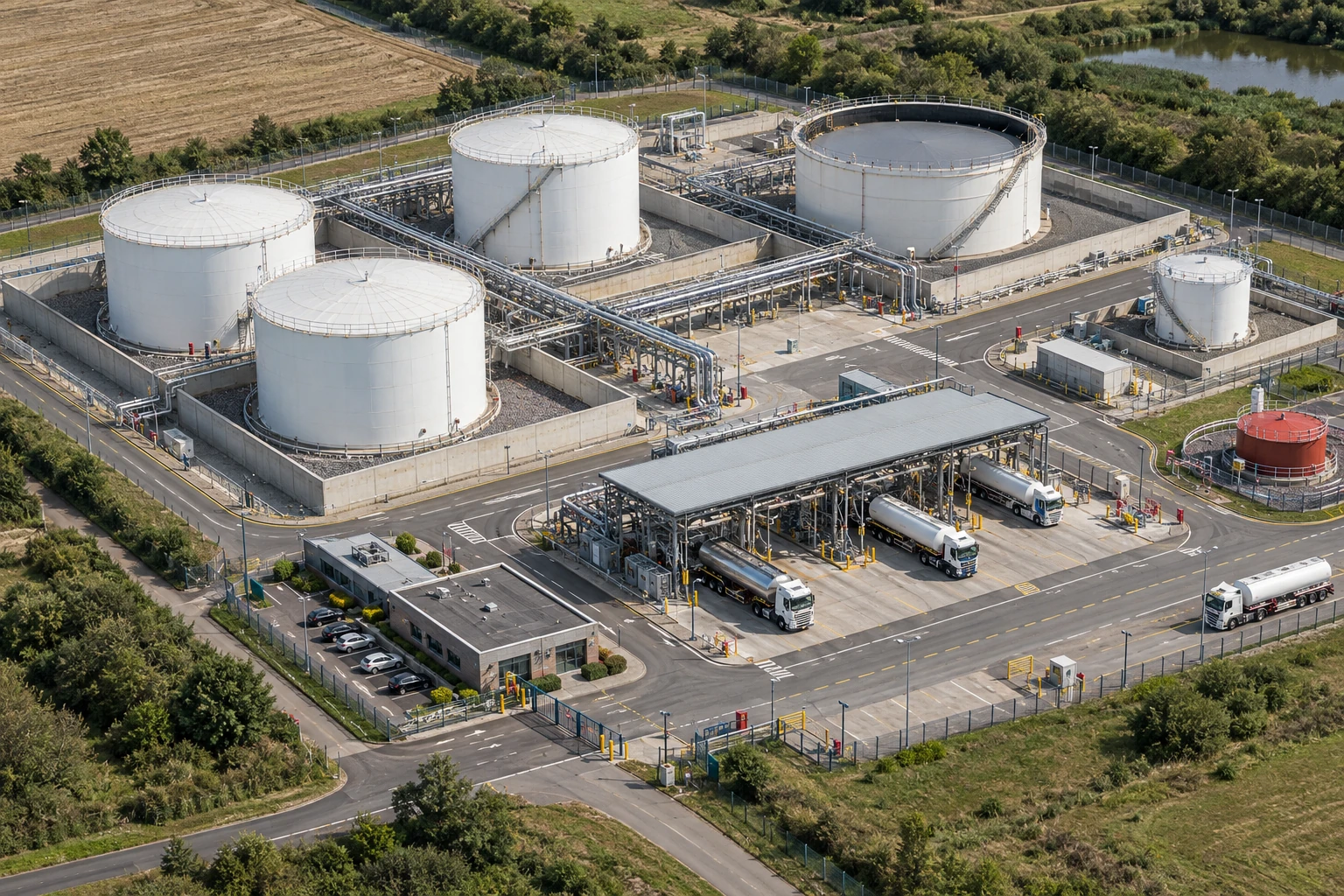

Production pressure overrides a degraded barrier
All related inspection points 2 across 1 location
Crown Fuels terminal 2 inspection points
Practice in the SHAREhub environment. Browser practice is separate from workplace competence and formal learning records.
What is a major accident prevention policy?
A major accident prevention policy (MAPP) states an in-scope operator’s aims and management commitment to prevent major accidents and limit their consequences. It is implemented through a safety management system and tested by plant evidence.
Best-practice guide: Major accident prevention policy and safety case thinking

What is a major accident prevention policy?
A major accident prevention policy (MAPP) states an in-scope operator’s aims and management commitment to prevent major accidents and limit their consequences. It is implemented through a safety management system and tested by plant evidence. A major accident prevention policy sets an in-scope operator's aims and commitment to prevent major accidents and limit their consequences.
Turn major accident prevention policy and safety case thinking knowledge into a decision
A major accident prevention policy sets an in-scope operator's aims and commitment to prevent major accidents and limit their consequences. The safety management arrangements, risk evidence and continuing checks must show how that commitment is delivered. Retain scope decision, MAPP-to-system links, revised scenario and assumptions, option appraisal, test and inspection results, competence, emergency review and named release.
the process operator new-transfer demonstration
Design and install under approved change control, verify the independent trip, containment and emergency interfaces, and train operators on limits and abnormal response. Close pre-start actions, update controlled drawings and procedures, prove critical functions, obtain competent approval and revise the safety report where the applicable duty requires it.
What must a MAPP connect to real work?
The policy should state aims, principles, management responsibility and commitment, then point to the safety management arrangements that deliver them.
Choose controls for major accident prevention policy and safety case thinking
Eliminate: Engineering and logistics evaluate removing the storage or transfer step, or redesigning the operation so the identified tank-overfill scenario cannot occur. Reduce: The process team evaluates lower hazardous inventory or a less hazardous material or process, subject to compatibility, quality and operating needs. Isolate: Competent designers specify prevention and mitigation for the actual plant, including suitable overfill protection, separation and containment where the scenario requires them. Control: Operations coordinates tank identification, available capacity, the delivery interface, monitored transfer and stop actions through the assessed procedure. PPE: The assessment selects compatible task-specific skin, eye and other residual protection for routine exposure. Read the full control table for qualifications, ownership and verification. Use the actual task and applicable jurisdiction; existing technical approval remains unchanged.
Use the full major accident prevention policy and safety case thinking lesson
Use the full topic for the decision points, practical examples, detailed control tables and source scope. HSE guidance applies to Great Britain; use HSENI for the Northern Ireland route and the source’s stated jurisdiction. A simplified guide does not change the page’s technical-review or approval status.

Read all six steps as text
1. What is a major accident prevention policy?
A major accident prevention policy (MAPP) states an in-scope operator’s aims and management commitment to prevent major accidents and limit their consequences.
- Avoid / redesign: Engineering and logistics evaluate removing the storage or transfer step, or redesigning the operation so the identified tank-overfill scenario cannot occur.
- Control the task: Competent designers specify prevention and mitigation for the actual plant, including suitable overfill protection, separation and containment where the scenario requires them.
- Verify before release: Record the credible scenario and whether the change truly removes it.
A major accident prevention policy (MAPP) states an in-scope operator’s aims and management commitment to prevent major accidents and limit their consequences. It is implemented through a safety management system and tested by plant evidence. A major accident prevention policy sets an in-scope operator's aims and commitment to prevent major accidents and limit their consequences.
Apply it: Which part of this plan would you check at the workface before authorising the task?
2. Turn major accident prevention policy and safety case thinking knowledge into a decision
Use the evidence to improve the actual work arrangement.
- Change at source: Engineering and logistics evaluate removing the storage or transfer step, or redesigning the operation so the identified tank-overfill scenario cannot occur.
- Make it observable: Record the credible scenario and whether the change truly removes it.
- Keep useful evidence: Retain scope decision, MAPP-to-system links, revised scenario and assumptions, option appraisal, test and inspection results, competence, emergency review and named release.
A major accident prevention policy sets an in-scope operator's aims and commitment to prevent major accidents and limit their consequences. The safety management arrangements, risk evidence and continuing checks must show how that commitment is delivered. Retain scope decision, MAPP-to-system links, revised scenario and assumptions, option appraisal, test and inspection results, competence, emergency review and named release.
Apply it: What evidence would show that the change improves this task, rather than only completing a record?
3. the process operator new-transfer demonstration
Example: a practical application of the existing topic lesson.
- Setting: the process operator is a upper-tier GB fuel terminal for this teaching example; a separate scope review has established its tier.
- Act: Screen the modification, test whether the MAPP arrangements cover it, update the hazard analysis and safety-report claims, and identify additional prevention and mitigation options before hazardous introduction.
- Hold / review: Do not start if the transfer path, safeguards, consequence assessment, actions or emergency plan are uncertain or unverified.
Design and install under approved change control, verify the independent trip, containment and emergency interfaces, and train operators on limits and abnormal response. Close pre-start actions, update controlled drawings and procedures, prove critical functions, obtain competent approval and revise the safety report where the applicable duty requires it.
Apply it: At which point would you hold this example, and what evidence would allow it to proceed?
4. What must a MAPP connect to real work?
Connect the task, the route to the person and the control that can fail.
- Source / exposure: The policy should state aims, principles, management responsibility and commitment, then point to the safety management arrangements that deliver them.
- Possible consequence: A short policy can refer to detailed systems for people and competence, hazard identification, operating control, management of change, emergency planning, monitoring, audit and review.
- Control failure: The test is whether those systems control the actual dangerous substances and scenarios.
The policy should state aims, principles, management responsibility and commitment, then point to the safety management arrangements that deliver them.
Apply it: Who could be exposed, including other trades, cleaners, maintainers and people nearby?
5. Choose controls for major accident prevention policy and safety case thinking
Start with the stronger practicable options and verify their effect.
- Eliminate: Engineering and logistics evaluate removing the storage or transfer step, or redesigning the operation so the identified tank-overfill scenario cannot occur.
- Reduce: The process team evaluates lower hazardous inventory or a less hazardous material or process, subject to compatibility, quality and operating needs.
- Isolate: Competent designers specify prevention and mitigation for the actual plant, including suitable overfill protection, separation and containment where the scenario requires them.
- Control: Operations coordinates tank identification, available capacity, the delivery interface, monitored transfer and stop actions through the assessed procedure.
- PPE: The assessment selects compatible task-specific skin, eye and other residual protection for routine exposure.
Eliminate: Engineering and logistics evaluate removing the storage or transfer step, or redesigning the operation so the identified tank-overfill scenario cannot occur. Reduce: The process team evaluates lower hazardous inventory or a less hazardous material or process, subject to compatibility, quality and operating needs. Isolate: Competent designers specify prevention and mitigation for the actual plant, including suitable overfill protection, separation and containment where the scenario requires them. Control: Operations coordinates tank identification, available capacity, the delivery interface, monitored transfer and stop actions through the assessed procedure. PPE: The assessment selects compatible task-specific skin, eye and other residual protection for routine exposure. Read the full control table for qualifications, ownership and verification. Use the actual task and applicable jurisdiction; existing technical approval remains unchanged.
Apply it: Which stronger option can be used here, and who will verify it before accepting the remaining risk?
6. Use the full major accident prevention policy and safety case thinking lesson
Follow the official sources below and retain the task-specific evidence.
- Official guidance: HSE COMAH 2015 overview
- Official guidance: HSENI Control of Major Accident Hazards Regulations
- Task decision: Retain scope decision, MAPP-to-system links, revised scenario and assumptions, option appraisal, test and inspection results, competence, emergency review and named release.
Use the full topic for the decision points, practical examples, detailed control tables and source scope. HSE guidance applies to Great Britain; use HSENI for the Northern Ireland route and the source’s stated jurisdiction. A simplified guide does not change the page’s technical-review or approval status.
Apply it: Which official source and full-topic section will you use to resolve the next decision?
The Control of Major Accident Hazards (COMAH) regimes in Great Britain (GB) and Northern Ireland (NI) apply only after a dangerous-substance scope and quantity check. Every in-scope operator needs a MAPP; an upper-tier operator also needs a detailed safety report. A process site outside COMAH can still use the policy-to-barrier method, but this page does not assign it a COMAH document duty. HSE COMAH 2015 overview and HSENI Control of Major Accident Hazards Regulations.
“Safety-case thinking” here means a structured explanation of a severe scenario, the measures that control it, and proof that those measures work. It is an educational method, not a replacement name or substitute for the legally required COMAH safety report. HSE COMAH 2015 overview.
What must a MAPP connect to real work?
The policy should state aims, principles, management responsibility and commitment, then point to the safety management arrangements that deliver them.
MAPP commitment: scenario, owner and as-found evidence


Read the complete visual as text
- Start: A policy states that a major-accident scenario is controlled. Test the real commitment rather than the signature.
- Question 1: Are the hazardous inventory and credible scenario behind this commitment explicit? Decision owner: Policy owner and process-safety lead.
- YES: Trace the prevention/mitigation claim to its scenario and consequence paths. Owner: Policy owner and process-safety lead. CONTINUE → QUESTION 2.
- NO • HOLD: Amend the risk basis and identify the inventory, event sequence and receptors; do not retain an unsupported control claim. Owner: Policy owner and process-safety lead. HOLD → REPEAT QUESTION 1 AFTER CORRECTION.
- UNKNOWN • HOLD: Hold the affected decision while the owner resolves the missing evidence. Amend the risk basis and identify the inventory, event sequence and receptors; do not retain an unsupported control claim. Owner: Policy owner and process-safety lead. HOLD → REPEAT QUESTION 1 AFTER CORRECTION.
- Question 2: Does a named, resourced SMS owner implement the commitment? Decision owner: Site leader and relevant control owner.
- YES: Identify the actual competence, operating, change, emergency and assurance arrangements that deliver the commitment. Owner: Site leader and relevant control owner. CONTINUE → QUESTION 3.
- NO • HOLD: Assign and resource implementation; a signed policy without control ownership remains an unresolved claim. Owner: Site leader and relevant control owner. HOLD → REPEAT QUESTION 2 AFTER CORRECTION.
- UNKNOWN • HOLD: Hold the affected decision while the owner resolves the missing evidence. Assign and resource implementation; a signed policy without control ownership remains an unresolved claim. Owner: Site leader and relevant control owner. HOLD → REPEAT QUESTION 2 AFTER CORRECTION.
- Question 3: Do current field observations, tests or exercises support the claimed control? Decision owner: Control owner and competent verifier.
- YES: Retain the as-found evidence, limitations and remaining actions; test whether changes and learning have been reflected. Owner: Control owner and competent verifier. CONTINUE → QUESTION 4.
- NO / CONTRADICTED: Reduce exposure, hold the affected operation and investigate the failed claim; correct and test the actual control. Owner: Control owner and competent verifier. HOLD → REPEAT QUESTION 3 AFTER CORRECTION.
- UNKNOWN / MISSING: Keep the claim qualified and the affected operation restricted or held; obtain appropriate field, test or exercise evidence. Owner: Control owner and competent verifier. HOLD → REPEAT QUESTION 3 AFTER CORRECTION.
- Question 4: Do policy and controls reflect relevant change, impairment and learning? Decision owner: Policy/SMS owner and operations lead.
- YES: Retain a live claim with its owner, evidence, assumptions and next review trigger. Owner: Policy/SMS owner and operations lead. OUTCOME → RECORD AND HAND OVER.
- NO • HOLD: Revise the controlled basis and communicate it; retain affected operational restrictions until the claim and field state agree. Owner: Policy/SMS owner and operations lead. HOLD → REPEAT QUESTION 4 AFTER CORRECTION.
- UNKNOWN • HOLD: Hold the affected decision while the owner resolves the missing evidence. Revise the controlled basis and communicate it; retain affected operational restrictions until the claim and field state agree. Owner: Policy/SMS owner and operations lead. HOLD → REPEAT QUESTION 4 AFTER CORRECTION.
- Outcome: Record a supported live commitment or a documented hold/corrective action with owner, evidence and review trigger.
- Stop and escalation boundary: This route does not approve operation or waive law, a failed barrier or an unassessed change. No universal COMAH quantity, bypass period, safety integrity level or risk score is supplied.
A short policy can refer to detailed systems for people and competence, hazard identification, operating control, management of change, emergency planning, monitoring, audit and review. The test is whether those systems control the actual dangerous substances and scenarios. A signed statement with no named owners, resources or follow-up is weak evidence. HSE COMAH 2015 overview and HSE L111 COMAH 2015 guidance.
| Policy commitment | Management arrangement | Field proof |
|---|---|---|
| Know the hazards | Current inventory and credible scenario studies. | Operators can identify top events and limits.Sources: HSE COMAH 2015 overview; HSE HSG254 Developing process safety indicators |
| Prevent and mitigate | Engineering standards, maintenance, procedures and emergency plans. | Critical barriers meet their specified functions.Sources: HSE COMAH 2015 overview; HSE HSG254 Developing process safety indicators |
| Manage change | Screen plant, substance, staffing and procedure changes. | Pre-start actions and affected records updated.Sources: HSE COMAH 2015 overview; HSE HSG254 Developing process safety indicators |
| Learn and improve | Review weak signals, incidents, audit and exercise actions. | Actions close with effectiveness evidence.Sources: HSE COMAH 2015 overview; HSE HSG254 Developing process safety indicators |
How does a safety management system implement the MAPP?
It assigns competent owners and repeatable processes for hazard identification, operational control, change, emergencies and assurance, with escalation when a barrier is degraded.
Policy → SMS → plant evidence


Read the complete visual as text
- MAPP commitment: A major-accident prevention policy identifies objectives and responsibilities; it is implemented through the safety management system.
- SMS implementation: People, hazard identification, operational control, change, emergency planning, monitoring, audit and review connect the policy to the real plant.
- Test the claim today: For a tank-overfill claim, trace the actual barrier, owner, required function and as-found evidence. A bypassed shutdown contradicts the claim and changes the operating decision.
The system needs a clear boundary between operations, engineering, maintenance and contractors. It should define the safe operating envelope, technical authority, change approvals, impairment controls, inspection and proof tests, emergency drills, audit and management review. A policy promise is credible only when people can demonstrate these arrangements in real work. HSE COMAH 2015 overview and HSE Leadership for the major hazard industries.
When is a COMAH safety report required?
Under both separate 2015 regimes, the upper tier carries the additional safety-report duty. The report demonstrates site-specific major-accident hazards, prevention and mitigation measures, and management arrangements.
Separate territorial document routes


Read the complete visual as text
- GB establishment: Apply GB general duties and COMAH 2015 after a relevant establishment, dangerous-substance and aggregation assessment.
- NI establishment: Apply the separate NI general duties and COMAH 2015 instrument, with its competent-authority route.
- Lower tier, upper tier, outside scope: MAPP implemented through SMS applies to both tiers; upper tier adds the statutory report and associated interfaces. Formal offshore safety cases are a separate regime; other duties continue outside COMAH.
The report is more detailed than the MAPP: it describes the establishment and environment, dangerous substances, possible major accident scenarios, measures to prevent or limit them and emergency arrangements. The relevant competent authority examines the report. Its preparation is not a one-off publication exercise; changed plant, inventory or new information may require review and revision under the applicable instrument. HSE COMAH 2015 overview and NI Control of Major Accident Hazards Regulations 2015.
Keep the NI determination separate
NI COMAH 2015 is a separate instrument, including five-year review and advance modification-submission provisions. The responsible legal/technical adviser must confirm the current NI regulation and amendments and record the applicable submission/conclusions gate before work; do not import GB numbering or treat handback as the first legal review.
What does “safety-case thinking” add?
It gives a reader a traceable argument: this hazardous inventory can produce these credible events; these controls prevent or limit them; this evidence shows the controls are suitable and working.
Upper-tier safety-report demonstration


Read the complete visual as text
- Establishment and event sequence: Describe inventory, operating state, neighbours and environmental receptors. Link an initiating event to loss of containment and credible consequences.
- Necessary measures: Connect design and operating prevention, shutdown, containment, detection, fire protection and emergency arrangements to that sequence.
- Evidence and limitations: Identify current evidence, dependencies, assumptions, unresolved actions and competent owners. A submitted report is not proof that the installed plant remains healthy.
Upper-tier report claim: argument and evidence


Read the complete visual as text
- Start: An upper-tier report author proposes a prevention or mitigation claim. Use the actual established upper-tier legal route.
- Question 1: Are site context, inventory, neighbours, environment and credible event sequence described? Decision owner: Report author and scenario specialists.
- YES: Trace the scenario from initiating events to people, environmental and off-site consequences. Owner: Report author and scenario specialists. CONTINUE → QUESTION 2.
- NO • HOLD: Complete the scenario and context; do not evaluate measures against an unspecified event. Owner: Report author and scenario specialists. HOLD → REPEAT QUESTION 1 AFTER CORRECTION.
- UNKNOWN • HOLD: Hold the affected decision while the owner resolves the missing evidence. Complete the scenario and context; do not evaluate measures against an unspecified event. Owner: Report author and scenario specialists. HOLD → REPEAT QUESTION 1 AFTER CORRECTION.
- Question 2: Are necessary measures linked to that scenario, including independence, dependencies and common causes? Decision owner: Process-safety and engineering reviewers.
- YES: State each function, performance requirement, assumption, owner and remaining limitation. Owner: Process-safety and engineering reviewers. CONTINUE → QUESTION 3.
- NO • HOLD: Rework the argument and challenge dependencies; separate drawing symbols do not demonstrate independent protection. Owner: Process-safety and engineering reviewers. HOLD → REPEAT QUESTION 2 AFTER CORRECTION.
- UNKNOWN • HOLD: Hold the affected decision while the owner resolves the missing evidence. Rework the argument and challenge dependencies; separate drawing symbols do not demonstrate independent protection. Owner: Process-safety and engineering reviewers. HOLD → REPEAT QUESTION 2 AFTER CORRECTION.
- Question 3: Is the evidence current for the installed plant and operating envelope? Decision owner: Evidence owner and competent technical reviewer.
- YES: Connect actual inspection, full-function test and field evidence to the claimed measures. Owner: Evidence owner and competent technical reviewer. CONTINUE → QUESTION 4.
- NO • HOLD: Qualify or withdraw the unsupported claim, restrict affected operation where required and resolve the installed-state evidence gap. Owner: Evidence owner and competent technical reviewer. HOLD → REPEAT QUESTION 3 AFTER CORRECTION.
- UNKNOWN • HOLD: Hold the affected decision while the owner resolves the missing evidence. Qualify or withdraw the unsupported claim, restrict affected operation where required and resolve the installed-state evidence gap. Owner: Evidence owner and competent technical reviewer. HOLD → REPEAT QUESTION 3 AFTER CORRECTION.
- Question 4: Are assumptions, uncertainty, open actions and competent sign-off traceable? Decision owner: Accountable report owner.
- YES: Retain the claim, reasoning, evidence and limitations as a controlled demonstration for the appropriate authority process. Owner: Accountable report owner. OUTCOME → RECORD AND HAND OVER.
- NO • HOLD: Keep the claim on hold until assumptions, open actions and competent review are explicit; document production alone is not acceptance. Owner: Accountable report owner. HOLD → REPEAT QUESTION 4 AFTER CORRECTION.
- UNKNOWN • HOLD: Hold the affected decision while the owner resolves the missing evidence. Keep the claim on hold until assumptions, open actions and competent review are explicit; document production alone is not acceptance. Owner: Accountable report owner. HOLD → REPEAT QUESTION 4 AFTER CORRECTION.
- Outcome: A traceable scenario-based claim with reasoning, current evidence, assumptions, actions and competent sign-off; subsequent change reopens the claim.
- Stop and escalation boundary: This route does not approve operation or waive law, a failed barrier or an unassessed change. No universal COMAH quantity, bypass period, safety integrity level or risk score is supplied. A report is examined through the applicable authority route; this diagram does not claim regulator approval.
For each severe scenario, connect initiating events and escalation to preventive and mitigating measures. Name performance standards, assumptions, dependencies, owners, inspection or test results, impairments and remaining actions. State where uncertainty remains. A thick report with no clear link from hazard to live barrier evidence does not demonstrate control. HSE COMAH 2015 overview and HSE HSG254 Developing process safety indicators.
| Claim | Evidence | Challenge |
|---|---|---|
| Tank overfill is prevented | Level control, independent trip design and effective test. | Could shared power, calibration or bypass defeat both?Sources: HSE Buncefield investigation and learning; HSE COMAH control systems |
| Release consequences are limited | Bund, isolation, emergency plan and exercise. | Would vapour or run-off reach neighbours?Sources: HSE Buncefield investigation and learning; HSE COMAH control systems |
| People can operate within limits | Usable procedure, competence assessment and alarm response. | What happens during abnormal transfer or shift handover?Sources: HSE Buncefield investigation and learning; HSE COMAH control systems |
| Arrangements remain current | Change records, audit, backlog and review. | Did a modification or new fact invalidate assumptions?Sources: HSE Buncefield investigation and learning; HSE COMAH control systems |
Trace one claim to the decision
Illustrative evidence chain: overfill prevention claim → named operations owner → credited detection/logic/final-element function and dependencies → current specified-scope test record → unresolved dangerous defect → hold the affected transfer and fund correction. A policy signature does not repair the failed evidence.
How should a policy reflect the main accident pathways?
A MAPP must be grounded in plausible loss-of-containment, fire, explosion, toxic-release or escalation pathways, including people and environmental consequences.
A policy at a fuel depot should lead to high-integrity storage, overfill control and emergency coordination; at a reactive plant it should lead to chemistry limits, cooling and relief. Identify the top event and what prevents it before claiming a generic “zero harm” ambition. HSE’s Buncefield learning illustrates why apparently routine transfer needs a credible overfill and vapour scenario. HSE large-tank overfill safety alert, HSE Buncefield investigation and learning and HSE COMAH 2015 overview.
How are additional controls judged?
Start with relevant good practice and credible harm, then test feasible options to reduce risk. Do not dismiss a protective measure only because it is costly or inconvenient.
For human health and safety risk, so far as reasonably practicable and ALARP are not a simple cost cap. For the GB COMAH route, HSE distinguishes ALARP for human risk from best available technology (BAT) for environmental risk; do not transfer the human-risk gross-disproportion test wholesale to environmental protection. Check the NI competent-authority route separately. Record the option, risk reduction, technical feasibility, sacrifice, uncertainty and competent challenge where a significant measure is rejected. The MAPP should make clear who may accept residual risk and when operation must stop. HSE COMAH 2015 overview, HSENI Control of Major Accident Hazards Regulations, HSE HSG65 Managing for health and safety and HSE Leadership for the major hazard industries.
What proves the policy and report are alive?
Audit a scenario through current plant condition and decision records, then compare the result with the policy and any safety-report claims.
Useful evidence includes inventory and hazard-study updates, barrier standards, proof tests, maintenance defects, temporary repairs, change approvals, competence demonstrations, emergency drills, leading and lagging process-safety indicators, and closure of regulator or audit actions. Sample the field; a green dashboard alone cannot prove performance. HSE HSG254 Developing process safety indicators and HSE Leadership for the major hazard industries.
When should the policy or safety report be reviewed?
Review when changes or new facts could alter a major-accident hazard, barrier, consequence or management arrangement; the formal duty and timing depend on the applicable GB or NI instrument.
Examples are increased inventory, a new substance, changed tank or control logic, repeated failed tests, altered staffing or emergency arrangements, a serious incident, or a new understanding of vapour behaviour. Screen the change before operation, update affected documents and communicate the revised basis. A review date on a cover sheet does not replace change-triggered review. HSE COMAH 2015 overview, NI Control of Major Accident Hazards Regulations 2015 and HSE COMAH plant modification and change procedures.
Put statutory timing before the change
At proposal/design, the change owner records applicability, notifications, advance submissions and any statutory hold before construction or modification. In GB, MAPP and safety-report reviews have five-year backstops and earlier triggers. Significant modifications require review before modification and necessary revised report parts must reach the competent authority in advance. A new-establishment route has its own pre-construction/pre-operation or modification submission and conclusions gate. This is not regulator approval for every routine MOC. At handback confirm as-built conformity and close-out evidence. HSE L111: COMAH regulations 7, 9 and 10.
How can the hierarchy of controls turn major accident policy and safety-case findings into stronger controls?
A major-accident control must interrupt the credible release or escalation, remain available when needed and have evidence of performance. Leaders should ask whether the hazardous inventory or operation can be removed or reduced before relying on shutdowns, procedures and emergency protection.
Illustrative decision: a fuel-storage site receives a tanker transfer into a storage tank. Overfilling could release flammable liquid and create a vapour cloud affecting workers and neighbours. The process engineer assesses the actual tank, delivery rate, protection, containment and interfaces; managers fund the solution and operations controls the transfer.
ERICPD means Eliminate, Reduce (including substitution), Isolate, Control, PPE and Discipline. The five-level hierarchy groups measures as elimination, substitution, engineering controls, administrative controls and PPE. They overlap: isolation is usually an engineering measure; control can include engineered and administrative measures. Discipline means maintaining and checking the controls, supervising the method and learning from defects, rather than blaming someone or accepting weaker protection.
How can the ERICPD hierarchy of controls turn major accident policy and safety-case findings into stronger controls?

| ERICPD and five-level position | Intervention and owner | Verification, failure and stop point |
|---|---|---|
| Eliminate / elimination | Engineering and logistics evaluate removing the storage or transfer step, or redesigning the operation so the identified tank-overfill scenario cannot occur. Examine risk transferred to transport, another tank or a supplier. | Record the credible scenario and whether the change truly removes it. A delivery plan alone is not elimination when fuel still enters the tank. |
| Reduce / substitution when replacing a hazard; otherwise engineering or administrative risk reduction | The process team evaluates lower hazardous inventory or a less hazardous material or process, subject to compatibility, quality and operating needs. Changes enter the authorised technical review. | Confirm that altered properties, quantities and operating conditions reduce the relevant consequence without introducing another major hazard. Unknown compatibility or an unreviewed new operating limit prevents adoption. |
| Isolate / engineering | Competent designers specify prevention and mitigation for the actual plant, including suitable overfill protection, separation and containment where the scenario requires them. Protection must account for the complete detection-to-final-element function and dependencies. | Verify installation, appropriate tests and ongoing performance against the design requirements. A failed or bypassed credited protective function, unverified tank level or ineffective containment requires the defined operating restriction and competent resolution. |
| Control / administrative | Operations coordinates tank identification, available capacity, the delivery interface, monitored transfer and stop actions through the assessed procedure. Supervisors ensure contractors and operators know the actual arrangement. | Observe the real transfer and challenge alarms and communication failures through protected checks. Workload, poor visibility or a changed transfer arrangement triggers reassessment; a manual instruction does not replace specified engineered prevention. |
| PPE / PPE | The assessment selects compatible task-specific skin, eye and other residual protection for routine exposure. Emergency response requires its own competent plan and equipment. | Inspect, maintain and replace selected PPE. It cannot protect the site or neighbouring public against an uncontrolled large flammable release or substitute for tank-overfill prevention. |
| Discipline / sustained engineering and administrative controls | Leaders require named ownership, maintenance and test records, impairment control and closure of recurrent faults. Operations and engineering keep assumptions and drawings current. | Review failed tests, overdue work and temporary bypasses by the scenario they affect. A high completion rate or favourable injury statistics does not establish healthy major-accident barriers. |
How can the ISO 45001 hierarchy of controls turn major accident policy and safety-case findings into stronger controls?

| ERICPD and five-level position | Intervention and owner | Verification, failure and stop point |
|---|---|---|
| Eliminate / elimination | Engineering and logistics evaluate removing the storage or transfer step, or redesigning the operation so the identified tank-overfill scenario cannot occur. Examine risk transferred to transport, another tank or a supplier. | Record the credible scenario and whether the change truly removes it. A delivery plan alone is not elimination when fuel still enters the tank. |
| Reduce / substitution when replacing a hazard; otherwise engineering or administrative risk reduction | The process team evaluates lower hazardous inventory or a less hazardous material or process, subject to compatibility, quality and operating needs. Changes enter the authorised technical review. | Confirm that altered properties, quantities and operating conditions reduce the relevant consequence without introducing another major hazard. Unknown compatibility or an unreviewed new operating limit prevents adoption. |
| Isolate / engineering | Competent designers specify prevention and mitigation for the actual plant, including suitable overfill protection, separation and containment where the scenario requires them. Protection must account for the complete detection-to-final-element function and dependencies. | Verify installation, appropriate tests and ongoing performance against the design requirements. A failed or bypassed credited protective function, unverified tank level or ineffective containment requires the defined operating restriction and competent resolution. |
| Control / administrative | Operations coordinates tank identification, available capacity, the delivery interface, monitored transfer and stop actions through the assessed procedure. Supervisors ensure contractors and operators know the actual arrangement. | Observe the real transfer and challenge alarms and communication failures through protected checks. Workload, poor visibility or a changed transfer arrangement triggers reassessment; a manual instruction does not replace specified engineered prevention. |
| PPE / PPE | The assessment selects compatible task-specific skin, eye and other residual protection for routine exposure. Emergency response requires its own competent plan and equipment. | Inspect, maintain and replace selected PPE. It cannot protect the site or neighbouring public against an uncontrolled large flammable release or substitute for tank-overfill prevention. |
| Discipline / sustained engineering and administrative controls | Leaders require named ownership, maintenance and test records, impairment control and closure of recurrent faults. Operations and engineering keep assumptions and drawings current. | Review failed tests, overdue work and temporary bypasses by the scenario they affect. A high completion rate or favourable injury statistics does not establish healthy major-accident barriers. |
The comparison is an original illustrative application of the general HSE hierarchy, not a machine-specific method, permit or design approval. The employer must choose measures for the actual work and jurisdiction. Apply the separate Northern Ireland legal route where relevant; the local assessment and competent technical decision govern release.
How does policy become a demonstrated control?
Follow the major-accident scenario to the barrier, its specified function, its owner and evidence that it can work in the actual operating state.
For the tank example, identify what detects the rising level, what stops or limits the incoming flow, which utilities and components the action depends on, and how a failed part is detected. A green screen or one successful trial does not prove every dangerous failure mode has been considered. Technical staff define the required test coverage and interval for the design; this lesson sets no generic number.
Leaders should sample the test evidence and inspect the actual arrangements with operators. Ask who can authorise an impairment, what plant restriction applies while it is unresolved, how a shift or contractor handover carries it forward, and who verifies restoration. Keep the original result, correction and named decision traceable. For a policy commitment, the evidence must show the arrangement operating in practice, not merely a signed document.
How would a new tank transfer test the MAPP and safety report?
Treat the new route as a changed major-accident scenario. The policy supplies governance, while the upper-tier safety report must continue to demonstrate control of the actual installation.
Keep the claim alive after change


Read the complete visual as text
- Change can invalidate the basis: A vessel modification can alter pressure, relief needs, scenarios or emergency consequences. Organisational changes can alter critical human tasks.
- Revise and verify: Reassess the scenario and necessary measures, update controlled claims and instructions and verify installed configuration and tests.
- Hold the startup gap: A missing safety-critical assessment holds release. Retain named technical and operational acceptance, then feed as-found evidence and learning into review.
Crownway new-transfer demonstration
Task, material and setting: Crownway Fuels Ltd is a upper-tier GB fuel terminal for this teaching example; a separate scope review has established its tier. It plans a new transfer route near an existing tank and neighbouring businesses.
People and prerequisites: The operator, design engineer, technical authority, emergency lead and site manager need current inventory, transfer assumptions, overfill scenario, barrier standard and public/environment receptors.
Before: Screen the modification, test whether the MAPP arrangements cover it, update the hazard analysis and safety-report claims, and identify additional prevention and mitigation options before hazardous introduction.
During: Design and install under approved change control, verify the independent trip, containment and emergency interfaces, and train operators on limits and abnormal response.
Hold or stop: Do not start if the transfer path, safeguards, consequence assessment, actions or emergency plan are uncertain or unverified.
Completion and hand back: Close pre-start actions, update controlled drawings and procedures, prove critical functions, obtain competent approval and revise the safety report where the applicable duty requires it.
Evidence: Retain scope decision, MAPP-to-system links, revised scenario and assumptions, option appraisal, test and inspection results, competence, emergency review and named release.
Move applicability to the proposal stage
Illustrative timeline: proposal — legal/technical owner identifies route and statutory submissions; design freeze — resolve required advance review and any conclusions gate; before modification — verify the applicable gate is met; pre-start — validate protection and close critical actions; handback — confirm as-built documents and monitoring. An internal signature cannot bypass a statutory hold.
Can the demonstration method be used elsewhere?
The same hazard-to-control-to-evidence logic transfers across high-consequence settings, but the legal document duty and detailed technical basis depend on the site and regime.
| Setting | Key event | Demonstration focus |
|---|---|---|
| Bulk fuel storage | Overfill, vapour cloud and off-site harm. | Independent trip, containment, ignition control and emergency interface.Sources: HSE Buncefield investigation and learning; HSE large-tank overfill safety alert; HSE COMAH 2015 overview. |
| Chemical reactor | Runaway reaction or toxic release. | Chemistry envelope, cooling, relief and detection.Sources: HSE COMAH control systems; HSE L111 COMAH 2015 guidance. |
| Ammonia refrigeration | Pressure loss and toxic release. | Actual inventory, integrity and response; check COMAH threshold.Sources: HSE introduction to pressure equipment; HSE COMAH 2015 overview. |
| Non-COMAH warehouse | Smaller hazardous stock or fire. | Use the method voluntarily; do not call a generic risk file a statutory COMAH safety report.Sources: HSE HSG71 chemical warehousing; HSE COMAH 2015 overview. |
For a fuel-terminal transfer operator, overfill can create a vapour cloud affecting neighbours. The policy must lead to inventory and route minimisation, independent overfill shutdown, containment and an emergency interface; managers verify tests and stop transfer for a failed trip. HSE Buncefield investigation and learning.
For chemical-reactor operators and nearby workers, wrong feed or lost cooling can produce runaway and toxic release. The demonstration should compare smaller batch and substitution options, show cooling, relief and isolation proof, and stop start-up for an unclosed hazard-study action. HSE COMAH 2015 overview.
For ammonia-refrigeration maintainers, a pressure-boundary failure can expose staff and responders. The operator must check actual substance quantity and legal tier, then show integrity, isolation and emergency evidence; a leak or overdue critical examination requires a hold, not an assumed COMAH safety report. HSENI Control of Major Accident Hazards Regulations.
For a non-COMAH warehouse, stock handling can still create fire or chemical exposure for pickers. Minimise incompatible inventory, separate storage and verify emergency arrangements; stop on damaged containment. The site may use the claim-control-evidence method without claiming a statutory COMAH MAPP. HSE COMAH 2015 overview.
Who owns policy, demonstration and field truth?
Senior management commits resources and receives challenge; the operator owns the MAPP and any required safety report; technical authorities define controls; workers report real conditions.
The safety function must have a named owner and performance standard. Operations controls the plant state, engineering maintains the design basis, maintenance verifies equipment, and emergency leads test consequences. Contractors need relevant information and supervision. A director should be able to ask why a report claim is still true after a modification or failed test. HSE Leadership for the major hazard industries and HSE HSG254 Developing process safety indicators.
What competence is needed to make the demonstration credible?
Assess people on the actual safety-critical decisions they make and revisit authorisation when the site, role or risk basis changes.
| Role | What to learn | Practical proof | Assessor and record | Reassessment trigger |
|---|---|---|---|---|
| New worker | Recognise major-hazard alarms, restrictions and reporting. | Shows safe response to an overfill warning. | Supervisor records area awareness. | New plant or incident.Sources: HSE Leadership for the major hazard industries; HSE COMAH 2015 overview |
| Operator | Know limits, critical controls and stop rights. | Demonstrates abnormal-transfer response. | Operations lead records authorisation. | Changed route or procedure.Sources: HSE Leadership for the major hazard industries; HSE COMAH 2015 overview |
| Engineer or maintainer | Know design basis, test acceptance and defect escalation. | Traces a failed trip to hold and verified restoration. | Technical lead records task scope. | New safeguard or failure.Sources: HSE Leadership for the major hazard industries; HSE COMAH 2015 overview |
| Technical authority | Assess scenario, options, independence and uncertainty. | Challenges the new-transfer claim and signs the basis. | Independent competent peer review. | Major change or new evidence.Sources: HSE Leadership for the major hazard industries; HSE COMAH 2015 overview |
| Site manager | Own safe operating decision and action closure. | Runs pre-start hold and release exercise. | Senior leader samples plant proof. | Overdue critical action.Sources: HSE Leadership for the major hazard industries; HSE COMAH 2015 overview |
| Director or board | Know MAPP commitment, top risk and resource decision. | Challenges a green report with adverse field evidence. | Board records decision and follow-up. | Strategy, ownership or inventory change.Sources: HSE Leadership for the major hazard industries; HSE COMAH 2015 overview |
Voluntary-standard detail on hold
Specific standard editions, clauses and derived management-system detail are withheld until authorised text, rights and competent technical review are complete. Use applicable law and verified site evidence for current decisions.
For general health and safety management, see HSE managing health and safety.
Which GB and NI legal routes govern these documents?
GB and NI have separate COMAH 2015 instruments. The MAPP applies to operators within scope; the detailed safety report is an additional upper-tier duty.
MAPP or safety report: establish the legal document route


Read the complete visual as text
- Start: A site asks whether COMAH applies or which statutory document is needed. Identify the territory, establishment and actual inventory before a tier label.
- Question 1: Which territory governs the actual establishment or work? Decision owner: Duty holder and competent legal/technical adviser.
- GREAT BRITAIN: Use the current GB instrument and applicable HSE route; record the actual site and activity. Owner: Duty holder and competent legal/technical adviser. CONTINUE → QUESTION 2.
- NORTHERN IRELAND: Use the separate current NI instrument and HSENI route; do not substitute GB regulation numbers. Owner: Duty holder and competent legal/technical adviser. CONTINUE → QUESTION 2.
- UNKNOWN: Pause the legal conclusion; establish territory and jurisdiction with competent advice before repeating this check. Owner: Duty holder and competent legal/technical adviser. HOLD → REPEAT QUESTION 1 AFTER CORRECTION.
- Question 2: Are the legal establishment boundary, actual substances, classification, quantities and aggregation basis established? Decision owner: Operator and competent process-safety/legal assessor.
- YES: Calculate applicability and tier under the correct current Schedule 1; retain the inventory and calculation basis. Owner: Operator and competent process-safety/legal assessor. CONTINUE → QUESTION 3.
- NO • HOLD: Pause classification and obtain current inventory, classification and aggregation evidence; no industry-label shortcut. Owner: Operator and competent process-safety/legal assessor. HOLD → REPEAT QUESTION 2 AFTER CORRECTION.
- UNKNOWN • HOLD: Hold the affected decision while the owner resolves the missing evidence. Pause classification and obtain current inventory, classification and aggregation evidence; no industry-label shortcut. Owner: Operator and competent process-safety/legal assessor. HOLD → REPEAT QUESTION 2 AFTER CORRECTION.
- Question 3: What does the competent Schedule 1 assessment conclude? Decision owner: Operator with competent legal/technical review.
- OUTSIDE COMAH: Do not claim a statutory COMAH document duty. Continue applicable general, dangerous-substance and environmental duties; record the reasoned scope and change trigger. Owner: Operator with competent legal/technical review. OUTCOME → RECORD AND HAND OVER.
- LOWER TIER: Prepare and implement MAPP through the safety management system; check notification and other applicable duties. Identify the relevant joint competent-authority route. Owner: Operator with competent legal/technical review. OUTCOME → RECORD AND HAND OVER.
- UPPER TIER: Retain MAPP and SMS and add the safety report, specified internal/emergency-planning and public-information duties under the applicable territorial regime. Owner: Operator with competent legal/technical review. OUTCOME → RECORD AND HAND OVER.
- UNKNOWN / CONFLICTING: Keep the legal conclusion on hold; obtain competent classification, calculation and regulator advice before choosing a tier. Owner: Operator with competent legal/technical review. HOLD → REPEAT QUESTION 2 AFTER CORRECTION.
- Outcome: Record current law, scope basis, inventory/classification, aggregation calculation, competent sign-off, relevant authority correspondence and review trigger.
- Stop and escalation boundary: This route does not approve operation or waive law, a failed barrier or an unassessed change. No universal COMAH quantity, bypass period, safety integrity level or risk score is supplied. GB joint authority is HSE, or ONR for nuclear establishments, with EA, SEPA or NRW as appropriate; NI uses HSENI and NIEA. General and fact-specific GB DSEAR 2002 or NI DSEAR 2003 duties remain outside COMAH where applicable.
Before asserting a duty, establish place, substances, quantities and tier from current law. The expression “safety-case thinking” in this lesson does not create or replace a statutory document. HSE L111 explains the GB regime; HSENI and the NI instrument govern NI scope. HSE COMAH 2015 overview, HSE L111 COMAH 2015 guidance and HSENI Control of Major Accident Hazards Regulations.
| Route | Document duty | Reader action |
|---|---|---|
| GB lower tier | Where Schedule 1 substance scope and lower-tier threshold are met, the operator needs a MAPP and safety management arrangements. | Check current substance classification, quantity and exclusions.Sources: GB Control of Major Accident Hazards Regulations 2015; HSE COMAH 2015 overview |
| GB upper tier | The in-scope upper-tier operator additionally prepares a safety report and associated emergency arrangements. | Demonstrate site-specific scenarios and controls in the current report.Sources: GB Control of Major Accident Hazards Regulations 2015; HSE COMAH 2015 overview |
| NI lower tier | The separate NI 2015 instrument requires a MAPP for in-scope operators. | Apply the NI threshold and competent-authority route.Sources: NI Control of Major Accident Hazards Regulations 2015; HSENI Control of Major Accident Hazards Regulations |
| NI upper tier | The separate NI instrument adds the safety-report requirement at upper tier. | Use current NI text; do not import GB regulation numbers.Sources: NI Control of Major Accident Hazards Regulations 2015; HSENI Control of Major Accident Hazards Regulations |
When should a policy or report claim be challenged immediately?
Stop or restrict affected operation when a credited control is failed, a major change is unassessed, emergency assumptions are invalid or the plant no longer matches the documented safety basis.
Claim, reasoning and evidence


Read the complete visual as text
- Scoped claim: State the defined scenario and operating envelope. Avoid an unqualified assertion that a toxic-transfer line is safe.
- Reasoning: Explain how containment integrity, detection, isolation, response and common-cause assessment support the claim.
- Current evidence: Use drawings, inspection basis, full-function tests, observed response, exercise and change records. A drawing that conflicts with field configuration breaks the argument until reconciled.
Changed or impaired claim: combine the barriers before a decision
2 linked parts. Follow the question numbers and complete the applicable route.
Part 1 of 2 · Questions 1–3

Continue · Part 2 of 2 · Questions 4–5


Read the complete visual as text
- Start: A bypass, overdue test, process change or conflicting record may invalidate the policy or report basis.
- Question 1: Is there an active release, fire, explosion, exposure or other immediate danger? Decision owner: Person discovering the danger and site emergency lead.
- YES • EMERGENCY: Raise the alarm, warn others, withdraw to safety and follow the local emergency plan now. Do not wait for the change or reporting paperwork. Owner: Person discovering the danger and site emergency lead. STOP / REFER → APPROPRIATE RESPONSE.
- NO: Keep the system in a protected state and examine the affected work decision. Owner: Person discovering the danger and site emergency lead. CONTINUE → QUESTION 2.
- UNKNOWN: Protect people from the possible hazard and obtain the site emergency/competent response from a safe position. Do not enter or restart to find out. Owner: Person discovering the danger and site emergency lead. STOP / REFER → APPROPRIATE RESPONSE.
- Question 2: Are the affected function, inventory, scenario and policy/report claim known? Decision owner: Site leader and competent technical authority.
- YES: Assess the actual changed state and which prevention or mitigation claim it invalidates. Owner: Site leader and competent technical authority. CONTINUE → QUESTION 3.
- NO • HOLD: Hold or reduce hazardous operation while the affected claim and scenario are established. Owner: Site leader and competent technical authority. HOLD → REPEAT QUESTION 2 AFTER CORRECTION.
- UNKNOWN • HOLD: Hold the affected decision while the owner resolves the missing evidence. Hold or reduce hazardous operation while the affected claim and scenario are established. Owner: Site leader and competent technical authority. HOLD → REPEAT QUESTION 2 AFTER CORRECTION.
- Question 3: Have other weak barriers and emergency arrangements been included in the combined assessment? Decision owner: Process-safety, engineering and emergency leads.
- YES: Assess shared dependencies and concurrent loss of protection before considering any interim state. Owner: Process-safety, engineering and emergency leads. CONTINUE → QUESTION 4.
- NO • HOLD: Keep the affected operation restricted; establish combined impairments rather than crediting each remaining barrier separately. Owner: Process-safety, engineering and emergency leads. HOLD → REPEAT QUESTION 3 AFTER CORRECTION.
- UNKNOWN • HOLD: Hold the affected decision while the owner resolves the missing evidence. Keep the affected operation restricted; establish combined impairments rather than crediting each remaining barrier separately. Owner: Process-safety, engineering and emergency leads. HOLD → REPEAT QUESTION 3 AFTER CORRECTION.
- Question 4: Can competent assessment support actual time-limited controls, monitoring, named authority and a hard endpoint? Decision owner: Named operations and technical authority.
- YES • NAMED DECISION: Record the bounded state and restrictions; maintain monitoring and restoration actions. This evidence supports the named authority’s decision only. Owner: Named operations and technical authority. AT CORRECTION → Q5.
- NO: Use the assessed safe shutdown or other risk-reduction arrangement; do not continue on the report’s previous claim. Owner: Named operations and technical authority. STOP / REFER → APPROPRIATE RESPONSE.
- UNKNOWN: Hold or reduce affected hazardous operation and obtain the missing combined-state or control evidence. Owner: Named operations and technical authority. HOLD → REPEAT QUESTION 4 AFTER CORRECTION.
- Question 5: After correction, are the control tests, field status and controlled documents reconciled for named operational release? Decision owner: Engineering verifies; operations receiving authority accepts.
- YES: Record the defined released state, constraints and subsequent effectiveness review. Owner: Engineering verifies; operations receiving authority accepts. OUTCOME → RECORD AND HAND OVER.
- NO • HOLD: Keep the affected state held; correct and test, update the claim and documents, and seek named release after verification. Owner: Engineering verifies; operations receiving authority accepts. HOLD → REPEAT QUESTION 5 AFTER CORRECTION.
- UNKNOWN • HOLD: Hold the affected decision while the owner resolves the missing evidence. Keep the affected state held; correct and test, update the claim and documents, and seek named release after verification. Owner: Engineering verifies; operations receiving authority accepts. HOLD → REPEAT QUESTION 5 AFTER CORRECTION.
- Outcome: At restoration, retain correction, tests, document revision and named operational release; a temporary condition remains tracked until removed or reassessed.
- Stop and escalation boundary: This route does not approve operation or waive law, a failed barrier or an unassessed change. No universal COMAH quantity, bypass period, safety integrity level or risk score is supplied.
Protect people, make the system safe and escalate to the site leader and competent technical authority. Record which claim failed, the current risk, interim restrictions and evidence required for release. Do not treat a report’s existence as permission to run in a different state. HSE COMAH 2015 overview and HSE COMAH plant modification and change procedures.
What should a lower-tier fuel-depot prevention policy be based on?
Start with the establishment inventory and major-accident scenarios rather than the number of tanks. Keep lower-tier duties distinct from upper-tier safety-report requirements.
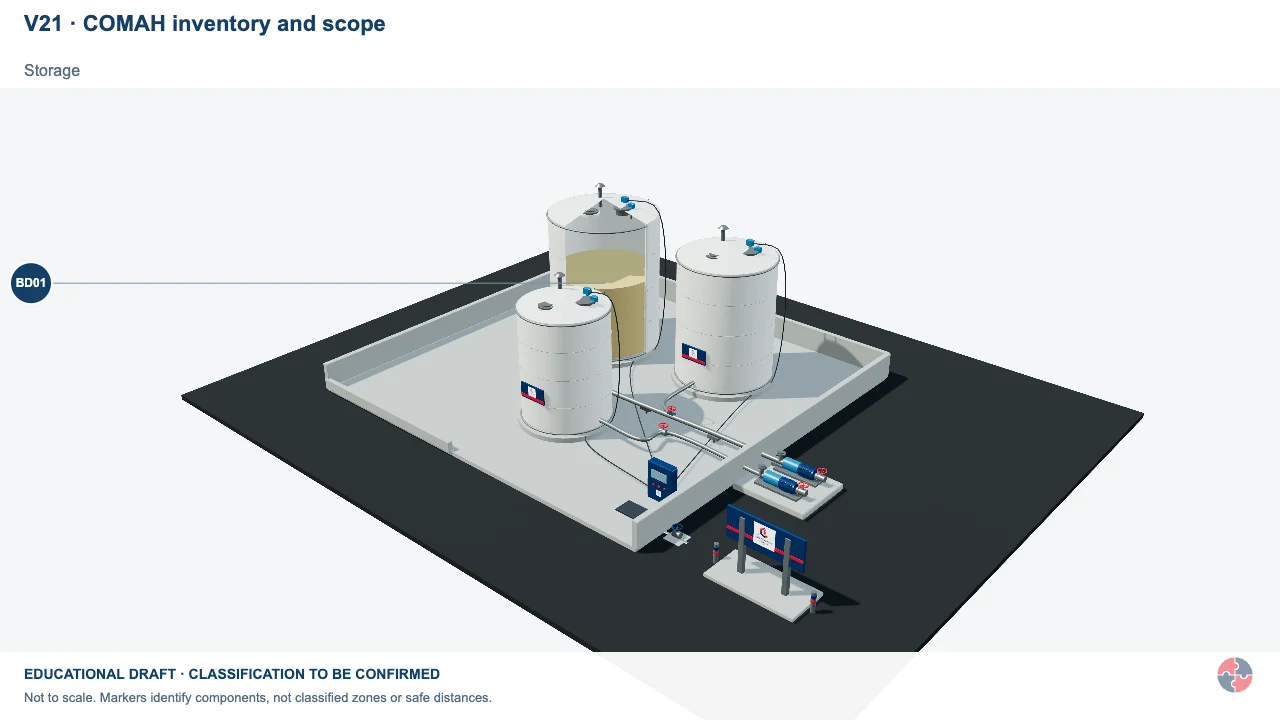
COMAH inventory and scope
Identify dangerous substances and their relevant quantities before determining whether COMAH applies and at which tier.
Activity focus: Inspect the assessment record instead of inferring scope from zone numbers or tank count.
Contextual workplace scene. Use the task, control and evidence checks in this section; appearance alone does not establish safe conditions, individual health or approval.
Educational illustration, not to scale. Coloured zones are teaching examples, not a site-specific hazardous-area classification.
Keep lower-tier duties distinct from upper-tier safety-report requirements; lower tier is a requested premise only.
What do the acronyms and key terms mean?
These definitions separate the policy, its management system and the upper-tier statutory report.
Definitions follow HSE COMAH 2015 overview and HSENI Control of Major Accident Hazards Regulations.
| Term | Full name | Meaning here |
|---|---|---|
| MAPP | Major accident prevention policy | Written in-scope operator policy implemented by a safety management system. |
| COMAH | Control of Major Accident Hazards | Separate GB and NI threshold-based 2015 regimes. |
| SMS | Safety management system | Arrangements that implement policy through people, controls, change, emergencies and review. |
| Safety report | Not an acronym | Detailed site-specific upper-tier COMAH demonstration required by law. |
| Safety-case thinking | Not an acronym | Explanatory claim-control-evidence method, not a substitute for a required report. |
| ALARP | As low as reasonably practicable | Risk-reduction language needing evidence and competent judgement. |
| ERICPD | Eliminate, Reduce, Isolate, Control, PPE, Discipline | Professional control-planning sequence, not COMAH law. |
| PPE | Personal protective equipment | Residual individual protection; it cannot prevent a major release. |
Explore the Crownway Fuels hierarchy
Start at the major accident prevention policy for the separate illustrative terminal. Explore responsibilities, applicable duties and the evidence expected.
Choose a document to see why it is used, who owns it, which duties it supports and what evidence it should produce. Switch to Text hierarchy for a list of expandable branches.
Fictional Crownway Fuels examples for English forecourts, with a separate illustrative bulk terminal. Check site applicability, permissions and actual controls before adapting any document for use.
Loading the Crownway register…
Which Crownway Fuels documents support this topic?
Open an editable document, read the preview, or find its place in the Crownway hierarchy. 10 resources relate to this page.
Fictional Crownway Fuels examples for English forecourts, with a separate illustrative bulk terminal. Check site applicability, permissions and actual controls before adapting any document for use.
Major accident prevention policy (9)
- Major accident prevention policy (CWF-POL-COMAH · Completed fictional example)
Document the lower-tier MAPP, approved commitments and organisational arrangements implemented through a proportionate SMS.
Read preview · Download DOCX · Show in hierarchy - Major accident prevention and proportionate safety management procedure (CWF-PRO-COMAH · Completed fictional example)
Explain who does what, in what sequence, the control rationale, evidence, escalation and safe restart conditions.
Read preview · Download DOCX · Show in hierarchy - Lower tier COMAH MAPP and SMS implementation plan (CWF-PLN-COMAH-01 · Completed fictional example)
Provide the site/task-specific lower tier comah mapp and sms implementation plan and retain its controlled output.
Read preview · Download DOCX · Show in hierarchy - Major accident hazard and scenario register (CWF-REG-COMAH-01 · Blank register with separate fictional worked entries)
Provide the site/task-specific major accident hazard and scenario register and retain its controlled output.
Read preview · Download XLSX · Show in hierarchy - Major accident risk and barrier evaluation (CWF-RA-COMAH-01 · Blank editable master)
Provide the site/task-specific major accident risk and barrier evaluation and retain its controlled output.
Read preview · Download DOCX · Show in hierarchy - Safety critical elements and performance standards register (CWF-REG-COMAH-02 · Blank register with separate fictional worked entries)
Provide the site/task-specific safety critical elements and performance standards register and retain its controlled output.
Read preview · Download XLSX · Show in hierarchy - COMAH notification and public information review record (CWF-FRM-COMAH-01 · Blank editable master)
Provide the site/task-specific comah notification and public information review record and retain its controlled output.
Read preview · Download DOCX · Show in hierarchy - MAPP and SMS effectiveness audit (CWF-AUD-COMAH-01 · Blank editable master)
Provide the site/task-specific mapp and sms effectiveness audit and retain its controlled output.
Read preview · Download DOCX · Show in hierarchy - MAPP five yearly and material change review (CWF-FRM-COMAH-02 · Blank editable master)
Provide the site/task-specific mapp five yearly and material change review and retain its controlled output.
Read preview · Download DOCX · Show in hierarchy
Worked example for the illustrative bulk terminal (1)
- Fuel terminal major accident prevention policy (CWF-MAPP-TERM-01 · Completed fictional example)
Shows the terminal’s policy, responsibilities and arrangements for major accident prevention.
Read preview · Download DOCX · Download PDF · Show related branch
Unlock another resource
You have used this month’s two free downloads. Publish a post in your own words to unlock one more resource, or choose SHARE Individual for 10 downloads per month.
You decide whether to share. If you do, use the relevant platform disclosure tools and do not make claims you do not genuinely hold.