SHARE Knowledge Hub
Physical and Psychological Health in Construction
Physical and psychological health in construction should be managed as one connected health-risk system, not as separate posters for manual handling, dust, noise, stress and wellbeing. Physical risks include musculoskeletal disorders (MSDs), noise-induced hearing loss, hand-arm vibration, dust, heat, cold and fatigue. Psychological risks include demands, control, support, relationships, role clarity, change, pressure, isolation and traumatic events. Good construction management uses Construction (Design and Management) (CDM) planning, worker involvement, welfare, task redesign, exposure control, health surveillance, stress risk assessment, supervisor checks, contractor coordination and learning from early warning signs.
Understanding Physical and Psychological Health in Construction
Physical and psychological health in construction should be managed as one connected health-risk system, not as separate posters for manual handling, dust, noise, stress and wellbeing. Physical risks include musculoskeletal disorders (MSDs), noise-induced hearing loss, hand-arm vibration, dust, heat, cold and fatigue. Psychological risks include demands, control, support, relationships, role clarity, change, pressure, isolation and traumatic events. Good construction management uses Construction (Design and Management) (CDM) planning, worker involvement, welfare, task redesign, exposure control, health surveillance, stress risk assessment, supervisor checks, contractor coordination and learning from early warning signs.
Why this matters at work
Some of the strongest health decisions precede the workface. The design and programme can avoid repeated breaking, specify quieter prefabricated components, reduce manual rework, position plant away from occupied rooms and leave safe access for maintenance. Procurement can compare tool and machine noise, vibration, ergonomics and service support. A lower purchase price is not a complete comparison if the tool imposes longer exposure or more labour.
Review the design with the people who will construct and maintain it. Record the remaining hazards and the assumptions behind the method, including sequence, shift length, weather, neighbouring work and specialist radiation operations. Feed them into tender and construction-phase planning. A control that depends on an empty adjacent room needs a schedule and verification, not just a note on a drawing. Revisit decisions when value engineering or late redesign changes the task.
How organisations manage this in practice
Agree practical changes such as removing unnecessary demand, clarifying authority, providing competent cover or reducing exposure to threatening situations. Assign resources, owners and review points, then check actual work and worker feedback. Keep individual clinical support and fair employment processes separate from the group risk assessment. Do not treat a report of distress as misconduct or place diagnoses in a broad leadership pack. The Management Standards are a guidance approach, and suitable assessment and action remain required under the applicable GB or NI framework. Escalate immediate safety concerns promptly and review after material change or failed arrangements.
Radiography is often scheduled at night or during a shutdown, when fewer people are expected. That assumption must be checked against security, cleaners, other contractors, welfare use and occupied premises beside the site. The specialist employer should define the controlled area, barriers, warnings, monitoring and supervision under its local rules. HSE industrial-radiography guidance describes appropriate dose-rate and personal alarm monitoring for the activity.
Audit one real task for each hazard and at least one overlapping workface. Check exposure assumptions, equipment model, worker consultation, surveillance or specialist advice, control maintenance, contractor briefing and change management. Review nights, basement work, temporary offices and outdoor work, not only the main day shift. Ask whether an observed improvement is in source exposure, worker protection, health outcome or simply paperwork. Close actions with field evidence.
How can I practise this topic in 3D?
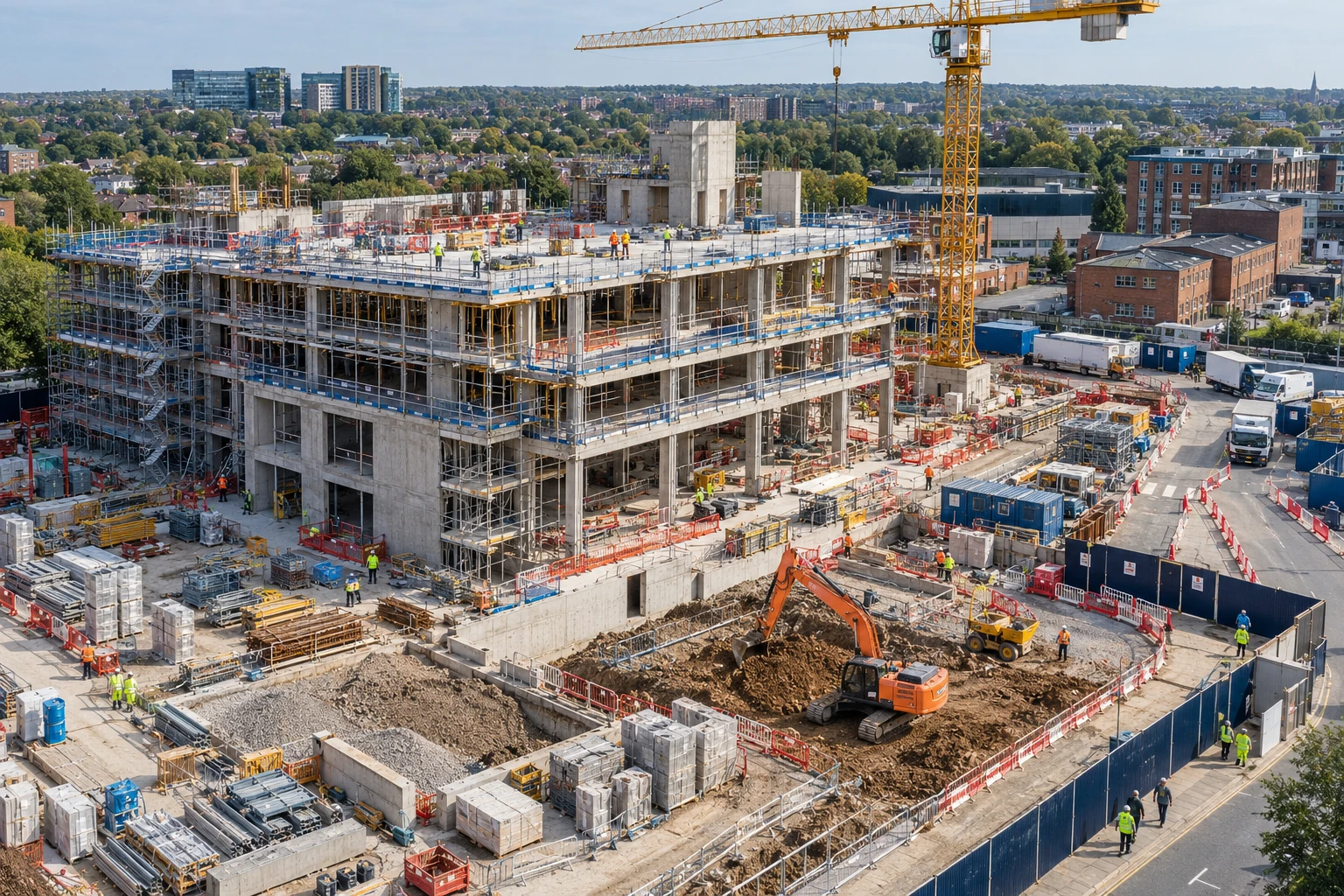

Programme pressure creates stress and fatigue
All related inspection points 2 across 1 location
Construction site 2 inspection points
Practice in the SHAREhub environment. Browser practice is separate from workplace competence and formal learning records.
Why must physical and psychological health be managed together?
Physical and psychological health risks often interact, especially where work is demanding, changeable, noisy, dusty, high-pressure or poorly planned.
Construction health management can fail when risks are split into disconnected topics. A worker using a breaker may face vibration, noise, dust, fatigue, time pressure, poor welfare and stress at the same time. A supervisor trying to recover programme delay may shorten breaks, increase pace and reduce control checks, which can increase both physical and psychological harm.
HSE's construction health guidance emphasises the same discipline used for safety: assess, control, train, monitor and review. Physical health risks such as MSDs, noise-induced hearing loss and HAVS are preventable. Psychological health risks should also be managed through work design, consultation and the HSE Management Standards.
| Health area | What can harm people | What good management looks like |
|---|---|---|
| Musculoskeletal health | Lifting, carrying, awkward posture, repetition, force and poor recovery. | Design out handling, use aids, plan sequences and intervene early. |
| Noise and vibration | Power tools, plant, impact tools, prolonged exposure and poor maintenance. | Select lower exposure methods, plan duration, maintain equipment and use health surveillance where required. |
| Respiratory and skin health | Dust, cement, silica, solvents, wet work and poor hygiene. | COSHH controls, welfare, RPE/PPE and exposure monitoring where needed. |
| Psychological health | High demands, low control, poor support, conflict, uncertainty and change. | Risk assess stressors, consult workers, support supervisors and act on patterns. |
| Fatigue and recovery | Long hours, night work, travel, heat, cold and poor welfare. | Plan work/rest, realistic programme, hydration, welfare and supervision. |
| Health surveillance | Required where exposure can cause detectable work-related harm. | Use risk-based surveillance and feed anonymous learning back into controls. |
How can the hierarchy of controls reduce physical exposures and harmful work demands in construction?
For a breaker operator on a pressured construction programme, vibration and noise enter through the tool and environment while unrealistic output targets reduce recovery and increase stress. Workers nearby may share the noise; the operator bears hand-arm exposure. HSE describes elimination, substitution, engineering, administrative controls and PPE. ERICPD uses Eliminate, Reduce, Isolate, Control, PPE and Discipline as a related decision aid, not a different legal duty.
Eliminate: the designer and principal contractor first test off-site fabrication or a method that avoids breaking concrete. Check that a design change does not move harmful exposure to another crew. The work planner records the method choice and residual risks.
Substitute and reduce: choose a suitable lower-vibration, lower-noise method and realistic task duration. The plant lead verifies tool specification and actual exposure time; a nominally quieter tool with poor productivity can extend exposure and pressure, so both health outcomes need checking.
Isolate and engineer: segregate the noisy work, use barriers or enclosures where practicable, maintain cutting/breaking equipment and provide dust extraction. The supervisor checks measurements or field evidence and confirms adjacent trades are outside the hazard zone.
Control, PPE and Discipline: plan rotation, recovery, consultation and a credible programme; monitor tool time, noise, symptoms, workload and near misses. Provide correctly selected hearing and respiratory protection for residual exposure, with fit and use checks. A worker report of numbness, hearing difficulty, distress or failed controls triggers review, not blame.
Direct source: HSE construction health risks
Direct source: HSE stress Management Standards
Direct source: HSE construction vibration
How can the ERICPD hierarchy of controls reduce physical exposures and harmful work demands in construction?

| ERICPD control level | Topic-specific example | Source and full task context |
|---|---|---|
| Eliminate | Remove avoidable hazardous tasks or unrealistic programme demands at planning stage. | Read the full task example, checks and stop points on this page. vibration and noise · lower-vibration, lower-noise method · recovery, consultation |
| Reduce | Assess a demonstrably lower-hazard material/process or tool; merely rotating workers does not replace the source hazard. | Read the full task example, checks and stop points on this page. vibration and noise · lower-vibration, lower-noise method · recovery, consultation |
| Isolate | Provide suitable physical barriers, dust extraction and maintained lower-exposure equipment. | Read the full task example, checks and stop points on this page. vibration and noise · lower-vibration, lower-noise method · recovery, consultation |
| Control | Agree realistic sequencing, workload, consultation, meaningful rotation/recovery and summed trigger-time planning. | Read the full task example, checks and stop points on this page. vibration and noise · lower-vibration, lower-noise method · recovery, consultation |
| PPE | Select suitable residual hearing/RPE/other protection from the task assessment, with fit where required. | Read the full task example, checks and stop points on this page. vibration and noise · lower-vibration, lower-noise method · recovery, consultation |
| Discipline | Supervise use, check actual exposure/workload, report failures and verify corrective follow-through. | Read the full task example, checks and stop points on this page. vibration and noise · lower-vibration, lower-noise method · recovery, consultation |
How can the ISO 45001 hierarchy of controls reduce physical exposures and harmful work demands in construction?

| ESEAP control level | Topic-specific example | Source and full task context |
|---|---|---|
| Elimination | Remove avoidable hazardous tasks or unrealistic programme demands at planning stage. | Read the full task example, checks and stop points on this page. vibration and noise · lower-vibration, lower-noise method · recovery, consultation |
| Substitution | Assess a demonstrably lower-hazard material/process or tool; merely rotating workers does not replace the source hazard. | Read the full task example, checks and stop points on this page. vibration and noise · lower-vibration, lower-noise method · recovery, consultation |
| Engineering controls | Provide suitable physical barriers, dust extraction and maintained lower-exposure equipment. | Read the full task example, checks and stop points on this page. vibration and noise · lower-vibration, lower-noise method · recovery, consultation |
| Administrative controls | Agree realistic sequencing, workload, consultation, meaningful rotation/recovery and summed trigger-time planning. | Read the full task example, checks and stop points on this page. vibration and noise · lower-vibration, lower-noise method · recovery, consultation |
| PPE | Select suitable residual hearing/RPE/other protection from the task assessment, with fit where required. | Read the full task example, checks and stop points on this page. vibration and noise · lower-vibration, lower-noise method · recovery, consultation |
What should a construction health dashboard show?
A useful dashboard helps site leaders see whether health risks are being controlled before illness, fatigue or distress becomes visible.
A construction health dashboard should not be a vanity scorecard. It should combine leading indicators, supervisor verification and occupational-health learning so the project can see which controls are reliable and which are starting to drift. The dashboard should be reviewed at project meetings with the same seriousness as safety, cost and programme.
Good dashboards separate raw activity from useful assurance. Counting toolbox talks is weaker than checking whether workers can explain the dust control, whether extraction is working, whether welfare defects were closed, whether HAVS exposure is being tracked and whether supervisors escalated unrealistic workload pressure.
| Health risk | Leading indicator | What it tells management |
|---|---|---|
| Dust and respiratory exposure | Extraction checks completed, visible dust findings closed, RPE face-fit status and housekeeping inspections. | Whether dust controls are working in real work, not just written in RAMS. |
| Noise | Noisy task plan, hearing protection zones verified, quieter plant procurement and hearing-surveillance feedback. | Whether exposure is being reduced and workers are protected. |
| HAVS | Tool vibration data, trigger-time planning, rotation, maintenance and health-surveillance prompts. | Whether daily exposure is being actively managed. |
| MSDs | Manual-handling redesign actions, mechanical aids used, early discomfort reports and supervisor interventions. | Whether task design is improving before injuries become chronic. |
| Fatigue | Overtime, travel time, night work, heat stress and rest-break compliance. | Whether programme pressure is increasing error and health risk. |
| Stress and wellbeing | Workload concerns, role clarity, support issues, conflict trends and change briefings. | Whether psychological risks are being managed as work-design issues. |
| Welfare | Toilet, washing, drying, drinking water and eating facilities checked and defects closed. | Whether basic health controls are reliable for direct labour and contractors. |
| OH referrals and surveillance | Confidential referral trends and anonymised surveillance learning. | Whether health data is being used to improve controls without breaching privacy. |
| Supervisor briefings | Daily briefings completed on the health controls that must not fail, not only the safety task steps. | Whether supervisors are turning health risks into field-level checks and stop-work prompts. |
Illustrative ledger, not a safe-time schedule. For one worker, list each tool and representative in-use vibration magnitude, observed/estimated operating (trigger) time, daily exposure contribution and total. For example record the breaker and grinder separately, then sum their contributions using the HSE calculator before choosing the control. The supervisor owns the allocation, pauses work if inputs or the plan become invalid, and rechecks actual use. Rotation changes an individual’s exposure, not the source hazard; count every subsequent vibrating task. Resequence a programme clash instead of recovering delay by extending exposure. HSE vibration exposure calculator
Illustrative daily vibration ledger — not a safe-time allowance
| Task/tool | Representative in-use magnitude | Operating/trigger duration | Input/evidence to verify |
|---|---|---|---|
| Breaker | 6 m/s² | 30 minutes (0.5 h) | Task-representative magnitude and observed operating time. |
| Grinder | 4 m/s² | 15 minutes (0.25 h) | Count this second tool as well; do not restart the exposure clock. |
For these inputs, A(8) = √[(6² × 0.5 + 4² × 0.25) / 8] = approximately 1.66 m/s². Use the HSE calculator for the actual day and include every vibrating task. These numbers neither set safe minutes nor establish that a real task is controlled. The supervisor checks representative inputs and actual use; uncertain inputs or changed workload pause the allocation for reassessment. Resequence a clash instead of extending use, record the control/owner, and recheck actual exposure and worker feedback.
How should the construction health dashboard be used?
A dashboard only adds value if leaders use it to make decisions about work design, resources, controls and escalation.
The dashboard should be reviewed as part of the normal project rhythm: daily supervisor checks, weekly site coordination, monthly management review and learning after incidents or health-surveillance trends. It should trigger action when leading indicators show drift, not wait for confirmed occupational illness or stress absence.
The key question is always: what decision will this data change? If dust findings repeat, change the method or sequencing. If welfare defects stay open, escalate them as failed health controls. If overtime and travel are rising, review fatigue and workload. If health surveillance suggests exposure, review source controls before blaming individuals.
| Review level | Typical questions | Decision output |
|---|---|---|
| Daily supervisor check | Are today's dust, noise, HAVS, manual-handling, welfare and workload controls in place? | Stop, fix or brief before the task starts. |
| Weekly project review | Are defects repeating, actions overdue or programme pressures undermining controls? | Re-sequence work, add resources, repair welfare or escalate contractor issues. |
| Monthly management review | Do trends show weak control ownership, poor procurement or unrealistic planning? | Change standards, procurement, training, contractor rules or programme assumptions. |
| OH/surveillance review | Do anonymised trends suggest exposure or early harm? | Review controls at source and update risk assessments. |
| Learning review | Did a complaint, near miss or incident reveal a work-design failure? | Update CPP, RAMS, briefings, assurance checks and action trackers. |
What integrated model helps construction managers?
A practical model is: identify health hazards, understand work pressure, design controls, brief workers, verify use, listen, review health data and improve.
The key shift is from treating health as an individual problem to treating it as work design. Back pain is not solved by a manual handling leaflet if blocks are stacked on the floor, access is cramped and the schedule rewards rushing. Stress is not solved by resilience training if the programme is unrealistic, roles conflict and workers cannot influence the method.
| Step | Physical health question | Psychological health question |
|---|---|---|
| Identify | Which tasks expose people to force, noise, vibration, dust, heat, cold or awkward posture? | Which demands, control, support, relationships, role or change issues could harm people? |
| Design | Can the task, material, plant, access or sequence be changed before work starts? | Can workload, communication, supervision and role clarity be improved before pressure builds? |
| Control | Are controls at source stronger than PPE or individual effort? | Are workers involved and able to raise concerns without blame? |
| Verify | Are controls being used in real work, not only written in RAMS? | Are workers skipping breaks, hiding issues or accepting unrealistic expectations? |
| Review | Do health surveillance, symptoms, absence, defects and feedback show controls are working? | Do stress indicators, turnover, conflict or near misses show work design problems? |
How do physical and psychological risks reinforce each other?
Construction health risk is strongest where physical exposure and work pressure combine, so managers should look for interaction patterns.
A breaker may create vibration and noise while schedule pressure pushes longer trigger time and fewer recovery opportunities. Assess the tool, actual use time and nearby trades alongside demands and control over work; treating stress and exposure as separate checklists can miss their shared cause.
| Interaction | How harm can build | Control response |
|---|---|---|
| Dust shortcuts + programme pressure | Workers remove extraction or RPE because the task is behind schedule. | Re-plan programme, provide extraction, exclude others and make dust control a critical path requirement. |
| Manual handling + low control | Workers accept poor storage, awkward access and heavy carrying because they cannot influence the method. | Redesign layout, consult workers and give supervisors authority to change the method. |
| Noise + communication pressure | Important instructions are missed and workers become frustrated or isolated. | Reduce noise, use visual briefings, plan communication and check understanding. |
| HAVS + cold + fatigue | Grip force increases, trigger time rises and symptoms may be ignored to finish the job. | Warm welfare, rotation, tool planning, symptom reporting and supervision. |
| Long shifts + high workload | Fatigue reduces attention, increases pain and makes conflict more likely. | Manage overtime, recovery, travel, resource levels and break quality. |
| Poor welfare + dignity concerns | Workers avoid drinking, washing or reporting symptoms because facilities are poor. | Fix welfare, protect privacy and escalate defects as health controls. |
What physical and psychological health risks appear on real sites?
Site examples help learners connect health theory to tasks, trades, supervisors and planning decisions.
For each trade, start with the task and the route of harm, then ask who can change the method before work begins. A supervisor needs an observable pre-use check and a clear stop point, while designers and managers need evidence that the selected method reduces exposure in practice.
| Task or setting | Physical health risks | Psychological or work-design risks |
|---|---|---|
| Drylining and plasterboard work | Manual handling boards, sanding dust, awkward overhead work and repetitive fixing. | Programme pressure, poor sequencing, other trades in dusty areas and welfare distance. |
| Breaking out concrete | HAVS, noise, silica dust, force, posture and fatigue. | Time pressure, poor rotation, weak supervision and normalised overexposure. |
| Roof work | Heat/cold, kneeling, manual handling, falls and weather exposure. | Weather delay pressure, isolation, fear of stopping and contractor interfaces. |
| Groundworks | Manual handling, vibration, dust, plant interface, wet/cold work and buried services. | Long shifts, changing plans, traffic pressure and high consequence decisions. |
| Fit-out in occupied buildings | Dust, noise, confined access, manual handling and poor welfare separation. | Client pressure, public interface, complaints and restricted working hours. |
| Night or weekend work | Fatigue, reduced support, travel risk and welfare limits. | Isolation, reduced supervision and pressure to complete before handover. |
How do HSE Management Standards apply?
The Management Standards help construction teams identify work-related stressors and link them to practical control actions.
The six standards are not a separate office-only framework. Demands, control, support, relationships, role and change all appear in construction. A poorly coordinated project can overload supervisors, give workers little control, reduce support, create conflict between trades, blur responsibilities and introduce late changes without proper briefing.
| Standard | Construction example | Control action |
|---|---|---|
| Demands | Unrealistic programme, excessive overtime or too many simultaneous tasks. | Resource properly, re-plan and set safe production expectations. |
| Control | Workers cannot change method or stop when health controls fail. | Use worker involvement, stop-work authority and method review. |
| Support | Supervisor lacks time, training or authority to manage health risks. | Coach supervisors and give them escalation routes. |
| Relationships | Trade conflict, blame or poor respect for welfare and dust/noise controls. | Set site standards, challenge behaviour and use fair issue resolution. |
| Role | Unclear dutyholder, supervisor, contractor or health-surveillance ownership. | Define responsibilities in CPP, RAMS and induction. |
| Change | Design, sequence, access or programme changes not re-briefed. | Use change review and brief health impacts before work restarts. |
How should site teams assess these risks?
Assessment should look at the task, the exposure, the person, the work organisation and the evidence that controls work.
Walk the work sequence with the people doing it. Identify physical exposure and workload demands, select controls at source, check they are usable on the programme, and record what change or symptom would trigger reassessment.
| Step | What to ask | Evidence |
|---|---|---|
| Task | What work creates force, posture, dust, noise, vibration, heat, cold, fatigue or stress? | Task assessment, RAMS and site observation. |
| People | Who is exposed, who is vulnerable, who is new and who is indirectly affected? | Briefing, workforce profile and contractor interface review. |
| Controls | Can risk be designed out or reduced before PPE or individual effort? | Design review, procurement and method selection. |
| Work organisation | Do pace, breaks, welfare, supervision and change increase health risk? | Programme, rota, welfare and supervisor feedback. |
| Health data | Do symptoms, surveillance, absence or complaints show weak controls? | OH feedback, trend review and action tracker. |
| Review | What changed today and what controls must not fail? | Supervisor daily check and close-out record. |
What should supervisors ask in daily briefings?
Daily briefings should turn the health-risk assessment into practical checks workers can understand before the task starts.
A briefing should name the day’s tool, material, location and overlapping trades. Ask workers to show the control, explain the stop condition and know whom to tell if exposure or workload differs from the plan.
| Prompt | Why it matters | Good answer from the team |
|---|---|---|
| What has changed since yesterday? | Change often invalidates yesterday's RAMS. | Access, weather, sequence, other trades, material location or team competence has been checked. |
| Which health control must not fail today? | Keeps focus on critical controls, not generic reminders. | Extraction, RPE fit, hearing protection zone, HAVS trigger time, welfare or break plan is named. |
| Where could programme pressure create a shortcut? | Pressure is a predictable risk factor. | The team knows what work can pause, escalate or be re-sequenced. |
| Who is new, vulnerable or working alone? | New starters and isolated workers may hide uncertainty. | Buddying, supervision and induction needs are clear. |
| How will we know dust/noise/vibration/fatigue is drifting? | Workers need visible warning signs and stop rules. | Dust clouds, tool times, symptoms, missed breaks or welfare defects are named. |
| What is the escalation route? | Workers need confidence that reporting will lead to action. | Supervisor, manager, OH/HSE adviser and stop-work route are clear. |
Which leading indicators show construction health is being managed?
Leading indicators should tell managers whether controls are effective before illness, injury or stress absence appears.
Check whether extraction, tool maintenance, task rotation and reasonable programme changes actually happen. Exposure readings, worker reports and closed corrective actions are more useful than counting briefing attendance alone.
| Indicator | What good looks like | What to challenge |
|---|---|---|
| Exposure controls checked | Dust extraction, noise controls, HAVS planning and manual-handling aids verified during work. | Checks only confirm PPE is worn. |
| Welfare defects closed | Toilet, washing, drinking water, drying and eating facilities repaired quickly. | Welfare defects stay open because they are not treated as health controls. |
| Workload concerns escalated | Supervisors report unrealistic programme, fatigue or staffing pressure early. | Programme pressure is normalised until a failure occurs. |
| Worker feedback used | Briefings and inspections capture what makes controls hard to use. | Workers are blamed for not following controls designed without them. |
| OH/surveillance learning reviewed | Anonymous trends lead to control improvement. | Health surveillance is filed without management review. |
| Action verification | Health actions are checked in the field after closure. | Actions are closed administratively without evidence. |
What does good control look like?
Good control prevents health risk at source and makes the healthy way of working the easy way of working.
This section turns legal language into workplace control. The examples show how broad duties become risk assessment, competent help, consultation, maintenance and review evidence.
| Control area | Practical example | Weak practice |
|---|---|---|
| Design and planning | Pre-cut materials, mechanical handling, lower-dust methods and realistic programme. | Expecting workers to compensate for poor design. |
| Procurement | Lower-vibration tools, quieter plant, dust extraction and suitable welfare. | Buying cheapest tools without exposure review. |
| Work organisation | Rotation, recovery, breaks, supervision and planned welfare access. | Rushing to recover delays by removing breaks. |
| Training and involvement | Workers help test whether controls work in real conditions. | Induction lists hazards but does not build understanding. |
| Health surveillance | Risk-based checks feed anonymous learning back to controls. | Health checks treated as a tick-box exercise. |
| Psychological support | Stressors assessed and practical changes made to demands, support, role and change. | Resilience posters instead of workload control. |
What warning signs show controls are failing?
Early warning signs should be used to improve the work before harm becomes chronic or serious.
Warning signs are included because failure usually appears before a serious event. Treat these points as prompts for inspection, audit, supervision and management review rather than as simple compliance statements.
| Warning sign | What it may indicate | Supervisor response |
|---|---|---|
| Workers skipping dust or noise controls | Controls are impractical, uncomfortable or poorly supervised. | Stop and review method, equipment and briefing. |
| Reports of tingling, pain, hearing issues or skin problems | Exposure may already be causing health effects. | Escalate to OH/HSE adviser and review controls. |
| Rushing, conflict or repeated short cuts | Programme pressure is overriding controls. | Escalate planning/resource issue. |
| High absence, fatigue or stress complaints | Workload, rota, welfare or support may be poor. | Use stress and fatigue risk review. |
| Health surveillance trends | Controls are not preventing exposure or early harm. | Review risk assessment and control standard. |
| Same RAMS copied across different sites | Assessment may not fit real conditions. | Make task and site-specific updates. |
How can programme pressure create health harm?
A fit-out example shows how physical and psychological risks reinforce each other when planning is weak. See HSE construction health risks.
Example A — drylining programme pressure
A drylining package falls behind programme. The contractor increases overtime and moves more workers into the area. Boards are carried further because storage is poor, joint sanding starts before extraction equipment arrives, other trades work nearby, and supervisors stop challenging dust because the deadline dominates. Workers report sore throats, fatigue, back pain and frustration. The weak response is to tell people to wear masks and work carefully. The strong response is to re-plan sequencing, storage, extraction, welfare, exclusion, rotation, programme pressure and supervision together.
| Issue | Weak response | Better response |
|---|---|---|
| Manual handling | Remind workers to lift correctly. | Improve storage, access, team handling and mechanical aids. |
| Dust | Issue masks after complaints. | Delay sanding until extraction and exclusion are ready. |
| Stress | Tell the team the deadline is non-negotiable. | Review demands, resources, communication and supervisor support. |
| Fatigue | Accept overtime as normal. | Plan recovery, rota limits and task rotation. |
| Learning | Close complaint as attitude issue. | Update CPP, RAMS, procurement and programme review. |
Example B — concrete-breaking task and hold points
Task material and setting: Concrete breaking on a multi-trade construction site under programme pressure.
People and prerequisites: Operator, adjacent trades, supervisor and principal contractor; current method, equipment and programme reviewed.
Before: Test whether off-site or quieter work removes the breaker; assess noise, vibration, dust and workload together.
During: Verify tool condition, barriers, extraction, actual exposure time and usable recovery.
Hold or stop: Stop for failed extraction, uncontrolled noise zone, vibration symptoms or unsafe pressure to continue.
Completion and hand back: Record exposure, defects, worker feedback and programme adjustments before the next phase.
Evidence: Design option review, method statement, equipment checks, exposure and worker-feedback record, completed corrective action.
What evidence shows this is managed well?
Evidence should show health risks are planned, controlled, verified and improved, not simply mentioned in a wellbeing policy.
Evidence should be read as a chain rather than a filing exercise. A single record rarely proves good management on its own; stronger assurance comes from matching records, observations, interviews, trends and verified action closure.
| Evidence | What it should show | Weakness to challenge |
|---|---|---|
| CPP and RAMS | Health risks, welfare, controls, monitoring and review built into planning. | Health risks mentioned generically. |
| Worker involvement | Workers consulted on real task difficulties and control usability. | Controls designed without workforce input. |
| Health surveillance | Risk-based surveillance and feedback to controls. | Screening not linked to risk. |
| Stress risk assessment | Demands, control, support, relationships, role and change addressed. | Stress treated as personal resilience only. |
| Inspection records | Supervisors check dust, noise, vibration, manual handling and welfare controls. | Inspections count PPE but not work design. |
| Action tracker | Health actions are owned, ranked, closed and verified. | Actions remain open or repeat. |
Keep the employer’s required health-surveillance outcome/fitness record distinct from OH’s confidential clinical record. Managers receive necessary functional restrictions and control actions, not diagnoses. Dashboards use suitably aggregated trends and suppress small crews/trades or free text that could identify an individual; privacy must not lead to omitting the employer’s legal health record.
Which legal duties apply?
Construction health duties come from general health and safety law, CDM and hazard-specific regulations.
The legal rows below distinguish Great Britain from Northern Ireland. Apply only the instrument in force for the workplace and task; guidance and an ISO system do not replace it.
| Duty or regulation | What it requires | How to apply it |
|---|---|---|
| Health and Safety at Work etc. Act 1974 | Requires employers to protect workers and others from work-related health and safety risks. | Treat physical and psychological health risks as business risks, not optional wellbeing extras. |
| Management of Health and Safety at Work Regulations 1999 | Requires suitable risk assessment, preventive arrangements, competent advice and review. | Assess tasks, people, contractors, change, welfare, fatigue, stress and health-risk controls. |
| CDM Regulations 2015 | Requires construction dutyholders to plan, manage, monitor and coordinate work. | Build health-risk controls into pre-construction information, CPP, RAMS, site setup, welfare and coordination. |
| Manual Handling Operations Regulations 1992 | Requires hazardous manual handling to be avoided, assessed and reduced. | Use task redesign, mechanical aids, sequencing and supervisor checks. |
| Control of Noise at Work Regulations 2005 | Requires noise exposure risks to be eliminated or reduced. | Control noisy tasks, exposure duration, hearing protection and health surveillance triggers. |
| Control of Vibration at Work Regulations 2005 | Requires vibration exposure risks to be controlled. | Manage HAVS exposure through tool selection, trigger time, maintenance and health surveillance. |
| COSHH Regulations 2002 | Requires hazardous substance exposure to be prevented or adequately controlled. | Include dust, silica, cement, solvents, fumes, biological agents and skin exposure. |
| UK GDPR / Data Protection Act 2018 | Worker health information must be handled lawfully and confidentially. | Separate health surveillance/OH records from manager action notes. |
| Health and Safety at Work (Northern Ireland) Order 1978 | General NI employer duty. | Protect NI workers and others from work risks. |
| Management of Health and Safety at Work Regulations (NI) 2000 | NI risk assessment and preventive arrangements. | Assess work factors, assign competent controls and review. |
| CDM Regulations (Northern Ireland) 2016 | Plan, coordinate and manage construction work in NI. | Apply design and contractor-interface controls to NI construction. |
| Control of Noise at Work Regulations (Northern Ireland) 2006 | Assess and control NI occupational noise. | Check noisy work and exposed neighbouring trades in NI. |
| Control of Vibration at Work Regulations (Northern Ireland) 2005 | Assess vibration exposure and eliminate or control it, with surveillance where required. | Use the NI instrument for breaker and other vibration work; verify tool exposure and controls. |
| Control of Substances Hazardous to Health Regulations (Northern Ireland) 2003 | Assess hazardous-substance risks and prevent or adequately control exposure. | Use the NI instrument for construction dust and chemical tasks; verify extraction and residual exposure. |
Manual handling of plasterboard in NI follows the separate Manual Handling Operations Regulations (Northern Ireland) 1992, as amended, including the 2003 amendment; the GB title is not the NI instrument. NI Manual Handling Regulations 1992
Read the NI 1992 manual-handling route with its amendments, including NI manual-handling amendment: 2003 regulation 4.
How should the control be managed and reviewed?
For a GB workplace, HSE guidance supports identifying the actual risk, taking practical protective steps and reviewing whether they work. Name the decision owner, check the control during the real task and correct a failed arrangement. Apply the separate Northern Ireland duties and guidance where the work is in NI.
GB management guidance: HSE managing health and safety
What training and awareness helps?
Training should help workers and supervisors understand health mechanisms, not just memorise topic names.
Training should be role-based. General awareness creates a baseline, but supervisors, managers, advisers and senior leaders need different levels of decision-making, verification and escalation competence.
| Role | Demonstration | Assessor | Record and reassessment |
|---|---|---|---|
| Construction workers | Recognise noise, vibration, dust, fatigue and pressure interactions; demonstrate reporting and stop points. | Supervisor observes briefing and field choice. | Induction plus changed task or symptom report. |
| Supervisors and trade leads | Choose method, check exposure duration and barriers, discuss workload without diagnosis, stop failed controls. | Construction health lead reviews live job plan. | Task check and corrective action; revisit each phase. |
| Designers and planners | Remove hazardous work and unrealistic sequencing where practicable; coordinate trades. | Principal contractor reviews method alternatives. | Design and programme decision log; review on change. |
| Managers and advisers | Integrate health surveillance, stress indicators and worker consultation into action. | Competent occupational health and safety lead reviews case. | Restricted health data and barrier review; reassess after trends. |
How could BuildOut Ltd manage this in practice?

BuildOut would manage physical and psychological health through design, planning, worker involvement, surveillance, stress-risk review and assurance.
A construction contractor needs to coordinate clients, designers, principal contractor duties, subcontractors, changing site conditions and programme pressure. BuildOut would integrate health controls into pre-construction information, CPP, RAMS, procurement, daily briefings, inspections and lessons learned.
| Management element | How the business would manage it | Evidence to review |
|---|---|---|
| Plan | Identify key physical and psychological health risks before work starts. | Health-risk register. |
| Design | Reduce manual handling, dust, noise, vibration and stressors through design and sequencing. | Design/risk review. |
| Engage | Involve workers in testing whether controls are usable. | Worker consultation record. |
| Verify | Check controls, surveillance feedback and stress indicators. | Assurance dashboard. |
| Improve | Update RAMS, procurement, training and programme control after learning. | Action tracker. |
What do the acronyms and key terms mean?
Acronyms should be understood before they are used in assessments, briefings, audits or learning answers.
Acronyms can exclude newer readers if they are not explained. This section keeps the main terms available at the end of the page so the article stays readable while still supporting learners and audit users.
| Acronym | Meaning | Plain-English use |
|---|---|---|
| CDM | Construction (Design and Management) Regulations | UK construction planning and dutyholder regulations. |
| MSD | Musculoskeletal Disorder | Injury or disorder affecting muscles, joints, limbs or back. |
| HAVS | Hand-Arm Vibration Syndrome | Health condition caused by vibration exposure to hands and arms. |
| NIHL | Noise-Induced Hearing Loss | Permanent hearing damage caused by excessive noise. |
| OH | Occupational Health | Specialist work-health advice. |
| CPP | Construction Phase Plan | Plan for managing construction work. |
Unlock another resource
You have used this month’s two free downloads. Publish a post in your own words to unlock one more resource, or choose SHARE Individual for 10 downloads per month.
You decide whether to share. If you do, use the relevant platform disclosure tools and do not make claims you do not genuinely hold.