
SHARE Knowledge Hub
Low Back Pain
Low back pain has many causes and a manager should not diagnose it. Prevent work-related aggravation by observing actual lifting, carrying, pushing, pulling and static tasks; avoid hazardous manual handling where practicable, assess what remains and redesign the task before relying on training. Adjust duties with the worker, and signpost urgent symptoms to clinical care.
Understanding Low Back Pain
Low back pain has many causes and a manager should not diagnose it. Prevent work-related aggravation by observing actual lifting, carrying, pushing, pulling and static tasks; avoid hazardous manual handling where practicable, assess what remains and redesign the task before relying on training. Adjust duties with the worker, and signpost urgent symptoms to clinical care.
Why this matters at work
Pain does not always mean structural damage, but it must still be taken seriously. A normal scan does not prove that the worker can do every task, and a scan showing age-related changes does not automatically explain the pain. Clinical interpretation and work-function evidence matter.
Work can cause, contribute to or aggravate low back pain, and non-work activity or health factors can also be relevant. The prevention question is whether work exposes people to a foreseeable risk and whether that exposure has been reduced as required; it does not depend on proving that work was the sole medical cause.
How organisations manage this in practice
Choose controls through worker trials and competent assessment, including maintenance, storage, charging, cleaning and emergency recovery. Verify actual exposure after implementation and keep interim controls time limited with an accountable owner for the stronger solution.
Assess the vehicle, route, terrain, seat, duration, maintenance and repeated shocks alongside manual work before and after driving. A new seat alone may not solve poor routes or excessive exposure. Obtain competent exposure assessment where needed and select engineering and organisational controls. Review worker reports and changes in vehicles or work patterns rather than using a generic driving-duration limit.
Fund changes in task, load, route and equipment, then provide task-specific training and maintenance. Build a confidential early-reporting pathway, functional work-demand profiles, fit-note discussion process and reviewed adjustment plan. Align supervisors, HR, occupational health and safety staff.
Start with the purpose of the task. Can material arrive at point of use, flow by gravity, be pumped or conveyed, be divided before delivery, or be handled by powered equipment? If not, reduce reach, force, frequency and duration through layout, load and route design.
Assess work organisation alongside physical factors. Ask whether staffing matches demand, whether equipment is available without delay, whether workers can stop a jammed or unsafe task, and whether targets assume uninterrupted ideal conditions. Review contractor and agency arrangements as well as permanent staff.
What should readers understand about low back pain?
Low back pain is not usually managed well by telling people to lift correctly; the task and work system need to change.
Best-practice guide: Low Back Pain
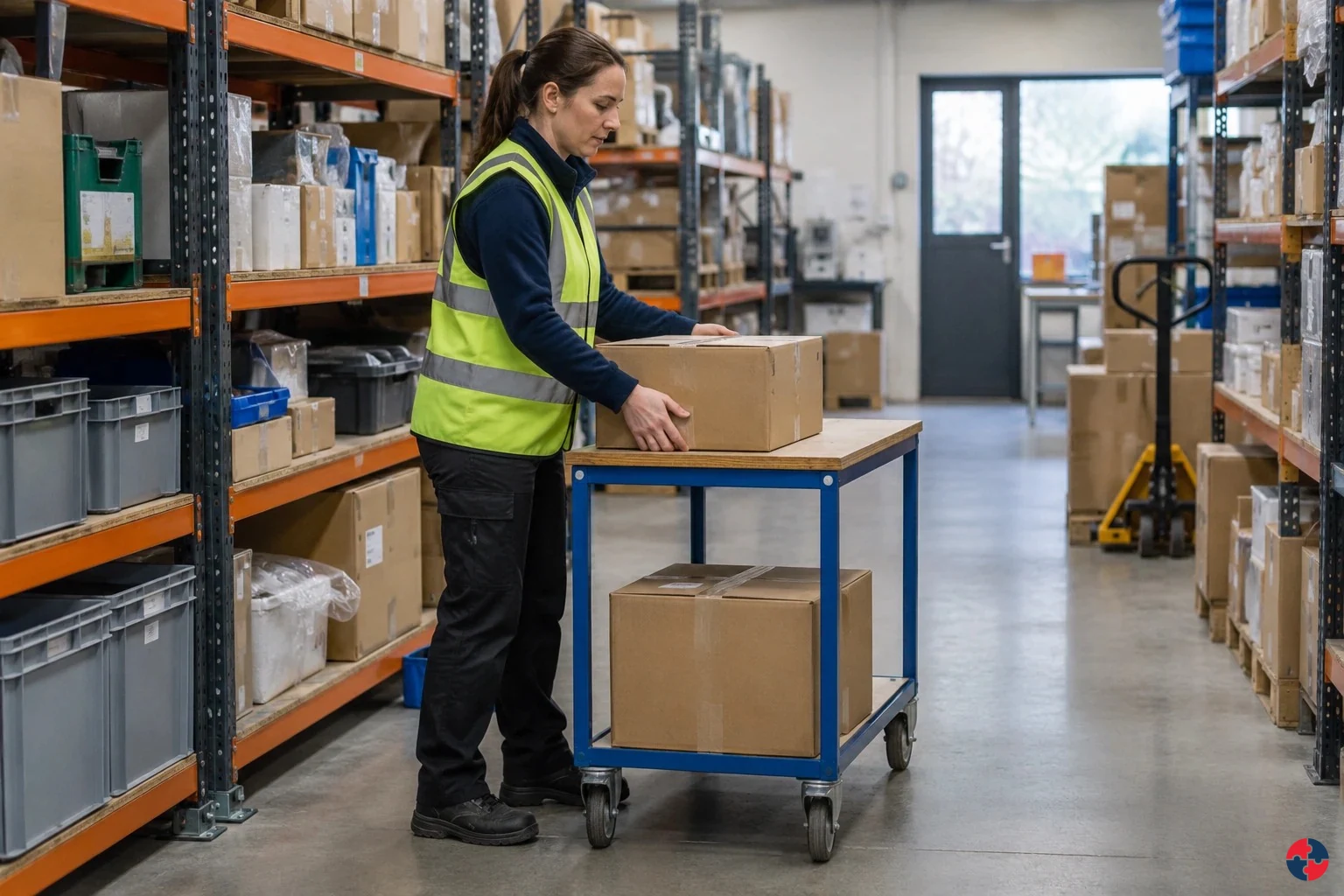
What should readers understand about low back pain?
Low back pain is not usually managed well by telling people to lift correctly; the task and work system need to change. Low back pain has many causes and a manager should not diagnose it.
Turn low back pain knowledge into a decision
Low back pain has many causes and a manager should not diagnose it. Prevent work-related aggravation by observing actual lifting, carrying, pushing, pulling and static tasks; avoid hazardous manual handling where practicable, assess what remains and redesign the task before relying on training. Construction phase plan and logistics review.
the site team worked example
Plan: Material size, delivery point, access route and storage height are reviewed before work starts. Evidence / response: Construction phase plan and logistics review. Control: Mechanical aids, lift tables, trolleys and team arrangements are selected for the task. Evidence / response: Handling aid checks and RAMS.
Task demands can aggravate pain and limit safe work
Heavy or awkward handling can place force on the back. Repeated bending, twisting or prolonged static work can contribute to discomfort. Pain can affect function; agree suitable work changes and use clinical advice where needed. Use the full topic for the detailed mechanism, task limits and source scope.
Choose controls for low back pain
Elimination: Arrange delivery at bench height and point of use so floor retrieval and a second manual lift are unnecessary. Substitution: Replace heavy cartons with suitable smaller packs; check stability and total repetition before accepting the new pack size. Engineering controls: Keep the unloading station away from vehicle movements and protect the clear route between pallet and bench. Engineering controls: Provide a suitable pallet positioner or lifting aid and adjustable receiving surface; verify capacity and access with the real cartons. Administrative controls: Agree replenishment quantities, handling limits and assistance before peak demand; do not use training to justify an excessive lift. Read the full control table for qualifications, ownership and verification. Use the actual task and applicable jurisdiction; existing technical approval remains unchanged.
Use the full low back pain lesson
Use the full topic for the decision points, practical examples, detailed control tables and source scope. HSE guidance applies to Great Britain; use HSENI for the Northern Ireland route and the source’s stated jurisdiction. A simplified guide does not change the page’s technical-review or approval status.

Read all six steps as text
1. What should readers understand about low back pain?
Low back pain is not usually managed well by telling people to lift correctly; the task and work system need to change.
- Avoid / redesign: Arrange delivery at bench height and point of use so floor retrieval and a second manual lift are unnecessary.
- Control the task: Keep the unloading station away from vehicle movements and protect the clear route between pallet and bench.
- Verify before release: If the hazardous step remains, retain a task assessment and select the stronger feasible remaining controls.
Low back pain is not usually managed well by telling people to lift correctly; the task and work system need to change. Low back pain has many causes and a manager should not diagnose it.
Apply it: Which part of this plan would you check at the workface before authorising the task?
2. Turn low back pain knowledge into a decision
Use the evidence to improve the actual work arrangement.
- Change at source: Arrange delivery at bench height and point of use so floor retrieval and a second manual lift are unnecessary.
- Make it observable: If the hazardous step remains, retain a task assessment and select the stronger feasible remaining controls.
- Keep useful evidence: Construction phase plan and logistics review.
Low back pain has many causes and a manager should not diagnose it. Prevent work-related aggravation by observing actual lifting, carrying, pushing, pulling and static tasks; avoid hazardous manual handling where practicable, assess what remains and redesign the task before relying on training. Construction phase plan and logistics review.
Apply it: What evidence would show that the change improves this task, rather than only completing a record?
3. the site team worked example
Example: a practical application of the existing topic lesson.
- Plan: Material size, delivery point, access route and storage height are reviewed before work starts.
- Control: Mechanical aids, lift tables, trolleys and team arrangements are selected for the task.
- Train: Workers practise the actual handling task and stop triggers.
Plan: Material size, delivery point, access route and storage height are reviewed before work starts. Evidence / response: Construction phase plan and logistics review. Control: Mechanical aids, lift tables, trolleys and team arrangements are selected for the task. Evidence / response: Handling aid checks and RAMS.
Apply it: At which point would you hold this example, and what evidence would allow it to proceed?
4. Task demands can aggravate pain and limit safe work
Connect the task, the route to the person and the control that can fail.
- Load: Heavy or awkward handling can place force on the back.
- Posture: Repeated bending, twisting or prolonged static work can contribute to discomfort.
- Work impact: Pain can affect function; agree suitable work changes and use clinical advice where needed.
Heavy or awkward handling can place force on the back. Repeated bending, twisting or prolonged static work can contribute to discomfort. Pain can affect function; agree suitable work changes and use clinical advice where needed. Use the full topic for the detailed mechanism, task limits and source scope.
Apply it: Where is this harm route present in the actual work, and which control breaks it before anyone is exposed?
5. Choose controls for low back pain
Start with the stronger practicable options and verify their effect.
- Elimination: Arrange delivery at bench height and point of use so floor retrieval and a second manual lift are unnecessary.
- Substitution: Replace heavy cartons with suitable smaller packs; check stability and total repetition before accepting the new pack size.
- Engineering controls: Keep the unloading station away from vehicle movements and protect the clear route between pallet and bench.
- Engineering controls: Provide a suitable pallet positioner or lifting aid and adjustable receiving surface; verify capacity and access with the real cartons.
- Administrative controls: Agree replenishment quantities, handling limits and assistance before peak demand; do not use training to justify an excessive lift.
Elimination: Arrange delivery at bench height and point of use so floor retrieval and a second manual lift are unnecessary. Substitution: Replace heavy cartons with suitable smaller packs; check stability and total repetition before accepting the new pack size. Engineering controls: Keep the unloading station away from vehicle movements and protect the clear route between pallet and bench. Engineering controls: Provide a suitable pallet positioner or lifting aid and adjustable receiving surface; verify capacity and access with the real cartons. Administrative controls: Agree replenishment quantities, handling limits and assistance before peak demand; do not use training to justify an excessive lift. Read the full control table for qualifications, ownership and verification. Use the actual task and applicable jurisdiction; existing technical approval remains unchanged.
Apply it: Which stronger option can be used here, and who will verify it before accepting the remaining risk?
6. Use the full low back pain lesson
Follow the official sources below and retain the task-specific evidence.
- Official guidance: HSE: Assess manual handling you cannot avoid
- Official guidance: Official task guidance: www.hse.gov.uk
- Task decision: Construction phase plan and logistics review.
Use the full topic for the decision points, practical examples, detailed control tables and source scope. HSE guidance applies to Great Britain; use HSENI for the Northern Ireland route and the source’s stated jurisdiction. A simplified guide does not change the page’s technical-review or approval status.
Apply it: Which official source and full-topic section will you use to resolve the next decision?
Low back pain can be short-term, recurring or persistent. It may involve muscles, ligaments, discs, joints, nerves or referred pain, and the medical cause is not always obvious. The workplace role is not to diagnose the back. It is to identify work factors that can contribute to pain or recovery problems and to make the task less demanding, more adjustable and better controlled.
Back pain risk is rarely about load weight alone. Bending, twisting, reaching, carrying distance, lifting frequency, pushing and pulling force, poor grip, unstable loads, floor condition, working height, fatigue, cold, vibration, pace, staffing levels and psychosocial pressure all matter. A light object lifted awkwardly hundreds of times may create more risk than a single heavier lift with good mechanical assistance.
The strongest learning point is prevention through design. Move the load less, place it at the right height, use handling aids, split or redesign loads, improve access, reduce repetition, rotate tasks intelligently and give workers authority to stop when the task no longer matches the assessment. Training matters, but training cannot compensate for a poor layout, unrealistic productivity pressure or missing equipment.
| Risk factor | How it can contribute | Control direction |
|---|---|---|
| Heavy or awkward manual handling | High spinal load, twisting and sudden strain. | Avoid, mechanise, split, team lift only where suitable and redesign storage. |
| Frequent repetition | Cumulative fatigue and reduced recovery. | Reduce frequency, rotate tasks and improve workflow. |
| Poor working height | Bending, stooping or overreaching. | Use adjustable benches, lift tables and better storage height. |
| Pushing and pulling | High force, poor posture or sudden movement. | Use suitable wheels, maintain floors and assess force. |
| Prolonged sitting or driving | Static posture, vibration and reduced movement. | Plan breaks, adjust seat, reduce exposure and review route demands. |
| Psychosocial pressure | Rushing, low control, poor support and fear of reporting. | Improve staffing, pacing, reporting culture and manager response. |
For task, load, posture, frequency, environment and worker input, use the direct HSE manual-handling assessment guidance.
What health boundary should workplaces respect?
Managers assess work; healthcare professionals assess symptoms and treatment.
NHS back-pain guidance says new bladder/bowel changes, loss of feeling around the genitals or anus, or pain/weakness/numbness in both legs need 999 or A&E. Severe sudden or rapidly worsening pain merits urgent GP or local urgent-care service advice. Stop the task and use the workplace emergency route rather than waiting for an ordinary occupational-health review.
For non-emergency pain, ask about work function and adjust the task with the worker. Do not diagnose a disc or prescribe exercise. Keep clinical information private and use functional advice for a safe return.
| Situation | Workplace response | Clinical boundary |
|---|---|---|
| Emergency warning sign | Stop task and help access 999/A&E. | NHS/clinicians assess; manager does not triage diagnosis. |
| Worsening non-emergency pain | Pause aggravating work; seek urgent GP or local urgent-care service where indicated. | No forced continuation. |
| Return to work | Use functional advice and redesign lifting. | Review, do not assume full capacity. |
The NHS emergency list also includes tingling in both legs, chest pain and back pain after a serious accident; consult the full NHS red-flag list. A manager should help access emergency care and avoid trying to rule out a serious condition.
For urgent non-emergency advice, follow the service for the reader’s location: NHS 111 in England, or a local GP, out-of-hours or Phone First route in Northern Ireland. Elsewhere use the local urgent-care route. Call 999 for an emergency.
The emergency summary also includes new changes in sexual sensation or function with back pain. Follow the full NHS emergency advice and seek immediate help; do not wait for an ordinary OH appointment. Feeling hot, cold or shivery, or generally unwell with back pain, warrants urgent GP or local urgent-care advice. This is a signpost, not a manager’s diagnostic checklist, and absence of a listed symptom does not rule out a serious condition. Sources: NHS back pain.
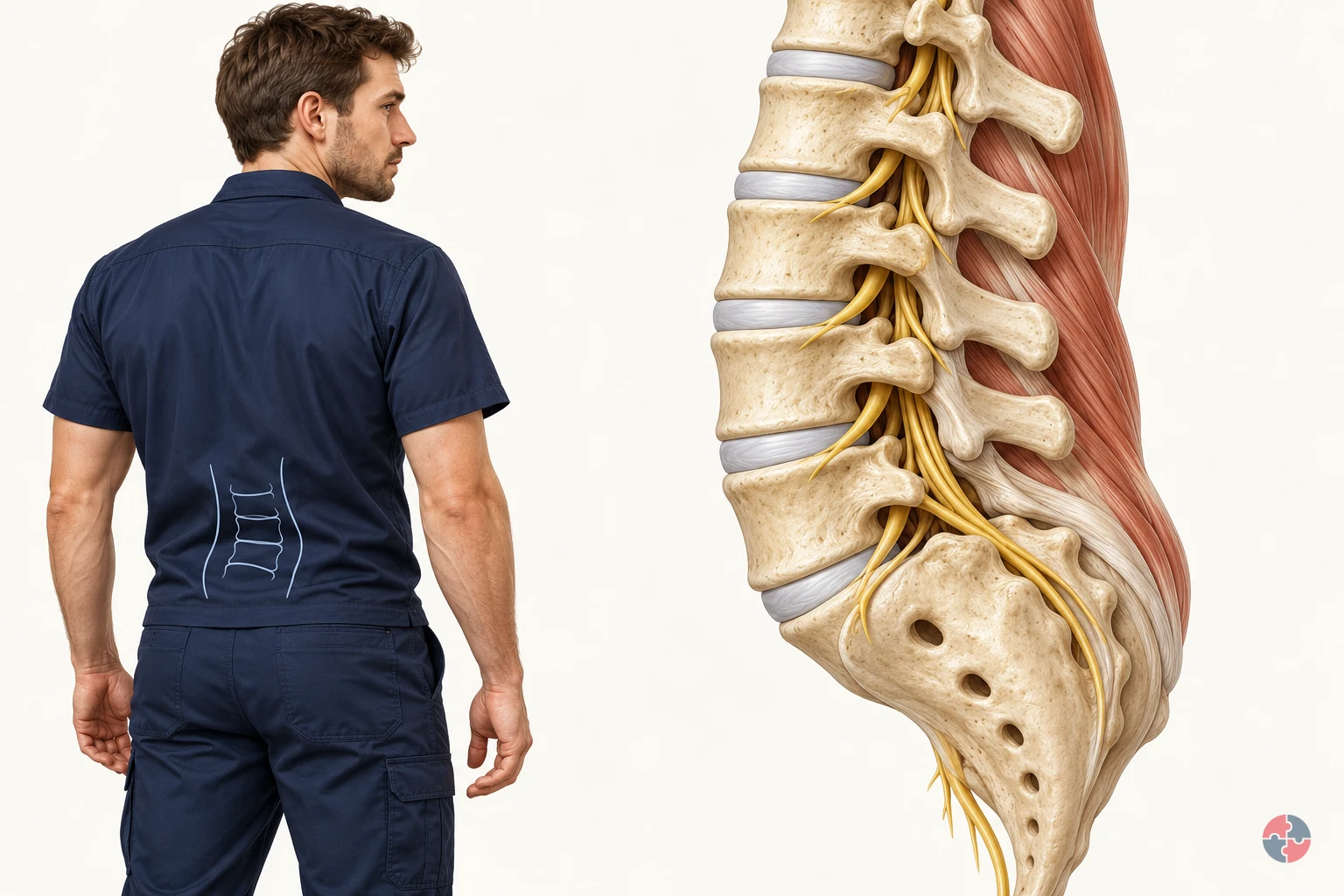

How does the back support movement, and how can work design reduce manual handling risk?
Interactive anatomy · Back and manual handling · Updated 2026-10-23
Read all anatomy and process explanations without the viewer
Simplified education, not a scan interpretation, diagnosis, safe-weight calculator, posture score or personalised exercise prescription. No webcam, posture capture or personal symptom input. Task demand comparisons never alter disc morphology or calculate spinal compression, tissue tolerance or injury probability.
Vertebral body
A vertebra is one of the bones of the spine. The vertebral body is the substantial front portion of a spinal bone. Neighbouring bodies are linked through discs, while other bony parts help enclose the nerve space behind them. Follow the bone-and-disc pattern to see how a spinal segment combines support with movement rather than behaving as a pile of separate blocks. University Hospitals Birmingham NHS Foundation Trust: Lumbar decompressive surgery: structure of the spine · DynamicHealth · NHS: Lower back pain
Intervertebral disc
A disc lies between neighbouring vertebral bodies. A disc is flexible tissue joining neighbouring vertebral bodies. A tougher outer region surrounds a softer centre, and the connected structure helps accommodate loading and movement. In the healthy model it stays part of the segment. The closer cutaway explains its regions; it is not a pressure gauge or a prediction of what a lift will do. University Hospitals Birmingham NHS Foundation Trust: Lumbar decompressive surgery: structure of the spine · DynamicHealth · NHS: Lower back pain
Outer disc region
The tougher outer region surrounds the softer centre. This labelled cross-section simplifies the disc’s tissue organisation. A ring outline is a teaching aid, not a measure of tissue strength. University Hospitals Birmingham NHS Foundation Trust: Lumbar decompressive surgery: structure of the spine
Inner disc region
The softer centre works with the outer disc tissue. Both regions contribute during loading. The diagram does not behave as a water balloon or show a pressure gauge. University Hospitals Birmingham NHS Foundation Trust: Lumbar decompressive surgery: structure of the spine
Facet joint
Small paired joints link neighbouring vertebrae. They contribute to stability and help guide movement at the back of the spine. Partner surfaces remain together during the normal movement example. The Dudley Group NHS Foundation Trust: Facet joint injections and medial branch block
Ligament
A ligament connects bones. Spinal ligaments help guide and restrain movement. They are a different tissue connection from a tendon. NHS: Sprains and strains · University Hospitals Birmingham NHS Foundation Trust: Lumbar decompressive surgery: structure of the spine
Supporting muscle
Back and trunk muscles help produce and control movement. Muscle fibres generate force and change length as they produce or control movement. Their pull is transmitted through tendon attachments to bone. Back, trunk and hip muscles contribute together during everyday bending and reaching. The highlighted muscle simplifies one part of that system, allowing you to follow a connection rather than calculate the effort of every muscle. DynamicHealth · NHS: Lower back pain · NHS: Tendonitis · York and Scarborough Teaching Hospitals NHS Foundation Trust: Treating a soft tissue injury: normal soft-tissue roles
Tendon attachment
A tendon transmits a muscle’s pull to bone. A tendon provides the connection through which muscle pull reaches bone. Trace it from the muscle into the attachment, then compare it with a ligament, which connects bones. The two connections contribute different functions. Keeping the attachment visible helps explain how a muscle can move or steady a joint without the tendon becoming a separate loose cord. NHS: Tendonitis · DynamicHealth · NHS: Lower back pain
Nerve root
Nerve roots leave the canal through side openings. A nerve root passes out beside the spinal bones towards the areas it supplies. Pressure or nearby inflammation can irritate it, sometimes producing symptoms in the buttock, leg or foot. The highlighted pathway explains this possible relationship, but symptoms vary. A coloured region cannot identify the cause of somebody’s pain or establish that a particular disc is responsible. University Hospitals Birmingham NHS Foundation Trust: Lumbar decompressive surgery: structure of the spine · NHS: Slipped disc · NHS: Sciatica · Norfolk & Waveney Community Musculoskeletal Services · NHS: Sciatica: understanding nerve irritation and protective muscle activity · Bradford Teaching Hospitals NHS Foundation Trust: Pain management: nerve root pain
Lower spinal canal
The lower lumbar canal contains a bundle of nerve roots. Below the end of the spinal cord these roots continue as the cauda equina. A solid spinal cord should not extend through this lower-lumbar illustration. University Hospitals Birmingham NHS Foundation Trust: Lumbar decompressive surgery: structure of the spine
Open the complete process transcript
The process, step by step
1 · Share support
Each vertebra works with the discs and other tissues around it to support the trunk while allowing movement. The disc between two vertebral bodies is flexible tissue, with a tougher outer region surrounding a softer centre. It helps the connected segment accommodate loading; it is not a loose pad that normally slides out when someone bends. Follow the repeating bone-and-disc arrangement, then look behind it towards the joints and nerve space. This relationship explains how support, movement and protection can coexist in the same part of the back. University Hospitals Birmingham NHS Foundation Trust: Lumbar decompressive surgery: structure of the spine · DynamicHealth · NHS: Lower back pain
What to watch: Follow two neighbouring vertebral bodies, the disc between them and the protected nerve space behind the bones in the lumbar view.
Why it matters: Support is shared across connected tissues rather than supplied by a single bone or disc. This arrangement allows the back to bear everyday demands while retaining the flexibility needed to change position.
Explore this step: Pause the model and locate the disc between two bones before selecting the next step.
2 · Allow movement
Movement of the back is spread across connected spinal segments and the rest of the body. The paired facet joints at the back of neighbouring vertebrae help guide movement, while ligaments connect bones and contribute to stability. In this step, the small illustrative movement helps you locate these relationships; it does not show a strain or a ligament being torn. Ordinary bending is part of normal function. Notice how a joint and a ligament perform different jobs, and avoid interpreting one demonstrated position as a universal safe or unsafe posture. University Hospitals Birmingham NHS Foundation Trust: Lumbar decompressive surgery: structure of the spine · The Dudley Group NHS Foundation Trust: Facet joint injections and medial branch block · Cambridge University Hospitals NHS Foundation Trust: Myth busting about posture, core stability and lifting
What to watch: Look behind the vertebral bodies for the paired facet joints, then follow the ligament between its bony attachment points.
Why it matters: Joints permit and guide movement; ligaments contribute restraint and stability. Together with the other spinal tissues, they allow controlled movement without making the back a rigid column or ordinary bending an injury.
Explore this step: Compare the joint and ligament labels and describe the different connection each one makes.
3 · Produce and control force
Muscle fibres produce force and can shorten or lengthen as they move or control the body. Their pull reaches bone through tendon attachments. Follow that continuous connection from the larger muscle region into the narrower tendon and its attachment, rather than treating muscle, tendon and bone as separate objects. Back, trunk and hip muscles contribute together during bending, turning and reaching. The model simplifies one part of this system so that the connection is easier to follow. Its movement is an explanation of function, not a measurement of an individual muscle’s effort or strength. DynamicHealth · NHS: Lower back pain · NHS: Tendonitis · York and Scarborough Teaching Hospitals NHS Foundation Trust: Treating a soft tissue injury: normal soft-tissue roles
What to watch: Follow the supporting muscle into its tendon and then to the bone, using the close view to keep the attachment visible.
Why it matters: This continuous attachment allows a muscle’s pull to move or steady the skeleton. Controlling a movement can involve muscle work as well as starting it; the visible motion does not account for every contributing muscle.
Explore this step: Trace the connection in both directions, then explain how a tendon differs from a ligament.
4 · Review the task
Normal back function takes place within a whole task, not an isolated spinal joint. Use the task view to compare a nearer reach with a more distant one. The load, how often it is handled, the working height, available space and the person’s capability all matter when assessing unavoidable handling. Repeated work is a separate factor from the reach shown in one still position. This comparison directs attention to work design; it does not calculate spinal force, identify a tissue injury or establish a safe load for everyone. HSE: Back pain at work · HSE: Assess manual handling you cannot avoid
What to watch: Compare the position of the person and the load in the closer and farther reach, including the surrounding working space.
Why it matters: The same body may face different demands when the task layout changes. Looking at reach alongside load, frequency, space and capability helps explain why an anatomy view alone cannot establish whether handling is suitable.
Explore this step: Compare both arrangements and name one task factor the model cannot measure for your workplace.
5 · Compare an example
Use the healthy segment as a reference before exploring an independent tissue example. A muscle strain concerns muscle tissue, a sprain concerns a ligament, and a disc example concerns a different structure again. These are separate explanations, not consecutive stages that every back passes through during a lift. Back pain can have several contributors, and the location or intensity of pain does not identify a damaged tissue by itself. Keep the normal view available so you can compare the selected structure without assuming that a pictured mechanism diagnoses a person or predicts what a task will do. NHS: Sprains and strains · NHS: Slipped disc · NHS: Back pain
What to watch: Locate the muscle, ligament, disc and nearby nerve root in the healthy reference before opening any separate tissue example.
Why it matters: Separating the tissues prevents a misleading story in which normal movement automatically becomes a specific injury. A model can explain a possible mechanism while leaving an individual’s symptoms and cause to proper assessment.
Explore this step: Choose one tissue example, identify the structure involved, and return to the healthy reference for comparison.
Mechanisms and their limits
Muscle strain example A pulled muscle, or strain, involves overstretched or torn muscle fibres. Watch the local fibre disruption: it can cause pain and tenderness. The muscle may also tighten involuntarily in a painful spasm. Back pain may also be felt in the buttock or thigh. Pain location alone does not identify the injured tissue or establish nerve involvement. The local fibre change is illustrative; the task does not predict injury severity or recovery time. The disc-and-nerve example is a separate mechanism. NHS: Sprains and strains · NHS: Back pain · Bexley Musculoskeletal Service · NHS: Acute low back pain
Avoid, assess and reduce handling risks
Redesign work and respond to early problems
Ligament sprain example A sprain involves an overstretched, twisted or torn ligament. Follow the band between the bones: disruption here can cause local pain and make movement uncomfortable. A ligament guides and restrains movement; it does not contract like muscle. This independent example is not a later stage of a strain. The simplified band and overlay do not identify the ligament involved in a person’s symptoms. NHS: Sprains and strains · University Hospitals Birmingham NHS Foundation Trust: Lumbar decompressive surgery: structure of the spine · York and Scarborough Teaching Hospitals NHS Foundation Trust: Treating a soft tissue injury: normal soft-tissue roles
Avoid, assess and reduce handling risks
Redesign work and respond to early problems
Disc protrusion and nerve irritation A local disc protrusion approaches a lumbar nerve root. Irritation here can produce radiating pain or tingling in the buttock and leg because the nerve supplies those regions. Nearby muscles may tighten protectively. Some disc protrusions cause no symptoms. This animation illustrates one possible symptomatic mechanism. It does not predict inevitable progression, measured forces or real-time injury. A nerve can be irritated by local inflammation as well as pressure. Visible contact is one example, rather than the only explanation for symptoms. The leg highlight marks a possible symptom region; it is not tissue damage spreading down the leg, a diagnostic dermatome map or proof of a person’s pain source. Reach, repetition and load-position controls remain separate and do not alter disc morphology or generate a diagnosis. NHS: Slipped disc · NHS: Back pain · NHS: Sciatica · Norfolk & Waveney Community Musculoskeletal Services · NHS: Sciatica: understanding nerve irritation and protective muscle activity · Bradford Teaching Hospitals NHS Foundation Trust: Pain management: nerve root pain
Read NHS advice about disc changes
Understand sciatica and leg symptoms
Recognise when back pain needs assessment
Muscle strain example — follow the anatomy
Look at: The muscle fibres beside the lumbar spine.
What changes: Excessive demand can overstretch or injure some muscle fibres and trigger protective spasm.
Why it matters: Pain and stiffness can limit movement; ordinary movement does not automatically tear muscle.
What to do: Improve the handling task and seek appropriate advice for persistent or severe symptoms.
Reaching for a crate on a deep shelf
Warehouse picking: a worker reaches past the shelf edge for a crate stored low and far away. The 32-second sequence illustrates a task and one possible acute strain; it does not calculate injury from reach or repetition. Reaching or bending does not inevitably injure a back. The highlighted muscle is an example, not a diagnosis.
A demanding pick The crate is awkward to reach and the route leaves little room to reposition. First consider whether this handling can be avoided or redesigned. HSE: Assess manual handling you cannot avoid · HSE: Back pain at work
Follow the muscle’s spinal attachments Locate the supporting muscle beside the lumbar spine and follow its tendon attachments to bone. These connections transmit pull as muscles control movement. The separate close-up next shows one possible local strain. DynamicHealth · NHS: Lower back pain · NHS: Tendonitis · York and Scarborough Teaching Hospitals NHS Foundation Trust: Treating a soft tissue injury: normal soft-tissue roles · NHS: Sprains and strains
A local muscle pull and painful tightening The enlarged example shows fibres overstretching with a small disrupted area. This illustrates a muscle pull: local pain and tenderness may accompany involuntary tightening, called spasm. The coloured cue marks possible symptoms, not a measured injury from the pick. NHS: Sprains and strains · NHS: Back pain
Change the task and respond to symptoms Bring stock within easier reach, review handling aids and remove access constraints. Encourage early reporting and appropriate clinical advice; use the separate urgent-help panel for warning signs. HSE: Back pain at work · HSE: Assess manual handling you cannot avoid · NHS: Back pain
Ligament sprain example — follow the anatomy
Look at: The ligaments connecting one vertebra to the next.
What changes: A sprain affects the supporting ligament, rather than the muscle fibres.
Why it matters: Injured tissue can be painful and make movement feel restricted.
What to do: Reduce awkward loading and improve the task, equipment and working space.
An unexpected twist while moving stock
A stockroom worker turns with an awkward load where the floor and access route restrict foot movement. Playback is a teaching reconstruction of one possible event; no force, likelihood or recovery duration is calculated. A sprain affects a ligament. This is independent of the muscle-strain example and does not mean every twist tears tissue.
Restricted handling space A load blocks the view and the worker has little room to turn. Check the route, floor, load and available assistance before handling. HSE: Assess manual handling you cannot avoid
Locate the ligament between vertebrae Find the ligament connection and neighbouring joint in the lumbar segment. Ligaments help guide and restrain movement between bones while supporting muscles control the turn. The close-up next isolates one possible local sprain. NHS: Sprains and strains · University Hospitals Birmingham NHS Foundation Trust: Lumbar decompressive surgery: structure of the spine · York and Scarborough Teaching Hospitals NHS Foundation Trust: Treating a soft tissue injury: normal soft-tissue roles
A stretched ligament with local disruption The enlarged band stretches between its bone attachments, with a small area of disrupted fibres in this sprain example. Local pain and tenderness may make movement difficult. The neighbouring muscle and disc remain separate tissues. NHS: Sprains and strains · University Hospitals Birmingham NHS Foundation Trust: Lumbar decompressive surgery: structure of the spine
Prevent a repeat and obtain advice Clear access, avoid unnecessary handling and review the method with the worker. New or worsening symptoms need appropriate advice; emergency warning signs stay available outside playback. HSE: Back pain at work · HSE: Assess manual handling you cannot avoid · NHS: Back pain
Disc protrusion and nerve irritation — follow the anatomy
Look at: The disc beside the spinal nerve root.
What changes: Disc material can bulge towards a nerve root and irritate or compress it.
Why it matters: Pain, tingling or weakness may be felt down the leg; the disc injury itself does not travel down the leg.
What to do: Review loading and seek clinical advice; use the emergency guidance for new bladder, bowel or saddle-area symptoms.
Disc protrusion, nerve irritation and possible radiating symptoms
An enlarged lower-back cutaway follows one possible symptomatic disc-and-nerve example, with a separate body inset for symptom location and muscle guarding. The 32-second playback slows and enlarges a selected teaching mechanism. It does not measure when a disc change arose, nerve-signal speed, symptom severity or healing time. The handling-task clip remains a separate example. Disc changes may have no symptoms. The regional highlight represents possible pain or tingling, not damage travelling down a leg. Guarding or spasm is a possible response, not an inevitable stage.
Connected disc and nerve root Identify the disc between neighbouring vertebrae and the nerve root beside it. This reference view sets the orientation for the animated example; it is not a scan of a person. NHS: Slipped disc · University Hospitals Birmingham NHS Foundation Trust: Lumbar decompressive surgery: structure of the spine
Disc tissue protrudes towards the nerve The local disc contour extends outwards and approaches the adjacent nerve root. In this selected example it makes contact. The disc remains attached between the vertebrae; it does not slip out as a loose object. NHS: Slipped disc · Norfolk & Waveney Community Musculoskeletal Services · NHS: Sciatica: understanding nerve irritation and protective muscle activity · Bradford Teaching Hospitals NHS Foundation Trust: Pain management: nerve root pain
Why symptoms can be felt down the leg Pressure or local inflammation can irritate the nerve root. The inset follows regions it supplies, where pain or tingling may be felt in the buttock, leg or foot. Nearby muscle tightening illustrates guarding; painful involuntary tightening is spasm. The leg highlight shows a possible symptom region, not a tear travelling down the leg. NHS: Sciatica · Norfolk & Waveney Community Musculoskeletal Services · NHS: Sciatica: understanding nerve irritation and protective muscle activity · Bradford Teaching Hospitals NHS Foundation Trust: Pain management: nerve root pain · NHS: Back pain
Respond to symptoms and review the work Report symptoms and review avoidable handling demands. Seek appropriate advice for persistent, worsening or activity-limiting symptoms. Use the separate urgent-help panel immediately for emergency warning signs. The animation keeps the example visible; response controls do not instantly reverse a disc change. HSE: Back pain at work · NHS: Back pain · NHS: Sciatica
Worked handling examples
Bending to lower a load
A worker lowers a held box towards a low receiving surface. The low destination and repeated handling make the arrangement worth reviewing.
Check the receiving height, reach, grip, load and number of moves, including whether a handling aid can remove the repeated low placement.
Inspect the low destination The box starts in the worker’s hands, with a low receiving point ahead. Notice the standing space, the handhold and the distance to the destination. HSE: Assess manual handling you cannot avoid
Bend and lower the box The worker bends forwards and lowers the box. Watch the trunk and hips move together while supporting muscles control the descent. Muscle fibres change length and transmit pull through their tendon attachments. HSE: Back pain at work · NHS: Tendonitis · Cambridge University Hospitals NHS Foundation Trust: Myth busting about posture, core stability and lifting · York and Scarborough Teaching Hospitals NHS Foundation Trust: Treating a soft tissue injury: normal soft-tissue roles
Inspect the supporting muscles Follow the fibres into their tendon attachments. In the separate strain example, a small area overstretches or tears and may become painful; involuntary muscle tightening can add spasm. Ordinary bending does not establish that this has happened. NHS: Sprains and strains · NHS: Tendonitis · Cambridge University Hospitals NHS Foundation Trust: Myth busting about posture, core stability and lifting · York and Scarborough Teaching Hospitals NHS Foundation Trust: Treating a soft tissue injury: normal soft-tissue roles
Raise the receiving point and reduce handling Compare a receiving point closer to a practical working height. Before relying on a handling instruction, consider a suitable lift table, a different delivery arrangement or removing the handling step. HSE: Manual handling at work · HSE: Manual handling: reduce the risk of injury
Compare raised placement Provide a suitable raised receiving surface within easy access, and check whether a handling aid or process change can remove the repeated low placement. Confirm that the revised arrangement works with the team. HSE: Manual handling at work · HSE: Assess manual handling you cannot avoid · HSE: Manual handling: reduce the risk of injury
Ordinary bending is part of normal movement. This composite task does not identify a pain source, assign a safe posture or predict injury.
Turning while holding a load
A worker transfers a box to a surface at the side. The original layout invites a turn through the trunk while the feet remain facing the first surface.
Review transfer direction, foot space, the load and the pace of work so people have room to reposition while controlling the box.
Spot the sideways destination The destination is offset from the starting position. Before moving, check that the turning route is clear and the load will not hide obstacles. HSE: Assess manual handling you cannot avoid · HSE: Manual handling: good handling technique
Watch the loaded turn Compare the feet, pelvis and shoulders as the worker turns with the box. Supporting muscles change their pull to control the turn, while ligaments guide and restrain movement between neighbouring bones. HSE: Back pain at work · University Hospitals Birmingham NHS Foundation Trust: Lumbar decompressive surgery: structure of the spine · HSE: Manual handling: good handling technique · York and Scarborough Teaching Hospitals NHS Foundation Trust: Treating a soft tissue injury: normal soft-tissue roles
Inspect the ligament connection Follow the ligament between its two bone attachments. The separate sprain example shows local fibre disruption that can cause pain and tenderness. A sprain affects this supporting band; it is distinct from a muscle pull or disc change. NHS: Sprains and strains · University Hospitals Birmingham NHS Foundation Trust: Lumbar decompressive surgery: structure of the spine
Make room to turn with the load Compare a clearer transfer arrangement that lets the worker reposition the feet towards the destination. Review the layout first; a turning instruction cannot create missing floor space. HSE: Manual handling: good handling technique · HSE: Manual handling: reduce the risk of injury
Compare repositioned turn Clear the turning area and bring the receiving position into a better alignment. Where a turn remains, provide space to move the feet with the load; consider a suitable transfer aid for repeated moves. HSE: Manual handling: good handling technique · HSE: Manual handling: reduce the risk of injury
This is a selected work example and a separate possible sprain illustration. The model cannot decide whether a particular turn is harmful or diagnose symptoms.
Reaching to place a load
A worker places a box towards the back of a shelf. The shelf depth keeps the load away from the body during the final part of the placement.
Check shelf depth, placement height, access from the other side, grip and repetition instead of assessing the box by weight alone.
Identify the placement point The destination is set behind the accessible shelf edge. Notice the space in front of the shelf and the reach needed while the box is still supported by the hands. HSE: Assess manual handling you cannot avoid
Watch the load move away The box moves farther from the body as the worker reaches. Watch the trunk and arms extend while the supporting muscles control the load. The longer reach changes the task demand; the model does not calculate tissue force. HSE: Back pain at work · HSE: Assess manual handling you cannot avoid · HSE: Manual handling: good handling technique
Inspect muscle fibres and the spine Inspect the muscle fibres as they change length and pull through their attachments. The separate strain example shows local fibre disruption and possible painful spasm. For pain or tingling extending along a nerve-supplied leg region, choose the disc-and-nerve example. NHS: Sprains and strains · NHS: Tendonitis · NHS: Sciatica · York and Scarborough Teaching Hospitals NHS Foundation Trust: Treating a soft tissue injury: normal soft-tissue roles
Bring the receiving point within reach Compare a receiving point closer to the shelf edge. Consider changing the shelf or access, using a suitable aid, and setting the load down before making small position adjustments. HSE: Manual handling: good handling technique · HSE: Manual handling: reduce the risk of injury
Compare closer placement Move the receiving point nearer or redesign access so a long unsupported placement is unnecessary. Check suitable aids for the actual load and consider putting it down before the final position adjustment. HSE: Manual handling: good handling technique · HSE: Manual handling: reduce the risk of injury
Reach and load position are task factors, not a diagnosis. The colour and fibre motion identify a teaching region, rather than a measured injury from this placement.
Read the practice situations and all answer explanations
BK-Q1: Which plan best addresses the task?
Repeated boxes are stored deep on a low shelf. The team must reach in and lift them many times per shift.
Add a sign telling everyone to keep their backs perfectly straight. — A posture warning leaves the reach and repetition unchanged. Training supports a better task design; it cannot ensure safety on its own.
First consider avoiding the handling; then redesign storage and use a suitable handling aid. — This starts with the work. Review handling need, shelf access, the aid and how often people repeat the task, with worker input.
Declare it safe because each box is light. — Weight alone does not settle the assessment. Reach, repetition, grip, surroundings and individual capability also matter.
HSE: Manual handling at work · HSE: Back pain at work · HSE: Manual handling: training · HSE: Assess manual handling you cannot avoidBK-Q2: What can this illustration establish?
A scan report describes a disc change. No clinical history or assessment is included in this teaching example.
The disc change proves the exact cause of pain. — An image alone is not proof of the pain source. Back pain can have several contributing factors or no single obvious cause.
Some changes have no symptoms; assessment needs the person’s clinical context. — Correct. A disc finding must be interpreted with clinical assessment; this model cannot diagnose the learner.
Every bend will make the disc change worse. — The illustration does not support that prediction. It provides no individual tissue tolerance, injury probability or activity prescription.
NHS: Slipped disc · NHS: Back pain · Cambridge University Hospitals NHS Foundation Trust: Myth busting about posture, core stability and liftingBK-Q3: What should happen now?
A colleague has new back pain, loss of feeling around the genitals and new bladder changes. Emergency help is displayed independently of this question.
Finish the lesson before deciding. — Do not delay for a lesson or quiz. These symptoms need immediate emergency assessment.
Seek emergency medical help now. — Call 999 or go to A&E now. Do not drive yourself. The model cannot determine the cause.
Use the model to locate the affected disc. — This is not a diagnostic tool and cannot rule out a serious nerve problem. Seek emergency help now.
NHS: Back painSources and how the model is made
The opening images are AI-generated anatomical illustrations. The interactive 3D models and labelled SVG diagrams use original procedural artwork. These teaching images are not medical scans or diagnostic tools. Source references support the learner explanations and do not grant artwork rights.
- HSE: Manual handling at work — Avoid hazardous handling where practicable, assess unavoidable tasks and reduce risk; there is no universal weight limit.
- HSE: Back pain at work — Work design, repetition/reach, handling aids, consultation and early reporting.
- NHS: Sprains and strains — Muscle strain versus ligament sprain, local pain/tenderness and possible involuntary painful muscle tightening (spasm); no treatment programme copied.
- NHS: Slipped disc — Outward disc protrusion, possible nerve involvement and absence of symptoms in some people; the animation is not a diagnosis.
- NHS: Back pain — Often uncertain cause, possible muscle spasm, routine versus urgent assessment and emergency warning signs.
- University Hospitals Birmingham NHS Foundation Trust: Lumbar decompressive surgery: structure of the spine — Basic vertebral/disc/ligament anatomy, nerve roots and cauda equina only. Source illustrations and surgery instructions are not copied.
- DynamicHealth · NHS: Lower back pain — Lumbar support, discs, ligaments, tendon attachments and varied movement context.
- The Dudley Group NHS Foundation Trust: Facet joint injections and medial branch block — Only the normal role of paired facet joints in stability and guiding movement; no injection advice.
- NHS: Tendonitis — Tendons connect muscle to bone; no medication or treatment prescription reused.
- HSE: Manual handling: training — Training supports work design and does not ensure safe handling on its own.
- HSE: Assess manual handling you cannot avoid — Assessment of task, load, frequency, working environment and individual capability.
- Cambridge University Hospitals NHS Foundation Trust: Myth busting about posture, core stability and lifting — Avoid fear-based posture claims and a single ideal posture; no personalised exercise advice.
- NHS: Sciatica — Nerve irritation/compression, possible symptoms in the buttock and one leg or foot, variable symptom onset, when to obtain advice and emergency warning signs. No treatment programme or diagnostic distribution is copied.
- Norfolk & Waveney Community Musculoskeletal Services · NHS: Sciatica: understanding nerve irritation and protective muscle activity — Pressure and local inflammation as possible routes to nerve irritation; protective muscle activity and possible cramp; connected discs do not slip out as loose objects. No copied artwork, exercise or treatment programme.
- Bradford Teaching Hospitals NHS Foundation Trust: Pain management: nerve root pain — Disc bulges may irritate or compress nerve roots, with symptoms in supplied leg/foot regions. Only explanatory anatomy and symptom context, not clinical management or a diagnostic nerve map.
- HSE: Manual handling: good handling technique — Practical planning, load position, foot movement during turning, and setting down before final adjustment. Technique supports task redesign and suitable aids; no universal posture or safe load is inferred.
- HSE: Manual handling: reduce the risk of injury — Task-specific mechanical help and changes to load, height, layout, space and work routine for unavoidable handling. Original worked examples are not HSE-tested tasks.
- York and Scarborough Teaching Hospitals NHS Foundation Trust: Treating a soft tissue injury: normal soft-tissue roles — Basic anatomy only: muscle fibres contract and lengthen to produce or control movement, tendons connect muscle to bone, and ligaments connect bones. Paediatric treatment advice, recovery times and artwork are not reused.
- Bexley Musculoskeletal Service · NHS: Acute low back pain — Low-back pain may also be felt in the buttocks and thighs; pain intensity or location does not establish a specific tissue injury. No treatment programme, exercise, fixed recovery estimate or diagnostic rule is reused.
Power-zone explorer: what the colours mean
Choose Explore the 3D power zone in the handling examples. Move the load using the height, reach, side-position and mass controls. The floor target connects the feet to the load position; the translucent volume shows a close-in handling zone for this illustrative worker. Red highlights and matching text identify areas with added demand as the arrangement changes.
The display is a task-design illustration. It does not calculate tissue forces, identify damaged structures, predict pain or injury, or recommend a safe lifting weight. Actual handling needs assessment of the task, individual, load, environment and other factors, including repetition and recovery. Consider avoiding the handling or using suitable aids before relying on lifting technique.
HSE: good handling technique · HSE: control measures for lifting tasks
How can the hierarchy of controls reduce lifting, force and posture risks linked to low back pain?
Assessment should look at the task, individual, load, environment and work organisation.
Manual handling assessment should not sit in a folder while the workplace tells people to 'bend your knees'. A useful assessment watches the real task, including peak periods, delivery changes, awkward spaces, time pressure, damaged aids, poor storage and workers improvising. It asks why the risky movement is needed and how it can be removed or reduced.
Controls should be tested with workers. A trolley that is too wide for the corridor, a lift table that is usually blocked, or a mechanical aid that takes too long to fetch will not be used reliably. Good controls fit the actual workflow and are maintained, accessible and understood.
Choose the activity
How can the ERICPD hierarchy of controls reduce risks while moving cartons to a packing bench?

| Control level | Control for this activity | Owner and verification | Stop / restart decision |
|---|---|---|---|
| Eliminate | Arrange delivery at bench height and point of use so floor retrieval and a second manual lift are unnecessary. | Process owner verifies that the revised workflow achieves the required output and the hazardous step is genuinely removed. | If the hazardous step remains, retain a task assessment and select the stronger feasible remaining controls. |
| Reduce, including substitution | Replace heavy cartons with suitable smaller packs; check stability and total repetition before accepting the new pack size. | Process/technical owner validates the alternative, its compatibility and any new risks before adoption. | Reject the alternative if suitability is unproved or its new hazards are unresolved. |
| Isolate | Keep the unloading station away from vehicle movements and protect the clear route between pallet and bench. | Supervisor verifies the task boundaries and that the separation or isolation protects affected people and connected work. | Hold or stop for unstable load, failed aid, blocked route or pain during handling. |
| Control: physical safeguards | Provide a suitable pallet positioner or lifting aid and adjustable receiving surface; verify capacity and access with the real cartons. | Competent equipment/process owner checks load weight, working height, aid capacity and a full replenishment cycle. | Hold or stop for unstable load, failed aid, blocked route or pain during handling. |
| Control: work method and response | Agree replenishment quantities, handling limits and assistance before peak demand; do not use training to justify an excessive lift. | Supervisor confirms the limits, response, communication and restart authority with the people doing this activity. | Stop if the agreed method, communication, competent cover or task limits cannot be maintained. |
| PPE | Use grip and foot protection where contact hazards require it. A back belt does not control the load on the spine. | Assessor confirms whether PPE is needed and checks selection, condition, compatibility and any required face-fit evidence. | Do not rely on unsuitable or defective protection, or use PPE to continue after an essential source control fails. |
| Discipline | Inspect the aid and route each shift; review actual deliveries with workers when carton sizes or throughput change. | Release only after supervisor accepts the aid trial and revised delivery method. Retain the checks and unresolved restrictions at handover. | Keep the activity on hold while defects or required reinstatement evidence remain unresolved. |
How can the ISO 45001 hierarchy of controls reduce risks while moving cartons to a packing bench?

| Control level | Control for this activity | Owner and verification | Stop / restart decision |
|---|---|---|---|
| Elimination | Arrange delivery at bench height and point of use so floor retrieval and a second manual lift are unnecessary. | Process owner verifies that the revised workflow achieves the required output and the hazardous step is genuinely removed. | If the hazardous step remains, retain a task assessment and select the stronger feasible remaining controls. |
| Substitution | Replace heavy cartons with suitable smaller packs; check stability and total repetition before accepting the new pack size. | Process/technical owner validates the alternative, its compatibility and any new risks before adoption. | Reject the alternative if suitability is unproved or its new hazards are unresolved. |
| Engineering controls | Keep the unloading station away from vehicle movements and protect the clear route between pallet and bench. | Supervisor verifies the task boundaries and that the separation or isolation protects affected people and connected work. | Hold or stop for unstable load, failed aid, blocked route or pain during handling. |
| Engineering controls | Provide a suitable pallet positioner or lifting aid and adjustable receiving surface; verify capacity and access with the real cartons. | Competent equipment/process owner checks load weight, working height, aid capacity and a full replenishment cycle. | Hold or stop for unstable load, failed aid, blocked route or pain during handling. |
| Administrative controls | Agree replenishment quantities, handling limits and assistance before peak demand; do not use training to justify an excessive lift. | Supervisor confirms the limits, response, communication and restart authority with the people doing this activity. | Stop if the agreed method, communication, competent cover or task limits cannot be maintained. |
| PPE | Use grip and foot protection where contact hazards require it. A back belt does not control the load on the spine. | Assessor confirms whether PPE is needed and checks selection, condition, compatibility and any required face-fit evidence. | Do not rely on unsuitable or defective protection, or use PPE to continue after an essential source control fails. |
| Administrative controls | Inspect the aid and route each shift; review actual deliveries with workers when carton sizes or throughput change. | Release only after supervisor accepts the aid trial and revised delivery method. Retain the checks and unresolved restrictions at handover. | Keep the activity on hold while defects or required reinstatement evidence remain unresolved. |
How can the ERICPD hierarchy of controls reduce risks while moving a loaded roll cage?

| Control level | Control for this activity | Owner and verification | Stop / restart decision |
|---|---|---|---|
| Eliminate | Deliver directly to the point of use or redesign the stock flow so the cage movement is unnecessary. | Process owner verifies that the revised workflow achieves the required output and the hazardous step is genuinely removed. | If the hazardous step remains, retain a task assessment and select the stronger feasible remaining controls. |
| Reduce, including substitution | Choose a suitable lighter or powered handling arrangement after checking total journeys, braking and new vehicle risks. | Process/technical owner validates the alternative, its compatibility and any new risks before adoption. | Reject the alternative if suitability is unproved or its new hazards are unresolved. |
| Isolate | Separate the route from vehicle movements and keep people clear of cage pinch and runaway paths. | Supervisor verifies the task boundaries and that the separation or isolation protects affected people and connected work. | Hold or stop for uncontrolled movement, damaged wheel/brake, blocked route or excessive effort/pain. |
| Control: physical safeguards | Provide maintained suitable wheels, handles and brakes and a clear, level route; verify starting and manoeuvring forces with the real load. | Competent equipment/process owner checks real loaded-cage forces, wheels/brakes, route slope and visibility. | Hold or stop for uncontrolled movement, damaged wheel/brake, blocked route or excessive effort/pain. |
| Control: work method and response | Set load and route limits, assistance and stopping rules; do not rely on team pushing to overcome a defective cage or excessive force. | Supervisor confirms the limits, response, communication and restart authority with the people doing this activity. | Stop if the agreed method, communication, competent cover or task limits cannot be maintained. |
| PPE | Use assessed grip and foot protection for residual contact; no back belt makes excessive push/pull force acceptable. | Assessor confirms whether PPE is needed and checks selection, condition, compatibility and any required face-fit evidence. | Do not rely on unsuitable or defective protection, or use PPE to continue after an essential source control fails. |
| Discipline | Inspect wheels, load security and route defects and review demands when load, route or throughput changes. | Release only after supervisor accepts a safe cage, route and manageable handling demand. Retain the checks and unresolved restrictions at handover. | Keep the activity on hold while defects or required reinstatement evidence remain unresolved. |
How can the ISO 45001 hierarchy of controls reduce risks while moving a loaded roll cage?

| Control level | Control for this activity | Owner and verification | Stop / restart decision |
|---|---|---|---|
| Elimination | Deliver directly to the point of use or redesign the stock flow so the cage movement is unnecessary. | Process owner verifies that the revised workflow achieves the required output and the hazardous step is genuinely removed. | If the hazardous step remains, retain a task assessment and select the stronger feasible remaining controls. |
| Engineering controls | Choose a suitable lighter or powered handling arrangement after checking total journeys, braking and new vehicle risks. | Process/technical owner validates the alternative, its compatibility and any new risks before adoption. | Reject the alternative if suitability is unproved or its new hazards are unresolved. |
| Engineering controls | Separate the route from vehicle movements and keep people clear of cage pinch and runaway paths. | Supervisor verifies the task boundaries and that the separation or isolation protects affected people and connected work. | Hold or stop for uncontrolled movement, damaged wheel/brake, blocked route or excessive effort/pain. |
| Engineering controls | Provide maintained suitable wheels, handles and brakes and a clear, level route; verify starting and manoeuvring forces with the real load. | Competent equipment/process owner checks real loaded-cage forces, wheels/brakes, route slope and visibility. | Hold or stop for uncontrolled movement, damaged wheel/brake, blocked route or excessive effort/pain. |
| Administrative controls | Set load and route limits, assistance and stopping rules; do not rely on team pushing to overcome a defective cage or excessive force. | Supervisor confirms the limits, response, communication and restart authority with the people doing this activity. | Stop if the agreed method, communication, competent cover or task limits cannot be maintained. |
| PPE | Use assessed grip and foot protection for residual contact; no back belt makes excessive push/pull force acceptable. | Assessor confirms whether PPE is needed and checks selection, condition, compatibility and any required face-fit evidence. | Do not rely on unsuitable or defective protection, or use PPE to continue after an essential source control fails. |
| Administrative controls | Inspect wheels, load security and route defects and review demands when load, route or throughput changes. | Release only after supervisor accepts a safe cage, route and manageable handling demand. Retain the checks and unresolved restrictions at handover. | Keep the activity on hold while defects or required reinstatement evidence remain unresolved. |
For task, load, posture, frequency, environment and worker input, use the direct HSE manual-handling assessment guidance.
Why is manual handling training not enough?
Training helps people understand risk, but it cannot compensate for poor task design.
Manual handling training is useful when it is practical, task-specific and supported by good work design. It becomes weak when it is used as the main control for loads that are too heavy, too far away, too frequent, too awkward or moved through poor layouts. A trained worker still has a human body; they cannot safely lift around bad storage, time pressure, blocked aids, high repetition and unsuitable routes forever.
The professional test is simple: if the same task still requires excessive reach, twisting, pushing force, repetition, poor posture or rushed recovery after training, the risk has not been controlled. The task should be redesigned before relying on reminders, posters or refresher courses.
| Work design weakness | Why training cannot fix it | Better control |
|---|---|---|
| Excessive reach | Technique cannot remove the load on the back when work is too far from the body. | Bring materials closer, change storage height or redesign the workstation. |
| High frequency | Repetition creates cumulative fatigue even with good technique. | Reduce repetitions, automate, rotate with real recovery or change workflow. |
| Twisting and awkward posture | Workers cannot keep neutral posture if the layout forces rotation or side reach. | Use turntables, reposition work and remove obstructions. |
| Poor pushing or pulling routes | Training does not reduce force from bad wheels, slopes, thresholds or overloaded trolleys. | Improve wheels, route, maintenance, load limits or use powered aids. |
| Unsuitable handling aid | Aids that are blocked, too slow or badly matched will not be used reliably. | Select aids with workers, maintain them and make them available at point of use. |
| Poor workplace layout | Workers will improvise if materials, waste, pallets or vehicles block the planned method. | Plan housekeeping, delivery points, access routes and supervision checks. |
What ergonomic and operational details should be checked?
Low back pain prevention improves when the work is redesigned before training or PPE is considered.
A good back-risk review studies the work like a system. It looks at the weight and shape of the load, how far the worker reaches, how often the task repeats, how long recovery takes, whether the worker twists, whether pushing and pulling forces are high, whether vehicles or tools expose the worker to vibration and whether pace pressure removes recovery time.
The strongest control is usually not a training reminder. It is changing the task so the risky movement is no longer needed or is needed less often. This might mean delivery to point of use, lift tables, vacuum lifts, different packaging, adjustable benches, better vehicle layouts, reduced carry distances, job rotation with real recovery, or procurement rules that stop awkward loads entering the business.
| Risk detail | Why it matters | Better control |
|---|---|---|
| Load weight and centre of gravity | Heavy, unstable or offset loads increase spinal loading and sudden correction movements. | Reduce unit weight, improve packaging, use mechanical aids and mark heavy/awkward loads. |
| Reach distance | Lifting away from the body increases strain even when the load is not very heavy. | Store heavy items between knee and shoulder height and bring work closer to the worker. |
| Lift height and vertical travel | Floor-to-shoulder or above-shoulder movement adds strain and loss of control. | Use lift tables, scissor lifts, adjustable pallet heights and better racking layouts. |
| Frequency and duration | Small loads can become high risk when repeated for long periods without recovery. | Reduce repetition, rotate tasks properly, add mechanical assistance and plan recovery. |
| Twisting and asymmetry | Turning while loaded or working side-on increases back and shoulder stress. | Reposition work, use turntables, improve access and remove obstacles. |
| Pushing and pulling force | Poor wheels, slopes, thresholds and over-loaded trolleys create high force demands. | Use suitable wheels, powered aids, route maintenance and RAPP-style assessment. |
| Vibration and driving | Whole-body vibration from vehicles or mobile plant can aggravate back risk. | Maintain seats/routes, limit exposure, plan breaks and choose lower-vibration equipment. |
| Recovery and pace | Work rate, overtime and peak demand can remove the body's chance to recover. | Set realistic output targets, staff peak periods and encourage early reporting. |
| Observation | Question to ask | Immediate improvement |
|---|---|---|
| Worker repeatedly bends or twists | Why is the work positioned there? | Raise, rotate or reposition the work before the next shift. |
| Handling aid is nearby but unused | Is it suitable, available and quicker than manual handling? | Remove barriers to use and retrain on the real task. |
| Load is carried further than planned | Has the delivery point, access route or storage layout changed? | Move materials closer to point of use and update the task plan. |
| Worker reports discomfort early | What task pattern is aggravating symptoms? | Pause, review task design, record action and signpost if needed. |
| Vehicle or tool vibration is part of the task | Can exposure duration, seat condition, route quality or equipment choice be improved? | Check maintenance, route condition, seating and exposure rotation. |
| Worker returns after back absence | Which restrictions, adjustments and review dates are agreed? | Use a return plan, avoid rushed full duties and review recovery. |
For task, load, posture, frequency, environment and worker input, use the direct HSE manual-handling assessment guidance.
RAPP means Risk Assessment of Pushing and Pulling. Its simplified scores may underestimate forces with small wheels, floor irregularities/debris or gradients, especially on variable outdoor or delivery routes. Use a fuller site-specific pushing/pulling assessment where needed; a green score does not override observed force or worker difficulty. Replacing carrying with a hand pallet truck requires assessment of the new pushing/pulling risk. Sources: HSE RAPP limitations.
What workplace examples make low back pain risk visible?
Examples help people see that back risk is a system issue, not just a lifting technique issue.
The table gives practical examples, evidence expectations and common decision points so the section can be used for learning, supervision, audit and review.
| Sector or task | Typical back risk | Better control |
|---|---|---|
| Care handling | Supporting people, awkward postures and unpredictable movement. | Use care plan, hoists, slide sheets, enough staff and practical competence checks. |
| Warehouse picking | Repetition, reaching, twisting and pace pressure. | Slot heavy items at waist height, reduce reach, use aids and review pick rates. |
| Construction materials | Blocks, boards, cement, awkward access and uneven ground. | Plan deliveries, use mechanical aids, split loads and improve access routes. |
| Office and home working | Static posture, poor chair, poor screen position and low movement. | DSE assessment, adjustable setup, movement breaks and workload planning. |
| Driving and mobile work | Prolonged sitting, vibration, loading tools and awkward access to vans. | Seat setup, journey breaks, loading system and tool storage redesign. |
| Cleaning work | Reaching, twisting, mopping force and carrying water or equipment. | Use suitable equipment length, lighter systems, storage points and task rotation. |
How should the selected controls be checked in practice?
Redesign the repeated box lift before teaching technique.
At a dispatch station a worker transfers 12 kg boxes from a floor pallet to shoulder-height shelving 120 times per shift. HSE’s Manual Handling Assessment Charts (MAC) tool helps screen lifting risk factors but is not a complete assessment by itself. Observe the lowest pallet layer and busiest period, then ask whether the transfer can be eliminated, mechanically assisted or moved to a better height.
The control order is the five-level hierarchy: eliminate, substitute, engineer, administer, then use personal protective equipment for residual hazards. The ERICPD shorthand expands to Eliminate, Reduce, Isolate, Control, Personal protective equipment and Discipline. The supervisor raises the source pallet, lowers storage height, stages boxes at waist level and keeps a suitable trolley at the point of use. HSE manual-handling guidance says training alone cannot make poor task design safe. Stop the old method when the aid is blocked or the load changes; re-assess and observe the next peak shift.
What evidence shows back pain risk is being managed?
Evidence should show the task has changed, not just that training was delivered.
Trace one actual shift from task observation and worker input to changed height, available handling aid, route, maintenance and peak-period check. A training attendance sheet cannot demonstrate risk reduction.
| Evidence | What it should show | Weakness to challenge |
|---|---|---|
| Manual handling assessment | Task, individual, load, environment and frequency observed. | Assessment based only on load weight. |
| MAC/RAPP output | Structured prioritisation for lifting, carrying, pushing or pulling. | Tool completed but actions not implemented. |
| DSE assessment | Workstation, posture, breaks and home-working setup reviewed. | DSE treated as office paperwork only. |
| Handling aid register | Aids are suitable, available, maintained and used. | Aid exists but is stored far away or broken. |
| Training and competence | Workers understand task-specific controls and stop triggers. | Generic lifting video only. |
| Early reporting and trend review | Discomfort, near misses and absence patterns trigger task review. | Back pain treated as personal weakness. |
Which legal duties apply to low back pain risk?
Use the reporting, handling or exposure instrument for the actual location and task.
Great Britain and Northern Ireland have distinct instruments. The same work question may have different reporting thresholds or duty wording, so the site must check its own jurisdiction before making a legal claim.
| Jurisdiction | Direct instrument or authority | Decision supported |
|---|---|---|
| Great Britain | HSW Act 1974 | General safe-work duty. |
| Northern Ireland | HSW (NI) Order 1978 | Separate NI general duty. |
| Great Britain | Management Regulations 1999 | GB risk assessment and review. |
| Northern Ireland | Management Regulations (NI) 2000 | NI risk assessment and review. |
| Great Britain | Manual Handling Operations Regulations 1992 | Avoid, assess and reduce hazardous manual handling. |
| Northern Ireland | Manual Handling Operations Regulations (NI) 1992 | Separate NI manual-handling duties. |
Where an ongoing back condition meets disability criteria, reasonable adjustments may be required: Acas explains the Great Britain Equality Act 2010 route, while the Equality Commission for Northern Ireland explains the separate Disability Discrimination Act 1995 route. Do not assume every episode of back pain qualifies; discuss functional support in any case.
How should controls be owned and reviewed?
Assign a competent owner, check that task controls work, involve workers and act when evidence changes.
For Low back pain, record the actual hazard and task, the chosen control, the person responsible, the evidence that it works and the point at which work must stop or be reassessed. HSE management guidance for Great Britain describes planning, worker consultation, checking and action. HSENI guidance for Northern Ireland describes competent help, risk control and review. These management steps do not prove that a particular task control is suitable; use the topic-specific evidence and the applicable GB or NI law elsewhere on this page.
What training and awareness helps?
Competence means demonstrating a safer real task, not attendance at a lifting talk.
| Role | Demonstration | Assessor | Retained record | Reassessment trigger |
|---|---|---|---|---|
| Handling supervisor | Observe the 12 kg repeated lift; select changed heights and aid; stop if aid fails. | Competent assessor watches peak-shift task and challenges the assessment. | Task observation, aid check and reassessment. | Load, frequency, layout, symptoms or aid change. |
| Worker | Use the redesigned route and report blocked aid or worsening task demand. | Supervisor observes safely and invites feedback. | Induction/task demonstration and defect report. | Task or aid changes; difficulty reported. |
| Planner | Show that an avoid/engineer option was evaluated before training or PPE. | Safety/ergonomics lead reviews design decision. | Design option log and field validation. | New product, volume or work pattern. |
For the dispatch task of repeated floor-to-shoulder box lifts, ask the operator and supervisor to demonstrate the redesigned pickup height, available handling aid and a stop decision when the aid is unavailable. The assessor checks the actual task, load, frequency and layout with workers, records the control and who restores a failed aid, and reassesses after a route, product or work-rate change. A lifting-technique talk cannot establish that the task is safe: HSE manual-handling training guidance and the MAC assessment tool support the design and assessment decision.
How could BuildOut Ltd manage this in practice?

BuildOut would prevent low back pain by planning materials, access, mechanical aids and supervisor checks.
Construction back injuries often reflect poor logistics rather than poor character. BuildOut would plan deliveries close to use, avoid repeated carrying, use mechanical aids, brief teams on task-specific controls and verify that site changes have not recreated manual handling risk.
| Management element | How the business would manage it | Evidence to review |
|---|---|---|
| Plan | Material size, delivery point, access route and storage height are reviewed before work starts. | Construction phase plan and logistics review. |
| Control | Mechanical aids, lift tables, trolleys and team arrangements are selected for the task. | Handling aid checks and RAMS. |
| Train | Workers practise the actual handling task and stop triggers. | Briefing and competence record. |
| Monitor | Supervisors observe peak periods and changed deliveries. | Field verification checklist. |
| Improve | Back discomfort and near misses update logistics and procurement. | Action tracker and trend review. |
Which acronyms and terms are useful for low back pain?
These terms distinguish a control or legal decision from a label.
| Term | Meaning | Use here |
|---|---|---|
| MAC | Manual Handling Assessment Charts | Screen lifting, carrying and team-task risk; not complete assessment. |
| ERICPD | Eliminate, Reduce, Isolate, Control, Personal protective equipment, Discipline | Task redesign and sustained checks. |
| PPE | Personal protective equipment | Only a residual independent hazard, not a treatment. |
| GB | Great Britain | GB manual-handling instrument. |
| NI | Northern Ireland | Separate NI instrument. |
Unlock another resource
You have used this month’s two free downloads. Publish a post in your own words to unlock one more resource, or choose SHARE Individual for 10 downloads per month.
You decide whether to share. If you do, use the relevant platform disclosure tools and do not make claims you do not genuinely hold.