SHARE Knowledge Hub
Noise at Work
Noise at work can cause permanent hearing damage and make warnings harder to hear. Identify noisy sources and exposed people, estimate daily or weekly and peak exposure, reduce sound at source, and apply the correct GB or NI action and surveillance duties.
Understanding Noise at Work
Noise at work is a health and safety risk when sound can damage hearing, cause tinnitus or mask communication and warnings.
Why this matters at work
Pneumatic exhausts, blow-offs and leaks can dominate exposure even when the main machine is well enclosed. A silencer or nozzle must suit the process and remain maintained: blockage or damage can affect performance or safety. Quieter engineering should target the source that actually contributes most to personal dose or peak. Assess nearby workers and all operating states. Reducing one pulse is useful only when its effect on the total relevant exposure is understood and the control remains usable.
Find the sources and tasks contributing most to exposure, then compare quieter methods, machinery changes, isolation and organisational controls. Consult workers about access and maintenance so an enclosure can stay closed during production. Assign actions and verify their benefit at affected workers, including neighbours. Keep hearing protection as necessary while improvements are made; do not buy an expensive control around a minor source without assessing the dominant one. Source reduction can include a different process, quieter equipment, maintenance, damping, isolation, enclosures and better layout. The choice should reflect contribution to dose, feasibility and actual use, not the visual scale of an engineering project. A barrier with an unavoidable open access route can lose much of its benefit. Consider how controls interact with ventilation and maintenance and whether exposure is shifted to someone else. Verification should demonstrate reduced risk at workers’ positions rather than rely solely on catalogue performance.
How organisations manage this in practice
A completed noise programme should leave a manager able to answer who is exposed, to what daily or weekly dose and peak, which controls are in place, what remains to do, and when the next review is due.
Noise, hearing loss and protector attenuation can combine to mask or confuse warnings. Detection and identification matter, not merely an alarm being audible in a quiet inspection. The practical test should represent positions, work state and the intended protective equipment. Redundant cues can strengthen a critical warning, but do not replace separation where a vehicle-pedestrian conflict can be prevented. Consult workers and retain limitations of the test so a changed machine, alarm or headset prompts a reasoned review.
Operators report that a press sounds louder after a tooling change. The supervisor asks engineering to check the source and a competent assessor to review exposure. The team checks the engineering change during production and confirms remaining protection is suitable.
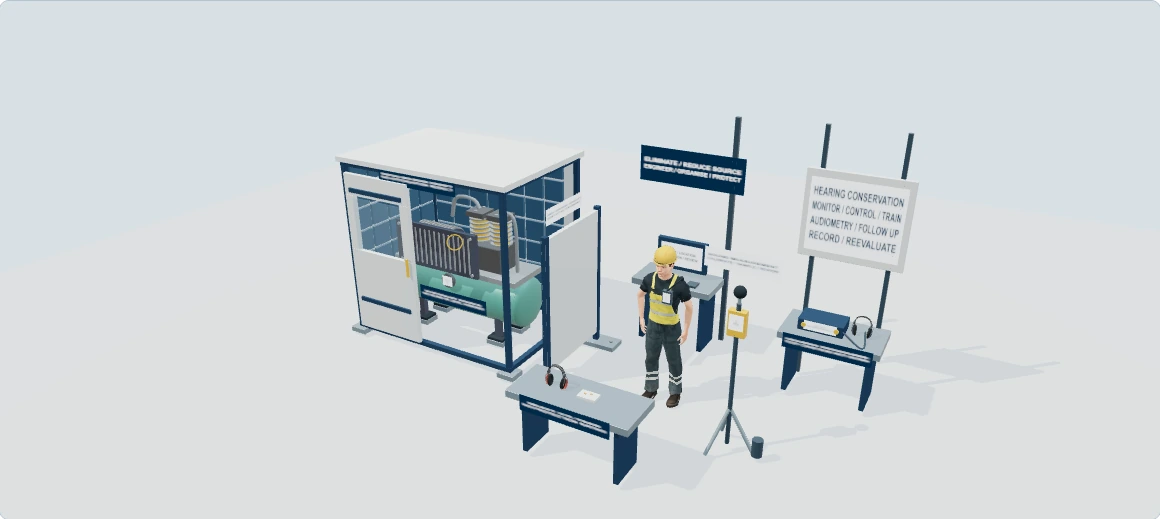

Noise: source, transmission path and the worker’s hearing
Explore how this equipment can harm its users and other people, then follow the practical measures that interrupt each pathway. This is a hazards and good-practice lesson; the separate checklist remains the pre-use/safety-check activity.
Checksheets and risk assessments
Equipment checksheets
Risk assessment forms
Risk assessment examples
Forms and tools
Full written walkthrough — all 8 steps
1. Identify the source and exposed people
What is happening: The machine is one possible sound source; the observer, adjacent stations and other tasks also matter.
How harm can occur: Noise can damage hearing, cause tinnitus and mask warnings or communication.
Best practice to apply: Observe the real work and affected people and identify the sources that dominate their exposure.
Why this works: Treating a minor source while a dominant one remains may give little benefit to the worker.
Noise at Work · Why is noise harmful?2. Reduce the source before relying on PPE
What is happening: The enclosure illustrates one engineering approach; source process and equipment choices come first.
How harm can occur: Unnecessary noisy work continues to expose people even if they carry hearing protection.
Best practice to apply: Consider quieter processes, equipment, maintenance and suitable source treatments before lower-order measures.
Why this works: Source reduction benefits everyone exposed and does not depend solely on individual wearing behaviour.
Noise at Work · How can the ISO 45001 hierarchy of controls reduce workplace noise at source and protect hearing?3. Understand openings and transmission paths
What is happening: A barrier or enclosure changes a path but sound can still travel through gaps and other routes.
How harm can occur: An opening, reflection or untreated path can leave the worker exposed despite a visible screen.
Best practice to apply: Use competent acoustic design and verify the actual arrangement, including access and necessary ventilation.
Why this works: A screen's appearance does not show attenuation at the person; the complete route matters.
Noise at Work · What failure chains cause avoidable exposure?4. Include the person and the full work pattern
What is happening: A person's exposure changes with tasks, location and duration.
How harm can occur: A short loud event or several jobs can be missed by a single convenient reading.
Best practice to apply: Assess representative daily/weekly and peak exposure where appropriate and include all relevant work.
Why this works: The assessment must describe the person's work, not only one machine's catalogue number.
Noise at Work · How do daily and peak exposure differ?5. Measure for a decision, not a decorative number
What is happening: The meter and dosimeter show that method, placement and interpretation are part of measurement.
How harm can occur: An unrepresentative or poorly interpreted result can lead to ineffective protection and continued harm.
Best practice to apply: Use suitable competent measurement and compare with the applicable GB or NI framework; no reading is supplied here.
Why this works: A valid result needs an appropriate method and context, not merely an instrument on site.
Noise at Work · What should be checked before and after a noisy task?6. Plan hearing protection for residual risk
What is happening: The protection station is separate from the source and path controls.
How harm can occur: Unsuitable fit, selection or use can leave hearing unprotected; overprotection can also hinder essential awareness.
Best practice to apply: Select suitable protection, fit, instruction and use arrangements while continuing practicable source reduction.
Why this works: Residual protection complements engineering and must work for the actual person and task.
Noise at Work · Who must be able to do what?7. Use surveillance to prevent further harm
What is happening: Health surveillance and symptom reports support prevention rather than making exposure acceptable.
How harm can occur: Progressive hearing change may be unnoticed while exposure continues.
Best practice to apply: Use the required competent health-surveillance arrangements and act on findings and reported symptoms.
Why this works: Finding harm should drive review and control, not be treated as an acceptable cost of work.
Noise at Work · What record and review cycle makes the programme accountable?8. Verify changes at the worker
What is happening: New machinery, layout, open doors or altered production can change the noise reaching people.
How harm can occur: A nominal treatment can lose effectiveness during real work or transfer exposure to someone else.
Best practice to apply: Verify actual improvement, keep controls maintained and review changed work and affected groups.
Why this works: A successful intervention improves exposure during use rather than only completing a purchase or record.
Noise at Work · How could a workshop replace a noisy blow-off step?
Illustrative awareness learning. Geometry, colours and movement do not establish safe distances, capacity, exposure, isolation or work permission. Use the actual assessment, equipment information and competent arrangements.
The wider workplace has its own account and subscription access. Exploring this lesson does not grant access, record course completion or authorise work.
UK guidance for further reading
HSE: NoiseHow can I practise this topic in 3D?

Panel beating and pneumatic-tool noise

Noise masks warnings beside the plant route

Pneumatic and chiller noise accumulates
All related inspection points 4 across 4 locations
Garage workshop 1 inspection point
Construction site 1 inspection point
From flour to chilled despatch 1 inspection point
Aerosystems Engineering 1 inspection point
Practice in the SHAREhub environment. Browser practice is separate from workplace competence and formal learning records.
What are the first decisions?
Identify the task and source, the people and duration, then decide whether action values or peaks may be reached and which source controls can be installed.
Best-practice guide: Noise at Work
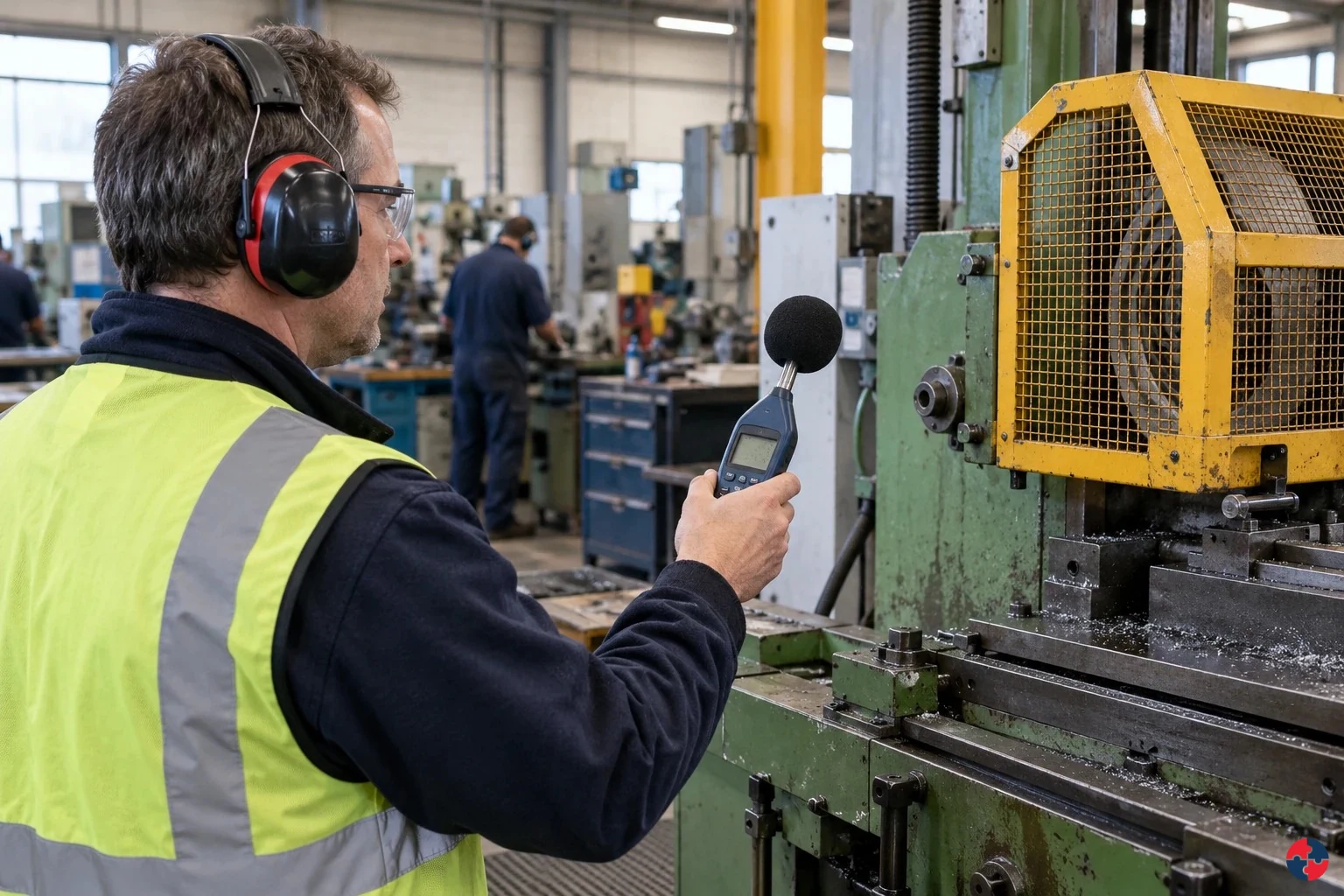
What are the first decisions?
Identify the task and source, the people and duration, then decide whether action values or peaks may be reached and which source controls can be installed. Noise at work can cause permanent hearing damage and make warnings harder to hear.
Turn noise at work knowledge into a decision
Noise at work can cause permanent hearing damage and make warnings harder to hear. Identify noisy sources and exposed people, estimate daily or weekly and peak exposure, reduce sound at source, and apply the correct GB or NI action and surveillance duties. After: the manager accepts the new method only when product quality and noise are verified, updates the training and retains hearing surveillance for those still at risk.
Replace the noisy swarf blow-off step
The engineer and noise assessor check the changed process under representative conditions. Product quality and new hazards still need review. The supervisor stops the task if an enclosure is removed, and the manager keeps the remaining protection and surveillance programme appropriate to the assessed exposure.
Sound can damage hearing before pain warns you
Identify the source, duration and people exposed, then assess daily or weekly exposure and peaks. Reduce noise at source and verify the residual exposure. A hearing test measures an outcome; it does not make the noisy process quieter.
Choose controls for noise at work
Eliminate: Remove an unnecessary compressed-air cleaning step and use a non-air cleaning method; process owner confirms product quality and other hazards. Substitution: Procure a lower-noise saw or nozzle for the same output; buyer and engineer compare supplier data under the intended load. Engineering: Enclose the saw, fit damping and place the compressor away from occupied work; engineer checks guarding, access and heat. Administrative: Supervisor limits time in the remaining noisy area and marks access; exposure assessor calculates actual full-shift exposure. PPE plus upkeep: Fit suitable hearing protection for residual noise and teach seal checks. Read the full control table for qualifications, ownership and verification. Use the actual task and applicable jurisdiction; existing technical approval remains unchanged.
Use the full noise at work lesson
Use the full topic for the decision points, practical examples, detailed control tables and source scope. HSE guidance applies to Great Britain; use HSENI for the Northern Ireland route and the source’s stated jurisdiction. A simplified guide does not change the page’s technical-review or approval status.

Read all six steps as text
1. What are the first decisions?
Identify the task and source, the people and duration, then decide whether action values or peaks may be reached and which source controls can be installed.
- Avoid / redesign: Remove an unnecessary compressed-air cleaning step and use a non-air cleaning method; process owner confirms product quality and other hazards.
- Control the task: Enclose the saw, fit damping and place the compressor away from occupied work; engineer checks guarding, access and heat.
- Verify before release: Observe the task and verify the compressor is not used; hold a reintroduced blow-off job.
Identify the task and source, the people and duration, then decide whether action values or peaks may be reached and which source controls can be installed. Noise at work can cause permanent hearing damage and make warnings harder to hear.
Apply it: Which part of this plan would you check at the workface before authorising the task?
2. Turn noise at work knowledge into a decision
Use the evidence to improve the actual work arrangement.
- Change at source: Remove an unnecessary compressed-air cleaning step and use a non-air cleaning method; process owner confirms product quality and other hazards.
- Make it observable: Observe the task and verify the compressor is not used; hold a reintroduced blow-off job.
- Keep useful evidence: After: the manager accepts the new method only when product quality and noise are verified, updates the training and retains hearing surveillance for those still at risk.
Noise at work can cause permanent hearing damage and make warnings harder to hear. Identify noisy sources and exposed people, estimate daily or weekly and peak exposure, reduce sound at source, and apply the correct GB or NI action and surveillance duties. After: the manager accepts the new method only when product quality and noise are verified, updates the training and retains hearing surveillance for those still at risk.
Apply it: What evidence would show that the change improves this task, rather than only completing a record?
3. Replace the noisy swarf blow-off step
Example: a workshop tests a non-air cleaning method.
- Find: A blow-off gun operates beside a saw and nearby packers.
- Change: Trial vacuum cleaning and a suitable quieter saw arrangement.
- Verify: Measure realistic cutting and cleaning cycles before routine acceptance.
The engineer and noise assessor check the changed process under representative conditions. Product quality and new hazards still need review. The supervisor stops the task if an enclosure is removed, and the manager keeps the remaining protection and surveillance programme appropriate to the assessed exposure.
Apply it: Does the acceptance evidence cover the full task and the people nearby?
4. Sound can damage hearing before pain warns you
Connect the task, the route to the person and the control that can fail.
- Exposure: Repeated noise exposure can permanently damage hearing.
- Peaks: A high impulsive peak needs assessment as well as daily exposure.
- Communication: Noise and poorly selected protection can interfere with warnings.
Identify the source, duration and people exposed, then assess daily or weekly exposure and peaks. Reduce noise at source and verify the residual exposure. A hearing test measures an outcome; it does not make the noisy process quieter.
Apply it: Which source can be removed or made quieter before relying on hearing protection?
5. Choose controls for noise at work
Start with the stronger practicable options and verify their effect.
- Eliminate: Remove an unnecessary compressed-air cleaning step and use a non-air cleaning method; process owner confirms product quality and other hazards.
- Substitution: Procure a lower-noise saw or nozzle for the same output; buyer and engineer compare supplier data under the intended load.
- Engineering: Enclose the saw, fit damping and place the compressor away from occupied work; engineer checks guarding, access and heat.
- Administrative: Supervisor limits time in the remaining noisy area and marks access; exposure assessor calculates actual full-shift exposure.
- PPE plus upkeep: Fit suitable hearing protection for residual noise and teach seal checks.
Eliminate: Remove an unnecessary compressed-air cleaning step and use a non-air cleaning method; process owner confirms product quality and other hazards. Substitution: Procure a lower-noise saw or nozzle for the same output; buyer and engineer compare supplier data under the intended load. Engineering: Enclose the saw, fit damping and place the compressor away from occupied work; engineer checks guarding, access and heat. Administrative: Supervisor limits time in the remaining noisy area and marks access; exposure assessor calculates actual full-shift exposure. PPE plus upkeep: Fit suitable hearing protection for residual noise and teach seal checks. Read the full control table for qualifications, ownership and verification. Use the actual task and applicable jurisdiction; existing technical approval remains unchanged.
Apply it: Which stronger option can be used here, and who will verify it before accepting the remaining risk?
6. Use the full noise at work lesson
Follow the official sources below and retain the task-specific evidence.
- Official guidance: HSE noise risk assessment
- Official guidance: HSE buy quiet guidance
- Task decision: After: the manager accepts the new method only when product quality and noise are verified, updates the training and retains hearing surveillance for those still at risk.
Use the full topic for the decision points, practical examples, detailed control tables and source scope. HSE guidance applies to Great Britain; use HSENI for the Northern Ireland route and the source’s stated jurisdiction. A simplified guide does not change the page’s technical-review or approval status.
Apply it: Which official source and full-topic section will you use to resolve the next decision?
An employee does not need to prove a hearing diagnosis to report a noisy task. A supervisor should pause an uncontrolled new process, consult the noise assessment and protect nearby people. A manager gives the action plan an owner and checks whether a quiet alternative or enclosure works in actual use. Sources: HSE noise risk assessment, HSE buy quiet guidance.
Match each treatment to the sound path
Different noise mechanisms need different controls. Removing a noisy task, damping a vibrating panel, silencing an exhaust and treating room reflections act on different parts of the path.
Find the source, the sound paths and everyone exposed
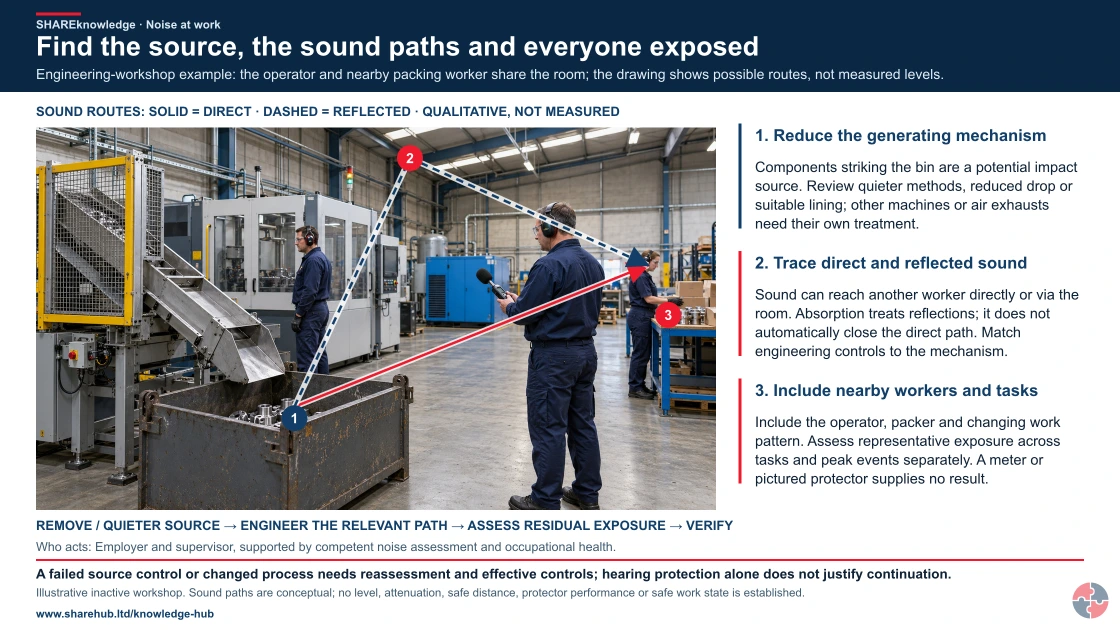
Full written explanation
A realistic HD British engineering-workshop planning scene shows stationary component-transfer equipment, a receiving bin, other enclosed machinery and a compressor, an operator, a nearby packing worker and a person holding a sound-level meter. Native qualitative arrows connect the potential component-impact source to the nearby worker by a solid direct route and a dashed room-reflected route. These are explanatory paths, not a measured sound field, frequency response, modelled attenuation or safe boundary. Numbered explanations distinguish reducing the generating mechanism, treating the relevant airborne/reflected path and assessing all workers across representative tasks and separate peak events. Actual equipment, positions, duration, protection and control performance need evidence. The original hierarchy and source-treatment distinctions, full assessment, access/HPZ and hearing-conservation programme remain; the existing ear explainer remains a separate teaching resource.
Engineering-workshop example: the operator and nearby packing worker share the room; the drawing shows possible routes, not measured levels.
- Reduce the generating mechanism. Components striking the bin are a potential impact source. Review quieter methods, reduced drop or suitable lining; other machines or air exhausts need their own treatment.
- Trace direct and reflected sound. Sound can reach another worker directly or via the room. Absorption treats reflections; it does not automatically close the direct path. Match engineering controls to the mechanism.
- Include nearby workers and tasks. Include the operator, packer and changing work pattern. Assess representative exposure across tasks and peak events separately. A meter or pictured protector supplies no result.
Change the pathway
- Reduce the source. Avoid the noisy task or use a quieter process, equipment or treatment.
- Control the sound path. Use suitable enclosure, isolation, layout or acoustic treatment for the mechanism.
- Assess residual exposure. Manage access and provide suitable hearing protection and health arrangements.
Evidence check: Daily exposure and peak sound answer different questions; task rotation alone may not reduce exposure.
Use the full exposure assessment, sound-path controls and hearing-protection programme
Primary references: HSE source, engineering and sound-path controls · HSE representative noise-risk assessment · HSE hearing protection and assessed hearing-protection zones · HSE Sound Advice: music and entertainment (HSG260)
Open the complete HD image (new tab)Download image

Use the full exposure assessment, sound-path controls and hearing-protection programme
Primary references: HSE source, engineering and sound-path controls · HSE representative noise-risk assessment · HSE hearing protection and assessed hearing-protection zones · HSE Sound Advice: music and entertainment (HSG260)

Remove task
Ask whether the noisy blow-off or other activity can be removed or replaced by a quieter method. Assess the new method’s other hazards.
Quieter source
Select or change equipment and process at source, using evidence relevant to the real task.
Damping
Treat vibration of a radiating panel where that mechanism is established. Damping is not a substitute for closing an airborne sound path.
Silencer
Assess a suitable exhaust/air-flow treatment for the actual system and its operating requirements.
Enclosure leak
Check doors, openings and maintenance condition. A small unassessed opening can undermine the expected enclosure performance.
Room reflection
Absorption treats reflected sound in the room; it does not automatically control the direct path from the source to the worker.
Verify at the worker
Check the changed task, people’s positions and durations with suitable measurements. Provide suitable residual protection and surveillance where required.
No reduction in decibels or universal enclosure design is promised. Verify performance under representative operation before relying on the change.
Why is noise harmful?
Sound exposure can damage inner-ear structures and cause permanent hearing loss and tinnitus; loud work can also mask speech and alarms.
Risk depends on the sound energy reaching the worker over time and on impulsive peaks. A three-decibel increase represents approximately twice the sound energy, so a short louder task can matter disproportionately. HSE noise measurement overview. Feeling accustomed to a machine does not show that hearing is safe. nidirect explains the inner-ear mechanism. Sources: HSE noise worker advice.
Sound quantities. Sound pressure is the local pressure fluctuation measured at a position; sound intensity describes energy flow through an area. Frequency, measured in hertz, describes pitch and affects both perceived sound and which enclosure or protector performs well. The A-weighting used for daily exposure approximates hearing sensitivity; the C-weighted peak captures impulsive pressure. Beyond permanent hearing injury, noise can interfere with communication and warning recognition; these safety effects should be assessed alongside hearing damage. HSE action-value duties
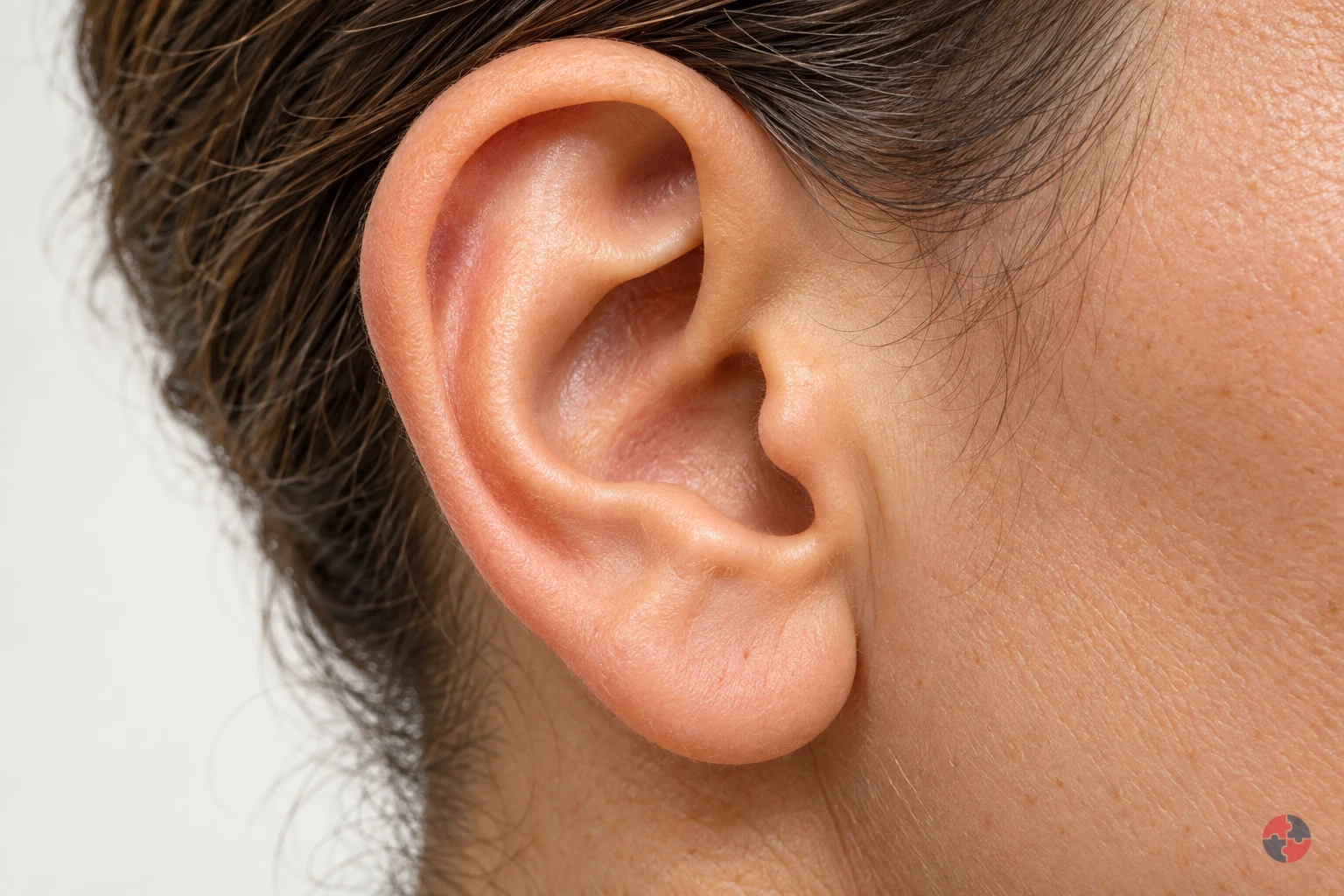
How does the ear work, and how can workplace exposure damage hearing?
Explore the outer, middle and inner ear. Follow sound from an air pressure wave to a nerve signal, then compare three different ways workplace exposure can affect hearing.
Sudden hearing loss in one or both ears needs urgent medical assessment. Contact a GP or the urgent medical service appropriate to your location straight away. Do not wait for a routine workplace hearing check. NHS: Hearing loss
Read the anatomy and hearing explanations without the viewer
This educational illustration is not a hearing test, diagnosis, exposure calculator or individual prediction of hearing loss. The Eustachian tube and balance structures provide context and are outside the guided sound route.
01 · Pinna
The visible folds collect sound. The outer rim, inner folds and central bowl guide sound towards the canal. Explore the ridges and recesses before opening the cutaway. The outside of an ear can look normal even when its inner hearing structures are damaged. Yorkshire Auditory Implant Service · NHS: How we hear · Leeds Teaching Hospitals NHS Trust: The ear · Royal Berkshire NHS Foundation Trust: Your hearing and noise exposure · NHS: Hearing loss
02 · Ear canal
Sound pressure travels through the air in this passage. The curved canal ends at the eardrum. Its skin-lined wall and entrance hairs are shown in cutaway so the route is visible. Sound pressure travels along the canal; the tissue itself does not travel along it. Yorkshire Auditory Implant Service · NHS: How we hear · Leeds Teaching Hospitals NHS Trust: The ear
03 · Eardrum
A thin, slightly conical membrane moves with sound. The eardrum separates the outer and middle ear. Its centre is connected to the hammer bone. Watch the membrane move, then compare the optional opening shown for an intense-blast injury. A tear is possible, not inevitable. Yorkshire Auditory Implant Service · NHS: How we hear · Leeds Teaching Hospitals NHS Trust: The ear · NHS England: Major-incident clinical guidelines: acute acoustic trauma
04 · Malleus · hammer
The hammer receives movement from the eardrum. Its handle connects with the eardrum and its head joins the anvil. These are small, shaped bones with joints, not a continuous tube. The model enlarges them so you can follow their movement. Yorkshire Auditory Implant Service · NHS: How we hear · Leeds Teaching Hospitals NHS Trust: The ear · NHS England: Major-incident clinical guidelines: acute acoustic trauma
05 · Incus · anvil
The anvil links the hammer to the stirrup. Its body and long process form the middle link in the chain. Follow the contact between each bone. The separate blast option illustrates a possible gap in this mechanical connection. Yorkshire Auditory Implant Service · NHS: How we hear · Leeds Teaching Hospitals NHS Trust: The ear · NHS England: Major-incident clinical guidelines: acute acoustic trauma
06 · Stapes · stirrup
The stirrup transfers movement into the inner ear. Two slender limbs surround a real opening and meet an oval footplate. The footplate moves at the inner-ear entrance, setting the cochlear fluid in motion. It does not carry airborne sound into the nerve. Yorkshire Auditory Implant Service · NHS: How we hear · Leeds Teaching Hospitals NHS Trust: The ear · NHS England: Major-incident clinical guidelines: acute acoustic trauma
07 · Cochlea
This fluid-filled spiral contains the sensory hearing system. The cutaway exposes the coiled chambers and a fine sensory ribbon inside the shell. Fluid movement acts on the sensory structures. The enlarged cell sample below the coil shows where movement begins to become a nerve signal. Yorkshire Auditory Implant Service · NHS: How we hear · Leeds Teaching Hospitals NHS Trust: The ear · Royal Berkshire NHS Foundation Trust: Your hearing and noise exposure · NHS: Hearing loss
08 · Sensory hair cells
Microscopic sensory bundles turn movement into hearing signals. The magnified sample shows sensory cells, their small surface bundles and nerve connections. Different hair cells help detect and fine-tune sound. They are inside the cochlea, not hairs in the ear canal; this sample is enlarged for inspection. Yorkshire Auditory Implant Service · NHS: How we hear · Royal Berkshire NHS Foundation Trust: Your hearing and noise exposure · NHS: Hearing loss
09 · Auditory nerve
The auditory nerve carries electrical information towards the brain. Fine fibres converge from the cochlea into the hearing nerve. The travelling markers represent nerve signalling. By this stage the message is electrical information, not a blue pressure wave or a stream of cochlear fluid. Yorkshire Auditory Implant Service · NHS: How we hear · Leeds Teaching Hospitals NHS Trust: The ear · HSE: Controlling noise at work: combined chemical and noise exposures
10 · Brain connection
The brain interprets the hearing information. This endpoint represents the wider auditory pathway, rather than a complete brain map. The brain uses incoming information to recognise speech, warnings and other sounds. Reduced or distorted input can make communication harder. Yorkshire Auditory Implant Service · NHS: How we hear · Royal Berkshire NHS Foundation Trust: Your hearing and noise exposure · NHS: Hearing loss
11 · Eustachian tube
The middle ear has a separate pressure-balancing connection. The Eustachian tube links the middle-ear space to the area behind the nose. It helps maintain middle-ear pressure. Follow its downward route and notice that it is separate from the six-stage sound-to-signal journey. Leeds Teaching Hospitals NHS Trust: The ear
12 · Balance structures
Three loops and neighbouring organs help sense head movement. The semicircular canals lie in different planes beside the cochlea. Together with the nearby vestibular organs they support balance. Their location is shown for orientation; the hearing route continues through the cochlea and auditory nerve. Mersey Care NHS Foundation Trust: BPPV: inner-ear balance anatomy
Six stages from sound to signal
1 · Air carries the sound. Watch the pressure fronts enter the outer bowl and move along the canal. The air pressure varies; no solid object travels into the ear. Yorkshire Auditory Implant Service · NHS: How we hear
2 · The eardrum vibrates. The pressure changes make the thin eardrum move back and forth. This is the change from an airborne pressure wave to mechanical movement. Yorkshire Auditory Implant Service · NHS: How we hear
3 · Three bones transmit movement. The hammer, anvil and stirrup pass vibration along their connected chain. The stirrup transfers this movement at the entrance to the inner ear. Yorkshire Auditory Implant Service · NHS: How we hear
4 · Cochlear fluid moves. A wave of movement passes through the cochlear fluid and sensory structures. The markers move locally to show vibration; fluid does not circulate continuously around the coil. Yorkshire Auditory Implant Service · NHS: How we hear
5 · Sensory cells respond. Small bundles on the sensory cells move. These cells help turn movement into electrical information and support the fine tuning of sound. Yorkshire Auditory Implant Service · NHS: How we hear · Royal Berkshire NHS Foundation Trust: Your hearing and noise exposure
6 · A nerve signal reaches the brain. Signals travel along the auditory nerve towards the brain, where the information is interpreted as sound. This is a different kind of signal from the pressure wave at step one. Yorkshire Auditory Implant Service · NHS: How we hear
Three different exposure mechanisms
Repeated harmful noise. Repeated harmful noise can damage cochlear hair cells and cause gradual, permanent hearing loss. Ringing or buzzing may also occur. The example does not show every possible noise injury. The comparison has no real-time scale, exposure dose or predicted amount of hearing loss. Temporary hearing dullness after noise is a warning of stress on the hearing system, not reassurance that exposure was safe. Royal Berkshire NHS Foundation Trust: Your hearing and noise exposure
Acute acoustic trauma. A very intense burst, such as a blast, can cause acute hearing injury. Possible injury includes damage to the inner-ear hearing system, a perforated eardrum or disruption of the middle-ear bones. Eardrum or ossicle injury is possible, not inevitable after every loud event. An intact eardrum does not establish that hearing is unharmed. The illustration cannot identify an individual injury; sudden hearing loss needs urgent medical assessment. Royal Berkshire NHS Foundation Trust: Your hearing and noise exposure · NHS: Hearing loss · NHS England: Major-incident clinical guidelines: acute acoustic trauma
Ototoxic chemical exposure. Some workplace chemicals, particularly some solvents, can add to the hearing risk from noise. Solvents can enter the body through breathing, skin contact or ingestion. Assess chemical and noise exposures together, and control both. Effects vary with the substance and exposure; the chemical assessment must identify the actual hazards. The selected structures are a teaching focus, not evidence that every chemical affects every highlighted structure. Hearing protection controls noise at the ear; it does not control inhalation, skin or ingestion exposure to chemicals. HSE: Controlling noise at work: combined chemical and noise exposures · HSE: Construction hazardous substances: solvents
Start with the noise source The repeated wave markers represent sound pressure from ongoing noise. Watch them enter the outer ear and follow the canal; they are a teaching cue, not a measured noise level.
Follow movement towards the cochlea The eardrum and middle-ear bones pass vibration towards the cochlea. The slow animation lets you follow the route; real sound and tissue movement are much faster.
Inspect a possible inner-ear effect Look closely at the magnified cells: some surface bundles become bent or shortened. That change in shape marks an illustrative injury, while the unmarked cells allow comparison. Noise-damaged sensory structures can lead to permanent hearing loss or distortion.
Connect the mechanism to prevention Return to the noise source: consider quieter equipment and processes, separation and other suitable controls. Use hearing protection where required. Compare the normal structures, and seek advice for changes in hearing.
Repeated harmful noise — follow the anatomy
Look at: The cochlear sensory cells, especially the small bundles in the magnified sample.
What changes: Harmful noise can injure these sensory structures; bent and shortened bundles mark an illustrative damaged area.
Why it matters: Hearing may become permanently reduced or distorted, and tinnitus can occur.
What to do: Reduce noise at its source, use suitable hearing protection where required and act on hearing-check findings.
A brief, intense sound A single wave front represents an impulse such as a loud bang. The quiet optional sound is only a cue; it does not reproduce a harmful exposure.
Trace the pressure wave Follow the wave down the canal towards the eardrum. The slowed display makes the direction clear without depicting an actual pressure or a safe distance.
Inspect the selected injury example Inspect the cochlear cells, then choose the separate mechanical-injury option. This shows a possible membrane opening and disruption of the bone chain. These injuries can occur after an intense blast; they are not inevitable and the model cannot diagnose a person.
Act on a change in hearing Sudden hearing loss needs urgent medical assessment. Follow the NHS advice below and review the source and exposure controls; do not wait for the animation or a routine hearing check.
Acute acoustic trauma — follow the anatomy
Look at: The cochlea first, then the separate optional eardrum and bone-chain example.
What changes: An intense impulse can injure the inner ear and can sometimes tear the eardrum or disrupt the bones.
Why it matters: Hearing may change suddenly even when there is no obvious external injury.
What to do: Get urgent medical assessment for sudden hearing loss and stop further harmful exposure.
Start with the chemical task Identify the actual chemical and exposure routes in the work. The model labels body uptake separately from the sound pathway: chemicals are not shown travelling down the ear canal.
Follow the labelled uptake route Breathing, skin contact or ingestion may allow some substances to enter the body. The connecting curve is a conceptual link to possible hearing effects, not a measured bloodstream pathway.
Examine the hearing structures Select the cochlea, sensory structures or auditory nerve to locate the hearing system. Which structures are affected depends on the substance; the model cannot identify an effect for an unspecified chemical.
Control chemical and noise exposure together Assess the substance and noise risks together. Earplugs address noise at the ear but do not prevent chemical uptake. Review the task, substitution and exposure controls using the source links below.
Ototoxic chemical exposure — follow the anatomy
Look at: The labelled body-uptake route and the highlighted hearing structures.
What changes: Some chemicals can add to noise-related hearing risk; the effect depends on the substance and exposure.
Why it matters: Ear protection alone does not prevent a chemical from entering the body by breathing, skin contact or ingestion.
What to do: Identify the actual substance, eliminate or substitute it where possible, and control chemical and noise exposures together.
Sources and how the model is made
This original model omits surrounding bone and soft tissue to expose the pathway. Ossicles, cochlear structures and sensory cells are simplified or enlarged; exploded spacing is a teaching arrangement. The colours, separated structures and magnified cells support learning; they do not measure hearing or predict an individual injury.
The opening ear image is an AI-generated anatomical illustration. The selectable diagrams and 3D model are original procedural artwork, not medical scans. Three.js 0.180.0 is used under its MIT licence. .
- Yorkshire Auditory Implant Service · NHS: How we hear — Air conduction, eardrum/ossicle movement, cochlear fluid, hair-cell receptors and electrical signals to the brain. Text only; no source artwork or video reused. Checked 2026-10-22.
- Mersey Care NHS Foundation Trust: BPPV: inner-ear balance anatomy — Basic context on semicircular canals sensing head movement and supporting balance/posture. No diagnosis or treatment exercises reused. Checked 2026-10-22.
- Leeds Teaching Hospitals NHS Trust: The ear — Pinna/canal/eardrum, named ossicles, cochlear hearing pathway and middle-ear pressure connection. Text only. Checked 2026-10-22.
- Royal Berkshire NHS Foundation Trust: Your hearing and noise exposure — March 2026 leaflet: cochlear hair-cell damage, permanent hearing loss, tinnitus and possible intense-sound eardrum damage. No dose table or self-treatment advice reused. Checked 2026-10-22.
- HSE: Controlling noise at work: combined chemical and noise exposures — L108 paragraph 48: some chemicals, particularly solvents, may act with noise to increase hearing harm; assess mixed exposure and consider elimination/substitution. This does not establish a substance-specific bloodstream injury mechanism. Checked 2026-10-22.
- HSE: How do I control the risks from noise? — Quieter processes, equipment and methods; noise reduction before reliance on protection. Checked 2026-10-22.
- HSE: Hearing protection — Protection as a supplement, correct selection, fit, use and maintenance. Checked 2026-10-22.
- HSE: Health surveillance for hearing — Appropriate hearing checks and review of exposure controls; no diagnosis by this module. Checked 2026-10-22.
- NHS: Hearing loss — Urgency of sudden hearing loss and avoidance of self-diagnosis. Learner advice uses a location-neutral GP/urgent medical route rather than presenting NHS 111 as universal across the UK. Checked 2026-10-22.
- HSE: Construction hazardous substances: solvents — Solvent entry by inhalation, skin contact and ingestion, plus task-specific elimination/substitution and exposure controls. This source is about solvent uptake/control, not a universal pattern of ear injury. Checked 2026-10-22.
- NHS England: Major-incident clinical guidelines: acute acoustic trauma — Specialty overview SO/1, PDF pages 66–67: noise/blast-associated sensorineural injury and possible conductive injury from eardrum perforation or ossicular discontinuity. Clinical background only; treatment algorithms are not instructions for learners. Checked 2026-10-22.
How do daily and peak exposure differ?
Estimate representative personal exposure across all tasks and compare the separate C-weighted peak, using competent measurements when the decision is uncertain.
A different job is not automatically a quieter job
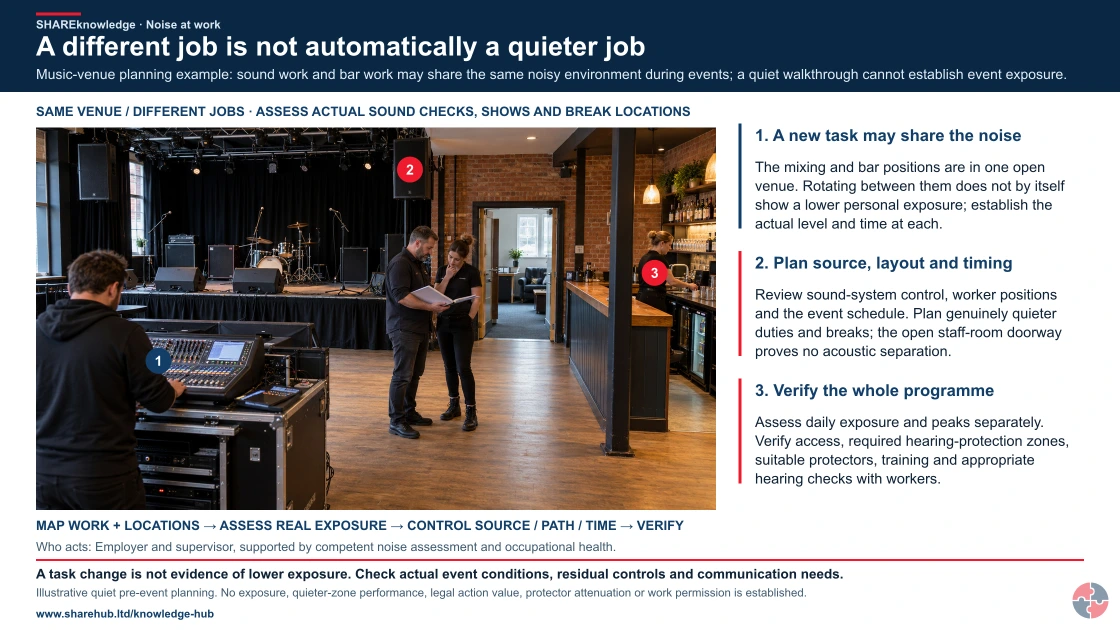
Full written explanation
A realistic HD quiet pre-event British music-venue scene shows stage loudspeakers and monitors, a technical/mixing position, a bar work position and a separate staff-room doorway while staff review an event plan. The photograph cannot establish event sound levels or whether the staff room is acoustically quieter. Native explanations connect jobs within the same amplified-sound environment, real task durations and locations, source/layout/scheduling changes, and the complete exposure and residual-control programme. Rotating between jobs that remain noisy is not proof that personal exposure falls. Plan genuinely quieter duties/breaks and verify actual event exposure, separate peak events, assessed access/HPZ arrangements, suitable protection, training, maintenance, communication and appropriate hearing checks. No numerical action value, safe distance, attenuation, diagnosis or operating permission is assigned. The full original four-step assessment/control/verification text and existing native ear and hierarchy materials remain unchanged.
Music-venue planning example: sound work and bar work may share the same noisy environment during events; a quiet walkthrough cannot establish event exposure.
- Map the work pattern. Identify tasks, people, duration, peak events and communication needs.
- Assess actual exposure. Use representative information and competent measurement where needed.
- Target the mechanism. Treat the source and the relevant direct or reflected sound path.
- Verify and sustain. Check controls in use, residual protection, maintenance and appropriate hearing checks.
When the evidence does not fit: A failed enclosure or changed noisy process needs reassessment and effective controls; hearing protection does not justify unrestricted continuation.
Who acts: Employer and supervisor, supported by competent noise assessment and occupational health.
Changed workplace
Engineering workshop: Control machine impact or vibration and check the operator’s actual exposure.
Music venue: Consider staff locations, exposure pattern and communication; industrial machine controls may not transfer.
Evidence check: Daily exposure and peak sound answer different questions; task rotation alone may not reduce exposure.
Use the full exposure assessment, sound-path controls and hearing-protection programme
Primary references: HSE source, engineering and sound-path controls · HSE representative noise-risk assessment · HSE hearing protection and assessed hearing-protection zones · HSE Sound Advice: music and entertainment (HSG260)
Open the complete HD image (new tab)Download image

Use the full exposure assessment, sound-path controls and hearing-protection programme
Primary references: HSE source, engineering and sound-path controls · HSE representative noise-risk assessment · HSE hearing protection and assessed hearing-protection zones · HSE Sound Advice: music and entertainment (HSG260)


The personal dosemeter microphone is on the shoulder near the ear, outside the hearing protector, clear of clothing and neck contact. The task sequence includes short high-noise work as well as machine cycles and breaks, so the sample can represent the person’s actual exposure pattern.
Why record a short noisy task?
Short high-level exposures can materially affect daily exposure and may be missed by an unrepresentative sample.
An illustrative position, not a calibrated measurement record or evidence of protected sound level at the ear. Select the microphone side/position, sample duration, checks and task record under the instrument instructions and a competent representative measurement plan.
Source guidance: HSE L108
Record machine mode, position, operating time, other noise sources, nearby workers and variation across days. A supplier emission figure is a starting point, not personal exposure at this workstation. Weekly averaging may be relevant where daily exposure varies; it does not erase a high peak. HSE sets the representative-estimate requirement. Sources: HSE noise employer duties.
What failure chains cause avoidable exposure?
Noisy procurement, missing enclosures, unmeasured overtime and poorly fitted protectors can each defeat a plan.
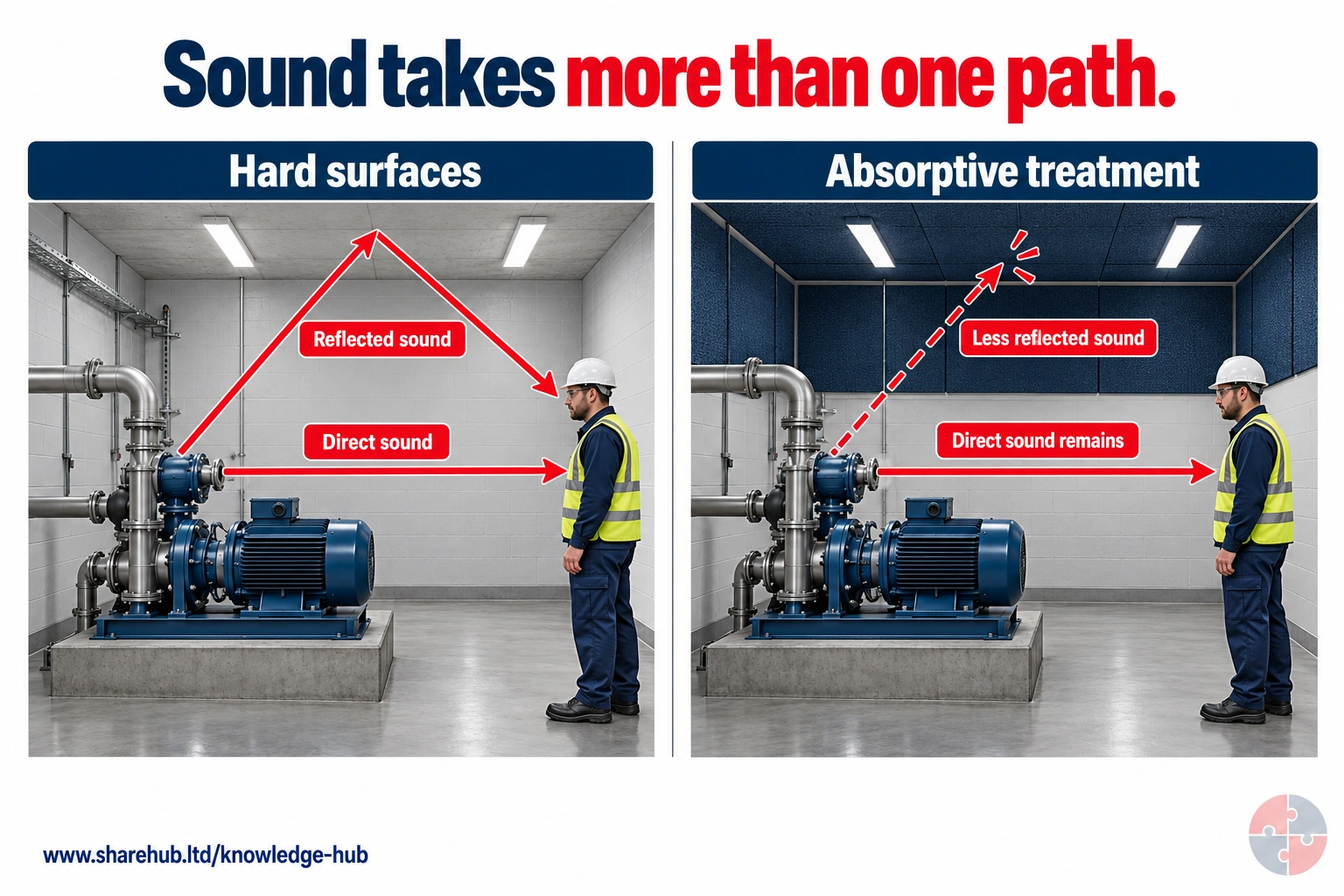

Absorption addresses reflected sound; source control or a suitable barrier may still be needed for the direct path.
Which sound path remains after absorption?
The direct path from the machine to the worker remains.
Conceptual paths, not a noise prediction or performance guarantee.
Source guidance: HSE guidance
A new saw marketed as quieter may be loud with the installed blade and material. A removed acoustic panel changes exposure; the operator should stop and report it. Workers rotated into a press area can acquire higher daily exposure than the old assessment shows. A hearing protector worn with spectacles or removed for conversation can underperform. Verify the actual source, time and use. Sources: HSE buy quiet guidance, HSE noise risk assessment, HSE noise hearing protection.
How can the hierarchy of controls reduce workplace noise at source and protect hearing?
Remove an unnecessary noisy task, buy quieter equipment, enclose or damp the source, then limit residual exposure and fit hearing protection.
3 related visuals
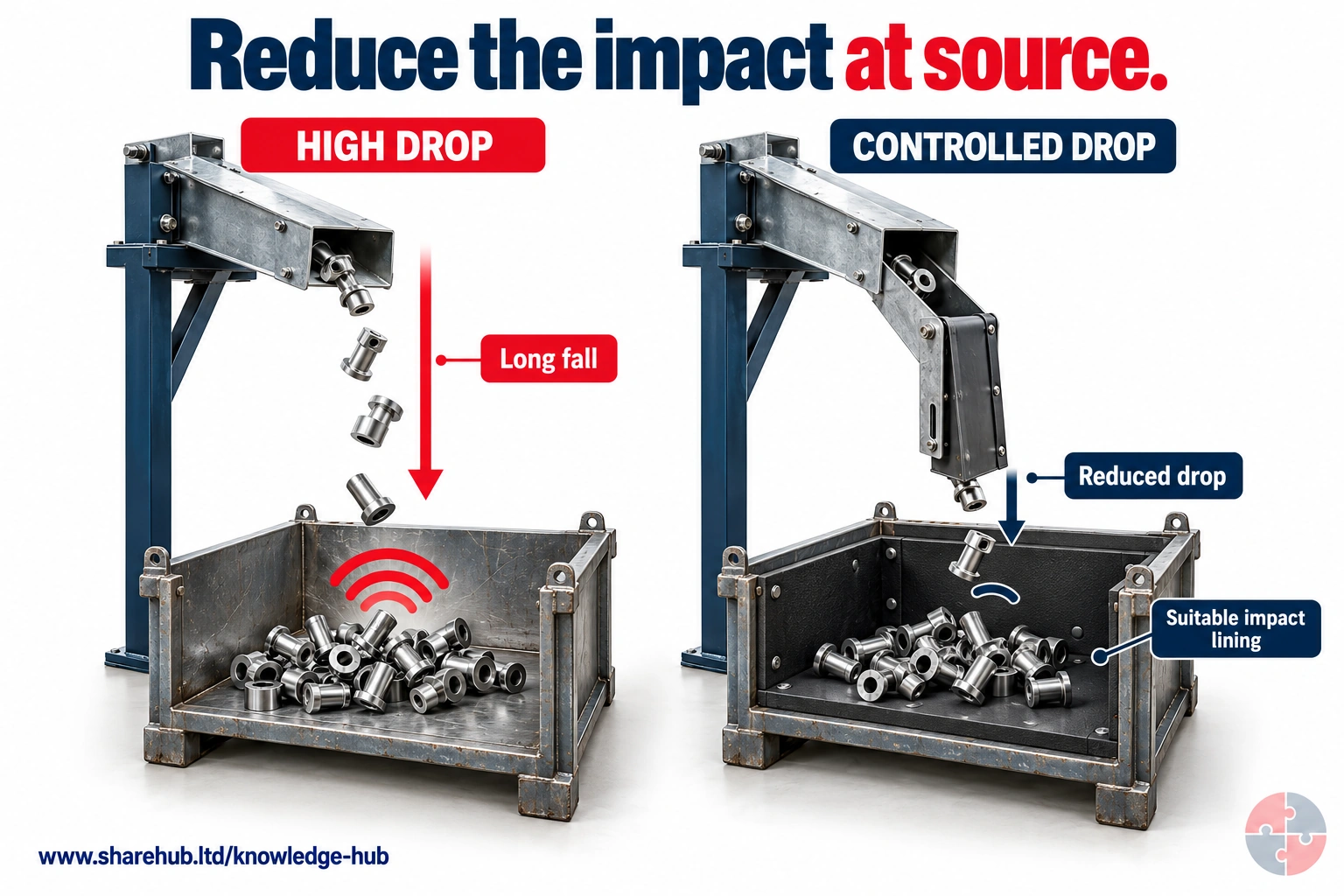

Reducing the free fall and using a suitable impact lining can reduce noise generated as components strike a bin.
Which change reduces the impact before it reaches the bin?
The extended chute reduces the falling distance.
No noise reduction or exposure value is claimed. Check material flow, wear, contamination and measured noise after modification.
Source guidance: HSE L108 · HSE guidance
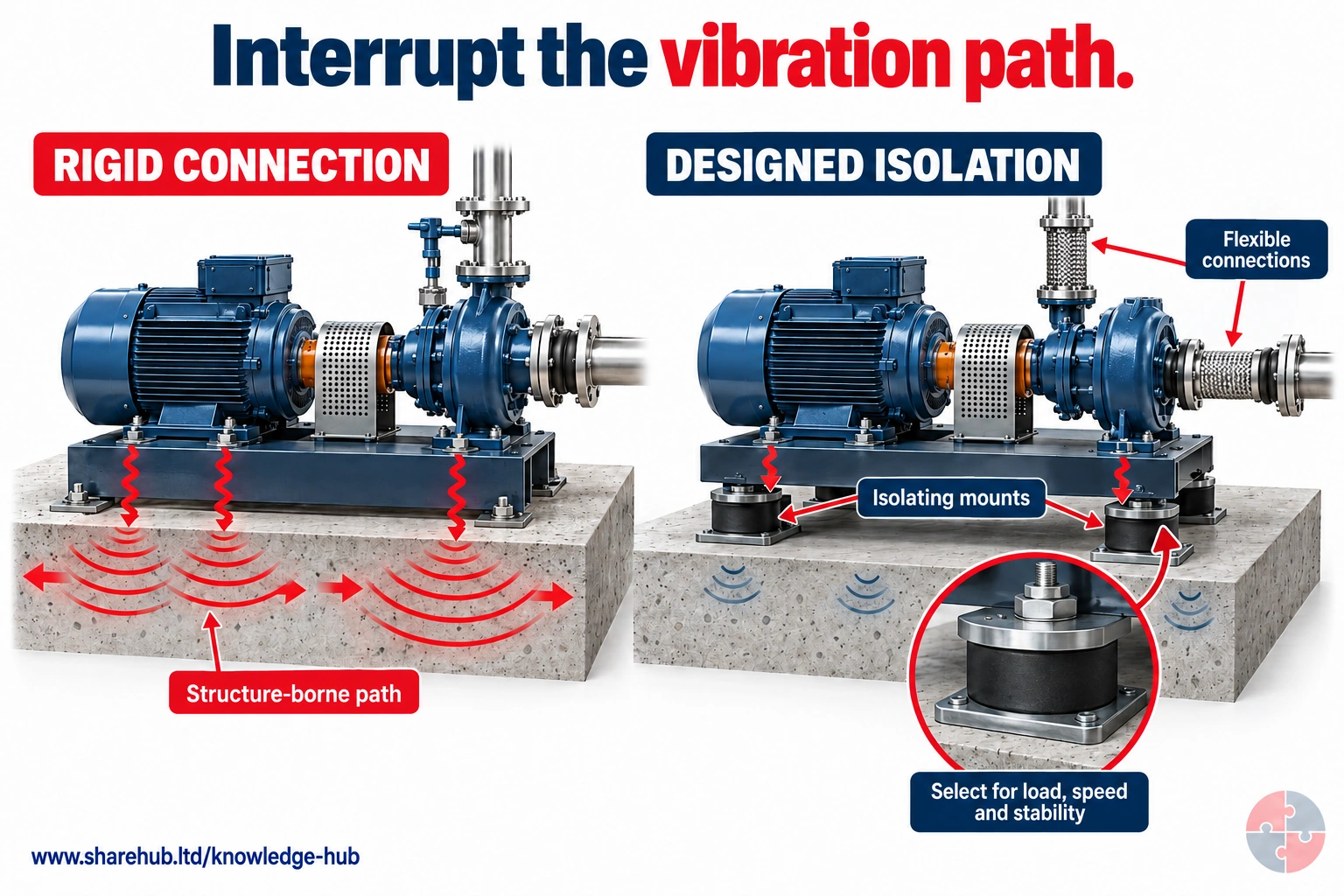

Isolation mounts and flexible connections can interrupt structure-borne vibration paths. A rigid connection can bypass the intended isolation.
Why include the pipe connections in the review?
Rigid connected services can transmit vibration even when the machine base is isolated.
Concept only. Mounts and flexible connections need design for load, speed, stability, alignment and service conditions; arrows are not measured performance.
Source guidance: HSE L108 · HSE guidance
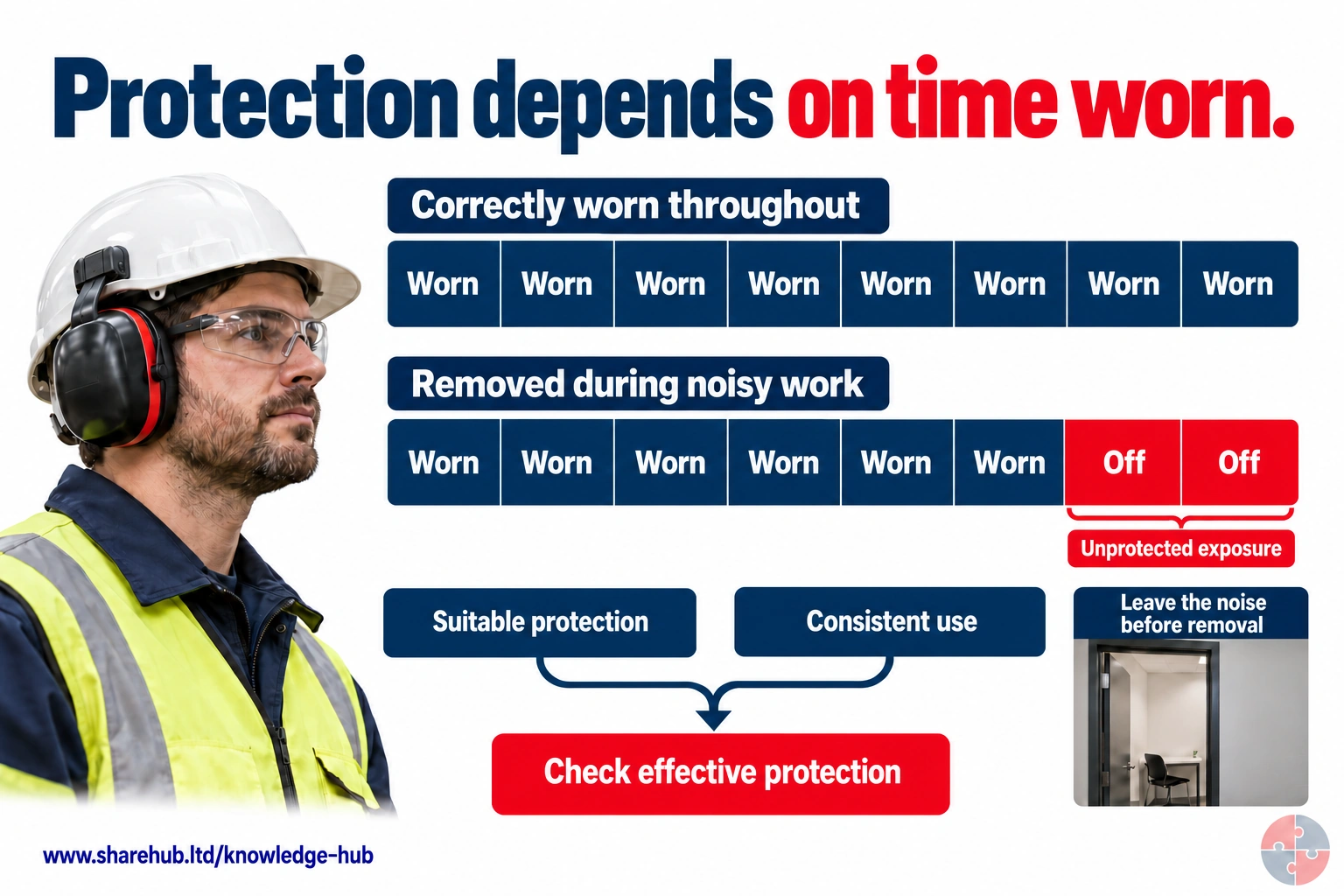

The lower row includes periods of unprotected exposure during the same noisy work. Even brief removal can sharply reduce overall protection; suitable selection, correct fit and consistent use matter together. Earmuffs must seal properly with spectacles, helmets and other equipment, as assessed for the wearer.
Where should someone go before removing required hearing protection?
Leave the noisy area for a suitable quiet location first.
Conceptual equal-length blocks without attenuation or personal-exposure data; no percentage loss is calculated. Hearing protection supplements effective technical and organisational noise controls. Confirm fit, compatibility and enough protection without preventing necessary communication or warning awareness.
Source guidance: HSE guidance
HSE prioritises eliminating and substituting hazards before engineering controls, administrative controls and PPE, as explained in its five-level hierarchy of controls. SHARE uses ERICPD as a task-planning prompt: Eliminate; Reduce, including substitution; Isolate through engineered separation; Control with other engineered or administrative measures; PPE; and Discipline, meaning continued verification and maintenance. ERICPD is not a sixth HSE level or a separate legal duty. The example below is a feasibility test for this work, not a universal prescription.
How can the ERICPD hierarchy of controls reduce workplace noise at source and protect hearing?

| Five-level hierarchy | Task-specific measure, feasibility and owner | Verification and stop point |
|---|---|---|
| Eliminate | Remove an unnecessary compressed-air cleaning step and use a non-air cleaning method; process owner confirms product quality and other hazards. | Observe the task and verify the compressor is not used; hold a reintroduced blow-off job. Sources: HSE; HSENI. |
| Reduce | Procure a lower-noise saw or nozzle for the same output; buyer and engineer compare supplier data under the intended load. | Acceptance measurement at the operator position; reject an unverified noisy replacement. Sources: HSE; HSENI. |
| Engineering | Enclose the saw, fit damping and place the compressor away from occupied work; engineer checks guarding, access and heat. | Measure outside the enclosure and check door seals; failed enclosure or new rattling stops use. Sources: HSE; HSENI. |
| Administrative | Supervisor limits time in the remaining noisy area and marks access; exposure assessor calculates actual full-shift exposure. | Observe access and repeat exposure estimate after changed shifts; duration alone is not source control. Sources: HSE; HSENI. |
| PPE | Fit suitable hearing protection for residual noise and teach seal checks. | Inspect fit and use; surveillance trend or defect restarts the source-control review. Sources: HSE; HSENI. |
| Discipline / continuing assurance | Continuing checks mean maintenance, supervision and learning after the stronger controls. |
How can the ISO 45001 hierarchy of controls reduce workplace noise at source and protect hearing?

| Five-level hierarchy | Task-specific measure, feasibility and owner | Verification and stop point |
|---|---|---|
| Elimination | Remove an unnecessary compressed-air cleaning step and use a non-air cleaning method; process owner confirms product quality and other hazards. | Observe the task and verify the compressor is not used; hold a reintroduced blow-off job. Sources: HSE; HSENI. |
| Substitution | Procure a lower-noise saw or nozzle for the same output; buyer and engineer compare supplier data under the intended load. | Acceptance measurement at the operator position; reject an unverified noisy replacement. Sources: HSE; HSENI. |
| Engineering | Enclose the saw, fit damping and place the compressor away from occupied work; engineer checks guarding, access and heat. | Measure outside the enclosure and check door seals; failed enclosure or new rattling stops use. Sources: HSE; HSENI. |
| Administrative | Supervisor limits time in the remaining noisy area and marks access; exposure assessor calculates actual full-shift exposure. | Observe access and repeat exposure estimate after changed shifts; duration alone is not source control. Sources: HSE; HSENI. |
| PPE | Fit suitable hearing protection for residual noise and teach seal checks. | Inspect fit and use; surveillance trend or defect restarts the source-control review. Sources: HSE; HSENI. |
| Administrative controls / continuing assurance | Continuing checks mean maintenance, supervision and learning after the stronger controls. |
A site plan should state who installs each source measure, where measurements will be repeated and what stops operation. Protectors support the plan; they do not turn an untreated noisy machine into acceptable source control. Sources: HSE noise construction controls, HSE noise hearing protection.
Match the control to the path. Damping reduces vibration of a resonant panel; a silencer reduces air-flow or exhaust noise; insulation and a sealed enclosure block sound transmission; absorptive lining reduces reflected sound in a room but may do little to the direct path beside a saw. The engineer tests the actual frequency and operating mode, then confirms the reduction at the worker position. HSE source-control methods
Continue with representative noise assessment and source-control planning and the hearing-concern and clinical pathway. Source control, exposure calculation and personal clinical assessment answer separate questions.
Read the practical categories separately: elimination removes the hazardous task/source; substitution replaces it with a suitable safer alternative; physical separation, containment and capture are engineering decisions. Duration/access/briefing are administrative measures, PPE covers residual exposure, and continued inspection, maintenance and verified action closure sustain the controls. Exposure monitoring or dosimetry measures exposure rather than protecting a person. The detailed text and records below distinguish these decisions; an overview illustration is not task authorisation.
What are the GB and NI action levels?
GB regulations date from 2005; NI has its own 2006 regulations. Both require risk assessment, source control, protection and surveillance according to exposure.
The lower values are 80 dB(A) daily or weekly and 135 dB(C) peak; upper values are 85 dB(A) and 137 dB(C); exposure limits are 87 dB(A) and 140 dB(C). The action values are assessed without credit for hearing protectors; the protection effect may be considered for the limit. The 87 dB(A) value is a ceiling, not a design target. Check the HSE value table and NI regulator guidance at the decision point. Sources: HSE L108 noise guidance (third edition, 2021).
At the lower action value (80 dB(A) daily or weekly, or 135 dB(C) peak), assess the risk, give information and training, and make suitable hearing protection available on request where exposure is between lower and upper values. At the upper action value (85 dB(A), or 137 dB(C) peak), implement a planned programme of technical and organisational source reduction, provide protection, mark hearing-protection zones where needed and ensure correct use; arrange hearing surveillance for workers regularly above the upper value or otherwise at particular risk. The exposure limit (87 dB(A), or 140 dB(C) peak) must not be exceeded. Protector attenuation can be considered for the limit, not for deciding whether action values are met. Check the task, exposure basis and jurisdiction with HSE action-value duties and HSENI noise duties.
Noise exposure calculators
Method boundary for protected-level estimates. The supplied calculator uses predicted noise reduction (PNR) rounded away from zero for parity with HSE workbook V5-2, August 2025 (no macros, beta), whose limit-value sheet uses ROUNDUP. L108 Appendix 1 paragraph 18 describes nearest-integer rounding. For LAeq 100, LCeq 103.2 and H/M/L 30/25/20, unrounded PNR 24.25 becomes 25 in that workbook method (79 dB(A) at the ear including the allowance), or 24 with nearest rounding (80 dB(A)). These methods can produce different decision-boundary results. A competent owner must reconcile the selected method and signed reference cases before operational reliance; this editorial note does not certify the calculation.
Check the combined hours-plus-minutes and all task durations before using or exporting a daily record. The current shared implementation can accept 24 hours plus 1,440 minutes as 48 hours with only a warning. Treat that as an unresolved input error, not an ordinary daily result. The assessor must explain an unusually long working period and use the appropriate assessment basis. Do not rely on an exported record that has not resolved this duration issue.
What should be checked before and after a noisy task?
Check the chosen machine, enclosure, operating mode, nearby people and protection, then confirm the action plan with representative exposure evidence.
Before start, look for rattles, missing panels, failed silencers and changed materials. During work, observe doors and worker positions; stop a failed enclosure or unexpected impulse. After a control change, remeasure under normal load and update the assessment and worker briefing. Where exposure warrants it, occupational-health hearing checks provide an independent signal of whether prevention is working. Sources: HSE noise risk assessment, HSE noise health surveillance.
How could a workshop replace a noisy blow-off step?
A workshop removes compressed-air swarf cleaning, tests a non-air method and checks the new exposure before routine use.
Before: workers use a blow-off gun beside a running saw, and a new shift includes two nearby packers. During: the engineer tests vacuum cleaning and a quieter saw blade while the assessor measures realistic cutting and cleaning cycles. The supervisor stops use if the enclosure door is removed. After: the manager accepts the new method only when product quality and noise are verified, updates the training and retains hearing surveillance for those still at risk. Sources: HSE buy quiet guidance, HSE noise risk assessment.
Transfer to construction cutting: A contractor cuts masonry beside another trade. The manager first tests a quieter cutting method and separation of nearby workers, then verifies tool condition and realistic task exposure; selected hearing protection covers the residual risk. The supervisor stops the cut if the source control or exclusion fails and records the corrected method before hand-back. HSE construction noise controls supports this task transfer.
Who must be able to do what?
A worker, supervisor, engineer, competent noise assessor and occupational-health professional have different decisions; a course certificate alone does not prove task competence.
Train for the actual machine, protection fit, hold point and reporting route. Observe the task and refresh after changed equipment or a failed control. The assessor needs sound and exposure competence; the occupational-health provider interprets audiometry and preserves medical confidentiality. The manager checks that a reported loss changes the control plan. Sources: HSE noise risk assessment, HSE noise health surveillance.
The operator and supervisor should be assessed on the source-control decision in the actual work area, including people nearby. Protector fit remains necessary for residual exposure, but it is not evidence that the machine or enclosure is quiet enough.
| Role | Practical responsibility | Evidence and boundary | Training and assessor check | Reassess when |
|---|---|---|---|---|
| Operator or nearby worker | Recognise the noisy machine and who else is exposed; report a removed enclosure, unusual sound or tinnitus. | Demonstrates the local stop and reporting route, not merely correct protector fit. | Supervisor observes a normal and abnormal task; records the briefing and stop decision. | New machine, nearby trade or symptom |
| Supervisor | Check source enclosure, work method and nearby access before the shift; stop an open or failed control. | A witnessed pre-start and a documented correction before restart. | Operations manager observes the source-control check during actual production. | Changed setup, enclosure defect or near miss |
| Engineer or buyer | Specify a quieter machine or method and prove installed noise reduction at representative load. | Purchase comparison, acceptance test and maintenance record. | Engineering lead reviews the specification and field measurement. | New plant, blade, tool or worn component |
| Noise assessor | Estimate representative daily/weekly and peak exposure with uncertainty. | Assessment and remeasurement after change. | Technical lead assesses: Measurement method, calibration and logarithmic-exposure calculation | Changed process or uncertain estimate |
| Occupational health | Run indicated hearing surveillance and advise on concerning change. | Fitness advice to employer; confidential medical detail retained clinically. | Clinical lead assesses: Surveillance protocol and confidential interpretation review | Threshold shift or altered exposure |
| Manager | Fund controls, own action plan, consult workers and verify completion. | Dated action register and field evidence. | Senior dutyholder assesses: Duty/action-value briefing and verified closure review | New legal guidance or overdue action |
What record and review cycle makes the programme accountable?
Keep a source and exposure register, named action owners, verification results and triggers for reassessment.
HSE explains that a formal health and safety management system is optional. The employer must still plan, control, check and improve the measures for this task. Verify enclosure condition and representative exposure under the actual load, then record the owner, repair and acceptance result before closing a noise-control action.
How should a buy-quiet decision be specified and verified?
Compare equipment for the intended work and verify the installed result; a supplier emission figure alone does not establish a worker's daily exposure.
Consider a workshop replacing a noisy compressed-air cleaning step. The buyer describes the material, production rate, operator position and cleaning quality needed. Compare feasible methods that remove or reduce the noise-producing step, and assess any new hazards, rather than comparing only the price of a similar noisy nozzle. See HSE buy quiet guidance.
Ask suppliers about the conditions behind their noise information and the likely behaviour in the intended installation. Different test arrangements or operating loads may make headline figures unsuitable for direct comparison. The competent assessor considers exposure from the whole task and other machines, including the people nearby; a machine emission value is not automatically a personal daily exposure value. See HSE noise risk assessment.
At acceptance, verify that the alternative does the required job, its source controls are installed correctly and exposure evidence represents actual production. Record the selected option, rejected alternatives and residual safeguards. If the agreed performance is not demonstrated, keep the affected acceptance open and correct the design or method rather than treating new equipment as inherently quiet. See HSE noise risk assessment. Also see HSE buy quiet guidance.
Decision basis: HSE buy quiet guidance. HSE noise risk assessment. The scenario and suggested records are illustrative; apply the source within its stated jurisdiction and the assessed work.
What should happen when an enclosure door must be opened?
Reassess the operating condition and restore an effective source-control method; do not assume that hearing protection makes a failed enclosure acceptable.
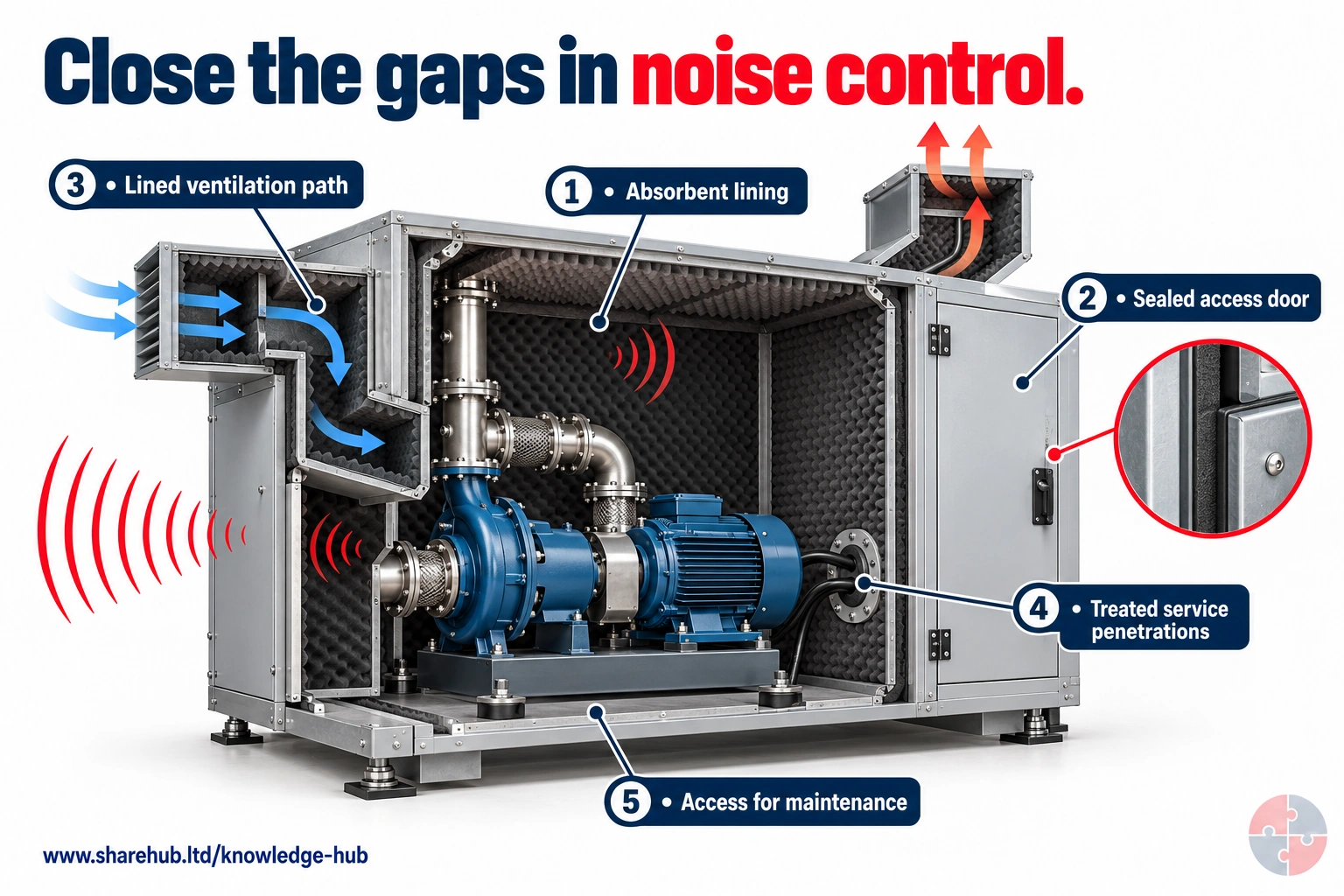

The teaching cutaway opens the front so the lining, ventilation treatment, door seal and service penetrations can be seen. In operation the enclosure needs its full specified panels and access doors closed. Treated openings and seals reduce sound escape; they do not imply a silent machine or remove every airborne or structure-borne path.
Which detail could defeat otherwise effective panels?
An open door, unsealed penetration or untreated ventilation opening can allow sound to escape.
Conceptual cutaway with unquantified sound/airflow symbols, not a performance claim. Lining, baffles and seals need suitable acoustic, heat, fire, contamination and maintenance properties. Cooling, guarding, access and all transmission paths require competent design and verification.
Source guidance: HSE guidance
In an illustrative machine task, a supervisor leaves an acoustic access door open because workpieces are awkward to load. That changes the noise-control system the assessment relied on. The engineering team should examine loading access, the process and the enclosure design, with the actual task and other safety functions in view. Do not improvise a change to machine guarding or interlocks. See HSE noise reduction.
Hold the affected operating condition while the responsible owner resolves the control. Suitable residual hearing protection and access arrangements must be assessed for any authorised interim work, not used to justify unrestricted continuation. After modification, check the installed source control under the relevant load and tell each shift what condition is accepted. See HSE noise hearing protection.
Decision basis: HSE noise reduction. HSE noise hearing protection. The scenario and suggested records are illustrative; apply the source within its stated jurisdiction and the assessed work.
Can protection and warning communication both be checked?
Select effective hearing protection for the assessed exposure while ensuring essential alarms and communication remain usable.
Learning check: a purchaser selects the largest attenuation rating for every worker. The learner should question the real exposure, fit, wearing, other PPE and the risk of unnecessary isolation from useful sound. A high rating on a box does not establish effective protection in the actual work. See HSE noise hearing protection.
Learning check: a worker repeatedly removes a protector to hear an instruction. Investigate the communication method and equipment compatibility with the worker instead of accepting repeated unprotected exposure. Verify that the resulting arrangement still provides adequate protection and usable essential warnings. See HSE over-protection guidance.
Ask the supervisor to demonstrate the pre-use source-control check, the correct protected-work boundary and the response to a failed enclosure. Ask the buyer and assessor to show acceptance evidence. The routine should connect purchasing, engineering, exposure assessment and worker experience rather than treating earplugs as the entire noise programme. See HSENI noise-induced hearing loss.
Decision basis: HSE noise hearing protection. HSE over-protection guidance. HSENI noise-induced hearing loss. The scenario and suggested records are illustrative; apply the source within its stated jurisdiction and the assessed work.
Which terms carry the key decisions?
Do not confuse a momentary sound level, full-day exposure and a peak value.
| Term | Meaning | Use in this lesson |
|---|---|---|
| dB(A) | A-weighted decibels | Used for daily/weekly exposure. |
| dB(C) | C-weighted decibels | Used for peak sound pressure. |
| L_EX,8h | Daily personal noise exposure | Energy-equivalent exposure normalised to eight hours. |
| EAV | Exposure action value | Triggers specified employer action. |
| ELV | Exposure limit value | Must not be exceeded; protection effect may be considered. |
| NIHL | Noise-induced hearing loss | Sensorineural hearing impairment from harmful noise. |
| ACOP | Approved Code of Practice | Official code with its own scope and legal context; distinguish it from legislation. |
| HSE | Health and Safety Executive | Great Britain workplace regulator; use its guidance within scope. |
| HSENI | Health and Safety Executive for Northern Ireland | Northern Ireland workplace regulator; NI duties have separate instruments. |
| GB | Great Britain | England, Scotland and Wales; distinguish the NI legal route. |
| NI | Northern Ireland | Use the Northern Ireland legislation and regulator route. |
| PPE | Personal protective equipment | Residual personal protection supporting stronger source controls. |
| ERICPD | Eliminate; Reduce; Isolate; Control; PPE; Discipline | SHARE planning prompt; Discipline means maintaining controls, not blame. |
Which BuildOut documents support this topic?
Download individual editable BuildOut documents for this topic. Procedures and plans contain completed arrangements; forms, checklists, assessments, RAMS and permits are blank masters. Registers include separate worked examples.
| Document | Purpose and content | Editable download |
|---|---|---|
| Noise assessment and hearing-conservation procedure BOUK-PRO-NOISE · Completed worked example · v1.0 | Assess realistic exposure, select quieter methods/equipment and verify controls and surveillance. | Download DOCX Read preview |
| Task and personal noise-exposure assessment BOUK-RA-NOISE-01 · Blank editable master · v1.0 | Determine representative exposure and the measures required. | Download DOCX Read preview |
| Noise reduction and hearing-protection zone plan BOUK-PLN-NOISE-01 · Completed worked example · v1.0 | Identify quieter methods, isolation, maintenance, access controls and hearing protection. | Download DOCX Read preview |
| Noise-control and hearing-protection verification BOUK-CHK-NOISE-01 · Blank editable master · v1.0 | Check control use, suitability and practical effectiveness. | Download DOCX Read preview |
| Noise health-surveillance referral and follow-up BOUK-FRM-NOISE-01 · Blank editable master · v1.0 | Record exposure-based referral and fitness recommendations, with clinical privacy. | Download DOCX Read preview |
Review and adapt the documents for your organisation, activities and jurisdiction before approval and issue. Open the SHAREms management-system hierarchy to find each document under its parent policy.