SHARE Knowledge Hub
Slips, Trips and Falls Injuries
Slips, trips and falls injuries explains what should happen after a same-level fall at work: immediate care, 999 triggers, scene safety, factual recording, RIDDOR checks, investigation, return-to-work support and learning that prevents repeat harm. It complements the prevention page by focusing on the injury pathway, reporting quality and how a single fall can reveal deeper problems with flooring, cleaning, lighting, access routes, housekeeping, footwear, supervision or work design.
Understanding Slips, Trips and Falls Injuries
Slips, trips and falls injuries explains what should happen after a same-level fall at work: immediate care, 999 triggers, scene safety, factual recording, RIDDOR checks, investigation, return-to-work support and learning that prevents repeat harm. It complements the prevention page by focusing on the injury pathway, reporting quality and how a single fall can reveal deeper problems with flooring, cleaning, lighting, access routes, housekeeping, footwear, supervision or work design.
Why this matters at work
Discuss functional ability and relevant medical recommendations against the actual duties, including driving, heights, machinery, manual handling and concentration. A fit note suggesting possible work with changes requires discussion of feasible arrangements, not automatic assignment to unchanged tasks. Head-injury symptoms can affect work after the visible injury has settled, and uncertainty about safe return should be referred for healthcare or occupational-health advice. Agree duties, hours, restrictions, support and review in clear terms, keeping medical details confidential. Explain how the worker should report difficulty and make sure supervisors can maintain the arrangement. Check that the accident causes have also been corrected before exposing the person or others again. Record the plan and review it as recovery progresses. Avoid a universal timetable or a manager's guarantee of fitness based only on the number of days absent.
First establish that the accident was work-related and which category applies. GB reportable outcomes include specified injuries, over-seven-day incapacity for normal work and defined circumstances involving non-workers taken directly from the scene to hospital for injury treatment. Different rules apply to recording over-three-day incapacity. A hospital visit or any fall does not automatically make an event reportable.
How organisations manage this in practice
Make the approach safe and summon trained first aid or emergency help as indicated. Prevent a second accident by controlling traffic, plant and the immediate hazard through safe arrangements. Do not assume the person is uninjured because they can speak or stand. A head strike, significant fall or concerning symptoms can require urgent assessment. Follow the trained responder and emergency dispatcher's instructions.
A school opens a temporary classroom and staff report that conditions differ between an empty room and a full lesson. The premises manager observes the occupied room and checks relevant controls with staff. The teacher reports whether the change works at the busiest time.
A factory team reports a workplace condition that gets worse after another line starts. The supervisor observes the task under those conditions and asks a competent person to check exposure and controls. A follow-up observation covers the same shift and operating load.
Put the person and urgent help before evidence collection
After a fall, obtain appropriate first aid or emergency help and prevent another person being harmed. Record the scene only when care and immediate safety allow.

Person and urgent help
Summon the trained first aider and appropriate emergency support. Call 999 for a life-threatening emergency or suspected serious injury, following the call handler’s advice.
Avoid unsafe movement
Do not force a potentially injured person to stand, walk or be lifted for convenience. Follow professional/first-aid advice and the immediate safety circumstances.
Control the area
Keep others clear of the contamination, obstruction or other ongoing hazard and provide a safe alternative route. Do not obstruct urgent access.
Record facts later
When appropriate, preserve factual scene, witness and task information without delaying care or creating further exposure. Do not diagnose an injury from the account or photograph.
Correct and verify
Investigate the cause and verify effective correction before the designated owner reopens the route. Check the arrangement under representative conditions.
Further health concern
Seek appropriate clinical help for worsening or concerning symptoms. The response depends on the person and injury; one general fall scenario cannot cover every emergency.
Read the complete controls: ERICPD planning prompts
Discipline verifies and sustains all the controls; it is not a separate substitute for them.
| Prompt or level | Complete task-specific example |
|---|---|
| Eliminate | Remove recurring water entry where practicable. |
| Reduce | Improve suitable matting and cleaning. |
| Isolate | Prevent access while unsafe and provide a safe route. |
| Control | Repair defects and verify the route before reopening. |
| PPE | PPE is not treatment for an injury. |
| Discipline | Sustain checks and learning, with care and emergency escalation first. Read the accompanying source table for the framework distinctions. |
Read the complete controls: ESEAP effectiveness order
Compare stronger feasible controls while preserving the actual task, checks and release requirements.
| Prompt or level | Complete task-specific example |
|---|---|
| Elimination | Remove recurring water entry where practicable. |
| Substitution | No separate measure is specified in this example. |
| Engineering controls | Provide suitable physical matting and, where applicable, drainage for foreseeable contamination. Use assessed physical barriers and a usable protected alternative route while the surface is unsafe. Repair floor and route defects through the competent physical correction. |
| Administrative controls | Plan and perform the assessed safe-cleaning method and timing. Inspect and verify the route and controls before reopening. Sustain checks and learning, with care and emergency escalation first. |
| PPE | PPE is not treatment for an injury. Read the accompanying source table for the framework distinctions. |
The sequence does not replace first-aid training or emergency advice and provides no lifting or treatment technique.
Why do slip, trip and fall injuries need structured follow-up?
After a same-level work fall, attend to the person and prevent a second injury before recording the scene. Seek emergency or urgent clinical help according to symptoms, then decide reportability under the correct GB or Northern Ireland rules. Investigation must find why the surface, route, cleaning or work design failed, verify corrective action and support a safe return to work.
Best-practice guide: Slips, Trips and Falls Injuries
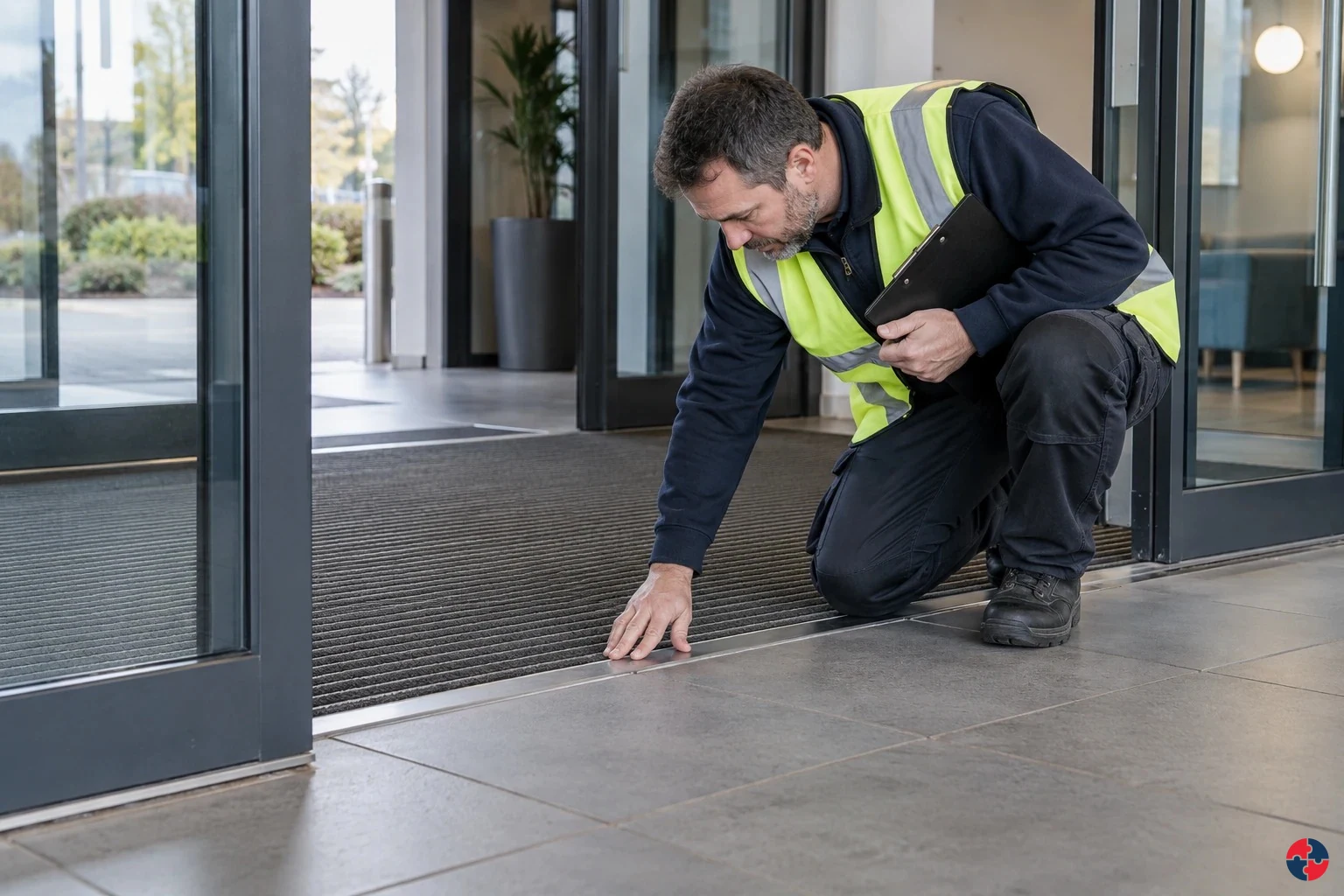
Why do slip, trip and fall injuries need structured follow-up?
After a same-level work fall, attend to the person and prevent a second injury before recording the scene. Seek emergency or urgent clinical help according to symptoms, then decide reportability under the correct GB or Northern Ireland rules. Slips, trips and falls injuries explains what should happen after a same-level fall at work: immediate care, 999 triggers, scene safety, factual recording, RIDDOR checks, investigation, return-to-work support and learning that prevents repeat harm.
Turn slips, trips and falls injuries knowledge into a decision
Slips, trips and falls injuries explains what should happen after a same-level fall at work: immediate care, 999 triggers, scene safety, factual recording, RIDDOR checks, investigation, return-to-work support and learning that prevents repeat harm. It complements the prevention page by focusing on the injury pathway, reporting quality and how a single fall can reveal deeper problems with flooring, cleaning, lighting, access routes, housekeeping, footwear, supervision or work design. Record symptoms and care route only as necessary, work connection, photos, witnesses, reporting rationale, controls, owner and follow-up.
Reception fall with delayed head symptoms
Provide first aid, assess urgent symptoms, isolate the route and preserve factual scene evidence without delaying care. Check the GB or NI reporting test by location, fix water entry and cleaning controls, verify the route, then review any worker return to duties.
Do not let evidence collection delay care
Do not force a potentially injured person to move for convenience. The circumstances and professional advice determine the response.
Choose controls for slips, trips and falls injuries
Change the work: Remove or reduce the hazard before relying on procedures or personal protection. Strengthen prevention: For slips, trips and falls injuries, assess the actual task and first look for a way to remove the hazard. Verify the barriers: Where that is not possible, consider a safer substitute, engineered separation and then clear work procedures. Sustain the controls: PPE protects against remaining exposure; it does not make an uncontrolled task safe. Review the decision: In Northern Ireland, verify the separate legal route and site instructions. Read the full control table for qualifications, ownership and verification. Use the actual task and applicable jurisdiction; existing technical approval remains unchanged.
Use the full slips, trips and falls injuries lesson
Use the full topic for the decision points, practical examples, detailed control tables and source scope. HSE guidance applies to Great Britain; use HSENI for the Northern Ireland route and the source’s stated jurisdiction. A simplified guide does not change the page’s technical-review or approval status.
Read all six steps as text
1. Why do slip, trip and fall injuries need structured follow-up?
After a same-level work fall, attend to the person and prevent a second injury before recording the scene.
- Avoid / redesign: Remove or reduce the hazard before relying on procedures or personal protection.
- Control the task: Where that is not possible, consider a safer substitute, engineered separation and then clear work procedures.
- Verify before release: Remove or reduce the hazard before relying on procedures or personal protection.
After a same-level work fall, attend to the person and prevent a second injury before recording the scene. Seek emergency or urgent clinical help according to symptoms, then decide reportability under the correct GB or Northern Ireland rules. Slips, trips and falls injuries explains what should happen after a same-level fall at work: immediate care, 999 triggers, scene safety, factual recording, RIDDOR checks, investigation, return-to-work support and learning that prevents repeat harm.
Apply it: Which part of this plan would you check at the workface before authorising the task?
2. Turn slips, trips and falls injuries knowledge into a decision
Use the evidence to improve the actual work arrangement.
- Change at source: Remove or reduce the hazard before relying on procedures or personal protection.
- Make it observable: Remove or reduce the hazard before relying on procedures or personal protection.
- Keep useful evidence: Record symptoms and care route only as necessary, work connection, photos, witnesses, reporting rationale, controls, owner and follow-up.
Slips, trips and falls injuries explains what should happen after a same-level fall at work: immediate care, 999 triggers, scene safety, factual recording, RIDDOR checks, investigation, return-to-work support and learning that prevents repeat harm. It complements the prevention page by focusing on the injury pathway, reporting quality and how a single fall can reveal deeper problems with flooring, cleaning, lighting, access routes, housekeeping, footwear, supervision or work design. Record symptoms and care route only as necessary, work connection, photos, witnesses, reporting rationale, controls, owner and follow-up.
Apply it: What evidence would show that the change improves this task, rather than only completing a record?
3. Reception fall with delayed head symptoms
Example: a practical application of the existing topic lesson.
- Setting: Visitor fall on a wet public reception route with possible head injury.
- Act: A visitor slips on an unsegregated wet entrance and strikes their head; a colleague reports a recurring leak.
- Hold / review: Call 999 for the emergency head-injury signs described below; use an appropriate local urgent clinical route for other concerning symptoms.
Provide first aid, assess urgent symptoms, isolate the route and preserve factual scene evidence without delaying care. Check the GB or NI reporting test by location, fix water entry and cleaning controls, verify the route, then review any worker return to duties.
Apply it: At which point would you hold this example, and what evidence would allow it to proceed?
4. Do not let evidence collection delay care
Person first, safe scene, facts later, verified correction before reopening.
- Failed response: A person is urged to stand or evidence is collected while urgent care or an ongoing hazard remains unresolved.
- Possible consequence: Necessary help may be delayed, the person may be further harmed or another person may fall on the same unresolved route.
- Care and correction: Obtain appropriate first aid/emergency support, follow professional advice, control the area, then investigate and verify effective correction.
Do not force a potentially injured person to move for convenience. The circumstances and professional advice determine the response.
Apply it: What help is needed now, what hazard remains and when can evidence be collected safely?
5. Choose controls for slips, trips and falls injuries
Start with the stronger practicable options and verify their effect.
- Change the work: Remove or reduce the hazard before relying on procedures or personal protection.
- Strengthen prevention: For slips, trips and falls injuries, assess the actual task and first look for a way to remove the hazard.
- Verify the barriers: Where that is not possible, consider a safer substitute, engineered separation and then clear work procedures.
- Sustain the controls: PPE protects against remaining exposure; it does not make an uncontrolled task safe.
- Review the decision: In Northern Ireland, verify the separate legal route and site instructions.
Change the work: Remove or reduce the hazard before relying on procedures or personal protection. Strengthen prevention: For slips, trips and falls injuries, assess the actual task and first look for a way to remove the hazard. Verify the barriers: Where that is not possible, consider a safer substitute, engineered separation and then clear work procedures. Sustain the controls: PPE protects against remaining exposure; it does not make an uncontrolled task safe. Review the decision: In Northern Ireland, verify the separate legal route and site instructions. Read the full control table for qualifications, ownership and verification. Use the actual task and applicable jurisdiction; existing technical approval remains unchanged.
Apply it: Which stronger option can be used here, and who will verify it before accepting the remaining risk?
6. Use the full slips, trips and falls injuries lesson
Follow the official sources below and retain the task-specific evidence.
- Official guidance: nidirect source
- Official guidance: nidirect falls emergency route
- Task decision: Record symptoms and care route only as necessary, work connection, photos, witnesses, reporting rationale, controls, owner and follow-up.
Use the full topic for the decision points, practical examples, detailed control tables and source scope. HSE guidance applies to Great Britain; use HSENI for the Northern Ireland route and the source’s stated jurisdiction. A simplified guide does not change the page’s technical-review or approval status.
Apply it: Which official source and full-topic section will you use to resolve the next decision?
This pathway covers same-level slips and trips; falls from height need a separate work-at-height assessment and response. Slip, trip and fall injuries range from bruising and sprains to fractures, head injury, spinal concern, loss of consciousness and long-term musculoskeletal pain. A person may get up quickly through embarrassment or adrenaline, so supervisors should not assume that a fall is minor because the person tries to carry on.
The immediate priority is care and scene safety. That means first aid, 999 where needed, preventing others using the same unsafe area and keeping enough evidence to understand the event once the person is safe. Record basic facts when safe, but do not delay cleaning, isolation or other urgent hazard control to preserve evidence.
A good follow-up asks why the fall made sense in that workplace at that time: wet entrance matting after rain, a cable across a temporary route, poor stair nosing, uneven ground, rushed delivery, unsuitable footwear, poor lighting or a cleaning method that left residue. The aim is not to prove the worker should have watched where they were going. The aim is to understand the system that put a person in that position.
| Indicator | Why it matters | Immediate response |
|---|---|---|
| Head impact, confusion or loss of consciousness | May indicate concussion or more serious head injury. | Call 999 for the emergency signs below; obtain prompt clinical assessment for other concerning symptoms and arrange appropriate observation following clinical advice. CDC concussion danger signs; nidirect source |
| Neck, back or spinal pain | Possible spinal injury needs prompt clinical assessment. | Call 999 if head, back or neck injury is suspected after a fall; avoid unnecessary movement and follow dispatcher advice. nidirect falls emergency route; NICHD spinal-injury facts |
| Suspected fracture or deformity | May need urgent clinical care and immobilisation. | Call emergency help or arrange urgent medical assessment. NIH fracture guidance; nidirect source |
| Severe bleeding or open wound | Heavy blood loss can be life-threatening. | Call 999 for heavy blood loss and provide first aid within training and dispatcher instructions. Other wounds need assessment according to severity. nidirect first aid |
| Unable to weight-bear or severe pain | May indicate fracture, ligament injury or serious soft-tissue harm. | Do not force the person to walk; arrange medical support. NIH fracture guidance; nidirect source |
| Individual support needs | Mobility, communication or existing health needs may affect the response. | Arrange suitable assistance and individual clinical advice; do not infer injury severity from a personal characteristic. This is an illustrative support prompt. |
| Symptoms worsen after return to work | Some injuries become clear later. | Review work tasks and signpost medical advice. CDC concussion danger signs; nidirect source |
Clinical indicators use US government fracture/head-injury evidence and NI government emergency guidance. The UK emergency number is 999. nidirect severe head injury; nidirect falls emergency route; nidirect first aid. Prevention uses HSE slip and trip factors; this source does not establish medical triage.
What should happen from fall injury to prevention learning?
A competent response follows the event from immediate care through reporting, investigation, corrective action and assurance.
The pathway should be simple enough for supervisors to use under pressure. Care comes first, then scene safety, factual recording, reportability check, investigation, action tracking, return-to-work support and review. Skipping any step weakens learning.
The investigation should connect the injury to the prevention controls. If someone fractures a wrist after slipping on a wet reception floor, the action is not complete when the floor is cleaned. The organisation needs to ask why contamination reached the route, whether matting was suitable, whether barriers were used, whether cleaning created or removed risk, and whether the same weakness exists elsewhere.
| Stage | Purpose | Good practice |
|---|---|---|
| Immediate care | Protect the injured person. | First aid, 999 or urgent medical advice where needed. |
| Scene safety | Prevent repeat harm. | Isolate the hazard, provide safe route and supervise area. |
| Factual record | Capture what happened before memory or scene changes. | Record time, place, task, surface, contaminant, footwear, lighting, witnesses and photographs where appropriate. |
| Reportability check | Decide whether RIDDOR or internal escalation applies. | Use injury type, absence, hospital treatment and work-relatedness criteria. |
| Investigation | Find causes and control weaknesses. | Look at route design, cleaning, maintenance, workload, supervision and previous weak signals. |
| Actions | Prevent recurrence. | Assign owners, interim controls, due dates and verification evidence. |
| Return to work | Support recovery and avoid aggravation. | Review duties, walking routes, manual handling, driving and phased return needs. |
| Assurance | Check learning has changed the workplace. | Inspect similar routes, trend incidents and review action quality. |
This is an illustrative incident pathway. HSE investigation guidance supports causal learning; medical urgency, reporting and return each use the separate sources in their sections.
What does a good fall injury investigation look like?
A useful investigation explains why the person fell and what the organisation must change, not just who fell.
Reception fall with delayed head symptoms
Task material and setting: Visitor fall on a wet public reception route with possible head injury.
People and prerequisites: Injured visitor, first aider, supervisor and duty manager; safe route available
Before: A visitor slips on an unsegregated wet entrance and strikes their head; a colleague reports a recurring leak.
During: Provide first aid, assess urgent symptoms, isolate the route and preserve factual scene evidence without delaying care.
Hold or stop: Call 999 for the emergency head-injury signs described below; use an appropriate local urgent clinical route for other concerning symptoms.
Completion and hand back: Check the GB or NI reporting test by location, fix water entry and cleaning controls, verify the route, then review any worker return to duties.
Evidence: Record symptoms and care route only as necessary, work connection, photos, witnesses, reporting rationale, controls, owner and follow-up.
Separate employee wrist-injury example
The following case concerns an employee wrist injury, separate from the visitor head-impact example above.
At Riverside Leisure Ltd, a cleaner slips near the changing-room entrance at 06:20 and lands heavily on one wrist. The person reports pain but wants to continue. The supervisor arranges first aid, stops use of the wet corridor, photographs the surface and checks whether other workers use the same route to open the building.
The investigation finds that early deliveries cross the same wet area, the cleaner's footwear was general safety footwear rather than slip-resistant for wet tiles, the cleaning method left residue, the mat well was too short for peak wet-foot traffic, and previous near misses were discussed informally but not recorded. The action plan therefore changes the floor-cleaning method, matting, footwear specification, route inspection, delivery timing and near-miss reporting.
| Evidence | Weak conclusion | Stronger conclusion |
|---|---|---|
| Worker slipped on wet tile | Worker should have walked more carefully. | Wet route control failed and needs design, cleaning and supervision review. |
| Cleaning just completed | Cleaning is recorded, so control exists. | Cleaning method may have created a wet or contaminated surface. |
| No previous injury record | This was unpredictable. | Near misses and complaints may exist outside formal reporting. |
| Footwear was safety-rated | Footwear was suitable. | Slip resistance must match surface and contaminant. |
| Area reopened quickly | Business disruption was avoided. | Area should remain controlled until the cause is understood and safe route exists. |
The cases illustrate incident management. HSE investigation guidance supports investigation; the care and reporting decisions use the clinical and GB/NI criteria below.
Transfer the visitor case to an employee: the care and route controls stay symptom- and hazard-based, while RIDDOR uses the worker injury/incapacity test rather than the GB visitor hospital-treatment test. Return-to-work restrictions are a separate work/clinical decision. A report or completed form does not verify that the entrance is safe. GB RIDDOR criteria; NI RIDDOR criteria.
When should a fall trigger 999 or urgent medical help?
Emergency escalation is needed when signs suggest serious injury, medical deterioration or unsafe movement.
A fall response should never delay urgent care for the sake of paperwork. Call 999 for the emergency head-injury signs described below, such as a person knocked out who has not woken, a seizure, new weakness, inability to stay awake, new difficulty understanding or speaking, or new confusion. A suspected fracture without emergency signs still needs prompt clinical assessment; use an appropriate local urgent clinical route for urgent triage. Do not move someone unnecessarily when a spinal injury is suspected.
Supervisors should also treat delayed symptoms seriously. A person may report worsening headache, dizziness, pain or reduced mobility later in the shift or after going home. The incident record should allow that follow-up to connect back to the original event.
| Trigger | Why it matters | Action |
|---|---|---|
| After head impact: not waking, seizure, new weakness, difficulty understanding or speaking, or new confusion | May indicate serious head or neurological injury. | Call 999 for these emergency signs; other concerning symptoms need prompt clinical assessment under the criteria below. nidirect severe head injury; nidirect concussion |
| Neck or back pain after fall | Possible spinal concern. | Call 999 when head/back/neck injury is suspected; avoid unnecessary movement and follow dispatcher advice. nidirect falls |
| Suspected broken bone | Needs clinical assessment and may be reportable. | Arrange urgent medical support. NIH fracture guidance; nidirect urgent and emergency care |
| Severe bleeding | Heavy blood loss can be life-threatening. | Call 999 for heavy blood loss and provide first aid within training and dispatcher instructions. nidirect first aid |
| Worsening symptoms later | Some injuries are delayed or initially masked. | Seek clinical assessment appropriate to the symptoms and location, including 999 for emergency signs. Review duties only after immediate care; do not wait for manager permission. CDC concussion danger signs nidirect urgent and emergency care Urgent medical criteria |
| Safety-critical worker injured | Pain, medication or reduced mobility may affect work safety. | Review driving, plant, lone work and emergency duties. HSE sickness absence and return to work |
For the UK response, nidirect severe head injury and nidirect concussion distinguish emergency signs from urgent assessment. Call 999 for an unresponsive person, seizures, new weakness, inability to stay awake or new difficulty speaking/understanding. Persistent headache, vomiting, memory problems or blood-thinning treatment after head injury also need prompt emergency-department assessment; follow local clinical/dispatcher advice on safe transport. nidirect falls emergency route supports 999 for suspected head/back/neck injury or inability to get up after a fall; avoid unnecessary movement. NICHD spinal-injury facts describes prompt professional care and prevention of further spinal injury, not instructions for managers to apply collars. nidirect first aid supports the heavy-blood-loss emergency boundary.
How should RIDDOR and internal records be handled?
Reporting decisions should be factual, timely and separate from the deeper investigation.
Point-of-use source supports the section’s main boundary; check the actual task and location.
RIDDOR is not the same as investigation. In Great Britain, HSE sets an over-seven-day incapacity reporting threshold; in Northern Ireland, HSENI retains an over-three-day threshold. The day of the accident is excluded from the count, while weekends and rest days count. Check the separate rules for specified or major injuries and non-workers. GB reporting guidance; NI reporting guidance. A fall may need immediate internal reporting even if it is not reportable externally, and a RIDDOR report does not prove the causes have been controlled. Managers check the applicable GB specified-injury/over-seven-day rules or NI major-injury/over-three-day rules, and the separate non-worker test.
Good records are factual and respectful. They should describe what happened, where, when, who was involved, first-aid or medical response, reportability decision, interim controls and action ownership. They should not include unnecessary medical details beyond what is needed for safety, absence, reporting and support.
| Record area | What to include | Quality test |
|---|---|---|
| Immediate report | Basic facts, injury, location, hazard and controls taken. | Could a manager understand the risk within minutes? HSE incident investigation |
| RIDDOR check | Criteria considered and decision rationale. | Is the decision based on guidance, not guesswork? GB RIDDOR criteria; NI RIDDOR criteria |
| Scene evidence | Photos, surface condition, lighting, weather, footwear, task and witnesses. | Was evidence captured before the scene changed? HSE incident investigation |
| Investigation | Underlying causes and prevention actions. | Does it look beyond individual behaviour? HSE incident investigation |
| Absence and return | Work impact, adjustments and review date. | Is medical privacy protected? UK GDPR Article 5; HSE sickness absence and return to work |
| Learning | Similar locations checked and actions verified. | Could the same event happen elsewhere tomorrow? HSE incident investigation; HSE slip and trip factors |
Worked count: a worker is injured on Monday and cannot do normal duties from Tuesday through the following Tuesday: eight consecutive days, excluding the accident day and including the weekend. This crosses GB over-seven-day and NI over-three-day thresholds if the accident is work-related; GB over-three-day incapacity alone is recorded rather than reported. GB RIDDOR criteria; NI RIDDOR criteria.
For a GB visitor, ask whether a work-related accident caused injury and the person was taken directly from the scene to hospital for treatment. Diagnostic tests or an X-ray alone do not meet that treatment test. NI has its own non-worker reporting route; check HSENI rather than transferring the GB worker day threshold. GB RIDDOR criteria; NI RIDDOR criteria. These are reporting decisions, not clinical transport instructions.
Name the responsible reporter and backup, track later absence/clinical information and revisit reportability. A confirmed fracture in the wrist example needs the specified-injury check rather than waiting only for incapacity days. Keep internal reporting, clinical care and the separate GB/NI statutory categories and reporting clocks distinct.
For GB, notify relevant deaths, specified injuries, non-worker hospital-treatment accidents and dangerous occurrences without delay, with the report received within ten days. Over-seven-day incapacity reports are due within fifteen days of the incident. Track the actual category, responsible reporter and due date; use the separate NI process rather than transplanting these GB clocks.HSE RIDDOR: when to report
How should return to work be managed after a fall?
Return to work should consider pain, mobility, medication, task demands and whether the original hazard has been controlled.
A worker may be medically fit for some work but not fit for ladders, plant operation, long walking routes, manual handling, lone work, stairs or emergency-response duties. Return planning should therefore focus on work impact and risk, not on diagnosis detail.
The supervisor should check whether the route, task or pace that contributed to the injury has changed. Returning the person to the same conditions without action can aggravate injury and undermine trust.
| Prompt | Example question | Possible control |
|---|---|---|
| Mobility | Can the person walk the normal route safely? | Temporary route change, closer parking or reduced walking. |
| Pain and medication | Could pain or medication affect driving, plant or emergency response? | Temporary restriction and OH/GP advice where needed. |
| Manual handling | Does lifting or carrying increase pain or fall risk? | Task redesign or mechanical aid. |
| Stairs and uneven ground | Are routes suitable during recovery? | Alternative duties or access changes. |
| Lone work | Could the person get help if symptoms worsen? | Check-in plan or temporary paired work. |
| Review | When should adjustments be reviewed? | Set a date and record work-focused outcome. |
The adjustment options are illustrative, informed by HSE return-to-work guidance. Agree restrictions from work demands and competent clinical advice, with privacy governed separately.
How is this different from the slips and trips prevention page?
This page focuses on what happens after an event: care, evidence, reporting, investigation, recovery and assurance.
The prevention page is mainly about stopping slips and trips before harm occurs. This injury page starts once someone has fallen and asks what the organisation must do next. That distinction matters because a good prevention control can be undermined by a poor incident response, and a good incident response should feed back into prevention.
The pathway should be visible to first aiders, supervisors, managers, HR, HSE and facilities. Everyone does not do the same job, but everyone should know where their part begins and ends. Immediate care should not wait for an investigation, and investigation should not stop when the first-aid form is complete.
| Stage | What happens | Evidence or decision |
|---|---|---|
| Immediate care | Check the person, provide first aid and call 999 where red flags are present. | First-aid record and emergency escalation. |
| Scene preservation | Make the area safe while keeping enough evidence to understand what happened. | Photos, isolation record and temporary route. |
| Witness facts | Capture what was seen, not opinions or blame. | Witness notes, time, location, task and condition details. |
| RIDDOR decision | Check work-relatedness, injury type, absence and reporting criteria. | Recorded rationale and report if required. |
| Root cause | Look beyond the fall to control weaknesses and previous warning signs. | Investigation report and causal analysis. |
| Corrective action | Fix source, route, cleaning, lighting, footwear, workload or supervision. | Action owner, due date and verification. |
| Return-to-work | Review duties, pain, medication, mobility and safety-critical tasks. | Work-focused adjustment and review date. |
| Assurance check | Confirm the action works and similar locations have been checked. | Closure evidence, inspection and trend review. |
The pathway assigns illustrative responsibilities. HSE investigation guidance supports learning and corrective action; it does not establish medical urgency or RIDDOR thresholds.
What if symptoms appear after the person has left work?
Delayed symptoms should be linked back to the incident and reviewed through care, reporting, investigation and work adjustment.
CDC concussion danger signs supports the section’s main boundary; check the actual task and location.
A worker who slips on a wet entrance mat may feel embarrassed and finish the shift. That evening they develop a headache, wrist swelling and dizziness. The next morning they call in sick and attend urgent care. If the original report was thin, the organisation may struggle to decide what happened, whether RIDDOR applies and whether the entrance is still unsafe.
A stronger approach treats delayed symptoms as foreseeable. Supervisors tell injured people what to do if symptoms worsen, keep factual scene evidence, update the incident record, review absence and duties, and check whether further medical or RIDDOR action is needed. This protects the person and improves the quality of learning.
| Timeline | Risk | Good response |
|---|---|---|
| Immediately after fall | Person minimises injury and returns to work. | First aid, factual report and advice to report worsening symptoms. CDC concussion danger signs; nidirect urgent and emergency care |
| End of shift | Pain, swelling or dizziness develops. | Use the clinical route appropriate to delayed symptoms and location, with 999 for emergency signs. Do not wait for a manager’s permission; contact the employer once safe. See the urgent-medical-help section. CDC concussion danger signs nidirect urgent and emergency care Urgent medical criteria |
| Next day absence | Reportability and work-relatedness need review. | Update record and check RIDDOR criteria. GB RIDDOR criteria; NI RIDDOR criteria |
| Investigation | Scene may already have changed. | Use photos, witnesses, cleaning records and inspection history. HSE incident investigation |
| Return planning | Medication or reduced grip may affect work. | Review duties, driving, manual handling and lone work. HSE sickness absence and return to work |
| Prevention | Same entrance may still expose others. | Verify matting, cleaning, drainage, lighting and weather controls. HSE slip and trip factors |
Delayed pain, swelling or dizziness needs the clinical route appropriate to the symptoms and location; use 999 for emergency signs described in the urgent-medical-help section. Contact the employer once safe and never wait for a manager’s permission. Not every ache is an emergency.
How can the hierarchy of controls prevent slips, trips and same-level falls?
Control classification: Classify the mechanism separately from its upkeep: physical floor repair, drainage, barriers, protected routes, compartmentation, fire doors and suitable disposal facilities are physical measures where specified. Cleaning schedules, inspections, policies, funding, supervision and verification are administrative arrangements maintaining them. A verbal instruction is not a physical barrier. Read this correction with the source table. Retained overview and stage artwork requires the matching classification update.
Remove or reduce the hazard before relying on procedures or personal protection.
For slips, trips and falls injuries, assess the actual task and first look for a way to remove the hazard. Where that is not possible, consider a safer substitute, engineered separation and then clear work procedures. PPE protects against remaining exposure; it does not make an uncontrolled task safe. HSE hierarchy of controls
The selected measures need a named owner, a usable stop point and a check that they still work when the task or conditions change. In Northern Ireland, verify the separate legal route and site instructions.
Care and emergency escalation come first. For the reception, remove recurring water entry where practicable, improve matting/cleaning and prevent access while unsafe. Provide a safe route, repair defects and verify conditions before reopening. ERICPD (Eliminate, Reduce, Isolate, Control, PPE, Discipline) is a teaching prompt for prevention; PPE is not treatment for an injury and Discipline means sustained checks and learning. HSE slip and trip factors; HSE barriers and cleaning. Photograph only when it does not delay care or hazard control.
How can the ERICPD hierarchy of controls prevent slips, trips and same-level falls?

| ERICPD control level | Topic-specific example | Source and full task context |
|---|---|---|
| Eliminate | Remove recurring water entry where practicable. | Read the full task example, checks and stop points on this page. HSE hierarchy of controls · HSE slip and trip factors · HSE barriers and cleaning |
| Reduce | Improve suitable matting and cleaning. | Read the full task example, checks and stop points on this page. HSE hierarchy of controls · HSE slip and trip factors · HSE barriers and cleaning |
| Isolate | Prevent access while unsafe and provide a safe route. | Read the full task example, checks and stop points on this page. HSE hierarchy of controls · HSE slip and trip factors · HSE barriers and cleaning |
| Control | Repair defects and verify the route before reopening. | Read the full task example, checks and stop points on this page. HSE hierarchy of controls · HSE slip and trip factors · HSE barriers and cleaning |
| PPE | PPE is not treatment for an injury. | Read the full task example, checks and stop points on this page. HSE hierarchy of controls · HSE slip and trip factors · HSE barriers and cleaning |
| Discipline | Sustain checks and learning, with care and emergency escalation first. | Read the full task example, checks and stop points on this page. HSE hierarchy of controls · HSE slip and trip factors · HSE barriers and cleaning |
How can the ISO 45001 hierarchy of controls prevent slips, trips and same-level falls?

| Five-level control stage(s) | Topic-specific example | Source and full task context |
|---|---|---|
| Elimination | Remove recurring water entry where practicable. | Read the full task example, checks and stop points on this page. HSE hierarchy of controls · HSE slip and trip factors · HSE barriers and cleaning |
| Engineering controls / Administrative controls | Improve suitable matting and cleaning. | Read the full task example, checks and stop points on this page. HSE hierarchy of controls · HSE slip and trip factors · HSE barriers and cleaning |
| Engineering controls | Prevent access while unsafe and provide a safe route. | Read the full task example, checks and stop points on this page. HSE hierarchy of controls · HSE slip and trip factors · HSE barriers and cleaning |
| Engineering controls / Administrative controls | Repair defects and verify the route before reopening. | Read the full task example, checks and stop points on this page. HSE hierarchy of controls · HSE slip and trip factors · HSE barriers and cleaning |
| PPE | PPE is not treatment for an injury. | Read the full task example, checks and stop points on this page. HSE hierarchy of controls · HSE slip and trip factors · HSE barriers and cleaning |
| Administrative controls | Sustain checks and learning, with care and emergency escalation first. | Read the full task example, checks and stop points on this page. HSE hierarchy of controls · HSE slip and trip factors · HSE barriers and cleaning |
What should supervisors do immediately after a slip, trip or fall injury?
Supervisors should protect the injured person, make the area safe, preserve facts, report through the correct route and trigger investigation.
The first decisions are practical: does the person need urgent medical help, can the area stay open, who else is exposed, and what evidence will disappear if the scene is changed? Supervisors should be trained to make these decisions quickly without creating a blame-focused atmosphere.
If the event has serious injury potential, immediate escalation should happen even before all facts are known. Waiting for absence duration or a final diagnosis can delay control of an unsafe route.
| Decision | Ask | Action |
|---|---|---|
| Medical escalation | Are there head, spinal, fracture, severe bleeding or worsening symptoms? | Follow the emergency/urgent criteria above; call 999 for emergency signs. nidirect severe head injury; nidirect falls; nidirect first aid |
| Area control | Could someone else fall now? | Isolate, reroute, dry, repair or supervise the area. HSE slip and trip factors |
| Evidence | What facts will change quickly? | Record surface, lighting, contaminant, task, footwear, weather and photographs when safe, without delaying care or hazard control. HSE incident investigation |
| Report route | Does internal, insurance, RIDDOR or senior escalation apply? | Notify the right people and record rationale. GB RIDDOR criteria; NI RIDDOR criteria |
| Investigation level | Is there serious harm, repeat risk, public interface or weak control evidence? | Increase investigation depth and assign competent lead. HSE incident investigation |
| Return planning | Could injury affect safe work? | Review duties, routes, driving, manual handling and review date. HSE sickness absence and return to work |
Where do fall injury responses commonly fail?
Responses fail when care, evidence, reporting, investigation and return-to-work planning are treated as separate tasks rather than one learning pathway.
A poor response can look efficient: the person is helped up, the floor is mopped, a report form is completed and the area reopens. The weakness is that the same hazard may still exist because no one understood the root of the event.
A stronger response recognises the injury as evidence about how the workplace is functioning. It asks what controls were supposed to prevent the fall, why they were weak, where else they may be weak and how closure will be verified.
| Failure or weak practice | How it develops | What good looks like |
|---|---|---|
| Care delayed for paperwork | Supervisor asks for report details before urgent help. | Care and scene safety come first. |
| Scene cleaned too soon | No safe opportunity is taken to capture basic facts during urgent hazard control. | Capture facts when safe without delaying care or removing danger. |
| Worker blamed | Investigation stops at inattention or rushing. | Review design, surface, contamination, task and supervision. |
| No RIDDOR rationale | Reportability is guessed or ignored. | Record criteria checked and decision made. |
| Weak action | Brief everyone to be careful. | Fix source, route, cleaning, lighting, footwear or workload. |
| No return review | Person returns to full duties while sore or medicated. | Review safety-critical tasks and recovery needs. |
| No extent check | Only the exact location is fixed. | Inspect similar routes, entrances, stairs and wet areas. |
The failure table illustrates incident-response weaknesses; HSE investigation guidance supports investigation and learning from control failures.
What evidence shows fall injuries are being learned from?
Evidence should show prompt care, accurate reporting, good investigation, proportionate escalation and verified prevention actions.
Evidence should fit the site and incident risk: route condition, contamination, cleaning, defects and corrective actions need usable records and verification; serious injury also needs clinical, reporting and recovery follow-up.
| Evidence item | What it should show | Assurance question |
|---|---|---|
| First-aid and immediate response record | Care provided, escalation, time, responder and injured person's condition. | Was urgent help sought when needed? |
| Incident report | Facts about location, task, surface, contaminant, lighting, footwear and witnesses. | Does it support learning rather than blame? |
| RIDDOR check | Criteria considered, decision, date and person responsible. | Can the organisation explain its decision? |
| Investigation record | Direct, underlying and management causes. | Does it link injury to prevention controls? |
| Action tracker | Interim controls, owners, due dates and close-out evidence. | Were actions verified at the worksite? |
| Return-to-work review | Work impact, adjustments and review date. | Are medical details kept proportionate and private? |
| Trend map | Location, time, weather, surface, task and recurrence themes. | Are repeat weak signals escalated? |
These fields illustrate proportionate incident evidence. HSE investigation guidance supports factual investigation; reporting and health records have their separate tests and privacy requirements.
How should slips, trips and falls injuries be assured?
Assurance should test whether controls work in practice, not whether the page or procedure exists.
Assurance should include frontline checks, manager review and periodic independent sampling where risk warrants it. The purpose is to find weak signals early, close actions properly and update the risk assessment when work changes.
| Assurance level | What to check | What good looks like |
|---|---|---|
| Frontline check | Supervisors know first response, escalation and area-control steps. | Real incidents are handled consistently. |
| HSE review | Sample incident records, RIDDOR decisions and investigation quality. | Reports lead to meaningful action. |
| Facilities assurance | Defect, cleaning and route actions close properly. | Physical conditions improve. |
| HR/OH review | Return-to-work arrangements protect privacy and safety. | Recovery support is work-focused. |
| Leadership review | Repeat locations, serious injuries, claims and overdue actions. | Resources address persistent causes. |
Sample investigation and verified corrective action using HSE investigation guidance; assess reporting and recovery against their separate sources.
Which GB and Northern Ireland duties apply?
Reporting and workplace duties must be selected by location. GB RIDDOR has an over-seven-day incapacity reporting trigger; Northern Ireland retains an over-three-day trigger. Neither threshold replaces immediate clinical care or the duty to investigate and prevent recurrence.
Check the actual work location, current commencement and responsible authority before acting.
| Jurisdiction | Route | Direct source | Decision supported |
|---|---|---|---|
| Great Britain | Work and floor duties | Health and Safety at Work etc. Act 1974; Management of Health and Safety at Work Regulations 1999; Workplace (Health, Safety and Welfare) Regulations 1992, regulation 12 | Control the route and investigate the risk. |
| Northern Ireland | Separate work and floor duties | Health and Safety at Work (Northern Ireland) Order 1978; Management of Health and Safety at Work Regulations (Northern Ireland) 2000; Workplace (Health, Safety and Welfare) Regulations (Northern Ireland) 1993 | Use NI workplace rules. |
| Great Britain | GB RIDDOR | Types of reportable incidents | Apply specified-injury, over-seven-day and non-worker criteria. |
| Northern Ireland | NI reporting | Accident reporting | Apply major-injury and over-three-day NI criteria. |
| United States clinical evidence | Injury care | CDC concussion danger signs; NIH fracture guidance | US symptom evidence informs assessment; use the separate NI clinical pages for the UK 999/urgent response route. |
How should management check this work?
Use a defined plan, carry out the controls, check performance and correct what does not work.
For slips, trips and falls injuries, assign a competent owner to set the work controls, check their use and review them after change, failure or new evidence. HSE managing health and safety
A management-system label or certificate is not approval of a site limit, procedure or individual work decision. Apply GB and NI duties to the correct location.
What training and competence are needed?
Competence is shown by a role-specific decision or task, checked by a named assessor and revisited when conditions change.
Direct training source anchors the topic-specific competence and briefing.
The following role assessments and evidence are illustrative SHARE implementation choices. The linked authorities support the clinical, reporting or investigation boundaries; they do not prescribe these assessment methods.
| Role | Practice to demonstrate | Assessor and method | Evidence to retain | Reassess when |
|---|---|---|---|---|
| Workers and first aiders | Show scene safety, call 999 for emergency signs, and state the GB/NI urgent route. | First-aid lead observes a scenario and corrects escalation errors. | Attendance, scenario result and correction. | New route, drill failure or changed first-aid arrangements. |
| Supervisors | Demonstrate immediate isolation, witness/scene capture, and correct GB versus NI reporting referral. | Safety manager reviews a simulated fall report. | Signed case assessment and follow-up actions. | Incident, rule update or weak investigation. |
| Managers | Decide investigation level, assign actions and verify closure across similar routes. | Senior manager samples two completed investigations. | Action register and verification record. | Repeat fall, overdue action or site redesign. |
| HR and occupational health advisers | Separate private health detail from operational adjustments and agree a review date. | HR lead reviews a return plan. | Minimised adjustment plan and access decision. | Changed capability, role or data process. |
| Safety specialists | Test causal analysis, reporting rationale and effectiveness of route controls. | Competent peer audits a live anonymised case. | Audit trail, source version and closure evidence. | Serious event, trend or legal change. |
The assessments are local learning examples. Use the medical, reporting and investigation criteria for the demonstrated decision; a slips-prevention overview does not establish clinical competence.
How could Riverside Leisure Ltd manage this in practice?

Riverside Leisure Ltd can manage fall injuries by linking immediate response with route control, investigation, recovery support and prevention learning.
In this leisure setting, falls can involve employees, contractors, children, customers and older visitors. Wet areas, external paths, stairs, changing rooms, cafe spillages and deliveries all create different injury and reporting routes.
| Management element | How the business would manage it | Evidence to review |
|---|---|---|
| First response | Poolside, reception and facilities teams know 999 and first-aid triggers. | Briefing and incident drills. |
| Scene control | Wet corridors, stairs or external paths are isolated until safe. | Area-control record. |
| Investigation | Surface, cleaning, footwear, lighting, weather and task are checked. | Investigation report and photos. |
| Reporting | Managers check RIDDOR, insurance and internal escalation. | Reportability decision log. |
| Learning | Repeat locations are mapped and reviewed monthly. | Trend map and action tracker. |
This business plan illustrates owners and checks. HSE investigation guidance supports causal investigation; symptom triage and reportability follow their separate sections.
For health information, UK GDPR Article 9 adds a separate special-category condition alongside the Article 5 principles. UK GDPR Article 9
What do the acronyms and key terms mean?
These terms distinguish the event, control and reporting or policy route.
| Term | Meaning | Practical use |
|---|---|---|
| RIDDOR | Reporting of Injuries, Diseases and Dangerous Occurrences Regulations | Use the correct GB or NI regime. |
| Specified injury | GB reportable injury category | Different NI major-injury terminology. |
| Over-seven-day | GB incapacitation trigger | More than seven consecutive days. |
| Over-three-day | NI reporting trigger | Separate from GB record-only rules. |
| Near miss | Event without injury | Investigate its prevention signal. |
| ERICPD | Eliminate, Reduce, Isolate, Control, PPE, Discipline | Teaching prompt to apply to the actual work hazard. |



Connect with SHARE
This social destination is not connected on this page yet.