SHARE Knowledge Hub
Vapour Cloud Explosions
A vapour cloud explosion follows delayed ignition of a dispersed flammable gas, vapour or mist that has mixed with air. Flame, blast pressure and flying debris can injure people on site or beyond it, depending on inventory, release path, congestion and occupancy. Preventing loss of containment and proving independent safeguards are the first decisions; detection and emergency planning address residual risk.
Understanding Vapour Cloud Explosions
A vapour cloud explosion follows delayed ignition of a dispersed flammable gas, vapour or mist that has mixed with air. Flame, blast pressure and flying debris can injure people on site or beyond it, depending on inventory, release path, congestion and occupancy. Preventing loss of containment and proving independent safeguards are the first decisions; detection and emergency planning address residual risk.
Why this matters at work
A VCE can damage adjacent equipment, supports, control cables, fireproofing, isolation valves and utilities, producing further loss of containment. Fire following the explosion can then weaken equipment over minutes or hours. Domino assessment should identify both immediate blast failure and delayed thermal escalation, including common-cause damage to supposedly independent barriers.
Scenario descriptions should distinguish catastrophic rupture, full-bore line failure, realistic leaks, seal failure, open drain, relief discharge, sampling error, hose pull-away, overfill and process venting. Each has a different release direction, momentum, duration and opportunity for detection or isolation. The selected cases should collectively test prevention, mitigation and emergency arrangements rather than merely populate a consequence table.
How organisations manage this in practice
The prevention hierarchy is to substitute where reasonably practicable, minimise quantity, avoid or minimise release, control release at source, prevent formation of an explosive atmosphere, collect and remove releases safely, avoid ignition and adverse conditions, and segregate incompatibles. Mitigation then limits consequences through occupancy reduction, explosion-resistant plant, suppression or relief, spread control and suitable PPE.
The technical lesson is that hot pressurised liquid can flash and form a major cloud rapidly. The management lesson is that a temporary connection carrying hazardous inventory requires the same or greater design, stress analysis, support, fabrication, examination and review as permanent plant. Production urgency and incomplete drawings must not substitute for a defensible design basis.
Audit should trace one credible scenario end to end. Start with inventory and hazard study, then inspect actual plant, test selected barriers, review impairments, observe work and challenge emergency response. Document-by-document review can miss mismatches between the model, drawing, installed valve, detector and operator understanding.
Transfer rate, available ullage and alarm-to-overflow time determine response margin. Control rooms need an unambiguous tank identity and rate trend. Procedures define who can start, monitor and stop receipt, how simultaneous transfers are controlled and what happens when gauging or high-level protection is unavailable. A manual dip is not a casual substitute for impaired independent protection.
What is a vapour cloud explosion?
It is an explosion following ignition of a dispersed flammable gas, vapour or mist cloud; a release does not automatically become an explosion.
Best-practice guide: Vapour Cloud Explosions
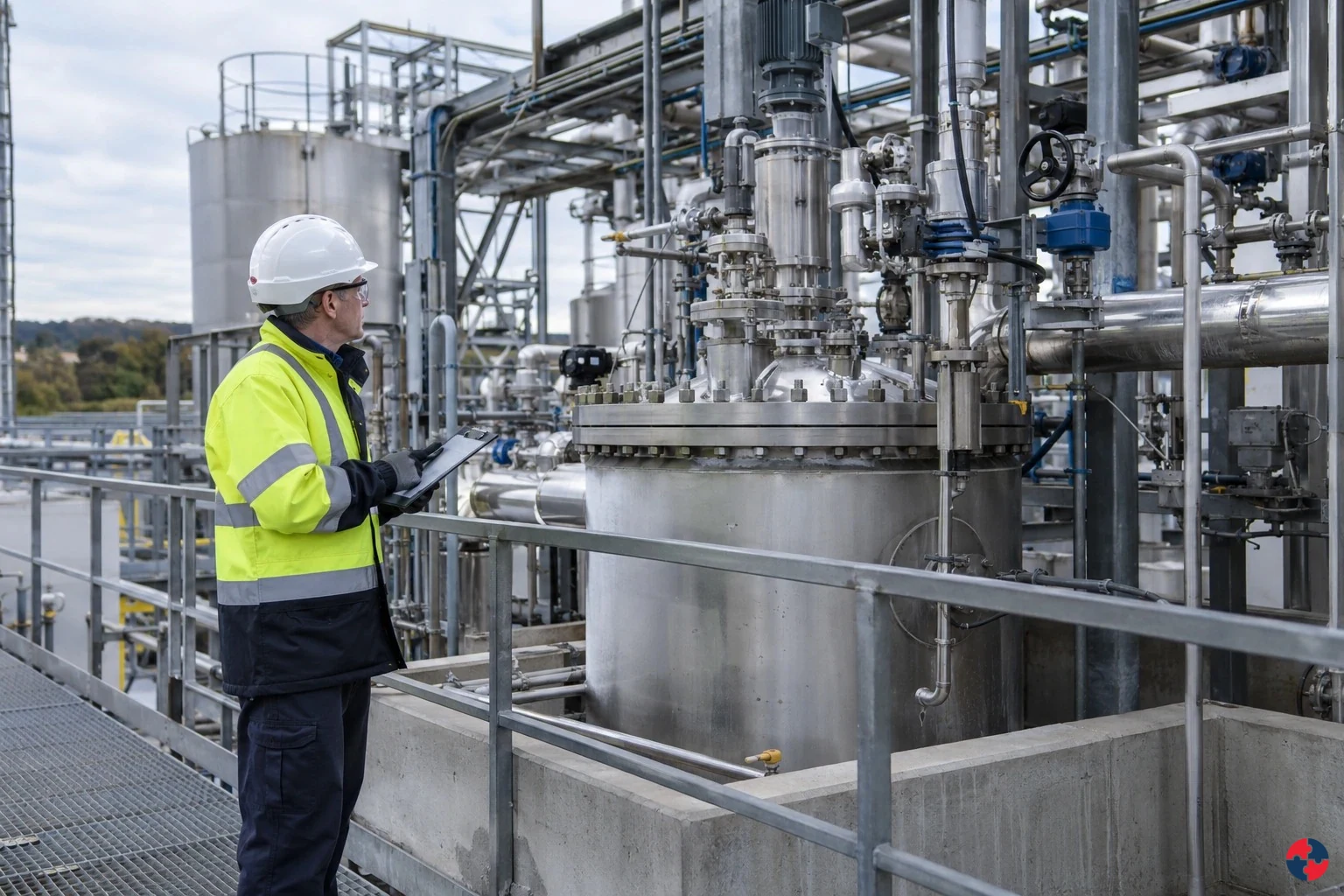
What is a vapour cloud explosion?
It is an explosion following ignition of a dispersed flammable gas, vapour or mist cloud; a release does not automatically become an explosion. A vapour cloud explosion follows delayed ignition of a dispersed flammable gas, vapour or mist that has mixed with air.
Turn vapour cloud explosions knowledge into a decision
A vapour cloud explosion follows delayed ignition of a dispersed flammable gas, vapour or mist that has mixed with air. Flame, blast pressure and flying debris can injure people on site or beyond it, depending on inventory, release path, congestion and occupancy. Keep transfer and alarm trends, initial safeguard checks, defect/impairment decisions, test results, relevant change approval, contractor coordination, revised assessment and named hand-back acceptance.
Bulk-fuel depot: stop on an overfill-protection fault
Once filling is authorised, compare level change with flow. In this example the level indication freezes while flow continues, and a protection fault appears. Engineering identifies the fault and any shared sensor, power or control dependency, repairs the system and proves the protective functions against their design.
How can a vapour cloud injure people?
A release does not automatically become an explosion. Mixing, ignition, confinement and congestion affect the possible outcome. The existing LPG and enclosed-space example also requires a credible release and ignition scenario; use the full topic for its scope.
Choose controls for vapour cloud explosions
Elimination: Remove an unnecessary solvent use or open decanting step through process redesign. Substitution: Validate a suitable less flammable product or solvent-free method against operating temperature, quality and new hazards. Engineering controls: Use an assessed dedicated dispensing area separated from ignition sources, occupied routes and incompatible materials. Provide compatible closed transfer, containment and ventilation, with assessed electrical, bonding and earthing measures where required. Administrative controls: Verify product identity, receiving capacity, connections and spill response; prevent unapproved containers and hot work in the affected area. PPE: Select compatible splash and other assessed protection, including anti-static requirements where identified; PPE does not prevent a vapour explosion. Read the full table for ownership, verification and stop/restart requirements. Discipline sustains every control; ERICPD planning prompts and the ESEAP effectiveness order serve different purposes.
Use the full vapour cloud explosions lesson
Use the full topic for the decision points, practical examples, detailed control tables and source scope. HSE guidance applies to Great Britain; use HSENI for the Northern Ireland route and the source’s stated jurisdiction. A simplified guide does not change the page’s technical-review or approval status.

Read all six steps as text
1. What is a vapour cloud explosion?
It is an explosion following ignition of a dispersed flammable gas, vapour or mist cloud; a release does not automatically become an explosion.
- Avoid / redesign: Remove an unnecessary solvent use or open decanting step through process redesign.
- Control the task: Use an assessed dedicated dispensing area separated from ignition sources, occupied routes and incompatible materials.
- Verify before release: Confirm receiving capacity, line-up, connection condition and the required protective functions before transfer; stop on a fault.
It is an explosion following ignition of a dispersed flammable gas, vapour or mist cloud; a release does not automatically become an explosion. A vapour cloud explosion follows delayed ignition of a dispersed flammable gas, vapour or mist that has mixed with air.
Apply it: Which part of this plan would you check at the workface before authorising the task?
2. Turn vapour cloud explosions knowledge into a decision
Use the evidence to improve the actual work arrangement.
- Change at source: Remove an unnecessary solvent use or open decanting step through process redesign.
- Make it observable: Compare tank level change with transfer flow, confirm alarm and protection availability and retain fault, test and hand-back evidence.
- Keep useful evidence: Keep transfer and alarm trends, initial safeguard checks, defect/impairment decisions, test results, relevant change approval, contractor coordination, revised assessment and named hand-back acceptance.
A vapour cloud explosion follows delayed ignition of a dispersed flammable gas, vapour or mist that has mixed with air. Flame, blast pressure and flying debris can injure people on site or beyond it, depending on inventory, release path, congestion and occupancy. Keep transfer and alarm trends, initial safeguard checks, defect/impairment decisions, test results, relevant change approval, contractor coordination, revised assessment and named hand-back acceptance.
Apply it: What evidence would show that the change improves this task, rather than only completing a record?
3. Bulk-fuel depot: stop on an overfill-protection fault
Example: a practical application of the existing topic lesson.
- Setting: Transfer petrol to a specified tank at an illustrative bulk-fuel depot; this is separate from the solvent-decanting example.
- Act: Check the actual line-up, hoses/couplings and containment condition.
- Hold / review: Stop filling by the approved method from a protected position, inform control and hold the affected operation.
Once filling is authorised, compare level change with flow. In this example the level indication freezes while flow continues, and a protection fault appears. Engineering identifies the fault and any shared sensor, power or control dependency, repairs the system and proves the protective functions against their design.
Apply it: At which point would you hold this example, and what evidence would allow it to proceed?
4. How can a vapour cloud injure people?
Connect the task, the route to the person and the control that can fail.
- Fuel or solvent transfer: Overfill or hose failure can release flammable material; mixing and ignition may cause fire, blast injury and debris wounds.
- Line break or intrusive maintenance: Residual flammable material may escape and mix with air; nearby hot work can ignite a flammable mixture.
- LPG supply or enclosed plant: Gas enters a poorly ventilated space or drain → ignition can cause burns, pressure injury and structural damage.
A release does not automatically become an explosion. Mixing, ignition, confinement and congestion affect the possible outcome. The existing LPG and enclosed-space example also requires a credible release and ignition scenario; use the full topic for its scope.
Apply it: Who could be exposed, including other trades, cleaners, maintainers and people nearby?
5. Choose controls for vapour cloud explosions
Start with the stronger practicable options and verify their effect.
- Elimination: Remove an unnecessary solvent use or open decanting step through process redesign.
- Substitution: Validate a suitable less flammable product or solvent-free method against operating temperature, quality and new hazards.
- Engineering controls: Use an assessed dedicated dispensing area separated from ignition sources, occupied routes and incompatible materials. Provide compatible closed transfer, containment and ventilation, with assessed electrical, bonding and earthing measures where required.
- Administrative controls: Verify product identity, receiving capacity, connections and spill response; prevent unapproved containers and hot work in the affected area.
- PPE: Select compatible splash and other assessed protection, including anti-static requirements where identified; PPE does not prevent a vapour explosion.
Elimination: Remove an unnecessary solvent use or open decanting step through process redesign. Substitution: Validate a suitable less flammable product or solvent-free method against operating temperature, quality and new hazards. Engineering controls: Use an assessed dedicated dispensing area separated from ignition sources, occupied routes and incompatible materials. Provide compatible closed transfer, containment and ventilation, with assessed electrical, bonding and earthing measures where required. Administrative controls: Verify product identity, receiving capacity, connections and spill response; prevent unapproved containers and hot work in the affected area. PPE: Select compatible splash and other assessed protection, including anti-static requirements where identified; PPE does not prevent a vapour explosion. Read the full table for ownership, verification and stop/restart requirements. Discipline sustains every control; ERICPD planning prompts and the ESEAP effectiveness order serve different purposes.
Apply it: Which stronger option can be used here, and who will verify it before accepting the remaining risk?
6. Use the full vapour cloud explosions lesson
Follow the official sources below and retain the task-specific evidence.
- Official guidance: HSE DSEAR in detail
- Official guidance: HSE Buncefield investigation and learning
- Task decision: Keep transfer and alarm trends, initial safeguard checks, defect/impairment decisions, test results, relevant change approval, contractor coordination, revised assessment and named hand-back acceptance.
Use the full topic for the decision points, practical examples, detailed control tables and source scope. HSE guidance applies to Great Britain; use HSENI for the Northern Ireland route and the source’s stated jurisdiction. A simplified guide does not change the page’s technical-review or approval status.
Apply it: Which official source and full-topic section will you use to resolve the next decision?
The pathway is inventory, loss of containment, mixing and dispersion, delayed ignition, flame propagation and consequences. Congestion and enclosure can accelerate flame and increase overpressure, but severe outcomes cannot be ruled out simply because a plant is outdoors. Other outcomes include no ignition, flash fire, jet fire or pool fire. The actual material properties, process conditions and site layout need a competent assessment.
- Prevent the release Remove avoidable transfers; verify containment, inventory, line-up and independent safeguards.
- Control the cloud Check isolation, ventilation or drainage and ignition controls against the actual substance and layout.
- Respond to a warning On a leak or alarm, stop safely if protected, warn others and withdraw under the site plan.
- Restart deliberately A competent site authority verifies cause, repair, gas status and safeguards before re-entry or restart.
| Pathway | Question to answer | Control priority |
|---|---|---|
| Inventory | What material, amount and condition can feed a release? | Reduce hazardous inventory where practicable. |
| Release | Can tank, hose, pipe or valve fail or overfill? | Containment, transfer limits and independent protection. |
| Cloud | Where can vapour travel or collect? | Source control, ventilation, drainage and layout. |
| Ignition | What credible source could ignite it? | Hazardous area and work controls. |
| Consequence | Who and what could be struck? | Separation, emergency plans and protection. |
Which activities and outcomes does this guide cover?
Use it for credible flammable gas, vapour and mist release scenarios in storage, transfer, process, maintenance and abnormal operation.
Examples include petrol loading, liquefied petroleum gas (LPG) systems, solvent handling, vapour recovery, start-up, line breaking and contractor hot work. It does not replace a site Dangerous Substances and Explosive Atmospheres Regulations (DSEAR) assessment, hazardous-area classification, quantitative consequence study, manufacturer instructions or emergency plan. Dust explosions, boiling liquid expanding vapour explosion (BLEVE), pressure-only rupture and toxic clouds have different mechanisms, although they may coexist and need separate assessment. Control of Major Accident Hazards (COMAH) adds duties only if a site falls within its threshold and tier rules.
What makes a release more severe?
Release size and duration, material properties, weather, drainage, congestion, enclosure, ignition timing and exposed people alter the possible cloud and consequences.
A vapour may enter drains, culverts or buildings, and a cloud can outgrow the classified zone drawn for normal operation. Lower and upper explosive limits describe a laboratory flammable range for a specific material and conditions; they are not an evacuation threshold or permission to work. Blast and occupied-building vulnerability require competent, site-specific study. HSE RR1190 illustrates enclosure and turbulence effects but is research, not a universal blast calculation.
A release is the start of a chain, not a certain explosion
Keep two examples distinct: the existing solvent-transfer controls concern a local decanting task; the bulk-petrol tank overfill scenario concerns a depot transfer. The same prevention questions apply, but the plant, scale, safeguards and consequences need their own assessment.

Establish the release scenario
Identify the substance, operating conditions, receiving capacity, transfer route and credible loss of containment. Prove the intended tank and connections before transfer. A frozen level indication or unproved protective function is a reason to stop, not assume capacity.
Explain the conditional chain
Released vapour may disperse or accumulate and mix with air. Ignition depends on a flammable mixture and an ignition source; outcomes depend on conditions such as confinement and congestion. Not every release becomes an explosion. Vapour need not look like smoke.
Retain all physical controls
Assess compatible closed transfer, containment, ventilation and appropriate electrical, bonding and earthing arrangements where required. Keep the dedicated transfer area separated from occupied routes, ignition sources and incompatible materials. Neither administrative checks nor PPE replace these physical controls.
Protect people during a fault
Use the assessed protected stop, alarm and emergency arrangements. Do not enter a suspected vapour cloud to find a valve or inspect a leak. Exclude people, prevent ignition through the planned safe arrangements and require competent correction and proof of protective functions before restart.
Read the complete controls: ERICPD planning prompts
Discipline verifies and sustains all the controls; it is not a separate substitute for them.
| Prompt or level | Complete task-specific example |
|---|---|
| Eliminate | Remove an unnecessary solvent use or open decanting step through process redesign. |
| Reduce | Validate a suitable less flammable product or solvent-free method against operating temperature, quality and new hazards. |
| Isolate | Use an assessed dedicated dispensing area separated from ignition sources, occupied routes and incompatible materials. |
| Control | Provide compatible closed transfer, containment and ventilation, with assessed electrical, bonding and earthing measures where required. |
| PPE | Select compatible splash and other assessed protection, including anti-static requirements where identified; PPE does not prevent a vapour explosion. |
| Discipline | Inspect hoses, seals and ignition controls and safely manage solvent-contaminated waste before hand-back. |
Read the complete controls: ESEAP effectiveness order
Compare stronger feasible controls while preserving the actual task, checks and release requirements.
| Prompt or level | Complete task-specific example |
|---|---|
| Elimination | Remove an unnecessary solvent use or open decanting step through process redesign. |
| Substitution | Validate a suitable less flammable product or solvent-free method against operating temperature, quality and new hazards. |
| Engineering controls | Use an assessed dedicated dispensing area separated from ignition sources, occupied routes and incompatible materials. Provide compatible closed transfer, containment and ventilation, with assessed electrical, bonding and earthing measures where required. |
| Administrative controls | Verify product identity, receiving capacity, connections and spill response; prevent unapproved containers and hot work in the affected area. |
| PPE | Select compatible splash and other assessed protection, including anti-static requirements where identified; PPE does not prevent a vapour explosion. |
The diagram is not to scale and does not set hazardous-area zones or blast distances. A classification zone is not an explosion consequence boundary.
How can a vapour cloud injure people?
A release can become a dispersed flammable cloud; delayed ignition can expose people to flame, blast pressure, flying debris and collapse.
A hose leak, tank overfill or gas escape can mix fuel with air and carry it into a work area, drain or building. Delayed ignition can burn skin and airways; pressure and shattered glass or other debris can injure ears, lungs and the whole body. Secondary fire or collapse can extend harm. These outcomes depend on material and inventory, release duration, weather, ventilation, congestion, enclosure, ignition and where people are located. A smell may be absent or misleading; a detector alarm, unexplained level or flow, visible leak or failed barrier is enough to stop and withdraw under the site plan. See HSE.
| Task or exposure | Route and plausible harm | Early warning | Stop or escalate |
|---|---|---|---|
| Fuel or solvent transfer | Overfill or hose failure → cloud and delayed ignition → burns, blast injury and debris wounds. | Rising level, unexpected flow or vapour alarm. | Stop transfer by the safe route, warn and withdraw; do not approach the cloud. Source |
| Line break or intrusive maintenance | Residual flammable material escapes, mixes with air and meets nearby hot work → burns and blast injury. | Unproven isolation, gas reading or unexpected residue. | Hold work, make area safe and escalate for competent isolation reassessment. Source |
| LPG supply or enclosed plant | Gas enters a poorly ventilated space or drain → ignition can cause burns, pressure injury and structural damage. | Gas alarm, leak indication or failed ventilation; odour is not a reliable sole test. | Stop use, isolate only if safe, evacuate and use the site emergency plan. Source |
How can the hierarchy of controls prevent a flammable vapour cloud during solvent dispensing?
Eliminate or reduce dangerous inventory where practicable, prevent and control releases, prevent explosive atmospheres, then control ignition and mitigate consequences.
First consider replacing the substance or process with a less dangerous alternative. Where elimination is not reasonably practicable, HSE DSEAR sets an ordered approach to release control and mitigation. Sound design, compatible materials, mechanical integrity, overfill protection and reliable line-up come before gas detection. Ventilation, safe collection and drainage can limit a release where designed for it. Hazardous-area classification informs equipment and ignition control; it does not itself stop a leak. Layout, separation, explosion resistance and emergency arrangements address residual consequences. PPE cannot make a flammable cloud safe. See HSE.
| Layer | Typical measure | Check today |
|---|---|---|
| Avoid release | Containment, integrity, verified transfer and independent high-high protection. | Inspection, test and operating limit. Source |
| Limit cloud | Isolation, ventilation and controlled drainage. | Proof test and design basis. Source |
| Avoid ignition | Suitable equipment, static control and hot-work discipline. | Classification, permit and field check. Source |
| Limit harm | Separation, shutdown and emergency response. | Scenario, drill and route review. Source |
How can the ERICPD hierarchy of controls prevent a flammable vapour cloud during solvent dispensing?

| Control level | Control for this activity | Owner and verification | Stop / restart decision |
|---|---|---|---|
| Eliminate | Remove an unnecessary solvent use or open decanting step through process redesign. | Task owner verifies that the proposed change removes the named hazardous step, including foreseeable cleaning, maintenance and work transferred elsewhere. | If the hazardous step remains, keep it within the task assessment and select the stronger feasible remaining controls. |
| Reduce, including substitution | Validate a suitable less flammable product or solvent-free method against operating temperature, quality and new hazards. | Competent task/process owner validates suitability, compatibility and new hazards against the actual operating requirements before the alternative is adopted. | Reject an alternative if its performance is unproved or its new hazards are unresolved. |
| Isolate | Use an assessed dedicated dispensing area separated from ignition sources, occupied routes and incompatible materials. | Supervisor checks the actual boundary, affected people and connected work; verify separation or isolation before allowing access. | Hold or stop for leak, failed ventilation, uncontrolled ignition source or uncertain container compatibility. |
| Control: physical safeguards | Provide compatible closed transfer, containment and ventilation, with assessed electrical, bonding and earthing measures where required. | Competent equipment/process owner checks solvent properties, connections, ventilation, static precautions and receiving capacity. | Hold or stop for leak, failed ventilation, uncontrolled ignition source or uncertain container compatibility. |
| Control: work method and response | Verify product identity, receiving capacity, connections and spill response; prevent unapproved containers and hot work in the affected area. | Supervisor confirms the work limits, competent cover, communication and stop/restart authority with the people doing this activity. | Hold work when the agreed limits, competent cover or effective communication cannot be maintained. |
| PPE | Select compatible splash and other assessed protection, including anti-static requirements where identified; PPE does not prevent a vapour explosion. | Assessor confirms whether personal protection is needed and checks suitability, condition, compatibility and any required fit evidence. | Do not use unsuitable protection or rely on PPE to continue after an essential source control fails. |
| Discipline | Inspect hoses, seals and ignition controls and safely manage solvent-contaminated waste before hand-back. | Release only after process supervisor accepts a secure transfer system and controlled waste route. Retain verification and unresolved restrictions at handover. | Keep the task on hold until required reinstatement evidence and unresolved defects are accepted by the responsible owner. |
How can the ISO 45001 hierarchy of controls prevent a flammable vapour cloud during solvent dispensing?

| Control level | Control for this activity | Owner and verification | Stop / restart decision |
|---|---|---|---|
| Elimination | Remove an unnecessary solvent use or open decanting step through process redesign. | Task owner verifies that the proposed change removes the named hazardous step, including foreseeable cleaning, maintenance and work transferred elsewhere. | If the hazardous step remains, keep it within the task assessment and select the stronger feasible remaining controls. |
| Substitution | Validate a suitable less flammable product or solvent-free method against operating temperature, quality and new hazards. | Competent task/process owner validates suitability, compatibility and new hazards against the actual operating requirements before the alternative is adopted. | Reject an alternative if its performance is unproved or its new hazards are unresolved. |
| Engineering controls | Use an assessed dedicated dispensing area separated from ignition sources, occupied routes and incompatible materials. | Supervisor checks the actual boundary, affected people and connected work; verify separation or isolation before allowing access. | Hold or stop for leak, failed ventilation, uncontrolled ignition source or uncertain container compatibility. |
| Engineering controls | Provide compatible closed transfer, containment and ventilation, with assessed electrical, bonding and earthing measures where required. | Competent equipment/process owner checks solvent properties, connections, ventilation, static precautions and receiving capacity. | Hold or stop for leak, failed ventilation, uncontrolled ignition source or uncertain container compatibility. |
| Administrative controls | Verify product identity, receiving capacity, connections and spill response; prevent unapproved containers and hot work in the affected area. | Supervisor confirms the work limits, competent cover, communication and stop/restart authority with the people doing this activity. | Hold work when the agreed limits, competent cover or effective communication cannot be maintained. |
| PPE | Select compatible splash and other assessed protection, including anti-static requirements where identified; PPE does not prevent a vapour explosion. | Assessor confirms whether personal protection is needed and checks suitability, condition, compatibility and any required fit evidence. | Do not use unsuitable protection or rely on PPE to continue after an essential source control fails. |
| Administrative controls | Inspect hoses, seals and ignition controls and safely manage solvent-contaminated waste before hand-back. | Release only after process supervisor accepts a secure transfer system and controlled waste route. Retain verification and unresolved restrictions at handover. | Keep the task on hold until required reinstatement evidence and unresolved defects are accepted by the responsible owner. |
How should stronger source controls be chosen?
Start by avoiding the hazardous task or release, then use suitable substitution and physical controls before relying on work rules or personal protection.
The order guides a decision; the actual control depends on this task, the people exposed and what a change could introduce. A supervisor should observe the control during real work, hold a failed task and obtain a competent release after correction. HSE guidance for this control decision
| Control layer | Task decision |
|---|---|
| Avoid | Avoid an unnecessary flammable transfer |
| Substitute or reduce | Assess a less flammable material or smaller inventory |
| Engineer | Use compatible closed transfer, overfill protection and safe drainage |
| Organise and verify | Verify line-up, isolation, alarms and a protected withdrawal route |
| Protect residual exposure | PPE cannot make a flammable cloud safe |
How do controls change across industries?
The same release–dispersion–ignition chain can arise in different tasks, but the material, layout and people exposed determine the controls.
These are representative scenarios, not claims that every leak produces a vapour cloud explosion. A competent site assessment must confirm whether a cloud and damaging blast are credible. The strongest feasible control is chosen before residual safeguards; any warning of loss of containment or impaired protection triggers the site stop and emergency route. See HSE.
| Sector, task and people | Mechanism and harm | Strongest feasible control and residual safeguards | Check or stop point |
|---|---|---|---|
| Manufacturing: solvent batch transfer; operators and maintenance staff. | Seal or hose failure disperses solvent vapour near equipment; ignition may burn people or project debris. | Substitute a less flammable process where feasible; otherwise closed transfer, inventory limits, compatible equipment, detection and ignition controls. | Verify line-up and integrity; stop on leak, abnormal flow or detector alarm. Source |
| Construction: contractor hot work beside an operating fuel facility; contractors and site staff. | Residual vapour from a live line or drain meets a spark; flash fire or blast can burn and injure nearby workers. | Eliminate hot work if feasible; otherwise prove isolation and gas-free status, separate simultaneous operations and control ignition. | Stop if isolation, gas status, ventilation or adjacent operations change. Source |
| Hospitality: LPG supply to a commercial kitchen; catering staff, cleaners and visitors. | A supply leak in a poorly ventilated service space can accumulate and ignite; burns, blast and debris injury are possible. | Use a safer supply or design where feasible; competent installation, leak prevention, ventilation and suitable gas controls remain essential. | Check ventilation and supply condition; on suspected leak, stop, withdraw and follow gas emergency arrangements. Source |
| Logistics: bulk petrol reception and tank filling; drivers, operators and neighbours. | Overfill releases petrol vapour that travels before ignition; blast and thermal injury can extend beyond the loading point. | Reduce transfer hazard and prevent overfill with independently tested safeguards; retain safe drainage, monitoring, separation and emergency response. | Verify capacity, level trend and trip availability; stop on discrepancy or failed protection. Source |
How can I practise this topic in 3D?
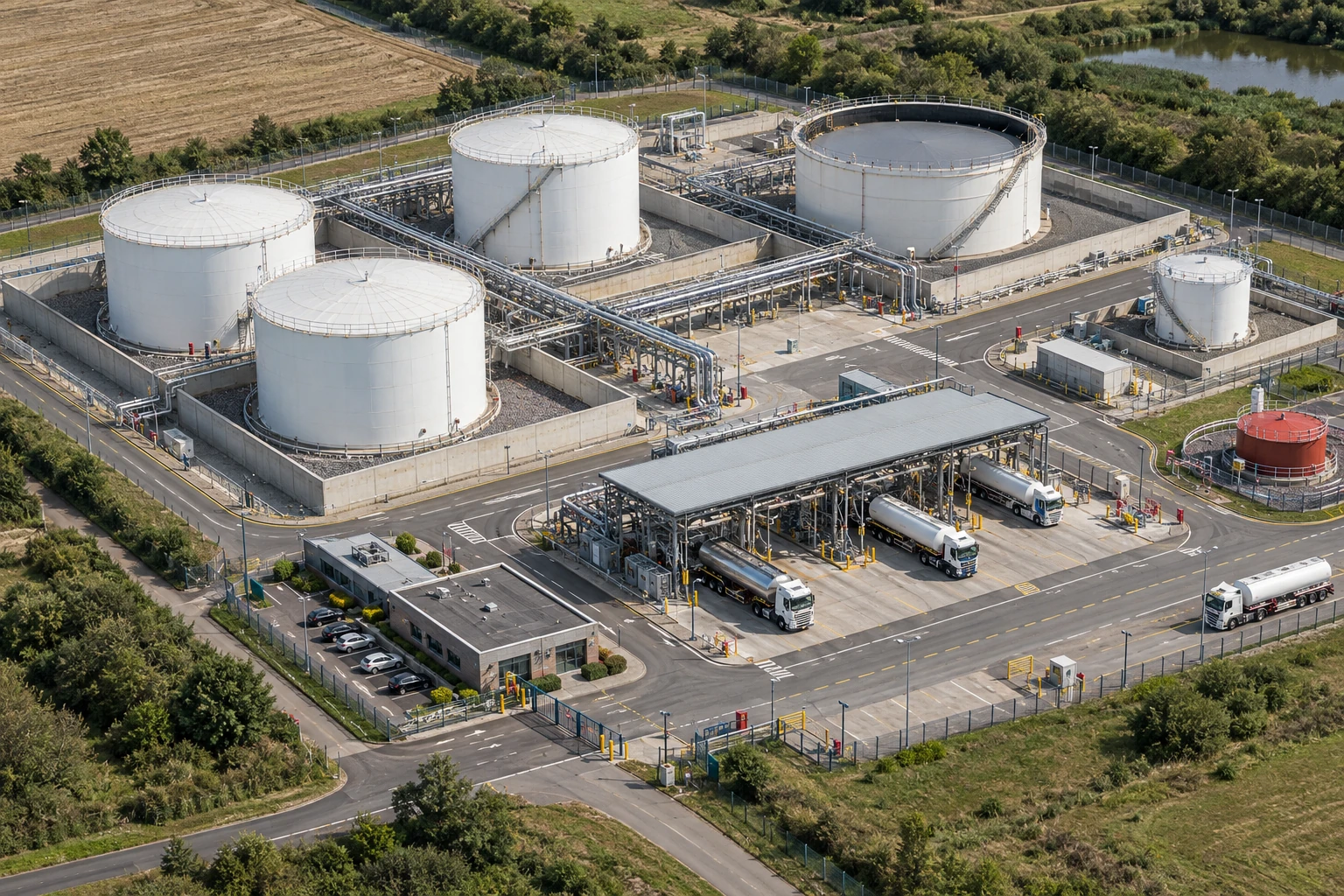

A low-level release is judged only by what can be seen
All related inspection points 2 across 1 location
Crown Fuels terminal 2 inspection points
Practice in the SHAREhub environment. Browser practice is separate from workplace competence and formal learning records.
What should be checked before transfer or intrusive work?
Confirm the substance, line-up, inventory, operating envelope, safeguards, people nearby and emergency arrangements before work begins.
For a transfer, verify destination capacity and route, instrumentation and independent overfill protection, hoses and couplings, drainage, communication and safe stop method. For intrusive work, verify isolation against current drawings and the actual plant, de-inventory and gas-free method, permit boundaries, simultaneous operations (SIMOPS), detector suitability and affected contractors. Document who owns each hold point. A signed permit or test result is not proof that vapour cannot return. See HSE.
What matters during the job and at completion?
Keep the operating envelope and barrier status under active watch, then leave a traceable hand-back of condition, defects and changes.
During transfer, compare flow and level trends, respond to unexpected alarms or vapour evidence, and do not normalise nuisance trips. During maintenance, keep the isolation boundary, testing method, ventilation and permit interactions under supervision. Stop on changed weather or occupancy if the assessment depends on them. At completion, confirm equipment is intact, temporary items removed, drains and valves correct, alarms/trips restored, tests recorded and affected teams briefed before normal operation resumes.
What can gas detection and isolation actually do?
Detection warns of a release or drives a designed protective action; it does not prevent the release and cannot, on its own, prove an area safe.
Detector type and position must match likely gas, release, ventilation and weather, with response, maintenance and calibration verified. The alarm must have a defined human or automatic action, and the action needs a response time compatible with the credible scenario. Emergency isolation may limit feeding inventory but must be reachable or actuated without sending people into a cloud. A zero or low reading at one point does not clear hidden pockets, drains or changing conditions. Alarm setpoints and gas-free criteria are site- and instrument-specific.
Worked selection decision: A contractor brings a detector labelled for methane to a solvent-pump job. The label and a zero reading do not establish suitability for the solvent vapour. The competent assessor checks the actual substance, manufacturer response/limitations, calibration and functional checks, sampling locations and conditions. Until those match the task, hold the work and obtain suitable detection and a valid sampling plan; do not invent a correction factor or use the reading as clearance.
| Element | Ask | Weak signal |
|---|---|---|
| Detector | Can it see this material and release location? | Blind spot or overdue calibration. Source: HSE |
| Alarm | Who acts and how quickly? | Nuisance alarms ignored. Source: HSE |
| Isolation | Can it close safely and be verified? | Common power/control dependency. Source: HSE |
| Portable test | Is the sampling plan valid for location and time? | One reading used as universal clearance. Source: HSE |
How are ignition sources controlled?
Control fixed and temporary ignition sources against the assessed hazardous area and credible abnormal release, including work beyond the normal zone map.
Use the site classification and current equipment documentation to select suitable electrical and mechanical items. Manage static, hot surfaces, vehicles, tools, phones and welding through the actual task assessment and permits. Stop hot work if isolation, gas testing, ventilation or nearby transfer control is uncertain. Product conformity marking is a supply-law matter; it does not establish that an item is suitable for this specific zone, gas group, temperature class, installation or maintenance condition.
When must work stop?
Stop and withdraw for a credible release, detector alarm, unexpected vapour, impaired safeguard, uncertain isolation or uncontrolled ignition source. Use the approved safe-stop only from a protected position; do not wait for a generic gas value.
Do not wait for a generic concentration or visible cloud. Stop the operation by its safe procedure if this can be done without entering danger; otherwise withdraw. Tell the control room or incident controller, account for people and prevent entry. A supervisor must not substitute an ad hoc PPE rule for an impaired prevention barrier. Changes in substance, route, weather, occupancy or simultaneous work require a new assessment before continuing. See HSE.
| Trigger | Immediate response |
|---|---|
| Release, odour or alarm | Stop safely, warn, withdraw and start site emergency response. Source |
| Overfill or abnormal trend | Use defined transfer stop and escalation. Source |
| Failed trip, detector or isolation | Hold affected work and assess barrier impairment. Source |
| Hot-work conflict or unknown material | Suspend permit and verify conditions. Source |
What should happen when a flammable cloud may be present?
For a credible flammable release or alarm, use the approved safe-stop only from a protected position, warn and withdraw by the site route, account for people and follow incident command. No entry into a suspected cloud or universal evacuation distance.
Do not enter a suspected cloud to search for a leak, operate a local valve, recover equipment or rescue a person without a planned and equipped response. Avoid actions that could create ignition. The incident controller establishes and adjusts exclusion and evacuation areas from the scenario, conditions and emergency-service advice; this guide gives no universal distance. Tell responders the material, inventory, release point, drains/buildings affected, missing people and isolation status. Call the emergency services through the site plan for a serious release or fire. An alarm may require evacuation before ignition.
Who can authorise re-entry and restart?
Incident command may authorise controlled investigative re-entry only after site-specific hazard assessment; repair, barrier proof and named site approval are separate prerequisites for restart. No single gas reading, odour change or elapsed time clears either gate.
The site's competent process-safety and operations people must establish source isolation, residual inventory, dispersion and hidden accumulation, ventilation, atmospheric testing plan, ignition control, equipment damage, emergency readiness and any responder restrictions. Re-entry may need staged access and continuing monitoring. A single gas reading, an elapsed period or the disappearance of odour is not a clearance rule. Restart also requires repair and test of failed barriers, current drawings and procedures, change control where needed, rebriefing and the named site authority. Do not invent a universal restart sign-off role or threshold.
| Gate | Evidence | Decision |
|---|---|---|
| Controlled re-entry | Source secured, area assessed, sampling and access plan. | Incident command/site competent authority. Sources: HSE; HSE |
| Repair hand-back | Damage, isolation, test and permit records. | Operations and engineering owners. Source: HSE |
| Restart | Barrier proof, change review, emergency readiness and rebrief. | Named authority in site system. Sources: HSE; HSE |
How could a petrol transfer be held before overfill?
In this Crownway Fuels Ltd transfer, an abnormal level trend and unavailable independent high-high protection stop filling before a release. See HSE.
Crownway transfer overfill hold
Task material and setting: Fill the specified petrol tank at Crownway Fuels Ltd without overfill or release. An outdoor tank farm has connected transfer lines, a pump, low drains and a nearby occupied control room; its open-air location does not rule out a dangerous cloud.
People and prerequisites: The operator and driver understand the transfer and safe-stop procedure; the supervisor controls contractors and nearby work. Engineering has established the alarm/trip design basis and verified independence. Before starting, tank identity, available capacity, transfer route, safeguard availability and the emergency plan must be confirmed.
Before: Check the actual line-up, hoses/couplings and containment condition. Verify level indication, high-level warning, independent high-high protection and the safe-stop method against current site records; brief communications and affected teams. If the protection status cannot be established, do not start.
During: Once filling is authorised, compare level change with flow. In this example the level indication freezes while flow continues, and a protection fault appears. A second screen showing the same sensor is not independent evidence: both displays can repeat the same failed measurement.
Hold or stop: Stop filling by the approved method from a protected position, inform control and hold the affected operation. Do not bypass the trip or continue using an informal timing estimate. If release is suspected, warn and withdraw under the emergency plan. A changed fuel, destination or neighbouring hot-work activity also requires reassessment.
Completion and hand back: Engineering identifies the fault and any shared sensor, power or control dependency, repairs the system and proves the protective functions against their design. Operations verifies the as-left route, available capacity, restored safeguards, communication and emergency readiness. The named site authority records release after rebriefing; a normal-looking display alone does not justify restart.
Evidence: Keep transfer and alarm trends, initial safeguard checks, defect/impairment decisions, test results, relevant change approval, contractor coordination, revised assessment and named hand-back acceptance.
Worked protection evidence for this transfer
For the transfer, record the initiating overfill fault and the protective function claimed, then identify its sensor, logic, power supply and final shut-off element. Two displays of the same sensor are one dependency, not two independent barriers. The competent engineer records the functional test stimulus, actual alarm or shutdown response, and any shared dependency or impairment. Name who owns each unresolved impairment and hold the affected transfer until the authorised safe arrangement is verified. A lit lamp alone does not demonstrate the claimed shutdown function; this example sets no SIL or test interval.
How could line breaking and hot work be controlled?
A contractor job on solvent pipework remains on hold until isolation, residual material, gas testing, adjacent operations and ignition control are verified for the actual configuration. See HSE.
Crownway solvent line break
Task material and setting: Repair a solvent pump at Crownway Fuels Ltd. Flammable solvent may remain in connected pipework, low drains and the pump body; nearby plant remains operational. Plan a cold method where practicable. Any proposed hot work requires its own assessed ignition controls.
People and prerequisites: The site supervisor, competent isolator, maintenance contractor and adjacent operators agree the work boundary and emergency route. Current drawings are checked against the physical plant; the actual solvent and residues, stored pressure and connected inventory must be understood.
Before: Use the site isolation scheme to remove hazardous inventory and energy, secure and prove the boundary, and establish a suitable atmospheric test and monitoring plan. Coordinate permits and simultaneous operations. A valve tag that does not match the drawing is a hold point, even when the permit is signed.
During: Keep isolation integrity, atmosphere, ventilation and nearby activities under review. A dry drain or zero gauge alone may mislead if a passage is blocked or material remains trapped. Only the agreed competent team may resolve such uncertainty; no exploratory line opening is authorised by this example.
Hold or stop: Stop if isolation cannot be proved, material is unknown, liquid or pressure returns, a detector alarms, ventilation changes or another team restarts a conflicting transfer. Suspend affected permits and inform the site owner. A suspected release requires warning and withdrawal before investigation.
Completion and hand back: Check the repair and perform the specified leak/function tests. Remove temporary isolations through the controlled reinstatement sequence, restore detectors and safeguards, account for tools and waste, and update records. Operations accepts the as-left configuration and any outstanding restrictions before the named authority releases use.
Evidence: Retain plant/material identification, isolation and proving records, permits, gas-test method/results, contractor and adjacent-team briefings, defect/change decisions and the repair and hand-back record.
What if gas detection alarms during a shift?
Treat a credible alarm as a release warning, not as an instrument fault to be dismissed at the panel.
In a pump area, a detector alarms while a loading hose is connected. The operator follows the site safe-stop instruction from a protected location, warns others and withdraws. The supervisor bars entry and activates the planned response. The incident commander considers wind, drains, enclosed rooms and off-site receptors, then coordinates sampling and isolation by trained responders. A failed detector can be a false alarm, but that conclusion follows investigation, not assumption. Re-entry, repair and restart pass the separate gates above. The records are alarm trace, personnel account, test results, defect cause and authorisation. See HSE.
What should Buncefield change in a local review?
It should prompt a trace from tank overfill to cloud formation, ignition, blast and emergency vulnerability, with evidence for each barrier.
Buncefield involved a petrol tank overfill and a large vapour cloud followed by explosions and fire. HSE reports more than 40 injuries, widespread damage and a large evacuation. Its lesson is not a transferable cloud radius: local sites need to test overfill protection independence, alarm response, connected inventory, low points, vulnerable buildings and emergency facilities. HSE also reported a later vapour-recovery overfill where protection shared a common failure with the basic control system.
Which warning signs show controls are degrading?
Repeated small leaks, bypassed trips, nuisance alarms, uncertain isolations and unresolved permit conflicts are process-safety warnings even without injury.
Other signs include overdue proof tests, temporary repairs without an end point, contractors who cannot explain emergency actions, detector blind spots, altered drainage or building occupancy, and close-out records with no physical verification. Trend combinations rather than treating each finding separately. A good personal injury rate cannot show that a major-accident barrier is healthy. See HSE.
What proves the barriers work now?
Trace a credible scenario to named safeguards, performance requirements, current tests, defect decisions and emergency exercises.
For a fuel transfer, review the alarm and trip design basis, independence, proof-test results, operator response, emergency isolation test and actual work records. HSG254 distinguishes proactive checks from failure-event indicators; both are needed. Sample field practice and management decisions as well as documents. A passed test date can become stale if the plant or operating envelope changes.
| Barrier | Leading evidence | Lagging signal |
|---|---|---|
| Containment | Inspection and integrity test. | Leak or repair history. Source: HSE |
| Overfill protection | Independent proof test and response drill. | Trip demand, bypass or overfill near miss. Source: HSE |
| Detection/isolation | Calibration and action test. | Missed alarm or slow isolation. Source: HSE |
| Emergency | Scenario exercise and route inspection. | Muster or communication failure. Source: HSE |
How should a risk register and management review use this?
Record each credible release and escalation scenario with barrier owners, dependencies, test evidence, impaired states and decisions.
The register should identify who could be harmed on and off site, the actual substance and inventory, initiating events, preventive and mitigative barriers, emergency assumptions and residual risk. Management should see overdue safety-critical work, bypasses, repeat alarms, incident actions and exercise findings together, with a decision owner and closure evidence. Changes to plant, software, staffing, drainage, buildings or neighbouring activity require screening. SHARE recommends this assurance structure; it is not itself a legal certificate or universal acceptance criterion.
Which GB and NI duties apply?
GB uses DSEAR 2002; Northern Ireland uses its separate DSEAR 2003 regulations. COMAH duties arise only for establishments within the relevant thresholds.
Both DSEAR regimes require risk assessment and measures to control fire and explosion risk; use the current instrument for the location. HSE L138 and INDG370 explain GB practice, while NI dutyholders should verify NI legislation and HSENI position rather than assume GB ACOP status. GB COMAH 2015 and NI COMAH 2015 are separate regimes. General workplace health and safety, fire, environmental and planning duties may also apply. This page is not a site-specific legal opinion. See legislation.gov.uk.
| Jurisdiction | Workplace instrument | Additional regime if in scope |
|---|---|---|
| Great Britain | DSEAR 2002. | COMAH 2015 and tier requirements. Source; HSE COMAH 2015 guidance; HSE L138 DSEAR ACOP and guidance |
| Northern Ireland | DSEAR (NI) 2003. | COMAH (NI) 2015 and tier requirements. Source; HSENI COMAH overview |
How do equipment supply rules differ from workplace use?
DSEAR governs workplace assessment and use; separate product-supply rules govern equipment and protective systems placed on the GB or NI market.
OPSS publishes separate GB 2016 and NI 2017 explosive-atmosphere equipment guidance. Purchasers should obtain current declaration, marking, instructions and intended category, then a competent person checks suitability for the assessed zone and material, temperature, installation and maintenance. A CE, UKCA or other mark alone does not prove suitability for the site or make a hazardous task safe. Do not transfer a GB product-marking statement into NI without checking the current NI regime.
Which government guidance supports technical decisions?
Use HSE DSEAR, isolation and process-safety guidance with the actual substance, plant and operating conditions.
A competent designer must decide hazardous-area classification, equipment selection and independent safeguard performance from current legislation, HSE guidance and the real site. Do not infer a zone, detector setpoint, blast rating or safety integrity level from a catalogue page. Verify the legal route and design basis before specifying or restarting the system.
What training and authorisation are needed?
Competence must match each person’s decision: recognising a release is different from proving an isolation, changing a trip or authorising restart.
A briefing gives workers and visitors the alarm, withdrawal and reporting route. Operators practise transfer checks and safe stop on their own plant; maintainers demonstrate isolation and gas-testing boundaries; supervisors challenge simultaneous work and impaired safeguards. Engineers prove design and protection assumptions, while emergency teams rehearse scenario command. The site names who assesses and authorises each role, keeps the practical result and reassesses after plant, task or incident changes. A course certificate alone does not authorise entry or override. See HSE.
| Role/level | Task learning | Demonstration and assessor | Record and reassessment |
|---|---|---|---|
| Everyone nearby | Recognise alarms, possible release and withdrawal route. | Supervisor checks the person can explain alert, safe exit and muster. | Induction record; refresh after route or alarm change. Source |
| Operators and drivers | Substance, line-up, capacity, trend, independent protection and safe stop. | Operations assessor observes a simulated fault and correct stop on actual system. | Task authorisation and exercise; reassess after equipment or procedure change. Source |
| Maintainers and contractors | Isolation, residues, detection suitability, permit and ignition boundary. | Competent isolator/permit issuer witnesses proving and changed-condition challenge. | Permit scope and assessment; reassess after plant or work-scope change. Source |
| Supervisors and coordinators | Concurrent work, barrier impairment and contractor interface. | Site manager samples a real hold and release decision with field evidence. | Decision log and observation; reassess after near miss or failed barrier. Source |
| Engineers, managers and purchasers | Design basis, independent safeguards, procurement and proof-test backlog. | Technical authority tests scenario assumptions; leader reviews overdue critical actions. | Design/approval and action records; reassess after modification or incident. Source |
| Specialists, responders and auditors | DSEAR scenario, emergency command, source scope and assurance sampling. | Relevant competent lead observes exercise or technical/audit judgement. | Competence scope, exercise/audit result; reassess when scenario or law changes. Source |
What should follow a release, fire or near miss?
Protect people first, preserve evidence when safe, investigate failed barriers and test reporting criteria under the applicable jurisdiction.
Keep the plant secure while the incident controller and responders manage it. Preserve trends, alarms, permits, witness accounts, maintenance history and samples under the organisation procedure. Investigate precursor conditions and common-cause failures, not just the final ignition source. Review DSEAR assessment and emergency plan, then verify corrective actions before restart. GB RIDDOR and NI reporting rules have defined criteria; not every odour or near miss is automatically reportable, and a serious event may have multiple notification duties.
How could Crownway Fuels Ltd manage the whole cycle?

The fuel operator connects transfer design, daily barrier checks, contractor work, emergency exercises and leadership review to each credible release scenario.
Crownway identifies petrol, solvent and LPG inventories and maps release paths to nearby roads, buildings and drains. Engineering maintains tank and pipe integrity, independent overfill protection, detection and remote isolation. Operations verifies line-up and responds to trends. Maintenance uses proven isolation and permit coordination. Emergency planners test a delayed-ignition scenario and access routes. Management reviews repeat alarms, safety-critical backlog and close-out. These are example organisational arrangements, not a published Crownway policy or a statutory template. See HSE.
Why can a fuel-depot zone drawing not predict a vapour-cloud explosion?
Distinguish where an explosive atmosphere may occur from a separately assessed release and consequence scenario. The viewer performs no blast or dispersion calculation.
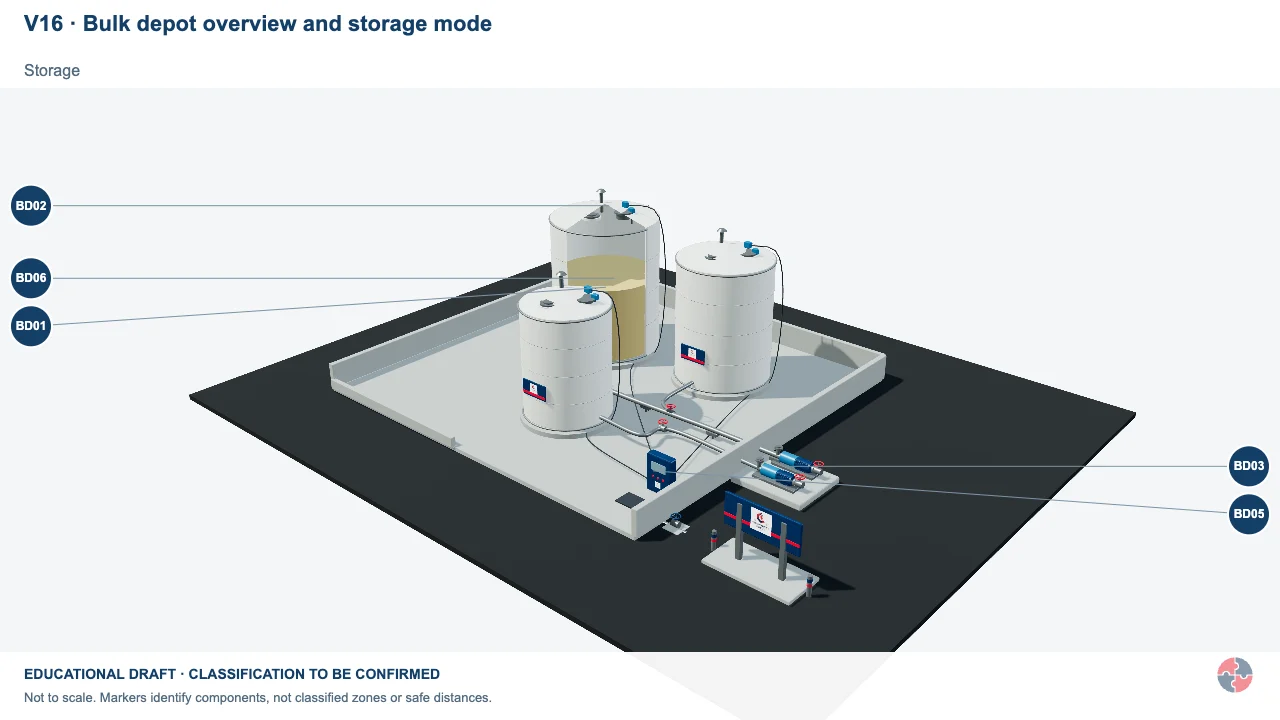
Bulk depot overview and storage mode
Explore the bulk depot system and compare selectable Zone 0, Zone 1 and Zone 2 teaching volumes around its petrol example.
Activity focus: Use cutaway for the internal vapour spaces, then compare the rounded vent, pump and mode-dependent connection envelopes.
Contextual workplace scene. Use the task, control and evidence checks in this section; appearance alone does not establish safe conditions, individual health or approval.
Educational illustration, not to scale. Coloured zones are teaching examples, not a site-specific hazardous-area classification.
Separate reviewed consequence scenario required; classified areas do not predict a vapour-cloud explosion footprint.
What do the acronyms and key terms mean?
The same abbreviation can hide different duties or measurements. Expand it at first use in work instructions and check the actual material, site and jurisdiction.
| Term | Full expansion | Meaning in this task |
|---|---|---|
| VCE | Vapour cloud explosion | Delayed ignition of a dispersed flammable cloud; not every leak has this outcome. |
| DSEAR | Dangerous Substances and Explosive Atmospheres Regulations | Separate GB and NI workplace instruments for dangerous-substance fire and explosion risk. |
| COMAH | Control of Major Accident Hazards | Additional duties for in-scope establishments and tiers. |
| LEL / UEL | Lower / upper explosive limit | Material- and condition-specific flammable range, not a universal clearance reading. |
| ESD | Emergency shutdown | Designed action to limit the release; test its response and dependencies. |
| SIMOPS | Simultaneous operations | Other work that can change the ignition, release or people-at-risk scenario. |
Unlock another resource
You have used this month’s two free downloads. Publish a post in your own words to unlock one more resource, or choose SHARE Individual for 10 downloads per month.
You decide whether to share. If you do, use the relevant platform disclosure tools and do not make claims you do not genuinely hold.