SHARE Knowledge Hub
Permit-to-work Systems
A permit-to-work system is a formal control system for high-risk, non-routine or interacting work where ordinary procedures are not enough. A permit does not make work safe by itself. It should define the job, location, hazards, isolations, tests, precautions, authorisation, communication, supervision, suspension, handback and close-out evidence. Good permit systems control hot work, confined spaces, electrical isolation, line breaking, work at height, excavations, lifting interfaces and process safety work through competent roles, clear decision rights, live field verification and permit audits.
Understanding Permit-to-work Systems
A permit-to-work (PTW) is a formal communication and control process for hazardous non-routine work. It states the exact task, location, equipment, timing, hazards, precautions, authorisation and handback. HSE emphasises that issuing a permit does not itself make a job safe; the risk assessment, physical controls, competent people and site verification do.
Why this matters at work
Control duplicate records, copied permits, stale drawings, offline edits and simultaneous changes by different users. Define what happens if the network, device or central system fails while work is open. Keep a reliable view of isolation ownership and emergency access to permit information. A change from paper to digital is a management-of-change project: retrain for the permit process, not just the buttons.
Decide at planning whether ordinary instructions are enough or a formal permit is needed. Consider intrusive work, loss of containment, stored energy, electrical exposure, confined entry, ignition, excavation, work near live operations and simultaneous jobs. A low-risk routine task can still require a permit when it interacts with a live plant state; conversely, issuing a permit for every small task can bury the critical controls and overload authorisers.
How organisations manage this in practice
A contractor may have a detailed method statement but lack knowledge of site inventory, connected systems, live operations and permit status. The host should supply that context, check competence and jointly verify the work boundary and controls. Contract clauses do not transfer control of plant isolations by themselves. State who issues, accepts, monitors, suspends and hands back the job when more than one employer is involved.
Sample permits from planning to handback, not just completed forms. Check whether the work described matched the actual job, isolations were in place and tested, conflicting work was controlled, workers understood the limits, monitoring happened and closure was safe. Observe active jobs and interview all roles.
Mark the workface and isolation points in a way that survives shift change. If a tag is wrong, missing or duplicated, stop work and correct identification under site change control. A photograph may assist orientation but does not replace field verification. Tell affected operations staff exactly which equipment is unavailable and what may not be operated. The permit boundary must match the isolation boundary and the task method throughout the job.
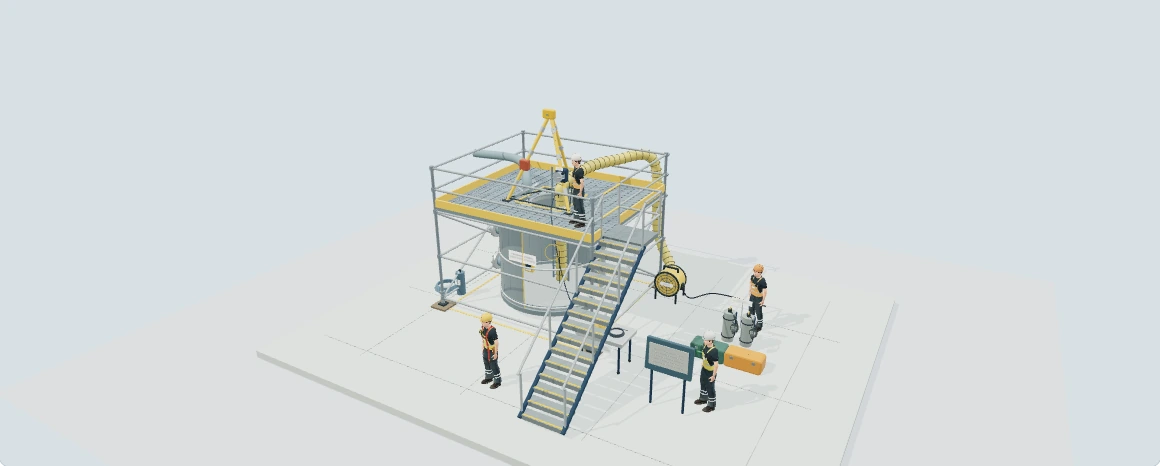

Confined-space tank entry: prepare, monitor and rescue
Follow a fictional tank inspection from avoiding entry through preparation, a supervised entry example and emergency response. Explore the access scaffold, rescue tripod and retrieval line, fresh-air duct, sample probe, personal gas monitor and standby team. Each step explains what the equipment does and what must be verified in the real job.
Checksheets and risk assessments
Risk assessment forms
Risk assessment examples
Forms and tools
Full written walkthrough — all 16 steps
1. First ask: can the task be done outside?
What is happening: A camera, remote inspection or suitable external cleaning may remove the need for anyone to enter. This example considers a tank with previous hydrocarbon service; the internal cutaway is a teaching view, not a second doorway.
How harm can occur: An enclosed space with a foreseeable specified risk can cause fire, explosion, poisoning, loss of consciousness, drowning or asphyxiation. Size alone does not decide whether it is a confined space.
Best practice to apply: Define the task, tank history, residues and connected plant. Avoid entry where reasonably practicable. A competent person develops the safe system and site-specific emergency arrangements before entry is considered.
2. Plan the job, people and permit
What is happening: The supervisor coordinates operations, contractors, the entry team and rescue team. The plan defines the work, duration, tools, exposure controls, access, communications and permit boundaries.
How harm can occur: A change of task, shift or neighbouring operation can defeat an earlier assessment. Hot work, solvents, sludge disturbance and heat can introduce new hazards.
Best practice to apply: Identify named competent roles, suitable entrants and fitness considerations. Decide the permit-to-work requirements, isolation responsibilities, authorised activities and the conditions that suspend work. The model never issues permission.
3. Empty, drain and clean from outside
What is happening: In this fictional preparation stage the tank is emptied, drained and flushed under a planned method before entry. Water is used only if compatible with the previous contents; contaminated washings go to controlled collection.
How harm can occur: Empty does not mean clean: sludge, scale, pockets and connected pipework may retain toxic or flammable material. Cleaning itself can release vapour or create chemical reactions and environmental risks.
Best practice to apply: Before draining or cleaning, establish and verify the isolations required for that preparation stage. Confirm substance compatibility, drainage, safe disposal and effective removal of residues. Do not prescribe a universal flushing time or assume water removes every substance. Reassess if residues remain or will be disturbed.
4. Prove and maintain all isolations
What is happening: Identify every inlet, outlet, bypass, drain, nitrogen and utility connection, plus pumps, agitators and electrical energy. The visible blanks illustrate positive separation; actual isolation must be selected, installed and verified.
How harm can occur: A closed valve may pass. Pressure, gravity inflow, rotating equipment or reconnection can overwhelm someone inside. Temporary preparation hoses can become an overlooked route back into the tank.
Best practice to apply: Use the plant isolation scheme, locks, tags and independent checks where required; establish zero-energy conditions. Control each preparation stage and verify the final entry boundary, including removal/isolation of temporary supplies. See the linked HSG253 lesson.
5. Purging removes a hazard and can create another
What is happening: If a competent hydrocarbon preparation plan requires inert-gas purging, it happens without entrants. Nitrogen can displace flammable vapour, but also displaces oxygen. The stored nitrogen hose is disconnected in the entry example.
How harm can occur: Nitrogen is invisible and can cause rapid unconsciousness without warning. Bringing air into remaining flammable vapour can create an explosive mixture; gases vented outside can also harm the standby team.
Best practice to apply: Use a designed purge and gas-freeing sequence with suitable instruments and controlled discharge. Verify each transition before admitting air. Remove/isolate the nitrogen supply, ventilate with fresh air, and test before considering entry. Never enter to investigate a purge problem.
6. Ventilate with clean fresh air — never oxygen
What is happening: A blower takes uncontaminated outside air through a flexible duct routed through the top manway and down to the lower part of the tank. Air then leaves by the separate outlet. Blue arrows show the intended supply route; amber arrows show the outlet route, not measured gas concentrations.
How harm can occur: Short-circuiting airflow, dead pockets, contaminated intakes or failed fans can leave dangerous conditions. Adding oxygen greatly increases the fire risk. Ventilation does not replace isolation or testing.
Best practice to apply: Select suitable equipment for the assessed atmosphere and ignition risks; position the intake away from exhausts and the discharge away from people and re-entry. Check effective circulation and maintain the required flow throughout work. Keep ducts clear of entry and rescue routes.
7. Sample the atmosphere before anyone enters
What is happening: The tester uses a pump and probe from outside. Sample representative positions, including different heights, the work area and pockets; do not assume gases form neat layers. The model probe and instrument are illustrative.
How harm can occur: One sample at the hatch can miss a dangerous pocket. A blocked tube, wrong sensor, poor calibration or insufficient sample travel time can create false reassurance. Some flammable sensors do not work reliably in low oxygen.
Best practice to apply: Use a competent tester, suitable sensors, current calibration and manufacturer-specified function/bump checks. Check oxygen first, then flammability and relevant toxic contaminants; allow sample transport and instrument response time. Record locations, time and results against the task-specific limits. Normal air is about 20.9% oxygen; departures need investigation, not an automatic green light.
8. Provide safe scaffold access and a clear hatch
What is happening: The access stair, boarded platform, guardrails, toe boards and guarded transfer point give the team a working position at the tank top. The hatch and fixed internal ladder provide the illustrative entry route.
How harm can occur: Falls, dropped tools and a restricted hatch can injure the entrant or prevent casualty recovery. Tank roofs and ordinary guardrails must not be assumed capable of carrying rescue loads.
Best practice to apply: Have competent people design/erect/inspect the access and verify its load paths. Check roof and platform capacity, opening protection, clearances with PPE/BA and a casualty, ladder security and a clear route to ground. The drawn scaffold is not a build specification.
9. Rig the tripod and retrieval equipment
What is happening: The tripod is aligned above the hatch and its feet secured on an engineered supporting arrangement. A personnel retrieval winch/line leads through the head pulley to a compatible harness. A separate fall-protection function is provided where the assessment requires it.
How harm can occur: A normal inertia/fall-arrest reel is not automatically a rescue winch. Incompatible components, inadequate anchors, sharp edges, snags or side loads can defeat recovery. A line is not a guarantee that an unconscious person fits through the hatch.
Best practice to apply: Verify equipment compatibility, ratings, inspections/examinations and pre-use checks; follow the manufacturer’s rescue configuration. Rehearse the actual route with a suitable dummy. Assess entanglement and the need for entry rescue; never improvise by attaching to a guardrail.
10. Fit the entrant’s equipment and escape provision
What is happening: The entrant wears a correctly fitted rescue harness, a personal gas monitor in the breathing zone and suitable PPE. The small escape set is carried where the assessment calls for it. The rescue team’s full breathing apparatus is staged outside.
How harm can occur: A filtering mask does not supply oxygen. An escape set is for leaving a developing emergency, not routine work or re-entry. A gas meter only detects the hazards its sensors are designed for.
Best practice to apply: Check the person is trained and suited to the task; fit and check harness, monitor, communications and escape equipment. Confirm battery, alarms, sensors, cylinders and escape duration for the route. This example assumes a verified breathable atmosphere; work requiring BA needs its own competent plan.
11. Brief the whole team at the entry point
What is happening: The entrant, dedicated standby attendant, supervisor and rescue team agree the job and rehearse the response before the permit is released. The attendant remains outside, maintains an entry log and stays in reliable contact.
How harm can occur: Unclear commands, competing duties or an absent attendant can delay evacuation. Relying solely on calling 999 leaves an incapacitated worker without an immediate suitable rescue arrangement.
Best practice to apply: Point out isolation boundaries, gas-test results, alarm/evacuation triggers, check-in method and backup signal, rescue roles, equipment, casualty route, first aid/AED and emergency rendezvous. Verify responders are ready and enough people are available. Each person repeats their role and stop-work authority.
12. Illustrative entry: maintain all the controls
What is happening: Only at this learning stage does the entrant appear inside, connected to the retrieval line. Assume the actual competent authoriser has verified the safe system. The attendant remains at the hatch; ventilation, an area monitor and the personal monitor remain in use.
How harm can occur: Conditions can deteriorate after a satisfactory pre-entry test. Work can release vapours, consume oxygen or produce heat and fumes; a meter at one location cannot describe every pocket.
Best practice to apply: Maintain the monitoring and communication specified for the work, repeat tests after interruptions/changes, and keep the entry log current. Record real readings; the model shows no invented safe values. Never continue if a critical control is lost.
13. Alarm or loss of a control: stop and get out
What is happening: A gas alarm, failed ventilation, lost communication, unexpected inflow or illness triggers the agreed response. A responsive entrant stops work and leaves immediately using the planned route, using an escape set only as trained and specified.
How harm can occur: Stopping to troubleshoot inside can turn a recoverable problem into a casualty. Silence or a failed instrument is not evidence that the atmosphere is safe.
Best practice to apply: The attendant raises the alarm and starts the site response. Do not silence the alarm and continue or restart from a single better reading. Secure the space and require reassessment, testing and fresh authorisation before any return.
14. Unresponsive entrant: planned non-entry recovery
What is happening: The attendant summons the trained rescue team and emergency services as planned. Where the assessed route and casualty position allow, trained personnel use the prepared system to recover the casualty without another person entering.
How harm can occur: Pulling a trapped casualty, a snagged line or an unplanned angle can cause further injury. An attendant who rushes in may become a second casualty.
Best practice to apply: Use only the practised, compatible recovery method. Keep people outside the hazardous atmosphere. If the route is obstructed or recovery cannot be safely achieved, stop that attempt and use the planned specialist entry-rescue response; do not improvise.
15. Entry rescue requires a protected, trained team
What is happening: Some emergencies need rescuers to enter. The staged full BA, communications, rescue equipment and casualty handling arrangements illustrate preparation for that separate rescue operation.
How harm can occur: A spare mask or escape hood does not make rescue entry safe. The same atmosphere, energy, entrapment or fire that affected the entrant can harm rescuers.
Best practice to apply: Only trained, equipped and properly supported rescuers use the site-specific entry-rescue plan, with suitable BA, control of entry, backup and remaining-air management. Maintain required isolations/plant controls. Emergency-service support complements the arrangements already in place.
16. Receive the casualty, then hand back safely
What is happening: The team moves the casualty to the planned safe area for trained first aid and ambulance handover. After normal work or an incident, account for all people and equipment and close the entry under the agreed handback process.
How harm can occur: A contaminated casualty can expose helpers. Premature reinstatement can trap someone or reintroduce energy; an incident must not be treated as permission to resume.
Best practice to apply: Give responders the tank identity, substances, readings and events. Provide first aid/AED only within training and follow emergency advice. Record the event, inspect affected equipment, review the plan and formally control removal of isolations and return to service.
Awareness example, not an entry permit, engineered rescue design or gas-clearance certificate. Actual entry requires a competent assessment, verified controls and a practised rescue plan for that space. Ventilate with clean fresh air — never oxygen. No entry during nitrogen purging.
The wider workplace has its own account and subscription access. Exploring this lesson does not grant access, record course completion or authorise work.
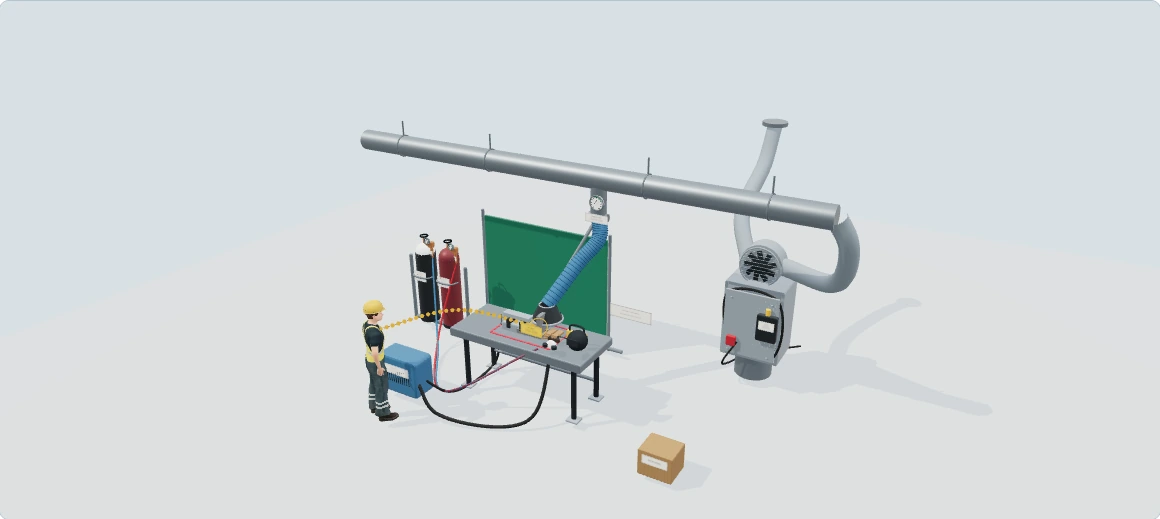
Welding and hot work: heat, fume and hidden ignition routes
Explore how this equipment can harm its users and other people, then follow the practical measures that interrupt each pathway. This is a hazards and good-practice lesson; the separate checklist remains the pre-use/safety-check activity.
Hazards and good practice: learn what can hurt people during use, change and maintenance. Pre-use and safety checks stay in the separate checklist.
Checksheets and risk assessments
Equipment checksheets
- Welding and gas cutting — 3D checks · Word · PDF
- Local exhaust ventilation: user and condition check — 3D checks · Word · PDF
- Fire extinguishers and fire points — 3D checks · Word · PDF
Risk assessment forms
- Task-specific COSHH assessment · Word
- Flammable substances and explosive-atmosphere assessment · Word
Risk assessment examples
Forms and tools
Full written walkthrough — all 8 steps
1. Consider a cold or off-site method
What is happening: The stationary bench represents a work decision, not an operating arc or a permit release.
How harm can occur: Heat, sparks and ignition can harm people and plant beyond the immediate welding point.
Best practice to apply: Consider avoiding hot work or moving it to a suitable designated area before developing the remaining controls.
Why this works: Removing ignition from the hazardous location is stronger than relying on a permit to justify it.
Hot Work Control in Process Areas · What major accident scenario should hot work control prevent?2. Identify the actual plant and boundaries
What is happening: The workpiece can be connected to equipment or spaces beyond what the operator sees.
How harm can occur: Residual product, pressure or a wrong boundary can lead to fire, explosion or loss of containment.
Best practice to apply: Verify the job, plant identity, connected equipment, residues and required isolations through the actual safe system.
Why this works: A clean-looking surface does not identify what is inside or connected to it.
Hot Work Control in Process Areas · How should isolation, draining and cleaning be proved?3. Follow heat and sparks beyond the bench
What is happening: Heat can conduct through material and particles can pass through openings or reach the far side.
How harm can occur: Hidden combustibles can ignite out of sight of the person doing the work.
Best practice to apply: Remove or suitably protect combustibles and inspect credible ignition routes, including adjacent spaces and other sides.
Why this works: Controlling the full route prevents a local task creating a remote fire.
Hot Work Control in Process Areas · What does hot work control mean in plain English?4. Keep the atmosphere decision current
What is happening: Testing and monitoring arrangements depend on the actual substances, location and change during work.
How harm can occur: A changed or untested atmosphere can create fire, explosion, poisoning or asphyxiation.
Best practice to apply: Use competent assessment and the required testing/monitoring and ventilation; suspend work when its conditions are no longer valid.
Why this works: A previous reading or permit does not freeze the atmosphere or remove process change.
Hot Work Control in Process Areas · How should gas testing be planned and interpreted?5. Control welding fume at the source
What is happening: The articulated hood sits over a clamped joint inside a red illustrative bench footprint. Use the comparison to move the vice and joint outside it: a nearby hood is useful only while the real source stays in its verified three-dimensional capture range.
How harm can occur: Inhaled fume and associated gases can cause serious harm; outdoor work is not automatically controlled.
Best practice to apply: Commission and test the actual tool, source position/height, hood setting and full working movement under representative conditions. Mark the verified footprint on the bench, record the arrangement and normal indicators, and keep every part of the source task within it. Reposition/reassess if the hood, process or draught changes; provide assessed RPE where needed.
Why this works: Marking the tested working position makes correct use repeatable. A running fan, a bench mark or a smoke test at an idle hood alone does not prove capture during the real task.
Hot Work Control in Process Areas · What would a good worked hot work permit example include? LEV Local Exhaust Ventilation · What are capture zones, working zones and breathing zones?6. Protect people from radiation and hot material
What is happening: Screens, the working position and suitable protection have separate functions.
How harm can occur: Arc radiation, hot metal and fragments can injure the welder, helpers or passers-by.
Best practice to apply: Control line of sight, access and hot-material handling and use protection selected for the actual process.
Why this works: Protecting the boundary stops other people being exposed to a task they are not performing.
Hot Work Control in Process Areas · BuildOut documents to download7. Provide a capable watch and emergency response
What is happening: A fire watch must cover credible ignition points and be able to stop work and raise the alarm.
How harm can occur: A developing or concealed fire can grow while attention remains on the workpiece.
Best practice to apply: Provide the required competent fire watch, suitable communication and emergency arrangements during and after the task.
Why this works: Independent observation can find ignition beyond the operator's view; a model supplies no universal watch duration.
Hot Work Control in Process Areas · What should a fire watch do during and after hot work?8. Complete hand-back after the controls are finished
What is happening: Residual heat, hidden spaces and temporary arrangements remain important after the tool stops.
How harm can occur: Premature permit closure or incorrect reinstatement can allow delayed fire or release when plant returns.
Best practice to apply: Complete specified post-work checks and watch, account for outstanding work and verify reinstatement before formal hand-back.
Why this works: Closure must reflect the actual condition and remaining risks, rather than only the end of welding.
Hot Work Control in Process Areas · What should happen before hot work is handed back?
Illustrative awareness learning. Geometry, colours and movement do not establish safe distances, capacity, exposure, isolation or work permission. Use the actual assessment, equipment information and competent arrangements.
The wider workplace has its own account and subscription access. Exploring this lesson does not grant access, record course completion or authorise work.
UK guidance for further reading
HSE: Welding and hot workHSE HSG258: verified and marked capture zonesHow can I practise this topic in 3D?
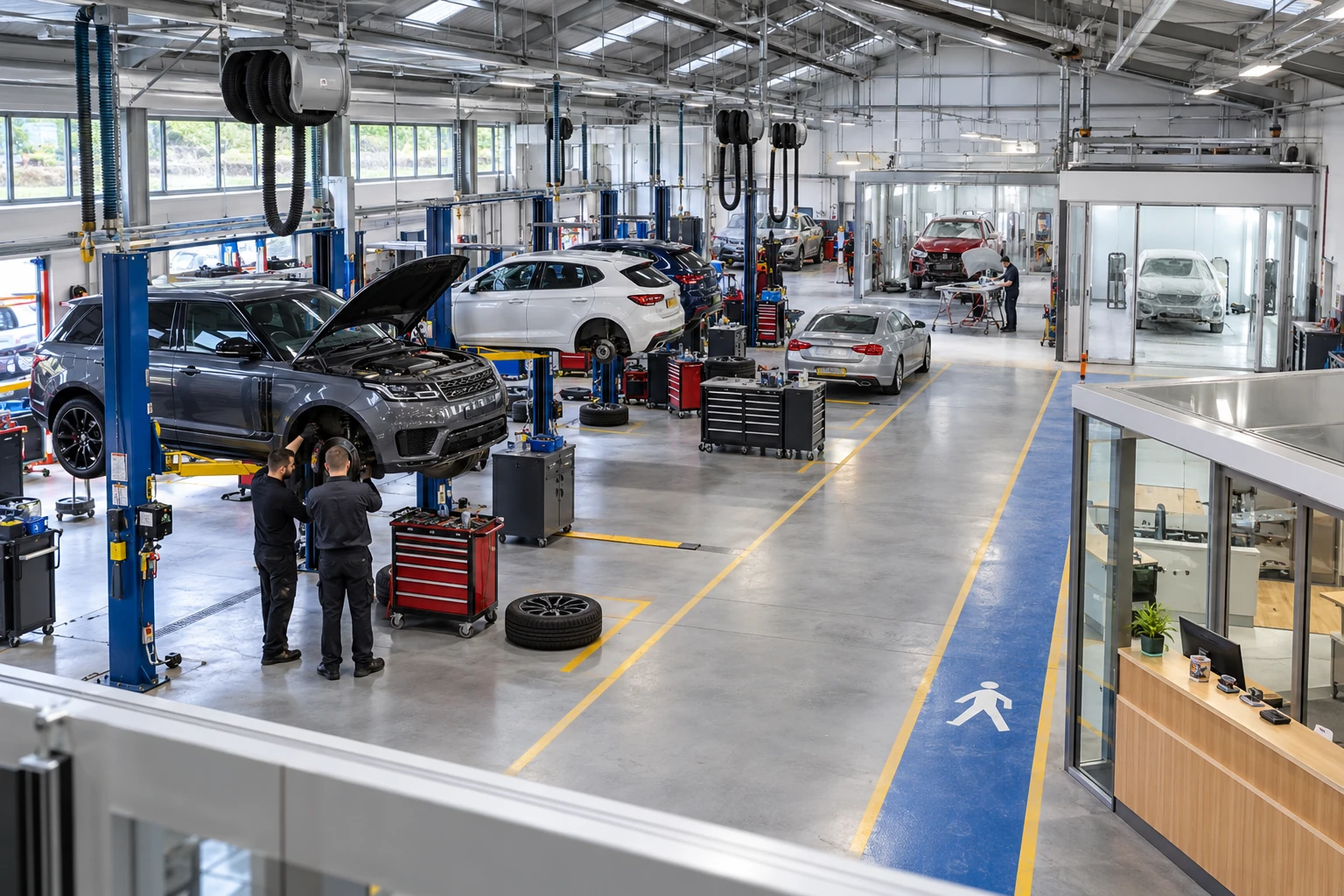
Hot work beside trim and solvent waste
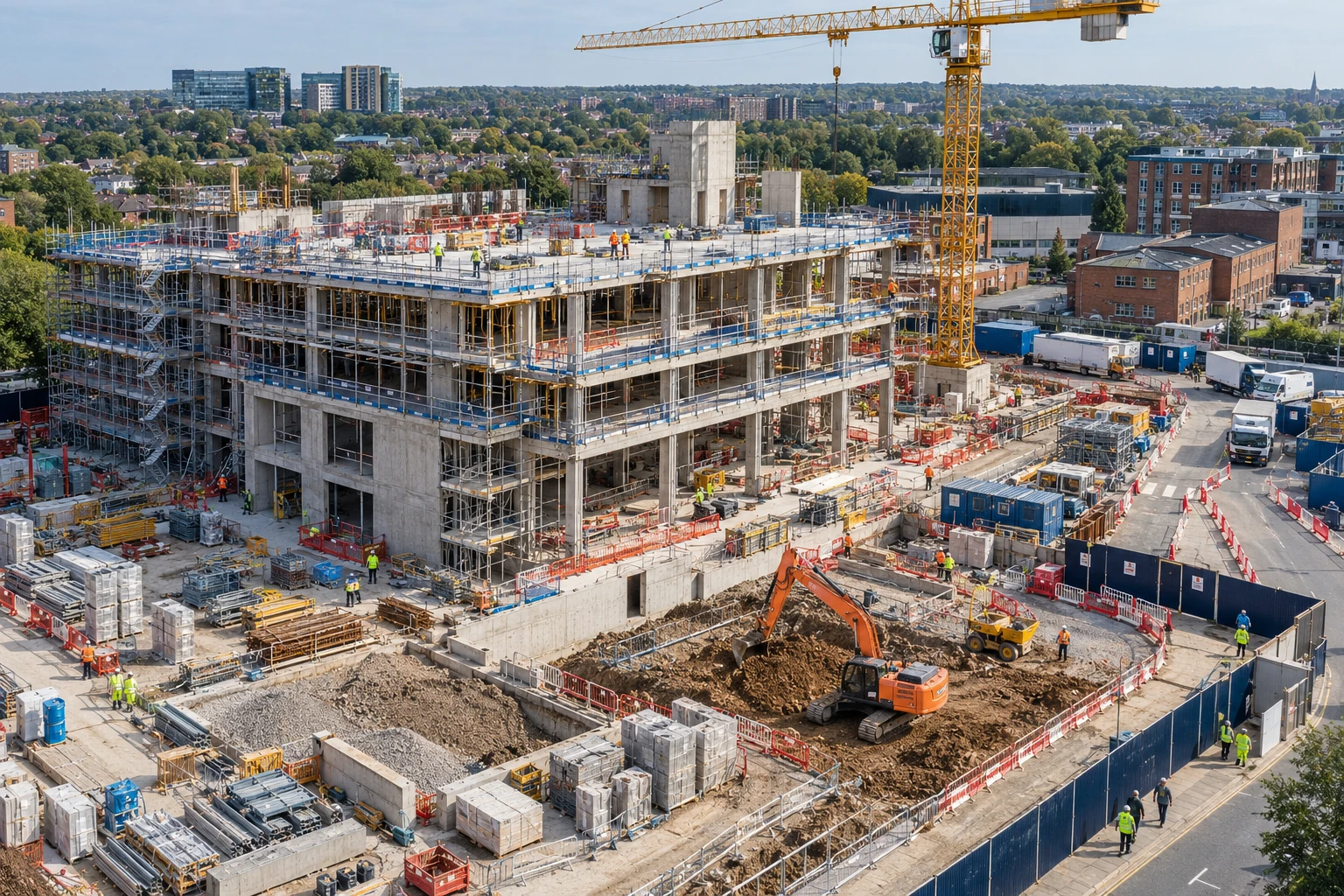
A concrete hose is cleared without controlling pressure
A specialist contractor arrives without interface planning
All related inspection points 15 across 3 locations
Garage workshop 1 inspection point
Construction site 3 inspection points
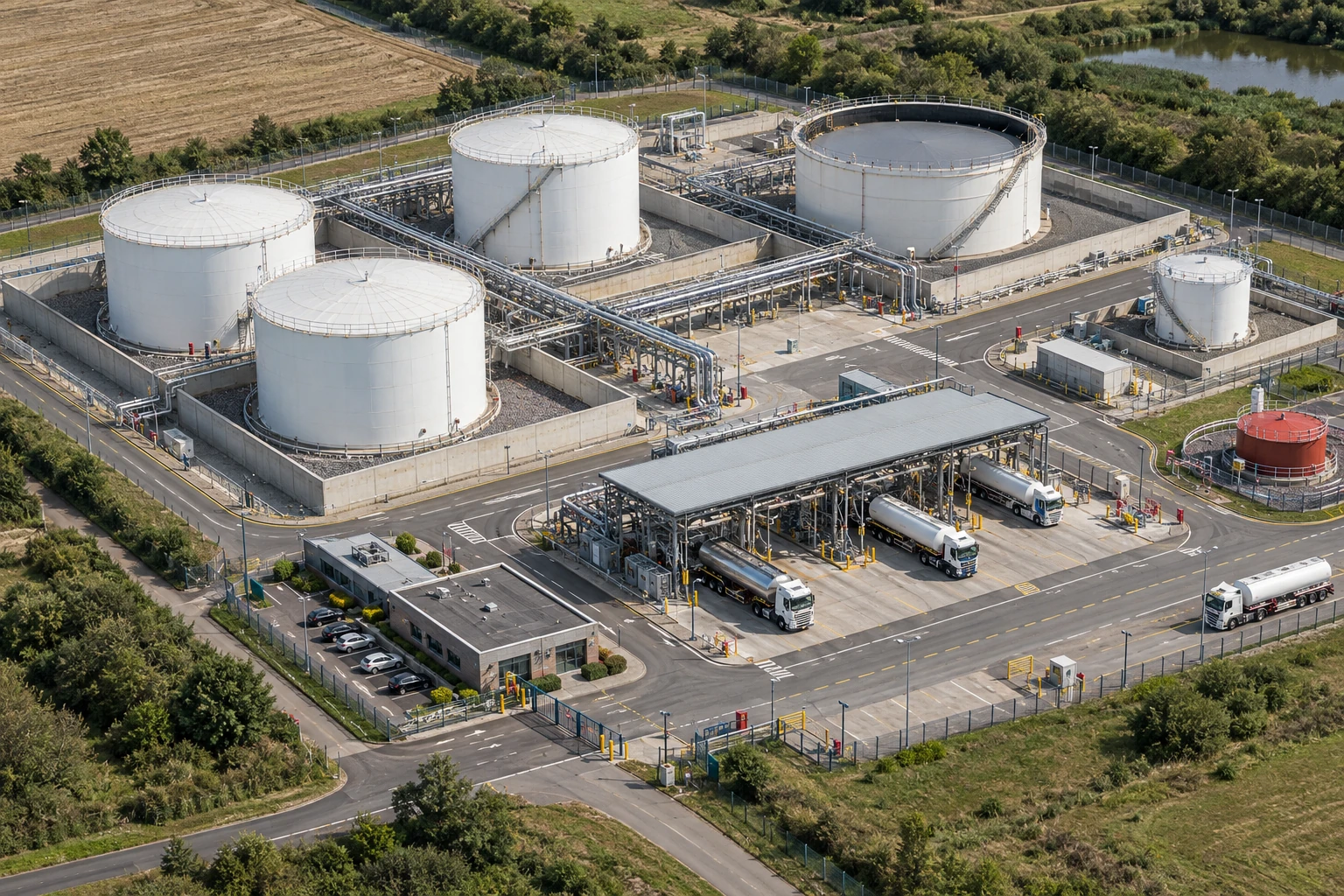
Crown Fuels terminal 11 inspection points
Practice in the SHAREhub environment. Browser practice is separate from workplace competence and formal learning records.
Follow the physical task behind the permit
Use the fictional petrol-tank example to connect the permit, isolation and blind registers to the actual work boundary, changes during cleaning, the protected first break and controlled handback.
Included with Paid membership. Authorised staff can review the model. Select Start guided example to follow the authored scenes; browsing stage text alone does not change the model. Stop restores the saved manual example.
The 22-stage example follows initial isolation and inventory recovery; temporary water and collection hoses at the DBB bleed connections; nitrogen to a reviewed top vent; pressure and gas-test evidence; locks and example documents; the protected first break and final spades; external pump work; then protected spade removal, remade joints, specified bolting and a separate line-test and handback review.
Keep the evidence separate. Water appearance and authored zero gauges do not establish cleaning or proof. Zero LEL after nitrogen does not establish a safe atmosphere. No universal torque, tank test pressure, leak-test pass or entry permission is supplied.
Conceptual learning only: no work, first break or confined-space entry is authorised. HSG253 and L101 are GB-origin HSE guidance; use the applicable local law and a competent, plant-specific assessment.
Read the full isolation explanation and source links or use the eight illustrated isolation arrangements on the free topic page.
What is a permit-to-work system?
A permit-to-work system is a formal written and operational procedure that controls specified high-risk work before, during and after the task.
Best-practice guide: Permit-to-work Systems
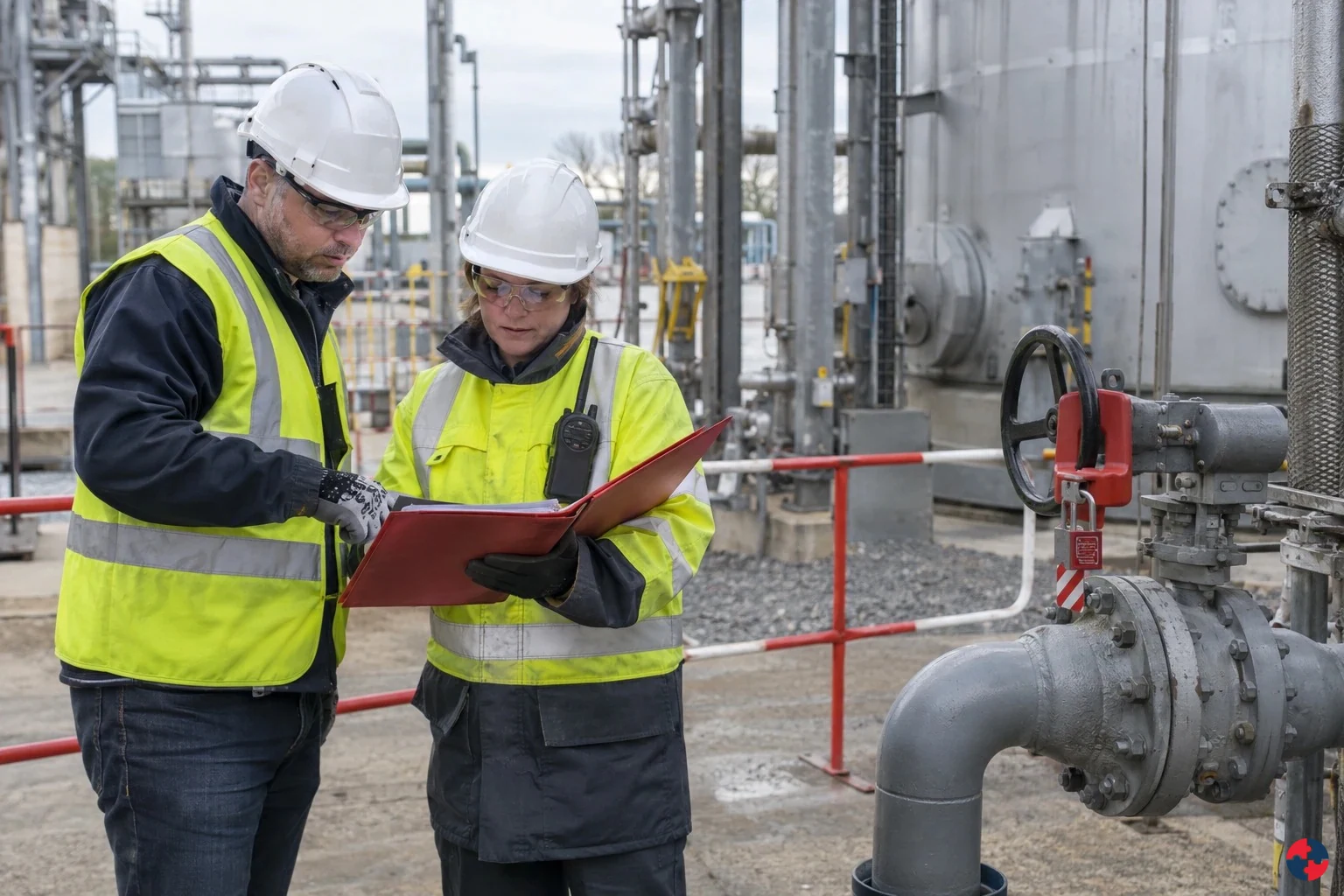
What is a permit-to-work system?
A permit-to-work system is a formal written and operational procedure that controls specified high-risk work before, during and after the task. A permit-to-work system is a formal control system for high-risk, non-routine or interacting work where ordinary procedures are not enough.
Turn permit-to-work systems knowledge into a decision
A permit-to-work system is a formal control system for high-risk, non-routine or interacting work where ordinary procedures are not enough. A permit does not make work safe by itself. Permit, isolation certificate, test record, field check, stop/reissue history and signed handback.
Pump P-204: line break and handback
Issuer and acceptor verify the field condition and test evidence; the team follows the authorised scope and monitors change. Check guarding, cleanliness and controlled removal of isolation before authorised plant return.
The permit must control the physical work boundary
The permit describes a different location, scope or plant state. Unproven isolation can release motion, pressure or hazardous material. Other work or an unplanned restart can expose the permitted team. Use the full topic for the detailed mechanism, task limits and source scope.
Choose controls for permit-to-work systems
Eliminate: Eliminate or redesign: the maintenance planner checks whether the repair can be completed without opening the line, or whether the pump can be taken fully out of service and worked on in a controlled workshop. Reduce: Substitute or reduce: engineering considers a less hazardous cleaning medium or reduced inventory and pressure before opening, only if process compatibility and the approved procedure allow it. Isolate: Isolate and engineer: the isolation authority selects a risk-based physical isolation scheme under HSE HSG253, identifies the exact line, secures energy sources, drains and vents to a safe system, and proves the boundary before work. Control: Control, PPE and Discipline: the area authority coordinates simultaneous operations, gas-test timing, permitted scope, time limit, fire/containment arrangements and shift handover under HSG250. Control: Read the full task example, checks and stop points on this page. Read the full control table for qualifications, ownership and verification. Use the actual task and applicable jurisdiction; existing technical approval remains unchanged.
Use the full permit-to-work systems lesson
Use the full topic for the decision points, practical examples, detailed control tables and source scope. HSE guidance applies to Great Britain; use HSENI for the Northern Ireland route and the source’s stated jurisdiction. A simplified guide does not change the page’s technical-review or approval status.

Read all six steps as text
1. What is a permit-to-work system?
A permit-to-work system is a formal written and operational procedure that controls specified high-risk work before, during and after the task.
- Avoid / redesign: Eliminate or redesign: the maintenance planner checks whether the repair can be completed without opening the line, or whether the pump can be taken fully out of service and worked on in a controlled workshop.
- Control the task: Isolate and engineer: the isolation authority selects a risk-based physical isolation scheme under HSE HSG253, identifies the exact line, secures energy sources, drains and vents to a safe system, and proves the boundary before work.
- Verify before release: Read the full task example, checks and stop points on this page.
A permit-to-work system is a formal written and operational procedure that controls specified high-risk work before, during and after the task. A permit-to-work system is a formal control system for high-risk, non-routine or interacting work where ordinary procedures are not enough.
Apply it: Which part of this plan would you check at the workface before authorising the task?
2. Turn permit-to-work systems knowledge into a decision
Use the evidence to improve the actual work arrangement.
- Change at source: Eliminate or redesign: the maintenance planner checks whether the repair can be completed without opening the line, or whether the pump can be taken fully out of service and worked on in a controlled workshop.
- Make it observable: Read the full task example, checks and stop points on this page.
- Keep useful evidence: Permit, isolation certificate, test record, field check, stop/reissue history and signed handback.
A permit-to-work system is a formal control system for high-risk, non-routine or interacting work where ordinary procedures are not enough. A permit does not make work safe by itself. Permit, isolation certificate, test record, field check, stop/reissue history and signed handback.
Apply it: What evidence would show that the change improves this task, rather than only completing a record?
3. Pump P-204: line break and handback
Example: a practical application of the existing topic lesson.
- Setting: Replace a gasket on hydrocarbon pump P-204 at a fuel terminal during a planned shutdown.
- Act: Identify the exact flange and boundary, plan the isolation, drain and vent to a safe route, and check concurrent work.
- Hold / review: A passing valve, blocked drain, residual pressure, odour, gas alarm or conflicting operation suspends the job for reassessment.
Issuer and acceptor verify the field condition and test evidence; the team follows the authorised scope and monitors change. Check guarding, cleanliness and controlled removal of isolation before authorised plant return.
Apply it: At which point would you hold this example, and what evidence would allow it to proceed?
4. The permit must control the physical work boundary
Connect the task, the route to the person and the control that can fail.
- Mismatch: The permit describes a different location, scope or plant state.
- Energy: Unproven isolation can release motion, pressure or hazardous material.
- Interface: Other work or an unplanned restart can expose the permitted team.
The permit describes a different location, scope or plant state. Unproven isolation can release motion, pressure or hazardous material. Other work or an unplanned restart can expose the permitted team. Use the full topic for the detailed mechanism, task limits and source scope.
Apply it: Where is this harm route present in the actual work, and which control breaks it before anyone is exposed?
5. Choose controls for permit-to-work systems
Start with the stronger practicable options and verify their effect.
- Eliminate: Eliminate or redesign: the maintenance planner checks whether the repair can be completed without opening the line, or whether the pump can be taken fully out of service and worked on in a controlled workshop.
- Reduce: Substitute or reduce: engineering considers a less hazardous cleaning medium or reduced inventory and pressure before opening, only if process compatibility and the approved procedure allow it.
- Isolate: Isolate and engineer: the isolation authority selects a risk-based physical isolation scheme under HSE HSG253, identifies the exact line, secures energy sources, drains and vents to a safe system, and proves the boundary before work.
- Control: Control, PPE and Discipline: the area authority coordinates simultaneous operations, gas-test timing, permitted scope, time limit, fire/containment arrangements and shift handover under HSG250.
- Control: Read the full task example, checks and stop points on this page.
Eliminate: Eliminate or redesign: the maintenance planner checks whether the repair can be completed without opening the line, or whether the pump can be taken fully out of service and worked on in a controlled workshop. Reduce: Substitute or reduce: engineering considers a less hazardous cleaning medium or reduced inventory and pressure before opening, only if process compatibility and the approved procedure allow it. Isolate: Isolate and engineer: the isolation authority selects a risk-based physical isolation scheme under HSE HSG253, identifies the exact line, secures energy sources, drains and vents to a safe system, and proves the boundary before work. Control: Control, PPE and Discipline: the area authority coordinates simultaneous operations, gas-test timing, permitted scope, time limit, fire/containment arrangements and shift handover under HSG250. Control: Read the full task example, checks and stop points on this page. Read the full control table for qualifications, ownership and verification. Use the actual task and applicable jurisdiction; existing technical approval remains unchanged.
Apply it: Which stronger option can be used here, and who will verify it before accepting the remaining risk?
6. Use the full permit-to-work systems lesson
Follow the official sources below and retain the task-specific evidence.
- Official guidance: HSE - Permit to work systems.
- Official guidance: HSE - Guidance on permit-to-work systems HSG250
- Task decision: Permit, isolation certificate, test record, field check, stop/reissue history and signed handback.
Use the full topic for the decision points, practical examples, detailed control tables and source scope. HSE guidance applies to Great Britain; use HSENI for the Northern Ireland route and the source’s stated jurisdiction. A simplified guide does not change the page’s technical-review or approval status.
Apply it: Which official source and full-topic section will you use to resolve the next decision?
The permit is not the control itself. It is the authorisation and communication mechanism that confirms controls have been identified, implemented and verified. If the isolation is wrong, the gas test is invalid, the rescue plan is absent or the work team has not understood the precautions, the permit document does not make the job safe. See HSE - Permit to work systems.
Permit systems are strongest where work is non-routine, hazardous, intrusive or likely to interact with other activities. This includes hot work, confined-space entry, line breaking, electrical dead work under its specialist permit system, isolations, excavation, work at height, lifting over live plant, maintenance with guards removed and tasks involving dangerous substances.
A strong permit system is field-based. It makes people go to the job, check the conditions, verify isolations, talk to the people doing the work and stop when conditions change. A paper or electronic permit that is issued from a desk without field verification is a weak barrier.
A permit authorises a defined job under stated conditions; it does not replace isolation, competent work planning or a safe method. The issuer and performing authority should both understand the exact equipment and boundary in the field. If that boundary cannot be identified, the job does not start.
| Element | What it means | Weak practice to challenge |
|---|---|---|
| Defined scope | Exact task, location, equipment and boundary are clear. | Permit says 'maintenance' with no work detail. |
| Hazard identification | Energy, substances, atmosphere, access, adjacent work and escalation are understood. | Hazards copied from a generic template. |
| Controls verified | Isolations, tests, barriers, rescue, PPE and supervision are checked before start. | Controls listed but not physically verified. |
| Authorisation | Competent issuer and acceptor understand the work and conditions. | Permit signed without discussion. |
| Live monitoring | Conditions are checked while work is underway. | Permit treated as valid regardless of change. |
| Handback | Plant, area and safeguards are reinstated before close-out. | Permit closed because shift ended. |
Relevant primary guidance: HSE - Guidance on permit-to-work systems HSG250; HSE - Safe isolation of plant and equipment HSG253
What does a good permit lifecycle look like?
A good permit follows the job from planning through risk control, issue, live monitoring, suspension, handback and audit.
A hot-work permit must match the real workface
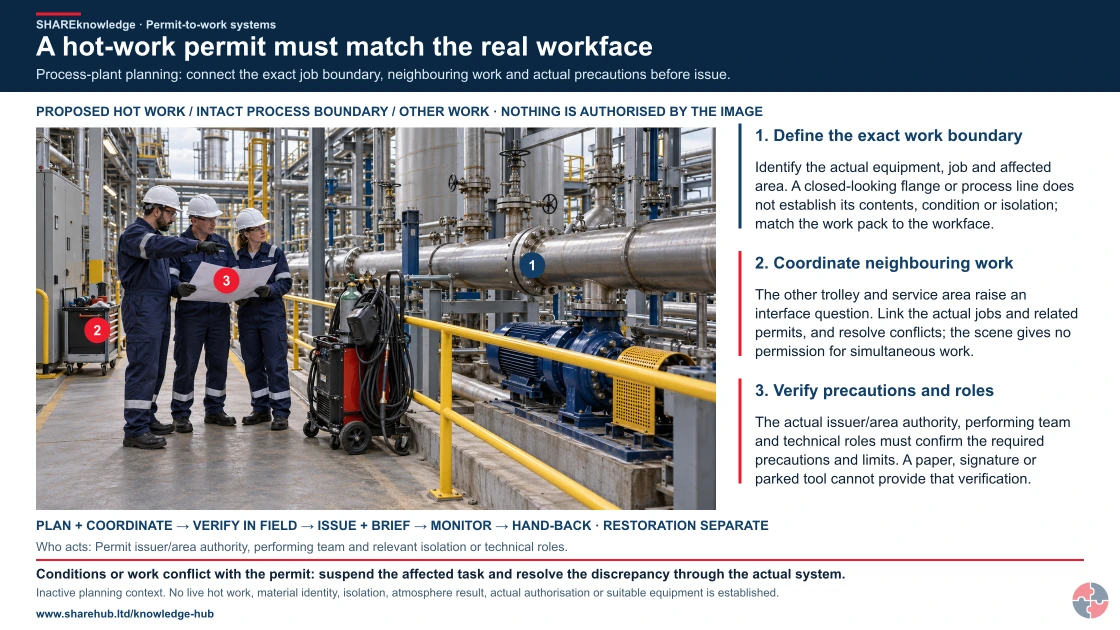
Full written explanation
A realistic inactive British process-plant scene places an intact bolted process flange and connected pipework beside a guarded pump, a parked powered-off welding trolley and a separate maintenance/service interface. Three colleagues review unreadable task papers without performing hot work, operating valves or testing equipment. Native numbered labels connect the exact job/equipment boundary, neighbouring work and required precautions/roles; a complete native connection carries planning and coordination through verification, issue/briefing, monitoring and hand-back with controlled restoration. The image establishes no material identity, real permit, signatory, isolation, atmosphere, compatible equipment, actual safe state or authority to start. It is not a prescribed hot-work layout, testing method or parallel-work permission. Full original hazardous-maintenance, changed-condition and uncontrolled-event pathway, planning, physical-verification and monitoring barriers, four task checks, roles, suspension hold and cases remain in the source and written alternative. Hazardous maintenance: Hot work, entry or opening equipment can expose people to existing or introduced hazards. Conditions differ from the plan: Passing isolation, a blocked drain or simultaneous work can invalidate assumptions. Uncontrolled event: Release, ignition, injury or exposure can follow despite a signed document.
Process-plant planning: connect the exact job boundary, neighbouring work and actual precautions before issue.
- Define the exact work boundary. Identify the actual equipment, job and affected area. A closed-looking flange or process line does not establish its contents, condition or isolation; match the work pack to the workface.
- Coordinate neighbouring work. The other trolley and service area raise an interface question. Link the actual jobs and related permits, and resolve conflicts; the scene gives no permission for simultaneous work.
- Verify precautions and roles. The actual issuer/area authority, performing team and technical roles must confirm the required precautions and limits. A paper, signature or parked tool cannot provide that verification.
Change the pathway
- Plan and coordinate. Define the job, interfaces and actual safe system before issue.
- Verify physical precautions. Check isolations, tests and other required measures at the workface.
- Monitor and hand back. Suspend on change; use controlled hand-back and separate return-to-service checks.
Evidence check: A permit cannot make a passing valve tight or a blocked proving route effective.
Primary references: HSE: permit-to-work roles, linked jobs and hand-over · HSE HSG250: permit-to-work system guidance overview · HSE HSG253: process-isolation guidance overview
Open the complete HD image (new tab)Download image

Primary references: HSE: permit-to-work roles, linked jobs and hand-over · HSE HSG250: permit-to-work system guidance overview · HSE HSG253: process-isolation guidance overview
The lifecycle is the backbone of permit quality: plan -> risk assess -> isolate -> test -> issue -> brief -> perform -> monitor -> suspend if needed -> hand back -> close out -> audit. Each stage has a different purpose and a different owner. Skipping one stage often creates the conditions for a serious incident.
For process safety, the lifecycle also protects major accident barriers. A line break, hot work task or confined-space entry may defeat containment, introduce ignition, remove safeguards or put people into an atmosphere that can change. The permit system must connect to isolation standards, gas testing, SIMOPS, emergency response and management of change.
| Stage | Purpose | Evidence |
|---|---|---|
| Plan | Decide whether a permit is required and define work scope. | Work pack, risk assessment and permit type. |
| Risk assess | Identify hazards, affected people, adjacent work and emergency needs. | Task risk assessment and field check. |
| Isolate and make safe | Remove, lock, tag, drain, vent or control energy and substances. | Isolation certificate and verification. |
| Test and verify | Confirm atmosphere, dead state, zero energy or safe access where needed. | Gas test, prove-dead record or pressure/containment check. |
| Issue and brief | Authorise only when conditions and roles are understood. | Signed permit and toolbox talk. |
| Monitor | Check that work stays within permit conditions. | Area checks, fire watch, gas retest or supervisor log. |
| Suspend | Pause work when conditions, scope, weather, SIMOPS or shift change affect safety. | Suspension note and revalidation. |
| Hand back and close | Confirm work complete, area safe and safeguards reinstated. | Handback signature and restart checks. |
| Audit | Check permit quality and field reality. | Permit audit findings and corrective actions. |
How can the hierarchy of controls reduce task risks before relying on a permit-to-work?
Consider the planned opening of hydrocarbon pump P-204. The harm chain is residual liquid or vapour in a line, release through the opened flange, then skin contact, inhalation or ignition. Odour, pressure, a failed drain or a changed adjacent operation are warnings to stop. The HSE five-level hierarchy is elimination, substitution, engineering, administrative controls and PPE; ERICPD expresses Eliminate, Reduce including substitution, Isolate, Control, PPE and Discipline. A permit sits in the administrative layer and cannot replace the physical barriers.
Eliminate or redesign: the maintenance planner checks whether the repair can be completed without opening the line, or whether the pump can be taken fully out of service and worked on in a controlled workshop. Operations checks process feasibility and the work pack records why intrusive work remains necessary. If production pressure prevents a safe shutdown, the job is held rather than authorised on a weaker permit.
Substitute or reduce: engineering considers a less hazardous cleaning medium or reduced inventory and pressure before opening, only if process compatibility and the approved procedure allow it. Operations verifies the actual substance and condition against drawings and process information. Assuming a line is empty because a gauge reads zero is a failure mode; unexpected contents require withdrawal and reassessment.
Isolate and engineer: the isolation authority selects a risk-based physical isolation scheme under HSE HSG253, identifies the exact line, secures energy sources, drains and vents to a safe system, and proves the boundary before work. The issuer and acceptor walk the site against the certificate and drawings; evidence includes lock/valve status, test results and a field check. A passing valve, blocked drain, wrong tag or failed test stops the job. See HSE HSG253 safe isolation guidance.
Control, PPE and Discipline: the area authority coordinates simultaneous operations, gas-test timing, permitted scope, time limit, fire/containment arrangements and shift handover under HSG250. The performing team uses substance-specific eye, hand and body protection selected from the safety data and task assessment, checks condition and replacement, and understands its limits against vapour or ignition. Supervisors sample live permits in the field and investigate repeated corrections. If atmosphere, scope, plant state or adjacent work changes, suspend, make safe and reauthorise only after controls are reverified.
Control-order source: HSE - Hierarchy of controls
How can the ERICPD hierarchy of controls reduce task risks before relying on a permit-to-work?

| ERICPD control level | Topic-specific example | Source and full task context |
|---|---|---|
| Eliminate | Avoid opening the line if a feasible redesign or non-intrusive repair removes that intervention. | Read the full task example, checks and stop points on this page. HSE HSG253 safe isolation guidance · HSE - Hierarchy of controls |
| Reduce | Assess a less hazardous compatible cleaning medium; lowering pressure or inventory is reduction, not itself substitution. | Read the full task example, checks and stop points on this page. HSE HSG253 safe isolation guidance · HSE - Hierarchy of controls |
| Isolate | Implement and prove the risk-based physical isolation, secure energy sources and safe drain/vent boundary. | Read the full task example, checks and stop points on this page. HSE HSG253 safe isolation guidance · HSE - Hierarchy of controls |
| Control | Coordinate simultaneous operations, scope, gas-test timing, authorisation, suspension, revalidation and shift handover. | Read the full task example, checks and stop points on this page. HSE HSG253 safe isolation guidance · HSE - Hierarchy of controls |
| PPE | Select substance/task-specific eye, hand and body protection; check suitability and condition. PPE does not repair failed isolation. | Read the full task example, checks and stop points on this page. HSE HSG253 safe isolation guidance · HSE - Hierarchy of controls |
| Discipline | Verify field conditions and follow the stop/reissue/handback system; changed conditions require reassessment. | Read the full task example, checks and stop points on this page. HSE HSG253 safe isolation guidance · HSE - Hierarchy of controls |
How can the ISO 45001 hierarchy of controls reduce task risks before relying on a permit-to-work?

| ESEAP control level | Topic-specific example | Source and full task context |
|---|---|---|
| Elimination | Avoid opening the line if a feasible redesign or non-intrusive repair removes that intervention. | Read the full task example, checks and stop points on this page. HSE HSG253 safe isolation guidance · HSE - Hierarchy of controls |
| Substitution | Assess a less hazardous compatible cleaning medium; lowering pressure or inventory is reduction, not itself substitution. | Read the full task example, checks and stop points on this page. HSE HSG253 safe isolation guidance · HSE - Hierarchy of controls |
| Engineering controls | Implement and prove the risk-based physical isolation, secure energy sources and safe drain/vent boundary. | Read the full task example, checks and stop points on this page. HSE HSG253 safe isolation guidance · HSE - Hierarchy of controls |
| Administrative controls | Coordinate simultaneous operations, scope, gas-test timing, authorisation, suspension, revalidation and shift handover. | Read the full task example, checks and stop points on this page. HSE HSG253 safe isolation guidance · HSE - Hierarchy of controls |
| PPE | Select substance/task-specific eye, hand and body protection; check suitability and condition. PPE does not repair failed isolation. | Read the full task example, checks and stop points on this page. HSE HSG253 safe isolation guidance · HSE - Hierarchy of controls |
When is a permit needed instead of RAMS only?
A permit decision should test the task, the interface risk, the need for isolation, specialist authorisation and emergency controls before work starts.
A risk assessment and method statement can describe how work will be done, but a permit controls whether the work may start under live site conditions. The decision should not be based on habit or paperwork preference. It should ask whether the task is high risk, whether it interacts with other work, whether energy or substances must be isolated, whether a specialist must authorise it, and whether emergency controls must be ready before the first tool is used.
The practical flow is: high-risk task -> interface risk -> isolation needed -> specialist authorisation -> emergency controls -> permit required / RAMS only / stop and redesign. If the answer is uncertain, if a critical control cannot be verified, or if a permit is being used to approve work that is still fundamentally unsafe, the correct decision is to stop and redesign the job.
| Decision point | Permit likely needed when | RAMS only may be enough when |
|---|---|---|
| High-risk task | Work could cause fatality, major injury, fire, explosion, collapse, engulfment or exposure if controls fail. | Routine low-risk work has stable conditions and established controls. |
| Interface risk | The task affects operations, public routes, contractors, live plant, traffic, services or adjacent work. | The task is isolated from other people, plant and changing site conditions. |
| Isolation needed | Electrical, mechanical, hydraulic, pneumatic, thermal, chemical, pressure or stored energy needs formal isolation. | No hazardous energy or substance release is credible. |
| Specialist authorisation | A competent person must approve entry, hot work, excavation, lifting, electrical work, line breaking or live interface control. | Normal supervisor authority is sufficient and controls are already built into routine procedure. |
| Emergency controls | Rescue, fire watch, spill response, gas testing, exclusion zones or emergency services interface must be confirmed before start. | Emergency arrangements are ordinary workplace arrangements and do not change for the task. |
| Stop and redesign | Controls cannot be verified, the scope is vague, conditions are changing or the permit is being used as permission to take unacceptable risk. | Not applicable; a permit should never be used to make an unsafe job acceptable. |
Which level of work control is enough?
The control level should match the risk, complexity and live interface of the task.
Not every job needs a permit, but every job needs the right level of control. The mistake is treating the options as paperwork choices. RAMS, checklists, permits and specialist authorisations do different jobs. A RAMS describes the planned method; a pre-start check confirms the team and conditions are ready; a permit authorises specified high-risk work under defined controls; specialist authorisation confirms that a competent technical owner has accepted the control standard; stop and redesign is the correct answer when the proposed work cannot be made acceptably safe.
This ladder should be used by planners, supervisors and authorisers before work starts and again when conditions change. If a job moves up the ladder during the day because of weather, SIMOPS, unexpected services, poor isolation or scope creep, the work should pause and be reauthorised at the correct level.
| Control level | Use when | Example |
|---|---|---|
| RAMS only | Routine task, stable environment, competent team and controls already embedded in normal procedure. | Routine low-level maintenance in a controlled workshop with no live interfaces or isolations. |
| Checklist / pre-start brief | The task is routine but needs confirmation of people, equipment, area condition or simple hold points before starting. | Daily scaffold inspection, plant pre-use check, warehouse unloading brief or low-risk roof-edge exclusion check. |
| Permit required | High-risk, non-routine, intrusive or interacting work needs formal authorisation, time limits, conditions and handback. | Hot work, confined-space entry, permit to dig, work at height on a fragile roof or line breaking. |
| Specialist authorisation required | Technical judgement or legal competence is needed before work can proceed. | Live electrical work, complex lift, temporary works change, pressure-system intervention, radiography or high-hazard DSEAR work. |
| Stop and redesign | The control cannot be verified, rescue is inadequate, isolation is uncertain, competence is missing or the job relies on luck. | Excavation with uncertain services, hot work near uncontrolled vapour, roof work without fall prevention or confined-space entry without rescue. |
Which tasks commonly need permit control?
Permit requirements should be based on task risk, site rules, interaction hazards and the potential severity if controls fail.
Permit requirements should be based on task risk, site rules, interaction hazards and the potential severity if controls fail. The table gives practical examples, evidence expectations and common decision points so the section can be used for learning, supervision, audit and review.
| Permit type | Typical work | Critical controls |
|---|---|---|
| Hot work | Welding, grinding, flame cutting, torching or spark-producing work. | DSEAR check, gas test, fire watch, isolation of combustibles, red permit where local system uses HSG250-style colour coding. |
| Spark-potential work | Drilling, impact tools, battery tools or non-hot work that could still ignite vapour or dust. | Yellow/spark-potential permit where used, ignition review, atmosphere checks and area approval. |
| Confined space entry | Tanks, pits, vessels, ducts, chambers or poorly ventilated spaces. | Avoid entry, isolate, test atmosphere, ventilate, rescue plan, communications and entry control. |
| Electrical work | Dead work after secure isolation and proving dead; testing and re-energisation use separately controlled procedures. | An electrical permit declares equipment safe for dead work. Competent isolation/prove-dead controls, cancellation, worker withdrawal and controlled re-energisation are required; it does not authorise live work. |
| Line breaking or intrusive maintenance | Opening pipework, vessels, pumps or process systems. | Positive isolation, drain/vent, residual contents check, PPE and containment. |
| Excavation | Breaking ground near services or unstable ground. | Permit to dig, service drawings, CAT/Genny, trial holes, exclusion and rescue planning. |
| Work at height | Roof work, fragile surfaces, elevated maintenance or scaffold alteration. | Access plan, fall prevention, rescue and weather controls. |
| Lifting over live plant | Cranes, telehandlers or lifting near people, plant or services. | Lift plan, exclusion zone, ground bearing, communications and permit interface. |
A confined space is classified by its enclosure and reasonably foreseeable specified risks, not merely by the name tank, pit or duct or by poor ventilation alone. An open-looking space can qualify; another space may still need a controlled safe system. Use the confined-spaces decision guidance before choosing the authorisation.
How do permits apply to construction and project work?
Construction permits control temporary, changing and interface-heavy work where drawings, RAMS and site rules must be verified against the real location.
Permit-to-work is sometimes taught through process-safety examples, but construction and project work need the same discipline. A construction permit often controls the point where a planned method meets live site reality: buried services are not exactly where drawings suggest, roof sheets may be fragile, traffic routes may change, temporary works may be incomplete, public interfaces may be close and several contractors may be working in the same area.
The permit should confirm that the task is ready to start: the correct drawings are reviewed, the area has been inspected, isolation or exclusion is in place, the supervisor understands the RAMS, rescue or emergency arrangements are ready, and any specialist approvals have been obtained. It should never replace design, planning, competence or supervision.
For a project tie-in, the principal contractor and operating area authority should agree who controls the plant, drawings, service information, isolation and handback. A permit to dig is weak if buried-service information or physical location is uncertain; stop for further locating and redesign before excavation.
| Permit or authorisation | Where it is used | What must be verified |
|---|---|---|
| Work at height / roof access | Roof inspection, fragile surface work, edge work, scaffold alteration or MEWP access. | Access route, fall prevention, fragile surface controls, rescue, weather and exclusion below. |
| Permit to dig / excavation | Breaking ground, trial holes, service trenches, foundations and road crossings. | Utility drawings, CAT/Genny scan, trial holes, ground conditions, collapse control, access and emergency plan. |
| Hot works | Welding, cutting, grinding, torch-on roofing, soldering or spark-potential tasks. | Combustibles removed or protected, DSEAR review where relevant, fire watch, extinguishers and post-work checks. |
| Confined spaces | Chambers, tanks, pits, culverts, ducts, sewers or poorly ventilated spaces. | Avoidance review, isolation, atmosphere testing, ventilation, entry control, rescue and communications. |
| Electrical dead work / separate testing and live-work decisions | Secure isolation and dead maintenance; separate controlled testing, commissioning and energisation interfaces. | Dead-work permit, competence, secure isolation and prove dead; cancel the permit and withdraw workers before re-energisation. Apply a separate justified live-work/testing procedure where applicable. |
| Complex lifting / crane lifts | Lifts over structures, roads, people, live plant, services or occupied areas. | Lift plan, appointed person review, ground bearing, exclusion, weather, communication and public interface. |
| Demolition / temporary works interface | Soft strip, structural alteration, propping, façade retention or temporary works changes. | Design approval, sequence, exclusion, services isolation, stability, permit hold points and sign-off. |
| Road closure / traffic interface | Works affecting public roads, site haul routes, pedestrians, deliveries or emergency access. | Traffic management plan, signage, barriers, banksman, permits from relevant authority where needed and emergency access. |
| Pressure systems, line breaking and isolations | Opening pipework, plant, vessels or pressure systems during project tie-ins. | Isolation certificate, depressurisation, drain/vent, residual contents, spill control and reinstatement. |
What evidence should a permit-to-dig briefing make explicit?
Compare the work boundary with records, locating, exposed verification, protection and unresolved interfaces. A permit coordinates the agreed work; a signed form does not itself make the excavation safe.
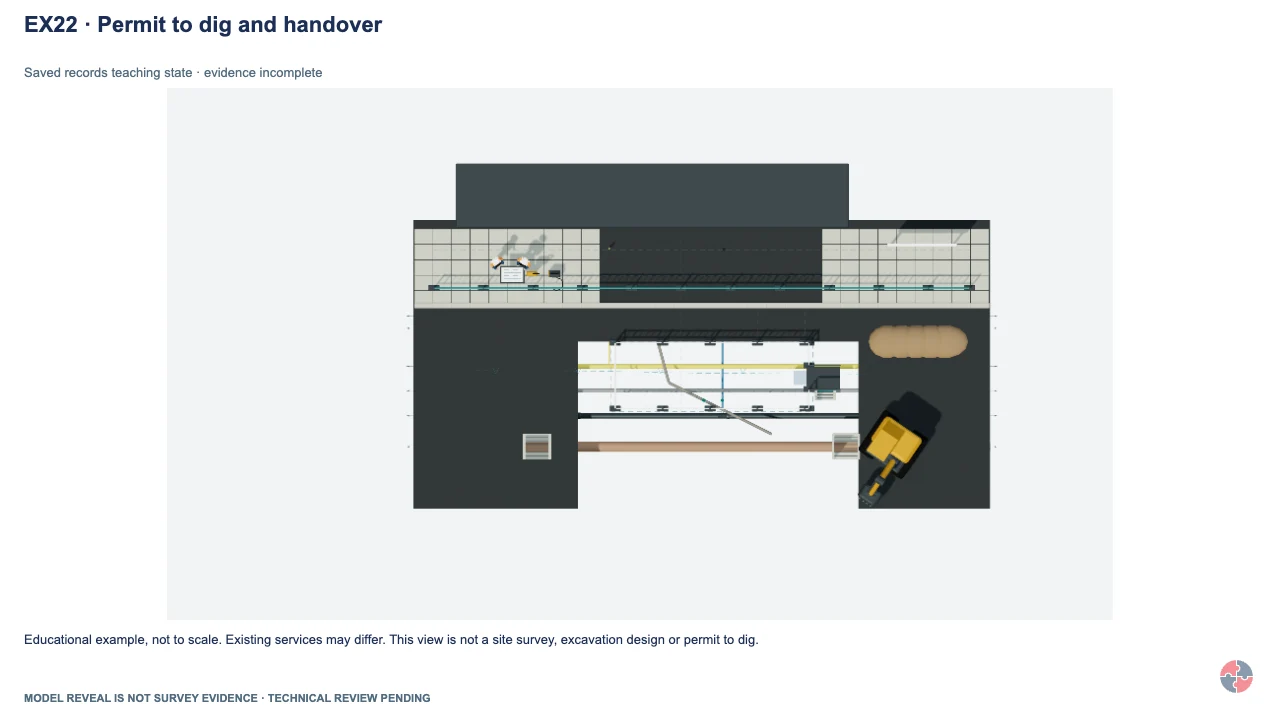
Permit to dig and handover
A permit coordinates a defined task and its controls. Check evidence, limits, unknowns and handover status; paperwork alone does not establish safe ground.
Learning focus: A permit coordinates a defined task and its controls. Check evidence, limits, unknowns and handover status; paperwork alone does not establish safe ground.
Educational example, not to scale. Existing services may differ. This view is not a site survey, excavation design or permit to dig.
Permit arrangements depend on the project and task. This example does not claim a universal standalone legal requirement for permit-to-dig paperwork.
Return to the main excavation lesson · Explore the planned Build Out excavation controls
Who does what in a permit-to-work system?
Clear permit roles prevent assumption, duplicated authority and gaps between operations, maintenance and contractors.
Permit systems fail when titles exist but decision rights are unclear. The issuer must understand the area and hazards. The acceptor must understand the work and controls. The isolation authority must know how the plant is made safe. The gas tester must be competent to test correctly. The supervisor must monitor conditions, not just collect signatures.
| Role | Main responsibility | Evidence of competence |
|---|---|---|
| Permit requester | Defines the work scope and need for permit control. | Work pack and risk assessment. |
| Area authority / issuer | Confirms area conditions, interactions and local safeguards. | Authorisation record and field verification. |
| Permit acceptor / performing authority | Accepts controls and briefs the work team. | Toolbox talk and work-team sign-on. |
| Isolation authority | Plans, applies and verifies isolations. | Isolation certificate, locks/tags and test record. |
| Gas tester | Tests atmosphere correctly and interprets results. | Competence record and calibrated instrument. |
| Fire watch / hole watch / standby | Monitors specified risks and escalation conditions. | Briefing, equipment and log. |
| Supervisor | Checks work remains within scope and stops change. | Monitoring record and stop-work authority. |
| Permit coordinator | Controls SIMOPS, permit clashes and overall permit board. | Permit register and conflict review. |
What should a permit actually say?
A permit should be specific enough that a competent person can verify the job, controls and stop conditions in the field.
A permit should be specific enough that a competent person can verify the job, controls and stop conditions in the field. The table gives practical examples, evidence expectations and common decision points so the section can be used for learning, supervision, audit and review.
| Permit field | Good permit wording | Weak permit wording |
|---|---|---|
| Job scope | Remove pump P-204 after isolation, drain, vent and gas-free confirmation. | Pump job. |
| Location | Bund 2, south pump bay, between valves V-204A and V-204B. | Tank farm. |
| Hazards | Residual hydrocarbon, stored pressure, ignition, line break, adjacent transfer. | Chemical hazard. |
| Controls | Blind installed, drain open, LEL gas test, bonded tools, spill kit, fire watch. | Wear PPE. |
| Validity | Valid 09:00-15:00 for named task and conditions only. | Valid all day. |
| Stop conditions | Gas alarm, odour, pressure found, weather change, adjacent hot work or scope change. | Stop if unsafe. |
| Handback | Area clean, guards refitted, blinds removed only under control, plant reinstatement checked. | Job complete. |
How should SIMOPS and permit clashes be controlled?
Simultaneous operations must be reviewed because individually safe tasks can become unsafe when combined.
SIMOPS is where permit systems earn their keep. Hot work near flammable transfer, drain opening near ignition sources, lifting over people, confined-space entry during nearby chemical cleaning, or electrical work during recommissioning can create risk not visible on a single permit.
The permit board, permit coordinator or area authority should actively check interactions at planning, issue, shift handover and revalidation. Electronic systems can help, but only if they are backed by field awareness.
The area authority needs a live view of permits, transfers, lifts and equipment impairments, including work by contractors. Where two jobs conflict, separate them in time or space, suspend one, or change the controls before either proceeds. A shift handover must identify live permits, plant status, tests due and anything that would invalidate authorisation.
| Combination | What can go wrong | Control decision |
|---|---|---|
| Hot work + solvent transfer | Ignition source introduced near vapour release. | Separate in time/space, suspend transfer or prohibit hot work. |
| Line break + confined-space entry | Release changes atmosphere or rescue conditions. | Coordinate isolation, ventilation, gas testing and rescue. |
| Lifting + maintenance below | Dropped load or exclusion-zone conflict. | Stop lower-level work and establish exclusion zone. |
| Electrical isolation + recommissioning | Unexpected energisation during handback. | Use lock control, shift handover and controlled energisation. |
| Excavation + vehicle movement | Plant enters excavation zone or hits services. | Traffic plan, banksman, permit to dig and exclusion zone. |
| Contractor work + operations change | Work team unaware of process or area status change. | Revalidate permit after operational change. |
How could a permit fail during line breaking?
A line-breaking scenario shows why permits must verify isolations and stop when reality differs from the plan.
Close the permit loop around the physical task
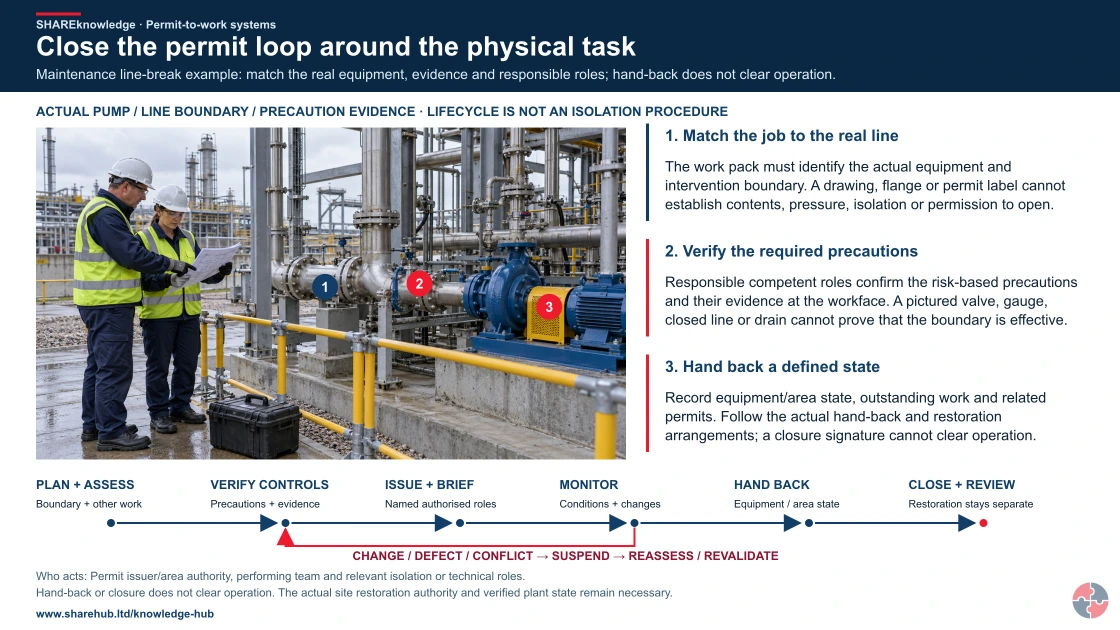
Full written explanation
A detailed realistic inactive pump and process-line workface shows an intact flange, connected valve/branch pipework, a pump coupling guard and two colleagues reviewing an unreadable drawing outside the equipment boundary. Native labels distinguish matching the job to the actual line, confirming competent evidence of required precautions, and handing back a defined equipment/area state. Beneath the same connected physical context, one complete native lifecycle links planning/assessment, field verification, issue/briefing, monitoring, hand-back and close/review. A distinct red return connection from monitoring to verification represents suspension and reassessment/revalidation when conditions, defects or other work conflict with the permit. It is a task-control communication model, not a valve, isolation, gas-test, confined-space, rescue or restart procedure. Hand-back and closure do not confer operating clearance: actual restoration authority and verified plant state remain separate. The source's full lifecycle, actual roles, four written checks, risk-based isolation requirements, changed-condition hold and original cases remain unchanged. No specific system scheme, asset identity, passing-valve diagnosis, blocked-drain finding, test criterion or permission is inferred from the photograph.
Maintenance line-break example: match the real equipment, evidence and responsible roles; hand-back does not clear operation.
- Plan the work and interfaces. Assess the job, people, isolations, simultaneous work and hand-back requirements.
- Verify before issue. The responsible roles confirm actual controls and tests; record the correct work boundary.
- Brief and monitor. The team understands limits; changes, defects and conflicting work trigger suspension/review.
- Hand back and close. Confirm the equipment and area state, reconcile permits and use the controlled restoration process.
When the evidence does not fit: Reality does not match the permit: suspend affected work, protect the area and resolve the discrepancy before authorised reissue/restart.
Who acts: Permit issuer/area authority, performing team and relevant isolation or technical roles.
Changed workplace
Process hot work: Coordinate ignition, atmosphere and adjacent work rather than checking signatures alone.
Maintenance line break: Verify the real isolation and contents; an assumed drained line may still contain pressure or liquid.
Evidence check: A permit cannot make a passing valve tight or a blocked proving route effective.
Primary references: HSE: permit-to-work roles, linked jobs and hand-over · HSE HSG250: permit-to-work system guidance overview · HSE HSG253: process-isolation guidance overview
Open the complete HD image (new tab)Download image

Primary references: HSE: permit-to-work roles, linked jobs and hand-over · HSE HSG250: permit-to-work system guidance overview · HSE HSG253: process-isolation guidance overview
A maintenance team is issued a permit to replace a pump gasket. The line is believed to be drained, but the drain valve is blocked and the upstream isolation valve passes. The permit lists 'line isolated' but the issuer has not witnessed zero pressure or confirmed the drain point. When the flange is loosened, liquid is released. The failure is not only worker error; it is a weak isolation and permit verification system.
A competent system would use an isolation plan, lock/tag control, drain/vent verification, residual-pressure check, correct PPE, spill containment, stop-work triggers and handback checks before the pump is returned to service.
At pump P-204, the permit boundary must identify the actual flange and both isolation points. The team verifies locks, drain and vent paths and zero pressure before opening the line. A blocked drain, passing valve, unexpected odour or residual pressure is a stop point: withdraw, make the area safe and replan isolation rather than treating leakage as normal. The issuer and acceptor then confirm guarding, cleanliness and controlled reinstatement before handback.
Pump P-204: line break and handback
Task material and setting: Replace a gasket on hydrocarbon pump P-204 at a fuel terminal during a planned shutdown.
People and prerequisites: Area authority, isolation authority, permit acceptor and maintenance team; current drawings and risk-based isolation scheme.
Before: Identify the exact flange and boundary, plan the isolation, drain and vent to a safe route, and check concurrent work.
During: Issuer and acceptor verify the field condition and test evidence; the team follows the authorised scope and monitors change.
Hold or stop: A passing valve, blocked drain, residual pressure, odour, gas alarm or conflicting operation suspends the job for reassessment.
Completion and hand back: Check guarding, cleanliness and controlled removal of isolation before authorised plant return.
Evidence: Permit, isolation certificate, test record, field check, stop/reissue history and signed handback.
What evidence shows a permit system is working?
Evidence should prove that permits are specific, field-verified, understood, monitored and audited.
Evidence should be read as a chain rather than a filing exercise. A single record rarely proves good management on its own; stronger assurance comes from matching records, observations, interviews, trends and verified action closure.
| Evidence | What it should show | Weakness to challenge |
|---|---|---|
| Permit register | All permits visible, valid, coordinated and closed. | Expired or duplicate permits. |
| Field verification | Issuer/acceptor inspected real conditions. | Desk-issued permits. |
| Isolation certificates | Energy and substances isolated, locked, tagged and verified. | Permit says isolated without certificate. |
| Gas testing records | Instrument, location, time, result, competence and retest frequency. | Single gas test used for changing conditions. |
| Toolbox talk/sign-on | Work team understood scope, controls and stop conditions. | Names signed without briefing. |
| Permit audits | Quality of scope, controls, field reality and handback checked. | Audit counts permits but not quality. |
| Learning loop | Permit findings feed training, procedures and risk controls. | Same findings repeat. |
Which legal duties support permit-to-work systems?
These duties require risks to be assessed and controlled; a permit may be an appropriate part of the safe system for selected high-risk tasks. See HSE permit-to-work principles
These duties require risks to be assessed and controlled; a permit may be an appropriate part of the safe system for selected high-risk tasks.
| Duty or regulation | What it requires | How to apply it |
|---|---|---|
| Health and Safety at Work etc. Act 1974 | Requires safe systems of work, information, training and supervision. | Use permits as part of a safe system for high-risk, non-routine or interacting work. |
| Management of Health and Safety at Work Regulations 1999 | Requires risk assessment, preventive arrangements, competence and emergency procedures. | Link permit issue to task risk assessment, isolation, competence, monitoring and handback. |
| Confined Spaces Regulations 1997 | Requires avoidance of entry where possible and safe systems where confined-space work is necessary. | Use permit controls for entry, isolation, atmosphere testing, rescue and communication. |
| Electricity at Work Regulations 1989 | Requires electrical systems and work to prevent danger. | Use specialist electrical permits only for equipment made safe for dead work. Keep site coordination separate from controlled testing and any separately justified live work; verify isolation and prove dead. |
| PUWER 1998 | Requires work equipment to be safe, maintained and used by competent people. | Control maintenance, guarding removal, energy isolation and restart through permits where risk justifies it. |
| DSEAR 2002 | Requires dangerous-substance fire and explosion risks to be assessed and controlled. | Use permits for hot work, gas testing, ignition control, hazardous areas and handback. |
| Confined Spaces Regulations (Northern Ireland) 1999 | NI confined-space entry and safe-system requirements. | Avoid entry where possible; verify isolation, atmosphere and rescue before authorisation. |
| Electricity at Work Regulations (Northern Ireland) 1991 | NI electrical work precautions and competence. | Use isolation and prove-dead controls, with live work justified and controlled. |
| Provision and Use of Work Equipment Regulations (Northern Ireland) 1999 | NI work-equipment suitability, maintenance and energy isolation. | Control intrusive maintenance and safe reinstatement. |
| Dangerous Substances and Explosive Atmospheres Regulations (Northern Ireland) 2003 | NI dangerous-substance fire and explosion risk duties. | Control ignition, atmosphere and interacting work. |
| Health and Safety at Work (Northern Ireland) Order 1978 | Sets general employer health, safety and welfare duties in NI. | Apply to NI work and protect workers and others from work risks. |
| Management of Health and Safety at Work Regulations (NI) 2000 | Requires NI work-risk assessment and preventive arrangements. | Plan and review task controls, competence and emergency arrangements. |
Relevant primary guidance: HSE - Guidance on permit-to-work systems HSG250
How should the control be managed and reviewed?
For a GB workplace, HSE guidance supports identifying the actual risk, taking practical protective steps and reviewing whether they work. Name the decision owner, check the control during the real task and correct a failed arrangement. Apply the separate Northern Ireland duties and guidance where the work is in NI.
GB management guidance: HSE managing health and safety
What training and awareness helps?
Permit training should be practical and role-specific, with field exercises and audit feedback.
Training should be role-based. General awareness creates a baseline, but supervisors, managers, advisers and senior leaders need different levels of decision-making, verification and escalation competence.
Assess issuers on a field walkdown: they must identify equipment, verify isolation evidence, find a conflicting permit and explain suspension and handback. Assess acceptors on briefing the team and recognising a changed condition. Gas testers and isolation authorities need task-specific practical authorisation. Keep assessor, result, authorisation and reassessment trigger, not attendance alone.
| Role | Learning and demonstration | Assessor | Record and reassessment |
|---|---|---|---|
| Work team and contractors | Read the exact scope, isolation boundary, live conditions and stop triggers; explain their own sign-on. | Permit acceptor observes a briefing. | Briefing and sign-on; repeat when site or task changes. |
| Permit acceptors and supervisors | Walk the equipment, challenge wrong tags or changed conditions, suspend and hand back safely. | Area authority witnesses a field exercise. | Assessed work pack and authorisation scope; reassess after a permit failure. |
| Issuers and area authorities | Verify isolation, SIMOPS, gas-test and handover evidence before release. | Permit system owner tests a live scenario. | Authorisation, assessment and audit sample; refresh after plant or rule change. |
| Isolation authorities and gas testers | Apply and prove the assigned isolation or test method within their technical scope. | Competent technical assessor observes practice. | Test and authorisation records; reassess after equipment, method or incident change. |
| Managers and auditors | Sample field reality against permit records, resolve recurring defects and fund barriers. | Technical lead challenges a sample audit. | Closed corrective actions and review minutes; repeat after trend deterioration. |
Relevant primary guidance: HSE - Guidance on permit-to-work systems HSG250
How could Crownway Fuels Ltd manage this in practice?

Crownway Fuels Ltd would use a permit to connect a specific job to verified precautions, competent people, live interfaces and a controlled suspension and hand-back.
Crownway Fuels Ltd · practical example
Control a pump repair across a shift change
The key lesson A permit coordinates defined work and precautions; it is neither a substitute for risk assessment nor proof that equipment is isolated.
The situation: A contractor is scheduled to repair a depot pump while deliveries continue elsewhere. The repair will cross a shift change. The important question is whether the agreed safeguards and coordination remain effective throughout the job.
Why this matters: The repair continues while people, conditions and adjacent activities can change. Keeping the permit connected to field verification and shift communication prevents a document from outliving the conditions on which it was issued.
How Crownway Fuels Ltd would manage it
- Define the work boundary — Maintenance Coordinator. Agree the exact equipment, task, limits and completion evidence with operations and the contractor. Identify related permits and simultaneous activities, including delivery movements and work on connected equipment.
- Prepare the precautions — Authorised permit issuer. Have the assessed isolations, tests, access restrictions and emergency arrangements established and verified through the site's approved system. The contractor's permit acceptor checks the workface and briefs the actual work party.
- Release the defined task — Authorised permit issuer and acceptor. Confirm the conditions, validity, communications and stop triggers together before work starts. A permit signature records that controlled decision; it does not establish an equipment state without the supporting verification.
- Control the shift change — Shift Supervisor. Keep the job status, linked controls and restrictions visible to the incoming shift. Suspend and revalidate or reissue the permit as the site's system requires; no crew assumes that yesterday's or another shift's permission remains valid.
- Hand back and close — Authorised operating authority. Confirm work completion, equipment condition, outstanding restrictions and the separate requirements for reinstatement. Close related controls in the agreed sequence and communicate the accepted status before dependent operations resume.
When the conditions change
- Recognise the trigger
- The job, work party, shift conditions or a linked precaution changes outside the permit’s agreed conditions.
- Make the immediate decision
- Work is stopped or suspended under the site system and made safe by the authorised people; related operations are informed.
- Verify the next step
- The issuer, acceptor and relevant operating authority complete the site’s required revalidation or new-permit process using verified conditions and an updated briefing.
What good looks like
The work party and incoming shift agree what is being worked on, which precautions apply, when work must stop and who can accept the return. A changed condition returns to the relevant control decision.
Evidence to look for: Current permit and linked certificates, work-party briefing, shift transfer or suspension record, verification evidence and accepted hand-back.
Common mistake to avoid: Assuming that possession of a signed permit, or pressing Stop, establishes safe access to the pump.
Apply this to your work: Could the incoming shift explain the status of every open job without relying on the outgoing person's memory?
Guidance behind the management approach: HSE HSG250: permit-to-work systems. Use the topic's legal and technical guidance for the applicable work and location.
At a fuel terminal, permits control hot work, line breaking, tank entry, electrical isolation, work at height, excavation and contractor maintenance. Crownway would integrate permit issue with isolation certificates, gas testing, SIMOPS reviews, shift handover and field audits.
| Management element | How the business would manage it | Evidence to review |
|---|---|---|
| Screen | Decide permit type and risk level. | Permit matrix. |
| Plan | Define job, hazards, isolations, tests and emergency controls. | Work pack. |
| Issue | Field-verify controls with issuer and acceptor. | Signed permit and briefing. |
| Monitor | Check SIMOPS, gas retests and stop conditions. | Area authority log. |
| Learn | Audit permits and track repeat findings. | Permit assurance dashboard. |
How does this topic align with ISO 45001?
Use these examples to connect the relevant clauses to your own occupational health and safety management system. For each clause, identify the person responsible, the control in use and the evidence that it works.
Scroll across the table to read all four columns.
| ISO 45001 clause | How it applies | What to put in place | How to verify it works |
|---|---|---|---|
| 8.1.1 Operational planning and control | A permit translates the job assessment into conditions that the issuer and work team can check at a particular location and time. | Set criteria for issue, suspension and hand-back. Before releasing the job, confirm the work scope, linked isolations and conflicts with nearby work or deliveries, and identify who can resolve them. | Follow an active pump-repair permit from issue to the worksite. Check that the recorded boundary and controls match conditions and that concurrent operations were considered. |
| 7.4.2 Internal communication | A shift change creates a communication risk when equipment stays out of service, a permit is suspended or a contractor is expected back. | Require outgoing and incoming operations staff to review active and suspended permits, linked isolations and restrictions together. Define who informs the contractor of changes and who can authorise a restart. | Sample an overnight handover and check that incoming staff can explain the job status, the restrictions still in force and the decision needed before work resumes. |
| 9.1.1 Monitoring and evaluating performance | Monitoring a permit system should show whether the agreed controls reach the job and remain effective as conditions change. | Observe live work and sample suspended and completed permits. Track recurring problems such as unclear scope, missed checks or incomplete hand-back, and review whether changes to the system improve the results. | Compare a sample of permit records with site observations and follow one repeated problem through the review and a later check. |
Selected applications of ISO 45001:2018 with Amendment 1:2024. Use the current standard for a full assessment and check the legal duties that apply to the work and location.
ISO 45001:2018 · 2024 climate action amendment · ISO 45002 implementation guidance · ISO technical committee clause FAQ
What should a permit review establish before work on a fuel system?
Locate the work and its connected systems, then distinguish the reviewed controls from appearance. The example is not an issued permit or a step-by-step hazardous-work method.
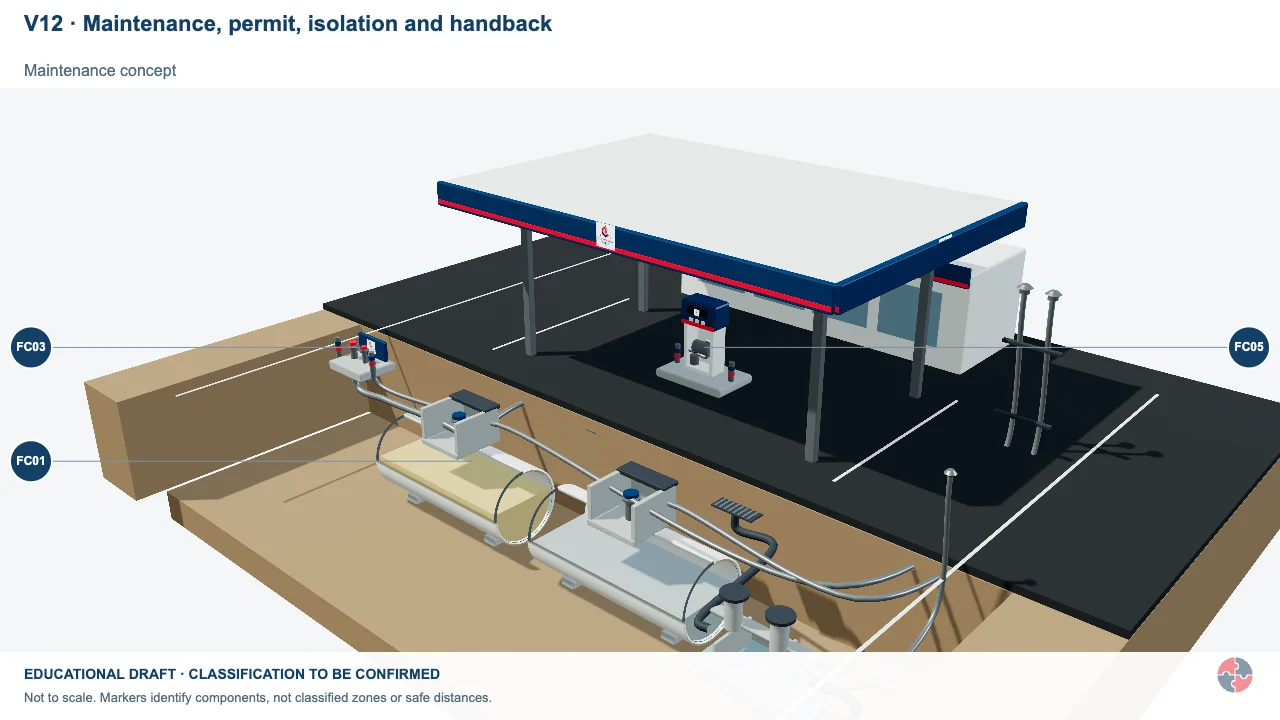
Maintenance, permit, isolation and handback
Maintenance changes the task and may open systems that are closed during normal use.
Activity focus: Inspect the work boundary, nearby live activities and responsibility for restoring the installation.
Educational illustration, not to scale. Coloured zones are teaching examples, not a site-specific hazardous-area classification.
What do the acronyms and key terms mean?
Acronyms should be understood before they are used in assessments, briefings, audits or learning answers.
Acronyms can exclude newer readers if they are not explained. This section keeps the main terms available at the end of the page so the article stays readable while still supporting learners and audit users.
| Acronym | Meaning | Plain-English use |
|---|---|---|
| PTW | Permit-to-Work | Formal authorisation system for specified high-risk work. |
| SIMOPS | Simultaneous Operations | Different tasks or operations occurring at the same time and affecting each other. |
| LEL | Lower Explosive Limit | Lowest concentration of flammable vapour/gas in air that can ignite. |
| DSEAR | Dangerous Substances and Explosive Atmospheres Regulations | GB and NI have separate dangerous-substances and explosive-atmospheres instruments; use the one for the work location. |
| LOTO | Lockout/Tagout | Control of hazardous energy through locks, tags and isolation. |
Which BuildOut documents support this topic?
Download individual editable BuildOut documents for this topic. Procedures and plans contain completed arrangements; forms, checklists, assessments, RAMS and permits are blank masters. Registers include separate worked examples.
| Document | Purpose and content | Editable download |
|---|---|---|
| Permit issue, suspension, handover and cancellation procedure BOUK-PRO-PTW · Completed worked example · v1.0 | Identify permit interfaces, competence, isolations, simultaneous operations and restoration. | Download DOCX Read preview |
| Permit register and simultaneous-operations board BOUK-REG-PTW-01 · Blank register with separate worked entries · v1.0 | Coordinate active permits, isolations, interfaces and shift handovers. | Download XLSX Read preview |
| General high-risk work permit BOUK-PTW-PTW-01 · Blank editable master · v1.0 | Document work boundary, prerequisites, controls, time validity and accountable release. | Download DOCX Read preview |
| Isolation certificate and lock register BOUK-FRM-PTW-01 · Blank editable master · v1.0 | Record energy source, isolation point, lock owner, verification and restoration. | Download DOCX Read preview |
| Permit suspension, handover and cancellation record BOUK-FRM-PTW-02 · Blank editable master · v1.0 | Control temporary stop, personnel/shift change and final safe handback. | Download DOCX Read preview |
| Permit-system audit and field verification BOUK-CHK-PTW-01 · Blank editable master · v1.0 | Test whether permits match actual site conditions and controls. | Download DOCX Read preview |
Review and adapt the documents for your organisation, activities and jurisdiction before approval and issue. Open the SHAREms management-system hierarchy to find each document under its parent policy.
Which Crownway Fuels documents support this topic?
Open an editable document, read the preview, or find its place in the Crownway hierarchy. 7 resources relate to this page.
Fictional Crownway Fuels examples for English forecourts, with a separate illustrative bulk terminal. Check site applicability, permissions and actual controls before adapting any document for use.
Permit to work and simultaneous operations policy (7)
- Permit to work and simultaneous operations policy (CWF-POL-PTW · Completed fictional example)
Set company expectations, responsibilities and resources for permit to work and simultaneous operations.
Read preview · Download DOCX · Show in hierarchy - Permit to work and simultaneous operations procedure (CWF-PRO-PTW · Completed fictional example)
Explain who does what, in what sequence, the control rationale, evidence, escalation and safe restart conditions.
Read preview · Download DOCX · Show in hierarchy - Active permits and simultaneous operations board (CWF-REG-PTW-01 · Blank register with separate fictional worked entries)
Provide the site/task-specific active permits and simultaneous operations board and retain its controlled output.
Read preview · Download XLSX · Show in hierarchy - General hazardous work permit (CWF-PTW-PTW-01 · Blank editable master)
Provide the site/task-specific general hazardous work permit and retain its controlled output.
Read preview · Download DOCX · Show in hierarchy - Simultaneous operations and live trading assessment (CWF-RA-PTW-01 · Blank editable master)
Provide the site/task-specific simultaneous operations and live trading assessment and retain its controlled output.
Read preview · Download DOCX · Show in hierarchy - Permit issue suspension handover and closure check (CWF-CHK-PTW-01 · Blank editable master)
Provide the site/task-specific permit issue suspension handover and closure check and retain its controlled output.
Read preview · Download DOCX · Download PDF · Show in hierarchy - Permit to work quality and field compliance audit (CWF-AUD-PTW-01 · Blank editable master)
Provide the site/task-specific permit to work quality and field compliance audit and retain its controlled output.
Read preview · Download DOCX · Show in hierarchy
Unlock another resource
You have used this month’s two free downloads. Publish a post in your own words to unlock one more resource, or choose SHARE Individual for 10 downloads per month.
You decide whether to share. If you do, use the relevant platform disclosure tools and do not make claims you do not genuinely hold.