SHARE Knowledge Hub
Work Equipment General Requirements
Work equipment must suit the task and workplace, remain stable and guarded, and be used, maintained and inspected by people with the right information and competence. A product mark or completed form does not prove safety during cleaning, adjustment or a changed task. Check the actual machine, controls and work area, prevent access to danger and stop use when a critical safeguard fails.
Understanding Work Equipment General Requirements
PUWER is the central Great Britain framework for equipment provided or used at work. It covers far more than machinery operation: selection, installation, setting, programming, adjustment, transport, cleaning, maintenance and repair all count. The core question is whether the equipment is suitable and can be used without exposing anyone to avoidable danger in its actual workplace and operating modes.
Why this matters at work
Select and verify safeguards with competent machinery input and the manufacturer's information. Ensure protection does not create additional trapping, visibility or handling problems and that it remains effective during actual use. Check damage, bypassing, defeated interlocks and whether a reset can cause unexpected movement. Record faults and remove affected equipment from use until safety is restored. Do not invent a reach distance or interlock category for an unspecified machine. Reassess any modification and provide a safe isolated method for tasks that require access beyond normal protection.
Obtain a suitable replacement or competent repair and verification before release. Confirm the replacement is appropriate for the supply, location and materials and that operators understand the safe method. Record the equipment identity, defects, unavailable status and supplier response, including what the next shift needs to know. Review receipt and pre-use arrangements to prevent recurrence. Check whether transport or site conditions caused the damage and whether similar equipment is affected. Do not treat hire ownership as a reason for the host employer to ignore equipment condition or allow use while the responsibility dispute is resolved.
How organisations manage this in practice
Provide appropriate controls to bring equipment to a safe condition in a safe manner. Stop controls should have priority over start controls, and stopping the equipment or relevant parts should remove energy where appropriate. The required stopping function depends on the process: uncontrolled power removal can itself create danger for some brakes, loads or chemical processes.
Identify normal stop, controlled stop, emergency stop and isolation as distinct functions. Confirm that the person can reach the control, that the hazardous motion ceases soon enough, and that associated feed or downstream machinery is coordinated. A stop button does not dissipate residual pressure or prevent gravity movement.
Review inspection when the task, installation, location, environment or rate of use changes, or after damage, modification, exceptional events or evidence of deterioration. The purpose is to detect problems before they create danger, so the interval and detail should reflect how the equipment can fail. Manufacturer advice, operating experience and competent judgement help establish suitable arrangements. Not every item needs the same checklist or an annual engineering examination.
The workplace changes the equipment decision
Suitability depends on task, people and place as well as the machine. Keep four connected lifecycle duties distinct from specialist and product-supply requirements.
Support and access
Review stable support, operating and maintenance access, movement and emergency interfaces in the actual location.
Lighting and controls
Check glare, task lighting and readable controls with intended users; no generic clearance or lux value is supplied.
Applicable duties
Check baseline use, specialist regimes, cold-metal power presses and product supply separately; a conformity mark is not workplace approval.
Correct and verify
Hold affected use until the relevant owner verifies the actual arrangement. Inspection, intervention, controlled testing and production release remain distinct.
Read the complete task-specific control examples
ERICPD is a planning cross-map: Discipline verifies and sustains every control. ESEAP compares effectiveness. A label does not authorise the task; retain the owner, evidence and stop or change decision.
Work Equipment General Requirements · ERICPD
- Eliminate
- Design out a need to reach into hazardous equipment for feeding, clearing or adjustment, where practicable.
- Reduce
- Specify equipment that fits the task, material, users and conditions, with safer feeding and accessible maintenance arrangements.
- Isolate
- Fit appropriate guarding and protective devices, stable supports and effective controls for the actual hazards.
- Control
- Provide usable information, instruction, competent authorisation and inspections suited to risk.
- PPE
- Select compatible task-specific PPE for residual noise, particles or other assessed exposure; check fit and condition and whether PPE creates a machine hazard.
- Discipline
- Maintain protective functions, inspect on relevant triggers and review after changes, damage or incidents.
Work Equipment General Requirements · ESEAP
- Elimination
- Design out a need to reach into hazardous equipment for feeding, clearing or adjustment, where practicable.
- Substitution
- Specify equipment that fits the task, material, users and conditions, with safer feeding and accessible maintenance arrangements.
- Engineering controls
- Fit appropriate guarding and protective devices, stable supports and effective controls for the actual hazards.
- Administrative controls
- Provide usable information, instruction, competent authorisation and inspections suited to risk.
- PPE
- Select compatible task-specific PPE for residual noise, particles or other assessed exposure; check fit and condition and whether PPE creates a machine hazard.
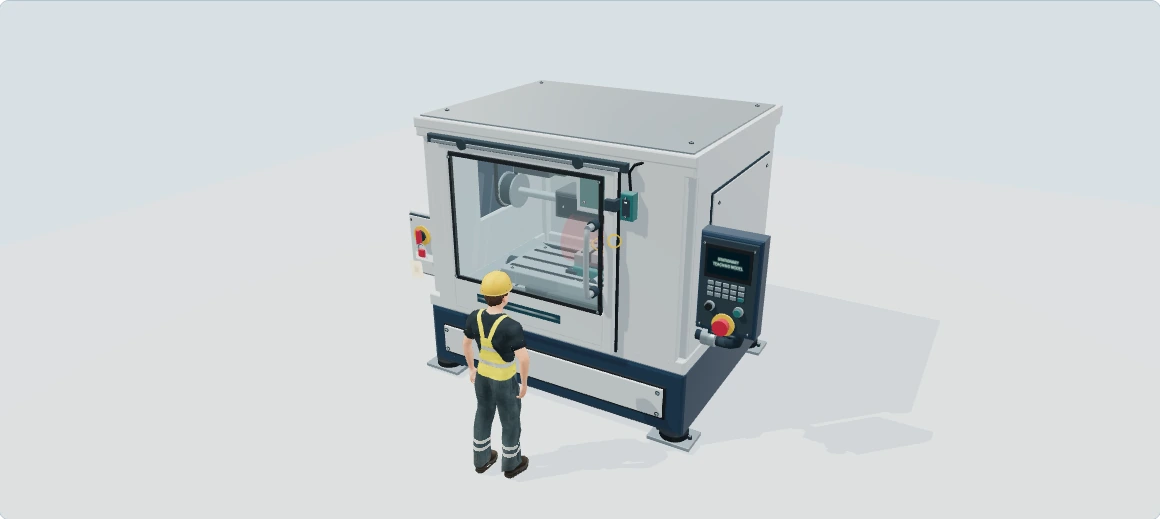

Machinery guarding: trace the energy to the harm
Explore the working zone, guards, interlock, transmission, controls and energy isolator. Compare production work, cleaning and maintenance without treating a stopped machine as safely isolated.
Checksheets and risk assessments
Risk assessment forms
Risk assessment examples
Forms and tools
Full written walkthrough — all 8 steps
1. Identify the dangerous movement
What is happening: The cutaway exposes the workholding and cutter so you can inspect where contact could occur. It does not open or enable the real machine.
How harm can occur: A cutter can sever tissue; rotating parts can wind in hair or clothing; moving workholding can crush a hand.
Best practice to apply: Identify the task, all exposed people and the machinery’s intended operating limits. Keep the actual danger zone inaccessible.
2. Inspect the enclosure and access
What is happening: Inspect the enclosure, viewing panel and access edges. The visual cutaway changes only the drawing.
How harm can occur: A missing, damaged or unsuitable guard may allow reach into dangerous movement or fail to contain an ejected item.
Best practice to apply: Check the actual guard, fixing, condition and suitability. Do not infer reach distances or containment performance from this model.
3. Understand an interlock’s role
What is happening: The access interlock is a separate protective function. Its presence does not establish the reliability or stopping performance of the actual system.
How harm can occur: Defeating an interlock can permit access while hazardous movement is possible. Run-down may continue after a stop request.
Best practice to apply: Verify required protective functions through competent assessment and maintenance. Do not bypass them or use the cutaway as a working configuration.
4. Find the transmission hazards
What is happening: Inspect the drive and the cover around it. Dangerous movement can exist beyond the obvious working point.
How harm can occur: Belts, pulleys and rotating shafts can entangle, draw in or trap people during production or servicing.
Best practice to apply: Keep appropriate transmission guarding in place. Plan access and maintenance with the equipment information and actual energy sources.
5. Separate control stops from isolation
What is happening: The control panel and emergency stop act through control functions. The energy isolator is physically separate.
How harm can occur: A stopped display may conceal live energy or allow an unexpected restart; an emergency stop does not remove every energy source.
Best practice to apply: Use the required stop arrangements for operation and the actual safe isolation procedure for intrusive access.
6. Control hazardous energy for access
What is happening: Locate the separate isolator and the points where electrical, pneumatic, hydraulic, gravitational or mechanical energy may remain.
How harm can occur: Unexpected energisation, stored pressure or a falling component can cause shock, crushing or impact.
Best practice to apply: Identify, isolate, secure and verify the relevant energies using competent task-specific arrangements. The pictured lock is not proof that a machine is safe.
7. Plan cleaning and material handling
What is happening: Consider how material is loaded, held, removed and cleaned without bringing a person into danger.
How harm can occur: An inadequately held item can be ejected; reaching to clear swarf or a blockage can expose hands and clothing.
Best practice to apply: Use suitable workholding and handling methods. Stop and follow the safe system when a blockage or abnormal condition occurs.
8. Protect the people around the machine
What is happening: The operator’s work position and surrounding access affect people other than the person at the controls.
How harm can occur: Visitors, cleaners and nearby trades may enter a danger area or be struck by an ejected item.
Best practice to apply: Check layout, access, instruction, competence and supervision. Review the machine after changes and before returning it to service.
Illustrative awareness learning. The model does not design equipment, authorise work, verify safe conditions or complete a real inspection.
The wider workplace has its own account and subscription access. Exploring this lesson does not grant access, record course completion or authorise work.
How can I practise this topic in 3D?
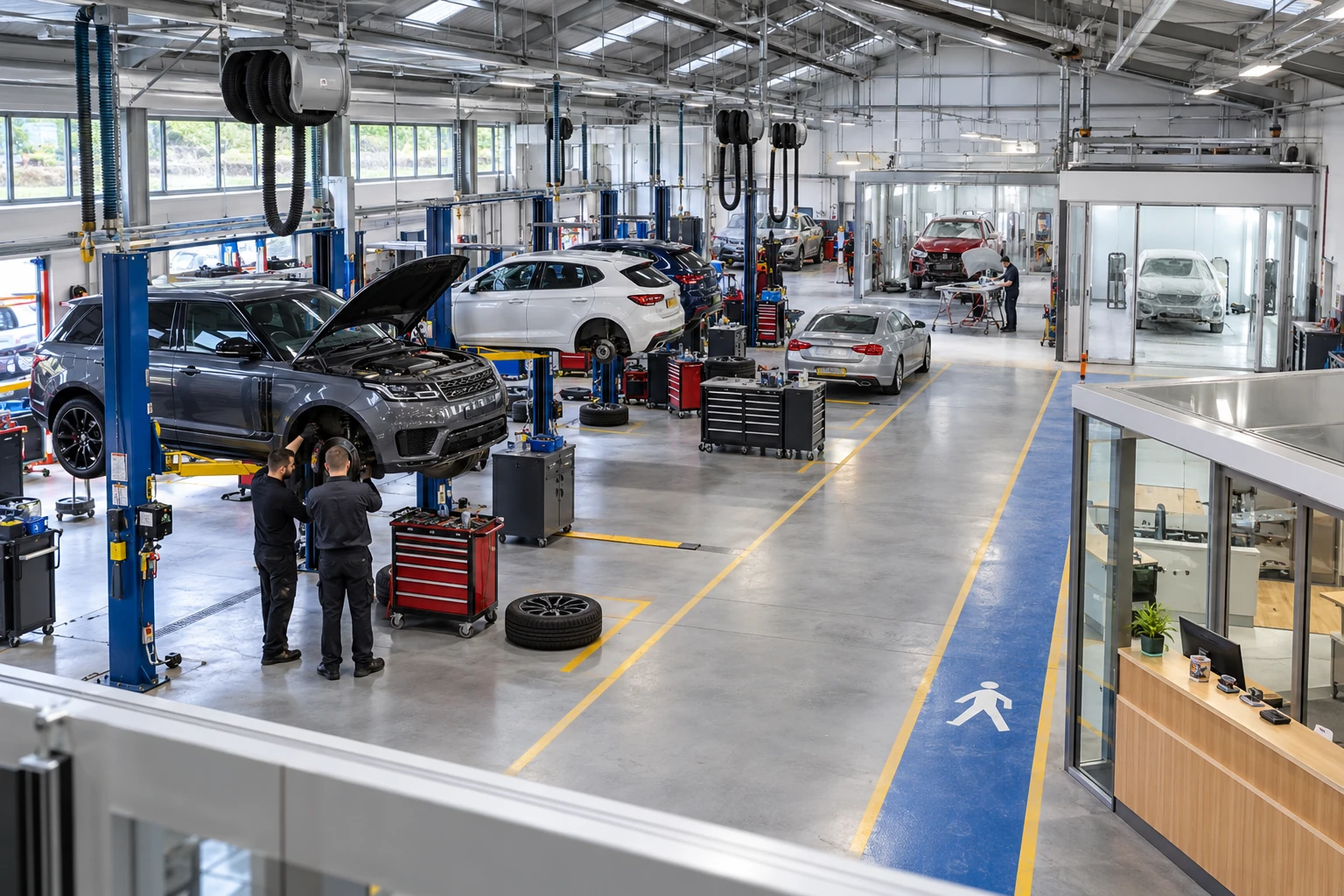
Grinding with an unsuitable wheel setup
All related inspection points 1 across 1 location
Garage workshop 1 inspection point
Practice in the SHAREhub environment. Browser practice is separate from workplace competence and formal learning records.
What should a worker do before using work equipment?
Confirm the equipment is the right type for the task, check guards and controls, inspect for obvious damage, understand the safe method and emergency response, keep others clear, and stop if condition or permission is uncertain.
Do not begin because the equipment ran yesterday, carries a conformity mark or belongs to a contractor. Check any recorded limitation, attachment, inspection status and local authorisation that the task actually requires.
| Before start | During use | At completion |
|---|---|---|
| Identify equipment and task. | Use within assessed conditions. | Stop safely and leave controlled. |
| Check guards, controls and condition. | Watch for change or defect. | Report defects and hand back. |
| Confirm competence and area. | Keep others protected. | Record any hold or release. |
How can ordinary equipment use become serious harm?
A hand, body or bystander can reach a dangerous moving part, be struck by ejected material, or be caught by unexpected movement. Maintenance, set-up and clearing jams can remove normal safeguards just when someone is closest to stored energy.
Trace the task, energy source, access route and foreseeable intervention. Check whether the guard, interlock, isolation and restart control work in the actual work area, not only in the purchase file.
| Task and exposure | Possible harm | Control and stop point |
|---|---|---|
| Feeding or cleaning a powered cutter | Hand reaches a blade or drawing-in point; amputation or crush injury can follow. | Use fixed or interlocked guarding and a safe method; stop if the guard can be bypassed. |
| Clearing a jam | Stored energy or an automatic restart moves the mechanism while a person is inside. | Isolate and verify the equipment-specific zero-energy or safely restrained state before access, controlling every energy source and verifying dissipation or engineered restraint; do not restart until a named release check. |
| Using unstable or damaged equipment | Tip-over or ejection strikes operator or bystander. | Choose stable equipment, control the area and quarantine defects. |
What counts as work equipment and use?
Work equipment includes machinery, appliances, apparatus, tools and installations used at work, while use includes starting, stopping, programming, setting, transporting, repairing, modifying, maintaining, servicing and cleaning.
A hand tool, office appliance, machine line, scaffold component, ladder, lift truck or process installation may be work equipment. The applicable controls depend on the actual use and risk, not the label or purchase value.
Tool or appliance. Why it is in scope: Used to perform work.; Decision: Suitability and safe use.
Machine or installation. Why it is in scope: Creates mechanical or other energy hazards.; Decision: Guarding, controls and lifecycle evidence.
Cleaning or adjustment. Why it is in scope: It is use under Provision and Use of Work Equipment Regulations (PUWER).; Decision: Safe state and competent method.
Transport or modification. Why it is in scope: Can change condition or risk.; Decision: Planning, inspection and change control.
Which general PUWER duties must be checked?
For the actual task, check suitability, condition, safeguards, controls, isolation, inspection, maintenance, competent users and safe intervention. A power press used for working cold metal needs a separate applicability check for GB PUWER Part IV or the corresponding Northern Ireland provisions, including exclusions; general PUWER controls alone are not a release decision.
In Great Britain the baseline map is principally PUWER 1998 regulations 4 to 24, with separate Part IV power-press provisions in regulations 31 to 35. Northern Ireland has its own PUWER 1999 route. Check the actual press, use, safeguards and legal scope with a competent specialist; this matrix sets no universal examination period, test method or authority to operate.
| Decision group | Practical question | Evidence or hold |
|---|---|---|
| Suitability and condition | Is it fit for this task and environment and kept safe? | Specification, assessment, maintenance and applicable inspection. |
| People and access | Who may use, set, clean, inspect or maintain it? | Information, training, restriction and supervision. |
| Danger and controls | Can anyone reach danger or be hit by ejection, rupture or uncontrolled movement? | Safeguards, controls, tests and stop criteria. |
| Place and communication | Is it stable, lit and understood? | Installation, workspace, markings and warnings. |
| Intervention and release | Can it be isolated and restored safely? | Energy control, planned tests and named handback. |
How do workplace-use duties differ from product-supply duties?
PUWER controls equipment provided or used at work; product-supply rules govern placing products on a market. A CE, UK Conformity Assessed (UKCA) or CE and UK Northern Ireland (UKNI) route does not by itself prove workplace suitability, correct installation or safe use.
Choose the GB or NI market route and the product sector before relying on conformity documentation. Separately complete workplace selection, risk assessment, guarding, installation, competence, inspection and maintenance decisions.
Who will use it and for what? Workplace-use route: PUWER and other workplace law.; Product-supply route: Not the main market decision.
May this product be placed on this market? Workplace-use route: Does not answer safe-use question.; Product-supply route: Current GB or NI sector rules.
Was it modified or assembled? Workplace-use route: Reassess safe use.; Product-supply route: May create manufacturer obligations.
Which hazards must the equipment assessment cover?
Assess mechanical contact and ejection together with electrical, pressure, thermal, chemical, ergonomic, noise, vibration, fire, explosion, mobility, stability and work-at-height hazards that the equipment or task can create.
Consider normal production, foreseeable abnormal events, clearing blockages, tool change, cleaning, testing, breakdown, maintenance and recovery after a stop. People nearby can be exposed even when they do not operate the equipment.
Mechanical. Examples: Crushing, shearing, cutting, entanglement, drawing-in, ejection.; Control question: Can access or energy be prevented?
Energy. Examples: Electricity, pressure, gravity, heat, stored motion.; Control question: Can every source be isolated and dissipated?
Exposure. Examples: Dust, fume, noise, vibration, substances.; Control question: Which separate regime and source control apply?
Context. Examples: Mobility, stability, falls, traffic, fire.; Control question: What environment and interface change the risk?
How should work equipment be controlled across its life?
Control starts with need and specification, continues through purchase or hire, acceptance, installation, use, inspection, maintenance and change, and ends with safe decommissioning or disposal.
Treat each transfer as an evidence gate. A check at purchase does not cover later deterioration, modification, relocation, new attachments, changed users or a different environment.
Select. Critical question: Is this the right equipment and control concept?; Evidence: Specification and risk decision.
Accept and install. Critical question: Is identity, condition and setup proven?; Evidence: Acceptance and commissioning.
Use and maintain. Critical question: Does it remain safe in real work?; Evidence: Checks, defects, maintenance and inspection.
Change or retire. Critical question: Has risk changed or energy been removed?; Evidence: Change review or decommission record.
How should suitable equipment be selected?
Select equipment that is suitable for the intended task, people, environment, loads and conditions, with risks controlled by design and compatible guards, controls, attachments and information.
Prefer eliminating hazardous operations or choosing safer equipment before adding procedural controls. Include cleaning, maintenance, access, foreseeable misuse and emergency recovery in the selection decision.
Task and capacity. Question: Can it do the work within maker limits?; Reject or hold when: Duty or attachment is unclear.
People. Question: Can intended users operate and maintain it safely?; Reject or hold when: Access, reach or competence is unsuitable.
Environment. Question: Is it suitable for wet, dusty, explosive or public conditions?; Reject or hold when: Protection or compatibility is unproven.
Lifecycle. Question: Can it be inspected, isolated and maintained?; Reject or hold when: Safe intervention cannot be achieved.
What should a purchase or hire specification contain?
Specify the real task, materials, environment, users, foreseeable interventions, required safeguards, information, inspection and maintenance support, and the evidence needed before acceptance.
Do not procure from a catalogue description alone. Ask how the equipment will be installed, guarded, isolated, cleaned, maintained, moved, integrated and withdrawn from service.
Intended use. Procurement evidence: Duty, workpiece, environment and interfaces.; Acceptance gate: Matches actual work.
Safeguards. Procurement evidence: Guarding and control philosophy.; Acceptance gate: No accessible danger zone in assessed use.
Support. Procurement evidence: Instructions, parts, maintenance and competence needs.; Acceptance gate: Organisation can sustain safe use.
Market route. Procurement evidence: Applicable conformity and supplier documents.; Acceptance gate: Correct market and product sector.
How should equipment be accepted before first use?
Verify identity, condition, documentation, correct market route where relevant, intended use, guards, controls, accessories, installation needs, inspection status and support before the equipment enters service.
Record deviations and quarantine anything damaged, incomplete, unexpectedly modified or unsupported. Delivery paperwork alone is not a commissioning record.
Identity and specification. Evidence: Model, serial or asset reference and intended duty.; Hold point: Mismatch or unknown origin.
Condition and completeness. Evidence: Damage check, guards, accessories and instructions.; Hold point: Missing or damaged safety part.
Legal and support route. Evidence: Applicable supplier documents and service support.; Hold point: Wrong market route or no critical information.
Workplace readiness. Evidence: Installation, risk assessment and training plan.; Hold point: Site prerequisites absent.
What should installation and commissioning prove?
Commissioning should prove that the equipment is stable, correctly assembled and located, connected to safe services, guarded, controlled, isolated, documented and able to perform the intended task without creating uncontrolled risk.
Test safeguards and abnormal responses without exposing people. Integration with other machines, extraction, traffic routes or control systems needs a whole-system review.
Physical installation. Question: Is it stable, secure and safely accessible?; Evidence: Installation inspection.
Safeguards and controls. Question: Do guards, interlocks and stops work as intended?; Evidence: Functional test.
Energy and isolation. Question: Can all sources be safely controlled?; Evidence: Isolation test and diagram.
Operational handover. Question: Are method, competence and maintenance ready?; Evidence: Commissioning and release record.
What does a conformity mark prove?
A conformity mark supports the applicable product-supply process; it does not prove that equipment is suitable for a particular workplace, correctly installed, maintained, guarded for every task or safe after modification.
In Great Britain, current guidance recognises UKCA and CE routes within their stated scope. In Northern Ireland, use the current CE or CE and UKNI route as applicable. Always check sector-specific rules and current dates.
| Evidence | What it supports | What it cannot replace |
|---|---|---|
| Declaration and marking | Product-supply conformity route. | Task suitability and risk assessment. |
| Instructions | Intended use and residual risk information. | Safe local installation and supervision. |
| Workplace acceptance | Condition and integration at the site. | Required ongoing maintenance and inspection. |
What about stability, lighting and working space?
Secure or stabilise equipment as needed, provide lighting adequate for the work and its hazards, and arrange enough safe space for use, access, cleaning and maintenance without exposing people to moving parts or traffic.
A machine that is suitable in one place may be unsafe on a different floor, outdoors or beside another operation. Check foundations, restraints, access, visibility, shadows, glare, weather and adjacent activity with competent input where necessary.
| Condition | Assessment question | Stop or redesign |
|---|---|---|
| Stability | Could it tip, slide or shift in operation or intervention? | Unknown support or restraint. |
| Lighting | Can controls, hazards and markings be seen? | Poor visibility or glare. |
| Workspace | Can the task and intervention be done without entering danger? | Blocked access or unsafe reach. |
What belongs in a pre-use check?
A pre-use check should cover visible condition, correct setup and attachment, guards and protective devices, controls, cables or hoses, stability, work area and any equipment-specific indicator identified by the assessment or manufacturer.
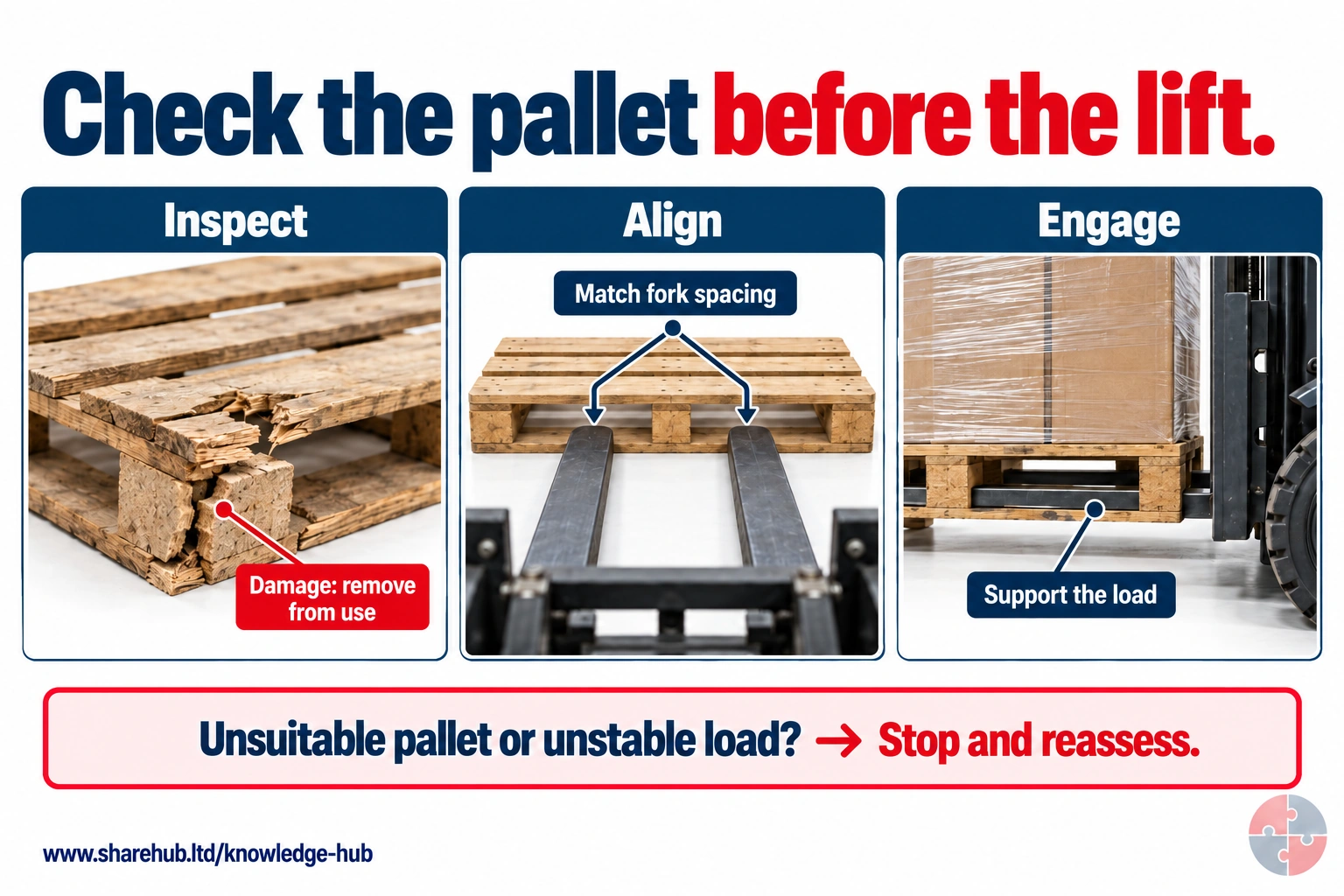

Pallet condition, correct fork entry and load support are checked together before lifting.
What should happen if a load-bearing pallet board is damaged?
Do not proceed on the assumption that careful fork positioning will compensate; remove the unsuitable pallet from use and reassess.
Equipment, pallet type and load requirements determine the correct handling method.
Source guidance: HSE HSG76
A quick user check is not a substitute for a formal inspection. Its content and record depend on risk, equipment and the organisation's system; do not invent a universal checklist or sign-off interval.
| Check | Example observation | Action |
|---|---|---|
| Condition | Damage, wear, leakage or loose part. | Stop and report if safety may be affected. |
| Safeguards | Guard or device missing, open or defeated. | Do not use; quarantine. |
| Controls | Start, stop or indication abnormal. | Hold pending competent decision. |
| Area and task | Wrong attachment, unstable base or people exposed. | Correct conditions before start. |
How should equipment be monitored during use?
Use equipment only for the assessed task and conditions, keep safeguards in place, maintain exclusion and stability, watch for abnormal sound, movement, heat, vibration, leakage or control response, and stop before investigating a change.
Do not reach through a guard, defeat a device, clear a blockage live or rely on familiarity. A change in material, attachment, operator, environment or production method can invalidate the starting decision.
Unexpected movement or ejection. Immediate response: Stop from a safe position.; Next decision: Quarantine and investigate.
Guard or device changes state. Immediate response: Stop work and keep clear.; Next decision: Competent safeguarding review.
Abnormal noise, heat or vibration. Immediate response: Stop without close diagnosis.; Next decision: Maintenance assessment.
Task or environment changes. Immediate response: Pause the job.; Next decision: Reassess method and suitability.
What should happen when work finishes?
Stop the equipment through the defined sequence, leave moving and stored energy controlled, clean without entering danger, record defects or restrictions, and hand back the equipment and area in a known state.
Completion is not permission for maintenance. Any intervention requiring access to danger or stored energy needs its own isolation and authorised method.
Normal stop. Expected state: Movement ceases through intended control.; Evidence: User observation.
Secure and clean. Expected state: No unintended access, restart or unsafe residue.; Evidence: Task completion check.
Report. Expected state: Defects and restrictions are visible to the next user.; Evidence: Tag, log or handover.
Hand back. Expected state: Named owner accepts status.; Evidence: Release or continued hold.
How can the hierarchy of controls reduce work-equipment risks before relying on user instructions?
Remove the hazard where reasonably practicable. If it remains, consider a safer method, engineering controls and safe work arrangements before personal protective equipment for residual risk.
HSE places elimination, substitution, engineering, administrative controls and personal protective equipment in that order. Verify that the chosen controls work on the actual task.
ERICPD (Eliminate, Reduce including substitution, Isolate, Control, personal protective equipment (PPE), Discipline) is a SHARE decision prompt cross-mapped to HSE’s five-level hierarchy. Choose stronger feasible controls first, verify them in the actual task and record why a stronger option cannot be used. Discipline means sustaining controls through maintenance, supervision and learning.
How can the ERICPD hierarchy of controls reduce work-equipment risks before relying on user instructions?

| ERICPD prompt | HSE relation | Actual measure | Owner, evidence and stop point |
|---|---|---|---|
| Eliminate | Elimination | Design out a need to reach into hazardous equipment for feeding, clearing or adjustment, where practicable. Consider use, cleaning and maintenance when deciding whether the hazardous step can be removed. | Designer and process owner verify the whole task sequence with operators and maintainers. Hold the original method if safe elimination has not been assessed. Basis: HSE PUWER overview; HSE Introduction to work equipment and machinery |
| Reduce, including substitution | Substitution or safer design | Specify equipment that fits the task, material, users and conditions, with safer feeding and accessible maintenance arrangements. Compare alternatives and assess new interfaces rather than treat product marking as proof of safe workplace use. | Purchaser and competent engineer review specifications, instructions and a realistic trial. Reject equipment that requires unsafe workarounds or cannot be adequately guarded and maintained. Basis: HSE PUWER guidance and topic index; HSE INDG229 Using work equipment safely |
| Isolate | Engineering where physical or technical separation is feasible | Fit appropriate guarding and protective devices, stable supports and effective controls for the actual hazards. Before intrusive maintenance, establish isolation and control stored energy under the approved procedure. | Competent engineer verifies protective functions, stability and installation; authorised maintainer proves the safe state. Stop if safeguarding, stability or energy control fails. Basis: HSE L22 Safe use of work equipment; HSE Maintenance of work equipment |
| Control | Administrative or organisational controls | Provide usable information, instruction, competent authorisation and inspections suited to risk. Make normal stops, emergency controls and handback arrangements understandable for actual users and foreseeable abnormal tasks. | Supervisor verifies pre-use condition and the worker’s ability to recognise limits and defects. Hold a changed or high-risk task without the right competence and safe method. Basis: HSE Training and competence for work equipment; HSE Inspection of work equipment |
| PPE | Personal protective equipment for residual exposure | Select compatible task-specific PPE for residual noise, particles or other assessed exposure; check fit and condition and whether PPE creates a machine hazard. It cannot replace guarding, stable installation or effective isolation. | Competent task owner checks the residual-risk assessment and equipment. Stop if PPE is unsuitable, and redesign the task when the underlying hazard remains uncontrolled. Basis: HSE hierarchy of control; HSE L22 Safe use of work equipment |
| Discipline | Sustain and improve all levels | Maintain protective functions, inspect on relevant triggers and review after changes, damage or incidents. Record the actual defect, corrective work, test result and person authorised to release equipment. | Equipment owner verifies field repair and safe handback. Hold use when repeated defects, modifications or inspection findings undermine suitability or safeguarding. Basis: HSE Maintenance of work equipment; HSENI Refurbished and modified machinery; HSE Inspection of work equipment |
How can the ISO 45001 hierarchy of controls reduce work-equipment risks before relying on user instructions?

| ERICPD prompt | HSE relation | Actual measure | Owner, evidence and stop point |
|---|---|---|---|
| Eliminate | Elimination | Design out a need to reach into hazardous equipment for feeding, clearing or adjustment, where practicable. Consider use, cleaning and maintenance when deciding whether the hazardous step can be removed. | Designer and process owner verify the whole task sequence with operators and maintainers. Hold the original method if safe elimination has not been assessed. Basis: HSE PUWER overview; HSE Introduction to work equipment and machinery |
| Reduce, including substitution | Substitution or safer design | Specify equipment that fits the task, material, users and conditions, with safer feeding and accessible maintenance arrangements. Compare alternatives and assess new interfaces rather than treat product marking as proof of safe workplace use. | Purchaser and competent engineer review specifications, instructions and a realistic trial. Reject equipment that requires unsafe workarounds or cannot be adequately guarded and maintained. Basis: HSE PUWER guidance and topic index; HSE INDG229 Using work equipment safely |
| Isolate | Engineering where physical or technical separation is feasible | Fit appropriate guarding and protective devices, stable supports and effective controls for the actual hazards. Before intrusive maintenance, establish isolation and control stored energy under the approved procedure. | Competent engineer verifies protective functions, stability and installation; authorised maintainer proves the safe state. Stop if safeguarding, stability or energy control fails. Basis: HSE L22 Safe use of work equipment; HSE Maintenance of work equipment |
| Control | Administrative or organisational controls | Provide usable information, instruction, competent authorisation and inspections suited to risk. Make normal stops, emergency controls and handback arrangements understandable for actual users and foreseeable abnormal tasks. | Supervisor verifies pre-use condition and the worker’s ability to recognise limits and defects. Hold a changed or high-risk task without the right competence and safe method. Basis: HSE Training and competence for work equipment; HSE Inspection of work equipment |
| PPE | Personal protective equipment for residual exposure | Select compatible task-specific PPE for residual noise, particles or other assessed exposure; check fit and condition and whether PPE creates a machine hazard. It cannot replace guarding, stable installation or effective isolation. | Competent task owner checks the residual-risk assessment and equipment. Stop if PPE is unsuitable, and redesign the task when the underlying hazard remains uncontrolled. Basis: HSE hierarchy of control; HSE L22 Safe use of work equipment |
| Discipline | Sustain and improve all levels | Maintain protective functions, inspect on relevant triggers and review after changes, damage or incidents. Record the actual defect, corrective work, test result and person authorised to release equipment. | Equipment owner verifies field repair and safe handback. Hold use when repeated defects, modifications or inspection findings undermine suitability or safeguarding. Basis: HSE Maintenance of work equipment; HSENI Refurbished and modified machinery; HSE Inspection of work equipment |
What substitution means in equipment selection
Replacing a powered cutting process with purchased pre-cut components can remove that cutting exposure from this workplace, after checking handling and supplier risks. Replacing the hazardous process with a genuinely lower-hazard one is substitution; improving a feed arrangement or guard is engineering control. Equipment that merely fits the task does not by itself prove hazard replacement.
What is the guarding hierarchy?
Prevent access to dangerous parts with fixed guards where practicable, then use other guards or protection devices, then jigs, holders or push-sticks, with information, instruction, training, supervision and PPE only for remaining risk.
A guard must be suitable, effective, maintained, not easily bypassed and not create a new hazard. Guard design and safe distance are equipment-specific engineering decisions, not values to copy from this guide.
| Priority | Control | Boundary |
|---|---|---|
| 1 | Fixed guard. | Use where practicable and compatible with necessary access. |
| 2 | Other guard or protection device. | Must fail or act to a safe condition as designed. |
| 3 | Jig, holder, push-stick or similar aid. | Keeps the person from danger where higher controls cannot fully apply. |
| 4 | Information, training, supervision and PPE. | Residual layer, not a substitute for practicable safeguarding. |
What if equipment or material is very hot or cold?
Where contact with very hot or cold equipment or process material could injure someone, prevent exposure through design, guarding, insulation, separation, safe handling and clear information appropriate to the task.
Include residual heat or cold after stopping, cleaning and maintenance. The actual process and manufacturer data determine temperatures and protections; this guide sets no generic threshold.
Operation. Control question: Can a person touch a dangerous surface or material?; Hold point: Guard, insulate or separate before use.
Shutdown. Control question: Does residual temperature remain?; Hold point: Wait, verify and warn under the local method.
Intervention. Control question: Will opening expose stored thermal energy?; Hold point: Plan competent isolation and protection.
How are ejection, rupture and other specified hazards controlled?
Prevent or contain foreseeable ejection of parts or material, rupture, fire, explosion and unintended release at source; protect people through suitable engineering and operating controls selected for the actual process.
Do not assume a guard against contact also contains a failed workpiece or pressure release. Assess material, speed, energy, failure mode, surrounding people and connected equipment. Pressure systems, dangerous substances and explosive atmospheres may need separate legal routes.
Ejected workpiece or fragment. Check: Workholding, enclosure and safe direction.; Stop or escalate: Loose work or failed enclosure.
Rupture or release. Check: Integrity, pressure and containment assessment.; Stop or escalate: Leak, crack or unknown rating.
Fire or explosion. Check: Ignition, fuel and atmosphere interaction.; Stop or escalate: Unassessed process or failed protection.
How should interlocks and protective devices be managed?
If a guard interlock or protective device fails, move clear, use only the trained safe stopping action available from a safe position, warn others and report it; do not reach in, repeat the failed test, bypass or adjust the device. Quarantine affected equipment until safe isolation, competent repair, representative safeguard testing and named operating-owner release are recorded.
Do not tape, wedge, bridge, override or programme around a device to maintain production. Diagnostic or test modes require a designed safe method, restricted authority and equipment-specific controls.
Device functions normally. Meaning: Only evidence for the tested safeguard function.; Response: Continue within assessed use.
Intermittent trip. Meaning: Possible fault or changing condition.; Response: Stop, quarantine and diagnose safely.
Bypass found. Meaning: Safeguard no longer reliable.; Response: Isolate as needed and escalate.
Reset restores operation. Meaning: Does not explain cause.; Response: Investigate before release.
What makes starting, stopping and operating controls safe?
Controls should be identifiable, appropriate, reachable from a safe position, protected against unintended operation where needed, and arranged so starting occurs only through deliberate action and stopping brings equipment to a safe state.
The operator must understand normal stop, emergency response, reset and restart. A reset should not itself create hazardous movement unless the assessed control design specifically provides safe conditions.
| Control function | Expected behaviour | Verification |
|---|---|---|
| Start | Deliberate action with danger zone clear. | Commissioning and user check. |
| Normal stop | Brings operation to intended safe state. | Functional test. |
| Mode or selector | Controls access and authority for the chosen mode. | Restricted setting and instruction. |
| Restart | No unexpected movement after interruption or reset. | Cause and safe-state check. |
Which markings and warnings are needed?
Provide markings and warnings that make safety-critical controls, limits, hazards and actions clear to the people who use or work around the equipment; keep them legible and consistent with the actual machine and instructions.
Signs and alarms support, but do not replace, guarding or effective control. Check language, accessibility, visibility, audible signal in the real environment and whether a worker knows what action an alarm requires. Do not invent a rating or limit.
Control labels. Use: Identify correct start, stop, mode and isolation route.; Failure signal: Ambiguous or worn label.
Safety markings. Use: Show actual equipment limits or prohibited conditions.; Failure signal: Missing, inconsistent or unverifiable value.
Warning device. Use: Prompt the defined response.; Failure signal: Alarm unnoticed, misunderstood or routinely ignored.
How must starting, stopping and control systems behave?
Starting and significant changes in operating condition should require deliberate action; normal stop must take precedence over start, and controls and systems must be positioned and designed so foreseeable failure does not create danger.
A stop button is not an isolation point. Check the whole machine and connected line, mode selection, reset, unexpected restart and what happens after power loss or return. Have a competent controls specialist define and verify safety functions for the actual machine.
Start or change. Expected decision: Deliberate command in the selected safe mode.; Hold point: Unexpected start or unclear mode.
Normal stop. Expected decision: Reaches the intended safe state.; Hold point: Continued hazardous motion or unreliable response.
Emergency stop. Expected decision: Additional rapid stop where appropriate.; Hold point: Not a replacement for guard or isolation.
Control failure. Expected decision: Risk remains controlled by design.; Hold point: Unverified fault response or connected-system state.
What is an emergency stop for?
An emergency stop is an additional rapid protective action, not normal stopping, guarding or isolation. After use, move clear, warn and report, exclude the area, control connected plant and do not reset, enter or investigate until authorised people apply the equipment-specific isolation; the named operating owner releases only after cause, repair, safeguard and controlled-test evidence is accepted.
Releasing an emergency stop does not prove a safe state or permit restart. Keep people clear and preserve the event state; emergency command governs any live emergency, while competent maintainers and control specialists govern isolated investigation and the operating owner governs return to service.
When is it used? Answer: For an emergency requiring rapid stop.; Boundary: Not the routine production stop.
What does it do? Answer: Acts with priority as designed.; Boundary: May not remove every energy source.
Does it isolate? Answer: Not necessarily.; Boundary: Apply the full isolation procedure.
Can it be reset and run? Answer: Only after cause and safe state are verified.; Boundary: Named return-to-service authority governs.
How should equipment be isolated?
Identify every energy source, stop and separate the equipment, prevent reconnection or release, dissipate or restrain stored energy, verify the safe state, control the work and restore only through the authorised sequence.
Electrical isolation alone may leave hydraulic, pneumatic, pressure, thermal, gravity, spring, rotational or process energy. The actual isolation points, verification method and lock-off arrangements must come from competent equipment-specific planning.
| Energy or stage | Control question | Evidence |
|---|---|---|
| Identify | What can move, energise, pressurise, heat or release? | Energy map and instructions. |
| Separate and secure | Can reconnection or release be prevented? | Isolation and lock-off record. |
| Dissipate or restrain | What stored energy remains? | Verified zero or safely restrained state. |
| Restore | Are people clear and safeguards restored? | Controlled handback and release. |
How should maintenance be planned?
Plan maintenance as work in its own right: define scope, condition, isolation, access, competence, tools, parts, coordination, testing, safeguards and handback before intervention begins.
Maintain equipment in an efficient state and good repair. Where maintenance cannot be done at rest, use an equipment-specific safe method and protection designed for that task; routine production pressure never supplies the justification.
Prepare. Control: Scope, hazards, safe state and people.; Evidence: Work order or task plan.
Intervene. Control: Isolation, access, tools and coordination.; Evidence: Permit or maintenance record.
Test. Control: Controlled test with restricted exposure.; Evidence: Functional and safeguard results.
Hand back. Control: Covers, guards and settings restored.; Evidence: Named acceptance and release.
When is a work-equipment inspection needed?
Inspect equipment where safety depends on installation or assembly, at suitable risk-based intervals and after exceptional circumstances that may jeopardise safety. If the equipment is a power press used for working cold metal, separately check the applicable GB PUWER Part IV or Northern Ireland power-press provisions for competent thorough examination and guard or protective-device inspection and testing before authorised use; this page sets no universal interval or method.
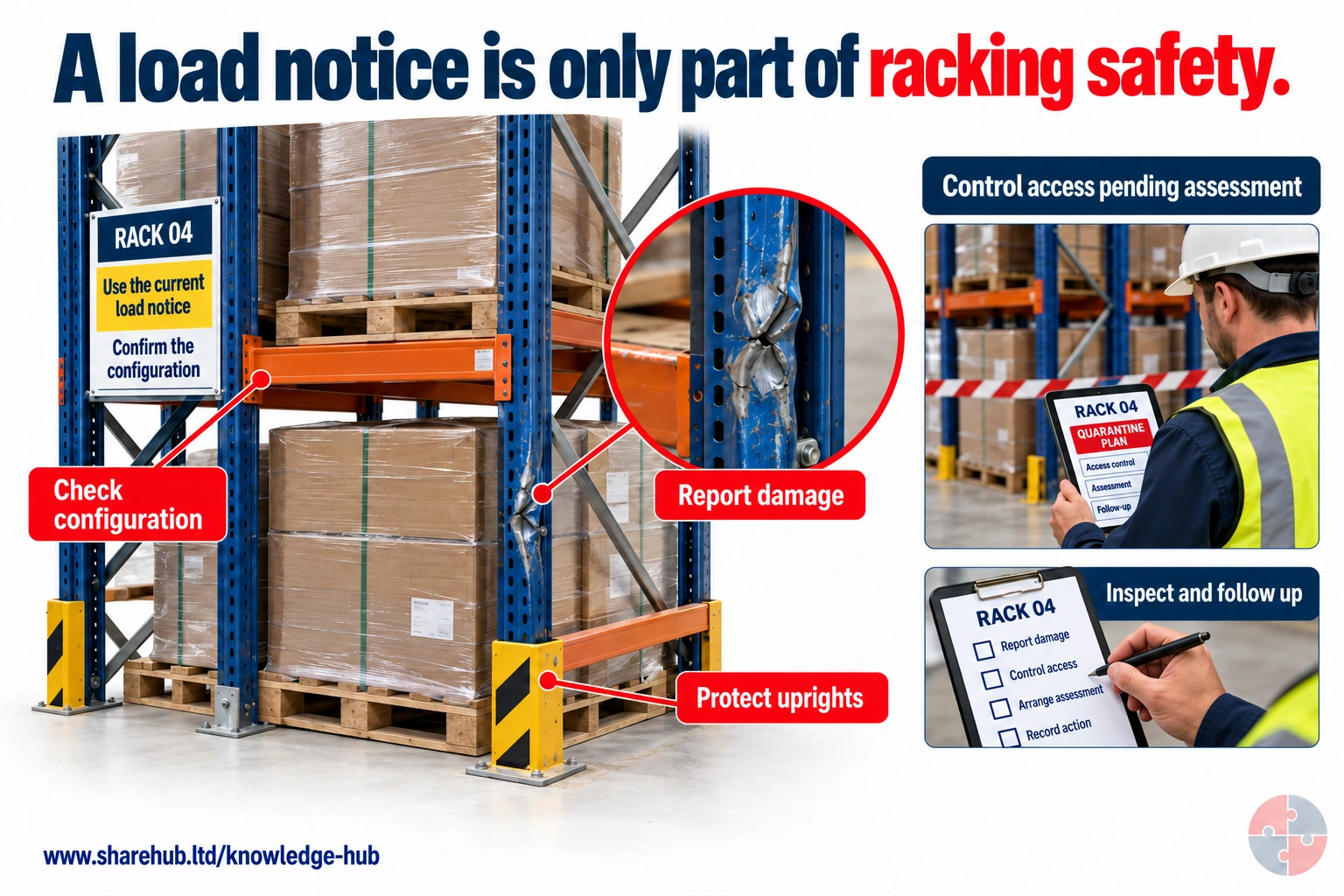

The load-notice prompt, configuration, upright protection, visible impact damage and quarantine inset show linked racking controls. Report damage immediately to the person responsible and arrange a competent response. Damage affecting safety requires controlled offloading and prevention of further use until remedied; the drawing does not assign a damage category.
Can the load notice settle whether a damaged upright remains usable?
No. Report and record the damage immediately, control access and use, and obtain a competent assessment and safe response, including offloading where required. A load notice does not override damage.
No rated capacity or damage classification is provided; competent racking assessment remains necessary.
Source guidance: HSE HSG76
Frequency and scope depend on the actual equipment, use, conditions, deterioration, manufacturer information and applicable law. A pre-use condition check, formal PUWER inspection and any power-press thorough examination or safeguard test are distinct. Hold use for missing, unsafe or uncertain evidence and obtain competent review and named operational release.
| Trigger | Purpose | Decision basis |
|---|---|---|
| Installation or assembly | Prove safe installation before use. | Equipment and installation dependency. |
| Deterioration risk | Detect safety-relevant decline in time. | Risk, use, conditions and experience. |
| Exceptional event | Assess damage or loss of integrity. | Accident, modification, long disuse or severe condition. |
| User check | Identify obvious immediate defects. | Separate from formal inspection where required. |
What inspection evidence is needed?
Where GB or NI PUWER requires an inspection, record the result and retain it at least until the next inspection under that regulation is recorded; keep it longer where another specialised regime or the organisation requires. This formal record is distinct from a simple pre-use check and from any specialised thorough examination.
A sticker can communicate status but is not the inspection result. Identify the equipment, inspection date and scope, findings, defects, action and competent person; where required, equipment used outside the undertaking must carry physical evidence of its last inspection.
Equipment identity. Why it matters: Links finding to the actual asset.; Limit: Avoid ambiguous family labels.
Scope and result. Why it matters: Shows what was examined and found.; Limit: A pass word alone may be insufficient.
Defect and action. Why it matters: Prevents unresolved return to use.; Limit: Track closure and restrictions.
Competent person and date. Why it matters: Shows accountable judgement.; Limit: No invented generic expiry.
What should happen when a defect is found?
Stop use where safety may be affected, bring the equipment to a controlled state, prevent further use, identify the defect, protect others, report it and keep it quarantined until competent evidence supports release.
Do not remove a tag, swap a guard, clear a jam or press reset as an informal return to service. The severity, affected equipment and connected systems must be understood first.
Immediate danger. Action: Stop, keep clear and isolate if safe and trained.; Release condition: Emergency or competent recovery route.
Safety device or guard defect. Action: Quarantine equipment.; Release condition: Repair and safeguarding verification.
Condition uncertain. Action: Treat as held.; Release condition: Competent inspection and evidence.
Minor non-safety issue. Action: Record and manage under local system.; Release condition: Decision still documented.
What must each role learn and demonstrate?
Competence must match the decision and consequence of error. Attendance alone does not show that a worker, manager or specialist can recognise a stop condition, select a control and verify it in practice.
Use observed tasks and scenario questions. Reassess after change, defect, incident or a materially different role, and seek a specialist for technical or legal decisions outside local competence.
| Role | Demonstrated decision | Reassessment trigger |
|---|---|---|
| Worker or operator | Explain the task risk, pre-use check and when to stop. | New task, equipment or unsafe event. |
| Supervisor or manager | Select and verify controls, allocate resources and act on reports. | Work pattern, staffing, process or equipment change. |
| Maintainer or specialist | Show the technical basis, safe state, examination or referral within own competence. | Modified system, failed test or new evidence. |
| Safety adviser or auditor | Trace law, hazard, control and field evidence without substituting a checklist for judgement. | Regulatory or technical change. |
How should modification and change be controlled?
Keep modified, refurbished, relocated, integrated or reprogrammed equipment out of normal work until the change and affected scope are understood, workplace and product-supply duties are resolved, safeguards and controls are restored, applicable inspection and controlled tests pass, and the named operating owner records release. A commissioning or diagnostic test under a controlled plan is not permission for production use.
A change to software, controls, guards, attachments, material, location or duty can alter stability, access, stopping, energy, exposure or maintenance. Quarantine unresolved changes and route every correction back through the affected engineering, inspection, test and operational-release gate.
New attachment or duty. Workplace-use question: Is equipment still suitable and guarded?; Product-supply question: Does intended use or conformity scope change?
Control or software change. Workplace-use question: Are modes, stops and restart safe?; Product-supply question: Who now takes manufacturer responsibility?
Refurbishment. Workplace-use question: Is condition and performance demonstrated?; Product-supply question: Is it substantially changed or newly supplied?
Integration. Workplace-use question: Are whole-system risks controlled?; Product-supply question: Does an assembly become a new product?
What training and competence are needed?
Users, supervisors and those who manage, inspect, maintain or modify equipment need adequate information, instruction and training for their role, with competence demonstrated for the actual equipment and task.
Simple equipment may be covered by suitable in-house instruction; complex or high-risk work may need specialist training and supervised experience. There is no universal certificate or refresher expiry.
| Role | Competence content | Review trigger |
|---|---|---|
| User | Normal use, checks, limits, defects and emergency response. | New equipment, task or performance concern. |
| Supervisor | Authorisation, observation, stop and release. | Change or control failure. |
| Maintainer or inspector | Technical method, isolation and judgement. | Design change or scope extension. |
| Manager or purchaser | Suitability, interfaces and assurance. | New process, supplier or regime. |
Who may use specific-risk equipment?
Where equipment use presents a specific risk, restrict use to appointed people and restrict repairs, modifications, maintenance or servicing to specifically designated people with adequate training.
Appointment must match the equipment, task and limits. A generic induction, trade title or previous experience does not automatically authorise a different machine, intervention or site.
Normal specific-risk use. Restriction: Appointed and adequately trained people.; Evidence: Authorisation matrix.
Repair or maintenance. Restriction: Specifically designated competent people.; Evidence: Scope and competence record.
New attachment or mode. Restriction: Reassess authorisation.; Evidence: Briefing and demonstration.
Visitor or contractor. Restriction: No assumption from employer or badge.; Evidence: Interface and local acceptance.
What should supervision verify?
Supervision should verify authorised people, correct equipment and setup, guards and controls, the actual method, conditions during use, defect response and handback, with closer oversight where competence or risk requires it.
Supervision is an active control, not a signature. It should detect drift such as routine bypassing, wrong attachments, informal repairs, missed checks or production pressure overriding a hold.
Start. Observation: Identity, setup, guards and people.; Response: Permit or hold.
Work. Observation: Real behaviour and machine response.; Response: Coach, correct or stop.
Change. Observation: New material, mode or environment.; Response: Pause and reassess.
Finish. Observation: Defects, state and handback.; Response: Release or quarantine.
Who is responsible for hired work equipment?
Hiring does not remove workplace-use duties: the supplier or hirer may have supply and maintenance obligations, while the employer or person controlling use must still ensure suitability, safe condition, inspection evidence, competence and safe operation.
Agree in writing who selects, delivers, inspects, maintains, responds to defects and removes the equipment. Verify the agreement against what arrives and how it will actually be used.
Supplier or hire company. Question: What is supplied, maintained and documented?; Evidence: Specification, instructions and inspection evidence.
Hiring organisation. Question: Is it suitable for the actual workplace and task?; Evidence: Acceptance and risk assessment.
User and supervisor. Question: Are setup, competence and daily condition controlled?; Evidence: Briefing, checks and defect route.
Breakdown or return. Question: Who makes safe and who authorises movement?; Evidence: Call-out, isolation and handover.
How should contractor equipment be controlled?
The host and contractor should exchange task, site, equipment, competence, inspection, maintenance, isolation, emergency and defect information, then agree who controls each decision before work starts.
A contractor-owned machine is not automatically acceptable, and a host permit does not prove its condition. Shared or connected systems need one coordinated safe state and clear release authority.
Verify equipment and documents. During work: Coordinate exclusions and site conditions.; Handback: Report defects and restrictions.
Agree isolation and emergency interfaces. During work: Stop on mismatch or unsafe change.; Handback: Jointly confirm equipment and area state.
Name decision owners. During work: Protect other employers and the public.; Handback: Retain required evidence.
What additional issues apply to mobile work equipment?
Assess stability, visibility, routes, pedestrians, riders, falling objects, overturn, towing, braking, parking, attachments, ground conditions and maintenance for the actual mobile equipment and environment. A mobile elevating work platform (MEWP) adds height, stability and rescue decisions to the general equipment check.
Do not infer a safe speed, slope, separation distance, load or braking performance from this guide. Use manufacturer limits, site design and competent assessment, and apply lifting rules when mobile equipment lifts loads.
Route and people. Question: Can vehicle and pedestrian movements be separated?; Boundary: Site-specific layout and control.
Stability and ground. Question: Are load, gradient and surface within limits?; Boundary: Manufacturer and competent data.
Operator and riders. Question: Are positions and restraints suitable?; Boundary: Equipment-specific requirements.
Attachment or lift. Question: Does duty change stability or legal regime?; Boundary: PUWER plus Lifting Operations and Lifting Equipment Regulations (LOLER) where applicable.
Which specialised regimes may also apply?
PUWER is not a complete answer where equipment lifts loads or people, contains pressure, uses electricity, supports work at height, creates substances, noise or vibration, or can ignite a dangerous atmosphere.
Determine applicability for the real equipment and task in the correct jurisdiction. Sector regimes for construction, mines, quarries, agriculture, rail or merchant shipping may also change duties and enforcement routes.
Lifting loads or people. Additional route: LOLER or NI equivalent as applicable.; Boundary: Separate thorough-examination and planning decisions.
Pressure or electricity. Additional route: Pressure-systems or electrical-safety law.; Boundary: Specialist integrity and isolation.
Work at height. Additional route: Work-at-height law.; Boundary: Access selection and fall prevention.
Dust, fume, noise, vibration or flammables. Additional route: COSHH, DSEAR, noise or vibration law.; Boundary: Separate exposure and ignition decisions.
When is another equipment regime needed?
Use baseline workplace-use duties, then check each applicable specialist route separately: lifting, pressure, mobile or agricultural machinery, offshore, woodworking, chainsaws, printing machines, electrical equipment, product supply and power presses used for working cold metal. A competent person must resolve GB PUWER Part IV or corresponding NI power-press applicability and exclusions before thorough examination, safeguard inspection, records and release are decided.
Specialist publications illustrate scope, not universal intervals or dimensions. A covered power press may require competent thorough examination and frequent inspection and testing of guards or protection devices; use L112 and the applicable GB or NI law to determine exact duties, reports and records. Commissioning or diagnostic testing remains separate controlled work, not production permission. Obtain competent applicability and named operating-release decisions.
Lifting equipment or operation. Additional route: LOLER and relevant NI provisions.; Boundary: Separate planning and thorough examination.
Pressure system or autoclave. Additional route: Pressure systems and specialist guidance.; Boundary: Do not infer pressure limits here.
Mobile, agricultural or MEWP. Additional route: Mobile equipment, sector, height and lifting guidance.; Boundary: Site, stability and operator decisions are specific.
Offshore lifting. Additional route: Offshore and lifting guidance.; Boundary: Do not generalise offshore details.
Woodworking, chainsaw or printing machine. Additional route: Machine- and sector-specific guidance.; Boundary: L114 supports woodworking only; chainsaw and printing-machine routes need their own competent source and safeguard review.
Product placed on GB or NI market. Additional route: Current sector-specific supply rules.; Boundary: Conformity marking is not workplace-use approval.
Power press for working cold metal. Additional route: GB PUWER Part IV or corresponding NI provisions; check exclusions with a competent specialist.; Boundary: Required thorough examination, guard or protective-device inspection and testing, reports and records precede named operational release; no interval or test method is inferred here.
What should happen in a work-equipment emergency?
Raise the alarm, stop or isolate only through trained actions that are safe from the person's position, keep people out of danger, call the site emergency route and preserve the equipment state for competent recovery and investigation.
Do not approach moving, energised, pressurised, hot, unstable or damaged equipment to diagnose it. Rescue, firefighting and first-aid actions must follow the site plan and trained roles.
Person in danger. Immediate action: Raise alarm and use designed emergency control if safe.; Prohibited assumption: Do not enter the danger zone.
Unexpected movement or release. Immediate action: Keep clear and stop connected work.; Prohibited assumption: Emergency stop is not full isolation.
Fire, pressure or electrical event. Immediate action: Use the site emergency plan.; Prohibited assumption: Do not improvise specialist response.
After the event. Immediate action: Maintain exclusion and control evidence.; Prohibited assumption: No restart because conditions appear normal.
Who may return equipment to service?
The named operating owner should authorise return only after the cause is understood, repairs and safeguards are complete, inspection or testing matches the defect and risk, people are clear, documentation is updated and restrictions are communicated.
Repair completion, a reset, a replaced fuse, an inspection sticker or production need is not enough by itself. Serious events or modifications may require engineering, safeguarding, electrical, pressure, lifting or legal review.
Cause. Required evidence: Defect or event understood.; Owner: Competent investigator or specialist.
Restoration. Required evidence: Repair and safeguards verified.; Owner: Maintainer and tester.
Readiness. Required evidence: Method, competence, area and interfaces ready.; Owner: Supervisor and affected parties.
Authorisation. Required evidence: Signed or recorded release.; Owner: Named operating owner.
How can testing and return to service be controlled?
Plan commissioning and post-maintenance tests as separate controlled work: define the test boundary, authorised people, equipment state, safeguards, isolation changes, exclusion, stop criteria and recordable acceptance before applying energy.
A test with guards open or altered safety functions needs an equipment-specific competent method and authority; this page gives no permission for live diagnosis or bypass. Restore safeguards, verify the whole affected system, brief users and obtain named operating acceptance before production.
Before test. Evidence: Competent plan and controlled area.; If unresolved: Remain isolated and held.
During test. Evidence: Observed intended and fault responses.; If unresolved: Stop and investigate.
Before production. Evidence: Guard, stop, reset, connected-system and method evidence plus named sign-off.; If unresolved: Remain quarantined.
How do general equipment duties change by workplace?
The same suitability, guarding and maintenance logic applies in a factory, construction site, warehouse or farm, but task, terrain, attachment, access and supervision change the control.
A product mark is not a local task assessment. Identify the operator, maintainer, bystander and person authorised to return equipment to service.
| Setting | Credible mechanism | Decisive check |
|---|---|---|
| Factory production | A guarded machine is opened for a jam or changeover. | Verify isolation and interlock condition before access and restart. |
| Construction site | Temporary plant or hired tool may not suit ground, power or interface. | Check specification, condition and exclusion before use. |
| Warehouse | Mobile equipment and pedestrians meet at a blind route. | Segregate routes and assess visibility and attachment stability. |
| Farm | Machinery on uneven ground or with rotating drives can overturn or entangle. | Check terrain, guard and attachment; stop on a critical defect. |
Who owns each work-equipment decision?
Assign owners for specification, acceptance, use, inspection, maintenance, isolation, modification, quarantine, emergency control and return to service; do not let responsibility disappear between departments or companies.
One person may hold several roles, but the evidence and competence requirements remain distinct. Emergency command and later operational release are separate decisions.
Specification and acceptance. Typical owner: Purchaser and technical owner.; Interface: User and maintenance input.
Use and supervision. Typical owner: Operating manager or supervisor.; Interface: Worker and nearby people.
Inspection and maintenance. Typical owner: Competent person and asset owner.; Interface: Defect and isolation system.
Return to service. Typical owner: Named operating owner.; Interface: Technical evidence and affected parties.
Which Great Britain duties are central?
In Great Britain, the Health and Safety at Work etc Act 1974, Management Regulations 1999 and PUWER 1998 form the central workplace route, with specialised regulations added according to the equipment and task.
Use current amended legislation and HSE guidance. L22 provides Approved Code of Practice (ACOP) and guidance for PUWER, while product-supply rules remain a separate current-market question. See Health and Safety at Work etc Act 1974.
| Layer | Main function | Evidence |
|---|---|---|
| HSWA 1974 | Safe plant, systems, information, training and protection of others. | Governance and safe systems. See Health and Safety at Work etc Act 1974. |
| MHSWR 1999 | Assessment, arrangements, coordination and emergency planning. | Risk and interface records. See Management of Health and Safety at Work Regulations 1999. |
| PUWER 1998 | Suitability, maintenance, inspection, guarding, controls and competence. | Equipment lifecycle evidence. See Provision and Use of Work Equipment Regulations 1998. |
| Specialist lifting and pressure duties | Apply the separate GB lifting and qualifying pressure-system duties where relevant. | Lift planning and examination; pressure safe limits, written scheme and examination. See Lifting Operations and Lifting Equipment Regulations 1998; Pressure Systems Safety Regulations 2000. |
Which Northern Ireland duties are central?
In Northern Ireland, the Health and Safety at Work Order 1978, Management Regulations Northern Ireland 2000 and PUWER Northern Ireland 1999 form the central workplace route, with separate NI or applicable specialist regimes added as needed.
Do not relabel Great Britain legislation as UK-wide. Use current NI legislation, HSENI guidance and the applicable Northern Ireland product-market route. See Health and Safety at Work Northern Ireland Order 1978.
| Layer | Main function | Evidence |
|---|---|---|
| HSWA Order 1978 | Safe plant, systems, information, training and protection of others. | Governance and safe systems. See Health and Safety at Work Northern Ireland Order 1978. |
| MHSWR NI 2000 | Assessment, arrangements, coordination and emergency planning. | Risk and interface records. See Management of Health and Safety at Work Regulations Northern Ireland 2000. |
| PUWER NI 1999 | Suitability, maintenance, inspection, guarding, controls and competence. | Equipment lifecycle evidence. See Provision and Use of Work Equipment Regulations Northern Ireland 1999. |
| Specialist lifting and pressure duties | Apply the separate NI lifting and qualifying pressure-system duties where relevant. | Lift planning and examination; pressure safe limits, written scheme and examination. See Lifting Operations and Lifting Equipment Regulations Northern Ireland 1999; Pressure Systems Safety Regulations Northern Ireland 2004. |
How should work-equipment control be assured?
Assurance should test whether equipment is suitable, safeguards work, defects are controlled, inspections and maintenance match risk, competence is real, contractor interfaces work and return-to-service decisions are evidence based.
Use field observation and equipment sampling, not record presence alone. Trend repeated guard damage, bypasses, emergency stops, overdue actions, recurring faults and differences between shifts or sites.
Is the inventory complete? Evidence: Assets, location, owner and status.; Escalation: Unknown equipment held.
Do safeguards work in practice? Evidence: Observed use and functional evidence.; Escalation: Bypass or drift quarantined.
Are defects closed? Evidence: Traceable report, repair and release.; Escalation: Repeat or overdue issue reviewed.
Are people competent? Evidence: Demonstration and supervision.; Escalation: Restriction or refresher based on need.
Which warning signs require immediate attention?
Missing or defeated guards, unexpected movement, unreliable controls, recurring trips, damaged cables or hoses, leaks, unstable equipment, unknown modifications, expired required evidence or informal repairs require a stop, hold or competent review.
Also treat emergency-stop use, reports that workers must reach into danger, and workarounds that have become normal as control failures rather than operator inconvenience.
Guard opened or removed for production. Likely weakness: Safeguarding and workflow conflict.; Action: Stop and redesign or restore.
Frequent reset or emergency stop. Likely weakness: Unresolved fault or process instability.; Action: Quarantine and investigate.
Temporary tape, wedge or bridge. Likely weakness: Device defeated.; Action: Prevent use and escalate.
Inspection or modification unclear. Likely weakness: Evidence gap.; Action: Hold pending competent decision.
What do complete work-equipment decisions look like?
Two complete BuildOut Ltd cases cover routine guarded-drill work and hired mobile equipment. The four scenario-type summaries retain the defect/emergency and maintenance/change decision boundaries; they are not six full worked cases. Each case is training only and requires actual equipment evidence and named authorisation.
BuildOut Ltd could use one asset lifecycle with risk-based gates for specification, acceptance, authorisation, use, defects, maintenance, inspection, change and release, while applying the correct GB or NI and specialist regime at each site.
How could BuildOut Ltd govern work equipment?
The teaching model keeps operations, engineering, procurement and contractors connected. It does not replace equipment-specific instructions, examinations, limits or site authority.
Specify. BuildOut owner: Procurement plus technical and user leads.; Minimum evidence: Task, environment and safeguard requirements.
Accept. BuildOut owner: Asset owner and competent installer.; Minimum evidence: Identity, condition, documentation and commissioning.
Operate. BuildOut owner: Supervisor and authorised user.; Minimum evidence: Checks, competence and method.
Hold and release. BuildOut owner: Operating owner with technical evidence.; Minimum evidence: Defect closure and recorded authorisation.
Each example is a training pattern, not an equipment permission. Replace every example details with the real machine, manufacturer instructions, energy sources, people, environment, inspection status and named authority.
| Scenario type | Primary decision | End state |
|---|---|---|
| Routine use | Start only after suitability, safeguards and checks pass. | Controlled completion. |
| Hire or contractor | Accept only after duties and evidence align. | Accepted, rejected or held. |
| Defect or emergency | Stop and prevent restart. | Quarantine or authorised return. |
| Maintenance or change | Control energy and evidence. | Verified handback. |
Routine guarded pillar-drill task
Task material and setting: Training only, not authorisation for a real machine. Before drilling, an authorised user confirms the task, material, workholding, guard, controls, bit, area and permission. Stop and keep the drill unavailable for a loose workpiece, damaged bit, guard or control defect, unusual response or intrusion. Use the normal stop, wait for movement to cease and record defects; the workshop supervisor releases only after the check, briefing, defect closure and safe handback are accepted.
People and prerequisites: Authorised user and workshop supervisor; suitable drill, correct workholding and bit, current local assessment, functioning guard and controls, safe area and known defect route.
Before: Confirm the task and material, inspect the drill, guard, workholding and emergency control, remove loose items, set the work securely and keep others outside the operating space.
During: Keep the guard and workholding in position, use the intended controls, observe sound, movement and swarf, and stop before any adjustment or clearing.
Hold or stop: Do not start or continue for a loose workpiece, damaged bit, missing or defeated guard, unreliable control, unusual movement, unexpected material response or unauthorised person in the area.
Completion and hand back: Stop through the normal control, wait for movement to cease, leave the machine and area clean through the safe method, record any defect and hand back in a known state.
Evidence: Authorisation, pre-use check, task briefing, any defect report and supervisor release.
Hired mobile equipment arrives on site
Task material and setting: Training only, not permission to operate hired plant. Keep the platform out of service until identity, condition, instructions, applicable inspection or examination evidence, ground, route, weather, rescue plan and operator competence match the real task. Reject or quarantine any mismatch or uncertainty. The site supervisor accepts use only on the agreed evidence, and the supplier or site owner completes a recorded defect and return handover.
People and prerequisites: Hire supplier, site logistics lead, competent equipment assessor, authorised operator and supervisor; agreed specification, delivery evidence, site assessment, ground and route plan, rescue and defect arrangements, and any specialised examination evidence required.
Before: Match the delivered machine to the order, inspect condition and documentation, verify inspection or examination evidence applicable to the machine, confirm ground, access, weather and interface controls, and brief the authorised operator.
During: Use only within manufacturer and site limits, maintain route and people controls, observe stability and machine response, and stop for changed ground, weather, load, alarm or condition.
Hold or stop: Reject or quarantine the equipment for identity mismatch, damage, missing safety information, uncertain inspection or examination status, wrong attachment, unsuitable ground, unavailable rescue arrangements or unverified operator competence.
Completion and hand back: Park and secure through the agreed method, record condition and defects, prevent further use where held, and complete a joint handover to the supplier or site owner.
Evidence: Hire specification, delivery and acceptance record, applicable inspection or examination evidence, operator authorisation, daily checks, defect history and return handover.
What do the acronyms and key terms mean?
Keep work equipment, use, guard, protection device, emergency stop, isolation, inspection, maintenance, competent person, quarantine and return to service distinct.
| Term | Meaning | Boundary |
|---|---|---|
| Work equipment | Machinery, appliance, apparatus, tool or installation used at work. | Scope depends on real use. |
| Guard | Physical barrier preventing or restricting access to danger. | Design is equipment specific. |
| Protection device | Control or sensing function that reduces risk. | Must not be bypassed. |
| Emergency stop | Additional rapid stop function where appropriate. | Not full isolation. |
| Isolation | Separation and control of all relevant energy. | Includes stored energy. |
| Inspection | Competent check to detect safety-relevant deterioration or installation issues. | Not the same as maintenance. |
| Quarantine | State preventing further use pending decision. | Release needs evidence and authority. |
| Return to service | Recorded operational acceptance after restoration. | Repair alone is insufficient. |
| PUWER | Provision and Use of Work Equipment Regulations; separate GB 1998 and NI 1999 instruments. | Workplace use, suitability, safeguards and maintenance. |
| UKCA, CE and UKNI | UK Conformity Assessed, Conformité Européenne and UK Northern Ireland product markings. | A mark is not a workplace-use risk assessment; check the current market route. |
| LOLER | Lifting Operations and Lifting Equipment Regulations, with separate GB and NI instruments. | Additional lifting duties where applicable. |
| PSSR | Pressure Systems Safety Regulations, with separate GB and NI instruments. | Additional pressure-system duties where in scope. |
| ACOP | Approved Code of Practice. | Has special legal status within its approved jurisdiction and edition. |
| ERICPD | Eliminate, Reduce including substitution, Isolate, Control, personal protective equipment, Discipline. | A SHARE decision prompt; sustain effective controls and learning. |
| PPE | Personal protective equipment. | Use for assessed residual exposure; it does not replace stronger feasible controls. |
Unlock another resource
You have used this month’s two free downloads. Publish a post in your own words to unlock one more resource, or choose SHARE Individual for 10 downloads per month.
You decide whether to share. If you do, use the relevant platform disclosure tools and do not make claims you do not genuinely hold.